EP0892634B1 - Utilisation de l'octoxyglycerine dans une composition cosmetique et/ou dermatologique comme actif pour le traitement de la seborrhee et/ou de l'acne - Google Patents
Utilisation de l'octoxyglycerine dans une composition cosmetique et/ou dermatologique comme actif pour le traitement de la seborrhee et/ou de l'acne Download PDFInfo
- Publication number
- EP0892634B1 EP0892634B1 EP97945918A EP97945918A EP0892634B1 EP 0892634 B1 EP0892634 B1 EP 0892634B1 EP 97945918 A EP97945918 A EP 97945918A EP 97945918 A EP97945918 A EP 97945918A EP 0892634 B1 EP0892634 B1 EP 0892634B1
- Authority
- EP
- European Patent Office
- Prior art keywords
- composition
- acne
- use according
- skin
- seborrhoea
- Prior art date
- Legal status (The legal status is an assumption and is not a legal conclusion. Google has not performed a legal analysis and makes no representation as to the accuracy of the status listed.)
- Expired - Lifetime
Links
Classifications
-
- A—HUMAN NECESSITIES
- A61—MEDICAL OR VETERINARY SCIENCE; HYGIENE
- A61K—PREPARATIONS FOR MEDICAL, DENTAL OR TOILETRY PURPOSES
- A61K8/00—Cosmetics or similar toiletry preparations
- A61K8/18—Cosmetics or similar toiletry preparations characterised by the composition
- A61K8/30—Cosmetics or similar toiletry preparations characterised by the composition containing organic compounds
- A61K8/33—Cosmetics or similar toiletry preparations characterised by the composition containing organic compounds containing oxygen
- A61K8/34—Alcohols
-
- A—HUMAN NECESSITIES
- A61—MEDICAL OR VETERINARY SCIENCE; HYGIENE
- A61K—PREPARATIONS FOR MEDICAL, DENTAL OR TOILETRY PURPOSES
- A61K8/00—Cosmetics or similar toiletry preparations
- A61K8/18—Cosmetics or similar toiletry preparations characterised by the composition
- A61K8/30—Cosmetics or similar toiletry preparations characterised by the composition containing organic compounds
- A61K8/33—Cosmetics or similar toiletry preparations characterised by the composition containing organic compounds containing oxygen
- A61K8/34—Alcohols
- A61K8/345—Alcohols containing more than one hydroxy group
-
- A—HUMAN NECESSITIES
- A61—MEDICAL OR VETERINARY SCIENCE; HYGIENE
- A61K—PREPARATIONS FOR MEDICAL, DENTAL OR TOILETRY PURPOSES
- A61K31/00—Medicinal preparations containing organic active ingredients
- A61K31/075—Ethers or acetals
- A61K31/08—Ethers or acetals acyclic, e.g. paraformaldehyde
-
- A—HUMAN NECESSITIES
- A61—MEDICAL OR VETERINARY SCIENCE; HYGIENE
- A61K—PREPARATIONS FOR MEDICAL, DENTAL OR TOILETRY PURPOSES
- A61K31/00—Medicinal preparations containing organic active ingredients
- A61K31/185—Acids; Anhydrides, halides or salts thereof, e.g. sulfur acids, imidic, hydrazonic or hydroximic acids
- A61K31/19—Carboxylic acids, e.g. valproic acid
-
- A—HUMAN NECESSITIES
- A61—MEDICAL OR VETERINARY SCIENCE; HYGIENE
- A61K—PREPARATIONS FOR MEDICAL, DENTAL OR TOILETRY PURPOSES
- A61K31/00—Medicinal preparations containing organic active ingredients
- A61K31/60—Salicylic acid; Derivatives thereof
-
- A—HUMAN NECESSITIES
- A61—MEDICAL OR VETERINARY SCIENCE; HYGIENE
- A61P—SPECIFIC THERAPEUTIC ACTIVITY OF CHEMICAL COMPOUNDS OR MEDICINAL PREPARATIONS
- A61P17/00—Drugs for dermatological disorders
- A61P17/10—Anti-acne agents
-
- A—HUMAN NECESSITIES
- A61—MEDICAL OR VETERINARY SCIENCE; HYGIENE
- A61Q—SPECIFIC USE OF COSMETICS OR SIMILAR TOILETRY PREPARATIONS
- A61Q19/00—Preparations for care of the skin
-
- A—HUMAN NECESSITIES
- A61—MEDICAL OR VETERINARY SCIENCE; HYGIENE
- A61Q—SPECIFIC USE OF COSMETICS OR SIMILAR TOILETRY PREPARATIONS
- A61Q19/00—Preparations for care of the skin
- A61Q19/008—Preparations for oily skin
-
- A—HUMAN NECESSITIES
- A61—MEDICAL OR VETERINARY SCIENCE; HYGIENE
- A61Q—SPECIFIC USE OF COSMETICS OR SIMILAR TOILETRY PREPARATIONS
- A61Q5/00—Preparations for care of the hair
-
- A—HUMAN NECESSITIES
- A61—MEDICAL OR VETERINARY SCIENCE; HYGIENE
- A61Q—SPECIFIC USE OF COSMETICS OR SIMILAR TOILETRY PREPARATIONS
- A61Q5/00—Preparations for care of the hair
- A61Q5/008—Preparations for oily hair
Definitions
- the present invention relates to the use of octoxyglycerin in a cosmetic or dermatological composition for treating seborrhea and associated skin disorders, including acne and / or hyperseborrhoea.
- sebum The secretion of sebum is a normal phenomenon and useful for the skin as for hair.
- hypersecretion of sebum called seborrhea
- Sebaceous hypersecretion and disruption of the keratinization of the pilosebaceous follicle result in the obstruction of the pilosebaceous follicle and the formation of retentional lesions or blackheads.
- pathologies and in particular acne and / or hyperseborrhea relate in particular to the colonization of the skin or of the hair follicle by germs of the genus Propionibacterium such as Propionibacterium acnes, Propionibacterium granulosum, Propionibacterium avidum.
- triclosan To fight against these pathogens, active ingredients such as than triclosan, hexamidine, hexetidine and benzalkonium chloride. But the use of these active ingredients is not without side effects. So the triclosan has significant toxicity, even topically. In in addition, it has been shown to be insufficiently effective, particularly in some vehicles where its activity is inhibited by surfactants. Hexamidine and hexetidine in the form of salts are sensitizing substances, likely to cause allergies. Furthermore, chloride Benzalkonium can be irritating at usual doses. Of more, it destabilizes compositions containing anionic surfactants.
- the subject of the present invention is precisely the use of compounds individuals to achieve this effect.
- octoxyglycerin had a strong activity on Propionibacterium acnes and Propionibacterium granulosum , and could therefore be used in a cosmetic or dermatological composition as an anti-seborrheic and anti-acne active agent.
- the document DE-A-4140474 describes the use of monoalkyl ethers of glycerol in compositions for cleansing and caring for the skin.
- these compounds are used as superfat additives preventing drying of the skin in antiseptic and disinfectant compositions based on alcohols, the monoalkyl ethers of glycerol reinforcing the antiseptic effect of the alcohol while avoiding drying of the skin.
- glycerol monoalkyl ethers, particularly octoxyglycerin to act on the pathologies linked to Propionibacterium acnes and Propionibacterium granulosum, and in particular to treat seborrhea and acne, has never been described.
- WO 93/25208 describes the use of glycerol monoalkyl ethers in cytocidal, antibacterial and spermicidal compositions. This document does not specifically describe the activity of monoalkyl ethers on germs of the genus Propionibacterium and even less the pathologies linked to Propionibacterium acnes and Propionibacterium granulosum, and in particular seborrhea and acne. In addition, octoxyglycerine is not mentioned in this document.
- the present invention therefore relates to the use of octoxyglycerin in a cosmetic composition for treating seborrhea of the skin and / or leather hair, and / or skin disorders associated with seborrhea.
- the present invention also relates to the use of octoxyglycerin for the manufacture of a medicament intended to treat seborrhea of the skin and / or scalp, and / or skin disorders associated with seborrhea.
- the skin disorders associated with seborrhea can in particular be acne, oily skin prone to acne and / or hyperseborrhea.
- the present invention also relates to the use of octoxyglycerin in a cosmetic composition for treating acne and / or oily skin acne tendency and / or hyperseborrhea.
- the present invention also relates to the use of octoxyglycerin for the manufacture of a drug intended to treat acne and / or oily skin acne tendency and / or hyperseborrhea.
- the present invention also relates to the use of octoxyglycerin in a cosmetic composition to act on germs of the genus Propionibacterium .
- the present invention also relates to the use of octoxyglycerin for the manufacture of a medicament intended to act on germs of the genus Propionibacterium.
- the present invention also relates to a cosmetic treatment process seborrhea and / or disorders associated with seborrhea, consisting of apply to the skin and / or scalp with disorders of the seborrhea, a composition containing at least octoxyglycerin.
- the present invention also relates to a method of treatment cosmetic of acne consisting in applying to acne skin a composition containing at least octoxyglycerine.
- the subject of the invention is a cosmetic composition and / or anti-acne dermatological, characterized in that it contains at least, in a cosmetically and / or dermatologically acceptable medium, a effective amount of octoxyglycerin as an anti-acne active ingredient.
- the octoxyglycerine, (1, (2-ethylhexyl) glycerol ether), corresponds to the following formula (I): RO-CH 2 -CHOH-CH 2 OH in which R represents a 2-ethylhexyl radical.
- Octoxyglycerine is used, according to the present invention, in an amount ranging preferably from 0.05 to 10%, and better still from 0.1 to 5%, and even better still from 0.1 to 2.5% of the total weight of the composition.
- compositions according to the invention contain a cosmetically and / or dermatologically acceptable, i.e. compatible with the skin, mucous membranes, hair and scalp. They can come in all dosage forms suitable for topical application, in particular in the form of aqueous, hydroalcoholic or oily solutions, aqueous, hydroalcoholic or oily gels, pasty anhydrous products or solids, emulsions obtained by dispersion of a fatty phase in a aqueous phase (O / W) or - inversely (W / O), suspensions, microemulsions, microcapsules, microparticles, or Ionic (liposomes) and / or non-ionic vesicular dispersions. These compositions are prepared according to the usual methods in the fields considered.
- compositions according to the invention can also be used in the form foams or in the form of aerosol compositions containing also a pressurized propellant.
- compositions according to the invention are those conventionally used in the fields considered.
- compositions constitute in particular skin products such as cleaning or treatment gels or creams, lotions or milks purifiers, camouflage sticks, hair lotions or antiseborrhoeic shampoos, anti-hair loss compositions for leather Scalp.
- compositions of the invention may include adjuvants conventionally implemented in the fields considered as bodies grease, organic solvents, solubilizing agents, thickening agents and gelling agents, softeners, antioxidants, opacifiers, agents stabilizers, foaming agents, perfumes, ionic emulsifiers or no, the charges, the sequestrants and the chelators, the preservatives, the perfumes, filters, essential oils, coloring matters, pigments, active hydrophilic or lipophilic agents, lipid vesicles or any other ingredient usually used in cosmetics.
- adjuvants are introduced in the quantities usually used in the field cosmetic or dermatological, and for example from 0 to 20% of the total weight of the composition.
- the proportion of the fatty phase can range from 5 to 80% and preferably from 5 to 50% by weight total of the composition.
- Oils, emulsifiers and coemulsifiers used in the composition in the form of an emulsion are chosen from those conventionally used in the cosmetic or dermatological field.
- the emulsifier and possibly the coemulsifier are present in the composition, in a proportion ranging from 0.3 to 30% by weight, and preferably from 0.5 to 20% by weight relative to the total weight of the composition.
- the emulsion may, in addition, contain lipid vesicles.
- mineral oils isoparaffin
- oils of vegetable origin oils of animal origin
- synthetic oils silicone oils (cyclopentadimethylsiloxane)
- fluorinated oils we can also use as fatty fatty alcohols, fatty acids (stearic acid), waxes (carnauba wax, ozokerite).
- emulsifiers which can be used in the invention, mention may, for example, be made of ethylene glycol monostearate, sorbitan tristearate, palmitostearate mixture glycol / polyethylene glycol stearate (6 EO) / stearate polyethylene glycol (32 EO) sold under the name "Tefose 63" by the Gattefosse company, and hydrogenated lecithin.
- gelling or thickening agents mention may be made of natural gums (xanthan gum), polysaccharides (hydroxypropylmethylcellulose, carboxymethylcellulose), carboxyvinyl polymers (carbomer), acrylic copolymers, polyacrylamides and in particular the mixture of polyacrylamide, C 13 -C 14 -Isoparaffin and Laureth-7, sold under the name Sepigel 305 by the company Seppic, oxyethylenated sugar derivatives such as oxyethylenated methylglucose.
- xanthan gum polysaccharides (hydroxypropylmethylcellulose, carboxymethylcellulose), carboxyvinyl polymers (carbomer), acrylic copolymers, polyacrylamides and in particular the mixture of polyacrylamide, C 13 -C 14 -Isoparaffin and Laureth-7, sold under the name Sepigel 305 by the company Seppic, oxyethylenated sugar derivatives such as oxyethylenated methylglucose.
- foaming agents there may be mentioned for example N-carboxyethoxyethyl N-cocoylamidoethyl amino-acetate N-di-sodium, lauryl ether sulfate sodium, sodium lauroyl sarcosinate, triethanolamine lauryl sulfate and again the mixture of sodium cocoyl isethionate and coconut fatty acids.
- acrylic copolymers such as ethylene glycol dimethacrylate / lauryl methacrylate copolymer sold by Dow Corning under the name of Polytrap.
- agents capable of complementing the effect of the glycerol alkyl ether in the treatment of seborrhea and associated dermatoses, including acne may, for example, be anti-inflammatory agents such as benzoyl peroxide, antibiotics, antiseptic agents such as octopirox, keratolytic agents such as ⁇ -hydroxy acids or ⁇ -hydroxy acids in free, etherified or esterified form, retinoic acid and its derivatives, retinol and its derivatives such as palmitate, acetate or retinol propionate, antiseborrhoeic agents such as metal salts di- or trivalent such as the alkaline earth metal salts and the lanthanides, and more particularly the strontium salts and the neodymium salts.
- this agent is a keratolytic agent, and in particular an ⁇ -hydroxy acid or a ⁇ -
- the amount of agent can range, for example, from 0 to 20% and preferably from 0.05 to 5% of the total weight of the composition.
- ⁇ -hydroxy acids there may be mentioned in particular glycolic acids, lactic, malic, tartaric, citric, mandelic.
- ⁇ -hydroxy acids we may include salicylic acid and its derivatives, hydroxy-2 acids alkanoic and their derivatives such as hydroxy-2-methyl-3-benzoic acid and hydroxy-2-methoxy-3-benzoic acid.
- hydrophilic active agents mention may also be made, for example, of proteins or protein hydrolysates, amino acids, polyols (glycerin, propylene glycol), urea, allantoin, sugars and derivatives of sugar, vitamins, starch, bacterial or vegetable extracts.
- the composition containing the alkyl ether contains plus, suitably, at least one filter, so as to preserve efficiency of the active ingredient according to the invention while protecting the skin from the harmful effects of solar rays.
- filters mention may be made of organic filters or pigments which can be in the form of nanoparticles (nanopigments) or no. Examples of organic filters are sulfonated derivatives or benzophenone sulfonates, sulfonic or sulfonate derivatives of benzylidene camphor and acrylates such as octocrylene.
- the amount of filter depends on the desired sun protection. It can go for example from 0 to 10 % and preferably from 0.1 to 5% of the total weight of the composition.
- the Elfacos GT 282S is dispersed in demineralized water at 80 ° C., then cools to 50 ° C. Furthermore, it is dispersed at 50 ° C. in demineralized water, foaming agents, softener and glycerin with slow stirring, then pour this preparation gently with slow stirring into the dispersion of Elfacos GT 282S. Octoxyglycerin is then added to it at 40 ° C.
- the gel obtained is suitable for the treatment of seborrheic dermatitis, in application twice a day on the face.
- the Elfan AT 84 G is dispersed in demineralized water at 80 ° C. After complete dissolution, add the silicate salt of magnesium and aluminum hydrate. Cool to 60 ° C, then add sodium lauroyl sarcosinate and hydroxypropylmethylcellulose gel. The stearic acid and the ethylene glycol monostearate previously warmed in a water bath. At this mixture, add the octoxyglycerin and the perfume:
- the cream obtained is suitable for the treatment of acne-prone skin, by application to the face twice a day.
- Mixture A is prepared containing sorbitan tristearate, the emulsifier and cyclopentadimethylsiloxane at 60 ° C.
- mixture B is prepared by swelling, in demineralized water at 70 ° C., the mixture of glycerol and of carbomer, then the xanthan gum.
- the emulsion is produced at 65 ° C by pouring mixture A into mixture B with stirring. The mixture is allowed to cool to 50 ° C. and the Polytrap is added, then the octoxyglycerine.
- the cream obtained is suitable for the treatment of the skin, by application to the face and back of the body once a day.
- the xanthan gum is swollen in demineralized water with the glycerin at 70 ° C. After cooling to 30 ° C., glycolic acid is added, ethyl alcohol, co-solvent with octoxyglycerin and perfume.
- the gel obtained is suitable for the treatment of seborrheic skin, in application once or twice a day on the face.
- the cream obtained is beige in color and suitable for the treatment of skin, by application to the face twice a day.
- the oxides and the agent are dispersed in the mixture of waxes and oil, at 100 ° C. demoulding, for 2 hours.
- Octoxyglycerin is added to it just before casting.
- the stick obtained can be applied to the face several times a day.
- Glycerin, ethyl alcohol, co-solvent are mixed in demineralized water and octoxyglycerin.
- the lotion obtained is suitable for cleaning the skin, by application to the face twice a day.
- the carboxymethylcellulose is dispersed in demineralized water, and added conditioning agent, triethanolamine lauryl sulfate and methylglucose oxyethylenated. After cooling to 40 ° C, octoxyglycerin is added.
- the shampoo obtained is suitable for washing the hair and allows a marked improvement in the condition of the scalp.
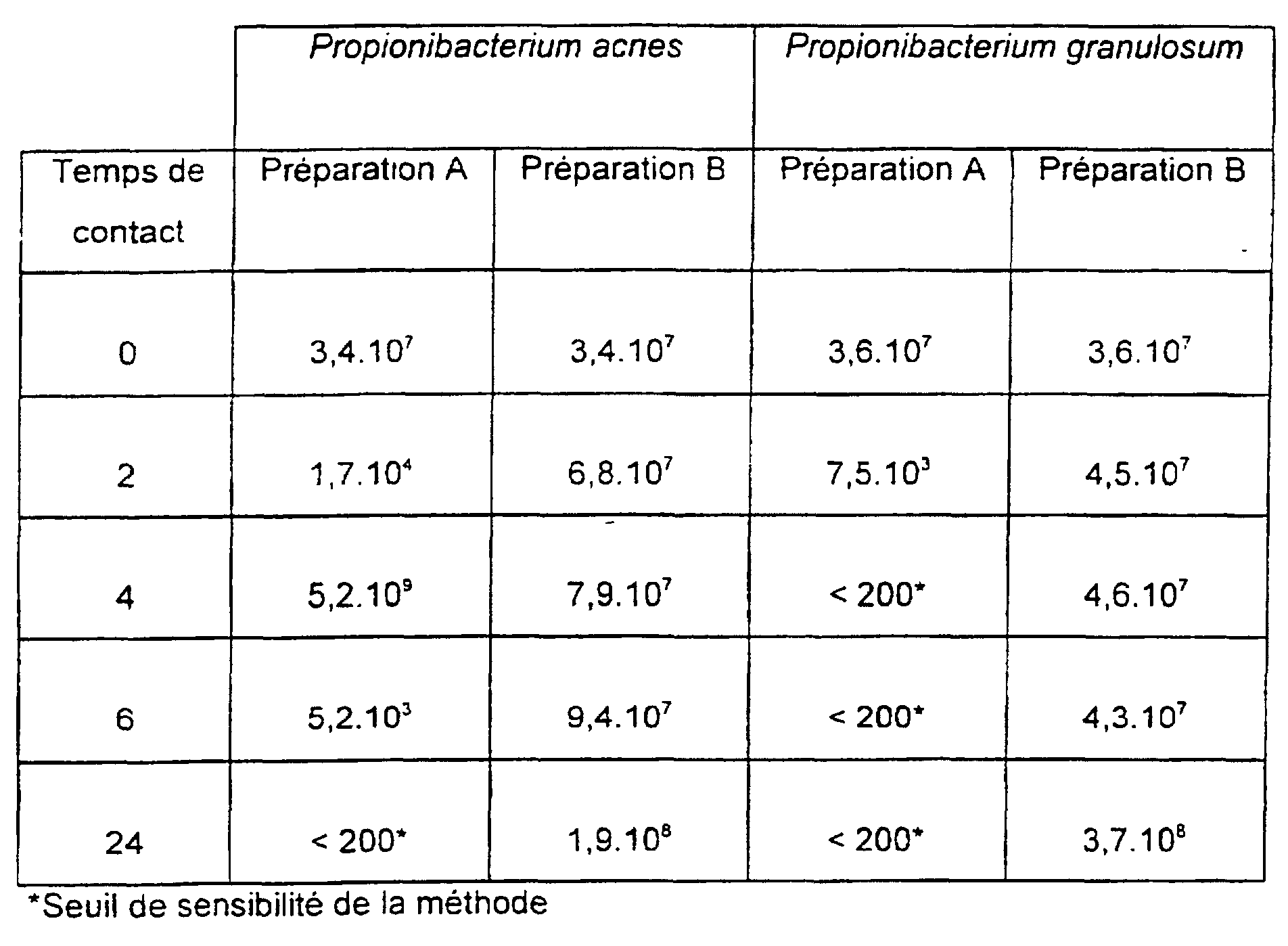
- the test described below highlights the activity of octoxyglycerin on Propionibacterium acnes and Propionibacterium granulosum.
- the colonies are counted on boxes containing more than 20 and less than 200 colonies.
- compositions tested are as follows:
- preparation A After 2 hours of contact, there is a superior decontamination with preparation A according to the invention.
- the number of microorganisms is 1000 times lower for Propionibacterium acnes and 10000 times lower for Propionibacterium granulosum at the inoculation rate (T0) while for preparation B, it is unchanged.
Landscapes
- Health & Medical Sciences (AREA)
- Life Sciences & Earth Sciences (AREA)
- Public Health (AREA)
- Veterinary Medicine (AREA)
- Animal Behavior & Ethology (AREA)
- General Health & Medical Sciences (AREA)
- Epidemiology (AREA)
- Medicinal Chemistry (AREA)
- Pharmacology & Pharmacy (AREA)
- Chemical & Material Sciences (AREA)
- Dermatology (AREA)
- Emergency Medicine (AREA)
- Birds (AREA)
- Engineering & Computer Science (AREA)
- Bioinformatics & Cheminformatics (AREA)
- Chemical Kinetics & Catalysis (AREA)
- General Chemical & Material Sciences (AREA)
- Nuclear Medicine, Radiotherapy & Molecular Imaging (AREA)
- Organic Chemistry (AREA)
- Cosmetics (AREA)
- Acyclic And Carbocyclic Compounds In Medicinal Compositions (AREA)
- Pharmaceuticals Containing Other Organic And Inorganic Compounds (AREA)
Description
- Copolymère d'alcool de suif hydrogéné oxyéthyléné (60 OE) /myristyl glycol (solubilisant) (Elfacos GT 282 S vendu par la société Akzo) 0,9 %
- Octoxyglycérine 0,1 %
- Glycérine 3 %
- Acide glycolique 1 %
- N-carboxyéthoxyéthyl N-cocoylamidoéthyl aminoacétate N-di-sodique à 38 % dans l'eau 5 %
- Lauryl éther sulfate de sodium 14,3 %
- Diéthanolamide d'acides gras de coprah (adoucissant) 0,7 %
- Eau déminéralisée qsp 100 %
- Monostéarate d'éthylène glycol 2 %
- Octoxyglycérine 2,5 %
- Silicate de magnésium et d'aluminium hydraté (stabilisant) 1,7 %
- hydroxypropylméthylcellulose 0,8 %
- Mélange de cocoyl isethionate de sodium et d'acides gras de coprah (Elfan AT 84 G vendu par la société Akzo) 15 %
- Acide stéarique 1,25 %
- Lauroyl sarcosinate de sodium à 30 % dans l'eau 10 %
- Parfum 0,3 %
- Eau déminéralisée qsp 100 %
- Tristéarate de sorbitane 1 %
- Octoxyglycérine 0,5 %
- Carbomer 0,4 %
- Gomme de xanthane 0,5 %
- Polytrap (Dow Corning) 1 %
- Cyclopentadiméthylsiloxane (huile volatile) 6 %
- Glycérine 3 %
- Tefose 63 (Gattefosse) (émulsionnant) 4 %
- Eau déminéralisée qsp 100 %
- Octoxyglycérine 5 %
- Gomme de xanthane 1 %
- Glycérine 2 %
- Parfum 0,2 %
- Alcool éthylique (solvant) 30 %
- Mélange alcool butylique oxyéthyléné (26 OE) - oxypropyléné (26 OP) / huile de ricin hydrogénée oxyéthylénée (40 OE) dans l'eau (Solubilisant LRI vendu par la société Wackherr) (co-solvant) 1 %
- Eau déminéralisée qsp 100 %
- Stérols de soja oxyéthylénés (5 OE) 1,6 %
- Lécithine hydrogénée 2,4 %
- Octoxyglycérine 2 %
- Huile d'amandes d'abricot 6 %
- Oxyde de fer jaune (pigments) 0,45 %
- Oxydes de fer brun (pigments) 0,4 %
- Oxyde de fer noir (pigments) 0,07 %
- Oxyde de titane (pigments) 5 %
- Polytrap (Dow Corning) 1 %
- polyacrylamide / C13-C14-Isoparaffine / Laureth-7 (Sepigel 305) 4 %
- Cyclopentadiméthylsiloxane (huile volatile) 6 %
- Glycérine 6 %
- Propylène glycol 6 %
- Eau déminéralisée qsp 100 %
- Octoxyglycérine 1 %
- Cire de carnauba 8 %
- Ozokérite 6 %
- Oxyde de fer jaune (pigments) 2,5 %
- Oxydes de fer brun (pigments) 1 %
- Oxyde de fer noir (pigments) 0,5 %
- Oxyde de titane (pigments) 20 %
- Polydiméthylsiloxane / silice hydratée (agent de démoulage) 0,1 %
- Isoparaffine qsp 100 %
- Octoxyglycérine 2 %
- Glycérine 2 %
- Alcool éthylique (solvant) 30 %
- Alcool butylique oxyéthyléné (26 OE) oxypropyléné (26 OP) / huile de ricin hydrogénée oxyéthylénée (40 OE) dans l'eau(Solubilisant LRI vendu par la société Wackherr) (co-solvant) 1 %
- Eau déminéralisée qsp 100 %
- Octoxyglycérine 2 %
- Triéthanolamine lauryl sulfate à 40 % dans l'eau 37 %
- Diéthanolamide d'acides gras de coprah (agent conditionneur de cheveux) 2 %
- Carboxyméthylcellulose 0,5 %
- Méthylglucose oxyéthyléné 2,5 %
- Eau déminéralisée qsp 100 %

Claims (12)
- Utilisation de l'octoxyglycérine dans une composition cosmétique pour lutter contre les germes du genre Propionibacterium.
- Utilisation de l'octoxyglycérine pour la fabrication d'un médicament destiné à lutter contre les germes du genre Propionibacterium.
- Utilisation selon l'une quelconque des revendications 1 ou 2, pour traiter la séborrhée de la peau et/ou du cuir chevelu, et/ou les désordres cutanés associés à la séborrhée.
- Utilisation selon l'une quelconque des revendications 1 à 3, pour traiter l'acné et/ou la peau grasse à tendance acnéique et/ou l'hyperséborrhée.
- Utilisation selon l'une quelconque des revendications précédentes, caractérisée en ce que de l'octoxyglycérine est présente en une quantité allant de 0,05 à 10 % en poids de la composition.
- Utilisation selon la revendication précédente, caractérisée en ce que de l'octoxyglycérine est présente en une quantité allant de 0,1 à 2,5 % en poids de la composition
- Utilisation selon l'une quelconque des revendications précédentes, caractérisée en ce que la composition est une solution aqueuse, huileuse ou hydroalcoolique, une émulsion, une microémulsion, un gel aqueux, huileux ou anhydre, un sérum, une dispersion de vésicules, un produit anhydre solide ou pâteux.
- Utilisation selon l'une quelconque des revendications précédentes, caractérisée en ce que la composition se présente sous forme d'une crème, d'une lotion, d'un gel ou d'un stick.
- Utilisation selon l'une quelconque des revendications précédentes, caractérisée en ce que la composition comprend au moins un adjuvant choisi parmi les corps gras, les solvants organiques, les agents solubilisants, les gélifiants, les agents moussants, les émulsionnants, les charges, les filtres, les pigments, les agents actifs hydrophiles ou lipophiles, les vésicules lipidiques.
- Utilisation selon l'une quelconque des revendications précédentes, caractérisée en ce que la composition comprend au moins un agent choisi parmi les α-hydroxyacides, les β-hydroxyacides et les sels des métaux di- ou trivalents.
- Procédé de traitement cosmétique de la séborrhée et/ou des désordres associés à la séborrhée, consistant à appliquer sur la peau et/ou le cuir chevelu présentant des troubles de la séborrhée, une composition contenant au moins de l'octoxyglycérine.
- Procédé de traitement cosmétique de l'acné, consistant à appliquer sur la peau.acnéique une composition contenant au moins de l'octoxyglycérine.
Applications Claiming Priority (3)
| Application Number | Priority Date | Filing Date | Title |
|---|---|---|---|
| FR9613980A FR2755852B1 (fr) | 1996-11-15 | 1996-11-15 | Utilisation d'un alkylether de glycerol dans une composition cosmetique et/ou dermatologique comme actif pour le traitement de la seborrhee et de l'acne |
| FR9613980 | 1996-11-15 | ||
| PCT/FR1997/002039 WO1998022081A1 (fr) | 1996-11-15 | 1997-11-13 | Utilisation de l'octoxyglycerine dans une composition cosmetique et/ou dermatologique comme actif pour le traitement de la seborrhee et/ou de l'acne |
Publications (2)
| Publication Number | Publication Date |
|---|---|
| EP0892634A1 EP0892634A1 (fr) | 1999-01-27 |
| EP0892634B1 true EP0892634B1 (fr) | 2002-10-09 |
Family
ID=9497676
Family Applications (1)
| Application Number | Title | Priority Date | Filing Date |
|---|---|---|---|
| EP97945918A Expired - Lifetime EP0892634B1 (fr) | 1996-11-15 | 1997-11-13 | Utilisation de l'octoxyglycerine dans une composition cosmetique et/ou dermatologique comme actif pour le traitement de la seborrhee et/ou de l'acne |
Country Status (9)
| Country | Link |
|---|---|
| US (1) | US6040347A (fr) |
| EP (1) | EP0892634B1 (fr) |
| JP (1) | JP3553615B2 (fr) |
| KR (1) | KR100283793B1 (fr) |
| CA (1) | CA2241894C (fr) |
| DE (1) | DE69716251T2 (fr) |
| ES (1) | ES2185050T3 (fr) |
| FR (1) | FR2755852B1 (fr) |
| WO (1) | WO1998022081A1 (fr) |
Cited By (1)
| Publication number | Priority date | Publication date | Assignee | Title |
|---|---|---|---|---|
| DE102007017851A1 (de) * | 2007-04-16 | 2008-10-23 | Schülke & Mayr GmbH | Zusammensetzung auf Basis von Glycerinether/Polyol-Gemischen |
Families Citing this family (34)
| Publication number | Priority date | Publication date | Assignee | Title |
|---|---|---|---|---|
| JP2002519313A (ja) * | 1998-06-29 | 2002-07-02 | ザ、プロクター、エンド、ギャンブル、カンパニー | ジオールを含有するリーブオンヘア剤組成物 |
| US6221816B1 (en) | 1998-12-25 | 2001-04-24 | Kao Corporation | Detergent composition comprising a monoglyceryl ether |
| US6224579B1 (en) * | 1999-03-31 | 2001-05-01 | The Trustees Of Columbia University In The City Of New York | Triclosan and silver compound containing medical devices |
| JP3404337B2 (ja) | 1999-10-12 | 2003-05-06 | 花王株式会社 | 水性液状洗浄剤組成物 |
| DE10025122A1 (de) * | 2000-05-20 | 2001-11-22 | Beiersdorf Ag | Kombinationen von Clycerinmonoalkylethern und Fettsäreglyceriden |
| DE10025123B4 (de) * | 2000-05-20 | 2014-07-10 | Beiersdorf Ag | Desodorierende Zubereitungen mit Oligoglycerinmonocarbonsäuremonoestern, Arylverbindungen und Glycerylethern |
| DE10025124B4 (de) * | 2000-05-20 | 2015-07-16 | Beiersdorf Ag | Kombinationen von Glycerinmonoalkylethern und Aryl-substituierten Alkoholen |
| DE10025553A1 (de) * | 2000-05-24 | 2001-11-29 | Merck Patent Gmbh | Zusammensetzung, enthaltend mindestens ein Aryloxim und mindestens einen Wirkstoff zur Behandlung von Akne und ihre Verwendung |
| DE10028638A1 (de) † | 2000-06-09 | 2001-12-20 | Schuelke & Mayr Gmbh | Lagerstabile Zusammensetzungen von Glycerinmonoalkylethern |
| US7329412B2 (en) | 2000-12-22 | 2008-02-12 | The Trustees Of Columbia University In The City Of New York | Antimicrobial medical devices containing chlorhexidine free base and salt |
| WO2003028690A1 (fr) * | 2001-09-29 | 2003-04-10 | Beiersdorf Ag | Batons cosmetiques et dermatologiques |
| US6846846B2 (en) * | 2001-10-23 | 2005-01-25 | The Trustees Of Columbia University In The City Of New York | Gentle-acting skin disinfectants |
| CA2475224C (fr) * | 2002-02-07 | 2011-11-01 | The Trustees Of Columbia University In The City Of New York | Compositions de sels de zinc contre l'irritation des muqueuses dues a des spermicides et des microbicides |
| US7745425B2 (en) * | 2002-02-07 | 2010-06-29 | The Trustees Of Columbia University In The City Of New York | Non-irritating compositions containing zinc salts |
| US7879365B2 (en) * | 2002-02-07 | 2011-02-01 | The Trustees Of Columbia University In The City Of New York | Zinc salt compositions for the prevention of dermal and mucosal irritation |
| PE20030828A1 (es) * | 2002-03-04 | 2003-11-04 | Novartis Ag | Composicion oftalmica que comprende ascomicina |
| KR20030079231A (ko) * | 2002-04-02 | 2003-10-10 | 지앤비코스메틱 | 피부 표면에 국소 적용되는, 피부 여드름 개선용 화장료조성물 및 그의 제조방법 |
| DE10224979B4 (de) * | 2002-06-05 | 2004-07-15 | Schülke & Mayr GmbH | Verwendung von synergistischen Zubereitungen auf Basis von Gemischen von Glycerinether mit aromatischem Alkohol zur Bekämpfung von Mykobakterien |
| DE10224978A1 (de) | 2002-06-05 | 2003-12-24 | Schuelke & Mayr Gmbh | Glycerinether als Konservierungsmittel für Kühlschmierstoffe |
| US20040208908A1 (en) * | 2003-04-16 | 2004-10-21 | The Trustees Of Columbia University In The City Of New York | Antimicrobial medical articles containing a synergistic combination of anti-infective compounds and octoxyglycerin |
| BRPI0412675A (pt) * | 2003-07-17 | 2006-10-03 | Univ Columbia | composições antimicrobianas contendo combinações sinergìsticas de compostos de amÈnio quaternário e óleos essenciais e/ou constituintes |
| FR2861986B1 (fr) * | 2003-11-07 | 2007-12-14 | Oreal | Composition de maquillage comprenant une emulsion |
| DE102004032734A1 (de) * | 2004-03-18 | 2005-10-06 | Henkel Kgaa | Präbiotisch wirksame Substanzen für Deodorantien |
| DE102005051862B4 (de) * | 2005-10-25 | 2018-08-30 | Beiersdorf Ag | Emulsion enthaltend 1,2-Alkandiole, Emulgatoren und polare Ölkomponenten sowie deren Verwendung |
| US7759327B2 (en) * | 2006-01-06 | 2010-07-20 | The Trustees Of Columbia University In The City Of New York | Compositions containing zinc salts for coating medical articles |
| US7670997B2 (en) * | 2006-06-08 | 2010-03-02 | Bausch & Lomb Incorporated | Ophthalmic compositions comprising a branched, glycerol monoalkyl compound and a fatty acid monoester |
| US20070287752A1 (en) * | 2006-06-08 | 2007-12-13 | Burke Susan E | Ophthalmic Compositions Comprising A Branched, Glycerol Compound |
| DE102006062566A1 (de) | 2006-12-29 | 2008-07-03 | Henkel Kgaa | Kosmetische und dermatologische Zusammensetzungen gegen unreine Haut und/oder Akne |
| US9981069B2 (en) | 2007-06-20 | 2018-05-29 | The Trustees Of Columbia University In The City Of New York | Bio-film resistant surfaces |
| FR2923159B1 (fr) * | 2007-11-07 | 2010-02-26 | Oreal | Utilisation d'un monoalkyle ether de glycerol a titre d'agent anti-oxydant |
| FR2937547B1 (fr) * | 2008-10-28 | 2012-11-09 | Oreal | Utilisation d'un lysat de microorganisme pour le traitement des peaux grasses |
| US11730684B2 (en) * | 2016-10-19 | 2023-08-22 | Shiseido Company, Ltd. | Cleansing composition |
| JP7408329B2 (ja) * | 2019-09-26 | 2024-01-05 | 株式会社Adeka | セラミド合成促進剤 |
| JP7498551B2 (ja) * | 2019-09-26 | 2024-06-12 | 株式会社Adeka | 抗炎症剤 |
Family Cites Families (4)
| Publication number | Priority date | Publication date | Assignee | Title |
|---|---|---|---|---|
| JPS55160713A (en) * | 1979-06-04 | 1980-12-13 | Shiseido Co Ltd | Stable aqueous powder dispersion composition |
| JPS5639033A (en) * | 1979-09-04 | 1981-04-14 | Kao Corp | Alpha-mono(methyl-branched alkyl glyceryl ether and skin cosmetic containing the same |
| US5466714A (en) * | 1987-12-31 | 1995-11-14 | Research Foundation For Mental Health Hygiene, Inc. | Spermicidal and cytocidal fatty acid compositions |
| DE4140474C2 (de) * | 1991-12-09 | 1995-07-13 | Schuelke & Mayr Gmbh | Hautpflegeadditiv |
-
1996
- 1996-11-15 FR FR9613980A patent/FR2755852B1/fr not_active Expired - Fee Related
-
1997
- 1997-11-13 KR KR1019980705418A patent/KR100283793B1/ko not_active Expired - Fee Related
- 1997-11-13 US US09/101,623 patent/US6040347A/en not_active Expired - Fee Related
- 1997-11-13 EP EP97945918A patent/EP0892634B1/fr not_active Expired - Lifetime
- 1997-11-13 WO PCT/FR1997/002039 patent/WO1998022081A1/fr not_active Ceased
- 1997-11-13 CA CA002241894A patent/CA2241894C/fr not_active Expired - Fee Related
- 1997-11-13 ES ES97945918T patent/ES2185050T3/es not_active Expired - Lifetime
- 1997-11-13 DE DE69716251T patent/DE69716251T2/de not_active Expired - Lifetime
- 1997-11-13 JP JP52326298A patent/JP3553615B2/ja not_active Expired - Fee Related
Cited By (1)
| Publication number | Priority date | Publication date | Assignee | Title |
|---|---|---|---|---|
| DE102007017851A1 (de) * | 2007-04-16 | 2008-10-23 | Schülke & Mayr GmbH | Zusammensetzung auf Basis von Glycerinether/Polyol-Gemischen |
Also Published As
| Publication number | Publication date |
|---|---|
| ES2185050T3 (es) | 2003-04-16 |
| JPH11501954A (ja) | 1999-02-16 |
| CA2241894C (fr) | 2004-06-22 |
| US6040347A (en) | 2000-03-21 |
| DE69716251D1 (de) | 2002-11-14 |
| EP0892634A1 (fr) | 1999-01-27 |
| FR2755852A1 (fr) | 1998-05-22 |
| KR19990077273A (ko) | 1999-10-25 |
| KR100283793B1 (ko) | 2002-07-18 |
| WO1998022081A1 (fr) | 1998-05-28 |
| JP3553615B2 (ja) | 2004-08-11 |
| DE69716251T2 (de) | 2003-02-20 |
| FR2755852B1 (fr) | 1998-12-24 |
| CA2241894A1 (fr) | 1998-05-28 |
Similar Documents
| Publication | Publication Date | Title |
|---|---|---|
| CA2241894C (fr) | Utilisation de l'octoxyglycerine dans une composition cosmetique et/ou dermatologique comme actif pour le traitement de la seborrhee et/ou de l'acne | |
| EP2821386B1 (fr) | Composition cosmétique, dermatologique ou pharmaceutique comprenant au moins un dérivé de vanilline comme conservateur | |
| DE69627988T3 (de) | Inhibitoren der no-synthase | |
| CA2174598C (fr) | Utilisation d'un inhibiteur d'hmg-coenzyme a-reductase pour lutter contre le vieillissement de la peau_ou stimuler le processus de renouvellement epidermique | |
| EP0771557B1 (fr) | Utilisation de l'acide ascorbique comme actif pour le traitement de la séborrhée dans une composition cosmétique et/ou dermatologique | |
| CA2234797A1 (fr) | Composition topique contenant de la capsazepine | |
| WO2011039444A2 (fr) | Composition, utilisation et procédé de conservation | |
| EP0953345B1 (fr) | Utilisation d'au moins un hydroxystilbène en tant qu'agent diminuant l'adhésion des micro-organismes | |
| EP0716850B1 (fr) | Utilisation d'un dérivé de l'éthylène diamine dans une composition cosmétique ou dermatologique et composition contenant notamment un produit à effet secondaire irritant | |
| FR2737410A1 (fr) | Utilisation de derives d'acide benzoique pour favoriser la desquamation de la peau ou stimuler le processus de renouvellement epidermique | |
| EP1123692B1 (fr) | Utilisation de dérivés de polyaminoacides pour traiter la séborrhée et les désordres cutanés associés | |
| FR2901139A1 (fr) | Compositions comprenant au moins un derive de l'acide naphtoique et du peroxyde de benzoyle, leurs procedes de preparation, et leurs utilisations | |
| EP0819427B1 (fr) | Utilisation de l'iodo-3 propynyl-2 butylcarbamate dans une composition cosmétique et/ou dermatologique comme actif pour le traitement de la séborrhée | |
| WO2002047652A1 (fr) | Composition renfermant la 7-hydroxy dhea et/ou la 7-ceto dhea et au moins un agent antimicrobien | |
| FR2757402A1 (fr) | Systeme conservateur et son utilisation dans une composition cosmetique ou pharmaceutique | |
| WO2002072048A2 (fr) | Utilisation de sels divalents de tropolone pour le traitement des cheveux | |
| FR2839448A1 (fr) | Utilisation d'esters de triclosan, de piroctone et de tropolone dans une composition a liberation controlee | |
| FR3142888A1 (fr) | Utilisation cosmétique d’une association d’acide salicylique et/ou de ses dérivés et/ou de leurs sels, de sarcosine et d’un extrait d’algue d’origine marine pour traiter et/ou prévenir les peaux grasses | |
| FR2789898A1 (fr) | Agent antimicrobien a base d'extrait de chlorophora et son utilisation dans une composition dermatologique ou cosmetique | |
| FR2789900A1 (fr) | Agent antimicrobien a base d'extrait d'asterostigma sp et son utilisation dans une composition dermatologique ou cosmetique |
Legal Events
| Date | Code | Title | Description |
|---|---|---|---|
| PUAI | Public reference made under article 153(3) epc to a published international application that has entered the european phase |
Free format text: ORIGINAL CODE: 0009012 |
|
| 17P | Request for examination filed |
Effective date: 19981130 |
|
| AK | Designated contracting states |
Kind code of ref document: A1 Designated state(s): DE ES FR GB IT |
|
| 17Q | First examination report despatched |
Effective date: 20010703 |
|
| GRAG | Despatch of communication of intention to grant |
Free format text: ORIGINAL CODE: EPIDOS AGRA |
|
| GRAG | Despatch of communication of intention to grant |
Free format text: ORIGINAL CODE: EPIDOS AGRA |
|
| GRAH | Despatch of communication of intention to grant a patent |
Free format text: ORIGINAL CODE: EPIDOS IGRA |
|
| GRAH | Despatch of communication of intention to grant a patent |
Free format text: ORIGINAL CODE: EPIDOS IGRA |
|
| GRAA | (expected) grant |
Free format text: ORIGINAL CODE: 0009210 |
|
| AK | Designated contracting states |
Kind code of ref document: B1 Designated state(s): DE ES FR GB IT |
|
| REG | Reference to a national code |
Ref country code: GB Ref legal event code: FG4D Free format text: NOT ENGLISH |
|
| REF | Corresponds to: |
Ref document number: 69716251 Country of ref document: DE Date of ref document: 20021114 |
|
| GBT | Gb: translation of ep patent filed (gb section 77(6)(a)/1977) |
Effective date: 20030128 |
|
| REG | Reference to a national code |
Ref country code: ES Ref legal event code: FG2A Ref document number: 2185050 Country of ref document: ES Kind code of ref document: T3 |
|
| PLBE | No opposition filed within time limit |
Free format text: ORIGINAL CODE: 0009261 |
|
| STAA | Information on the status of an ep patent application or granted ep patent |
Free format text: STATUS: NO OPPOSITION FILED WITHIN TIME LIMIT |
|
| 26N | No opposition filed |
Effective date: 20030710 |
|
| PGFP | Annual fee paid to national office [announced via postgrant information from national office to epo] |
Ref country code: DE Payment date: 20101110 Year of fee payment: 14 |
|
| PGFP | Annual fee paid to national office [announced via postgrant information from national office to epo] |
Ref country code: GB Payment date: 20101110 Year of fee payment: 14 Ref country code: IT Payment date: 20101115 Year of fee payment: 14 |
|
| PGFP | Annual fee paid to national office [announced via postgrant information from national office to epo] |
Ref country code: ES Payment date: 20101217 Year of fee payment: 14 |
|
| GBPC | Gb: european patent ceased through non-payment of renewal fee |
Effective date: 20111113 |
|
| PG25 | Lapsed in a contracting state [announced via postgrant information from national office to epo] |
Ref country code: IT Free format text: LAPSE BECAUSE OF NON-PAYMENT OF DUE FEES Effective date: 20111113 |
|
| REG | Reference to a national code |
Ref country code: DE Ref legal event code: R119 Ref document number: 69716251 Country of ref document: DE Effective date: 20120601 |
|
| PG25 | Lapsed in a contracting state [announced via postgrant information from national office to epo] |
Ref country code: GB Free format text: LAPSE BECAUSE OF NON-PAYMENT OF DUE FEES Effective date: 20111113 |
|
| REG | Reference to a national code |
Ref country code: ES Ref legal event code: FD2A Effective date: 20130604 |
|
| PG25 | Lapsed in a contracting state [announced via postgrant information from national office to epo] |
Ref country code: DE Free format text: LAPSE BECAUSE OF NON-PAYMENT OF DUE FEES Effective date: 20120601 |
|
| PG25 | Lapsed in a contracting state [announced via postgrant information from national office to epo] |
Ref country code: ES Free format text: LAPSE BECAUSE OF NON-PAYMENT OF DUE FEES Effective date: 20111114 |
|
| REG | Reference to a national code |
Ref country code: FR Ref legal event code: PLFP Year of fee payment: 19 |
|
| REG | Reference to a national code |
Ref country code: FR Ref legal event code: PLFP Year of fee payment: 20 |
|
| PGFP | Annual fee paid to national office [announced via postgrant information from national office to epo] |
Ref country code: FR Payment date: 20161014 Year of fee payment: 20 |