EP0893482A1 - Lyophile Organosilicium- und hydrophile nanoskopische Polyamidamin-Domänen aufweisende auf Dendrimeren aufbauende Netzwerke - Google Patents
Lyophile Organosilicium- und hydrophile nanoskopische Polyamidamin-Domänen aufweisende auf Dendrimeren aufbauende Netzwerke Download PDFInfo
- Publication number
- EP0893482A1 EP0893482A1 EP98113072A EP98113072A EP0893482A1 EP 0893482 A1 EP0893482 A1 EP 0893482A1 EP 98113072 A EP98113072 A EP 98113072A EP 98113072 A EP98113072 A EP 98113072A EP 0893482 A1 EP0893482 A1 EP 0893482A1
- Authority
- EP
- European Patent Office
- Prior art keywords
- dendrimer
- copolydendrimer
- hydrophilic
- organosilicon
- composition
- Prior art date
- Legal status (The legal status is an assumption and is not a legal conclusion. Google has not performed a legal analysis and makes no representation as to the accuracy of the status listed.)
- Granted
Links
- 239000000412 dendrimer Substances 0.000 title claims abstract description 103
- 229920000736 dendritic polymer Polymers 0.000 title claims abstract description 103
- 229920000962 poly(amidoamine) Polymers 0.000 title claims abstract description 46
- 239000000203 mixture Substances 0.000 claims abstract description 23
- 229920000333 poly(propyleneimine) Polymers 0.000 claims abstract description 22
- 230000002209 hydrophobic effect Effects 0.000 claims abstract description 16
- 239000003431 cross linking reagent Substances 0.000 claims abstract description 6
- XLYOFNOQVPJJNP-UHFFFAOYSA-N water Substances O XLYOFNOQVPJJNP-UHFFFAOYSA-N 0.000 claims description 20
- 239000003153 chemical reaction reagent Substances 0.000 claims description 19
- -1 -NH(O)CNH2 Chemical group 0.000 claims description 11
- 229920001971 elastomer Polymers 0.000 claims description 11
- 125000000325 methylidene group Chemical group [H]C([H])=* 0.000 claims description 10
- 239000000806 elastomer Substances 0.000 claims description 9
- 239000002904 solvent Substances 0.000 claims description 4
- 125000003903 2-propenyl group Chemical group [H]C([*])([H])C([H])=C([H])[H] 0.000 claims description 3
- 125000006519 CCH3 Chemical group 0.000 claims description 3
- 125000003545 alkoxy group Chemical group 0.000 claims description 3
- 125000004432 carbon atom Chemical group C* 0.000 claims description 3
- 229910052736 halogen Inorganic materials 0.000 claims description 3
- 125000000217 alkyl group Chemical group 0.000 claims description 2
- 125000002947 alkylene group Chemical group 0.000 claims description 2
- 125000003118 aryl group Chemical group 0.000 claims description 2
- 125000000732 arylene group Chemical group 0.000 claims description 2
- 125000004104 aryloxy group Chemical group 0.000 claims description 2
- 150000002367 halogens Chemical class 0.000 claims description 2
- 229910052739 hydrogen Inorganic materials 0.000 claims description 2
- 239000001257 hydrogen Substances 0.000 claims description 2
- 125000004435 hydrogen atom Chemical class [H]* 0.000 claims description 2
- 150000003961 organosilicon compounds Chemical class 0.000 claims description 2
- 230000009477 glass transition Effects 0.000 claims 2
- 239000002243 precursor Substances 0.000 abstract description 19
- 238000004132 cross linking Methods 0.000 abstract description 10
- 125000000956 methoxy group Chemical group [H]C([H])([H])O* 0.000 abstract description 7
- 239000011521 glass Substances 0.000 abstract description 6
- 238000009826 distribution Methods 0.000 abstract description 3
- OKKJLVBELUTLKV-UHFFFAOYSA-N Methanol Chemical compound OC OKKJLVBELUTLKV-UHFFFAOYSA-N 0.000 description 18
- 238000002360 preparation method Methods 0.000 description 18
- FAPWRFPIFSIZLT-UHFFFAOYSA-M Sodium chloride Chemical compound [Na+].[Cl-] FAPWRFPIFSIZLT-UHFFFAOYSA-M 0.000 description 16
- 230000004580 weight loss Effects 0.000 description 16
- IJGRMHOSHXDMSA-UHFFFAOYSA-N Atomic nitrogen Chemical compound N#N IJGRMHOSHXDMSA-UHFFFAOYSA-N 0.000 description 14
- 239000010408 film Substances 0.000 description 14
- 239000012528 membrane Substances 0.000 description 10
- 239000000047 product Substances 0.000 description 10
- 229920002521 macromolecule Polymers 0.000 description 9
- HEDRZPFGACZZDS-MICDWDOJSA-N Trichloro(2H)methane Chemical compound [2H]C(Cl)(Cl)Cl HEDRZPFGACZZDS-MICDWDOJSA-N 0.000 description 8
- 238000000034 method Methods 0.000 description 8
- 229910052757 nitrogen Inorganic materials 0.000 description 8
- 239000011780 sodium chloride Substances 0.000 description 8
- XUIMIQQOPSSXEZ-UHFFFAOYSA-N Silicon Chemical compound [Si] XUIMIQQOPSSXEZ-UHFFFAOYSA-N 0.000 description 7
- 229910052710 silicon Inorganic materials 0.000 description 7
- YMWUJEATGCHHMB-UHFFFAOYSA-N Dichloromethane Chemical compound ClCCl YMWUJEATGCHHMB-UHFFFAOYSA-N 0.000 description 6
- WYURNTSHIVDZCO-UHFFFAOYSA-N Tetrahydrofuran Chemical compound C1CCOC1 WYURNTSHIVDZCO-UHFFFAOYSA-N 0.000 description 6
- 230000015572 biosynthetic process Effects 0.000 description 6
- 238000012986 modification Methods 0.000 description 6
- 230000004048 modification Effects 0.000 description 6
- 150000004756 silanes Chemical class 0.000 description 6
- 239000010703 silicon Substances 0.000 description 6
- SQGYOTSLMSWVJD-UHFFFAOYSA-N silver(1+) nitrate Chemical compound [Ag+].[O-]N(=O)=O SQGYOTSLMSWVJD-UHFFFAOYSA-N 0.000 description 6
- 125000000524 functional group Chemical group 0.000 description 5
- SENLDUJVTGGYIH-UHFFFAOYSA-N n-(2-aminoethyl)-3-[[3-(2-aminoethylamino)-3-oxopropyl]-[2-[bis[3-(2-aminoethylamino)-3-oxopropyl]amino]ethyl]amino]propanamide Chemical compound NCCNC(=O)CCN(CCC(=O)NCCN)CCN(CCC(=O)NCCN)CCC(=O)NCCN SENLDUJVTGGYIH-UHFFFAOYSA-N 0.000 description 5
- 229920000642 polymer Polymers 0.000 description 5
- 238000003786 synthesis reaction Methods 0.000 description 5
- PIICEJLVQHRZGT-UHFFFAOYSA-N Ethylenediamine Chemical class NCCN PIICEJLVQHRZGT-UHFFFAOYSA-N 0.000 description 4
- 238000006731 degradation reaction Methods 0.000 description 4
- 238000000113 differential scanning calorimetry Methods 0.000 description 4
- 125000003916 ethylene diamine group Chemical group 0.000 description 4
- 239000000463 material Substances 0.000 description 4
- 230000035699 permeability Effects 0.000 description 4
- 238000012360 testing method Methods 0.000 description 4
- HHHPYRGQUSPESB-UHFFFAOYSA-N 3-(dimethoxymethylsilyl)propyl prop-2-enoate Chemical compound COC(OC)[SiH2]CCCOC(=O)C=C HHHPYRGQUSPESB-UHFFFAOYSA-N 0.000 description 3
- 229920001353 Dextrin Polymers 0.000 description 3
- 239000004375 Dextrin Substances 0.000 description 3
- ZMXDDKWLCZADIW-UHFFFAOYSA-N N,N-Dimethylformamide Chemical compound CN(C)C=O ZMXDDKWLCZADIW-UHFFFAOYSA-N 0.000 description 3
- 239000000654 additive Substances 0.000 description 3
- 150000001412 amines Chemical class 0.000 description 3
- 238000013459 approach Methods 0.000 description 3
- KRKNYBCHXYNGOX-UHFFFAOYSA-N citric acid Chemical compound OC(=O)CC(O)(C(O)=O)CC(O)=O KRKNYBCHXYNGOX-UHFFFAOYSA-N 0.000 description 3
- 150000001875 compounds Chemical class 0.000 description 3
- 239000008367 deionised water Substances 0.000 description 3
- 229910021641 deionized water Inorganic materials 0.000 description 3
- 235000019425 dextrin Nutrition 0.000 description 3
- 238000010438 heat treatment Methods 0.000 description 3
- CXKWCBBOMKCUKX-UHFFFAOYSA-M methylene blue Chemical compound [Cl-].C1=CC(N(C)C)=CC2=[S+]C3=CC(N(C)C)=CC=C3N=C21 CXKWCBBOMKCUKX-UHFFFAOYSA-M 0.000 description 3
- 229960000907 methylthioninium chloride Drugs 0.000 description 3
- 239000003607 modifier Substances 0.000 description 3
- 125000005371 silicon functional group Chemical group 0.000 description 3
- 229920002379 silicone rubber Polymers 0.000 description 3
- 229910001961 silver nitrate Inorganic materials 0.000 description 3
- YLQBMQCUIZJEEH-UHFFFAOYSA-N tetrahydrofuran Natural products C=1C=COC=1 YLQBMQCUIZJEEH-UHFFFAOYSA-N 0.000 description 3
- 238000002411 thermogravimetry Methods 0.000 description 3
- DRCATYMPTJJKPX-UHFFFAOYSA-N 3-[bis[[ethenyl(dimethyl)silyl]oxy]methylsilyl]propyl prop-2-enoate Chemical compound C=C[Si](C)(C)OC(O[Si](C)(C)C=C)[SiH2]CCCOC(=O)C=C DRCATYMPTJJKPX-UHFFFAOYSA-N 0.000 description 2
- MCDBEBOBROAQSH-UHFFFAOYSA-N 3-[dimethoxy(methyl)silyl]propyl prop-2-enoate Chemical compound CO[Si](C)(OC)CCCOC(=O)C=C MCDBEBOBROAQSH-UHFFFAOYSA-N 0.000 description 2
- CSCPPACGZOOCGX-UHFFFAOYSA-N Acetone Chemical compound CC(C)=O CSCPPACGZOOCGX-UHFFFAOYSA-N 0.000 description 2
- HEDRZPFGACZZDS-UHFFFAOYSA-N Chloroform Chemical compound ClC(Cl)Cl HEDRZPFGACZZDS-UHFFFAOYSA-N 0.000 description 2
- IAZDPXIOMUYVGZ-UHFFFAOYSA-N Dimethylsulphoxide Chemical compound CS(C)=O IAZDPXIOMUYVGZ-UHFFFAOYSA-N 0.000 description 2
- 230000005526 G1 to G0 transition Effects 0.000 description 2
- SECXISVLQFMRJM-UHFFFAOYSA-N N-Methylpyrrolidone Chemical compound CN1CCCC1=O SECXISVLQFMRJM-UHFFFAOYSA-N 0.000 description 2
- 238000005481 NMR spectroscopy Methods 0.000 description 2
- 238000007259 addition reaction Methods 0.000 description 2
- 239000003463 adsorbent Substances 0.000 description 2
- 229910052782 aluminium Inorganic materials 0.000 description 2
- XAGFODPZIPBFFR-UHFFFAOYSA-N aluminium Chemical compound [Al] XAGFODPZIPBFFR-UHFFFAOYSA-N 0.000 description 2
- 239000012298 atmosphere Substances 0.000 description 2
- OSGAYBCDTDRGGQ-UHFFFAOYSA-L calcium sulfate Chemical compound [Ca+2].[O-]S([O-])(=O)=O OSGAYBCDTDRGGQ-UHFFFAOYSA-L 0.000 description 2
- 230000015556 catabolic process Effects 0.000 description 2
- 238000006243 chemical reaction Methods 0.000 description 2
- SZZZMXFBEKWPBU-UHFFFAOYSA-N chloromethyl-ethenyl-dimethylsilane Chemical compound ClC[Si](C)(C)C=C SZZZMXFBEKWPBU-UHFFFAOYSA-N 0.000 description 2
- 238000000576 coating method Methods 0.000 description 2
- 239000002131 composite material Substances 0.000 description 2
- 239000007933 dermal patch Substances 0.000 description 2
- 238000009792 diffusion process Methods 0.000 description 2
- SFUOZXABFSQINF-UHFFFAOYSA-N ethenyl-(iodomethyl)-dimethylsilane Chemical compound IC[Si](C)(C)C=C SFUOZXABFSQINF-UHFFFAOYSA-N 0.000 description 2
- 230000007062 hydrolysis Effects 0.000 description 2
- 238000006460 hydrolysis reaction Methods 0.000 description 2
- 239000003999 initiator Substances 0.000 description 2
- 229910052751 metal Inorganic materials 0.000 description 2
- 239000002184 metal Substances 0.000 description 2
- 229910044991 metal oxide Inorganic materials 0.000 description 2
- 150000004706 metal oxides Chemical class 0.000 description 2
- 229910052976 metal sulfide Inorganic materials 0.000 description 2
- 230000003287 optical effect Effects 0.000 description 2
- 150000002894 organic compounds Chemical class 0.000 description 2
- 125000000962 organic group Chemical group 0.000 description 2
- 150000002902 organometallic compounds Chemical class 0.000 description 2
- 239000000376 reactant Substances 0.000 description 2
- 239000011541 reaction mixture Substances 0.000 description 2
- 230000035484 reaction time Effects 0.000 description 2
- 239000005060 rubber Substances 0.000 description 2
- 150000003839 salts Chemical class 0.000 description 2
- 238000000926 separation method Methods 0.000 description 2
- UQMGAWUIVYDWBP-UHFFFAOYSA-N silyl acetate Chemical class CC(=O)O[SiH3] UQMGAWUIVYDWBP-UHFFFAOYSA-N 0.000 description 2
- 238000001542 size-exclusion chromatography Methods 0.000 description 2
- 238000001998 small-angle neutron scattering Methods 0.000 description 2
- 239000000126 substance Substances 0.000 description 2
- 230000008961 swelling Effects 0.000 description 2
- 150000003568 thioethers Chemical class 0.000 description 2
- 125000003396 thiol group Chemical class [H]S* 0.000 description 2
- 229920002554 vinyl polymer Polymers 0.000 description 2
- AVQQQNCBBIEMEU-UHFFFAOYSA-N 1,1,3,3-tetramethylurea Chemical compound CN(C)C(=O)N(C)C AVQQQNCBBIEMEU-UHFFFAOYSA-N 0.000 description 1
- 238000001644 13C nuclear magnetic resonance spectroscopy Methods 0.000 description 1
- 238000005160 1H NMR spectroscopy Methods 0.000 description 1
- OZDGMOYKSFPLSE-UHFFFAOYSA-N 2-Methylaziridine Chemical group CC1CN1 OZDGMOYKSFPLSE-UHFFFAOYSA-N 0.000 description 1
- NIXOWILDQLNWCW-UHFFFAOYSA-M Acrylate Chemical compound [O-]C(=O)C=C NIXOWILDQLNWCW-UHFFFAOYSA-M 0.000 description 1
- 239000004970 Chain extender Substances 0.000 description 1
- 241000284156 Clerodendrum quadriloculare Species 0.000 description 1
- 229910020427 K2PtCl4 Inorganic materials 0.000 description 1
- 238000006845 Michael addition reaction Methods 0.000 description 1
- 101100010166 Mus musculus Dok3 gene Proteins 0.000 description 1
- FXHOOIRPVKKKFG-UHFFFAOYSA-N N,N-Dimethylacetamide Chemical compound CN(C)C(C)=O FXHOOIRPVKKKFG-UHFFFAOYSA-N 0.000 description 1
- 229920003171 Poly (ethylene oxide) Polymers 0.000 description 1
- 229910018557 Si O Inorganic materials 0.000 description 1
- VYPSYNLAJGMNEJ-UHFFFAOYSA-N Silicium dioxide Chemical compound O=[Si]=O VYPSYNLAJGMNEJ-UHFFFAOYSA-N 0.000 description 1
- RTAQQCXQSZGOHL-UHFFFAOYSA-N Titanium Chemical class [Ti] RTAQQCXQSZGOHL-UHFFFAOYSA-N 0.000 description 1
- 125000003668 acetyloxy group Chemical group [H]C([H])([H])C(=O)O[*] 0.000 description 1
- 239000002318 adhesion promoter Substances 0.000 description 1
- 238000007112 amidation reaction Methods 0.000 description 1
- 239000003963 antioxidant agent Substances 0.000 description 1
- 125000001951 carbamoylamino group Chemical group C(N)(=O)N* 0.000 description 1
- 239000006229 carbon black Substances 0.000 description 1
- 239000003054 catalyst Substances 0.000 description 1
- 238000006555 catalytic reaction Methods 0.000 description 1
- 238000012512 characterization method Methods 0.000 description 1
- 239000003795 chemical substances by application Substances 0.000 description 1
- 238000004587 chromatography analysis Methods 0.000 description 1
- 238000004040 coloring Methods 0.000 description 1
- 238000004891 communication Methods 0.000 description 1
- 238000006482 condensation reaction Methods 0.000 description 1
- 125000004122 cyclic group Chemical group 0.000 description 1
- 238000013500 data storage Methods 0.000 description 1
- 238000013461 design Methods 0.000 description 1
- KPUWHANPEXNPJT-UHFFFAOYSA-N disiloxane Chemical compound [SiH3]O[SiH3] KPUWHANPEXNPJT-UHFFFAOYSA-N 0.000 description 1
- NJDNXYGOVLYJHP-UHFFFAOYSA-L disodium;2-(3-oxido-6-oxoxanthen-9-yl)benzoate Chemical compound [Na+].[Na+].[O-]C(=O)C1=CC=CC=C1C1=C2C=CC(=O)C=C2OC2=CC([O-])=CC=C21 NJDNXYGOVLYJHP-UHFFFAOYSA-L 0.000 description 1
- 238000005538 encapsulation Methods 0.000 description 1
- 238000001704 evaporation Methods 0.000 description 1
- 230000008020 evaporation Effects 0.000 description 1
- 230000001747 exhibiting effect Effects 0.000 description 1
- 239000000945 filler Substances 0.000 description 1
- 239000000706 filtrate Substances 0.000 description 1
- 238000001914 filtration Methods 0.000 description 1
- 239000003063 flame retardant Substances 0.000 description 1
- GNBHRKFJIUUOQI-UHFFFAOYSA-N fluorescein Chemical compound O1C(=O)C2=CC=CC=C2C21C1=CC=C(O)C=C1OC1=CC(O)=CC=C21 GNBHRKFJIUUOQI-UHFFFAOYSA-N 0.000 description 1
- 239000011888 foil Substances 0.000 description 1
- 239000000417 fungicide Substances 0.000 description 1
- 239000005350 fused silica glass Substances 0.000 description 1
- GNOIPBMMFNIUFM-UHFFFAOYSA-N hexamethylphosphoric triamide Chemical compound CN(C)P(=O)(N(C)C)N(C)C GNOIPBMMFNIUFM-UHFFFAOYSA-N 0.000 description 1
- 238000006459 hydrosilylation reaction Methods 0.000 description 1
- 239000004973 liquid crystal related substance Substances 0.000 description 1
- 239000011159 matrix material Substances 0.000 description 1
- 230000005499 meniscus Effects 0.000 description 1
- 150000002739 metals Chemical class 0.000 description 1
- GRVDJDISBSALJP-UHFFFAOYSA-N methyloxidanyl Chemical compound [O]C GRVDJDISBSALJP-UHFFFAOYSA-N 0.000 description 1
- 239000002086 nanomaterial Substances 0.000 description 1
- 239000012299 nitrogen atmosphere Substances 0.000 description 1
- 230000005693 optoelectronics Effects 0.000 description 1
- 125000002524 organometallic group Chemical group 0.000 description 1
- 229920001558 organosilicon polymer Polymers 0.000 description 1
- 125000001997 phenyl group Chemical group [H]C1=C([H])C([H])=C(*)C([H])=C1[H] 0.000 description 1
- 239000000049 pigment Substances 0.000 description 1
- 239000004014 plasticizer Substances 0.000 description 1
- 229920000548 poly(silane) polymer Polymers 0.000 description 1
- 229920001296 polysiloxane Polymers 0.000 description 1
- 230000001681 protective effect Effects 0.000 description 1
- 238000010926 purge Methods 0.000 description 1
- 238000011160 research Methods 0.000 description 1
- LIVNPJMFVYWSIS-UHFFFAOYSA-N silicon monoxide Inorganic materials [Si-]#[O+] LIVNPJMFVYWSIS-UHFFFAOYSA-N 0.000 description 1
- 239000007787 solid Substances 0.000 description 1
- 230000007928 solubilization Effects 0.000 description 1
- 238000005063 solubilization Methods 0.000 description 1
- 229910001220 stainless steel Inorganic materials 0.000 description 1
- 238000003756 stirring Methods 0.000 description 1
- 238000003860 storage Methods 0.000 description 1
- 238000006467 substitution reaction Methods 0.000 description 1
- 239000002562 thickening agent Substances 0.000 description 1
- 239000010409 thin film Substances 0.000 description 1
- 239000012780 transparent material Substances 0.000 description 1
- 125000000391 vinyl group Chemical group [H]C([*])=C([H])[H] 0.000 description 1
- 238000000196 viscometry Methods 0.000 description 1
Images


Classifications
-
- C—CHEMISTRY; METALLURGY
- C08—ORGANIC MACROMOLECULAR COMPOUNDS; THEIR PREPARATION OR CHEMICAL WORKING-UP; COMPOSITIONS BASED THEREON
- C08L—COMPOSITIONS OF MACROMOLECULAR COMPOUNDS
- C08L101/00—Compositions of unspecified macromolecular compounds
- C08L101/005—Dendritic macromolecules
-
- B—PERFORMING OPERATIONS; TRANSPORTING
- B82—NANOTECHNOLOGY
- B82Y—SPECIFIC USES OR APPLICATIONS OF NANOSTRUCTURES; MEASUREMENT OR ANALYSIS OF NANOSTRUCTURES; MANUFACTURE OR TREATMENT OF NANOSTRUCTURES
- B82Y15/00—Nanotechnology for interacting, sensing or actuating, e.g. quantum dots as markers in protein assays or molecular motors
-
- C—CHEMISTRY; METALLURGY
- C08—ORGANIC MACROMOLECULAR COMPOUNDS; THEIR PREPARATION OR CHEMICAL WORKING-UP; COMPOSITIONS BASED THEREON
- C08G—MACROMOLECULAR COMPOUNDS OBTAINED OTHERWISE THAN BY REACTIONS ONLY INVOLVING UNSATURATED CARBON-TO-CARBON BONDS
- C08G83/00—Macromolecular compounds not provided for in groups C08G2/00 - C08G81/00
- C08G83/002—Dendritic macromolecules
- C08G83/003—Dendrimers
-
- Y—GENERAL TAGGING OF NEW TECHNOLOGICAL DEVELOPMENTS; GENERAL TAGGING OF CROSS-SECTIONAL TECHNOLOGIES SPANNING OVER SEVERAL SECTIONS OF THE IPC; TECHNICAL SUBJECTS COVERED BY FORMER USPC CROSS-REFERENCE ART COLLECTIONS [XRACs] AND DIGESTS
- Y10—TECHNICAL SUBJECTS COVERED BY FORMER USPC
- Y10S—TECHNICAL SUBJECTS COVERED BY FORMER USPC CROSS-REFERENCE ART COLLECTIONS [XRACs] AND DIGESTS
- Y10S977/00—Nanotechnology
- Y10S977/70—Nanostructure
- Y10S977/788—Of specified organic or carbon-based composition
Definitions
- Our invention discloses dendrimer-based networks having lyophilic organosilicon and hydrophilic polyamidoamine (PAMAM) and/or polypropyleneimine (PPI) nanoscopic domains and silicon-containing dendrimer-based elastomers prepared from radially layered copoly(amidoamineorganosilicon) (PAMAMOS) and/or copoly(propyleneimineorganosilicon) (PPIOS) dendrimer precursors.
- PAMAM lyophilic organosilicon and hydrophilic polyamidoamine
- PPI polypropyleneimine
- Dendritic polymers have become one of the fastest growing areas of research interest in polymer science for two main reasons.
- First, dendritic polymers provide for a new class of macromolecular architecture best described as tree-like macromolecules consisting of unique branch-upon-branch-upon-branch structural organizations.
- Second, these new polymers exhibit properties that are not found in any other class of conventional polymer architecture, including linear, randomly branched and crosslinked macromolecules. This latter molecular architectural feature is important for imparting macroscopic properties and behavior to polymeric materials.
- dendritic polymers representing globular macromolecules having branch junctures in every repeat unit, as well as unusually precise molecular shapes, sizes and functionality.
- these macromolecules assume shapes from almost spherical to ellipsoidal.
- Such macromolecules span the lower domain of the nanoscopic size region, i.e., from 1 to 15 nm in diameter with regular increments of 0.7 to 1.3 nm per generation.
- the macromolecules contain from only few to several thousand inert or reactive surface groups. Reference is made to Table 1 for an example of one representative type of such a macromolecule.
- the Hydrodynamic Radius shown in Table 1 was determined at 25°C., pH of 2.7, using 0.1 molar citric acid in water. Values are reported as obtained via Size Exclusion Chromatography (SEC) relative to linear polyethylene oxide standards; Dilute Solution Viscometry (DSV) and Small Angle Neutron Scattering (SANS).
- dendrimers are obtained with almost perfect monodispersity, having weight average molecular weight/number average molecular weight ( M w / M n ) coefficients routinely below 1.02 and ranging in molecular weights from only several thousand to a million or more.
- M w / M n weight average molecular weight/number average molecular weight
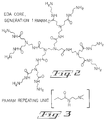
- the first well defined, symmetrical, dendrimer family were the polyamidoamine (PAMAM) dendrimers of the general structure depicted in Figures 2 and 3.
- PAMAM polyamidoamine
- Figure 2 shows the structure of an ethylenediamine (EDA) core
- Generation 1 dendrimer shows the structure of the PAMAM repeating unit.
- EDA ethylenediamine
- Figure 3 shows the structure of the PAMAM repeating unit.
- Silicon containing dendritic polymers have gained increasing attention only recently. There are three different main silicon containing dendrimer families. The most widely utilized is the carbosilane dendrimer family, used for various surface modifications. Their preparation was originally described in J. Chem. Soc., Chem. Commun., Pages 1400-1401, (1992). Polysiloxane-based dendrimers have also been reported, but the synthetic methodology for their preparation is not very practical, see Dokl. Akad. Nauk. SSSR, 309, Pages 376-380, (1989) and Macromolecules, Volume 24, Number 12, Pages 3469-3474, (1991).
- the uniqueness of our invention resides in the preparation of networks from copolydendrimers having a covalently bonded hydrophilic PAMAM or PPI interior and an oleophilic hydrophobic organosilicon radially concentric outer layer.
- Prior work to prepare hydrophobic dendrimers with hydrophilic interiors has not included organosilicon outer layers, see for example, Polymer Preprints, Volume 37, Number 2, Page 247, (1996).
- our dendrimer compositions have a variable degree of reactive functional groups on the PAMAMOS or PPIOS dendrimer surface, depending upon (i) the functionality of the starting PAMAM or PPI dendrimer reactant; (ii) the completeness of modification by the organosilicon reagent; and (iii) the functionality (Z) of the organosilicon reagent.
- the functionality of PAMAM or PPI dendrimers is determined by the functionality of the initiator core reagent used in their synthesis and by generation.
- ethylene diamine (EDA) when used as the initiator core reagent, the functionality of the amine terminated PAMAM dendrimers ranges from 4 at generation 0 to 4096 at generation 10, doubling from every generation to the next, as shown in Table 1 above.
- Our present invention also provides for the utilization of silicon-containing dendrimers for preparation of more complex nanoscopic products such as in dendrimer-based networks.
- Such networks can result from establishing a three-dimensional covalent connectivity between individual dendrimers.
- such connectivity is established (i) between the surfaces of two adjacent dendrimers, (ii) between one dendrimer surface and another dendrimer interior, and (iii) between interiors of two neighboring dendrimers.
- organosilicon networks described as being "somewhere in between inorganic glasses and organic elastomers" were also prepared.
- the precursors used were not dendrimers, but small molecular weight multi-functional branched compounds having 12 alkoxysilane groups per molecule, emanating from either a single silicon atom, a linear disiloxane segment or a ring system. See, for example, MJ Michalczyk and KG Sharp, 29th Organosilicon Symposium, Evanston, Illinois (March 22-23, 1996).
- Our invention provides silicon-containing dendrimer-based networks (including elastomers) prepared from radially layered copoly(amidoamine-organosilicon) (PAMAMOS) or copoly(propyleneimine-organosilicon) (PPIOS) dendrimer precursors. Since polyamidoamines and polypropyleneimines are hydrophilic moieties, the resulting products are the first silicon-containing networks (including elastomers) having covalently bonded hydrophilic and hydrophobic nanoscopic domains; the size, shape and relative distribution are precisely controlled by reagents and conditions used in the synthesis of the precursors and by preparative conditions applied in their crosslinking into a network.
- PAMAMOS precursors are obtained from PAMAM dendrimers whose surface has been partially or completely modified with functional organosilicon moieties.
- Related precursors are also prepared from poly(propyleneinine) (PPI) dendrimers in the same way.
- PPI poly(propyleneinine)
- compositions are organized as a hydrophilic poly(amidoamine) (PAMAM) or poly(propyleneimine) (PPI) interior with a hydrophobic organosilicon exterior layer.
- PAMAM poly(amidoamine)
- PPI poly(propyleneimine)
- the nature of the organosilicon layer may vary, as well as the architectural parameters of the dendrimer structure itself, including the functionality of the core, length and functionality of the branches and the generation of each different layer, i.e., their relative thickness.
- organosilicon modifiers are compounds such as (3-acryloxypropyl)methyldimethoxysilane, (3-acryloxypropyl)bis(vinyldimethylsiloxy)methylsilane, iodomethyldimethylvinylsilane, chloromethyldimethylvinylsilane, as well as other (3-acryloxypropyl)-functional silanes or other haloalkyl-functional silanes.
- PAMAMOS dendrimers are functional, globular, nanoscopic macromolecules having sizes ranging from 1 to 15 nm in diameter; molecular weights ranging from 1,200 to 1,000,000; with a hydrophilic PAMAM interior encapsulated in a covalently connected lyophilic (oleophilic, hydrophobic) organosilicon outer shell. As such, they can be used for the preparation of PAMAM-organosilicon-containing dendritic networks, when having reactive silicon-functional groups at the outer surface.
- Figure 1 for a schematic representation of one such network according to our invention.
- the reactive silicon-functional groups at the outer surface include any (CH 3 ) 3-z-y X z W y Si- moiety, where X and W represent reactive groups; z is 1, 2 or 3; and y is 0, 1 or 2.
- R represents an alkyl group having 1-6 carbon atoms or an aryl group such as phenyl; and R' represents the corresponding alkylene or arylene groups.
- the alkoxy group -OR is most preferred.
- W is either a reactive or a non-reactive group, in which case W is different from -CH 3 or -X.
- the crosslinking is performed with or without one or more added reactants, such as small molecular or oligomeric (i) difunctional reagents A 2 , (ii) trifunctional reagents A 3 , (iii) polyfunctional reagents A x where x is 4 or more, or (iv) by simply using moisture from the atmosphere or intentionally added water.
- reactants such as small molecular or oligomeric (i) difunctional reagents A 2 , (ii) trifunctional reagents A 3 , (iii) polyfunctional reagents A x where x is 4 or more, or (iv) by simply using moisture from the atmosphere or intentionally added water.
- Representative A 2 , A 3 and A x reagents are organohalosilanes, tetrahalosilanes, organosilanoles, organo(organooxysilanes), namely, dialkoxysilanes and trialkoxysilanes, organo-H-silanes, organoaminosilanes, organoacyloxysilanes, namely, acetoxysilanes, organosilsesquioxanes, ureido-substituted silanes, vinyl-substituted silanes and allyl-substituted silanes.
- Corresponding organic or organometallic compounds can also be employed.
- Obtained elastomers are clear, highly transparent materials, exhibiting low glass temperature (T g ) and high thermal and thermo-oxidative stability.
- T g glass temperature
- the exact values of these property parameters will depend on the PAMAM dendrimer and the organosilicon reagent used; their relative content in the resulting PAMAMOS copolydendrimer; the number of built outer organosilicon layers; and the type and relative amount of reagents A 2 , A 3 and A x .
- the elastomers are mechanically stable. They show unique separation and swelling characteristics and can be obtained as thin films having non-stick surfaces. Their unique interior structure provides evenly distributed hydrophilic domains of precisely controlled nanoscopic sizes, which are covalently connected within an oleophilic and elastomeric organosilicon matrix. Reference is again made to Figure 1 of the present application, for a schematic representation of one such network.
- This unique network architecture offers (i) new avenues in the preparation of specialty membranes; (ii) new types of protective or functional coatings; and (iii) novel routes to composites having other organic, organometallic or inorganic additives, namely, metal oxides, sulfides or salts; that have not been available with organosilicon polymers prior to our invention. Additional applications include use of these elastomers in skin-patch delivery systems, as controlled porosity materials, as adsorbents, stationary phases for chromatographic applications, as well as for the preparation of new personal care products and agricultural products.
- Our invention provides dendrimer-based networks from radially layered copolydendrimers having dramatically different intra-molecular composition, i.e., their surfaces and their interiors.
- the resulting network product has well defined, covalently bonded and dramatically different domains including hydrophilic and hydrophobic regions distributed throughout its bulk. Additionally, the size and shape of the hydrophilic domains is precisely controlled by selection of an appropriate PAMAM or PPI dendrimer generation used for copolydendrimer precursor preparation. As an example, reference is made to Figure 2 and Table 1, for appropriate type of PAMAM dendrimers.
- the hydrophilic dendrimer is a generation 0 to generation 10 polyamidoamine dendrimer or a generation 0 to generation 5 polypropyleneimine dendrimer.
- the molecular weight of the hydrophilic dendrimer ranges from 350 to over 1,000,000.
- the hydrophobic domain is prepared by controlling the chemical composition and thickness of the organosilicon layer formed on the hydrophilic PAMAM or PPI interior. Therefore, since the size and shape of both of the network domains is controlled, predesigned properties for the resulting network are possible.
- a single PAMAMOS or PPIOS copolydendrimer precursor is used in the crosslinking reaction. If, however, a specific distribution pattern of relative sizes and shapes of the domains is desirable, then mixtures of different PAMAMOS, PPIOS or combinations of the two, prepared from different generation PAMAM or PPI dendrimers having different thickness of organosilicon surface shells, are used in the preparation.
- radially layered dendrimer based networks having tailored semipermeability, tailored swelling and diffusion behavior, tailored surface and mechanical properties, tailored glass temperature and tailored insulating, and optical characteristics are provided according to the teaching of our invention.
- the structural composition of the dendrimer is varied so as to result in different mass and size ratios of the two compositions.
- the size of the hydrophilic polyamidoamine or polypropyleneimine domain is predefined by selecting an appropriate PAMAM or PPI dendrimer for use in the precursor preparation.
- the relative mass ratio and size of the organosilicon domains is predefined by the number and structure of the organosilicon layer around the PAMAM or PPI core in the radially layered PAMAMOS or PPIOS copolydendrimer precursor and by the number and type of crosslinking reagent, if a crosslinking agent or agents are employed.
- Organosilicon compounds that react to form the dendrimer i.e., the organosilicon modifier, are compounds such as (3-acryloxypropyl)methyldimethoxysilane, (3-acryloxypropyl)bis(vinyldimethylsiloxy)methylsilane, iodomethyldimethylvinylsilane, chloromethyldimethylvinylsilane, as well as other (3-acryloxypropyl)-functional silanes or haloalkyl-functional silanes.
- the type of reactive surface group of the PAMAMOS or PPIOS copolydendrimer precursor which participates in the network forming crosslinking is defined in the last stages of the precursor preparation.
- the surface group used is ⁇ Si-OCH 3
- other surface groups are possible, such as different ⁇ Si-OR groups, ⁇ Si-halogen, ⁇ Si-NH 2 , ⁇ Si-NR 2 , ⁇ Si-H, ⁇ Si-Vinyl, ⁇ Si-Allyl, ⁇ Si-R-SH, ⁇ Si-O(O)CCH 3 or ⁇ Si-NH(O)CNH 2 ( ⁇ Si-Ureido).
- crosslinking is obtained by the controlled or uncontrolled hydrolysis of PAMAMOS dendrimer precursors having ⁇ Si-OCH 3 surface groups, using either water or atmospheric moisture.
- crosslinking agents examples include small molecular or oligomeric (i) difunctional reagents A 2 , (ii) trifunctional reagents A 3 , or (iii) polyfunctional reagents A x where x is 4 or more.
- Representative A 2 , A 3 and A x reagents are organohalosilanes, tetrahalosilanes, organo(organooxysilanes), namely dialkoxysilanes and trialkoxysilanes, organo-H-silanes, organoaminosilanes, organoacyloxysilanes, namely acetoxysilanes, organosilsesquioxanes, vinyl-substituted silanes, allyl-substituted silanes and corresponding organic or organometallic compounds.
- organohalosilanes namely dialkoxysilanes and trialkoxysilanes
- organo-H-silanes organoaminosilanes
- organoacyloxysilanes namely acetoxysilanes, organosilsesquioxanes
- vinyl-substituted silanes allyl-substituted silanes and corresponding organic or organo
- the method is not solvent specific and among suitable solvents for preparing the radially layered copolydendrimer precursors are methanol, N,N-dimethylformamide, tetrahydrofuran, dimethylacetamide, dimethylsulfoxide, N-methyl-2-pyrrolidone, hexamethylphosphoramide, chloroform, methylene chloride and tetramethylurea.
- Preliminary characterization data is included in the examples.
- All glassware used in this synthesis was first dried overnight in a heating oven and then assembled while still hot.
- a three-necked round bottomed flask was equipped with a nitrogen inlet, a stopper and a condenser with another stopper at its top; evacuated to a partial vacuum; and flame-dried using several nitrogen-vacuum purging cycles.
- the apparatus was filled with nitrogen predried by passing it over DRIERITE®, the stopper on the flask was removed under a strong counter-stream of dry-nitrogen and replaced by a rubber septum.
- a rubber balloon was placed on the top of the condenser to allow control of slight over pressures in the assembly.
- Syringes were also dried overnight in the oven and kept in a desiccator until used.
- the dendrimer was lyophilized under high vacuum overnight in a round-bottomed flask, then weighted (1.46 g; 0.21 mmol; 13.57 mmol of -NH groups), placed under dry-nitrogen and the flask was equipped with a rubber-septum.
- Anhydrous methanol (14 mL) was added via a syringe through the septum. When all of the dendrimer was dissolved, the mixture was transferred with a syringe to the apparatus.
- the modified dendrimer was stable, providing it was kept in an anhydrous solution.
- Example 2 Preparation of a dendrimer-based network from a PAMAM-organosilicon copolydendrimer having on average 84.5 ⁇ Si-OCH 3 surface groups
- a PAMAM-organosilicon copolydendrimer precursor having on average 84.5 reactive methoxy end-groups on its surface was synthesized by the procedure of Example 1, during 24 hours of reaction time.
- 1 mL of the reaction mixture having 0.015 mmol of dendrimer and 0.5 mmol of (3-acryloxypropyl)dimethoxymethylsilane in 1 mL of methanol was poured in an aluminum pan, covered with an aluminum foil and left exposed to room atmosphere without any additional precautions. In contact with moisture from air and catalyzed by the basic PAMAM interior, the cure occurred slowly, accompanied by the slow liberation and evaporation of methanol. The pan was weighted from time to time.
- the resulting product was obtained in the form of a perfectly clear, transparent colorless film. It was not soluble in methanol, methylene chloride, tetrahydrofuran (THF), acetone or water. This was determined by attempted solubilization of 5 mg of the product in 5 mL of a solvent for 1 month.
- the thermal properties of the film were examined by differential scanning calorimetry (DSC) and thermal gravimetric analysis (TGA), in nitrogen and in air.
- DSC differential scanning calorimetry
- TGA thermal gravimetric analysis
- DSC was performed from -65°C. to +100°C. at a heating rate of 10°/min.
- TGA was performed from room temperature to 1,000°C. at a heating rate of 20°/min.
- the glass temperature T g was found at -7°C.
- samples were stable until 175°C., above which was observed a two-step weight loss process.
- the first step started at 175°C. and ended at 355°C.
- the sample lost 40 % of its original weight, with the maximum rate of this loss found at 320°C.
- the second step started at 355°C. and continued until 600°C.
- the total weight lost was 48% of the original weight, with the maximum rate of this loss appearing at 390°C.
- the degradation was in a three-step process.
- the first step started at 180°C, showed maximum rate of weight loss at 300°C. and ended at 350°C., resulting in a total weight loss of 21% of the original weight.
- the second step started at 350°C., showed maximum rate of weight loss at 400°C. and ended at 565°C., after the total weight loss was 35% of the original sample weight.
- the final third degradation step started at 565°C., showed maximum rate of weight loss at 655°C. and ended at 780°C., with the total weight loss of 20% of the original sample weight.
- a syringe filtration apparatus as depicted in Figures 4 and 5.
- Such apparatus is well known in the art and typically comprises a VACUUM FLASK for supporting the SYRINGE FILTER.
- the FILTER includes a MEMBRANE positioned between PAPER FILTERS and supported on a stainless steel WIRE MESH. Communication between the SYRINGE FILTER and the VACUUM FLASK is established by passing the NEEDLE of the SYRINGE FILTER through a SEPTUM on the VACUUM FLASK.
- the rate of decrease of the meniscus of 20 mL of water in the SYRINGE was followed as a function of time.
- the flow rate of pure water through the MEMBRANE contained in the FILTER was 2 mL/min, as compared to 2.5 mL/min through the same apparatus when the MEMBRANE was absent.
- Permselectivity of the film was tested with NaCl solution, also using the apparatus depicted in Figures 4 and 5.
- the NaCl solution used was prepared from 5.8478 gram of NaCl dissolved in 1 liter of deionized water. A concentration of 0.10006 mol/L was determined by titrating 5 mL of this solution in 50 mL of water with 0.1N solution of silver nitrate.
- the silver nitrate solution was prepared by dissolving 17.0174 gram of silver nitrate in 1 L of deionized water to provide a concentration of 0.10017 mol/L, in the presence of dextrin (5 mL of 2% by weight of dextrin in water) and 5 drops of 0.2 % by weight sodium fluorescein solution in water as indicator.
- dextrin 5 mL of 2% by weight of dextrin in water
- sodium fluorescein solution in water as indicator.
- NaCl solution was first run through the apparatus without the MEMBRANE and the total volume collected and NaCl content were determined. Two runs were performed providing quantitative volumes of solutions collected. In each case, after the entire volume of each solution had passed through the FILTER in Figure 4, the apparatus was rinsed three times with a total of 45 mL of deionized water.
- Example 3 Preparation of an elastomeric dendrimer-based network from a PAMAM-organosilicon copolydendrimer having on average 91.5 ⁇ Si-OCH 3 surface groups.
- the procedure for this preparation was that of Example 2, except that the modification of the PAMAM dendrimer was allowed to continue for 48 hours.
- the obtained modified dendrimer had on an average 91.5 ⁇ Si-OCH 3 end groups per molecule.
- the obtained elastomeric film had T g of -20°C. as determined by DSC.
- the obtained elastomeric film also had high temperature properties described hereinafter. In nitrogen, a two-step degradation process started at 180°C.; the first step of which lasted until 340°C. showing a maximum rate of weight loss at 320°C., with a total weight loss 40% of the original sample weight.
- the second step started at 340°C., lasted until 500°C., had a maximum rate of weight loss at 390°C. and an overall weight loss of 45% of the original sample weight.
- the three-step degradation process had the following characteristics.
- the first step started at 175°C., had a maximum rate of weight loss at 300°C. and a total weight loss of 22% of the original sample weight.
- the second step started at 340°C., lasted until 560°C., had a maximum rate of weight loss at 430°C. and the total weight loss was 38% of the original weight.
- the third step started at 560°C., lasted until 800°C., had a maximum rate of weight loss at 657°C.
- Example 4 Preparation of an elastomeric dendrimer-based network from a PAMAM-organosilicon copolydendrimer having on average 96 ⁇ Si-OCH 3 surface groups
- the procedure for this preparation was that of Examples 2 and 3, except that the modification of the dendrimer was allowed to continue for 71 hours of the total reaction time, resulting in an obtained modified dendrimer having on average 96 ⁇ Si-OCH 3 surface groups per molecule.
- the T g of the obtained elastomeric film was -18°C. as determined by DSC. Its thermal and thermo-oxidative stability were similar to that described for the elastomeric film of Example 3.
- the permeability of the film toward water was 0.004 mL/min, using the apparatus depicted in Figures 4 and 5, under partial vacuum of 0.3 Torr.
- Our elastomeric dendrimer-based networks can be compounded with additives normally employed in silicone elastomers including fillers such as fused silica, carbon black and glass microballons; catalysts such as tin carboxylates and titanate esters; pigments; plasticizers; adhesion promoters; fungicides; flame retardants; thickeners; chain extenders; vulcanizing agents; and antioxidants.
- additives normally employed in silicone elastomers including fillers such as fused silica, carbon black and glass microballons; catalysts such as tin carboxylates and titanate esters; pigments; plasticizers; adhesion promoters; fungicides; flame retardants; thickeners; chain extenders; vulcanizing agents; and antioxidants.
- the networks provide an avenue for introducing various inorganic components into silicone rubbers. This is accomplished by molecular encapsulation of inorganic additives such as metals, metal oxides, sulfides and/or metal salts, into the PAMAM interior, prior to formation of its organosilicon exterior or by diffusion after the network has formed.
- inorganic additives such as metals, metal oxides, sulfides and/or metal salts
Landscapes
- Chemical & Material Sciences (AREA)
- Health & Medical Sciences (AREA)
- Engineering & Computer Science (AREA)
- Medicinal Chemistry (AREA)
- Polymers & Plastics (AREA)
- Organic Chemistry (AREA)
- Chemical Kinetics & Catalysis (AREA)
- Nanotechnology (AREA)
- Life Sciences & Earth Sciences (AREA)
- General Health & Medical Sciences (AREA)
- Molecular Biology (AREA)
- Crystallography & Structural Chemistry (AREA)
- Silicon Polymers (AREA)
- Compositions Of Macromolecular Compounds (AREA)
- Macromolecular Compounds Obtained By Forming Nitrogen-Containing Linkages In General (AREA)
Applications Claiming Priority (2)
| Application Number | Priority Date | Filing Date | Title |
|---|---|---|---|
| US08/897,943 US5902863A (en) | 1997-07-21 | 1997-07-21 | Dendrimer-based networks containing lyophilic organosilicon and hydrophilic polyamidoamine nanoscopic domains |
| US897943 | 1997-07-21 |
Publications (2)
| Publication Number | Publication Date |
|---|---|
| EP0893482A1 true EP0893482A1 (de) | 1999-01-27 |
| EP0893482B1 EP0893482B1 (de) | 2004-05-12 |
Family
ID=25408695
Family Applications (1)
| Application Number | Title | Priority Date | Filing Date |
|---|---|---|---|
| EP98113072A Expired - Lifetime EP0893482B1 (de) | 1997-07-21 | 1998-07-14 | Lyophile Organosilicium- und hydrophile nanoskopische Polyamidamin-Domänen aufweisende auf Dendrimeren aufbauende Netzwerke |
Country Status (4)
| Country | Link |
|---|---|
| US (1) | US5902863A (de) |
| EP (1) | EP0893482B1 (de) |
| JP (1) | JPH1171519A (de) |
| DE (1) | DE69823747D1 (de) |
Cited By (10)
| Publication number | Priority date | Publication date | Assignee | Title |
|---|---|---|---|---|
| EP1036809A1 (de) * | 1999-03-18 | 2000-09-20 | Dow Corning Corporation | Radial angeordnete Dendrimer |
| EP1090072A4 (de) * | 1998-04-27 | 2001-05-09 | Univ Akron | Supramolekulare strukturen und verfahren zu deren herstellung |
| WO2002010260A1 (en) * | 2000-07-28 | 2002-02-07 | Diazem Corporation | Silicone derivatized macromolecules |
| EP1167405A3 (de) * | 2000-05-02 | 2002-03-27 | Dow Corning Corporation | Auf Dendrimeren aufbauende interpenetrierende Polymernetzwerke |
| EP1219666A3 (de) * | 2001-01-02 | 2003-03-26 | Michigan Molecular Institute | Hyperverzweigte Polycarbosilane, Polycarbosiloxane, Polycarbosilazane und Kopolymere |
| EP1184404A3 (de) * | 2000-08-14 | 2003-08-27 | Michigan Molecular Institute | Silizium enthaltende mehrarmige sternförmige Polymere |
| WO2004020504A1 (en) * | 2002-08-29 | 2004-03-11 | Isis Innovation Limited | Blended dendrimers |
| WO2005084905A1 (en) * | 2004-03-09 | 2005-09-15 | Nv Bekaert Sa | Composite article comprising a metal reinforcement element embedded in a thermoplastic polymer material |
| US7025198B2 (en) | 2002-12-31 | 2006-04-11 | Cryovac, Inc. | Absorbent pad with controlled rate of wicking |
| WO2017222358A3 (fr) * | 2016-06-21 | 2018-04-19 | Universite Euromediterraneenne De Fes | Nouvelles macromolécules géantes: les copoly-dendrimères contenant des hétéroatomes |
Families Citing this family (33)
| Publication number | Priority date | Publication date | Assignee | Title |
|---|---|---|---|---|
| JP3181276B2 (ja) * | 1999-08-31 | 2001-07-03 | 科学技術振興事業団 | 樹枝状分岐構造を持つ両親媒性化合物 |
| US6471968B1 (en) | 2000-05-12 | 2002-10-29 | Regents Of The University Of Michigan | Multifunctional nanodevice platform |
| US6889735B2 (en) * | 2000-08-03 | 2005-05-10 | The Goodyear Tire & Rubber Company | Pneumatic tire having a rubber component containing a dendrimer |
| US20020132496A1 (en) * | 2001-02-12 | 2002-09-19 | Ball Ian J. | Ultra low-k dielectric materials |
| KR100429905B1 (ko) * | 2001-03-12 | 2004-05-03 | 학교법인 포항공과대학교 | 덴드론 혹은 덴드론 유도체로 안정화된 금속 나노 입자 및그 제조 방법 |
| US6534600B2 (en) | 2001-03-26 | 2003-03-18 | Michigan Molecular Institute | Hyperbranched polyureas, polyurethanes, polyamidoamines, polyamides and polyesters |
| EP1278061B1 (de) * | 2001-07-19 | 2011-02-09 | Sony Deutschland GmbH | Chemische Sensoren aus Nanopartikel-Dendrimer-Komposit-Materialen |
| US6646089B2 (en) * | 2001-10-03 | 2003-11-11 | Michigan Molecular Institute | Hyperbranched polymers with latent functionality and methods of making same |
| US6866764B2 (en) * | 2002-02-21 | 2005-03-15 | Michigan Molecular Institute | Processes for fabricating printed wiring boards using dendritic polymer copper nanocomposite coatings |
| US6803106B2 (en) * | 2002-04-16 | 2004-10-12 | William Henry Campbell | Multi-layered macromolecules and methods for their use |
| AU2003256038A1 (en) * | 2002-08-30 | 2004-03-19 | Ramot At Tel Aviv University Ltd. | Self-immolative dendrimers releasing many active moieties upon a single activating event |
| US7153905B2 (en) * | 2003-03-21 | 2006-12-26 | The General Hospital Corporation | Hyperbranched dendron and methods of synthesis and use thereof |
| US20040251188A1 (en) * | 2003-06-10 | 2004-12-16 | Skinner Charles E. | Immoblized alkylated amine functional macromolecules, alkylated ammonium salt functional macromolecules, and alkylated quaternary ammonium salt functional macromolecules, process for their preparation and methods for their use |
| CN100532459C (zh) * | 2004-02-18 | 2009-08-26 | 财团法人川村理化学研究所 | 有机无机复合纳米纤维、有机无机复合结构体以及它们的制备方法 |
| US20090104119A1 (en) * | 2004-08-25 | 2009-04-23 | Majoros Istvan J | Dendrimer Based Compositions And Methods Of Using The Same |
| US20060269480A1 (en) * | 2005-05-31 | 2006-11-30 | Ramot At Tel Aviv University Ltd. | Multi-triggered self-immolative dendritic compounds |
| US20070041934A1 (en) * | 2005-08-12 | 2007-02-22 | Regents Of The University Of Michigan | Dendrimer based compositions and methods of using the same |
| DE102006009004A1 (de) * | 2006-02-23 | 2007-09-06 | Sustech Gmbh & Co. Kg | Multifunktionelle sternförmige Präpolymere, deren Herstellung und Verwendung |
| WO2009009203A2 (en) * | 2007-04-19 | 2009-01-15 | The Regents Of The University Of Michigan | Dendrimer based compositions and methods of using the same |
| US20080282480A1 (en) * | 2007-05-15 | 2008-11-20 | The Hong Kong Polytechnic University | Multifunction Finishing Liquids Containing Dendrimers and the Application of the Liquids in Textile Finishing |
| WO2009151687A2 (en) | 2008-03-12 | 2009-12-17 | The Regents Of The University Of Michigan | Dendrimer conjugates |
| US8889635B2 (en) | 2008-09-30 | 2014-11-18 | The Regents Of The University Of Michigan | Dendrimer conjugates |
| WO2010054321A2 (en) | 2008-11-07 | 2010-05-14 | The Regents Of The University Of Michigan | Methods of treating autoimmune disorders and/or inflammatory disorders |
| CN102917699A (zh) | 2009-10-13 | 2013-02-06 | 密执安大学评议会 | 树枝状聚合物组合物和合成方法 |
| US8912323B2 (en) | 2009-10-30 | 2014-12-16 | The Regents Of The University Of Michigan | Multifunctional small molecules |
| KR102007997B1 (ko) | 2011-02-07 | 2019-08-07 | 라이프 테크놀로지스 코포레이션 | 감수성 화합물을 안정화시키는 조성물 및 방법 |
| US9402911B2 (en) | 2011-12-08 | 2016-08-02 | The Regents Of The University Of Michigan | Multifunctional small molecules |
| DE102018114018A1 (de) | 2018-06-12 | 2019-12-12 | Universität Paderborn | Antifouling-Beschichtung |
| CN110713604B (zh) * | 2019-10-14 | 2021-07-13 | 浙江海洋大学 | 一种pamam复合防污材料的制备方法 |
| CN112029093B (zh) * | 2020-09-11 | 2023-01-20 | 广州辰东新材料有限公司 | 一种树枝状硅烷-聚酰胺-胺聚合物及其制备方法和用途 |
| CN112940247B (zh) * | 2021-02-05 | 2022-07-26 | 浙江大学 | 一种油溶性超支化聚酰胺胺的生产方法及设备 |
| CN114044907B (zh) * | 2021-12-15 | 2022-11-11 | 兴宇汽车零部件股份有限公司 | 一种膨胀阻燃功能化poss阻燃剂及其制备方法 |
| CN115160771B (zh) * | 2022-06-30 | 2023-08-22 | 宁波坚锋新材料有限公司 | 一种同质异构微交联再生尼龙及其制备方法 |
Citations (2)
| Publication number | Priority date | Publication date | Assignee | Title |
|---|---|---|---|---|
| EP0342411A2 (de) * | 1988-05-14 | 1989-11-23 | Teroson GmbH | Form- und Dichtungsmasse |
| US5393795A (en) * | 1993-01-22 | 1995-02-28 | The Dow Chemical Company | Polymer blend containing a modified dense star polymer or dendrimer and a matrix polymer |
Family Cites Families (5)
| Publication number | Priority date | Publication date | Assignee | Title |
|---|---|---|---|---|
| US4737550A (en) * | 1983-01-07 | 1988-04-12 | The Dow Chemical Company | Bridged dense star polymers |
| US4568737A (en) * | 1983-01-07 | 1986-02-04 | The Dow Chemical Company | Dense star polymers and dendrimers |
| US4713975A (en) * | 1986-05-30 | 1987-12-22 | The Dow Chemical Company | Dense star polymers for calibrating/characterizing sub-micron apertures |
| US5560929A (en) * | 1986-08-18 | 1996-10-01 | The Dow Chemical Company | Structured copolymers and their use as absorbents, gels and carriers of metal ions |
| US5739218A (en) * | 1997-06-02 | 1998-04-14 | Dow Corning Corporation | Radially layered copoly (amidoamine-organosilicon) dendrimers |
-
1997
- 1997-07-21 US US08/897,943 patent/US5902863A/en not_active Expired - Lifetime
-
1998
- 1998-07-14 DE DE69823747T patent/DE69823747D1/de not_active Expired - Lifetime
- 1998-07-14 EP EP98113072A patent/EP0893482B1/de not_active Expired - Lifetime
- 1998-07-17 JP JP10203670A patent/JPH1171519A/ja active Pending
Patent Citations (2)
| Publication number | Priority date | Publication date | Assignee | Title |
|---|---|---|---|---|
| EP0342411A2 (de) * | 1988-05-14 | 1989-11-23 | Teroson GmbH | Form- und Dichtungsmasse |
| US5393795A (en) * | 1993-01-22 | 1995-02-28 | The Dow Chemical Company | Polymer blend containing a modified dense star polymer or dendrimer and a matrix polymer |
Cited By (13)
| Publication number | Priority date | Publication date | Assignee | Title |
|---|---|---|---|---|
| EP1090072A4 (de) * | 1998-04-27 | 2001-05-09 | Univ Akron | Supramolekulare strukturen und verfahren zu deren herstellung |
| EP1036809A1 (de) * | 1999-03-18 | 2000-09-20 | Dow Corning Corporation | Radial angeordnete Dendrimer |
| EP1167405A3 (de) * | 2000-05-02 | 2002-03-27 | Dow Corning Corporation | Auf Dendrimeren aufbauende interpenetrierende Polymernetzwerke |
| WO2002010260A1 (en) * | 2000-07-28 | 2002-02-07 | Diazem Corporation | Silicone derivatized macromolecules |
| EP1184404A3 (de) * | 2000-08-14 | 2003-08-27 | Michigan Molecular Institute | Silizium enthaltende mehrarmige sternförmige Polymere |
| EP1219666A3 (de) * | 2001-01-02 | 2003-03-26 | Michigan Molecular Institute | Hyperverzweigte Polycarbosilane, Polycarbosiloxane, Polycarbosilazane und Kopolymere |
| WO2004020504A1 (en) * | 2002-08-29 | 2004-03-11 | Isis Innovation Limited | Blended dendrimers |
| US7977861B2 (en) | 2002-08-29 | 2011-07-12 | Isis Innovation Limited | Blended dendrimers |
| US7025198B2 (en) | 2002-12-31 | 2006-04-11 | Cryovac, Inc. | Absorbent pad with controlled rate of wicking |
| WO2005084905A1 (en) * | 2004-03-09 | 2005-09-15 | Nv Bekaert Sa | Composite article comprising a metal reinforcement element embedded in a thermoplastic polymer material |
| CN1925963B (zh) * | 2004-03-09 | 2011-01-26 | 贝卡尔特股份有限公司 | 包含嵌入热塑性聚合物材料中的金属增强元件的复合材料制品 |
| WO2017222358A3 (fr) * | 2016-06-21 | 2018-04-19 | Universite Euromediterraneenne De Fes | Nouvelles macromolécules géantes: les copoly-dendrimères contenant des hétéroatomes |
| US11332585B2 (en) | 2016-06-21 | 2022-05-17 | Universite Euromediterraneenne De Fes | Giant macromolecules: copolydendrimers containing heteroatoms |
Also Published As
| Publication number | Publication date |
|---|---|
| JPH1171519A (ja) | 1999-03-16 |
| DE69823747D1 (de) | 2004-06-17 |
| EP0893482B1 (de) | 2004-05-12 |
| US5902863A (en) | 1999-05-11 |
Similar Documents
| Publication | Publication Date | Title |
|---|---|---|
| EP0893482B1 (de) | Lyophile Organosilicium- und hydrophile nanoskopische Polyamidamin-Domänen aufweisende auf Dendrimeren aufbauende Netzwerke | |
| Gnanasekaran et al. | Developments of polyhedral oligomeric silsesquioxanes (POSS), POSS nanocomposites and their applications: a review | |
| US5938934A (en) | Dendrimer-based nanoscopic sponges and metal composites | |
| Pielichowski et al. | Polyhedral oligomeric silsesquioxanes (POSS)-containing nanohybrid polymers | |
| Dudziec et al. | Double-decker silsesquioxanes: current chemistry and applications | |
| US6995215B2 (en) | Cross-linked networks from multifunctional hyperbranched polymers | |
| Kim et al. | Amphiphilic telechelics incorporating polyhedral oligosilsesquioxane: 1. Synthesis and characterization | |
| US6812298B2 (en) | Hyperbranched polymers by multimonomer polymerization | |
| Choi et al. | Organic/inorganic hybrid composites from cubic silsesquioxanes | |
| US6384172B1 (en) | Hyperbranched polycarbosilanes, polycarbosiloxanes, polycarbosilazenes and copolymers thereof | |
| US5739218A (en) | Radially layered copoly (amidoamine-organosilicon) dendrimers | |
| Wright et al. | Chemical modification of fluorinated polyimides: new thermally curing hybrid polymers with POSS | |
| US20030018130A1 (en) | Hyperbranched polymer domain networks and methods of making same | |
| Vysochinskaya et al. | Star‐shaped siloxane polymers with various cyclic cores: Synthesis and properties | |
| WO2002100867A1 (en) | Well-defined nanosized building blocks for organic/inorganic nanocomposites | |
| Dvornic et al. | Nanostructured dendrimer-based networks with hydrophilic polyamidoamine and hydrophobic organosilicon domains | |
| KR20130125224A (ko) | 사다리형 사이올계 실세스퀴옥산 고분자 및 이의 제조방법 | |
| KR20000062943A (ko) | 고생성 방사상 적층된 덴드리머 | |
| Pan | Polyhedral oligomeric silsesquioxane (POSS) | |
| Sharp | Star alkoxysilane molecules, gels and appreciably tough glasses | |
| Chechelska-Noworyta et al. | Application of spectroscopic methods in the studies of polysiloxanes, cubic oligomeric silsesquioxanes, and spherosilicates modified by organic functional groups via hydrosilylation | |
| Flipsen et al. | Densely crosslinked polycarbosiloxanes. I. Synthesis | |
| Dvornic et al. | Nanostructured materials from radially layered copolymeric amidoamine-organosilicon (PAMAMOS) dendrimers | |
| Sheremetyeva et al. | Fluorine-containing organosilicon polymers of different architectures. Synthesis and properties study | |
| JP3000089B2 (ja) | ポリジオルガノシロキサン―ポリエーテルブロック共重合体およびその製造方法 |
Legal Events
| Date | Code | Title | Description |
|---|---|---|---|
| PUAI | Public reference made under article 153(3) epc to a published international application that has entered the european phase |
Free format text: ORIGINAL CODE: 0009012 |
|
| AK | Designated contracting states |
Kind code of ref document: A1 Designated state(s): DE FR GB IT NL |
|
| AX | Request for extension of the european patent |
Free format text: AL;LT;LV;MK;RO;SI |
|
| 17P | Request for examination filed |
Effective date: 19990423 |
|
| AKX | Designation fees paid |
Free format text: DE FR GB IT NL |
|
| RAP1 | Party data changed (applicant data changed or rights of an application transferred) |
Owner name: DENDRITECH, INC. Owner name: DOW CORNING CORPORATION |
|
| RAP1 | Party data changed (applicant data changed or rights of an application transferred) |
Owner name: MICHIGAN MOLECULAR INSTITUTE |
|
| GRAP | Despatch of communication of intention to grant a patent |
Free format text: ORIGINAL CODE: EPIDOSNIGR1 |
|
| GRAS | Grant fee paid |
Free format text: ORIGINAL CODE: EPIDOSNIGR3 |
|
| GRAA | (expected) grant |
Free format text: ORIGINAL CODE: 0009210 |
|
| AK | Designated contracting states |
Kind code of ref document: B1 Designated state(s): DE FR GB IT NL |
|
| PG25 | Lapsed in a contracting state [announced via postgrant information from national office to epo] |
Ref country code: NL Free format text: LAPSE BECAUSE OF FAILURE TO SUBMIT A TRANSLATION OF THE DESCRIPTION OR TO PAY THE FEE WITHIN THE PRESCRIBED TIME-LIMIT Effective date: 20040512 Ref country code: IT Free format text: LAPSE BECAUSE OF FAILURE TO SUBMIT A TRANSLATION OF THE DESCRIPTION OR TO PAY THE FEE WITHIN THE PRESCRIBED TIME-LIMIT;WARNING: LAPSES OF ITALIAN PATENTS WITH EFFECTIVE DATE BEFORE 2007 MAY HAVE OCCURRED AT ANY TIME BEFORE 2007. THE CORRECT EFFECTIVE DATE MAY BE DIFFERENT FROM THE ONE RECORDED. Effective date: 20040512 Ref country code: FR Free format text: LAPSE BECAUSE OF FAILURE TO SUBMIT A TRANSLATION OF THE DESCRIPTION OR TO PAY THE FEE WITHIN THE PRESCRIBED TIME-LIMIT Effective date: 20040512 |
|
| REG | Reference to a national code |
Ref country code: GB Ref legal event code: FG4D |
|
| REF | Corresponds to: |
Ref document number: 69823747 Country of ref document: DE Date of ref document: 20040617 Kind code of ref document: P |
|
| PG25 | Lapsed in a contracting state [announced via postgrant information from national office to epo] |
Ref country code: GB Free format text: LAPSE BECAUSE OF NON-PAYMENT OF DUE FEES Effective date: 20040812 |
|
| PG25 | Lapsed in a contracting state [announced via postgrant information from national office to epo] |
Ref country code: DE Free format text: LAPSE BECAUSE OF FAILURE TO SUBMIT A TRANSLATION OF THE DESCRIPTION OR TO PAY THE FEE WITHIN THE PRESCRIBED TIME-LIMIT Effective date: 20040813 |
|
| NLV1 | Nl: lapsed or annulled due to failure to fulfill the requirements of art. 29p and 29m of the patents act | ||
| PLBE | No opposition filed within time limit |
Free format text: ORIGINAL CODE: 0009261 |
|
| STAA | Information on the status of an ep patent application or granted ep patent |
Free format text: STATUS: NO OPPOSITION FILED WITHIN TIME LIMIT |
|
| GBPC | Gb: european patent ceased through non-payment of renewal fee |
Effective date: 20040812 |
|
| 26N | No opposition filed |
Effective date: 20050215 |
|
| EN | Fr: translation not filed |