EP0893550A2 - Verfahren zum Herstellen von Verbundstoffen und -platten und Vorrichtung für dieses Verfahren - Google Patents
Verfahren zum Herstellen von Verbundstoffen und -platten und Vorrichtung für dieses Verfahren Download PDFInfo
- Publication number
- EP0893550A2 EP0893550A2 EP98108948A EP98108948A EP0893550A2 EP 0893550 A2 EP0893550 A2 EP 0893550A2 EP 98108948 A EP98108948 A EP 98108948A EP 98108948 A EP98108948 A EP 98108948A EP 0893550 A2 EP0893550 A2 EP 0893550A2
- Authority
- EP
- European Patent Office
- Prior art keywords
- adhesive
- carrier
- solvent
- wetted
- sprinkled
- Prior art date
- Legal status (The legal status is an assumption and is not a legal conclusion. Google has not performed a legal analysis and makes no representation as to the accuracy of the status listed.)
- Granted
Links
- 238000000034 method Methods 0.000 title claims abstract description 33
- 239000002131 composite material Substances 0.000 title claims description 15
- 238000004519 manufacturing process Methods 0.000 title claims description 6
- 239000000853 adhesive Substances 0.000 claims abstract description 61
- 230000001070 adhesive effect Effects 0.000 claims abstract description 61
- 239000002904 solvent Substances 0.000 claims abstract description 27
- XLYOFNOQVPJJNP-UHFFFAOYSA-N water Substances O XLYOFNOQVPJJNP-UHFFFAOYSA-N 0.000 claims abstract description 6
- 239000000843 powder Substances 0.000 claims abstract description 4
- 239000006260 foam Substances 0.000 claims abstract description 3
- 239000000463 material Substances 0.000 claims abstract description 3
- 239000010410 layer Substances 0.000 claims description 21
- 239000004848 polyfunctional curative Substances 0.000 claims description 3
- BPQQTUXANYXVAA-UHFFFAOYSA-N Orthosilicate Chemical compound [O-][Si]([O-])([O-])[O-] BPQQTUXANYXVAA-UHFFFAOYSA-N 0.000 claims description 2
- 230000002745 absorbent Effects 0.000 claims description 2
- 239000002250 absorbent Substances 0.000 claims description 2
- 238000010276 construction Methods 0.000 claims description 2
- 239000004744 fabric Substances 0.000 claims description 2
- PMYUVOOOQDGQNW-UHFFFAOYSA-N hexasodium;trioxido(trioxidosilyloxy)silane Chemical compound [Na+].[Na+].[Na+].[Na+].[Na+].[Na+].[O-][Si]([O-])([O-])O[Si]([O-])([O-])[O-] PMYUVOOOQDGQNW-UHFFFAOYSA-N 0.000 claims description 2
- 239000007788 liquid Substances 0.000 claims description 2
- 230000008961 swelling Effects 0.000 claims description 2
- 239000000969 carrier Substances 0.000 claims 1
- 239000002344 surface layer Substances 0.000 claims 1
- 238000004026 adhesive bonding Methods 0.000 abstract description 4
- 239000004115 Sodium Silicate Substances 0.000 abstract 1
- 229910052910 alkali metal silicate Inorganic materials 0.000 abstract 1
- 238000005253 cladding Methods 0.000 abstract 1
- 150000001875 compounds Chemical class 0.000 abstract 1
- 239000004745 nonwoven fabric Substances 0.000 abstract 1
- 229920006395 saturated elastomer Polymers 0.000 abstract 1
- NTHWMYGWWRZVTN-UHFFFAOYSA-N sodium silicate Chemical compound [Na+].[Na+].[O-][Si]([O-])=O NTHWMYGWWRZVTN-UHFFFAOYSA-N 0.000 abstract 1
- 229910052911 sodium silicate Inorganic materials 0.000 abstract 1
- 239000002759 woven fabric Substances 0.000 abstract 1
- 239000012790 adhesive layer Substances 0.000 description 7
- 239000003292 glue Substances 0.000 description 5
- 238000007650 screen-printing Methods 0.000 description 3
- 230000032683 aging Effects 0.000 description 1
- 230000001427 coherent effect Effects 0.000 description 1
- 238000001035 drying Methods 0.000 description 1
- 238000001704 evaporation Methods 0.000 description 1
- 230000008020 evaporation Effects 0.000 description 1
- 238000009413 insulation Methods 0.000 description 1
- 235000011837 pasties Nutrition 0.000 description 1
- 238000002360 preparation method Methods 0.000 description 1
Images


Classifications
-
- B—PERFORMING OPERATIONS; TRANSPORTING
- B32—LAYERED PRODUCTS
- B32B—LAYERED PRODUCTS, i.e. PRODUCTS BUILT-UP OF STRATA OF FLAT OR NON-FLAT, e.g. CELLULAR OR HONEYCOMB, FORM
- B32B7/00—Layered products characterised by the relation between layers; Layered products characterised by the relative orientation of features between layers, or by the relative values of a measurable parameter between layers, i.e. products comprising layers having different physical, chemical or physicochemical properties; Layered products characterised by the interconnection of layers
- B32B7/04—Interconnection of layers
- B32B7/12—Interconnection of layers using interposed adhesives or interposed materials with bonding properties
-
- B—PERFORMING OPERATIONS; TRANSPORTING
- B32—LAYERED PRODUCTS
- B32B—LAYERED PRODUCTS, i.e. PRODUCTS BUILT-UP OF STRATA OF FLAT OR NON-FLAT, e.g. CELLULAR OR HONEYCOMB, FORM
- B32B37/00—Methods or apparatus for laminating, e.g. by curing or by ultrasonic bonding
- B32B37/12—Methods or apparatus for laminating, e.g. by curing or by ultrasonic bonding characterised by using adhesives
- B32B37/1284—Application of adhesive
-
- B—PERFORMING OPERATIONS; TRANSPORTING
- B32—LAYERED PRODUCTS
- B32B—LAYERED PRODUCTS, i.e. PRODUCTS BUILT-UP OF STRATA OF FLAT OR NON-FLAT, e.g. CELLULAR OR HONEYCOMB, FORM
- B32B5/00—Layered products characterised by the non- homogeneity or physical structure, i.e. comprising a fibrous, filamentary, particulate or foam layer; Layered products characterised by having a layer differing constitutionally or physically in different parts
- B32B5/02—Layered products characterised by the non- homogeneity or physical structure, i.e. comprising a fibrous, filamentary, particulate or foam layer; Layered products characterised by having a layer differing constitutionally or physically in different parts characterised by structural features of a fibrous or filamentary layer
- B32B5/022—Non-woven fabric
-
- B—PERFORMING OPERATIONS; TRANSPORTING
- B32—LAYERED PRODUCTS
- B32B—LAYERED PRODUCTS, i.e. PRODUCTS BUILT-UP OF STRATA OF FLAT OR NON-FLAT, e.g. CELLULAR OR HONEYCOMB, FORM
- B32B5/00—Layered products characterised by the non- homogeneity or physical structure, i.e. comprising a fibrous, filamentary, particulate or foam layer; Layered products characterised by having a layer differing constitutionally or physically in different parts
- B32B5/02—Layered products characterised by the non- homogeneity or physical structure, i.e. comprising a fibrous, filamentary, particulate or foam layer; Layered products characterised by having a layer differing constitutionally or physically in different parts characterised by structural features of a fibrous or filamentary layer
- B32B5/024—Woven fabric
-
- B—PERFORMING OPERATIONS; TRANSPORTING
- B32—LAYERED PRODUCTS
- B32B—LAYERED PRODUCTS, i.e. PRODUCTS BUILT-UP OF STRATA OF FLAT OR NON-FLAT, e.g. CELLULAR OR HONEYCOMB, FORM
- B32B5/00—Layered products characterised by the non- homogeneity or physical structure, i.e. comprising a fibrous, filamentary, particulate or foam layer; Layered products characterised by having a layer differing constitutionally or physically in different parts
- B32B5/18—Layered products characterised by the non- homogeneity or physical structure, i.e. comprising a fibrous, filamentary, particulate or foam layer; Layered products characterised by having a layer differing constitutionally or physically in different parts characterised by features of a layer of foamed material
-
- B—PERFORMING OPERATIONS; TRANSPORTING
- B32—LAYERED PRODUCTS
- B32B—LAYERED PRODUCTS, i.e. PRODUCTS BUILT-UP OF STRATA OF FLAT OR NON-FLAT, e.g. CELLULAR OR HONEYCOMB, FORM
- B32B2307/00—Properties of the layers or laminate
- B32B2307/50—Properties of the layers or laminate having particular mechanical properties
- B32B2307/56—Damping, energy absorption
-
- B—PERFORMING OPERATIONS; TRANSPORTING
- B32—LAYERED PRODUCTS
- B32B—LAYERED PRODUCTS, i.e. PRODUCTS BUILT-UP OF STRATA OF FLAT OR NON-FLAT, e.g. CELLULAR OR HONEYCOMB, FORM
- B32B2307/00—Properties of the layers or laminate
- B32B2307/70—Other properties
- B32B2307/724—Permeability to gases, adsorption
-
- B—PERFORMING OPERATIONS; TRANSPORTING
- B32—LAYERED PRODUCTS
- B32B—LAYERED PRODUCTS, i.e. PRODUCTS BUILT-UP OF STRATA OF FLAT OR NON-FLAT, e.g. CELLULAR OR HONEYCOMB, FORM
- B32B2607/00—Walls, panels
Definitions
- the invention relates to a method for producing Composites and panels, such as an acoustic panel in sandwich construction for sound and heat absorbing Room ceilings and / or walls, consisting from a porous support and from one or both sides flat with the carrier by an adhesive bonded cover layer made of a fleece, fabric, Foam or the like air-permeable material.
- Such a method and an associated composite panel are, for example, from published patent application DE 195 22 216 A1 already known.
- the carrier and the top layer (s) thereby that usually, because of fire protection, a relative thick inorganic, partially coherent and related the porosity of the composite plate disturbing adhesive layer is applied is in the previously known Document provided that the adhesive is grid-like is applied by means of screen printing.
- the adhesive is not related in this way Layer, but webs of glue change with glue-free Areas.
- the screen printing process is more appropriate, because the adhesive-free areas are much larger can be held; nevertheless it can also be do not avoid that the adhesive layer at least is partially impermeable to air. Both procedures are relatively complex and can be particularly not in a steady manufacturing process integrate the composite panels, but interrupt such a sequence.
- the object of the invention is therefore to a method of the type specified in the introduction shape it into a continuous smoothly Process flow can be inserted while worrying that the porosity of the composite panel largely remains preserved.
- the object is achieved by a method solved, in which the adhesive in the form of a swell and free-flowing, dry powder is used applied to the adhesive surface of the carrier and with a liquid solvent is wetted, and in which also after swelling of the moistened adhesive mutually facing adhesive surfaces of the carrier and the Cover layer (s) put together and under pressure and / or Exposure to temperature can be glued together.
- the adhesive can be dosed well, right to the edge and evenly in a uniformly running Scattering process are applied so that between the individual grains on the ones to be joined Adhesive areas of evenly distributed open areas remain and that swollen after adding the solvent and when gluing always compressed adhesive layer still has sufficient porosity so that impinging Sound waves are not reflected but largely absorbed or let through to the carrier and there be absorbed.
- the function of the composite panel is largely preserved in this way, and at the same time the structural elements of the top layer (s) and the surface of the carrier evenly with each other glued; larger areas, like them unavoidable with an adhesive applied with screen printing are completely eliminated.
- the powdery Adhesive can be applied very economically in one compared to the known methods significantly less Scope, and also the amount of solvent used is much smaller, so that accordingly Weight of the finished composite panel is not much larger is that of the bare support and the top layer (s) together; the drying time is thereby significantly shortened.
- Another advantage of The inventive method is that the Glue application means are significantly simplified so that set-up times are significantly reduced. Excess Adhesive powder can be reused without preparation become.
- the adhesive and the solvent can get into the area in very different ways, which is later formed by the adhesive layer (s) becomes.
- the carrier first wetted with the solvent and then with the adhesive is sprinkled. Instead, you can go the other way round also proceed in such a way that first the carrier with Sprinkle glue and then the solvent is wetted. In both cases then the top layer (s) are placed untreated and in the subsequent mechanical gluing process connected to the carrier. But it is still conceivable that the carrier sprinkled with adhesive and the Adhesive surface (s) of the cover layer (s) wetted with solvent and then glued to the carrier will / will, so that the adhesive only swells comes when the top layer (s) already on the carrier is / are created. On the continuity of the process nothing changes.
- the method can be used particularly efficiently if a slightly water soluble, especially cold water soluble and highly absorbent, spray-dried inorganic Adhesive is used.
- a slightly water soluble, especially cold water soluble and highly absorbent, spray-dried inorganic Adhesive is used.
- Such an inorganic Glue is non-flammable and free of harmful to health Emissions; he is beyond usually also temperature and aging resistant and easy to dispose of.
- An alkaline is particularly advantageous for the adhesive Silicate, for example sodium disilicate used.
- the pot life for the adhesive layer is eliminated or is determined by the evaporation of the solvent, if the adhesive surface (s) of the cover layer (s) before the Joined with the carrier wetted with solvent will be. It also does not apply if a suitable one Harder is added before the adhesive surfaces together be glued.
- Composite plate is evenly porous and excellent suitable for sound and heat insulation and can be used without further used indoors because they all Fire safety requirements are sufficient.
- a device tailored to the process for the production of composite panels is characterized that the carrier is in continuous flow are continuously sprinkled with the adhesive and the adhesive also continuously with the solvent and if necessary contacted with a hardener becomes.
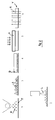
- a carrier T should (here) a cover layer D to one acoustic panel assembled as composite panel V. become.
- Fig. 1 the carrier T in step 1 sprayed with a solvent L and then (Work step 2) sprinkled with the granular adhesive K.
- a step 3 the two combine Components K, L under sources to a compressible, porous adhesive layer S. Then (Work step 4) this is covered with the top layer D. and (step 5) by means of the (heatable) Stamp F to a thin, the top layer D with the Carrier T compressed film compressed.
- the (Step 6) finished composite panel V is for Sound waves A or an air flow permeable.
- step 3 the top layer D with the solvent L sprayed in, while, as in Fig. 1, the granular adhesive K is sprinkled on the carrier T.
- Step 1 which in Step 2 only distributed over the surface of the carrier plate T. is, however, not wetted, and only in step 4 when applying the top layer D with the solvent L comes into contact.
Landscapes
- Engineering & Computer Science (AREA)
- Textile Engineering (AREA)
- Laminated Bodies (AREA)
- Processing And Handling Of Plastics And Other Materials For Molding In General (AREA)
- Reinforced Plastic Materials (AREA)
- Application Of Or Painting With Fluid Materials (AREA)
- Paints Or Removers (AREA)
Abstract
Description
- Fig. 1 bis 3
- je eine Variante des erfindungsgemäßen Verfahrens in einer schematisch dargestellten, zugehörigen Vorrichtung.
- A
- Schallwelle
- D
- Deckschicht
- F
- Stempel
- K
- Klebstoff
- S
- Klebstoff-Schicht
- L
- Lösungsmittel
- T
- Träger
- V
- Verbundplatte
Claims (14)
- Verfahren zum Herstellen von Verbundstoffen und - platten (V), beispielsweise einer Akustikplatte in Sandwich-Bauweise für schall- und wärmeabsorbierende Raum-Decken und/oder -Wände, bestehend aus einem porösen Träger (T) und aus einer ein- oder beidseitig mit dem Träger (T) durch einen Klebstoff (K) flächig verbundenen Deckschicht (D) aus einem Vlies, Gewebe, Schaumstoff oder dergleichen luftdurchlässigen Werkstoff,
dadurch gekennzeichnet, daß(a) der Klebstoff (K) in Form eines quell- und rieselfähigen, trockenen Pulvers verwendet wird, das auf die Klebefläche des Trägers (T) aufgetragen und mit einem flüssigen Lösungsmittel (L) benetzt wird, und(b) nach Quellen des befeuchteten Klebstoffes (K) die einander zugewandten Klebeflächen des Trägers (T) und der Deckschicht(en) (D) aneinandergelegt und unter Druck- und/oder Temperatureinwirkung miteinander verklebt werden. - Verfahren nach Anspruch 1, dadurch gekennzeichnet, daß der Träger (T) zunächst mit dem Lösungsmittel (L) benetzt und danach mit dem Klebstoff (K) bestreut wird.
- Verfahren nach Anspruch 1 oder 2, dadurch gekennzeichnet, daß zunächst der Träger (T) mit Klebstoff (K) bestreut und dieser danach mit dem Lösungsmittel (L) benetzt wird.
- Verfahren nach einem der Ansprüche 1 bis 3, dadurch gekennzeichnet, daß der Träger (T) mit Klebstoff (K) bestreut und die Klebfläche(n) der Deckschicht(en) (D) mit Lösungsmittel (L) benetzt wird/werden.
- Verfahren nach einem der vorhergehenden Ansprüche, dadurch gekennzeichnet, daß ein leicht wasserlöslicher und gut absorbierender, sprühgetrockneter anorganischer Klebstoff (K) verwendet wird.
- Verfahren nach Anspruch 5, dadurch gekennzeichnet, daß der Klebstoff (K) kaltwasserlöslich ist.
- Verfahren nach einem der vorhergehenden Ansprüche, dadurch gekennzeichnet, daß ein Klebstoff (K) mit einem Schüttgewicht von 50 bis 250 g/l und einer Korngröße von 0,05 bis 1,5 mm, vorzugsweise von 0,063 bis 1,0 mm, verwendet wird.
- Verfahren nach einem der vorhergehenden Ansprüche, dadurch gekennzeichnet, daß insgesamt zwischen 5 und 400 g/m2, vorzugsweise 20 g/m2 Klebstoff (K) auf die Klebeflächen aufgestreut werden.
- Verfahren nach einem der vorhergehenden Ansprüche, dadurch gekennzeichnet, daß die Klebeflächen und/oder der Klebstoff (K) mit insgesamt zwischen 5 und 200 g/m2, vorzugsweise 30 g/m2 Lösungsmittel (L) benetzt werden.
- Verfahren nach einem der vorhergehenden Ansprüche, dadurch qekennzeichnet, daß als Lösungsmittel (L) Wasser verwendet wird.
- Verfahren nach einem der vorhergehenden Ansprüche, dadurch gekennzeichnet, daß ein alkalisches Silikat, beispielsweise Natriumdisilikat, als Klebstoff (K) verwendet wird.
- Verfahren nach einem der vorhergehenden Ansprüche, dadurch gekennzeichnet, daß ein geeigneter Härter zugesetzt wird, bevor die Klebeflächen miteinander verklebt werden.
- Verfahren nach einem der vorhergehenden Ansprüche, dadurch gekennzeichnet, daß nur soviel Lösungsmittel (L) auf den Träger (T) aufgebracht wird, daß der Klebstoff (K) am Träger (T) haftet und daß für die Verbindung von Träger (T) und Deckschicht (D) weitere Lösungsmittel zugegeben werden und anschließend die Verbindung unter Druck und/oder Temperatur erfolgt.
- Vorrichtung zur Herstellung von Verbundstoffen und -platten (V) nach einem der vorhergehenden Ansprüche, dadurch gekennzeichnet, daß die Träger (T) in fortlaufendem Durchlauf kontinuierlich mit dem Klebstoff (K) bestreut werden und der Klebstoff (K) kontinuierlich mit dem Lösungsmittel (L) und gegebenfalls mit einem Härter kontaktiert wird.
Applications Claiming Priority (2)
| Application Number | Priority Date | Filing Date | Title |
|---|---|---|---|
| DE19731910A DE19731910A1 (de) | 1997-07-24 | 1997-07-24 | Verfahren zum Herstellen von Verbundstoffen und -platten und Vorrichtung für dieses Verfahren |
| DE19731910 | 1997-07-24 |
Publications (3)
| Publication Number | Publication Date |
|---|---|
| EP0893550A2 true EP0893550A2 (de) | 1999-01-27 |
| EP0893550A3 EP0893550A3 (de) | 1999-12-01 |
| EP0893550B1 EP0893550B1 (de) | 2004-02-25 |
Family
ID=7836805
Family Applications (1)
| Application Number | Title | Priority Date | Filing Date |
|---|---|---|---|
| EP98108948A Expired - Lifetime EP0893550B1 (de) | 1997-07-24 | 1998-05-16 | Verfahren zum Herstellen von Verbundstoffen und -platten und Vorrichtung für dieses Verfahren |
Country Status (6)
| Country | Link |
|---|---|
| EP (1) | EP0893550B1 (de) |
| AT (1) | ATE260383T1 (de) |
| DE (2) | DE19731910A1 (de) |
| DK (1) | DK0893550T3 (de) |
| ES (1) | ES2216201T3 (de) |
| PT (1) | PT893550E (de) |
Citations (1)
| Publication number | Priority date | Publication date | Assignee | Title |
|---|---|---|---|---|
| DE19522216A1 (de) | 1995-06-20 | 1997-01-02 | Wilhelmi Werke Gmbh & Co Kg | Verfahren zur Herstellung einer Akustikplatte und Akustikplatte nach diesem Verfahren |
Family Cites Families (2)
| Publication number | Priority date | Publication date | Assignee | Title |
|---|---|---|---|---|
| DE9300151U1 (de) * | 1993-01-08 | 1993-03-11 | Wilhelmi Werke GmbH & Co KG, 6335 Lahnau | Akustikplatte |
| DE19600586A1 (de) * | 1996-01-10 | 1997-07-17 | Wilhelmi Werke Ag | Verfahren zur Herstellung einer Akustikplatte und Akustikplatte in Sandwichbauweise |
-
1997
- 1997-07-24 DE DE19731910A patent/DE19731910A1/de not_active Ceased
-
1998
- 1998-05-16 DE DE59810821T patent/DE59810821D1/de not_active Expired - Lifetime
- 1998-05-16 PT PT98108948T patent/PT893550E/pt unknown
- 1998-05-16 EP EP98108948A patent/EP0893550B1/de not_active Expired - Lifetime
- 1998-05-16 AT AT98108948T patent/ATE260383T1/de not_active IP Right Cessation
- 1998-05-16 DK DK98108948T patent/DK0893550T3/da active
- 1998-05-16 ES ES98108948T patent/ES2216201T3/es not_active Expired - Lifetime
Patent Citations (1)
| Publication number | Priority date | Publication date | Assignee | Title |
|---|---|---|---|---|
| DE19522216A1 (de) | 1995-06-20 | 1997-01-02 | Wilhelmi Werke Gmbh & Co Kg | Verfahren zur Herstellung einer Akustikplatte und Akustikplatte nach diesem Verfahren |
Also Published As
| Publication number | Publication date |
|---|---|
| DE59810821D1 (de) | 2004-04-01 |
| EP0893550B1 (de) | 2004-02-25 |
| ES2216201T3 (es) | 2004-10-16 |
| ATE260383T1 (de) | 2004-03-15 |
| PT893550E (pt) | 2004-07-30 |
| DE19731910A1 (de) | 1999-01-28 |
| EP0893550A3 (de) | 1999-12-01 |
| DK0893550T3 (da) | 2004-04-13 |
Similar Documents
| Publication | Publication Date | Title |
|---|---|---|
| DE2923768C2 (de) | ||
| EP0873453B1 (de) | Verfahren zur herstellung einer akustikplatte und akustikplatte in sandwichbauweise | |
| DE3486310T2 (de) | Verfahren für zusammengestellte Holzerzeugnisse. | |
| CH635158A5 (de) | Bauplatte aus gips mit einer ummantelung aus glasfasern. | |
| EP0849411A1 (de) | Schallschluckende Bauplatte | |
| LU86190A1 (de) | Akutisch poroeses verbundmaterial fuer bauzwecke | |
| DE2716867A1 (de) | Saugfaehige vorlage | |
| DE2356081B2 (de) | Schallabsorbierende wandverkleidung | |
| DE2736820A1 (de) | Windel | |
| EP3275611B1 (de) | Verfahren zur herstellung einer faserplatte | |
| DE3042023A1 (de) | Geraeuschdaempfender belag und verfahren zu dessen herstellung | |
| DE2248698A1 (de) | Isolierplatte aus mineralwollfasern | |
| DE3627725A1 (de) | Schall- und schwingungsdaempfende verkleidung fuer karosserieteile | |
| DE19719509C2 (de) | Verfahren zur Herstellung einer Wärmedämmverbundplatte und damit hergestellte Wärmedämmverbundplatte | |
| EP0893550B1 (de) | Verfahren zum Herstellen von Verbundstoffen und -platten und Vorrichtung für dieses Verfahren | |
| EP0752901B1 (de) | Verfahren zur herstellung von flexiblem flächenfiltermaterial gegen schadstoffe und verwendung derartigen flächenfiltermaterials | |
| DE69520784T2 (de) | Isoliermatte mit einer lage mineralfasern | |
| DE4321877C1 (de) | Verfahren zum Befestigen von Verkleidungselementen an einer Gebäudewand | |
| DE69922502T2 (de) | Verfahren zur Herstellung eines Türblattes | |
| EP0464618B2 (de) | Mehrschicht-Leichtbauplatte | |
| EP0750078A1 (de) | Verfahren zur Herstellung einer Akustikplatte und Akustikplatte nach diesem Verfahren | |
| DE708053C (de) | Verfahren zur Herstellung kombinierter Bauplatten | |
| AT393288B (de) | Verfahren zum verbinden von bauplatten | |
| AT235443B (de) | Verfahren zum Verkleben von Gegenständen mit starren, unregelmäßigen Oberflächen | |
| EP3556549B1 (de) | Trägermaterial für kunstharz |
Legal Events
| Date | Code | Title | Description |
|---|---|---|---|
| PUAI | Public reference made under article 153(3) epc to a published international application that has entered the european phase |
Free format text: ORIGINAL CODE: 0009012 |
|
| AK | Designated contracting states |
Kind code of ref document: A2 Designated state(s): AT BE CH DE DK ES FR GB IE IT LI LU NL PT SE |
|
| AX | Request for extension of the european patent |
Free format text: AL;LT;LV;MK;RO;SI |
|
| PUAL | Search report despatched |
Free format text: ORIGINAL CODE: 0009013 |
|
| AK | Designated contracting states |
Kind code of ref document: A3 Designated state(s): AT BE CH CY DE DK ES FI FR GB GR IE IT LI LU MC NL PT SE |
|
| AX | Request for extension of the european patent |
Free format text: AL;LT;LV;MK;RO;SI |
|
| 17P | Request for examination filed |
Effective date: 19991118 |
|
| AKX | Designation fees paid |
Free format text: AT BE CH DE DK ES FR GB IE IT LI LU NL PT SE |
|
| 17Q | First examination report despatched |
Effective date: 20030129 |
|
| GRAP | Despatch of communication of intention to grant a patent |
Free format text: ORIGINAL CODE: EPIDOSNIGR1 |
|
| GRAS | Grant fee paid |
Free format text: ORIGINAL CODE: EPIDOSNIGR3 |
|
| GRAA | (expected) grant |
Free format text: ORIGINAL CODE: 0009210 |
|
| AK | Designated contracting states |
Kind code of ref document: B1 Designated state(s): AT BE CH DE DK ES FR GB IE IT LI LU NL PT SE |
|
| REG | Reference to a national code |
Ref country code: GB Ref legal event code: FG4D Free format text: NOT ENGLISH |
|
| REG | Reference to a national code |
Ref country code: CH Ref legal event code: NV Representative=s name: FREI PATENTANWALTSBUERO Ref country code: CH Ref legal event code: EP |
|
| REG | Reference to a national code |
Ref country code: SE Ref legal event code: TRGR |
|
| REG | Reference to a national code |
Ref country code: IE Ref legal event code: FG4D Free format text: GERMAN |
|
| GBT | Gb: translation of ep patent filed (gb section 77(6)(a)/1977) |
Effective date: 20040310 |
|
| REF | Corresponds to: |
Ref document number: 59810821 Country of ref document: DE Date of ref document: 20040401 Kind code of ref document: P |
|
| REG | Reference to a national code |
Ref country code: DK Ref legal event code: T3 |
|
| PGFP | Annual fee paid to national office [announced via postgrant information from national office to epo] |
Ref country code: IE Payment date: 20040504 Year of fee payment: 7 |
|
| PGFP | Annual fee paid to national office [announced via postgrant information from national office to epo] |
Ref country code: SE Payment date: 20040518 Year of fee payment: 7 |
|
| REG | Reference to a national code |
Ref country code: PT Ref legal event code: SC4A Free format text: AVAILABILITY OF NATIONAL TRANSLATION Effective date: 20040525 |
|
| REG | Reference to a national code |
Ref country code: ES Ref legal event code: FG2A Ref document number: 2216201 Country of ref document: ES Kind code of ref document: T3 |
|
| ET | Fr: translation filed | ||
| PLBE | No opposition filed within time limit |
Free format text: ORIGINAL CODE: 0009261 |
|
| STAA | Information on the status of an ep patent application or granted ep patent |
Free format text: STATUS: NO OPPOSITION FILED WITHIN TIME LIMIT |
|
| 26N | No opposition filed |
Effective date: 20041126 |
|
| PGFP | Annual fee paid to national office [announced via postgrant information from national office to epo] |
Ref country code: PT Payment date: 20050422 Year of fee payment: 8 |
|
| PGFP | Annual fee paid to national office [announced via postgrant information from national office to epo] |
Ref country code: LU Payment date: 20050425 Year of fee payment: 8 |
|
| PGFP | Annual fee paid to national office [announced via postgrant information from national office to epo] |
Ref country code: FR Payment date: 20050428 Year of fee payment: 8 |
|
| PGFP | Annual fee paid to national office [announced via postgrant information from national office to epo] |
Ref country code: BE Payment date: 20050504 Year of fee payment: 8 |
|
| PGFP | Annual fee paid to national office [announced via postgrant information from national office to epo] |
Ref country code: GB Payment date: 20050511 Year of fee payment: 8 |
|
| PGFP | Annual fee paid to national office [announced via postgrant information from national office to epo] |
Ref country code: NL Payment date: 20050513 Year of fee payment: 8 |
|
| PG25 | Lapsed in a contracting state [announced via postgrant information from national office to epo] |
Ref country code: IE Free format text: LAPSE BECAUSE OF NON-PAYMENT OF DUE FEES Effective date: 20050516 |
|
| PG25 | Lapsed in a contracting state [announced via postgrant information from national office to epo] |
Ref country code: SE Free format text: LAPSE BECAUSE OF NON-PAYMENT OF DUE FEES Effective date: 20050517 |
|
| PGFP | Annual fee paid to national office [announced via postgrant information from national office to epo] |
Ref country code: DK Payment date: 20050517 Year of fee payment: 8 |
|
| PGFP | Annual fee paid to national office [announced via postgrant information from national office to epo] |
Ref country code: AT Payment date: 20050527 Year of fee payment: 8 |
|
| PGFP | Annual fee paid to national office [announced via postgrant information from national office to epo] |
Ref country code: ES Payment date: 20050615 Year of fee payment: 8 |
|
| EUG | Se: european patent has lapsed | ||
| REG | Reference to a national code |
Ref country code: IE Ref legal event code: MM4A |
|
| PG25 | Lapsed in a contracting state [announced via postgrant information from national office to epo] |
Ref country code: GB Free format text: LAPSE BECAUSE OF NON-PAYMENT OF DUE FEES Effective date: 20060516 Ref country code: AT Free format text: LAPSE BECAUSE OF NON-PAYMENT OF DUE FEES Effective date: 20060516 |
|
| PG25 | Lapsed in a contracting state [announced via postgrant information from national office to epo] |
Ref country code: ES Free format text: LAPSE BECAUSE OF NON-PAYMENT OF DUE FEES Effective date: 20060517 |
|
| PGFP | Annual fee paid to national office [announced via postgrant information from national office to epo] |
Ref country code: CH Payment date: 20060522 Year of fee payment: 9 |
|
| PG25 | Lapsed in a contracting state [announced via postgrant information from national office to epo] |
Ref country code: DK Free format text: LAPSE BECAUSE OF NON-PAYMENT OF DUE FEES Effective date: 20060531 Ref country code: BE Free format text: LAPSE BECAUSE OF NON-PAYMENT OF DUE FEES Effective date: 20060531 |
|
| PGFP | Annual fee paid to national office [announced via postgrant information from national office to epo] |
Ref country code: IT Payment date: 20060531 Year of fee payment: 9 |
|
| PG25 | Lapsed in a contracting state [announced via postgrant information from national office to epo] |
Ref country code: PT Free format text: LAPSE BECAUSE OF NON-PAYMENT OF DUE FEES Effective date: 20061116 |
|
| PG25 | Lapsed in a contracting state [announced via postgrant information from national office to epo] |
Ref country code: NL Free format text: LAPSE BECAUSE OF NON-PAYMENT OF DUE FEES Effective date: 20061201 |
|
| REG | Reference to a national code |
Ref country code: DK Ref legal event code: EBP |
|
| GBPC | Gb: european patent ceased through non-payment of renewal fee |
Effective date: 20060516 |
|
| REG | Reference to a national code |
Ref country code: PT Ref legal event code: MM4A Free format text: LAPSE DUE TO NON-PAYMENT OF FEES Effective date: 20061116 |
|
| NLV4 | Nl: lapsed or anulled due to non-payment of the annual fee |
Effective date: 20061201 |
|
| REG | Reference to a national code |
Ref country code: FR Ref legal event code: ST Effective date: 20070131 |
|
| REG | Reference to a national code |
Ref country code: ES Ref legal event code: FD2A Effective date: 20060517 |
|
| BERE | Be: lapsed |
Owner name: *WILHELMI WERKE A.G. Effective date: 20060531 |
|
| REG | Reference to a national code |
Ref country code: CH Ref legal event code: PL |
|
| PG25 | Lapsed in a contracting state [announced via postgrant information from national office to epo] |
Ref country code: CH Free format text: LAPSE BECAUSE OF NON-PAYMENT OF DUE FEES Effective date: 20070531 Ref country code: LI Free format text: LAPSE BECAUSE OF NON-PAYMENT OF DUE FEES Effective date: 20070531 |
|
| PG25 | Lapsed in a contracting state [announced via postgrant information from national office to epo] |
Ref country code: FR Free format text: LAPSE BECAUSE OF NON-PAYMENT OF DUE FEES Effective date: 20060531 |
|
| PG25 | Lapsed in a contracting state [announced via postgrant information from national office to epo] |
Ref country code: LU Free format text: LAPSE BECAUSE OF NON-PAYMENT OF DUE FEES Effective date: 20060516 |
|
| PG25 | Lapsed in a contracting state [announced via postgrant information from national office to epo] |
Ref country code: IT Free format text: LAPSE BECAUSE OF NON-PAYMENT OF DUE FEES Effective date: 20070516 |
|
| PGFP | Annual fee paid to national office [announced via postgrant information from national office to epo] |
Ref country code: DE Payment date: 20160520 Year of fee payment: 19 |
|
| REG | Reference to a national code |
Ref country code: DE Ref legal event code: R119 Ref document number: 59810821 Country of ref document: DE |
|
| PG25 | Lapsed in a contracting state [announced via postgrant information from national office to epo] |
Ref country code: DE Free format text: LAPSE BECAUSE OF NON-PAYMENT OF DUE FEES Effective date: 20171201 |