EP0893911A2 - Optisches Gerät mit mehreren Strahlen und damit ausgerüstetes Bilderzeugungsgerät - Google Patents
Optisches Gerät mit mehreren Strahlen und damit ausgerüstetes Bilderzeugungsgerät Download PDFInfo
- Publication number
- EP0893911A2 EP0893911A2 EP98113319A EP98113319A EP0893911A2 EP 0893911 A2 EP0893911 A2 EP 0893911A2 EP 98113319 A EP98113319 A EP 98113319A EP 98113319 A EP98113319 A EP 98113319A EP 0893911 A2 EP0893911 A2 EP 0893911A2
- Authority
- EP
- European Patent Office
- Prior art keywords
- laser beams
- light sources
- image
- emitted
- sync signal
- Prior art date
- Legal status (The legal status is an assumption and is not a legal conclusion. Google has not performed a legal analysis and makes no representation as to the accuracy of the status listed.)
- Withdrawn
Links
- 230000003287 optical effect Effects 0.000 title claims description 27
- 239000003795 chemical substances by application Substances 0.000 claims description 15
- 239000000969 carrier Substances 0.000 claims description 4
- 238000001514 detection method Methods 0.000 claims description 4
- 239000003086 colorant Substances 0.000 abstract description 26
- 238000000034 method Methods 0.000 description 6
- 238000004140 cleaning Methods 0.000 description 5
- 230000007547 defect Effects 0.000 description 3
- 238000005286 illumination Methods 0.000 description 3
- 238000004519 manufacturing process Methods 0.000 description 3
- 238000000926 separation method Methods 0.000 description 3
- 238000010586 diagram Methods 0.000 description 2
- 238000007599 discharging Methods 0.000 description 2
- 210000000078 claw Anatomy 0.000 description 1
- 230000003111 delayed effect Effects 0.000 description 1
- 238000010438 heat treatment Methods 0.000 description 1
- 238000012986 modification Methods 0.000 description 1
- 230000004048 modification Effects 0.000 description 1
- 238000003825 pressing Methods 0.000 description 1
- 238000005096 rolling process Methods 0.000 description 1
- 238000003878 thermal aging Methods 0.000 description 1
- 238000011144 upstream manufacturing Methods 0.000 description 1
- 230000000007 visual effect Effects 0.000 description 1
Images



Classifications
-
- H—ELECTRICITY
- H04—ELECTRIC COMMUNICATION TECHNIQUE
- H04N—PICTORIAL COMMUNICATION, e.g. TELEVISION
- H04N1/00—Scanning, transmission or reproduction of documents or the like, e.g. facsimile transmission; Details thereof
- H04N1/46—Colour picture communication systems
- H04N1/50—Picture reproducers
- H04N1/506—Reproducing the colour component signals picture-sequentially, e.g. with reproducing heads spaced apart from one another in the subscanning direction
Definitions
- the present invention relates to a multi-beam optical apparatus for guiding laser beams which are exited from a plurality of light sources onto targets and, in particular, a multi-beam optical apparatus for controlling write timings relative to respective targets by controlling the exiting timing of each laser beam, and an image forming apparatus equipped with the multi-beam optical apparatus.
- the light exposure device comprises a plurality of light sources exiting laser beams based on color-separated image signals, a plurality of mirrors and of lenses conducting laser beams which are exited from the respective laser beam sources onto the surfaces (hereinafter referred to simply as drum surfaces) of photosensitive drums prepared for respective colors, and a plurality of polygon mirrors provided correspondingly to the respective laser beam sources and allowing the laser beams which are to be conducted to the respective drum surfaces to be deflected along the directions (horizontal directions) of the rotation shafts of the respective rotation drums to scan the drum surfaces.
- portions of the laser beams reflected on the respective polygon mirrors are reflected to corresponding reflection mirrors, so that they are received by a corresponding number of light receiving elements. And the timings in which writings are effected by the respective laser beams are controlled based on the laser beams received by the light receiving elements.
- the light exposure device of the conventional color copier it is necessary to, as a structure for detecting the timings of effecting writings by the respective laser beams in the horizontal direction, provide a plurality of reflection mirrors and of light receiving elements so as to correspond to the corresponding mirrors. For this reason, many more components parts are required for the light exposure device and, in addition, the manufacturing cost becomes high.
- a multi-beam optical apparatus comprising:
- an image forming apparatus comprising:
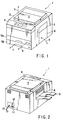
- FIG. 1 is a perspective view, as seen from a right diagonal front side, showing a color copying machine 1 (hereinafter referred to simply as a copier) serving as an image forming apparatus of the present invention
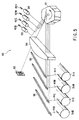
- FIG. 2 is a perspective view, as seen from a left diagonal rear side, showing the copier 1.
- a document rest 2 is provided at the top section of the copier 1 to place a document on the document rest.
- a document pressing cover 3 is provided to press the document in place and can be opened/closed in a direction as indicated by arrows in FIG. 1.
- An operator panel 4 is provided at a front upper side section of the copier 1.
- a plurality of operation keys such as a copy start switch, are provided at the operation panel 4 so as to set and execute various kinds of instructions on the copier 1.
- Sheet cassettes 5a, 5b are provided at a lower zone of the copier 1 to receive recording sheets, by size, in plural numbers, the recording sheets being of such a type as to allow on image to be transferred thereto.
- the sheet cassettes 5a, 5b can be inserted/withdrawn into/out of the copier 1 along the directions indicated as arrows b and c in FIG. 1.
- An access cover 6 and sheet guide 7 are provided at the right surface side of the copier, the former being provided for handling jamming of sheets and the latter for manually supplying sheets.
- the access cover 6 is so provided as to allow it to be opened/closed relative to the copier 1 in a direction of arrows d in FIG. 1.
- the sheet guide 7 is opened and closed as a necessity arises.
- a discharge outlet 8 and discharge tray 9 are provided on the left surface side of the copier 1.
- the discharge outlet 8 is used to discharge a recording sheet with an image formed thereon.
- the discharge tray 9 is used to receive those recorded sheets discharged via the discharge outlet 9.
- the discharge tray 9 is detachably provided on the copier 1.
- a power supply cord 10, I/F connector 11 and I/F connector 12 are provided on the back surface side of the copier 1.
- the power supply code 10 supplies an electric power to the copier 1, the I/F connector 11 is connected to an external device, such as a personal computer, and the I/F connector 12 is connected to a facsimile equipment.
- FIG. 3 is a cross-sectional view diagrammatically showing an internal arrangement of the copying machine 1.
- the copier 1 can be broadly grouped into:
- the image reading section 20 has an optical system 25 comprising an illumination lamp 21 for illuminating a document, not shown, placed on the document rest 2, reflection mirrors 22a, 22b, 22c for sequentially reflecting a reflection light beam coming from the document, and an image forming lens 23, a light receiving element 24, such as a CCD, for photoelectrically converting the reflected light beam coming from the optical system 25 to an electric signal, and an image processing device 26 for subjecting the photoelectrically converted signal to color separation to provide image signals of the respective colors yellow (Y), magenta (M), cyan (C) and black (B).
- an optical system 25 comprising an illumination lamp 21 for illuminating a document, not shown, placed on the document rest 2, reflection mirrors 22a, 22b, 22c for sequentially reflecting a reflection light beam coming from the document, and an image forming lens 23, a light receiving element 24, such as a CCD, for photoelectrically converting the reflected light beam coming from the optical system 25 to an electric signal, and an image processing device 26 for subjecting the
- the image forming section 30, utilizing the so-called photoelectric system, utilizes a light exposure device 40 for exposing, with light, the surfaces (hereinafter referred to simply as drum surfaces) of later-described photosensitive drums 51Y, 51M, 51C, 51B provided for the respective colors (Y, M, C, B), an image forming mechanism 50 including the photosensitive drums 51Y, 51M, 51C and 51B for the respective colors, a transfer mechanism 60, and a fixing device 70.
- the transfer mechanism 60 has a transfer belt 61 for conveying the recording sheet along the drum surfaces of the respective photosensitive drums 51Y, 51M, 51C, 51B.
- the transfer belt 61 is stretched around and between a drive roller 63 and a driven roller 64 such that all these photosensitive drums are set in rolling contact with the transfer belt. These rollers are located in a spaced-apart relation.
- the drive roller 63 is rotated, by a motor not shown, in a direction of an arrow in FIG. 3.
- the transfer belt 61 is run at a predetermined speed in an endless fashion in a direction indicated by an arrow in FIG. 3.
- a predetermined tension force is applied, by a pressure-applying mechanism not shown, to the driven roller 64 in a direction away from the drive roller 63, so that the transfer belt 61 is stretched taut.
- Transfer devices 62Y, 62M, 62C, 62B are provided inside the transfer belt 61.
- the transfer devices 62Y, 62M, 62C, 62B are arranged below, and opposite to, the photosensitive drums 51Y, 51M, 51C, 51B, respectively, with the upper flight of the transfer belt 61 interposed.
- a sheet feed-in guide device 65, cleaning device 66 and later-described image sensor 67 are provided in given places relative to the transfer belt 61, the sheet feed-in guide device 65 feeding the recording sheet on the transfer belt 61 in correct order and the cleaning device 66 cleaning the surface of the transfer belt 61.
- the image forming mechanism 50 is provided above the transfer mechanism 60.
- image forming units 50Y, 50M, 50C and 50B are equidistantly arranged so as to form an image of any of the colors yellow (Y), magenta (M), cyan (C) and black (B) as seen from the right side in FIG. 3.
- the respective image forming units 50Y, 50M, 50C, 50B are of such a type as to have a similar structure. They form an image of any of such colors through the known photoelectric process.
- the respective image forming units 50Y, 50M, 50C, 50B have photosensitive drums 51Y, 51M, 51C, 51B, respectively.
- the four photosensitive drums are provided, there is also the case where these four photosensitive drums are handled as a single image carrier means.
- the light exposure device 40 is arranged above the image forming mechanism 50 and has laser light sources 42Y, 42M, 42C, 42B (see FIGS. 5 and 6) driven on the basis of an image signal of any of colors prepared by the image processing device 26.
- the respective laser light sources 42Y, 42M, M2C, 42B exit laser beams 41Y, 41M, 41C, 41B corresponding to the respective colors based on those color-separated image signals.
- the laser beams exited from the respective laser sources are directed toward the drum surfaces of the photosensitive drums 51Y, 51M, 51C, 51B in the image forming units 50Y, 50M, 50C, 50B past a laser-described optical system to illuminate these drum surfaces. By doing so, those electrostatic latent images corresponding to the respective colors are formed on the corresponding drum surfaces.
- cleaning devices 54Y, 54M, 54C, 54B and discharging devices 55Y, 55M, 55C, 55B, respectively, are provided along the rotation directions of the photosensitive drums 51Y, 51M, 51C, 51B.
- the charging device charges the corresponding drum surface to a predetermined potential and the developing device is supplied with a developing agent of a color corresponding to an electrostatic latent image formed on the corresponding drum surface and develops the latent image.
- the laser beams 41Y, 41M, 41C, 41B of those colors guided via the light exposure device 40 are guided to the drum surfaces charged by the charging devices 52Y, 52M, 52C, 52B to predetermined potentials and those electrostatic latent images corresponding to the respective colors are formed on the corresponding drum surfaces.
- the developing agents of the respective colors are supplied by the developing devices 53Y, 53M, 53C, 53B to the electrostatic latent images of the respective drum surfaces, so that these latent images are converted to visual images.
- the fixing device 70 has a pair of heating rollers 71a, 71b, upper and lower. These rollers are heated to a predetermined temperature and pressed under a predetermined pressure and allow the sheet to pass therebetween, so that the developing agent's image on the sheet is melted to fix it to the sheet.
- the sheet conveying section 80 has the sheet cassettes 5a, 5b each with a plurality of sheets held therein.
- the respective sheet cassettes 5a, 5b each store a predetermined size of recording sheets and set below the transfer mechanism 60.
- a sheet feeding section 80 has a sheet feeding section 82 for allowing the recording sheet which is taken out from the sheet cassette (5a, 5b) to he conveyed toward the image forming section 30.
- the sheet feeding section 82 has pickup rollers 83a, 83b for picking up the recording sheet one by one from the sheet cassette (5a, 5b), conveying roller pairs 84a, 84b for conducting the picked-up recording sheet onto the transfer belt 61, and a aligning roller pair 85 for adjusting a timing in which the recording sheet is fed.
- a manual sheet feeding device 86 is provided upstream of the aligning roller pair 85 to allow the recording sheet which is manually fed via the sheet guide 7 (see FIG. 1) to be guided onto the transfer belt 61. With the sheet guide 7 set in an opened state, a sheet is placed on the sheet guide 7 and a pick-up roller 87 is rotated to allow the leading edge of the recording sheet to be sent into the aligning roller 85.
- the document reading section 20 is started, so that the illumination lamp 21 is lighted and the optical system 25 operates. Light reflected from the document is received by the light receiving element 24 past the optical system 25 and, being converted to an electric signal, fed to the image processing device 26.
- the image signal thus fed is separated by the image processing device 26 into color image signals corresponding to yellow, magenta, cyan and black. These color image signals are sent to a writing image processing device, not shown.
- the signals coming from the writing image processing device are sent to the light exposure device 40.
- the photosensitive drums 51Y, 51M, 51C, 51B, transfer belt 61 fixing device 70, etc. are started.
- the recording sheet held in the sheet cassette (5a, 5b) or the recording sheet manually fed via the manual sheet feeding device 86 is picked up by the pick-up roller (83a, 83b) or pick-up roller 87 in the manual sheet supply device.
- the recording sheet picked up by the picked-up roller (83a, 83b) is conveyed by the conveying roller pair (84a, 84b) to the aligning roller 85 where its sheet supplying timing is adjusted. And the recording sheet is sent onto the transfer belt 61.
- the image signals from the writing image processing device are sent to the light exposure device 40 and exited as laser beams 41Y, 41M, 41C, 41B corresponding to the respective colors.
- the exiting timings of the laser beams exited from the respective laser light sources 42Y, 42M, 42C, 42B, that is, the writing timings, are adjusted by the method as will be set out below.
- the laser beam 41Y for a yellow image is exited from the light beam source 42Y by energizing the yellow laser light source 42Y corresponding to the yellow image signal by means of the light exposure device 40.
- the drum surface of the photosensitive drum 51Y being uniformly charged by the charging device 52Y, is subjected to light exposure by the laser light beam 41Y to form an electrostatic latent image corresponding to the yellow image signal.
- the photosensitive drum 51Y is rotated in a direction of an arrow e (see FIG. 4) and the electrostatic latent image on the photosensitive drum 51Y is moved by the rotation of the photosensitive drum 51Y.
- the latent image on the photosensitive drum is developed by the developing device 53Y to provide a yellow developing agent image.
- the yellow image is transferred by the transfer device 62Y onto the recording sheet fed on the transfer belt 61.
- the yellow developing agent left untransferred on the surface of the photosensitive drum 61Y is cleaned by a corresponding cleaning device 54Y off the drum surface.
- a remnant potential on the photosensitive drum 51Y is uniformly lowered by being illuminated by a discharging device 55, thus being in readiness for the next photoelectric process.
- the corresponding image signals are sent to the light exposure device 40, the corresponding laser beam sources 42M, 42C and 42B are energized in accordance with the respective image signals to allow the laser beams 41M, 41C, 41B to be exited, and image of the corresponding colors are formed through the same process as that of the yellow image forming means 50Y in the respective image forming means.
- the recording sheet is conveyed on the transfer belt 61, the respective color images are sequentially transferred, the image-transferred sheet is separated as a forced separation, either around the curvature of the drive roller 63 or by a separation claw, not shown, off the transfer belt 61 and sent to the fixing device 70.
- the resultant sheet is image-fixed either through the application of heat or under pressure, and the fixed sheet is discharged via the discharge outlet 8 onto the discharge tray 9 provided outside the copier 1.
- the light exposure device 40 has a plurality of laser light beam sources 42Y, 42M, 42C, 42B energized in accordance with the color-separated image signals.
- the respective laser light beam sources 42Y, 42M, 42C, 42B exit laser light beams 41Y, 41M, 41C, 41B on the basis of image signals of corresponding colors.
- the light exposure device 40 has one polygon mirror 91 for allowing the laser light beams 41Y, 41M, 41C, 41B which are exited from the corresponding laser light sources 42Y, 42M, 42C, 42B to be continuously and periodically deflected and these beams to be directed onto the surfaces of the respective photosensitive drums 51Y, 51M, 51C, 51B, so that scanning can be made on the drum surfaces in the drum's rotation directions, that is, in the horizontal scanning directions.
- the light exposure device 40 includes a light receiving element 92 for receiving a portion of the laser beam at a position deflected by the polygon mirror 91 away from the image area, the laser beam being exited from the black laser light source 42B serving as a reference light source.
- the laser beams 41Y, 41M, 41C, 41B are exited from the laser beam sources 42Y, 42M, 42C, 42B in a way to correspond to the color-separated image signals and are conducted to the polygon mirror 91 past pre-deflection lenses 93.
- the polygon mirror 91 provides a multi-face mirror at its outer periphery and, being rotated at a predetermined speed in a direction of an arrow in FIG. 5, reflects all the laser beams and periodically deflected.
- the direction in which the laser beams are deflected by the polygon mirror 91 corresponds to the horizontal scanning direction, that is, the direction corresponding to the rotation axis along which the photosensitive drum is rotated.
- the respective laser beams 41Y, 41M, 41C, 41B deflected by the polygon mirror 91, being passed through a post-deflection lens 94, are directed, past corresponding reflection mirrors 95, to the surfaces of the photosensitive drums 51Y, 51M, 51C, 51B for illumination.
- the respective drum surfaces With the rotations of the respective photosensitive drums 51Y, 51M, 51C, 51B, the respective drum surfaces are scanned, with the corresponding color laser beams, in the horizontal scanning direction and in the vertical scanning direction. In this way, electrostatic latent images are created on the drum surfaces in a way to correspond to the color-separated image signals.
- the electrostatic latent images of the corresponding colors formed on the respective surface, being developed as already set out above, are sequentially transferred to the recording sheet with the developing agents deposited thereon and are fixed, so that a color image is created on the recording sheet.
- the surface accuracy and mounting angle of an optical member such as the pre-deflection lens 93, post-deflection lens 94 and reflection mirror 95, as well as the timing in which writing is effected (scanning is started) in a horizontal direction with the laser beams 41Y, 41M, 41C, 41B from the laser beam sources 42Y, 42M, 42C and 41B, are adjusted with high accuracy, so that an accurate registration is achieved among the developing agent images of respective colors on the recording sheet and hence any image defect, such as a color misregister, never emerges on an output color image.
- the timing in which writing is made by the laser beam in a horizontal direction is shifted to cause the shifting of the electrostatic latent images on the respective photosensitive drums, so that the image defect, such as a color misregister, emerges on the output image.
- the writing timings of the laser beams from the respective laser beam sources 42Y, 42M, 42C, 42B are so adjusted as to prevent such misregister emerging on the output image.
- the control system of the light exposure device 40 includes a controller 100 serving as a control means of the present invention.
- To the control circuit 100 are connected those drive circuits 96Y, 96M, 96C, 96B adapted to drive laser beam sources 42Y (beam source C), 42M (beam source B), 42C (beam source A) and 42B (reference beam source).
- the above-mentioned light receiving element 92 and image sensor 67 are connected to the controller 100.
- the image sensor 67 is located at a place above, and spaced a given distance apart from the transfer belt 61 and detects a later-described register pattern transferred to the transfer belt 61.
- the controller 100 Based on an image signal including register patterns initially prepared for timing adjustment, the controller 100 generates control signals to the drive circuits 96Y, 96M, 96C, 96B at a power-ON time, at a time of the ending of a warm-up operation immediately following the stopping of the device or at any arbitrary time at which the images are being output.
- the respective drive circuits energize the respective laser beam sources 42Y, 42M, 42C, 42B on the basis of the corresponding control signals.
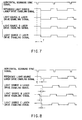
- the controller 100 receives the laser beam signal coming past the light receiving element 92 from the post-deflection lens 94 after it has been exited from the reference beam source 42B and deflected by the pre-deflection mirror and then polygon mirror 91 and obtains a horizontal scanning sync signal (hereinafter referred to simply as a sync signal) as shown in FIG. 7. And the controller 100 supplies laser drive enabling signals to the respective drive circuits 96Y, 96M, 96C, 96B in a way to be delayed a time T from the obtainment of the sync signal. By doing so, laser beams of the respective colors including the register patterns are exited.
- a sync signal horizontal scanning sync signal
- electrostatic latent images containing the register patterns are formed on the surfaces of the photosensitive drums 51Y, 51M, 51C, 51B. And the electrostatic latent images on the corresponding drum surfaces are developed by the developing agents to provide register pattern images of the respective colors on the corresponding drum surfaces. And the pattern images on the corresponding drum surfaces are sequentially transferred directly to the transfer belt 61 and the register patterns of the corresponding colors are formed on the transfer belt 61.
- the register patterns of the respective colors on the transfer belt 61 are read out by the image sensor 67.
- the sensor detects, relative to the register pattern of the black (reference), shifts of the register patterns of the other colors.
- the controller 100 decides that no laser beam is exited from the respective laser beam source and that there occurs a light exposure error. And the controller 100 suspends a subsequent sheet from being supplied and displays the contents of the error via the operator panel 4.
- the amount of shift of the register pattern is corrected as being set to be zero and a corresponding laser drive enabling signal of a write timing as shown, for example, in FIG. 8 is created.
- the respective drive circuits 96Y, 96M, 96C, 96B are energized based on such signal to correct the write timings of the laser beams from the laser beam sources 42Y, 42M, 42C, 42B.
- Subsequent write timings of the laser beams from the respective laser beam sources 42Y, 42M, 42C, 42B are adjusted by such corrected timings, so that an image defect, such as a color misregister, does not emerge on the output image.
- the register patterns are formed on the transfer belt 61 with the conveying sheet placed relative to the transfer belt. And the register patterns are read out by the image sensor 67 and, by doing so, it is possible to control the write timings of the respective laser beams.
- the register patterns are read out by the image sensor 67 and, by doing so, it is possible to control the write timings of the respective laser beams.
- a single polygon mirror 91 and a single light receiving element adapted to receive, as a reference beam, a portion of the laser beam 41B exited from the reference beam source 42B and a sync signal is obtained by the reference beam.
- the register pattern of the respective color is output onto the transfer belt 61 and any amounts of shifts of the register patterns are detected by the image sensor 67.
- the detected amounts of shifts are fed back to the drive circuits 96Y, 96M, 96C, 96B for energizing the respective beam sources 42Y, 42M, 42C, 42B and, by doing so, the write timings of the laser beams 41Y, 41M, 41C, 41B are corrected by setting the amounts of shifts of the register patterns to be zero.
- the present embodiment it is not necessary that a plurality of reflection mirrors and of light receiving elements be provided for detecting the write timings of writing laser beams of the respective colors in the horizontal scanning direction. It is, therefore, possible to manufacture an apparatus as a simpler and low-cost unit. Further, the write timings of writing the respective laser beams in the horizontal scanning direction are corrected by detecting amounts of shifts of the register patterns. It is, therefore, possible to easily and positively adjust the optical paths of the respective laser beams even if the accuracy of optical members or components as well as their mounting accuracys are lower.
- the present invention is not restricted to the above-mentioned embodiment and various changes or modification of the present invention can be made without departing from the spirit and scope of the present invention.
- the laser beam source 42B for block is used as the reference beam, it is possible to use any of the laser sources of the other colors as the reference beam source.
Landscapes
- Engineering & Computer Science (AREA)
- Multimedia (AREA)
- Signal Processing (AREA)
- Color Electrophotography (AREA)
- Mechanical Optical Scanning Systems (AREA)
- Facsimile Scanning Arrangements (AREA)
- Control Or Security For Electrophotography (AREA)
- Dot-Matrix Printers And Others (AREA)
Applications Claiming Priority (3)
| Application Number | Priority Date | Filing Date | Title |
|---|---|---|---|
| JP9200069A JPH1144853A (ja) | 1997-07-25 | 1997-07-25 | マルチビーム光学装置、およびこのマルチビーム光学装置を備えた画像形成装置 |
| JP200069/97 | 1997-07-25 | ||
| JP20006997 | 1997-07-25 |
Publications (2)
| Publication Number | Publication Date |
|---|---|
| EP0893911A2 true EP0893911A2 (de) | 1999-01-27 |
| EP0893911A3 EP0893911A3 (de) | 1999-12-29 |
Family
ID=16418335
Family Applications (1)
| Application Number | Title | Priority Date | Filing Date |
|---|---|---|---|
| EP98113319A Withdrawn EP0893911A3 (de) | 1997-07-25 | 1998-07-16 | Optisches Gerät mit mehreren Strahlen und damit ausgerüstetes Bilderzeugungsgerät |
Country Status (4)
| Country | Link |
|---|---|
| US (1) | US6301021B1 (de) |
| EP (1) | EP0893911A3 (de) |
| JP (1) | JPH1144853A (de) |
| CN (1) | CN1130068C (de) |
Families Citing this family (14)
| Publication number | Priority date | Publication date | Assignee | Title |
|---|---|---|---|---|
| US6573918B2 (en) * | 2000-08-22 | 2003-06-03 | Ricoh Company, Ltd. | Image forming apparatus having a plurality of image data interfaces |
| US6842187B2 (en) * | 2003-05-02 | 2005-01-11 | Kabushiki Kaisha Toshiba | Optical beam scanning device and image forming apparatus |
| CN1324346C (zh) * | 2003-12-19 | 2007-07-04 | 株式会社理光 | 彩色图像形成装置 |
| US7158163B2 (en) * | 2004-03-22 | 2007-01-02 | Kabushiki Kaisha Toshiba | Light beam scanning apparatus capable of shortening the standby time and image forming apparatus capable of shortening the standby time |
| KR100800705B1 (ko) * | 2004-03-26 | 2008-02-01 | 삼성전자주식회사 | 입사파에 의해 발생되는 반사파를 억제하는 카메라 렌즈장치 |
| JP4429127B2 (ja) * | 2004-09-22 | 2010-03-10 | シャープ株式会社 | 光ビーム走査装置及び画像形成装置 |
| JP4845456B2 (ja) * | 2005-09-02 | 2011-12-28 | キヤノン株式会社 | 光走査装置および画像形成装置 |
| JP2006091879A (ja) * | 2005-09-16 | 2006-04-06 | Fuji Xerox Co Ltd | 光走査装置 |
| JP2007147826A (ja) * | 2005-11-25 | 2007-06-14 | Ricoh Co Ltd | 光書込装置、光書込方法、画像形成装置及び画像形成方法 |
| JP4238866B2 (ja) * | 2005-11-28 | 2009-03-18 | コニカミノルタビジネステクノロジーズ株式会社 | 画像形成装置 |
| US7777923B2 (en) * | 2006-07-20 | 2010-08-17 | Kabushiki Kaisha Toshiba | Optical beam scanning apparatus, image forming apparatus |
| US8144179B2 (en) * | 2007-08-21 | 2012-03-27 | Kabushiki Kaisha Toshiba | Image forming apparatus and control method thereof |
| US9097843B2 (en) | 2012-12-07 | 2015-08-04 | Guardian Industries Corp. | First surface mirror, method of making the same, and scanner and/or copier including the same |
| TWI620038B (zh) | 2017-01-11 | 2018-04-01 | 財團法人工業技術研究院 | 曝光方法和系統以及雷射直接成像系統 |
Family Cites Families (8)
| Publication number | Priority date | Publication date | Assignee | Title |
|---|---|---|---|---|
| US4561717A (en) * | 1980-05-16 | 1985-12-31 | Hitachi, Ltd. | Optical system for information processing |
| EP0478005B1 (de) * | 1987-04-28 | 1995-06-28 | Canon Kabushiki Kaisha | Multibilderzeugungsgerät |
| JPS63292163A (ja) * | 1987-05-26 | 1988-11-29 | Ricoh Co Ltd | 画像形成装置 |
| US5072244A (en) * | 1987-11-30 | 1991-12-10 | Canon Kabushiki Kaisha | Superposed image forming apparatus with plural and adjustable image forming stations |
| JPH0283518A (ja) * | 1988-09-20 | 1990-03-23 | Minolta Camera Co Ltd | レーザビーム走査装置 |
| JPH0547084A (ja) | 1991-08-14 | 1993-02-26 | Sony Corp | 記録再生装置 |
| US5291223A (en) * | 1991-09-19 | 1994-03-01 | Konica Corporation | Exposure unit for a multicolor image forming apparatus capable of better registration of the multicolor images |
| JPH08262352A (ja) * | 1995-03-23 | 1996-10-11 | Toshiba Corp | 光走査装置ならびにこの光走査装置を利用した画像形成装置 |
-
1997
- 1997-07-25 JP JP9200069A patent/JPH1144853A/ja active Pending
-
1998
- 1998-07-16 EP EP98113319A patent/EP0893911A3/de not_active Withdrawn
- 1998-07-20 US US09/118,976 patent/US6301021B1/en not_active Expired - Fee Related
- 1998-07-24 CN CN98116167.7A patent/CN1130068C/zh not_active Expired - Fee Related
Also Published As
| Publication number | Publication date |
|---|---|
| CN1206855A (zh) | 1999-02-03 |
| EP0893911A3 (de) | 1999-12-29 |
| US6301021B1 (en) | 2001-10-09 |
| JPH1144853A (ja) | 1999-02-16 |
| CN1130068C (zh) | 2003-12-03 |
Similar Documents
| Publication | Publication Date | Title |
|---|---|---|
| JP3377779B2 (ja) | 画像形成装置、および画像形成方法 | |
| JP3762003B2 (ja) | 画像形成装置 | |
| EP0893911A2 (de) | Optisches Gerät mit mehreren Strahlen und damit ausgerüstetes Bilderzeugungsgerät | |
| US5373355A (en) | Imperfect register correcting method to be carried out on a multicolor image forming apparatus | |
| US5926203A (en) | Image recording method and apparatus using multiple laser beams | |
| KR19980071745A (ko) | 칼라화상형성장치 | |
| EP0666685B1 (de) | Bilderzeugungsgerät | |
| US6246857B1 (en) | Image forming apparatus | |
| JPH10198109A (ja) | 画像形成装置 | |
| JP2000071522A (ja) | 画像形成装置 | |
| JP4988261B2 (ja) | 画像形成装置 | |
| JP3556511B2 (ja) | 画像形成装置における光走査装置の位置調整方法 | |
| US5943532A (en) | Image forming apparatus | |
| JP3633181B2 (ja) | 画像形成装置の画像位置調整方法 | |
| JPH10235928A (ja) | 光走査装置および画像形成装置 | |
| US11025799B2 (en) | Image forming apparatus correcting magnification of image in scanning direction of light beam | |
| JPH04317247A (ja) | デジタルカラー複写機 | |
| US20250044719A1 (en) | Image forming apparatus | |
| JPH0460568A (ja) | 画像形成装置 | |
| JPH09251223A (ja) | 画像形成装置 | |
| JPH0320837Y2 (de) | ||
| JP2026000565A (ja) | 書込み装置、および書込み方法 | |
| JPH11327246A (ja) | 画像形成装置 | |
| JPH0739900Y2 (ja) | 画像形成装置の搬送ベルト装置 | |
| JP2026002494A (ja) | 書込み装置、および書込み方法 |
Legal Events
| Date | Code | Title | Description |
|---|---|---|---|
| PUAI | Public reference made under article 153(3) epc to a published international application that has entered the european phase |
Free format text: ORIGINAL CODE: 0009012 |
|
| 17P | Request for examination filed |
Effective date: 19980729 |
|
| AK | Designated contracting states |
Kind code of ref document: A2 Designated state(s): DE FR GB |
|
| AX | Request for extension of the european patent |
Free format text: AL;LT;LV;MK;RO;SI |
|
| PUAL | Search report despatched |
Free format text: ORIGINAL CODE: 0009013 |
|
| AK | Designated contracting states |
Kind code of ref document: A3 Designated state(s): AT BE CH CY DE DK ES FI FR GB GR IE IT LI LU MC NL PT SE |
|
| AX | Request for extension of the european patent |
Free format text: AL;LT;LV;MK;RO;SI |
|
| AKX | Designation fees paid |
Free format text: DE FR GB |
|
| 17Q | First examination report despatched |
Effective date: 20010816 |
|
| STAA | Information on the status of an ep patent application or granted ep patent |
Free format text: STATUS: THE APPLICATION HAS BEEN WITHDRAWN |
|
| 18W | Application withdrawn |
Effective date: 20040317 |