EP0894811A1 - Copolymere auf Basis von ungesättigten Dicarbonsäure-Derivaten und Oxyalkylen-glykol-Alkenylethern - Google Patents
Copolymere auf Basis von ungesättigten Dicarbonsäure-Derivaten und Oxyalkylen-glykol-Alkenylethern Download PDFInfo
- Publication number
- EP0894811A1 EP0894811A1 EP98114350A EP98114350A EP0894811A1 EP 0894811 A1 EP0894811 A1 EP 0894811A1 EP 98114350 A EP98114350 A EP 98114350A EP 98114350 A EP98114350 A EP 98114350A EP 0894811 A1 EP0894811 A1 EP 0894811A1
- Authority
- EP
- European Patent Office
- Prior art keywords
- mol
- formula
- atoms
- radical
- copolymers
- Prior art date
- Legal status (The legal status is an assumption and is not a legal conclusion. Google has not performed a legal analysis and makes no representation as to the accuracy of the status listed.)
- Withdrawn
Links
- 229920001577 copolymer Polymers 0.000 title claims abstract description 45
- 150000001990 dicarboxylic acid derivatives Chemical class 0.000 title claims abstract description 20
- -1 unsaturated dicarboxylic acid imide Chemical class 0.000 claims abstract description 29
- 125000002496 methyl group Chemical group [H]C([H])([H])* 0.000 claims abstract description 27
- 239000000178 monomer Substances 0.000 claims abstract description 24
- 239000003999 initiator Substances 0.000 claims abstract description 9
- 239000004215 Carbon black (E152) Substances 0.000 claims abstract description 8
- 229930195733 hydrocarbon Natural products 0.000 claims abstract description 8
- QGZKDVFQNNGYKY-UHFFFAOYSA-O Ammonium Chemical compound [NH4+] QGZKDVFQNNGYKY-UHFFFAOYSA-O 0.000 claims abstract description 7
- 150000001408 amides Chemical class 0.000 claims abstract description 6
- 150000001768 cations Chemical class 0.000 claims abstract description 5
- 229910052751 metal Inorganic materials 0.000 claims abstract description 5
- 239000002184 metal Substances 0.000 claims abstract description 5
- 125000005702 oxyalkylene group Chemical group 0.000 claims abstract description 5
- 125000001495 ethyl group Chemical group [H]C([H])([H])C([H])([H])* 0.000 claims abstract description 3
- 125000001570 methylene group Chemical group [H]C([H])([*:1])[*:2] 0.000 claims abstract description 3
- 125000002348 vinylic group Chemical group 0.000 claims abstract 2
- 238000000034 method Methods 0.000 claims description 22
- XLYOFNOQVPJJNP-UHFFFAOYSA-N water Substances O XLYOFNOQVPJJNP-UHFFFAOYSA-N 0.000 claims description 21
- 125000004432 carbon atom Chemical group C* 0.000 claims description 16
- 230000000712 assembly Effects 0.000 claims description 15
- 238000000429 assembly Methods 0.000 claims description 15
- LYCAIKOWRPUZTN-UHFFFAOYSA-N ethylene glycol Natural products OCCO LYCAIKOWRPUZTN-UHFFFAOYSA-N 0.000 claims description 15
- 239000011230 binding agent Substances 0.000 claims description 13
- 229910052739 hydrogen Inorganic materials 0.000 claims description 13
- 239000001257 hydrogen Substances 0.000 claims description 13
- RTZKZFJDLAIYFH-UHFFFAOYSA-N Diethyl ether Chemical compound CCOCC RTZKZFJDLAIYFH-UHFFFAOYSA-N 0.000 claims description 10
- WGCNASOHLSPBMP-UHFFFAOYSA-N hydroxyacetaldehyde Natural products OCC=O WGCNASOHLSPBMP-UHFFFAOYSA-N 0.000 claims description 10
- 238000006116 polymerization reaction Methods 0.000 claims description 10
- 230000008569 process Effects 0.000 claims description 10
- 239000000654 additive Substances 0.000 claims description 9
- 229920002554 vinyl polymer Polymers 0.000 claims description 9
- 150000003254 radicals Chemical class 0.000 claims description 8
- 125000000391 vinyl group Chemical group [H]C([*])=C([H])[H] 0.000 claims description 8
- 125000004435 hydrogen atom Chemical class [H]* 0.000 claims description 7
- 229910052925 anhydrite Inorganic materials 0.000 claims description 6
- 239000007864 aqueous solution Substances 0.000 claims description 6
- OSGAYBCDTDRGGQ-UHFFFAOYSA-L calcium sulfate Chemical compound [Ca+2].[O-]S([O-])(=O)=O OSGAYBCDTDRGGQ-UHFFFAOYSA-L 0.000 claims description 6
- 239000004568 cement Substances 0.000 claims description 6
- 238000002360 preparation method Methods 0.000 claims description 6
- UFHFLCQGNIYNRP-UHFFFAOYSA-N Hydrogen Chemical compound [H][H] UFHFLCQGNIYNRP-UHFFFAOYSA-N 0.000 claims description 5
- 239000002253 acid Substances 0.000 claims description 5
- 150000007513 acids Chemical class 0.000 claims description 5
- NIXOWILDQLNWCW-UHFFFAOYSA-N acrylic acid group Chemical group C(C=C)(=O)O NIXOWILDQLNWCW-UHFFFAOYSA-N 0.000 claims description 5
- 125000003342 alkenyl group Chemical group 0.000 claims description 5
- 150000008056 dicarboxyimides Chemical class 0.000 claims description 5
- 239000010440 gypsum Substances 0.000 claims description 5
- 229910052602 gypsum Inorganic materials 0.000 claims description 5
- 239000000725 suspension Substances 0.000 claims description 5
- 125000002887 hydroxy group Chemical group [H]O* 0.000 claims description 4
- FQPSGWSUVKBHSU-UHFFFAOYSA-N methacrylamide Chemical class CC(=C)C(N)=O FQPSGWSUVKBHSU-UHFFFAOYSA-N 0.000 claims description 4
- 239000002904 solvent Substances 0.000 claims description 4
- 125000003107 substituted aryl group Chemical group 0.000 claims description 4
- 235000008733 Citrus aurantifolia Nutrition 0.000 claims description 3
- DGAQECJNVWCQMB-PUAWFVPOSA-M Ilexoside XXIX Chemical compound C[C@@H]1CC[C@@]2(CC[C@@]3(C(=CC[C@H]4[C@]3(CC[C@@H]5[C@@]4(CC[C@@H](C5(C)C)OS(=O)(=O)[O-])C)C)[C@@H]2[C@]1(C)O)C)C(=O)O[C@H]6[C@@H]([C@H]([C@@H]([C@H](O6)CO)O)O)O.[Na+] DGAQECJNVWCQMB-PUAWFVPOSA-M 0.000 claims description 3
- 235000011941 Tilia x europaea Nutrition 0.000 claims description 3
- 230000000996 additive effect Effects 0.000 claims description 3
- 239000004571 lime Substances 0.000 claims description 3
- 239000011734 sodium Substances 0.000 claims description 3
- 125000000542 sulfonic acid group Chemical group 0.000 claims description 3
- OYPRJOBELJOOCE-UHFFFAOYSA-N Calcium Chemical compound [Ca] OYPRJOBELJOOCE-UHFFFAOYSA-N 0.000 claims description 2
- ZLMJMSJWJFRBEC-UHFFFAOYSA-N Potassium Chemical compound [K] ZLMJMSJWJFRBEC-UHFFFAOYSA-N 0.000 claims description 2
- 239000007900 aqueous suspension Substances 0.000 claims description 2
- 239000011575 calcium Substances 0.000 claims description 2
- 125000003178 carboxy group Chemical group [H]OC(*)=O 0.000 claims description 2
- 239000011591 potassium Substances 0.000 claims description 2
- UIIIBRHUICCMAI-UHFFFAOYSA-N prop-2-ene-1-sulfonic acid Chemical compound OS(=O)(=O)CC=C UIIIBRHUICCMAI-UHFFFAOYSA-N 0.000 claims description 2
- 239000007858 starting material Substances 0.000 claims description 2
- JLVVSXFLKOJNIY-UHFFFAOYSA-N Magnesium ion Chemical compound [Mg+2] JLVVSXFLKOJNIY-UHFFFAOYSA-N 0.000 claims 1
- CIUQDSCDWFSTQR-UHFFFAOYSA-N [C]1=CC=CC=C1 Chemical compound [C]1=CC=CC=C1 CIUQDSCDWFSTQR-UHFFFAOYSA-N 0.000 claims 1
- 125000004429 atom Chemical group 0.000 claims 1
- 229910001424 calcium ion Inorganic materials 0.000 claims 1
- 229910001425 magnesium ion Inorganic materials 0.000 claims 1
- 229910001414 potassium ion Inorganic materials 0.000 claims 1
- 229910001415 sodium ion Inorganic materials 0.000 claims 1
- 238000004519 manufacturing process Methods 0.000 abstract description 8
- 150000001412 amines Chemical class 0.000 abstract description 4
- 150000001338 aliphatic hydrocarbons Chemical class 0.000 abstract description 2
- 125000000217 alkyl group Chemical group 0.000 abstract description 2
- 150000002430 hydrocarbons Chemical class 0.000 abstract 3
- 125000003118 aryl group Chemical group 0.000 abstract 2
- PPBRXRYQALVLMV-UHFFFAOYSA-N Styrene Chemical compound C=CC1=CC=CC=C1 PPBRXRYQALVLMV-UHFFFAOYSA-N 0.000 description 22
- 239000002202 Polyethylene glycol Substances 0.000 description 20
- 239000000203 mixture Substances 0.000 description 20
- 229920001223 polyethylene glycol Polymers 0.000 description 20
- 239000007787 solid Substances 0.000 description 12
- 239000004567 concrete Substances 0.000 description 11
- MGWAVDBGNNKXQV-UHFFFAOYSA-N diisobutyl phthalate Chemical compound CC(C)COC(=O)C1=CC=CC=C1C(=O)OCC(C)C MGWAVDBGNNKXQV-UHFFFAOYSA-N 0.000 description 11
- 239000000047 product Substances 0.000 description 11
- HEMHJVSKTPXQMS-UHFFFAOYSA-M sodium hydroxide Inorganic materials [OH-].[Na+] HEMHJVSKTPXQMS-UHFFFAOYSA-M 0.000 description 11
- IJGRMHOSHXDMSA-UHFFFAOYSA-N Atomic nitrogen Chemical compound N#N IJGRMHOSHXDMSA-UHFFFAOYSA-N 0.000 description 10
- PAFZNILMFXTMIY-UHFFFAOYSA-N cyclohexylamine Chemical compound NC1CCCCC1 PAFZNILMFXTMIY-UHFFFAOYSA-N 0.000 description 9
- FPYJFEHAWHCUMM-UHFFFAOYSA-N maleic anhydride Chemical compound O=C1OC(=O)C=C1 FPYJFEHAWHCUMM-UHFFFAOYSA-N 0.000 description 9
- 239000004566 building material Substances 0.000 description 8
- 229920000642 polymer Polymers 0.000 description 8
- ATVJXMYDOSMEPO-UHFFFAOYSA-N 3-prop-2-enoxyprop-1-ene Chemical compound C=CCOCC=C ATVJXMYDOSMEPO-UHFFFAOYSA-N 0.000 description 7
- QYKIQEUNHZKYBP-UHFFFAOYSA-N Vinyl ether Chemical compound C=COC=C QYKIQEUNHZKYBP-UHFFFAOYSA-N 0.000 description 7
- 238000006243 chemical reaction Methods 0.000 description 7
- 230000000052 comparative effect Effects 0.000 description 7
- IBZKBSXREAQDTO-UHFFFAOYSA-N 2-methoxy-n-(2-methoxyethyl)ethanamine Chemical compound COCCNCCOC IBZKBSXREAQDTO-UHFFFAOYSA-N 0.000 description 6
- 150000001875 compounds Chemical class 0.000 description 6
- 230000000694 effects Effects 0.000 description 6
- 229910052757 nitrogen Inorganic materials 0.000 description 6
- OFOBLEOULBTSOW-UHFFFAOYSA-N Propanedioic acid Natural products OC(=O)CC(O)=O OFOBLEOULBTSOW-UHFFFAOYSA-N 0.000 description 5
- VNWKTOKETHGBQD-UHFFFAOYSA-N methane Natural products C VNWKTOKETHGBQD-UHFFFAOYSA-N 0.000 description 5
- 239000011148 porous material Substances 0.000 description 5
- 238000012360 testing method Methods 0.000 description 5
- VZCYOOQTPOCHFL-UHFFFAOYSA-N trans-butenedioic acid Natural products OC(=O)C=CC(O)=O VZCYOOQTPOCHFL-UHFFFAOYSA-N 0.000 description 5
- YBYIRNPNPLQARY-UHFFFAOYSA-N 1H-indene Chemical group C1=CC=C2CC=CC2=C1 YBYIRNPNPLQARY-UHFFFAOYSA-N 0.000 description 4
- OZAIFHULBGXAKX-UHFFFAOYSA-N 2-(2-cyanopropan-2-yldiazenyl)-2-methylpropanenitrile Chemical compound N#CC(C)(C)N=NC(C)(C)C#N OZAIFHULBGXAKX-UHFFFAOYSA-N 0.000 description 4
- KYIKRXIYLAGAKQ-UHFFFAOYSA-N abcn Chemical compound C1CCCCC1(C#N)N=NC1(C#N)CCCCC1 KYIKRXIYLAGAKQ-UHFFFAOYSA-N 0.000 description 4
- 239000007795 chemical reaction product Substances 0.000 description 4
- VZCYOOQTPOCHFL-UPHRSURJSA-N maleic acid Chemical compound OC(=O)\C=C/C(O)=O VZCYOOQTPOCHFL-UPHRSURJSA-N 0.000 description 4
- 239000011976 maleic acid Substances 0.000 description 4
- 150000003839 salts Chemical class 0.000 description 4
- HZAXFHJVJLSVMW-UHFFFAOYSA-N 2-Aminoethan-1-ol Chemical compound NCCO HZAXFHJVJLSVMW-UHFFFAOYSA-N 0.000 description 3
- ROSDSFDQCJNGOL-UHFFFAOYSA-N Dimethylamine Chemical compound CNC ROSDSFDQCJNGOL-UHFFFAOYSA-N 0.000 description 3
- WSFSSNUMVMOOMR-UHFFFAOYSA-N Formaldehyde Chemical compound O=C WSFSSNUMVMOOMR-UHFFFAOYSA-N 0.000 description 3
- BAVYZALUXZFZLV-UHFFFAOYSA-N Methylamine Chemical compound NC BAVYZALUXZFZLV-UHFFFAOYSA-N 0.000 description 3
- 239000011398 Portland cement Substances 0.000 description 3
- 239000012190 activator Substances 0.000 description 3
- 150000005840 aryl radicals Chemical class 0.000 description 3
- 230000015572 biosynthetic process Effects 0.000 description 3
- 238000001816 cooling Methods 0.000 description 3
- DMBHHRLKUKUOEG-UHFFFAOYSA-N diphenylamine Chemical compound C=1C=CC=CC=1NC1=CC=CC=C1 DMBHHRLKUKUOEG-UHFFFAOYSA-N 0.000 description 3
- 150000002431 hydrogen Chemical class 0.000 description 3
- 229920001451 polypropylene glycol Polymers 0.000 description 3
- 150000003335 secondary amines Chemical class 0.000 description 3
- 239000000243 solution Substances 0.000 description 3
- 238000003756 stirring Methods 0.000 description 3
- 239000000126 substance Substances 0.000 description 3
- GETQZCLCWQTVFV-UHFFFAOYSA-N trimethylamine Chemical compound CN(C)C GETQZCLCWQTVFV-UHFFFAOYSA-N 0.000 description 3
- HIDBROSJWZYGSZ-UHFFFAOYSA-N 1-phenylpyrrole-2,5-dione Chemical compound O=C1C=CC(=O)N1C1=CC=CC=C1 HIDBROSJWZYGSZ-UHFFFAOYSA-N 0.000 description 2
- 125000003903 2-propenyl group Chemical group [H]C([*])([H])C([H])=C([H])[H] 0.000 description 2
- HVBSAKJJOYLTQU-UHFFFAOYSA-N 4-aminobenzenesulfonic acid Chemical compound NC1=CC=C(S(O)(=O)=O)C=C1 HVBSAKJJOYLTQU-UHFFFAOYSA-N 0.000 description 2
- PAYRUJLWNCNPSJ-UHFFFAOYSA-N Aniline Chemical compound NC1=CC=CC=C1 PAYRUJLWNCNPSJ-UHFFFAOYSA-N 0.000 description 2
- CIWBSHSKHKDKBQ-JLAZNSOCSA-N Ascorbic acid Chemical compound OC[C@H](O)[C@H]1OC(=O)C(O)=C1O CIWBSHSKHKDKBQ-JLAZNSOCSA-N 0.000 description 2
- XBPCUCUWBYBCDP-UHFFFAOYSA-N Dicyclohexylamine Chemical compound C1CCCCC1NC1CCCCC1 XBPCUCUWBYBCDP-UHFFFAOYSA-N 0.000 description 2
- VZCYOOQTPOCHFL-OWOJBTEDSA-N Fumaric acid Chemical compound OC(=O)\C=C\C(O)=O VZCYOOQTPOCHFL-OWOJBTEDSA-N 0.000 description 2
- DHMQDGOQFOQNFH-UHFFFAOYSA-N Glycine Chemical compound NCC(O)=O DHMQDGOQFOQNFH-UHFFFAOYSA-N 0.000 description 2
- MHAJPDPJQMAIIY-UHFFFAOYSA-N Hydrogen peroxide Chemical compound OO MHAJPDPJQMAIIY-UHFFFAOYSA-N 0.000 description 2
- WTDHULULXKLSOZ-UHFFFAOYSA-N Hydroxylamine hydrochloride Chemical compound Cl.ON WTDHULULXKLSOZ-UHFFFAOYSA-N 0.000 description 2
- VQTUBCCKSQIDNK-UHFFFAOYSA-N Isobutene Chemical compound CC(C)=C VQTUBCCKSQIDNK-UHFFFAOYSA-N 0.000 description 2
- WHNWPMSKXPGLAX-UHFFFAOYSA-N N-Vinyl-2-pyrrolidone Chemical compound C=CN1CCCC1=O WHNWPMSKXPGLAX-UHFFFAOYSA-N 0.000 description 2
- UFWIBTONFRDIAS-UHFFFAOYSA-N Naphthalene Chemical compound C1=CC=CC2=CC=CC=C21 UFWIBTONFRDIAS-UHFFFAOYSA-N 0.000 description 2
- GSEJCLTVZPLZKY-UHFFFAOYSA-N Triethanolamine Chemical compound OCCN(CCO)CCO GSEJCLTVZPLZKY-UHFFFAOYSA-N 0.000 description 2
- 229940077464 ammonium ion Drugs 0.000 description 2
- 230000008901 benefit Effects 0.000 description 2
- 239000003795 chemical substances by application Substances 0.000 description 2
- 239000008032 concrete plasticizer Substances 0.000 description 2
- 238000010276 construction Methods 0.000 description 2
- 238000007334 copolymerization reaction Methods 0.000 description 2
- HGCIXCUEYOPUTN-UHFFFAOYSA-N cyclohexene Chemical compound C1CCC=CC1 HGCIXCUEYOPUTN-UHFFFAOYSA-N 0.000 description 2
- JQVDAXLFBXTEQA-UHFFFAOYSA-N dibutylamine Chemical compound CCCCNCCCC JQVDAXLFBXTEQA-UHFFFAOYSA-N 0.000 description 2
- ZBCBWPMODOFKDW-UHFFFAOYSA-N diethanolamine Chemical compound OCCNCCO ZBCBWPMODOFKDW-UHFFFAOYSA-N 0.000 description 2
- 239000003480 eluent Substances 0.000 description 2
- 239000000839 emulsion Substances 0.000 description 2
- 150000002148 esters Chemical class 0.000 description 2
- FJKIXWOMBXYWOQ-UHFFFAOYSA-N ethenoxyethane Chemical compound CCOC=C FJKIXWOMBXYWOQ-UHFFFAOYSA-N 0.000 description 2
- 235000013312 flour Nutrition 0.000 description 2
- 239000004574 high-performance concrete Substances 0.000 description 2
- FSQQTNAZHBEJLS-UPHRSURJSA-N maleamic acid Chemical compound NC(=O)\C=C/C(O)=O FSQQTNAZHBEJLS-UPHRSURJSA-N 0.000 description 2
- 238000005259 measurement Methods 0.000 description 2
- CRVGTESFCCXCTH-UHFFFAOYSA-N methyl diethanolamine Chemical compound OCCN(C)CCO CRVGTESFCCXCTH-UHFFFAOYSA-N 0.000 description 2
- 235000019645 odor Nutrition 0.000 description 2
- 229920000233 poly(alkylene oxides) Polymers 0.000 description 2
- 229920001515 polyalkylene glycol Polymers 0.000 description 2
- 239000003505 polymerization initiator Substances 0.000 description 2
- 239000000843 powder Substances 0.000 description 2
- 125000002924 primary amino group Chemical group [H]N([H])* 0.000 description 2
- 239000011541 reaction mixture Substances 0.000 description 2
- 229910052708 sodium Inorganic materials 0.000 description 2
- 239000008030 superplasticizer Substances 0.000 description 2
- XOAAWQZATWQOTB-UHFFFAOYSA-N taurine Chemical compound NCCS(O)(=O)=O XOAAWQZATWQOTB-UHFFFAOYSA-N 0.000 description 2
- UMGDCJDMYOKAJW-UHFFFAOYSA-N thiourea Chemical compound NC(N)=S UMGDCJDMYOKAJW-UHFFFAOYSA-N 0.000 description 2
- OAOBMEMWHJWPNA-UHFFFAOYSA-N (4-aminophenyl)phosphonic acid Chemical compound NC1=CC=C(P(O)(O)=O)C=C1 OAOBMEMWHJWPNA-UHFFFAOYSA-N 0.000 description 1
- 229920002818 (Hydroxyethyl)methacrylate Polymers 0.000 description 1
- VACQOXIVQVPQKN-ARJAWSKDSA-N (z)-4-(2,2-dimethoxyethylamino)-4-oxobut-2-enoic acid Chemical compound COC(OC)CNC(=O)\C=C/C(O)=O VACQOXIVQVPQKN-ARJAWSKDSA-N 0.000 description 1
- WHZLCOICKHIPRL-SREVYHEPSA-N (z)-4-anilino-4-oxobut-2-enoic acid Chemical compound OC(=O)\C=C/C(=O)NC1=CC=CC=C1 WHZLCOICKHIPRL-SREVYHEPSA-N 0.000 description 1
- KZXUCEDDWWVYLD-WAYWQWQTSA-N (z)-4-oxo-4-(4-sulfoanilino)but-2-enoic acid Chemical compound OC(=O)\C=C/C(=O)NC1=CC=C(S(O)(=O)=O)C=C1 KZXUCEDDWWVYLD-WAYWQWQTSA-N 0.000 description 1
- VMDQUQBEIFMAIC-UHFFFAOYSA-N 1-(2,6-dimethylphenyl)pyrrole-2,5-dione Chemical compound CC1=CC=CC(C)=C1N1C(=O)C=CC1=O VMDQUQBEIFMAIC-UHFFFAOYSA-N 0.000 description 1
- AXTADRUCVAUCRS-UHFFFAOYSA-N 1-(2-hydroxyethyl)pyrrole-2,5-dione Chemical compound OCCN1C(=O)C=CC1=O AXTADRUCVAUCRS-UHFFFAOYSA-N 0.000 description 1
- VXNZUUAINFGPBY-UHFFFAOYSA-N 1-Butene Chemical group CCC=C VXNZUUAINFGPBY-UHFFFAOYSA-N 0.000 description 1
- UAJRSHJHFRVGMG-UHFFFAOYSA-N 1-ethenyl-4-methoxybenzene Chemical compound COC1=CC=C(C=C)C=C1 UAJRSHJHFRVGMG-UHFFFAOYSA-N 0.000 description 1
- AKUNSTOMHUXJOZ-UHFFFAOYSA-N 1-hydroperoxybutane Chemical compound CCCCOO AKUNSTOMHUXJOZ-UHFFFAOYSA-N 0.000 description 1
- HECLRDQVFMWTQS-RGOKHQFPSA-N 1755-01-7 Chemical compound C1[C@H]2[C@@H]3CC=C[C@@H]3[C@@H]1C=C2 HECLRDQVFMWTQS-RGOKHQFPSA-N 0.000 description 1
- YAJYJWXEWKRTPO-UHFFFAOYSA-N 2,3,3,4,4,5-hexamethylhexane-2-thiol Chemical compound CC(C)C(C)(C)C(C)(C)C(C)(C)S YAJYJWXEWKRTPO-UHFFFAOYSA-N 0.000 description 1
- FXNDIJDIPNCZQJ-UHFFFAOYSA-N 2,4,4-trimethylpent-1-ene Chemical compound CC(=C)CC(C)(C)C FXNDIJDIPNCZQJ-UHFFFAOYSA-N 0.000 description 1
- SMZOUWXMTYCWNB-UHFFFAOYSA-N 2-(2-methoxy-5-methylphenyl)ethanamine Chemical compound COC1=CC=C(C)C=C1CCN SMZOUWXMTYCWNB-UHFFFAOYSA-N 0.000 description 1
- 229920000536 2-Acrylamido-2-methylpropane sulfonic acid Polymers 0.000 description 1
- XHZPRMZZQOIPDS-UHFFFAOYSA-N 2-Methyl-2-[(1-oxo-2-propenyl)amino]-1-propanesulfonic acid Chemical compound OS(=O)(=O)CC(C)(C)NC(=O)C=C XHZPRMZZQOIPDS-UHFFFAOYSA-N 0.000 description 1
- LTHNHFOGQMKPOV-UHFFFAOYSA-N 2-ethylhexan-1-amine Chemical compound CCCCC(CC)CN LTHNHFOGQMKPOV-UHFFFAOYSA-N 0.000 description 1
- RCEJCSULJQNRQQ-UHFFFAOYSA-N 2-methylbutanenitrile Chemical compound CCC(C)C#N RCEJCSULJQNRQQ-UHFFFAOYSA-N 0.000 description 1
- FHBWGXDQIOWTCK-UHFFFAOYSA-N 2-methylpentanenitrile Chemical compound CCCC(C)C#N FHBWGXDQIOWTCK-UHFFFAOYSA-N 0.000 description 1
- XEEYSDHEOQHCDA-UHFFFAOYSA-N 2-methylprop-2-ene-1-sulfonic acid Chemical compound CC(=C)CS(O)(=O)=O XEEYSDHEOQHCDA-UHFFFAOYSA-N 0.000 description 1
- PHRHHNWLDSHEOG-UHFFFAOYSA-N 4-(2,5-dioxopyrrol-1-yl)benzenesulfonic acid Chemical compound C1=CC(S(=O)(=O)O)=CC=C1N1C(=O)C=CC1=O PHRHHNWLDSHEOG-UHFFFAOYSA-N 0.000 description 1
- JLBJTVDPSNHSKJ-UHFFFAOYSA-N 4-Methylstyrene Chemical compound CC1=CC=C(C=C)C=C1 JLBJTVDPSNHSKJ-UHFFFAOYSA-N 0.000 description 1
- NDYYJXGERWTRSD-UHFFFAOYSA-N 4-aminonaphthalene-2,7-disulfonic acid Chemical compound OS(=O)(=O)C1=CC=C2C(N)=CC(S(O)(=O)=O)=CC2=C1 NDYYJXGERWTRSD-UHFFFAOYSA-N 0.000 description 1
- KWSLGOVYXMQPPX-UHFFFAOYSA-N 5-[3-(trifluoromethyl)phenyl]-2h-tetrazole Chemical compound FC(F)(F)C1=CC=CC(C2=NNN=N2)=C1 KWSLGOVYXMQPPX-UHFFFAOYSA-N 0.000 description 1
- OMPJBNCRMGITSC-UHFFFAOYSA-N Benzoylperoxide Chemical compound C=1C=CC=CC=1C(=O)OOC(=O)C1=CC=CC=C1 OMPJBNCRMGITSC-UHFFFAOYSA-N 0.000 description 1
- JIGUQPWFLRLWPJ-UHFFFAOYSA-N Ethyl acrylate Chemical compound CCOC(=O)C=C JIGUQPWFLRLWPJ-UHFFFAOYSA-N 0.000 description 1
- IAYPIBMASNFSPL-UHFFFAOYSA-N Ethylene oxide Chemical compound C1CO1 IAYPIBMASNFSPL-UHFFFAOYSA-N 0.000 description 1
- WHUUTDBJXJRKMK-UHFFFAOYSA-N Glutamic acid Natural products OC(=O)C(N)CCC(O)=O WHUUTDBJXJRKMK-UHFFFAOYSA-N 0.000 description 1
- 239000004471 Glycine Substances 0.000 description 1
- WOBHKFSMXKNTIM-UHFFFAOYSA-N Hydroxyethyl methacrylate Chemical compound CC(=C)C(=O)OCCO WOBHKFSMXKNTIM-UHFFFAOYSA-N 0.000 description 1
- WHUUTDBJXJRKMK-VKHMYHEASA-N L-glutamic acid Chemical compound OC(=O)[C@@H](N)CCC(O)=O WHUUTDBJXJRKMK-VKHMYHEASA-N 0.000 description 1
- YIVJZNGAASQVEM-UHFFFAOYSA-N Lauroyl peroxide Chemical compound CCCCCCCCCCCC(=O)OOC(=O)CCCCCCCCCCC YIVJZNGAASQVEM-UHFFFAOYSA-N 0.000 description 1
- 229920000877 Melamine resin Polymers 0.000 description 1
- CERQOIWHTDAKMF-UHFFFAOYSA-N Methacrylic acid Chemical compound CC(=C)C(O)=O CERQOIWHTDAKMF-UHFFFAOYSA-N 0.000 description 1
- VVQNEPGJFQJSBK-UHFFFAOYSA-N Methyl methacrylate Chemical compound COC(=O)C(C)=C VVQNEPGJFQJSBK-UHFFFAOYSA-N 0.000 description 1
- BPQQTUXANYXVAA-UHFFFAOYSA-N Orthosilicate Chemical compound [O-][Si]([O-])([O-])[O-] BPQQTUXANYXVAA-UHFFFAOYSA-N 0.000 description 1
- OAICVXFJPJFONN-UHFFFAOYSA-N Phosphorus Chemical compound [P] OAICVXFJPJFONN-UHFFFAOYSA-N 0.000 description 1
- 229920003171 Poly (ethylene oxide) Polymers 0.000 description 1
- GOOHAUXETOMSMM-UHFFFAOYSA-N Propylene oxide Chemical compound CC1CO1 GOOHAUXETOMSMM-UHFFFAOYSA-N 0.000 description 1
- DWAQJAXMDSEUJJ-UHFFFAOYSA-M Sodium bisulfite Chemical compound [Na+].OS([O-])=O DWAQJAXMDSEUJJ-UHFFFAOYSA-M 0.000 description 1
- XSQUKJJJFZCRTK-UHFFFAOYSA-N Urea Natural products NC(N)=O XSQUKJJJFZCRTK-UHFFFAOYSA-N 0.000 description 1
- XTXRWKRVRITETP-UHFFFAOYSA-N Vinyl acetate Chemical compound CC(=O)OC=C XTXRWKRVRITETP-UHFFFAOYSA-N 0.000 description 1
- LXEKPEMOWBOYRF-UHFFFAOYSA-N [2-[(1-azaniumyl-1-imino-2-methylpropan-2-yl)diazenyl]-2-methylpropanimidoyl]azanium;dichloride Chemical compound Cl.Cl.NC(=N)C(C)(C)N=NC(C)(C)C(N)=N LXEKPEMOWBOYRF-UHFFFAOYSA-N 0.000 description 1
- 230000002378 acidificating effect Effects 0.000 description 1
- 230000004913 activation Effects 0.000 description 1
- 150000001299 aldehydes Chemical class 0.000 description 1
- 229910052783 alkali metal Inorganic materials 0.000 description 1
- 150000003973 alkyl amines Chemical class 0.000 description 1
- 125000002947 alkylene group Chemical group 0.000 description 1
- XYLMUPLGERFSHI-UHFFFAOYSA-N alpha-Methylstyrene Chemical compound CC(=C)C1=CC=CC=C1 XYLMUPLGERFSHI-UHFFFAOYSA-N 0.000 description 1
- 150000003863 ammonium salts Chemical class 0.000 description 1
- 239000012935 ammoniumperoxodisulfate Substances 0.000 description 1
- 150000008064 anhydrides Chemical group 0.000 description 1
- 150000004982 aromatic amines Chemical class 0.000 description 1
- 235000010323 ascorbic acid Nutrition 0.000 description 1
- 229960005070 ascorbic acid Drugs 0.000 description 1
- 239000011668 ascorbic acid Substances 0.000 description 1
- 235000019400 benzoyl peroxide Nutrition 0.000 description 1
- 229920001400 block copolymer Polymers 0.000 description 1
- HQABUPZFAYXKJW-UHFFFAOYSA-N butan-1-amine Chemical compound CCCCN HQABUPZFAYXKJW-UHFFFAOYSA-N 0.000 description 1
- CQEYYJKEWSMYFG-UHFFFAOYSA-N butyl acrylate Chemical compound CCCCOC(=O)C=C CQEYYJKEWSMYFG-UHFFFAOYSA-N 0.000 description 1
- UPIWXMRIPODGLE-UHFFFAOYSA-N butyl benzenecarboperoxoate Chemical compound CCCCOOC(=O)C1=CC=CC=C1 UPIWXMRIPODGLE-UHFFFAOYSA-N 0.000 description 1
- 125000000484 butyl group Chemical group [H]C([*])([H])C([H])([H])C([H])([H])C([H])([H])[H] 0.000 description 1
- 229910052791 calcium Inorganic materials 0.000 description 1
- 239000011083 cement mortar Substances 0.000 description 1
- 230000008859 change Effects 0.000 description 1
- 239000003638 chemical reducing agent Substances 0.000 description 1
- 125000004122 cyclic group Chemical group 0.000 description 1
- 125000000753 cycloalkyl group Chemical group 0.000 description 1
- 125000001511 cyclopentyl group Chemical group [H]C1([H])C([H])([H])C([H])([H])C([H])(*)C1([H])[H] 0.000 description 1
- 230000007423 decrease Effects 0.000 description 1
- 238000005661 deetherification reaction Methods 0.000 description 1
- 150000001991 dicarboxylic acids Chemical class 0.000 description 1
- 239000004205 dimethyl polysiloxane Substances 0.000 description 1
- 239000002270 dispersing agent Substances 0.000 description 1
- WBZKQQHYRPRKNJ-UHFFFAOYSA-L disulfite Chemical compound [O-]S(=O)S([O-])(=O)=O WBZKQQHYRPRKNJ-UHFFFAOYSA-L 0.000 description 1
- WNAHIZMDSQCWRP-UHFFFAOYSA-N dodecane-1-thiol Chemical compound CCCCCCCCCCCCS WNAHIZMDSQCWRP-UHFFFAOYSA-N 0.000 description 1
- JRBPAEWTRLWTQC-UHFFFAOYSA-N dodecylamine Chemical compound CCCCCCCCCCCCN JRBPAEWTRLWTQC-UHFFFAOYSA-N 0.000 description 1
- 238000001035 drying Methods 0.000 description 1
- 230000032050 esterification Effects 0.000 description 1
- 238000005886 esterification reaction Methods 0.000 description 1
- UIWXSTHGICQLQT-UHFFFAOYSA-N ethenyl propanoate Chemical compound CCC(=O)OC=C UIWXSTHGICQLQT-UHFFFAOYSA-N 0.000 description 1
- 238000001704 evaporation Methods 0.000 description 1
- 238000011010 flushing procedure Methods 0.000 description 1
- IVJISJACKSSFGE-UHFFFAOYSA-N formaldehyde;1,3,5-triazine-2,4,6-triamine Chemical class O=C.NC1=NC(N)=NC(N)=N1 IVJISJACKSSFGE-UHFFFAOYSA-N 0.000 description 1
- NVVZQXQBYZPMLJ-UHFFFAOYSA-N formaldehyde;naphthalene-1-sulfonic acid Chemical compound O=C.C1=CC=C2C(S(=O)(=O)O)=CC=CC2=C1 NVVZQXQBYZPMLJ-UHFFFAOYSA-N 0.000 description 1
- 238000009472 formulation Methods 0.000 description 1
- 239000001530 fumaric acid Substances 0.000 description 1
- 235000013922 glutamic acid Nutrition 0.000 description 1
- 239000004220 glutamic acid Substances 0.000 description 1
- 229960002989 glutamic acid Drugs 0.000 description 1
- 229960002449 glycine Drugs 0.000 description 1
- 229910001385 heavy metal Inorganic materials 0.000 description 1
- 230000036571 hydration Effects 0.000 description 1
- 238000006703 hydration reaction Methods 0.000 description 1
- 230000007062 hydrolysis Effects 0.000 description 1
- 238000006460 hydrolysis reaction Methods 0.000 description 1
- 230000002209 hydrophobic effect Effects 0.000 description 1
- 238000006358 imidation reaction Methods 0.000 description 1
- 150000003949 imides Chemical class 0.000 description 1
- 238000011065 in-situ storage Methods 0.000 description 1
- 238000009434 installation Methods 0.000 description 1
- 125000003010 ionic group Chemical group 0.000 description 1
- 230000005923 long-lasting effect Effects 0.000 description 1
- 159000000003 magnesium salts Chemical class 0.000 description 1
- XJRBAMWJDBPFIM-UHFFFAOYSA-N methyl vinyl ether Chemical compound COC=C XJRBAMWJDBPFIM-UHFFFAOYSA-N 0.000 description 1
- 238000005065 mining Methods 0.000 description 1
- 238000002156 mixing Methods 0.000 description 1
- 239000004570 mortar (masonry) Substances 0.000 description 1
- ZWWQICJTBOCQLA-UHFFFAOYSA-N o-propan-2-yl (propan-2-yloxycarbothioyldisulfanyl)methanethioate Chemical compound CC(C)OC(=S)SSC(=S)OC(C)C ZWWQICJTBOCQLA-UHFFFAOYSA-N 0.000 description 1
- 239000002245 particle Substances 0.000 description 1
- PNJWIWWMYCMZRO-UHFFFAOYSA-N pent‐4‐en‐2‐one Natural products CC(=O)CC=C PNJWIWWMYCMZRO-UHFFFAOYSA-N 0.000 description 1
- 125000001997 phenyl group Chemical group [H]C1=C([H])C([H])=C(*)C([H])=C1[H] 0.000 description 1
- 229910052698 phosphorus Inorganic materials 0.000 description 1
- 239000011574 phosphorus Substances 0.000 description 1
- 239000000049 pigment Substances 0.000 description 1
- 229920003023 plastic Polymers 0.000 description 1
- 239000004033 plastic Substances 0.000 description 1
- 239000004014 plasticizer Substances 0.000 description 1
- 229920000435 poly(dimethylsiloxane) Polymers 0.000 description 1
- 238000006068 polycondensation reaction Methods 0.000 description 1
- 229910052573 porcelain Inorganic materials 0.000 description 1
- 230000008092 positive effect Effects 0.000 description 1
- 229910052700 potassium Inorganic materials 0.000 description 1
- FQLQNUZHYYPPBT-UHFFFAOYSA-N potassium;azane Chemical compound N.[K+] FQLQNUZHYYPPBT-UHFFFAOYSA-N 0.000 description 1
- 239000011178 precast concrete Substances 0.000 description 1
- 150000003141 primary amines Chemical class 0.000 description 1
- 238000010926 purge Methods 0.000 description 1
- 238000010526 radical polymerization reaction Methods 0.000 description 1
- 230000009467 reduction Effects 0.000 description 1
- 238000010992 reflux Methods 0.000 description 1
- 239000011435 rock Substances 0.000 description 1
- 239000004576 sand Substances 0.000 description 1
- 229920006395 saturated elastomer Polymers 0.000 description 1
- 238000000926 separation method Methods 0.000 description 1
- 239000002002 slurry Substances 0.000 description 1
- 235000010267 sodium hydrogen sulphite Nutrition 0.000 description 1
- 229910001379 sodium hypophosphite Inorganic materials 0.000 description 1
- PFUVRDFDKPNGAV-UHFFFAOYSA-N sodium peroxide Chemical compound [Na+].[Na+].[O-][O-] PFUVRDFDKPNGAV-UHFFFAOYSA-N 0.000 description 1
- MJFZIDUBUNIFLZ-UHFFFAOYSA-M sodium;4-aminobenzenesulfonate;dihydrate Chemical compound O.O.[Na+].NC1=CC=C(S([O-])(=O)=O)C=C1 MJFZIDUBUNIFLZ-UHFFFAOYSA-M 0.000 description 1
- UCWBKJOCRGQBNW-UHFFFAOYSA-M sodium;hydroxymethanesulfinate;dihydrate Chemical compound O.O.[Na+].OCS([O-])=O UCWBKJOCRGQBNW-UHFFFAOYSA-M 0.000 description 1
- 239000004071 soot Substances 0.000 description 1
- 238000001694 spray drying Methods 0.000 description 1
- 238000003860 storage Methods 0.000 description 1
- 125000001424 substituent group Chemical group 0.000 description 1
- 229950000244 sulfanilic acid Drugs 0.000 description 1
- 239000000454 talc Substances 0.000 description 1
- 229910052623 talc Inorganic materials 0.000 description 1
- 229960003080 taurine Drugs 0.000 description 1
- 231100000331 toxic Toxicity 0.000 description 1
- 230000002588 toxic effect Effects 0.000 description 1
- NLVXSWCKKBEXTG-UHFFFAOYSA-N vinylsulfonic acid Chemical compound OS(=O)(=O)C=C NLVXSWCKKBEXTG-UHFFFAOYSA-N 0.000 description 1
Classifications
-
- C—CHEMISTRY; METALLURGY
- C04—CEMENTS; CONCRETE; ARTIFICIAL STONE; CERAMICS; REFRACTORIES
- C04B—LIME, MAGNESIA; SLAG; CEMENTS; COMPOSITIONS THEREOF, e.g. MORTARS, CONCRETE OR LIKE BUILDING MATERIALS; ARTIFICIAL STONE; CERAMICS; REFRACTORIES; TREATMENT OF NATURAL STONE
- C04B24/00—Use of organic materials as active ingredients for mortars, concrete or artificial stone, e.g. plasticisers
- C04B24/24—Macromolecular compounds
- C04B24/26—Macromolecular compounds obtained by reactions only involving carbon-to-carbon unsaturated bonds
- C04B24/2664—Macromolecular compounds obtained by reactions only involving carbon-to-carbon unsaturated bonds of ethylenically unsaturated dicarboxylic acid polymers, e.g. maleic anhydride copolymers
- C04B24/267—Macromolecular compounds obtained by reactions only involving carbon-to-carbon unsaturated bonds of ethylenically unsaturated dicarboxylic acid polymers, e.g. maleic anhydride copolymers containing polyether side chains
-
- C—CHEMISTRY; METALLURGY
- C04—CEMENTS; CONCRETE; ARTIFICIAL STONE; CERAMICS; REFRACTORIES
- C04B—LIME, MAGNESIA; SLAG; CEMENTS; COMPOSITIONS THEREOF, e.g. MORTARS, CONCRETE OR LIKE BUILDING MATERIALS; ARTIFICIAL STONE; CERAMICS; REFRACTORIES; TREATMENT OF NATURAL STONE
- C04B24/00—Use of organic materials as active ingredients for mortars, concrete or artificial stone, e.g. plasticisers
- C04B24/24—Macromolecular compounds
- C04B24/26—Macromolecular compounds obtained by reactions only involving carbon-to-carbon unsaturated bonds
- C04B24/2652—Nitrogen containing polymers, e.g. polyacrylamides, polyacrylonitriles
- C04B24/2658—Nitrogen containing polymers, e.g. polyacrylamides, polyacrylonitriles containing polyether side chains
-
- C—CHEMISTRY; METALLURGY
- C04—CEMENTS; CONCRETE; ARTIFICIAL STONE; CERAMICS; REFRACTORIES
- C04B—LIME, MAGNESIA; SLAG; CEMENTS; COMPOSITIONS THEREOF, e.g. MORTARS, CONCRETE OR LIKE BUILDING MATERIALS; ARTIFICIAL STONE; CERAMICS; REFRACTORIES; TREATMENT OF NATURAL STONE
- C04B24/00—Use of organic materials as active ingredients for mortars, concrete or artificial stone, e.g. plasticisers
- C04B24/24—Macromolecular compounds
- C04B24/26—Macromolecular compounds obtained by reactions only involving carbon-to-carbon unsaturated bonds
- C04B24/2688—Copolymers containing at least three different monomers
- C04B24/2694—Copolymers containing at least three different monomers containing polyether side chains
-
- C—CHEMISTRY; METALLURGY
- C08—ORGANIC MACROMOLECULAR COMPOUNDS; THEIR PREPARATION OR CHEMICAL WORKING-UP; COMPOSITIONS BASED THEREON
- C08F—MACROMOLECULAR COMPOUNDS OBTAINED BY REACTIONS ONLY INVOLVING CARBON-TO-CARBON UNSATURATED BONDS
- C08F222/00—Copolymers of compounds having one or more unsaturated aliphatic radicals, each having only one carbon-to-carbon double bond, and at least one being terminated by a carboxyl radical and containing at least one other carboxyl radical in the molecule; Salts, anhydrides, esters, amides, imides, or nitriles thereof
-
- C—CHEMISTRY; METALLURGY
- C04—CEMENTS; CONCRETE; ARTIFICIAL STONE; CERAMICS; REFRACTORIES
- C04B—LIME, MAGNESIA; SLAG; CEMENTS; COMPOSITIONS THEREOF, e.g. MORTARS, CONCRETE OR LIKE BUILDING MATERIALS; ARTIFICIAL STONE; CERAMICS; REFRACTORIES; TREATMENT OF NATURAL STONE
- C04B2103/00—Function or property of ingredients for mortars, concrete or artificial stone
- C04B2103/10—Accelerators; Activators
- C04B2103/14—Hardening accelerators
-
- C—CHEMISTRY; METALLURGY
- C04—CEMENTS; CONCRETE; ARTIFICIAL STONE; CERAMICS; REFRACTORIES
- C04B—LIME, MAGNESIA; SLAG; CEMENTS; COMPOSITIONS THEREOF, e.g. MORTARS, CONCRETE OR LIKE BUILDING MATERIALS; ARTIFICIAL STONE; CERAMICS; REFRACTORIES; TREATMENT OF NATURAL STONE
- C04B2103/00—Function or property of ingredients for mortars, concrete or artificial stone
- C04B2103/30—Water reducers, plasticisers, air-entrainers, flow improvers
Definitions
- the present invention relates to copolymers based on unsaturated Dicarboxylic acid derivatives and oxyalkylene glycol alkenyl ethers, process for their preparation and the use of these copolymers as additives for hydraulic binders, especially cement, to improve the Properties of building materials made therefrom in the processing process and in the hardened state.
- Additives used generally as water reduction or Superplasticizers are called.
- water reduction or Superplasticizers are above all Polycondensation products based on naphthalene or alkylnaphthalenesulfonic acids (cf. EP-A 214 412) or those containing sulfonic acid groups Melamine-formaldehyde resins (see. DE-PS 16 71 017) known.
- a disadvantage of these additives is the fact that they are excellent liquefying effect, especially in concrete construction, only for a short time Period remains.
- the decline in workability of Concrete mixes (“slump-loss”) in a short time can increase there in particular Cause problems where between the production and installation of the fresh concrete, for example due to long conveyance and transport routes, a long period lies.
- the present invention was therefore based on the object, new To provide polymer compounds which have the disadvantages mentioned not have according to the prior art, but in as possible low dosage the processability of highly concentrated Maintain building material mixtures for a long time in line with practice, without the Delay the hardening process and without excessive air pores introduce, while at the same time on the use of odorous substances can be dispensed with in the manufacturing process.
- copolymers according to the present invention consist of at least four assemblies a), b), c) and d).
- the second assembly b) corresponds to the formula II: and is derived from oxyalkylene glycol alkenyl ethers in which m, n and R 2 have the meanings indicated above.
- R 3 in turn means hydrogen or an aliphatic hydrocarbon radical with 1 to 5 carbon atoms, which can also be linear or branched or also unsaturated.
- p can have values between 0 and 3.
- the third assembly corresponds to the formula IIIa or / and IIIb: where a and M have the above meanings and R 4 are each independently hydrogen, an aliphatic hydrocarbon radical with 1 to 20 carbon atoms optionally substituted with hydroxyl groups, a cycloaliphatic hydrocarbon radical with 5 to 8 C atoms or an aryl radical with 6 to 14 C atoms is in which one or more H atoms can be substituted, for example, by the structural elements -COO a M 1 , - (SO 3 ) a M or / and - (PO 3 ) a M 2 , where a and M have the meanings given above .
- R 4 can be the radicals - (C m H 2m O) n -R 2 and - CO-NH-R 2 with the abovementioned meanings for m, n and R 2 .
- the fourth assembly d) corresponds to the formula IV where R 5 is each independently hydrogen or a methyl or methylene group which may optionally be substituted and forms one or more 5- to 8-membered rings (for example an indene ring), including R 7 , R 6 is hydrogen or a methyl or Is ethyl group and R 7 is each independently hydrogen, a C 1 to C 20 alkyl, a C 5 to C 8 cycloalkyl or C 6 to C 14 aryl radical which may optionally be substituted.
- R 7 can represent the groups -O-COR 4 , -OR 4 , -COOR 4 with the meaning given above for R 4 .
- the copolymers 1.0 to 90 Mol% assemblies of the formula Ia and / or Ib 0.5 to 80 mol% assemblies of the formula II, 0.5 to 80 mol% of assemblies of the formula IIIa or / and IIIb and contain 1.0 to 90 mol% of modules of the formula IV.
- copolymers preferably consist of 30 to 60 mol% of assemblies of the formula Ia and / or Ib, 10 to 40 mol% of modules of the formula II, 3 to 30 mol% of assemblies of the formula IIIa or / and IIIb and 10 to 60 mol% Components of the formula IV.
- a particularly preferred molar ratio of the structural units (I + III): (II + IV) is in the inventive Copolymers at about 1: 1.
- the copolymers according to the invention additionally up to 50 mol%, in particular up to 20 mol%, based on the sum of the assemblies I to IV, assemblies based on N-vinyl compounds, vinyl or Allylsulfonic acids and optionally substituted acrylic or Methacrylamides.
- the structural elements I to IV can each represent uniform compositions, but they can also be present as a mixture of different substances.
- n in the substituent R 1 of the formula Ia and in the formula II can assume different values in one and the same copolymer, which in a particularly preferred embodiment results in long and short alkylene oxide sequences alternating, which has particularly positive properties on the may have application properties of the copolymers according to the invention.
- the number of repeating structural elements a) to d) in the Copolymers according to the invention is not restricted, but it has proved to be advantageous to set this number so that the copolymers have an average molecular weight of 1,000 to 200,000, wherein the desired chain length depends primarily on the type of inorganic binder (Portland cement, anhydrite, gypsum, etc.) and the Application area (flow concrete, anhydrite screed, etc.) aimed.
- the copolymers according to the invention can be prepared in various ways Because of done. It is essential that 1 to 90 mol% of a unsaturated dicarboxylic acid derivative, 0.5 to 80 mol% of one Oxyalkylene glycol alkenyl ether, 0.5 to 80 mol% of an unsaturated Dicarboximide or amide and 1.9 to 90 mol% of a vinyl Monomers preferably polymerized using a free radical initiator.
- the monomers Ia, IIIa and IIIb it is thus possible to form the monomers Ia, IIIa and IIIb to use in preformed form or the structural elements mentioned during or / and after the polymerization by polymer analogs To form implementations from the preliminary stage Ib.
- the Modules II and IV usually from the corresponding pre-formed Monomers generated in the process of polymerization.
- the unsaturated dicarboxylic acid derivative which leads to structural groups of the formula Ia are preferably used as the unsaturated dicarboxylic acid derivative which leads to structural groups of the formula Ia.
- the structural unit Ib is derived from maleic anhydride.
- the unsaturated dicarboxylic acid derivatives which lead to the structural groups of the formula Ia or Ib are preferably used in an amount of 30 to 60 mol%.
- the second component essential to the invention for introducing assembly b) into the copolymers according to the invention is an oxyalkylene glycol alkenyl ether, which is preferably used in an amount of 10 to 40 mol%.
- the third component essential to the invention for introducing the assembly c) is preferably 3 to 30 mol% of an unsaturated dicarboximide or / and amide.
- the structural unit III can be present according to the invention both as a 5-membered, preferably substituted, cyclic imide (IIIa), but also as an open-chain dicarboxylic acid monoamide of a primary and / or secondary amine (IIIb). This structure can already be determined by the nature of the corresponding monomers in accordance with VII: with the meanings given above for a, M and R 4 .
- Examples of such monomers are N-phenylmaleimide, N- (2,6-dimethylphenyl) -maleinimide, N-hydroxyethylmaleinimide, N- (4-sulfophenyl) -maleinimid (VIIa), N-phenylmaleinic acid monoamide, N- (4-sulfophenyl) maleic acid monoamide , N- (3,6-disulfonaphthyl-1) maleic monoamide and N, N- (dimethoxyethyl) maleic acid monoamide (VIIb).
- the structure according to IIIa or / and IIIb or VIIa or / and VIIb can however, are only formed in the course of the polymerization process, e.g. by reacting compounds bearing primary amino groups with an anhydride group according to Ib, where compounds of structure IIIa or VIIa arise.
- anhydride group according to Ib where compounds of structure IIIa or VIIa arise.
- secondary amines in this "in situ" process used the reaction remains at the monoamide level Structure IIIb and VIIb are available, which is even desirable in many cases.
- Examples of such primary and secondary amines are: n-butylamine, 2-ethylhexylamine, n-laurylamine, glutamic acid, glycine, sulfanilic acid, taurine, Phosphanilic acid, 1-amino-3,6-naphthalenedisulfonic acid, cyclohexylamine, Dibutylamine, bis (2-methoxyethyl) amine and others
- the fourth essential component for the introduction of assembly d) is preferably those monomers that have a high tendency for copolymerization with electron-poor acceptor monomers such as Have maleic anhydride.
- monomers are ethylene, Propylene, n-butylene, isobutene, diisobutene, cyclohexene, styrene, ⁇ -methylstyrene, Indene, 4-methoxystyrene, 4-methylstyrene, vinyl acetate, Vinyl propionate, methyl vinyl ether, ethyl vinyl ether, dicyclopentadiene and others.
- R 5 CH CR 6 R 7 where R 5 , R 6 and R 7 may have the meanings given under IV.
- the monomers of structure VIII can optionally also be used as a mixture.
- up to 50 mol% in particular up to 20 mol% based on the monomers accordingly of formulas I to IV or V to VIII other polymerizable monomers, e.g. Monomers based on N-vinyl compounds, vinyl or allylsulfonic acids as well as optionally substituted acrylic or methacrylamides for assembly of the copolymers according to the invention used.
- monomers based on N-vinyl compounds, vinyl or allylsulfonic acids as well as optionally substituted acrylic or methacrylamides for assembly of the copolymers according to the invention used.
- Examples of such Compounds are N-vinylpyrrolidone, allylsulfonic acid, methallylsulfonic acid, Vinylsulfonic acid, 2-acrylamido-2-methylpropanesulfonic acid, etc.
- copolymers according to the present invention can be according to the usual methods are produced.
- a particular advantage is that according to the invention without solvent or in aqueous solution can work. In both cases it is unpressurized and therefore safety-friendly reactions.
- the polymerization is carried out at 20 to 100 ° C. using a conventional radical initiator, the concentration of the aqueous solution preferably being set to 20 to 50% by weight.
- the free-radical polymerization can be carried out in the acidic pH range, in particular at a pH between 4.0 and 6.5, it being possible to use the conventional initiators such as H 2 O 2 without it being too feared ether cleavage, which would have a very negative impact on the yields.
- the unsaturated dicarboxylic acid derivative is presented and the rest Monomers are metered in together with the polymerization initiator, as soon as the required reaction temperature in the template is reached.
- the polymerization aids are added separately Lower the activation threshold of the preferably peroxidic initiator can, so that the copolymerization at relatively low temperatures can expire.
- the unsaturated dicarboxylic acid derivatives are in the preferred form Polyalkylene glycol monoesters of the general formula V used, it is also possible according to the invention, first in the template Implementation of the unsaturated dicarboxylic acid with the polyalkylene oxides to manufacture intermediate. It is also possible to introduce the Assembly c) required dicarboximides or / and amides according to the general formula IIIb or VIIb separately intermediate to produce and if necessary the unsaturated dicarboxylic acid derivative add together with the other monomers.
- the type of polymerization initiators, activators and other aids, e.g. Molecular weight regulator is relative unproblematic, i.e.
- the usual radical donors come as initiators used, such as hydrogen peroxide, sodium or potassium Ammonium peroxodisulfate, tert.
- Reducing agents are Fe (II) salts, sodium hydroxymethanesulfinate dihydrate, Alkali metal sulfites and metabisulfites, sodium hypophosphite, Hydroxylamine hydrochloride, thiourea, etc.
- Sodium bisulfite comes as polymerization accelerators or activators, Ascorbic acid or heavy metal salts and as a molecular weight regulator sulfur-free compounds such as allyl compounds, aldehydes and components containing phosphorus.
- a particular advantage of the copolymers according to the invention is the fact that they can be made without solvents, which is possible with the help of usual radical starters at temperatures between 60 and 150 ° C. can be done.
- This variant can be for economic reasons are used in particular when the inventive Copolymers in anhydrous form directly in accordance with the invention Use should be fed because then an expensive Separation of the solvent, especially the water, for example can be dispensed with by spray drying.
- the inventive Copolymers diluted with water after polymerization and through Addition of lye neutralized.
- the copolymers according to the invention are outstandingly suitable as Additive for aqueous suspensions, in particular based on inorganic binders, e.g. Cement, lime, gypsum, hemihydrate and Anhydrite. Here, they are used in an amount of 0.01 to 10% by weight, preferably 0.05 to 3 wt .-% based on the weight of the inorganic binder used.
- the copolymers here an excellent and long-lasting liquefying effect without high Introduce portions of air pores into the corresponding binder mixture and without sacrificing the strength and durability of the to have to accept hardened building material.
- They are particularly suitable Copolymers according to the invention for suspensions with low Water content, for example for suspensions with a water content of 15 to 45 wt .-% based on the proportion of inorganic binder.
- feed 1 a separate heatable and stirrable feed vessel (feed 1) was at the same time a mixture of 763.3 g (0.413 mol) of methyl polyethylene glycol (MW 1,850 g / mol), 69.8 g (0.279 mol) methyl polyethylene glycol monoallyl ether (MW 250 g / mol) and 38.1 g (0.165 mol) sulfanilic acid sodium salt dihydrate prepares to which at a temperature of 65 ° C 203.9 g (2.079 mol) of maleic anhydride were added with stirring (Formation of monomer component VIIb).
- reaction mixture was raised to 115 ° C warmed and stirred for a further 60 minutes. Then the Reaction temperature increased to 140 ° C and 120 minutes Completion of esterification and imide formation stirred.
- the clear, orange colored polymer melt was stirred further cooled to 115 ° C, mixed with 63 g of diisobutyl phthalate, further to 50 ° C cooled, diluted with 2,500 ml of water and with dilute sodium hydroxide solution adjusted to a pH of 6.5.
- the red-brown colored polymer melt was with 63 g of diisobutyl phthalate offset, diluted and neutralized.
- Example 1 was repeated, but 97.7 g (0.279 mol) Methyl polyethylene glycol monovinyl ether (MW 350 g / mol) instead of the im Example 1 used allyl ether (MW 250 g / mol). About that in addition, the vinyl ether was metered in as a mixture with styrene in feed 2 and not like the allyl ether in Example 1 in feed 1. The dark brown polymer 64 g of diisobutyl phthalate were added in the cooling phase, with water diluted and neutralized with NaOH.
- the cloudy, brownish-colored end product contained 33.8% by weight of solids.
- Example 4 was repeated with 160.2 g (0.237 mol) of one side methyl etherified block copolymer of ethylene oxide and propylene oxide (molar fraction 10: 3, MW 675 g / mol), which instead of Methyl polyethylene glycol (MW 500 g / mol) was used in Example 4.
- the light brown end product had a solids content of 34.1% by weight.
- a polymer was obtained according to the procedure described in Example 4 synthesized, in the after-reaction instead of di (2-methoxyethyl) amine Cyclohexylamine was used in an amount of 37.7 g (0.380 mol).
- the red-brown colored end product contained 36.1% by weight of solids.
- the light orange aqueous end product had a solids content of 35.0 % By weight.
- Plasticizer "Liquiment N” based on a Naphthalenesulfonic acid formaldehyde polycondensate.
- a copolymer was made Methyl polyethylene glycol (MW 500 g / mol), maleic anhydride, which in one polymer-analogous reaction was partially implemented with cyclohexylamine, and styrene.
- aqueous copolymer formulations became comparative Testing as flow agent for cement-containing solid suspensions (mortar, Concrete) subjected to their compared to conventional products to demonstrate improved properties:
Landscapes
- Chemical & Material Sciences (AREA)
- Ceramic Engineering (AREA)
- Engineering & Computer Science (AREA)
- Organic Chemistry (AREA)
- Chemical Kinetics & Catalysis (AREA)
- Materials Engineering (AREA)
- Structural Engineering (AREA)
- Health & Medical Sciences (AREA)
- Medicinal Chemistry (AREA)
- Polymers & Plastics (AREA)
- Curing Cements, Concrete, And Artificial Stone (AREA)
- Macromonomer-Based Addition Polymer (AREA)
- Addition Polymer Or Copolymer, Post-Treatments, Or Chemical Modifications (AREA)
Abstract
Es werden Copolymere auf Basis von ungesättigten Dicarbonsäure-Derivaten, Oxyalkylenglykol-Alkenylethern, ungesättigten Dicarbonsäureimiden und/oder -amiden sowie vinylischen Monomeren beschrieben und deren Verwendung als Zusatzmittel für hydraulische Bindemittel, insbesondere Zement. Die Copolymere zeigen auch in Betonmischungen mit extrem niedrigen Wasseranteilen eine hervorragende verflüssigende Wirkung und verzögern auch bei hoher Dosierung den Erhärtungsprozeß nicht.
Description
Die vorliegende Erfindung betrifft Copolymere auf Basis von ungesättigten
Dicarbonsäure-Derivaten und Oxyalkylenglykol-Alkenylethern, Verfahren zu
deren Herstellung sowie die Verwendung dieser Copolymere als Zusatzmittel
für hydraulische Bindemittel, insbesondere Zement, zur Verbesserung der
Eigenschaften daraus hergestellter Baustoffe im Verarbeitungsprozeß und
im erhärteten Zustand.
Es ist bekannt, daß man wäßrigen Aufschlämmungen von pulverförmigen
anorganischen oderorganischen Substanzen, wie Tonen, Porzellanschlicker,
Silikatmehl, Kreide, Ruß, Gesteinsmehl, Pigmenten, Talkum,
Kunststoffpulvern und hydraulischen Bindemitteln zur Verbesserung ihrer
Verarbeitbakeit, d.h. Knetbarkeit, Streichfähigkeit, Spritzbarkeit,
Pumpbarkeit oder Fließfähigkeit, oft Zusatzmittel in Form von
Dispergiermitteln zusetzt. Diese in der Regel ionische Gruppen enthaltenden
Zusatzmittel sind in der Lage, Feststoffagglomerate aufzubrechen, die
gebildeten Teilchen zu dispergieren und auf diese Weise die Verarbeitbarkeit
speziell von hochkonzentrierten Suspensionen zu verbessern. Dieser Effekt
wird gezielt auch bei der Herstellung von Baustoffmischungen, die
hydraulische Bindemittel wie Zement, Kalk, Gips oder Anhydrit enthalten,
ausgenutzt.
Um diese Baustoffmischungen auf der Basis der genannten Bindemittel in
eine gebrauchsfertige, verarbeitbare Form zu überführen, ist in der Regel
wesentlich mehr Anmachwasser erforderlich, als für den nachfolgenden
Hydratations- bzw. Erhärtungsprozeß notwendig wäre. Der durch das
überschüssige, später verdunstende Wasser gebildete Hohlraumanteil im
Baukörper führt zu signifikant verschlechterten mechanischen Festigkeiten
und Beständigkeiten.
Um diesen überschüssigen Wasseranteil bei einer vorgegebenen
Verarbeitungskonsistenz zu reduzieren oder/und die Verarbeitbarkeit bei
einem vorgegebenen Wasser/Bindemittel-Verhältnis zu verbessern, werden
Zusatzmittel eingesetzt, die im allgemeinen als Wasserreduktions- oder
Fließmittel bezeichnet werden. Als derartige Mittel sind vor allem
Polykondensationsprodukte auf Basis von Naphthalin- oder Alkylnaphthalinsulfonsäuren
(vgl. EP-A 214 412) bzw. Sulfonsäuregruppen enthaltende
Melamin-Formaldehydharze (vgl. DE-PS 16 71 017) bekannt.
Nachteilig bei diesen Zusatzmitteln ist die Tatsache, daß ihre ausgezeichnete
verflüssigende Wirkung insbesondere im Betonbau nur über eine kurze
Zeitspanne bestehen bleibt. Der Abfall der Verarbeitbarkeit von
Betonmischungen ("Slump-loss") in kurzer Zeit kann insbesondere dort zu
Problemen führen, wo zwischen Herstellung und Einbau des Frischbetons,
beispielsweise durch lange Förder- und Transportwege, ein großer Zeitraum
liegt.
Ein zusätzliches Problem ergibt sich bei der Anwendung derartiger
Fließmittel im Bergbau und im Innenbereich (Gipskartonplattentrocknung,
Anhydritfließestrich-Anwendungen, Betonfertigteilherstellung), wo es zur
Freisetzung des in den Produkten herstellungsbedingt enthaltenden
toxischen Formaldehyds und damit zu beträchtlichen arbeitshygienischen
Belastungen kommen kann. Aus diesem Grund wurde auch schon versucht,
statt dessen formaldehydfreie Betonfließmittel aus Maleinsäuremonoestern
und Styrol, beispielsweise entsprechend der EP-A 306 449, zu entwickeln.
Die Fließwirkung von Betonmischungen kann mit Hilfe dieser Zusatzmittel
über einen ausreichend langen Zeiraum aufrecht erhalten werden, jedoch
geht die ursprünglich vorhandene, sehr hohe Dispergierwirkung nach
Lagerung der wäßrigen Zubereitung des Fließmittels, bedingt durch die
Hydrolyse des polymeren Esters, sehr schnell verloren.
Dieses Probelm tritt bei polymeren Fließmitteln betehend aus Copolymeren
mit Maleinsäuremonoester-, Maleinsäureamid- bzw. -imid-Strukturen sowie
Vinylmonomeren gemäß der EP-A 610 699 nicht auf. Jedoch weisen diese
Produkte den Nachteil auf, daß sie unerwünscht hohe Anteile von Luftporen
einführen, woraus eine reduzierte Festigkeit und Beständigkeit des
erhärteten Baustoffs resultiert. Um die für die vorgesehene Verwendung der
Copolymere erforderliche optimale Kettenlänge einzustellen, ist außerdem
der Einsatz von Molekulargewichtsreglern wie n- und tert.-Dodecylmercaptan
bzw. Diisopropylxanthogendisulfit unverzichtbar. Die
Verwendung dieser Verbindungen bei der Herstellung der oben genannten
Fließmittel ist jedoch mit sehr starken Geruchsbelästigungen verbunden.
Das Problem der Einführung unerwünscht hoher Anteile an Luftporen wird
bei den in der EP-A 736 553 beschriebenen Copolymeren auf Basis von
Oxyalkylenglykol-Alkenylethernundungesättigten Dicarbonsäure-Derivaten
durch hydrophobe Strukturelemente basierend auf Polydimethylsiloxan,
Polypropylenglykol-haltigen (Block-)Polymeren oder/und Dicarbonsäureestern
behoben. Darüber hinaus ist der Einsatz geruchsbelästigender
Molekulargewichtsregler zur Herstellung der Produkte nicht erforderlich.
Jedoch weisen derartige Copolymere, ebenso wie die in der EP-A 610 699
beschriebenen, insbesondere dort nicht die optimalen Eigenschaften auf, wo
mit geringstmöglichem Wasseranteil ein besonders dicht gefügter und daher
hochfester und hochbeständiger Beton erzeugt werden soll, nämlich in dem
zukunftsträchtigen und innovativen Feld des Hochleistungsbetonbaus.
Der vorliegenden Erfindung lag daher die Aufgabe zugrunde, neue
Polymerverbindungen bereitzustellen, welche die genannten Nachteile
entsprechend dem Stand der Technik nicht aufweisen, sondern in möglichst
geringer Dosierung die Verarbeitbarkeit von hochkonzentrierten
Baustoffmischungen praxisgerecht lange aufrechterhalten, ohne den
Erhärtungsprozeß zu verzögern und ohne ein Übermaß an Luftporen
einzuführen, wobei gleichzeitig auf den Einsatz geruchsbelästigender Stoffe
beim Herstellverfahren verzichtet werden kann.
Diese Aufgabe wurde durch Copolymere gemäß Anspruch 1 gelöst. Es hat
sich nämlich überraschenderweise gezeigt, daß die erfindungsgemäßen
Produkte auf der Basis von ungesättigten Dicarbonsäure-Derivaten und
Oxyalkylenglykol-Alkenylethern wäßrigen Baustoffmischungen
ausgezeichnete Verarbeitungseigenschaften verleihen, ohne die
Eigenschaften des Baustoffs im erhärteten Zustand negativ zu beeinflussen.
Besonders überraschend war die Tasache, daß die erfindungsgemäßen
Copolymere auch in Betonmischungen mit extrem niedrigen Wasseranteilen
eine hervorragende verflüssigende Wirkung zeigen und auch bei hoher
Dosierung den Erhärtungsprozeß nicht verzögern.
Die Copolymere entsprechend der vorliegenden Erfindung bestehen aus
mindestens vier Baugruppen a), b), c) und d).
Die erste Baugruppe a) stellt ein Dicarbonsäure-Derivat entsprechend der
Formel Ia und/oder Ib dar:
 mit folgender Bedeutung für a, M und R1:
- M
- bedeutet jeweils unabhängig Wasserstoff, ein ein- oder zweiwertiges Metallkation, Ammoniumion oder einen organischer Aminrest, wobei als organische Aminreste vorzugsweise substituierte Ammonium-Gruppen eingesetzt werden, die sich ableiten von primären, sekundären oder tertiären C1 bis C20-Alkylaminen, C1 bis C20-Alkanolaminen, C5 bis C8-Cycloalkylaminen und C5 bis C14-Arylaminen. Beispiele für die entsprechenden Amine sind Methylamin, Dimethylamin, Trimethylamin, Ethanolamin, Diethanolamin, Triethanolamin, Methyldiethanolamin, Cyclohexylamin, Dicyclohexylamin, Phenylamin, Diphenylamin in der protonierten (Ammonium)Form.
- a
- = 1/2 oder 1, je nachdem, ob es sich bei M und ein ein- oder zweiwertiges Kation handelt.
- R1
- kann ebenfalls OaM, vorzugsweise aber -O-(CmH2mO)n-R2 bedeuten, wobei R2 H, ein aliphatischer Kohlenwasserstoffrest mit 1 bis 20 C-Atomen, ein cycloaliphatischer Kohlenwasserstoffrest mit 5 bis 8 C-Atomen oder ein gegebenenfalls substituierter Arylrest mit 6 bis 14 C-Atomen und m 2 bis 4 sowie n 1 bis 200 sein kann. Die aliphatischen Kohlenwasserstoffe können hierbei linear oder verzweigt sowie gesättigt oder ungesättigt sein. Bevorzugte Cycloalkylreste sind Cyclopentyl- oder Cyclohexylreste, bevorzugte Arylreste sind Phenyl- oder Naphthylreste, die beispielsweise durch C1-C4-Alkylreste und insbesondere durch Hydroxyl-, Carboxyl- und/oder Sulfonsäuregruppen substituiert sein können.
Anstelle des oder neben dem Dicarbonsäure-Derivat gemäß Formel Ia kann
die Baugruppe a) (Dicarbonsäure-Derivat) auch in cyclischer Form
entsprechend Formel Ib vorliegen.
Die zweite Baugruppe b) entspricht der Formel II:
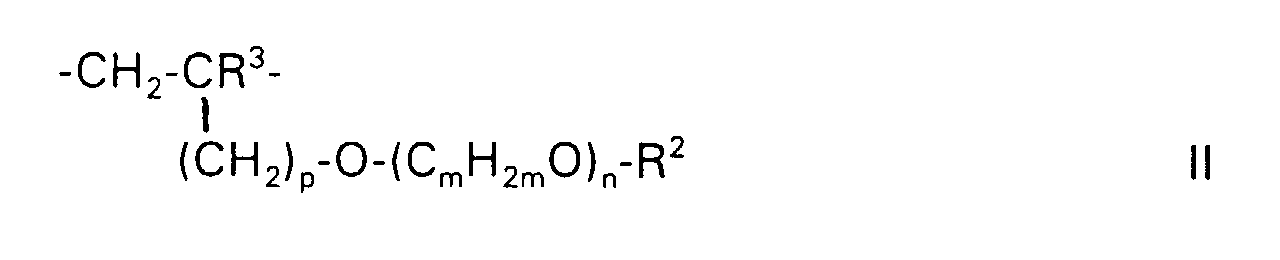 und leitet sich von Oxyalkylenglykol-Alkenylethern ab, in der m, n und R2
die oben bezeichneten Bedeutungen besitzen. R3 bedeutet wiederum
Wasserstoff oder einen aliphatischen Kohlenwasserstoffrest mit 1 bis 5 C-Atomen,
der ebenfalls linear oder verzweigt bzw. auch ungesättigt sein
kann. p kann Werte zwischen 0 und 3 annehmen.
und leitet sich von Oxyalkylenglykol-Alkenylethern ab, in der m, n und R2
die oben bezeichneten Bedeutungen besitzen. R3 bedeutet wiederum
Wasserstoff oder einen aliphatischen Kohlenwasserstoffrest mit 1 bis 5 C-Atomen,
der ebenfalls linear oder verzweigt bzw. auch ungesättigt sein
kann. p kann Werte zwischen 0 und 3 annehmen.
Gemäß den bevorzugten Ausführungsformen bedeuten in den Formeln Ia
und II m 2 oder/und 3, so daß es sich um Polyalkylenoxid-Gruppen handelt,
die sich von Polyethylenoxid oder/und Polypropylenoxid ableiten. In einer
weitern bevorzugten Ausführungsfom bedeutet p in Formel II 0 oder 1, d.h.
es handelt sich um Vinyl- oder/und Allylpolyalkoxylate.
Die dritte Baugruppe entspricht der Formel IIIa oder/und IIIb:
 wobei a und M die obigen Bedeutungen haben und R4 jeweils unabhängig
Wasserstoff, ein aliphatischer gegebenenfalls mit Hydroxyl-Gruppen
substituierter Kohlenwasserstoffrest mit 1 bis 20 Kohlenstoffatomen, ein
cycloaliphatischer Kohlenwasserstoffrest mit 5 bis 8 C-Atomen oder ein
Arylrest mit 6 bis 14 C-Atomen ist, in welchem ein oder mehrere H-Atome
beispielsweise durch die Strukturelemente -COOaM1, -(SO3)aM oder/und
-(PO3)aM2 substituiert sein können, wobei a und M die obengenannten
Bedeutungen besitzen. Außerdem kann R4 für die Reste -(CmH2mO)n-R2 und -
CO-NH-R2 stehen mit den oben genannten Bedeutungen für m, n und R2.
wobei a und M die obigen Bedeutungen haben und R4 jeweils unabhängig
Wasserstoff, ein aliphatischer gegebenenfalls mit Hydroxyl-Gruppen
substituierter Kohlenwasserstoffrest mit 1 bis 20 Kohlenstoffatomen, ein
cycloaliphatischer Kohlenwasserstoffrest mit 5 bis 8 C-Atomen oder ein
Arylrest mit 6 bis 14 C-Atomen ist, in welchem ein oder mehrere H-Atome
beispielsweise durch die Strukturelemente -COOaM1, -(SO3)aM oder/und
-(PO3)aM2 substituiert sein können, wobei a und M die obengenannten
Bedeutungen besitzen. Außerdem kann R4 für die Reste -(CmH2mO)n-R2 und -
CO-NH-R2 stehen mit den oben genannten Bedeutungen für m, n und R2.
Die vierte Baugruppe d) entspricht der Formel IV
 wobei R5 jeweils unabhängig Wasserstoff oder eine Methyl- oder
Methylengruppe ist, die gegebenenfalls substituiert sein kann und unter
Einbeziehung von R7 einen oder mehrere 5- bis 8-gliedrige Ringe
(beispielsweise einen Indenring) bildet, R6 Wasserstoff oder eine Methyl- oder
Ethylgruppe ist und R7 jeweils unabhängig Wasserstoff, ein C1 bis C20-Alkyl-,
ein C5 bis C8-Cycloalkyl- oder C6 bis C14-Arylrest ist, der
gegebenenfalls substituiert sein kann. Daneben kann R7 für die Gruppen
-O-COR4, -OR4, -COOR4 mit der oben angegebenen Bedeutung für R4 stehen.
wobei R5 jeweils unabhängig Wasserstoff oder eine Methyl- oder
Methylengruppe ist, die gegebenenfalls substituiert sein kann und unter
Einbeziehung von R7 einen oder mehrere 5- bis 8-gliedrige Ringe
(beispielsweise einen Indenring) bildet, R6 Wasserstoff oder eine Methyl- oder
Ethylgruppe ist und R7 jeweils unabhängig Wasserstoff, ein C1 bis C20-Alkyl-,
ein C5 bis C8-Cycloalkyl- oder C6 bis C14-Arylrest ist, der
gegebenenfalls substituiert sein kann. Daneben kann R7 für die Gruppen
-O-COR4, -OR4, -COOR4 mit der oben angegebenen Bedeutung für R4 stehen.
Es ist als erfindungswesentlich anzusehen, daß die Copolymere 1,0 bis 90
Mol-% Baugruppen der Formel Ia oder/und Ib 0,5 bis 80 Mol-% Baugruppen
der Formel II, 0,5 bis 80 Mol-% Baugruppen der Formel IIIa oder/und IIIb
sowie 1,0 bis 90 Mol-% Baugruppen der Formel IV enthalten.
Vorzugsweise bestehen diese Copolymere aus 30 bis 60 Mol-% Baugruppen
der Formel Ia oder/und Ib, 10 bis 40 Mol-% Baugruppen der Formel II, 3 bis
30 Mol-% Baugruppen der Formel IIIa oder/und IIIb sowie 10 bis 60 Mol-%
Baugruppen der Formel IV. Ein besonders bevorzugtes molares Verhältnis
der Struktureinheiten (I+III) : (II+IV) liegt bei den erfindungsgemäßen
Copolymeren bei ungefähr 1 : 1.
Gemäß einer bevorzugten Ausführungsform enthalten die
erfindungsgemäßen Copolymere zusätzlich noch bis zu 50 Mol-%,
insbesondere bis zu 20 Mol-%, bezogen auf die Summe der Baugruppen I
bis IV, Baugruppen auf der Basis von N-Vinylverbindungen, Vinyl- oder
Allylsulfonsäuren sowie gegebenenfalls substituierte Acryl- bzw.
Methacrylamide.
Die Strukturelemente I bis IV können jeweils einheitliche
Zusammensetzungen darstellen, sie können aber auch als Gemisch
verschiedener Substanzen vorliegen. So kann z.B. n im Substituenten R1 der
Formel Ia sowie in der Formel II verschiedene Werte in ein und demselben
Copolymer annehmen, was in einer besonders bevorzugten
Ausführungsform dazu führt, daß sich lange und kurze Alkylenoxid-Sequenzen
abwechseln, was besonders positive Eigenschaften auf die
anwendungstechnischen Eigenschaften der erfindungsgemäßen Copolymere
haben kann.
Die Anzahl der sich wiederholenden Strukturelemente a) bis d) in den
erfindungsgemäßen Copolymeren ist nicht eingeschränkt, doch hat es sich
als vorteilhaft erwiesen, diese Anzahl so einzustellen, daß die Copolymere
ein mittleres Molekulargewicht von 1 000 bis 200 000 aufweisen, wobei
sich die gewünschte Kettenlänge in erster Linie nach der Art des
anorganischen Bindemittels (Portlandzement, Anhydrit, Gips usw.) und dem
Anwendungsgebiet (Fließbeton, Anhydritestrich etc.) richtet.
Die Herstellung der erfindungsgemäßen Copolymere kann auf verschiedenen
Wegen erfolgen. Wesentlich ist hierbei, daß man 1 bis 90 Mol-% eines
ungesättigten Dicarbonsäure-Derivats, 0,5 bis 80 Mol-% eines
Oxyalkylenglykol-Alkenylethers, 0,5 bis 80 Mol-% eines ungesättigten
Dicarbonsäureimids oder -amids und 1,9 bis 90 Mol-% eines vinylischen
Monomers vorzugsweise mit Hilfe eines radikalischen Starters polymerisiert.
So ist es möglich, die die Baugruppen Ia, IIIa und IIIb bildenden Monomere
in vorgebildeter Form einzusetzen oder aber die genannten Strukturelemente
während oder/und nach der Polymerisation durch polymeranaloge
Umsetzungen aus der Vorstufe Ib zu bilden. Demgegenüber werden die
Baugruppen II und IV in der Regel aus den entsprechenden vorgebildeten
Monomeren im Prozeß der Polymerisation erzeugt.
Als ungesättigtes Dicarbonsäure-Derivat, welches zu Baugruppen der Formel
Ia führt, werden vorzugsweise Maleinsäure, Fumarsäure, ein- oder
zweiwertige Metallsalze dieser Dicarbonsäuren, wie das Natrium-, Kalium-,
Calcium- oder Magnesiumsalz, Ammoniumsalze oder Salze mit einem
organischen Aminrest eingesetzt. Als vorzugsweise verwendete Monomere,
welche die Einheit Ia bilden, werden Polyalkylenglykolmonoester der oben
genannten Säuren verwendet, welche die allgemeine Formel V
MaOOC-CH = CH-COO-(CmH2mO)n-R2
aufweisen, mit den bereits angegebenen Bedeutungen für a, m, n und R2.
Die Struktureinheit Ib leitet sich von Maleinsäureanhydrid ab. Die
ungesättigten Dicarbonsäure-Derivate, welche zu den Baugruppen der
Formel Ia bzw. Ib führen, werden vorzugsweise in einer Menge von 30 bis
60 Mol-% eingesetzt.
Die zweite erfindungswesentliche Komponente zur Einführung der
Baugruppe b) in die erfindungsgemäßen Copolymere stellt ein
Oxyalkylenglykol-Alkenylether dar, der vorzugsweise in einer Menge von 10
bis 40 Mol-% eingesetzt wird. Bei den bevorzugten Oxyalkylenglykol-Alkenylethern
entsprechend der Formel VI
CH2 = CR3-(CH2)p-O-(CmH2mO)n-R2
weisen p, m, n, R2 und R3 die oben genannten Bedeutungen auf. Als
besonders vorteilhaft hat sich hierbei die Verwendung von
Methylpolyethylenglykolmonovinyl- und -allylethern zur Steuerung der
Kettenlänge erwiesen (p=0 bzw. 1, m = 2).
Als dritte erfindungswesentliche Komponente zur Einführung der Baugruppe
c) werden vorzugsweise 3 bis 30 Mol-% eines ungesättigten
Dicarbonsäureimids oder/und -amids eingesetzt. Die Struktureinheit III kann
erfindungsgemäß hierbei sowohl als 5-gliedriges, vorzugsweise
substituiertes, cyclisches Imid (IIIa), aber auch als offenkettiges
Dicarbonsäuremonoamid eines primären oder/und sekundären Amins (IIIb)
vorliegen. Diese Struktur kann bereits durch die Natur der entsprechenden
Monomere entsprechend VII vorgegeben sein:
 mit den oben angegebenen Bedeutungen für a, M und R4.
Beispiele für derartige Monomere sind N-Phenylmaleinimid, N-(2,6-Dimethylphenyl)-maleinimid,N-Hydroxyethylmaleinimid,N-(4-Sulfophenyl)-maleinimid (VIIa), N-Phenylmaleinsäuremonoamid, N-(4-Sulfophenyl)maleinsäuremonoamid,
N-(3,6-Disulfonaphthyl-1)-maleinsäuremonoamid
und N,N-(Dimethoxyethyl)-maleinsäuremonoamid (VIIb).
Die Struktur entsprechend IIIa oder/und IIIb bzw. VIIa oder/und VIIb kann
jedoch auch erst im Verlauf des Polymerisationsprozesses gebildet werden,
z.B. durch Umsetzung von primäre Aminogruppen tragenden Verbindungen
mit einer Anhydrid-Gruppe gemäß Ib, wobei Verbindungen der Struktur IIIa
bzw. VIIa entstehen. Werden sekundäre Amine in diesem "in situ"-Prozeß
eingesetzt, so bleibt die Reaktion auf der Stufe des Monoamids gemäß
Struktur IIIb bzw. VIIb stehen, was in vielen Fällen sogar erwünscht ist.
Beispiele für derartige primäre und sekundäre Amine sind: n-Butylamin, 2-Ethylhexylamin,
n-Laurylamin, Glutaminsäure, Glycin, Sulfanilsäure, Taurin,
Phosphanilsäure, 1-Amino-3,6-naphthalindisulfonsäure, Cyclohexylamin,
Dibutylamin, Bis-(2-methoxyethyl)-amin u.a.
Bei der vierten wesentlichen Komponente zur Einführung der Baugruppe d)
handelt es sich vorzugsweise um solche Monomere, die eine hohe Tendenz
zur Copolymerisation mit elektronenarmen Acceptormonomeren wie
Maleinsäureanhydrid haben. Beispiele für solche Monomere sind Ethylen,
Propylen, n-Butylen, Isobuten, Diisobuten, Cyclohexen, Styrol, α-Methylstyrol,
Inden, 4-Methoxy-styrol, 4-Methylstyrol, Vinylacetat,
Vinylpropionat, Methylvinylether, Ethylvinylether, Dicyclopentadien u.a.
Daneben können auch Methylmethacrylat, Ethylacrylat, Hydroxyethylmethacrylat,
Butylacrylat, Acrylsäure, Methacrylsäure u.a. Monomere der
allgemeinen Formel VIII verwendet werden:
R5CH=CR6R7
wobei R5, R6 und R7 die unter IV angegebenen Bedeutungen besitzen
können. Die Monomere der Struktur VIII können gegebenenfalls auch als
Gemisch eingesetzt werden.
Gemäß einer bevorzugten Ausführungsform werden noch bis zu 50 Mol-%
insbesondere bis zu 20 Mol-%, bezogen auf die Monomere entsprechend
der Formeln I bis IV bzw. V bis VIII andere polymerisierbare Monomere, z.B.
Monomere auf Basis von N-Vinylverbindungen, Vinyl-oder Allylsulfonsäuren
sowie gegebenenfalls substiuierte Acryl- bzw. Methacrylamide zum Aufbau
der erfindungsgemäßen Copolymere verwendet. Beispiele für derartige
Verbindungen sind N-Vinylpyrrolidon, Allylsulfonsäure, Methallylsulfonsäure,
Vinylsulfonsäure, 2-Acrylamido-2-methylpropansulfonsäure usw.
Die Copolymere entsprechend der vorliegenden Erfindung können nach den
üblichen Methoden hergestellt werden. Ein besonderer Vorteil besteht darin,
daß man erfindungsgemäß ohne Lösemittel oder aber in wäßriger Lösung
arbeiten kann. In beiden Fällen handelt es sich um drucklose und daher
sicherheitstechnisch unbedenkliche Reaktionen.
Wird das Verfahren in wäßriger Lösung durchgeführt, so erfolgt die
Polymerisation bei 20 bis 100°C mit Hilfe eines üblichen Radikalstarters,
wobei die Konzentration der wäßrigen Lösung vorzugsweise auf 20 bis 50
Gew.-% eingestellt wird. Gemäß einer bevorzugten Ausführungsform kann
die radikalische Polymerisation hierbei im sauren pH-Bereich durchgeführt
werden, insbesondere bei einem pH-Wert zwischen 4,0 und 6,5, wobei auf
die herkömmlichen Initiatoren wie H2O2 zurückgegriffen werden kann, ohne
daß es zu einer befürchteten Etherabspaltung kommt, wodurch die
Ausbeuten sehr stark beeinträchtigt würden.
Beim erfindungsgemäßen Verfahren wird vorzugsweise so gearbeitet, daß
das ungesättigte Dicarbonsäure-Derivat vorgelegt wird und die übrigen
Monomeren zusammen mit dem Polymerisationsinitiator zudosiert werden,
sobald die erforderliche Reaktionstemperatur in der Vorlage erreicht ist.
Separat zugegeben werden die Polymerisations-Hilfsmittel, welche die
Aktivierungsschwelle des vorzugsweise peroxidischen Initiators senken
können, so daß die Copolymerisation bei relativ niedrigen Temperaturen
ablaufen kann.
Werden die ungesättigten Dicarbonsäure-Derivate in Form der bevorzugten
Polyalkylenglykolmonoester der allgemeinen Formel V eingesetzt, so ist es
erfindungsgemäß auch möglich, diese zuerst in der Vorlage durch
Umsetzung der ungesättigten Dicarbonsäure mit den Polyalkylenoxiden
intermediär herzustellen. Ebenso ist es möglich, die zur Einführung der
Baugruppe c) erforderlichen Dicarbonsäureimide oder/und -amide
entsprechend der allgemeinen Formel IIIb bzw. VIIb gesondert intermediär
herzustellen und diese dem ungesättigten Dicarbonsäure-Derivat ggf.
zusammen mit den übrigen Monomeren zuzusetzen.
Die Art der verwendeten Polymerisationsinitiatoren, -aktivatoren und
sonstige Hilfsmittel, wie z.B. Molekulargewichtsregler, ist relativ
unproblematisch, d.h. als Initiatoren kommen die üblichen Radikalspender
zum Einsatz, wie Wasserstoffperoxid, Natrium-, Kalium- oder
Ammoniumperoxodisulfat, tert. Butylhydroperoxid, Dibenzoylperoxid,
Lauroylperoxid, Dicylohexylperoxodicarbonat, tert. Butylperoxy-2-ethylhexanoat,
tert. Butylperbenzoat, Natriumperoxid, 2,2'-Azobis-(2-amidinopropan)-dihydrochlorid,
Azobis-(isobutyronitril), Azobis-(2-methylvaleronitril),
Azobis-(cyclohexancarbonitril) usw. Kommen
Redoxsysteme zum Einsatz, so werden oben genannte Initiatoren mit
reduzierend wirkenden Aktivatoren kombiniert. Beispiele für derartige
Reduktionsmittel sind Fe(II)-salze, Natriumhydroxymethansulfinat-Dihydrat,
Alkalimetallsulfite und -metabisulfite, Natriumhypophosphit,
Hydroxylaminhydrochlorid, Thioharnstoff usw.
Als Polymerisationsbeschleuniger oder Aktivatoren kommen Natriumbisulfit,
Ascorbinsäure oder Schwermetallsalze und als Molekulargewichtsregler
schwefelfreie Verbindungen wie Allylverbindungen, Aldehyde und
phosphorhaltige Komponenten zum Einsatz.
Ein besonderer Vorteil der erfindungsgemäßen Copolymere ist die Tatsache,
daß sie auch ohne Lösemittel hergestellt werden können, was mit Hilfe der
üblichen radikalischen Starter bei Temperaturen zwischen 60 und 150°C
erfolgen kann. Diese Variante kann aus wirtschaftlichen Gründen
insbesondere dann angewendet werden, wenn die erfindungsgemäßen
Copolymere in wasserfreier Form direkt ihrer erfindungsgemäßen
Verwendung zugeführt werden sollen, weil dann eine aufwendige
Abtrennung des Lösemittels, insbesondere des Wassers, beispielsweise
durch Sprühtrocknung entfallen kann.
Gemäß einer bevorzugten Ausführungsform werden die erfindungsgemäßen
Copolymere nach der Polymerisation mit Wasser verdünnt und durch
Zugabe von Lauge neutralisiert.
Die erfindungsgemäßen Copolymere eigenen sich hervorragend als
Zusatzmittel für wäßrige Suspensionen, insbesondere auf Basis von
anorganischen Bindemitteln, wie z.B. Zement, Kalk, Gips, Halbhydrat und
Anhydrit. Hierbei werden sie in einer Menge von 0,01 bis 10 Gew.-%,
vorzugsweise 0,05 bis 3 Gew.-% bezogen auf das Gewicht des
anorganischen Bindemittels, eingesetzt. Die Copolymere besitzen hierbei
eine ausgezeichnete und langanhaltende verflüssigende Wirkung, ohne hohe
Anteile von Luftporen in die entsprechende Bindemittelmischung einzuführen
und ohne hierbei Einbußen bei der Festigkeit und Beständigkeit des
erhärteten Baustoffs hinnehmen zu müssen. Besonders geeignet sind die
erfindungsgemäßen Copolymere für Suspensionen mit geringem
Wassergehalt, beispielsweise für Suspensionen mit einem Wassergehalt von
15 bis 45 Gew.-% bezogen auf den Anteil an anorganischem Bindemittel.
Die nachfolgenden Beispiele sollen die Erfindung näher erläutern.
In einem 2 500 ml Doppelwandreaktionsgefäß mit Thermometer, Rührer,
Rückflußkühler und zwei Eingängen für separate Zuläufe wurden 763,3 g
(0,413 Mol) Methylpolyethylenglykol (MW 1 850 g/Mol) vorgelegt und mit
9,8 g (0,100 Mol) Maleinsäureanhydrid unter Rühren vermischt. Die
eingeschlossene Luft wurde durch 30 minütiges Einleiten von Stickstoff
entfernt und der Kolbeninhalt auf 105°C erwärmt.
In einem separaten heizbaren und rührbaren Zulaufgefäß (Zulauf 1) wurde
gleichzeitig eine Mischung aus 763,3 g (0,413 Mol) Methylpolyethylenglykol
(MW 1 850 g/Mol), 69,8 g (0,279 Mol) Methylpolyethylenglykol-Monoallylether
(MW 250 g/Mol) und 38,1 g (0,165 Mol) Sulfanilsäure-Natriumsalzdihydrat
bereitet, zu welcher bei einer Temperatur von 65°C
203,9 g (2,079 Mol)Maleinsäureanhydrid unter Rühren eingetragen wurden
(Bildung der Monomerkomponente VIIb). Nach Spülung mit Stickstoff wurde
diese Mischung sowie eine zweite Mischung bestehend aus 287,2 g (2,758
Mol) Styrol, 12,2 g Azobis-(isobutyronitril) und 2,5 g 1,1'Azobis(cyclohexancarbonitril)
(Zulauf 2) kontinuierlich über einen Zeitraum von 60
Minuten in den Reaktor dosiert.
Nach Beendigung der Zugabe wurde das Reaktionsgemisch auf 115°C
erwärmt und weitere 60 Minuten gerührt. Anschließend wurde die
Reaktionstemperatur auf 140°C erhöht und 120 Minuten zur
Vervollständigung der Veresterung und Imidbildung gerührt.
Die klare, orange gefärbte Polymerschmelze wurde unter weiterem Rühren
auf 115°C abgekühlt, mit 63 g Diisobutylphthalat versetzt, weiter auf 50°C
abgekühlt, mit 2 500 ml Wasser verdünnt und mit verdünnter Natronlauge
auf einen pH-Wert von 6,5 gestellt.
Es wurde eine gelborange gefärbte, trübe Lösung erhalten, die einen
Feststoffgehalt von 34,7 Gew.-% aufwies.
Es wurde analog Beispiel 1 verfahren, jedoch mit folgender
Zusammensetzung der Zuläufe 1 und 2:
- 763,3 g (0,413 Mol)
- Methylpolyethylenglykol (MW 1 850 g/Mol)
- 31,2 g (0,125 Mol)
- Methylpolyethylenglykol-Monoallylether (MW 250 g/Mol)
- 28,6 g (0,165 Mol)
- N-Phenylmaleinimid
- 212,0 g (2,162 Mol)
- Maleinsäureanhydrid
- 290,3 g (2,787 Mol)
- Styrol
- 12,2 g
- Azobis-(isobutyronitril)
- 2,5 g
- Azobis-(cyclohexancarbonitril)
Die rotbraun gefärbte Polymerschmelze wurde mit 63 g Diisobutylphthalat
versetzt, verdünnt und neutralisiert.
Es wurde eine trübe, gelblich gefärbte Zubereitung mit einem Feststoffgehalt
von 34,3 Gew.-% erhalten.
Beispiel 1 wurde wiederholt, jedoch wurden 97,7 g (0,279 Mol)
Methylpolyethylenglykol-Monovinylether (MW 350 g/Mol) statt des im
Beispiel 1 verwendeten Allylethers (MW 250 g/Mol) eingesetzt. Darüber
hinaus wurde der Vinylether im Gemisch mit Styrol im Zulauf 2 dosiert und
nicht wie der Allylether im Beispiel 1 im Zulauf 1. Das dunkelbraune Polymer
wurde in der Abkühlphase mit 64 g Diisobutylphthalat versetzt, mit Wasser
verdünnt und mit NaOH neutralisiert.
Das trübe, bräunlich gefärbte Endprodukt enthielt 33,8 Gew.-% Feststoff.
Es wurden 1 318,1 g (0,7125 Mol) Methylpolyethylenglykol (MW 1 850
g/Mol) und 118,8 g (0,2376 Mol) Methylpolyethylenglykol (MW 500 g/Mol)
vorgelegt und mit 219,9 g (2,243 Mol) Maleinsäureanhydrid vermischt.
Nach 30 minütiger Stickstoffspülung wurde der Kolbeninhalt auf 105°C
erwärmt und aus einem separaten Zulauf eine Mischung aus
- 223,8 g (2,149 Mol)
- Styrol
- 179,1 g (0,716 Mol)
- Methylpolyethylenglykol-Monoallylether (MW 250 g/Mol)
- 13,1 g
- Azobis-(isobutyronitril) und
- 2,7 g
- Azobis-(cyclohexancarbonitril)
Anschließend wurde eine Mischung aus 35,9 g (0,270 Mol) Di-(2-methoxyethyl)amin
und 63,3 g Diisobutylphthalat über einen Zeitraum von
30 Minuten zugegeben und die Temperatur auf 140°C erhöht. Nach
Erreichen dieser Temperatur wurde noch 2 Stunden zur Vervollständigung
der Ester- und Monoamidbildung gerührt. Nach Abkühlen auf 50°C wurde
mit Wasser verdünnt und mit verdünnter Natronlauge ein pH-Wert von 6,5
eingestellt.
Erhalten wurde eine bernsteinfarben gefärbte Emulsion mit 34,9 Gew.-%
Feststoff.
Beispiel 4 wurde wiederholt mit 160,2 g (0,237 Mol) eines einseitig
methylveretherten Blockcopolymerisats aus Ethylenoxid und Propylenoxid
(molarer Anteil 10:3, MW 675 g/Mol), welches anstelle des
Methylpolyethylenglykol (MW 500 g/Mol) in Beispiel 4 eingesetzt wurde.
Erhalten wurde eine Emulsion mit 36,0 Gew.-% Feststoff.
Es wurde verfahren wie in Beispiel 4 beschrieben, jedoch wurde die
Styrolmenge auf 150,4 g (1,444 Mol) reduziert zugunsten von zusätzlich
78,4 g (0,705 Mol) N-Vinylpyrrolidon.
Das hellbraune Endprodukt wies 34,1 Gew.-% Feststoff auf.
- 800 g (0,800 Mol)
- Methylpolyethylenglykol-Monovinylether (MW 1 000 g/Mol)
- 100 g (0,200 Mol)
- Methylpolyethylenglykol (MW 500 g/Mol) und
- 257,4 g (2,625 Mol)
- Maleinsäureanhydrid
Anschließend wurde ein Mischung aus
- 26 g (0,250 Mol)
- Styrol
- 950 g (0,950 Mol)
- Methylpolyethylenglykol-Monovinylether (MW 1 000 g/Mol) und
- 21 g
- Azobis-(2-methylbutyronitril)
Anschließend wurden
- 56,4 g (0,423 Mol)
- Di-(2-methoxyethyl)amin und
- 65 g
- Diisobutylphthalat
Es verblieb eine hellbraune Zubereitung mit 39.9 Gew.-% Feststoff.
Es wurde wie unter Beispiel 7 beschrieben verfahren, jedoch wurden 880
g (0,800 Mol) Methylpolyethylenglykol-Monoallylether (MW 1 100 g/Mol)
anstelle des Vinylethers in der Vorlage und 1 045 g (0,950 Mol)
Methylpolyethylenglykol-Monoallylether (MW 1 100 g/Mol) anstelle des
Vinylethers im Zulauf eingesetzt. Die Initiatormenge mußte auf 43,5 g
erhöht werden.
Erhalten wurde ein hellbraun gefärbtes Produkt mit 43,2 Gew.-% Feststoff.
Nach dem im Beispiel 4 beschriebenen Verfahren wurde ein Polymer
synthetisiert, wobei in der Nachreaktion statt Di-(2-methoxyethyl)amin
Cyclohexylamin in einer Menge von 37,7 g (0,380 Mol) eingesetzt wurde.
Das rotbraun gefärbte Endprodukt enthielt 36,1 Gew.-% Feststoff.
Statt Di-(2-methoxyethyl)amin im Beispiel 4 wurden 91,0 g (0,182 Mol)
Methylpolyethylenglykol-Monoamin (MW 500 g/Mol) zur polymeranalogen
Imidbildung verwendet.
Das hellorange wäßrige Endprodukt wies einen Feststoffgehalt von 35,0
Gew.-% auf.
Handelsübliches Betonfließmittel "Melment L 10" auf Basis eines
sulfonierten Melamin-Formaldehyd-Polykondensats.
Kommerziell erhältliches Fließmittel "Liquiment N" auf Basis eines
Naphthalinsulfonsäure-Formaldehyd-Polykondensats.
Nach dem in der EP-A 306 449 beschriebenen Verfahren (Beispiel 1) wurde
ein Copolymerisat aus Methylpolyethylenglykol-Monomaleinat und Styrol
synthetisiert.
Nach EP-A 610 699 (Beispiel 7) wurde ein Copolymer aus
Methylpolyethylenglykol(MW 500 g/Mol), Maleinsäureanhydrid, das in einer
polymeranalogen Reaktion teilweise mit Cyclohexylamin umgesetzt wurde,
und Styrol hergestellt.
Copolymer aus Maleinsäureanhydrid, Methylpolyethylenglykolmonovinylether
(MW 500 g/Mol) und Polypropylenglykol-bis(maleinamidsäure) gemäß
EP-A 736 553, Beispiel 1.
Die wäßrigen Copolymere-Zubereitungen wurden einer vergleichenden
Prüfung als Fließmittel für zementhaltige Feststoffsuspensionen (Mörtel,
Beton) unterzogen, um ihre gegenüber herkömmlichen Produkten
verbesserten Eigenschaften nachzuweisen:
450 g Portlandzement (CEM I 42,5 R, Mannersdorf) wurden mit 1 350 g
Normensand (Grobanteil:Feinanteil = 2:1) und 225 g Wasser, welches die
erfindungsgemäßen Produkte bzw. die Vergleichsprodukte in gelöster Form
enthielt, normgerecht angerührt. Unmittelbar nach Herstellung der
Zementmörtel erfolgte die Bestimmung des Ausbreitmaßes sowie dessen
zeitliche Veränderung über einen Zeitraum von 90 Minuten. Darüber hinaus
wurde der Luftgehalt in der Mischung zu Beginn der Messung ermittelt.
Die Ergebnisse dieser Prüfungen zeigt Tabelle 1.
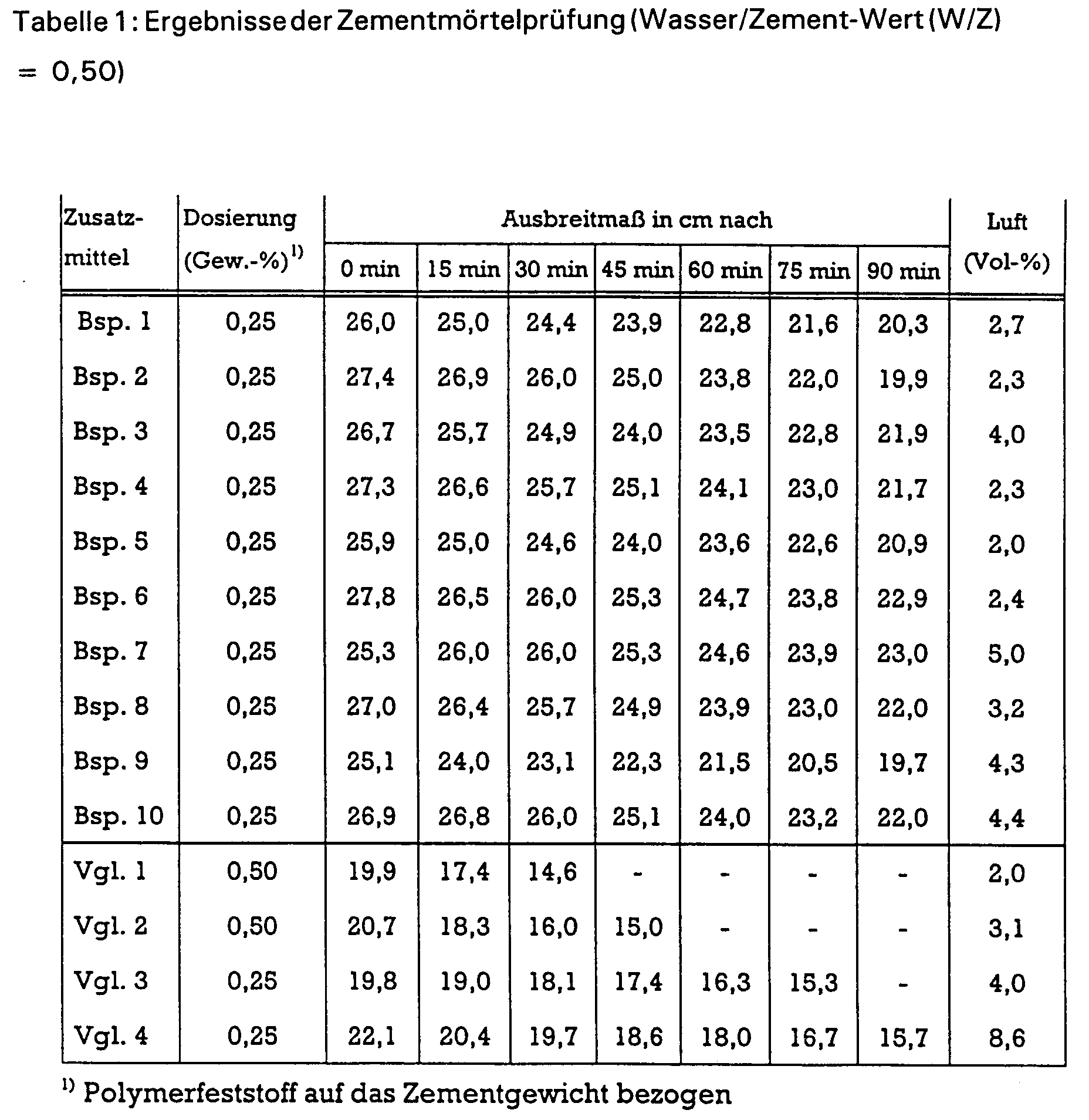
Normgemäß wurden in einem Betonzwangsmischer 5,3 kg Portlandzement
(CEM I 42,5 R, Kiefersfelden) mit 33,0 kg Zuschlägen (Sieblinie 0 bis 32
mm) und 2,65 kg Wasser (abzüglich des Wassers aus dem Zusatzmittel)
vermischt. Die wäßrigen Lösungen der erfindungsgemäßen Copolymere
bzw. der Vergleichsprodukte wurden zugesetzt und 10 bzw. 40 Minuten
nach Zugabe des Fließmittels erfolgte die Bestimmung des Ausbreitmaßes
nach DIN 1048 (Doppelbestimmung).
Im Anschluß an die Messung des 10 min-Ausbreitmaßes wurden die
Frischbetone in Formen gefüllt, 10 sec verdichtet und 24 h bei 20°C
gelagert. Von den erhaltenen Prüfkörpern (15 x 15 x 15 cm Kantenlänge)
wurde die Druckfestigkeit sowie der Luftporenanteil über die Dichte dieser
Prüfkörper ermittelt.
Die Ergebnisse sind in Tabelle 2 zusammengestellt.

Neben den Betonprüfungen, die mit den erfindungsgemäßen Produkten und
den Vergleichspolymeren bei einem Wasser/Zement-Wert von 0,50
durchgeführt wurden (Tabelle 2), wurden Tests bei einem deutlich
reduzierten Wasseranteil (0,40) vorgenommen. Mit diesem niedrigen Wert
können Hochleistungsbetone mit einem besonders dichten Gefüge
hergestellt werden.
Die Durchführung erfolgte wie im Anwendungsbeispiel 2 beschrieben,
jedoch mit 2,12 kg Wasser statt 2,65 kg.
Die Ergebnisse sind in Tabelle 3 zusammengefaßt.

Claims (17)
- Copolymere auf Basis von ungesättigten Dicarbonsäure-Derivaten und Oxyalkylenglykol-Alkenylethern enthaltend(a) 1 bis 90 Mol-% Baugruppen der Formel Ia oder/und Ib
 wobei M jeweils unabhängig Wasserstoff, ein ein- oder zweiwertiges Metallkation, ein Ammoniumion oder ein organischer Aminrest ist,a = 1/2 oder 1 ist,R1 jeweils unabhängig -OaM oder -O-(CmH2mO)n-R2 ist, wobei R2 Wasserstoff, ein aliphatischer Kohlenwasserstoffrest mit 1 bis 20 C-Atomen, ein cycloaliphatischer Kohlenwasserstoffrest mit 5 bis 8 C-Atomen oder ein gegebenenfalls substituierter Arylrest mit 6 bis 14 C-Atomen ist, m 2 bis 4 ist und n 1 bis 200 ist,(b) 0,5 bis 80 Mol-% Baugruppen der Formel II
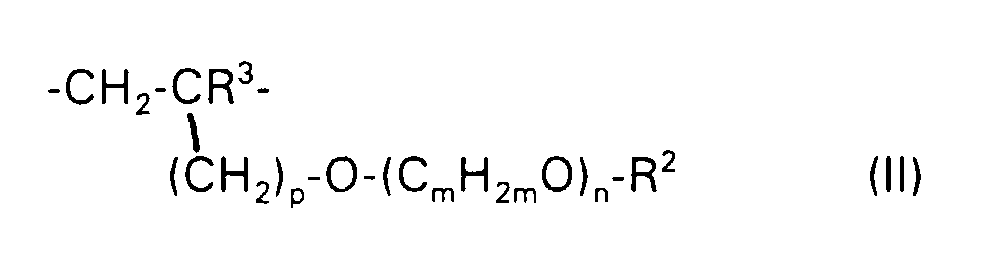 wobei R3 jeweils unabhängig Wasserstoff oder ein aliphatischer Kohlenwasserstoffrest mit 1 bis 5 C-Atomen ist,p 0 bis 3 ist undR2, m, n die oben genannten Bedeutungen besitzen,(c) 0,5 bis 80 Mol-% Baugruppen der Formel IIIa oder/und IIIb
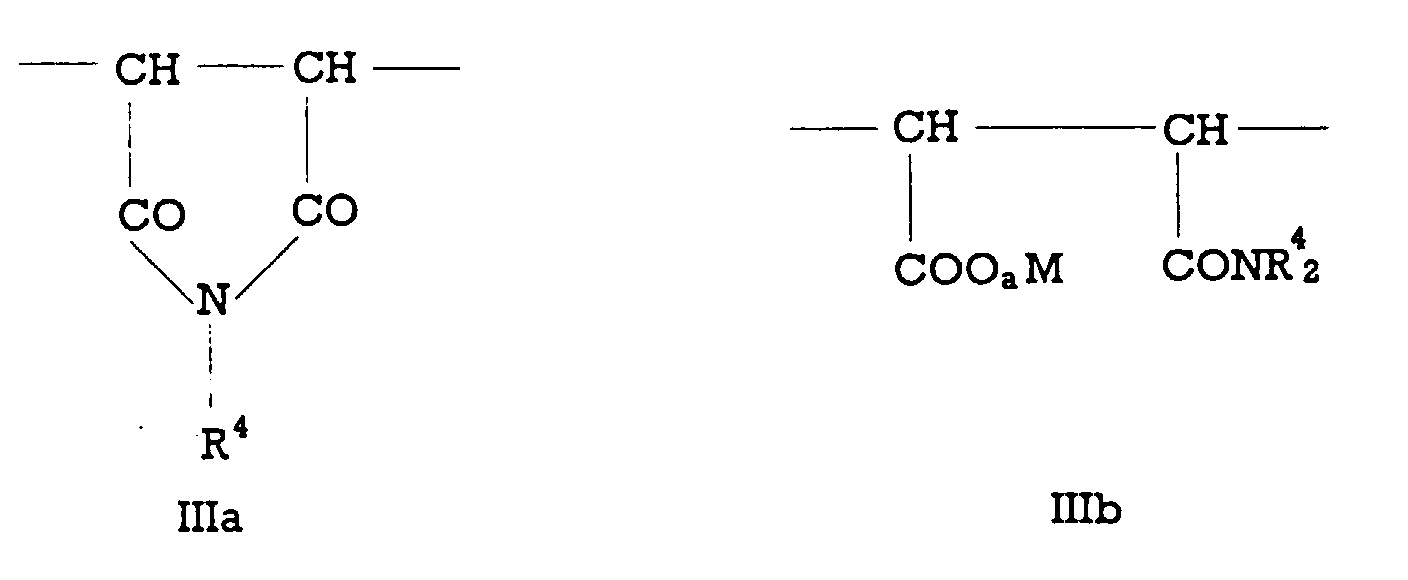 worin R4 jeweils unabhängig Wasserstoff, ein gegebenenfalls mit Hydroxylgruppen substituierter aliphatischer Kohlenwasserstoffrest mit 1 bis 20 C-Atomen, ein cycloaliphatischer Kohlenwasserstoffrest mit 5 bis 8 C-Atomen, ein gegebenenfalls mit -COOaM,-(SO3)aM oder/und -(PO3)aM2-Gruppen substituierter Arylrest mit 6 bis 14 C-Atomen, -(CmH2mO)n-R2 oder -CO-NH-R1 ist und M, a, R2, m und n die oben genannten Bedeutungen besitzen sowie(d) 1,0 bis 90 Mol-% Baugruppen der Formel IV
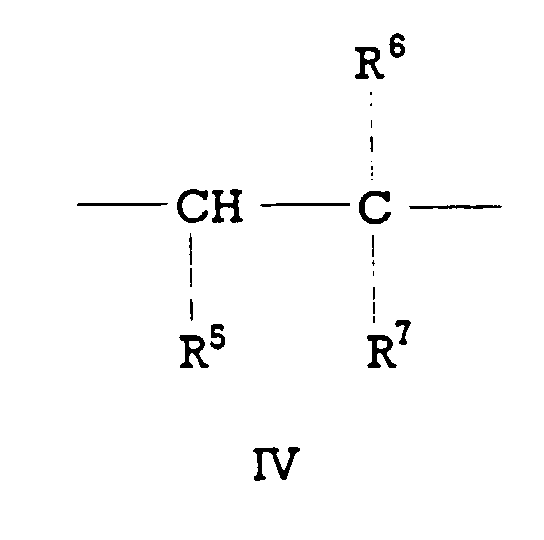 worin R5 jeweils unabhängig Wasserstoff, eine Methyl- oder eine gegebenenfalls substituierte Methylengruppe, die unter Einbeziehung von R7 einen oder mehrere 5- bis 8-gliedrige Ringe bildet, ist, R6 jeweils unabhängig Wasserstoff, eine Methyl- oder eine Ethylgruppe ist sowie R7 jeweils unabhängig Wasserstoff, ein aliphatischer Kohlenwasserstoffrest mit 1 bis 20 C-Atomen, ein cycloaliphatischer Rest mit 5 bis 8 C-Atomen, ein gegebenenfalls substitutierter Arylrest mit 6 bis 14 C-Atomen, -OCOR4, -OR4 oder -COOR4 ist und R4 die oben genannte Bedeutung besitzt.
 - Copolymere nach Anspruch 1,
dadurch gekennzeichnet,
daß sie 30 bis 60 Mol-% Baugruppen der Formel Ia oder/und Ib, 10 bis 40 Mol-% Baugruppen der Formel II, 3 bis 30 Mol-% Baugruppen der Formel IIIa oder/und IIIb sowie 10 bis 60 Mol-% Baugruppen der Formel IV enthalten. - Copolymere nach einem der Ansprüche 1 oder 2,
dadurch gekennzeichnet,
daß das molare Verhältnis der Struktureinheiten (I + III) zu (II + IV) bei ungefähr 1:1 liegt. - Copolymere nach einem der Ansprüche 1 bis 3,
dadurch gekennzeichnet,
daß M ein ein- oder zweiwertiges Metallkation ausgewählt aus der Gruppe bestehend aus Natrium-, Kalium-, Calcium- oder Magnesiumionen bedeutet. - Copolymere nach einem der Ansprüche 1 bis 4,
dadurch gekennzeichnet,
daß R2 ein Phenylrest ist, der durch Hydroxyl-, Carboxy- oder/und Sulfonsäure-Gruppen substituiert ist. - Copolymere nach einem der Ansprüche 1 bis 5,
dadurch gekennzeichnet,
daß in der Formel II p 0 oder 1 bedeutet und m 2 oder/und 3 bedeutet. - Copolymere nach einem der Ansprüche 1 bis 6,
dadurch gekennzeichnet,
daß sie bis zu 50 Mol-%, insbesondere bis zu 20 Mol-%, bezogen auf die Summe der Baugruppen der Formeln I, II, III und IV zusätzliche Baugruppen enthalten, deren Monomere N-Vinylverbindungen, Vinyl- oder Allylsulfonsäuren sowie gegebenenfalls substituierte Acryl- bzw. Methacrylamide darstellen. - Copolymere nach einem der Ansprüche 1 bis 7,
dadurch gekennzeichnet,
daß sie ein mittleres Molekulargewicht von 1 000 bis 200 000 aufweisen. - Verfahren zur Herstellung der Copolymere nach einem der Ansprüche 1 bis 8,
dadurch gekennzeichnet,
daß man 1 bis 90 Mol-% eines ungesättigten Dicarbonsäure-Derivats, 0,5 bis 80 Mol-% eines Oxyalkylenglykol-Alkenylethers, 0,5 bis 80 Mol-% eines ungesättigten Dicarbonsäureimids oder/und -amids und 1,0 bis 90 Mol-% eines vinylischen Monomers mit Hilfe eines radikalischen Starters polymerisiert. - Verfahren nach Anspruch 9,
dadurch gekennzeichnet,
daß man 30 bis 60 Mol-% eines ungesättigten Dicarbonsäure-Derivats, 10 bis 40 Mol-% eines Oxylalkylenglykol-Alkenylethers, 3 bis 30 Mol-% eines ungesättigten Dicarbonsäureimids oder/und - amids und 10 bis 60 Mol-% eines vinylischen Monomers einsetzt. - Verfahren nach einem der Ansprüche 9 bis 10,
dadurch gekennzeichnet,
daß man noch zusätzlich bis zu 50 Mol-%, insbesondere bis zu 20 Mol-%, bezogen auf die Monomeren mit den Baugruppen gemäß den Formeln I, II, III und IV einer N-Vinylverbindung, einer Vinyl- oder Allylsulfonsäure oder eines Acryl- oder Methacrylamids copolymerisiert. - Verfahren nach einem der Ansprüche 9 bis 11,
dadurch gekennzeichnet,
daß man die Polymerisation in wäßriger Lösung bei einer Temperatur von 20 bis 100°C durchführt. - Verfahren nach Anspruch 12,
dadurch gekennzeichnet,
daß die Konzentration der Monomere in der wäßrigen Lösung 20 bis 50 Gew.-% beträgt. - Verfahren nach einem der Ansprüche 9 bis 13,
dadurch gekennzeichnet,
daß man die Polymerisation ohne Lösemittel mit Hilfe eines radikalischen Starters bei Temperaturen von 20 bis 150°C durchführt. - Verwendung der Copolymere nach einem der Ansprüche 1 bis 8 als Zusatzmittel für wäßrige Suspensionen auf Basis von anorganischen Bindemitteln, insbesondere Zement, Kalk, Gips, Halbhydrat und Anhydrit.
- Verwendung nach Anspruch 15,
dadurch gekennzeichnet,
daß die Copolymere in einer Menge von 0,01 bis 10 Gew.-% vorzugsweise 0,1 bis 5 Gew.-% bezogen auf das Gewicht des anorganischen Bindemittels eingesetzt werden. - Verwendung nach Anspruch 15 oder 16 für Suspensionen mit geringem Wassergehalt von 14 bis 45 Gew.-% bezogen auf den Bindemittelgehalt.
Applications Claiming Priority (2)
| Application Number | Priority Date | Filing Date | Title |
|---|---|---|---|
| DE19733429 | 1997-08-01 | ||
| DE19733429 | 1997-08-01 |
Publications (1)
| Publication Number | Publication Date |
|---|---|
| EP0894811A1 true EP0894811A1 (de) | 1999-02-03 |
Family
ID=7837774
Family Applications (1)
| Application Number | Title | Priority Date | Filing Date |
|---|---|---|---|
| EP98114350A Withdrawn EP0894811A1 (de) | 1997-08-01 | 1998-07-30 | Copolymere auf Basis von ungesättigten Dicarbonsäure-Derivaten und Oxyalkylen-glykol-Alkenylethern |
Country Status (6)
| Country | Link |
|---|---|
| US (1) | US6211317B1 (de) |
| EP (1) | EP0894811A1 (de) |
| JP (1) | JP4484259B2 (de) |
| CA (1) | CA2244384A1 (de) |
| DE (1) | DE19834173A1 (de) |
| PL (1) | PL327787A1 (de) |
Cited By (63)
| Publication number | Priority date | Publication date | Assignee | Title |
|---|---|---|---|---|
| DE19926611A1 (de) * | 1999-06-11 | 2000-12-14 | Sueddeutsche Kalkstickstoff | Copolymere auf Basis von ungesättigten Mono- oder Dicarbonsäure-Derivaten und Oxyalkylenglykol-Alkenylethern, Verfahren zu deren Herstellung und ihre Verwendung |
| WO2002046117A1 (de) | 2000-12-07 | 2002-06-13 | Skw Polymers Gmbh | VERWENDUNG VON FLIEssMITTELN AUF POLYCARBOXYLAT-BASIS FÜR TONERDESCHMELZZEMENT-HALTIGE, SELBSTVERLAUFENDE SPACHTEL- UND AUSGLEICHSMASSEN |
| WO2002049983A1 (de) * | 2000-12-19 | 2002-06-27 | Skw Polymers Gmbh | Verwendung von fliessmitteln auf polycarboxylat-basis für anhydrit-basierte fliessestriche |
| DE102004005434A1 (de) * | 2004-02-04 | 2005-08-25 | Construction Research & Technology Gmbh | Copolymere auf Basis von ungesättigten Mono- oder Dicarbonsäure-Derivaten und Oxyalkylenglykol-Alkenylethern, Verfahren zu deren Herstellung und ihre Verwendung |
| EP1609770A2 (de) | 2004-06-22 | 2005-12-28 | PCI Augsburg GmbH | Hydraulisch abbindender Klebemörtel |
| WO2007076941A1 (de) | 2005-12-21 | 2007-07-12 | Construction Research & Technology Gmbh | Copolymere auf basis von ungesättigten mono- oder dicarbonsäure-derivaten und oxyalkylenglykol-alkenylethern, verfahren zu deren herstellung und ihre verwendung |
| WO2009024234A1 (de) * | 2007-08-23 | 2009-02-26 | Clariant Finance (Bvi) Limited | Anionische wasserlösliche additive auf allyl- und vinyletherbasis |
| DE102007039785A1 (de) | 2007-08-23 | 2009-02-26 | Clariant International Ltd. | Nichtionische wasserlösliche Additive auf Allyl- und Vinyletherbasis |
| EP2194079A1 (de) * | 2008-12-08 | 2010-06-09 | Construction Research and Technology GmbH | Semikontinuierlich betriebenes Verfahren zur Herstellung von Copolymeren |
| EP2194078A1 (de) * | 2008-12-08 | 2010-06-09 | Construction Research and Technology GmbH | Verfahren zur Herstellung von Copolymeren |
| EP2194076A1 (de) * | 2008-12-08 | 2010-06-09 | Construction Research and Technology GmbH | Semikontinuierlich betriebenes Verfahren zur Herstellung von Copolymeren |
| EP2194077A1 (de) * | 2008-12-08 | 2010-06-09 | Construction Research and Technology GmbH | Verfahren zur Herstellung von wässrigen Copolymerzubereitungen |
| WO2012049037A1 (de) | 2010-10-11 | 2012-04-19 | Basf Se | Zusammensetzung umfassend ein pestizid und ein polycarboxylatether |
| EP2443923A1 (de) | 2010-10-25 | 2012-04-25 | Basf Se | Zusammensetzung umfassend ein Pestizid und ein Polycarboxylatether |
| EP2687498A1 (de) | 2012-07-20 | 2014-01-22 | Construction Research & Technology GmbH | Additiv für hydraulisch abbindende Massen |
| EP2695866A2 (de) | 2013-05-24 | 2014-02-12 | Basf Se | Modifiziertes Rheologieadditiv |
| EP2759337A1 (de) | 2013-01-25 | 2014-07-30 | Basf Se | Additiv für hydraulisch abbindende Massen |
| WO2014114782A1 (en) | 2013-01-25 | 2014-07-31 | Basf Se | Hardening accelerator composition |
| EP2769964A1 (de) | 2013-02-26 | 2014-08-27 | Construction Research & Technology GmbH | Additiv für hydraulisch abbindende Massen |
| EP2842927A1 (de) | 2013-08-29 | 2015-03-04 | BASF Construction Polymers GmbH | Erhärtungsbeschleuniger enthaltend Ettringit und Calciumsilikathydrat |
| EP2065349A4 (de) * | 2006-09-13 | 2015-04-01 | Toho Chem Ind Co Ltd | Zementdispergiermittel |
| EP2899171A1 (de) | 2014-01-22 | 2015-07-29 | Construction Research & Technology GmbH | Additiv für hydraulisch abbindende Massen |
| WO2015110295A1 (de) | 2014-01-21 | 2015-07-30 | Basf Se | Calciumsulfat-zusammensetzung umfassend ein additiv |
| WO2016146935A1 (fr) * | 2015-03-16 | 2016-09-22 | Coatex | Utilisation de copolymeres pour ameliorer la resistance mecanique aux jeunes ages d'une composition hydraulique |
| WO2016146933A1 (fr) * | 2015-03-16 | 2016-09-22 | Coatex | Nouveau copolymere a titre d'agent reducteur d'eau dans une composition hydraulique |
| WO2016169981A1 (en) | 2015-04-21 | 2016-10-27 | Basf Se | Method for producing a calcium silicate hydrate-comprising hardening accelerator in powder form |
| WO2016207429A1 (en) | 2015-06-26 | 2016-12-29 | Construction Research & Technology Gmbh | Additive for hydraulically setting compositions |
| WO2017212045A1 (en) | 2016-06-09 | 2017-12-14 | Basf Se | Construction chemical compositions comprising a bisulfite adduct of glyoxylic acid |
| WO2017212044A1 (en) | 2016-06-09 | 2017-12-14 | Basf Se | Hydration control mixture for mortar and cement compositions |
| WO2018154013A1 (de) | 2017-02-22 | 2018-08-30 | Cirkel Gmbh & Co. Kg | Oxidische Zusammensetzung mit einem Gehalt an semigeordnetem Calcium-Silikat-Hydrat |
| WO2018154012A1 (de) | 2017-02-22 | 2018-08-30 | Basf Se | Semigeordnetes calciumsilikathydrat enthaltende zusammensetzung |
| WO2019077050A1 (en) | 2017-10-20 | 2019-04-25 | Construction Research & Technology Gmbh | TOWING REGULATION COMPOSITION FOR CEMENTITIOUS SYSTEMS |
| US10501371B2 (en) | 2015-03-16 | 2019-12-10 | Coatex | Copolymer as a water-reducing agent in a hydraulic composition and use of copolymers for improving the early mechanical strength of a hydraulic composition |
| CN111019062A (zh) * | 2019-12-24 | 2020-04-17 | 重庆江通新型建材股份有限公司 | 一种快硬早强型聚羧酸减水剂及其制备方法 |
| WO2020173723A1 (en) | 2019-02-27 | 2020-09-03 | Basf Se | Mixture comprising glyoxylic acid or condensation or addition products thereof |
| WO2020212607A1 (en) | 2019-04-18 | 2020-10-22 | Construction Research & Technology Gmbh | Shotcrete composition |
| WO2020244981A1 (en) | 2019-06-03 | 2020-12-10 | Basf Se | Use of an additive kit in 3D printing of a construction material composition |
| WO2021185718A1 (en) | 2020-03-20 | 2021-09-23 | Basf Se | Environmentally friendly construction material compositions having improved early strength |
| WO2021254802A1 (en) | 2020-06-18 | 2021-12-23 | Basf Se | Hydration control mixture for mortar and cement compositions |
| WO2022043349A1 (en) | 2020-08-26 | 2022-03-03 | Construction Research & Technology Gmbh | Limestone calcined clay cement (lc3) construction composition |
| WO2022043347A1 (en) | 2020-08-26 | 2022-03-03 | Construction Research & Technology Gmbh | Construction composition |
| WO2022043350A1 (en) | 2020-08-26 | 2022-03-03 | Construction Research & Technology Gmbh | Set control composition for cementitious systems |
| WO2022043348A1 (en) | 2020-08-26 | 2022-03-03 | Construction Research & Technology Gmbh | Cement-reduced construction composition |
| WO2022073961A1 (en) | 2020-10-09 | 2022-04-14 | Basf Se | Process for producing calcium silicate hydrate |
| WO2022214567A1 (en) | 2021-04-09 | 2022-10-13 | Basf Se | Use of polyethers for pigment dispersions |
| WO2022248630A1 (en) | 2021-05-27 | 2022-12-01 | Basf Se | Dispersion composition comprising a cement-based sealing slurry and an additive mixture |
| WO2022268772A1 (en) | 2021-06-22 | 2022-12-29 | Construction Research & Technology Gmbh | Cement dispersant comprising a naphthalenesulfonic acid polycondensate and at least one of a phosphorylated polycondensate and a polycarboxylate ether, and construction composition |
| WO2023025585A1 (en) | 2021-08-25 | 2023-03-02 | Basf Se | Construction material compositions having high early and late strength |
| WO2023025929A1 (en) | 2021-08-27 | 2023-03-02 | Construction Research & Technology Gmbh | Use of a colloidal polymer inorganic hybrid material as a construction composition additive |
| WO2023052424A1 (en) | 2021-09-29 | 2023-04-06 | Construction Research & Technology Gmbh | Set control composition for cementitious systems |
| EP4194428A1 (de) | 2021-12-10 | 2023-06-14 | Construction Research & Technology GmbH | Als rheologischer modifikator für zementartige anwendungen nützliche hydrokolloidpartikelsuspension, verwendung einer hydrokolloidpartikelsuspension |
| WO2023126283A1 (en) | 2021-12-28 | 2023-07-06 | Construction Research & Technology Gmbh | Additive or sealing composition for cementitous compositions, cementitious composition, methods of manufacturing the same, and methods of preparing a cementitious structure and treating a surface thereof |
| WO2023203207A1 (en) | 2022-04-21 | 2023-10-26 | Construction Research & Technology Gmbh | Process for the preparation of a calcium silicate hydrate seed composition useful as a hardening accelerator for cementitious compositions |
| WO2023217567A1 (en) | 2022-05-09 | 2023-11-16 | Basf Se | Dry mortar composition containing metal salt of a polyol |
| WO2023247699A1 (en) | 2022-06-22 | 2023-12-28 | Construction Research & Technology Gmbh | Hardening accelerator composition for cementitious compositions, cementitious composition and process for accelerating the hardening of a cementitious composition |
| WO2024175758A1 (en) | 2023-02-24 | 2024-08-29 | Construction Research & Technology Gmbh | Backfill material |
| WO2024180241A1 (en) | 2023-03-01 | 2024-09-06 | Construction Research & Technology Gmbh | Improved shotcrete compositions |
| EP4438577A1 (de) | 2023-03-28 | 2024-10-02 | Sika Technology AG | Anorganischer schaumstoff auf basis von normalem portlandzement |
| WO2024235790A1 (en) | 2023-05-12 | 2024-11-21 | Basf Se | Mixed guerbet reaction of ethanol and methanol to produce isobutanol |
| EP4501882A1 (de) | 2023-08-01 | 2025-02-05 | Construction Research & Technology GmbH | Hinterfüllmaterial |
| EP4516759A1 (de) | 2023-09-01 | 2025-03-05 | Construction Research & Technology GmbH | Baumaterial mit niedrigem kohlenstofffussabdruck mit verbesserter früh- und spätfestigkeit |
| WO2026012601A1 (en) | 2024-07-12 | 2026-01-15 | Construction Research & Technology Gmbh | Method of placing a flowable construction material for 3d concrete printing |
| WO2026057639A1 (en) | 2024-09-12 | 2026-03-19 | Basf Se | Binder composition suitable to produce a foamed molded body |
Families Citing this family (48)
| Publication number | Priority date | Publication date | Assignee | Title |
|---|---|---|---|---|
| DE19843730A1 (de) * | 1998-09-24 | 2000-03-30 | Sueddeutsche Kalkstickstoff | Stabilisierte, wasserlösliche Polymerpulver auf Basis von Polyoxyalkylenglykol-Carboxylaten und Verfahren zu deren Herstellung |
| JP3336456B2 (ja) * | 1998-12-25 | 2002-10-21 | 日本シーカ株式会社 | セメント分散剤および該分散剤を含むコンクリート組成物 |
| US20040106704A1 (en) * | 2001-09-18 | 2004-06-03 | Christian Meyer | Admixture to improve rheological property of composition comprising a mixture of hydraulic cement and alumino-silicate mineral admixture |
| DE10156997A1 (de) * | 2001-11-21 | 2003-08-14 | Basf Ag | Verwendung bestimmter Copolymere als Adjuvans und Mittel für den agrotechnischen Bereich |
| US20030230407A1 (en) * | 2002-06-13 | 2003-12-18 | Vijn Jan Pieter | Cementing subterranean zones using cement compositions containing biodegradable dispersants |
| TWI293882B (en) * | 2003-03-24 | 2008-03-01 | Sankyo Co | Polymeric modifiers and pharmaceutical compositions |
| US20040211342A1 (en) * | 2003-04-25 | 2004-10-28 | Mbt Holding Ag | Rheology stabilizer for cementitious compositions |
| DE102004032399A1 (de) * | 2004-07-03 | 2006-02-09 | Construction Research & Technology Gmbh | Mischungszusammensetzung enthaltend Copolymere auf Basis von ungesättigten Carbonsäure- und Alkenylether-Derivaten sowie sulfogruppenhaltige Co- und Terpolymere |
| JP2006117652A (ja) * | 2004-09-24 | 2006-05-11 | Sankyo Co Ltd | 高分子修飾剤及びタンパク質を含有する医薬組成物 |
| DE102005022843A1 (de) | 2005-05-18 | 2006-11-23 | Construction Research & Technology Gmbh | Phosphor-haltige Monomere, Verfahren zu ihrer Herstellung sowie deren Verwendung |
| US20060280899A1 (en) | 2005-06-14 | 2006-12-14 | United States Gypsum Company | Method of making a gypsum slurry with modifiers and dispersants |
| US20060278127A1 (en) | 2005-06-14 | 2006-12-14 | United States Gypsum Company | Gypsum products utilizing a two-repeating unit dispersant and a method for making them |
| US7572328B2 (en) | 2005-06-14 | 2009-08-11 | United States Gypsum Company | Fast drying gypsum products |
| US7544242B2 (en) | 2005-06-14 | 2009-06-09 | United States Gypsum Company | Effective use of dispersants in wallboard containing foam |
| US7504165B2 (en) | 2005-06-14 | 2009-03-17 | United States Gypsum Company | High strength flooring compositions |
| US20060280898A1 (en) | 2005-06-14 | 2006-12-14 | United States Gypsum Company | Modifiers for gypsum slurries and method of using them |
| US8088218B2 (en) | 2005-06-14 | 2012-01-03 | United States Gypsum Company | Foamed slurry and building panel made therefrom |
| US7875114B2 (en) | 2005-06-14 | 2011-01-25 | United States Gypsum Company | Foamed slurry and building panel made therefrom |
| KR20080032094A (ko) | 2005-06-14 | 2008-04-14 | 유나이티드 스테이츠 집섬 컴파니 | 2-반복하는 단위 분산제를 활용한 석고 제품 및 이들을제조하기 위한 방법 |
| DE102005057896A1 (de) * | 2005-12-02 | 2007-06-14 | Basf Ag | Verwendung von Kammpolymeren als Mahlhilfsmittel für zementhaltige Zubereitungen |
| DE102007021868A1 (de) * | 2007-05-10 | 2008-11-20 | Clariant International Limited | Nichtionische wasserlösliche Additive |
| DE102007021869A1 (de) * | 2007-05-10 | 2008-11-13 | Clariant International Limited | Anionische wasserlösliche Additive |
| DE102007045230A1 (de) | 2007-09-21 | 2009-04-09 | Clariant International Limited | Polycarboxylatether als Dispergiermittel für anorganische Pigmentformulierungen |
| EP2090599A1 (de) * | 2008-02-13 | 2009-08-19 | Construction Research and Technology GmbH | Copolymer mit Polyetherseitenketten und Dicarbonsäurederivatbausteinen |
| EP2090596A1 (de) * | 2008-02-13 | 2009-08-19 | Construction Research and Technology GmbH | Copolymer mit Polyetherseitenketten und Hydroxyalkyl- und Säurebausteinen |
| ES2502524T3 (es) * | 2008-03-19 | 2014-10-03 | Construction Research & Technology Gmbh | Método operado de manera semicontinua para la producción de copolímeros |
| US7973110B2 (en) * | 2008-06-16 | 2011-07-05 | Construction Research & Technology Gmbh | Copolymer synthesis process |
| DE102008038072A1 (de) * | 2008-08-16 | 2010-02-18 | Clariant International Ltd. | Nichtionische wasser- und lösungsmittellösliche Additive |
| DE102008038070A1 (de) * | 2008-08-16 | 2010-02-18 | Clariant International Ltd. | Trockene Pigmentpräparationen mit nichtionischen Additiven |
| DE102008038071A1 (de) * | 2008-08-16 | 2010-02-18 | Clariant International Limited | Anionische wasser- und lösungsmittellösliche Additive |
| DE102010009493A1 (de) * | 2010-02-26 | 2011-09-29 | Clariant International Limited | Polymere und ihre Verwendung als Dispergiermittel mit schaumhemmender Wirkung |
| ES2426730T3 (es) * | 2011-05-10 | 2013-10-24 | Sika Technology Ag | Polímero de ácido maleico, éteres alílicos y compuestos de ácido (met)acrílico, su preparación y su utilización |
| EP2574636B1 (de) | 2011-09-30 | 2014-04-16 | BASF Construction Solutions GmbH | Schnell suspendierbare pulverförmige Zusammensetzung |
| DE102011089535A1 (de) | 2011-12-22 | 2013-06-27 | Evonik Industries Ag | Entschäumerzusammensetzungen für Baustoffmischungen |
| EP2742995A1 (de) | 2012-12-11 | 2014-06-18 | Construction Research & Technology GmbH | Kontinuierliches Verfahren zur Herstellung von Copolymeren |
| EP2784038A1 (de) | 2013-03-26 | 2014-10-01 | Basf Se | Fließmittel auf Zuschlägen |
| EP2784036A1 (de) | 2013-03-26 | 2014-10-01 | Basf Se | Schnell suspendierbare pulverförmige zusammensetzung |
| EP2784040A1 (de) | 2013-03-26 | 2014-10-01 | Basf Se | Schnell suspendierbare pulverförmige Zusammensetzung |
| CN103739790B (zh) * | 2013-12-27 | 2016-08-17 | 马鞍山中海新材料有限公司 | 一种缓释保坍型聚羧酸系减水剂及其制备方法 |
| EP2952492A1 (de) | 2014-06-06 | 2015-12-09 | Basf Se | Zusammensetzung auf Basis von Calciumsilikat-Hydrat |
| EP3018108A1 (de) | 2014-11-10 | 2016-05-11 | Basf Se | Polymer mit Polyetherseitenketten |
| US10505757B2 (en) | 2014-12-12 | 2019-12-10 | Nxp Usa, Inc. | Network interface module and a method of changing network configuration parameters within a network device |
| WO2016146402A1 (de) | 2015-03-13 | 2016-09-22 | Basf Se | Verfahren zur herstellung eines dispergiermittels |
| US10628352B2 (en) | 2016-07-19 | 2020-04-21 | Nxp Usa, Inc. | Heterogeneous multi-processor device and method of enabling coherent data access within a heterogeneous multi-processor device |
| EP3497069A1 (de) | 2016-08-11 | 2019-06-19 | Basf Se | Dispergiermittelzusammensetzung für anorganische feststoffsuspensionen |
| JP7104374B2 (ja) * | 2019-03-06 | 2022-07-21 | 日油株式会社 | 非水系分散剤および非水系分散体組成物 |
| CN112708074B (zh) * | 2020-12-29 | 2022-05-17 | 科之杰新材料集团浙江有限公司 | 一种聚羧酸减水剂及其制备方法 |
| CN112661888B (zh) * | 2020-12-29 | 2022-05-17 | 科之杰新材料集团浙江有限公司 | 一种减水剂及其制备方法 |
Citations (4)
| Publication number | Priority date | Publication date | Assignee | Title |
|---|---|---|---|---|
| EP0056627A2 (de) * | 1981-01-16 | 1982-07-28 | Nippon Shokubai Kagaku Kogyo Co., Ltd | Copolymer und Verfahren zu seiner Herstellung |
| EP0606055A2 (de) * | 1993-01-06 | 1994-07-13 | Hoechst Aktiengesellschaft | Terpolymere auf Basis von alpha,beta-ungesättigten Dicarbonsäureanhydriden, alpha,beta-ungesättigten Verbindungen und Polyoxyalkylenethern von niederen, ungesättigten Alkoholen |
| EP0610699A1 (de) * | 1993-02-01 | 1994-08-17 | Chemie Linz GmbH | Copolymere auf Basis von Maleinsäurederivaten und Vinylmonomeren, deren Herstellung und Verwendung |
| EP0736553A2 (de) * | 1995-04-07 | 1996-10-09 | SKW Trostberg Aktiengesellschaft | Copolymere auf Basis von Oxyalkylenglykol-Alkenyl-ethern und ungesättigten Dicarbonsäure-Derivaten |
-
1998
- 1998-07-29 DE DE19834173A patent/DE19834173A1/de not_active Withdrawn
- 1998-07-30 US US09/126,360 patent/US6211317B1/en not_active Expired - Fee Related
- 1998-07-30 JP JP21561498A patent/JP4484259B2/ja not_active Expired - Fee Related
- 1998-07-30 EP EP98114350A patent/EP0894811A1/de not_active Withdrawn
- 1998-07-31 PL PL98327787A patent/PL327787A1/xx unknown
- 1998-07-31 CA CA002244384A patent/CA2244384A1/en not_active Abandoned
Patent Citations (4)
| Publication number | Priority date | Publication date | Assignee | Title |
|---|---|---|---|---|
| EP0056627A2 (de) * | 1981-01-16 | 1982-07-28 | Nippon Shokubai Kagaku Kogyo Co., Ltd | Copolymer und Verfahren zu seiner Herstellung |
| EP0606055A2 (de) * | 1993-01-06 | 1994-07-13 | Hoechst Aktiengesellschaft | Terpolymere auf Basis von alpha,beta-ungesättigten Dicarbonsäureanhydriden, alpha,beta-ungesättigten Verbindungen und Polyoxyalkylenethern von niederen, ungesättigten Alkoholen |
| EP0610699A1 (de) * | 1993-02-01 | 1994-08-17 | Chemie Linz GmbH | Copolymere auf Basis von Maleinsäurederivaten und Vinylmonomeren, deren Herstellung und Verwendung |
| EP0736553A2 (de) * | 1995-04-07 | 1996-10-09 | SKW Trostberg Aktiengesellschaft | Copolymere auf Basis von Oxyalkylenglykol-Alkenyl-ethern und ungesättigten Dicarbonsäure-Derivaten |
Cited By (91)
| Publication number | Priority date | Publication date | Assignee | Title |
|---|---|---|---|---|
| DE19926611A1 (de) * | 1999-06-11 | 2000-12-14 | Sueddeutsche Kalkstickstoff | Copolymere auf Basis von ungesättigten Mono- oder Dicarbonsäure-Derivaten und Oxyalkylenglykol-Alkenylethern, Verfahren zu deren Herstellung und ihre Verwendung |
| WO2000077058A1 (de) * | 1999-06-11 | 2000-12-21 | Degussa Construction Chemicals Gmbh | Copolymere auf basis von ungesättigten mono- oder dicarbonsäure-derivaten und oxyalkylenglykol-alkenylethern, verfahren zu deren herstellung und ihre verwendung |
| AU762434B2 (en) * | 1999-06-11 | 2003-06-26 | Construction Research & Technology Gmbh | Copolymers based on unsaturated mono-or dicarboxylic acid derivatives and oxyalkylene glycol alkenyl ethers, method for the production and use thereof |
| US6777517B1 (en) | 1999-06-11 | 2004-08-17 | Degussa Construction Chemicals Gmbh | Copolymers based on unsaturated mono-or dicarboxylic acid derivatives and oxyalkylene glycol alkenyl ethers, method for the production and use thereof |
| WO2002046117A1 (de) | 2000-12-07 | 2002-06-13 | Skw Polymers Gmbh | VERWENDUNG VON FLIEssMITTELN AUF POLYCARBOXYLAT-BASIS FÜR TONERDESCHMELZZEMENT-HALTIGE, SELBSTVERLAUFENDE SPACHTEL- UND AUSGLEICHSMASSEN |
| WO2002049983A1 (de) * | 2000-12-19 | 2002-06-27 | Skw Polymers Gmbh | Verwendung von fliessmitteln auf polycarboxylat-basis für anhydrit-basierte fliessestriche |
| DE102004005434A1 (de) * | 2004-02-04 | 2005-08-25 | Construction Research & Technology Gmbh | Copolymere auf Basis von ungesättigten Mono- oder Dicarbonsäure-Derivaten und Oxyalkylenglykol-Alkenylethern, Verfahren zu deren Herstellung und ihre Verwendung |
| EP1609770A2 (de) | 2004-06-22 | 2005-12-28 | PCI Augsburg GmbH | Hydraulisch abbindender Klebemörtel |
| EP1609770A3 (de) * | 2004-06-22 | 2010-10-06 | PCI Augsburg GmbH | Hydraulisch abbindender Klebemörtel |
| WO2007076941A1 (de) | 2005-12-21 | 2007-07-12 | Construction Research & Technology Gmbh | Copolymere auf basis von ungesättigten mono- oder dicarbonsäure-derivaten und oxyalkylenglykol-alkenylethern, verfahren zu deren herstellung und ihre verwendung |
| EP2065349A4 (de) * | 2006-09-13 | 2015-04-01 | Toho Chem Ind Co Ltd | Zementdispergiermittel |
| WO2009024234A1 (de) * | 2007-08-23 | 2009-02-26 | Clariant Finance (Bvi) Limited | Anionische wasserlösliche additive auf allyl- und vinyletherbasis |
| DE102007039785A1 (de) | 2007-08-23 | 2009-02-26 | Clariant International Ltd. | Nichtionische wasserlösliche Additive auf Allyl- und Vinyletherbasis |
| DE102007039784A1 (de) | 2007-08-23 | 2009-02-26 | Clariant International Limited | Anionische wasserlösliche Additive auf Allyl- und Vinyletherbasis |
| US8318882B2 (en) | 2007-08-23 | 2012-11-27 | Clariant Finance (Bvi) Limited | Anionic water-soluble additives based on allyl ether and vinyl ether |
| WO2010066470A1 (de) * | 2008-12-08 | 2010-06-17 | Construction Research & Technology Gmbh | Verfahren zur herstellung von copolymeren |
| EP2194079A1 (de) * | 2008-12-08 | 2010-06-09 | Construction Research and Technology GmbH | Semikontinuierlich betriebenes Verfahren zur Herstellung von Copolymeren |
| WO2010066471A1 (de) * | 2008-12-08 | 2010-06-17 | Construction Research & Technology Gmbh | Semikontinuierlich betriebenes verfahren zur herstellung von copolymeren |
| WO2010066469A1 (de) * | 2008-12-08 | 2010-06-17 | Construction Research & Technology Gmbh | Verfahren zur herstellung von wässrigen copolymerzubereitungen |
| WO2010066468A1 (de) * | 2008-12-08 | 2010-06-17 | Construction Research & Technology Gmbh | Semikontinuierlich betriebenes verfahren zur herstellung von copolymeren |
| EP2194076A1 (de) * | 2008-12-08 | 2010-06-09 | Construction Research and Technology GmbH | Semikontinuierlich betriebenes Verfahren zur Herstellung von Copolymeren |
| EP2194078A1 (de) * | 2008-12-08 | 2010-06-09 | Construction Research and Technology GmbH | Verfahren zur Herstellung von Copolymeren |
| EP2194077A1 (de) * | 2008-12-08 | 2010-06-09 | Construction Research and Technology GmbH | Verfahren zur Herstellung von wässrigen Copolymerzubereitungen |
| WO2012049037A1 (de) | 2010-10-11 | 2012-04-19 | Basf Se | Zusammensetzung umfassend ein pestizid und ein polycarboxylatether |
| EP2443923A1 (de) | 2010-10-25 | 2012-04-25 | Basf Se | Zusammensetzung umfassend ein Pestizid und ein Polycarboxylatether |
| EP2687498A1 (de) | 2012-07-20 | 2014-01-22 | Construction Research & Technology GmbH | Additiv für hydraulisch abbindende Massen |
| WO2014013077A1 (de) | 2012-07-20 | 2014-01-23 | Construction Research & Technology Gmbh | Additiv für hydraulisch abbindende massen |
| US9802864B2 (en) | 2013-01-25 | 2017-10-31 | Basf Se | Additive for masses that set hydraulically |
| EP2759337A1 (de) | 2013-01-25 | 2014-07-30 | Basf Se | Additiv für hydraulisch abbindende Massen |
| WO2014114784A1 (de) | 2013-01-25 | 2014-07-31 | Basf Se | Additiv für hydraulisch abbindende massen |
| WO2014114782A1 (en) | 2013-01-25 | 2014-07-31 | Basf Se | Hardening accelerator composition |
| US9598315B2 (en) | 2013-01-25 | 2017-03-21 | Basf Se | Hardening accelerator composition |
| US9777133B2 (en) | 2013-02-26 | 2017-10-03 | Construction Research & Technology, Gmbh | Additive for hydraulically setting compounds |
| EP2769964A1 (de) | 2013-02-26 | 2014-08-27 | Construction Research & Technology GmbH | Additiv für hydraulisch abbindende Massen |
| EP2695866A2 (de) | 2013-05-24 | 2014-02-12 | Basf Se | Modifiziertes Rheologieadditiv |
| EP2842927A1 (de) | 2013-08-29 | 2015-03-04 | BASF Construction Polymers GmbH | Erhärtungsbeschleuniger enthaltend Ettringit und Calciumsilikathydrat |
| US9676666B2 (en) | 2013-08-29 | 2017-06-13 | Basf Construction Solutions Gmbh | Hardening accelerator containing ettringite and calcium silicate hydrate |
| WO2015110295A1 (de) | 2014-01-21 | 2015-07-30 | Basf Se | Calciumsulfat-zusammensetzung umfassend ein additiv |
| EP2899171A1 (de) | 2014-01-22 | 2015-07-29 | Construction Research & Technology GmbH | Additiv für hydraulisch abbindende Massen |
| FR3033787A1 (fr) * | 2015-03-16 | 2016-09-23 | Coatex Sas | Utilisation de copolymeres pour ameliorer la resistance mecanique aux jeunes ages d'une composition hydraulique |
| FR3033794A1 (fr) * | 2015-03-16 | 2016-09-23 | Coatex Sas | Nouveau copolymere a titre d'agent reducteur d'eau dans une composition hydraulique |
| WO2016146933A1 (fr) * | 2015-03-16 | 2016-09-22 | Coatex | Nouveau copolymere a titre d'agent reducteur d'eau dans une composition hydraulique |
| WO2016146935A1 (fr) * | 2015-03-16 | 2016-09-22 | Coatex | Utilisation de copolymeres pour ameliorer la resistance mecanique aux jeunes ages d'une composition hydraulique |
| US10501371B2 (en) | 2015-03-16 | 2019-12-10 | Coatex | Copolymer as a water-reducing agent in a hydraulic composition and use of copolymers for improving the early mechanical strength of a hydraulic composition |
| WO2016169981A1 (en) | 2015-04-21 | 2016-10-27 | Basf Se | Method for producing a calcium silicate hydrate-comprising hardening accelerator in powder form |
| US10144673B2 (en) | 2015-04-21 | 2018-12-04 | Basf Se | Method for producing a calcium silicate hydrate-comprising hardening accelerator in powder form |
| WO2016207429A1 (en) | 2015-06-26 | 2016-12-29 | Construction Research & Technology Gmbh | Additive for hydraulically setting compositions |
| US11377392B2 (en) | 2015-06-26 | 2022-07-05 | Construction Research & Technology Gmbh | Additive for hydraulically setting compositions |
| US10723656B2 (en) | 2016-06-09 | 2020-07-28 | Basf Se | Construction chemical compositions comprising a bisulfite adduct of glyoxylic acid |
| WO2017212045A1 (en) | 2016-06-09 | 2017-12-14 | Basf Se | Construction chemical compositions comprising a bisulfite adduct of glyoxylic acid |
| WO2017212044A1 (en) | 2016-06-09 | 2017-12-14 | Basf Se | Hydration control mixture for mortar and cement compositions |
| US10815152B2 (en) | 2016-06-09 | 2020-10-27 | Basf Se | Hydration control mixture for mortar and cement compositions |
| WO2018154013A1 (de) | 2017-02-22 | 2018-08-30 | Cirkel Gmbh & Co. Kg | Oxidische Zusammensetzung mit einem Gehalt an semigeordnetem Calcium-Silikat-Hydrat |
| WO2018154012A1 (de) | 2017-02-22 | 2018-08-30 | Basf Se | Semigeordnetes calciumsilikathydrat enthaltende zusammensetzung |
| US11667569B2 (en) | 2017-02-22 | 2023-06-06 | Basf Se | Composition containing a semi-ordered calcium silicate hydrate |
| WO2019077050A1 (en) | 2017-10-20 | 2019-04-25 | Construction Research & Technology Gmbh | TOWING REGULATION COMPOSITION FOR CEMENTITIOUS SYSTEMS |
| WO2020173723A1 (en) | 2019-02-27 | 2020-09-03 | Basf Se | Mixture comprising glyoxylic acid or condensation or addition products thereof |
| US12595209B2 (en) | 2019-02-27 | 2026-04-07 | Basf Se | Mixture comprising glyoxylic acid or condensation or addition products thereof |
| WO2020212607A1 (en) | 2019-04-18 | 2020-10-22 | Construction Research & Technology Gmbh | Shotcrete composition |
| WO2020244981A1 (en) | 2019-06-03 | 2020-12-10 | Basf Se | Use of an additive kit in 3D printing of a construction material composition |
| CN111019062A (zh) * | 2019-12-24 | 2020-04-17 | 重庆江通新型建材股份有限公司 | 一种快硬早强型聚羧酸减水剂及其制备方法 |
| WO2021185718A1 (en) | 2020-03-20 | 2021-09-23 | Basf Se | Environmentally friendly construction material compositions having improved early strength |
| WO2021254802A1 (en) | 2020-06-18 | 2021-12-23 | Basf Se | Hydration control mixture for mortar and cement compositions |
| WO2022043347A1 (en) | 2020-08-26 | 2022-03-03 | Construction Research & Technology Gmbh | Construction composition |
| WO2022043348A1 (en) | 2020-08-26 | 2022-03-03 | Construction Research & Technology Gmbh | Cement-reduced construction composition |
| WO2022043349A1 (en) | 2020-08-26 | 2022-03-03 | Construction Research & Technology Gmbh | Limestone calcined clay cement (lc3) construction composition |
| WO2022043350A1 (en) | 2020-08-26 | 2022-03-03 | Construction Research & Technology Gmbh | Set control composition for cementitious systems |
| WO2022073961A1 (en) | 2020-10-09 | 2022-04-14 | Basf Se | Process for producing calcium silicate hydrate |
| US12454486B2 (en) | 2020-10-09 | 2025-10-28 | Basf Se | Process for producing calcium silicate hydrate |
| WO2022214567A1 (en) | 2021-04-09 | 2022-10-13 | Basf Se | Use of polyethers for pigment dispersions |
| WO2022248630A1 (en) | 2021-05-27 | 2022-12-01 | Basf Se | Dispersion composition comprising a cement-based sealing slurry and an additive mixture |
| WO2022268772A1 (en) | 2021-06-22 | 2022-12-29 | Construction Research & Technology Gmbh | Cement dispersant comprising a naphthalenesulfonic acid polycondensate and at least one of a phosphorylated polycondensate and a polycarboxylate ether, and construction composition |
| WO2023025585A1 (en) | 2021-08-25 | 2023-03-02 | Basf Se | Construction material compositions having high early and late strength |
| WO2023025929A1 (en) | 2021-08-27 | 2023-03-02 | Construction Research & Technology Gmbh | Use of a colloidal polymer inorganic hybrid material as a construction composition additive |
| WO2023052424A1 (en) | 2021-09-29 | 2023-04-06 | Construction Research & Technology Gmbh | Set control composition for cementitious systems |
| WO2023104856A1 (en) | 2021-12-10 | 2023-06-15 | Construction Research & Technology Gmbh | Hydrocolloid particle suspension useful as rheological modifier for cementitious applications, use of a hydrocolloid particle suspension |
| EP4194428A1 (de) | 2021-12-10 | 2023-06-14 | Construction Research & Technology GmbH | Als rheologischer modifikator für zementartige anwendungen nützliche hydrokolloidpartikelsuspension, verwendung einer hydrokolloidpartikelsuspension |
| WO2023126283A1 (en) | 2021-12-28 | 2023-07-06 | Construction Research & Technology Gmbh | Additive or sealing composition for cementitous compositions, cementitious composition, methods of manufacturing the same, and methods of preparing a cementitious structure and treating a surface thereof |
| WO2023203207A1 (en) | 2022-04-21 | 2023-10-26 | Construction Research & Technology Gmbh | Process for the preparation of a calcium silicate hydrate seed composition useful as a hardening accelerator for cementitious compositions |
| WO2023217567A1 (en) | 2022-05-09 | 2023-11-16 | Basf Se | Dry mortar composition containing metal salt of a polyol |
| WO2023247699A1 (en) | 2022-06-22 | 2023-12-28 | Construction Research & Technology Gmbh | Hardening accelerator composition for cementitious compositions, cementitious composition and process for accelerating the hardening of a cementitious composition |
| WO2024175758A1 (en) | 2023-02-24 | 2024-08-29 | Construction Research & Technology Gmbh | Backfill material |
| WO2024180241A1 (en) | 2023-03-01 | 2024-09-06 | Construction Research & Technology Gmbh | Improved shotcrete compositions |
| EP4438577A1 (de) | 2023-03-28 | 2024-10-02 | Sika Technology AG | Anorganischer schaumstoff auf basis von normalem portlandzement |
| WO2024200688A1 (en) | 2023-03-28 | 2024-10-03 | Sika Technology Ag | Inorganic foam based on ordinary portland cement |
| WO2024235790A1 (en) | 2023-05-12 | 2024-11-21 | Basf Se | Mixed guerbet reaction of ethanol and methanol to produce isobutanol |
| EP4501882A1 (de) | 2023-08-01 | 2025-02-05 | Construction Research & Technology GmbH | Hinterfüllmaterial |
| WO2025026633A1 (en) | 2023-08-01 | 2025-02-06 | Construction Research & Technology Gmbh | Backfill material |
| EP4516759A1 (de) | 2023-09-01 | 2025-03-05 | Construction Research & Technology GmbH | Baumaterial mit niedrigem kohlenstofffussabdruck mit verbesserter früh- und spätfestigkeit |
| WO2026012601A1 (en) | 2024-07-12 | 2026-01-15 | Construction Research & Technology Gmbh | Method of placing a flowable construction material for 3d concrete printing |
| WO2026057639A1 (en) | 2024-09-12 | 2026-03-19 | Basf Se | Binder composition suitable to produce a foamed molded body |
Also Published As
| Publication number | Publication date |
|---|---|
| CA2244384A1 (en) | 1999-02-01 |
| DE19834173A1 (de) | 1999-02-04 |
| PL327787A1 (en) | 1999-02-15 |
| JPH11116643A (ja) | 1999-04-27 |
| JP4484259B2 (ja) | 2010-06-16 |
| US6211317B1 (en) | 2001-04-03 |
Similar Documents
| Publication | Publication Date | Title |
|---|---|---|
| DE19834173A1 (de) | Copolymere auf Basis von ungesättigten Dicarbonsäure-Derivaten und Oxyalkylenglykol-Alkenylethern | |
| EP1189955B1 (de) | Copolymere auf basis von ungesättigten mono- oder dicarbonsäure-derivaten und oxyalkylenglykol-alkenylethern, verfahren zu deren herstellung und ihre verwendung | |
| EP0736553B1 (de) | Copolymere auf Basis von Oxyalkylenglykol-Alkenyl-ethern und ungesättigten Dicarbonsäure-Derivaten | |
| EP1711544B1 (de) | Copolymere auf basis von ungesättigten mono- oder dicarbonsäure-derivaten und oxyalkylenglykol-alkenylethern, verfahren zu deren herstellung und ihre verwendung | |
| EP0610699B1 (de) | Copolymere auf Basis von Maleinsäurederivaten und Vinylmonomeren, deren Herstellung und Verwendung | |
| EP1966258B1 (de) | Copolymere auf basis von ungesättigten mono- oder dicarbonsäure-derivaten und oxyalkylenglykol-alkenylethern, verfahren zu deren herstellung und ihre verwendung | |
| DE69306717T2 (de) | Dispersionsmittel für Zement | |
| DE69210785T2 (de) | Dispersionsmittel für Zement | |
| AT404730B (de) | Acryl-copolymere und polymerzusammensetzungen sowie deren verwendung als additive oder beimischungen zur verbesserung der eigenschaften von dispersionen und baustoffen | |
| DE102004050395A1 (de) | Polykondensationsprodukt auf Basis von aromatischen oder heteroaromatischen Verbindungen, Verfahren zu seiner Herstellung und dessen Verwendung | |
| DE69217071T2 (de) | Wasserlösliche Vinylacetat/Maleinsäurehalbamid-Copolymere und ihre Verwendung als Verflüssiger oder Wasserreduziermittel für wässrige Dispersionen | |
| DE4338867A1 (de) | Wasserlösliche Pfropfpolymere | |
| EP2065351B1 (de) | Dispergiermittel für hydraulisch abbindende Systeme | |
| DE10237286A1 (de) | Verwendung von Blockcopolymeren als Dilpergiermittel für wässrige Feststoff-Suspensionen | |
| EP2784036A1 (de) | Schnell suspendierbare pulverförmige zusammensetzung | |
| WO2013034505A1 (de) | Kammpolymere mit verzögerter alkalischer hydrolyse | |
| EP3353131B1 (de) | Copolymere mit gradientenstruktur als dispergiermittel für alkalisch aktivierte bindemittel | |
| EP3353136A1 (de) | Zusatzmittel enthaltend ein fliessmittel und ein copolymer | |
| EP2986580B1 (de) | Verwendung von kammpolymeren zur kontrolle der rheologie von mineralischen bindemittelzusammensetzungen | |
| EP2784038A1 (de) | Fließmittel auf Zuschlägen | |
| EP3353127B1 (de) | Blockcopolymere als dispergiermittel für alkalisch aktivierte bindemittel | |
| EP3940010A1 (de) | Verfahren zur herstellung von wohldefinierten kammpolymeren | |
| EP3497069A1 (de) | Dispergiermittelzusammensetzung für anorganische feststoffsuspensionen |
Legal Events
| Date | Code | Title | Description |
|---|---|---|---|
| PUAI | Public reference made under article 153(3) epc to a published international application that has entered the european phase |
Free format text: ORIGINAL CODE: 0009012 |
|
| AK | Designated contracting states |
Kind code of ref document: A1 Designated state(s): AT BE CH DE ES FR GB IT LI LU NL |
|
| AX | Request for extension of the european patent |
Free format text: AL;LT;LV;MK;RO;SI |
|
| 17P | Request for examination filed |
Effective date: 19990224 |
|
| AKX | Designation fees paid |
Free format text: AT BE CH DE ES FR GB IT LI LU NL |
|
| RAP1 | Party data changed (applicant data changed or rights of an application transferred) |
Owner name: SKW BAUCHEMIE GMBH |
|
| STAA | Information on the status of an ep patent application or granted ep patent |
Free format text: STATUS: THE APPLICATION IS DEEMED TO BE WITHDRAWN |
|
| 18D | Application deemed to be withdrawn |
Effective date: 20020201 |