EP0895598B1 - Appareil permettant d'effectuer des tests logiques et de courant de fuite sur un circuit logique numerique - Google Patents
Appareil permettant d'effectuer des tests logiques et de courant de fuite sur un circuit logique numerique Download PDFInfo
- Publication number
- EP0895598B1 EP0895598B1 EP97903049A EP97903049A EP0895598B1 EP 0895598 B1 EP0895598 B1 EP 0895598B1 EP 97903049 A EP97903049 A EP 97903049A EP 97903049 A EP97903049 A EP 97903049A EP 0895598 B1 EP0895598 B1 EP 0895598B1
- Authority
- EP
- European Patent Office
- Prior art keywords
- terminal
- voltage
- diode
- signal
- control signal
- Prior art date
- Legal status (The legal status is an assumption and is not a legal conclusion. Google has not performed a legal analysis and makes no representation as to the accuracy of the status listed.)
- Expired - Lifetime
Links
Images


Classifications
-
- G—PHYSICS
- G01—MEASURING; TESTING
- G01R—MEASURING ELECTRIC VARIABLES; MEASURING MAGNETIC VARIABLES
- G01R31/00—Arrangements for testing electric properties; Arrangements for locating electric faults; Arrangements for electrical testing characterised by what is being tested not provided for elsewhere
- G01R31/28—Testing of electronic circuits, e.g. by signal tracer
-
- G—PHYSICS
- G01—MEASURING; TESTING
- G01R—MEASURING ELECTRIC VARIABLES; MEASURING MAGNETIC VARIABLES
- G01R31/00—Arrangements for testing electric properties; Arrangements for locating electric faults; Arrangements for electrical testing characterised by what is being tested not provided for elsewhere
- G01R31/28—Testing of electronic circuits, e.g. by signal tracer
- G01R31/30—Marginal testing, e.g. by varying supply voltage
- G01R31/3004—Current or voltage test
-
- G—PHYSICS
- G01—MEASURING; TESTING
- G01R—MEASURING ELECTRIC VARIABLES; MEASURING MAGNETIC VARIABLES
- G01R31/00—Arrangements for testing electric properties; Arrangements for locating electric faults; Arrangements for electrical testing characterised by what is being tested not provided for elsewhere
- G01R31/28—Testing of electronic circuits, e.g. by signal tracer
- G01R31/317—Testing of digital circuits
- G01R31/3181—Functional testing
- G01R31/319—Tester hardware, i.e. output processing circuits
- G01R31/31917—Stimuli generation or application of test patterns to the device under test [DUT]
- G01R31/31924—Voltage or current aspects, e.g. driver, receiver
Definitions
- the present invention relates in general to digital logic circuit testers and in particular to an apparatus for performing both logic and leakage current tests on a digital logic circuit.
- Logic circuit manufacturers routinely perform both logic and parametric tests on their products.
- a typical prior art logic tester stimulates various terminals of the circuit with input logic signals while monitoring various output logic signals produced by the tester in response to the input logic signal stimulus to determine if the output signals exhibit expected logic patterns.
- a "parametric" test measures analog characteristics of the circuit at its terminals.
- One of the most important parametric characteristics of a logic circuit is its leakage current, the amount of current an input terminal of a logic circuit sources or sinks when the terminal is driven to a high or low logic level.
- Leakage current is typically measured by connecting the terminal to a voltage source through a precision resistor and measuring the voltage drop across the terminal. The voltage drop is proportional to the leakage current.
- U.S. Patent Re. 31,056, reissued Oct. 12, 1982 to Chau et al discloses a circuit tester for performing both logic and parametric tests on a circuit.
- a logic signal driver within the tester supplies a logic signal to a terminal of a device under test ("DUT").
- a parametric signal source within the tester supplies a parametric test signal to the DUT terminal. Since the logic signal driver and parametric signal source are employed for different tests and would interfere with one another if concurrently tied to the DUT terminal, the two signal sources are linked to the DUT terminal through separate relay contacts so that only one signal source is connected to the DUT terminal at a time. While the use of a relay to isolate the logic and parametric signal sources allows one tester apparatus to perform both parametric and logic tests, the relay requires a relatively large amount of current to switch, is relatively slow and bulky and is subject to mechanical failure after repeated use.
- U.S. Patent 4,989,209 issued January 29, 1991 to Littlebury et al describes an integrated circuit tester including both logic and parametric test signal sources alternatively connected to a DUT terminal via transistor switches. While transistor switches are smaller, faster and less subject to failure than relay switches, leakage current in transistor switches connected to a DUT terminal can adversely affect a measurement of the DUT terminal's leakage current. Also the capacitance of a transistor switch linking the logic signal source to the DUT terminal can adversely affect the edge characteristics of the logic signal.
- a clamping circuit typically includes of a pair of transistors linking the DUT terminal to high and low voltage sources. As the voltage at the DUT terminal begins to rise above an upper limit, the transistor connecting the DUT terminal to the low voltage source begins to turn on, thereby absorbing excess current flowing into the DUT terminal and limiting the terminal voltage rise.
- the transistor linking the DUT terminal to the high voltage source begins to turn on, thereby supplying additional current into the DUT terminal to limit low voltage. spikes at the DUT terminal. While the clamping circuit eliminates voltage spikes at the DUT terminal, it adversely affects terminal leakage current measurement, even when the clamping circuit transistors are turned off, because the clamping transistors themselves have significant leakage current.
- the present invention relates to an automated tester for performing both logic and leakage current tests on an integrated circuit or other logic device under test (DUT).
- the tester includes a set of local modules, one for each terminal of the DUT.
- each local module has a driver for supplying a logic signal input to the DUT terminal when the DUT terminal is a DUT input, a comparator for detecting the logic level of a signal produced by the DUT at the terminal when the terminal is a DUT output, and a clamping circuit for limiting voltage swing at the DUT terminal during the logic test.
- each local module includes a source for supplying a parametric signal to the DUT terminal. The comparator detects the resulting voltage level produced at the DUT terminal as a measure of the terminal's leakage current.
- the parametric signal source and the clamping circuit are linked to the DUT terminal through hot carrier Schottky diodes.
- the parametric signal source is isolated from the DUT terminal by reverse biasing the Schottky diodes that link the parametric signal source to the DUT terminal.
- the clamping circuit is isolated from the DUT terminal by reverse biasing the Schottky diodes that link it to the DUT terminal.
- the Schottky diodes when reverse biased, have very low capacitance and leakage current.
- a DUT terminal leakage current measurement is not substantially influenced by clamping circuit leakage current and the edges of test signal pulses are not substantially affected by capacitance added to the DUT terminal by the parametric signal source.
- the Schottky diodes used to switch the clamping circuit and parametric signal source are small, reliable, quickly switched and they operate with little power dissipation.
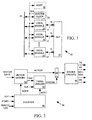
- FIG. 1 is a block diagram depicting an automated tester 10 for performing logic and leakage current tests on an integrated circuit or similar device under test (DUT) 12.
- Tester 10 includes a set of local modules 14, each connected to a corresponding terminal 15 of DUT 12 through a transmission line 17. Each local module 14 can either transmit a test signal to its corresponding DUT terminal 15 or receive an output signal from the corresponding DUT terminal 15.
- Local modules 14 are also connected to a host computer 16 through a common bus 18.
- Bus 18 conveys test instructions, test results, and control signals between the host computer 16 and local modules 14.
- a clock circuit 20 supplies a system clock signal CLK to local modules 14 and to host computer 16 for timing their operations.
- some local modules 14 generate and transmit logic signal patterns to DUT input terminals while other local modules 14 sample output signals produced at DUT output terminals.
- the host computer 16 sends programming data to each local module 14 via bus 18 telling each local module when to pulse a DUT input signal or when to sample a DUT output signal.
- the host computer 16 then sends a START signal concurrently to local modules 14 via bus 18 causing the local modules to begin the logic test.
- Each local module 14 responds to the START signal by carrying out the sequence of actions indicated by its stored programming data using pulses of the CLK signal as a timing reference.
- each local module 14 sampling a DUT 12 output signal stores the sample data in an internal acquisition memory.
- the host computer 16 reads the acquired data out of the acquisition memory of each local module 14 via bus 18 and makes that data available to a user.
- Tester 10 also performs leakage current tests on DUT 12.
- the high or low level leakage currents of a DUT terminal 15 are the amounts of current the terminal 15 draws when the terminal is driven to a high or low logic level.
- each local module 14 drives its corresponding DUT 12 terminal 15 to high and low logic levels, determines whether the resulting leakage currents are above or below given levels, and then stores data indicating the result in its acquisition memory for later retrieval by host computer 16.
- FIG. 2 illustrates a preferred embodiment of a typical local module 14 in combined block and schematic diagram form.
- Local module 14 includes several subsystems: a clamping circuit 22, a parametric signal source 24, a data acquisition circuit 26, a logic signal source 27, a timing signal generator 28, and a bus interface circuit 30.
- the parametric signal source 24 generates output signals for testing the high and low level leakage currents at terminal 15.
- Source 24 includes two adjustable voltage sources for supplying high and low level test signals to the DUT terminal through precision resistors. Since the amount of voltage drop across each resistor is proportional to the high or low leakage current of terminal 15, the resulting voltage at terminal 15 indicates the leakage current.
- Data acquisition circuit 26 monitors that terminal voltage VT to determine leakage current.
- Logic signal source 27 produces an output logic signal VL for stimulating DUT terminal 15 when terminal 15 acts as a DUT input terminal. To isolate itself from terminal 15 when not needed during leakage currenc tests or during logic tests when terminal 15 acts as a DUT output, source 27 tristates the VL logic signal.
- Data acquisition circuit 26 samples the DUT terminal voltage VT during leakage current tests, compares that sampled terminal voltage to its expected threshold values and stores data representing the result of the comparison in an internal acquisition memory. Data acquisition circuit 26 also samples the DUT terminal voltage VT at appropriate times during logic signal tests when DUT terminal 15 acts as a DUT output terminal, determines whether the sampled terminal voltage is at a high or low logic level, and stores data indicating the result of that determination in its acquisition memory. After the logic and leakage current tests are complete, host computer 16 of FIG. 1 uses bus 18 to access the test results stored in the acquisition memory within circuit 27. Clamping circuit 22 prevents the DUT terminal 15 voltage from swinging above or below predetermined limits during a logic test.
- Timing signal generator 28 receives programming data and control signals from the host computer 16 of FIG. 1 via bus 18 and bus interface circuit 30. In response to the programming data, timing signal generator 28 produces output signals controlling operations of parametric and logic signal sources 24 and 27 and clamping circuic 22. Timing signal generator uses the CLK signal from clock 20 of FIG. 1 as a timing reference.
- Clamping circuit 22 includes registers 32 and 34, multiplexers 36 and 38, digital-to-analog conveners (DACS) 40 and 42, diodes 44 and 46, an NPN transistor 48, a PNP transistor 50, and hot carrier Schottky diodes 52 and 54.
- Host computer 16 of FIG. 1 stores two data values D1 and D2 in register 32 via bus 18 and bus interface circuit 30.
- Multiplexer 36 supplies data D1 to the input of DAC 40 when the tester is performing a logic test and supplies data D2 to DAC 40 when the tester is performing a leakage current test.
- the host computer also stores two data values D3 and D4 in register 34.
- Multiplexer 38 forwards data D3 to the input of DAC 42 during logic tests and forwards data D4 to DAC 42 during leakage current tests.
- the output of DACS 40 and 42 drive bases (control terminals) of transistors 48 and 50.
- the collector (“load terminal”) of transistor 48 is connected to a positive voltage source V while the collector of transistor 50 is grounded.
- Schottky diodes 52 and 54 couple the emitters (also "load terminals") of transistors 48 and 50 to DUT terminal 15.
- Diodes 44 and 46 are connected in series between the bases of transistors 48 and 50.
- the selected data value D1 causes DAC 40 to supply a voltage signal VLC to the base of transistor 48 of sufficient magnitude to turn on transistor 48 when the DUT terminal output voltage VT begins to fall below a predetermined minimum level. The current supplied by transistor 48 clamps VT to that minimum level.
- the selected data value D3 causes DAC 42 to supply a voltage signal VHC to the base of transistor 50 sufficient to turn on transistor 50 when the DUT terminal output voltage VT attempts to rise above a predetermined maximum level. In such event current supplied by transistor 50 clamps VT to the maximum level.
- multiplexers 36 and 38 select data values D2 and D4.
- Data value D2 causes DAC 40 to supply a voltage signal VLC to the base of transistor 48 which ensures transistor 48 stays off and diode 52 remains reverse biased.
- data value D4 causes DAC 40 to supply a voltage signal VHC to the base of transistor 50 which turns transistor 50 off and reverse biases diode 54.
- D2 may be set to produce a DAC 40 output voltage of 0 volts or less and D4 may be set to produce a DAC 42 output voltage of at least 5 volts. With diodes 52 and 54 reverse biased, clamping circuit 22 does not affect current flowing through the DUT terminal.
- Diodes 44 and 46 of clamping circuit 22 ensure that transistors 48 and 50 do not turn on concurrently, thereby shorting source V to ground. Without diodes 44 and 46 transistors 48 and 50 could concurrently turn on as a result of a programming error when incorrect data values are delivered to DACS 40 and 42.
- Parametric signal source 24 supplies a test signal to DUT terminal 15 during leakage current tests.
- Source 24 includes registers 53 and 55, multiplexers 56 and 58, DACS 60 and 62, 10 6 Ohm resistors 64 and 66, and hot carrier Schottky diodes 68 and 70.
- Host computer 16 stores two data values D5 and D6 in register 53 and two data values D7 and D8 in register 55.
- Multiplexer 56 supplies either data value D5 or D6 to the input of DAC 60.
- Multiplexer 58 supplies either data value D7 or D8 to the input of DAC 62.
- Resistor 64 and diode 68 in series couple the output of DAC 60 to DUT terminal 15 while resistor 66 and diode 70 in series couple the output of DAC 62 to the DUT terminal.
- multiplexers 56 and 58 supply data values D6 and D7 to DACS 60 and 62, respectively with D6 sized so that DAC 60 forward biases diode 68 and with D7 sized so that DAC 62 reverse biases diode 70.
- the value of D6 is chosen so that the voltage drop across resistor 64 and diode 68 produces a voltage VT at DUT terminal 15 equal to the high logic level when the DUT is drawing its rated high level leakage current. If DUT terminal 15 is drawing excessive leakage current, VT will fall below the high logic level due to excessive voltage drop across resistor 64. As discussed below data acquisition circuit 26 ascertains when the DUT terminal voltage VT falls below its expected value.
- multiplexers 56 and 58 supply data values D5 and D8 to DACS 60 and 62.
- D5 is sized so Chat the output of DAC 60 reverse biases diode 68.
- the value of D8 is chosen so that diode 70 is forward biased with the voltage drop across resistor 66 and diode 70 producing a voltage VT at DUT terminal 15 equal to the nominal low logic level when the DUT is drawing its rated low level leakage current. If the DUT has excessive leakage current, VT will rise above the low logic level due to excessive voltage across resistor 66.
- Data acquisition circuit 26 senses when the DUT terminal voltage VT rises above its expected level.
- Logic test signal source 27 stimulates DUT terminal 15 with a logic signal VL during logic tests when terminal 15 is a DUT input terminal.
- the host computer 16 of FIG. 1 stores two data values D12 and D13 in a register 72.
- the D12 value is supplied to a DAC 74 and the D13 value is supplied to a DAC 76.
- the values of D12 and D13 are set so that DAC 74 produces a high logic level reference signal VHL and DAC 76 produces a low logic level reference signal VLL.
- the VHL and VLL reference signals are supplied to a tristate driver 78.
- Timing signal generator 28 supplies driver 78 with a tristate control signal TS and an input logic signal VX.
- timing signal generator 28 asserts the TS signal to turn on driver 78. With TS asserted, driver 78 drives its output signal VL to either the high logic level of reference signal VHL or the low logic level of reference signal VLL depending on the state of an input logic signal VX produced by timing signal generator 28. Otherwise, during a leakage current test or when the DUT terminal is acting as a DUT output, signal generator 28 deasserts TS to tristate the driver 78 output signal VL.
- the data acquisition circuit 26 includes a comparator 82 for comparing the DUT terminal voltage VT to a reference threshold voltage VTH produced by a DAC 84. Comparator 82 produces an output signal VC that is high when VT exceeds VTH and low when VTH exceeds VT.
- An acquisition memory 83 stores a bit indicating the state of the VC signal when write enabled by a pulse cf a signal WE from signal generator 28.
- host computer 16 of FIG. 1 writes three data values D9-D11 into register 88. The D9 value defines a threshold voltage VTH used during a logic test to distinguish between high and low logic levels at DUT terminal 15.
- the D10 value defines a threshold voltage VTH that marks the allowable lower limit of DUT terminal voltage VT in a high level leakage current test while the D11 value defines a threshold voltage marking the allowable upper limit of terminal voltage VT for a low level leakage current test.
- a multiplexer 86 controlled by a two-bit signal MX5 from timing signal generator 28, selects one of data values D9-D11 stored in a register 88 as input to DAC 84 depending upon the type of test being performed.
- Timing signal generator 28 receives and stores programming data from host computer 16 of FIG. 1 before the start of a test and controls timing of its output signals in accordance with its stored data. Its output signals TS and VX control driver 78 and its WE output signal controls the timing of data storage by acquisition memory 83. Controller 28 also produces a set of output signals MX1-MX5 for controlling multiplexers 36, 38, 56, 58 and 86.
- DUT terminal 15 is bi-directional, has high and low logic levels of 5 and 0 volts, respectively, and has rated high and low level leakage currents of 1 microamp and 0.5 microamp, respectively.
- Local module 14 is to perform high and low level leakage current tests in succession followed by a logic test.
- the DUT terminal is bi- directional so that to perform the logic test, the local module must sometimes drive the DUT terminal 15 to a high logic or low logic level and must at other times sample and store the logic state of the output signal VT produced by the DUT at terminal 15.
- host computer 16 of FIG. 1 initially stores the data values D1-D13 in the various registers of module 14 of FIG. 2 sized so as to produce the DAC output signals with indicated voltages during indicated tests.
- DATA SIGNAL VOLTAGE TEST D1 VLC 0.8V LOGIC D2 VLC 0.0V HIGH/LOW D3 VHC 4.2V LOGIC D4 VHC 5.0V HIGH/LOW D5 VHP 0.0V LOGIC/LOW D6 VHP 6.2V HIGH D7 VLP 6.0V LOGIC/LOW D8 VLP -.7V LOW D9 VTH 2.5V LOGIC D10 VTH 5.0V HIGH D11 VTH 0.0V LOW D12 VHL 5.0V LOGIC D13 VLL 0.0V LOGIC
- multiplexer 36 of clamping circuit 22 of FIG. 2 selects the data value D1 stored in register 32 when the local module is performing a logic test.
- the DAC 40 output signal VLC produced in response to the D1 data is 0.8 volts.
- the drop across the base- emitter junction of transistor 48 is 0.6V
- the drop across diode 52 is 0.2V
- diode 52 becomes forward biased
- transistor 48 begins to turn on.
- Transistor 48 supplies sufficient current to prevent VT from failing below 0 volts.
- multiplexer 36 selects D2 as input to DAC 40, and D2 is sized so that VLC is 0 volts.
- diode 52 which has very little leakage current when reverse biased, effectively isolates transistor 48 from DUT terminal 15 so that transistor 48 supplies no leakage current to DUT terminal 15.
- Multiplexer 38 of the clamping circuit 22 of FIG. 2 selects data value D3 in register 34 as input to DAC 42 when local module 14 is performing a logic test.
- DAC 42 output signal VHC produced in response to the D3 data is 4.2 volts.
- DUT terminal voltage VT rises to 5V transistor 50 begins to turn on and diode 54 becomes forward biased. The total drop across the base-emitter junction of transistor 50 and diode 54 is 0.8V. Transistor 50 sinks sufficient current to prevent VT from rising above 5 volts.
- multiplexer 38 selects data D4 as input to DAC 42. Data D4 sets VHC at 5 volts. This reverse biases diode 54 for normal values of VT (0-5V) so as to substantially isolate transistor 50 from DUT terminal 15. With diode 54 isolating transistor 50, the transistor cannot sink appreciable leakage current from terminal 15.
- Multiplexer 56 of the parametric signal generator 24 of FIG. 2 selects D5 as input to DAC 60 during a logic test or during a low level leakage current test.
- Data D5 sets the DAC 60 output signal VHP to 0.0V to ensure that diode 68 remains reverse biased. Diode 68 thus isolates DAC 60 from DUT terminal 15.
- multiplexer 56 selects data D6 causing DAC 60 to set VHP at 6.2 volts. If the high level leakage current at DUT terminal 15 is the rated 1 microamp or less, terminal voltage VT will be at least 5.0 volts.
- Multiplexer 58 selects D7 as input to DAC 62 during a logic test or during a high level leakage current test.
- D7 is suitably set to produce a DAC 62 output signal VLP signal of 6.0V. This voltage reverse biases diode 70 for all expected values of terminal voltage VT, thereby substantially isolating DAC 62 from DUT terminal 15.
- a low level leakage current test multiplexer 58 selects D8 as input to DAC 62, thereby producing a DAC output voltage VLP of - 0.7 volts. At the rated low level leakage current of 0.5 microamps or less, a VLP of -0.7 volts will produce a VT of at least 0 volts. A DUT terminal voltage VT exceeding 0.0 volts indicates that the low level leakage current exceeds its rated value.
- Multiplexer 86 of data acquisition circuit 26 selects D9 as input to DAC 84 during logic tests.
- D9 is set to produce a DAC 84 output voltage VTH of 2.5V. If VT exceeds 2.5V, comparator 82 drives its output signal VC high. If VT is less than 2.5, comparator 82 drives output signal VC low.
- Multiplexer 86 selects D10 during a high level leakage current test. D10 causes DAC 84 to produce a 5.0V VTH output. When VT exceeds 5.0V comparator 82 drives its output signal VC high indicating that the DUT terminal 15 has passed the high level leakage current test.
- comparator 82 drives its output signal VC low indicating DUT terminal 15 has failed the high level leakage current test.
- Multiplexer 86 selects D11 during a low level leakage current test. D11 tells DAC 84 to produce a 0.0V VTH output.
- comparator 82 drives its output signal VC high indicating that DUT terminal 15 has passed the low level leakage current test.
- comparator 82 drives its output signal VC low to indicate DUT germinal 15 has failed the low level leakage current test.
- host computer 16 of FIG. 1 stores the D1-D11 data in the local module registers, transmits programming data to timing signal generator 28 via bus 18, and then concurrently sends a START signal to the signal generator 28 of each local module via bus 18.
- signal generator 28 begins generating its output put signals in accordance with its stored programming data.
- controller 28 initially deasserts TS to tristate the VL output signal of driver 78 and sets multiplexer control MX1-MX5 to switch all multiplexers to select the DAC input data (D2, D4, D6, D7 and D10) appropriate for a high level leakage current test per Table I above. Controller 28 then pulses the write enable signal WE to acquisition memory 83 causing it to sample and store at a first address the state of the VC output signal of comparator 82. This bit indicates whether DUT terminal 15 has passed the high level leakage current test.
- Controller 28 sets control signals MX1-MX5 to switch the multiplexers to select the DAC input data (D2, D4, D5, D8 and D11) appropriate for a low level leakage current test.
- Timing signal generator 28 then again pulses the write enable signal WE causing acquisition memory 83 to sample the VC output signal and store at a next address a bit indicating whether DUT terminal 15 has passed the low level leakage current test.
- controller 28 sets the MX1-MX5 multiplexer control signals so that the various multiplexers select data (D2, D3, D5, D7 and D9) appropriate for a logic test per Table I above. Thereafter, whenever local module 14 is to send a high or low level signal to DUT terminal 15, signal generator 28 sets VX to the appropriate state and sets output signal TS to turn on tristate driver 78, thereby supplying a 5.0V or 0.0V signal to DUT terminal 15.
- signal generator 28 pulses the write enable signal WE causing the acquisition memory to sample VC and to store a bit indicating whether VT is above or below the 2.5V threshold established by selected data D9.
- the host computer 16 reads the test data out of memory 83 via bus 18. The first two bits of the data indicate whether DUT terminal 15 passed the high and low leakage current tests and remaining bits of data from acquisition memory 83 form the results of the logic test.
- FIG. 3 illustrates timing signal generator 28 of FIG. 2 in more detailed block diagram form.
- the host computer 16 of FIG. 1 writes a sequence of "vector data" words to a vector memory 90.
- the test is organized into a set of consecutive time periods, each lasting a given number of system clock CLK signal pulses.
- a separate vector data word is stored in memory 90 for each time period of the test.
- Each vector data word includes ACTION bits and TIME bits.
- Each ACTION bit indicates a state to which timing signal generator 28 is to drive a corresponding one of its output signals during the time period.
- the TIME bits indicate a time during the time period that the timing signal generator is to take the actions indicated by the ACTION bits.
- the host computer supplies data value PERIOD_LEN to a counter 96 indicating the number of CLK signal pulses in each test period.
- the START signal produced by the host computer resets counter 96 and tells it to begin counting CLK signal pulses to determine when each test period begins.
- counter 96 increments an output address supplied to vector memory 90 causing the vector memory to read out the vector data word at the indicated address.
- the TIME bits of the read out word are supplied to a timing vernier 92.
- Counter 96 sends a NEXT signal pulse to timing vernier 92 at the start of each test period.
- Latch 93 latches the ACTION bits onto inputs of a set of driver circuits 94 which drive output signals TS, VX, MX1-MX5 and WE to states indicated by their corresponding ACTION bits.
- FIG. 4 illustrates an alternative embodiment of a local module 14 of FIG. 1 generally similar to the embodiment of local module 14 shown in FIG. 2. Similar elements in FIGS. 2 and 4 are similarly numbered. The only difference between the embodiments of FIGS. 2 and 4 lies in the arrangement of Schottky diodes linking the clamping circuit 22 and the parametric signal source 24 to the DUT terminal 15.
- resistors 64 and 66 of source 24 and transistors 48 and 50 of clamping circuit 22 are linked to DUT terminal 15 via separate Schottky diodes 52, 54, 68 and 70.
- FIG. 2 illustrates an alternative embodiment of a local module 14 of FIG. 1 generally similar to the embodiment of local module 14 shown in FIG. 2. Similar elements in FIGS. 2 and 4 are similarly numbered. The only difference between the embodiments of FIGS. 2 and 4 lies in the arrangement of Schottky diodes linking the clamping circuit 22 and the parametric signal source 24 to the DUT terminal 15.
- the emitter of transistor 48 is connected to DUT terminal 15 through a series of two Schottky diodes 52A and 52B and the emitter of transistor 50 is connected to terminal 15 through a series of two Schottky diodes 54A and 54B.
- Diode 52B also links resistor 64 of parametric signal source 24 to terminal 15 while diode 54B also links resistor 66 of source 24 to terminal 15.
- the embodiment of module 14 of FIG. 4 is programmed in the same way as the embodiment of FIG. 2 although values of D1-D8 must be altered slightly to account for the presence of the extra Schottkey diodes in the paths between the DUT terminal and transistors 48 and 50.
- One advantage to the embodiment of FIG. 4 is that the Schottkey diode arrangement of FIG. 4 presents less capacitance at terminal 15 and therefore allows the logic test signal VL to operate with sharp edges at a higher frequency than the Schottky diode arrangement of FIG. 2.
- the circuit of FIG. 4 also improves clamping response to voltage swings at DUT terminal 15.
- DAC 40 when the DUT terminal voltage VT begins to fall below the threshold set by the VLC output of DAC 40, DAC 40 must charge the inherent capacitances of diode 52 and the base-emitter junction of transistor 48 before it can turn on transistor 48 and limit the VT voltage swing.
- DAC 42 when DUT terminal voltage VT begins to rise above the threshold set by DAC 42, DAC 42 must charge the inherent capacitances of diode 54 and the base-emitter junction of transistor 50 before it can turn on transistor 50. The time required to charge this capacitance delays the response of the clamping circuit to voltage swings at the DUT terminal 15.
- the output voltages DACs 60 and 62 of parametric signal source 24 may be set to precharge diodes 52A and 54B and the base-emitter diodes of transistors 48 and 50 so that the clamping circuit 22 can more quickly respond to voltage swings at the DUT terminal 15.
- the swing in VT is to be limited to 0-5V
- diode 52A To precharge diode 52A and the emitter-base junction of transistor 48, we set D5 so that the output VHP of DAC 60 to 0.2V. While the emitter-base junction of transistor 48 and diode 52Aare forward biased for all values of DUT terminal voltage VT, diode 52B remains reverse biased until VT reaches 0 volts. When VT starts to fall below 0 volts, transistor 48 begins to supply current to terminal 15 to prevent VT from falling below 0. The only delay in response is the time required to charge the relatively small inherent capacitance of diode 52B, the capacitance of diode 52A and the emitter-base junction of transistor 48 having been precharged.
- D3 so that the VHC output of DAC 42 is 4.0 volts to account for the 0.6V drop across the emitter- base junction of transistor 50 and the 0.2V forward bias drop across each of diodes 54A and 54B.
- D7 we also set D7 so that the output VLP of DAC 62 is 4.8V. This value of VLP precharges the inherent capacitances of diode 54B and the emitter-base junction of transistor 50 but keeps diode 54A reverse biased until VT begins to rise above 5.0V. At that point after only a relatively small delay required for charging the inherent capacitance of diode 54A, the transistor 50 begins to draw current from DUT terminal 15 so as to limit the DUT terminal voltage rise.
Landscapes
- Engineering & Computer Science (AREA)
- General Engineering & Computer Science (AREA)
- Physics & Mathematics (AREA)
- General Physics & Mathematics (AREA)
- Tests Of Electronic Circuits (AREA)
- Testing Of Individual Semiconductor Devices (AREA)
Claims (19)
- Dispositif sensible à des signaux de commande d'entrée pour exécuter des tests logiques et paramétriques sur un circuit numérique (12) comportant une borne (15) du circuit,une source de signal logique (27) couplée à la borne (15) du circuit pour envoyer un signal de test logique (VL) à la borne (15) du circuit en réponse à l'application d'un premier signal de commande d'entrée (TS), le signal de test logique alternant entre les niveaux logiques haut et bas;le dispositif étant caractérisé parune première diode (68); etune source de signal de test paramétrique (53-66,70) connectée à la borne du circuit par l'intermédiaire de ladite première diode pour envoyer un signal de test paramétrique (VHP) à la borne du circuit par l'intermédiaire de la première diode lors de l'application d'un second signal de commande d'entrée (MX3, MX4) et pour polariser en inverse ladite première diode lorsque ledit second signal de commande n'est pas appliqué.
- Dispositif selon la revendication 1, dans lequel ladite première diode (68) est une diode Schottky.
- Dispositif selon la revendication 1, comprenant en outre:une seconde diode (52); etdes moyens de verrouillage (32-50,54) connectés à la borne (15) du circuit par l'intermédiaire de ladite seconde diode (52) pour répondre au positionnement d'un troisième signal de commande d'entrée (MX1,MX2) par l'envoi d'un signal de verrouillage à ladite borne (15) du circuit par l'intermédiaire de ladite première diode (68) pour empêcher une tension de ladite borne (15) du circuit d'osciller au-delà d'une limite prédéterminée, et pour polariser en inverse ladite seconde diode (52) lorsque ledit troisième signal de commande (MX1,MX2) n'est pas appliqué.
- Dispositif selon la revendication 3, dans lequel lesdites et secondes diodes (68,52) sont des diodes Schottky.
- Dispositif selon la revendication 1, comprenant en outre des moyens de détection couplés à la borne (15) du circuit pour détecter si une tension au niveau de la borne (15) du circuit augmente au-dessus d'un niveau de seuil prédéterminé.
- Dispositif selon la revendication 3, comprenant en outre:des moyens de verrouillage (32-50, 54) connectés à la borne (15) du circuit au moyen de ladite seconde diode (52) pour répondre à l'application d'un premier signal de commande d'entrée (MX1,MX2) par envoi d'un signal de verrouillage à ladite borne (15) du circuit par l'intermédiaire de ladite première diode (68) pour empêcher qu'une tension de ladite borne (15) du circuit n'oscille au-delà d'une limite prédéterminée, et pour polariser en inverse ladite seconde diode (52) lorsque ledit troisième signal de commande (MX1,MX2) n'est pas appliqué; etdes moyens de détection (82) couplés à la borne (15) correspondante du circuit pour détecter si une tension sur la borne (15) du circuit augmente au-dessus d'un niveau de seuil prédéterminé.
- Dispositif selon la revendication 6, dans lequel lesdites première et seconde diodes (68,52) sont des diodes Schottky.
- Dispositif selon la revendication 1, dans lequel ladite source de signal logique (27) comprend:un générateur de signal (28) pour générer un premier signal de sortie (VX) variant entre des premier et second états; etdes moyens (72,74,76,78,78) recevant ledit premier signal de sortie (VX) provenant dudit générateur de signal (28) et recevant ledit premier signal de commande et possédant un premier noeud de sortie connecté à ladite borne (15) du circuit pour générer et envoyer ledit signal de test logique (VL) audit premier noeud lorsque ledit premier signal de commande d'entrée (TS) est appliqué, des variations entre les niveaux haut et bas dudit signal de test logique (VL) étant commandées de façon cadencée en réponse aux premier et second états dudit premier signal de sortie (VX), et pour placer ledit premier noeud de sortie dans une condition trois-états lorsque ledit premier signal de commande (TS) n'est pas appliqué.
- Dispositif selon la revendication 1, dans lequel ladite source de signal de test paramétrique (53-66,70) comprend:une source de tension ajustable (53,36,40) recevant ledit second signal de commande et possédant un second noeud de sortie, pour produire une première tension de sortie sur ledit second noeud de sortie lorsque ledit second signal de commande est appliqué et pour produire une seconde tension de sortie sur ledit second noeud de sortie lorsque ledit second signal de commande n'est pas appliqué; etune résistance (64), la résistance (64) et ladite première diode (68) étant connectées en série entre ledit second noeud de sortie et ladite borne (15) du circuit, la première tension de sortie étant suffisante pour polariser dans le sens direct ladite première diode (58) et ladite seconde tension de sortie étant suffisante pour polariser en inverse ladite première diode (68) lorsqu'une tension de ladite borne (15) du circuit se situe dans une gamme définie par lesdits niveaux logiques haut et bas.
- Dispositif selon la revendication 3, dans lequel lesdits moyens de serrage (32-50, 54) comprennent:une source de tension fixe (V+);un transistor (48) possédant une borne de commande, une première borne de charge connectée à ladite source de tension fixe et une seconde borne de charge couplée à ladite borne de circuit par l'intermédiaire de ladite seconde diode; etune source de tension ajustable (32,36,40) en réponse audit troisième signal de commande pour envoyer, à ladite borne de commande, une première tension suffisante pour placer ledit transistor (48) à l'état conducteur et polariser en direct la seconde diode (52) lorsque ledit troisième signal de commande est appliqué, et que la tension de ladite borne du circuit atteint ladite limite prédéterminée et pour l'envoi, à ladite borne de commande, d'une seconde tension suffisante pour placer ledit transistor (48) à l'état bloqué et polariser en inverse ladite seconde diode (52) lorsque ledit troisième signal de commande n'est pas appliqué.
- Dispositif selon la revendication 3, dans lequel ladite source de signal de test paramétrique (53-66,70) comprend:une source de tension ajustable (53,60) recevant ledit second signal de commande et possédant un second noeud de sortie, pour produire une première tension de sortie sur ledit second noeud de sortie lorsque ledit second signal de commande est appliqué et pour produire une seconde tension de sortie au niveau dudit second noeud de sortie lorsque ledit second signal de commande n'est pas appliqué; etune résistance (64), la résistance (60) et ladite première diode (68) étant connectées en série entre ledit second noeud de sortie et ladite borne (15) du circuit; ladite première tension de sortie étant suffisante pour polariser dans le sens direct ladite première diode (68), et la seconde tension de sortie étant suffisante pour polariser en inverse ladite première diode (48) lorsqu'une tension de ladite borne (15) du circuit se situe dans une gamme définie par lesdits niveaux logiques haut et bas, et dans lequel lesdits moyens de verrouillage (32-50,54) comprennent:une source de tension fixe (V+);un transistor (48) possédant une borne de commande, une première borne de source connectée à ladite source de tension, fixe et une seconde borne de charge couplée à ladite borne (15) du circuit par l'intermédiaire de ladite seconde diode (52); etune source de tension ajustable (32,36,40) apte à répondre audit troisième signal de commande pour envoyer à ladite borne de commande une première tension suffisante pour placer ledit transistor (48) à l'état conducteur et polariser dans le sens direct ladite seconde diode (52) lorsque ledit troisième signal de commande est appliqué et que la tension de ladite borne (15) du circuit atteint ladite limite prédéterminée et pour envoyer à ladite borne de commande une seconde tension suffisante pour placer ledit transistor (48) à l'état bloqué et polariser en inverse ladite seconde diode (52) lorsque ledit troisième signal de commande n'est pas appliqué.
- Dispositif selon la revendication 11, dans lequel lesdites première et seconde diodes (68,52) sont des diodes Schottky.
- Dispositif selon la revendication 1, ce dispositif comprenant en outre:une seconde diode (54) connectée en série avec ladite première diode; etdes moyens de verrouillage (32-50,54) connectés à la borne (15) du circuit par l'intermédiaire desdites première et seconde diodes (68,52) connectées en série pour répondre à l'application d'un troisième signal de commande d'entrée par l'envoi d'un signal de verrouillage à ladite borne (15) du circuit par l'intermédiaire desdites première et seconde diodes (68,52) pour empêcher qu'une tension de ladite borne (15) du circuit n'oscille au-delà d'une limite prédéterminée.
- Dispositif selon la revendication 13, dans lequel lesdites première et seconde diodes (68,52) sont des diodes Schottky.
- Dispositif selon la revendication 13, comprenant en outre des moyens de détection (78) couplés à la borne (15) du circuit pour détecter si une tension (VT) au niveau de la borne (15) du circuit augmente au-dessus d'un niveau de seul prédéterminé.
- Dispositif selon la revendication 13, dans lequel ladite source (27) de signal logique comprend:un générateur de signal (28) pour générer un premier signal de sortie (VX) variant entre des premier et second états; etdes moyens (78) recevant ledit premier signal de sortie provenant dudit générateur de signal (28) et recevant ledit premier signal de commande et possédant un premier noeud de sortie connecté à ladite borne (15) du circuit pour générer et envoyer ledit signal de test logique audit premier noeud lorsque ledit premier signal de commande d'entrée est appliqué, des variations entre les niveaux haut et bas dudit signal de test logique sont commandées de façon cadencée en réponse aux premier et second états dudit premier signal de sortie, et pour placer ledit premier noeud de sortie dans une condition trois-états lorsque ledit premier signal de commande n'est pas appliqué.
- Dispositif selon la revendication 13, dans lequel ladite source de signal de test paramétrique (53-66,70) comprend:une source de tension ajustable (53,58,60) recevant ledit second signal de commande et possédant un second noeud de sortie, pour produire une première tension de sortie sur ledit second noeud de sortie lorsque ledit second signal de commande est appliqué et pour produire une seconde tension de sortie sur ledit second noeud de sortie lorsque ledit second signal de commande n'est pas appliqué; etune résistance (64), la résistance (64) et ladite première diode (68) étant connectées en série entre ledit second noeud de sortie et ladite borne (15) du circuit.
- Dispositif selon la revendication 13, dans lequel lesdits moyens de verrouillage (32-50,54) comprennent:une source de tension fixe (V+);un transistor (48) possédant une borne de commande, une première borne de charge connectée à ladite source de tension fixe et une seconde borne de charge couplée à ladite borne (15) de circuit par l'intermédiaire desdites première et seconde diodes (68,52); etune source de tension ajustable (32,36,40) en réponse audit troisième signal de commande pour envoyer, à ladite borne de commande, une première tension suffisante pour placer ledit transistor (48) à l'état conducteur et polariser en direct les première et seconde diodes (68,52) lorsque ledit troisième signal de commande est appliqué, et que la tension de ladite borne (15) du circuit atteint ladite limite prédéterminée et pour l'envoi, à ladite borne de commande, d'une seconde tension (VLC) suffisante pour polariser en inverse ladite seconde diode (52) lorsque ledit troisième signal de commande n'est pas appliqué.
- Dispositif selon la revendication 17,
dans lequel lesdits moyens de verrouillage (32-50,54) comprennent:une source de tension fixe (V+);un transistor (48) possédant une borne de commande, une première borne de source connectée à ladite source de tension fixe et une seconde borne de charge couplée à ladite borne (15) du circuit par l'intermédiaire desdites première et seconde diodes (68,52); etune source de tension ajustable (32,36,40) apte à répondre audit troisième signal de commande pour envoyer à ladite borne de commande une première tension suffisante pour placer ledit transistor (48) à l'état conducteur et polariser dans le sens direct lesdites première et seconde diodes (68,52) lorsque ledit troisième signal de commande est appliqué et que la tension de ladite borne (15) du circuit atteint ladite limite prédéterminée et pour envoyer à ladite borne de commande une seconde tension suffisante pour polariser en inverse ladite seconde diode (52) lorsque ledit troisième signal de commande n'est pas appliqué.
Applications Claiming Priority (3)
| Application Number | Priority Date | Filing Date | Title |
|---|---|---|---|
| US639165 | 1996-04-25 | ||
| US08/639,165 US5696773A (en) | 1996-04-25 | 1996-04-25 | Apparatus for performing logic and leakage current tests on a digital logic circuit |
| PCT/US1997/000974 WO1997040394A1 (fr) | 1996-04-25 | 1997-01-17 | Appareil permettant d'effectuer des tests logiques et de courant de fuite sur un circuit logique numerique |
Publications (3)
| Publication Number | Publication Date |
|---|---|
| EP0895598A1 EP0895598A1 (fr) | 1999-02-10 |
| EP0895598A4 EP0895598A4 (fr) | 2000-07-12 |
| EP0895598B1 true EP0895598B1 (fr) | 2004-12-15 |
Family
ID=24562996
Family Applications (1)
| Application Number | Title | Priority Date | Filing Date |
|---|---|---|---|
| EP97903049A Expired - Lifetime EP0895598B1 (fr) | 1996-04-25 | 1997-01-17 | Appareil permettant d'effectuer des tests logiques et de courant de fuite sur un circuit logique numerique |
Country Status (6)
| Country | Link |
|---|---|
| US (1) | US5696773A (fr) |
| EP (1) | EP0895598B1 (fr) |
| JP (1) | JP2000509148A (fr) |
| KR (1) | KR100377919B1 (fr) |
| DE (1) | DE69731946T2 (fr) |
| WO (1) | WO1997040394A1 (fr) |
Families Citing this family (14)
| Publication number | Priority date | Publication date | Assignee | Title |
|---|---|---|---|---|
| JPH10199293A (ja) * | 1996-12-27 | 1998-07-31 | Canon Inc | メモリのデータ保持特性の試験方法 |
| US5951705A (en) * | 1997-10-31 | 1999-09-14 | Credence Systems Corporation | Integrated circuit tester having pattern generator controlled data bus |
| JP3392029B2 (ja) * | 1997-12-12 | 2003-03-31 | 株式会社アドバンテスト | Icテスタの電圧印加電流測定回路 |
| TW527491B (en) * | 1999-02-02 | 2003-04-11 | Fujitsu Ltd | Test method and test circuit for electronic device |
| US6175939B1 (en) | 1999-03-30 | 2001-01-16 | Credence Systems Corporation | Integrated circuit testing device with dual purpose analog and digital channels |
| US6429677B1 (en) | 2000-02-10 | 2002-08-06 | International Business Machines Corporation | Method and apparatus for characterization of gate dielectrics |
| US6586921B1 (en) | 2000-05-12 | 2003-07-01 | Logicvision, Inc. | Method and circuit for testing DC parameters of circuit input and output nodes |
| US6982587B2 (en) * | 2002-07-12 | 2006-01-03 | Rambus Inc. | Equalizing transceiver with reduced parasitic capacitance |
| US7143323B2 (en) * | 2002-12-13 | 2006-11-28 | Teradyne, Inc. | High speed capture and averaging of serial data by asynchronous periodic sampling |
| JP4791943B2 (ja) * | 2006-11-30 | 2011-10-12 | 東芝マイクロエレクトロニクス株式会社 | 半導体装置 |
| US8504883B2 (en) | 2010-08-25 | 2013-08-06 | Macronix International Co., Ltd. | System and method for testing integrated circuits |
| WO2013077882A1 (fr) * | 2011-11-23 | 2013-05-30 | Intel Corporation | Essais de courant pour des connecteurs d'interface d'e/s |
| US9671427B2 (en) | 2013-04-24 | 2017-06-06 | Keysight Technologies, Inc. | Dual output high voltage active probe with output clamping and associated methods |
| US9423422B2 (en) * | 2013-04-24 | 2016-08-23 | Keysight Technologies, Inc. | Oscilloscope probe having output clamping circuit |
Family Cites Families (13)
| Publication number | Priority date | Publication date | Assignee | Title |
|---|---|---|---|---|
| USRE31056E (en) * | 1977-03-23 | 1982-10-12 | Fairchild Camera & Instrument Corp. | Computer controlled high-speed circuit for testing electronic devices |
| US5168219A (en) * | 1988-10-31 | 1992-12-01 | Fujitsu Limited | Integrated circuit device having signal discrimination circuit and method of testing the same |
| US4989209A (en) * | 1989-03-24 | 1991-01-29 | Motorola, Inc. | Method and apparatus for testing high pin count integrated circuits |
| US5059889A (en) * | 1990-03-08 | 1991-10-22 | Texas Instruments Incorporated | Parametric measurement unit/device power supply for semiconductor test system |
| US5132564A (en) * | 1990-07-27 | 1992-07-21 | North American Philips Corp. | Bus driver circuit with low on-chip dissipation and/or pre-biasing of output terminal during live insertion |
| US5212443A (en) * | 1990-09-05 | 1993-05-18 | Schlumberger Technologies, Inc. | Event sequencer for automatic test equipment |
| US5200696A (en) * | 1990-09-10 | 1993-04-06 | Ltx Corporation | Test system apparatus with Schottky diodes with programmable voltages |
| US5146159A (en) * | 1991-02-01 | 1992-09-08 | Schlumberger Technologies, Inc. | Pin driver for in-circuit test apparatus |
| US5282271A (en) * | 1991-10-30 | 1994-01-25 | I-Cube Design Systems, Inc. | I/O buffering system to a programmable switching apparatus |
| US5294882A (en) * | 1992-07-28 | 1994-03-15 | Sharp Kabushiki Kaisha | Integrated circuit capable of testing reliability |
| JP2803499B2 (ja) * | 1992-11-26 | 1998-09-24 | 日本電気株式会社 | アナログ・デジタルcmos集積回路 |
| US5430400A (en) * | 1993-08-03 | 1995-07-04 | Schlumberger Technologies Inc. | Driver circuits for IC tester |
| US5519335A (en) * | 1995-03-13 | 1996-05-21 | Unisys Corporation | Electronic tester for testing Iddq in an integrated circuit chip |
-
1996
- 1996-04-25 US US08/639,165 patent/US5696773A/en not_active Expired - Lifetime
-
1997
- 1997-01-17 EP EP97903049A patent/EP0895598B1/fr not_active Expired - Lifetime
- 1997-01-17 DE DE69731946T patent/DE69731946T2/de not_active Expired - Fee Related
- 1997-01-17 WO PCT/US1997/000974 patent/WO1997040394A1/fr not_active Ceased
- 1997-01-17 KR KR10-1998-0708499A patent/KR100377919B1/ko not_active Expired - Fee Related
- 1997-01-17 JP JP9538030A patent/JP2000509148A/ja active Pending
Also Published As
| Publication number | Publication date |
|---|---|
| JP2000509148A (ja) | 2000-07-18 |
| EP0895598A4 (fr) | 2000-07-12 |
| US5696773A (en) | 1997-12-09 |
| WO1997040394A1 (fr) | 1997-10-30 |
| KR100377919B1 (ko) | 2003-06-12 |
| KR20000010609A (ko) | 2000-02-15 |
| EP0895598A1 (fr) | 1999-02-10 |
| DE69731946T2 (de) | 2005-12-22 |
| DE69731946D1 (de) | 2005-01-20 |
Similar Documents
| Publication | Publication Date | Title |
|---|---|---|
| EP0895598B1 (fr) | Appareil permettant d'effectuer des tests logiques et de courant de fuite sur un circuit logique numerique | |
| US6195772B1 (en) | Electronic circuit testing methods and apparatus | |
| US6940271B2 (en) | Pin electronics interface circuit | |
| US6175230B1 (en) | Circuit-board tester with backdrive-based burst timing | |
| US4710704A (en) | IC test equipment | |
| US5951705A (en) | Integrated circuit tester having pattern generator controlled data bus | |
| US6057716A (en) | Inhibitable continuously-terminated differential drive circuit for an integrated circuit tester | |
| EP0136206A1 (fr) | Méthode et appareil pour la surveillance des essais automatiques des circuits électroniques | |
| US6202186B1 (en) | Integrated circuit tester having pattern generator controlled data bus | |
| US5521493A (en) | Semiconductor test system including a novel driver/load circuit | |
| JPH05232171A (ja) | 伝送線路終端装置 | |
| US5146161A (en) | Integrated circuit test system | |
| US7509227B2 (en) | High-speed digital multiplexer | |
| US5010297A (en) | Automatic test equipment with active load having high-speed inhibit mode switching | |
| KR101257246B1 (ko) | 핀 일렉트로닉스 드라이버 | |
| JP3950646B2 (ja) | 負荷電流出力回路一体形ドライバ回路及、それを備えたピンエレクトロニクスic及びicテスタ | |
| US6211723B1 (en) | Programmable load circuit for use in automatic test equipment | |
| US6005433A (en) | Low charge injection mosfet switch | |
| JP2000206192A (ja) | 安全なバックドライブレベルの直接測定装置 | |
| US6313669B1 (en) | Buffer circuitry | |
| EP1070260A1 (fr) | Agencement d'essai de courant transitoire d'un circuit cmos electronique numerique | |
| US5068599A (en) | Integrated circuit having an enabling circuit for controlling primary and secondary subcircuits | |
| US6393593B1 (en) | Tester and method for testing LSI designed for scan method | |
| JP2684178B2 (ja) | スキュー補正装置 | |
| EP0216276A2 (fr) | Testeur logique de semi-conducteur à alimentation en courant à restauration rapide |
Legal Events
| Date | Code | Title | Description |
|---|---|---|---|
| PUAI | Public reference made under article 153(3) epc to a published international application that has entered the european phase |
Free format text: ORIGINAL CODE: 0009012 |
|
| 17P | Request for examination filed |
Effective date: 19981012 |
|
| AK | Designated contracting states |
Kind code of ref document: A1 Designated state(s): DE FR GB NL |
|
| A4 | Supplementary search report drawn up and despatched |
Effective date: 20000530 |
|
| AK | Designated contracting states |
Kind code of ref document: A4 Designated state(s): DE FR GB NL |
|
| RIC1 | Information provided on ipc code assigned before grant |
Free format text: 7G 01R 31/28 A, 7G 01R 31/30 B |
|
| 17Q | First examination report despatched |
Effective date: 20040303 |
|
| RIC1 | Information provided on ipc code assigned before grant |
Ipc: 7G 01R 31/30 A |
|
| GRAP | Despatch of communication of intention to grant a patent |
Free format text: ORIGINAL CODE: EPIDOSNIGR1 |
|
| GRAS | Grant fee paid |
Free format text: ORIGINAL CODE: EPIDOSNIGR3 |
|
| GRAA | (expected) grant |
Free format text: ORIGINAL CODE: 0009210 |
|
| AK | Designated contracting states |
Kind code of ref document: B1 Designated state(s): DE FR GB NL |
|
| REG | Reference to a national code |
Ref country code: GB Ref legal event code: FG4D |
|
| REF | Corresponds to: |
Ref document number: 69731946 Country of ref document: DE Date of ref document: 20050120 Kind code of ref document: P |
|
| PG25 | Lapsed in a contracting state [announced via postgrant information from national office to epo] |
Ref country code: GB Free format text: LAPSE BECAUSE OF NON-PAYMENT OF DUE FEES Effective date: 20050315 |
|
| PG25 | Lapsed in a contracting state [announced via postgrant information from national office to epo] |
Ref country code: NL Free format text: LAPSE BECAUSE OF NON-PAYMENT OF DUE FEES Effective date: 20050801 |
|
| NLV4 | Nl: lapsed or anulled due to non-payment of the annual fee |
Effective date: 20050801 |
|
| PLBE | No opposition filed within time limit |
Free format text: ORIGINAL CODE: 0009261 |
|
| GBPC | Gb: european patent ceased through non-payment of renewal fee |
Effective date: 20050315 |
|
| NLXE | Nl: other communications concerning ep-patents (part 3 heading xe) |
Free format text: A REQUEST FOR RESTORATION TO THE PRIOR STATE (ARTICLE 23 OF THE PATENTS ACT 1995) HAS BEEN FILED ON 20051011. |
|
| 26N | No opposition filed |
Effective date: 20050916 |
|
| ET | Fr: translation filed | ||
| PGFP | Annual fee paid to national office [announced via postgrant information from national office to epo] |
Ref country code: FR Payment date: 20060104 Year of fee payment: 10 |
|
| PGFP | Annual fee paid to national office [announced via postgrant information from national office to epo] |
Ref country code: NL Payment date: 20060131 Year of fee payment: 10 Ref country code: DE Payment date: 20060131 Year of fee payment: 10 |
|
| NLXE | Nl: other communications concerning ep-patents (part 3 heading xe) |
Free format text: THE REQUEST FOR RESTORATION TO THE PRIOR STATE AS PROVIDED FOR IN THE PATENTS ACT 1995 (SEE PUBLICATION IN HEADING XE OF THE PATENT BULLETIN OF 20051201) HAS BEEN GRANTED; THE RESTORATION OF THE PATENT HAS BEEN ENTERED IN THE PATENT REGISTER. |
|
| PG25 | Lapsed in a contracting state [announced via postgrant information from national office to epo] |
Ref country code: DE Free format text: LAPSE BECAUSE OF NON-PAYMENT OF DUE FEES Effective date: 20070801 |
|
| NLV4 | Nl: lapsed or anulled due to non-payment of the annual fee |
Effective date: 20070801 |
|
| REG | Reference to a national code |
Ref country code: FR Ref legal event code: ST Effective date: 20070930 |
|
| PG25 | Lapsed in a contracting state [announced via postgrant information from national office to epo] |
Ref country code: FR Free format text: LAPSE BECAUSE OF NON-PAYMENT OF DUE FEES Effective date: 20070131 |