EP0895909A2 - Automatic tensioning device for hand brake levers - Google Patents
Automatic tensioning device for hand brake levers Download PDFInfo
- Publication number
- EP0895909A2 EP0895909A2 EP98500144A EP98500144A EP0895909A2 EP 0895909 A2 EP0895909 A2 EP 0895909A2 EP 98500144 A EP98500144 A EP 98500144A EP 98500144 A EP98500144 A EP 98500144A EP 0895909 A2 EP0895909 A2 EP 0895909A2
- Authority
- EP
- European Patent Office
- Prior art keywords
- hand brake
- casing
- tensioning device
- slide
- automatic tensioning
- Prior art date
- Legal status (The legal status is an assumption and is not a legal conclusion. Google has not performed a legal analysis and makes no representation as to the accuracy of the status listed.)
- Granted
Links
- 230000001105 regulatory effect Effects 0.000 claims description 3
- 239000000470 constituent Substances 0.000 description 3
- 238000010276 construction Methods 0.000 description 2
- 230000015572 biosynthetic process Effects 0.000 description 1
- 230000007423 decrease Effects 0.000 description 1
- 239000000463 material Substances 0.000 description 1
- 238000000034 method Methods 0.000 description 1
Images
Classifications
-
- B—PERFORMING OPERATIONS; TRANSPORTING
- B60—VEHICLES IN GENERAL
- B60T—VEHICLE BRAKE CONTROL SYSTEMS OR PARTS THEREOF; BRAKE CONTROL SYSTEMS OR PARTS THEREOF, IN GENERAL; ARRANGEMENT OF BRAKING ELEMENTS ON VEHICLES IN GENERAL; PORTABLE DEVICES FOR PREVENTING UNWANTED MOVEMENT OF VEHICLES; VEHICLE MODIFICATIONS TO FACILITATE COOLING OF BRAKES
- B60T7/00—Brake-action initiating means
- B60T7/02—Brake-action initiating means for personal initiation
- B60T7/08—Brake-action initiating means for personal initiation hand actuated
- B60T7/10—Disposition of hand control
- B60T7/108—Disposition of hand control with mechanisms to take up slack in the linkage to the brakes
-
- Y—GENERAL TAGGING OF NEW TECHNOLOGICAL DEVELOPMENTS; GENERAL TAGGING OF CROSS-SECTIONAL TECHNOLOGIES SPANNING OVER SEVERAL SECTIONS OF THE IPC; TECHNICAL SUBJECTS COVERED BY FORMER USPC CROSS-REFERENCE ART COLLECTIONS [XRACs] AND DIGESTS
- Y10—TECHNICAL SUBJECTS COVERED BY FORMER USPC
- Y10T—TECHNICAL SUBJECTS COVERED BY FORMER US CLASSIFICATION
- Y10T74/00—Machine element or mechanism
- Y10T74/20—Control lever and linkage systems
- Y10T74/20396—Hand operated
- Y10T74/20402—Flexible transmitter [e.g., Bowden cable]
- Y10T74/20408—Constant tension sustaining
-
- Y—GENERAL TAGGING OF NEW TECHNOLOGICAL DEVELOPMENTS; GENERAL TAGGING OF CROSS-SECTIONAL TECHNOLOGIES SPANNING OVER SEVERAL SECTIONS OF THE IPC; TECHNICAL SUBJECTS COVERED BY FORMER USPC CROSS-REFERENCE ART COLLECTIONS [XRACs] AND DIGESTS
- Y10—TECHNICAL SUBJECTS COVERED BY FORMER USPC
- Y10T—TECHNICAL SUBJECTS COVERED BY FORMER US CLASSIFICATION
- Y10T74/00—Machine element or mechanism
- Y10T74/20—Control lever and linkage systems
- Y10T74/20396—Hand operated
- Y10T74/20402—Flexible transmitter [e.g., Bowden cable]
- Y10T74/2045—Flexible transmitter [e.g., Bowden cable] and sheath support, connector, or anchor
Definitions
- This invention relates to an automatic tensioning device for the hand brake levers of automobile vehicles, whose purpose is to keep the brake cable properly tensioned. These cables go from the position of the said lever to the braking elements, the brake shoes of the vehicle wheels. In the same way, its application in other techniques that require a cable to be kept under tension is not discarded.
- the EP.A. 0040574 also uses a toothed central part in association with tow other toothed side parts.
- these two side parts have chamfers that rest on the inclined surfaces of a front part, with these side pieces in turn being forced by a spring that surrounds the central part and butts up against a rear cover fixed to this central part.
- One object is to provide an automatic tensioning device for hand brake levers that is extraordinarily simple.
- Another object of the invention is an automatic tensioning device for hand brake levers that provides a very sturdy system with a long working life.
- Another object of the invention is an automatic tensioning device for hand brake levers that offers very easy assembly and versatility, as it can be positioned in different locations in the system.
- the device in the invention claims a longitudinal casing or frame which is hollow inside and has a rectangular shape, that has one open end and has its other end tapered by having converging side walls of the cross section, and is also open towards the exterior.
- the first opening has a bigger cross section than the second.
- Running through the axial centre of this casing is a part by way of a slide, which has a square transversal cross section and is provided with vertically-cut teeth on its sides, at the end corresponding to the tapered part of the casing.
- the cross section of this slide is such that it is able to pass through the gap in the converging end of the casing.
- the end of the slide at the end corresponding to the wider part of the casing, is provided with a set of notches cut into two of its parallel sides, and the end is provided with means to receive the tension cables that are connected to the brake shoes.
- the portion of the slide that is provided with these notches is surrounded by a spring that becomes housed inside the casing and controlled by a rear cover that closes off the open end of the said casing.
- This cover is provided with two lugs that project inwards, whose ends have ridges that are capable of fitting into the notches in the slide, so that this cover, apart from closing off the end of the casing, acts as a support for the spring that surrounds the slide.
- the inside of the casing is also occupied by another two longitudinal parts with a square cross section that are located at the sides of the slide, with these side pieces having vertically-cut teeth on their sides towards the slide, that correspond with those on the said slide.
- the ends of these two longitudinal parts are wedge-shaped along the sides of their outer ends, through which they adapt to the converging inner sides of the casing.
- the open converging end of this casing also receives another cover provided with a square central hole, through which the slide passes.
- the inner side of this cover is provided with projections that also pass through the opening in the casing and provide frontal support for the two previously mentioned longitudinal parts and, at the same time, are used to unlock these in resetting the mechanism to zero, as will be explained later.
- a U-shaped fork is situated in front of this cover, with its wings or sides provided with vertical facing ledges capable of being housed between the teeth of the protruding portion of the slide, thus fixing the latter in the initial pretensioning position of the unit.
- the protruding forward end of the slide can be connected directly to the tensioning cable through a hole in the said end, which is usually inclined in relation to the rest of the slide.
- the protruding forward end of the slide can also be connected to a balance lever, from which the cables leave that go to the brake shoes.
- the unit of the device can be assembled on the hand brake base or support, by means of a pin that passes through a set of lugs with holes that form part of the casing itself.
- the unit can also be assembled on a rod or cable protruding from the hand brake lever itself, based on a prolongation that starts from the casing in the position of the cover that controls the internal spring.
- the unit of the device can be assembled on any cable, rod or tension member that is capable of being regulated.
- the operation of the automatic tensioning device begins with the setting of the tensioning of the cable by using the fork in order to carry out this setting.
- the fork is connected by any known or conventional means to the hand brake lever in such a way that when the lever is initially operated, the fork is extracted from its pretensioning position.
- the casing or frame (9) open at its rear end (12) and with its forward end (24) with converging side walls also open.
- the casing (9) has its lugs (11), holed and facing each other, capable of receiving a pin or shaft for it to be fitted onto the hand brake lever base or support.
- the lugs (18) finish off in ridges that are received in the two notches (3) in the slide (2), thus fixing the mutual position of both parts, and the two longitudinal parts (13, 14) have the teeth (15) cut in their facing sides, as well as the outer chamfers (23) for them to adapt to the converging side walls of the casing (9).
- the forward cover (6) that closes off the forward end (24) of the casing (9) has a central hole (8) through which the slide (2) passes, as do the rear lugs, not numbered, that become housed in the casing (9) as will be appreciated later.
- the U-shaped fork (19) can be seen, with its wings (20) provided with vertical facing ledges (21) responsible for becoming housed between the teeth (1) of the said slide in order to set the zero resetting position of the unit.
- This fork is situated in front of the forwards cover (6) in this operation, and has a prolongation (22) that is connected to the hand brake lever, so that when the hand brake lever begins its successive operations, the fork can be removed without being lost and with the possibility of being reusable.
- the fork is already removed and the device is assembled, pretensioned and prepared to carry out its function of automatically regulating the tension of the cable that goes from the end (4) of the slide towards the brake shoes of the wheels.
- the inclination of the end or head (4) of the slide (2) is advisable when a balance lever is used, with two tensioning cables being connected to this balance lever, for example, so that the theoretical longitudinal prolongation of this end (4) passes through the centre of the holes (10) in the lugs (11) on the casing (9) in order to avoid maladjustment in assembly.
- Figures 5 and 6 allow us to observe the entry of the two longitudinal parts (13, 14) to the base of the forwards converging area of the casing (9), duly, obliged by the spring (16) and putting pressure on the slide (2) by the engagement of the respective teeth.
- Figure 7 shows the construction variant, according to which the device is mounted on a cable or rod (24') that protrudes from the hand brake lever.
- the casing or frame is modified at the rear portion (25,26,27,28) in order to connect it to the said cable or rod (24'), all with the forward portion determined by the formation (23) connected to the cable (24) at the forward end of the slide (2), which is shown enlarged in Figure 8.
Landscapes
- Engineering & Computer Science (AREA)
- Transportation (AREA)
- Mechanical Engineering (AREA)
- Braking Arrangements (AREA)
- Mechanical Control Devices (AREA)
- Transmission Of Braking Force In Braking Systems (AREA)
Abstract
Description
- This invention relates to an automatic tensioning device for the hand brake levers of automobile vehicles, whose purpose is to keep the brake cable properly tensioned. These cables go from the position of the said lever to the braking elements, the brake shoes of the vehicle wheels. In the same way, its application in other techniques that require a cable to be kept under tension is not discarded.
- In devices of this type existing on the market, solutions aimed at this purpose are given, although these are not satisfactory, due especially to their complexity and to their lack of sturdiness, which makes their assembly laborious and their working life relatively short.
- Among these solutions, a device is known through patent US.A. 1,741,365, in which a brake mechanism based on levers uses a central part with toothed sides, to which another two toothed parts forced by springs are fitted, allowing the movement of the central part in one single direction when so requested externally.
- Along these same lines, the EP.A. 0040574 also uses a toothed central part in association with tow other toothed side parts. In this mechanism these two side parts have chamfers that rest on the inclined surfaces of a front part, with these side pieces in turn being forced by a spring that surrounds the central part and butts up against a rear cover fixed to this central part.
- One object is to provide an automatic tensioning device for hand brake levers that is extraordinarily simple.
- Another object of the invention is an automatic tensioning device for hand brake levers that provides a very sturdy system with a long working life.
- Another object of the invention is an automatic tensioning device for hand brake levers that offers very easy assembly and versatility, as it can be positioned in different locations in the system.
- In order to implement these objectives, the device in the invention claims a longitudinal casing or frame which is hollow inside and has a rectangular shape, that has one open end and has its other end tapered by having converging side walls of the cross section, and is also open towards the exterior. Obviously, the first opening has a bigger cross section than the second.
- Running through the axial centre of this casing is a part by way of a slide, which has a square transversal cross section and is provided with vertically-cut teeth on its sides, at the end corresponding to the tapered part of the casing.
- The cross section of this slide is such that it is able to pass through the gap in the converging end of the casing.
- The end of the slide, at the end corresponding to the wider part of the casing, is provided with a set of notches cut into two of its parallel sides, and the end is provided with means to receive the tension cables that are connected to the brake shoes.
- The portion of the slide that is provided with these notches is surrounded by a spring that becomes housed inside the casing and controlled by a rear cover that closes off the open end of the said casing. This cover is provided with two lugs that project inwards, whose ends have ridges that are capable of fitting into the notches in the slide, so that this cover, apart from closing off the end of the casing, acts as a support for the spring that surrounds the slide.
- The inside of the casing is also occupied by another two longitudinal parts with a square cross section that are located at the sides of the slide, with these side pieces having vertically-cut teeth on their sides towards the slide, that correspond with those on the said slide.
- The ends of these two longitudinal parts are wedge-shaped along the sides of their outer ends, through which they adapt to the converging inner sides of the casing.
- As these two longitudinal parts are shorter than the slide, the end of the internal spring is supported on their rear sides, with which the spring puts pressure on the two parts, pushing them towards the converging end of the casing.
- In the same way, the open converging end of this casing also receives another cover provided with a square central hole, through which the slide passes. The inner side of this cover is provided with projections that also pass through the opening in the casing and provide frontal support for the two previously mentioned longitudinal parts and, at the same time, are used to unlock these in resetting the mechanism to zero, as will be explained later.
- With the device prepared in this way, a U-shaped fork is situated in front of this cover, with its wings or sides provided with vertical facing ledges capable of being housed between the teeth of the protruding portion of the slide, thus fixing the latter in the initial pretensioning position of the unit.
- The protruding forward end of the slide can be connected directly to the tensioning cable through a hole in the said end, which is usually inclined in relation to the rest of the slide.
- The protruding forward end of the slide can also be connected to a balance lever, from which the cables leave that go to the brake shoes.
- The unit of the device can be assembled on the hand brake base or support, by means of a pin that passes through a set of lugs with holes that form part of the casing itself.
- The unit can also be assembled on a rod or cable protruding from the hand brake lever itself, based on a prolongation that starts from the casing in the position of the cover that controls the internal spring.
- By extension, the unit of the device can be assembled on any cable, rod or tension member that is capable of being regulated.
- The operation of the automatic tensioning device, once it has been situated in the place required, begins with the setting of the tensioning of the cable by using the fork in order to carry out this setting.
- The fork is connected by any known or conventional means to the hand brake lever in such a way that when the lever is initially operated, the fork is extracted from its pretensioning position.
- As the different operations of using the hand brake lever take place, the tension of the cable decreases, causing the internal spring inside the casing, that acts against the rear cover, to come into action. As this is connected to the slide, traction takes place on the slide, overcoming the inter-relation between its notches and those of the two adjacent longitudinal parts, with which the cable becomes tensioned once again.
- To operate the device in the opposite way, for instance for pretensioning, it is necessary to operate the forward cover, whose lugs are facing the two longitudinal parts, by pressing on these lugs, which become released from their recesses in the converging side walls of the casing.
- All these and other details of the invention will be understood with greater clarity by referring to the accompanying sheets of drawings, in which the following are represented, for guidance purposes only:
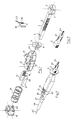
- Figure 1 is a perspective view that shows the device of the invention divided into its constituent parts.
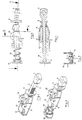
- Figure 2 is a perspective view of the device of the invention in its assembled position, with the cover connected to the larger open end of the casing.
- Figure 3 shows a working position of the device of the invention in a perspective view.
- Figure 4 is a side elevation of Figure 3.
- Figure 5 corresponds to the view resulting from the cross section along I-I in Figure 4.
- Figure 6 corresponds to the view resulting from the cross section along II-II in Figure 4.
- Figure 7 is a construction variant of the unit of the device, in accordance with the invention.
- Figure 8 shows the forward part of the slide in greater clarity, in accordance with Figure 7.
- Looking now at Figure 1, we can appreciate the casing or frame (9), open at its rear end (12) and with its forward end (24) with converging side walls also open. The casing (9) has its lugs (11), holed and facing each other, capable of receiving a pin or shaft for it to be fitted onto the hand brake lever base or support.
- At the rear part, we can appreciate the cover (17) with its lugs (18) as well as the spring (18) that goes round the slide (2) and is supported on the cover (17) and on the rear sides of the two longitudinal parts (13, 14).
- The lugs (18) finish off in ridges that are received in the two notches (3) in the slide (2), thus fixing the mutual position of both parts, and the two longitudinal parts (13, 14) have the teeth (15) cut in their facing sides, as well as the outer chamfers (23) for them to adapt to the converging side walls of the casing (9).
- We can also observe the slide (2) with its teeth (1) that correspond to the teeth (15) of the two longitudinal parts (13, 14), the notches (3) and the forward end (4) provided with the hole (5) in order to connect the cable for tensioning.
- The forward cover (6) that closes off the forward end (24) of the casing (9) has a central hole (8) through which the slide (2) passes, as do the rear lugs, not numbered, that become housed in the casing (9) as will be appreciated later.
- Above the slide (2), the U-shaped fork (19) can be seen, with its wings (20) provided with vertical facing ledges (21) responsible for becoming housed between the teeth (1) of the said slide in order to set the zero resetting position of the unit. This fork is situated in front of the forwards cover (6) in this operation, and has a prolongation (22) that is connected to the hand brake lever, so that when the hand brake lever begins its successive operations, the fork can be removed without being lost and with the possibility of being reusable.
- As shown in Figure 2, the fork is already removed and the device is assembled, pretensioned and prepared to carry out its function of automatically regulating the tension of the cable that goes from the end (4) of the slide towards the brake shoes of the wheels. In the same Figure 2 we can also see the facing holes (10) in the lugs on the casing (9), with the slide (2) housed inside the casing, as well as the occupation of the said casing by the longitudinal parts (13, 14).
- According to Figure 3, the slide (2) has gradually entered into the interior of the casing, overcoming the resistance of the spring (16) and the rear cover (17),so that when it moves against the position of the cable, this becomes tensioned. This position is complemented by the one shown in Figure 4, which makes it possible to appreciate, in conjunction with Figure 3, the exact positions of the different constituent parts.
- The inclination of the end or head (4) of the slide (2) is advisable when a balance lever is used, with two tensioning cables being connected to this balance lever, for example, so that the theoretical longitudinal prolongation of this end (4) passes through the centre of the holes (10) in the lugs (11) on the casing (9) in order to avoid maladjustment in assembly.
- Figures 5 and 6 allow us to observe the entry of the two longitudinal parts (13, 14) to the base of the forwards converging area of the casing (9), duly, obliged by the spring (16) and putting pressure on the slide (2) by the engagement of the respective teeth.
- We can also appreciate the position of the forward cover (6) with its lugs making contact with the forward ends of the two longitudinal parts (13, 14). Acting on the cover (6) makes it possible to unlock the sad two parts in order to set the device to zero.
- Figure 7 shows the construction variant, according to which the device is mounted on a cable or rod (24') that protrudes from the hand brake lever. In this case, the casing or frame is modified at the rear portion (25,26,27,28) in order to connect it to the said cable or rod (24'), all with the forward portion determined by the formation (23) connected to the cable (24) at the forward end of the slide (2), which is shown enlarged in Figure 8.
- It is important to point out, once having described the nature and advantages of this invention, its non-restrictive character, inasmuch as changes in the shape, materials or dimensions of its constituent parts will not in any way alter its essence, as long as they do not mean a substantial variation of the whole assembly.
Claims (10)
- Automatic tensioning device for hand brake levers, with a hand brake lever connected to cables, which in turn are connected to the brake shoes of the vehicle wheels, with a central part (2) by way of a square-shaped slide with sides provided with vertically-cut teeth and another two adjacent parts (13, 14) with a square cross section, also provided with vertically-cut teeth that correspond with those in the central part and are positioned opposite them, with these two parts having wedge-shaped ends (23) and their other ends receiving a spring (16) that acts on them, with a casing (9) which has three parts (2, 13, 14) fitted or adapted to it and has a central hole or gap through which the central part passes and converging inclined inner sides or walls (24) that act as a support for the wedge-shaped end areas of the adjacent parts (13, 14), which is characterized in that the interior of the casing (9) is hollow and has an approximately rectangular cross section, with its rear end open and with the central part (2) provided with its ends (4), to which the tension cables of the brakes are connected and with its other end provided with notches (3), into which the lugs (18) of a rear cover (17) become housed, with this rear cover closing off the casing and acting as a stop for the spring (16), in that the forward end of the casing, in turn, receives a cover (6) provided with a square hole (8), through which the central part or slide can pass and provided on its side towards the casing with a set of lugs (7) that become housed in the interior of the said casing, acting at the same time as the front support for the two longitudinal parts (13, 14) in order to unlock these when setting the mechanism to zero, and also havig a U-shaped fork (19), situated in front of the cover (6), with its wings (20) provided with vertical facing ledges (21) that become housed on the teeth of the slide (1), setting the initial pretensioning position of the unit.
- Automatic tensioning device for hand brake levers, in accordance with claim 1, characterized in that the forward end (4) of the slide is connected to a balance lever, to which the cables that go to the brake shoes are connected.
- Automatic tensioning device for hand brake levers, in accordance with claim 1, characterized in that the forward end (4) of the slide is connected directly to the tensioning cables and is provided with an angular inclination in relation to the rest of it.
- Automatic tensioning device for hand brake levers, in accordance with claim 1, characterized in that the unit is mounted on the hand brake lever itself by means of the appropriate means on the casing (9).
- Automatic tensioning device for hand brake levers, in accordance with claim 1, characterized in that the unit is mounted on the base or support of the hand brake lever by means of a pin or shaft that passes through holed lugs (10) on the casing itself (9).
- Automatic tensioning device for hand brake levers, in accordance with claim 1, characterized in that the unit is mounted directly onto a cable or rod (24') that protrudes from the hand brake lever, based on a polongation (25) of the side of the said lever, that protrudes from the casing or frame (9).
- Automatic tensioning device for hand brake levers, in accordance with claim 1, characterized in that the unit is mounted onto any cable, tension member or rod that is capable of being regulated.
- Automatic tensioning device for hand brake levers, in accordance with claim 1, characterized in that the hand brake lever and the casing (9) are metallic.
- Automatic tensioning device for hand brake levers, in accordance with claim 1, characterized in that the hand brake lever and the casing (9) are made of plastic.
- Automatic tensioning device for hand brake levers, in accordance with claim 1, characterized in that the fork (19) is connect by any means whatsoever to the hand brake lever, so that when this lever is operated, it becomes extracted from its pretensioning position and leaves its position on the slide (1).
Applications Claiming Priority (2)
| Application Number | Priority Date | Filing Date | Title |
|---|---|---|---|
| ES9701337 | 1997-06-19 | ||
| ES009701337A ES2141659B1 (en) | 1997-06-19 | 1997-06-19 | SELF-TENSING DEVICE FOR HAND BRAKE LEVERS. |
Publications (3)
| Publication Number | Publication Date |
|---|---|
| EP0895909A2 true EP0895909A2 (en) | 1999-02-10 |
| EP0895909A3 EP0895909A3 (en) | 1999-04-21 |
| EP0895909B1 EP0895909B1 (en) | 2002-10-09 |
Family
ID=8299732
Family Applications (1)
| Application Number | Title | Priority Date | Filing Date |
|---|---|---|---|
| EP98500144A Expired - Lifetime EP0895909B1 (en) | 1997-06-19 | 1998-06-19 | Automatic tensioning device for hand brake levers |
Country Status (5)
| Country | Link |
|---|---|
| US (1) | US6023992A (en) |
| EP (1) | EP0895909B1 (en) |
| BR (1) | BR9804184A (en) |
| DE (1) | DE69808572T2 (en) |
| ES (2) | ES2141659B1 (en) |
Cited By (3)
| Publication number | Priority date | Publication date | Assignee | Title |
|---|---|---|---|---|
| WO2001053709A1 (en) * | 2000-01-20 | 2001-07-26 | Batz, S. Coop. | Brake cable tensioner |
| FR2805508A1 (en) * | 2000-02-24 | 2001-08-31 | Rapid Sa | Method of mounting of a parking brake for a motor vehicle, uses pre-assembly of components and locks them together to allow fitting in position as group, then releases components to occupy working position |
| WO2002070311A3 (en) * | 2001-03-02 | 2003-02-06 | Edscha Ag | Cable pull adjustment for a parking brake |
Families Citing this family (10)
| Publication number | Priority date | Publication date | Assignee | Title |
|---|---|---|---|---|
| WO2007026208A2 (en) * | 2005-08-29 | 2007-03-08 | Ventra Group Inc. | Brake tension monitoring assembly and method |
| US7475615B2 (en) * | 2006-06-05 | 2009-01-13 | Ventra Group Inc. | Self-adjusting parking brake actuator for vehicles |
| US8215202B2 (en) * | 2007-06-18 | 2012-07-10 | Grand Rapids Controls Company, Llc | Cable length adjustment mechanism |
| DE202008000220U1 (en) * | 2008-01-07 | 2009-05-28 | Al-Ko Kober Ag | mounting aid |
| US20110030497A1 (en) * | 2008-04-17 | 2011-02-10 | Nebojsa Djordjevic | Self-adjust mechanism for parking brake assembly |
| KR101031065B1 (en) | 2008-06-18 | 2011-04-25 | 에스엘 주식회사 | Automatic cable tension adjusting device for parking brake and parking brake device using the same |
| US20100275715A1 (en) * | 2009-05-01 | 2010-11-04 | Dura Global Technologies, Inc. | Shift cable assembly and connector therefor |
| US8381613B2 (en) * | 2010-07-08 | 2013-02-26 | Ventra Group, Inc. | Parking brake cable and adjust system having no lost cable travel |
| US8690109B2 (en) | 2011-08-03 | 2014-04-08 | Haworth, Inc. | Automatic gap adjustor |
| ES2425005B1 (en) * | 2012-04-04 | 2015-02-17 | Batz, S.Coop. | Self-tensioning device of a cable adapted to parking brakes and parking brake with the self-tensioning device |
Citations (2)
| Publication number | Priority date | Publication date | Assignee | Title |
|---|---|---|---|---|
| US1741365A (en) | 1927-06-11 | 1929-12-31 | Heymann Edward | Brake mechanism |
| EP0040574A1 (en) | 1980-05-19 | 1981-11-25 | PAUMELLERIE ELECTRIQUE Société dite: | Control device for handbrake |
Family Cites Families (9)
| Publication number | Priority date | Publication date | Assignee | Title |
|---|---|---|---|---|
| JPH0130655Y2 (en) * | 1985-06-19 | 1989-09-20 | ||
| FR2621090A1 (en) * | 1987-09-29 | 1989-03-31 | Kuczynski Grzegorz Robert | Device for automatically adjusting the position of the handbrake lever of a vehicle |
| JP2571795B2 (en) * | 1987-11-17 | 1997-01-16 | 住友電気工業株式会社 | Purple diamond and method for producing the same |
| JP2839711B2 (en) * | 1992-05-07 | 1998-12-16 | キュスター ウント コンパニー ゲゼルシャフト ミット ベシュレンクテル ハフツング | Mechanical flexible remote control means length correction device |
| ES2089652T3 (en) * | 1992-08-12 | 1996-10-01 | Kuester & Co Gmbh | ADJUSTMENT DEVICE FOR BRAKES, ESPECIALLY FOR VEHICLE BRAKES. |
| JPH06147215A (en) * | 1992-10-31 | 1994-05-27 | Nhk Spring Co Ltd | Control cable length adjusting device |
| DE9405849U1 (en) * | 1994-04-08 | 1995-05-18 | AL-KO Kober AG, 89359 Kötz | Parking brake for motor vehicles, vehicle trailers or the like. |
| US5485762A (en) * | 1994-06-20 | 1996-01-23 | Hi-Shear Corporation | Adjuster to establish and maintain residual tension in a cable system |
| DE19618422C2 (en) * | 1995-11-20 | 1999-11-11 | Kuester & Co Gmbh | Device for automatic length correction of cables |
-
1997
- 1997-06-19 ES ES009701337A patent/ES2141659B1/en not_active Expired - Fee Related
-
1998
- 1998-06-17 US US09/098,378 patent/US6023992A/en not_active Expired - Fee Related
- 1998-06-19 ES ES98500144T patent/ES2185134T3/en not_active Expired - Lifetime
- 1998-06-19 BR BR9804184-3A patent/BR9804184A/en not_active IP Right Cessation
- 1998-06-19 EP EP98500144A patent/EP0895909B1/en not_active Expired - Lifetime
- 1998-06-19 DE DE69808572T patent/DE69808572T2/en not_active Expired - Lifetime
Patent Citations (2)
| Publication number | Priority date | Publication date | Assignee | Title |
|---|---|---|---|---|
| US1741365A (en) | 1927-06-11 | 1929-12-31 | Heymann Edward | Brake mechanism |
| EP0040574A1 (en) | 1980-05-19 | 1981-11-25 | PAUMELLERIE ELECTRIQUE Société dite: | Control device for handbrake |
Cited By (6)
| Publication number | Priority date | Publication date | Assignee | Title |
|---|---|---|---|---|
| WO2001053709A1 (en) * | 2000-01-20 | 2001-07-26 | Batz, S. Coop. | Brake cable tensioner |
| ES2160537A1 (en) * | 2000-01-20 | 2001-11-01 | Batz S Coop | Brake cable tensioner |
| FR2805508A1 (en) * | 2000-02-24 | 2001-08-31 | Rapid Sa | Method of mounting of a parking brake for a motor vehicle, uses pre-assembly of components and locks them together to allow fitting in position as group, then releases components to occupy working position |
| EP1134136A1 (en) * | 2000-02-24 | 2001-09-19 | Rapid S.A. | Mounting method for a hand brake device and assembly for applying the method |
| WO2002070311A3 (en) * | 2001-03-02 | 2003-02-06 | Edscha Ag | Cable pull adjustment for a parking brake |
| US7146873B2 (en) | 2001-03-02 | 2006-12-12 | Edscha Betaetigungssysteme Gmbh | Cable pull adjustment for a parking brake |
Also Published As
| Publication number | Publication date |
|---|---|
| ES2141659A1 (en) | 2000-03-16 |
| DE69808572T2 (en) | 2003-09-18 |
| BR9804184A (en) | 1999-12-14 |
| ES2141659B1 (en) | 2000-11-16 |
| US6023992A (en) | 2000-02-15 |
| EP0895909A3 (en) | 1999-04-21 |
| EP0895909B1 (en) | 2002-10-09 |
| ES2185134T3 (en) | 2003-04-16 |
| DE69808572D1 (en) | 2002-11-14 |
Similar Documents
| Publication | Publication Date | Title |
|---|---|---|
| EP0895909B1 (en) | Automatic tensioning device for hand brake levers | |
| US20190176870A1 (en) | Steering column for a motor vehicle | |
| DE4340633C2 (en) | Return system for the pedal system and / or the steering column of motor vehicles. | |
| US5448928A (en) | Variable ratio parking brake lever with self-adjust cable tensioning means | |
| ES2277661T3 (en) | RETRACTABLE PEDAL DEVICE IN CASE OF FRONT IMPACT WITH A VEHICLE. | |
| HUE029834T2 (en) | Internally collapsible steering column assembly | |
| EP0440698A1 (en) | Steering wheel rod with sliding and tilting movements. | |
| EP0568996B1 (en) | Linear drive for a belt tensioner | |
| AU711315B2 (en) | Parking brake for motor vehicles, towed vehicles, or suchlike | |
| CA2326150A1 (en) | Steering wheel impact positioning system | |
| US4532824A (en) | Automobile automatic transmission control device | |
| US6264228B1 (en) | Hitch assembly for activating a towed vehicle's brakes | |
| GB1569095A (en) | Lock for anchoring a vehicle cab of the tippable type | |
| IT9048489A1 (en) | DEVICE FOR HEIGHT ADJUSTMENT OF THE ANCHORAGE OR TOP REFERENCE POINT OF A SAFETY BELT SYSTEM. | |
| EP0556169A1 (en) | Stanchion for vehicle load platform | |
| FR2595643A1 (en) | PRESSURE MODULATOR WITH ELECTROMAGNETIC CONTROL | |
| MXPA98004912A (en) | Automotive device for fr levers | |
| DE4322796C2 (en) | Mechanical acceleration sensor | |
| DE19629263A1 (en) | Belt tightener with tensioning spring for safety belt for vehicle | |
| FR2786737A1 (en) | Operating pedal mounting for automobile has releasable coupling between fixing strap attached to bulkhead wall and operating pedal | |
| EP1398233A2 (en) | Braking device for trailers with slack adjuster | |
| FR3043971A1 (en) | AUTOMOTIVE VEHICLE PARKING BRAKE PARK | |
| EP0960792A1 (en) | Safety device for a parking hand brake with a plastic lever | |
| EP0045240B1 (en) | Device for the automatic release of the safety-belt fastened to the body of an automotive vehicle | |
| RU2078703C1 (en) | Emergency braking device |
Legal Events
| Date | Code | Title | Description |
|---|---|---|---|
| PUAI | Public reference made under article 153(3) epc to a published international application that has entered the european phase |
Free format text: ORIGINAL CODE: 0009012 |
|
| AK | Designated contracting states |
Kind code of ref document: A2 Designated state(s): DE ES FI GB IT SE |
|
| AX | Request for extension of the european patent |
Free format text: AL;LT;LV;MK;RO;SI |
|
| PUAL | Search report despatched |
Free format text: ORIGINAL CODE: 0009013 |
|
| AK | Designated contracting states |
Kind code of ref document: A3 Designated state(s): AT BE CH CY DE DK ES FI FR GB GR IE IT LI LU MC NL PT SE |
|
| AX | Request for extension of the european patent |
Free format text: AL;LT;LV;MK;RO;SI |
|
| AKX | Designation fees paid |
Free format text: DE ES FI GB IT SE |
|
| 17P | Request for examination filed |
Effective date: 20000105 |
|
| EUG | Se: european patent has lapsed | ||
| GRAG | Despatch of communication of intention to grant |
Free format text: ORIGINAL CODE: EPIDOS AGRA |
|
| 17Q | First examination report despatched |
Effective date: 20020605 |
|
| GRAG | Despatch of communication of intention to grant |
Free format text: ORIGINAL CODE: EPIDOS AGRA |
|
| GRAH | Despatch of communication of intention to grant a patent |
Free format text: ORIGINAL CODE: EPIDOS IGRA |
|
| GRAH | Despatch of communication of intention to grant a patent |
Free format text: ORIGINAL CODE: EPIDOS IGRA |
|
| GRAA | (expected) grant |
Free format text: ORIGINAL CODE: 0009210 |
|
| AK | Designated contracting states |
Kind code of ref document: B1 Designated state(s): DE ES FI GB IT SE |
|
| PG25 | Lapsed in a contracting state [announced via postgrant information from national office to epo] |
Ref country code: FI Free format text: LAPSE BECAUSE OF FAILURE TO SUBMIT A TRANSLATION OF THE DESCRIPTION OR TO PAY THE FEE WITHIN THE PRESCRIBED TIME-LIMIT Effective date: 20021009 |
|
| REG | Reference to a national code |
Ref country code: GB Ref legal event code: FG4D |
|
| REF | Corresponds to: |
Ref document number: 69808572 Country of ref document: DE Date of ref document: 20021114 |
|
| REG | Reference to a national code |
Ref country code: ES Ref legal event code: FG2A Ref document number: 2185134 Country of ref document: ES Kind code of ref document: T3 |
|
| PLBE | No opposition filed within time limit |
Free format text: ORIGINAL CODE: 0009261 |
|
| STAA | Information on the status of an ep patent application or granted ep patent |
Free format text: STATUS: NO OPPOSITION FILED WITHIN TIME LIMIT |
|
| 26N | No opposition filed |
Effective date: 20030710 |
|
| PGFP | Annual fee paid to national office [announced via postgrant information from national office to epo] |
Ref country code: SE Payment date: 20060616 Year of fee payment: 9 |
|
| PGFP | Annual fee paid to national office [announced via postgrant information from national office to epo] |
Ref country code: GB Payment date: 20060619 Year of fee payment: 9 |
|
| PGFP | Annual fee paid to national office [announced via postgrant information from national office to epo] |
Ref country code: IT Payment date: 20060630 Year of fee payment: 9 |
|
| EUG | Se: european patent has lapsed | ||
| GBPC | Gb: european patent ceased through non-payment of renewal fee |
Effective date: 20070619 |
|
| PG25 | Lapsed in a contracting state [announced via postgrant information from national office to epo] |
Ref country code: GB Free format text: LAPSE BECAUSE OF NON-PAYMENT OF DUE FEES Effective date: 20070619 |
|
| PG25 | Lapsed in a contracting state [announced via postgrant information from national office to epo] |
Ref country code: SE Free format text: LAPSE BECAUSE OF NON-PAYMENT OF DUE FEES Effective date: 20070620 |
|
| PG25 | Lapsed in a contracting state [announced via postgrant information from national office to epo] |
Ref country code: IT Free format text: LAPSE BECAUSE OF NON-PAYMENT OF DUE FEES Effective date: 20070619 |
|
| PGFP | Annual fee paid to national office [announced via postgrant information from national office to epo] |
Ref country code: ES Payment date: 20100609 Year of fee payment: 13 |
|
| PGFP | Annual fee paid to national office [announced via postgrant information from national office to epo] |
Ref country code: DE Payment date: 20100625 Year of fee payment: 13 |
|
| REG | Reference to a national code |
Ref country code: DE Ref legal event code: R119 Ref document number: 69808572 Country of ref document: DE Effective date: 20120103 |
|
| PG25 | Lapsed in a contracting state [announced via postgrant information from national office to epo] |
Ref country code: DE Free format text: LAPSE BECAUSE OF NON-PAYMENT OF DUE FEES Effective date: 20120103 |
|
| REG | Reference to a national code |
Ref country code: ES Ref legal event code: FD2A Effective date: 20120717 |
|
| PG25 | Lapsed in a contracting state [announced via postgrant information from national office to epo] |
Ref country code: ES Free format text: LAPSE BECAUSE OF NON-PAYMENT OF DUE FEES Effective date: 20110620 |