EP0896201A1 - Rastersondenmikroskop - Google Patents
Rastersondenmikroskop Download PDFInfo
- Publication number
- EP0896201A1 EP0896201A1 EP98306153A EP98306153A EP0896201A1 EP 0896201 A1 EP0896201 A1 EP 0896201A1 EP 98306153 A EP98306153 A EP 98306153A EP 98306153 A EP98306153 A EP 98306153A EP 0896201 A1 EP0896201 A1 EP 0896201A1
- Authority
- EP
- European Patent Office
- Prior art keywords
- cantilever
- probe
- sensor
- microscope
- scanning
- Prior art date
- Legal status (The legal status is an assumption and is not a legal conclusion. Google has not performed a legal analysis and makes no representation as to the accuracy of the status listed.)
- Granted
Links
- 239000000523 sample Substances 0.000 title claims abstract description 215
- 238000006073 displacement reaction Methods 0.000 claims abstract description 20
- 230000003287 optical effect Effects 0.000 claims description 19
- 238000005452 bending Methods 0.000 claims description 15
- 239000010453 quartz Substances 0.000 claims description 10
- VYPSYNLAJGMNEJ-UHFFFAOYSA-N silicon dioxide Inorganic materials O=[Si]=O VYPSYNLAJGMNEJ-UHFFFAOYSA-N 0.000 claims description 10
- 239000013307 optical fiber Substances 0.000 claims description 7
- 230000002209 hydrophobic effect Effects 0.000 claims description 5
- 230000003993 interaction Effects 0.000 claims 1
- 238000005259 measurement Methods 0.000 description 25
- 230000010355 oscillation Effects 0.000 description 18
- 238000000034 method Methods 0.000 description 17
- 238000001514 detection method Methods 0.000 description 7
- 230000003068 static effect Effects 0.000 description 7
- 230000000704 physical effect Effects 0.000 description 6
- 241001422033 Thestylus Species 0.000 description 3
- XLYOFNOQVPJJNP-UHFFFAOYSA-N water Substances O XLYOFNOQVPJJNP-UHFFFAOYSA-N 0.000 description 3
- XUIMIQQOPSSXEZ-UHFFFAOYSA-N Silicon Chemical compound [Si] XUIMIQQOPSSXEZ-UHFFFAOYSA-N 0.000 description 2
- 230000001419 dependent effect Effects 0.000 description 2
- 229910052710 silicon Inorganic materials 0.000 description 2
- 239000010703 silicon Substances 0.000 description 2
- 229910052581 Si3N4 Inorganic materials 0.000 description 1
- 239000000919 ceramic Substances 0.000 description 1
- 239000011248 coating agent Substances 0.000 description 1
- 238000000576 coating method Methods 0.000 description 1
- 239000000470 constituent Substances 0.000 description 1
- 238000010586 diagram Methods 0.000 description 1
- 238000007429 general method Methods 0.000 description 1
- 239000012535 impurity Substances 0.000 description 1
- 230000001939 inductive effect Effects 0.000 description 1
- 230000007257 malfunction Effects 0.000 description 1
- 238000012545 processing Methods 0.000 description 1
- HQVNEWCFYHHQES-UHFFFAOYSA-N silicon nitride Chemical compound N12[Si]34N5[Si]62N3[Si]51N64 HQVNEWCFYHHQES-UHFFFAOYSA-N 0.000 description 1
- 239000000126 substance Substances 0.000 description 1
Images



Classifications
-
- G—PHYSICS
- G01—MEASURING; TESTING
- G01Q—SCANNING-PROBE TECHNIQUES OR APPARATUS; APPLICATIONS OF SCANNING-PROBE TECHNIQUES, e.g. SCANNING PROBE MICROSCOPY [SPM]
- G01Q60/00—Particular types of SPM [Scanning Probe Microscopy] or microscopes; Essential components thereof
- G01Q60/24—AFM [Atomic Force Microscopy] or apparatus therefor, e.g. AFM probes
- G01Q60/38—Probes, their manufacture, or their related instrumentation, e.g. holders
-
- B—PERFORMING OPERATIONS; TRANSPORTING
- B82—NANOTECHNOLOGY
- B82Y—SPECIFIC USES OR APPLICATIONS OF NANOSTRUCTURES; MEASUREMENT OR ANALYSIS OF NANOSTRUCTURES; MANUFACTURE OR TREATMENT OF NANOSTRUCTURES
- B82Y35/00—Methods or apparatus for measurement or analysis of nanostructures
-
- G—PHYSICS
- G01—MEASURING; TESTING
- G01Q—SCANNING-PROBE TECHNIQUES OR APPARATUS; APPLICATIONS OF SCANNING-PROBE TECHNIQUES, e.g. SCANNING PROBE MICROSCOPY [SPM]
- G01Q20/00—Monitoring the movement or position of the probe
- G01Q20/02—Monitoring the movement or position of the probe by optical means
-
- Y—GENERAL TAGGING OF NEW TECHNOLOGICAL DEVELOPMENTS; GENERAL TAGGING OF CROSS-SECTIONAL TECHNOLOGIES SPANNING OVER SEVERAL SECTIONS OF THE IPC; TECHNICAL SUBJECTS COVERED BY FORMER USPC CROSS-REFERENCE ART COLLECTIONS [XRACs] AND DIGESTS
- Y10—TECHNICAL SUBJECTS COVERED BY FORMER USPC
- Y10S—TECHNICAL SUBJECTS COVERED BY FORMER USPC CROSS-REFERENCE ART COLLECTIONS [XRACs] AND DIGESTS
- Y10S977/00—Nanotechnology
- Y10S977/84—Manufacture, treatment, or detection of nanostructure
- Y10S977/849—Manufacture, treatment, or detection of nanostructure with scanning probe
- Y10S977/86—Scanning probe structure
- Y10S977/873—Tip holder
Definitions
- the present invention relates to a scanning type atomic force microscope for observing the shape of the surface of a sample as well as a scanning probe microscope for observing surface physical properties by scanning a probe along the surface of the sample by utilising the force exerted between substances (that is, force exerted between the probe and sample).
- a conventional scanning type atomic force microscope by using a cantilever formed of silicon nitride or silicon and a stylus formed thereon as a probe for the atomic force microscope, an atomic force exerted between a front end of the stylus and the surface of the sample is detected as bending of the cantilever, a change in an oscillation amplitude or a change in resonance frequency.
- the surface of the sample is observed by moving the stylus and the sample relative to each other while controlling the distance between the front end of the stylus and the surface of the sample to be constant.
- there is a control method of the shear force system where the probe is oscillated horizontally in respect of the surface of the sample.
- An optical method such as an optical lever method, an optical interference method or the like is mainly used for detecting the displacement of the cantilever.
- an optical method is used, the constitution of the device becomes complicated and adjustment of an optical axis or the like is needed which makes handling of the device complicated.
- each of the detecting methods which do not utilise optical means it is necessary to integrally form the piezoelectric element and the probe and a problem arises in the case where a portion of the probe is damaged or malfunctions the whole of the probe must be interchanged.
- a problem also arises in the reproducibility of dynamic properties.
- a scanning probe microscope in which a cantilever probe is closely arranged on a surface of a measurement object.
- the cantilever probe is relatively scanned two-dimensionally on the surface of the measurement object by using a three-dimensional fine movement element thereby observing surface shape or surface physical properties of the measurement object.
- a sensor cantilever is installed at a distance touchable to the cantilever, apart therefrom and separately from the cantilever probe.
- oscillating means for oscillating either or both of the cantilever probe and the sensor cantilever is installed.
- the cantilever probe can be operated by being separated from the cantilever means and nonoptical detection for detecting the displacement by an electric signal is made possible by using a piezoelectric element in the sensor cantilever. Further, the resonance frequency of the sensor cantilever is made higher than the resonance frequency of the cantilever probe.
- the cantilever probe is provided with a bending moment by being brought into dynamic equilibrium between the surface of the measurement object and the oscillating sensor cantilever by which a change in resonance characteristic of the sensor cantilever occurs. Static bending of the cantilever is detected as an alternating current signal. The static force exerted between the cantilever probe and the surface of the measurement object is detected and the distance control between the front end of the probe and the surface of the measurement object can be carried out.
- the resonance frequency of the cantilever probe is made higher than the resonance frequency of the sensor cantilever.
- the probe cantilever is oscillated at the same frequency as that of the oscillating sensor cantilever and by a change in the resonance characteristic of the sensor cantilever, the distance control between the front end of the cantilever probe and the surface of the measurement object is carried out; by which the distance control of the probe in an oscillation mode is made possible.
- contact pressure between the cantilever probe and the sensor cantilever can arbitrarily be changed and the operational characteristic of the probe can be adjusted to be optimum.
- An optical wave guide is included at a portion of the cantilever probe and is constituted such that one end face of the wave guide coincides with the front end of the probe for observing function information by which the observation of optical information is made possible.
- piezoelectric detecting means is provided on the cantilever probe. This outputs a signal identifying displacement of the probe independently from the signal of the sensor cantilever, by which observation of information of the surface physical properties is made possible.
- Fig. 1 shows an example of the constitution of a scanning probe microscope according to the present invention.
- a cantilever probe 2 is arranged closely on the surface of a measurement object 1 and a three-dimensional fine movement element 3 provides two-dimensional scanning of the surface of the measurement object 1. Thereby, the surface shape or surface physical properties of the measurement object can be observed.
- a sensor cantilever 4 is installed on a support 6 separately from the cantilever 2, apart therefrom and at a distance touchable to the cantilever probe 2.
- “touchable” indicates a state where they are originally brought into contact with each other or where they are separated from each other by a distance where they can be brought into contact with each other by oscillation.
- Oscillating means 5 is driven by an alternating current voltage source 7 and oscillates either one or both of the cantilever probe 2 and the sensor cantilever 4.
- a change is resonance characteristic of the sensor cantilever 4 which is dependent on the distance between the cantilever probe 2 and the surface of the sample 1, is input in to a control device 9 via an amplifier 8.
- the control device 9 can control the distance between the probe and the surface of the measurement object by controlling the fine movement element 3 based on the change in the resonance characteristic.
- the conventional optical detection system may be used or the displacement may be detected as an electric signal by using a piezoelectric detection element at the sensor cantilever 4.
- Fig. 1 describes the major component according to the present invention.
- constituent elements which are generally used in the probe microscope other than those described in Fig. 1 are included.
- Fig. 2 is a view for explaining the operation in the case where the resonance frequency of the sensor cantilever 4 is set higher than the resonance frequency of the cantilever probe 2.
- the cantilever probe 2 is provided with a bending moment caused by being brought into dynamic equilibrium between the oscillating sensor cantilever 4 and the surface of the measurement object 1.
- the resonance characteristic of the sensor cantilever 4 is changed. Based on the change in the resonance characteristic, a static force exerted between the cantilever probe 2 and the surface of the measurement object 1 can be detected and the distance control can be carried out between the front end of the probe and the surface of the measurement object.
- the cantilever probe 2 cannot follow the oscillation of the sensor cantilever 4 and therefore, only the sensor cantilever 4 is oscillated and continuously repeats collision with the cantilever probe 2.
- the cantilever probe 2 is provided with constant bending by the continuous collision.
- the amount of oscillation is reduced compared with free oscillation in the resonance state and the phase of oscillation is also changed.
- attractive force or repulsive force by operation of atomic force arises between the cantilever probe 2 and the measurement object 1.
- the amplitude of oscillation of the sensor cantilever 4 is increased and when repulsive force is exerted thereon, the amplitude of oscillation of the sensor cantilever 4 is reduced.
- the distance control between the sample-probe can be carried out by an alternating current signal.
- the resonance frequencies of the two cantilevers need to be set sufficiently different from each other in consideration thereof.
- Fig. 3 is a view showing a constitution for detecting twist of the cantilever probe in the contact mode operation mentioned above.
- the contact mode operation in the case where the cantilever probe is twisted by friction with the sample, light from a light source is reflected by the twisted cantilever probe 2. Reflected light is detected by optical detecting means 11 and an amount of twist is detected by which friction information of the sample surface can be observed.
- the optical detecting means 11 such as an optical lever method can be used, a piezoelectric detecting system mentioned later can also be used.
- Fig. 4 is a view showing a constitution in which the substantial resonance frequency of the cantilever probe 2 is set to be higher than the resonance frequency of the sensor cantilever 4.
- the probe cantilever 2 is oscillated at the same frequency as that oscillating the sensor cantilever 4 and the distance control between the front end of the cantilever probe 2 and the surface of the measurement object 1 is carried out by the change in the resonance frequency of the sensor cantilever 4, by which the distance control of a so-called dynamic mode system can be carried out.
- means for detecting the phase and the amplitude of the cantilever probe 2 is provided independently from the sensor cantilever 4.
- the displacement signal of the sensor cantilever 4 is compared with the displacement signal of the cantilever probe 2 by which a so-called phase image can be provided.
- a change in phase which is dependent on viscoelasticity inherent to the sample can be obtained by setting the amplitude of oscillation of the cantilever probe 2 to about several nanometers such that the front end of the probe is always prevented from leaving the adsorbed water whereby viscoelastic information can be obtained.
- these cantilevers can be oscillated by applying an alternating current signal to the piezoelectric element 5.
- the cantilever probe 2 and the sensor cantilever 4 are fixed onto the same support 6 and the piezoelectric element 5 is oscillated at a frequency near to the resonance frequency of the sensor cantilever 4, by which the sensor cantilever 4 is resonated and its oscillation amplitude can be made larger than that of the cantilever probe 2.
- similar operation is shown as in the case where only the sensor cantilever 4 is oscillated by a piezoelectric element as shown in Fig. 5.
- Fig. 5 is a view showing a constitution where the cantilever probe 2 is supported by the support 10 and only the sensor cantilever 4 is oscillated by the piezoelectric element 5.
- a change in the distance between the sensor cantilever 4 and the cantilever probe 2 or a change in contact pressure therebetween is caused based on the bending of the cantilever probe 2 and the change can be detected as a change in amplitude or a change in phase of the sensor cantilever 4.
- the surface shape of the measurement object 1 can be observed by controlling the fine movement element 3 comprising the piezoelectric element by the control device 9 which controls the amount of the displacement constant by a feedback control.
- the resonance frequency of the sensor cantilever is higher than that of the cantilever probe mentioned above
- an adhering force for adhering the probes may be caused between the cantilever probe and the sensor cantilever due to adsorbed water on the surface or the like.
- the force is received by the sensor cantilever in a direction in which the cantilever probe leaves the face of the sample and the bending of the cantilever probe cannot be accurately detected.
- hydrophobic treatment is carried out in respect of both sides or one side of portions where the cantilever probe and the sensor cantilever are brought into contact with each other, by which the problem can be avoided.
- the hydrophobic treatment method there can be used a general method where a molecule having a hydrophobic radical is directly chemically bonded or physically adsorbed onto the portion such that the hydrophobic radical is directed to the outer side.
- the cantilever probe 2 is oscillated at the same frequency by the sensor cantilever 4 and the force exerted on the cantilever probe 2 is indirectly detected as a change in the amplitude or the phase of oscillation.
- the cantilever probe 2 and the sensor cantilever 4 there is a system where the cantilever probe 2 and the sensor cantilever 4 are fixed onto the same holder 6 and the sensor cantilever 4 is resonated by oscillating the piezoelectric oscillator 5 at a frequency near to the resonance frequency of the sensor cantilever 4.
- Fig. 6 shows a constitution in which only the cantilever probe 2 connected to the support 6 is oscillated by the piezoelectric element 5 by which the sensor cantilever 4, the end of which is brought into contact with the cantilever probe 2, is oscillated.
- Fig. 7 is a view showing a constitution in which a position adjusting mechanism 12 is installed to the device constitution described with reference to Fig. 1 through Fig. 6.
- the position adjusting mechanism 12 By providing the position adjusting mechanism 12, the contact pressure between the cantilever probe 2 and the sensor cantilever 4 can arbitrarily be changed. Thereby, adjustment can be carried out such that the measurement is performed under an optimum condition.
- piezoelectric element used in the sensor cantilever 4 there is a piezoelectric ceramics element of PZT or the like having the piezoelectric characteristic in the thickness direction or a piezoelectric element of a bimorph type having the piezoelectric characteristic in the bending direction, where two sheets of films having the piezoelectric characteristic in the lateral direction are pasted together. Further, there is a method where a change in the resistance of silicon doped with ZnO or an impurity or the like is used. Also, there is a method where the bending oscillation of a quartz oscillator is used.
- the bending oscillation of an X plate quartz oscillator or a turning fork type quartz oscillator is utilised and electric charge generated at an electrode of the quartz oscillator can be used as a control signal by amplifying it by the amplifier 8.
- observation of optical information can be realised by constituting a cantilever probe including an optical wave guide at a portion of the cantilever probe such that one end face of the wave guide coincides with the front end of the probe.
- Fig. 8 is a view showing an example of a constitution in the case where a probe comprising an optical fiber is used as a probe having a wave guide.
- an optical fibre probe 13 is provided with a metallic coating at a portion thereof operating as a cantilever, except a front end portion disposed closely to the surface of the measurement object 1. A very small opening is formed at the front end portion.
- Light from a light source 15 can be introduced via a lens 14 to an end face of the optical fiber on a side opposed to the probe portion of the optical fiber. Meanwhile, light scattered by the surface of the sample 1 can be detected by an optical detector 17 via a lens 16 arranged to focus on the front end of the probe.
- An example where a tuning fork type quartz oscillator 18 is used as the sensor cantilever is shown.
- Physical property information of the surface of the sample can be obtained by measuring the oscillation characteristics of the cantilever probe 2 and the sensor cantilever 4 mentioned above separately from each other.
- a probe having piezoelectric detecting means in the cantilever probe 2 may also be used.
- signals are detected by arranging piezoelectric elements 19 of a bimorph type in parallel on the cantilever probe and reversing polarities thereof such that the signals are output in respect of twist of the cantilever probe 2.
- Observation of fraction information of the surface can be carried out by subjecting the output signals to signal processing via the amplifier 8. According to the constitution, the directions of bending of the two piezoelectric elements are reversed by the twist of the cantilever probe 2. Accordingly, electric charge is generated in respect of the twist.
- the detection of the twist can be carried out also by arranging a piezoelectric resistor 20 vertically to the longitudinal direction of the cantilever 2.
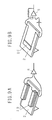
- Fig. 11 shows a constitution where a major spring element portion included in the cantilever probe is arranged substantially vertically to the surface of the measurement object. There can be provided a constitution where shear force exerted between the front end of the cantilever probe 1 and the surface of the measurement object 1 (illustration is omitted) is sensed by which the distance control between the sample-probe is carried out.
- Fig. 11 illustrates an example where the optical fiber probe 13 of a straight type is used as a cantilever probe and the tuning fork type quartz oscillator 18 is used as the sensor cantilever.
- Fig. 12 illustrates an example constituted by bringing the cantilever probe 2 and the sensor cantilever 4 into contact with each other while they intersect each other at an angle.
Landscapes
- Physics & Mathematics (AREA)
- Health & Medical Sciences (AREA)
- General Health & Medical Sciences (AREA)
- General Physics & Mathematics (AREA)
- Nuclear Medicine, Radiotherapy & Molecular Imaging (AREA)
- Radiology & Medical Imaging (AREA)
- Chemical & Material Sciences (AREA)
- Engineering & Computer Science (AREA)
- Nanotechnology (AREA)
- Analytical Chemistry (AREA)
- Crystallography & Structural Chemistry (AREA)
- Length Measuring Devices With Unspecified Measuring Means (AREA)
Applications Claiming Priority (7)
| Application Number | Priority Date | Filing Date | Title |
|---|---|---|---|
| JP209461/97 | 1997-08-04 | ||
| JP20946197 | 1997-08-04 | ||
| JP20946197 | 1997-08-04 | ||
| JP07466698A JP3511361B2 (ja) | 1997-08-04 | 1998-03-23 | 走査プローブ顕微鏡 |
| JP74666/98 | 1998-03-23 | ||
| JP7466698 | 1998-03-23 | ||
| US09/128,181 US6249000B1 (en) | 1997-08-04 | 1998-08-03 | Scanning probe microscope |
Publications (2)
| Publication Number | Publication Date |
|---|---|
| EP0896201A1 true EP0896201A1 (de) | 1999-02-10 |
| EP0896201B1 EP0896201B1 (de) | 2003-05-02 |
Family
ID=27301579
Family Applications (1)
| Application Number | Title | Priority Date | Filing Date |
|---|---|---|---|
| EP98306153A Expired - Lifetime EP0896201B1 (de) | 1997-08-04 | 1998-07-31 | Rastersondenmikroskop |
Country Status (3)
| Country | Link |
|---|---|
| US (1) | US6249000B1 (de) |
| EP (1) | EP0896201B1 (de) |
| JP (1) | JP3511361B2 (de) |
Cited By (4)
| Publication number | Priority date | Publication date | Assignee | Title |
|---|---|---|---|---|
| WO2000040946A1 (de) * | 1999-01-05 | 2000-07-13 | Krotil Hans Ulrich | Verfahren und vorrichtung zur gleichzeitigen bestimmung der adhäsion, der reibung und weiterer materialeigenschaften einer probenoberfläche |
| WO2011047336A1 (en) * | 2009-10-15 | 2011-04-21 | Nexgen Semt Holding, Inc. | Imaging devices for measuring the structure of a surface |
| US10566169B1 (en) | 2008-06-30 | 2020-02-18 | Nexgen Semi Holding, Inc. | Method and device for spatial charged particle bunching |
| US12493005B1 (en) | 2022-06-07 | 2025-12-09 | Nexgen Semi Holding, Inc. | Extended range active illumination imager |
Families Citing this family (27)
| Publication number | Priority date | Publication date | Assignee | Title |
|---|---|---|---|---|
| US6254385B1 (en) * | 1997-01-02 | 2001-07-03 | Lj Laboratories, Llc | Apparatus and method for measuring optical characteristics of teeth |
| US6307629B1 (en) * | 1997-08-12 | 2001-10-23 | Lj Laboratories, L.L.C. | Apparatus and method for measuring optical characteristics of an object |
| US6373573B1 (en) | 2000-03-13 | 2002-04-16 | Lj Laboratories L.L.C. | Apparatus for measuring optical characteristics of a substrate and pigments applied thereto |
| US6301004B1 (en) | 2000-05-31 | 2001-10-09 | Lj Laboratories, L.L.C. | Apparatus and method for measuring optical characteristics of an object |
| US6870616B2 (en) * | 1998-06-30 | 2005-03-22 | Jjl Technologies Llc | Spectrometer apparatus for determining an optical characteristic of an object or material having one or more sensors for determining a physical position or non-color property |
| US6501542B2 (en) | 1998-06-30 | 2002-12-31 | Lj Laboratories, Llc | Apparatus and method for measuring optical characteristics of an object |
| US6573984B2 (en) | 1998-06-30 | 2003-06-03 | Lj Laboratories Llc | Apparatus and method for measuring optical characteristics of teeth |
| US6249348B1 (en) * | 1998-11-23 | 2001-06-19 | Lj Laboratories, L.L.C. | Integrated spectrometer assembly and methods |
| IL145136A0 (en) * | 2001-08-27 | 2002-06-30 | Multiple plate tip or sample scanning reconfigurable scanning probe microscope with transparent interfacing of far-field optical microscopes | |
| CA2556622A1 (en) * | 2004-03-02 | 2005-09-15 | Wyeth | Macrolides and methods for producing same |
| US7598723B2 (en) * | 2005-02-14 | 2009-10-06 | Clemson University | Method and apparatus for detecting resonance in electrostatically driven elements |
| US8384372B1 (en) | 2005-02-14 | 2013-02-26 | Clemson University | Non-linear electrical actuation and detection |
| US7571638B1 (en) * | 2005-05-10 | 2009-08-11 | Kley Victor B | Tool tips with scanning probe microscopy and/or atomic force microscopy applications |
| US9423693B1 (en) | 2005-05-10 | 2016-08-23 | Victor B. Kley | In-plane scanning probe microscopy tips and tools for wafers and substrates with diverse designs on one wafer or substrate |
| US8646111B2 (en) * | 2006-02-14 | 2014-02-04 | The Regents Of The University Of California | Coupled mass-spring systems and imaging methods for scanning probe microscopy |
| JP2007232596A (ja) * | 2006-03-01 | 2007-09-13 | Jeol Ltd | 磁気共鳴力顕微鏡 |
| US7603891B2 (en) | 2006-04-25 | 2009-10-20 | Asylum Research Corporation | Multiple frequency atomic force microscopy |
| US8024963B2 (en) | 2006-10-05 | 2011-09-27 | Asylum Research Corporation | Material property measurements using multiple frequency atomic force microscopy |
| JP4816414B2 (ja) * | 2006-11-10 | 2011-11-16 | 株式会社島津製作所 | 走査型プローブ顕微鏡 |
| EP2283486A2 (de) * | 2008-05-23 | 2011-02-16 | Veeco Instruments Inc. | Vorverstärkungs-kragträger und anwendungen dafür |
| US8677809B2 (en) * | 2008-06-16 | 2014-03-25 | Oxford Instruments Plc | Thermal measurements using multiple frequency atomic force microscopy |
| KR101065981B1 (ko) | 2009-05-20 | 2011-09-19 | 인하대학교 산학협력단 | 소리굽쇠-주사탐침 결합 진동계 |
| US20110041224A1 (en) * | 2009-08-06 | 2011-02-17 | Purdue Research Foundation | Atomic force microscope including accelerometer |
| CN102621351B (zh) * | 2012-04-20 | 2015-03-11 | 中国科学院苏州纳米技术与纳米仿生研究所 | 一种扫描近场光学显微镜 |
| JP5546651B1 (ja) * | 2013-01-28 | 2014-07-09 | 株式会社エリオニクス | 表面力測定方法および表面力測定装置 |
| US9778572B1 (en) | 2013-03-15 | 2017-10-03 | Victor B. Kley | In-plane scanning probe microscopy tips and tools for wafers and substrates with diverse designs on one wafer or substrate |
| US9383388B2 (en) | 2014-04-21 | 2016-07-05 | Oxford Instruments Asylum Research, Inc | Automated atomic force microscope and the operation thereof |
Citations (4)
| Publication number | Priority date | Publication date | Assignee | Title |
|---|---|---|---|---|
| JPH04102008A (ja) * | 1990-08-21 | 1992-04-03 | Brother Ind Ltd | 原子間力顕微鏡 |
| US5338932A (en) * | 1993-01-04 | 1994-08-16 | Motorola, Inc. | Method and apparatus for measuring the topography of a semiconductor device |
| JPH06323845A (ja) * | 1993-03-19 | 1994-11-25 | Tadatomo Suga | 走査型力顕微鏡用薄膜式力検出プローブ |
| US5641896A (en) * | 1994-05-11 | 1997-06-24 | Dr. Khaled Karrai Und Dr. Miles Haines Gesellschaft Burgerlichen Rechts | Coupled oscillator scanning imager |
Family Cites Families (14)
| Publication number | Priority date | Publication date | Assignee | Title |
|---|---|---|---|---|
| EP0290647B1 (de) * | 1987-05-12 | 1991-07-24 | International Business Machines Corporation | Atomares Kräftemikroskop mit oscillierendem Quarz |
| JPH05196458A (ja) * | 1991-01-04 | 1993-08-06 | Univ Leland Stanford Jr | 原子力顕微鏡用ピエゾ抵抗性片持ばり構造体 |
| JPH05164514A (ja) * | 1991-12-19 | 1993-06-29 | Advantest Corp | トンネル顕微鏡及び原子間力顕微鏡両用探針 |
| JPH06317404A (ja) * | 1993-05-10 | 1994-11-15 | Canon Inc | カンチレバー型アクチュエータ及びそれを用いた走査型探針顕微鏡並びに情報処理装置 |
| JPH0763548A (ja) * | 1993-08-24 | 1995-03-10 | Canon Inc | カンチレバー型プローブ、及びそれを有する走査型トンネル顕微鏡並びに情報処理装置 |
| US5883705A (en) * | 1994-04-12 | 1999-03-16 | The Board Of Trustees Of The Leland Stanford, Jr. University | Atomic force microscope for high speed imaging including integral actuator and sensor |
| US6006594A (en) * | 1994-05-11 | 1999-12-28 | Dr. Khaled Und Dr. Miles Haines Gesellschaft Burgerlichen Rechts | Scanning probe microscope head with signal processing circuit |
| US5679952A (en) * | 1994-05-23 | 1997-10-21 | Hitachi, Ltd. | Scanning probe microscope |
| JPH085643A (ja) * | 1994-06-14 | 1996-01-12 | Nissin Electric Co Ltd | 複合顕微鏡 |
| JP2848539B2 (ja) * | 1995-02-07 | 1999-01-20 | インターナシヨナル・ビジネス・マシーンズ・コーポレーシヨン | カンチレバー振れセンサ及びその使用方法 |
| JPH08221816A (ja) * | 1995-02-13 | 1996-08-30 | Canon Inc | 記録再生装置及び走査型プローブ顕微鏡等の情報処理装置 |
| JPH0989911A (ja) * | 1995-09-22 | 1997-04-04 | Kared Karei & Mires Heines G Burgerrihen Rechts Mbh | 連成オシレータ走査イメージャー |
| JP3171787B2 (ja) * | 1995-09-25 | 2001-06-04 | 株式会社リコー | 表面状態測定装置 |
| FR2755224B1 (fr) * | 1996-10-24 | 1998-12-04 | Suisse Electronique Microtech | Capteur a effet tunnel, notamment pour relever la topographie d'une surface |
-
1998
- 1998-03-23 JP JP07466698A patent/JP3511361B2/ja not_active Expired - Fee Related
- 1998-07-31 EP EP98306153A patent/EP0896201B1/de not_active Expired - Lifetime
- 1998-08-03 US US09/128,181 patent/US6249000B1/en not_active Expired - Lifetime
Patent Citations (4)
| Publication number | Priority date | Publication date | Assignee | Title |
|---|---|---|---|---|
| JPH04102008A (ja) * | 1990-08-21 | 1992-04-03 | Brother Ind Ltd | 原子間力顕微鏡 |
| US5338932A (en) * | 1993-01-04 | 1994-08-16 | Motorola, Inc. | Method and apparatus for measuring the topography of a semiconductor device |
| JPH06323845A (ja) * | 1993-03-19 | 1994-11-25 | Tadatomo Suga | 走査型力顕微鏡用薄膜式力検出プローブ |
| US5641896A (en) * | 1994-05-11 | 1997-06-24 | Dr. Khaled Karrai Und Dr. Miles Haines Gesellschaft Burgerlichen Rechts | Coupled oscillator scanning imager |
Non-Patent Citations (3)
| Title |
|---|
| "DOUBLE CANTILEVER SENSOR FOR THIN-FILM HARDNESS TESTING AND MASS STORAGE APPLICATION", IBM TECHNICAL DISCLOSURE BULLETIN, vol. 34, no. 10A, 1 March 1992 (1992-03-01), pages 194 - 195, XP000302273 * |
| PATENT ABSTRACTS OF JAPAN vol. 016, no. 337 (P - 1390) 22 July 1992 (1992-07-22) * |
| PATENT ABSTRACTS OF JAPAN vol. 095, no. 002 31 March 1995 (1995-03-31) * |
Cited By (6)
| Publication number | Priority date | Publication date | Assignee | Title |
|---|---|---|---|---|
| WO2000040946A1 (de) * | 1999-01-05 | 2000-07-13 | Krotil Hans Ulrich | Verfahren und vorrichtung zur gleichzeitigen bestimmung der adhäsion, der reibung und weiterer materialeigenschaften einer probenoberfläche |
| US6880386B1 (en) | 1999-01-05 | 2005-04-19 | Witec Wissenschaftliche Instrumente Und Technologie Gmbh | Method and device for simultaneously determining the adhesion, friction, and other material properties of a sample surface |
| US10566169B1 (en) | 2008-06-30 | 2020-02-18 | Nexgen Semi Holding, Inc. | Method and device for spatial charged particle bunching |
| US11605522B1 (en) | 2008-06-30 | 2023-03-14 | Nexgen Semi Holding, Inc. | Method and device for spatial charged particle bunching |
| WO2011047336A1 (en) * | 2009-10-15 | 2011-04-21 | Nexgen Semt Holding, Inc. | Imaging devices for measuring the structure of a surface |
| US12493005B1 (en) | 2022-06-07 | 2025-12-09 | Nexgen Semi Holding, Inc. | Extended range active illumination imager |
Also Published As
| Publication number | Publication date |
|---|---|
| EP0896201B1 (de) | 2003-05-02 |
| US6249000B1 (en) | 2001-06-19 |
| JP3511361B2 (ja) | 2004-03-29 |
| JPH11108940A (ja) | 1999-04-23 |
Similar Documents
| Publication | Publication Date | Title |
|---|---|---|
| EP0896201B1 (de) | Rastersondenmikroskop | |
| US8220318B2 (en) | Fast microscale actuators for probe microscopy | |
| US7552625B2 (en) | Force sensing integrated readout and active tip based probe microscope systems | |
| US7441447B2 (en) | Methods of imaging in probe microscopy | |
| JP3608009B2 (ja) | 原子間力顕微鏡 | |
| US7098678B2 (en) | Multiple local probe measuring device and method | |
| US5742377A (en) | Cantilever for scanning probe microscope including piezoelectric element and method of using the same | |
| US20080307865A1 (en) | Three-Dimensional Nanoscale Metrology using FIRAT Probe | |
| US20070103697A1 (en) | Integrated displacement sensors for probe microscopy and force spectroscopy | |
| US20050066714A1 (en) | Active probe for an atomic force microscope and method for use thereof | |
| US20070012094A1 (en) | Integrated displacement sensors for probe microscopy and force spectroscopy | |
| EP0871166B1 (de) | Vorrichtung zur Materialbearbeitung, Datenaufzeichnung oder Datenwiedergabe mit Rastersondenmikroskop | |
| US6642517B1 (en) | Method and apparatus for atomic force microscopy | |
| US6952952B2 (en) | Topography and recognition imaging atomic force microscope and method of operation | |
| US6469293B1 (en) | Multiprobe and scanning probe microscope | |
| EP0846932B1 (de) | Optisches Nahfeld- und Atomkraft-Rastermikroskop | |
| JP2000199736A (ja) | 走査型近視野顕微鏡 | |
| JP3539867B2 (ja) | 走査型プローブ顕微鏡 | |
| JP3754821B2 (ja) | カンチレバー振幅測定方法および非接触原子間力顕微鏡 | |
| JP2000258330A (ja) | 走査型プローブ顕微鏡 | |
| US9057706B2 (en) | Optical cantilever based analyte detection | |
| JP2007121316A (ja) | 走査型近視野顕微鏡 | |
| JPH06323845A (ja) | 走査型力顕微鏡用薄膜式力検出プローブ | |
| WO2004012201A2 (en) | Method of and apparatus for calibrating cantilevers | |
| JPH0915137A (ja) | 摩擦力測定装置および走査型摩擦力顕微鏡 |
Legal Events
| Date | Code | Title | Description |
|---|---|---|---|
| PUAI | Public reference made under article 153(3) epc to a published international application that has entered the european phase |
Free format text: ORIGINAL CODE: 0009012 |
|
| AK | Designated contracting states |
Kind code of ref document: A1 Designated state(s): DE FR |
|
| AX | Request for extension of the european patent |
Free format text: AL;LT;LV;MK;RO;SI |
|
| 17P | Request for examination filed |
Effective date: 19990806 |
|
| AKX | Designation fees paid |
Free format text: DE FR |
|
| GRAH | Despatch of communication of intention to grant a patent |
Free format text: ORIGINAL CODE: EPIDOS IGRA |
|
| GRAH | Despatch of communication of intention to grant a patent |
Free format text: ORIGINAL CODE: EPIDOS IGRA |
|
| GRAA | (expected) grant |
Free format text: ORIGINAL CODE: 0009210 |
|
| AK | Designated contracting states |
Designated state(s): DE FR |
|
| PG25 | Lapsed in a contracting state [announced via postgrant information from national office to epo] |
Ref country code: FR Free format text: LAPSE BECAUSE OF FAILURE TO SUBMIT A TRANSLATION OF THE DESCRIPTION OR TO PAY THE FEE WITHIN THE PRESCRIBED TIME-LIMIT Effective date: 20030502 |
|
| REF | Corresponds to: |
Ref document number: 69813965 Country of ref document: DE Date of ref document: 20030605 Kind code of ref document: P |
|
| PGFP | Annual fee paid to national office [announced via postgrant information from national office to epo] |
Ref country code: FR Payment date: 20030711 Year of fee payment: 6 |
|
| PLBE | No opposition filed within time limit |
Free format text: ORIGINAL CODE: 0009261 |
|
| STAA | Information on the status of an ep patent application or granted ep patent |
Free format text: STATUS: NO OPPOSITION FILED WITHIN TIME LIMIT |
|
| 26N | No opposition filed |
Effective date: 20040203 |
|
| EN | Fr: translation not filed | ||
| PGFP | Annual fee paid to national office [announced via postgrant information from national office to epo] |
Ref country code: DE Payment date: 20080814 Year of fee payment: 11 |
|
| PG25 | Lapsed in a contracting state [announced via postgrant information from national office to epo] |
Ref country code: DE Free format text: LAPSE BECAUSE OF NON-PAYMENT OF DUE FEES Effective date: 20100202 |