EP0896298A2 - RAM Adressengenerator für tetrahaedrische Interpolation über einen hexagonalen Verbund - Google Patents
RAM Adressengenerator für tetrahaedrische Interpolation über einen hexagonalen Verbund Download PDFInfo
- Publication number
- EP0896298A2 EP0896298A2 EP98110565A EP98110565A EP0896298A2 EP 0896298 A2 EP0896298 A2 EP 0896298A2 EP 98110565 A EP98110565 A EP 98110565A EP 98110565 A EP98110565 A EP 98110565A EP 0896298 A2 EP0896298 A2 EP 0896298A2
- Authority
- EP
- European Patent Office
- Prior art keywords
- memory
- memories
- values
- interpolation
- data points
- Prior art date
- Legal status (The legal status is an assumption and is not a legal conclusion. Google has not performed a legal analysis and makes no representation as to the accuracy of the status listed.)
- Withdrawn
Links
Images




Classifications
-
- G—PHYSICS
- G06—COMPUTING OR CALCULATING; COUNTING
- G06T—IMAGE DATA PROCESSING OR GENERATION, IN GENERAL
- G06T3/00—Geometric image transformations in the plane of the image
- G06T3/40—Scaling of whole images or parts thereof, e.g. expanding or contracting
- G06T3/4007—Scaling of whole images or parts thereof, e.g. expanding or contracting based on interpolation, e.g. bilinear interpolation
Definitions
- a printer memory circuit for storing a table of conversion factors for transforming data from one color space to another by tetrahedral interpolation and, more specifically, a circuit having four separate memories arranged so that each of the four input values will always be loaded in separate memories, allowing fully parallel fetching of all four data points.
- the memory is addressed by three numbers representing the three RGB values.
- each number can have 5 most significant bits (msb's) which designate the integer portion and three least significant bits (lsb's) which represent a fractional value.
- msb's most significant bits
- lsb's least significant bits
- the interpolation algorithm then computes the output (cyan) value from 4 data points of the cube which define a tetrahedron, and the three fractional parts of the inputs. This basic process is described in U.S. Patent No. 4,275,413, Linear Interpolator for Color Correction, and is incorporated herein by reference.
- This invention is a circuit which consists of four separate memories, which will be referred to as A through D, each one-fourth the size of the single memory described above, and containing data arranged in such a way that it will be guaranteed that each of the four data points will always be in a different memory.
- any time that four points on the cube that define a tetrahedron are specified one will be in a location labeled A, one in a location labeled B, one in a location labeled C, and one in a location labeled D.
- all data points labeled A are in memory A
- all points labeled B are in memory b, etc., then it is guaranteed that each of the four data points will always be in a separate memory, and all can be accessed in parallel.
- the remaining problem is to decide which of the possible six tetrahedrons within the cube is to be used to provide the four (of 8) data points, which is to say, which of the tetrahedrons the point to be interpolated is located in.
- One way is to label the tetrahedrons 1 through 6 and apply comparisons to the fractional values (xf, yf and zf) of the RGB inputs. For example, if xf is greater than yf is greater than zf, then the interpolation point is in tetrahedron 1, which thereby identifies the four data points.
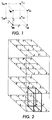
- Fig 1 is the numbering system used in this discussion to identify the 8 corners of a cube of memory.
- P 000 is the starting point of the cube
- P 100 is P 000+1 in the x direction
- P 010 is P 000+1 in the y direction etc.
- These memories could be labeled A, B, C and D, and the data could be stored into each in accordance with the number of lsb "1"s. For example, for a given cube, if the data point with no "1"s is stored in memory B, then the three data points with a single "1" would be stored in C, the data points with two “1”s would be stored in memory D, and the data point with three “1”s would be stored in A. This would guarantee that the four data points would always be in different memories.
- Fig 2 is a diagram showing how four memories would be used to store the values of data.
- This specific example is a diagram of a 3 x 3 x 3 cube section of the data table, having the cube of Fig 1 highlighted. Each intersection of orthogonal lines represents a data word in memory. Those labeled A are stored in memory A, those labeled B are stored in memory B, etc. As shown, the sequence A, B, C, D, A, B, C, D, A... proceeds from left to right, bottom to top and front to back throughout the data table. Putting Figs 1 and 2 together, for example, location P 000 of the highlighted cube of Fig 1 is stored in memory B.
- 16 A values, A 000 through A 332 are loaded into memory A; 16 B values, B 100 through B 333 are loaded into memory B; 16 C values C 200 through C 330 are loaded into memory C; and 16 D values, D 300 through D 331 , are loaded into memory D.
- memories A 22 through D 25 are loaded and accessed as shown in Figs 2 and 3.
- the 64 data points are loaded into memories A 22 through D 25.
- Each data point is identified by x, y and z coordinates.
- the x, y and z terms are summed, modulo 4, and loaded as follows. If the sum, modulo 4, is 0, memory A is used; if the sum, modulo 4, is 1, memory B is used, etc.
- the RGB outputs of the scanner 28 are formed into memory addresses by address generator 29 into x, y and z addresses having an integer (int) part and a fractional (f) part.
- the three integer parts, and their incremented values, are input to the logic 21.
- the first task of the logic is to address the starting point, P 000 , of the selected cube, and this is done simply by combining the x, y and z integer parts to form the P 000 address.
- the three integer parts will generate the address in memory B of the starting point of the current cube.
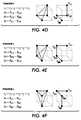
- the other three (of seven remaining) points of the selected cube that are needed by the interpolation process are selected by the tetrahedron selector logic 20 as shown in Fig 4. All of the six processes of Fig 4 are similar, and therefore only Tetrahedron 1 will be explained.
- P 100 is the memory address that would be determined if P 000 were incremented in the x direction but not in y and z. Therefore, the P 100 output of the logic 21 is addressed by a combination of xint+1, yint and zint. The other two outputs are generated similarly.
- the four data points output by the memories 22 through 25 of Fig 3 are applied to an interpolation circuit 26 which is shown in more detail in Fig 5.
- the data values obtained from the data points P 000 and P 100 in memory are subtracted at difference logic 51, multiplied by the fractional part of x and applied to the adder 57.
- the difference between P 100 and P 110 is used for y and the difference between P 110 and P 111 is used for z.
- the result is then added at adder 58 to the value from memory at P 000 to generate the final value, for cyan in this example.
- the remaining registers in Fig 5 are for timing purposes.
- a single LUT look up table
- the addresses output by logic 60 would be sequential and nine bits wide.
- the address would have the general form x 2 x 1 x 0 y 2 y 1 y 0 z 2 z 1 z 0 .
- address 000 000 000 would be loaded as entry 0, address 000 000 001 would be entry 1, etc.
- four sequential addresses must be used.
- the RGB inputs assume 8 bits each, are applied to a single RAM address logic 60 to generate four addresses, each nine bits wide. These are used to address the LUT 62 four times to generate four data outputs which identify a tetrahedron.
- An interpolation step is then used in the interpolator 61 to form the final output, here assumed to be cyan.
- the memory can also be divided into two or four parts. As shown in Fig 7, the use of two look up tables, each half the size of a typical single table, allows the retrieval of RAM data in half the time. Thus, two cycles are required to output four data points.
- the RGB inputs to the address logic 72 result in four output addresses, each eight bits wide. These are generated in logic 73 so that two are applied to RAM 1 and two are applied to RAM 2. In two memory cycles, four outputs are generated.
- the method of loading the dual RAM's involves sequentially traversing every address of a single RAM (any size) and using the above described equation to determine the appropriate RAM to load the data into. As the single LUT is traversed, every entry at the current address location is the next to be sequentially stored in the dual RAM that has been determined by the equation shown above.
- An example of a 256 entry dual LUT (based on a 512 single RAM configuration) is as follows. To generate the addresses for dual RAM's the least significant bit (z 0 ) is discarded.
- the result from the dual RAM selection equation together with the appropriate binary address are all that is required to download the pixel data needed for tetrahedral interpolation.
- the address and RAM selection scheme described above at least two of the four required addresses (the original versions prior to discarding of bits) must be generated simultaneously in hardware. This would be the equivalent to one clock time.
- the use of four look up tables each one quarter the size of a typical single table, allows the retrieval of RAM data in one quarter the time. This is the example shown in Fig 3.
- one cycle is required to output four data points.
- the RGB inputs to the address logic12 result in four output addresses, each seven bits wide. These are output from logic 86 so that one is applied to each of RAM's 0-3 in one memory cycle to generate four parallel outputs.
- the quad RAM like the single RAM, has sequential addresses, but the number of bits in each address is two bits less in the quad case. Another difference is in the number of entries per LUT. For example, in the case where a 512 entry single LUT would be used, its data equivalent in the quad LUT case would have 128 entries in each of four RAM's. The address for each of four LUT's would be seven bits wide. The seven bits would be the most significant of the single RAM's 9 bit address, with the least significant two bits discarded. But, before discarding of any bit occurs, the address bits of the single RAM configuration have to be used to determine which quad RAM (RAM0 - RAM3) that pixel data will be loaded to and retrieved from.
Landscapes
- Physics & Mathematics (AREA)
- General Physics & Mathematics (AREA)
- Engineering & Computer Science (AREA)
- Theoretical Computer Science (AREA)
- Image Processing (AREA)
- Color Image Communication Systems (AREA)
- Memory System (AREA)
- Facsimile Image Signal Circuits (AREA)
Applications Claiming Priority (2)
| Application Number | Priority Date | Filing Date | Title |
|---|---|---|---|
| US87349397A | 1997-06-12 | 1997-06-12 | |
| US873493 | 1997-06-12 |
Publications (2)
| Publication Number | Publication Date |
|---|---|
| EP0896298A2 true EP0896298A2 (de) | 1999-02-10 |
| EP0896298A3 EP0896298A3 (de) | 1999-11-17 |
Family
ID=25361744
Family Applications (1)
| Application Number | Title | Priority Date | Filing Date |
|---|---|---|---|
| EP98110565A Withdrawn EP0896298A3 (de) | 1997-06-12 | 1998-06-09 | RAM Adressengenerator für tetrahaedrische Interpolation über einen hexagonalen Verbund |
Country Status (2)
| Country | Link |
|---|---|
| EP (1) | EP0896298A3 (de) |
| JP (1) | JPH1117976A (de) |
Family Cites Families (6)
| Publication number | Priority date | Publication date | Assignee | Title |
|---|---|---|---|---|
| US4929978A (en) * | 1987-10-23 | 1990-05-29 | Matsushita Electric Industrial Co., Ltd. | Color correction method for color copier utilizing correction table derived from printed color samples |
| JPH0313066A (ja) * | 1989-06-09 | 1991-01-22 | Matsushita Electric Ind Co Ltd | 色修正方法及びその装置 |
| JP2666523B2 (ja) * | 1990-05-16 | 1997-10-22 | 松下電器産業株式会社 | 色変換装置 |
| US5296923A (en) * | 1991-01-09 | 1994-03-22 | Konica Corporation | Color image reproducing device and method |
| JP2903807B2 (ja) * | 1991-10-17 | 1999-06-14 | 富士ゼロックス株式会社 | 色信号変換方法および装置 |
| JPH0877341A (ja) * | 1994-08-29 | 1996-03-22 | Xerox Corp | カラー画像処理装置及び方法 |
-
1998
- 1998-06-02 JP JP10152613A patent/JPH1117976A/ja active Pending
- 1998-06-09 EP EP98110565A patent/EP0896298A3/de not_active Withdrawn
Also Published As
| Publication number | Publication date |
|---|---|
| JPH1117976A (ja) | 1999-01-22 |
| EP0896298A3 (de) | 1999-11-17 |
Similar Documents
| Publication | Publication Date | Title |
|---|---|---|
| US5809181A (en) | Color conversion apparatus | |
| US5321797A (en) | Apparatus and method for performing coordinate transformation employing stored values and interpolation | |
| US5241373A (en) | Apparatus for correction of color signal values | |
| US5111192A (en) | Method to rotate a bitmap image 90 degrees | |
| US5684981A (en) | Memory organization and method for multiple variable digital data transformation | |
| CA1324847C (en) | Color graphics system | |
| US5268853A (en) | Orthogonal transformation processor for compressing information | |
| EP0272655A2 (de) | Verfahren und Gerät zur Erzeugung von Daten einer Nachschlagetafel | |
| US5475510A (en) | Method for transforming color signals and apparatus for the method | |
| EP0619675B1 (de) | Anzeigesystem für Farbbilder | |
| JP3976849B2 (ja) | 補間器入力データを生成する装置 | |
| KR920704496A (ko) | 복수개의 선택된 이미지를 변환시키도록 복합 이미지 변환 모듈을 마련하는 칼라 이미지 처리 시스템 | |
| CA2399732A1 (en) | Method and apparatus for quantizing a color image through a single dither matrix | |
| US5313314A (en) | Method for transforming color signal and apparatus for executing the method | |
| GB2253320A (en) | Converting between rgb colour space and yiq colour space using 32 bit microprocessor | |
| US5412740A (en) | Signal processing system having reduced memory space | |
| US5880744A (en) | Method and apparatus for vector transformation involving a transformation matrix | |
| JPH09186874A (ja) | しきい値を用いた改善されたスクリーニング方法とシステム | |
| EP0896297A2 (de) | RAM Adressengenerator für tetrahaedrische Interpolation über einen hexagonalen Verbund | |
| US5359549A (en) | Orthogonal transformation processor for compressing information | |
| EP0896298A2 (de) | RAM Adressengenerator für tetrahaedrische Interpolation über einen hexagonalen Verbund | |
| JP2845384B2 (ja) | 画像処理装置 | |
| US6938064B1 (en) | Method for computing fast Fourier transform and inverse fast Fourier transform | |
| US6084601A (en) | Corner buffer system for improved memory read efficiency during texture mapping | |
| US5376973A (en) | Image memory device |
Legal Events
| Date | Code | Title | Description |
|---|---|---|---|
| PUAI | Public reference made under article 153(3) epc to a published international application that has entered the european phase |
Free format text: ORIGINAL CODE: 0009012 |
|
| AK | Designated contracting states |
Kind code of ref document: A2 Designated state(s): DE FR GB |
|
| AX | Request for extension of the european patent |
Free format text: AL;LT;LV;MK;RO;SI |
|
| RTI1 | Title (correction) | ||
| PUAL | Search report despatched |
Free format text: ORIGINAL CODE: 0009013 |
|
| AK | Designated contracting states |
Kind code of ref document: A3 Designated state(s): AT BE CH CY DE DK ES FI FR GB GR IE IT LI LU MC NL PT SE |
|
| AX | Request for extension of the european patent |
Free format text: AL;LT;LV;MK;RO;SI |
|
| 17P | Request for examination filed |
Effective date: 20000517 |
|
| AKX | Designation fees paid |
Free format text: DE FR GB |
|
| STAA | Information on the status of an ep patent application or granted ep patent |
Free format text: STATUS: THE APPLICATION IS DEEMED TO BE WITHDRAWN |
|
| 18D | Application deemed to be withdrawn |
Effective date: 20011231 |