EP0896837A2 - Dispositif pour trier des déchets - Google Patents
Dispositif pour trier des déchets Download PDFInfo
- Publication number
- EP0896837A2 EP0896837A2 EP98202696A EP98202696A EP0896837A2 EP 0896837 A2 EP0896837 A2 EP 0896837A2 EP 98202696 A EP98202696 A EP 98202696A EP 98202696 A EP98202696 A EP 98202696A EP 0896837 A2 EP0896837 A2 EP 0896837A2
- Authority
- EP
- European Patent Office
- Prior art keywords
- cylindrical sieve
- holes
- garbage
- plates
- arrangement according
- Prior art date
- Legal status (The legal status is an assumption and is not a legal conclusion. Google has not performed a legal analysis and makes no representation as to the accuracy of the status listed.)
- Granted
Links
- 238000007599 discharging Methods 0.000 claims description 4
- 230000002349 favourable effect Effects 0.000 description 8
- 238000000926 separation method Methods 0.000 description 5
- 230000006378 damage Effects 0.000 description 2
- 230000001934 delay Effects 0.000 description 1
- 230000000694 effects Effects 0.000 description 1
- 239000004576 sand Substances 0.000 description 1
- 238000007493 shaping process Methods 0.000 description 1
Images



Classifications
-
- B—PERFORMING OPERATIONS; TRANSPORTING
- B07—SEPARATING SOLIDS FROM SOLIDS; SORTING
- B07B—SEPARATING SOLIDS FROM SOLIDS BY SIEVING, SCREENING, SIFTING OR BY USING GAS CURRENTS; SEPARATING BY OTHER DRY METHODS APPLICABLE TO BULK MATERIAL, e.g. LOOSE ARTICLES FIT TO BE HANDLED LIKE BULK MATERIAL
- B07B1/00—Sieving, screening, sifting, or sorting solid materials using networks, gratings, grids, or the like
- B07B1/18—Drum screens
-
- B—PERFORMING OPERATIONS; TRANSPORTING
- B07—SEPARATING SOLIDS FROM SOLIDS; SORTING
- B07B—SEPARATING SOLIDS FROM SOLIDS BY SIEVING, SCREENING, SIFTING OR BY USING GAS CURRENTS; SEPARATING BY OTHER DRY METHODS APPLICABLE TO BULK MATERIAL, e.g. LOOSE ARTICLES FIT TO BE HANDLED LIKE BULK MATERIAL
- B07B1/00—Sieving, screening, sifting, or sorting solid materials using networks, gratings, grids, or the like
- B07B1/18—Drum screens
- B07B1/22—Revolving drums
-
- B—PERFORMING OPERATIONS; TRANSPORTING
- B07—SEPARATING SOLIDS FROM SOLIDS; SORTING
- B07B—SEPARATING SOLIDS FROM SOLIDS BY SIEVING, SCREENING, SIFTING OR BY USING GAS CURRENTS; SEPARATING BY OTHER DRY METHODS APPLICABLE TO BULK MATERIAL, e.g. LOOSE ARTICLES FIT TO BE HANDLED LIKE BULK MATERIAL
- B07B1/00—Sieving, screening, sifting, or sorting solid materials using networks, gratings, grids, or the like
- B07B1/46—Constructional details of screens in general; Cleaning or heating of screens
- B07B1/50—Cleaning
Definitions
- the invention relates to an arrangement for sorting garbage, comprising a cylindrical sieve rotating while in operation, on one axial end provided with a fill opening for accepting unsorted garbage, on a second axial end provided with an outlet opening for discharging at least substantially coarser garbage and provided with holes along its outer surface for discharging finer garbage.
- outlet opening is located at a lower level than the fill opening, which causes the coarser garbage to automatically leave the cylindrical sieve after some time via the outlet opening and to fall onto a transport belt for example.
- Finer garbage which leaves the cylindrical sieve via the holes, falls for example onto a second transport belt, running underneath the cylindrical sieve.
- the arrangement according to the invention substantially obviates this problem and is characterized in that obstruction means are provided, moving together with the cylindrical sieve, for preventing long, slender garbage from falling through the holes.
- a favourable embodiment of the arrangement according to the invention is characterized in that the obstruction means comprise a system of plates, arranged at least substantially parallel to the cylindrical sieve.
- the obstruction means comprise a system of plates, arranged at least substantially parallel to the cylindrical sieve.
- the plates should, however, not be chosen too small, in order to prevent a slender object that passes a hole from getting stuck between the cylindrical sieve and the plate.
- a favourable embodiment therefore is characterized in that the dimensions of a plate are larger than the dimensions of a hole belonging to that plate.
- a further favourable embodiment according to the invention is characterized in that the obstruction means comprise a system of plates, connected to the cylindrical sieve and extending in an axial direction or in a radial direction, whereby each plate obstructs a multitude of holes.
- the obstruction means comprise a system of plates, connected to the cylindrical sieve and extending in an axial direction or in a radial direction, whereby each plate obstructs a multitude of holes.
- a still further embodiment is characterized in that a distance between a plate and the cylindrical sieve is larger than the dimensions of the holes in the cylindrical sieve.
- a favourable embodiment of the invention by which the garbage to be sorted can be separated in two fractions, is characterized in that a distance between two plates mutually is larger than the dimensions of the holes in the cylindrical sieve. Finer garbage that has passed the holes will substantially unobstructedly leave the arrangement and end up for example on a transport belt, running underneath the cylindrical sieve.
- a very favourable embodiment of the invention in which garbage to be sorted may be separated into three fractions, is characterized in that a distance between two plates mutually is smaller than the dimensions of the holes in the cylindrical sieve.
- Very fine garbage for example a sand component contained in the garbage, can leave the arrangement between the plates, while coarser garbage will leave the system of plates near the outlet opening.
- the invention is characterized in that the obstruction means comprise a second cylindrical sieve, enclosing the first cylindrical sieve in a radial direction, whereby the second cylindrical sieve obstructs the holes in the first cylindrical sieve and whereby the second cylindrical sieve is provided with smaller holes than the first cylindrical sieve.
- the obstruction means now fully add to the structural strength of the arrangement and moreover enable the separation and removal of very fine garbage.
- a further favourable embodiment at least substantially removes this drawback and is characterized in that the obstruction means are provided with ribs, disposed in an axial direction, which ribs prevent the projecting parts from laterally rotating away.
- the obstruction means are provided with ribs, disposed in an axial direction, which ribs prevent the projecting parts from laterally rotating away.
- a vibrator device may be provided, located above the cylindrical sieve, for acting in a radial sense on the passing plates while in operation, for loosening any subjects that might still be caught, at their arrival at the highest point in the cylindrical sieve.
- a still further embodiment of the invention is based on the assumption that long, slender garbage will substantially exclusively fall through the holes in the lowest part of the cylindrical sieve and that it therefore suffices to locate obstruction means underneath the cylindrical sieve.
- This embodiment is characterized in that the obstruction means comprise an additional transport belt, moving underneath the cylindrical sieve in a radial direction.
- a favourable embodiment is characterized in that the additional transport belt is provided with ribs, disposed orthogonally to a transport direction of the additional transport belt.
- the ribs provide a good contact between the additional transport belt and the cylindrical sieve, while still leaving clearance for finer garbage that passes the holes to be collected and removed.
- the ribs reduce the risk of long, slender garbage that has passed a hole of being caught between the additional transport belt and the cylindrical sieve.
- Fig. 1 schematically represents in front view a cylindrical sieve 1 which can be rotated with the aid of a drive means 2, for example a system of transport wheels which in turn are rotated by an electromotor, further not shown.
- a drive means 2 for example a system of transport wheels which in turn are rotated by an electromotor, further not shown.
- garbage 3 On one side garbage 3 is fed into cylindrical sieve 1, the coarser components of which leave the cylindrical sieve at an opposite side. The finer components will leave cylindrical sieve 1 via a system of holes 4. These finer components then for example fall on a transport belt 5, passing underneath cylindrical sieve 1.
- Cylindrical sieve 1 may be slightly tilted in an axial direction in order to facilitate the transport of garbage.
- cylindrical sieve 1 may be internally provided with sloping or spirally shaped ribs.
- a vibrator device is provided, here embodied as a wheel 7, connected to a movable arm 8, rotatable around an axis 9, and mounted for running on the outside of cylindrical sieve 1. While running, wheel 7 is successively lifted up by each of the plates 6 passing by and then dropped into the space between the plates, which causes a powerful vibration. Objects that are possibly stuck in the holes 4 will be loosened by it.
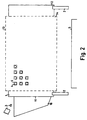
- Fig. 2 shows schematically in side view a cylindrical sieve 1, provided wit drive means 2 and a non-rotating hopper 10 that connects to fill opening 11.
- the cylindrical sieve 1 is positioned such that it slopes from left to right, such that coarser garbage that is poured into cylindrical sieve 1 will eventually be discharged at outlet opening 12, because of the rotating movement of cylindrical sieve 1.
- Cylindrical sieve 1 is on substantially its entire surface provided with holes 4, and each hole 4 is individually covered by a single plate 6. Plates 6 are located at some distance of cylindrical sieve 1, such that finer garbage that can pass the holes 4 will fall on a transport belt 5 and will be removed.
- the arrangement of plates 6 forms, as it were, a second cylindrical sieve 13, rotating together with cylindrical sieve 1 and enclosing it.
- the mutual distance between the plates can be chosen freely. An obvious choice is to make the distance such that garbage that has passed holes 4, will practically unhindered fall onto transport belt 5.
- the single plates 6 are preferably attached to cylindrical sieve 1 with a bolt.
- the advantage is that, if an object gets stuck it can be easily removed, because only one bolt has to be loosened and the single plate is easy to handle.
- the disadvantage is that many attachments are needed and that coarser garbage, especially when the distance between the plates 6 is chosen to be small, is seriously hindered by all the attachments that are in its way towards the additional outlet opening 14.
- plates 6 such that they cover more than one hole, for example rectangular plates 6, covering four holes each, provided with only one central connection.
- Fig. 2 moreover shows that at the interface with the drive means 2 cylindrical sieve 1 is not provided with holes. This is not mandatory, but it prevents drive means 2 from rapidly becoming dirty. Moreover it should be noted that cylindrical sieve 1 may as well be rotated via an axially disposed rotation axis on which a drive means act. In that case the entire cylindrical sieve 1 may be covered with holes.
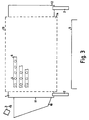
- Fig. 3 shows schematically in side view a cylindrical sieve 1 provided with holes 4 and with a system of axially disposed plates 4, again for preventing long slender objects from leaving cylindrical sieve 1 via the holes 4.
- the plates 6 If the distance between the plates 6 is chosen to be small, at least smaller than the diameters of the holes 4, the plates 6 again form a second cylindrical sieve 13, enclosing cylindrical sieve 1. In this way the garbage can again be separated into three components. Is the mutual distance large, a separation into two components takes place.
- the plates 6 can be manufactured easily and need a limited number of attachments compared with the embodiment described with reference to Fig. 2. This is especially advantageous if the plates are mounted with a small mutual distance, for the separation of garbage in three components.
- the plates 6 in Fig. 3 are represented such that they cover in width only one hole 4, it is also possible to give plates 6 a larger width, such that they cover more holes. The advantage is that a smaller number of attachments will suffice.
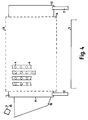
- Fig. 4 schematically shows in side view a cylindrical sieve 1, provided with holes 4 and with a system of radially disposed plates 6.
- Plates 6 have a limited number of attachments, which is advantageous if the plates 6 are mounted with a small mutual distance, for separating the garbage into three components.
- the plates shown in Fig. 4 can be given a larger width, such that they cover more holes in an axial direction. The advantage again is that fewer attachments are needed.
- the embodiments as shown in Fig. 3 and Fig. 4 are equivalent, the first embodiment adding to the strength of the apparatus in an axial direction and the second embodiment adding to the strength in radial direction.
- Fig. 5 shows in side view a cylindrical sieve 1, enclosed by a second cylindrical sieve 13, made in one piece.
- cylindrical sieve 13 is provided with holes 15 which do not correspond to the holes 4; holes 15 again provide for the separation of very fine garbage.
- the second cylindrical sieve 13 adds to the strength of the arrangements in both directions.
- Fig. 6 shows schematically in front view a cylindrical sieve 1, the bottom of which is enclosed by an additional transport belt 15.
- Cylindrical sieve 1 and additional transport belt 15 have corresponding speeds and are each individually driven by known means, not shown here.
- Via holes 4 in cylindrical sieve 1 finer garbage can reach the space between cylindrical sieve 1 and additional transport belt 15 and next be put down onto transport belt 5, which may now be chosen relatively narrow as compared to the embodiments mentioned in Fig. 1-5, because the finer garbage is delivered more concentrated.
- additional transport belt 15 covers the holes 4 as described with reference to the previous figures, in order to prevent long, slender objects from falling through.
- cylindrical sieve 1 is made very robust.
- An additional advantage of this embodiment is that the chance of clamping a long, slender object is reduced even further.
- cylindrical sieve 1 with holes of different diameters, for example the first three meters measured from funnel 10 with holes of 50 millimetre diameter and the following three meters with holes of 150 millimetre diameter, which again provides for a separation into more fractions. If additional transport belt 15 is used, one may chose for one common additional transport belt 15 or for separate additional transport belts 15 for removing the fractions.
Landscapes
- Combined Means For Separation Of Solids (AREA)
- Electrical Discharge Machining, Electrochemical Machining, And Combined Machining (AREA)
Applications Claiming Priority (4)
| Application Number | Priority Date | Filing Date | Title |
|---|---|---|---|
| NL1006768 | 1997-08-13 | ||
| NL1006768A NL1006768C1 (nl) | 1997-08-13 | 1997-08-13 | Inrichting voor het sorteren van afval. |
| NL1007235A NL1007235C1 (nl) | 1997-10-09 | 1997-10-09 | Inrichting voor het sorteren van afval. |
| NL1007235 | 1997-10-09 |
Publications (3)
| Publication Number | Publication Date |
|---|---|
| EP0896837A2 true EP0896837A2 (fr) | 1999-02-17 |
| EP0896837A3 EP0896837A3 (fr) | 2000-08-02 |
| EP0896837B1 EP0896837B1 (fr) | 2004-10-20 |
Family
ID=26642641
Family Applications (1)
| Application Number | Title | Priority Date | Filing Date |
|---|---|---|---|
| EP98202696A Expired - Lifetime EP0896837B1 (fr) | 1997-08-13 | 1998-08-11 | Dispositif pour trier des déchets |
Country Status (3)
| Country | Link |
|---|---|
| EP (1) | EP0896837B1 (fr) |
| AT (1) | ATE279993T1 (fr) |
| DE (1) | DE69827087T2 (fr) |
Cited By (3)
| Publication number | Priority date | Publication date | Assignee | Title |
|---|---|---|---|---|
| EP1177838A3 (fr) * | 2000-07-31 | 2002-08-14 | Heissenberger & Pretzler Ges.m.b.H. | Tamis à tambour |
| NL2021040B1 (nl) * | 2018-02-28 | 2019-08-30 | Senro B V | Afvalscheidingsinrichting |
| EP3533525A1 (fr) | 2018-02-28 | 2019-09-04 | Senro B.V. | Appareil de séparation de déchets |
Family Cites Families (1)
| Publication number | Priority date | Publication date | Assignee | Title |
|---|---|---|---|---|
| JPH07106344B2 (ja) * | 1992-09-16 | 1995-11-15 | 日本磁力選鉱株式会社 | 長尺物分離装置 |
-
1998
- 1998-08-11 AT AT98202696T patent/ATE279993T1/de not_active IP Right Cessation
- 1998-08-11 EP EP98202696A patent/EP0896837B1/fr not_active Expired - Lifetime
- 1998-08-11 DE DE69827087T patent/DE69827087T2/de not_active Expired - Lifetime
Cited By (3)
| Publication number | Priority date | Publication date | Assignee | Title |
|---|---|---|---|---|
| EP1177838A3 (fr) * | 2000-07-31 | 2002-08-14 | Heissenberger & Pretzler Ges.m.b.H. | Tamis à tambour |
| NL2021040B1 (nl) * | 2018-02-28 | 2019-08-30 | Senro B V | Afvalscheidingsinrichting |
| EP3533525A1 (fr) | 2018-02-28 | 2019-09-04 | Senro B.V. | Appareil de séparation de déchets |
Also Published As
| Publication number | Publication date |
|---|---|
| DE69827087T2 (de) | 2005-10-20 |
| EP0896837B1 (fr) | 2004-10-20 |
| DE69827087D1 (de) | 2004-11-25 |
| ATE279993T1 (de) | 2004-11-15 |
| EP0896837A3 (fr) | 2000-08-02 |
Similar Documents
| Publication | Publication Date | Title |
|---|---|---|
| US5398815A (en) | Landfill waste material separating method | |
| FI75078B (fi) | Skoerdetroeska. | |
| RU2155108C1 (ru) | Способ переработки твердых бытовых отходов и устройство для его осуществления | |
| JP2571246B2 (ja) | 繊維性物質選別用装置 | |
| US4312750A (en) | Grain cleaning apparatus | |
| US20240407321A1 (en) | Lift to Sift Litter Box | |
| EP0896837B1 (fr) | Dispositif pour trier des déchets | |
| CN110626814B (zh) | 一种尾矿处理系统 | |
| EP0079357A1 (fr) | Tambour de separation d'un materiau en vrac. | |
| US4155840A (en) | Four group size vibratory screening apparatus | |
| US4308135A (en) | Sizing screens | |
| US4280900A (en) | Rotary seed cleaner | |
| US4314675A (en) | Grain bin discharge guard | |
| US2674374A (en) | Corrugated slot screen | |
| RU2038869C1 (ru) | Устройство для разделения сыпучих материалов по крупности частиц | |
| JPH0424419Y2 (fr) | ||
| NL1007235C1 (nl) | Inrichting voor het sorteren van afval. | |
| US994580A (en) | Grain-cleaning machine. | |
| JPH079464U (ja) | 細粒種子の選別機 | |
| CA1130761A (fr) | Crible multi-etage suspendu a vibrateur excentrique central | |
| SU1699656A1 (ru) | Сортировка дл измельченных древесных материалов | |
| JPH0323338Y2 (fr) | ||
| JPH06173294A (ja) | 土砂ホッパ装置 | |
| NL1006768C1 (nl) | Inrichting voor het sorteren van afval. | |
| US1034931A (en) | Bean-separator. |
Legal Events
| Date | Code | Title | Description |
|---|---|---|---|
| PUAI | Public reference made under article 153(3) epc to a published international application that has entered the european phase |
Free format text: ORIGINAL CODE: 0009012 |
|
| AK | Designated contracting states |
Kind code of ref document: A2 Designated state(s): AT BE CH DE DK GB LI NL |
|
| AX | Request for extension of the european patent |
Free format text: AL;LT;LV;MK;RO;SI |
|
| 17P | Request for examination filed |
Effective date: 19990730 |
|
| PUAL | Search report despatched |
Free format text: ORIGINAL CODE: 0009013 |
|
| AK | Designated contracting states |
Kind code of ref document: A3 Designated state(s): AT BE CH CY DE DK ES FI FR GB GR IE IT LI LU MC NL PT SE |
|
| AX | Request for extension of the european patent |
Free format text: AL;LT;LV;MK;RO;SI |
|
| AKX | Designation fees paid |
Free format text: AT BE CH DE DK GB LI NL |
|
| 17Q | First examination report despatched |
Effective date: 20020614 |
|
| GRAP | Despatch of communication of intention to grant a patent |
Free format text: ORIGINAL CODE: EPIDOSNIGR1 |
|
| GRAS | Grant fee paid |
Free format text: ORIGINAL CODE: EPIDOSNIGR3 |
|
| GRAA | (expected) grant |
Free format text: ORIGINAL CODE: 0009210 |
|
| RIN1 | Information on inventor provided before grant (corrected) |
Inventor name: BUSSCHERS, ALFONSIUS JOHANNES MARIA DECEASED |
|
| AK | Designated contracting states |
Kind code of ref document: B1 Designated state(s): AT BE CH DE DK GB LI NL |
|
| PG25 | Lapsed in a contracting state [announced via postgrant information from national office to epo] |
Ref country code: LI Free format text: LAPSE BECAUSE OF FAILURE TO SUBMIT A TRANSLATION OF THE DESCRIPTION OR TO PAY THE FEE WITHIN THE PRESCRIBED TIME-LIMIT Effective date: 20041020 Ref country code: CH Free format text: LAPSE BECAUSE OF FAILURE TO SUBMIT A TRANSLATION OF THE DESCRIPTION OR TO PAY THE FEE WITHIN THE PRESCRIBED TIME-LIMIT Effective date: 20041020 Ref country code: AT Free format text: LAPSE BECAUSE OF FAILURE TO SUBMIT A TRANSLATION OF THE DESCRIPTION OR TO PAY THE FEE WITHIN THE PRESCRIBED TIME-LIMIT Effective date: 20041020 |
|
| REG | Reference to a national code |
Ref country code: GB Ref legal event code: FG4D |
|
| REG | Reference to a national code |
Ref country code: CH Ref legal event code: EP |
|
| REF | Corresponds to: |
Ref document number: 69827087 Country of ref document: DE Date of ref document: 20041125 Kind code of ref document: P |
|
| PG25 | Lapsed in a contracting state [announced via postgrant information from national office to epo] |
Ref country code: DK Free format text: LAPSE BECAUSE OF FAILURE TO SUBMIT A TRANSLATION OF THE DESCRIPTION OR TO PAY THE FEE WITHIN THE PRESCRIBED TIME-LIMIT Effective date: 20050120 |
|
| REG | Reference to a national code |
Ref country code: CH Ref legal event code: PL |
|
| PG25 | Lapsed in a contracting state [announced via postgrant information from national office to epo] |
Ref country code: GB Free format text: LAPSE BECAUSE OF NON-PAYMENT OF DUE FEES Effective date: 20050811 |
|
| PLBE | No opposition filed within time limit |
Free format text: ORIGINAL CODE: 0009261 |
|
| STAA | Information on the status of an ep patent application or granted ep patent |
Free format text: STATUS: NO OPPOSITION FILED WITHIN TIME LIMIT |
|
| 26N | No opposition filed |
Effective date: 20050721 |
|
| GBPC | Gb: european patent ceased through non-payment of renewal fee |
Effective date: 20050811 |
|
| PGFP | Annual fee paid to national office [announced via postgrant information from national office to epo] |
Ref country code: NL Payment date: 20150827 Year of fee payment: 18 |
|
| REG | Reference to a national code |
Ref country code: NL Ref legal event code: MM Effective date: 20160901 |
|
| PG25 | Lapsed in a contracting state [announced via postgrant information from national office to epo] |
Ref country code: NL Free format text: LAPSE BECAUSE OF NON-PAYMENT OF DUE FEES Effective date: 20160901 |
|
| PGFP | Annual fee paid to national office [announced via postgrant information from national office to epo] |
Ref country code: DE Payment date: 20170822 Year of fee payment: 20 |
|
| PGFP | Annual fee paid to national office [announced via postgrant information from national office to epo] |
Ref country code: BE Payment date: 20170821 Year of fee payment: 20 |
|
| REG | Reference to a national code |
Ref country code: DE Ref legal event code: R071 Ref document number: 69827087 Country of ref document: DE |
|
| REG | Reference to a national code |
Ref country code: BE Ref legal event code: MK Effective date: 20180811 |