EP0897761A2 - Vorrichtung zum Sortieren von körnigem Material nach Farbe - Google Patents
Vorrichtung zum Sortieren von körnigem Material nach Farbe Download PDFInfo
- Publication number
- EP0897761A2 EP0897761A2 EP98115356A EP98115356A EP0897761A2 EP 0897761 A2 EP0897761 A2 EP 0897761A2 EP 98115356 A EP98115356 A EP 98115356A EP 98115356 A EP98115356 A EP 98115356A EP 0897761 A2 EP0897761 A2 EP 0897761A2
- Authority
- EP
- European Patent Office
- Prior art keywords
- injection
- grains
- control section
- section
- nozzle device
- Prior art date
- Legal status (The legal status is an assumption and is not a legal conclusion. Google has not performed a legal analysis and makes no representation as to the accuracy of the status listed.)
- Withdrawn
Links
Images




Classifications
-
- B—PERFORMING OPERATIONS; TRANSPORTING
- B07—SEPARATING SOLIDS FROM SOLIDS; SORTING
- B07C—POSTAL SORTING; SORTING INDIVIDUAL ARTICLES, OR BULK MATERIAL FIT TO BE SORTED PIECE-MEAL, e.g. BY PICKING
- B07C5/00—Sorting according to a characteristic or feature of the articles or material being sorted, e.g. by control effected by devices which detect or measure such characteristic or feature; Sorting by manually actuated devices, e.g. switches
- B07C5/34—Sorting according to other particular properties
- B07C5/342—Sorting according to other particular properties according to optical properties, e.g. colour
- B07C5/3425—Sorting according to other particular properties according to optical properties, e.g. colour of granular material, e.g. ore particles, grain
-
- B—PERFORMING OPERATIONS; TRANSPORTING
- B07—SEPARATING SOLIDS FROM SOLIDS; SORTING
- B07C—POSTAL SORTING; SORTING INDIVIDUAL ARTICLES, OR BULK MATERIAL FIT TO BE SORTED PIECE-MEAL, e.g. BY PICKING
- B07C5/00—Sorting according to a characteristic or feature of the articles or material being sorted, e.g. by control effected by devices which detect or measure such characteristic or feature; Sorting by manually actuated devices, e.g. switches
- B07C5/36—Sorting apparatus characterised by the means used for distribution
- B07C5/363—Sorting apparatus characterised by the means used for distribution by means of air
- B07C5/365—Sorting apparatus characterised by the means used for distribution by means of air using a single separation means
- B07C5/366—Sorting apparatus characterised by the means used for distribution by means of air using a single separation means during free fall of the articles
-
- Y—GENERAL TAGGING OF NEW TECHNOLOGICAL DEVELOPMENTS; GENERAL TAGGING OF CROSS-SECTIONAL TECHNOLOGIES SPANNING OVER SEVERAL SECTIONS OF THE IPC; TECHNICAL SUBJECTS COVERED BY FORMER USPC CROSS-REFERENCE ART COLLECTIONS [XRACs] AND DIGESTS
- Y10—TECHNICAL SUBJECTS COVERED BY FORMER USPC
- Y10S—TECHNICAL SUBJECTS COVERED BY FORMER USPC CROSS-REFERENCE ART COLLECTIONS [XRACs] AND DIGESTS
- Y10S209/00—Classifying, separating, and assorting solids
- Y10S209/932—Fluid applied to items
-
- Y—GENERAL TAGGING OF NEW TECHNOLOGICAL DEVELOPMENTS; GENERAL TAGGING OF CROSS-SECTIONAL TECHNOLOGIES SPANNING OVER SEVERAL SECTIONS OF THE IPC; TECHNICAL SUBJECTS COVERED BY FORMER USPC CROSS-REFERENCE ART COLLECTIONS [XRACs] AND DIGESTS
- Y10—TECHNICAL SUBJECTS COVERED BY FORMER USPC
- Y10S—TECHNICAL SUBJECTS COVERED BY FORMER USPC CROSS-REFERENCE ART COLLECTIONS [XRACs] AND DIGESTS
- Y10S209/00—Classifying, separating, and assorting solids
- Y10S209/938—Illuminating means facilitating visual inspection
Definitions
- the present invention relates to a granular material color sorting apparatus which optically detects and removes bad grains in cereal grains such as rice grains, wheat grains or the like.
- the "bad grain” used herein means colored grains such as degenerated cereal grains, and foreign matters such as pieces of glass or stones in similar color to good cereal grains or transparent.
- the granular material color sorting apparatus to be improved by the invention comprises a feed device for material grains, a transfer device adapted to make the material fed from the feed device flow down, an optical detector unit mounted near the terminal end of the transfer device, an injection nozzle device mounted along the path of falling-down of the material from the transfer device, and a control unit connected to the optical detector unit and the injection nozzle device.
- the material grains fall down from an inclined sliding surface of the transfer device through a substantially constant locus, and the optical detector unit optically detects the material grains.
- the control unit discriminates good and bad grains based on the optical detection value, and activates the injection nozzle device to blow off the bad grains. Thus, the bad grains are sorted from the material grains.
- the optical detector unit uses a visible light sensor for detecting the colored grains, and a near infrared sensor for detecting glass or stones.
- a visible light sensor for detecting the colored grains
- a near infrared sensor for detecting glass or stones.
- Such granular material color sorting apparatus is found, for example, in United States Patent No. 5,638,961 of the same assignee as the present invention.
- the control unit has a comparator, an injection time control section, and an injection delay control section.
- the comparator compares a detected value of the optical detector unit with a predetermined threshold to discriminate bad grains from good grains.
- the injection time control section activates the injection nozzle device for a predetermined period of time to inject air.
- the injection delay control section delays the operation of the injection nozzle device for a predetermined period of time after detection of a bad grain. In operation, as shown in Fig. 9, if detection signals S1 and S3 from the near infrared sensor 130 and a detection signal S2 from the visible light sensor 120 exceed thresholds, the comparator 140 determines them as bad grains, and outputs signals N1, N2 and N3 indicating the bad grains.
- the injection delay control section 180 and the injection time control section 190 output signals T1, T2 and T3 of a fixed delay time t, as well as signals F1, F2 and F3 of a fixed injection time f in response to the bad grain signals N1, N2 and N3, respectively, to activate the injection nozzle device.
- the injection delay control section 180 activates the injection nozzle device at a relatively short period of delay time or timing for enabling capture of glass or a stone of a higher falling-down speed.
- the injection time control section 190 outputs an injection time f for enabling capture of even a colored cereal grain of a lower falling-down speed so as to remove the bad grain.
- one activation of the injection nozzle device is necessary to have a long injection time f so that bad grains being determined can be removed regardless of colored cereal grains or foreign matters such as glass or stones, and thus consumes much air.
- the injection time f is long, good cereal grains before and after a bad grain are also removed by an injected air flow in a higher ratio, and it becomes impossible to sort only bad grains.
- Japanese Utility Model Application Laid-Open Publication No. 6-41876 proposes a sorting apparatus varying a driving time and a driving delay time for air injection depending on the lengths of objects to be sorted.
- This apparatus is for small objects such as pharmaceuticals or electronic components, has an optical detector unit for sensing the length of an object to be sorted, and is provided in an air nozzle driving system with means for changing the activation time of an air nozzle in response to its detection signal.
- the sorting apparatus described in this publication is so constructed as to control the injection or drive time and/or the delay time of the air nozzle driving system depending on a detection signal of length of an object to be sorted. Therefore, the apparatus may effectively sort bad ones different from good articles only in size, but may not sufficiently sort colored grains or foreign matters such as glass or stones of different falling-down speeds.
- the present invention has an object of providing a granular material sorting apparatus which can accurately and economically remove bad grains mixed in a material and having different falling-down speeds from each other.
- Another object of the present invention is to provide a granular material color sorting apparatus which consumes less air to be injected in sorting colored grains or foreign matters such as glass or stones out from material cereal grains, and by which only bad grains can be sorted accurately and surely.
- the invention aims at controlling an injection nozzle device so that it differently operates in removing colored grains and in removing foreign matters.
- a granular material color sorting apparatus comprises a transfer device for causing material grains to fall down in a substantially fixed locus, at least one optical detector unit mounted along the falling-down locus of the material grains, an injection nozzle device for injecting air to the material grains after the optical detection to remove them, and a control unit for controlling operation of the injection nozzle device in response to the detection by the optical detector unit.
- the optical detector unit comprises a colored grain detection sensor section for optically detecting colored grains different in color from good material grains, and a foreign matter detection sensor section for optically detecting foreign matter in similar color to the good material grains or transparent.
- the control unit has a comparator section for discriminating the good material grains and bad grains of colored grains and foreign matters based on output signals from the optical detector unit, an injection time control section for activating the injection nozzle device over a predetermined period of time depending on discrimination by the comparator section, and an injection delay control section for delaying the activation of the injection nozzle device for a predetermined period of time after the detection by the optical detector unit.
- the injection time control section and the injection delay control section are adapted to output different injection times and different injection delay times to the injection nozzle device depending on colored grains or foreign matters.
- the injection time control section and the injection delay control section are preferably adapted to set the injection time and the injection delay time for the injection nozzle device according to the magnitude of a colored grain detection signal from the colored grain detection sensor section and to that of a foreign matter detection signal from the foreign matter detection sensor section.
- removal of bad grains can be more effectively performed by setting the operation of the injection device in more detail depending on the magnitude of a detection signal, that is, the size of a bad grain.
- the injection time control section and the injection delay control section are arranged to perform the detection of light from the same position, even if an optical detection position is shifted due to displacement of the setting position, bad grains can be properly eliminated by changing and adjusting the injection time and the injection delay time corresponding to each sensor section.
- the granular material color sorting apparatus is provided with set of the injection time control section and the injection delay control section for each of the colored grain detection sensor section and the foreign matter detection sensor section.
- the injection time control section and the injection delay control section may be provided with an input section for inputting and setting an injection time and an injection delay time.
- an operator can appropriately set an injection time and an injection delay time in the injection time control section and the injection delay control section according to the situation of sorting.
- the granular material color sorting apparatus 1 comprises a transfer device 3 for transferring material grains G, optical detector units 2a and 2b for optically detecting the material G, an injection nozzle device 4 for removing bad grains with air injection, and a control unit 5 for controlling operation of the injection nozzle device 4 based on output signals of the optical detector units 2a and 2b.
- the transfer device 3 has an inclined transfer path, receives the material grains G from feed means (not shown), and causes them to fall down in a substantially fixed locus.
- the optical detector units 2a and 2b are disposed on opposite sides of the locus of the material grains G falling down from the terminal end of the transfer path of the transfer device 3 with the locus interposed between them.
- the injection nozzle device 4 is disposed below one of the optical detector units so that it injects air to the material G after the optical detection.
- Each of the optical detector units 2a and 2b includes a halogen lamp 6, a fluorescent lamp 7, a background 8, and an optical detection section 9a or 9b.
- Each optical detection section 9a or 9b has a condenser lens 10, an optical filter 11, a colored grain detection sensor or a visible light sensor 12a or 12b for detecting colored grains, and a foreign matter detection sensor or a near infrared sensor 13a or 13b, for detecting foreign matters such as glass or stones.
- These optical detection sections 9a and 9b are mounted to receive light from the same optical detection position P in the falling-down locus of the material grains G.
- the structure and operation of the granular material color sorting apparatus 1 may be similar to, for example, those described in United States Patent No. 5,638,961 referred to above, except for the optical detection/control system, and will not be described any further.
- the detection/control system including the optical detection units 2a and 2b, and a control unit 5 with reference to Fig. 2.
- Each of the visible light sensors 12a and 12b of the optical detection unit connects to an amplifier 14a or 14b through an I/V converter (not shown), and then to a comparator or a detection signal determination section 16.
- the I/V converter converts a value of detected quantity of light by the visible light sensor into a voltage value, and the amplifier amplifies the voltage value.
- the detection signal determination section 16 is an electronic circuit device storing thresholds indicating good cereal grains, determines good and bad grains by comparing the amplified voltage value or detection signal with the thresholds, and determines magnitude of the detection signal of a bad grain, or the length L described later.
- the detection signal determination section 16 is connected with an injection delay control section 18 and an injection time control section 19, which are connected to the injection nozzle device 4, respectively.
- the injection delay control section 18 is an electronic circuit device for delaying air injection from the injection nozzle device 4 for a predetermined period of time
- the injection time control section 19 is an electronic circuit device for activating the injection nozzle device 4 over a predetermined period of
- Each of the near infrared sensors 13a and 13b also connects to an amplifier 15a or 15b through the I/V converter (not shown) as in the visible light sensor described above, and then to a detection signal determination section 17.
- the I/V converter converts a value of detected quantity of light by the near infrared sensor into a voltage value, and the amplifier amplifies the voltage value.
- the detection signal determination section 17 is an electronic circuit device storing thresholds indicating good cereal grains, compares the amplified voltage value or detection signal with the thresholds to determine good and bad grains, and determines magnitude of the detection signal of a bad grain.
- the detection signal determination section 17 is connected with an injection delay control section 20 and an injection time control section 21, which are connected to the injection nozzle device 4, respectively.
- the determination section 17, and the control sections 20 and 21 are electronic circuit devices.
- a silicon photo-sensor, CCD line sensor or the like is used for the visible light sensor or colored grain detection sensor 12a, 12b, and a germanium photo-sensor, InGaAs array sensor or the like is used for the near infrared sensor or foreign matter sensor 13a, 13b.
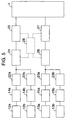
- This granular material color sorting apparatus similarly to the above embodiment, may be of the structure that is the same as the conventional apparatus, except for the optical detection/control system, and here only the optical detection/control system will be described based on Fig. 5.
- those components of the second embodiment which may be similar to the above embodiment will be designated by like reference signs, and their description will be omitted.
- Each of the visible light sensors 12a or 12b of the optical detection unit connects to an amplifier 14a or 14b through an I/V converter (not shown), to which amplifier a comparator 22a or 22b is connected. Similar to the above embodiment, the I/V converter converts a value of detected quantity of light by the visible light sensor into a voltage value, and the amplifier amplifies the voltage value. Each comparator stores thresholds indicating good grains, and compares the amplified voltage value or detected signal with the thresholds to determine good grains and bad grains.
- the comparators 22a and 22b are connected with an injection time control section 24 and an injection delay control section 25, and the injection delay control section 25 connects to the injection nozzle device 4.
- the injection time control section 24 causes the injection nozzle device 4 to inject air over a predetermined period of time
- the injection delay control section 25 delays operation of the injection nozzle device 4 for a predetermined period of time.
- Each of the near infrared sensors 13a and 13b of the optical detector unit connects to an amplifier 15a or 15b through an I/V converter (not shown), and then to a comparator 23a or 23b.
- the I/V converter converts a value of detected quantity of light by the near infrared sensor into a voltage value, and the amplifier amplifies the voltage value.
- Each comparator compares the amplified voltage value or detection signal with the thresholds to determine good grains and bad grains.
- the comparators 23a and 23b are connected with an injection time control section 26 and an injection delay control section 27, and the injection delay control section 27 connects to the injection nozzle device 4.
- the injection time control section 26 causes the injection nozzle device 4 to inject air over a predetermined period of time, and the injection delay control section 27 delays operation of the injection nozzle device 4 for a predetermined period of time.
- the control unit of this embodiment may be provided with an input section that is capable of setting and inputting an activation time and a delay time for air injection.
- Such input section 28 is indicated as connected to the injection time control sections 24 and 26, and the injection delay control section 25 and 27 by broken lines in Fig. 5.
- the optical detection/control system of this embodiment has an essential arrangement that is similar to the second embodiment, and differs only in the number of injection time control section and injection delay control section. That is, the second embodiment has a set of injection time control section and injection delay control section for each pair of visible light sensor and near infrared sensor.
- the third embodiment is provided with a set of injection time control section 24a, 24b, 26a or 26b and injection delay control section 25a, 25b, 27a or 27b for each of visible light sensor and near infrared sensor.
- the visible sensors 12a and 12b detect the quantity of light from the material G.
- the values of detected quantities of light are converted into voltage values by the I/V converter.
- the voltage values are amplified by the amplifiers 14a and 14b, and output to the detection signal determination section 16 as detection signals.
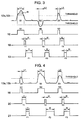
- Fig. 3 shows the detection signals or voltage values S1, S2 and S3 corresponding to the quantities of detected light by the visible light sensors 12a and 12b.
- the detection signal determination section 16 compares the detection signals S1, S2 and S3 with the thresholds, if they exceed the thresholds, determines that they are bad grains or colored grains, and outputs bad grain signals N1, N2 and N3. In this case, the detection signal determination section 16 determines widths L1, L2 and L3 of the detection signals S1, S2 and S3, and outputs values of the respective widths L1, L2 and L3 as the magnitude of detection signals of bad grains to the injection delay control section 18 and the injection time control section 19.
- the injection delay control section 18 and the injection time control section 19 store and are set with the injection times and the injection delay times corresponding to the values of width of detection signals, respectively.
- the injection delay control section 18 and the injection time control section 19 automatically select the injection times and the injection delay times according to the values of width of the detection signals from the detection signal determination section 16, and output delay signals T1, T2 and T3 and activation signals F1, F2 and F3 to a drive circuit (not shown) for activating the injection nozzle device 4. Then, the injection nozzle device 4 receives these signals, and operates at the predetermined injection delay times and injection times.
- the injection delay control section 18 selects injection delay times t1, t2 and t3 depending on the values of width of the detection signals S1, S2 and S3 determined as bad grains.
- the injection delay time t is inversely proportional to the value of width of a detection signal, and set to t3 > t2 > t1 if the widths of the detection signal have values of L1 > L2 > L3. That is, when the width of a detection signal is large, it is assumed that the grain is large. Since a larger grain has a higher falling-down speed, and reaches the injection nozzle device faster, the delay time is made shorter from the detection to the activation of the nozzle.
- the injection time control section 19 also selects, as shown in Fig. 3, injection times f1, f2 and f3 depending on the values of width of the detection signals S1, S2 and S3 determined as bad grains.
- the injection time f is proportional to the value of width of a detection signal, and set to f1 > f2 > f3 if the widths of the detection signal shown in Fig. 3 have values of L1 > L2 > L3. That is, when the width of a detection signal is large, as described above, it is assumed that the grain is large. Since a larger grain is heavier, the injection time is made longer to remove the heavier grain.
- the injection delay times t and the injection times f are previously stored and set in the injection delay control section 20 and the injection time control section 21, respectively. These times have setting depending on the values of width L1, L2 and L3 of the detection signals S1, S2 and S3 determined as bad grains, and taking into account the fact that foreign matters have higher falling-down speeds than colored grains. That is, for a foreign matter such as glass or stone, even if it has the same value of width of a detection signal, the injection time and the injection delay time are set to be longer and shorter than those for a colored grain such as a discolored cereal grain. As shown in Fig.
- the injection delay time t is inversely proportional to the values of width L2 > L3 > L1 of the detection signals, and predetermined times t1 > t3 > t2 are automatically selected.
- the injection time f is proportional to the values of width of the detection signals, and predetermined times f2 > f3 > f1 are automatically selected.
- the injection nozzle device 4 is activated by the injection delay times and the injection times thus selected, and detected bad grains are removed by injection air from the injection nozzle device 4.
- the operation of the injection nozzle device 4 is set to the necessary injection time and the optimal delay time depending on whether the bad grain detected in the material G is a colored grain or a foreign matter such as glass or stone of a different falling-down speed, and depending on the magnitude of each detection signal. Therefore, it is possible to reduce the amount of air used by the injection nozzle device than the conventional art, that is, to reduce the running cost of the machine, and to sort only bad grains economically and accurately.
- the first embodiment captures the width of a detection signal as the magnitude of the detection signal
- the magnitude is not limited to this, and it may be captured by other factors such as the area of a detection signal denoted by reference sign M in Fig. 3.
- the visible light sensors 12a and 12b detect the quantities of light from the material G which falls down from the transfer device 3 and reaches the optical detection position P.
- the values of detected quantities of light are converted into voltage values by the I/V converter.
- the voltage values are amplified by the amplifiers 14a and 14b, and output to the comparators 22a and 22b as detection signals. See Fig. 5.
- Fig. 8 shows the detection signals or voltage values S1, S2 and S3 corresponding to the quantities of detected light by the visible light sensors 12a and 12b.
- the comparator 22a, 22b compares the detection signals S1, S2 and S3 with the thresholds, if they exceed the thresholds, determines them as bad grains or colored grains, and outputs bad grain signals N1, N2 and N3 to the injection time control section 24.
- the injection time control section 24 selects a predetermined injection time f according to these bad grain signals, and sends it to the injection delay control section 25.
- the injection delay control section 25 selects a predetermined injection delay time t, and outputs injection time signals F1, F2 and F3 together with injection delay time signals T1, T2 and T3 to a drive circuit (not shown) for activating the injection nozzle device 4.
- the injection time in this case is set relatively shorter by taking into account the fact that the colored grain detected has a specific gravity smaller than a foreign matter.
- the injection delay time is set relatively longer by taking into account the fact that a colored grain has a falling-down speed smaller than a foreign matter. Then, the injection nozzle device 4 receives these signals, and operates at the predetermined injection delay times and injection times.
- Fig. 7 shows the detection signals or voltage values S1, S2 and S3 corresponding to the quantities of detected light by the visible light sensors 13a and 13b.
- the comparator 23a, 23b compares the detection signals S1, S2 and S3 with the threshold, if they exceed the threshold, determines them as bad grains or foreign matters, and outputs bad grain signals N1, N2 and N3 to the injection time control section 26.
- the injection time control section 26 selects a predetermined injection time f according to these bad grain signals, and sends it to the injection delay control section 27.
- the injection delay control section 27 selects a predetermined injection delay time t, and outputs delay time signals F1, F2 and F3 together with injection delay time signals T1, T2 and T3 to a drive circuit (not shown) for activating the injection nozzle device 4.
- the injection time in this case is set relatively longer by taking into account the fact that the foreign matter detected has a specific gravity larger than a colored grain.
- the injection delay time is set relatively shorter by taking into account the fact that a foreign matter has a falling-down speed larger than a colored grain. Then, the injection nozzle device 4 receives these signals, and operates at the predetermined injection delay times and injection times.
- the second embodiment can also appropriately set the injection time f and the injection delay time t for colored grains and foreign matters, respectively, in sorting colored grains and foreign matters such as glass or stones mixed in the material cereal grains and having different falling-down speeds from each other. Therefore, it is possible to reduce the amount of air used by the injection nozzle device than in the conventional art, so that the running cost of the machine can be reduced to economically and accurately sort only bad grains.
- the injection times and the injection delay times for the injection time control section 24, 26 and the injection delay control section 25, 27 can be appropriately set in accordance with the situation of sorting through this input section by an operator.
- each of the visible light sensors 12a and 12b is provided with the injection time control section 24a or 24b and the injection delay control section 25a or 25b. Therefore, the injection times and the injection delay times can be set in the injection time control sections 24a and 24b, and the injection delay control sections 25a and 25b in correspondence to the visible sensors 12a and 12b, respectively.
- the injection times and the injection delay times can be set in the injection time control sections 26a and 26b, and the injection delay control sections 27a and 27b in correspondence to the near infrared sensors 13a and 13b, respectively.
- the injection times and the injection delay times are set in the injection time control sections 24a, 24b, 26a and 26b, and the injection delay control sections 25a, 25b, 27a and 27b in correspondence to the difference in specific gravity and falling-down speed between colored grains and foreign matter. That is, the injection time f for a case where a detected bad grain is a foreign matter such as glass or stone is set longer than that for a colored grain because the foreign matter has a higher specific gravity than the colored grain. In addition, the injection delay time for a foreign matter is set shorter than that for a colored grain because the foreign matter has a higher falling-down speed than the colored grain.
- the third embodiment attains similar operation and advantages to the second embodiment.
- the visible light sensor 12a and the near infrared sensor 13a, as well as the visible light sensor 12b and the near infrared sensor 13b detect the quantities of light from the same position P, even if the optical detection position is shifted by, for example, displacement of the optical detection sections 9a and 9b, it is possible to prevent erroneous detection and removal of bad grains by changing and adjusting the injection time and the injection delay time for each sensor. This eliminates necessity of complicated adjusting operation such as correction of displacement of the optical detection position through fine adjustment for setting angles of the optical detection sections 9a and 9b or the like.
- the input section 28 described for the second embodiment may be similarly used for the third embodiment.
- the position for optically detecting colored grains may be different from the position for optically detecting foreign matters such as glass or stones.
- the injection time and the injection delay time are set for the injection time control section and the injection delay control section by taking into account the difference of the optical detection positions. That is, when the optical detection is done at different positions, there is a possibility that bad grains detected at the optical detection position remote from the injection nozzle device will not be removed because they have a long distance to reach the position of the injection nozzle device, and there will be variation in time to reach.
- the present invention enables the actuation time of the injection nozzle device to be set for each optical sensor, there is no possibility in failing to blow off bad grains by adjusting the injection time to cover all variation of reaching time.
Landscapes
- Sorting Of Articles (AREA)
- Investigating Materials By The Use Of Optical Means Adapted For Particular Applications (AREA)
Applications Claiming Priority (6)
| Application Number | Priority Date | Filing Date | Title |
|---|---|---|---|
| JP239001/97 | 1997-08-19 | ||
| JP23900197 | 1997-08-19 | ||
| JP23900197 | 1997-08-19 | ||
| JP29632397 | 1997-10-13 | ||
| JP296323/97 | 1997-10-13 | ||
| JP29632397 | 1997-10-13 |
Publications (2)
| Publication Number | Publication Date |
|---|---|
| EP0897761A2 true EP0897761A2 (de) | 1999-02-24 |
| EP0897761A3 EP0897761A3 (de) | 1999-07-07 |
Family
ID=26534025
Family Applications (1)
| Application Number | Title | Priority Date | Filing Date |
|---|---|---|---|
| EP98115356A Withdrawn EP0897761A3 (de) | 1997-08-19 | 1998-08-14 | Vorrichtung zum Sortieren von körnigem Material nach Farbe |
Country Status (8)
| Country | Link |
|---|---|
| US (1) | US6100488A (de) |
| EP (1) | EP0897761A3 (de) |
| KR (1) | KR100312880B1 (de) |
| CN (1) | CN1128026C (de) |
| AU (1) | AU704213B2 (de) |
| BR (1) | BR9803181B1 (de) |
| MY (1) | MY115405A (de) |
| TW (1) | TW375537B (de) |
Cited By (2)
| Publication number | Priority date | Publication date | Assignee | Title |
|---|---|---|---|---|
| GB2428209A (en) * | 2005-07-13 | 2007-01-24 | Radix System Ltd | Sorter |
| ITBO20110215A1 (it) * | 2011-04-21 | 2012-10-22 | Asm Advanced Sorting Machines S R L | Dispositivo selezionatore a bassa potenza |
Families Citing this family (34)
| Publication number | Priority date | Publication date | Assignee | Title |
|---|---|---|---|---|
| BE1010682A3 (nl) * | 1997-01-17 | 1998-11-03 | Ruymen Marc | Sorteerapparaat. |
| US6252188B1 (en) * | 1999-09-03 | 2001-06-26 | Delta Technology Corporation | Sorter for agricultural products |
| JP4561944B2 (ja) * | 2000-06-16 | 2010-10-13 | 株式会社サタケ | 粒状物選別装置 |
| JP2003156447A (ja) * | 2001-11-19 | 2003-05-30 | Yamamoto Co Ltd | 色彩選別機 |
| US7041926B1 (en) | 2002-05-22 | 2006-05-09 | Alan Richard Gadberry | Method and system for separating and blending objects |
| US6936784B2 (en) * | 2002-05-28 | 2005-08-30 | Satake Usa, Inc. | Illumination source for sorting machine |
| KR100458506B1 (ko) * | 2002-08-21 | 2004-12-03 | 주식회사 대원지에스아이 | 큐를 이용한 광학장치와 공기분사기 사이의 시간지연처리수단을 구비하는 곡물 선별기 |
| US20050097021A1 (en) * | 2003-11-03 | 2005-05-05 | Martin Behr | Object analysis apparatus |
| US7673556B2 (en) * | 2004-07-19 | 2010-03-09 | Spencer William L | Coffee maker and method of use |
| US7674994B1 (en) * | 2004-10-21 | 2010-03-09 | Valerio Thomas A | Method and apparatus for sorting metal |
| US7659486B2 (en) * | 2005-10-20 | 2010-02-09 | Valerio Thomas A | Method and apparatus for sorting contaminated glass |
| EP1960111A4 (de) * | 2005-10-24 | 2013-11-20 | Thomas Valerio | Sortierprozess, -system und vorrichtung für unterschiedliche materialien |
| MX2008012509A (es) * | 2006-03-31 | 2009-05-11 | Thomas Valerio | Metodo y aparato para clasificar metales no ferrosos finos y piezas de cable aislado. |
| WO2008085945A1 (en) | 2007-01-05 | 2008-07-17 | Valerio Thomas A | System and method for sorting dissimilar materials |
| JP5082676B2 (ja) * | 2007-08-23 | 2012-11-28 | 株式会社サタケ | 光学式穀物選別機 |
| CA2640783A1 (en) * | 2007-10-08 | 2009-04-08 | William L. Spencer | Coffee maker brewbasket with carafe locking mechanism |
| US7732726B2 (en) * | 2008-04-03 | 2010-06-08 | Valerio Thomas A | System and method for sorting dissimilar materials using a dynamic sensor |
| JP2011525144A (ja) | 2008-06-11 | 2011-09-15 | トーマス エイ. バレリオ、 | 処理したリサイクル材料から金属を回収する方法およびシステム |
| WO2010011671A1 (en) * | 2008-07-21 | 2010-01-28 | Blyth Peter C | Method and system for removing polychlorinated biphenyls from plastics |
| EA019377B1 (ru) * | 2008-08-22 | 2014-03-31 | Марк Л. Фопел | Способ и устройство диагностики и скрининга заболеваний с использованием электромагнитных полей сверхнизкой частоты |
| WO2010127036A1 (en) * | 2009-04-28 | 2010-11-04 | Mtd America Ltd (Llc) | Apparatus and method for separating materials using air |
| WO2011011523A1 (en) * | 2009-07-21 | 2011-01-27 | Velerio Thomas A | Method and system for separating and recovering like-type materials from an electronic waste system |
| US8757523B2 (en) | 2009-07-31 | 2014-06-24 | Thomas Valerio | Method and system for separating and recovering wire and other metal from processed recycled materials |
| WO2011014862A1 (en) * | 2009-07-31 | 2011-02-03 | Valerio Thomas A | Method and system for separating and recovering wire and other metal from processed recycled materials |
| JP5569799B2 (ja) * | 2010-06-18 | 2014-08-13 | 株式会社サタケ | 色彩選別機 |
| USD681063S1 (en) * | 2011-06-03 | 2013-04-30 | Satake Corporation | Optical grain sorter |
| JP5676369B2 (ja) * | 2011-06-03 | 2015-02-25 | 株式会社クボタ | 粒状体選別装置 |
| USD688711S1 (en) * | 2011-10-14 | 2013-08-27 | Moretto S.P.A. | Apparatus for handling materials in granular form |
| IE20120388A1 (en) * | 2012-09-07 | 2014-03-12 | Odenberg Engineering Ltd | Method and apparatus for handling harvested root crops |
| CN106269570A (zh) * | 2015-05-29 | 2017-01-04 | 合肥美亚光电技术股份有限公司 | 物料的分选装置和分选方法 |
| AT520798B1 (de) * | 2018-01-10 | 2024-08-15 | Insort Gmbh | Vorrichtung zum Ausschleusen von Schlechtprodukten aus einem Produktstrom |
| JP7306158B2 (ja) * | 2019-08-27 | 2023-07-11 | 株式会社サタケ | 光学式粒状物選別機 |
| US11883854B2 (en) * | 2020-03-05 | 2024-01-30 | Satake Corporation | Optical sorter |
| JP7006764B1 (ja) | 2020-12-25 | 2022-02-14 | 株式会社サタケ | 選別装置 |
Family Cites Families (10)
| Publication number | Priority date | Publication date | Assignee | Title |
|---|---|---|---|---|
| AU425088B2 (en) * | 1971-10-25 | 1972-06-15 | Csr Limited | Highspeed sorting |
| JPH0641876A (ja) * | 1992-07-18 | 1994-02-15 | Ueda Seni Kogyo Kk | 染色したプラスチック構造物その製造方法及び装置 |
| AT398534B (de) * | 1992-11-27 | 1994-12-27 | Wageneder Sbm Gmbh | Verfahren zur aufbereitung von baumischschutt sowie anlage zur durchführung des verfahrens |
| US5353937A (en) * | 1993-05-17 | 1994-10-11 | Esm International, Inc. | Automatic variable ejector delay time and dwell type mechanism in a sorting apparatus |
| JPH07155702A (ja) * | 1993-12-01 | 1995-06-20 | Satake Eng Co Ltd | 穀粒色彩選別装置 |
| US5413222A (en) * | 1994-01-21 | 1995-05-09 | Holder; Morris E. | Method for separating a particular metal fraction from a stream of materials containing various metals |
| US5407082A (en) * | 1994-07-28 | 1995-04-18 | Esm International Inc. | Automatic ejector rate normalizer using multiple trip levels established in a master channel |
| JP3079932B2 (ja) * | 1994-12-28 | 2000-08-21 | 株式会社佐竹製作所 | 穀粒色彩選別装置 |
| JP3272606B2 (ja) * | 1996-07-25 | 2002-04-08 | 三菱重工業株式会社 | ガラスカレット分別装置 |
| US5862919A (en) * | 1996-10-10 | 1999-01-26 | Src Vision, Inc. | High throughput sorting system |
-
1998
- 1998-08-11 TW TW087113206A patent/TW375537B/zh not_active IP Right Cessation
- 1998-08-12 AU AU79917/98A patent/AU704213B2/en not_active Expired
- 1998-08-13 MY MYPI98003684A patent/MY115405A/en unknown
- 1998-08-14 EP EP98115356A patent/EP0897761A3/de not_active Withdrawn
- 1998-08-17 US US09/135,262 patent/US6100488A/en not_active Expired - Lifetime
- 1998-08-18 KR KR1019980033450A patent/KR100312880B1/ko not_active Expired - Lifetime
- 1998-08-18 CN CN98118453A patent/CN1128026C/zh not_active Expired - Lifetime
- 1998-08-18 BR BRPI9803181-3A patent/BR9803181B1/pt not_active IP Right Cessation
Cited By (3)
| Publication number | Priority date | Publication date | Assignee | Title |
|---|---|---|---|---|
| GB2428209A (en) * | 2005-07-13 | 2007-01-24 | Radix System Ltd | Sorter |
| GB2428209B (en) * | 2005-07-13 | 2009-02-11 | Radix Systems Ltd | Sorter |
| ITBO20110215A1 (it) * | 2011-04-21 | 2012-10-22 | Asm Advanced Sorting Machines S R L | Dispositivo selezionatore a bassa potenza |
Also Published As
| Publication number | Publication date |
|---|---|
| CN1128026C (zh) | 2003-11-19 |
| MY115405A (en) | 2003-05-31 |
| KR100312880B1 (ko) | 2001-12-20 |
| BR9803181B1 (pt) | 2009-08-11 |
| KR19990023674A (ko) | 1999-03-25 |
| BR9803181A (pt) | 1999-10-26 |
| EP0897761A3 (de) | 1999-07-07 |
| AU704213B2 (en) | 1999-04-15 |
| TW375537B (en) | 1999-12-01 |
| US6100488A (en) | 2000-08-08 |
| AU7991798A (en) | 1999-03-04 |
| CN1208673A (zh) | 1999-02-24 |
Similar Documents
| Publication | Publication Date | Title |
|---|---|---|
| US6100488A (en) | Granular material color sorting apparatus utilizing fluid jets with an injection delay control unit | |
| US5779058A (en) | Color sorting apparatus for grains | |
| US5465821A (en) | Sheet discriminating apparatus | |
| KR960013495A (ko) | 알곡 선별 장치 | |
| JPS6257683A (ja) | 農産物の選別装置 | |
| US6498570B2 (en) | Optical highway line detector | |
| JP2005064586A (ja) | 撮像タイミング自動検知機能を備えた検査・選別機用撮像装置 | |
| JP4206522B2 (ja) | 穀粒色彩選別機 | |
| JPH11179292A5 (de) | ||
| JPH0610635B2 (ja) | 色彩選別機の選別性能自動調整装置 | |
| JP5673109B2 (ja) | 光学式選別機及び光学式選別機による選別方法 | |
| KR100344579B1 (ko) | 컨베이어 배출위치의 변이를 감지보상하는 컵형과일선별기 및 선별방법 | |
| US5062532A (en) | Sorting machine including photo site processing | |
| US4835403A (en) | Clocked optical sensing apparatus | |
| JP4461520B2 (ja) | 粒状物色彩選別方法及び粒状物色彩選別装置 | |
| MXPA98006554A (en) | Classifier apparatus, by color, of granu material | |
| US20010020685A1 (en) | Detector and method for detecting plate-shaped or sheet-shaped body | |
| US5246117A (en) | Sorting machine including product length inspection | |
| KR0157591B1 (ko) | 어류 계수 시스템 | |
| JP3095579B2 (ja) | びん色認識方法 | |
| JPH07249143A (ja) | コイン選別装置 | |
| JPH11237341A (ja) | 粒状物色彩選別方法 | |
| JP3461294B2 (ja) | 火炎検出装置 | |
| JPH0769194B2 (ja) | センサコントローラ | |
| JPH041154Y2 (de) |
Legal Events
| Date | Code | Title | Description |
|---|---|---|---|
| PUAI | Public reference made under article 153(3) epc to a published international application that has entered the european phase |
Free format text: ORIGINAL CODE: 0009012 |
|
| 17P | Request for examination filed |
Effective date: 19980814 |
|
| AK | Designated contracting states |
Kind code of ref document: A2 Designated state(s): CH DE ES GB IT LI |
|
| AX | Request for extension of the european patent |
Free format text: AL;LT;LV;MK;RO;SI |
|
| PUAL | Search report despatched |
Free format text: ORIGINAL CODE: 0009013 |
|
| AK | Designated contracting states |
Kind code of ref document: A3 Designated state(s): AT BE CH CY DE DK ES FI FR GB GR IE IT LI LU MC NL PT SE |
|
| AX | Request for extension of the european patent |
Free format text: AL;LT;LV;MK;RO;SI |
|
| AKX | Designation fees paid |
Free format text: CH DE ES GB IT LI |
|
| 17Q | First examination report despatched |
Effective date: 20000821 |
|
| STAA | Information on the status of an ep patent application or granted ep patent |
Free format text: STATUS: THE APPLICATION IS DEEMED TO BE WITHDRAWN |
|
| 18D | Application deemed to be withdrawn |
Effective date: 20020216 |