EP0897784A1 - Chipkarte, Verfahren zum Herstellen von Chipkarten sowie eine Vorrichtung zum Durchführen des Verfahrens - Google Patents
Chipkarte, Verfahren zum Herstellen von Chipkarten sowie eine Vorrichtung zum Durchführen des Verfahrens Download PDFInfo
- Publication number
- EP0897784A1 EP0897784A1 EP98112833A EP98112833A EP0897784A1 EP 0897784 A1 EP0897784 A1 EP 0897784A1 EP 98112833 A EP98112833 A EP 98112833A EP 98112833 A EP98112833 A EP 98112833A EP 0897784 A1 EP0897784 A1 EP 0897784A1
- Authority
- EP
- European Patent Office
- Prior art keywords
- plastic material
- chip card
- component
- skin component
- card according
- Prior art date
- Legal status (The legal status is an assumption and is not a legal conclusion. Google has not performed a legal analysis and makes no representation as to the accuracy of the status listed.)
- Granted
Links
Images

Classifications
-
- G—PHYSICS
- G06—COMPUTING OR CALCULATING; COUNTING
- G06K—GRAPHICAL DATA READING; PRESENTATION OF DATA; RECORD CARRIERS; HANDLING RECORD CARRIERS
- G06K19/00—Record carriers for use with machines and with at least a part designed to carry digital markings
- G06K19/06—Record carriers for use with machines and with at least a part designed to carry digital markings characterised by the kind of the digital marking, e.g. shape, nature, code
- G06K19/067—Record carriers with conductive marks, printed circuits or semiconductor circuit elements, e.g. credit or identity cards also with resonating or responding marks without active components
- G06K19/07—Record carriers with conductive marks, printed circuits or semiconductor circuit elements, e.g. credit or identity cards also with resonating or responding marks without active components with integrated circuit chips
- G06K19/077—Constructional details, e.g. mounting of circuits in the carrier
- G06K19/0772—Physical layout of the record carrier
- G06K19/07724—Physical layout of the record carrier the record carrier being at least partially made by a molding process
-
- B—PERFORMING OPERATIONS; TRANSPORTING
- B29—WORKING OF PLASTICS; WORKING OF SUBSTANCES IN A PLASTIC STATE IN GENERAL
- B29C—SHAPING OR JOINING OF PLASTICS; SHAPING OF MATERIAL IN A PLASTIC STATE, NOT OTHERWISE PROVIDED FOR; AFTER-TREATMENT OF THE SHAPED PRODUCTS, e.g. REPAIRING
- B29C45/00—Injection moulding, i.e. forcing the required volume of moulding material through a nozzle into a closed mould; Apparatus therefor
- B29C45/0013—Injection moulding, i.e. forcing the required volume of moulding material through a nozzle into a closed mould; Apparatus therefor using fillers dispersed in the moulding material, e.g. metal particles
-
- B—PERFORMING OPERATIONS; TRANSPORTING
- B29—WORKING OF PLASTICS; WORKING OF SUBSTANCES IN A PLASTIC STATE IN GENERAL
- B29C—SHAPING OR JOINING OF PLASTICS; SHAPING OF MATERIAL IN A PLASTIC STATE, NOT OTHERWISE PROVIDED FOR; AFTER-TREATMENT OF THE SHAPED PRODUCTS, e.g. REPAIRING
- B29C45/00—Injection moulding, i.e. forcing the required volume of moulding material through a nozzle into a closed mould; Apparatus therefor
- B29C45/16—Making multilayered or multicoloured articles
- B29C45/1642—Making multilayered or multicoloured articles having a "sandwich" structure
-
- G—PHYSICS
- G06—COMPUTING OR CALCULATING; COUNTING
- G06K—GRAPHICAL DATA READING; PRESENTATION OF DATA; RECORD CARRIERS; HANDLING RECORD CARRIERS
- G06K19/00—Record carriers for use with machines and with at least a part designed to carry digital markings
- G06K19/06—Record carriers for use with machines and with at least a part designed to carry digital markings characterised by the kind of the digital marking, e.g. shape, nature, code
- G06K19/067—Record carriers with conductive marks, printed circuits or semiconductor circuit elements, e.g. credit or identity cards also with resonating or responding marks without active components
- G06K19/07—Record carriers with conductive marks, printed circuits or semiconductor circuit elements, e.g. credit or identity cards also with resonating or responding marks without active components with integrated circuit chips
- G06K19/077—Constructional details, e.g. mounting of circuits in the carrier
- G06K19/07745—Mounting details of integrated circuit chips
-
- B—PERFORMING OPERATIONS; TRANSPORTING
- B29—WORKING OF PLASTICS; WORKING OF SUBSTANCES IN A PLASTIC STATE IN GENERAL
- B29C—SHAPING OR JOINING OF PLASTICS; SHAPING OF MATERIAL IN A PLASTIC STATE, NOT OTHERWISE PROVIDED FOR; AFTER-TREATMENT OF THE SHAPED PRODUCTS, e.g. REPAIRING
- B29C45/00—Injection moulding, i.e. forcing the required volume of moulding material through a nozzle into a closed mould; Apparatus therefor
- B29C45/0053—Injection moulding, i.e. forcing the required volume of moulding material through a nozzle into a closed mould; Apparatus therefor combined with a final operation, e.g. shaping
-
- B—PERFORMING OPERATIONS; TRANSPORTING
- B29—WORKING OF PLASTICS; WORKING OF SUBSTANCES IN A PLASTIC STATE IN GENERAL
- B29K—INDEXING SCHEME ASSOCIATED WITH SUBCLASSES B29B, B29C OR B29D, RELATING TO MOULDING MATERIALS OR TO MATERIALS FOR MOULDS, REINFORCEMENTS, FILLERS OR PREFORMED PARTS, e.g. INSERTS
- B29K2105/00—Condition, form or state of moulded material or of the material to be shaped
- B29K2105/26—Scrap or recycled material
-
- B—PERFORMING OPERATIONS; TRANSPORTING
- B29—WORKING OF PLASTICS; WORKING OF SUBSTANCES IN A PLASTIC STATE IN GENERAL
- B29L—INDEXING SCHEME ASSOCIATED WITH SUBCLASS B29C, RELATING TO PARTICULAR ARTICLES
- B29L2017/00—Carriers for sound or information
- B29L2017/006—Memory cards, chip cards
Definitions
- the invention relates to a chip card according to the preamble of claim 1, a method for manufacturing smart cards according to the preamble of claim 15 and a Device for performing the method.
- the object of the invention is therefore a smart card and a Specify method for producing smart cards, so that on simple way a chip card with adapted to the requirements Properties is created.
- the particular advantage of the chip card according to the invention is in that through the formation of an injection molding manufactured card body as a combination of a core component and a skin component surrounding it from different Plastic materials the physical or mechanical properties of the card significantly improved can be.
- the skin and core components can be advantageous have different material properties. While the core component made of a particularly flowable material can exist, the skin component can consist of one material suitable for labeling or printing be trained.
- the core component completely enclosed by the skin component.
- a gate body free of sprues can be produced.
- the skin component Have means for laser inscription so that the card body subsequently in the area of its surface with visual Information can be provided.
- the core component also have a means for laser marking, so that it protected as an authenticity feature below the card surface is arranged.
- the means for laser inscription is preferably a laser additive consisting of a number of soot or pearlescent pigments educated.
- the skin component is made from a thermal transfer printable or thermal sublimation printable Material so that the surface in one desired area using a thermal printer or Thermal sublimation printer can be printed.
- the skin component has a thickness of 0.1 to 0.2 mm so that the largest Volume of the chip card is formed by the core component.
- the core component preferably consists of a Recycled, which in this way restores the manufacturing process can be supplied.
- the core component can also be formed by a thermoplastic elastomer, the elasticity or the bending strength of the Chip card is improved.
- the skin and core components can advantageously be made of different materials, the skin component from a visually appealing material and the core component from a sufficient material properties Material is formed.
- the skin component a colorant can be added. In this way an economical production of the chip card is guaranteed.
- the invention has the features of claim 19.
- the device according to the invention enables in one process step the injection of two components by a common one Jet. All that is needed as a setting parameter Volume ratio between one and the other component be specified.
- the chip cards described below are made by Injection molding produced by means of an injection molding machine, which is suitable for several materials, preferably two materials, one after the other or almost simultaneously in one form to inject.
- the injection molding machine can use a nozzle have, through which the materials in succession, or two Have nozzles through which a material almost simultaneously, is injected into the mold. It is important that the skin component first enters the mold and through the Inject the following core component on the mold wall is distributed under cooling.
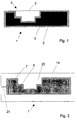
- FIG. 1 shows a chip card 1 according to a first exemplary embodiment, in which a core component 2 from a recyclate and a skin component 3 made of a PC plastic material is.
- the recycled material is shredded and melted plastic material from ABS, for example or PVC and has compared to the skin component an unappealing color.
- the material properties of the Recyclates can be identical to that for skin component 3
- the core component 2 is completely through the skin component 3 enclosed so that the skin component 3 a protective Layer forms. It preferably takes up 20% of the card volume a, so that the card 1 with any mechanical or temperature-related stress safely through the skin component 3 is protected.
- the bending properties of the card 1 are mainly due to the material of the core component 2 determined.
- the volume fraction of the skin component 3 can but also higher, up to approx. 40%.
- the skin component 3 has a recess 4 in which a Chip module 5 is used and is held in this inseparable.
- the recess 4 can on the one hand after the spraying process Milling generated or on the other hand during the spraying process be formed by lowering a displaceable die.
- TPE thermoplastic elastomer
- the chip card 1 will molded in a mold 19, with a molding 20 the recess for later insertion of a chip module.
- An injection point 21 through which the injection material is injected into the mold 19, is about in the middle on a short narrow side of the chip card.
- the card 1 is a core component 8 consisting of an ABS material and a skin component 9 consisting of a Colorant added PC material. This is one any color of card 1 possible.
- FIG. 4 shows a device for injection molding a card, from an injection molding machine 10 with a master cylinder 11 and an auxiliary unit 12 with an auxiliary cylinder 13.
- the cylinders 11, 13 are plasticizing cylinders formed, a skin component in the secondary cylinder 13 14 is plasticized and in a preparatory step the same after moving the auxiliary unit 12 in the nozzle area of the main unit 10 through a main spray nozzle 15
- Injection molding machine 10 is passed into the master cylinder 11.
- the skin component melt displaces in the master cylinder 11 an already melted core component 16.
Landscapes
- Engineering & Computer Science (AREA)
- Computer Hardware Design (AREA)
- Microelectronics & Electronic Packaging (AREA)
- Manufacturing & Machinery (AREA)
- General Physics & Mathematics (AREA)
- Theoretical Computer Science (AREA)
- Physics & Mathematics (AREA)
- Mechanical Engineering (AREA)
- Chemical & Material Sciences (AREA)
- Dispersion Chemistry (AREA)
- Injection Moulding Of Plastics Or The Like (AREA)
- Credit Cards Or The Like (AREA)
- Electrochromic Elements, Electrophoresis, Or Variable Reflection Or Absorption Elements (AREA)
- Cosmetics (AREA)
Abstract
Description
- Fig.1
- einen Längsschnitt durch eine Chipkarte nach einem ersten Ausführungsbeispiel,
- Fig.2
- einen Längsschnitt durch eine Chipkarte nach einem zweiten Ausführungsbeispiel,
- Fig.3
- einen Längsschnitt durch eine Chipkarte nach einem dritten Ausführungsbeispiel und
- Fig.4
- eine Vorrichtung zur Herstellung einer Chipkarte.
Claims (21)
- Chipkarte mit einem Kartenkörper, der mittels Spritzgießen in einem Formraum aus mindestens einem Kunststoffmaterial herstellbar ist, dadurch gekennzeichnet, daß der Kartenkörper durch Einspritzen eines ersten Kunststoffmaterials zur Bildung einer Hautkomponente (3) der Chipkarte (1) einerseits und durch Einspritzen eines zweiten Kunststoffmaterials zur Bildung einer Kernkomponente (2) der Chipkarte (1) andererseits herstellbar ist, wobei die Kernkomponente (2) den durch die Hautkomponente (3) gebildeten Hohlraum vollständig ausfüllt.
- Chipkarte nach Anspruch 1, dadurch gekennzeichnet, daß die Hautkomponente (3) die Kernkomponente (2) vollständig umgibt.
- Chipkarte nach Anspruch 1 oder 2, dadurch gekennzeichnet, daß die Hautkomponente (3) Mittel zur Laserbeschriftung aufweist, derart, daß visuell sichtbare Informationen durch eine mittels Laserstrahl bewirkten lokalen Materialumwandung der Hautkomponente (3) bildbar sind.
- Chipkarte nach einem der Ansprüche 1 bis 3, dadurch gekennzeichnet, das das Mittel zur Laserbeschriftung als Laseradditiv ausgebildet ist, daß dem für die Hautkomponente (3) vorgesehenen Kunststoffmaterial hinzugemischt wird.
- Chipkarte nach Anspruch 1 oder 2, dadurch gekennzeichnet, daß das der Hautkomponente (3) zugeordnete erste Kunststoffmaterial transparent ausgebildet ist und daß das der Kernkomponente (2) zugeordnete zweite Kunststoffmaterial ein Mittel zur Laserbeschriftung aufweist.
- Chipkarte nach einem der Ansprüche 1 bis 5, dadurch gekennzeichnet, daß das Mittel zur Laserbeschriftung im sichtbaren Wellenlängenbereich transparent und in einem Wellenlängenbereich des Laserstrahls absorbierend ausgebildet ist.
- Chipkarte nach einem der Ansprüche 1 bis 6, dadurch gekennzeichnet, daß das Mittel zur Laserbeschriftung durch Einwirkung des Laserstrahls eine Verfärbung aufweist.
- Chipkarte nach einem der Ansprüche 1 bis 7, dadurch gekennzeichnet, daß die Hautkomponente (3) aus einem thermotransferdruckfähigem Material, insbesondere aus PVC, besteht.
- Chipkarte nach einem der Ansprüche 1 bis 8, dadurch gekennzeichnet, daß die Hautkomponente (3) eine Dicke von 0,1 mm bis 0,2 mm aufweist.
- Chipkarte nach einem der Ansprüche 1 bis 9, dadurch gekennzeichnet, daß die Kernkomponente (2) aus einem Recyclat und die Hautkomponente (3) aus einem hochwertigen Werkstoff besteht.
- Chipkarte nach einem der Ansprüche 1 bis 10, dadurch gekennzeichnet, daß die Kernkomponente (6) aus einem thermoplastischem Elastomer (TPE) und die Hautkomponente (7) aus einem hochtemperaturbeständigen Werkstoff ausgebildet ist.
- Chipkarte nach einem der Ansprüche 1 bis 11, dadurch gekennzeichnet, daß die Hautkomponente (9) aus einem PC-Werkstoff oder einem ABS-Werkstoff besteht.
- Chipkarte nach einem der Ansprüche 1 bis 12, dadurch gekennzeichnet, daß die Kernkomponente (8) aus einem ABS-Werkstoff einerseits und die Hautkomponente (9) aus einem PC-Werkstoff oder einem PMA-Werkstoff oder einem PPT-Werkstoff andererseits bestehen.
- Chipkarte nach einem der Ansprüche 1 bis 13, dadurch gekennzeichnet, daß die Hautkomponente (9) und/oder die Kernkomponente (8) aus einem Material unter Zusatz eines Farbmittels bestehen.
- Verfahren zum Herstellen von Chipkarten oder Chipkartenrohlingen durch Einspritzen eines schmelzflüssigen Kunststoffmaterials in einen Formraum und anschließendem Abkühlen des Kunststoffmaterials, dadurch gekennzeichnet, daß ein erstes Kunststoffmaterial in den Formraum (17) eingespritzt wird zur Bildung einer außenliegenden Hautkomponente (14) und daß nachfolgend ein zweites Kunststoffmaterial in den Formraum (17) eingespritzt wird zur Bildung einer Kernkomponente (16).
- Verfahren nach Anspruch 15, dadurch gekennzeichnet, daß das erste Kunstoffmaterial und das zweite Kunststoffmaterial durch dieselbe Düse (15) in den Formraum (17) eingespritzt werden.
- Verfahren nach Anspruch 15 oder 16, dadurch gekennzeichnet, daß das erste Kunstoffmaterial aus einem Nebenaggregat (12) in schmelzflüssiger Form in ein das zweite Kunststoffmaterial in schmelzflüssiger Form aufweisendes Hauptaggregat (10) eingeführt wird und daß nachfolgend in einem einzigen Spritzvorgang das erste und zweite Kunststoffmaterial in den Formraum (17) unter Bildung der die Kernkomponente (16) umschließenden Hautkomponente (14) eingespritzt wird.
- Verfahren nach einem der Ansprüche 15 bis 17, dadurch gekennzeichnet, daß das zweite Kunststoffmaterial vor dem vollständigen Erstarren des ersten Kunststoffmaterials in den Formraum (17) eingespritzt wird, derart, daß das zweite Kunststoffmaterial das erste Kunststoffmaterial kontinuierlich in Richtung des Fließwegendes verschiebt zur Bildung der Hautkomponente (14).
- Vorrichtung zum Durchführen des Verfahrens nach Anspruch 15, mit einer Spritzgießmaschine, dadurch gekennzeichnet, daß ein zusätzliches Nebenaggregat (12) vorgesehen ist, in dem das erste Kunststoffmaterial schmelzbar ist, und daß das Nebenaggregat (12) eine Beschickungsdüse aufweist, die derart einer Haupteinspritzdüse (15) der Spritzgießmaschine zuordbar ist, daß das erste Kunststoffmaterial in einem Vorbereitungsschritt einem Hauptzylinder (11) zuführbar ist, wobei in dem Hauptzylinder (11) bereits das zweite Kunststoffmaterial in Schmelzform vorhanden ist, und daß in einem einzigen Spritzgießschritt das erste und zweite Kunststoffmaterial durch die Haupspritzdüse (15) unter Umkehrung der räumlichen Anordnung in den Formraum (17) spritzbar ist.
- Vorrichtung nach Anspruch 19, dadurch gekennzeichnet, daß das Nebenaggregat (12) quer zu der Spritzgießmaschine angeordnet ist und in Längserstreckung derselben verfahrbar ausgebildet ist.
- Vorrichtung nach Anspruch 19 oder 20, dadurch gekennzeichnet, daß das Nebenaggregat (12) einen Plastifizierungszylinder zur Plastifizierung des ersten Kunststoffmaterials aufweist.
Applications Claiming Priority (2)
| Application Number | Priority Date | Filing Date | Title |
|---|---|---|---|
| DE19736063A DE19736063C2 (de) | 1997-08-20 | 1997-08-20 | Chipkarte |
| DE19736063 | 1997-08-20 |
Publications (2)
| Publication Number | Publication Date |
|---|---|
| EP0897784A1 true EP0897784A1 (de) | 1999-02-24 |
| EP0897784B1 EP0897784B1 (de) | 2002-05-08 |
Family
ID=7839520
Family Applications (1)
| Application Number | Title | Priority Date | Filing Date |
|---|---|---|---|
| EP98112833A Expired - Lifetime EP0897784B1 (de) | 1997-08-20 | 1998-07-10 | Chipkarte |
Country Status (5)
| Country | Link |
|---|---|
| US (1) | US20020023962A1 (de) |
| EP (1) | EP0897784B1 (de) |
| AT (1) | ATE217247T1 (de) |
| DE (2) | DE19736063C2 (de) |
| ES (1) | ES2175563T3 (de) |
Cited By (1)
| Publication number | Priority date | Publication date | Assignee | Title |
|---|---|---|---|---|
| EP1413978A1 (de) * | 2002-10-24 | 2004-04-28 | SCHLUMBERGER Systèmes | Datenträger |
Families Citing this family (8)
| Publication number | Priority date | Publication date | Assignee | Title |
|---|---|---|---|---|
| DE20014560U1 (de) | 2000-08-23 | 2000-10-26 | Smon, Branislav, 71686 Remseck | Flachmaterial, insbesondere zur Herstellung von Kreditkarten, Geldkarten, Telefonkarten o.dgl. |
| DE10207001A1 (de) * | 2002-02-19 | 2003-09-04 | Orga Kartensysteme Gmbh | Chipkarte |
| DE202004003554U1 (de) * | 2004-03-04 | 2004-06-03 | Novacard Informationssysteme Gmbh | Chipkarte |
| US20090184168A1 (en) * | 2008-01-17 | 2009-07-23 | Roger Ricketts | Recyclable plastic cards and methods of making same |
| US20110084148A1 (en) * | 2009-10-14 | 2011-04-14 | Ricketts Roger H | Plastic cards made from post-consumer plastic |
| CN102233649A (zh) * | 2011-05-06 | 2011-11-09 | 泰德兴精密电子(昆山)有限公司 | 三色产品注塑结构 |
| JP2013022880A (ja) * | 2011-07-22 | 2013-02-04 | Sekisui Techno Seikei Kk | 成形品の製造方法 |
| US9380698B1 (en) * | 2014-12-05 | 2016-06-28 | VivaLnk, Inc. | Stretchable electronic patch having a foldable circuit layer |
Citations (6)
| Publication number | Priority date | Publication date | Assignee | Title |
|---|---|---|---|---|
| JPS6058819A (ja) * | 1983-09-12 | 1985-04-05 | Kinugawa Rubber Ind Co Ltd | 二層成形品の製法 |
| JPS60176736A (ja) * | 1984-02-23 | 1985-09-10 | Matsushita Electric Works Ltd | 射出成型機 |
| JPS6369613A (ja) * | 1986-09-10 | 1988-03-29 | Mazda Motor Corp | 多層射出成形用の金型構造 |
| EP0548858A1 (de) * | 1991-12-20 | 1993-06-30 | GAO Gesellschaft für Automation und Organisation mbH | Ausweiskarte sowie Verfahren und Vorrichtung zur Herstellung derselben |
| US5443378A (en) * | 1994-07-11 | 1995-08-22 | Ferromatik Milacron Maschinenbau Gmbh | Apparatus for the sandwich method of injection molding |
| JPH08224754A (ja) * | 1994-12-22 | 1996-09-03 | Matsushita Electric Works Ltd | 保温食器及びその製造方法 |
Family Cites Families (4)
| Publication number | Priority date | Publication date | Assignee | Title |
|---|---|---|---|---|
| DE3711079A1 (de) * | 1987-04-02 | 1988-10-13 | Battenfeld Gmbh | Verfahren und vorrichtung zum spritzgiessen von formteilen aus mindestens zwei verschiedenen kunststoffkomponenten |
| DE3939864A1 (de) * | 1989-12-01 | 1991-06-06 | Gao Ges Automation Org | Mehrschichtige ausweiskarte mit langer lebensdauer |
| DE4142392C2 (de) * | 1991-12-20 | 2003-10-16 | Gao Ges Automation Org | Verfahren und Vorrichtung zum Herstellen von spritzgegossenen Chipkarten mit bereichsweise reduzierter Wandstärke |
| DE19519902C2 (de) * | 1995-05-31 | 1998-03-19 | Richard Herbst | Verfahren zum Herstellen von Gegenständen aus Kunststoff sowie Halbzeug zur Verwendung bei diesem Verfahren |
-
1997
- 1997-08-20 DE DE19736063A patent/DE19736063C2/de not_active Expired - Lifetime
-
1998
- 1998-07-10 DE DE59804029T patent/DE59804029D1/de not_active Expired - Fee Related
- 1998-07-10 EP EP98112833A patent/EP0897784B1/de not_active Expired - Lifetime
- 1998-07-10 AT AT98112833T patent/ATE217247T1/de not_active IP Right Cessation
- 1998-07-10 ES ES98112833T patent/ES2175563T3/es not_active Expired - Lifetime
- 1998-08-19 US US09/136,451 patent/US20020023962A1/en not_active Abandoned
Patent Citations (6)
| Publication number | Priority date | Publication date | Assignee | Title |
|---|---|---|---|---|
| JPS6058819A (ja) * | 1983-09-12 | 1985-04-05 | Kinugawa Rubber Ind Co Ltd | 二層成形品の製法 |
| JPS60176736A (ja) * | 1984-02-23 | 1985-09-10 | Matsushita Electric Works Ltd | 射出成型機 |
| JPS6369613A (ja) * | 1986-09-10 | 1988-03-29 | Mazda Motor Corp | 多層射出成形用の金型構造 |
| EP0548858A1 (de) * | 1991-12-20 | 1993-06-30 | GAO Gesellschaft für Automation und Organisation mbH | Ausweiskarte sowie Verfahren und Vorrichtung zur Herstellung derselben |
| US5443378A (en) * | 1994-07-11 | 1995-08-22 | Ferromatik Milacron Maschinenbau Gmbh | Apparatus for the sandwich method of injection molding |
| JPH08224754A (ja) * | 1994-12-22 | 1996-09-03 | Matsushita Electric Works Ltd | 保温食器及びその製造方法 |
Non-Patent Citations (4)
| Title |
|---|
| PATENT ABSTRACTS OF JAPAN vol. 10, no. 18 (M - 448) 24 January 1986 (1986-01-24) * |
| PATENT ABSTRACTS OF JAPAN vol. 12, no. 292 (M - 729) 10 August 1988 (1988-08-10) * |
| PATENT ABSTRACTS OF JAPAN vol. 9, no. 194 (M - 403) 10 August 1985 (1985-08-10) * |
| PATENT ABSTRACTS OF JAPAN vol. 97, no. 1 31 January 1997 (1997-01-31) * |
Cited By (2)
| Publication number | Priority date | Publication date | Assignee | Title |
|---|---|---|---|---|
| EP1413978A1 (de) * | 2002-10-24 | 2004-04-28 | SCHLUMBERGER Systèmes | Datenträger |
| WO2004038653A1 (en) * | 2002-10-24 | 2004-05-06 | Axalto Sa | Data support having several electronic modules mounted on the same surface |
Also Published As
| Publication number | Publication date |
|---|---|
| DE59804029D1 (de) | 2002-06-13 |
| US20020023962A1 (en) | 2002-02-28 |
| ES2175563T3 (es) | 2002-11-16 |
| DE19736063A1 (de) | 1999-02-25 |
| ATE217247T1 (de) | 2002-05-15 |
| EP0897784B1 (de) | 2002-05-08 |
| DE19736063C2 (de) | 2000-01-05 |
Similar Documents
| Publication | Publication Date | Title |
|---|---|---|
| EP0504571B1 (de) | Werkzeug zum Mehrkomponenten-Spritzgiessen von Bürstenkörpern | |
| DE69933729T2 (de) | Verfahren und Vorrichtung zum Herstellen von gefärbten oder lackierten geformten Kunststoffgegenständen | |
| DE2228168C3 (de) | Verfahren und Vorrichtung zum Herstellen eines plattenförmigen Gegenstandes aus Kunststoff mit einem gegenüber einem Grundkörper andersfarbigen, in sich mehrfarbigen Reliefmuster | |
| EP0791448A2 (de) | Verfahren und Vorrichtung zum Spritzgiessen von Kunststoffteilen | |
| DE3879841T2 (de) | Verfahren zum Herstellen von Formteilen mit unebenem Muster. | |
| DE4237588A1 (de) | ||
| DE19739522C2 (de) | Spritzprägeverfahren | |
| DE2155888B2 (de) | Verfahren zum Herstellen von Bürsten bzw. Bürstenkörpern | |
| DE69031564T2 (de) | Nacheinander eingespritzte mehrkomponente einspritzgiessverfahren | |
| EP0668140B1 (de) | Verfahren zur Herstellung von Zahnbürsten | |
| EP0897784B1 (de) | Chipkarte | |
| DE505439T1 (de) | Spritzgiessen von kreuzgelegten laminaten. | |
| EP1112832B1 (de) | Offene Spritzgiessdüse | |
| DE19613779C2 (de) | Verfahren zum Spritzgießen von dreischichtigen Spritzlingen und Vorrichtung für die Durchführung des Verfahrens | |
| DE2157132A1 (de) | Verfahren und vorrichtung zum herstellen von hohlkoerpern im spritzgussverfahren | |
| DE3607410A1 (de) | Verfahren und vorrichtung zum spritzen von kunststoffteilen | |
| DE4224171A1 (de) | Spritzgußteil sowie Verfahren und Spritzgießwerkzeug zum Herstellen von Spritzgußteilen | |
| DE1177326B (de) | Verfahren zur Herstellung von aus thermoplastischen Kunststoffen bestehenden kuenstlichen Blumenblaettern und Vorrichtung zur Durchfuehrung dieses Verfahrens | |
| DE102006036139A1 (de) | Spritzgießanordnung und Verfahren zum Anspritzen eines Formteils und Verwendung einer Spritzgießanordnung | |
| DE68914675T2 (de) | Stabilisiertes spritzgiessen während der anwendung eines gemeinsamen formteils mit separaten komplementären formteilen. | |
| EP0419953A2 (de) | Vorrichtung zum zweischichtigen Spritzgiessen | |
| EP0079400A1 (de) | Verfahren zur Herstellung von Borsten aus Kunststoff aufweisenden Bürsten, insbesondere Haarbürsten, oder Borstenträgern für solche Bürsten und danach hergestellte Bürsten | |
| DE10355300A1 (de) | Verfahren zum Spritzgießen von Kunststoffmaterialien unter Verwendung von Gashaltedruck in der Form | |
| DE69300067T2 (de) | Verfahren zum Herstellen von Autospoilern. | |
| CH703482B1 (de) | Graviertes Mehr-Komponenten-Armband und Herstellungsverfahren dafür. |
Legal Events
| Date | Code | Title | Description |
|---|---|---|---|
| PUAI | Public reference made under article 153(3) epc to a published international application that has entered the european phase |
Free format text: ORIGINAL CODE: 0009012 |
|
| AK | Designated contracting states |
Kind code of ref document: A1 Designated state(s): AT BE CH DE DK ES FR GB GR IT LI NL PT SE |
|
| AX | Request for extension of the european patent |
Free format text: AL;LT;LV;MK;RO;SI |
|
| 17P | Request for examination filed |
Effective date: 19990312 |
|
| AKX | Designation fees paid |
Free format text: AT BE CH DE DK ES FR GB GR IT LI NL PT SE |
|
| 17Q | First examination report despatched |
Effective date: 19990923 |
|
| RTI1 | Title (correction) |
Free format text: CHIP CARD |
|
| GRAG | Despatch of communication of intention to grant |
Free format text: ORIGINAL CODE: EPIDOS AGRA |
|
| GRAG | Despatch of communication of intention to grant |
Free format text: ORIGINAL CODE: EPIDOS AGRA |
|
| GRAH | Despatch of communication of intention to grant a patent |
Free format text: ORIGINAL CODE: EPIDOS IGRA |
|
| RAP1 | Party data changed (applicant data changed or rights of an application transferred) |
Owner name: ORGA KARTENSYSTEME GMBH |
|
| GRAH | Despatch of communication of intention to grant a patent |
Free format text: ORIGINAL CODE: EPIDOS IGRA |
|
| REG | Reference to a national code |
Ref country code: GB Ref legal event code: IF02 |
|
| GRAA | (expected) grant |
Free format text: ORIGINAL CODE: 0009210 |
|
| AK | Designated contracting states |
Kind code of ref document: B1 Designated state(s): AT BE CH DE DK ES FR GB GR IT LI NL PT SE |
|
| PG25 | Lapsed in a contracting state [announced via postgrant information from national office to epo] |
Ref country code: NL Free format text: LAPSE BECAUSE OF FAILURE TO SUBMIT A TRANSLATION OF THE DESCRIPTION OR TO PAY THE FEE WITHIN THE PRESCRIBED TIME-LIMIT Effective date: 20020508 Ref country code: GR Free format text: LAPSE BECAUSE OF FAILURE TO SUBMIT A TRANSLATION OF THE DESCRIPTION OR TO PAY THE FEE WITHIN THE PRESCRIBED TIME-LIMIT Effective date: 20020508 |
|
| REF | Corresponds to: |
Ref document number: 217247 Country of ref document: AT Date of ref document: 20020515 Kind code of ref document: T |
|
| REG | Reference to a national code |
Ref country code: CH Ref legal event code: EP |
|
| REF | Corresponds to: |
Ref document number: 59804029 Country of ref document: DE Date of ref document: 20020613 |
|
| PG25 | Lapsed in a contracting state [announced via postgrant information from national office to epo] |
Ref country code: BE Free format text: LAPSE BECAUSE OF NON-PAYMENT OF DUE FEES Effective date: 20020731 |
|
| PG25 | Lapsed in a contracting state [announced via postgrant information from national office to epo] |
Ref country code: SE Free format text: LAPSE BECAUSE OF FAILURE TO SUBMIT A TRANSLATION OF THE DESCRIPTION OR TO PAY THE FEE WITHIN THE PRESCRIBED TIME-LIMIT Effective date: 20020808 Ref country code: PT Free format text: LAPSE BECAUSE OF FAILURE TO SUBMIT A TRANSLATION OF THE DESCRIPTION OR TO PAY THE FEE WITHIN THE PRESCRIBED TIME-LIMIT Effective date: 20020808 Ref country code: DK Free format text: LAPSE BECAUSE OF FAILURE TO SUBMIT A TRANSLATION OF THE DESCRIPTION OR TO PAY THE FEE WITHIN THE PRESCRIBED TIME-LIMIT Effective date: 20020808 |
|
| GBT | Gb: translation of ep patent filed (gb section 77(6)(a)/1977) |
Effective date: 20020726 |
|
| ET | Fr: translation filed | ||
| NLV1 | Nl: lapsed or annulled due to failure to fulfill the requirements of art. 29p and 29m of the patents act | ||
| REG | Reference to a national code |
Ref country code: ES Ref legal event code: FG2A Ref document number: 2175563 Country of ref document: ES Kind code of ref document: T3 |
|
| BERE | Be: lapsed |
Owner name: *ORGA KARTENSYSTEME G.M.B.H. Effective date: 20020731 |
|
| PLBE | No opposition filed within time limit |
Free format text: ORIGINAL CODE: 0009261 |
|
| STAA | Information on the status of an ep patent application or granted ep patent |
Free format text: STATUS: NO OPPOSITION FILED WITHIN TIME LIMIT |
|
| 26N | No opposition filed |
Effective date: 20030211 |
|
| PGFP | Annual fee paid to national office [announced via postgrant information from national office to epo] |
Ref country code: GB Payment date: 20060628 Year of fee payment: 9 |
|
| PGFP | Annual fee paid to national office [announced via postgrant information from national office to epo] |
Ref country code: ES Payment date: 20060705 Year of fee payment: 9 |
|
| PGFP | Annual fee paid to national office [announced via postgrant information from national office to epo] |
Ref country code: FR Payment date: 20060720 Year of fee payment: 9 Ref country code: AT Payment date: 20060720 Year of fee payment: 9 |
|
| PGFP | Annual fee paid to national office [announced via postgrant information from national office to epo] |
Ref country code: CH Payment date: 20060724 Year of fee payment: 9 |
|
| PGFP | Annual fee paid to national office [announced via postgrant information from national office to epo] |
Ref country code: DE Payment date: 20060726 Year of fee payment: 9 |
|
| PGFP | Annual fee paid to national office [announced via postgrant information from national office to epo] |
Ref country code: IT Payment date: 20070830 Year of fee payment: 10 |
|
| REG | Reference to a national code |
Ref country code: CH Ref legal event code: PL |
|
| GBPC | Gb: european patent ceased through non-payment of renewal fee |
Effective date: 20070710 |
|
| PG25 | Lapsed in a contracting state [announced via postgrant information from national office to epo] |
Ref country code: LI Free format text: LAPSE BECAUSE OF NON-PAYMENT OF DUE FEES Effective date: 20070731 Ref country code: DE Free format text: LAPSE BECAUSE OF NON-PAYMENT OF DUE FEES Effective date: 20080201 Ref country code: CH Free format text: LAPSE BECAUSE OF NON-PAYMENT OF DUE FEES Effective date: 20070731 |
|
| PG25 | Lapsed in a contracting state [announced via postgrant information from national office to epo] |
Ref country code: GB Free format text: LAPSE BECAUSE OF NON-PAYMENT OF DUE FEES Effective date: 20070710 |
|
| REG | Reference to a national code |
Ref country code: FR Ref legal event code: ST Effective date: 20080331 |
|
| PG25 | Lapsed in a contracting state [announced via postgrant information from national office to epo] |
Ref country code: AT Free format text: LAPSE BECAUSE OF NON-PAYMENT OF DUE FEES Effective date: 20070710 |
|
| PG25 | Lapsed in a contracting state [announced via postgrant information from national office to epo] |
Ref country code: FR Free format text: LAPSE BECAUSE OF NON-PAYMENT OF DUE FEES Effective date: 20070731 |
|
| REG | Reference to a national code |
Ref country code: ES Ref legal event code: FD2A Effective date: 20070711 |
|
| PG25 | Lapsed in a contracting state [announced via postgrant information from national office to epo] |
Ref country code: ES Free format text: LAPSE BECAUSE OF NON-PAYMENT OF DUE FEES Effective date: 20070711 |
|
| PG25 | Lapsed in a contracting state [announced via postgrant information from national office to epo] |
Ref country code: IT Free format text: LAPSE BECAUSE OF NON-PAYMENT OF DUE FEES Effective date: 20080710 |