EP0897929A1 - Derives de chitine ayant des groupes alkyle inferieur carboxyles en tant que substituants hydrophiles et substituants hydrophobes, supports micellaires a poids moleculaire eleve comportant ces derives et composition aqueuse micellaire correspondante - Google Patents
Derives de chitine ayant des groupes alkyle inferieur carboxyles en tant que substituants hydrophiles et substituants hydrophobes, supports micellaires a poids moleculaire eleve comportant ces derives et composition aqueuse micellaire correspondante Download PDFInfo
- Publication number
- EP0897929A1 EP0897929A1 EP97918388A EP97918388A EP0897929A1 EP 0897929 A1 EP0897929 A1 EP 0897929A1 EP 97918388 A EP97918388 A EP 97918388A EP 97918388 A EP97918388 A EP 97918388A EP 0897929 A1 EP0897929 A1 EP 0897929A1
- Authority
- EP
- European Patent Office
- Prior art keywords
- chitin
- degree
- derivatives
- substituents
- substitution
- Prior art date
- Legal status (The legal status is an assumption and is not a legal conclusion. Google has not performed a legal analysis and makes no representation as to the accuracy of the status listed.)
- Granted
Links
Images

Classifications
-
- C—CHEMISTRY; METALLURGY
- C08—ORGANIC MACROMOLECULAR COMPOUNDS; THEIR PREPARATION OR CHEMICAL WORKING-UP; COMPOSITIONS BASED THEREON
- C08L—COMPOSITIONS OF MACROMOLECULAR COMPOUNDS
- C08L5/00—Compositions of polysaccharides or of their derivatives not provided for in groups C08L1/00 or C08L3/00
- C08L5/08—Chitin; Chondroitin sulfate; Hyaluronic acid; Derivatives thereof
-
- C—CHEMISTRY; METALLURGY
- C08—ORGANIC MACROMOLECULAR COMPOUNDS; THEIR PREPARATION OR CHEMICAL WORKING-UP; COMPOSITIONS BASED THEREON
- C08B—POLYSACCHARIDES; DERIVATIVES THEREOF
- C08B37/00—Preparation of polysaccharides not provided for in groups C08B1/00 - C08B35/00; Derivatives thereof
- C08B37/0006—Homoglycans, i.e. polysaccharides having a main chain consisting of one single sugar, e.g. colominic acid
- C08B37/0024—Homoglycans, i.e. polysaccharides having a main chain consisting of one single sugar, e.g. colominic acid beta-D-Glucans; (beta-1,3)-D-Glucans, e.g. paramylon, coriolan, sclerotan, pachyman, callose, scleroglucan, schizophyllan, laminaran, lentinan or curdlan; (beta-1,6)-D-Glucans, e.g. pustulan; (beta-1,4)-D-Glucans; (beta-1,3)(beta-1,4)-D-Glucans, e.g. lichenan; Derivatives thereof
- C08B37/0027—2-Acetamido-2-deoxy-beta-glucans; Derivatives thereof
- C08B37/003—Chitin, i.e. 2-acetamido-2-deoxy-(beta-1,4)-D-glucan or N-acetyl-beta-1,4-D-glucosamine; Chitosan, i.e. deacetylated product of chitin or (beta-1,4)-D-glucosamine; Derivatives thereof
Definitions
- This invention relates to chitin derivatives having carboxyalkyl groups as hydrophilic substituents and alkyl groups as hydrophobic substituents, micelle-forming substances and polymer micellar carriers comprised of the said chitin derivatives, and micelle-like aqueous compositions using the said micelle-forming substances and polymer micellar carriers.
- this invention relates to the chitin derivatives having carboxyalkyl groups as hydrophilic substituents and alkyl groups as hydrophobic substituents, which are useful as soil-improving agents, protein aggregating agents, micelle-forming agents, etc.
- this invention relates to micelle-forming substances and polymer micellar carriers, which are comprised of the chitin derivatives having carboxyalkyl groups as hydrophilic substituents and alkyl groups as hydrophobic substituents, and micelle-like aqueous compositions comprising the said chitin derivatives.
- Chitin is a polymer of N-acetylglucosamine (poly ⁇ -1,4-N-acetyl glucosamine).
- chitin is a polysaccharide comprising crustacean shells, squid pens and so on. For instance, in the processing of the crab, a lot of shells are produced as a byproduct and chitin contents of the shell is about 15% of the shell weight. Therefore, profitable utilization of chitin has been desired.
- Chitin is a biodegradable polymer and is very compatible to the living body, so chitin is a noteworthy material as the sutures and a wound-covering agent in the field of surgery, and also is remarkable as a disintegrable or degradable material by microorganisms.
- Chitin and chitosan are dietary fibers when ingested in the intestine and they are safe for a human. The average molecular weight of those generally used in food is 400,000 to 2,000,000 or more.
- the molecular weight of chitin is adjusted according to the purpose of use. In general, strong acidic reagents are most in use to prepare lower molecular weight chitin.
- chitinases derived from microorganisms and plants
- lysozymes derived from microorganisms and plants
- Chitin and its derivatives have been used as soil-improving agents, protein aggregating agents and wood-improving agents. And it has been reported that the polymer structure having both hydrophilic and hydrophobic moieties showed desirable property in micelle-formation and that polymer can solubilize the hydrophobic compound. However, there has been no report on the nature of the carboxyalkyl chitin derivatives and the method of production thereof.
- carboxymethylated chitin is more potent in activation of macrophages than the sulfated chitin.
- DAC-70 70%-deacetylated chitin
- carboxymethyl group had a comparable potency to that of DAC-70, while the chitin derivative having sulfate group was inactive.
- the purpose of this invention is to provide chitin derivatives having carboxyalkyl groups as hydrophilic substituents and alkyl groups as hydrophobic substituents, which are useful for production of soil-improving agents, protein aggregating agents, micelle-forming agents, etc.
- the purpose of this invention is to provide micelle-forming substances comprised of the said chitin derivatives.
- the purpose of this invention is to provide polymer micellar carriers comprised of the said chitin derivatives.
- the purpose of this invention is to provide aqueous micelle-like compositions using the chitin derivatives having carboxyalkyl groups as hydrophilic substituents and alkyl groups as hydrophobic substituents as the polymer micellar carriers.
- the gist of this invention is chitin derivatives having carboxyalkyl groups represented by the formula (1) below.
- the degree of deacetylation of the N-acetyl group in chitin is 70 to 100% (100% deacetylation means one deacetylated N-acetyl group per one monosaccharide unit); the degree of substitution of R 1 with one of the above-mentioned alkyl groups or alkylcarbonyl groups is 10 to
- An additional gist of this invention is a characteristic of the micelle-forming substances comprised of above-mentioned chitin derivatives, or polymer micellar carriers comprised of above-mentioned chitin derivatives.
- a further additional gist is micelle-like aqueous compositions with the above-mentioned chitin derivatives as polymer micellar carriers.
- the above-mentioned micelle-like aqueous compositions are the polymer micellar compositions include hydrophobic compounds. The hydrophobic compounds are exemplified by insoluble perfumes, insoluble pigments, or fats and oils.
- chitin which can have any crystalline structures, such as ⁇ -, ⁇ -, or ⁇ -form
- a chitin derivative having hydrophilic groups and alkyl group as hydrophobic groups represented by the formula (1). Recrystallized or recomposed chitin, or chitosan (deacetylated chitin) is also available.
- Molecular weight and degree of deacetylation are not limited.
- Particle size is not limited, but smaller particle chitin is more easy to disperse in the solvent, the particle size can be chosen according to the purpose.
- the chitosan solution used in the present invention is prepared by using chitosan obtained by complete or partial deacetylation of chitin or chitosan contained abundantly in shells of crabs or shrimps and in squid pens.
- micelle-like aqueous compositions are liquid-like compositions which solubilize hydrophobic substances and are seen as clear or milky solution by uniformly dispersed hydrophobic substances in the aqueous solvents.
- Aqueous solvents used herein include distilled water and the like. Edible salt, saccharides, acids, ethyl alcohol, etc. can be added to the solvent as needed.
- Solubilization methods of hydrophobic substances are not limited, but to swell chitin derivatives, the solution temperature is desirable to keep at 20 to 100°C.
- To prepare polymer micelles include hydrophobic substances, ultrasonic treatment for 10 to 120 minutes is desirable. For example, 100 mg of a chitin derivative, 45 g of water, and 5 g of 5% ⁇ -carotene oil are mixed by stirring and are sonicated for 1 hour. The resulted emulsion is centrifuged to remove the oil layer and the precipitate and the aqueous layer is obtained. Thus a micelle-like aqueous composition is obtained in which ⁇ -carotene oil is dispersed uniformly. ⁇ -Carotene in the aqueous layer is quantified by determination of the b value (direction of yellowish color) with a color-difference meter.
- the micelle-like compositions can be used both an aqueous composition and a dried composition, and the dried composition is more desirable because the hydrophobic substance remains more stable in this state.
- Dried compositions can be obtained by drying an aqueous composition.
- the methods of drying the compositions are not limited, and exemplified by lyophilizing, spray drying, and drying under reduced pressure.
- Carboxymethyl chitin was purified by washing with methanol, dialysis, and filtration. Then purified carboxymethyl chitin was added to the solution mixture of 40 ml of 45% sodium hydroxide and 40 ml of 2-propanol, followed by reflux at 110°C for 1 hour. After removal of 2-propanol and then dialysis, the resulted purified carboxymethyl chitosan was dissolved in 40 ml of water and 40 ml of methanol was added to carboxymethyl chitosan solution. The mixture was stirred with 4 g of laurylaldehyde for 30 minutes, and then 1.3 g of sodium borohydride was added to the mixture with continuous stirring.
- the physical properties of the laurylated carboxymethyl chitin are listed in Table 1. Molecular weight degree of laurylation (%) degree of carboxymethylation (%) degree of deacetylation (%) 50000 90 140 100
- the physical properties were determined by the following methods.
- Carboxymethyl chitin (4 g) obtained in Example 1 was stirred in concentrated hydrochloric acid (100 ml) at room temperature for 1 hour. On neutralization, carboxymethyl chitin with reduced molecular weight was obtained as precipitates. The precipitates as the starting material were treated in the same manner as described in Example 1, to give laurylated carboxymethyl chitin (0.8 g).
- Example 1 In place of pulverized squid pen chitin in Example 1, purified crab chitin (Kyowa Technos Co, LTD.: reduced molecular weight chitin passable through 100 mesh-sieve, molecular weight of 50000) was used as the starting material for preparation of laurylated carboxymethyl chitin by the procedure described in Example 1 (degree of carboxymethylation, 111%; degree of deacetylation, 92%; degree of laurylation, 64%).
- chitosan (Kyowa Tecnos Co, LTD.: Flonac C-100M, degree of deacetylation: 75.5%) was dissolved in 150 ml of water and a small amount of acetic acid. The solution was stirred with 150 ml of methanol at room temperature for 1 hour, and then stirred with 30 g of laurylaldehyde at room temperature for further 1 hour. Sodium borohydride aqueous solution (10 g/10 ml) was added dropwise, and stirred overnight at room temperature. Methanol was added to the reaction mixture to precipitate the product, then precipitation was washed with methanol, aqueous methanol, hexane, and acetone in this order. The washed product was dried in vacuo, to give 16.8 g of laurylated chitosan (degree of laurylation, 58.2%).
- Example 2 In the same manner as in Example 1 except that octylaldehyde was used in place of laurylaldehyde in Example 1, octylated carboxymethyl chitin was prepared (degree of octylation, 36.2%).
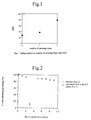
- a mixture of 100 mg of a chitin derivative, 45 g of distilled water, and 5 g of 0.5% ⁇ -carotene oil was sonicated (manufactured by nissei, NS-605, 28 kHz) for 1 hour.
- the resultant emulsion was kept still and centrifuged (3,000 rpm, 20 min), to give the aqueous layer after removal of the oil layer and the precipitation.
- the product without the chitin derivatives was used as the control.
- ⁇ -Carotene in the aqueous layer was quantified by measurement of the b value (direction of yellowish color).
- the b value was measured with the color difference meter (MINOLTA, CR-200, cell ⁇ :29 mm, sample amount :4 g).
- the particle size distribution was determined with Shimazu centrifugal particle size analyzer SA-CP3 in the centrifugal floating mode at 1.4 of particle density, 0.997 of solute density, 0.916 of solute viscosity, and at room temperature.
- the particle size of alkylated carboxymethyl chitin was smaller than that of the control.
- a part of the aqueous layer was freeze-dried and reconstituted in the same volume of water for evaluation of the resistance.
- the alkylated carboxymethyl chitin derivatives having alkyl groups of 6 or 12 carbon atoms were examined for the resistance of micelles to freeze-drying: the derivative having an alkyl group of 6 carbon atoms was well dispersed on reconstitution, showing the b value after reconstituted comparable to that of the solution before freeze-drying (b value remaining percentage: 93.3%). However the derivative having an alkyl group of 12 carbon atoms was poorly dispersed on reconstitution so that a part of oil was separated and the b value remaining percentage was as low as 32.5%.
- Alkylated carboxymethyl chitin derivatives having alkyl groups of 6 or 12 carbon atoms were autoclaved in retort pouches at 121°C for 10 minutes for evaluation of the resistance.
- the b value remaining percentage of the aqueous layer was 79.6% and 97.3% for the derivative having an alkyl group of 6 carbon atoms and for the derivative having an alkyl group of 12 carbon atoms, respectively; thus the derivatives were shown to be resistant to retort.
- This invention is able to provide chitin derivatives having carboxyalkyl groups as the hydrophilic substituents and alkyl groups as hydrophobic substituents useful for production of soil-improving agents, protein aggregating agents, micelle-forming agents, etc.
- This invention is able to provide polymer micellar carriers comprised of the chitin derivatives and micelle-like aqueous compositions of insoluble perfumes, insoluble pigments, or fats and oils by using the chitin derivatives.
Landscapes
- Chemical & Material Sciences (AREA)
- Health & Medical Sciences (AREA)
- Life Sciences & Earth Sciences (AREA)
- Medicinal Chemistry (AREA)
- Polymers & Plastics (AREA)
- Organic Chemistry (AREA)
- Chemical Kinetics & Catalysis (AREA)
- General Health & Medical Sciences (AREA)
- Molecular Biology (AREA)
- Engineering & Computer Science (AREA)
- Biochemistry (AREA)
- Materials Engineering (AREA)
- Polysaccharides And Polysaccharide Derivatives (AREA)
- Cosmetics (AREA)
- Separation Of Suspended Particles By Flocculating Agents (AREA)
Applications Claiming Priority (4)
| Application Number | Priority Date | Filing Date | Title |
|---|---|---|---|
| JP139634/96 | 1996-05-09 | ||
| JP13963496 | 1996-05-09 | ||
| JP13963496 | 1996-05-09 | ||
| PCT/JP1997/001549 WO1997042226A1 (fr) | 1996-05-09 | 1997-05-08 | Derives de chitine ayant des groupes alkyle inferieur carboxyles en tant que substituants hydrophiles et substituants hydrophobes, supports micellaires a poids moleculaire eleve comportant ces derives et composition aqueuse micellaire correspondante |
Publications (3)
| Publication Number | Publication Date |
|---|---|
| EP0897929A1 true EP0897929A1 (fr) | 1999-02-24 |
| EP0897929A4 EP0897929A4 (fr) | 2000-03-22 |
| EP0897929B1 EP0897929B1 (fr) | 2004-03-24 |
Family
ID=15249857
Family Applications (1)
| Application Number | Title | Priority Date | Filing Date |
|---|---|---|---|
| EP97918388A Expired - Lifetime EP0897929B1 (fr) | 1996-05-09 | 1997-05-08 | Derives de chitine ayant des groupes alkyle inferieur carboxyles en tant que substituants hydrophiles et substituants hydrophobes, supports micellaires a poids moleculaire eleve comportant ces derives et composition aqueuse micellaire correspondante |
Country Status (6)
| Country | Link |
|---|---|
| US (1) | US6251959B1 (fr) |
| EP (1) | EP0897929B1 (fr) |
| JP (1) | JP4119482B2 (fr) |
| CA (1) | CA2257067C (fr) |
| DE (1) | DE69728260T2 (fr) |
| WO (1) | WO1997042226A1 (fr) |
Cited By (2)
| Publication number | Priority date | Publication date | Assignee | Title |
|---|---|---|---|---|
| US7967871B2 (en) | 2005-04-29 | 2011-06-28 | The Sun Products Corporation | Polymers for laundry applications |
| WO2019064231A1 (fr) * | 2017-09-27 | 2019-04-04 | Association For The Advancement Of Tissue Engineering And Cell Based Technologies & Therapies (A4Tec) - Associação | Chitosane de poids moléculaire élevé, son procédé d'obtention et ses utilisations |
Families Citing this family (5)
| Publication number | Priority date | Publication date | Assignee | Title |
|---|---|---|---|---|
| GB0221941D0 (en) * | 2002-09-20 | 2002-10-30 | Univ Strathclyde | Polysoaps |
| EP1694712A1 (fr) | 2003-12-04 | 2006-08-30 | University of Utah Research Foundation | Macromolecules modifiees et procedes de production et d'utilisation associes |
| CN1318453C (zh) * | 2005-07-21 | 2007-05-30 | 浙江大学 | 荧光标记疏水改性壳寡糖聚合物及制备方法和应用 |
| US8877170B2 (en) * | 2009-02-21 | 2014-11-04 | Sofradim Production | Medical device with inflammatory response-reducing coating |
| FR3016882A1 (fr) | 2014-01-30 | 2015-07-31 | Sofradim Production | Procede de preparation de chitosane a haut degre d’acetylation |
Family Cites Families (8)
| Publication number | Priority date | Publication date | Assignee | Title |
|---|---|---|---|---|
| US3953608A (en) * | 1971-05-10 | 1976-04-27 | L'oreal | Cosmetic compositions for the skin containing a chitosan derivative |
| JPS5590505A (en) | 1978-12-29 | 1980-07-09 | Kureha Chem Ind Co Ltd | Carboxyalkylchitin and preparation of deacetylated product thereof |
| US4308377A (en) | 1978-12-29 | 1981-12-29 | Kureha Kagaku Kogyo Kabushiki Kaisha | Shaped material comprising denatured chitin and process for preparing same |
| JPS5590503A (en) * | 1978-12-29 | 1980-07-09 | Kureha Chem Ind Co Ltd | Chitin molding material |
| JP2517760B2 (ja) | 1989-05-11 | 1996-07-24 | 新技術事業団 | 水溶性高分子化医薬製剤 |
| KR940003548U (ko) | 1992-08-14 | 1994-02-21 | 김형술 | 세탁물 건조기 |
| FR2721933B1 (fr) | 1994-06-30 | 1996-09-27 | Gattefosse Ets Sa | Derives du chitosane, procede pour sa preparation et composition cosmetique contenant de tels derives |
| DE4442987C2 (de) * | 1994-12-02 | 1997-04-17 | Henkel Kgaa | Kationische Chitinabbauprodukte |
-
1997
- 1997-05-08 JP JP53974697A patent/JP4119482B2/ja not_active Expired - Fee Related
- 1997-05-08 EP EP97918388A patent/EP0897929B1/fr not_active Expired - Lifetime
- 1997-05-08 CA CA002257067A patent/CA2257067C/fr not_active Expired - Fee Related
- 1997-05-08 US US09/180,373 patent/US6251959B1/en not_active Expired - Fee Related
- 1997-05-08 DE DE69728260T patent/DE69728260T2/de not_active Expired - Lifetime
- 1997-05-08 WO PCT/JP1997/001549 patent/WO1997042226A1/fr not_active Ceased
Cited By (2)
| Publication number | Priority date | Publication date | Assignee | Title |
|---|---|---|---|---|
| US7967871B2 (en) | 2005-04-29 | 2011-06-28 | The Sun Products Corporation | Polymers for laundry applications |
| WO2019064231A1 (fr) * | 2017-09-27 | 2019-04-04 | Association For The Advancement Of Tissue Engineering And Cell Based Technologies & Therapies (A4Tec) - Associação | Chitosane de poids moléculaire élevé, son procédé d'obtention et ses utilisations |
Also Published As
| Publication number | Publication date |
|---|---|
| CA2257067C (fr) | 2005-08-16 |
| CA2257067A1 (fr) | 1997-11-13 |
| EP0897929A4 (fr) | 2000-03-22 |
| EP0897929B1 (fr) | 2004-03-24 |
| WO1997042226A1 (fr) | 1997-11-13 |
| DE69728260D1 (de) | 2004-04-29 |
| US6251959B1 (en) | 2001-06-26 |
| DE69728260T2 (de) | 2005-02-24 |
| JP4119482B2 (ja) | 2008-07-16 |
Similar Documents
| Publication | Publication Date | Title |
|---|---|---|
| US9187575B2 (en) | Isolation of glucan particles and uses thereof | |
| EP1483299B1 (fr) | Derives de membranes cellulaires provenant de la biomasse et leur preparation | |
| Barikani et al. | Preparation and application of chitin and its derivatives: a review | |
| CN1330671C (zh) | 含脱乙酰壳多糖的多糖、其制备方法和用途 | |
| WO2001064756A1 (fr) | Sulfate de chondroitine tire du saumon | |
| US20220356272A1 (en) | Processes for extracting and purifying chitin by using green solvents | |
| US8445465B2 (en) | Glycol chitosan derivative, preparation method thereof and drug delivery system comprising the same | |
| JPH0776241B2 (ja) | アミノ多糖類及びそれらの誘導体の酸による非晶出化方法 | |
| EP0897929B1 (fr) | Derives de chitine ayant des groupes alkyle inferieur carboxyles en tant que substituants hydrophiles et substituants hydrophobes, supports micellaires a poids moleculaire eleve comportant ces derives et composition aqueuse micellaire correspondante | |
| Biswas et al. | Biomedical applications carboxymethyl chitosans | |
| Park et al. | Other microbial polysaccharides: Pullulan, scleroglucan, elsinan, levan, alternant, dextran | |
| JP2000143704A (ja) | キトオリゴ糖誘導体 | |
| Gruber | Polysaccharide-based polymers | |
| Ibram | Studies on chitosan, chitin and chitooligosaccharides and their biomedical properties | |
| JPWO1997042226A1 (ja) | 親水性置換基としてカルボキシル低級アルキル基および疎水性置換基を有するキチン誘導体、当該キチン誘導体からなる高分子ミセル型担体およびそのミセル様水性組成物 | |
| Van Luyen et al. | Chitin and derivatives | |
| JP2002306090A (ja) | カードラン・キトサン含有組成物およびその製造方法 | |
| WO1997041894A1 (fr) | Composition aqueuse micellaire et procede de solubilisation d'un medicament hydrophobe | |
| WO2008032134A1 (fr) | Procédé d'obtention de glucane de levure par autolyse de cellules de levure saccharomyces cerevisiae de boulangerie | |
| KR19990064910A (ko) | 키틴/키토산 올리고머 및 그 계면활성제의 항균 특성과 이용 | |
| JP2529729B2 (ja) | キトサン誘導体の製造法 | |
| CN101157710B (zh) | 补铁剂羧甲基壳寡糖亚铁的制备方法 | |
| JP5646164B2 (ja) | 分岐キトサン誘導体 | |
| CN108467440A (zh) | 羟乙基壳聚糖抗坏血酸盐及其制备方法 | |
| RU2332081C1 (ru) | Способ получения хитозана из панцирей ракообразных |
Legal Events
| Date | Code | Title | Description |
|---|---|---|---|
| PUAI | Public reference made under article 153(3) epc to a published international application that has entered the european phase |
Free format text: ORIGINAL CODE: 0009012 |
|
| 17P | Request for examination filed |
Effective date: 19981106 |
|
| AK | Designated contracting states |
Kind code of ref document: A1 Designated state(s): DE FR GB IT |
|
| A4 | Supplementary search report drawn up and despatched |
Effective date: 20000203 |
|
| AK | Designated contracting states |
Kind code of ref document: A4 Designated state(s): DE FR GB IT |
|
| 17Q | First examination report despatched |
Effective date: 20011112 |
|
| GRAP | Despatch of communication of intention to grant a patent |
Free format text: ORIGINAL CODE: EPIDOSNIGR1 |
|
| GRAS | Grant fee paid |
Free format text: ORIGINAL CODE: EPIDOSNIGR3 |
|
| GRAA | (expected) grant |
Free format text: ORIGINAL CODE: 0009210 |
|
| AK | Designated contracting states |
Kind code of ref document: B1 Designated state(s): DE FR GB IT |
|
| REG | Reference to a national code |
Ref country code: GB Ref legal event code: FG4D |
|
| REF | Corresponds to: |
Ref document number: 69728260 Country of ref document: DE Date of ref document: 20040429 Kind code of ref document: P |
|
| ET | Fr: translation filed | ||
| PLBE | No opposition filed within time limit |
Free format text: ORIGINAL CODE: 0009261 |
|
| STAA | Information on the status of an ep patent application or granted ep patent |
Free format text: STATUS: NO OPPOSITION FILED WITHIN TIME LIMIT |
|
| 26N | No opposition filed |
Effective date: 20041228 |
|
| PGFP | Annual fee paid to national office [announced via postgrant information from national office to epo] |
Ref country code: IT Payment date: 20090518 Year of fee payment: 13 |
|
| PG25 | Lapsed in a contracting state [announced via postgrant information from national office to epo] |
Ref country code: IT Free format text: LAPSE BECAUSE OF NON-PAYMENT OF DUE FEES Effective date: 20100508 |
|
| PGFP | Annual fee paid to national office [announced via postgrant information from national office to epo] |
Ref country code: FR Payment date: 20110523 Year of fee payment: 15 |
|
| PGFP | Annual fee paid to national office [announced via postgrant information from national office to epo] |
Ref country code: GB Payment date: 20110504 Year of fee payment: 15 |
|
| PGFP | Annual fee paid to national office [announced via postgrant information from national office to epo] |
Ref country code: DE Payment date: 20110505 Year of fee payment: 15 |
|
| GBPC | Gb: european patent ceased through non-payment of renewal fee |
Effective date: 20120508 |
|
| REG | Reference to a national code |
Ref country code: FR Ref legal event code: ST Effective date: 20130131 |
|
| REG | Reference to a national code |
Ref country code: DE Ref legal event code: R119 Ref document number: 69728260 Country of ref document: DE Effective date: 20121201 |
|
| PG25 | Lapsed in a contracting state [announced via postgrant information from national office to epo] |
Ref country code: GB Free format text: LAPSE BECAUSE OF NON-PAYMENT OF DUE FEES Effective date: 20120508 Ref country code: FR Free format text: LAPSE BECAUSE OF NON-PAYMENT OF DUE FEES Effective date: 20120531 |
|
| PG25 | Lapsed in a contracting state [announced via postgrant information from national office to epo] |
Ref country code: DE Free format text: LAPSE BECAUSE OF NON-PAYMENT OF DUE FEES Effective date: 20121201 |