EP0898407A2 - Automatisierte Personenrufsteuerung mit Anruferidentifikationsübertragung - Google Patents
Automatisierte Personenrufsteuerung mit Anruferidentifikationsübertragung Download PDFInfo
- Publication number
- EP0898407A2 EP0898407A2 EP19980306388 EP98306388A EP0898407A2 EP 0898407 A2 EP0898407 A2 EP 0898407A2 EP 19980306388 EP19980306388 EP 19980306388 EP 98306388 A EP98306388 A EP 98306388A EP 0898407 A2 EP0898407 A2 EP 0898407A2
- Authority
- EP
- European Patent Office
- Prior art keywords
- call
- telephone
- incoming
- related information
- recited
- Prior art date
- Legal status (The legal status is an assumption and is not a legal conclusion. Google has not performed a legal analysis and makes no representation as to the accuracy of the status listed.)
- Withdrawn
Links
- 238000000034 method Methods 0.000 claims abstract description 27
- 230000004044 response Effects 0.000 claims description 5
- 230000008569 process Effects 0.000 description 4
- 230000006870 function Effects 0.000 description 3
- 230000003213 activating effect Effects 0.000 description 2
- 238000010586 diagram Methods 0.000 description 2
- 230000011664 signaling Effects 0.000 description 2
- 230000004913 activation Effects 0.000 description 1
- 230000007246 mechanism Effects 0.000 description 1
- 230000007704 transition Effects 0.000 description 1
Images


Classifications
-
- H—ELECTRICITY
- H04—ELECTRIC COMMUNICATION TECHNIQUE
- H04M—TELEPHONIC COMMUNICATION
- H04M1/00—Substation equipment, e.g. for use by subscribers
- H04M1/006—Call diverting means
-
- H—ELECTRICITY
- H04—ELECTRIC COMMUNICATION TECHNIQUE
- H04M—TELEPHONIC COMMUNICATION
- H04M1/00—Substation equipment, e.g. for use by subscribers
- H04M1/66—Substation equipment, e.g. for use by subscribers with means for preventing unauthorised or fraudulent calling
- H04M1/663—Preventing unauthorised calls to a telephone set
-
- H—ELECTRICITY
- H04—ELECTRIC COMMUNICATION TECHNIQUE
- H04M—TELEPHONIC COMMUNICATION
- H04M3/00—Automatic or semi-automatic exchanges
- H04M3/42—Systems providing special services or facilities to subscribers
-
- H—ELECTRICITY
- H04—ELECTRIC COMMUNICATION TECHNIQUE
- H04M—TELEPHONIC COMMUNICATION
- H04M3/00—Automatic or semi-automatic exchanges
- H04M3/42—Systems providing special services or facilities to subscribers
- H04M3/50—Centralised arrangements for answering calls; Centralised arrangements for recording messages for absent or busy subscribers ; Centralised arrangements for recording messages
- H04M3/53—Centralised arrangements for recording incoming messages, i.e. mailbox systems
- H04M3/533—Voice mail systems
Definitions
- This invention is related to a method and apparatus for providing a paging signal upon the receipt of a telephone call. More particularly, this invention relates to a method and apparatus for forwarding a paging signal based on call related information.
- Some telephones and telephone systems provide call related information in conjunction with the establishment of a telephone call connection.
- some consumer telephones support a Caller ID feature which provides an identification of a calling party.
- Caller ID information typically includes the telephone number and area code of the calling party and the time and date of the call. Other information, such as a name associated with the calling party, may also be supplied.
- Caller ID information is typically made available on a display device located proximate to, or incorporated into, the telephone associated with the called party.
- the caller ID data is sent as an encoded signal between the first and second rings.
- Type II caller ID and also known as caller ID with call waiting, the called telephone is in use and normal voice conversation is interrupted to send the caller ID data.
- call related information may be provided to the called party by an intermediate machine, such as a central switch.
- the information provided by the central switch may be identical to that provided as caller ID information in the consumer environment.
- the central switch may be capable of providing additional information, or may discriminate between internal calls, for which additional information is provided, and external calls, for which limited information is provided or for which caller ID information is forwarded.
- Telephone answering systems also appear in both a consumer-oriented implementation, such as a telephone answering machine, and a business-implementation, such as a "voicemail" system. These systems typically record a message from an incoming caller when an incoming call has not been answered within a predetermined number of rings.
- a telephone answering machine which may be configured as a stand-alone unit or may be incorporated into a telephone, conventionally records a message in analog form onto a tape or in digital form through use of logic incorporated into a digital signal processor, a micrcontroller, or an application specific integrated circuit. The stored message is then available for operator playback by activating a playback function through, for example, pressing a button on the telephone answering machine, or by remotely activating the telephone answering machine through a predetermined signaling scheme.
- a central switch or other intermediate machine stores and processes voicemail messages. Incoming calls that are not answered within a predetermined number of rings are typically handled by the intermediate machine to play a prerecorded greeting to an incoming caller and record a message from the incoming caller.
- a user of a telephone in such a voicemail system typically checks for messages by calling a special number, and, in response to queries from the intermediate machine, entering the user's extension number (or other identifier), and a personal identification number.
- the calling party has only two or three options. Generally, the calling party has a first option of leaving a message or a second option of not leaving a message and calling back at a later time. In addition, especially in the business environment, the calling party may have the option of pressing a specified key on the calling party's telephone to transfer to another party who works with the intended party.
- the telephone answering device does not provide a mechanism for the called party to be automatically alerted when an incoming caller is storing a message, or to selectively be alerted based on call specific parameters.
- a telephone call handling device includes a decoder adapted to decode call related information received with an incoming call, and a calling unit adapted to call a paging number with a message based on the call related information so that the target party is alerted to the fact that a call has been received and is provided information relating to the incoming call.
- a method of handling an incoming call includes counting the number of ring signals in the incoming call, decoding call related information associated with the incoming call, and selectively calling a paging number with a message based on the call related information if the number of rings counted in the counting step exceeds a predetermined threshold.
- a telephone answering device 105 is coupled to a telephone line interface 107 and to a telephone 109.
- Telephone answering device 105 includes a decoder 111 and a calling unit 113.
- the decoder 111 decodes call related information, such as caller ID data, received with an incoming call, and calling unit 113 subsequently calls a paging number with a message based on at least some of the call related information.
- telephone answering device 105 also includes a ring detector/counter 115, a selector 117, and a recording unit 119.
- the ring detector/counter 115 detects and counts ring signals associated with an incoming call and provides selector 117 with an indication that a threshold number of ring signals has been exceeded. Ring detector/counter 115 may also sense whether a switchhook associated with telephone 109 has been activated. Operationally, after ring detector/counter 115 determines that the threshold number of rings have occurred in the absence of switchhook activation, it enables selector 117 to compare at least some of the call related information received from decoder 111 to predetermined information such as, for example, a set of pre-approved call sources.
- selector 117 determines based on this comparison that the source of the incoming call is one of the pre-approved call sources, then selector 117 enables calling unit 113 to place a subsequent call to a forwarding number, such as a number associated with a pager. Alternatively, if selector 117 determines that the call source is not one of the pre-approved call sources, selector 117 enables recording unit 119 to communicate with the calling party in a conventional manner. Recording unit 119 will subsequently cause a message to be sent to the calling party via telephone line interface 107 and will subsequently record information provided by the calling party on a tape or within a memory.
- Decoder 111, calling unit 113, ring detector/counter 115, selector 117 and recording unit 119 may be incorporated into a digital signal processor, such as an integrated circuit digital signal processor and/or a micrcontroller, that controls a variety of other telephone answering device features in addition to those described herein with respect to the present invention.
- the digital signal processor will enable a telephone call to be connected between telephone 109 and telephone line interface 107 if telephone 109 is answered prior to the ring detector/counter counting a number of rings corresponding to the threshold.
- the DSP will also enable such a telephone call to take place if telephone 109 is answered while recording unit 119 is in the process of recording a message, or while calling unit 113 is in the process of placing a call to the forwarding number.
- the forwarding number may correspond to a pager or pager service used by the party associated with telephone 109 (i.e., the "target party").
- a telephone call to the telephone number of the target party i.e., the telephone number associated with telephone 109
- the target party can be instantly alerted to the fact that a specific calling party is trying to contact the target party.
- the system can be configured to enable every incoming call that is not answered within a predetermined number of rings to generate a subsequent paging message to the target party's pager.
- the system can be configured to use selector 117 to screen incoming calls so that only previously selected call sources (i.e., "pre-approved” call sources) result in a paging signal, while all other call sources are handled in a "conventional" manner wherein the call source hears a message indicating that the target party is not available and is thus provided an opportunity to leave a message.
- pre-approved call sources i.e., "pre-approved” call sources
- the system can also be configured to enable both the recording of a message and the sending of a paging signal to the target party.
- This feature can also be limited to specific predetermined call sources, and the call sources for which this feature is enabled need not correspond to the same call sources for which only the paging feature is enabled.
- the target party When a call source is enabled for this feature, the target party will receive a page signal identifying the calling party. This page signal may also indicate that the calling party has left a message on the target party's telephone answering device 105 in recording unit 119. The target party may then retrieve the message stored in recording unit 119 according to conventional remote storage retrieval procedures.
- selector 117 may serve an additional function of determining, if the incoming call is not answered within the threshold number of rings, whether it is a Type I situation or a Type II situation.
- a Type I situation telephone 109 is on-hook. In this situation, according to this embodiment, a paging call will be placed.
- a Type II situation on the other hand, telephone 109 is off-hook (i.e., is currently being used as part of a telephone call).
- a paging call will not be placed since the fact that telephone 109 is off-hook presumptively implies that a user of telephone 109, such as the target party, is aware of the incoming call by way of conventional call waiting signaling methods, and is also aware of the caller ID data associated with the incoming call. Since the target party is aware of the incoming caller ID data, according to this embodiment, selector 117 enables calling unit 113 only in Type I situations, and may be further configured , as in the previous embodiment, to enable calling unit 113 only for specific pre-approved call sources.
- Type II Caller ID message upon receiving an indication that a Type II Caller ID message is being received, can provide input to telephone 109 to cause selector 117 to enable or disable the paging feature for this incoming call.
- selector 117 upon receiving an indication that a Type II Caller ID message is being received, can provide input to telephone 109 to cause selector 117 to enable or disable the paging feature for this incoming call.
- the ability to enable or disable the paging feature can be limited to users having knowledge of a personal identification number (PIN).
- PIN personal identification number
- the principal user can enter a command and a PIN number to cause selector 117 to disable calling unit 113.
- the principal user When, however, a user other than the principal user (i.e., a user that does not know the PIN) is engaged in a telephone conversation at the time of an incoming call, the principal user will be alerted by way of a paging call, or will be alerted if the incoming call is from a pre-approved call source.
- the principal user When, however, a user other than the principal user (i.e., a user that does not know the PIN) is engaged in a telephone conversation at the time of an incoming call, the principal user will be alerted by way of a paging call, or will be alerted if the incoming call is from a pre-approved call source.
- Figure 2 shows telephone answering device 105'.
- Telephone line interface 107, telephone 109, decoder 111, calling unit 113, ring detector/counter 115, and recording unit 119 are functionally equivalent to the corresponding devices shown in Figure 1 and therefore have like designations.
- Telephone answering device 105' also includes incoming call select unit 202.
- incoming call select unit 202 provides a prompt, via telephone line interface 107, to the calling party informing the calling party that the calling party has an option of leaving a message and/or sending a page to the target party.
- incoming call select unit 202 enables calling unit 113 and/or recording unit 119. For example, if the calling party prefers to merely leave a message, then incoming call select unit 202 enables only recording unit 119. Alternatively, if the incoming caller prefers to page the target party, then incoming call select unit 202 enables calling unit 113. Further, if the incoming caller selects to both leave a message and provide a page, then incoming call select unit 202 will enable both calling unit 113 and recording unit 119.
- Incoming call select unit 202 may also incorporate features of selector 117 ( Figure 1). Thus, for example, incoming call select unit 202 can compare the call related information provided by decoder 111 with predetermined information corresponding to one or more pre-approved call sources that are approved by the target party for corresponding features, such as the feature of providing a page to the target party via calling unit 113. In this example, incoming call select unit 202 will first determine the features approved for the incoming caller prior to providing the prompt to the incoming caller. For example, if the incoming caller is not approved for sending a page to the target party, incoming call select unit 202 will not enable calling unit 113 and will enable recording unit 119.
- incoming call select unit 202 can be configured to determine if it is a Type I or Type II situation, and only enable calling unit 113 if it is a Type I situation.
- Figure 3 provides an operational flowchart of an example of a method of handling an incoming call according to the invention.
- an incoming call is received via telephone interface 107.
- ring detector/counter 115 counts a number or ring signals from the incoming call.
- decoder 111 decodes call related information associated with the incoming call. It is understood, of course, that steps 303 and 305 can occur in parallel or in any order as decoder 111 and ring detector/counter 115 can be operating simultaneously.
- ring detector/counter 115 determines if the number of ring signals exceeds the ring threshold.
- An example of a ring threshold is four rings.
- step 309 the call is handled as an answered call.
- calling unit 113 will be enabled to place a paging call to a call forwarding number. In placing the paging call, calling unit 113 should wait until the present call is complete, such as, by waiting for an indication via telephone interface 107 that the calling party has returned to an on-hook state. At this time, telephone line interface 107 will be free to enable calling unit 113 to place the paging call to the target party.
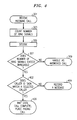
- Figure 4 shows an alternative method of handling an incoming call according to the invention.
- steps 301, 303, 305, 307 and 309 are equivalent to the like-numbered steps in Figure 3.
- the selector 117 determines if the call related information decoded by decoder 111 matches a selected caller (i.e., a caller previously pre-approved by the target party). If the answer to the inquiry in step 402 is NO, then a message is recorded via recording unit 119 at step 404.
- the process of recording a message at step 404 can encompass, for example, recording unit 119 providing a prerecorded greeting to the calling party via telephone line interface 107, and the calling party subsequently providing a message to be stored on a tape or in a memory of recording unit 119.
- the calling unit 113 waits until the call is complete and then places a paging call to the target party.
- selector 117 can identify a first party to be paged when the call related information decoded by decoder 111 corresponds to a calling party identified in a first table, and can also identify a second party to be paged if the call related information corresponds to a calling party in a second table.
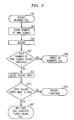
- FIG. 5 provides an example of yet another method of handling an incoming call according to the invention.
- steps 301, 303, 305, 307 and 309 are equivalent to the like-numbered steps described with respect to the methods of Figure 3 and 4.
- incoming call select unit 202 ( Figure 2) provides a query to the calling party at step 501 via the telephone line interface 107 if the number of ring signals is determined at step 307 to exceed the threshold.
- Incoming call select unit 202 receives a response to a query and determines at step 503 if the calling party wants to page the target party. If the answer to this inquiry is NO, then at step 505 a message is recorded in a manner similar to that described above with respect to step 404.
- the calling unit 113 waits until the call is complete and then places the paging call.
- the paging call options described above with respect to Figure 4 also apply to the method of Figure 5.
- the method of Figure 5 can also be modified to provide for a determination of the status of the incoming caller (i.e., whether the incoming caller is approved for paging), prior to issuing the query at step 501.
- the query at step 501 can be a specific query corresponding to the status of the calling party.
- a first calling party that is approved for paging will get a first query at step 501 while a second calling party that is not approved for paging will get a second query.
- the first query for example, will ask the calling party if the calling party desires to leave a message or to page the target party.
- the second query for example, will merely ask the calling party to "leave a message after the beep," in a conventional manner. It is further possible to have calling parties that are pre-approved to both leave a message and page the target party. The query issued at step 501 would thus reflect this status.
- each of the methods of Figures 3-5 can be modified to include a step to determine if telephone 109 is off-hook, in a Type II situation, in which case only the conventional option of recording a message may be preferred, or in which case the user of telephone 109 can disable the calling unit upon entry, for example, of an appropriate PIN.
- the aforementioned embodiments describe the invention primarily in the consumer environment, wherein the functionality of the invention is resident in a telephone or in a device proximate to the telephone.
- the principals of the invention also extend to the business telephone environment, wherein the functionality of the invention is resident in an intermediate machine, such as a central switch.
- an intermediate machine such as a central switch.
- a user of the voicemail system i.e., someone with a voicemail box
- This function can be enabled by the user for only pre-approved callers, so that the intermediate machine evaluates call related information, such as caller ID information, associated with the incoming call, and places a paging call when the call related information meets certain pre-approved parameters.
- caller ID data is provided as an example of call related information upon which a decision is made regarding whether to send a paging call.
- Other parameters may be evaluated as part of a decision regarding whether to place a paging call.
- a decision to place a paging call can be based on one or more of the time of day, the date, the area code, local exchange or country code of the incoming caller, or any other parameter.
Landscapes
- Engineering & Computer Science (AREA)
- Signal Processing (AREA)
- Computer Security & Cryptography (AREA)
- Telephonic Communication Services (AREA)
- Telephone Function (AREA)
- Small-Scale Networks (AREA)
- Mobile Radio Communication Systems (AREA)
Applications Claiming Priority (2)
| Application Number | Priority Date | Filing Date | Title |
|---|---|---|---|
| US91578097A | 1997-08-21 | 1997-08-21 | |
| US915780 | 2001-07-26 |
Publications (1)
| Publication Number | Publication Date |
|---|---|
| EP0898407A2 true EP0898407A2 (de) | 1999-02-24 |
Family
ID=25436241
Family Applications (1)
| Application Number | Title | Priority Date | Filing Date |
|---|---|---|---|
| EP19980306388 Withdrawn EP0898407A2 (de) | 1997-08-21 | 1998-08-11 | Automatisierte Personenrufsteuerung mit Anruferidentifikationsübertragung |
Country Status (3)
| Country | Link |
|---|---|
| EP (1) | EP0898407A2 (de) |
| JP (1) | JPH11220551A (de) |
| KR (1) | KR19990023718A (de) |
Cited By (4)
| Publication number | Priority date | Publication date | Assignee | Title |
|---|---|---|---|---|
| EP1069750A3 (de) * | 1999-07-15 | 2003-05-28 | Winbond Electronics Corporation | Anrufersanmeldung Nachrichtverwaltungssystem und Verfahren |
| US7251318B1 (en) | 1994-01-05 | 2007-07-31 | Intellect Wireless Inc. | Method and apparatus for improved personal communication devices and systems |
| US7257210B1 (en) | 1994-01-05 | 2007-08-14 | Intellect Wireless Inc. | Picture phone with caller id |
| HRP20041044B1 (en) * | 2004-11-05 | 2008-08-31 | Jarčević Predrag | The incoming call number identifying device controlling various hardware by counting the number of rings |
Families Citing this family (1)
| Publication number | Priority date | Publication date | Assignee | Title |
|---|---|---|---|---|
| US6318455B1 (en) * | 1999-07-14 | 2001-11-20 | Mitsubishi Heavy Industries, Ltd. | Heat exchanger |
-
1998
- 1998-08-11 EP EP19980306388 patent/EP0898407A2/de not_active Withdrawn
- 1998-08-20 KR KR1019980033705A patent/KR19990023718A/ko not_active Withdrawn
- 1998-08-21 JP JP10234802A patent/JPH11220551A/ja active Pending
Cited By (13)
| Publication number | Priority date | Publication date | Assignee | Title |
|---|---|---|---|---|
| US7305076B1 (en) | 1994-01-05 | 2007-12-04 | Intellect Wireless Inc. | Method and apparatus for improved paging receiver and system |
| US7251318B1 (en) | 1994-01-05 | 2007-07-31 | Intellect Wireless Inc. | Method and apparatus for improved personal communication devices and systems |
| US7254223B1 (en) | 1994-01-05 | 2007-08-07 | Intellect Wireless Inc. | Method and apparatus for improved personal communication devices and systems |
| US7257210B1 (en) | 1994-01-05 | 2007-08-14 | Intellect Wireless Inc. | Picture phone with caller id |
| US7266186B1 (en) | 1994-01-05 | 2007-09-04 | Intellect Wireless Inc. | Method and apparatus for improved paging receiver and system |
| US7286658B1 (en) | 1994-01-05 | 2007-10-23 | Intellect Wireless Inc. | Method and apparatus for improved personal communication devices and systems |
| US7308088B1 (en) | 1994-01-05 | 2007-12-11 | Intellect Wireless, Inc. | Method and apparatus for improved personal communication devices and systems |
| US7310416B1 (en) | 1994-01-05 | 2007-12-18 | Intellect Wireless Inc. | Method and apparatus for improved personal communication devices and systems |
| US7349532B2 (en) | 1994-01-05 | 2008-03-25 | Intellect Wireless Inc. | Picture and video message center system |
| US7426264B1 (en) | 1994-01-05 | 2008-09-16 | Henderson Daniel A | Method and apparatus for improved personal communication devices and systems |
| US7454000B1 (en) | 1994-01-05 | 2008-11-18 | Intellect Wireless, Inc. | Method and apparatus for improved personal communication devices and systems |
| EP1069750A3 (de) * | 1999-07-15 | 2003-05-28 | Winbond Electronics Corporation | Anrufersanmeldung Nachrichtverwaltungssystem und Verfahren |
| HRP20041044B1 (en) * | 2004-11-05 | 2008-08-31 | Jarčević Predrag | The incoming call number identifying device controlling various hardware by counting the number of rings |
Also Published As
| Publication number | Publication date |
|---|---|
| KR19990023718A (ko) | 1999-03-25 |
| JPH11220551A (ja) | 1999-08-10 |
Similar Documents
| Publication | Publication Date | Title |
|---|---|---|
| AU617882B2 (en) | Telephone answering service with integrated voice and textual message storage | |
| US6430270B1 (en) | Automatic conversational record | |
| US5181236A (en) | Automatic call returning method for call distributor with message record capability | |
| US5604791A (en) | Single line telephone answering system with access security features | |
| US6697473B2 (en) | Automated personalized telephone management system | |
| US5469491A (en) | Telephone answering service with integrated voice and textual message storage | |
| US4985913A (en) | Multiple message answering machine keyed to the incoming phone number | |
| US5781613A (en) | Telephone answering device and method for screening incoming telephone calls with blocked calling party identification information | |
| US6639972B1 (en) | Method for screening active voice mail messages | |
| US6006088A (en) | Intelligent cordless telephone interface device | |
| EP0822697A2 (de) | Anrufunterscheidung in einem Fernsprechsystem | |
| US20020142756A1 (en) | Telephone answering system with courtesy greeting selectable after call is received | |
| US5113429A (en) | Telephone answering service with integrated voice and textual message storage | |
| KR960009924B1 (ko) | 자동응답 전화장치 및 그 전화장치용 자동응답 및 메시지 전달방법 | |
| EP0845895A2 (de) | Halbunterbrechbare Nachrichten für Sprachansagen erzeugende Fernsprechsysteme | |
| US20030108189A1 (en) | Method and device for identifying and notifying the recipient of a phone call using a distinct phone ring pattern assigned to that call recipient | |
| EP0637158A1 (de) | Telefonbeantwortungssystem | |
| JPH11220551A (ja) | 呼出者id自動ページング装置及び方法 | |
| US6711248B1 (en) | Message callback feature | |
| US20020015478A1 (en) | Discrete stress-reducing human-telecommunications interface | |
| US7162027B1 (en) | Voice messaging system caller ring bypass control | |
| EP0898406A2 (de) | Anrufbeantworter mit Personensuchoption | |
| US20030103600A1 (en) | Telephone answering device with special outgoing message capabilities | |
| EP1093275A2 (de) | Selektive Anruferidentitätsblockierung | |
| EP0957622A2 (de) | Gerät und Verfahren zur Auswahl einer auf Anrufinformation basierten abgehenden Grussnachricht |
Legal Events
| Date | Code | Title | Description |
|---|---|---|---|
| PUAI | Public reference made under article 153(3) epc to a published international application that has entered the european phase |
Free format text: ORIGINAL CODE: 0009012 |
|
| AK | Designated contracting states |
Kind code of ref document: A2 Designated state(s): AT BE CH CY DE DK ES FI FR GB GR IE IT LI LU MC NL PT SE |
|
| AX | Request for extension of the european patent |
Free format text: AL;LT;LV;MK;RO;SI |
|
| STAA | Information on the status of an ep patent application or granted ep patent |
Free format text: STATUS: THE APPLICATION HAS BEEN WITHDRAWN |
|
| 18W | Application withdrawn |
Withdrawal date: 20011122 |