EP0957622A2 - Gerät und Verfahren zur Auswahl einer auf Anrufinformation basierten abgehenden Grussnachricht - Google Patents
Gerät und Verfahren zur Auswahl einer auf Anrufinformation basierten abgehenden Grussnachricht Download PDFInfo
- Publication number
- EP0957622A2 EP0957622A2 EP99303452A EP99303452A EP0957622A2 EP 0957622 A2 EP0957622 A2 EP 0957622A2 EP 99303452 A EP99303452 A EP 99303452A EP 99303452 A EP99303452 A EP 99303452A EP 0957622 A2 EP0957622 A2 EP 0957622A2
- Authority
- EP
- European Patent Office
- Prior art keywords
- related information
- call related
- messages
- stored
- message
- Prior art date
- Legal status (The legal status is an assumption and is not a legal conclusion. Google has not performed a legal analysis and makes no representation as to the accuracy of the status listed.)
- Withdrawn
Links
- 238000000034 method Methods 0.000 title claims abstract description 19
- SGPGESCZOCHFCL-UHFFFAOYSA-N Tilisolol hydrochloride Chemical compound [Cl-].C1=CC=C2C(=O)N(C)C=C(OCC(O)C[NH2+]C(C)(C)C)C2=C1 SGPGESCZOCHFCL-UHFFFAOYSA-N 0.000 claims 1
- 238000010586 diagram Methods 0.000 description 4
- 230000004044 response Effects 0.000 description 4
- 230000006870 function Effects 0.000 description 3
- 108010076504 Protein Sorting Signals Proteins 0.000 description 2
- 230000009977 dual effect Effects 0.000 description 2
- 238000004891 communication Methods 0.000 description 1
- 238000001514 detection method Methods 0.000 description 1
- 239000004973 liquid crystal related substance Substances 0.000 description 1
- 238000012986 modification Methods 0.000 description 1
- 230000004048 modification Effects 0.000 description 1
- 238000012544 monitoring process Methods 0.000 description 1
- 238000004806 packaging method and process Methods 0.000 description 1
- 230000010363 phase shift Effects 0.000 description 1
- 230000008569 process Effects 0.000 description 1
- 238000012545 processing Methods 0.000 description 1
Images



Classifications
-
- H—ELECTRICITY
- H04—ELECTRIC COMMUNICATION TECHNIQUE
- H04M—TELEPHONIC COMMUNICATION
- H04M1/00—Substation equipment, e.g. for use by subscribers
- H04M1/64—Automatic arrangements for answering calls; Automatic arrangements for recording messages for absent subscribers; Arrangements for recording conversations
- H04M1/65—Recording arrangements for recording a message from the calling party
- H04M1/6505—Recording arrangements for recording a message from the calling party storing speech in digital form
-
- H—ELECTRICITY
- H04—ELECTRIC COMMUNICATION TECHNIQUE
- H04M—TELEPHONIC COMMUNICATION
- H04M1/00—Substation equipment, e.g. for use by subscribers
- H04M1/57—Arrangements for indicating or recording the number of the calling subscriber at the called subscriber's set
-
- H—ELECTRICITY
- H04—ELECTRIC COMMUNICATION TECHNIQUE
- H04M—TELEPHONIC COMMUNICATION
- H04M1/00—Substation equipment, e.g. for use by subscribers
- H04M1/66—Substation equipment, e.g. for use by subscribers with means for preventing unauthorised or fraudulent calling
- H04M1/663—Preventing unauthorised calls to a telephone set
Definitions
- This invention relates generally to a voice messaging system and more particularly, to a voice messaging system which selects, for a particular incoming call, a particular outgoing greeting message (OGM) or announcement from a plurality of outgoing greeting messages based on incoming call related information.
- OGM outgoing greeting message
- PBXs private branch exchanges
- Conventional voice messaging machines are capable of receiving call related information, e.g., Caller ID information associated with an incoming call.
- Caller ID a caller's telephone number and/or household name is transmitted by the telephone company to the voice messaging machine.
- Type I service Caller ID information is transmitted during the silent interval between the first two rings to a telephone in an on-hook condition.
- Type II customer premises equipment CPE
- CPE Customer premises equipment
- CIDCW Caller ID Call Waiting
- CIDCW Caller ID Call Waiting
- a pre-recorded outgoing greeting message is played. If the caller leaves a voice message, the voice message and call related information, e.g., Caller ID information associated therewith, may be stored in the voice messaging system. Thereafter, the user retrieves the stored voice messages during playback of the voice message.
- call related information e.g., Caller ID information associated therewith
- One conventional Type I/Type II customer premises equipment including the capability to receive call related information, e.g., Caller ID information is shown in FIG. 4.
- customer premises equipment 111 such as a telephone answering device (TAD) includes a caller ID detector/receiver 112 adapted to receive a telephone number or other call related information about a calling party from the central office 113 over the telephone line 114 via telephone line interface 148 .
- TAD telephone answering device
- the telephone number or other call related information e.g., Caller ID information
- call related information follows a caller ID alerting signal sequence (CAS tones) or other type of dual-tone or single tone alerting signal sequence.
- Controller 118 is a processor, e.g., a microprocessor, a digital signal processor, or a microcontroller.
- the telephone number and/or the calling party's household name associated with that telephone number are displayed on a display device 104.
- the TAD 111 further includes a voice recorder/playback circuit 120 having a standard microphone 122 and speaker 124 electrically connected thereto.
- An alpha-numeric keypad 126 is also provided to provide control dual tone multi frequency (DTMF) control signal to the controller 118 and local operation of the system.
- DTMF dual tone multi frequency
- Conventional voice messaging systems for home use permit the user to record and program one outgoing greeting message to be played at any one time after the TAD 111 receives a predetermined number of rings.
- Typical voice messaging systems for office use such as private branch exchanges (PBXs), allow the user to choose only one outgoing greeting message or announcement for playback in response to an outside call.
- PBXs private branch exchanges
- Some voice messaging systems allow the user to record a second, more personal outgoing greeting message for use when the user indicates use of the alternative, second outgoing message.
- a voice messaging system and method includes a voice recorder to store a plurality of outgoing greeting messages. Each of the outgoing greeting messages is associated with respective pre-stored call related information.
- a receiver receives call related information associated with an incoming call.
- a processor compares the received call related information with the pre-stored call related information to identify one of the plurality of outgoing greeting messages such that a personalized outgoing greeting message may be selected and played based on call related information received with respect to the calling party.
- the present invention relates to a voice messaging system such as a telephone answering device or voice mail system which selects an outgoing greeting message or announcement based on call related information associated with an incoming call.
- a voice messaging system such as a telephone answering device or voice mail system which selects an outgoing greeting message or announcement based on call related information associated with an incoming call.
- the embodiment described is a telephone answering device, but the principles disclosed are equally applicable to voice messaging systems in general.
- a telephone answering system includes a telephone answering device (TAD) 11 having a call information detector/receiver circuit 12 .
- the call information detector/receiver receives call related information from a central office 13 over a telephone line 14 via telephone line interface (TLI) 48.
- TAI telephone line interface
- the TAD 11 includes a voice module 110, including the voice recorder/playback circuit 20, a microphone 22 and a speaker 24 in communication with the controller 18.
- the function of the voice recorder/playback circuit 20 is to record incoming voice messages and to playback recorded voice messages from voice memory.
- a suitable voice recorder/playback circuit 20 is disclosed in U.S. Patent No. 5,524,140, the content of which is hereby explicitly incorporated into the present specification by reference.
- Call related information e.g., Caller ID information such as a telephone number and/or the household name of the calling party is transmitted to the TAD 11, e.g., between the first and second rings of an incoming call from the calling party, or before first ring, or contained within Caller ID/Call Waiting (CIDCW) information.
- the call related information is generally stored in a centralized database at the telephone company central office 13 which provides the call related information service, e.g., Caller ID service.
- Call related information stored at the central office 13 is transmitted to the TAD 11, received by the call information detector/receiver 12, and provided to a controller 18.
- the controller 18 is any appropriate processor, e.g., a microprocessor, a digital signal processor, or a microcontroller.
- the processor 18 includes a dual tone multi frequency (DTMF) decoder 71 and a DTMF generator 73 to, e.g., detect and generate control signal relating to an incoming call.
- DTMF dual tone multi frequency
- the voice module 110 may include software modules which perform DTMF detection and decoding.
- the TAD 11 further includes a voice recorder/playback circuit 110.
- the processor 18 controls the functioning of the voice recorder/playback circuit 110 such as PLAY, RECORD, ERASE and STOP signals.
- the received call related information such as, for example, a telephone number, area code, household name, time of call, private "P", out of area "O", and/or anonymous "A" information associated with the incoming call is compared by the processor 18 with pre-stored call related information contained in an outgoing message/call information directory 16 to identify a pre-selected outgoing greeting message from among a plurality of possible outgoing greeting messages.
- the outgoing message/caller information directory 16 is stored in memory such as Flash memory at the TAD 11.
- Each of the plurality of outgoing greeting messages is associated with respective call related information pre-stored in the outgoing message/call information directory 16.
- One of the possible outgoing greeting messages is designated as a default OGM, to be played for incoming calls which do not match an entry in the outgoing message/call information directory 16.
- a user can pre-select an outgoing greeting message to be used for a particular caller by recording a plurality of outgoing greeting messages and by entering call related information such as at least a portion of a telephone number and/or at least a portion of a household name via keypad 26 for those callers to be presented with that particular outgoing greeting message. This. process may be repeated for as many outgoing greeting messages to be as desired, within the limits of the memory accessible by the TAD 11.
- incoming call related information relating to a calling party matches call information in an entry in the outgoing message/call information directory 16, a particular one of the plurality of outgoing greeting messages is designated by the entry to be played for that caller.
- the processor 18 causes a voice recorder/playback circuit 20 (FIG. 3) to play the selected outgoing greeting message to the caller.
- the caller may then leave a voice message or may simply hang-up.
- the TAD 11 may play back a 'canned' outgoing message based on received call related information. For instance, an individual may desire to play back a pre-recorded, stern sounding message to strangers while playing a personalized message to recognized callers as determined based on the received call related information.
- FIG. 2 shows the physical packaging of a TAD 11 in accordance with the principles of the present invention.
- the TAD 11 may be packaged to fit within a console 30 which includes a control panel 32.
- the console 30 may be equipped with a standard handset 34 and a phone jack 36 which can be plugged into any standard telephone company modular jack, e.g., an RJ-11 jack.
- the control panel 32 includes a liquid crystal display (LCD) 104 and the alpha-numeric keypad 26.
- the LCD 104 displays call related information regarding incoming calls, e.g., the telephone number and/or the household name associated with the incoming call. If there is no call related information relating to a particular incoming call, the LCD 104 is left blank or otherwise indicates that call related information is not available for that particular call.
- the display 104 is used to scroll through a log of call related information.
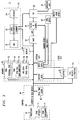
- FIG. 3 shows a more detailed block diagram of an embodiment of a TAD 11 in accordance with the principles of the present invention.
- the TAD 11 includes a control circuit 44, memory 46, the telephone line interface (TLI) 48, display 104 and voice module 110 as shown and described with respect to FIGS. 1 and 2.
- TAD 11 includes a control circuit 44, memory 46, the telephone line interface (TLI) 48, display 104 and voice module 110 as shown and described with respect to FIGS. 1 and 2.
- Control circuit 44 includes the processor 18 which controls the TAD 11 by executing instructions that are stored in program code in ROM 52.
- Random access memory (RAM) 54 is also provided for general use and to store log and priority data 55 and voice message data 56.
- the RAM 54 includes voice memory such as Flash memory for storing the plurality of outgoing greeting messages and received voice messages.
- a real time clock circuit 65 provides the TAD 11 with the current time and date.
- the telephone line interface 48 includes circuitry which permits the TAD 11 to be connected directly to a standard telephone module jack, i.e., an RJ-11 jack.
- the telephone line interface 48 also includes various control and monitoring circuits that are common to ordinary telephones. These circuits are conventional and may include an electronic telephone circuit (not shown) for controlling dialing functions and for interfacing a telephone handset.
- a ring detect circuit 58 detects the ring signal of an incoming call and an on/off hook detect circuit 70 are also provided.
- the TAD 11 includes a filter and demodulating circuit 60 that is used for demodulating an incoming serial data stream relating to call related information. Data received by the filter and demodulating circuit 60 includes at least data representing the telephone number of an incoming call.
- Data relating to a household name associated with the telephone number of the incoming call may also be received by the filter and demodulating circuit 60.
- One protocol for the otherwise conventional portions of the circuit shown in FIG. 3 is described in U.S. Patent No. 4,582,956, the disclosure of which is hereby explicitly incorporated herein by reference into the present specification.
- Frequency shift keying, phase shift keying, quadrature amplitude modulation or any other suitable modulation technique may be used for transmitting a serial data stream to the TAD 11.
- a universal asynchronous receiver/transmitter (UART) 62 is used to convert the demodulated serial data received from the filter and demodulating circuit 60 to a parallel format read by the processor 18 via address and data busses 64. Alternatively, the processor 18 can perform the UART function.
- the ring interface circuit 58 provides a signal indicative of the incoming ring signal to the processor 18.
- Call related information is transmitted by the central office 13 to the TAD 11 during the silent period between the first and second rings, is displayed on display 104.
- the incoming call related information is received by the call information detector/receiver 12 and is compared with call information in the outgoing message/call information directory 16 by the processor 18 to determine a match for selecting a particular outgoing greeting message to be played in response to the incoming call.
- the information in the disclosed embodiment is compared whether or not the TAD 11 answers the incoming call. However, the invention is equally applicable if the incoming call information is not compared until after the TAD 11 answers the incoming call.
- the processor 18 If there is a match and the TAD 11 answers the incoming call, e.g., after a predetermined number of rings, the processor 18 causes an off-hook condition and then causes the voice/recorder playback circuit 20 to transmit or play the selected outgoing greeting message through the telephone line interface circuit 48 and to the telephone line 14. If there is no match of the incoming call related information with pre-stored call related information in the outgoing message/caller information directory 16, a pre-recorded, default outgoing greeting message is transmitted to the calling party via the telephone line 14.
- the caller may record a voice message.
- the voice message is digitized, compressed and stored in the voice memory section 56 of RAM 54. It can be appreciated that while the present invention relates to digital TAD, other storage devices such as cassette tapes are also possible.
- the controller or processor 18 can distinguish three states during a call: voice signals, DTMF signals, and dial tone or silence, by reading the level and modulation of the signals on the telephone line 14.
- the voice recorder/playback circuit 20 can distinguish between the tones of DTMF signals and the signal level ranges associated with human speech detected on the telephone line 14. If voice signals are detected, the processor 18 immediately executes a voice record routine. If no voice is present on the telephone line 14, but DTMF signals are being transmitted, the processor 18 executes a DTMF decode routine. If there is a dial tone or silence on the telephone line 14 for a predetermined period of time, e.g., five seconds, the processor 18 causes the on/off hook detect circuit 70 to go "on-hook", terminating the call.
- An interesting mode develops with, e.g., a local voice messaging system together with voice mail service maintained at the central office.
- the system may be set to selectively play a special outgoing message from the voice mailbox based on the incoming call related information.
- Another interesting feature can be implemented wherein if the calling party hangs up after the call related information is received but before a complete voice message is recorded, the voice messaging system can call that user and play back a special message or announcement such as "Sorry I was busy when you called. Can you give me another chance and leave a message after the beep?" based on that call related information.
- a voice messaging system in accordance with the principles of the present invention provides an effective way of personalizing outgoing greeting messages based on call related information.
- a user of the voice messaging system of the invention may provide professional greetings for general incoming business calls, and friendly or humorous greetings for calls from family and friends.
Landscapes
- Engineering & Computer Science (AREA)
- Signal Processing (AREA)
- Computer Security & Cryptography (AREA)
- Telephonic Communication Services (AREA)
- Telephone Function (AREA)
Applications Claiming Priority (2)
| Application Number | Priority Date | Filing Date | Title |
|---|---|---|---|
| US7594598A | 1998-05-12 | 1998-05-12 | |
| US75945 | 1998-05-12 |
Publications (2)
| Publication Number | Publication Date |
|---|---|
| EP0957622A2 true EP0957622A2 (de) | 1999-11-17 |
| EP0957622A3 EP0957622A3 (de) | 2000-04-12 |
Family
ID=22128933
Family Applications (1)
| Application Number | Title | Priority Date | Filing Date |
|---|---|---|---|
| EP99303452A Withdrawn EP0957622A3 (de) | 1998-05-12 | 1999-05-04 | Gerät und Verfahren zur Auswahl einer auf Anrufinformation basierten abgehenden Grussnachricht |
Country Status (3)
| Country | Link |
|---|---|
| EP (1) | EP0957622A3 (de) |
| JP (1) | JPH11355431A (de) |
| TW (1) | TW404108B (de) |
Cited By (3)
| Publication number | Priority date | Publication date | Assignee | Title |
|---|---|---|---|---|
| WO2001045361A1 (en) * | 1999-12-16 | 2001-06-21 | Koninklijke Philips Electronics N.V. | Telephone answering device handling calls according to caller-id and priority party list |
| EP1453283A1 (de) * | 2003-02-28 | 2004-09-01 | France Telecom | System zur Verwaltung ankommender Telefonanrufe |
| US6804334B1 (en) * | 2000-05-19 | 2004-10-12 | Lucent Technologies Inc. | Method and device for dynamic message delivery based upon identification of originating caller |
Family Cites Families (3)
| Publication number | Priority date | Publication date | Assignee | Title |
|---|---|---|---|---|
| EP0813787B1 (de) * | 1995-03-08 | 2001-11-21 | TELEFONAKTIEBOLAGET L M ERICSSON (publ) | Telefongerät mit anruferabhängigem rufsignal |
| GB2305329A (en) * | 1995-09-15 | 1997-04-02 | Christopher Moller | Telecommunication system |
| KR100194427B1 (ko) * | 1995-12-22 | 1999-06-15 | 윤종용 | 전화단말기에서 호출시 발신자번호 음성메세지 발생장치 및 방법 |
-
1999
- 1999-03-30 TW TW88105034A patent/TW404108B/zh active
- 1999-05-04 EP EP99303452A patent/EP0957622A3/de not_active Withdrawn
- 1999-05-12 JP JP13087999A patent/JPH11355431A/ja active Pending
Cited By (4)
| Publication number | Priority date | Publication date | Assignee | Title |
|---|---|---|---|---|
| WO2001045361A1 (en) * | 1999-12-16 | 2001-06-21 | Koninklijke Philips Electronics N.V. | Telephone answering device handling calls according to caller-id and priority party list |
| US6804334B1 (en) * | 2000-05-19 | 2004-10-12 | Lucent Technologies Inc. | Method and device for dynamic message delivery based upon identification of originating caller |
| EP1453283A1 (de) * | 2003-02-28 | 2004-09-01 | France Telecom | System zur Verwaltung ankommender Telefonanrufe |
| FR2851868A1 (fr) * | 2003-02-28 | 2004-09-03 | France Telecom | Systeme de gestion d'appels telephoniques entrants |
Also Published As
| Publication number | Publication date |
|---|---|
| TW404108B (en) | 2000-09-01 |
| JPH11355431A (ja) | 1999-12-24 |
| EP0957622A3 (de) | 2000-04-12 |
Similar Documents
| Publication | Publication Date | Title |
|---|---|---|
| US6335962B1 (en) | Apparatus and method for grouping and prioritizing voice messages for convenient playback | |
| US6026152A (en) | Ring count controlled by incoming call related information | |
| US6072859A (en) | Apparatus and method of generating voice message of caller's number in case of incoming call in telephone | |
| US7206572B2 (en) | Calling party announcement apparatus | |
| US6782088B1 (en) | Apparatus and method for downloading a forwarding telephone number | |
| US6430270B1 (en) | Automatic conversational record | |
| US5680447A (en) | Circuit and method for responding to third party calls in a telephone system having call waiting | |
| JPH0652914B2 (ja) | 発呼者電話番号表示装置 | |
| US6393106B1 (en) | Telephone answering device which records voice message of third party caller | |
| US6292543B1 (en) | Apparatus and method which saves call related information when the status of recorded voice message is changed remotely | |
| EP0844773A2 (de) | Telefonanrufbeantworter mit Nachrichtenvermittlung in Abhängigkeit von der Anruferidentifizierung | |
| US7162027B1 (en) | Voice messaging system caller ring bypass control | |
| TW404108B (en) | Appartaus and method for selecting an outgoing greeting message based on call related information | |
| EP0948178A2 (de) | Vorrichtung und Verfahren zur Aufnahme von Sprachnachrichten auf der Basis der einkommenden Anrufsinformation | |
| JP3326329B2 (ja) | 電話機およびメッセージ再生方法 | |
| JPH0486053A (ja) | 電話機 | |
| CN1240321A (zh) | 基于呼叫有关信息选取输出问候消息的设备和方法 | |
| JPH01180170A (ja) | 自動構内交換装置 | |
| EP1011247A1 (de) | Fernsprechstelle mit Sprachmitteilung der Anruferidentifizierung | |
| JPH09200317A (ja) | 通信装置 | |
| JPH0936952A (ja) | 電話装置 | |
| GB2393603A (en) | Ringtone player with ringtones downloaded via telephone line | |
| JPH04344755A (ja) | 電話機 | |
| JPH0483458A (ja) | ガイダンス入りリングバックトーン送出方法 | |
| JPH04215355A (ja) | 割込呼出応答方式 |
Legal Events
| Date | Code | Title | Description |
|---|---|---|---|
| PUAI | Public reference made under article 153(3) epc to a published international application that has entered the european phase |
Free format text: ORIGINAL CODE: 0009012 |
|
| AK | Designated contracting states |
Kind code of ref document: A2 Designated state(s): DE |
|
| AX | Request for extension of the european patent |
Free format text: AL;LT;LV;MK;RO;SI |
|
| PUAL | Search report despatched |
Free format text: ORIGINAL CODE: 0009013 |
|
| AK | Designated contracting states |
Kind code of ref document: A3 Designated state(s): AT BE CH CY DE DK ES FI FR GB GR IE IT LI LU MC NL PT SE |
|
| AX | Request for extension of the european patent |
Free format text: AL;LT;LV;MK;RO;SI |
|
| RIC1 | Information provided on ipc code assigned before grant |
Free format text: 7H 04M 3/50 A, 7H 04M 19/04 B |
|
| STAA | Information on the status of an ep patent application or granted ep patent |
Free format text: STATUS: THE APPLICATION HAS BEEN WITHDRAWN |
|
| 17P | Request for examination filed |
Effective date: 20000915 |
|
| AKX | Designation fees paid |
Free format text: DE |
|
| 18W | Application withdrawn |
Withdrawal date: 20001103 |