EP0899325A2 - Weichspülmittelzusammemsetzung - Google Patents
Weichspülmittelzusammemsetzung Download PDFInfo
- Publication number
- EP0899325A2 EP0899325A2 EP98810753A EP98810753A EP0899325A2 EP 0899325 A2 EP0899325 A2 EP 0899325A2 EP 98810753 A EP98810753 A EP 98810753A EP 98810753 A EP98810753 A EP 98810753A EP 0899325 A2 EP0899325 A2 EP 0899325A2
- Authority
- EP
- European Patent Office
- Prior art keywords
- alkyl
- formula
- hydroxy
- alkoxy
- independently
- Prior art date
- Legal status (The legal status is an assumption and is not a legal conclusion. Google has not performed a legal analysis and makes no representation as to the accuracy of the status listed.)
- Granted
Links
- 0 CC(C)[N+](*)(*)*=CC Chemical compound CC(C)[N+](*)(*)*=CC 0.000 description 5
Classifications
-
- C—CHEMISTRY; METALLURGY
- C11—ANIMAL OR VEGETABLE OILS, FATS, FATTY SUBSTANCES OR WAXES; FATTY ACIDS THEREFROM; DETERGENTS; CANDLES
- C11D—DETERGENT COMPOSITIONS; USE OF SINGLE SUBSTANCES AS DETERGENTS; SOAP OR SOAP-MAKING; RESIN SOAPS; RECOVERY OF GLYCEROL
- C11D3/00—Other compounding ingredients of detergent compositions covered in group C11D1/00
- C11D3/395—Bleaching agents
- C11D3/3951—Bleaching agents combined with specific additives
-
- C—CHEMISTRY; METALLURGY
- C11—ANIMAL OR VEGETABLE OILS, FATS, FATTY SUBSTANCES OR WAXES; FATTY ACIDS THEREFROM; DETERGENTS; CANDLES
- C11D—DETERGENT COMPOSITIONS; USE OF SINGLE SUBSTANCES AS DETERGENTS; SOAP OR SOAP-MAKING; RESIN SOAPS; RECOVERY OF GLYCEROL
- C11D1/00—Detergent compositions based essentially on surface-active compounds; Use of these compounds as a detergent
- C11D1/38—Cationic compounds
- C11D1/62—Quaternary ammonium compounds
-
- C—CHEMISTRY; METALLURGY
- C11—ANIMAL OR VEGETABLE OILS, FATS, FATTY SUBSTANCES OR WAXES; FATTY ACIDS THEREFROM; DETERGENTS; CANDLES
- C11D—DETERGENT COMPOSITIONS; USE OF SINGLE SUBSTANCES AS DETERGENTS; SOAP OR SOAP-MAKING; RESIN SOAPS; RECOVERY OF GLYCEROL
- C11D3/00—Other compounding ingredients of detergent compositions covered in group C11D1/00
- C11D3/0005—Other compounding ingredients characterised by their effect
- C11D3/001—Softening compositions
- C11D3/0015—Softening compositions liquid
-
- C—CHEMISTRY; METALLURGY
- C11—ANIMAL OR VEGETABLE OILS, FATS, FATTY SUBSTANCES OR WAXES; FATTY ACIDS THEREFROM; DETERGENTS; CANDLES
- C11D—DETERGENT COMPOSITIONS; USE OF SINGLE SUBSTANCES AS DETERGENTS; SOAP OR SOAP-MAKING; RESIN SOAPS; RECOVERY OF GLYCEROL
- C11D3/00—Other compounding ingredients of detergent compositions covered in group C11D1/00
- C11D3/0005—Other compounding ingredients characterised by their effect
- C11D3/0063—Photo- activating compounds
-
- C—CHEMISTRY; METALLURGY
- C11—ANIMAL OR VEGETABLE OILS, FATS, FATTY SUBSTANCES OR WAXES; FATTY ACIDS THEREFROM; DETERGENTS; CANDLES
- C11D—DETERGENT COMPOSITIONS; USE OF SINGLE SUBSTANCES AS DETERGENTS; SOAP OR SOAP-MAKING; RESIN SOAPS; RECOVERY OF GLYCEROL
- C11D3/00—Other compounding ingredients of detergent compositions covered in group C11D1/00
- C11D3/16—Organic compounds
- C11D3/168—Organometallic compounds or orgometallic complexes
-
- C—CHEMISTRY; METALLURGY
- C11—ANIMAL OR VEGETABLE OILS, FATS, FATTY SUBSTANCES OR WAXES; FATTY ACIDS THEREFROM; DETERGENTS; CANDLES
- C11D—DETERGENT COMPOSITIONS; USE OF SINGLE SUBSTANCES AS DETERGENTS; SOAP OR SOAP-MAKING; RESIN SOAPS; RECOVERY OF GLYCEROL
- C11D3/00—Other compounding ingredients of detergent compositions covered in group C11D1/00
- C11D3/16—Organic compounds
- C11D3/26—Organic compounds containing nitrogen
- C11D3/30—Amines; Substituted amines ; Quaternized amines
-
- C—CHEMISTRY; METALLURGY
- C11—ANIMAL OR VEGETABLE OILS, FATS, FATTY SUBSTANCES OR WAXES; FATTY ACIDS THEREFROM; DETERGENTS; CANDLES
- C11D—DETERGENT COMPOSITIONS; USE OF SINGLE SUBSTANCES AS DETERGENTS; SOAP OR SOAP-MAKING; RESIN SOAPS; RECOVERY OF GLYCEROL
- C11D2111/00—Cleaning compositions characterised by the objects to be cleaned; Cleaning compositions characterised by non-standard cleaning or washing processes
- C11D2111/10—Objects to be cleaned
- C11D2111/12—Soft surfaces, e.g. textile
-
- C—CHEMISTRY; METALLURGY
- C11—ANIMAL OR VEGETABLE OILS, FATS, FATTY SUBSTANCES OR WAXES; FATTY ACIDS THEREFROM; DETERGENTS; CANDLES
- C11D—DETERGENT COMPOSITIONS; USE OF SINGLE SUBSTANCES AS DETERGENTS; SOAP OR SOAP-MAKING; RESIN SOAPS; RECOVERY OF GLYCEROL
- C11D2111/00—Cleaning compositions characterised by the objects to be cleaned; Cleaning compositions characterised by non-standard cleaning or washing processes
- C11D2111/40—Specific cleaning or washing processes
- C11D2111/46—Specific cleaning or washing processes applying energy, e.g. irradiation
Definitions
- the present invention relates to a fabric softener composition and a Process for bleaching textile fiber materials using this fabric softener composition.
- the object of the present invention is to provide water-soluble phthalocyanine compounds as a photo bleach in certain fabric softener compositions to use, which contain so-called "esterquats" as active substance, these are quaternary Ammonium compounds, at least one interrupted by carboxy groups have long chain hydrophobic alkyl or alkenyl group. Containing esterquats Fabric softeners are described, for example, in EP-A-0,239,910 or WO 95/24460.
- the number of substituents Q 1 and Q 2 in formula (2a) or (2b), which can be the same or different, is between 1 and 8, and, as is customary in the case of phthalocyanines, it does not have to be an integer (degree of substitution) . If other non-cationic substituents are also present, the sum of the latter and the cationic substituents is between 1 and 4.
- the minimum number of substituents that must be present in the molecule depends on the water solubility of the resulting molecule. Sufficient water solubility is given when enough phthalocyanine compound goes into solution to cause photodynamically catalyzed oxidation on the fiber. A solubility of 0.01 mg / l may already be sufficient, in general that of 0.001 to g / l is appropriate.
- Halogen means fluorine, bromine or especially chlorine.
- the group is preferred
- heterocyclic rings in the group the groups mentioned above are also suitable, with only the binding to the residual substituents taking place via a carbon atom.
- phenyl, naphthyl and aromatic hetero rings can be substituted by one or two further radicals, for example by C 1 -C 6 alkyl, C 1 -C 6 alkoxy, halogen carboxy, carb-C 1 -C 6 - Alkoxy, hydroxy, amino, cyano, sulfo, sulfonamido etc.
- All of the nitrogen heterocycles mentioned above can still be by alkyl groups be substituted, either on a carbon atom or on another in the ring located nitrogen atom.
- Preferred as the alkyl group is the methyl group.
- a - s in formula (2a) means any anion as a counterion to the positive charge of the residual molecule. It is generally introduced through the manufacturing process (quaternization). It then preferably means a halogen ion, an alkyl sulfate or an aryl sulfate ion. Of the aryl sulfate ions, the phenyl sulfonate, p-tolyl sulfonate and p-chlorophenyl sulfonate ions are mentioned.
- any other anion can also act as the anion, since the anions can be easily exchanged in a known manner;
- a s - can also represent a sulfate, sulfite, carbonate, phosphate, nitrate, acetate, oxalate, citrate, lactate or other anion of an organic carboxylic acid.
- the index s is r for monovalent anions.
- s assumes a value ⁇ r, which, depending on the conditions, must be such that it just compensates for the positive charge of the residual molecule.
- C 1 -C 6 -alkyl and C 1 -C 6 -alkoxy are straight-chain or branched alkyl or alkoxy radicals such as methyl, ethyl, n-propyl, isopropyl, n-butyl, sec-butyl, tert-butyl, amyl, Isoamyl, tert-amyl or hexyl or methoxy, ethoxy, n-propoxy, isopropoxy, n-butoxy, sec-butoxy, tert-butoxy, amyloxy, isoamyloxy, tert-amyloxy or hexyloxy.
- C 2 -C 22 alkenyl means, for example, allyl, methallyl, isopropenyl, 2-butenyl, 3-butenyl, isobutenyl, n-penta-2,4-dienyl, 3-methyl-but-2-enyl, n-oct-2 -enyl, n-dodec-2-enyl, iso-dodecenyl, n-dodec-2-enyl or n-octadec-4-enyl.
- the C 8 -C 20 fatty acid residues defined for the quaternary ammonium compounds of the formula (1) are derived from saturated or unsaturated fatty acids, such as, for example, capric, lauric, myristic, palmitic, stearic, dodecyl; Pentadecyl; Hexadecyl or oleic acid; or decen, dodecen, tetradecen, hexadecen, oleic, linoleic, linolenic, ricinoleic acid, coconut fatty acid, or preferably tallow fatty acid.
- saturated or unsaturated fatty acids such as, for example, capric, lauric, myristic, palmitic, stearic, dodecyl; Pentadecyl; Hexadecyl or oleic acid; or decen, dodecen, tetradecen, hexadecen, oleic
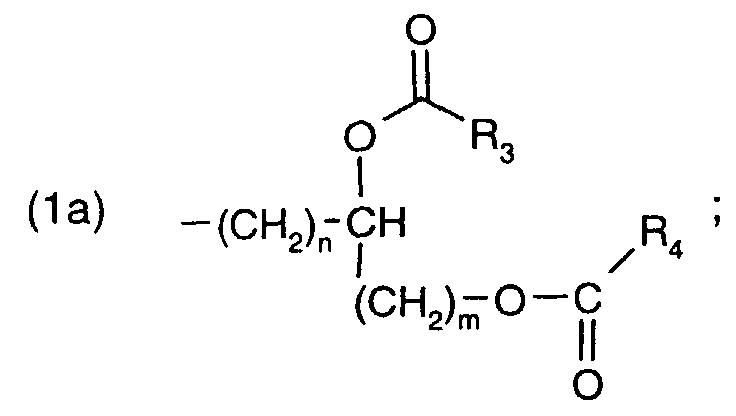
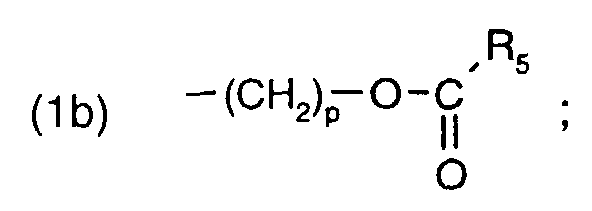
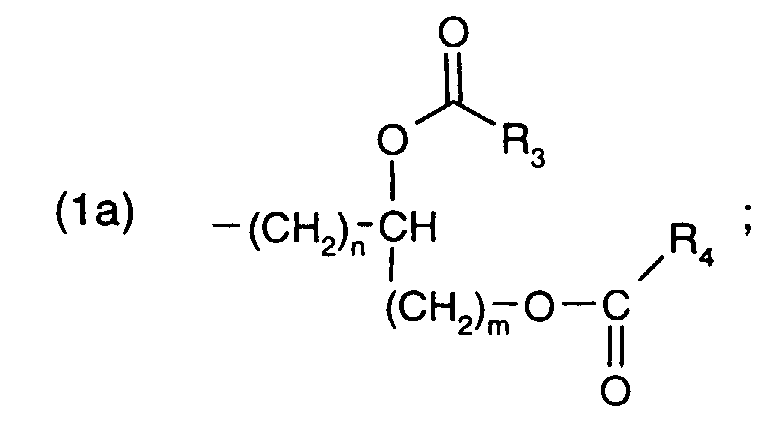
- Particularly preferred quaternary ammonium compounds which can be used according to the invention are those of the formula (1) in which A and B independently of one another are the radical of the formula (1a) or (1b), or those compounds of the formula (1) in which A and B are the radical of the formula (1b).
- the photobleaches used according to the invention are in the fabric softener composition used in only small amounts and therefore have catalytic Effect.
- the fabric softener compositions according to the invention preferably contain 0.0001 to 0.05, preferably 0.001 to 0.005% by weight of component (a) and 1 to 20, preferably 5 to 20% by weight of component (b).
- the fabric softener composition according to the invention can also be that for commercially available Contain conventional additives such as alcohols, e.g. Ethanol, n-propanol, i-propanol, polyhydric alcohols, e.g.
- Glycerin and propylene glycol amphoteric and nonionic surfactants such as Carboxyl derivatives of imidazole, ethoxylated fatty alcohols, hydrogenated and ethoxylated castor oil, alkyl polyglycosides, for example decyl polyglucose and dodecyl polyglucose, fatty alcohols, fatty acid esters, fatty acids, ethoxylated Fatty acid glycerides or fatty acid partial glycerides; still smaller amounts of dyes, Perfumes, buffer substances, inorganic or organic salts, e.g.
- amphoteric and nonionic surfactants such as Carboxyl derivatives of imidazole, ethoxylated fatty alcohols, hydrogenated and ethoxylated castor oil, alkyl polyglycosides, for example decyl polyglucose and dodecyl polyglucose, fatty alcohols, fatty acid est
- water soluble Potassium, sodium or magnesium salts non-aqueous solvents, pH buffers, perfumes, Dyes, hydrotroping agents, anti-foaming agents, corrosion inhibitors, anti-redeposition agents, Viscosity regulators, in particular polymeric or other thickeners, stabilizers, Enzymes, optical brighteners, anti-enema agents, anti-stain agents, antimicrobials, germicides, Fungicides, antioxidants, corrosion inhibitors and wrinkle free agents.
- the fabric softener composition according to the invention is usually liquid.
- the one in it Active ingredients contained are preferably emulsified in water.
- the production takes place usually in such a way that the active substance, i.e. the quaternary ammonium compound of the formula (1) stirred in water in the molten state, then optionally Add further desired additives and finally, after cooling, the Add phthalocyanine compound as a dilute stock solution.
- the composition according to the invention is used in the for known Fabric softener usual way, the photobleaching agent only by irradiation with Light takes effect, e.g. in US-A-4,166,718.
- the photobleaching agent only by irradiation with Light takes effect, e.g. in US-A-4,166,718.
- a washing cycle in a liquor containing an inventive
- Contains fabric softener composition aftertreated in one rinse cycle.
- Irradiation with visible and / or infrared light or in daylight can take place directly in the fabric softener liquor, for example by means of a corresponding artificial light source in the washing machine.
- the radiation can also be preferred after removing the textiles from the rinsing bath in a damp state, whereby sunlight is preferably used as the light source.
- the exposure can be in this case expediently take place while the textiles are drying.
- the textiles are not on the line, but dried in a tumble dryer, for example, the exposure also take place during this drying process, for example by a suitable one artificial light source, which is attached to or in the dryer.
- a suitable one artificial light source which is attached to or in the dryer.
- oxygen is also required for the effectiveness of the photobleaching agent.
- the (dissolved) oxygen present in the wash liquor is sufficient (the liquor should if possible contain no reducing agent) or the oxygen dissolved in the moisture and atmospheric oxygen if the exposure is outside the bath.
- textile fiber materials with the inventive fabric softener composition can be treated, e.g. Silk, wool, polyamide materials or polyurethanes, and in particular cellulose-containing fiber materials of all kinds in Consideration.
- Such fiber materials are, for example, the natural cellulose fiber, such as Cotton, linen, jute and hemp, as well as cellulose and regenerated cellulose.
- Prefers are textile fiber materials made of cotton.
- the fabric softener compositions according to the invention are also suitable for fibers containing hydroxyl groups in mixed fabrics are included, e.g. Mixtures of cotton with polyester fibers or polyamide fibers.
- the effect of the photo bleaching agent will remove stains from the treated Tissue significantly improved. This also allows color transfers between individual pieces of tissue can be prevented or reduced.
- composition according to the invention has the advantage that the essential components in their effect do not influence each other, that is Bleaching action of the photo bleaching agent through the quaternary ammonium compound and conversely is not affected.
- a viscous, homogeneous liquid is created.
- Y brightness values
- Table 2 Formulation from example without exposure with 2 h exposure Y [%] ⁇ Y Y [%] ⁇ Y 1 68.1 71.1 2nd 67.9 -0.2 74 2.9 3rd 67.3 -0.8 75.9 4.8 4th 67.6 -0.5 77.8 6.7
- the fabric After washing, the fabric is rinsed under running water.
- 1 part of the fabric is ironed dry. 1 part of the fabric soiled with wine and coffee is exposed for 4 hours under Osram lamps and then ironed dry.
- the tissue soiled with tea is exposed to moisture under Osram lamps for 2 hours and subsequently ironed dry.
- results of the washing test of the tea soiled tissue tissue soiled with tea Y (start) 35.5 after 1 wash cycle after 3 washing cycles after 5 washing cycles exposure without 2 hours without 2 hours without 2 hours Y ⁇ Y Y ⁇ Y Y ⁇ Y Y ⁇ Y Y ⁇ Y Y ⁇ Y Formulation 8a) 40.6 40.7 41.2 44.7 41.3 49.9 Formulation 8b) 40.2 -0.4 43.4 2.7 41.6 0.4 53.4 8.7 41.6 0.3 63.5 13.6
Landscapes
- Chemical & Material Sciences (AREA)
- Organic Chemistry (AREA)
- Life Sciences & Earth Sciences (AREA)
- Engineering & Computer Science (AREA)
- Chemical Kinetics & Catalysis (AREA)
- Oil, Petroleum & Natural Gas (AREA)
- Wood Science & Technology (AREA)
- Inorganic Chemistry (AREA)
- Detergent Compositions (AREA)
- Treatments For Attaching Organic Compounds To Fibrous Goods (AREA)
- Nitrogen Condensed Heterocyclic Rings (AREA)
Abstract

und
Description
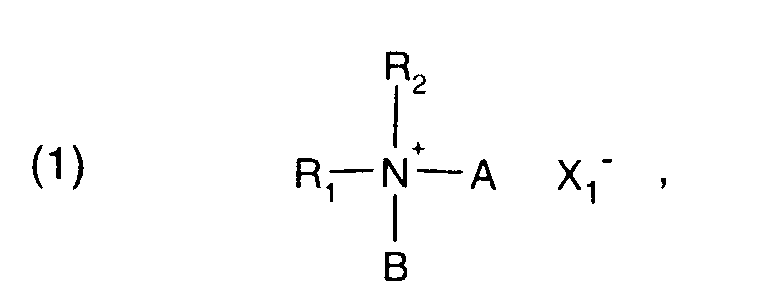
- R1 und R2 unabhängig voneinander C1-C5-Alkyl; oder Hydroxy-C1-C5-Alkyl;
- A den Rest der Formel
oder den Rest der Formel
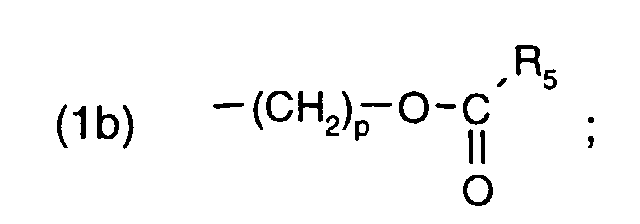
- B
- C1-C5-Alkyl; einen C8-C20-Fettsäurerest; den Rest der Formel (1a) oder den Rest der Formel (1b);
- R3, R4 und R5 unabhängig voneinander einen C8-C20-Fettsäurerest;
- X1 -
- ein für Weichmacher kompatibles Anion;
m, n und p eine Zahl von 0 bis 5;
bedeuten.

- PC
- das Phthalocyaninringsystem;
- Me
- Zn, Fe(ll), Ca, Mg, Na, K, Al-Z1, Si(lV), P(V), Ti(lV), Ge(lV), Cr(VI), Ga(lll), Zr(lV), In(lll), Sn(lV) oder Hf(Vl);
- Z1
- ein Halogenid-, Sulfat-, Nitrat-, Acetat-, Alkoholat-, Carboxylat- oder Hydroxy-lon;
- q
- 0,1 oder 2;
- r
- 1 bis 4;
- Q1
- eine Sulfo- oder Carboxylgruppe; oder einen Rest der Formel -SO2X2-R6-X3 +, -O-R6-X3 +; oder -(CH2)t-Y1 +;
- R6
- verzweigtes oder unverzweigtes C1-C8-Alkylen; oder 1,3- oder 1,4-Phenylen;
- X2
- -NH-; oder -N-C1-C5-Alkyl-;
- X3 +
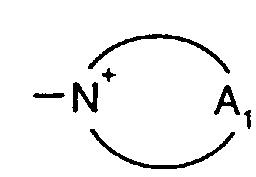
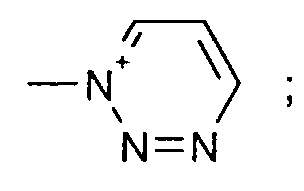
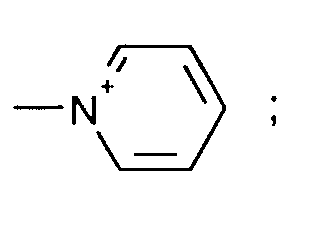
- eine Gruppe der Formel
für den Fall, dass R6 = C1-C8-Alkylen, auch eine Gruppe der Formel


- Y1+
- eine Gruppe der Formel
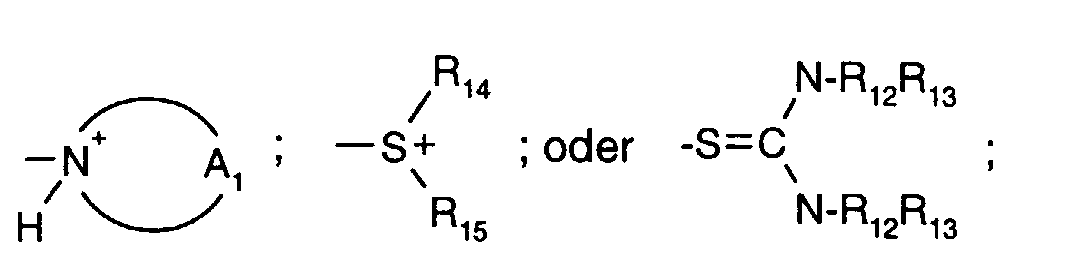
- t
- 0 oder 1;
- R7 und R8
- unabhängig voneinander C1-C6-Alkyl;
- R9
- C1-C6Alkyl; C5-C7-Cycloalkyl; oder NR11R12;
- R10 und R11
- unabhängig voneinander, C1-C5-Alkyl;
- R12 und R13
- unabhängig voneinander Wasserstoff oder C1-C5-Alkyl;
- R14 und R15
- unabhängig voneinander nicht substituiertes oder durch Hydroxy, Cyano, Carboxy, Carb-C1-C6-Akoxy, C1-C6-Alkoxy, Phenyl, Naphthyl oder Pyridyl substituiertes C1-C6-Alkyl;
- u
- 1 bis 6;
- A1
- die Ergänzung zu einem aromatischen 5- bis 7-gliedrigen Stickstoffheterocyclus, der gegebenenfalls noch ein oder zwei weitere Stickstoffatome als Ringglieder enthalten kann, und
- B1
- die Ergänzung zu einem gesättigten 5- bis 7-gliedrigen Stickstoffheterocyclus, der gegebenenfalls noch 1 bis 2 Stickstoff-, Sauerstoff- und/oder Schwefelatome als Ringglieder enthalten kann;
- Q2
- Hydroxy; C1-C22-Alkyl; verzweigtes C4-C22-Alkyl; C2-C22-Alkenyl; verzweigtes C4-C22-Alkenyl
und Mischungen davon; C1-C22-Alkoxy; einen Sulfo- oder Carboxylrest; einen Rest der Formel
 -SO2(CH2)v-OSO3M; -SO2(CH2)v-SO3M;
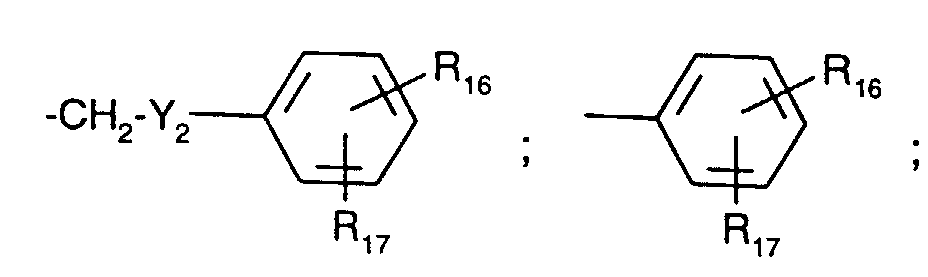
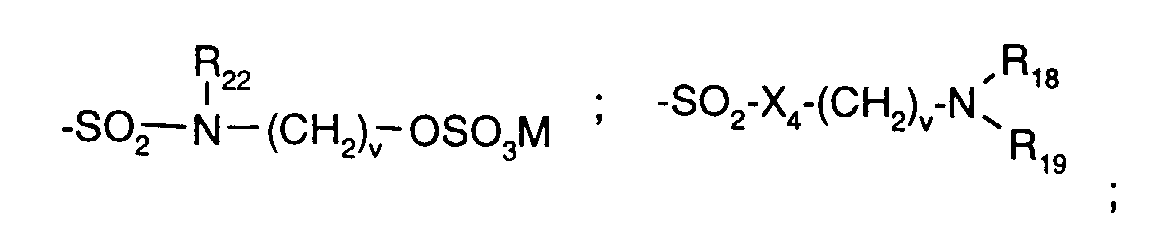
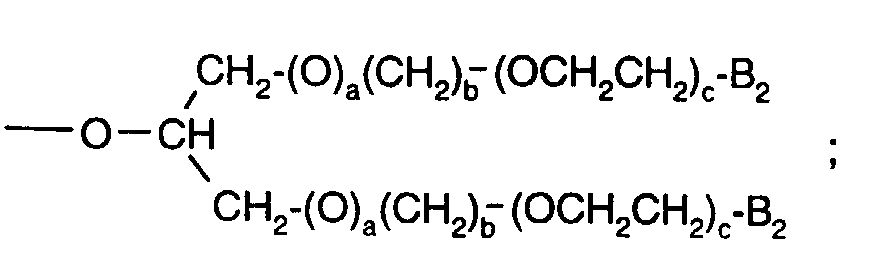
 einen verzweigten Alkoxyrest der Formel

 eine Alkylethylenoxyeinheit der Formel -(T1)d-(CH2)b(OCH2CH2)a-B3 oder einen Ester der Formel COOR23
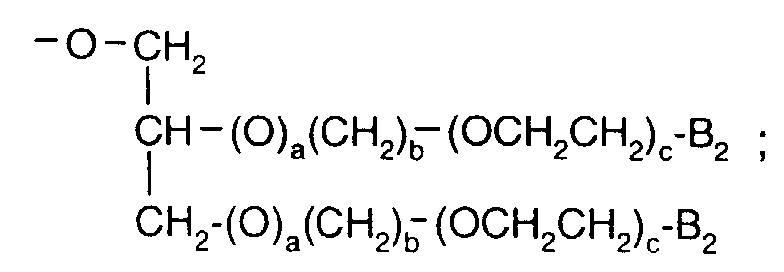
worin - B2
- Wasserstoff; Hydroxy; C1-C30-Alkyl; C1-C30-Alkoxy; -CO2H; -CH2COOH; SO3 -M1 +; -OSO3 -M1 +; -PO3 2-; M1; -OPO3 2-M1; und Mischungen davon;
- B3
- Wasserstoff; Hydroxy; -COOH; -SO3 -M1 +; -OSO3 -M1 +; C1-C6-Alkoxy;
- M1
- ein wasserlösliches Kation;
- T1
- -O-; oder -NH-;
- X1 und X4
- unabhängig voneinander -O-; -NH-; oder -N-C1-C5-Alkyl;
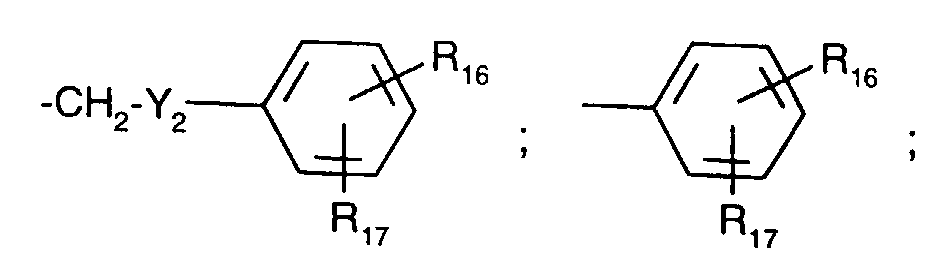
- R16 und R17
- unabhängig voneinander Wasserstoff, die Sulfogruppe und deren Salze, die Carboxylgruppe und deren Salze oder die Hydroxylgruppe bedeuten, wobei mindestens einer der Reste R16 und R17 für eine Sulfo- oder Carboxylgruppe oder deren Salze steht,
- Y2
- -O-, -S-, -NH- oder -N-C1-C5-Alkyl;
- R18 und R19
- unabhängig voneinander Wasserstoff, C1-C6-Alkyl, Hydroxy-C1-C6-Alkyl, Cyano-C1-C6-Alkyl, Sulfo- C1-C6-Alkyl, Carboxy oder Halogen-C1-C6-Alkyl; nicht substituiertes oder durch Halogen, C1-C4-Alkyl oder C1-C4-Alkoxy, Sulfo oder Carboxy substituiertes Phenyl; oder R18 und R19 zusammen mit dem Stickstoffatom, an das sie gebunden sind, einen gesättigten 5- oder 6-gliedrigen heterocyclischen Ring, der zusätzlich noch ein Stickstoff- oder Sauerstoffatom als Ringglied enthalten kann;
- R20 und R21
- unabhängig voneinander einen C1-C6-Alkyl- oder Aryl-C1-C6-Alkylrest;
- R22
- Wasserstoff; oder nicht substituiertes oder durch Halogen, Hydroxy, Cyano, Phenyl, Carboxy, Carb-C1-C6-Alkoxy oder C1-C6-Alkoxy substituiertes C1-C6-Alkyl;
- R23
- C1-C22-Alkyl, verzweigtes C4-C22-Alkyl, C1-C22-Alkenyl oder verzweigtes C4-C22-Alkenyl; C3-C22-Glykol; C1-C22-Alkoxy; verzweigtes C4-C22-Alkoxy; und Mischungen davon;
- M
- Wasserstoff; oder ein Alkalimetall- oder Ammoniumion,
- Z2
- ein Chlor-, Brom, Alkyl- oder Aralkylsulfation;
- a
- 0 oder 1;
- b
- 0 bis 6;
- c
- 0 bis 100;
- d
- 0; oder 1;
- e
- 0 bis 22;
- v
- eine ganze Zahl von 2 bis 12;
- w
- o oder 1; und
- A
- ein organisches oder anorganisches Anion bedeuten, und
- s
- im Falle einwertiger Anionen A- gleich r und im Falle mehrwertiger Anionen ≤ r ist, wobei As - die positive Ladung kompensieren muss; wobei, wenn r ≠ 1, die Reste Q1 gleich oder verschieden sein können,





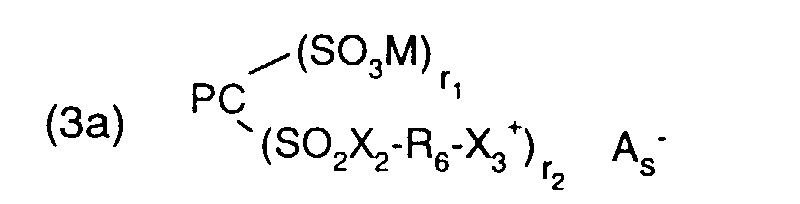
- PC, X2, X3 und R6
- die oben angegebene Bedeutung haben,
- M
- Wasserstoff, ein Alkalimetall-, Ammonium- oder Aminsalzion;
bedeutet, und die Summe der Zahlen r1 und r2 von 1 bis 4 reicht und - As -
- die positive Ladung des Restmoleküls genau kompensiert,
und insbesondere der Formel - worin
- PC
- wie in Formel (2a) definiert ist,
- R6'
- C2-C6-Alkylen;
- r1
- eine Zahl von 1 bis 4;
- X3'
- eine Gruppe der Formel
oder
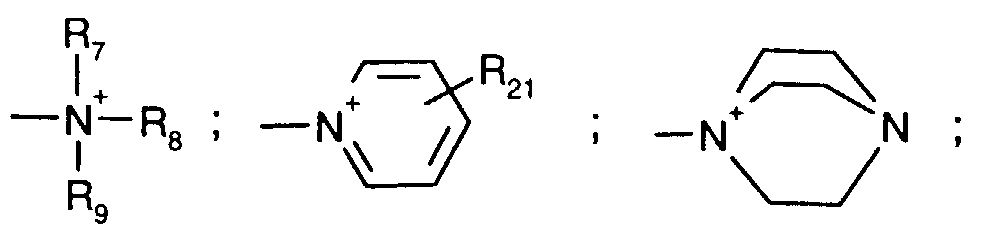 bedeuten,

- R7 und R8
- unabhängig voneinander unsubstituiertes oder durch Hydroxy, Cyano, Halogen oder Phenyl substituiertes C1-C4-Alkyl;
- R9
- R7; Cyclohexyl oder Amino;
- R11
- C1-C4-Alkyl;
- R21
- C1-C4-Alkyl; C1-C4-Alkoxy; Halogen, Carboxy, Carb-C1-C4-Alkoxy oder Hydroxy; und
- A'
- ein Halogenid-, Alkylsulfat- oder Arylsulfation;

- PC
- das Phthalocyaninringsystem;
- Me
- Zn, Fe(ll), Ca, Mg, Na, K, Al-Z1, Si(lV), P(V), Ti(lV), Ge(lV), Cr(VI), Ga(lll), Zr(lV), In(lll), Sn(lV) oder Hf(Vl);
- Z1
- ein Halogenid-, Sulfat-, Nitrat-, Acetat-, Alkoholat-, Carboxylat- oder Hydroxy-lon;
- q
- 0; 1; oder 2;
- Y3'
- Wasserstoff; ein Alkalimetall- oder Ammoniumion; und
- r
- eine beliebige Zahl von 1 bis 4;
- Me
- Zn oder AI-Z1; und
- Z1
- ein Halogenid-, Sulfat-, Nitrat-, Acetat-, Alkoholat-, Carboxylat- oder Hydroxy-lon; bedeuten.

- PC, Me und q
- die in Formel (5) angegebene Bedeutung haben;
- R17' und R18'
- unabhängig voneinander Wasserstoff, Phenyl, Sulfophenyl, Carboxyphenyl, C1-C6-Alkyl, Hydroxy-C1-C6-Alkyl, Cyano-C1-C6-Alkyl, Sulfo-C1-C6-Alkyl, Carboxy-C1-C6-Alkyl oder Halogen C1-C6-Alkyl oder zusammen mit dem Stickstoffatom den Morpholinring;
- q'
- eine ganze Zahl von 2 bis 6; und
- r
- eine Zahl von 1 bis 4;
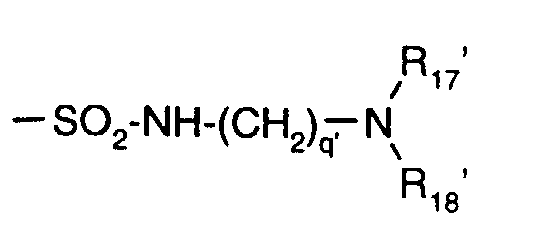

- PC, Me und q
- die in Formel (5) angegebenen Bedeutung haben,
- Y'3
- Wasserstoff, ein Alkalimetall- oder Ammoniumion,
- q'
- eine ganze Zahl von 2 bis 6;
- R17' und R18'
- unabhängig voneinander Wasserstoff, Phenyl, Sulfophenyl, Carboxyphenyl, C1-C6-Alkyl, Hydroxy C1-C6-Alkyl, Cyano C1-C6-Alkyl, Sulfo C1-C6-Alkyl, Carboxy C1-C6-Alkyl oder Halogen C1-C6-Alkyl oder zusammen mit dem Stickstoffatom den Morpholinring,
- m'
- 0 oder 1; und
- r und r1
- unabhängig voneinander eine beliebige Zahl von 0,5 und 3 bedeuten, wobei die Summe r +r1 mindestens 1, jedoch höchstens 4 beträgt.
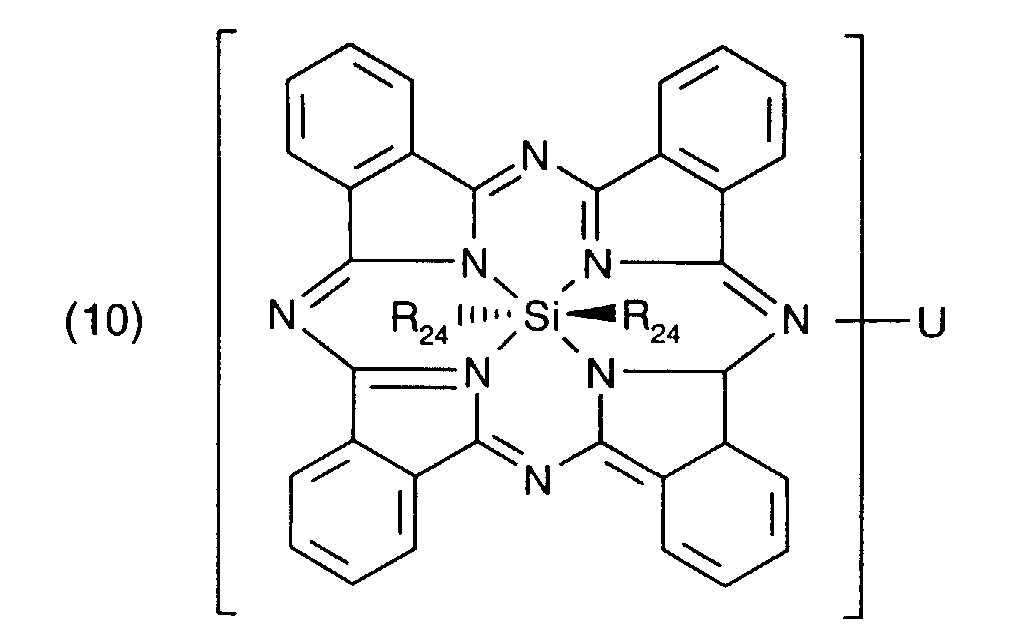
- R24
- Hydroxy; C1-C22-Alkyl; verzweigtes C4-C22-Alkyl; C1-C22-Alkenyl; verzweigtes C4-C22-Alkenyl und Mischungen davon; C1-C22-Alkoxy; einen Sulfo- oder Carboxylrest; einen





- U
- [Q1]r +As -; oder Q2; bedeuten.
- X1
- ein Halogenatom; -CH3SO4 -; -C2H5SO4 -;oder -NO3 -;
A und B unabhängig voneinander den Rest der Formel (1a) oder (1b), oder solche Verbindungen der Formel (1), worin A und B den Rest der Formel (1b) bedeuten.
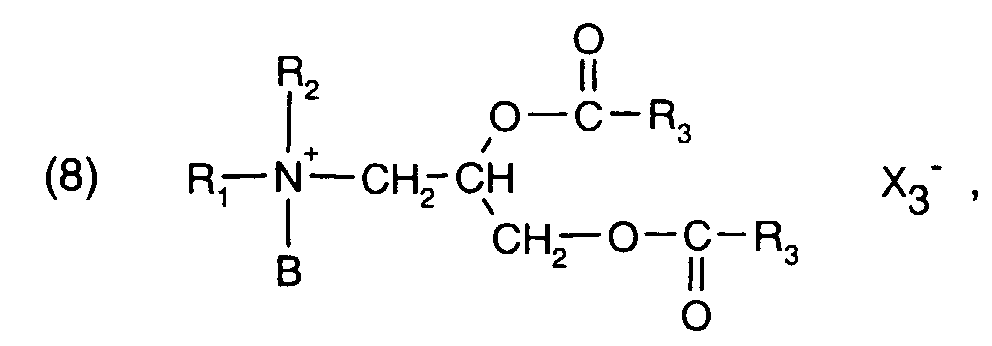
- R1, R2 und B
- C1-C5-Alkyl;
- R3
- den aliphatischen Rest der Talgfettsäure; und
- X3 -
- ein Halogenatom;
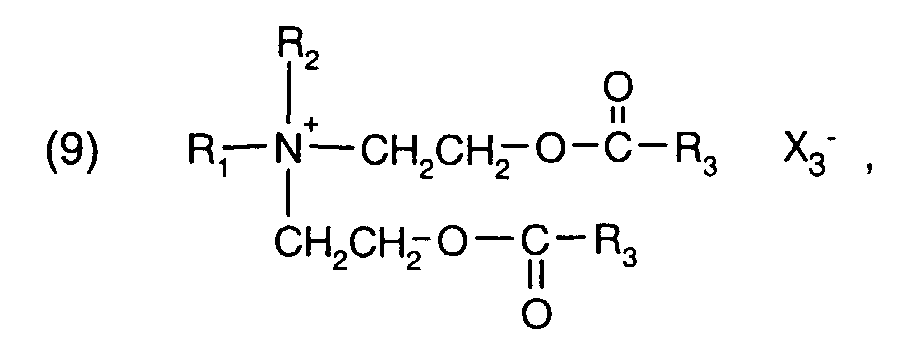
- R1 und R2
- C1-C5-Alkyl;
- R3
- den aliphatischen Rest der Talgfettsäure und
- X3-
- ein Halogenatom;
| Beispiel | Konzentration der Formulierung von (102) [%] | Menge der eingesetzten Formulierung von (102) [g] | eingesetztes Wasser [g] | Menge der Verbindung d. F. (102) [mg] | Verbindung d. F. (102) bezogen auf Spülmittel-Formulierung [%] |
| 1 | 0 | 0,0 | 0,9 | 0,0 | 0,0 |
| 2 | 0,038 | 0,9 | 0,0 | 0,345 | 0,00115 |
| 3 | 0,23 | 0,45 | 0,45 | 1,035 | 0,00345 |
| 4 | 0,23 | 0,9 | 0,0 | 2,074 | 0,00690 |

werden in eine 50 ml Flasche vorgelegt. Dazu werden 0,9 g Wasser bzw. ein Gemisch aus Wasser und der angegebenen Menge der Formulierung, enthaltend als Aktivsubstanz die Verbindung der Formel
| Formulierung aus Beispiel | ohne Belichtung | mit 2 h Belichtung | ||
| Y[%] | ΔY | Y[%] | ΔY | |
| 1 | 68,1 | 71,1 | ||
| 2 | 67,9 | -0,2 | 74 | 2,9 |
| 3 | 67,3 | -0,8 | 75,9 | 4,8 |
| 4 | 67,6 | -0,5 | 77,8 | 6,7 |
| Formulierung aus Beispiel | ohne Belichtung | mit 2 h Belichtung | ||
| Y[%] | ΔY | Y[%] | ΔY | |
| 1 | 58,1 | 59,1 | ||
| 2 | 58,2 | 0,1 | 60,5 | 1,4 |
| 3 | 58 | -0,1 | 61,2 | 2,1 |
| 4 | 57,9 | -0,2 | 63,3 | 4,2 |
Die Ergebnisse sind in Tabelle 4 aufgeführt:
| Formulierung aus Beispiel | ohne Belichtung | mit 2 Stunden Belichtung | mit 4 Stunden Belichtung | |||
| Y[%] | ΔY | Y[%] | ΔY | Y[%] | ΔY | |
| 1 | 79,4 | 81,2 | 83,4 | |||
| 2 | 78,6 | -0,8 | 84,5 | 3,3 | 87 | 3,6 |
| 3 | 78,6 | -0,8 | 86,3 | 5,1 | 88,7 | 5,3 |
| 4 | 78,7 | -07 | 86,5 | 5,3 | 89 | 5,6 |

werden mit Wasser auf 40 g verdünnt und bei 50-60°C im Wasserbad zu einer homogenen Paste verrührt. Man erhält eine 18,75%ige wässrige Formulierung der Verbindung der Formel (103) (= Formulierung 8a)).
1 Teil des mit Wein und Kaffee angeschmutzten Gewebes wird 4 Stunden feucht unter Osram-Lampen belichtet und nachträglich trockengebügelt.
| Ergebnisse der Waschtests der mit Rotwein bzw. Kaffee angeschmutztem Gewebe | ||||||||
| mit Rotwein angeschmutztes Gewebe Y(Start) = 52,3 | mit Kaffee angeschmutztes Gewebe Y(Start) = 73,7 | |||||||
| ohne Belichtung | mit 4 Stunden Belichtung | ohne Belichtung | mit 4 Stunden Belichtung | |||||
| Y | ΔY | Y | ΔY | Y | ΔY | Y | ΔY | |
| Formulierung 8a) | 66,1 | 66,2 | 77,9 | 80,2 | ||||
| Formulierung 8b) | 65,0 | 1,1 | 71,5 | 5,3 | 79,4 | 1,5 | 86,9 | 6,7 |
| Ergebnisse der Waschtests des mit Tee angeschmutzten Gewebes | ||||||||||||
| mit Tee angeschmutztes Gewebe Y(Start) = 35,5 | ||||||||||||
| nach 1 Waschzyklus | nach 3 Waschzyklen | nach 5 Waschzyklen | ||||||||||
| Belichtung | ohne | 2 Stunden | ohne | 2 Stunden | ohne | 2Stunden | ||||||
| Y | ΔY | Y | ΔY | Y | ΔY | Y | ΔY | Y | ΔY | Y | ΔY | |
| Formulierung 8a) | 40,6 | 40,7 | 41,2 | 44,7 | 41,3 | 49,9 | ||||||
| Formulierung 8b) | 40,2 | -0,4 | 43,4 | 2,7 | 41,6 | 0,4 | 53,4 | 8,7 | 41,6 | 0,3 | 63,5 | 13,6 |
Claims (15)
- Weichspülmittelzusammensetzung, enthaltendbedeuten.(a) ein wasserlösliches Zn, Fe(ll), Ca, Mg, Na, K, Al, Si(lV), P(V), Ti(lV), Ge(lV), Cr(VI), Ga(lll), Zr(lV), In(lll), Sn(lV) oder Hf(VI) Phthalocyanin; und(b) eine quaternäre Ammoniumverbindung der Formelworin
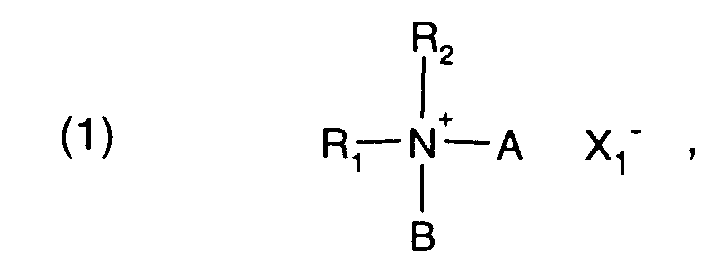 R1 und R2 unabhängig voneinander C1-C5-Alkyl; oder Hydroxy-C1-C5-Alkyl; A den Rest der Formeloder den Rest der Formel

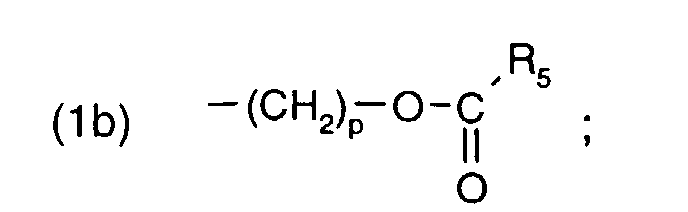 B C1-C5-Alkyl; einen C8-C20-Fettsäurerest; den Rest der Formel (1a) oder den Rest der Formel (1b);R3, R4 und R5 unabhängig voneinander einen C8-C20-Fettsäurerest;X1 - ein für Weichmacher kompatibles Anion;undm, n und p eine Zahl von 0 bis 5;
- Zusammensetzung nach Anspruch 1, dadurch gekennzeichnet, dass sie ein Phthalocyanin der Formelenthält, worin

- PC
- das Phthalocyaninringsystem;
- Me
- Zn, Fe(ll), Ca, Mg, Na, K, Al-Z1, Si(lV), P(V), Ti(lV), Ge(lV), Cr(VI), Ga(lll), Zr(lV), In(lll), Sn(lV) oder Hf(Vl);
- Z1
- ein Halogenid-, Sulfat-, Nitrat-, Acetat-, Alkoholat-, Carboxylat- oder Hydroxy-lon;
- q
- 0,1 oder 2;
- r
- 1 bis 4;
- Q1
- eine Sulfo- oder Carboxylgruppe; oder einen Rest der Formel -SO2X2-R6-X3 +, -O-R6-X3 +; oder -(CH2)tY1 +;
- R6
- verzweigtes oder unverzweigtes C1-C8-Alkylen; oder 1,3- oder 1,4-Phenylen;
- X2
- -NH-; oder -N-C1-C5-Alkyl-;
- X3 +
- eine Gruppe der Formel


- Y1 +
- eine Gruppe der Formel
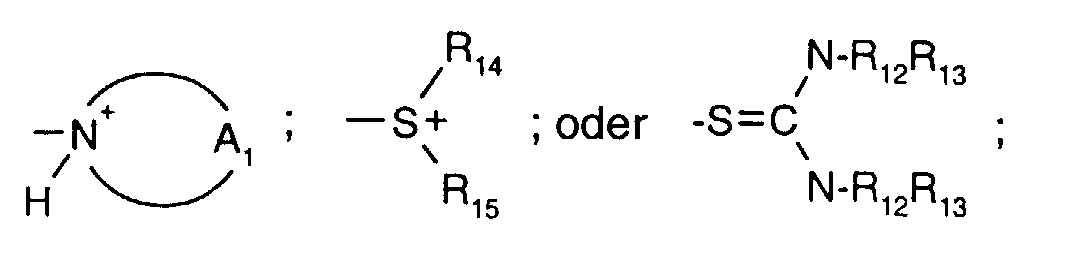
- t
- 0 oder 1;
- R7 und R8
- unabhängig voneinander C1-C6-Alkyl;
- R9
- C1-C6Alkyl; C5-C7-Cycloalkyl; oder NR11R12;
- R10 und R11
- unabhängig voneinander, C1-C5-Alkyl;
- R12 und R13
- unabhängig voneinander Wasserstoff oder C1-C5-Alkyl;
- R14 und R15
- unabhängig voneinander nicht substituiertes oder durch Hydroxy, Cyano, Carboxy, Carb-C1-C6-Akoxy, C1-C6-Alkoxy, Phenyl, Naphthyl oder Pyridyl substituiertes C1-C6-Alkyl;
- u
- 1 bis 6;
- A1
- die Ergänzung zu einem aromatischen 5- bis 7-gliedrigen Stickstoffheterocyclus, der gegebenenfalls noch ein oder zwei weitere Stickstoffatome als Ringglieder enthalten kann, und
- B1
- die Ergänzung zu einem gesättigten 5- bis 7-gliedrigen Stickstoffheterocyclus, der gegebenenfalls noch 1 bis 2 Stickstoff-, Sauerstoff- und/oder Schwefelatome als Ringglieder enthalten kann;
- Q2
- Hydroxy; C1-C22-Alkyl; verzweigtes C4-C22-Alkyl; C2-C22-Alkenyl; verzweigtes C4-C22-Alkenyl
und Mischungen davon; C1-C22-Alkoxy; einen Sulfo- oder Carboxylrest; einen Rest
der Formel
 -SO2(CH2)v-OSO3M; -SO2(CH2)v-SO3M;
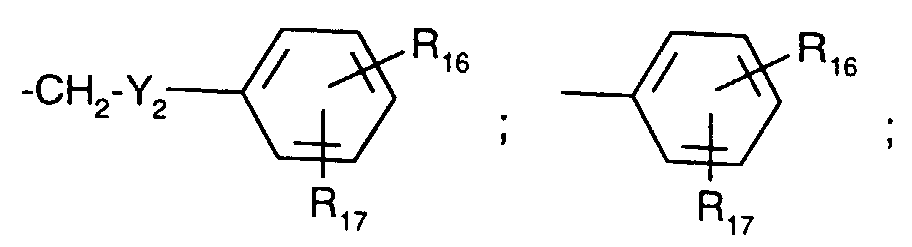

 einen verzweigten Alkoxyrest der Formel

 eine Alkylethylenoxyeinheit der Formel

worin- B2
- Wasserstoff; Hydroxy; C1-C30-Alkyl; C1-C30-Alkoxy; -CO2H; -CH2COOH; SO3 -M1 +; -OSO3 -M1 +; -PO3 2-; M1; -OPO3 2-M1; und Mischungen davon;
- B3
- Wasserstoff; Hydroxy; -COOH; -SO3 -M1 +; -OSO3 -M1 +; C1-C6-Alkoxy;
- M1
- ein wasserlösliches Kation;
- T1
- -O-; oder -NH-;
- X1 und X4
- unabhängig voneinander -O-; -NH-; oder -N-C1-C5-Alkyl;
- R16 und R17
- unabhängig voneinander Wasserstoff, die Sulfogruppe und deren Salze, die Carboxylgruppe und deren Salze oder die Hydroxylgruppe bedeuten, wobei mindestens einer der Reste R16 und R17 für eine Sulfo- oder Carboxylgruppe oder deren Salze steht,
- Y2
- -O-, -S-, -NH- oder -N-C1-C5-Alkyl;
- R18 und R19
- unabhängig voneinander Wasserstoff, C1-C6-Alkyl, Hydroxy-C1-C6-Alkyl, Cyano-C1-C6-Alkyl, Sulfo- C1-C6-Alkyl, Carboxy oder Halogen-C1-C6-Alkyl; nicht substituiertes oder durch Halogen, C1-C4-Alkyl oder C1-C4-Alkoxy, Sulfo oder Carboxy substituiertes Phenyl; oder R18 und R19 zusammen mit dem Stickstoffatom, an das sie gebunden sind, einen gesättigten 5- oder 6-gliedrigen heterocyclischen Ring, der zusätzlich noch ein Stickstoff- oder Sauerstoffatom als Ringglied enthalten kann;
- R20 und R21
- unabhängig voneinander einen C1-C6-Alkyl- oder Aryl-C1-C6-Alkylrest;
- R22
- Wasserstoff; oder nicht substituiertes oder durch Halogen, Hydroxy, Cyano, Phenyl, Carboxy, Carb-C1-C6-Alkoxy oder C1-C6-Alkoxy substituiertes C1-C6-Alkyl;
- R23
- C1-C22-Alkyl, verzweigtes C4-C22-Alkyl, C1-C22-Alkenyl oder verzweigtes C4-C22-Alkenyl; C3-C22-Glykol; C1-C22-Alkoxy; verzweigtes C4-C22-Alkoxy; und Mischungen davon;
- M
- Wasserstoff; oder ein Alkalimetall- oder Ammoniumion,
- Z2
- ein Chlor-, Brom, Alkyl- oder Aralkylsulfation;
- a
- 0 oder 1;
- b
- 0 bis 6;
- c
- 0 bis 100;
- d
- 0; oder 1;
- e
- 0 bis 22;
- v
- eine ganze Zahl von 2 bis 12;
- w
- o oder 1; und
- A
- ein organisches oder anorganisches Anion
- s
- im Falle einwertiger Anionen A- gleich r und im Falle mehrwertiger Anionen ≤ r ist, wobei As - die positive Ladung kompensieren muss; wobei, wenn r ≠ 1, die Reste Q1 gleich oder verschieden sein können,
- Zusammensetzung nach Anspruch 1 oder 2, dadurch gekennzeichnet, dass sie ein Phthalocyanin der Formelenthält, worin

PC, X2, X3, R6 die in Anspruch 2 angegebene Bedeutung haben;- M
- Wasserstoff, ein Alkalimetall-, Ammonium- oder Aminsalzion;
bedeutet, und die Summe der Zahlen r1 und r2 von 1 bis 4 reicht und - As
- die positive Ladung des Restmoleküls genau kompensiert.
- Zusammensetzung nach Anspruch 1 oder 2, dadurch gekennzeichnet, dass es ein Phthalocyanin der Formelenthält, worin

- PC
- wie in Anspruch 2 definiert ist,
- R6'
- C2-C6-Alkylen;
- r1
- eine Zahl von 1 bis 4;
- X3'+
- eine Gruppe der Formel
oder
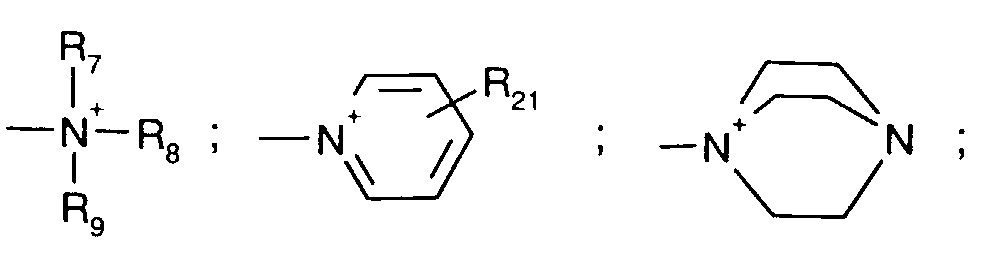 bedeutet,
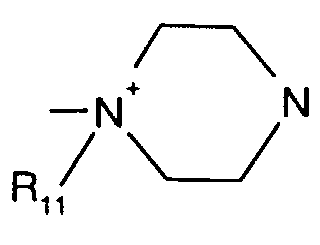
- R7 und R8
- unabhängig voneinander unsubstituiertes oder durch Hydroxy, Cyano, Halogen oder Phenyl substituiertes C1-C4-Alkyl;
- R9
- R7; Cyclohexyl oder Amino;
- R11
- C1-C4-Alkyl;
- R21
- C1-C4-Alkyl; C1-C4-Alkoxy; Halogen, Carboxy, Carb-C1-C4-Alkoxy oder Hydroxy; und
- A'
- ein Halogenid-, Alkylsulfat- oder Arylsulfation;
- Zusammensetzung nach Anspruch 1 oder 2, dadurch gekennzeichnet, dass die Zusammensetzung Phthalocyanine der Formelenthält, worin

- PC
- das Phthalocyaninringsystem;
- Me
- Zn, Fe(ll), Ca, Mg, Na, K, Al-Z1, Si(lV), P(V), Ti(lV), Ge(lV), Cr(VI), Ga(lll), Zr(lV), In(lll), Sn(lV) oder Hf(Vl);
- Z1
- ein Halogenid-, Sulfat-, Nitrat-, Acetat-, Alkoholat-, Carboxylat- oder Hydroxy-lon;
- q
- 0; 1; oder 2;
- Y3'
- Wasserstoff; ein Alkalimetall- oder Ammoniumion; und
- r
- eine beliebige Zahl von 1 bis 4;
- Zusammensetzung nach Anspruch 5, dadurch gekennzeichnet, dass in Formel (5)
- Me
- Zn oder AI-Z1; und
- Z1
- ein Halogenid-, Sulfat-, Nitrat-, Acetat-, Alkoholat-, Carboxylat- oder Hydroxy-lon;
- Zusammensetzung nach Anspruch 1,2 oder 5, dadurch gekennzeichnet, dass die Zusammensetzung ein Phthalocyanin der Formelenthält, worin

- R24
- Hydroxy; C1-C22-Alkyl; verzweigtes C4-C22-Alkyl; C1-C22-Alkenyl; verzweigtes C4-C22-Alkenyl
und Mischungen davon; C1-C22-Alkoxy; einen Sulfo- oder Carboxylrest; einen
Rest der Formel
 -SO2(CH2)v-OSO3M; -SO2(CH2)v-SO3M;


 einen verzweigten
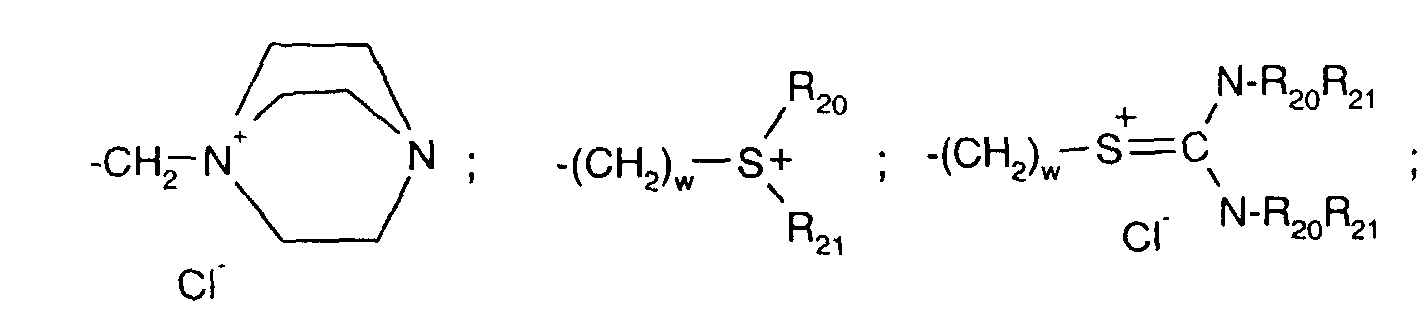
Alkoxyrest der Formel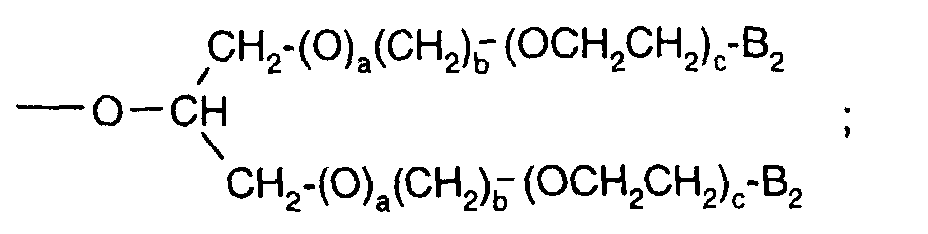 eine Alkylethylenoxyeinheit der Formel

-(T1)d-(CH2)b(OCH2CH2)a-B3 oder einen Ester der Formel COOR23; und - U
- [Q1]R +As -; oder Q2; bedeuten; und
- Zusammensetzung nach einem der Ansprüche 1 bis 7, dadurch gekennzeichnet, dass die quaternäre Ammoniumverbindung der Formel (1) entspricht, worin
- X1
- ein Halogenatom; -CH3SO4 -; -C2H5SO4 -; oder -NO3 -;
- Zusammensetzung nach einem der Ansprüche 1 bis 8, dadurch gekennzeichnet, dass in Formel (1)
A und B unabhängig voneinander den Rest der Formel (1a) oder (1b) bedeuten. - Zusammensetzung nach Anspruch 9, dadurch gekennzeichnet, dass
A und B den Rest der Formel (1b) bedeuten. - Zusammensetzung nach einem der Ansprüche 1 bis 7, dadurch gekennzeichnet, dass die quaternäre Ammoniumverbindung der Formelentspricht, worin
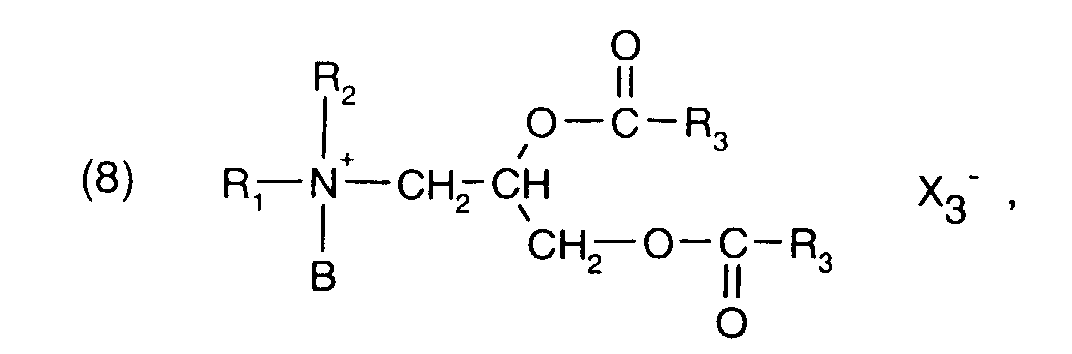
- R1, R2 und B
- C1-C5-Alkyl;
- R3
- den aliphatischen Rest der Talgfettsäure; und
- X3-
- ein Halogenatom;
- Zusammensetzung nach Anspruch 1, enthaltend(a) ein wasserlösliches Phthalocyanin der Formel (5) nach Anspruch 5 und(b) eine quaternäre Ammoniumverbindung der Formel (8) nach Anspruch 11.
- Zusammensetzung nach Anspruch 1, enthaltend(a) ein wasserlösliches Phthalocyanin der Formel (10) nach Anspruch 7 und(b) eine quaternäre Ammoniumverbindung der Formel (8) nach Anspruch 11.
- Zusammensetzung nach Anspruch 1, dadurch gekennzeichnet, dass sie 0,0001 bis 0,05 Gew.% der Komponente (a) und
1 bis 20 Gew.% der Komponente (b)
enthält. - Verfahren zum Bleichen von textilen Fasermaterialien mit einem Photobleichmittel, dadurch gekennzeichnet, dass man angeschmutzte Textilien in einem Bad, das Weichspülmittelzusammensetzung, enthaltendunter Bestrahlung mit sichtbarem und/oder infrarotem Licht oder im Tageslicht und in Gegenwart von Sauerstoff behandelt, wobei man entweder das Weichspülbad direkt oder die feuchten Textilien ausserhalb des Weichspülbades bestrahlt.(a) ein wasserlösliches Zn, Fe(ll), Ca, Mg, Na, K, Al, Si(lV), P(V), Ti(lV), Ge(lV), Cr(VI), Ga(lll), Zr(lV), In(lll), Sn(lV) oder Hf(VI) Phthalocyanin; und(b) eine quaternäre Ammoniumverbindung der Formel (1),
Priority Applications (1)
| Application Number | Priority Date | Filing Date | Title |
|---|---|---|---|
| EP98810753A EP0899325B1 (de) | 1997-08-15 | 1998-08-06 | Weichspülmittelzusammemsetzung |
Applications Claiming Priority (3)
| Application Number | Priority Date | Filing Date | Title |
|---|---|---|---|
| EP97810573 | 1997-08-15 | ||
| EP97810573 | 1997-08-15 | ||
| EP98810753A EP0899325B1 (de) | 1997-08-15 | 1998-08-06 | Weichspülmittelzusammemsetzung |
Publications (3)
| Publication Number | Publication Date |
|---|---|
| EP0899325A2 true EP0899325A2 (de) | 1999-03-03 |
| EP0899325A3 EP0899325A3 (de) | 1999-07-21 |
| EP0899325B1 EP0899325B1 (de) | 2001-12-19 |
Family
ID=8230344
Family Applications (1)
| Application Number | Title | Priority Date | Filing Date |
|---|---|---|---|
| EP98810753A Expired - Lifetime EP0899325B1 (de) | 1997-08-15 | 1998-08-06 | Weichspülmittelzusammemsetzung |
Country Status (11)
| Country | Link |
|---|---|
| US (1) | US6583105B1 (de) |
| EP (1) | EP0899325B1 (de) |
| JP (1) | JPH11172575A (de) |
| KR (1) | KR100505528B1 (de) |
| AU (1) | AU747856B2 (de) |
| BR (1) | BR9803753A (de) |
| DE (1) | DE59802506D1 (de) |
| ES (1) | ES2169492T3 (de) |
| ID (1) | ID20699A (de) |
| NZ (1) | NZ331196A (de) |
| ZA (1) | ZA987302B (de) |
Cited By (6)
| Publication number | Priority date | Publication date | Assignee | Title |
|---|---|---|---|---|
| EP0959123A1 (de) * | 1998-05-18 | 1999-11-24 | Ciba SC Holding AG | Wasserlösliche Granulate von Phthalocyaninverbindungen |
| WO2000052121A3 (en) * | 1999-03-05 | 2001-02-01 | Procter & Gamble | Hydrophobic liquid photobleaches |
| US6291412B1 (en) | 1998-05-18 | 2001-09-18 | Ciba Specialty Chemicals Corporation | Water-soluble granules of phthalocyanine compounds |
| WO2004022693A1 (en) * | 2002-09-04 | 2004-03-18 | Ciba Specialty Chemicals Holding Inc. | Formulations comprising water-soluble granulates |
| EP1806392A1 (de) * | 2005-09-06 | 2007-07-11 | Clariant (Brazil) S.A. | Stabile wässrige Esterquat-Zusammensetztungen |
| CN103147267A (zh) * | 2013-03-06 | 2013-06-12 | 浙江传化股份有限公司 | 一种低温练漂剂及其制备方法 |
Families Citing this family (8)
| Publication number | Priority date | Publication date | Assignee | Title |
|---|---|---|---|---|
| KR100554479B1 (ko) * | 2002-09-11 | 2006-03-03 | 씨제이라이온 주식회사 | 염착 얼룩 방지 세탁용 착염 |
| KR100502955B1 (ko) * | 2002-10-11 | 2005-07-21 | 씨제이라이온 주식회사 | 염착얼룩방지 세탁용 과립조성물 |
| US7345016B2 (en) * | 2003-06-27 | 2008-03-18 | The Procter & Gamble Company | Photo bleach lipophilic fluid cleaning compositions |
| CN101855331B (zh) * | 2007-09-08 | 2013-01-23 | 荷兰联合利华有限公司 | 与织物调理剂相关的改进 |
| GB0717485D0 (en) * | 2007-09-08 | 2007-10-17 | Unilever Plc | Improvements relating to fabric conditioners |
| BR112017015471A2 (pt) | 2015-01-19 | 2018-01-30 | Diversey, Inc. | auxiliar de secagem para produtos têxteis |
| EP3805346B1 (de) | 2019-10-08 | 2024-08-14 | The Procter & Gamble Company | Verfahren zum waschen von stoffen |
| US20240374769A1 (en) * | 2023-05-09 | 2024-11-14 | The Procter & Gamble Company | Light activated cleaning composition |
Family Cites Families (15)
| Publication number | Priority date | Publication date | Assignee | Title |
|---|---|---|---|---|
| GB1408144A (en) | 1972-06-02 | 1975-10-01 | Procter & Gamble Ltd | Bleaching process |
| US4033718A (en) * | 1973-11-27 | 1977-07-05 | The Procter & Gamble Company | Photoactivated bleaching process |
| CA1064797A (en) | 1975-04-03 | 1979-10-23 | Brandon H. Wiers | Photoactivated bleach-compositions and process |
| CH630127A5 (de) | 1977-03-25 | 1982-05-28 | Ciba Geigy Ag | Verfahren zum bleichen von textilien. |
| EP0003371A1 (de) | 1978-01-11 | 1979-08-08 | THE PROCTER & GAMBLE COMPANY | Einen Photoaktivator und eine kationische Verbindung enthaltendes Mittel zum verbesserten Bleichen und Waschen von Textilien |
| CA1104451A (en) * | 1978-02-28 | 1981-07-07 | Manuel Juan De Luque | Detergent bleach composition and process |
| MX155643A (es) * | 1980-02-29 | 1988-04-11 | Ciba Geigy Ag | Composicion blanqueadora de telas |
| EP0054992B1 (de) * | 1980-12-22 | 1985-03-20 | Unilever N.V. | Einen Photoaktivator enthaltende Zusammensetzung mit verbesserter Bleichwirkung |
| JP2855287B2 (ja) | 1990-08-22 | 1999-02-10 | ライオン株式会社 | 柔軟剤組成物 |
| ATE146508T1 (de) * | 1990-11-02 | 1997-01-15 | Zeneca Ltd | Polysubstituierte phthalocyanine |
| JP3330200B2 (ja) | 1993-09-14 | 2002-09-30 | 花王株式会社 | 液体漂白剤組成物 |
| DE69518844T2 (de) * | 1994-07-19 | 2001-04-12 | The Procter & Gamble Company, Cincinnati | Riechstoffe für wasch- und reinigungsmittelzusammensetzungen |
| IL116638A0 (en) | 1995-01-12 | 1996-05-14 | Procter & Gamble | Method and compositions for laundering fabrics |
| US5916481A (en) * | 1995-07-25 | 1999-06-29 | The Procter & Gamble Company | Low hue photobleaches |
| US5679661A (en) * | 1995-07-25 | 1997-10-21 | The Procter & Gamble Company | Low hue photodisinfectants |
-
1998
- 1998-07-31 NZ NZ331196A patent/NZ331196A/xx unknown
- 1998-08-06 DE DE59802506T patent/DE59802506D1/de not_active Expired - Lifetime
- 1998-08-06 ES ES98810753T patent/ES2169492T3/es not_active Expired - Lifetime
- 1998-08-06 EP EP98810753A patent/EP0899325B1/de not_active Expired - Lifetime
- 1998-08-10 ID IDP981114A patent/ID20699A/id unknown
- 1998-08-13 KR KR10-1998-0032821A patent/KR100505528B1/ko not_active Expired - Fee Related
- 1998-08-14 BR BR9803753-6A patent/BR9803753A/pt not_active IP Right Cessation
- 1998-08-14 ZA ZA987302A patent/ZA987302B/xx unknown
- 1998-08-14 AU AU80006/98A patent/AU747856B2/en not_active Ceased
- 1998-08-17 JP JP10230444A patent/JPH11172575A/ja active Pending
-
2000
- 2000-07-19 US US09/618,870 patent/US6583105B1/en not_active Expired - Fee Related
Cited By (9)
| Publication number | Priority date | Publication date | Assignee | Title |
|---|---|---|---|---|
| EP0959123A1 (de) * | 1998-05-18 | 1999-11-24 | Ciba SC Holding AG | Wasserlösliche Granulate von Phthalocyaninverbindungen |
| US6291412B1 (en) | 1998-05-18 | 2001-09-18 | Ciba Specialty Chemicals Corporation | Water-soluble granules of phthalocyanine compounds |
| WO2000052121A3 (en) * | 1999-03-05 | 2001-02-01 | Procter & Gamble | Hydrophobic liquid photobleaches |
| US6645928B1 (en) * | 1999-03-05 | 2003-11-11 | Case Western Reserve University | Hydrophobic liquid photobleaches |
| WO2004022693A1 (en) * | 2002-09-04 | 2004-03-18 | Ciba Specialty Chemicals Holding Inc. | Formulations comprising water-soluble granulates |
| US8080511B2 (en) | 2002-09-04 | 2011-12-20 | Basf Se | Formulations comprising water-soluble granulates |
| EP1806392A1 (de) * | 2005-09-06 | 2007-07-11 | Clariant (Brazil) S.A. | Stabile wässrige Esterquat-Zusammensetztungen |
| CN103147267A (zh) * | 2013-03-06 | 2013-06-12 | 浙江传化股份有限公司 | 一种低温练漂剂及其制备方法 |
| CN103147267B (zh) * | 2013-03-06 | 2015-07-15 | 浙江传化股份有限公司 | 一种低温练漂剂及其制备方法 |
Also Published As
| Publication number | Publication date |
|---|---|
| DE59802506D1 (de) | 2002-01-31 |
| JPH11172575A (ja) | 1999-06-29 |
| ID20699A (id) | 1999-02-18 |
| KR100505528B1 (ko) | 2005-11-09 |
| US6583105B1 (en) | 2003-06-24 |
| AU8000698A (en) | 1999-02-25 |
| NZ331196A (en) | 2000-01-28 |
| ZA987302B (en) | 1999-02-15 |
| EP0899325B1 (de) | 2001-12-19 |
| EP0899325A3 (de) | 1999-07-21 |
| BR9803753A (pt) | 1999-12-07 |
| KR19990023559A (ko) | 1999-03-25 |
| AU747856B2 (en) | 2002-05-23 |
| ES2169492T3 (es) | 2002-07-01 |
Similar Documents
| Publication | Publication Date | Title |
|---|---|---|
| EP0035470B1 (de) | Textilbehandlungsmittel | |
| EP0899325B1 (de) | Weichspülmittelzusammemsetzung | |
| DE2265710C1 (de) | Wasch- und Reinigungsmittelgemisch | |
| EP0026744B1 (de) | Mittel und Verfahren zur Behandlung und Verbesserung des Aussehens von Textilien | |
| DE602004004904T2 (de) | Nuancierungsmittel | |
| EP0153278B1 (de) | Wasserlösliche Phthalocyaninverbindungen und deren Verwendung als Photoaktivatoren | |
| DE3518804C2 (de) | Verfahren zur Durchführung einer Reaktion mit Singlett-Sauerstoff unter Einsatz von wasserlöslichen Azaphthalocyaninen und diese enthaltende Mittel | |
| DE2613936C2 (de) | ||
| DE2627449A1 (de) | Wasch- und bleichmittelgemische sowie verfahren zur verhinderung der farbuebertragung beim waschen oder bleichen | |
| DE2426581A1 (de) | Phosphatfreies weichspuelendes waschmittel | |
| DE2948923A1 (de) | Bleichendes waschmittel und verwendungsverfahren | |
| CH630127A5 (de) | Verfahren zum bleichen von textilien. | |
| DE2703998B2 (de) | ||
| DE1806584A1 (de) | Mono- und Diphthalimido-Derivate und ihre Verwendung als optische Aufheller | |
| DE1806256A1 (de) | Verwendung von Phthalimidinylderivaten als optische Aufheller | |
| EP0350449A2 (de) | Optische Aufheller enthaltende Flüssigwaschmittel | |
| DE2326467C3 (de) | ||
| DE2730246C2 (de) | Mittel zum optischen Aufhellen von synthetischen oder natürlichen organischen Materialien und Verfahren zum Aufhellen von organischen textilen Materialien | |
| EP0270489A1 (de) | Anionische Cyclo-diyliden Verbindungen, deren Herstellung und Verwendung in Waschmitteln als Nuancierfarbstoffe | |
| DE102015218190A1 (de) | Tensid-enthaltende Zusammensetzung zur Behandlung von Textilien mit einem Farbstoff | |
| DE19859575B4 (de) | Einweichmittel mit optischem Aufheller | |
| DE3101914A1 (de) | Teilweise verseifte lezithine und deren verwendung als textil-, papier- oder lederhilfsmittel | |
| EP0334372B1 (de) | Lagerstabile anionische Flüssigwaschmittel enthaltend amphotere Distyrylderivate | |
| EP0060439B1 (de) | Weisstönerhaltige Spinnmassen zur Herstellung von Celluloseregeneratfasern | |
| DE2112198C2 (de) | 2-(3-Phenyl-7-cumarinyl)-v-triazole, Verfahren zu deren Herstellung und deren Verwendung als optische Aufheller |
Legal Events
| Date | Code | Title | Description |
|---|---|---|---|
| PUAI | Public reference made under article 153(3) epc to a published international application that has entered the european phase |
Free format text: ORIGINAL CODE: 0009012 |
|
| AK | Designated contracting states |
Kind code of ref document: A2 Designated state(s): BE CH DE ES FR GB IT LI NL |
|
| AX | Request for extension of the european patent |
Free format text: AL;LT;LV;MK;RO;SI |
|
| PUAL | Search report despatched |
Free format text: ORIGINAL CODE: 0009013 |
|
| AK | Designated contracting states |
Kind code of ref document: A3 Designated state(s): AT BE CH CY DE DK ES FI FR GB GR IE IT LI LU MC NL PT SE |
|
| AX | Request for extension of the european patent |
Free format text: AL;LT;LV;MK;RO;SI |
|
| 17P | Request for examination filed |
Effective date: 19990719 |
|
| AKX | Designation fees paid |
Free format text: BE CH DE ES FR GB IT LI NL |
|
| 17Q | First examination report despatched |
Effective date: 20000524 |
|
| GRAG | Despatch of communication of intention to grant |
Free format text: ORIGINAL CODE: EPIDOS AGRA |
|
| GRAG | Despatch of communication of intention to grant |
Free format text: ORIGINAL CODE: EPIDOS AGRA |
|
| GRAH | Despatch of communication of intention to grant a patent |
Free format text: ORIGINAL CODE: EPIDOS IGRA |
|
| GRAH | Despatch of communication of intention to grant a patent |
Free format text: ORIGINAL CODE: EPIDOS IGRA |
|
| GRAA | (expected) grant |
Free format text: ORIGINAL CODE: 0009210 |
|
| AK | Designated contracting states |
Kind code of ref document: B1 Designated state(s): BE CH DE ES FR GB IT LI NL |
|
| REG | Reference to a national code |
Ref country code: CH Ref legal event code: EP |
|
| REG | Reference to a national code |
Ref country code: GB Ref legal event code: IF02 |
|
| REF | Corresponds to: |
Ref document number: 59802506 Country of ref document: DE Date of ref document: 20020131 |
|
| GBT | Gb: translation of ep patent filed (gb section 77(6)(a)/1977) |
Effective date: 20020319 |
|
| ET | Fr: translation filed | ||
| REG | Reference to a national code |
Ref country code: ES Ref legal event code: FG2A Ref document number: 2169492 Country of ref document: ES Kind code of ref document: T3 |
|
| PLBE | No opposition filed within time limit |
Free format text: ORIGINAL CODE: 0009261 |
|
| STAA | Information on the status of an ep patent application or granted ep patent |
Free format text: STATUS: NO OPPOSITION FILED WITHIN TIME LIMIT |
|
| 26N | No opposition filed | ||
| PGFP | Annual fee paid to national office [announced via postgrant information from national office to epo] |
Ref country code: NL Payment date: 20030704 Year of fee payment: 6 |
|
| PGFP | Annual fee paid to national office [announced via postgrant information from national office to epo] |
Ref country code: BE Payment date: 20031009 Year of fee payment: 6 |
|
| PG25 | Lapsed in a contracting state [announced via postgrant information from national office to epo] |
Ref country code: BE Free format text: LAPSE BECAUSE OF NON-PAYMENT OF DUE FEES Effective date: 20040831 |
|
| BERE | Be: lapsed |
Owner name: *CIBA SPECIALTY CHEMICALS HOLDING INC. Effective date: 20040831 |
|
| PG25 | Lapsed in a contracting state [announced via postgrant information from national office to epo] |
Ref country code: NL Free format text: LAPSE BECAUSE OF NON-PAYMENT OF DUE FEES Effective date: 20050301 |
|
| NLV4 | Nl: lapsed or anulled due to non-payment of the annual fee |
Effective date: 20050301 |
|
| BERE | Be: lapsed |
Owner name: *CIBA SPECIALTY CHEMICALS HOLDING INC. Effective date: 20040831 |
|
| REG | Reference to a national code |
Ref country code: CH Ref legal event code: PFA Owner name: CIBA HOLDING INC. Free format text: CIBA SPECIALTY CHEMICALS HOLDING INC.#KLYBECKSTRASSE 141#4057 BASEL (CH) -TRANSFER TO- CIBA HOLDING INC.#KLYBECKSTRASSE 141#4057 BASEL (CH) |
|
| PGFP | Annual fee paid to national office [announced via postgrant information from national office to epo] |
Ref country code: CH Payment date: 20090605 Year of fee payment: 12 |
|
| REG | Reference to a national code |
Ref country code: CH Ref legal event code: PL |
|
| PG25 | Lapsed in a contracting state [announced via postgrant information from national office to epo] |
Ref country code: CH Free format text: LAPSE BECAUSE OF NON-PAYMENT OF DUE FEES Effective date: 20100831 Ref country code: LI Free format text: LAPSE BECAUSE OF NON-PAYMENT OF DUE FEES Effective date: 20100831 |
|
| PGFP | Annual fee paid to national office [announced via postgrant information from national office to epo] |
Ref country code: GB Payment date: 20120831 Year of fee payment: 15 |
|
| PGFP | Annual fee paid to national office [announced via postgrant information from national office to epo] |
Ref country code: FR Payment date: 20120914 Year of fee payment: 15 Ref country code: IT Payment date: 20120828 Year of fee payment: 15 |
|
| PGFP | Annual fee paid to national office [announced via postgrant information from national office to epo] |
Ref country code: DE Payment date: 20121031 Year of fee payment: 15 |
|
| PGFP | Annual fee paid to national office [announced via postgrant information from national office to epo] |
Ref country code: ES Payment date: 20120928 Year of fee payment: 15 |
|
| GBPC | Gb: european patent ceased through non-payment of renewal fee |
Effective date: 20130806 |
|
| PG25 | Lapsed in a contracting state [announced via postgrant information from national office to epo] |
Ref country code: DE Free format text: LAPSE BECAUSE OF NON-PAYMENT OF DUE FEES Effective date: 20140301 |
|
| REG | Reference to a national code |
Ref country code: FR Ref legal event code: ST Effective date: 20140430 |
|
| PG25 | Lapsed in a contracting state [announced via postgrant information from national office to epo] |
Ref country code: IT Free format text: LAPSE BECAUSE OF NON-PAYMENT OF DUE FEES Effective date: 20130806 |
|
| REG | Reference to a national code |
Ref country code: DE Ref legal event code: R119 Ref document number: 59802506 Country of ref document: DE Effective date: 20140301 |
|
| PG25 | Lapsed in a contracting state [announced via postgrant information from national office to epo] |
Ref country code: GB Free format text: LAPSE BECAUSE OF NON-PAYMENT OF DUE FEES Effective date: 20130806 |
|
| PG25 | Lapsed in a contracting state [announced via postgrant information from national office to epo] |
Ref country code: FR Free format text: LAPSE BECAUSE OF NON-PAYMENT OF DUE FEES Effective date: 20130902 |
|
| REG | Reference to a national code |
Ref country code: ES Ref legal event code: FD2A Effective date: 20140909 |
|
| PG25 | Lapsed in a contracting state [announced via postgrant information from national office to epo] |
Ref country code: ES Free format text: LAPSE BECAUSE OF NON-PAYMENT OF DUE FEES Effective date: 20130807 |