EP0899565A1 - Détecteur de chromatographie en phase gazeuse - Google Patents
Détecteur de chromatographie en phase gazeuse Download PDFInfo
- Publication number
- EP0899565A1 EP0899565A1 EP97306580A EP97306580A EP0899565A1 EP 0899565 A1 EP0899565 A1 EP 0899565A1 EP 97306580 A EP97306580 A EP 97306580A EP 97306580 A EP97306580 A EP 97306580A EP 0899565 A1 EP0899565 A1 EP 0899565A1
- Authority
- EP
- European Patent Office
- Prior art keywords
- noble gas
- chamber
- chlorine
- sample
- excited
- Prior art date
- Legal status (The legal status is an assumption and is not a legal conclusion. Google has not performed a legal analysis and makes no representation as to the accuracy of the status listed.)
- Withdrawn
Links
- 239000000460 chlorine Substances 0.000 claims abstract description 92
- ZAMOUSCENKQFHK-UHFFFAOYSA-N Chlorine atom Chemical compound [Cl] ZAMOUSCENKQFHK-UHFFFAOYSA-N 0.000 claims abstract description 89
- 229910052801 chlorine Inorganic materials 0.000 claims abstract description 89
- 239000007789 gas Substances 0.000 claims abstract description 44
- 238000000034 method Methods 0.000 claims abstract description 35
- 229910052734 helium Inorganic materials 0.000 claims abstract description 21
- SWQJXJOGLNCZEY-UHFFFAOYSA-N helium atom Chemical compound [He] SWQJXJOGLNCZEY-UHFFFAOYSA-N 0.000 claims abstract description 21
- 239000001307 helium Substances 0.000 claims abstract description 20
- 229910052743 krypton Inorganic materials 0.000 claims abstract description 20
- DNNSSWSSYDEUBZ-UHFFFAOYSA-N krypton atom Chemical compound [Kr] DNNSSWSSYDEUBZ-UHFFFAOYSA-N 0.000 claims abstract description 17
- 230000005284 excitation Effects 0.000 claims abstract description 8
- 230000003595 spectral effect Effects 0.000 claims abstract 2
- 229910052756 noble gas Inorganic materials 0.000 claims description 45
- 238000001514 detection method Methods 0.000 claims description 35
- 239000012159 carrier gas Substances 0.000 claims description 19
- 150000001875 compounds Chemical class 0.000 claims description 18
- 229910052736 halogen Inorganic materials 0.000 claims description 16
- 150000002367 halogens Chemical class 0.000 claims description 16
- 239000000203 mixture Substances 0.000 claims description 12
- 229910052724 xenon Inorganic materials 0.000 claims description 4
- FHNFHKCVQCLJFQ-UHFFFAOYSA-N xenon atom Chemical compound [Xe] FHNFHKCVQCLJFQ-UHFFFAOYSA-N 0.000 claims description 4
- 230000005283 ground state Effects 0.000 claims description 3
- 150000002894 organic compounds Chemical class 0.000 claims description 3
- -1 halide compounds Chemical class 0.000 claims description 2
- 150000004820 halides Chemical class 0.000 claims 14
- 230000005281 excited state Effects 0.000 claims 2
- 150000002484 inorganic compounds Chemical class 0.000 claims 2
- 229910010272 inorganic material Inorganic materials 0.000 claims 2
- 230000003993 interaction Effects 0.000 claims 2
- 230000005540 biological transmission Effects 0.000 claims 1
- 230000001419 dependent effect Effects 0.000 claims 1
- 238000010892 electric spark Methods 0.000 claims 1
- 230000005855 radiation Effects 0.000 description 60
- 239000000523 sample Substances 0.000 description 33
- 238000006243 chemical reaction Methods 0.000 description 22
- 239000002019 doping agent Substances 0.000 description 21
- 239000003570 air Substances 0.000 description 18
- 150000001805 chlorine compounds Chemical class 0.000 description 13
- 239000000463 material Substances 0.000 description 11
- VZGDMQKNWNREIO-UHFFFAOYSA-N tetrachloromethane Chemical compound ClC(Cl)(Cl)Cl VZGDMQKNWNREIO-UHFFFAOYSA-N 0.000 description 10
- OKTJSMMVPCPJKN-UHFFFAOYSA-N Carbon Chemical compound [C] OKTJSMMVPCPJKN-UHFFFAOYSA-N 0.000 description 9
- 229910052799 carbon Inorganic materials 0.000 description 9
- 239000010453 quartz Substances 0.000 description 7
- VYPSYNLAJGMNEJ-UHFFFAOYSA-N silicon dioxide Inorganic materials O=[Si]=O VYPSYNLAJGMNEJ-UHFFFAOYSA-N 0.000 description 7
- 229910052731 fluorine Inorganic materials 0.000 description 6
- 239000011737 fluorine Substances 0.000 description 6
- 238000005259 measurement Methods 0.000 description 6
- 150000002500 ions Chemical class 0.000 description 5
- ORUIBWPALBXDOA-UHFFFAOYSA-L magnesium fluoride Chemical compound [F-].[F-].[Mg+2] ORUIBWPALBXDOA-UHFFFAOYSA-L 0.000 description 5
- 150000002835 noble gases Chemical class 0.000 description 5
- 230000003287 optical effect Effects 0.000 description 5
- XKRFYHLGVUSROY-UHFFFAOYSA-N Argon Chemical compound [Ar] XKRFYHLGVUSROY-UHFFFAOYSA-N 0.000 description 4
- PXGOKWXKJXAPGV-UHFFFAOYSA-N Fluorine Chemical compound FF PXGOKWXKJXAPGV-UHFFFAOYSA-N 0.000 description 4
- 238000011895 specific detection Methods 0.000 description 4
- 238000012360 testing method Methods 0.000 description 4
- 239000003054 catalyst Substances 0.000 description 3
- 238000010586 diagram Methods 0.000 description 3
- 230000002452 interceptive effect Effects 0.000 description 3
- 229910001635 magnesium fluoride Inorganic materials 0.000 description 3
- 238000000197 pyrolysis Methods 0.000 description 3
- 230000035945 sensitivity Effects 0.000 description 3
- 239000002689 soil Substances 0.000 description 3
- XLYOFNOQVPJJNP-UHFFFAOYSA-N water Substances O XLYOFNOQVPJJNP-UHFFFAOYSA-N 0.000 description 3
- IJGRMHOSHXDMSA-UHFFFAOYSA-N Atomic nitrogen Chemical compound N#N IJGRMHOSHXDMSA-UHFFFAOYSA-N 0.000 description 2
- CRCGQDIFUPCYPU-UHFFFAOYSA-N [Cl].[Kr] Chemical compound [Cl].[Kr] CRCGQDIFUPCYPU-UHFFFAOYSA-N 0.000 description 2
- 229910052786 argon Inorganic materials 0.000 description 2
- VKDJIPBMRCGQMQ-UHFFFAOYSA-N argon krypton xenon Chemical compound [Ar].[Kr].[Xe] VKDJIPBMRCGQMQ-UHFFFAOYSA-N 0.000 description 2
- 229910021398 atomic carbon Inorganic materials 0.000 description 2
- 230000015572 biosynthetic process Effects 0.000 description 2
- NEHMKBQYUWJMIP-UHFFFAOYSA-N chloromethane Chemical compound ClC NEHMKBQYUWJMIP-UHFFFAOYSA-N 0.000 description 2
- 239000000470 constituent Substances 0.000 description 2
- 239000010779 crude oil Substances 0.000 description 2
- 239000003344 environmental pollutant Substances 0.000 description 2
- 229930195733 hydrocarbon Natural products 0.000 description 2
- 150000002430 hydrocarbons Chemical class 0.000 description 2
- 238000012544 monitoring process Methods 0.000 description 2
- 231100000719 pollutant Toxicity 0.000 description 2
- KZBUYRJDOAKODT-UHFFFAOYSA-N Chlorine Chemical compound ClCl KZBUYRJDOAKODT-UHFFFAOYSA-N 0.000 description 1
- NINIDFKCEFEMDL-UHFFFAOYSA-N Sulfur Chemical compound [S] NINIDFKCEFEMDL-UHFFFAOYSA-N 0.000 description 1
- 238000010521 absorption reaction Methods 0.000 description 1
- 239000000809 air pollutant Substances 0.000 description 1
- 231100001243 air pollutant Toxicity 0.000 description 1
- 230000003321 amplification Effects 0.000 description 1
- 238000001311 chemical methods and process Methods 0.000 description 1
- 150000008280 chlorinated hydrocarbons Chemical class 0.000 description 1
- 230000001627 detrimental effect Effects 0.000 description 1
- 238000005516 engineering process Methods 0.000 description 1
- 150000002366 halogen compounds Chemical class 0.000 description 1
- 239000000383 hazardous chemical Substances 0.000 description 1
- 230000000155 isotopic effect Effects 0.000 description 1
- 238000012886 linear function Methods 0.000 description 1
- 229910052757 nitrogen Inorganic materials 0.000 description 1
- 238000003199 nucleic acid amplification method Methods 0.000 description 1
- 239000000575 pesticide Substances 0.000 description 1
- 239000000447 pesticide residue Substances 0.000 description 1
- 239000002574 poison Substances 0.000 description 1
- 231100000614 poison Toxicity 0.000 description 1
- 238000005086 pumping Methods 0.000 description 1
- 238000011002 quantification Methods 0.000 description 1
- 238000005215 recombination Methods 0.000 description 1
- 238000007670 refining Methods 0.000 description 1
- 238000000926 separation method Methods 0.000 description 1
- 239000011593 sulfur Substances 0.000 description 1
- 229910052717 sulfur Inorganic materials 0.000 description 1
- 239000011573 trace mineral Substances 0.000 description 1
- 235000013619 trace mineral Nutrition 0.000 description 1
- 239000003403 water pollutant Substances 0.000 description 1
- 238000007704 wet chemistry method Methods 0.000 description 1
Images
Classifications
-
- G—PHYSICS
- G01—MEASURING; TESTING
- G01N—INVESTIGATING OR ANALYSING MATERIALS BY DETERMINING THEIR CHEMICAL OR PHYSICAL PROPERTIES
- G01N27/00—Investigating or analysing materials by the use of electric, electrochemical, or magnetic means
- G01N27/62—Investigating or analysing materials by the use of electric, electrochemical, or magnetic means by investigating the ionisation of gases, e.g. aerosols; by investigating electric discharges, e.g. emission of cathode
- G01N27/68—Investigating or analysing materials by the use of electric, electrochemical, or magnetic means by investigating the ionisation of gases, e.g. aerosols; by investigating electric discharges, e.g. emission of cathode using electric discharge to ionise a gas
- G01N27/70—Investigating or analysing materials by the use of electric, electrochemical, or magnetic means by investigating the ionisation of gases, e.g. aerosols; by investigating electric discharges, e.g. emission of cathode using electric discharge to ionise a gas and measuring current or voltage
-
- G—PHYSICS
- G01—MEASURING; TESTING
- G01N—INVESTIGATING OR ANALYSING MATERIALS BY DETERMINING THEIR CHEMICAL OR PHYSICAL PROPERTIES
- G01N30/00—Investigating or analysing materials by separation into components using adsorption, absorption or similar phenomena or using ion-exchange, e.g. chromatography or field flow fractionation
- G01N30/02—Column chromatography
- G01N30/62—Detectors specially adapted therefor
- G01N30/64—Electrical detectors
-
- G—PHYSICS
- G01—MEASURING; TESTING
- G01N—INVESTIGATING OR ANALYSING MATERIALS BY DETERMINING THEIR CHEMICAL OR PHYSICAL PROPERTIES
- G01N30/00—Investigating or analysing materials by separation into components using adsorption, absorption or similar phenomena or using ion-exchange, e.g. chromatography or field flow fractionation
- G01N30/02—Column chromatography
- G01N30/62—Detectors specially adapted therefor
- G01N30/64—Electrical detectors
- G01N2030/642—Electrical detectors photoionisation detectors
Definitions
- This disclosure is directed toward the measurement of concentrations of compounds in a gas sample. More particularly, the disclosure is directed toward methods and apparatus for measuring concentrations of compounds containing chlorine within a mixture of noble gases and, in particular, within a helium carrier gas which has been doped with relatively small concentrations of krypton.
- the disclosed system has also been used for measuring concentrations of other halogens such as fluorine.
- Other noble gas dopants such as xenon and argon have a!so been employed. Spark discharges are used to initiate a series of reactions within the carrier gas and sample mixture which results in the formation of an excited chlorine-krypton molecule which, in turn, emits characteristic photon radiation.
- the concentration of chlorine within the sample is then determined from the measured intensity of the characteristic photon radiation from the decay of excited chlorine-krypton. It is emphasized that the intensity of the characteristic photon radiation is proportional to the mass of chlorine within the sample. The chlorine content is, therefore, determined independently of the structure of the compound in which it is contained.
- Chlorine pollutants in air or in water are generally in the form of organic compounds. Pollutants, however, also include a far greater variety of compounds which have chlorine in them.
- Common, and potentially dangerous, water and air pollutants include gaseous freons, pesticide residue in the soil, polychlorobiphenyl (often called PCB) and many others. While all of these can be extremely valuable compounds in one aspect, they can also be detrimental in trace quantities where they are not wanted. They are especially difficult to isolate, quantify and remove in trace quantities. Even trace quantities of these materials can pose significant environmental hazards in air, water, and soil.
- Detectors which respond to trace amounts of chlorine are also needed in many chemical processes which utilize catalysts. Even trace amounts of chlorine can deteriorate or even destroy catalysts. As an example, in the crude oil refining industry, concentrations of chlorine as low as ten parts per million can essentially destroy or "poison" the catalyst used in refineries which produce gasoline.
- U. S Patent No. 5,019,517 to Dale M. Coulson discloses a detector system and method for detecting trace gases.
- the detection system is especially suited for detecting a halogen containing component in a gas stream, and includes a gas chromatograph which is connected by a gas line to a pyrolysis chamber. Sources of additional gas streams are connected by a second gas line to the pyrolysis chamber.
- the system features a temperature control feedback system which maintains the temperature of the pyrolysis chamber independent of the detector electrodes and at a temperature between about 700 and 1,000 degrees Centigrade (°C).
- U. S. Patent No. 4,440,726 to Dale M. Coulson discloses an electrochemical detector cell which is sensitive to trace elements including chlorine and chlorine compounds. These techniques are usually slow, require apparatus which is relatively expensive to fabricate, operate and maintain. In addition, the apparatus associated with these techniques are relatively large physically, and the actual measurements are compound-specific. Test standards of the EPA are similar to the Coulson process mentioned above
- ELCD electrolytic conductivity detector
- Hall detector An electrolytic conductivity detector (ELCD), known in the art as the Hall detector, has been used to detect very small quantities of compounds containing elements such as sulfur and nitrogen. This technology is taught in U.S. Patents Nos. 3,934,193 and 4,555,383 to R. C. Hall. Hall's teachings of chlorine compound detection is limited to the detection of chlorinated hydrocarbons such as pesticides.
- Detection devices consisting of a pulse discharge chamber have been used to detect very small elemental concentrations, including chlorine.
- This type of detection device is exemplified by the disclosures of U.S. Patent Nos. 5,153,519 and 5,317,271 to Stanley D. Stearns and Wayne E. Wentworth, both of which are assigned to the assignee of the present disclosure.
- Selective sample ionization and element-specific photon radiation both generated by continuous or pulsed spark discharges, are used to determine quantitatively elements and compounds of interest within a sample.
- chlorine can be detected by the direct excitation of chlorine which decays by the emission of relatively intense radiation at a characteristic wavelength of approximately 138 nanometers (nm).
- This emission is resolved from other radiations generated within the pulse discharge chamber by means of a monochromator or other suitable spectrographic device. Since air is not transparent to radiation of wavelength less than approximately 200 nm, the monochromator of other spectrographic devices must be operated under vacuum conditions. Likewise, the "window" within the pulse discharge chamber through which the 138 nm emerges and impinges upon the monochromator must also be transparent to this radiation of interest. Relatively inexpensive quartz can not be used as a window material since it is only transparent to radiation above 200 nm. Instead, generally more expensive materials, such as magnesium fluoride, must be used as the chamber window material.
- One objective of the invention is to provide a chromatographic detector system which responds specifically to the element chlorine, or to any compounds containing the element chlorine.
- a further objective of the invention is to provide a detection system which can detect chlorine in amounts as small as 1 picogram (pg), and which responds linearly to the amount of chlorine within a sample over at least three orders of magnitude.
- a still further objective of the invention is to provide a system which can measure concentrations of other halogens.
- a still further goal of the invention is to provide a chlorine specific detection system which is relatively inexpensive to fabricate and maintain, physically compact and rugged, and relatively easy to operate. This objective includes a detection system which utilizes a spectrographic system such as a monochromator which can be operated in air at atmospheric pressure.
- the present disclosure sets forth a chlorine specific detection system which meets the foregoing objectives, and which provides additional advantages that will become apparent in the following disclosure.
- the system can also be used to measure concentrations of other halogens.
- the system is especially successful in detecting and quantifying chlorine in the form of both volatile organic and inorganic chlorine compounds, as well as chlorine gas.
- the sample is commingled in a mixture of noble gases. More specifically, a small concentration of krypton (Kr) gas, referred to as a "dopant", is added to the output from a GC, which contains the suspected chlorine sample of interest dispersed in a helium (He) carrier gas. Alternately the Kr dopant can be added to the carrier gas to the GC.
- Kr krypton
- He helium
- the Kr dopant can be added to the carrier gas to the GC.
- the carrier gas is typically "doped" with 1.0% to 5.0% Kr, and preferably with approximately 1.0% Kr. Tests have shown that the concentration of Kr dopant does not affect the quantitative Cl measurement if the concentration exceeds 0.2% threshold level. This aspect will be discussed further in a subsequent section of this disclosure.
- the mixture of Kr doped helium carrier gas which also contains the chlorine sample to be detected and quantified, is next passed into a spark discharge chamber in which various components of the gas are ionized and excited with an electrical spark discharge.
- the spark discharge can be either continuous or pulsed. Specifically, the spark discharge produces He + and He 2 + ions.
- He + and He 2 + ions then react with the Kr dopant atoms to produce krypton ions, Kr + , and one or two He.
- a generic molecule containing chlorine as "RCl” where "R” represents one or more additional elements
- the Kr + ion then reacts with the RCl molecule to form the excited molecule KrCl* and the ion R + .
- the excited molecule KrCl* decays to the ground state by the emission of characteristic photon radiation in a band centered about a wavelength of 222 nm.
- the emission of photon radiation will be referred to as an emission at 222 nm, but it should be understood that the emission is encompassed by a narrow band of wavelengths which is centered at 222 nm.
- This particular reaction is discussed in the publication "Comparison of the Rg + ( 2 P 1/2 )/Cl - /He and Rg + ( 2 P 3/2 )/Cl - /He three-body ionic-recombination reactions for the formation of RgCl*, Rg* and Cl*", Masaharu Tsuji et al, Chem. Phys ., 94 (6), 4291 (1991).
- the intensity of the emitted 222 nm photon radiation is proportional to the amount of compound RCl in the sample, and more specifically, proportional to the amount of elemental chlorine contained as sample in the Kr doped, helium carrier gas output from the GC column.
- the pulse discharge chamber incorporates a window or port which is transparent to photon radiation at 222 nm. Quartz is a suitable window material which meets this transparency requirement for the radiation of interest at 222 nm. If the detection system is used to detect emissions below 200 nm, window material transparent to these emissions, such as magnesium fluoride (MgF 2 ), must be used.
- Photon radiation emerges from the ionization chamber through the window, and into a monochromator which disperses the photon radiation generated within the ionisation chamber.
- the monochromator therefore provides a means for isolating the 222 nm photon radiation resulting from the decay of excited KrCl from radiation of other wavelengths which might be generated within the pulse discharge chamber.
- the intensity of 222 nm photon radiation delineated or resolved in the monochromator is then measured with a photomultiplier detection system featuring a photomultiplier tube and associated amplification and power circuitry.
- the output of the photomultiplier detection system is, therefore, proportional to the amount of chlorine in the gas which is input into the pulse discharge chamber.
- the photomultiplier detection system output which is typically an electrical current, can be converted to quantitative measures of sample chlorine content by using a calibration conversion constant.
- This calibration conversion constant is determined by measuring the output current of the photomultiplier detector system using samples containing known amounts of chlorine, again assuming that the Kr dopant concentration exceeds the previously mentioned 0.2% threshold concentration.
- the present detection system offers many advantages over prior art systems.
- the photon radiation centered about 222 nm from excited KrCl is easily measured using the previously described photomultiplier detection system.
- air is transparent to the 222 radiation thereby allowing the monochromator used to isolate the photon radiation from chlorine to be operated with air at atmospheric pressure.
- relatively inexpensive quartz can be used as window material in the pulse discharge chamber. If however, the system is used to detect photon radiations below 200 nm resulting for other emissions, air is no longer transparent to radiations of these wavelengths, therefore, the monochromator must be operated in a vacuum.
- Previously referenced detectors which also employ pulse discharge chambers as disclosed U.S. Patent Nos. 5,153,519 and 5,317,271, can excite elemental chlorine.
- the emission from excited chlorine occurs at wavelengths ranging from approximately 130 nm and into the UV-visible region.
- the atomic emission at the low wavelength of approximately 138 nm is intensive, and elemental chlorine concentration can be determined from a measure of this photon radiation.
- the monochromators required to disperse radiation at this wavelength must be devoid of air, since air absorbs radiation at this wavelength. Commonly, these monochromators are put under vacuum using vacuum pumping in order to eliminate the air. This adds significantly to the cost, size, complexity and operating expense of such a prior art detection system.
- quartz is not transparent to radiation at this wavelength. Windows for the pulse discharge chamber made of material transparent at 138 nm, such as magnesium fluoride, must be used in the spark discharge chamber. Magnesium fluoride is considerably more expensive to obtain and to fabricate than quartz, thereby further increasing the cost of such an elemental chlorine detector.
- the sensitivity of the device is as low as 1 to 2 pg of chlorine.
- the output of the photomultiplier detection system is linear with sample chlorine content over at least three orders of magnitude.
- Many chlorine compounds of interest also contain carbon, such as carbon tetrachloride (CCl 4 ).
- CCl 4 carbon tetrachloride
- many of the chlorine compounds of interest are found in hydrocarbons, thus much carbon is present, from other sources such as gasoline, in the sample to be analyzed. Carbon will therefore also be excited within the pulse discharge chamber in addition to excited chlorine as KrCl*.
- Excited atomic carbon emits photon radiation at wavelengths of 193.1 and 247.9 nm.
- the monochromator and associated photomultiplier detector system can easily resolve the 222 nm radiation of interest from the "interfering" photon radiation from carbon.
- the present chlorine specific detection system is very sensitive and is a simple system to operate once the various components have been assembled. It utilizes two sources of noble gas (as a carrier gas system) in which the sample gas containing chlorine is dispersed.
- the primary noble gas is helium which is the carrier gas for a GC column and contains the chlorine compound.
- the trace or dopant gas is krypton which is added to the mixture of helium carrier and sample gas. This mixture is then input into the pulse discharge chamber.
- the spark discharge can be either pulsed or continuous.
- the discharge creates excited KrCl through the reaction sequence previously discussed. Radiation from the decay of excited KrCl is detected with a photomultiplier detection system which utilizes a monochromator operating in air at atmospheric pressure.
- the output of this detection system is used to determine the concentration of chlorine within the sample. It is emphasized that the detection system responds to the mass of chlorine in the sample independent of the structure of a compound. As an example, CCl 4 induces four times the detector response than does CH 3 Cl.
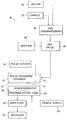
- the single drawing is a schematic block diagram of the detection apparatus of the present disclosure, and sets forth a pulse discharge chamber which has input from a source of an unknown sample, typically a gas chromatographic column, and which exposes a Kr trace gas and He carrier gas to a pulse discharge to thereby create metastable molecules which emit a photon at a particular frequency for quantification of any chlorine which may be present in the sample.
- a source of an unknown sample typically a gas chromatographic column
- the preferred embodiments of the system will be presented in two sections.
- the first section will disclose in detail the detection system apparatus and further, the key elements of the detection system apparatus.
- the second section will present in detail the series of reactions which occur within the pulse discharge chamber which eventually lead to the emission of photon radiation characteristic of the decay of KrCl excitement.
- the detection of this radiation is, as outlined previously, the means by which the chlorine content of the sample is determined.
- the test system utilizing a pulse discharge chamber 12.
- the pulse discharge chamber is a device of the sort described, for example, in Fig. 2 of U.S. Patent No. 5,153,519 and also exemplified in U.S. Patent No. 5,317,271, both of which are assigned to the assignee of the present disclosure.
- the pulse discharge chamber utilizes a current pulsing system 14 which provides a spark across a pair of spaced, separated terminals or electrodes (not shown) in the pulse discharge chamber. Pulsed excitation as commonly used by steady state excitation of the gas flow is acceptable.
- a mixture of gas is input into the pulse discharge chamber 12.
- the schematic illustrates helium carrier gas from a reservoir 24 being input into the gas chromatograph (GC) column 16 as a carrier gas.
- Sample containing the chlorine compound or compounds to be detected and quantified is input into the GC column 16 from a sample source 25.
- Gas eluted from the GC 16 is then flowed through a mixing valve 28.
- Krypton dopant gas from the reservoir 26 is also flowed into the mixing valve 28 where it is commingled with the helium carrier gas containing the unknown sample or samples of chlorine.
- the dopant gas can be added to the carrier gas to the GC.
- this gas mixture is then flowed into the inlet port 13 of the pulse discharge chamber 12 where it passes between the terminals of the pulse discharge chamber and exposed to a pulse discharge spark.
- the gas eventually exits the pulse discharge chamber 12 through the exit port 15 thereby giving a net flow of gas through the chamber from right to left as illustrated in the block diagram of the system.
- the gas which is exposed to the spark is excited. When that occurs, and long after the spark has ended, there remains a number of excited gas molecules as described in detail in the previously referenced U.S. patents Nos. 5,153,519 and 5,317,271, the descriptions which are entered herewithin by reference.
- the system produces, through a series of reactions within the pulse discharge chamber 12, photons from the decay of excited KrCl (KrCl*) which are used to identify and to quantify the chlorine in the sample material.
- KrCl* excited KrCl
- the characteristic photon radiation from the decay of KrCl* is a band centered about a wavelength of 222 nm. Details of the reactions occurring within the pulse discharge chamber 12 will be presented in the next section of this disclosure.
- the pulse discharge chamber 12 contains an optical window which is transparent to the 222 nm photon radiation emitted in the decay of KrCl excitement. Quartz is a material which meets this requirement. This window is identified by the numeral 11 and is depicted conceptually as being physically located in the side of the pulse discharge chamber 12. It should be understood that the optical window can be placed at a variety of locations in the pulse discharge chamber. As an example, in the previously referenced U.S. patents Nos. 5,153,519 and 5,317,271, it is disclosed that the optical window can even be located at the input orifice 13 of the pulse discharge chamber 12, or at any other position on the chamber where photon emission within the chamber 12 can be "viewed".
- a monochromator 18 is positioned near the optical window 11 to receive photon emissions from the chamber. Air at atmospheric pressure is transparent to the 222 nm radiation from chlorine. The monochromator can, therefore, be operated in air at atmospheric pressure, and does not require the vacuum operation or controlled gas environment operation of prior art devices.
- the monochromator can be of the prism type wherein the angle of the prism is adjusted with respect to the incident photon radiation to resolve radiation of a specific energy which, in the chlorine detection system, is 222 nm.
- the 222 nm radiation exits the monochromator 18 and then impinges upon a photomultiplier tube (PMT) 20 which converts the photon signal to a corresponding electrical signal in a manner well known in the art.
- PMT photomultiplier tube
- High voltage and B+ power supplies are shown conceptually as a power supply element 29.
- the current output from the PMT 20 is then amplified by means of the amplifier circuit 30 and subsequently recorded by the recorder 22.
- the intensity of the recorded current is proportional to the chlorine content within the pulse discharge chamber 12.
- Alternate means can be used to resolve the characteristic 222 nm photon radiation resulting from the KrCl excitement.
- the monochromator 18 contains a grating which is adjusted to pass only the characteristic KrCl radiation. This radiation is again detected by the PMT 20 and processed by the photomultiplier detection system as described previously.
- the monochromator is replaced with an interference filter (not shown) which is again set to pass a band of photon radiation centered at 222 nm with a band width of, perhaps, +/- 5 nm. Again the PMT detects the passed photon radiation and the photomultiplier detection system converts this signal to a corresponding optical signal in a manner previously discussed.
- quartz is no longer transparent to the emitted radiation.
- Magnesium fluoride (MgF 2 ) is a suitable window material which is transparent to radiation below 200 nm.
- the monochromator can no longer be operated in air at atmospheric pressure since air is not transparent to photon radiation below approximately 200 nm.
- the monochromator or any alternate spectrographic system must be operated under vacuum conditions.
- a generic chlorine compound will be designated as "RCl” where "R” represents one or more elements forming the chlorine molecule. As an example, “R” would represent CH 3 in CH 3 Cl.
- the excited molecule KrCl* then decays yielding KrCl* ⁇ KrCl + h ⁇ 222 where h ⁇ 222 represents a narrow band of photon radiation centered about a wavelength of 222 nm.
- the yield of 222 nm photon radiation will be independent of the Kr concentration and vary only with the concentration of RCl, as desired.
- An oversupply of krypton above the threshold 0.2% level does not, however, seem to handicap the operation of the system.
- Sensitivity of the chlorine detection device has been measured and has been found to be approximately 1 to 2 picograms of chlorine.
- the reason for this exceptionally high sensitivity apparently arises from the inherent high rate constant for an ion-molecule reaction such as the one depicted in equation (2).
- the response of the system to concentrations of Cl has been found to be linear over at least three orders of magnitude which allows the previously discussed calibration constant, for converting output current from the photomultiplier detection system to absolute chlorine content, to be a simple multiplicative constant.
- the response of chlorine to krypton initiated excitation is observed at 222 nanometers.
- the table below lists the response of both chlorine and fluorine to three noble gases (dopants) in the helium carrier gas. Each response is an observed emission wavelength in nanometers: argon krypton xenon fluorine 193 248 308 chlorine 174 222 308
- xenon dopant reacts with fluorine to yield a moderate response at 351 nm.
- the foregoing wavelength data shows that argon responses are below 200 nm in wavelength, and therefore are in a range at which air absorption is more likely to handicap intensity measurement.
- the ⁇ tabled data therefore suggests preferred use of krypton provided sharp discrimination of the fluorine and chlorine emissions is implemented to separate signals at 222 and 248 nm.
- the krypton is the preferred dopant.
- the present chlorine specific detection system is a simple system to operate once the various components have been assembled. It utilizes two sources of gas in which the sample gas containing chlorine is dispersed.
- the primary noble gas is helium which is the carrier gas from a GC column and contains the chlorine compound.
- the trace or dopant gas is krypton which is added to the mixture of helium carrier and sample gas. This mixture is then input into the pulse discharge chamber.
- the discharge creates excited KrCl through the reaction sequence previously discussed. Radiation from the decay of excited KrCl is detected with a photomultiplier and monochromator detection system which can be operated in air at atmospheric pressure, and the output of this system is used to determine the concentration of chlorine within the sample.
- the system has been found to be extremely sensitive to chlorine, and that the response of the system is linear with sample chlorine content over at least three orders of magnitude. Furthermore, photon radiation from most common "interfering" reactions that can occur within the pulse discharge chamber can be resolved from the desired radiation from the decay of excited KrCl using a monochromator, or alternately, by using a grating or an interference filter.
- the system can also be used to measure concentrations of other halogens. These concentrations are detected in the same methodology as is used to measure chlorine concentration, namely, by measuring radiation characteristic of the decay of a particular halogen compound. It has also been found that noble gases other than Kr can be used as a dopant.
Landscapes
- Chemical & Material Sciences (AREA)
- General Health & Medical Sciences (AREA)
- Life Sciences & Earth Sciences (AREA)
- Health & Medical Sciences (AREA)
- Analytical Chemistry (AREA)
- Biochemistry (AREA)
- Physics & Mathematics (AREA)
- General Physics & Mathematics (AREA)
- Immunology (AREA)
- Pathology (AREA)
- Chemical Kinetics & Catalysis (AREA)
- Electrochemistry (AREA)
- Investigating, Analyzing Materials By Fluorescence Or Luminescence (AREA)
- Other Investigation Or Analysis Of Materials By Electrical Means (AREA)
Priority Applications (2)
| Application Number | Priority Date | Filing Date | Title |
|---|---|---|---|
| CA002213974A CA2213974C (fr) | 1997-08-25 | 1997-08-25 | Detecteur pour chromatographe en phase gazeuse, specifique du chlore |
| EP97306580A EP0899565A1 (fr) | 1997-08-25 | 1997-08-28 | Détecteur de chromatographie en phase gazeuse |
Applications Claiming Priority (2)
| Application Number | Priority Date | Filing Date | Title |
|---|---|---|---|
| CA002213974A CA2213974C (fr) | 1997-08-25 | 1997-08-25 | Detecteur pour chromatographe en phase gazeuse, specifique du chlore |
| EP97306580A EP0899565A1 (fr) | 1997-08-25 | 1997-08-28 | Détecteur de chromatographie en phase gazeuse |
Publications (1)
| Publication Number | Publication Date |
|---|---|
| EP0899565A1 true EP0899565A1 (fr) | 1999-03-03 |
Family
ID=25679574
Family Applications (1)
| Application Number | Title | Priority Date | Filing Date |
|---|---|---|---|
| EP97306580A Withdrawn EP0899565A1 (fr) | 1997-08-25 | 1997-08-28 | Détecteur de chromatographie en phase gazeuse |
Country Status (2)
| Country | Link |
|---|---|
| EP (1) | EP0899565A1 (fr) |
| CA (1) | CA2213974C (fr) |
Cited By (2)
| Publication number | Priority date | Publication date | Assignee | Title |
|---|---|---|---|---|
| CN101995481B (zh) * | 2009-08-26 | 2012-09-26 | 中国科学院电子学研究所 | 超痕量疾病标志物快速检测仪 |
| CN105510503A (zh) * | 2015-12-31 | 2016-04-20 | 上海正帆科技股份有限公司 | 一种电子级氯气的分析装置和方法 |
Citations (4)
| Publication number | Priority date | Publication date | Assignee | Title |
|---|---|---|---|---|
| US4258334A (en) * | 1976-05-17 | 1981-03-24 | Sri International | Noble gas-halogen transfer laser method and means |
| US4259646A (en) * | 1979-04-10 | 1981-03-31 | The United States Of America As Represented By The United States Department Of Energy | High energy KrCl electric discharge laser |
| US5153519A (en) * | 1991-02-28 | 1992-10-06 | Wentworth Wayne E | High voltage spark excitation and ionization detector system |
| WO1995018966A2 (fr) * | 1994-01-03 | 1995-07-13 | Valco Instruments Co. Inc. | Systemes ameliores de decharges electriques pulsees |
-
1997
- 1997-08-25 CA CA002213974A patent/CA2213974C/fr not_active Expired - Lifetime
- 1997-08-28 EP EP97306580A patent/EP0899565A1/fr not_active Withdrawn
Patent Citations (4)
| Publication number | Priority date | Publication date | Assignee | Title |
|---|---|---|---|---|
| US4258334A (en) * | 1976-05-17 | 1981-03-24 | Sri International | Noble gas-halogen transfer laser method and means |
| US4259646A (en) * | 1979-04-10 | 1981-03-31 | The United States Of America As Represented By The United States Department Of Energy | High energy KrCl electric discharge laser |
| US5153519A (en) * | 1991-02-28 | 1992-10-06 | Wentworth Wayne E | High voltage spark excitation and ionization detector system |
| WO1995018966A2 (fr) * | 1994-01-03 | 1995-07-13 | Valco Instruments Co. Inc. | Systemes ameliores de decharges electriques pulsees |
Non-Patent Citations (1)
| Title |
|---|
| WENTWORTH W E ET AL: "PULSED-DISCHARGE HELIUM IONIZATION/ELECTRON CAPTURE/EMISSION DETECTOR OF CHLORINATED COMPOUNDS", PROCESS CONTROL AND QUALITY, vol. 5, no. 2/03, 1 December 1993 (1993-12-01), pages 193 - 204, XP000505400 * |
Cited By (2)
| Publication number | Priority date | Publication date | Assignee | Title |
|---|---|---|---|---|
| CN101995481B (zh) * | 2009-08-26 | 2012-09-26 | 中国科学院电子学研究所 | 超痕量疾病标志物快速检测仪 |
| CN105510503A (zh) * | 2015-12-31 | 2016-04-20 | 上海正帆科技股份有限公司 | 一种电子级氯气的分析装置和方法 |
Also Published As
| Publication number | Publication date |
|---|---|
| CA2213974C (fr) | 2002-01-22 |
| CA2213974A1 (fr) | 1999-02-25 |
Similar Documents
| Publication | Publication Date | Title |
|---|---|---|
| US5394092A (en) | System for identifying and quantifying selected constituents of gas samples using selective photoionization | |
| EP0475250B1 (fr) | Procédé d'analyse de flamme et dispositif détecteur utilisable pour celui-ci | |
| US5473162A (en) | Infrared emission detection of a gas | |
| US7227136B2 (en) | Method and arrangement for detecting harmful substances | |
| US5906946A (en) | Device and process for detecting and discriminating NO and NO2 from other nitrocompounds in real-time and in situ | |
| US4851683A (en) | Element specific radio frequency discharge helium plasma detector for chromatography | |
| CA1304836C (fr) | Methode permettant de detecter la presence de matieres etrangeres dans un gaz | |
| US20090031785A1 (en) | Capacitively coupled dielectric barrier discharge detector | |
| US5826214A (en) | Hand-held probe for real-time analysis of trace pollutants in atmosphere and on surfaces | |
| US6133740A (en) | Chlorine specific gas chromatographic detector | |
| KR100822099B1 (ko) | 가스 중의 질소 측정 방법 및 장치 | |
| JP2008508511A (ja) | コロナ放電イオン化エレメントを備えたイオン移動度分光器 | |
| JP3554329B2 (ja) | 改良型パルス放電システム | |
| CA2213974C (fr) | Detecteur pour chromatographe en phase gazeuse, specifique du chlore | |
| GB2163553A (en) | Method and apparatus for chemiluminescence analysis | |
| US5702954A (en) | Method to detect phosphorus | |
| CA1264382A (fr) | Methode et appareil pour l'analyse d'un melange gazeux; dispositif donnant un spectre d'emission dans le visible, utilise a cette fin | |
| Pack et al. | Use of an air/argon microwave plasma torch for the detection of tetraethyllead | |
| Lamola et al. | Recommended standards for reporting photochemical data | |
| Abdillahi | Gas Chromatography—Microwave-Induced Plasma for the Determination of Halogenated Hydrocarbons | |
| Kondrat’Eva et al. | Comparative study of gas-analyzing systems designed for continuous monitoring of TPP emissions | |
| Kim et al. | A compact AC-glow discharge-optical emission spectrometer for real-time detection of N 2 and Ar in O 2 with sub-ppm-level sensitivity | |
| Sun et al. | Development and characterization of chlorine-selective pulsed discharge emission detector for gas chromatography | |
| Nestrick et al. | Comments on variations in concentrations of organic compounds including polychlorinated dibenzo-p-dioxins and polynuclear aromatic hydrocarbons in fly ash from a municipal incinerator | |
| Lee et al. | Selective detection in pump-and-probe photolytic fragmentation fluorescence spectrometry based on differences in photofragment electronic state distributions |
Legal Events
| Date | Code | Title | Description |
|---|---|---|---|
| PUAI | Public reference made under article 153(3) epc to a published international application that has entered the european phase |
Free format text: ORIGINAL CODE: 0009012 |
|
| AK | Designated contracting states |
Kind code of ref document: A1 Designated state(s): CH DE FR GB IT LI NL SE |
|
| AX | Request for extension of the european patent |
Free format text: AL;LT;LV;RO;SI |
|
| 17P | Request for examination filed |
Effective date: 19990809 |
|
| AKX | Designation fees paid |
Free format text: CH DE FR GB IT LI NL SE |
|
| 17Q | First examination report despatched |
Effective date: 20060804 |
|
| STAA | Information on the status of an ep patent application or granted ep patent |
Free format text: STATUS: THE APPLICATION HAS BEEN WITHDRAWN |
|
| 18W | Application withdrawn |
Effective date: 20090209 |