EP0899653A2 - Prozessor mit verringerter Zahl von bedingten Befehlen - Google Patents
Prozessor mit verringerter Zahl von bedingten Befehlen Download PDFInfo
- Publication number
- EP0899653A2 EP0899653A2 EP98306919A EP98306919A EP0899653A2 EP 0899653 A2 EP0899653 A2 EP 0899653A2 EP 98306919 A EP98306919 A EP 98306919A EP 98306919 A EP98306919 A EP 98306919A EP 0899653 A2 EP0899653 A2 EP 0899653A2
- Authority
- EP
- European Patent Office
- Prior art keywords
- instruction
- conditional
- instructions
- condition
- sequence
- Prior art date
- Legal status (The legal status is an assumption and is not a legal conclusion. Google has not performed a legal analysis and makes no representation as to the accuracy of the status listed.)
- Granted
Links
Images







Classifications
-
- G—PHYSICS
- G06—COMPUTING OR CALCULATING; COUNTING
- G06F—ELECTRIC DIGITAL DATA PROCESSING
- G06F8/00—Arrangements for software engineering
- G06F8/40—Transformation of program code
- G06F8/41—Compilation
- G06F8/44—Encoding
- G06F8/447—Target code generation
-
- G—PHYSICS
- G06—COMPUTING OR CALCULATING; COUNTING
- G06F—ELECTRIC DIGITAL DATA PROCESSING
- G06F9/00—Arrangements for program control, e.g. control units
- G06F9/06—Arrangements for program control, e.g. control units using stored programs, i.e. using an internal store of processing equipment to receive or retain programs
- G06F9/30—Arrangements for executing machine instructions, e.g. instruction decode
- G06F9/30003—Arrangements for executing specific machine instructions
- G06F9/30007—Arrangements for executing specific machine instructions to perform operations on data operands
- G06F9/30021—Compare instructions, e.g. Greater-Than, Equal-To, MINMAX
-
- G—PHYSICS
- G06—COMPUTING OR CALCULATING; COUNTING
- G06F—ELECTRIC DIGITAL DATA PROCESSING
- G06F9/00—Arrangements for program control, e.g. control units
- G06F9/06—Arrangements for program control, e.g. control units using stored programs, i.e. using an internal store of processing equipment to receive or retain programs
- G06F9/30—Arrangements for executing machine instructions, e.g. instruction decode
- G06F9/30003—Arrangements for executing specific machine instructions
- G06F9/3005—Arrangements for executing specific machine instructions to perform operations for flow control
- G06F9/30058—Conditional branch instructions
-
- G—PHYSICS
- G06—COMPUTING OR CALCULATING; COUNTING
- G06F—ELECTRIC DIGITAL DATA PROCESSING
- G06F9/00—Arrangements for program control, e.g. control units
- G06F9/06—Arrangements for program control, e.g. control units using stored programs, i.e. using an internal store of processing equipment to receive or retain programs
- G06F9/30—Arrangements for executing machine instructions, e.g. instruction decode
- G06F9/30003—Arrangements for executing specific machine instructions
- G06F9/30072—Arrangements for executing specific machine instructions to perform conditional operations, e.g. using predicates or guards
-
- G—PHYSICS
- G06—COMPUTING OR CALCULATING; COUNTING
- G06F—ELECTRIC DIGITAL DATA PROCESSING
- G06F9/00—Arrangements for program control, e.g. control units
- G06F9/06—Arrangements for program control, e.g. control units using stored programs, i.e. using an internal store of processing equipment to receive or retain programs
- G06F9/30—Arrangements for executing machine instructions, e.g. instruction decode
- G06F9/30094—Condition code generation, e.g. Carry, Zero flag
-
- G—PHYSICS
- G06—COMPUTING OR CALCULATING; COUNTING
- G06F—ELECTRIC DIGITAL DATA PROCESSING
- G06F9/00—Arrangements for program control, e.g. control units
- G06F9/06—Arrangements for program control, e.g. control units using stored programs, i.e. using an internal store of processing equipment to receive or retain programs
- G06F9/30—Arrangements for executing machine instructions, e.g. instruction decode
- G06F9/30145—Instruction analysis, e.g. decoding, instruction word fields
-
- G—PHYSICS
- G06—COMPUTING OR CALCULATING; COUNTING
- G06F—ELECTRIC DIGITAL DATA PROCESSING
- G06F9/00—Arrangements for program control, e.g. control units
- G06F9/06—Arrangements for program control, e.g. control units using stored programs, i.e. using an internal store of processing equipment to receive or retain programs
- G06F9/30—Arrangements for executing machine instructions, e.g. instruction decode
- G06F9/30145—Instruction analysis, e.g. decoding, instruction word fields
- G06F9/3016—Decoding the operand specifier, e.g. specifier format
- G06F9/30167—Decoding the operand specifier, e.g. specifier format of immediate specifier, e.g. constants
-
- G—PHYSICS
- G06—COMPUTING OR CALCULATING; COUNTING
- G06F—ELECTRIC DIGITAL DATA PROCESSING
- G06F9/00—Arrangements for program control, e.g. control units
- G06F9/06—Arrangements for program control, e.g. control units using stored programs, i.e. using an internal store of processing equipment to receive or retain programs
- G06F9/30—Arrangements for executing machine instructions, e.g. instruction decode
- G06F9/30181—Instruction operation extension or modification
-
- G—PHYSICS
- G06—COMPUTING OR CALCULATING; COUNTING
- G06F—ELECTRIC DIGITAL DATA PROCESSING
- G06F9/00—Arrangements for program control, e.g. control units
- G06F9/06—Arrangements for program control, e.g. control units using stored programs, i.e. using an internal store of processing equipment to receive or retain programs
- G06F9/30—Arrangements for executing machine instructions, e.g. instruction decode
- G06F9/38—Concurrent instruction execution, e.g. pipeline or look ahead
- G06F9/3836—Instruction issuing, e.g. dynamic instruction scheduling or out of order instruction execution
- G06F9/3842—Speculative instruction execution
Definitions
- the present invention relates to a processor and an instruction conversion apparatus, and in particular to a technique for reducing the number of types of instructions and the processor hardware scale when conditional instructions are used.
- processors With high processing capability.
- a basic technique for increasing processing speed is a pipeline processing.
- pipeline processing the processing of each instruction is divided into a plurality of processing units (pipeline stages) and pipeline stages for different instructions are executed in parallel so that processing speed is improved.
- conditional instructions instead of branch instructions to reduce branch hazards to improve their processing capabilities.
- the conditional instructions are, for instance, described in detail in "The ARM RISC Chip-A Programmer's Guide", Addison-Wesly Publishing Company Inc.
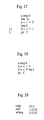
- Fig. 30 shows an instruction sequence including a conventional conditional transfer instruction.
- each of the legends "r0", “r1", and “r2" represents a register.
- the instruction 3001 is a transfer instruction for transferring the value "1" to the register "r0”.
- the instruction 3002 is a comparison instruction for comparing the values of the registers "r1” and “r2” and setting various flags to indicate the comparison result.
- the instruction 3003 is a conditional transfer instruction for referring to the flags and, when the values compared by the instruction 3002 are equal, transferring the value "0" to the register "r0".
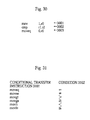
- Fig. 31 shows a list of conventional conditional transfer instructions 3101. This list includes six types of conditional transfer instructions 3101.
- the condition 3102 is a sign indicating a condition specified by each conditional transfer instruction. when the operation objects "a” and “b” are compared by a comparison instruction, the condition is one of the following cases: “a” and “b” are equal; “a” and “b” are not equal; “a” is greater than “b”; “a” is greater than or equal to “b”; “a” is smaller than “b”; and “a” is smaller than or equal to “b”.
- Each conditional transfer instruction is executed when its condition is satisfied.
- Fig. 32 shows conventional instructions, such as comparison instructions (CMP instructions), conditional addition instructions for performing addition when their conditions are satisfied, conditional transfer instructions for performing transfer when their conditions are satisfied, and conditional branch instructions for performing branch when their conditions are satisfied.
- CMP instructions comparison instructions
- conditional addition instructions for performing addition when their conditions are satisfied
- conditional transfer instructions for performing transfer when their conditions are satisfied
- conditional branch instructions for performing branch when their conditions are satisfied.
- last two characters of the operation code of each instruction in mnemonic code specify the condition.
- the number of types of conditions of each conditional instruction and each conditional branch instruction shown in Fig. 32 is ten because the conditions shown in Fig. 32 include conditions for data with signs, in addition to the conditions shown in Fig. 31.
- conditional instructions for each of two operations conditional transfer instructions and conditional addition instructions
- conditional branch instructions thirty-one.
- the total number is represented as 11+(10xA).
- conditional instructions There are also conditional instructions whose number of types is reduced. These conditional instructions are described in detail in "Hitachi Single Chip RISC Microcomputer SH7000/SH7600 Series Programming Manual", Hitachi, Ltd., p57-p58, p69-p70, and p75-p78.
- Fig. 33 shows comparison instructions, conditional addition instructions, and conditional branch instructions where the number of instruction types is reduced.
- conditional instructions and the conditional branch instructions shown in Fig. 33 use only two types of conditions, that is, a conditional flag is set or is reset. Therefore, Fig. 33 shows two types of conditional addition instructions, two types of conditional transfer instructions, two types of conditional branch instructions, and five types of comparison instructions for setting or resetting the conditional flag.
- the total number of types of instructions including comparison instructions, conditional instructions for each of two operations, and conditional branch instructions is eleven.
- the total number of types of instructions including comparison instructions, conditional instructions for each operation, and conditional branch instructions is represented as 7+(2xA).
- Processors performing pipeline processing need to use more types of conditional instructions to reduce branch hazards as much as possible.
- the object of the present invention is to provide an instruction conversion apparatus which reduces the number of types of instructions and a processor whose hardware scale is reduced, when conditional instructions are used.
- the processor of the present invention which decodes and executes an instruction sequence includes: a state hold unit for holding, when a predetermined instruction is executed, a renewal state for an execution result of the predetermined instruction; an obtaining unit for obtaining an instruction sequence composed of instructions matching instructions assigned to an instruction set of the processor, where the instruction set is assigned first conditional instructions, a first state condition for a first conditional instruction being mutually exclusive with a second state condition for a second conditional instruction which has a same operation code as the first conditional instruction, the instruction set not being assigned the second conditional instruction, and the first state condition and the second state condition specifying either of one state and a plurality of states; a decoding unit for decoding each instruction in the obtained instruction sequence one by one; a judging unit for judging whether the renewal state is included in either of the state and the plurality of states specified by the first state condition in the first conditional instruction, when the decoding unit decodes the first conditional instruction; and an execution unit for executing, only if a judgement result
- the processor of the present invention uses an instruction set including only conditional instructions specifying one out of a pair of exclusive conditions, not including conditional instructions specifying the other of the pair. Therefore, the number of types of conditional instructions is reduced, in comparison with a conventional processor.
- the processor of the present invention uses three types of conditional instructions for each operation, so that the number of types of conditional instructions can be reduced by half of that of a conventional processor.
- an operation code included in a conditional instruction may be one of a transfer operation code, an arithmetic operation code, and a logic operation code.
- each conditional instruction included in the instruction set of the processor of the present invention is a transfer operation, an arithmetic operation, and a logic operation.
- the processor of the present invention can use conditional transfer instructions, conditional arithmetic instructions, and conditional logic instructions. Accordingly, when the processor of the present invention performs pipeline processing, branch hazards can be reduced.
- the processor of the present invention which decodes and executes an instruction sequence includes: an obtaining unit for obtaining an instruction sequence composed of instructions matching instructions assigned to an instruction set of the processor, where the instruction set is assigned at least one first conditional flag setting instruction, at least one second conditional flag setting instruction, and at least one conditional execution instruction, each first conditional flag setting instruction including a first condition, and each second conditional flag setting instruction including a second condition, each first condition being mutually exclusive with one of the second conditions, each conditional execution instruction including an operation code that is not included in any other conditional execution instruction in the instruction set; a decoding unit for decoding each instruction in the obtained instruction sequence one by one; a conditional flag for holding a judgement result as to whether a predetermined condition is satisfied; a judging unit for judging, when the decoding unit decodes the first conditional flag setting instruction, whether the first condition in the first conditional flag setting instruction is satisfied and has the conditional flag hold a judgement result for the first condition and, when the decoding unit decodes the
- the processor of the present invention uses an instruction set including conditional flag setting instructions and instructions which are executed when their conditions are satisfied, not including instructions which are executed when their conditions are not satisfied. Therefore, the instruction set includes only one type of instruction which is executed when its condition is satisfied for each operation.
- a conventional processor uses ten types of conditional instructions for each operation and two types of instructions which are executed when their conditions are satisfied. As the number of operations of instructions which are executed when their conditions are satisfied increases, the processor of the present invention uses less types of the instructions.
- the processor of the present invention uses six types of conditional flag setting instructions and the conditions of these instructions are three pairs of exclusive conditions. Therefore, without instructions which are executed when their conditions are not satisfied, the processor of the present invention can perform the same processing as a conventional processor.
- the instruction set may be further assigned two types of first conditional flag setting instructions and two types of second conditional flag setting instructions, the first conditions of the first conditional flag setting instructions being a combination of the following conditions: 4. one out of "a ⁇ b” and “a ⁇ b”; and 5. one out of "a ⁇ b” and “a>b” (where a and b of conditions 4 and 5 are compared with signs of a and b being taken into account), and the second conditions of the second conditional flag setting instructions being mutually exclusive with the first conditions.
- the processor of the present invention uses ten types of conditional flag setting instructions and the conditions of these instructions are five pairs of exclusive conditions. Therefore, without instructions which are executed when their conditions are not satisfied, the processor of the present invention can perform the same processing as a conventional processor.
- an operation code included in a conditional execution instruction may be one of a transfer operation code, an arithmetic operation code, a logic operation code, and a branch operation code.
- each instruction which is executed when its condition is satisfied included in the instruction set of the processor of the present invention is a transfer operation, an arithmetic operation, a logic operation, or a branch operation.
- the processor of the present invention can use transfer instructions which are executed when their conditions are satisfied, arithmetic instructions which are executed when their conditions are satisfied, and logic instructions which are executed when their conditions are satisfied, and branch instructions which are executed when their conditions are satisfied. Accordingly, when the processor of the present invention performs pipeline processing, branch hazards can be reduced.
- the instruction conversion apparatus of the present invention converts instruction sequences not including conditional instructions into instruction sequences including conditional instructions, each of the conditional instructions including a condition and an operation code and having a processor execute an operation specified by the operation code only if the condition is satisfied, and includes: an obtaining unit for obtaining an instruction sequence which does not include conditional instructions; an instruction sequence detection unit for detecting, out of the obtained instruction sequence, a conversion target instruction sequence which transfers different transfer objects to a same storage resource depending on whether a predetermined condition is satisfied; a judging unit for judging whether an instruction set of a specialized processor is assigned a conditional instruction including a same condition as the predetermined condition; and a conversion unit for converting, when a judgement result by the judging unit is affirmative, the conversion target instruction sequence inLo an instruction sequence including a conditional instruction including the predetermined condition and for interchanging, when the judgement result by the judging unit is negative, the transfer objects of the conversion target instruction sequence and converts the conversion target instruction sequence into an instruction sequence including a
- the instruction conversion apparatus of the present invention does not generate undecodable conditional instructions but decodable conditional instructions for the specialized processor.
- the instruction conversion apparatus of the present invention can reduce the number of types of conditional instructions without reducing total number of conditional instructions, so that the number of fields for including instructions and a code size can be reduced. Also, the number of types of conditional instructions decodable by the specialized processor can be reduced without sacrificing the performance of the specialized processor.
- the instruction set of the specialized processor may be assigned a conditional instruction including a condition that is mutually exclusive with a condition included in a conditional instruction judged as not assigned to the instruction set by the judging unit, and conditions included in conditional instructions for a same operation assigned to the instruction set are not mutually exclusive.
- the judging unit of the instruction conversion apparatus of the present invention judges that the specialized processor uses an instruction set including conditional instructions specifying only one out of a pair of exclusive conditions. Therefore, the instruction conversion apparatus of the present invention does not generate conditional instructions specifying the other of the pair of exclusive conditions.
- the judging unit of the instruction conversion apparatus of the present invention judges that the specialized processor can decode three types of conditional instructions for each operation. Therefore, the number of types of conditional instructions is reduced by half of six types of conditional instructions for a conventional processor.
- each of the transfer objects is one of a numerical value, a value indicated by a different storage resource, an operation result of a numerical value and a value indicated by the different storage resource, an operation result of numerical values, and an operation result of values indicated by the different storage resource.
- the operation specified by a conditional instruction is a transfer operation, an arithmetic operation, and a logic operation.
- the instruction conversion apparatus can generate conditional instructions for all of transfer instructions, arithmetic instructions, and logic instructions. Accordingly, when the specialized processor performs pipeline processing, branch hazards is reduced.
- the conversion target instruction sequence may consecutively include a conditional branch instruction for branching to a next instruction but two, a transfer instruction for transferring a transfer object to a storage resource, an unconditional branch instruction for branching to a next instruction but one, and a transfer instruction for transferring another transfer object to the storage resource.
- the instruction sequence detection unit detects this instruction sequence.
- the instruction conversion apparatus of the present invention converts conditional instructions included in instruction sequences, each of the conditional instructions including a condition and an operation code and having a processor execute an operation specified by the operation code only if the condition is satisfied, and includes: an obtaining unit for obtaining an instruction sequence including conditional instructions; a conditional instruction detection unit for detecting a conditional instruction included in the obtained instruction sequence; a first judging unit for judging whether the detected conditional instruction is assigned to an instruction set of a specialized processor; a second judging unit for judging, when a judgement result by the first judging unit is negative, whether the obtained instruction sequence includes a conversion target instruction sequence which transfers different transfer objects to a same storage resource depending on whether a predetermined condition of the detected conditional instruction is satisfied; and a conversion unit for interchanging, when a judgement result by the second judging unit is affirmative, the transfer objects and converts the detected conditional instruction into a conditional instruction including a condition that is mutually exclusive with the predetermined condition.
- the instruction conversion apparatus of the present invention can converts undecodable conditional instructions into decodable conditional instructions for the specialized processor.
- the instruction conversion apparatus of the present invention can reduce the number of types of conditional instructions without reducing total number of conditional instructions, so that the number of fields for including instructions and a code size can be reduced. Also, the number of types of conditional instructions decodable by the specialized processor can be reduced without sacrificing the performance of the specialized processor.
- the instruction set of the specialized processor may be assigned a conditional instruction including a condition being mutually exclusive with a condition included in a conditional instruction judged as not assigned to the instruction set by the first judging unit, and conditions included in conditional instructions for a same operation assigned to the instruction set are not mutually exclusive.
- the first judging unit of the instruction conversion apparatus of the present invention judges that the specialized processor uses an instruction set including conditional instructions specifying only one out of a pair of exclusive conditions. Therefore, the instruction conversion apparatus of the present invention does not generate conditional instructions specifying the other of the pair of exclusive conditions.
- the conversion target instruction sequence consecutively may include a comparison instruction for comparing two comparison objects, a transfer instruction for transferring a predetermined transfer object to a predetermined storage resource, and a conditional instruction for transferring a transfer object that differs from the predetermined transfer object to the predetermined storage resource only if a predetermined condition is satisfied.
- the instruction sequence detection unit detects this instruction sequence.
- the conversion unit may include: an inverse conversion unit for converting, when a judgement result by the second judging unit is negative, the instruction sequence including the detected conditional instruction into an instruction sequence not including the detected conditional instruction.
- the instruction conversion apparatus of the present invention generates executable instruction sequences for the specialized processor.
- the instruction conversion apparatus of the present invention converts an instruction sequence not including a conditional flag setting instruction and a conditional execution instruction into an instruction sequence including a conditional flag setting instruction and a conditional execution instruction, each conditional flag setting instruction including a condition, having a specialized processor judge whether the condition is satisfied, and having a conditional flag hold a judgement result as to whether the condition is satisfied, each conditional execution instruction including an operation code and having the specialized processor execute an operation specified by the operation code only if a condition of the conditional execution instruction is satisfied.
- the instruction conversion apparatus includes: an obtaining unit for obtaining an instruction sequence which does not include conditional flag setting instructions and conditional execution instructions; an instruction sequence detection unit for detecting, out of the obtained instruction sequence, a conversion target instruction sequence which transfers different transfer objects to a same storage resource depending on whether a predetermined condition is satisfied; and a conversion unit for converting the conversion target instruction sequence into an instruction sequence which includes a conditional flag setting instruction including the predetermined condition and a conditional execution instruction including an operation code which specifies an operation for transferring a transfer object to the storage resource when the predetermined condition is satisfied.
- the instruction conversion apparatus of the present invention generates decodable conditional flag setting instruction and decodable instructions which are executed when their conditions are satisfied for the specialized processor.
- the instruction conversion apparatus of the present invention can reduce the number of types of conditional instructions without reducing total number of conditional instructions, so that the number of fields for including instructions and a code size can be reduced. Also, the number of types of conditional instructions decodable by the specialized processor can be reduced without sacrificing the performance of the specialized processor.
- the specialized processor uses instructions which are executed when their conditions are satisfied for 20 operations, for instance, it is enough to include in an instruction set 30 types of instructions including 10 types of conditional flag setting instruction and 20 types of instruction which are executed when their conditions are satisfied (one type of the instruction which is executed when its condition is satisfied x 20 operations).
- condition of a conditional flag setting instruction which is convertible by the conversion unit may be mutually exclusive with a condition of another conditional flag setting instruction which is convertible by the conversion unit.
- the conversion unit of the instruction conversion apparatus of the present invention generates six types of conditional flag setting instruction. Each pair of the conditions of these instructions is in an exclusive relation. Therefore, even if an instruction set does not include instructions which are executed when their conditions are not satisfied, the same processing as a conventional processor can be performed.
- the conversion target instruction sequence may consecutively include a comparison instruction for comparing two comparison objects, a conditional branch instruction for branching to a next instruction but two when a predetermined condition is satisfied, a transfer instruction for transferring a predetermined transfer object to a predetermined storage resource, an unconditional branch instruction for branching to a next instruction but one, and a transfer instruction for transferring a transfer object that differs from the predetermined transfer object to the predetermined storage resource.
- the instruction sequence detection unit detects this instruction sequence.
- the conversion target instruction sequence may consecutively include a comparison instruction for comparing two comparison objects, a transfer instruction for transferring a predetermined transfer object to a predetermined storage resource, and a conditional instruction for transferring a transfer object that differs from the predetermined transfer object to the predetermined storage resource only if a predetermined condition is satisfied.
- the instruction sequence detection unit detects this instruction sequence.
- the conversion target instruction sequence may consecutively include a comparison instruction for comparing two comparison objects, a conditional instruction for transferring a predetermined transfer object to a predetermined storage resource only if a predetermined condition is not satisfied, and a conditional instruction for transferring a transfer object that differs from the predetermined transfer object to the predetermined storage resource only if the predetermined condition is satisfied.
- the instruction sequence detection unit detects this instruction sequence.
- the computer-readable recording medium of the present invention records an instruction conversion program for having a computer perform a method of converting instruction sequences not including conditional instructions into instruction sequences including conditional instructions, each of the conditional instructions including a condition and an operation code and having a processor execute an operation specified by the operation code only if the condition is satisfied.
- the program includes: an obtaining step for obtaining an instruction sequence which does not include conditional instructions; an instruction sequence detection step for detecting, out of the obtained instruction sequence, a conversion target instruction sequence which transfers different transfer objects to a same storage resource depending on whether a predetermined condition is satisfied; a judging step for judging whether an instruction set of a specialized processor is assigned a conditional instruction including a same condition as the predetermined condition; and a conversion step for converting, when a judgement result in the judging step is affirmative, the conversion target instruction sequence into an instruction sequence including a conditional instruction including the predetermined condition and for interchanging, when the judgement result in the judging step is negative, the transfer objects of the conversion target instruction sequence and converts the conversion target instruction sequence into an instruction sequence including a conditional instruction including a condition that is mutually exclusive with the predetermined condition.
- the instruction conversion program of the present invention does not generate undecodable conditional instructions but decodable conditional instructions for the specialized processor.
- the instruction conversion program of the present invention can reduce the number of types of conditional instructions without reducing total number of conditional instructions, so that the number of fields for including instructions and a code size can be reduced. Also, the number of types of conditional instructions decodable by the specialized processor can be reduced without sacrificing the performance of the specialized processor.
- the computer-readable recording medium of the present invention records an instruction conversion program for having a computer perform a method of converting conditional instructions included in instruction sequences, each of the conditional instructions including a condition and an operation code and having a processor execute an operation specified by the operation code only if the condition is satisfied.
- the program includes: an obtaining step for obtaining an instruction sequence including conditional instructions; a conditional instruction detection step for detecting a conditional instruction included in the obtained instruction sequence; a first judging step for judging whether the detected conditional instruction is assigned to an instruction set of a specialized processor; a second judging step for judging, when a judgement result in the first judging step is negative, whether the obtained instruction sequence includes a conversion target instruction sequence which transfers different transfer objects to a same storage resource depending on whether a predetermined condition of the detected conditional instruction is satisfied; and a conversion step for interchanging, when a judgement result in the second judging step is affirmative, the transfer objects and converts the detected conditional instruction into a conditional instruction including a condition that is mutually exclusive with the predetermined condition.
- the instruction conversion program of the present invention can converts undecodable conditional instructions into decodable conditional instructions for the specialized processor.
- the instruction conversion program of the present invention can reduce the number of types of conditional instructions without reducing total number of conditional instructions, so that the number of fields for including instructions and a code size can be reduced. Also, the number of types of conditional instructions decodable by the specialized processor can be reduced without sacrificing the performance of the specialized processor.
- the computer-readable recording medium of the present invention records an instruction conversion program for having a computer perform a method of converting an instruction sequence not including a conditional flag setting instruction and a conditional execution instruction into an instruction sequence including a conditional flag setting instruction and a conditional execution instruction, each conditional flag setting instruction including a condition, having a specialized processor judge whether the condition is satisfied, and having a conditional flag hold a judgement result as to whether the condition is satisfied, each conditional execution instruction including an operation code and having the specialized processor execute an operation specified by the operation code only if a condition of the conditional execution instruction is satisfied.
- the program includes: an obtaining step for obtaining an instruction sequence which does not include conditional flag setting instructions and conditional execution instructions; an instruction sequence detection step for detecting, out of the obtained instruction sequence, a conversion target instruction sequence which transfers different transfer objects to a same storage resource depending on whether a predetermined condition is satisfied; and a conversion step for converting the conversion target instruction sequence into an instruction sequence which includes a conditional flag setting instruction including the predetermined condition and a conditional execution instruction including an operation code which specifies an operation for transferring a transfer object to the storage resource when the predetermined condition is satisfied.
- the instruction conversion program of the present invention generates decodable conditional flag setting instruction and decodable instructions which are executed when their conditions are satisfied for the specialized processor.
- the instruction conversion program of the present invention can reduce the number of types of conditional instructions without reducing total number of conditional instructions, so that the number of fields for including instructions and a code size can be reduced. Also, the number of types of conditional instructions decodable by the specialized processor can be reduced without sacrificing the performance of the specialized processor.
- the specialized processor uses instructions which are executed when their conditions are satisfied for 20 operations, for instance, it is enough to include in an instruction set 30 types of instructions including 10 types of conditional flag setting instruction and 20 types of instruction which are executed when their conditions are satisfied (one type of the instruction which is executed when its condition is satisfied x 20 operations).
- the present invention has great practical uses.
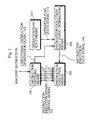
- Fig. 1 shows the construction of the processor of the present invention which executes machine instructions generated by the compiler of the present invention.
- This processor includes the operation flag hold means 101, instruction decoding means 102, the instruction execution means 103, and the instruction execution halt means 104.
- the operation flag hold means 101 holds an operation flag showing an instruction execution state, and outputs the operation flag state signal 111 showing the instruction execution state.
- the instruction decoding means 102 decodes machine instructions and outputs the instruction execution means control signal 112. When decoding conditional instructions, the instruction decoding means 102 outputs the conditional instruction designation signal 113.
- the instruction execution means 103 executes instructions according to the instruction execution means control signal output from the instruction decoding means 102.
- the instruction execution halt means 104 receives the operation flag state signal 111 output from the operation flag hold means 101 and the conditional instruction designation signal 113 output from the instruction decoding means 102. When a condition is not satisfied, the instruction execution halt means 104 outputs the instruction execution halt signal 113 to the instruction execution means 103 so that the instruction execution means 103 halts its instruction execution.
- the instruction execution halt means 104 may be replaced by an instruction execution continuation means and, when a condition is satisfied, the instruction execution continuation means may output an instruction execution signal to the instruction execution means 103 so that the instruction execution means 103 executes instructions.
- the processor including the instruction execution halt means 104 and the processor including the instruction execution continuation means are effectively the same, only with inverse logic.
- the processor of Embodiment 1 decodes and executes conditional transfer instructions specifying one out of a pair of conditions in an exclusive relation and does not decode and execute conditional transfer instructions specifying the other of the pair of conditions.
- the present processor decodes and executes a conditional instruction specifying one out of a pair of conditions that are "'a” and “b” are equal' and '"a” and “b” are not equal'.
- the present processor decodes and executes a conditional instruction specifying one out of a pair of conditions that are "'a” is greater than “b"' and '"a” is equal to or smaller than "b"', and decodes and executes a conditional instruction specifying one out of a pair of conditions that are '"a" is smaller than "b"' and '"a” is equal to or greater than "b"'.
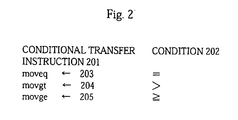
- Fig. 2 shows a list of conditional transfer instructions which the present processor can execute.
- This list includes three types of conditional transfer instructions 201.
- Each of the conditions 202 is a sign indicating the condition specified by one conditional transfer instruction.
- the present compiler generates only the conditional transfer instructions shown in Fig. 2, out of the conditional transfer instructions shown in Fig. 31.
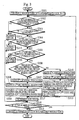
- Fig. 3 is a flowchart showing the operation of the compiler of Embodiment 1.
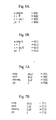
- Figs. 4A and 4B show example C source programs which are written in C language and are input into the present compiler.
- variable "a” and the variable "b” are compared and, when they are equal, "1" is assigned to the variable “c”; when they are not equal, "0” is assigned to the variable "c” and the function "f" is called.
- variable "a” and the variable "b” are compared and, when they are not equal, "1" is assigned to the variable “c”; when they are equal, "0” is assigned to the variable "c” and the function "f" is called.
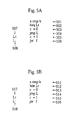
- Figs. 5A and 5B show intermediate code sequences which do not include conditional transfer instructions and are respectively generated from the C source programs shown in Fig. 4A and 4B in step S301 of the flowchart shown in Fig. 3. Note that Figs. 5A and 5B show the same intermediate code sequences as those generated by a conventional compiler during the conversion of the C source programs shown in Figs. 4A and 4B into machine instructions.
- the intermediate code 501 is a code for comparing the variables "a” and “b” and setting a flag to indicate the comparison result;
- the intermediate code 502 is a code for branching to the label "Lt” 507 when the variables "a” and “b” are equal;
- the intermediate code 503 is a code for transferring the immediate "0" to the variable "c”;
- the intermediate code 504 is a code for branching to the label "L” 508;
- the intermediate code 505 is a code for transferring the immediate "1" to the variable "c”;
- the intermediate code 506 is a code for calling the function "f".
- the intermediate code 511 is a code for comparing the variables "a” and “b” and setting a flag to indicate the comparison result;
- the intermediate code 512 is a code for branching to the label "Lt” 517 when the variables "a” and “b” are not equal;
- the intermediate code 513 is a code for transferring the immediate "0" to the variable "c”;
- the intermediate code 514 is a code for branching to the label "L” 518;
- the intermediate code 515 is a code for transferring the immediate "1" to the variable "c”;
- the intermediate code 516 is a code for calling the function "f".
- Figs. 6A and 6B show intermediate code sequences including conditional transfer instructions. These intermediate code sequences are respectively generated by the present compiler from the intermediate code sequences not including conditional transfer instructions shown in Figs. 5A and 5B in steps S302-S118 of the flowchart shown in Fig. 3.
- the intermediate code 601 is a code for comparing the variables "a” and “b” and setting a flag to indicate the comparison result;
- the intermediate code 602 is a code for transferring the immediate "0" to the variable “c”;
- the intermediate code 603 is a code for transferring the immediate "1” to the variable “c” when the variables "a” and "b” are equal;
- the intermediate code 604 is a code for calling the function "f".
- the intermediate code 611 is a code for comparing the variables "a” and “b” and setting a flag to indicate the comparison result;
- the intermediate code 612 is a code for transferring the immediate "1" to the variable “c”;
- the intermediate code 613 is a code for transferring the immediate "0" to the variable "c” when the variables "a” and "b” are equal;
- the intermediate code 614 is a code for calling the function "f".
- Figs. 7A and 7B show machine instruction sequences.
- the machine instruction sequences are respectively generated by the present compiler from the intermediate code sequences including conditional transfer instructions shown in Figs. 6A and 6B in step S319 of the flowchart shown in Fig. 3.
- the machine instruction sequences shown in Figs. 7A and 7B are respectively the same as those generated from intermediate code sequences including conditional transfer instructions shown in Figs. 6A and 6B.
- the machine instruction 701 is an instruction for comparing the values of registers "r0" and “r1” and setting a flag to indicate the comparison result;
- the machine instruction 702 is an instruction for transferring the immediate "0" to the register “r2”;
- the machine instruction 703 is an instruction for transferring the immediate "1” to the register “r2" when the values of the registers "r0" and “r1" are equal;
- the machine instruction 704 is an instruction for calling the function "f”.
- the machine instruction 711 is an instruction for comparing the values of registers "r0" and “r1” and setting a flag to indicate the comparison result;
- the machine instruction 712 is an instruction for transferring the immediate "1” to the register “r2”;
- the machine instruction 713 is an instruction for transferring the immediate "0” to the register “r2" when the values of the registers "r0” and “r1” are equal;
- the machine instruction 714 is an instruction for calling the function "f".
- the present compiler generates only conditional transfer instructions which the present processor can execute.
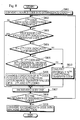
- Fig. 8 is a flowchart showing the operation of the compiler of the present embodiment.
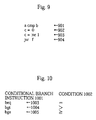
- Fig. 9 shows an intermediate code sequence including a conditional transfer instruction. This intermediate code sequence is generated by the present compiler from the C source program shown in Fig. 4B in step S801 of the flowchart shown in Fig. 8. Note that Fig. 9 shows the same intermediate code sequence as that generated by a conventional compiler for generating conditional transfer instruction during the conversion of the C source program shown in Fig. 4B into machine instructions.
- the intermediate code 901 is a code for comparing the variables "a” and “b” and setting a flag to indicate the comparison result;
- the intermediate code 902 is a code for transferring the immediate "0" to the variable “c”;
- the intermediate code 903 is a code for transferring the immediate "1" to the variable "c” when the variables "a” and "b” are not equal;
- the intermediate code 904 is a code for calling the function "f".
- the processor of the present embodiment can execute the conditional transfer instructions shown in Fig. 2, as the processor of Embodiment 1.
- the present compiler converts unexecutable conditional transfer instructions into executable conditional transfer instructions for the present processor.
- the processor of the present embodiment decodes and executes only conditional branch instructions specifying one out of a pair of conditions in an exclusive relation, out of the six types of conditional branch instructions specifying the same conditions as those specified by the six types of conditional transfer instructions 3101 shown in Fig. 31.
- Fig. 10 shows a list of example conditional branch instructions which the present processor can execute.
- This list includes three types of conditional branch instructions 1001.
- Each of the conditions 1002 is a sign indicating a condition specified by one conditional branch instruction.
- the condition of the "beq" 1003 is that "a” and "b” are equal; that of the "bgt” 1004 is that "a” is greater than “b”; and that of the "bge” 1005 is that "a” is greater than or equal to "b”.
- Each conditional branch instruction indicates a branch which is performed when its condition is satisfied. Note that in this embodiment, the present processor cannot execute other conditional instructions.
- Fig. 11 is a flowchart showing the operation of the compiler of Embodiment 3.
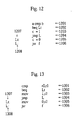
- Fig. 12 shows an intermediate code sequence which the present processor can decode. This intermediate code sequence is qenerated by the present compiler from the intermediate code sequence shown in Fig. 5B, which the present processor cannot decode, in steps S302-318 of the flowchart shown in Fig. 11.
- the intermediate code 1201 is a code for comparing the variables "a” and “b” and setting a flag to indicate the comparison result;
- the intermediate code 1202 is a code for branching to the label "Lt” 1207 when the variables "a” and “b” are equal;
- the intermediate code 1203 is a code for transferring the immediate "1" to the variable "c”;
- the intermediate code 1204 is a code for branching to the label "L” 1208;
- the intermediate code 1205 is a code for transferring the immediate "0" to the variable "c”;
- the intermediate code 1206 is a code for calling the function "f".
- Fig. 13 shows a machine instruction sequence. This machine instruction sequence is generated by the present compiler from the intermediate code sequence shown in Fig. 12 which the present processor can decode in step S319 of the flowchart shown in Fig. 11. Note that Fig. 13 shows the same machine instruction sequence as that generated by a conventional compiler from the intermediate code sequence shown in Fig. 12.
- the machine instruction 1301 is an instruction for comparing values of the registers "rO" and “rl” and setting a flag to indicate the comparison result;
- the machine instruction 1302 is an instruction for branching to the label “Lt” 1307 when the values of the registers "r0" and “r1” are equal;
- the machine instruction 1303 is an instruction for transferring the immediate "1" to the register "r2”;
- the machine instruction 1304 is an instruction for branching to the label "L” 1308;
- the machine instruction 1305 is an instruction for transferring the immediate "0" to the register "r2";
- the machine instruction 1306 is an instruction for calling the function "f".
- the present compiler converts unexecutable conditional branch instructions into executable conditional branch instructions for the present processor.
- Fig. 14 shows comparison instructions, a conditional addition instruction, a conditional transfer instruction, and a conditional branch instruction, where the number of types of instructions has been reduced. These instructions are used in the present embodiment.
- each of the conditional instructions and the conditional branch instruction uses only one condition where a conditional flag is set. Therefore, Fig. 14 shows one type of conditional addition instruction, one type of conditional transfer instruction, one type of conditional branch instruction, and ten types of comparison instructions for setting and resetting the conditional flag.
- the total number of instructions including the comparison instructions, the conditional instructions for two operations, and the conditional branch instruction is thirteen.
- the number of types of operations of conditional instructions is assumed to be A
- the total number of types of instructions including comparison instructions, conditional instructions for each operation, and the conditional branch instruction is represented as 11+A.
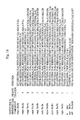
- each total number of types of instructions including comparison instructions, conditional addition instructions, conditional transfer instructions, and conditional branch instructions in Figs. 14, 32, and 33 is compared.
- the number of types of conditional instructions A is 0-3, the total number of instruction types shown in Fig. 33 is the lowest.
- the number of types of conditional instructions A is 4, the total number of instruction types shown in Figs. 14 and 33 is fifteen, which is the lowest (in this case, the total number of instruction types shown in Fig. 32 is 51).
- the total number of types of conditional instructions A is 5 or more, the total number of instruction types shown in Fig. 14 is the lowest. As A increases, the difference between these figures widens.
- the processor of the present embodiment decodes and executes the comparison instructions, the conditional addition instruction, the conditional transfer instruction, and the conditional branch instruction shown in Fig. 14.
- Fig. 15 shows the construction of the present compiler.
- the present compiler includes the intermediate code generation means 1501, the object code detection means 1502, the conditional instruction conversion means 1503, the intermediate code optimization means 1504, and the machine instruction generation means 1505.
- Fig. 16 shows an example of the C source code 1511. This C source code is written in C language and is input into the present compiler.
- the C source program shown in Fig. 16 is the same as that shown in Fig. 4A and therefore is not described here.
- the intermediate code generation means 1501 converts the C source code 1511 and generates the first intermediate code 1512. This conversion is the same as that performed by a conventional compiler and therefore is not described.
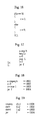
- Fig. 17 shows the first intermediate code 1512.
- the first intermediate code 1512 shown in Fig. 17 is the same as that shown in Fig. 5A and therefore is not described here.
- the present compiler generates the first intermediate code 1512 shown in Fig. 17 from the C source code 1511 shown in Fig. 16.
- the object code detection means 1502 detects instruction sequences whose predetermined operations are executed when their predetermined conditions are satisfied.
- the conditional instruction conversion means 1503 converts a sequence of instructions detected by the object code detection means 1502 into conditional instructions and generates the second intermediate code 1513 from the first intermediate code 1512.
- the object code detection means 1502 and the conditional instruction conversion means 1503 are described in more detail later.
- Fig. 18 shows the second intermediate code 1513.
- the intermediate code "a cmpeq b" 1801 is a conditional comparison code for comparing the variables "a" and "b". When the variables are equal, an operation flag is set, and when the variables are not equal, the operation flag is reset.
- the intermediate code 1304 is a code for calling the function "f".
- the present compiler generates the second intermediate code 1513 shown in Fig. 18 from the first intermediate code 1512 shown in Fig. 17.
- the intermediate code optimization means 1504 optimizes the second intermediate code 1513 and generates the intermediate code 1514. This optimization is the same as that performed by a conventional compiler and therefore is not described here.
- the intermediate code optimization means 1504 when receiving the second intermediate code 1513 shown in Fig. 18, the intermediate code optimization means 1504 does not perform the optimization processing. This is because the input second intermediate code does not include codes to be optimized. Therefore, the third intermediate code 1514 is the same as the second intermediate code 1513 shown in Fig. 18.
- the machine instruction generation means 1505 converts the third intermediate code 1514 and generates the machine instruction 1515. This conversion is the same as that performed by a conventional compiler and therefore is not described here.
- Fig. 19 shows the machine instruction 1515.
- the machine instruction “cmpeq r0, rl” 1901 is a conditional comparison instruction for comparing values of the registers "r0" and “r1". When the values are equal, the operation flag is set; when the values are not equal, the operation flag is reset.
- the machine instruction “mov 0, r2” 1902 is a transfer instruction for transferring the immediate "0" to the register "r2”.
- the machine instruction “movt 1, r2” 1903 is an instruction which is executed when its condition is satisfied. with this machine instruction 1903, only when the condition is satisfied by the result of a comparison instruction (when the operation flag is set), the immediate "1" is transferred to the register "r2".
- the machine instruction 1904 is an instruction for calling the function "f”.
- the present compiler generates the machine instruction 1515 shown in Fig. 19 from the third intermediate code 1514 shown in Fig. 18.
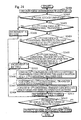
- Fig. 20 is a flowchart showing the operation of the object code detection means 1502 and the conditional instruction conversion means 1503 of the present compiler.
- the present compiler generates conditional comparison codes and codes which are executed when their conditions are satisfied.
- the present processor can execute these codes.
- the processor of Embodiment 5 decodes and executes the comparison instructions, the conditional addition instruction, the conditional transfer instruction, and the conditional branch instruction shown in Fig. 14, as the processor of Embodiment 4.
- the present processor includes the same components as the processor of Embodiment 4 shown in Fig. 15.
- Fig. 21 shows the first intermediate code 1512.
- the first intermediate code 1512 shown in Fig. 21 is the same as that shown in Fig. 6A and therefore is not described here.
- the intermediate code generation means 1501 generates the first intermediate code 1512 shown in Fig. 21 from the C source code 1511 shown in Fig. 16. This conversion is the same as that performed by a conventional compiler for generating conditional transfer instructions and therefore is not described here.
- the object code detection means 1502 and the conditional instruction conversion means 1503 generate the second intermediate code 1513 shown in Fig. 18 from the first intermediate code 1512 shown in Fig. 21.
- Fig. 22 is a flowchart showing the operation of the object code detection means 1502 and the conditional instruction conversion means 1503 of the present embodiment.
- the present compiler generates executable conditional comparison codes and codes which are executed when their conditions are satisfied for the present processor.
- the processor of Embodiment 6 decodes and executes the comparison instructions, the conditional addition instruction, the conditional transfer instruction, and the conditional branch instruction shown in Fig. 14, as the processors of Embodiments 4 and 5.
- the compiler of Embodiment 6 includes the same components as those of the processor of Embodiment 4 or Embodiment 5 shown in Fig. 15.
- Fig. 23 shows the first intermediate code 1512.
- the intermediate code 2301 is a code for comparing the variables "a” and “b” and setting a flag to indicate the comparison result;
- the intermediate code 2302 is a code for transferring the immediate "0" to the variable “c” when the variables "a” and “b” are not equal;
- the intermediate code 2303 is a code for transferring the immediate "1” to the variable "c” when the variables "a” and "b” are equal;
- the intermediate code 2304 is a code for calling the function "f".
- the intermediate code generation means 1501 generates the first intermediate code 1512 shown in Fig. 23 from the C source code 1511 shown in Fig. 16. This conversion is the same as that performed by a conventional compiler for generating conditional transfer instructions and therefore is not described here.
- the object code detection means 1502 and the conditional instruction conversion means 1503 generate the second intermediate code 1513 shown in Fig. 18 from the first intermediate code 1512 shown in Fig. 23.
- Fig. 24 is a flowchart showing the operation of the object code detection means 1502 and the conditional instruction conversion means 1503 of the present processor.
- the present compiler generates conditional comparison codes and codes which are executed when their conditions are satisfied.
- the present processor can execute these generated codes.
Landscapes
- Engineering & Computer Science (AREA)
- Theoretical Computer Science (AREA)
- Software Systems (AREA)
- General Engineering & Computer Science (AREA)
- Physics & Mathematics (AREA)
- General Physics & Mathematics (AREA)
- Devices For Executing Special Programs (AREA)
- Executing Machine-Instructions (AREA)
Priority Applications (1)
| Application Number | Priority Date | Filing Date | Title |
|---|---|---|---|
| EP05017199A EP1645956A3 (de) | 1997-08-29 | 1998-08-28 | Anordnung zur Befehlsumwandlung um der Anzahl von Befehlsarten zu reduzieren |
Applications Claiming Priority (6)
| Application Number | Priority Date | Filing Date | Title |
|---|---|---|---|
| JP23435497A JP3419267B2 (ja) | 1997-08-29 | 1997-08-29 | プロセッサ、コンパイラ及び命令列変換装置 |
| JP23435497 | 1997-08-29 | ||
| JP234354/97 | 1997-08-29 | ||
| JP95645/98 | 1998-04-08 | ||
| JP9564598 | 1998-04-08 | ||
| JP09564598A JP3843594B2 (ja) | 1998-04-08 | 1998-04-08 | プロセッサ、コンパイラ及び命令列変換装置 |
Related Child Applications (2)
| Application Number | Title | Priority Date | Filing Date |
|---|---|---|---|
| EP05017199A Division EP1645956A3 (de) | 1997-08-29 | 1998-08-28 | Anordnung zur Befehlsumwandlung um der Anzahl von Befehlsarten zu reduzieren |
| EP05017199.0 Division-Into | 2005-08-08 |
Publications (3)
| Publication Number | Publication Date |
|---|---|
| EP0899653A2 true EP0899653A2 (de) | 1999-03-03 |
| EP0899653A3 EP0899653A3 (de) | 2000-12-06 |
| EP0899653B1 EP0899653B1 (de) | 2006-10-04 |
Family
ID=26436871
Family Applications (2)
| Application Number | Title | Priority Date | Filing Date |
|---|---|---|---|
| EP98306919A Expired - Lifetime EP0899653B1 (de) | 1997-08-29 | 1998-08-28 | Prozessor mit verringerter Zahl von bedingten Befehlen |
| EP05017199A Withdrawn EP1645956A3 (de) | 1997-08-29 | 1998-08-28 | Anordnung zur Befehlsumwandlung um der Anzahl von Befehlsarten zu reduzieren |
Family Applications After (1)
| Application Number | Title | Priority Date | Filing Date |
|---|---|---|---|
| EP05017199A Withdrawn EP1645956A3 (de) | 1997-08-29 | 1998-08-28 | Anordnung zur Befehlsumwandlung um der Anzahl von Befehlsarten zu reduzieren |
Country Status (4)
| Country | Link |
|---|---|
| US (3) | US6230258B1 (de) |
| EP (2) | EP0899653B1 (de) |
| CN (3) | CN100347668C (de) |
| DE (1) | DE69836056T2 (de) |
Cited By (1)
| Publication number | Priority date | Publication date | Assignee | Title |
|---|---|---|---|---|
| DE10111461A1 (de) * | 2001-03-09 | 2002-09-26 | Fujitsu Siemens Computers Gmbh | Verfahren zum Umsetzen eines Objektcodes für einen ersten Prozessor in einen Objektcode eines zweiten Prozessors |
Families Citing this family (8)
| Publication number | Priority date | Publication date | Assignee | Title |
|---|---|---|---|---|
| US6360316B1 (en) * | 1999-06-16 | 2002-03-19 | Intel Corporation | Method for fast detection of mutually exclusive predicated instructions |
| US6321380B1 (en) * | 1999-06-29 | 2001-11-20 | International Business Machines Corporation | Method and apparatus for modifying instruction operations in a processor |
| JP3851228B2 (ja) * | 2002-06-14 | 2006-11-29 | 松下電器産業株式会社 | プロセッサ、プログラム変換装置及びプログラム変換方法、並びにコンピュータプログラム |
| US20040230781A1 (en) * | 2003-05-16 | 2004-11-18 | Via-Cyrix, Inc. | Method and system for predicting the execution of conditional instructions in a processor |
| US7210024B2 (en) * | 2005-02-10 | 2007-04-24 | Qualcomm Incorporated | Conditional instruction execution via emissary instruction for condition evaluation |
| US8977837B2 (en) * | 2009-05-27 | 2015-03-10 | Arm Limited | Apparatus and method for early issue and recovery for a conditional load instruction having multiple outcomes |
| CN101739237B (zh) * | 2009-12-21 | 2013-09-18 | 龙芯中科技术有限公司 | 微处理器功能性指令实现装置和方法 |
| CN102446112B (zh) * | 2010-10-12 | 2015-05-20 | 无锡江南计算技术研究所 | 指令处理装置和处理器、指令翻译装置和方法 |
Family Cites Families (19)
| Publication number | Priority date | Publication date | Assignee | Title |
|---|---|---|---|---|
| US5165033A (en) * | 1983-07-25 | 1992-11-17 | Hitachi, Ltd. | Microprocessor and data processor using the former |
| JPS6043751A (ja) * | 1983-08-18 | 1985-03-08 | Hitachi Ltd | 情報処理装置 |
| JP2810043B2 (ja) * | 1987-11-13 | 1998-10-15 | 株式会社日立製作所 | データ処理装置 |
| US5471593A (en) * | 1989-12-11 | 1995-11-28 | Branigin; Michael H. | Computer processor with an efficient means of executing many instructions simultaneously |
| JPH0460720A (ja) * | 1990-06-29 | 1992-02-26 | Hitachi Ltd | 条件分岐命令制御方式 |
| US5539888A (en) * | 1993-12-23 | 1996-07-23 | Unisys Corporation | System and method for processing external conditional branch instructions |
| KR960021079A (ko) * | 1994-12-21 | 1996-07-18 | 김진만 | 골프 스윙 교정 헬스기 |
| EP0730220A3 (de) * | 1995-03-03 | 1997-01-08 | Hal Computer Systems Inc | Verfahren und Vorrichtung zur schnellen Ausführung von Verzweigungsbefehlen |
| JP3113792B2 (ja) * | 1995-04-27 | 2000-12-04 | 松下電器産業株式会社 | 最適化装置 |
| JP3130446B2 (ja) * | 1995-05-10 | 2001-01-31 | 松下電器産業株式会社 | プログラム変換装置及びプロセッサ |
| GB2308470B (en) * | 1995-12-22 | 2000-02-16 | Nokia Mobile Phones Ltd | Program memory scheme for processors |
| US5826089A (en) * | 1996-01-04 | 1998-10-20 | Advanced Micro Devices, Inc. | Instruction translation unit configured to translate from a first instruction set to a second instruction set |
| US6105124A (en) * | 1996-01-26 | 2000-08-15 | Intel Corporation | Method and apparatus for merging binary translated basic blocks of instructions |
| US5770894A (en) * | 1996-07-10 | 1998-06-23 | International Business Machines Corporation | Parallel processing method having arithmetical conditions code based instructions substituted for conventional branches |
| US5951678A (en) * | 1997-07-25 | 1999-09-14 | Motorola, Inc. | Method and apparatus for controlling conditional branch execution in a data processor |
| US6075935A (en) * | 1997-12-01 | 2000-06-13 | Improv Systems, Inc. | Method of generating application specific integrated circuits using a programmable hardware architecture |
| US6202198B1 (en) * | 1998-04-21 | 2001-03-13 | Neoprobe Corporation | Programmable integrated analog input/output circuit with distributed matching memory array |
| US6353880B1 (en) * | 1998-07-22 | 2002-03-05 | Scenix Semiconductor, Inc. | Four stage pipeline processing for a microcontroller |
| US6226716B1 (en) * | 1998-12-22 | 2001-05-01 | Unisys Corporation | Test driver for use in validating a circuit design |
-
1998
- 1998-08-28 CN CNB031243908A patent/CN100347668C/zh not_active Expired - Fee Related
- 1998-08-28 DE DE69836056T patent/DE69836056T2/de not_active Expired - Lifetime
- 1998-08-28 CN CNB981202993A patent/CN1145878C/zh not_active Expired - Fee Related
- 1998-08-28 CN CNB2004100053791A patent/CN1282920C/zh not_active Expired - Fee Related
- 1998-08-28 EP EP98306919A patent/EP0899653B1/de not_active Expired - Lifetime
- 1998-08-28 EP EP05017199A patent/EP1645956A3/de not_active Withdrawn
- 1998-08-31 US US09/144,298 patent/US6230258B1/en not_active Expired - Lifetime
-
2001
- 2001-01-08 US US09/756,068 patent/US6606703B2/en not_active Expired - Lifetime
-
2003
- 2003-07-11 US US10/617,506 patent/US20050091478A1/en not_active Abandoned
Cited By (2)
| Publication number | Priority date | Publication date | Assignee | Title |
|---|---|---|---|---|
| DE10111461A1 (de) * | 2001-03-09 | 2002-09-26 | Fujitsu Siemens Computers Gmbh | Verfahren zum Umsetzen eines Objektcodes für einen ersten Prozessor in einen Objektcode eines zweiten Prozessors |
| DE10111461B4 (de) * | 2001-03-09 | 2005-08-11 | Fujitsu Siemens Computers Gmbh | Verfahren zum Umsetzen eines Objektcodes für einen ersten Prozessor in einen Objektcode eines zweiten Prozessors |
Also Published As
| Publication number | Publication date |
|---|---|
| US6606703B2 (en) | 2003-08-12 |
| DE69836056D1 (de) | 2006-11-16 |
| EP0899653B1 (de) | 2006-10-04 |
| CN1282920C (zh) | 2006-11-01 |
| CN1145878C (zh) | 2004-04-14 |
| CN1219703A (zh) | 1999-06-16 |
| CN1521618A (zh) | 2004-08-18 |
| EP0899653A3 (de) | 2000-12-06 |
| US20050091478A1 (en) | 2005-04-28 |
| DE69836056T2 (de) | 2007-04-12 |
| EP1645956A3 (de) | 2008-02-13 |
| US6230258B1 (en) | 2001-05-08 |
| EP1645956A2 (de) | 2006-04-12 |
| US20010001154A1 (en) | 2001-05-10 |
| CN100347668C (zh) | 2007-11-07 |
| CN1516004A (zh) | 2004-07-28 |
Similar Documents
| Publication | Publication Date | Title |
|---|---|---|
| EP2569694B1 (de) | Bedingte vergleichsanweisung | |
| EP0551932B1 (de) | Digitaler Signalprozessor der bedingte Mehrpunkt-Sprungbefehle im Pipelinemodus bearbeitet | |
| US6334176B1 (en) | Method and apparatus for generating an alignment control vector | |
| US4740893A (en) | Method for reducing the time for switching between programs | |
| US5812439A (en) | Technique of incorporating floating point information into processor instructions | |
| JP3917635B2 (ja) | データ処理システムにおけるプリディケーション命令 | |
| US5745722A (en) | Apparatus for decoding instruction immediate data to produce a string having a single bit different from other bit thereof | |
| JP2006079652A (ja) | 多重命令セットによるデータ処理 | |
| EP0899653B1 (de) | Prozessor mit verringerter Zahl von bedingten Befehlen | |
| EP0206276B1 (de) | Verfahren und Rechneranordnung für die bedingte Datenverarbeitung | |
| Padegs et al. | The IBM System/370 vector architecture: Design considerations | |
| EP0764900A2 (de) | Informationsverarbeitungsgerät zur Datenübertragung zu/von mehreren Registern durch Kurzwortbefehle | |
| US20070113060A1 (en) | Floating point status/control register encodings for speculative register field | |
| EP0897147A2 (de) | Prozessor mit Register zum Wiederherstellen von Konstanten | |
| US8041754B1 (en) | Establishing thread priority in a processor or the like | |
| JPH07120278B2 (ja) | データ処理装置 | |
| CN104025042B (zh) | 指令处理方法和装置 | |
| US20020108029A1 (en) | Program counter (PC) relative addressing mode with fast displacement | |
| CN114661355A (zh) | Risc架构处理器的寄存器架构、寄存器组及risc架构处理器 | |
| KR100532743B1 (ko) | 하드웨어량을삭감한프로세서및명령의종류를삭감하는명령변환장치 | |
| US6922773B2 (en) | System and method for encoding constant operands in a wide issue processor | |
| US7085989B2 (en) | Optimized testing of bit fields | |
| JPH1196001A (ja) | プログラム実行装置及びプログラム変換方法 | |
| Kim et al. | A DSP-enhanced 32-bit embedded microprocessor | |
| EP1503280A1 (de) | Sättigungs-Arithmetik in einer Prozessoreinheit |
Legal Events
| Date | Code | Title | Description |
|---|---|---|---|
| PUAI | Public reference made under article 153(3) epc to a published international application that has entered the european phase |
Free format text: ORIGINAL CODE: 0009012 |
|
| AK | Designated contracting states |
Kind code of ref document: A2 Designated state(s): DE FR GB NL |
|
| AX | Request for extension of the european patent |
Free format text: AL;LT;LV;MK;RO;SI |
|
| PUAL | Search report despatched |
Free format text: ORIGINAL CODE: 0009013 |
|
| AK | Designated contracting states |
Kind code of ref document: A3 Designated state(s): AT BE CH CY DE DK ES FI FR GB GR IE IT LI LU MC NL PT SE |
|
| AX | Request for extension of the european patent |
Free format text: AL;LT;LV;MK;RO;SI |
|
| RIC1 | Information provided on ipc code assigned before grant |
Free format text: 7G 06F 9/318 A, 7G 06F 9/45 B, 7G 06F 9/38 B |
|
| 17P | Request for examination filed |
Effective date: 20010305 |
|
| AKX | Designation fees paid |
Free format text: DE FR GB NL |
|
| 17Q | First examination report despatched |
Effective date: 20040803 |
|
| GRAP | Despatch of communication of intention to grant a patent |
Free format text: ORIGINAL CODE: EPIDOSNIGR1 |
|
| RIN1 | Information on inventor provided before grant (corrected) |
Inventor name: MIYAJI, SHINYA Inventor name: HEISHI, TAKETO Inventor name: TANAKA, TETSUYA Inventor name: SUZUKI, MASATO Inventor name: HIGAKI, NOBUO Inventor name: TANAKA, AKIRA Inventor name: ODANI, KENSUKE Inventor name: TAKAYAMA, SHUICHI |
|
| GRAS | Grant fee paid |
Free format text: ORIGINAL CODE: EPIDOSNIGR3 |
|
| GRAA | (expected) grant |
Free format text: ORIGINAL CODE: 0009210 |
|
| AK | Designated contracting states |
Kind code of ref document: B1 Designated state(s): DE FR GB NL |
|
| REG | Reference to a national code |
Ref country code: GB Ref legal event code: FG4D |
|
| REF | Corresponds to: |
Ref document number: 69836056 Country of ref document: DE Date of ref document: 20061116 Kind code of ref document: P |
|
| ET | Fr: translation filed | ||
| PLBE | No opposition filed within time limit |
Free format text: ORIGINAL CODE: 0009261 |
|
| STAA | Information on the status of an ep patent application or granted ep patent |
Free format text: STATUS: NO OPPOSITION FILED WITHIN TIME LIMIT |
|
| 26N | No opposition filed |
Effective date: 20070705 |
|
| PGFP | Annual fee paid to national office [announced via postgrant information from national office to epo] |
Ref country code: DE Payment date: 20110824 Year of fee payment: 14 Ref country code: FR Payment date: 20110818 Year of fee payment: 14 Ref country code: GB Payment date: 20110824 Year of fee payment: 14 |
|
| PGFP | Annual fee paid to national office [announced via postgrant information from national office to epo] |
Ref country code: NL Payment date: 20110823 Year of fee payment: 14 |
|
| REG | Reference to a national code |
Ref country code: NL Ref legal event code: V1 Effective date: 20130301 |
|
| GBPC | Gb: european patent ceased through non-payment of renewal fee |
Effective date: 20120828 |
|
| PG25 | Lapsed in a contracting state [announced via postgrant information from national office to epo] |
Ref country code: NL Free format text: LAPSE BECAUSE OF NON-PAYMENT OF DUE FEES Effective date: 20130301 |
|
| REG | Reference to a national code |
Ref country code: FR Ref legal event code: ST Effective date: 20130430 |
|
| PG25 | Lapsed in a contracting state [announced via postgrant information from national office to epo] |
Ref country code: GB Free format text: LAPSE BECAUSE OF NON-PAYMENT OF DUE FEES Effective date: 20120828 Ref country code: DE Free format text: LAPSE BECAUSE OF NON-PAYMENT OF DUE FEES Effective date: 20130301 |
|
| PG25 | Lapsed in a contracting state [announced via postgrant information from national office to epo] |
Ref country code: FR Free format text: LAPSE BECAUSE OF NON-PAYMENT OF DUE FEES Effective date: 20120831 |
|
| REG | Reference to a national code |
Ref country code: DE Ref legal event code: R119 Ref document number: 69836056 Country of ref document: DE Effective date: 20130301 |