EP0900563A1 - Herstellung pharmazeutischer Formulierungen enthaltend Aescin zur Behandlung von Oedemen und venösen Erkrankungen - Google Patents
Herstellung pharmazeutischer Formulierungen enthaltend Aescin zur Behandlung von Oedemen und venösen Erkrankungen Download PDFInfo
- Publication number
- EP0900563A1 EP0900563A1 EP98116194A EP98116194A EP0900563A1 EP 0900563 A1 EP0900563 A1 EP 0900563A1 EP 98116194 A EP98116194 A EP 98116194A EP 98116194 A EP98116194 A EP 98116194A EP 0900563 A1 EP0900563 A1 EP 0900563A1
- Authority
- EP
- European Patent Office
- Prior art keywords
- pellets
- extract
- parts
- dextrin
- mixture
- Prior art date
- Legal status (The legal status is an assumption and is not a legal conclusion. Google has not performed a legal analysis and makes no representation as to the accuracy of the status listed.)
- Granted
Links
- 238000004519 manufacturing process Methods 0.000 title claims abstract description 15
- 206010030113 Oedema Diseases 0.000 title claims abstract description 10
- 239000008194 pharmaceutical composition Substances 0.000 title claims description 15
- 238000011282 treatment Methods 0.000 title claims description 7
- YFESOSRPNPYODN-RSMWSHJLSA-N (2s,3s,4s,5r,6r)-6-[[(4s,6ar,6bs,8r,8ar,9r,10r,14br)-9-acetyloxy-8-hydroxy-4,8a-bis(hydroxymethyl)-4,6a,6b,11,11,14b-hexamethyl-10-[(z)-2-methylbut-2-enoyl]oxy-1,2,3,4a,5,6,7,8,9,10,12,12a,14,14a-tetradecahydropicen-3-yl]oxy]-4-hydroxy-3,5-bis[[(2s,3r,4s, Chemical compound O([C@@H]1[C@H](O[C@H]([C@@H]([C@H]1O)O[C@H]1[C@@H]([C@@H](O)[C@H](O)[C@@H](CO)O1)O)OC1CC[C@]2(C)C3CC=C4[C@@]([C@@]3(CCC2[C@]1(CO)C)C)(C)C[C@@H](O)[C@@]1(CO)[C@@H](OC(C)=O)[C@@H](C(CC14)(C)C)OC(=O)C(\C)=C/C)C(O)=O)[C@@H]1O[C@H](CO)[C@@H](O)[C@H](O)[C@H]1O.O([C@@H]1[C@H](O[C@H]([C@@H]([C@H]1O)O[C@H]1[C@@H]([C@@H](O)[C@H](O)[C@@H](CO)O1)O)OC1CC[C@]2(C)C3CC=C4[C@@]([C@@]3(CCC2[C@]1(CO)C)C)(C)C[C@@H](O)[C@@]1(CO)[C@@H](OC(C)=O)[C@@H](C(CC14)(C)C)OC(=O)C(/C)=C/C)C(O)=O)[C@@H]1O[C@H](CO)[C@@H](O)[C@H](O)[C@H]1O YFESOSRPNPYODN-RSMWSHJLSA-N 0.000 title 1
- AXNVHPCVMSNXNP-GKTCLTPXSA-N Aescin Natural products O=C(O[C@H]1[C@@H](OC(=O)C)[C@]2(CO)[C@@H](O)C[C@@]3(C)[C@@]4(C)[C@@H]([C@]5(C)[C@H]([C@](CO)(C)[C@@H](O[C@@H]6[C@@H](O[C@H]7[C@@H](O)[C@@H](O)[C@H](O)[C@@H](CO)O7)[C@@H](O)[C@H](O[C@H]7[C@H](O)[C@@H](O)[C@H](O)[C@H](CO)O7)[C@@H](C(=O)O)O6)CC5)CC4)CC=C3[C@@H]2CC1(C)C)/C(=C/C)/C AXNVHPCVMSNXNP-GKTCLTPXSA-N 0.000 title 1
- 208000037997 venous disease Diseases 0.000 title 1
- 239000008188 pellet Substances 0.000 claims abstract description 116
- 239000000284 extract Substances 0.000 claims abstract description 49
- 238000000034 method Methods 0.000 claims abstract description 48
- 239000003814 drug Substances 0.000 claims abstract description 36
- 239000003795 chemical substances by application Substances 0.000 claims abstract description 22
- 235000010181 horse chestnut Nutrition 0.000 claims abstract description 22
- 150000007949 saponins Chemical class 0.000 claims abstract description 22
- 241000157282 Aesculus Species 0.000 claims abstract description 21
- 230000008569 process Effects 0.000 claims abstract description 18
- 239000012730 sustained-release form Substances 0.000 claims abstract description 16
- 238000013268 sustained release Methods 0.000 claims abstract description 15
- 208000037265 diseases, disorders, signs and symptoms Diseases 0.000 claims abstract description 11
- 230000001225 therapeutic effect Effects 0.000 claims abstract description 8
- 239000007903 gelatin capsule Substances 0.000 claims abstract description 6
- 239000013563 matrix tablet Substances 0.000 claims abstract description 3
- 239000000203 mixture Substances 0.000 claims description 54
- 239000004375 Dextrin Substances 0.000 claims description 52
- 229920001353 Dextrin Polymers 0.000 claims description 52
- 235000019425 dextrin Nutrition 0.000 claims description 52
- 235000020721 horse chestnut extract Nutrition 0.000 claims description 45
- 229940011399 escin Drugs 0.000 claims description 28
- 229930186222 escin Natural products 0.000 claims description 28
- 238000005453 pelletization Methods 0.000 claims description 25
- 239000007788 liquid Substances 0.000 claims description 24
- 229940079593 drug Drugs 0.000 claims description 23
- 239000000463 material Substances 0.000 claims description 23
- 238000000576 coating method Methods 0.000 claims description 22
- LFQSCWFLJHTTHZ-UHFFFAOYSA-N Ethanol Chemical compound CCO LFQSCWFLJHTTHZ-UHFFFAOYSA-N 0.000 claims description 21
- 239000011248 coating agent Substances 0.000 claims description 21
- 238000001694 spray drying Methods 0.000 claims description 21
- 239000000126 substance Substances 0.000 claims description 20
- 239000002904 solvent Substances 0.000 claims description 17
- 239000004480 active ingredient Substances 0.000 claims description 15
- 239000002775 capsule Substances 0.000 claims description 14
- 229940098465 tincture Drugs 0.000 claims description 13
- 229920000036 polyvinylpyrrolidone Polymers 0.000 claims description 12
- 238000002360 preparation method Methods 0.000 claims description 11
- 235000013855 polyvinylpyrrolidone Nutrition 0.000 claims description 10
- 238000005507 spraying Methods 0.000 claims description 10
- 208000035475 disorder Diseases 0.000 claims description 9
- 238000009472 formulation Methods 0.000 claims description 9
- 239000011159 matrix material Substances 0.000 claims description 9
- 239000002245 particle Substances 0.000 claims description 9
- 239000003826 tablet Substances 0.000 claims description 9
- XLYOFNOQVPJJNP-UHFFFAOYSA-N water Substances O XLYOFNOQVPJJNP-UHFFFAOYSA-N 0.000 claims description 9
- 230000009471 action Effects 0.000 claims description 8
- 208000006752 brain edema Diseases 0.000 claims description 8
- DOIRQSBPFJWKBE-UHFFFAOYSA-N dibutyl phthalate Chemical compound CCCCOC(=O)C1=CC=CC=C1C(=O)OCCCC DOIRQSBPFJWKBE-UHFFFAOYSA-N 0.000 claims description 8
- 238000009792 diffusion process Methods 0.000 claims description 8
- URAYPUMNDPQOKB-UHFFFAOYSA-N triacetin Chemical compound CC(=O)OCC(OC(C)=O)COC(C)=O URAYPUMNDPQOKB-UHFFFAOYSA-N 0.000 claims description 8
- WHNWPMSKXPGLAX-UHFFFAOYSA-N N-Vinyl-2-pyrrolidone Chemical compound C=CN1CCCC1=O WHNWPMSKXPGLAX-UHFFFAOYSA-N 0.000 claims description 7
- 238000002156 mixing Methods 0.000 claims description 7
- 229910052623 talc Inorganic materials 0.000 claims description 7
- 235000012222 talc Nutrition 0.000 claims description 7
- 239000000454 talc Substances 0.000 claims description 7
- 206010061218 Inflammation Diseases 0.000 claims description 6
- 230000004054 inflammatory process Effects 0.000 claims description 6
- 206010048962 Brain oedema Diseases 0.000 claims description 5
- JIGUQPWFLRLWPJ-UHFFFAOYSA-N Ethyl acrylate Chemical compound CCOC(=O)C=C JIGUQPWFLRLWPJ-UHFFFAOYSA-N 0.000 claims description 5
- DOOTYTYQINUNNV-UHFFFAOYSA-N Triethyl citrate Chemical compound CCOC(=O)CC(O)(C(=O)OCC)CC(=O)OCC DOOTYTYQINUNNV-UHFFFAOYSA-N 0.000 claims description 5
- 239000013543 active substance Substances 0.000 claims description 5
- 238000001035 drying Methods 0.000 claims description 5
- 238000001704 evaporation Methods 0.000 claims description 5
- PNJWIWWMYCMZRO-UHFFFAOYSA-N pent‐4‐en‐2‐one Natural products CC(=O)CC=C PNJWIWWMYCMZRO-UHFFFAOYSA-N 0.000 claims description 5
- 230000008961 swelling Effects 0.000 claims description 5
- 239000001069 triethyl citrate Substances 0.000 claims description 5
- VMYFZRTXGLUXMZ-UHFFFAOYSA-N triethyl citrate Natural products CCOC(=O)C(O)(C(=O)OCC)C(=O)OCC VMYFZRTXGLUXMZ-UHFFFAOYSA-N 0.000 claims description 5
- 235000013769 triethyl citrate Nutrition 0.000 claims description 5
- QTBSBXVTEAMEQO-UHFFFAOYSA-M Acetate Chemical compound CC([O-])=O QTBSBXVTEAMEQO-UHFFFAOYSA-M 0.000 claims description 4
- 150000001252 acrylic acid derivatives Chemical class 0.000 claims description 4
- -1 aesculine Chemical compound 0.000 claims description 4
- 239000011230 binding agent Substances 0.000 claims description 4
- 230000008020 evaporation Effects 0.000 claims description 4
- 239000001087 glyceryl triacetate Substances 0.000 claims description 4
- 235000013773 glyceryl triacetate Nutrition 0.000 claims description 4
- 239000004615 ingredient Substances 0.000 claims description 4
- 230000002879 macerating effect Effects 0.000 claims description 4
- 239000003960 organic solvent Substances 0.000 claims description 4
- 229920000058 polyacrylate Polymers 0.000 claims description 4
- 229940069328 povidone Drugs 0.000 claims description 4
- 238000011321 prophylaxis Methods 0.000 claims description 4
- IKGXIBQEEMLURG-NVPNHPEKSA-N rutin Chemical compound O[C@@H]1[C@H](O)[C@@H](O)[C@H](C)O[C@H]1OC[C@@H]1[C@@H](O)[C@H](O)[C@@H](O)[C@H](OC=2C(C3=C(O)C=C(O)C=C3OC=2C=2C=C(O)C(O)=CC=2)=O)O1 IKGXIBQEEMLURG-NVPNHPEKSA-N 0.000 claims description 4
- 229960002622 triacetin Drugs 0.000 claims description 4
- 201000002282 venous insufficiency Diseases 0.000 claims description 4
- 108010010803 Gelatin Proteins 0.000 claims description 3
- XTXRWKRVRITETP-UHFFFAOYSA-N Vinyl acetate Chemical compound CC(=O)OC=C XTXRWKRVRITETP-UHFFFAOYSA-N 0.000 claims description 3
- YWIJKMNBNNCSMQ-UHFFFAOYSA-N [Cl-].CC(C(C(=O)O)=CCC[NH3+])(C)C.C(C(=C)C)(=O)O Chemical compound [Cl-].CC(C(C(=O)O)=CCC[NH3+])(C)C.C(C(=C)C)(=O)O YWIJKMNBNNCSMQ-UHFFFAOYSA-N 0.000 claims description 3
- 239000006185 dispersion Substances 0.000 claims description 3
- 239000000945 filler Substances 0.000 claims description 3
- 229920000159 gelatin Polymers 0.000 claims description 3
- 239000008273 gelatin Substances 0.000 claims description 3
- 235000019322 gelatine Nutrition 0.000 claims description 3
- 235000011852 gelatine desserts Nutrition 0.000 claims description 3
- 229920000642 polymer Polymers 0.000 claims description 3
- 230000003134 recirculating effect Effects 0.000 claims description 3
- 238000007873 sieving Methods 0.000 claims description 3
- LREQLEBVOXIEOM-UHFFFAOYSA-N 6-amino-2-methyl-2-heptanol Chemical compound CC(N)CCCC(C)(C)O LREQLEBVOXIEOM-UHFFFAOYSA-N 0.000 claims description 2
- 206010042674 Swelling Diseases 0.000 claims description 2
- FNYLWPVRPXGIIP-UHFFFAOYSA-N Triamterene Chemical compound NC1=NC2=NC(N)=NC(N)=C2N=C1C1=CC=CC=C1 FNYLWPVRPXGIIP-UHFFFAOYSA-N 0.000 claims description 2
- 229940035676 analgesics Drugs 0.000 claims description 2
- 239000000730 antalgic agent Substances 0.000 claims description 2
- 229940121363 anti-inflammatory agent Drugs 0.000 claims description 2
- 239000002260 anti-inflammatory agent Substances 0.000 claims description 2
- DCOPUUMXTXDBNB-UHFFFAOYSA-N diclofenac Chemical compound OC(=O)CC1=CC=CC=C1NC1=C(Cl)C=CC=C1Cl DCOPUUMXTXDBNB-UHFFFAOYSA-N 0.000 claims description 2
- 229960001259 diclofenac Drugs 0.000 claims description 2
- HESHRHUZIWVEAJ-JGRZULCMSA-N dihydroergotamine Chemical compound C([C@H]1C(=O)N2CCC[C@H]2[C@]2(O)O[C@@](C(N21)=O)(C)NC(=O)[C@H]1CN([C@H]2[C@@H](C3=CC=CC4=NC=C([C]34)C2)C1)C)C1=CC=CC=C1 HESHRHUZIWVEAJ-JGRZULCMSA-N 0.000 claims description 2
- 229960004704 dihydroergotamine Drugs 0.000 claims description 2
- 239000002934 diuretic Substances 0.000 claims description 2
- 229940030606 diuretics Drugs 0.000 claims description 2
- 239000003937 drug carrier Substances 0.000 claims description 2
- 238000011049 filling Methods 0.000 claims description 2
- 229930003935 flavonoid Natural products 0.000 claims description 2
- 150000002215 flavonoids Chemical class 0.000 claims description 2
- 235000017173 flavonoids Nutrition 0.000 claims description 2
- 229960005402 heptaminol Drugs 0.000 claims description 2
- 229960005436 inositol nicotinate Drugs 0.000 claims description 2
- 238000003801 milling Methods 0.000 claims description 2
- MFZCIDXOLLEMOO-GYSGTQPESA-N myo-inositol hexanicotinate Chemical compound O([C@H]1[C@@H]([C@H]([C@@H](OC(=O)C=2C=NC=CC=2)[C@@H](OC(=O)C=2C=NC=CC=2)[C@@H]1OC(=O)C=1C=NC=CC=1)OC(=O)C=1C=NC=CC=1)OC(=O)C=1C=NC=CC=1)C(=O)C1=CC=CN=C1 MFZCIDXOLLEMOO-GYSGTQPESA-N 0.000 claims description 2
- 239000001267 polyvinylpyrrolidone Substances 0.000 claims description 2
- 239000013558 reference substance Substances 0.000 claims description 2
- 239000011369 resultant mixture Substances 0.000 claims description 2
- 229960004555 rutoside Drugs 0.000 claims description 2
- 238000007789 sealing Methods 0.000 claims description 2
- 239000003451 thiazide diuretic agent Substances 0.000 claims description 2
- 229960001288 triamterene Drugs 0.000 claims description 2
- 229960003232 troxerutin Drugs 0.000 claims description 2
- 229940088594 vitamin Drugs 0.000 claims description 2
- 239000011782 vitamin Substances 0.000 claims description 2
- 235000013343 vitamin Nutrition 0.000 claims description 2
- 229930003231 vitamin Natural products 0.000 claims description 2
- 239000004014 plasticizer Substances 0.000 claims 2
- 238000000638 solvent extraction Methods 0.000 claims 2
- UABZBFJRDPRXJR-UHFFFAOYSA-N 2-methylidenebutanoate;trimethylazanium Chemical compound C[NH+](C)C.CCC(=C)C([O-])=O UABZBFJRDPRXJR-UHFFFAOYSA-N 0.000 claims 1
- SUPCQIBBMFXVTL-UHFFFAOYSA-N ethyl 2-methylprop-2-enoate Chemical compound CCOC(=O)C(C)=C SUPCQIBBMFXVTL-UHFFFAOYSA-N 0.000 claims 1
- RNTIBYGPJVJCCJ-UHFFFAOYSA-N n,n-dimethylmethanamine;ethyl 2-methylprop-2-enoate Chemical compound CN(C)C.CCOC(=O)C(C)=C RNTIBYGPJVJCCJ-UHFFFAOYSA-N 0.000 claims 1
- 239000007939 sustained release tablet Substances 0.000 claims 1
- 230000036765 blood level Effects 0.000 abstract description 2
- 201000010099 disease Diseases 0.000 abstract description 2
- 239000000243 solution Substances 0.000 description 16
- KFZMGEQAYNKOFK-UHFFFAOYSA-N Isopropanol Chemical compound CC(C)O KFZMGEQAYNKOFK-UHFFFAOYSA-N 0.000 description 14
- 210000001035 gastrointestinal tract Anatomy 0.000 description 8
- OKKJLVBELUTLKV-UHFFFAOYSA-N Methanol Chemical compound OC OKKJLVBELUTLKV-UHFFFAOYSA-N 0.000 description 6
- 230000000052 comparative effect Effects 0.000 description 6
- 239000002552 dosage form Substances 0.000 description 6
- CSCPPACGZOOCGX-UHFFFAOYSA-N Acetone Chemical compound CC(C)=O CSCPPACGZOOCGX-UHFFFAOYSA-N 0.000 description 4
- 239000000654 additive Substances 0.000 description 4
- 230000001788 irregular Effects 0.000 description 4
- 239000000725 suspension Substances 0.000 description 4
- 230000000996 additive effect Effects 0.000 description 3
- 238000005054 agglomeration Methods 0.000 description 3
- 230000002776 aggregation Effects 0.000 description 3
- 230000008901 benefit Effects 0.000 description 3
- 230000000903 blocking effect Effects 0.000 description 3
- 239000008280 blood Substances 0.000 description 3
- 210000004369 blood Anatomy 0.000 description 3
- 238000011161 development Methods 0.000 description 3
- 238000009826 distribution Methods 0.000 description 3
- 230000000694 effects Effects 0.000 description 3
- 238000011835 investigation Methods 0.000 description 3
- 239000000419 plant extract Substances 0.000 description 3
- 239000000843 powder Substances 0.000 description 3
- 238000012545 processing Methods 0.000 description 3
- 230000002035 prolonged effect Effects 0.000 description 3
- 239000007787 solid Substances 0.000 description 3
- 241000157280 Aesculus hippocastanum Species 0.000 description 2
- 241000196324 Embryophyta Species 0.000 description 2
- 230000015572 biosynthetic process Effects 0.000 description 2
- 239000008298 dragée Substances 0.000 description 2
- 239000003974 emollient agent Substances 0.000 description 2
- 238000005265 energy consumption Methods 0.000 description 2
- 230000003628 erosive effect Effects 0.000 description 2
- 238000001125 extrusion Methods 0.000 description 2
- 229930182470 glycoside Natural products 0.000 description 2
- 150000002338 glycosides Chemical class 0.000 description 2
- 238000011194 good manufacturing practice Methods 0.000 description 2
- 238000005469 granulation Methods 0.000 description 2
- 230000003179 granulation Effects 0.000 description 2
- 230000007246 mechanism Effects 0.000 description 2
- 238000012986 modification Methods 0.000 description 2
- 230000004048 modification Effects 0.000 description 2
- 230000000144 pharmacologic effect Effects 0.000 description 2
- 239000011877 solvent mixture Substances 0.000 description 2
- 238000005563 spheronization Methods 0.000 description 2
- 150000003648 triterpenes Chemical class 0.000 description 2
- 229920002126 Acrylic acid copolymer Polymers 0.000 description 1
- 235000014036 Castanea Nutrition 0.000 description 1
- 241001070941 Castanea Species 0.000 description 1
- 102000004190 Enzymes Human genes 0.000 description 1
- 108090000790 Enzymes Proteins 0.000 description 1
- VVQNEPGJFQJSBK-UHFFFAOYSA-N Methyl methacrylate Chemical compound COC(=O)C(C)=C VVQNEPGJFQJSBK-UHFFFAOYSA-N 0.000 description 1
- 241001070944 Mimosa Species 0.000 description 1
- 235000016462 Mimosa pudica Nutrition 0.000 description 1
- 208000027418 Wounds and injury Diseases 0.000 description 1
- TYVWBCMQECJNSK-UHFFFAOYSA-N [2-methyl-3-(2-methylprop-2-enoyloxy)butan-2-yl]azanium;chloride Chemical compound [Cl-].CC([NH3+])(C)C(C)OC(=O)C(C)=C TYVWBCMQECJNSK-UHFFFAOYSA-N 0.000 description 1
- 238000005299 abrasion Methods 0.000 description 1
- 238000010521 absorption reaction Methods 0.000 description 1
- 230000001476 alcoholic effect Effects 0.000 description 1
- 239000003708 ampul Substances 0.000 description 1
- 238000010171 animal model Methods 0.000 description 1
- 230000002429 anti-coagulating effect Effects 0.000 description 1
- 239000012867 bioactive agent Substances 0.000 description 1
- 230000004071 biological effect Effects 0.000 description 1
- 230000017531 blood circulation Effects 0.000 description 1
- 239000002327 cardiovascular agent Substances 0.000 description 1
- 229940125692 cardiovascular agent Drugs 0.000 description 1
- 239000000969 carrier Substances 0.000 description 1
- 238000004140 cleaning Methods 0.000 description 1
- 239000011247 coating layer Substances 0.000 description 1
- 238000007906 compression Methods 0.000 description 1
- 230000006835 compression Effects 0.000 description 1
- 238000013270 controlled release Methods 0.000 description 1
- 238000007796 conventional method Methods 0.000 description 1
- 229920001577 copolymer Polymers 0.000 description 1
- 229920001531 copovidone Polymers 0.000 description 1
- 239000006184 cosolvent Substances 0.000 description 1
- 238000005520 cutting process Methods 0.000 description 1
- 230000006378 damage Effects 0.000 description 1
- 230000003247 decreasing effect Effects 0.000 description 1
- 238000013461 design Methods 0.000 description 1
- 238000010586 diagram Methods 0.000 description 1
- 238000009510 drug design Methods 0.000 description 1
- 230000002708 enhancing effect Effects 0.000 description 1
- 238000013265 extended release Methods 0.000 description 1
- 239000007888 film coating Substances 0.000 description 1
- 238000009501 film coating Methods 0.000 description 1
- 239000012530 fluid Substances 0.000 description 1
- 230000030136 gastric emptying Effects 0.000 description 1
- 239000008187 granular material Substances 0.000 description 1
- 229940045809 horse chestnut seed Drugs 0.000 description 1
- 230000006872 improvement Effects 0.000 description 1
- 238000001727 in vivo Methods 0.000 description 1
- 239000005414 inactive ingredient Substances 0.000 description 1
- 238000002347 injection Methods 0.000 description 1
- 239000007924 injection Substances 0.000 description 1
- 208000014674 injury Diseases 0.000 description 1
- 150000002500 ions Chemical class 0.000 description 1
- 230000000622 irritating effect Effects 0.000 description 1
- 230000002045 lasting effect Effects 0.000 description 1
- 239000010410 layer Substances 0.000 description 1
- 150000002632 lipids Chemical class 0.000 description 1
- 239000012669 liquid formulation Substances 0.000 description 1
- 239000012528 membrane Substances 0.000 description 1
- 239000007932 molded tablet Substances 0.000 description 1
- 239000000178 monomer Substances 0.000 description 1
- 239000002674 ointment Substances 0.000 description 1
- 239000006186 oral dosage form Substances 0.000 description 1
- 150000007524 organic acids Chemical class 0.000 description 1
- 230000035699 permeability Effects 0.000 description 1
- 239000000546 pharmaceutical excipient Substances 0.000 description 1
- 239000000825 pharmaceutical preparation Substances 0.000 description 1
- 229940127557 pharmaceutical product Drugs 0.000 description 1
- 239000000902 placebo Substances 0.000 description 1
- 229940068196 placebo Drugs 0.000 description 1
- 230000001681 protective effect Effects 0.000 description 1
- 238000011160 research Methods 0.000 description 1
- 210000000582 semen Anatomy 0.000 description 1
- 239000000829 suppository Substances 0.000 description 1
- 230000002459 sustained effect Effects 0.000 description 1
- IMCGHZIGRANKHV-AJNGGQMLSA-N tert-butyl (3s,5s)-2-oxo-5-[(2s,4s)-5-oxo-4-propan-2-yloxolan-2-yl]-3-propan-2-ylpyrrolidine-1-carboxylate Chemical compound O1C(=O)[C@H](C(C)C)C[C@H]1[C@H]1N(C(=O)OC(C)(C)C)C(=O)[C@H](C(C)C)C1 IMCGHZIGRANKHV-AJNGGQMLSA-N 0.000 description 1
- 238000012360 testing method Methods 0.000 description 1
- 201000005060 thrombophlebitis Diseases 0.000 description 1
- 238000001665 trituration Methods 0.000 description 1
- 239000002699 waste material Substances 0.000 description 1
Images


Classifications
-
- A—HUMAN NECESSITIES
- A61—MEDICAL OR VETERINARY SCIENCE; HYGIENE
- A61K—PREPARATIONS FOR MEDICAL, DENTAL OR TOILETRY PURPOSES
- A61K9/00—Medicinal preparations characterised by special physical form
- A61K9/48—Preparations in capsules, e.g. of gelatin, of chocolate
- A61K9/50—Microcapsules having a gas, liquid or semi-solid filling; Solid microparticles or pellets surrounded by a distinct coating layer, e.g. coated microspheres, coated drug crystals
- A61K9/5005—Wall or coating material
- A61K9/5021—Organic macromolecular compounds
- A61K9/5026—Organic macromolecular compounds obtained by reactions only involving carbon-to-carbon unsaturated bonds, e.g. polyvinyl pyrrolidone, poly(meth)acrylates
-
- A—HUMAN NECESSITIES
- A61—MEDICAL OR VETERINARY SCIENCE; HYGIENE
- A61K—PREPARATIONS FOR MEDICAL, DENTAL OR TOILETRY PURPOSES
- A61K36/00—Medicinal preparations of undetermined constitution containing material from algae, lichens, fungi or plants, or derivatives thereof, e.g. traditional herbal medicines
- A61K36/18—Magnoliophyta (angiosperms)
- A61K36/185—Magnoliopsida (dicotyledons)
- A61K36/77—Sapindaceae (Soapberry family), e.g. lychee or soapberry
-
- A—HUMAN NECESSITIES
- A61—MEDICAL OR VETERINARY SCIENCE; HYGIENE
- A61K—PREPARATIONS FOR MEDICAL, DENTAL OR TOILETRY PURPOSES
- A61K9/00—Medicinal preparations characterised by special physical form
- A61K9/14—Particulate form, e.g. powders, Processes for size reducing of pure drugs or the resulting products, Pure drug nanoparticles
- A61K9/16—Agglomerates; Granulates; Microbeadlets ; Microspheres; Pellets; Solid products obtained by spray drying, spray freeze drying, spray congealing,(multiple) emulsion solvent evaporation or extraction
- A61K9/1605—Excipients; Inactive ingredients
- A61K9/1629—Organic macromolecular compounds
- A61K9/1652—Polysaccharides, e.g. alginate, cellulose derivatives; Cyclodextrin
Definitions
- HCE horse chestnut extract
- Such medicaments have been described in pharmaceutical literature, for instance in the German physician's desk reference Rote Liste", (1967), page 1333.
- Pharmaceutical products containing horse chestnut extract (HCE) have been manufactured and administered in the form of soft gelatin capsules, ointments, liquid formulations, ampuls or vials for injection, dragées or suppositories.
- HCE horse chestnut extract
- pellets have been used to describe a variety of systematically produced geometrically defined agglomerates comprising the drug and different ingredients such as binding agents, carriers and, if necessary, specific coatings.
- Pelletization inter alia is an agglomeration process that converts fine powders or granules of bulk drugs and excipients into small, free-flowing, spherical or semi-spherical units which are referred to as pellets. They range in size, typically, between 500 to 1500 ⁇ m, but diameters of less than 500 ⁇ m can also be used.
- Some of the most widely used pelletization processes in the art are extrusion or spheronization methods. In addition to this process solution/suspension layering or powdered layering are also utilized.
- Pellets have great importance in pharmaceutical industry for various reasons. Pelletized products not only show flexibility in dosage form, design and development, but are also utilized to improve the safety and potential of an almost ideal bioavailability of drugs. When pellets containing the active ingredient are administered in vivo in the form of suspension, capsules or disintegrating tablets, they have significant therapeutic advantages over single-unit dosage forms.
- pellets disperse freely in the gastrointestinal tract, they maximize drug absorption, reduce peak plasma fluctuations and minimize potential side effects without notably lowering drug bioavailability.
- This kind of unit dosage form also reduces variations in gastric emptying rates and overall transit times. In this way the undesirable variability of plasma profiles which are common with other conventional dosage forms such as single-unit medicaments in the form of simply compacted tablets or dragée cores, are minimized.
- a further advantage of pellets over the conventional single-unit dosage forms as indicated above is that high local concentrations of drugs which may inherently be irritative or anaestethic with conventional sustained release medicaments can be avoided.
- Controlled release pellets are prepared either to deliver the drug at a specific site within the gastrointestinal tract or to sustain the action of drugs over an extended period of time.
- Another advantage of manufacturing pellets is an enormous flexibility during the development of oral dosage forms, for instance, pellets composed of different drug entities can be blended and formulated in a single dosage form. This procedure allows the combined delivery of two or more drugs that may or may not be chemically compatible, to the same or different sites within the gastro-intestinal tract.
- a combination of pellets of different drugs, optionally having different release rates, administered as a single dose may be delivered to the same area or optionally to different sections of the gastro-intestinal tract.
- pellets have a low surface area-to-volume ratio and provide an ideal shape for the application of film coatings. It is important that pellets of reproducible weights for charging capsules can be achieved in order to conform to the FDA's Good Manufacturing Practice (GMP) Regulations.
- GMP Good Manufacturing Practice
- pelletization processes are other conventional methods including conventional such as globulation, balling or compression.
- a conventional granulation process is followed by globulation or spheronization is used.
- various problems arise depending on the specific drugs to be pelletized. In particular plant extracts tend to agglomerate before processing usually because of their hygroscopicity. Further problems may arise in coating the pellets to achieve sustained release and to obtain reproducible release rates.
- Matrix pellets may be used instead of coated pellets. Matrix pellets have the drug embedded in a matrix of lipid substance or polymers where one or more bioactive agents is set free within the gastro-intestinal tract by erosion. In contrast to this erosion form, the active ingredient is released across the fine pored water-insoluble, permeable coating membrane of the above said coated pellet, the coating, for instance, consisting of polymers built up by unsaturated organic acid monomer units.
- This form shows a mechanism which is substantially uneffected by pH, ion concentration or enzyme activity in the gastro-intestinal tract.
- Coated pellets having this pH-independent release mechanism are called diffusion pellets which following their uptake are distributed within the gastro-intestinal tract and gradually release the respective agent through the micropores of a suitable polymeric coating.
- the pellet form was chosen to study its applicability for developing a medicament on the basis of that plant extract having an improved quality, in particular superior drug safety and bioavailability. It has been demonstrated that the choice for an pH-independent agent release system, that is a coated pellet form, causes a series of further problems and drawbacks. Investigations carried out have shown that the type and composition of the horse chestnut extract (HCE) and additives used to form and spheronize the pellets, presents problems to the pellet surface consistency, that is its uniformity, for instance concerning its ideal ball or globule shape.
- the pellet processing usually leads to irregular, uneven and coarse surfaces and a broad mean grain distribution of the pellets to be manufactured. It also leads to mechanical problems such as blocking of machine parts or undesired agglomerations during pelletizing.
- Conventional horse chestnut extracts (HCE) obtained by drying the extracted seed material over heated drums or under reduced pressure in heated boxes are especially prone to cause considerable mechanical pelletizing problems which can result in blocked apparatus. This results in lost batches and unproductive working hours.
- Those conventional pelletizing processes employing common extract materials have been found to be very expensive and uneconomical. Furthermore, the drug safety was not found to be satisfactory and the desired release rates were not obtained.
- a first object of the present invention is to provide a method permitting the standardization of horse chestnut extract (HCE) pellets.
- a further object of the present invention is to provide a method of producing superior quality pellets containing escin as active ingredient, which pellets have improved safety and optimized bioavailability (permitting the provision of continuous therapeutical blood levels in a reproducible manner).
- HCE horse chestnut extract
- Yet a further object of the present invention is to permit the manufacture of a pharmaceutical composition containing escin in economical manner in such a way that the formulation can approximate to the desired ideal effect in the therapeutical treatment of post-traumatic edema and disorders of the venous circulatory system.
- a further object of the invention is to provide a horse chestnut extract (HCE) formulation whose active unit dosages can have minimum weight and dimensions so that the patient's compliance is not disturbed by large tablets or capsules to ingest.
- HCE horse chestnut extract
- minimum weight and dimensions of the pharmaceutical packages would save weights to be transported and stored so that energy consumption could be reduced for ecological and economical reasons. In this context the ecological aim to reduce the overall quantity of waste, which worldwide is an increasingly serious problem.
- the objects of the invention can be achieved according to the invention by a method of producing a pharmaceutical formulation (suitable for administration, inter alia, in capsule form), the formulation containing escin as the pharmaceutically active ingredient, for treatment or prophylaxis of venous circulatory disorders, various types of edema, or inflammation.
- a pharmaceutical formulation suitable for administration, inter alia, in capsule form
- the formulation containing escin as the pharmaceutically active ingredient, for treatment or prophylaxis of venous circulatory disorders, various types of edema, or inflammation.
- the formulation is prepared by a process comprising the following steps:
- the above method provides pellets with sustained release of the active ingredient in the blood stream by providing coated pellets. They are suitable for the production of formulations for the therapeutical and prophylactical administration in case of the above medical indications, in particular also to patients suffering from brain edema or swellings of different genesis.
- each capsule contains 20, 25, 30, 50, 75, 100 or 150 mg triterpene glycosides as agent which is calculated as escin, i.e. 200 mg pellet material can be filled into relatively small capsules if the triterpene glycoside content is only 15%, see step v) - b) to achieve a dosage amount of 30 mg agent or, for instance, approximately 278 mg coated pellets to encapsulate are sufficient to give a sustained release dosage unit of 50 mg triterperpene glycoside calculated as escin if the triterpene content of the coated pellet is in the upper limit of 18%.
- the standardization of the triterpene glycosides contained within the extract help produce batch to batch consistency which is a guaranty for the uniformity of dosages. It is specifically the addition of dextrin to at least one stage, preferably in defined and calculated proportions and amounts, that enhances the drug safety and improves the properties of the pellets.
- dextrin is used to prepare the dry extract from horse chestnut seeds to obtain a free-flowing which is standardized in terms of the active ingredient escin (which is used as a reference substance). Dextrin also renders the dry extract blend suitable for the subsequent pelletization step. Dextrin can be used for a two-step standardization on the basis of escin. Optionally the major amount of dextrin, which is used as standardizing amount and additive in both steps, may be added to the pelletization blend.
- dextrin as processed according to the invention also improves the flowing and pelletizing properties of the horse chestnut extract (HCE) considerably. Inspite of improved properties, no problems of demixing of the pellets have been found. Surprisingly dextrin has a positive impact at high densities and compacting of the extract so that globulizing to form pellets with a high density with improved resistance to abrasion or trituration is notably improved.
- an ideal pharmaceutical composition for the treatment of various forms of edema, disorders and diseases of the venous circulatory system, swellings or tumefactions, inflammations or for the enhancement of the anticoagulant action is provided.
- the method according to the invention consists in the following manufacturing steps which are illustrated below in more detail:
- the amount of pellets to be encapsulated is calculated in such a way that each capsule contains 20, 25, 30, 50, 75, 100 or 150 mg, preferably 50 or 100 mg triterpene glycosides as agent which is calculated as escin, i.e. just 200 mg pellet material has to be filled into relatively small capsules if the triterpene glycoside content is only 15%, see above step v) - b).
- escin a dosage amount of 30 mg agent or, for instance, approximately 417 mg coated pellets to encapsulate are sufficient to give a sustained release dosage unit of 75 mg triterperpene glycoside which is considerably increased (calculated on the basis of escin if the triterpene content of the coated pellet is in the upper limit of 18%).
- the standardization amounts of dextrin may be variable and incorporated in step iii) or/and step v).
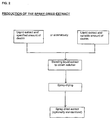
- the amount of dextrin necessary for standardization purposes can be determined and added in step iii) or in step v) and is best to be varied in only one of both steps. Best product results are obtained if the amount of dextrin is a fixed, predetermined quantity in step iii) in preparing the spraying mixture, whereas at the same time a determined amount of dextrin calculated for standardizing is added only in step v) before manufacturing the pellets. This surprising finding is demonstrated in more detail in the comparative examples below.
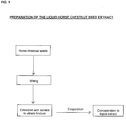
- the extract i.e. the concentrated tincture of Aesculus hippocastanum was prepared in accordance with the preceding description as outlined under paragraph 1), i) and ii) in the detailed description of the present invention in using 10 kgs of milled horse chestnut seeds.
- This material was then macerated and percolated by means of ca. 40 % in volume methanol or isopropanol in water as cosolvent at a temperature of ca. 33 °C ( 91 - 92°F) the amount of the total solvent being ca. 200 liters.
- the processes of macerating and percolating the seeds was repeatedly continued until the plant material was more or less exhausted.
- the extracted chestnuts were separated from the tincture and discharged. The obtained tincture was then decanted and filtered.
- the liquid horse chestnut extract (HCE) was prepared by evaporating the above tincture under reduced atmospheric pressure at a protective temperature of ca. 45°C (110 - 120 °F) until a content of total dry substance residue of ca 55% was obtained; for the preparation of the spray-drying mixture dextrin was added to the liquid horse chestnut extract (HCE) in a fixed amount of 5 or 20 parts per weight per 100 parts per weight total dry substance, for instance as kilograms, more specifically, 2 kgs dextrin per 20 kgs dry substance, i.e. per ca.
- the sieved pellets were then coated by spraying a suspension of a commercial mixture of poly(ethylacrylate, methylmethacrylate, trimethylammonioethylmethacrylate chloride) having a mean molecular weight of ca. 150 000 dissolved in the alcoholic mixture together with an emollient such as triethyl citrate in minor amounts and microtalc to prevent from agglomeration to get a suspension having a total content of solid substances of 2 - 4 % w/w on the basis of the unlaquered pellet cores, i.e.
- the sustained release rate may be controlled, for instance within the wanted values of 25 to 35 or 45 % w/w within the first hour.
- the thus coated diffusion sustained release pellets were encapsulated as described under above paragraph 4), step xi).
- the triterpene glycoside content was adjusted to 17 % w/w calculated on the basis of the reference agent escin.
- 294 mg coated pellets being within the sieving range of 800 - 1400 ⁇ m were encapsulated and sealed into blister packages.
- the coated diffusion pellets can in a conventional manner be compacted to rapidly desintegrating matrix tablets setting free the sustained release pellets comprising the escin in the wished dosage unit such as for instance 75 mg each.
- the pharmaceutical formulations according to the invention may additionally contain one or more further active ingredients being processed as pellets or contained in the said compacted tablet matrix in combination with pharmaceutically acceptable carriers and other inactive ingredients.
- These further active ingredients may be selected from the group consisting of circulatory drugs, flavonoids, analgesics, diuretics, vitamins and anti-inflammatory agents, in particular they may be selected from the group consisting of triamterene, thiazides, rutoside, aesculine, troxerutin, dihydroergotamine, heptaminol, diclofenac, inositol nicotinate or tocopherole.
- Those combinatory agent may also be selected from other drugs such as the blood flow enhancing agents, antirrheumatics, cardiovascular agents etc.
- Batch no. 1 was produced in accordance with the preceding example as diffusion pellets in the following specifically given process which features a fixed amount of dextrin which was added as 5 parts by weight to the spraying solution, i.e. the standardization to a content of 17 % escin was only carried out later on in the step to prepare the pelletization blend.
- Batch no. 2 was repeated with the exception that the feature of adding dextrin to the liquid extract was changed.
- the amount of dextrin was doubled to 10 parts by weight compared with batch no. 1 before spray-drying and reduced by 5 parts by weight in the later step of preparing the pelletization blend for standardization purposes. This means that the agent standardization on the basis of escin was carried out partially in step iii) and also partially in step v) to blend the pelletization mixture.
- batch no. 3 was produced in the same manner as batches no. 1 and 2 with the exception that a even greater amount of dextrin was added to the spray-drying solution, namely 21 parts by weight whereas at the same time the amount of dextrin in preparing the pelletization solution was reduced accordingly. This means that the standardization took place just iin step iii) before spray-drying.
- Batch no. 4 was produced in accordance with the preceding batches, however with the exception that the amount of dextrin was drastically increased beyond the quantity sufficient as standardization and powder/pellet additive. This added amount of dextrin in step iii) before spray-drying was 30 parts by weight whereas the dextrin amount in step v) was reduced to minor amounts.
- batch 5 was produced in accordance with the above batches only with the exception that no dextrin at all was added in step iii), but a respectively increased amount of dextrin was used for preparing the pelletization blend.
- the surface and consistency quality of batch no. 1 was excellent; the pellets showed a surprisingly round and smooth surface;
Landscapes
- Health & Medical Sciences (AREA)
- Life Sciences & Earth Sciences (AREA)
- Natural Medicines & Medicinal Plants (AREA)
- Engineering & Computer Science (AREA)
- Public Health (AREA)
- Pharmacology & Pharmacy (AREA)
- Epidemiology (AREA)
- Medicinal Chemistry (AREA)
- Animal Behavior & Ethology (AREA)
- General Health & Medical Sciences (AREA)
- Chemical & Material Sciences (AREA)
- Veterinary Medicine (AREA)
- Bioinformatics & Cheminformatics (AREA)
- Alternative & Traditional Medicine (AREA)
- Biotechnology (AREA)
- Botany (AREA)
- Medical Informatics (AREA)
- Microbiology (AREA)
- Mycology (AREA)
- Medicinal Preparation (AREA)
- Medicines Containing Plant Substances (AREA)
Applications Claiming Priority (2)
| Application Number | Priority Date | Filing Date | Title |
|---|---|---|---|
| US08/921,694 US6077534A (en) | 1997-09-02 | 1997-09-02 | Production of pharmaceutical formulations for treatment of edema and venous disorders |
| US921694 | 1997-09-02 |
Publications (2)
| Publication Number | Publication Date |
|---|---|
| EP0900563A1 true EP0900563A1 (de) | 1999-03-10 |
| EP0900563B1 EP0900563B1 (de) | 2004-02-11 |
Family
ID=25445835
Family Applications (1)
| Application Number | Title | Priority Date | Filing Date |
|---|---|---|---|
| EP98116194A Expired - Lifetime EP0900563B1 (de) | 1997-09-02 | 1998-08-27 | Herstellung pharmazeutischer Formulierungen enthaltend Aescin zur Behandlung von Oedemen und venösen Erkrankungen |
Country Status (5)
| Country | Link |
|---|---|
| US (1) | US6077534A (de) |
| EP (1) | EP0900563B1 (de) |
| CA (1) | CA2245370C (de) |
| ES (1) | ES2216219T3 (de) |
| PT (1) | PT900563E (de) |
Cited By (6)
| Publication number | Priority date | Publication date | Assignee | Title |
|---|---|---|---|---|
| WO2001068111A1 (de) * | 2000-03-15 | 2001-09-20 | Finzelberg Gmbh & Co. Kg | Hartgelatinekapseln enthaltend retardierte pflanzenextrakte und verfahren zur herstellung derselben |
| WO2002089918A1 (de) * | 2001-05-10 | 2002-11-14 | Brench Ag | Verwendung von rutinen und aescinen zur behandlung aurikulärer durchblutungsstörungen |
| WO2003035092A1 (en) * | 2001-10-26 | 2003-05-01 | Angiolab Inc. | Composition containing horse chestnut extract for anti-angiogenic and matrix metalloproteinase inhibitory activity |
| KR100533777B1 (ko) * | 2001-10-26 | 2005-12-06 | 주식회사 안지오랩 | 칠엽수 추출물을 유효성분으로 하는 혈관신생 억제용 조성물 |
| EP1811839A4 (de) * | 2004-11-18 | 2008-08-06 | Univ Rochester | Verfahren und zusammensetzungen in verbindung mit esculentosid a |
| WO2008093958A1 (en) * | 2007-01-29 | 2008-08-07 | Angiolab., Inc. | Method of producing extract of horse chestnut leaf |
Families Citing this family (7)
| Publication number | Priority date | Publication date | Assignee | Title |
|---|---|---|---|---|
| DE10122714A1 (de) * | 2001-05-10 | 2002-11-21 | Brench Ag | Verwendung von Rutinen und Aescinen zur Behandlung okulärer Durchblutungsstörungen |
| PL193976B1 (pl) * | 2002-07-01 | 2007-04-30 | Pliva Krakow | Tabletka o przedłużonym działaniu zawierająca indapamid i sposób wytwarzania tabletki o przedłużonym działaniu zawierającej indapamid |
| RU2310465C1 (ru) * | 2006-04-14 | 2007-11-20 | Общество с ограниченной ответственностью "КАМЕЛИЯ Научно-производственное предприятие" | Способ получения жидкого экстракта конского каштана из семян конского каштана обыкновенного |
| CA2704111C (en) * | 2007-05-14 | 2017-06-20 | Sustained Nano Systems Llc | Hypercompressed particles for controlled release of ophthalmic medications |
| US8071119B2 (en) * | 2007-05-14 | 2011-12-06 | Sustained Nano Systems Llc | Controlled release implantable dispensing device and method |
| US20090148498A1 (en) * | 2007-05-14 | 2009-06-11 | Sustained Nano Systems Llc | Controlled release implantable dispensing device and method |
| JP2015500241A (ja) * | 2011-12-02 | 2015-01-05 | ペガサス ラボラトリーズ インコーポレイテッド | 両親媒性脂質をベースとする徐放性組成物 |
Citations (2)
| Publication number | Priority date | Publication date | Assignee | Title |
|---|---|---|---|---|
| US5578307A (en) * | 1992-01-17 | 1996-11-26 | Alfatec-Pharma Gmbh | Shaped articles containing plant extract(s), in particular pellets, and their pharmaceutical or cosmetic use |
| DE19629040A1 (de) * | 1996-07-19 | 1998-01-22 | Basf Ag | Pflanzenextrakthaltige Arzneiformen |
Family Cites Families (6)
| Publication number | Priority date | Publication date | Assignee | Title |
|---|---|---|---|---|
| CH283585A (de) * | 1950-03-15 | 1952-06-15 | Hoffmann La Roche | Zur Herstellung von Tablettenüberzügen geeignetes Gemisch. |
| US3139383A (en) * | 1961-06-26 | 1964-06-30 | Norton Co | Encapsulated time release pellets and method for encapsulating the same |
| US3450691A (en) * | 1967-06-07 | 1969-06-17 | Klinge Co Chem Pharm Fab | Process of producing a water soluble horse chestnut saponin of low hemolytic activity and product |
| CH662505A5 (it) * | 1985-04-30 | 1987-10-15 | Seuref Ag | Composizioni farmaceutiche ad azione protettiva vascolare. |
| DE3643000A1 (de) * | 1986-12-17 | 1988-06-30 | Carolus Apotheke Dr Norma Beck | Kombinationspraeparate aus schleifendiuretika und die renale durchblutung foerdernden phytopharmaka |
| HU202743B (en) * | 1988-06-24 | 1991-04-29 | Richter Gedeon Vegyeszet | Active ingredient composition comprising medicinal herb extracts, cosmetics comprising such active ingredient and process for producing medicinal and veterinary compositions |
-
1997
- 1997-09-02 US US08/921,694 patent/US6077534A/en not_active Expired - Lifetime
-
1998
- 1998-08-19 CA CA002245370A patent/CA2245370C/en not_active Expired - Fee Related
- 1998-08-27 ES ES98116194T patent/ES2216219T3/es not_active Expired - Lifetime
- 1998-08-27 EP EP98116194A patent/EP0900563B1/de not_active Expired - Lifetime
- 1998-08-27 PT PT98116194T patent/PT900563E/pt unknown
Patent Citations (2)
| Publication number | Priority date | Publication date | Assignee | Title |
|---|---|---|---|---|
| US5578307A (en) * | 1992-01-17 | 1996-11-26 | Alfatec-Pharma Gmbh | Shaped articles containing plant extract(s), in particular pellets, and their pharmaceutical or cosmetic use |
| DE19629040A1 (de) * | 1996-07-19 | 1998-01-22 | Basf Ag | Pflanzenextrakthaltige Arzneiformen |
Non-Patent Citations (2)
| Title |
|---|
| "Rote Liste", 1997, EDITIO CANTOR, AULENDORFF/WÜRTT., XP002084542 * |
| DITTGEN M. ET AL: "Untersuchung der Bioverfügbarkeit von beta-Aescin nach oraler Verabreichung verschiedener Darreichungsformen", PHARMAZIE, vol. 51, no. 8, 1996, pages 608 - 610, XP002084541 * |
Cited By (7)
| Publication number | Priority date | Publication date | Assignee | Title |
|---|---|---|---|---|
| WO2001068111A1 (de) * | 2000-03-15 | 2001-09-20 | Finzelberg Gmbh & Co. Kg | Hartgelatinekapseln enthaltend retardierte pflanzenextrakte und verfahren zur herstellung derselben |
| WO2002089918A1 (de) * | 2001-05-10 | 2002-11-14 | Brench Ag | Verwendung von rutinen und aescinen zur behandlung aurikulärer durchblutungsstörungen |
| WO2003035092A1 (en) * | 2001-10-26 | 2003-05-01 | Angiolab Inc. | Composition containing horse chestnut extract for anti-angiogenic and matrix metalloproteinase inhibitory activity |
| KR100533777B1 (ko) * | 2001-10-26 | 2005-12-06 | 주식회사 안지오랩 | 칠엽수 추출물을 유효성분으로 하는 혈관신생 억제용 조성물 |
| US9962331B2 (en) | 2001-10-26 | 2018-05-08 | Angiolab, Inc. | Composition containing horse chestnut extract |
| EP1811839A4 (de) * | 2004-11-18 | 2008-08-06 | Univ Rochester | Verfahren und zusammensetzungen in verbindung mit esculentosid a |
| WO2008093958A1 (en) * | 2007-01-29 | 2008-08-07 | Angiolab., Inc. | Method of producing extract of horse chestnut leaf |
Also Published As
| Publication number | Publication date |
|---|---|
| ES2216219T3 (es) | 2004-10-16 |
| CA2245370A1 (en) | 1999-03-02 |
| PT900563E (pt) | 2004-06-30 |
| EP0900563B1 (de) | 2004-02-11 |
| CA2245370C (en) | 2009-07-28 |
| US6077534A (en) | 2000-06-20 |
Similar Documents
| Publication | Publication Date | Title |
|---|---|---|
| EP0068191B1 (de) | Orale Dipyridamolformen | |
| DE69832731T2 (de) | Arzneimittel mit magensaftresistentem überzug und methode zur herstellung | |
| EP0173210B1 (de) | Pellet-Zubereitung | |
| AT394310B (de) | Verfahren zur herstellung lagerstabiler, schnellzerfallender pharmazeutischer wirkstoff-presslinge | |
| EP0900563B1 (de) | Herstellung pharmazeutischer Formulierungen enthaltend Aescin zur Behandlung von Oedemen und venösen Erkrankungen | |
| EP0052075A1 (de) | Körnige Arzneimittel-Retardform | |
| US6558704B1 (en) | Process for preparing pellets containing up to 90 wt.% of a pharmaceutical active ingredient | |
| EP1267828B1 (de) | Pharmazeutische formulierungen enthaltend saccharosefettsäureester zur steuerung der wirkstofffreisetzung | |
| EP0052076A1 (de) | Schnellzerfallende Arzneimittel-Presslinge | |
| JP2016540833A (ja) | 広金銭草総フラボノイドカプセル剤およびその製造方法、並びにその応用 | |
| JP2016539955A (ja) | 薬物組成物、及びその製造方法、並びに使用 | |
| JP3221891B2 (ja) | 咀嚼可能な製薬錠剤調製のための回転造粒及び味覚遮蔽被覆加工 | |
| CN101130062A (zh) | 一种脑蛋白多肽的结肠靶向给药制剂及其制备方法 | |
| DE69816124T2 (de) | Pharmazeutische zusammensetzungen enthaltend zafirlukast | |
| CN101439067B (zh) | 一种含人参提取物的中药颗粒及其制备方法 | |
| CS261898B2 (en) | Method of homogeneous granulation product making | |
| MXPA98007097A (en) | Production of pharmaceutical formulations for the treatment of edema and veno disorders | |
| JPH0130A (ja) | 徐放性製剤 | |
| EP0381174B1 (de) | Verfahren zur Herstellung fester pharmazeutischer Zubereitungen | |
| CN114762684A (zh) | 一种治疗帕金森的缓释胶囊及其制备方法 | |
| JPH02167229A (ja) | かわらたけ由来の蛋白多糖体の粒状製剤 | |
| CN101439099B (zh) | 一种含赤芍提取物的中药颗粒及其制备方法 | |
| CA2378987C (en) | A binder for pharmaceutical compositions | |
| Shende et al. | A Closer View on Various Reported Therapeutically Active Formulations Containing Aloe vera (Aloe barbadensis) | |
| EP2826464A1 (de) | Feste Darreichungsform mit verzögerter Freisetzung |
Legal Events
| Date | Code | Title | Description |
|---|---|---|---|
| PUAI | Public reference made under article 153(3) epc to a published international application that has entered the european phase |
Free format text: ORIGINAL CODE: 0009012 |
|
| AK | Designated contracting states |
Kind code of ref document: A1 Designated state(s): ES FR GB IT NL PT SE |
|
| AX | Request for extension of the european patent |
Free format text: AL;LT;LV;MK;RO;SI |
|
| 17P | Request for examination filed |
Effective date: 19990802 |
|
| AKX | Designation fees paid |
Free format text: ES FR GB IT NL PT SE |
|
| REG | Reference to a national code |
Ref country code: DE Ref legal event code: 8566 |
|
| 17Q | First examination report despatched |
Effective date: 20021128 |
|
| GRAP | Despatch of communication of intention to grant a patent |
Free format text: ORIGINAL CODE: EPIDOSNIGR1 |
|
| GRAS | Grant fee paid |
Free format text: ORIGINAL CODE: EPIDOSNIGR3 |
|
| GRAA | (expected) grant |
Free format text: ORIGINAL CODE: 0009210 |
|
| AK | Designated contracting states |
Kind code of ref document: B1 Designated state(s): ES FR GB IT NL PT SE |
|
| REG | Reference to a national code |
Ref country code: GB Ref legal event code: FG4D |
|
| REG | Reference to a national code |
Ref country code: PT Ref legal event code: SC4A Free format text: AVAILABILITY OF NATIONAL TRANSLATION Effective date: 20040506 |
|
| REG | Reference to a national code |
Ref country code: ES Ref legal event code: FG2A Ref document number: 2216219 Country of ref document: ES Kind code of ref document: T3 |
|
| ET | Fr: translation filed | ||
| PLBE | No opposition filed within time limit |
Free format text: ORIGINAL CODE: 0009261 |
|
| STAA | Information on the status of an ep patent application or granted ep patent |
Free format text: STATUS: NO OPPOSITION FILED WITHIN TIME LIMIT |
|
| 26N | No opposition filed |
Effective date: 20041112 |
|
| PGFP | Annual fee paid to national office [announced via postgrant information from national office to epo] |
Ref country code: PT Payment date: 20080710 Year of fee payment: 11 Ref country code: NL Payment date: 20080815 Year of fee payment: 11 |
|
| REG | Reference to a national code |
Ref country code: GB Ref legal event code: 732E |
|
| PGFP | Annual fee paid to national office [announced via postgrant information from national office to epo] |
Ref country code: GB Payment date: 20080820 Year of fee payment: 11 |
|
| NLS | Nl: assignments of ep-patents |
Owner name: TEMMLER WERKE GMBH Effective date: 20081015 Owner name: FUJISAWA GMBH Effective date: 20081015 Owner name: ASTELLAS DEUTSCHLAND GMBH Effective date: 20081015 |
|
| NLT1 | Nl: modifications of names registered in virtue of documents presented to the patent office pursuant to art. 16 a, paragraph 1 |
Owner name: FUJISAWA DEUTSCHLAND GMBH Owner name: ASTELLAS PHARMA GMBH |
|
| PGFP | Annual fee paid to national office [announced via postgrant information from national office to epo] |
Ref country code: SE Payment date: 20080818 Year of fee payment: 11 |
|
| REG | Reference to a national code |
Ref country code: ES Ref legal event code: PC2A |
|
| REG | Reference to a national code |
Ref country code: FR Ref legal event code: TP Ref country code: FR Ref legal event code: CD |
|
| REG | Reference to a national code |
Ref country code: PT Ref legal event code: MM4A Free format text: LAPSE DUE TO NON-PAYMENT OF FEES Effective date: 20100301 |
|
| REG | Reference to a national code |
Ref country code: NL Ref legal event code: V1 Effective date: 20100301 |
|
| GBPC | Gb: european patent ceased through non-payment of renewal fee |
Effective date: 20090827 |
|
| PG25 | Lapsed in a contracting state [announced via postgrant information from national office to epo] |
Ref country code: PT Free format text: LAPSE BECAUSE OF NON-PAYMENT OF DUE FEES Effective date: 20100301 |
|
| PG25 | Lapsed in a contracting state [announced via postgrant information from national office to epo] |
Ref country code: NL Free format text: LAPSE BECAUSE OF NON-PAYMENT OF DUE FEES Effective date: 20100301 |
|
| PG25 | Lapsed in a contracting state [announced via postgrant information from national office to epo] |
Ref country code: GB Free format text: LAPSE BECAUSE OF NON-PAYMENT OF DUE FEES Effective date: 20090827 |
|
| PG25 | Lapsed in a contracting state [announced via postgrant information from national office to epo] |
Ref country code: SE Free format text: LAPSE BECAUSE OF NON-PAYMENT OF DUE FEES Effective date: 20090828 |
|
| REG | Reference to a national code |
Ref country code: FR Ref legal event code: PLFP Year of fee payment: 19 |
|
| PGFP | Annual fee paid to national office [announced via postgrant information from national office to epo] |
Ref country code: IT Payment date: 20160823 Year of fee payment: 19 |
|
| PGFP | Annual fee paid to national office [announced via postgrant information from national office to epo] |
Ref country code: FR Payment date: 20160825 Year of fee payment: 19 |
|
| PGFP | Annual fee paid to national office [announced via postgrant information from national office to epo] |
Ref country code: ES Payment date: 20160829 Year of fee payment: 19 |
|
| REG | Reference to a national code |
Ref country code: FR Ref legal event code: ST Effective date: 20180430 |
|
| PG25 | Lapsed in a contracting state [announced via postgrant information from national office to epo] |
Ref country code: FR Free format text: LAPSE BECAUSE OF NON-PAYMENT OF DUE FEES Effective date: 20170831 Ref country code: IT Free format text: LAPSE BECAUSE OF NON-PAYMENT OF DUE FEES Effective date: 20170827 |
|
| REG | Reference to a national code |
Ref country code: ES Ref legal event code: FD2A Effective date: 20181024 |
|
| PG25 | Lapsed in a contracting state [announced via postgrant information from national office to epo] |
Ref country code: ES Free format text: LAPSE BECAUSE OF NON-PAYMENT OF DUE FEES Effective date: 20170828 |