EP0901487B1 - 4(3h)-quinazolinones trisubstituees en position 2,3 et 6 - Google Patents
4(3h)-quinazolinones trisubstituees en position 2,3 et 6 Download PDFInfo
- Publication number
- EP0901487B1 EP0901487B1 EP97901749A EP97901749A EP0901487B1 EP 0901487 B1 EP0901487 B1 EP 0901487B1 EP 97901749 A EP97901749 A EP 97901749A EP 97901749 A EP97901749 A EP 97901749A EP 0901487 B1 EP0901487 B1 EP 0901487B1
- Authority
- EP
- European Patent Office
- Prior art keywords
- alkyl
- fluoro
- chloro
- methyl
- hydrogen
- Prior art date
- Legal status (The legal status is an assumption and is not a legal conclusion. Google has not performed a legal analysis and makes no representation as to the accuracy of the status listed.)
- Expired - Lifetime
Links
- 0 *CCC(N1*)=Nc2ccc(*)cc2C1=O Chemical compound *CCC(N1*)=Nc2ccc(*)cc2C1=O 0.000 description 2
Classifications
-
- C—CHEMISTRY; METALLURGY
- C07—ORGANIC CHEMISTRY
- C07D—HETEROCYCLIC COMPOUNDS
- C07D401/00—Heterocyclic compounds containing two or more hetero rings, having nitrogen atoms as the only ring hetero atoms, at least one ring being a six-membered ring with only one nitrogen atom
- C07D401/02—Heterocyclic compounds containing two or more hetero rings, having nitrogen atoms as the only ring hetero atoms, at least one ring being a six-membered ring with only one nitrogen atom containing two hetero rings
- C07D401/04—Heterocyclic compounds containing two or more hetero rings, having nitrogen atoms as the only ring hetero atoms, at least one ring being a six-membered ring with only one nitrogen atom containing two hetero rings directly linked by a ring-member-to-ring-member bond
-
- A—HUMAN NECESSITIES
- A61—MEDICAL OR VETERINARY SCIENCE; HYGIENE
- A61K—PREPARATIONS FOR MEDICAL, DENTAL OR TOILETRY PURPOSES
- A61K31/00—Medicinal preparations containing organic active ingredients
- A61K31/33—Heterocyclic compounds
- A61K31/395—Heterocyclic compounds having nitrogen as a ring hetero atom, e.g. guanethidine or rifamycins
- A61K31/495—Heterocyclic compounds having nitrogen as a ring hetero atom, e.g. guanethidine or rifamycins having six-membered rings with two or more nitrogen atoms as the only ring heteroatoms, e.g. piperazine or tetrazines
- A61K31/505—Pyrimidines; Hydrogenated pyrimidines, e.g. trimethoprim
-
- A—HUMAN NECESSITIES
- A61—MEDICAL OR VETERINARY SCIENCE; HYGIENE
- A61P—SPECIFIC THERAPEUTIC ACTIVITY OF CHEMICAL COMPOUNDS OR MEDICINAL PREPARATIONS
- A61P25/00—Drugs for disorders of the nervous system
-
- A—HUMAN NECESSITIES
- A61—MEDICAL OR VETERINARY SCIENCE; HYGIENE
- A61P—SPECIFIC THERAPEUTIC ACTIVITY OF CHEMICAL COMPOUNDS OR MEDICINAL PREPARATIONS
- A61P25/00—Drugs for disorders of the nervous system
- A61P25/04—Centrally acting analgesics, e.g. opioids
-
- A—HUMAN NECESSITIES
- A61—MEDICAL OR VETERINARY SCIENCE; HYGIENE
- A61P—SPECIFIC THERAPEUTIC ACTIVITY OF CHEMICAL COMPOUNDS OR MEDICINAL PREPARATIONS
- A61P25/00—Drugs for disorders of the nervous system
- A61P25/08—Antiepileptics; Anticonvulsants
-
- A—HUMAN NECESSITIES
- A61—MEDICAL OR VETERINARY SCIENCE; HYGIENE
- A61P—SPECIFIC THERAPEUTIC ACTIVITY OF CHEMICAL COMPOUNDS OR MEDICINAL PREPARATIONS
- A61P25/00—Drugs for disorders of the nervous system
- A61P25/14—Drugs for disorders of the nervous system for treating abnormal movements, e.g. chorea, dyskinesia
-
- A—HUMAN NECESSITIES
- A61—MEDICAL OR VETERINARY SCIENCE; HYGIENE
- A61P—SPECIFIC THERAPEUTIC ACTIVITY OF CHEMICAL COMPOUNDS OR MEDICINAL PREPARATIONS
- A61P25/00—Drugs for disorders of the nervous system
- A61P25/28—Drugs for disorders of the nervous system for treating neurodegenerative disorders of the central nervous system, e.g. nootropic agents, cognition enhancers, drugs for treating Alzheimer's disease or other forms of dementia
-
- A—HUMAN NECESSITIES
- A61—MEDICAL OR VETERINARY SCIENCE; HYGIENE
- A61P—SPECIFIC THERAPEUTIC ACTIVITY OF CHEMICAL COMPOUNDS OR MEDICINAL PREPARATIONS
- A61P27/00—Drugs for disorders of the senses
-
- A—HUMAN NECESSITIES
- A61—MEDICAL OR VETERINARY SCIENCE; HYGIENE
- A61P—SPECIFIC THERAPEUTIC ACTIVITY OF CHEMICAL COMPOUNDS OR MEDICINAL PREPARATIONS
- A61P29/00—Non-central analgesic, antipyretic or antiinflammatory agents, e.g. antirheumatic agents; Non-steroidal antiinflammatory drugs [NSAID]
-
- A—HUMAN NECESSITIES
- A61—MEDICAL OR VETERINARY SCIENCE; HYGIENE
- A61P—SPECIFIC THERAPEUTIC ACTIVITY OF CHEMICAL COMPOUNDS OR MEDICINAL PREPARATIONS
- A61P43/00—Drugs for specific purposes, not provided for in groups A61P1/00-A61P41/00
-
- A—HUMAN NECESSITIES
- A61—MEDICAL OR VETERINARY SCIENCE; HYGIENE
- A61P—SPECIFIC THERAPEUTIC ACTIVITY OF CHEMICAL COMPOUNDS OR MEDICINAL PREPARATIONS
- A61P9/00—Drugs for disorders of the cardiovascular system
-
- C—CHEMISTRY; METALLURGY
- C07—ORGANIC CHEMISTRY
- C07D—HETEROCYCLIC COMPOUNDS
- C07D239/00—Heterocyclic compounds containing 1,3-diazine or hydrogenated 1,3-diazine rings
- C07D239/70—Heterocyclic compounds containing 1,3-diazine or hydrogenated 1,3-diazine rings condensed with carbocyclic rings or ring systems
- C07D239/72—Quinazolines; Hydrogenated quinazolines
- C07D239/86—Quinazolines; Hydrogenated quinazolines with hetero atoms directly attached in position 4
- C07D239/88—Oxygen atoms
- C07D239/91—Oxygen atoms with aryl or aralkyl radicals attached in position 2 or 3
-
- C—CHEMISTRY; METALLURGY
- C07—ORGANIC CHEMISTRY
- C07D—HETEROCYCLIC COMPOUNDS
- C07D401/00—Heterocyclic compounds containing two or more hetero rings, having nitrogen atoms as the only ring hetero atoms, at least one ring being a six-membered ring with only one nitrogen atom
- C07D401/02—Heterocyclic compounds containing two or more hetero rings, having nitrogen atoms as the only ring hetero atoms, at least one ring being a six-membered ring with only one nitrogen atom containing two hetero rings
- C07D401/06—Heterocyclic compounds containing two or more hetero rings, having nitrogen atoms as the only ring hetero atoms, at least one ring being a six-membered ring with only one nitrogen atom containing two hetero rings linked by a carbon chain containing only aliphatic carbon atoms
-
- C—CHEMISTRY; METALLURGY
- C07—ORGANIC CHEMISTRY
- C07D—HETEROCYCLIC COMPOUNDS
- C07D401/00—Heterocyclic compounds containing two or more hetero rings, having nitrogen atoms as the only ring hetero atoms, at least one ring being a six-membered ring with only one nitrogen atom
- C07D401/14—Heterocyclic compounds containing two or more hetero rings, having nitrogen atoms as the only ring hetero atoms, at least one ring being a six-membered ring with only one nitrogen atom containing three or more hetero rings
-
- C—CHEMISTRY; METALLURGY
- C07—ORGANIC CHEMISTRY
- C07D—HETEROCYCLIC COMPOUNDS
- C07D403/00—Heterocyclic compounds containing two or more hetero rings, having nitrogen atoms as the only ring hetero atoms, not provided for by group C07D401/00
- C07D403/02—Heterocyclic compounds containing two or more hetero rings, having nitrogen atoms as the only ring hetero atoms, not provided for by group C07D401/00 containing two hetero rings
- C07D403/06—Heterocyclic compounds containing two or more hetero rings, having nitrogen atoms as the only ring hetero atoms, not provided for by group C07D401/00 containing two hetero rings linked by a carbon chain containing only aliphatic carbon atoms
-
- C—CHEMISTRY; METALLURGY
- C07—ORGANIC CHEMISTRY
- C07D—HETEROCYCLIC COMPOUNDS
- C07D413/00—Heterocyclic compounds containing two or more hetero rings, at least one ring having nitrogen and oxygen atoms as the only ring hetero atoms
- C07D413/02—Heterocyclic compounds containing two or more hetero rings, at least one ring having nitrogen and oxygen atoms as the only ring hetero atoms containing two hetero rings
- C07D413/12—Heterocyclic compounds containing two or more hetero rings, at least one ring having nitrogen and oxygen atoms as the only ring hetero atoms containing two hetero rings linked by a chain containing hetero atoms as chain links
-
- C—CHEMISTRY; METALLURGY
- C07—ORGANIC CHEMISTRY
- C07D—HETEROCYCLIC COMPOUNDS
- C07D413/00—Heterocyclic compounds containing two or more hetero rings, at least one ring having nitrogen and oxygen atoms as the only ring hetero atoms
- C07D413/14—Heterocyclic compounds containing two or more hetero rings, at least one ring having nitrogen and oxygen atoms as the only ring hetero atoms containing three or more hetero rings
-
- C—CHEMISTRY; METALLURGY
- C07—ORGANIC CHEMISTRY
- C07D—HETEROCYCLIC COMPOUNDS
- C07D417/00—Heterocyclic compounds containing two or more hetero rings, at least one ring having nitrogen and sulfur atoms as the only ring hetero atoms, not provided for by group C07D415/00
- C07D417/02—Heterocyclic compounds containing two or more hetero rings, at least one ring having nitrogen and sulfur atoms as the only ring hetero atoms, not provided for by group C07D415/00 containing two hetero rings
- C07D417/06—Heterocyclic compounds containing two or more hetero rings, at least one ring having nitrogen and sulfur atoms as the only ring hetero atoms, not provided for by group C07D415/00 containing two hetero rings linked by a carbon chain containing only aliphatic carbon atoms
-
- C—CHEMISTRY; METALLURGY
- C07—ORGANIC CHEMISTRY
- C07D—HETEROCYCLIC COMPOUNDS
- C07D417/00—Heterocyclic compounds containing two or more hetero rings, at least one ring having nitrogen and sulfur atoms as the only ring hetero atoms, not provided for by group C07D415/00
- C07D417/14—Heterocyclic compounds containing two or more hetero rings, at least one ring having nitrogen and sulfur atoms as the only ring hetero atoms, not provided for by group C07D415/00 containing three or more hetero rings
-
- C—CHEMISTRY; METALLURGY
- C07—ORGANIC CHEMISTRY
- C07D—HETEROCYCLIC COMPOUNDS
- C07D491/00—Heterocyclic compounds containing in the condensed ring system both one or more rings having oxygen atoms as the only ring hetero atoms and one or more rings having nitrogen atoms as the only ring hetero atoms, not provided for by groups C07D451/00 - C07D459/00, C07D463/00, C07D477/00 or C07D489/00
- C07D491/02—Heterocyclic compounds containing in the condensed ring system both one or more rings having oxygen atoms as the only ring hetero atoms and one or more rings having nitrogen atoms as the only ring hetero atoms, not provided for by groups C07D451/00 - C07D459/00, C07D463/00, C07D477/00 or C07D489/00 in which the condensed system contains two hetero rings
- C07D491/10—Spiro-condensed systems
Definitions
- the present invention relates to compounds of the formula I, described below, and their pharmaceutically acceptable salts, and pharmaceutical compositions and methods of treating neurodegenerative and CNS-trauma related conditions.
- AMPA receptors are a subspecies of glutamate receptors, identified by their ability to bind ⁇ -amino-3-hydroxy-5-methyl-4-isoxazolepropionic acid (AMPA), that are implicated as post-synaptic neurotransmitter receptors for excitatory amino acids.
- AMPA ⁇ -amino-3-hydroxy-5-methyl-4-isoxazolepropionic acid
- Excitatory amino acid receptors are classified into two general types. Receptors that are directly coupled to the opening of cation channels in the cell membrane of the neurons are termed "ionotropic.” This type of receptor has been subdivided Into at least three subtypes, which are defined by the depolarizing actions of the selective agonists N-methyl-D-aspartate (NMDA), ⁇ -amino-3-hydroxy-5-methylisoxazole-4-propionic acid (AMPA), and kainic acid (KA).
- NMDA N-methyl-D-aspartate
- AMPA ⁇ -amino-3-hydroxy-5-methylisoxazole-4-propionic acid
- KA kainic acid
- the second general type is the G-protein or second messenger-linked "metabotropic" excitatory amino acid receptor.
- This second type when activated by the agonists quisqualate, ibotenate, or trans-1-aminocyclopentane-1,3-dicarboxylic acid, leads to enhanced phosphoinosoltide hydrolysis in the postsynaptic cell.
- Both types of receptors appear not only to mediate normal synaptic transmission along excitatory pathways, but also participate in the modification of synaptic connection during development and changes in the efficiency of synaptic transmission throughout life. Schoepp, Bockaert, and Sladeczek. Trends in Pharmacol. Sci., 11, 508 (1990); McDonald and Johnson, Brain Research Reviews, 15, 41 (1990).
- Excitatory amino acid excitotoxicity has been implicated in the pathophyslology of a number of neurological disorders. This excitotoxicity has been implicated in the pathophysiology of acute and chronic neurodegenerative conditions including cerebral deficits subsequent to cardiac bypass surgery and grafting, stroke, cerebral ischemia, spinal cord trauma, head trauma, Atzheimer's Disease, Huntington's Chorea, amyotrophic lateral sclerosis, epilepsy, AIDS-induced dementia, perinatal hypoxia, hypoxia (such as conditions caused by strangulation, surgery, smoke inhalation, asphyxiation, drowning, choking, electrocution or drug or alcohol overdose), cardiac arrest, hypoglycemic neuronal damage, ocular damage and retinopathy, and idiopathic and drug-induced Parkinson's Disease.
- hypoxia such as conditions caused by strangulation, surgery, smoke inhalation, asphyxiation, drowning, choking, electrocution or drug or alcohol overdose
- cardiac arrest hypoglycemic neuro
- Neuromodulation Other neurological conditions, that are caused by glutamate dysfunction, require neuromodulation. These other neurological conditions include muscular spasms, migraine headaches, urinary incontinence, psychosis, addiction withdrawal (such as alcoholism and drug addiction including opiate, cocaine and nicotine addiction), opiate tolerance, anxiety, emesis, brain edema, chronic pain, convulsions, retinal neuropathy, tinnitus and tardive dyskinesia.
- a neuro-protective agent such as an AMPA receptor antagonist, is believed to be useful in treating these disorders and/or reducing the amount of neurological damage associated with these disorders.
- the EAA antagonists are also useful as analgesic agents.
- AMPA receptor antagonists are neuroprotective in focal and global ischemia models.
- the competitive AMPA receptor antagonist NBQX (2,3-dihydroxy-6-nitro-7-sulfamoylbenzo[f-]quinoxaline) has been reported effective in preventing global and focal ischemic damage. Sheardown et al. , Science, 247, 571 (1900); Buchan et al. , Neuroreport, 2, 473 (1991); LePelliet et al ., Brain Research, 671, 115 (1992).
- the noncompetitive AMPA receptor antagonists GKYI 52466 has been shown to be an effective neuroprotective agent in rat global ischemia models. LaPeillet et al.
- AMPA receptor antagonists may prove useful as neuroprotective agents and improve the neurological outcome of cerebral ischemia in humans.
- WO-A-95/19346 discloses quinazoline-2,4-diones having antagonist activity at AMPA excitatory amino acid receptors.
- WO-A-92/13535 discloses quinazolone derivatives having anticonvulsant activity.
- EP-A-0056637 discloses 4(3H)-quinazolinones which are useful as hypotensive agents.
- the present invention relates to a bicyclic compound of the formula wherein R' is optionally substituted phenyl of the formula Ph 1 or heteroaryl wherein said heteroaryl is selected from the group consisting of pyridin-2-yl, pyridin-3-yl and pyridin-4-yl, wherein said heteroaryl may optionally be substituted on any of the ring carbon atoms capable of forming an additional bond, up to a maximum of three substituents per ring, with a substituent selected from hydrogen, (C 1 -C 6 )alkyl, halogen, trifluoromethyl, amino-(CH 2 ) n -, (C 1 -C 5 )alkylamino-(CH 2 ) n -, di(C 1 -C 6 )alkyl-amino-(CH 2 ) n -, (C 1 -C 6 )alkoxy, hydroxy(C 1 -C 6 )alkyl, (C 1 -C 6
- R 2 is phenyl of the formula Ph 2 or a five or six membered heterocycle, wherein said 6-membered heterocycle has the formula wherein "N” is nitrogen; wherein said ring positions "K”, “L” and “M” may be independently selected from carbon or nitrogen, with the proviso that i) only one of” K", “L” or “M” can be nitrogen and ii) when “K", "L” or “M” is nitrogen then its respective R 15 , R 16 or R 17 is absent; wherein said five membered heterocycle has the formula wherein said "T” is -CH-, N, NH, O or S; wherein said ring positions "P” and “Q” may be independently selected from carbon, nitrogen, oxygen or sulfur; with the proviso that only one of "P.” “Q” or “T” can be oxygen or sulfur and at least one of "P,” “Q” or “T” must be a heteroatom; wherein said Ph 2 is a group of the formula R 3 is chloro or fluoro;
- Proviso (i) distinguishes the present invention from compounds disclosed in US-A-3558610.
- Proviso (ii) distinguishes the present invention from Leszkovsky, Erdeley and Tardy, Acta Physiologica, XXVII/1 81-90 1964.
- the excluded compounds have not been disclosed as AMPA receptor antagonists.
- the present invention also relates to the pharmaceutically acceptable acid addition salts of compounds of the formula I.
- the acids which are used to prepare t he pharmaceutically acceptable acid addition salts of the aforementioned base compounds of this invention are those which form non-toxic acid addition salts, i.e.
- salts containing pharmacologically acceptable anions such as the hydrochloride, hydrobromide, hydroiodide, nitrate, sulfate, bisulfate, phosphate, acid phosphate, acetate, lactate, citrate, acid citrate, tartrate, bitartrate, succinate, maleate, fumarate, gluconate, saccharate, benzoate, methanesulfonate, ethanesulfonate, benzenesulfonate, p-toluenesulfonate and pamoate [ i.e. , 1,1'-methylene-bis-(2-hydroxy-3-naphthoate)]salts.
- pharmacologically acceptable anions such as the hydrochloride, hydrobromide, hydroiodide, nitrate, sulfate, bisulfate, phosphate, acid phosphate, acetate, lactate, citrate, acid citrate, tartrate, bit
- the invention also relates to base addition salts of formula I.
- the chemical bases that may be used as reagents to prepare pharmaceutically acceptable base salts of those compounds of formula I that are acidic in nature are those that form non-toxic base salts with such compounds.
- Such non-toxic base salts include, but are not limited to those derived from such pharmacologically acceptable cations such as alkali metal cations (e.g. , potassium and sodium) and alkaline earth metal cations (e.g. , calcium and magnesium), ammonium or water-soluble amine addition salts such as N-methylglucamine (meglumine), and the lower alkanolammonium and other base salts of pharmaceutically acceptable organic amines.
- Preferred compounds of formula I wherein R 1 is Ph 1 are those wherein one of R 5 , R 6 , R 7 or R 8 is fluoro, bromo, chloro, methyl or trifluoromethyl, preferably R 5 is fluoro, bromo, chloro, methyl or trifluoromethyl. Most preferred compounds of formula I wherein R 1 is Ph 1 are those wherein R 5 is chloro or methyl.
- Preferred compounds of formula I wherein R 1 is heteroaryl are those wherein heteroaryl is pyridin-3-yl, optionally substituted with halo, -CN, CF 3 , or (C 1 -C 6 )alkyl, more preferably chloro or methyl, most preferably substituted at the 2-position.
- Preferred compounds of formula I wherein R 2 is Ph 2 are those wherein R 9 is fluoro, chloro, -CN or hydroxy; or R 10 is -CHO, chloro, fluoro, methyl, (C 1 -C 6 )alkyl-NH-(CH 2 ) p -, di(C 1 -C 6 )alkyl-N-(CH 2 ) p -, or cyano.
- R 2 is Ph 2 are those wherein R 9 is fluoro or -CN; or R 10 is methyl, (C 1 -C 6 )alkyl-NH-(CH 2 ) p -, di(C 1 -C 6 )alkyl-N-(CH 2 ) p -, or cyano.
- Preferred compounds of formula I wherein R 2 is heteroaryl are those wherein said heteroaryl is either an optionally substituted six-membered heterocycle wherein "K", “L” and “M” are carbon (i.e. pyridin-2-yl), or “K” and “L” are carbon and “M” is nitrogen (i.e. pyrimidin-2-yl), or said heteroaryl Is an optionally substituted five membered heterocycle wherein "T” is nitrogen, “P” is sulfur and “Q” is carbon (i.e. 1,3-thiazol-4-yl), or “T” is nitrogen or sulfur, “Q” is nitrogen or sulfur and “P” is carbon (i.e. 1,3-thiazol-2-yl) or “T” is oxygen and "P” and “Q” are each carbon (i.e. fur-2-yl).
- Preferred compounds of formula I wherein R 2 is an optionally substituted six-membered heterocycle wherein "K", “L” and “M” are carbon are those wherein R 14 is hydrogen, -CHO, chloro, fluoro, methyl, (C 1 -C 6 )alkyl-NH-(CH 2 ) p -, di(C 1 -C 6 )alkyl-N-(CH 2 ) p -, or cyano; R 17 is hydrogen, -CHO, chloro, fluoro, methyl, (C 1 -C 6 )alkyl-NH-(C 1 -C 6 )alkyl, di(C 1 -C 6 )alkyl-N-(C 1 -C 6 )alkyl, or cyano; or R 15 or R 16 are independently hydrogen, -CHO, chloro, fluoro, methyl or cyano.
- R 2 is an optionally substituted six-membered heterocycle wherein "K", “L” and “M” are carbon (i.e. pyridin-2-yl) are those wherein R 14 is hydrogen, -CHO, methyl, (C 1 -C 6 )alkyl-NH-(CH 2 ) p -, di(C 1 -C 6 )alkyl-N-(CH 2 ) p -, or cyano.
- Preferred compounds of formula I wherein R 2 is an optionally substituted five-membered heterocycle wherein "T” is nitrogen, “P” is sulfur and “Q” is carbon (i.e. 1,3-thiazol-4-yl) are those wherein R 14 , R 16 or R 18 are each independently hydrogen, chloro, fluoro, methyl or cyano.
- Preferred compounds of formula I wherein R 2 is an optionally substituted five-membered heterocycle wherein "T” is nitrogen or sulfur "Q” is sulfur or nitrogen and "P” is carbon (i.e. 1,3-thiazol-2-yl) are those wherein R 14 or R 15 are independently hydrogen, chloro, fluoro, methyl or cyano.
- This invention also relates to a pharmaceutical composition for treating or preventing a condition selected from cerebral deficits subsequent to cardiac bypass surgery and grafting, stroke, cerebral ischemia, spinal cord trauma, head trauma, Alzheimer's Disease, Huntington's Chorea, amyotrophic lateral sclerosis, epilepsy, AIDS-induced demential, muscular spasms, migraine headaches, urinary incontinence, psychosis, convulsions, perinatal hypoxia, hypoxia (such as conditions caused by strangulation, surgery, smoke inhalation, asphyxiation, drowning, choking, electrocution or drug or alcohol overdose), cardiac arrest, hypoglycemic neuronal damage, opiate tolerance, addiction withdrawal (such as alcoholism and drug addiction including opiate, cocaine and nicotine addiction), ocular damage, retinopathy, retinal neuropathy, tinnitus, idiopathic and drug induced Parkinson's Disease, anxiety, emesis, brain edema, chronic or acute pain, or tardive dyskines
- This invention also relates to the use of the present compounds for the preparation of a medicament for treating or preventing a condition selected from cerebral deficits subsequent to cardiac bypass surgery and grafting, stroke, cerebral ischemia, spinal cord trauma, head trauma, Alzheimer's Disease, Huntington's Chorea, amyotrophic lateral sclerosis, epilepsy, AIDS-induced demential, muscular spasms, migraine headaches, urinary incontinence, psychosis, convulsions, perinatal hypoxia, hypoxia (such as conditions caused by strangulation, surgery, smoke inhalation, asphyxiation, drowning, choking, electrocution or drug or alcohol overdose), cardiac arrest, hypoglycemic neuronal damage, opiate tolerance, addiction withdrawal (such as alcoholism and drug addiction including opiate, cocaine and nicotine addiction), ocular damage, retinopathy, retinal neuropathy, tinnitus, idiopathic and dr ug induced Parkinson's Disease, anxiety, emesis, brain e
- This invention also relates to a pharmaceutical composition for treating or preventing a condition selected from cerebral deficits subsequent to cardiac bypass surgery and grafting, stroke, cerebral ischemia, spinal cord trauma, head trauma, Alzheimer's Disease, Huntington's Chorea, amyotrophic lateral sclerosis, epilepsy, AIDS-induced demential, muscular spasms, migraine headaches, urinary incontinence, psychosis, convulsions, perinatal hypoxia, hypoxia (such as conditions caused by strangulation, surgery, smoke inhalation, asphyxiation, drowning, choking, electrocution or drug or alcohol overdose), cardiac arrest, hypoglycemic neuronal damage, opiate tolerance, addiction withdrawal (such as alcoholism and drug addiction including opiate, cocaine and nicotine addiction), ocular damage, retinopathy, retinal neuropathy, tinnitus, idiopathic and drug induced Parkinson's Disease, anxiety, emesis, brain edema, chronic or acute pain, or tardive dyskines
- This invention also relates to the use of the present compounds for the preparation of a medicament for treating or preventing a condition selected from cerebral deficits subsequent to cardiac bypass surgery and grafting, stroke, cerebral ischemia, spinal cord trauma, head trauma, Alzheimer's Disease, Huntington's Chorea, amyotrophic lateral sclerosis, epilepsy, AIDS-induced demential, muscular spasms, migraine headaches, urinary incontinence, psychosis, convulsions, perinatal hypoxia, hypoxia (such as conditions caused by strangulation, surgery, smoke inhalation, asphyxiation, drowning, choking, electrocution or drug or alcohol overdose), cardiac arrest, hypoglycemic neuronal damage, opiate tolerance, addiction withdrawal (such as alcoholism and drug addiction including opiate, cocaine and nicotine addiction), ocular damage, retinopathy, retinal neuropathy, tinnitus, idiopathic and dr ug induced Parkinson's Disease, anxiety, emesis, brain e
- the compounds of this invention include all stereoisomers and all optical isomers of compounds of the formula I (e.g. , R and S enantiomers), as well as racemic, diastereomeric and other mixtures of such isomers.
- the compounds of this invention may contain olefln-like double bonds. Whe n such bonds are present, the compounds of the invention exist as cis and trans configurations and as mixtures thereof.
- alkyl groups referred to herein, as well as the alkyl moieties of other groups referred to herein (e.g., alkoxy), may be linear or branched, and they may also be cyclic (e.g., cyclopropyl, cyclobutyl, cyclopentyl, or cyclohexyl) or be linear or branched and contain cyclic moieties.
- halo and halogen refer to fluorine, bromine, chlorine or iodine.
- the compounds of formula I can be prepared according to the methods of Scheme 1.
- K, L, M, P, Q, T, R 1 , R 2 , R 5 , R 6 , R 7 , R 8 , R 9 , R 10 , R 11 , R 12 , R 13 , R 14 , R 15 , R 16 , R 17 , Ph 1 , Ph 2 , n, m, and p are as defined above for formula I.
- Scheme 1 refers to the preparation of compounds of the formula I from compounds of the formula V.
- Compounds of the formula V are commercially available or can be prepared by methods well known to those of ordinary skill in the art.
- a compound of the formula V can be converted into an acetamide of the formula IV by reaction with acetyl chloride or acetic anhydride in the presence of a base in a reaction inert solvent.
- Suitable solvents include methylene chloride, dichloroethane, tetrahydrofuran and dioxane, preferably methylene chloride.
- Suitable bases include trialkylamines such as triethylamine and tributylamine, dimethylaminopyridine and potassium carbonate, preferably triethylamine.
- the temperature of the aforesaid reaction is in the range from about 0°C to about 35°C for about 1 hour to about 10 hours, preferably at about 30°C for about 3 hours.
- the acetamide of the formula IV is cyclized to a compound of the formula III by reaction with a dehydrating agent, in the presence of a catalyst, in dry reaction inert solvent.
- Suitable dehydrating agents include acetic anhydride, phosphorous pentoxide, dicyclohexylcarbodiimide, and acetyl chloride, preferably acetic anhydride.
- Suitable catalysts include sodium or potassium acetate, acetic acid, p-toluene sulfonic acid, or boron trifluoride etherate, preferably sodium acetate.
- Suitable solvents include dioxane, toluene, diglyme or dichloroethane, preferably dioxane.
- the temperature of the aforesaid reaction is in the range from about 80°C to about 110°C for about 1 hour to about 24 hours, preferably at about 100°C for about 3 to 10 hours.
- the compound of formula V can be directly converted Into a compound of formula III by reaction with acetic anhydride in the presence of an acid catalyst in a solvent.
- Suitable acid catalysts include acetic acid, sulfuric acid, or p-toluene sulfonic acid, preferably acetic acid.
- Suitable solvents include acetic acid, toluene or xylene, preferably acetic acid.
- the temperature of the aforesaid reaction i s from about 20°C to about 150°C for about 10 minutes to about 10 hours, preferably at about 120°C for about 2 to 5 hours.
- the compound of formula III is reacted with an amine of the formula R 1 NH 2 in a polar protic solvent in the presence of an a cid catalyst to form a compound of the formula II.
- Suitable acid catalysts include acetic acid, p-toluene sulfonic acid or sulfuric acid, preferably acetic acid.
- Suitable polar protic solvents include acetic acid, methanol, ethanol or isopropanol, preferably acetic acid.
- the temperature of the aforesaid reaction is from about 20°C to about 117°C for about 1 hour to about 24 hours, preferably at about 117°C for about 6 hours.
- a compound of the formula IV can be directly converted to a compound of the formula II by reaction with a dehydrating agent, an amine of the formula R 1 NH 2 , and a base, in a reaction inert solvent.
- Suitable dehydrating agents include phosphorous trichloride, phosphorous oxychloride, phosphorous pentachloride or thionyl chloride, preferably phosphorous trichloride.
- Suitable bases include pyridine, lutidine, dimethylaminopyridine, triethylamine or N-methyl morpholine, preferably pyridine.
- Suitable solvents include toluene, cyclohexane, benzene or xylene, preferably toluene.
- the reaction when the combined reactants are a liquid, the reaction may be run neat.
- the temperature of the aforesaid reaction is from about 50°C to about 150°C for about 1 hour to about 24 hours, preferably at about 110°C for about 4 hours.
- the compound of formula II is reacted with an aldehyde of the formula R 2 CHO in the presence of a catalyst and a dehydrating agent in a suitable solvent to form a compound of the formula I.
- Suitable catalysts include zinc chloride, sodium acetate, aluminum chloride, tin chloride, or boron trifluoride etherate, preferably zinc chloride or sodium acetate.
- Suitable dehydrating agents include acetic anhydride, methane sulfonic anhydride, trifluoroacetic anhydride or propionic anhydride, preferably acetic anhydride.
- Suitable polar solvents include acetic acid, dioxane, dimethoxyethane or propionic acid.
- the temperature of the aforesaid reaction is from about 60°C to about 100°C for about 30 minutes to about 24 hours, preferably at about 100°C for about 3 hours.
- Compounds of the formula I wherein the dashed line represents a single carbon-carbon bond may be prepared by hydrogenating the corresponding compounds wherein the dashed line represents a double carbon-carbon bond, using standard techniques that are well known to those skilled in the art. For example, reduction of the double bond may be effected with hydrogen gas (H 2 ), using catalysts such as palladium on carbon (Pd/C), palladium on barium sulfate (Pd/BaSO 4 ), platinum on carbon (Pt/C), or tris(triphenylphosphine) rhodium chloride (Wilkinson's catalyst), in an appropriate solvent such as methanol, ethanol, THF, dioxane or ethyl acetate, at a pressure from about 1 to about 5 atmospheres and a temperature from about 10°C to about 60°C, as described in Catalytic Hydrogenation in Organic Synthesis, Paul Rylander, Academic Press Inc., San Diego, 1979, pp.
- H 2 hydrogen gas
- a compound of the formula V can be converted to a compound of the formula II according to the methods described in Scheme 2.
- the compound of formula II, so formed, can be converted into a compound of formula I according to the methods of Scheme 1.
- a compound of the formula V is reacted with a coupling reagent, an amine of the formula R 1 NH 2 , and a base in a reaction inert solvent to form a compound of the formula VI.
- Suitable coupling reagents which activate the carboxylic functionality are dicyclohexylcarbodiimide, N-3-dimethylaminopropyl-N'-ethylcarbodiimide, 2-ethoxy-1-ethoxycarbonyl-1,2-dihydroquinoline (EEDQ), carbonyl diimidazole (CDI), and diethylphosphorylcyanide.
- Suitable bases include dimethylaminopyridine (DMAP), hydroxybenzotriazole (HBT), or triethylamine, preferably dimethylaminopyridine.
- the coupling is conducted in an inert solvent, preferably an aprotic solvent.
- Suitable solvents include acetonitrile, dichloromethane, dichloroethane, and dimethylformamide.
- the preferred solvent is dichloromethane.
- the temperature of the aforesaid reaction is generally from about -30 to about 80°C, preferably about 0 to about 25°C.
- the compound of formula VI is converted into a compound of the formula VII by reaction with acetyl chloride or acetic anhydride in the presence of a base in a reaction inert solvent.
- Suitable solvents include methylene chloride, tetrahydrofuran and chloroform, preferably methylene chloride.
- Suitable bases include trialkylamines such as triethylamine and tributylamine, dimethylaminopyridine and potassium carbonate, preferably triethylamine.
- the temperature of the aforesaid reaction is in the range from about 0°C to about 35°C for about 1 hour to about 10 hours, preferably at about 30°C for about 3 hours.
- the compound of formula VII is cyclized to a compound of formula II by reaction with triphenylphosphine, a base, and a dialkyl azodicarboxylate In a reaction inert solvent.
- Suitable bases include pyridine, triethylamine and 4-dimethylaminopyridine, preferably 4-dimethylaminopyridine.
- Suitable solvents include dimethylformamide, tetrahydrofuran and dioxane, preferably dioxane.
- the temperature of the aforesaid reaction is in the range from about 25°C to about 125°C for about 1 hour to about 24 hours, preferably at about 100°C for about 8 to 15 hours.
- the compound of formula II can be converted into a compound of formula I according to the method described in Scheme 1.
- the pressure of each of the above reactions is not critical. Generally, the reactions will be conducted at a pressure of about one to about three atmospheres, preferably at ambient pressure (about one atmosphere)
- R 2 is heteroaryl
- heteroaryl is selected from the group consisting of pyridin-2-yl, 1,3-pyrazin-4-yl, 1,4-pyrazin-3-yl, 1,3-pyrazin-2-yl, pyrrol-2yl, 1,3-imidazol-4-yl, 1,3-imidazol-2-yl, 1,3,4-triazol-2-yl, 1,3-oxazol-4-yl, 1,3-oxazol-2-yl, 1,3-thiazol-4-yl, 1,3-thiazol-2-yl, 1,2,4-oxadiazol-3-yl, 1,2,4-oxadiazol-5-yl, fur-2-yl, 1,3-oxazol-5-yl, and 1,3,4-oxadiazol-2-yl, wherein said heteroaryl may optionally be substituted on any of the atoms capable of forming an additional bond, up to a maximum of three substituents
- the compounds of the formula I which are basic in nature are capable of forming a wide variety of different salts with various inorganic and organic acids. Although such salts must be pharmaceutically acceptable for administration to animals, it is often desirable in practice to initially isolate a compound of the formula I from the reaction mixture as a pharmaceutically unacceptable salt and then simply convert the latter back to the free base compound by treatment with an alkaline reagent, and subsequently convert the free base to a pharmaceutically acceptable acid addition salt.
- the acid addition salts of the base compounds of this invention are readily prepared by treating the base compound with a substantially equivalent amount of the chosen mineral or organic acid in an aqueous solvent medium or in a suitable organic solvent such as methanol or ethanol. Upon careful evaporation of the solvent, the desired solid salt is obtained.
- the acids which are used to prepare the pharmaceutically acceptable acid addition salts of the base compounds of this invention are those which form non-toxic acid addition salts, i.e., salts containing pharmacologically acceptable anions, such as hydrochloride, hydrobromide, hydroiodide, nitrate, sulfate or bisulfate, phosphate or acid phosphate, acetate, lactate, citrate or acid citrate, tartrate or bitartrate, succinate, maleate, fumarate, gluconate, saccharate, benzoate, methanesulfonate and pamoate [i.e. 1,1'-methylene-bis-(2-hydroxy-3-naphthoate)] salts.
- non-toxic acid addition salts i.e., salts containing pharmacologically acceptable anions, such as hydrochloride, hydrobromide, hydroiodide, nitrate, sulfate or bisulfate, phosphate or acid phosphate
- Those compounds of the formula I which are acidic in nature are capable of forming base salts with various pharmacologically acceptable cations.
- such salts include the alkali metal or alkaline-earth metal salts and particular, the sodium and potassium salts. These salts are all prepared by conventional techniques.
- the chemical bases which are used as reagents to prepare the pharmaceutically acceptable base salts of this invention are those which form non-toxic base salts with the herein described acidic compounds of formula I. These non-toxic base salts include those derived from such pharmacologically acceptable cations as sodium, potassium calcium and magnesium, etc.
- salts can easily be prepared by treating the corresponding acidic compounds with an aqueous solution containing the desired pharmacologically acceptable cations, and then evaporating the resulting solution to dryness, preferably under reduced pressure.
- they may also be prepared by mixing lower alkanolic solutions of the acidic compounds and the desired alkali metal alkoxide together, and then evaporating the resulting solution to dryness in the same manner as before.
- stoichiometric quantities of reagents are preferably employed in order to ensure completeness of reaction of maximum product of yields of the desired final product.
- the compounds of the formula I and the pharmaceutically acceptable salts thereof are useful for the treatment of neurodegenerative and CNS-trauma related conditions and are potent AMPA receptor antagonists.
- the active compounds of the invention may therefore be used in the treatment or prevention of cerebral deficits subsequent to cardiac bypass surgery and grafting, stroke, cerebral ischemia, spinal cord trauma, head trauma, Alzheimer's Disease, Huntington's Chorea, amyotrophic lateral sclerosis, epilepsy, AIDS-induced demential, muscular spasms, migraine headaches, urinary incontinence, psychosis, convulsions, perinatal hypoxia, hypoxia (such as conditions caused by strangulation, surgery, smoke inhalation, asphyxiation, drowning, choking, electrocution or drug or alcohol overdose), cardiac arrest, hypoglycemic neuronal damage, opiate tolerance, addiction withdrawal (such as alcoholism and drug addiction including opiate, cocaine and nicotine addiction), ocular damage,
- the in vitro and in vivo activity of the compounds of the invention for AMPA receptor antagonism can be determined by methods available to one of ordinary skill in the art.
- One method for determining the activity of the compounds of the invention is by inhibition of pentylenetetrazol (PT2)-induced seizures.
- Another method for determining the activity of the compounds of the invention is by blockage of AMPA receptor activation-induced 45 Ca 2+ uptake.
- PT2 pentylenetetrazol
- PTZ pentylenetetrazol
- mice Male CD-1 mice from Charles River, weighing 14-16 g on arrival and 25-35 g at the time of testing, serve as subjects for these experiments. Mice are housed 13 per cage under standard laboratory conditions on a LD/7 a.m.: 7 p.m. lighting cycle for at least 7 days prior to experimentation. Food and water are available ad libitum until the time of testing.
- Drug vehicles will depend on compound solubility, but screening will typically be done using saline, distilled water, or E:D:S/5:5:90 (5% emulphor, 5% DMSO, and 90% saline) as the injection vehicle.
- mice are administered the test compounds or vehicle (i.p., s.c., or p.o.) and are placed into plexiglass cages in groups of five. At a predetermined time after these injections, mice are given an injection of PTZ (i.p., 120 mg/kg) and placed into individual plexiglass cages. Measures taken during this five minute test period are: (1) latency to clonic seizures, (2) latency to tonic seizures, and (3) latency to death. Treatment groups are compared to the vehicle-treated group by Kruskal-Wallis Anova and Mann-Whitney U tests (Statview). Percent protection is calculated for each group (number of subjects not showing seizure or death as indicated by a score of 300 secs) at each measure. ID 50 's are determined by probit analysis (Biostat).
- Another method for determining the activity of the compounds is to determine the effect of the compounds on motor coordination in mice. This activity can be determined according to the following procedure.
- mice Male CD-1 mice from Charles River, weighing 14-16 g on arrival and 23-35 g at the time of testing, serve as subjects for these experiments. Mice are housed 13 per cage under standard laboratory conditions on a L:D/7 a.m.: 7 p.m. lighting cycle for at least 7 days prior to experimentation. Food and water are available ad libitum until the time of testing.
- Drug vehicles will depend on compound solubility, but screening will typically be done using saline, distilled water, or E:D:S/5:5:90 (5% emulphor, 5% DMSO, and 90% saline) as the injection vehicle.
- the apparatus used in these studies consists of a group of five 13.34 x 13.34 cm wire mesh squares suspended on 11.43 cm steel poles connected to a 165.1 cm pole which is elevated 38.1 cm above the lab bench. These wire mesh squares can be turned upside-down.
- mice are administered test compounds or vehicle (i.p., s.c., or p.o) and are placed into plexiglass cages in groups of five. At a predetermined time after these injections, mice are placed on top of the wire mesh squares and flipped so that they are suspended upside-down. During the one minute test, mice are rated 0 if they fall off the screen,m 1 if they hang on upside-down, or 2 if they climb up onto the top. Treatment groups are compared to the vehicle-treated group with Kruskal-Wallis and Mann-Whitney U tests (Statview).
- cerebella Primary cultures of rat cerebellar granule neurons are prepared as described by Parks, T.N., Artman, L.D., Alasti, N., and Nemeth, E.F., Modulation Of N-Methyl-D-Aspartate Receptor-Mediated Increases In Cytosolic Calcium In Cultured Rat Cerebellar Granule Cells, Brain Res. 552, 13-22 (1991). According to this method, cerebella are removed from 8 day old CD rats, minced into 1 mm pieces and incubated for 15 minutes at 37°C in calcium-magnesium free Tyrode's solution containing 0.1 % trypsin. The tissue is then triturated using a fine bore Pasteur pipette.
- the cell suspension is plated onto poly-D-lysine coated 96-well tissue culture plates at 10 5 cells per well.
- Medium consists of Minimal Essential Medium (MEM), with Earle's salts, 10% heat inactivated Fetal Bovine Serum, 2 mM L-glutamine, 21 mM glucose, Penicillin-Streptomycin (100 units per ml) and 25 mM KCI. After 24 hours, the medium is replaced with fresh medium containing 10 ⁇ M cytosine arabinoside to inhibit cell division. Cultures should be used at 6-8 DIV.
- the effects of drugs on AMPA receptor activation-induced 45 Ca 2+ uptake can be examined in rat cerebellar granule cell cultures.
- Cultures in 96 well plates are preincubated for approximately 3 hours in serum free medium and then for 10 minutes in a Mg 2+ -free balanced salt solution (in mM: 120 NaCl, 5 KCl, 0.33 NaH 2 PO 4 1.8 CaCl 2 , 22.0 glucose and 10.0 HEPES at pH 7.4) containing 0.5 mM DTT, 10 uM glycine and drugs at 2X final concentration.
- the reaction is started by rapid addition of an equal volume of the balanced salt solution containing 100 ⁇ M of the AMPA receptor agonist kainic acid and 45 Ca 2+ (final specific activity 250 Cl/mmol).
- the reaction is stopped by aspirating the 45 Ca 2+ -containing solution and washing the cells 5X in an ice cold balanced salt solution containing no added calcium and 0.5 mM EDTA. Cells, are then lysed by overnight incubation in 0.1 % Triton-X100 and radioactivity in the lysate is then determined. All of the compounds of the invention, that were tested, had IC 50 s of less than 5 ⁇ M.
- compositions of the present invention may be formulated in a conventional manner using one or more pharmaceutically acceptable carriers.
- the active compounds of the invention may be formulated for oral, buccal, intranasal, parenteral (e.g. , intravenous, intramuscular or subcutaneous), transdermal or rectal administration or in a form suitable for administration by inhalation or insufflation.
- the pharmaceutical compositions may take the form of, for example, tablets or capsules prepared by conventional means with pharmaceutically acceptable excipients such as binding agents (e.g. , pregelatinised maize starch, polyvinylpyrrolidone or hydroxypropyl methylcellulose); fillers (e.g.. lactose, microcrystalline cellulose or calcium phosphate); lubricants (e.g. , magnesium stearate, talc or silica); disintegrants (e.g. , potato starch or sodium starch glycollate); or wetting agents (e.g. , sodium lauryl sulphate).
- binding agents e.g. , pregelatinised maize starch, polyvinylpyrrolidone or hydroxypropyl methylcellulose
- fillers e.g.. lactose, microcrystalline cellulose or calcium phosphate
- lubricants e.g. , magnesium stearate, talc or silica
- disintegrants e.g
- Liquid preparations for oral administration may take the form of, for example, solutions, syrups or suspensions, or they may be presented as a dry product for constitution with water or other suitable vehicle before use.
- Such liquid preparations may be prepared by conventional means with pharmaceutically acceptable additives such as suspending agents (e.g., sorbitol syrup, methyl cellulose or hydrogenated edible fats); emulsifying agents (e.g., lecithin or acacia); non-aqueous vehicles (e.g., almond oil, oily esters or ethyl alcohol); and preservatives (e.g., methyl or propyl p-hydroxybenzoates or sorbic acid).
- suspending agents e.g., sorbitol syrup, methyl cellulose or hydrogenated edible fats
- emulsifying agents e.g., lecithin or acacia
- non-aqueous vehicles e.g., almond oil, oily esters or ethyl alcohol
- composition may take the form of tablets or lozenges formulated in conventional manner.
- the active compounds of the invention may be formulated for parenteral administration by injection, including using conventional catheterization techniques or infusion.
- Formulations for injection may be presented In unit dosage form, e.g. , in ampules or in multi-dose containers, with an added preservative.
- the compositions may take such forms as suspensions, solutions or emulsions in oily or aqueous vehicles, and may contain formulating agents such as suspending, stabilizing and/or dispersing agents.
- the active ingredient may be in powder form for reconstitution with a suitable vehicle, e.g., sterile pyrogen-free water, before use.
- the active compounds of the invention may also be formulated in rectal compositions such as suppositories or retention enemas, e.g., containing conventional suppository bases such as cocoa butter or other glycerides.
- the active compounds of the invention are conveniently delivered in the form of a solution or suspension from a pump spray container that is squeezed or pumped by the patient or as an aerosol spray presentation from a pressurized container or a nebulizer, with the use of a suitable propellant, e.g. , dichlorodifluoromethane, trichlorofluoromethane, dichlorotetrafluoroethane, carbon dioxide or other suitable gas.
- a suitable propellant e.g. , dichlorodifluoromethane, trichlorofluoromethane, dichlorotetrafluoroethane, carbon dioxide or other suitable gas.
- the dosage unit may be determined by providing a valve to deliver a metered amount.
- the pressurized container or nebulizer may contain a solution or suspension of the active compound.
- Capsules and cartridges for use in an inhaler or insufflator may be formulated containing a powder mix of a compound of the invention and a suitable powder base such as lactose or starch.
- a proposed dose of the active compounds of the invention for oral, parenteral or buccal administration to the average adult human for the treatment of the conditions referred to above is 0.01 to 50 mg/kg of the active ingredient per unit dose which could be administered, for example, 1 to 4 times per day.
- Aerosol formulations for treatment of the conditions referred to above (e.g. , stroke) in the average adult human are preferably arranged so that each metered dose or "puff" of aerosol contains 20 ⁇ g to 1000 ⁇ g of the compound of the invention.
- the overall daily dose with an aerosol will be within the range 100 ⁇ g to 10 mg.
- Administration may be several times daily, for example 2, 3, 4 or 8 times, giving for example, 1, 2 or 3 doses each time.
- the product precipitated immediately and was allowed to stir for 3 hours at which time it was separated by filtration and dried In a steam of dry nitrogen.
- the product was 1.15g (100%) of 3-(2-chloro-phenyl)-6-fluoro-2-(2-pyridin-2-yl-ethyl)-3H-quinazolin-4-one hydrochloride, an amorphous white solid.
- a catalytic amount (about 100 mg) of anhydrous zinc chloride was added to a solution of 576 mg (2.0 mmol) of 3-(2-chlorophenyl)-6 fluoro-2-methyl-4(3H)-quinazolinone and 270 mg (2.0 mmol) of 2,6-pyridinedicarboxaldehyde in 20-25 mL of dioxane and 1.0 mL of acetic anhydride.
- the reaction mixture was heated at reflux under a nitrogen atmosphere for 3 hours until TLC indicated that the starting materials had been consumed.
- the cooled reaction mixture was poured into water and the mixture was extracted with ethyl acetate.
- the ethereal layer was separated and the aqueous was extracted once again with either; the ethereal extracts were discarded.
- the combined ethereal extracted were dried with brine and with magnesium sulfate and the solvent was evaporated.
- the reworked free base in ethyl acetate was treated with 7.5 mg (0.06 mmol) of maleic acid dissolved in a little ethyl acetate. Crystals formed from the resulting solutions which were filtered and washed with ethyl acetate to give 22 mg of the monomaleate salt, (24%), m.p. 170.5 - 171.5°C,
- Anhydrous zinc chloride (2.7 g, 20 mmol) was fused with a nitrogen purge in a round bottom flask with an open flame. The reaction vessel was allowed to return to ambient temperature, at which time dioxane (150 mL) was then added. To this mixture was added 6-fluoro--2-methyl-3-(2-methyl-pyridin-3-yl)-3H-quinazolin-4-one (2.6 g, 10 mmol), acetic anhydride (2.8 mL, 30 mmol), and 2-methylthiazole-4-carboxaldehyde (3.7 g, 30 mmol). The reaction was refluxed 2 hours, cooled to ambient temperature, and diluted with water. Sodium carbonate was added until the mixture was basic.
Landscapes
- Chemical & Material Sciences (AREA)
- Organic Chemistry (AREA)
- Health & Medical Sciences (AREA)
- Veterinary Medicine (AREA)
- Public Health (AREA)
- General Health & Medical Sciences (AREA)
- Animal Behavior & Ethology (AREA)
- Life Sciences & Earth Sciences (AREA)
- Medicinal Chemistry (AREA)
- Pharmacology & Pharmacy (AREA)
- General Chemical & Material Sciences (AREA)
- Chemical Kinetics & Catalysis (AREA)
- Nuclear Medicine, Radiotherapy & Molecular Imaging (AREA)
- Bioinformatics & Cheminformatics (AREA)
- Engineering & Computer Science (AREA)
- Neurology (AREA)
- Neurosurgery (AREA)
- Biomedical Technology (AREA)
- Pain & Pain Management (AREA)
- Rheumatology (AREA)
- Cardiology (AREA)
- Heart & Thoracic Surgery (AREA)
- Hospice & Palliative Care (AREA)
- Psychiatry (AREA)
- Psychology (AREA)
- Epidemiology (AREA)
- Pharmaceuticals Containing Other Organic And Inorganic Compounds (AREA)
- Plural Heterocyclic Compounds (AREA)
- Compositions Of Macromolecular Compounds (AREA)
- Paints Or Removers (AREA)
- Nitrogen Condensed Heterocyclic Rings (AREA)
Abstract
Claims (21)
- Composé de formuledans laquelle R1 représente un groupe phényle, facultativement substitué, de formule Ph1 ou hétéroaryle, ledit groupe hétéroaryle étant choisi dans le groupe consistant en les groupes pyridine-2-yle, pyridine-3-yle et pyridine-4-yle, ledit groupe hétéroaryle pouvant être facultativement substitué sur n'importe lequel des atomes de carbone du noyau capables de former une liaison supplémentaire, jusqu'à un maximum de trois substituants par noyau, avec un substituant choisi entre l'hydrogène, des groupes alkyle en C1 à C6, halogéno, trifluorométhyle, amino-(CH2)n-, (alkyle en C1 à C6)amino-(CH2)n-, di-(alkyle en C1 à C6)amino-(CH2)n-, alkoxy en C1 à C6, hydroxyalkyle en C1 à C6, (alkyle en C1 à C6)-O-(alkyle en C1 à C6)-, -CN,
 hydroxy, H-C (=O)-, (alkyle en C1 à C6) -C (=O) - (CH2)n-, HO-C(=O)-(CH2) n-, (alkyle en C1 à C6)-O-C (=O)-(CH2)n-, NH2-C(=O)-(CH2)n-, (alkyle en C1 à C6)-NH-C (=O)-(CH2)n- et di-(alkyle en C1 à C6)-NH-C(=O)-(CH2)n-;
ledit groupe Ph1 est un groupe de formuleR2 représente un groupe phényle de formule Ph2 ou un hétérocycle penta- ou hexagonal, ledit hétérocycle hexagonal répondant à la formule dans laquelle "N" représente un atome d'azote ; lesdites positions "K", "L" et "M" du noyau pouvant être choisies, indépendamment, entre le carbone et l'azote, sous réserve que i) une seule des positions "K", "L" et "M" puisse être occupée par un atome d'azote et ii) lorsque la position "K", "L" ou "M" est occupée par un atome d'azote, alors son groupe R15, R16 ou R17 respectif soit absent ;
ledit hétérocycle pentagonal répondant à la formuledans laquelle ledit symbole "T" représente un groupe -CH-, N, NH, O ou S ; les atomes desdites positions "P" et "Q" du noyau pouvant être choisis, indépendamment, entre le carbone, l'azote, l'oxygène et le soufre ; sous réserve qu'un seul de "P", "Q" et "T" puisse représenter l'oxygène ou le soufre et au moins un de "P", "Q" et "T" représente un hétéroatome ;
ledit groupe Ph2 étant un groupe de formuleR3 représente un groupe chloro ou fluoro ;
R5 représente l'hydrogène, un groupe alkyle en C1 à C6, halogéno, CF3, alkoxy en C1 à C6 ou alkylthiol en C1 à C6 ;
R6 représente l'hydrogène ou un groupe halogéno ;
R7 représente l'hydrogène ou un groupe halogéno ;
R8 représente l'hydrogène ou un groupe halogéno ;
R9 représente l'hydrogène, un groupe halogéno, CF3, alkyle en C1 à C6 facultativement substitué avec un à trois atomes d'halogènes, alkoxy en C1 à C6 facultativement substitué avec un à trois atomes d'halogènes, alkylthiol en C1 à C6, amino-(CH2)s-, (alkyle en C1 à C6)-NH-(CH2)s-, di-(alkyle en C1 à C6)-N-(CH2)s-, (cycloalkyle en C3 à C7)-NH-(CH2)s-, H2N- (C=O) - (CH2)s-, (alkle en C1 à C6) -HN- (C=O)-(CH2)s-, di-(alkyle en C1 à C6)-N-(C=O)-(CH2)s-, (cycloalkyle en C3 à C7)-NH-(C=O)-(CH2)s-, R13O-(CH2)s-, R13O-(C=O)-(CH2)s-, H(O=C)-NH-(CH2)s-, (alkyle en C1 à C6)-(O=C) -NH- (CH2) s-, H-(C=O)-(CH2)s-, (alkyle en C1 à C6)-(C=O)-, hydroxy, hydroxyalkyle en C1 à C6, (alkyle en C1 à C6)-O- (alkyle en C1 à C6)- et -CN ;
R10 et R14 sont choisis, indépendamment, entre l'hydrogène, des groupes halogéno, CF3, alkyle en C1 à C6 facultativement substitué avec un à trois atomes d'halogènes, alkoxy en C1 à C6 facultativement substitué avec un à trois atomes d'halogènes, alkylthiol en C1 à C6, amino-(CH2)p-, (alkyle en C1 à C6)-NH-(CH2)p-, di-(alkyle en C1 à C6)-N-(CH2)p-, (cycloalkyle en C3 à C7) -NH- (CH2)p-, amino-(alkyle en C1 à C6) -NH- (CH2)p-, (alkyle en C1 à C6)-NH-(alkyle en C1 à C6)-NH-(CH2)p-, di-(alkyle en C1 à C6)-N-(alkyle en C1 à C6)-NH-(CH2)p-,H2N-(C=O)-(CH2)p-, (alkyle en C1 à C6)-HN-(C=O)-(CH2)p- di-(alkyle en C1 à C6)-N-(C=O) - (CH2)p, (cycloalkyle en C3 à C7)-NH-(C=O)-(CH2) p-, R13O-(CH2) p-, R13O-(C=O)-(CH2)p-, H(O=C)-O-, H (O=C )-O-(alkyle en C1 à C6) , H (O=C)-NH-(CH2)p-, (alkyle en C1 à C6) - (O=C) -NH-(CH2) p-, -CHO, H-(C=O)-()p-, (alkyle en C1 à C6)-(C=O)-(CH2)p-,
 (alkyle en C1 à C6)-(C=O) -O-NH-(CH2)p-, amino-(alkyle en C1 à C6)-(C=O)O(CH2)p-, (alkyle en C1 à C6)-NH-(alkyle en C1 à C6)-(C=O)-O-(CH2) p-, di- (alkyle en C1 à C6)-N-(alkyle en C1 à C6) - (C=O) -O- (CH2) p-, amino- (alkyle en C1 à C6) -O- (C=O)-(CH2)p-, (alkyle en C1 à C6)-NH-(alkyle en C1 à C6)-O-(C=O)-(CH2)p-, di-(alkyle en C1 à C6)-N-(alkyle en C1 à C6)-O-(C=O)-(CH2)p-, hydroxy, hydroxy-(alkyle en C1 à C6)-, hydroxy-(alkyle en C1 à C6)-NH-(CH2)p-, (alkyle en C1 à C6)-O-(alkyle en C1 à C6)-, -CN, pipéridine- (CH2)p-, pyrrolidine-(CH2)p et 3-pyrroline-(CH2)p-, lesdits groupes pipéridine, pyrrolidine et 3-pyrroline desdits groupements pipéridine-(CH2)p-, pyrrolidine-(CH2)p- et 3-pyrroline-(CH2)p- pouvant être facultativement substitués sur n'importe lesquels des atomes de carbone du noyau capables de porter une liaison supplémentaire avec un substituant choisi, indépendamment, entre des substituants halogéno, CF3, alkyle en C1 à C6 facultativement substitué avec un à trois atomes d'halogènes, alkoxy en C1 à C6 facultativement substitué avec un à trois atomes d'halogènes, alkylthiol en C1 à C6, amino-(CH2)p-, (alkyle en C1 à C6)-NH-(CH2)p-, di-(alkyle en C1 à C6)-NH-(CH2)p-, (cycloalkyle en C3 à C7)-NH-(CH2)p-, amino-(alkyle en C1 à C6)-NH-(CH2)p-, (alkyle en C1 à C6)-NH-(alkyle en C1 à C6)-NH-(CH2)p-, di-(alkyle en C1 à C6)-N-(alkyle en C1 à C6)-NH-(-CH2)p-, (alkyle en C1 à C6)-O-(alkyle en C1 à C6)-,
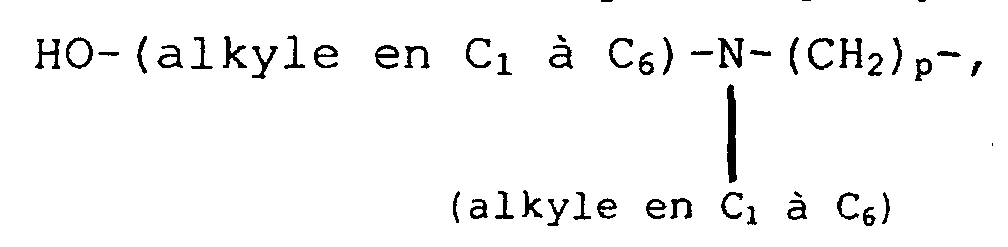 H2N-(C=O)-(CH2)p-, (alkyle en C1 à C6)-HN-(C=O)-(CH2)p-, di-(alkyle en C1 à C6)-N-(C=O)-(CH2)p-, (cyclo-alkyle en C3 à C7)-NH-(C=O) - (CH2)p-, R13O-(CH2)p-, R13O-(C=O)-(CH2)p-, H(O=C)-O-, H(O=C)-O-(alkyle en C1 à C6)-, H(O=C)-NH-(CH2)p-, (alkyle en C1 à C6)-(O=C)-NH-(CH2)p-, -CHO, R-(C=O)-(CH2)p-, (alkyle en C1 à C6)-(C=O)-,
 (alkyle en C1 à C6)- (C=O)-O-NH-(CH2)p-, amino-(alkyle en C1 à C6)-(C=O)-O-(CH2)p-(alkyle en C1 à C6)-NH-(alkyle en C1 à C6)-(C=O)-O-(CH2)p-, di-(alkyle en C1 à C6)-N-(alkyle en C1 à C6)-(C=O)-O-(CH2)p-, hydroxy, hydroxyalkyle en C1 à C6-, hydroxy-(alkyle en C1 à C6)-NH-(CH2)p- et -CN ;
R11 représente l'hydrogène ou un groupe halogéno ;
R12 représente l'hydrogène, un groupe -CN ou halogène ;
R13 représente l'hydrogène, un groupe alkyle en C1 à C6, (alkyle en C1 à C6)-(C=O)-, (alkyle en C1 à C6)-O-(C=O)-, (alkyle en C1 à C6)-NH-(C=O)- ou di-(alkyle en C1 à C6 ) -N- ( C=O ) ;
R15 représente l'hydrogène, un groupe -CN, alkyle en C1 à C6, halogéno, CF3, -CHO ou alkoxy en C1 à C6 ;
R16 représente l'hydrogène, un groupe -CN, alkyle, en C1 à C6, halogéno, CF3, -CHO ou alkoxy en C1 à C6 ;
R17 représente l'hydrogène, un groupe -CN, alkyle en C1 à C6, amino-alkyle en C1 à C6-, (alkyle en C1 à C6)-NH-(alkyle en C1 à C6)-, di-(alkyle en C1 à C6)-N-(alkyle en C1 à C6)-, halogéno, CF3, -CHO ou alkoxy en C1 à C6 ;
n représente un nombre entier de zéro à 3 ;
chaque indice p représente, indépendamment, un nombre entier de zéro à 4 ;
s représente un nombre entier de zéro à 4 ;
la ligne discontinue représente une double liaison facultative ;
sous réserve que : i) lorsque R9 représente l'hydrogène, un des groupes R11 et R12 soit autre que l'hydrogène ; ii) lorsque R3 représente un groupe chloro, R5 représente un groupe méthyle, R6, R7 et R8 représentent l'hydrogène et K, L et M représentent le carbone, alors (a) un des groupes R14 à R17 soit autre que l'hydrogène ou (b) R17 soit autre que l'hydrogène ou un groupe méthyle ; et les sels pharmaceutiquement acceptables de ces composés. - Composé suivant la revendication 1, dans lequel R3 représente un groupe fluoro.
- Composé suivant la revendication 1, dans lequel R1 représente un groupe Ph1 et un des groupes R5, R6, R7 et R8 représente un groupe fluoro, bromo, chloro, méthyle ou trifluorométhyle.
- Composé suivant la revendication 1,.dans lequel R1 représente un groupe Ph1 et R5 représente un groupe fluoro, bromo, chloro, méthyle ou trifluorométhyle.
- Composé suivant la revendication 2, dans lequel R1 représente un groupe Ph1 et R5 représente un groupe fluoro, bromo, chloro, méthyle ou trifluorométhyle.
- Composé suivant la revendication 1, dans lequel R2 représente un groupe Ph2 et R9 représente un groupe fluoro, chloro, -CN ou hydroxy, ou bien R10 représente un groupe -CHO, chloro, fluoro, méthyle, (alkyle en C1 à C6)-NH-(CH2)p-, di-(alkyle en C1 à C6)-N-(CH2)p- ou cyano.
- Composé suivant la revendication 2, dans lequel R2 représente un groupe Ph2 et R9 représente un groupe fluoro, chloro, -CN ou hydroxy, ou bien R10 représente un groupe -CHO, chloro, fluoro, méthyle, (alkyle en C1 à C6)-NH-(CH2)p-, di-(alkyle en C1 à C6)-N-(CH2)p- ou cyano.
- Composé suivant la revendication 1, dans lequel R1 représente un groupe hétéroaryle facultativement substitué avec un substituant halogéno, -CN, CF3 ou alkyle en C1 à C6.
- Composé suivant la revendication 2, dans lequel R1 représente un groupe hétéroaryle facultativement substitué avec un substituant halogéno, -CN, CF3 ou alkyle en C1 à C6.
- Composé suivant la revendication 6, dans lequel R1 représente un groupe hétéroaryle facultativement substitué avec un substituant halogéno, -CN, CF3 ou alkyle en C1 à C6.
- Composé suivant la revendication 1, dans lequel R1 représente un groupe pyridine-3-yle facultativement substitué avec un substituant chloro ou méthyle.
- Composé suivant la revendication 1, dans lequel R1 représente un groupe pyridine-3-yle substitué en position 2 du noyau pyridine avec un substituant chloro ou méthyle.
- Composé suivant la revendication 1, dans lequel R2 représente un groupe hétéroaryle, ledit groupe hétéroaryle étant un hétérocycle hexagonal facultativement substitué dans lequel "K", "L" et "M" représentent le carbone, ou bien "K" et "L" représentent le carbone et M représente l'azote (c'est-à-dire un groupe pyrimidine-2-yle), ou bien ledit groupe hétéroaryle étant un hétérocycle pentagonal facultativement substitué dans lequel "T" représente l'azote, "P" représente le soufre et "Q" représente le carbone, ou "T" représente l'azote ou le soufre, "Q" représente l'azote ou le soufre et "P" représente le carbone, ou bien "T" représente l'oxygène et "P" et "Q" représentent chacun le carbone.
- Composé suivant la revendication 1, dans lequel R2 représente un hétérocycle hexagonal facultativement substitué dans lequel "K", "L" et "M" représentent le carbone, R14 représentant l'hydrogène, un groupe -CHO, chloro, fluoro, méthyle, (alkyle en C1 à C6)-NH-(CH2)p-, di-(alkyle en C1 à C6)-N-(CH2)p- ou cyano ; R17 représente l'hydrogène, un groupe -CHO, chloro, fluoro, méthyle, (alkyle en C1 à C6)-NH-(alkyle en C1 à C6), di-(alkyle en C1 à C6)-N-(alkyle en C1 à C6) ou cyano ; ou bien R15 et R16 représentent, indépendamment, l'hydrogène, un groupe -CHO, chloro, fluoro, méthyle ou cyano.
- Composé suivant la revendication 1, dans lequel R2 représente un hétérocycle hexagonal facultativement substitué dans lequel "K", "L" et "M" représentent le carbone et R14 représente l'hydrogène, un groupe -CHO, méthyle, (alkyle en C1 à C6)-NH-(CH2)p-, di-(alkyle en C1 à C6)-N-(CH2)p- ou cyano.
- Composé suivant la revendication 1, dans lequel R2 représente un hétérocycle pentagonal facultativement substitué dans lequel "T" représente l'azote, "P" représente le soufre et "Q" représente le carbone et R14, R15 et R16 représentent chacun, indépendamment, l'hydrogène, un groupe chloro, fluoro, méthyle ou cyano.
- Composé suivant la revendication 1, dans lequel R2 représente un hétérocycle pentagonal facultativement substitué dans lequel "T" représente l'azote ou le soufre, "Q" représente le soufre ou l'azote et "P" représente le carbone et R14 et R15 sont choisis, indépendamment, entre l'hydrogène, des groupes chloro, fluoro, méthyle et cyano.
- Composé suivant la revendication 1, qui est choisi dans le groupe consistant en les composés suivants :3-(2-chlorophényl)-2-[2-(5-diéthylaminométhyl-2-fluorophényl)-vinyl]-6-fluoro-3H-quinazoline-4-one;3-(2-chlorophényl)-2-[2-(6-diéthylaminométhylpyridine-2-yl)-vinyl]-6-fluoro-3H-quinazoline-4-one ;3-(2-chlorophényl)-2-[2-(4-diéthylaminométhylpyridine-2-yl)-vinyl]-6-fluoro-3H-quinazoline-4-one ;3-(2-chlorophényl)-2-[2-(6-éthylaminométhylpyridine-2-yl)-vinyl]-6-fluoro-3H-quinazoline-4-one ;3-(2-bromophényl)-2-[2-(6-diéthylaminométhylpyridine-2-yl)-vinyl]-6-fluoro-3H-quinazoline-4-one ;3-(2-chlorophényl)-6-fluoro-2-[2-(6-méthoxyméthylpyridine-2-yl) -vinyl] -3H-quinazoline-4-one ;6-fluoro-3-(2-méthylpyridine-3-yl)-2-[2-(2-méthylthiazole-4-yl)-vinyl]-3H-quinazoline-4-one ;3-(2-chlorophényl)-6-fluoro-2-[2-(4-méthylpyrimidine-2-yl) -vinyl] -3H-quinazoline-4-one;3-(2-chlorophényl) -6-fluoro-2-{2-[6-(isopropylaminométhyl]-pyridine-2-yl]-éthyl}-3H-quinazoline-4-one; et2-[2-(5-diéthylaminométhyl-2-fluorophényl)-vinyl]-6-fluoro-3-(2-méthylpyridine-3-yl)-3H-quinazoline-4-one.
- Composition pharmaceutique qui comprend un composé de formule (I), suivant l'une quelconque des revendications 1 à 18, ou un de ses sels pharmaceutiquement acceptables, et un support pharmaceutiquement acceptable.
- Composé de formule (I) suivant l'une quelconque des revendications 1 à 18, ou un de ses sels pharmaceutiquement acceptables, destiné à être utilisé comme médicament.
- Utilisation d'un composé de formule (I), suivant l'une quelconque des revendications 1 à 18, ou d'un de ses sels pharmaceutiquement acceptables, dans la production d'un médicament destiné au traitement de déficiences cérébrales faisant suite à une intervention chirurgicale de dérivation cardiaque et une greffe, un ictus, une ischémie cérébrale, un traumatisme de la moelle épinière, un traumatisme cérébral, la maladie d'Alzheimer, la chorée de Huntington, la sclérose latérale amyotrophique, la démence induite par le SIDA, les spasmes musculaires, les céphalées de la migraine, l'incontinence urinaire, la psychose, des convulsions, l'hypoxie périnatale, un arrêt cardiaque, l'altération neuronale hypoglycémique, la tolérance aux opiacées, le sevrage des opaciées, l'altération oculaire et la rétinopathie, une maladie de Parkinson idiopathique et une maladie de Parkinson induite par un médicament, l'anxiété, les vomissements, l'oedème cérébral, la douleur chronique ou la dyskinésie tardive.
Priority Applications (1)
| Application Number | Priority Date | Filing Date | Title |
|---|---|---|---|
| SI9730555T SI0901487T1 (en) | 1996-05-15 | 1997-02-17 | 2,3,6 trisubstituted-4(3h)-quinazolinones |
Applications Claiming Priority (3)
| Application Number | Priority Date | Filing Date | Title |
|---|---|---|---|
| US1773896P | 1996-05-15 | 1996-05-15 | |
| US17738P | 1996-05-15 | ||
| PCT/IB1997/000134 WO1997043276A1 (fr) | 1996-05-15 | 1997-02-17 | Nouvelles 4(3h)-quinazolinones disubstituees en position 2,3 |
Publications (3)
| Publication Number | Publication Date |
|---|---|
| EP0901487A1 EP0901487A1 (fr) | 1999-03-17 |
| EP0901487B1 true EP0901487B1 (fr) | 2003-06-04 |
| EP0901487B9 EP0901487B9 (fr) | 2004-09-29 |
Family
ID=21784266
Family Applications (1)
| Application Number | Title | Priority Date | Filing Date |
|---|---|---|---|
| EP97901749A Expired - Lifetime EP0901487B9 (fr) | 1996-05-15 | 1997-02-17 | 4(3h)-quinazolinones trisubstituees en position 2,3 et 6 |
Country Status (38)
| Country | Link |
|---|---|
| US (1) | US6303615B1 (fr) |
| EP (1) | EP0901487B9 (fr) |
| JP (1) | JP3241388B2 (fr) |
| KR (1) | KR100375155B1 (fr) |
| CN (2) | CN1103772C (fr) |
| AP (1) | AP1148A (fr) |
| AR (1) | AR007118A1 (fr) |
| AT (1) | ATE242232T1 (fr) |
| AU (1) | AU730503B2 (fr) |
| BG (1) | BG102999A (fr) |
| BR (1) | BR9709085A (fr) |
| CA (1) | CA2252907C (fr) |
| CZ (1) | CZ295565B6 (fr) |
| DE (1) | DE69722613T2 (fr) |
| DK (1) | DK0901487T3 (fr) |
| DZ (1) | DZ2237A1 (fr) |
| EA (1) | EA002905B1 (fr) |
| ES (1) | ES2198546T3 (fr) |
| GT (1) | GT199700049A (fr) |
| HN (1) | HN1997000052A (fr) |
| HR (1) | HRP970261B1 (fr) |
| HU (1) | HUP9902148A3 (fr) |
| ID (1) | ID17149A (fr) |
| IL (1) | IL126589A (fr) |
| IS (1) | IS4881A (fr) |
| MA (1) | MA26430A1 (fr) |
| NO (1) | NO985293L (fr) |
| OA (1) | OA10918A (fr) |
| PL (1) | PL330042A1 (fr) |
| PT (1) | PT901487E (fr) |
| SI (1) | SI0901487T1 (fr) |
| SK (1) | SK284108B6 (fr) |
| TN (1) | TNSN97087A1 (fr) |
| TR (1) | TR199802296T2 (fr) |
| TW (1) | TW539675B (fr) |
| WO (1) | WO1997043276A1 (fr) |
| YU (1) | YU19197A (fr) |
| ZA (1) | ZA974156B (fr) |
Families Citing this family (43)
| Publication number | Priority date | Publication date | Assignee | Title |
|---|---|---|---|---|
| TR199902094T2 (xx) * | 1997-02-28 | 1999-12-21 | Prizer Products Inc. | 3-Heteroareil-4(3H)-kinazolinonlar�n atropizomerleri. |
| SK113299A3 (en) * | 1997-02-28 | 2001-05-10 | Pfizer Prod Inc | Atropisomers of 3-aryl-4(3h)-quinazolinones and their use as ampa-receptor antagonists |
| US6060479A (en) * | 1997-06-09 | 2000-05-09 | Pfizer Inc | Quinazoline-4-one AMPA antagonists |
| IL125950A0 (en) * | 1997-09-05 | 1999-04-11 | Pfizer Prod Inc | Methods of administering ampa receptor antagonists to treat dyskinesias associated with dopamine agonist therapy |
| EP0900567A3 (fr) * | 1997-09-05 | 2001-05-02 | Pfizer Products Inc. | Quinazoline-4-ones antagonistes d'AMPA pour le traitement des dyscinésies associées à la thérapie aux agonistes de la dopamine |
| JPH11279158A (ja) * | 1998-02-09 | 1999-10-12 | Pfizer Prod Inc | キナゾリン―4―オン誘導体の製造方法 |
| AU767849B2 (en) | 1999-02-15 | 2003-11-27 | Eisai R&D Management Co., Ltd. | Heterodiazinone derivatives |
| US6890930B1 (en) * | 1999-09-28 | 2005-05-10 | 3-Dimensional Pharmaceuticals, Inc. | Quinazolinones |
| US7230000B1 (en) | 1999-10-27 | 2007-06-12 | Cytokinetics, Incorporated | Methods and compositions utilizing quinazolinones |
| US6545004B1 (en) | 1999-10-27 | 2003-04-08 | Cytokinetics, Inc. | Methods and compositions utilizing quinazolinones |
| US20020061897A1 (en) | 2000-03-30 | 2002-05-23 | Elliott Richard L. | Neuropeptide Y antagonists |
| US6667300B2 (en) | 2000-04-25 | 2003-12-23 | Icos Corporation | Inhibitors of human phosphatidylinositol 3-kinase delta |
| ES2320973T3 (es) | 2000-06-12 | 2009-06-01 | EISAI R&D MANAGEMENT CO., LTD. | Compuestos de 1,2-dihidropiridina, procedimiento para su preparacion y uso de los mismos. |
| US7053216B2 (en) * | 2001-11-19 | 2006-05-30 | Iconix Pharmaceuticals, Inc. | Modulators of Rho C activity |
| GB0129260D0 (en) | 2001-12-06 | 2002-01-23 | Eisai London Res Lab Ltd | Pharmaceutical compositions and their uses |
| JP2005529076A (ja) | 2002-02-15 | 2005-09-29 | サイトキネティクス・インコーポレーテッド | キナゾリノンの合成 |
| RU2004135554A (ru) | 2002-05-09 | 2006-01-20 | Цитокинетикс, Инк. (Us) | Пиримидиноны, композиции на их основе и способы их использования |
| EP1553931A4 (fr) | 2002-05-09 | 2006-08-30 | Cytokinetics Inc | Composes, compositions et procedes |
| EP1513820A4 (fr) | 2002-05-23 | 2006-09-13 | Cytokinetics Inc | Composes, compositions et procedes |
| CA2489367A1 (fr) | 2002-06-14 | 2003-12-24 | Cytokinetics, Inc. | Composes, compositions et procedes |
| EP1537089A4 (fr) | 2002-07-23 | 2008-04-16 | Cytokinetics Inc | Composes, compositions et procedes |
| WO2004034972A2 (fr) | 2002-09-30 | 2004-04-29 | Cytokinetics, Inc. | Composes, compositions, et procedes |
| EP1692112A4 (fr) | 2003-12-08 | 2008-09-24 | Cytokinetics Inc | Composes, compositions, et methodes associees |
| WO2005113556A1 (fr) | 2004-05-13 | 2005-12-01 | Icos Corporation | Quinazolinones utilisees en tant qu'inhibiteurs de la phosphatidylinositol 3-kinase delta humaine |
| MY148809A (en) | 2004-07-06 | 2013-05-31 | Eisai R&D Man Co Ltd | Crystals of 1,2-dihydropyridine compound and their production process |
| US7893260B2 (en) | 2005-11-04 | 2011-02-22 | Hydra Biosciences, Inc. | Substituted quinazolin-4-one compounds for antagonizing TRPV3 function |
| EP2079739A2 (fr) | 2006-10-04 | 2009-07-22 | Pfizer Products Inc. | Dérivés de pyrido[4,3-d]pyrimidin-4(3h)-one utilisés en tant qu'antagonistes du récepteur calcique |
| WO2008140750A1 (fr) * | 2007-05-10 | 2008-11-20 | Hydra Biosciences Inc. | Composés modulant la fonction du trp v3 |
| CA2704710C (fr) * | 2007-09-26 | 2016-02-02 | Celgene Corporation | Derives de quinazolinone substituee en 6-, 7- ou 8- et compositions en renfermant |
| PT2239257E (pt) | 2008-01-30 | 2012-09-12 | Shin Poong Pharmaceutical Co Ltd | Novo derivado de quinazolina-2,4-diona e composições médicas para a profilaxia e tratamento da doença dos nervos cranianos contendo o dito derivado |
| US9492449B2 (en) | 2008-11-13 | 2016-11-15 | Gilead Calistoga Llc | Therapies for hematologic malignancies |
| KR20160091440A (ko) | 2008-11-13 | 2016-08-02 | 길리아드 칼리스토가 엘엘씨 | 혈액 종양에 대한 요법 |
| BRPI1012333A2 (pt) | 2009-03-24 | 2016-03-29 | Gilead Calistoga Llc | atropisômeros de derivados de 2-purinil-3-tolil-quinazolinonas e métodos de uso |
| AP2011005956A0 (en) | 2009-04-20 | 2011-10-31 | Gilead Calistoga Llc | Methods of treatment for solid tumors. |
| CA2768843A1 (fr) | 2009-07-21 | 2011-01-27 | Gilead Calistoga Llc | Traitement de troubles du foie par des inhibiteurs de pi3k |
| US9216177B2 (en) | 2011-02-28 | 2015-12-22 | Drexel University | Small molecular inhibitors of RAD51 recombinase and methods thereof |
| NZ629684A (en) | 2012-03-05 | 2016-10-28 | Gilead Calistoga Llc | Polymorphic forms of (s)-2-(1-(9h-purin-6-ylamino)propyl)-5-fluoro-3-phenylquinazolin-4(3h)-one |
| WO2015095605A1 (fr) | 2013-12-20 | 2015-06-25 | Gilead Calistoga Llc | Formes polymorphes d'un sel chlorhydrate de la (s)-2-(9h-purine-6-ylamino)propyl)-5-fluoro-3-phénylquinazolin-4(3h)-one |
| NZ736970A (en) | 2013-12-20 | 2018-11-30 | Gilead Calistoga Llc | Process methods for phosphatidylinositol 3-kinase inhibitors |
| MA40059A (fr) | 2014-06-13 | 2015-12-17 | Gilead Sciences Inc | Inhibiteurs de la phosphatidylinositol 3-kinase |
| MA54460A (fr) | 2018-12-14 | 2021-10-20 | Eisai R&D Man Co Ltd | Formulations pharmaceutiques à base d'eau de composés de 1,2-dihydropyridine |
| WO2021154966A1 (fr) | 2020-01-29 | 2021-08-05 | Kamari Pharma Ltd. | Composés et compositions pour leur utilisation dans le traitement de troubles cutanés |
| CN113831335A (zh) * | 2020-06-24 | 2021-12-24 | 北京大学 | 吡啶[2,3-d]并嘧啶-4-(3H)-酮类化合物及其制备方法和应用 |
Citations (1)
| Publication number | Priority date | Publication date | Assignee | Title |
|---|---|---|---|---|
| US3558610A (en) * | 1966-12-30 | 1971-01-26 | Squibb & Sons Inc | Quinazolinone derivatives |
Family Cites Families (9)
| Publication number | Priority date | Publication date | Assignee | Title |
|---|---|---|---|---|
| DE1195321B (de) * | 1962-03-16 | 1965-06-24 | Troponwerke Dinklage & Co | Verfahren zur Herstellung von substituierten Chinazolon-(4)-derivaten |
| US3748325A (en) | 1970-04-06 | 1973-07-24 | Karamchand Premchand Private | Process for the preparation of quinazolinone derivatives |
| AU543928B2 (en) * | 1981-01-16 | 1985-05-09 | Masayuki Ishikawa | 4(311)-quinazolinone derivatives |
| GB9022785D0 (en) | 1990-10-19 | 1990-12-05 | Merck Sharp & Dohme | Therapeutic agents |
| WO1992013535A1 (fr) * | 1991-02-06 | 1992-08-20 | Research Corporation Technologies, Inc. | Quinazolones substituees a activite anticonvulsivante |
| US5284957A (en) | 1992-09-03 | 1994-02-08 | Eli Lilly And Company | Excitatory amino acid receptor antagonists |
| NZ266127A (en) | 1993-05-06 | 1997-11-24 | Novo Nordisk As | Quinoxaline derivatives, preparation and medicaments |
| GB9400680D0 (en) * | 1994-01-14 | 1994-03-09 | Sandoz Ltd | Improvements in or relating to organic compounds |
| SK113299A3 (en) | 1997-02-28 | 2001-05-10 | Pfizer Prod Inc | Atropisomers of 3-aryl-4(3h)-quinazolinones and their use as ampa-receptor antagonists |
-
1997
- 1997-02-17 CN CN97194654A patent/CN1103772C/zh not_active Expired - Fee Related
- 1997-02-17 ES ES97901749T patent/ES2198546T3/es not_active Expired - Lifetime
- 1997-02-17 AU AU15549/97A patent/AU730503B2/en not_active Ceased
- 1997-02-17 EP EP97901749A patent/EP0901487B9/fr not_active Expired - Lifetime
- 1997-02-17 EA EA199800923A patent/EA002905B1/ru not_active IP Right Cessation
- 1997-02-17 DK DK97901749T patent/DK0901487T3/da active
- 1997-02-17 PL PL97330042A patent/PL330042A1/xx unknown
- 1997-02-17 SI SI9730555T patent/SI0901487T1/xx unknown
- 1997-02-17 AT AT97901749T patent/ATE242232T1/de not_active IP Right Cessation
- 1997-02-17 BR BR9709085A patent/BR9709085A/pt not_active Application Discontinuation
- 1997-02-17 HU HU9902148A patent/HUP9902148A3/hu unknown
- 1997-02-17 WO PCT/IB1997/000134 patent/WO1997043276A1/fr not_active Ceased
- 1997-02-17 JP JP54068297A patent/JP3241388B2/ja not_active Expired - Fee Related
- 1997-02-17 KR KR10-1998-0709205A patent/KR100375155B1/ko not_active Expired - Fee Related
- 1997-02-17 SK SK1520-98A patent/SK284108B6/sk unknown
- 1997-02-17 CA CA002252907A patent/CA2252907C/fr not_active Expired - Fee Related
- 1997-02-17 US US09/180,732 patent/US6303615B1/en not_active Expired - Fee Related
- 1997-02-17 CZ CZ19983526A patent/CZ295565B6/cs not_active IP Right Cessation
- 1997-02-17 PT PT97901749T patent/PT901487E/pt unknown
- 1997-02-17 TR TR1998/02296T patent/TR199802296T2/xx unknown
- 1997-02-17 DE DE69722613T patent/DE69722613T2/de not_active Expired - Fee Related
- 1997-04-08 TW TW086104460A patent/TW539675B/zh active
- 1997-04-21 HN HN1997000052A patent/HN1997000052A/es unknown
- 1997-04-29 GT GT199700049A patent/GT199700049A/es unknown
- 1997-05-13 AR ARP970102001A patent/AR007118A1/es not_active Application Discontinuation
- 1997-05-14 DZ DZ970085A patent/DZ2237A1/fr active
- 1997-05-14 ID IDP971603A patent/ID17149A/id unknown
- 1997-05-14 YU YU19197A patent/YU19197A/sh unknown
- 1997-05-14 MA MA24613A patent/MA26430A1/fr unknown
- 1997-05-14 TN TNTNSN97087A patent/TNSN97087A1/fr unknown
- 1997-05-14 ZA ZA974156A patent/ZA974156B/xx unknown
- 1997-05-15 HR HR970261A patent/HRP970261B1/xx not_active IP Right Cessation
- 1997-05-15 AP APAP/P/1997/001003A patent/AP1148A/en active
- 1997-12-17 IL IL12658997A patent/IL126589A/xx not_active IP Right Cessation
-
1998
- 1998-10-27 IS IS4881A patent/IS4881A/is unknown
- 1998-11-06 OA OA9800216A patent/OA10918A/en unknown
- 1998-11-13 NO NO985293A patent/NO985293L/no unknown
- 1998-12-08 BG BG102999A patent/BG102999A/xx unknown
-
2002
- 2002-09-05 CN CN02131946A patent/CN1420114A/zh active Pending
Patent Citations (1)
| Publication number | Priority date | Publication date | Assignee | Title |
|---|---|---|---|---|
| US3558610A (en) * | 1966-12-30 | 1971-01-26 | Squibb & Sons Inc | Quinazolinone derivatives |
Non-Patent Citations (1)
| Title |
|---|
| LESZKOVSZKY G. ET AL: "THE PHARMACOLOGY OF QUINAZOLONE DERIVATIVES", ACTA PHYSIOLOGICA, vol. XXVII, no. 1, 1964, pages 81 - 90 * |
Also Published As
Similar Documents
| Publication | Publication Date | Title |
|---|---|---|
| EP0901487B1 (fr) | 4(3h)-quinazolinones trisubstituees en position 2,3 et 6 | |
| EP0968194B1 (fr) | Atropisomeres de 3-aryl-4(3h)-quinazolinones et leur utilisation comme antagonistes des recepteurs de l'ampa | |
| EP0807633B1 (fr) | (5,6)-Pyrimidin-4-ones condensées à hétéroaryle, substituées en 2,3 | |
| US6060479A (en) | Quinazoline-4-one AMPA antagonists | |
| EP0900799B1 (fr) | Nouveaux atropismères de (5,6)-Pyrimidin-4-ones condensés à hétéroaryle, substitués en 2,3 | |
| EP0964860B1 (fr) | Atropisomeres de 3-heteroaryl-4(3h)-quinazolinones pour le traitement des troubles neurodegeneratifs et des troubles lies a un traumatisme du systeme nerveux central | |
| CZ9902994A3 (cs) | Aťropoisomery 3-aryl-4(3H)-chinazolinonů a jejich použití jako antagonizujících činidel receptoru AMPA | |
| MXPA99008012A (en) | Atropisomers of 3-aryl-4(3h)-quinazolinones and their use as ampa-receptor antagonists | |
| CZ9902995A3 (cs) | Atropoisomery 3-heteroaryl-4(3H)-chinazolinonů I pro léčení neurodegenaritivních stavů a stavů odvozených od CNS-traumatu |
Legal Events
| Date | Code | Title | Description |
|---|---|---|---|
| PUAI | Public reference made under article 153(3) epc to a published international application that has entered the european phase |
Free format text: ORIGINAL CODE: 0009012 |
|
| 17P | Request for examination filed |
Effective date: 19981104 |
|
| AK | Designated contracting states |
Kind code of ref document: A1 Designated state(s): AT BE CH DE DK ES FI FR GB GR IE IT LI LU NL PT SE |
|
| AX | Request for extension of the european patent |
Free format text: AL PAYMENT 981104;LT PAYMENT 981104;LV PAYMENT 981104;RO PAYMENT 981104;SI PAYMENT 981104 |
|
| 17Q | First examination report despatched |
Effective date: 20000224 |
|
| RTI1 | Title (correction) |
Free format text: 2,3,6 TRISUBSTITUTED-4(3H)-QUINAZOLINONES |
|
| RTI1 | Title (correction) |
Free format text: 2,3,6 TRISUBSTITUTED-4(3H)-QUINAZOLINONES |
|
| GRAH | Despatch of communication of intention to grant a patent |
Free format text: ORIGINAL CODE: EPIDOS IGRA |
|
| GRAH | Despatch of communication of intention to grant a patent |
Free format text: ORIGINAL CODE: EPIDOS IGRA |
|
| RIN1 | Information on inventor provided before grant (corrected) |
Inventor name: BERTRAND L. CHENARD Inventor name: WELCH, WILLARD, MCKOWAN, JR. Inventor name: ELLIOTT, MARK, LEONARD |
|
| GRAA | (expected) grant |
Free format text: ORIGINAL CODE: 0009210 |
|
| RIN1 | Information on inventor provided before grant (corrected) |
Inventor name: BERTRAND L. CHENARD Inventor name: WELCH, WILLARD, MCKOWAN, JR. Inventor name: ELLIOTT, MARK, LEONARD |
|
| AK | Designated contracting states |
Designated state(s): AT BE CH DE DK ES FI FR GB GR IE IT LI LU NL PT SE |
|
| AX | Request for extension of the european patent |
Extension state: AL LT LV RO SI |
|
| REG | Reference to a national code |
Ref country code: GB Ref legal event code: FG4D |
|
| REG | Reference to a national code |
Ref country code: CH Ref legal event code: EP |
|
| REG | Reference to a national code |
Ref country code: IE Ref legal event code: FG4D |
|
| REF | Corresponds to: |
Ref document number: 69722613 Country of ref document: DE Date of ref document: 20030710 Kind code of ref document: P |
|
| REG | Reference to a national code |
Ref country code: CH Ref legal event code: NV Representative=s name: DR. R.C. SALGO EUROPEAN PATENT ATTORNEY |
|
| REG | Reference to a national code |
Ref country code: DK Ref legal event code: T3 |
|
| PGFP | Annual fee paid to national office [announced via postgrant information from national office to epo] |
Ref country code: PT Payment date: 20030829 Year of fee payment: 8 |
|
| REG | Reference to a national code |
Ref country code: GR Ref legal event code: EP Ref document number: 20030402873 Country of ref document: GR |
|
| PGFP | Annual fee paid to national office [announced via postgrant information from national office to epo] |
Ref country code: BE Payment date: 20030910 Year of fee payment: 8 |
|
| REG | Reference to a national code |
Ref country code: SE Ref legal event code: TRGR |
|
| PGFP | Annual fee paid to national office [announced via postgrant information from national office to epo] |
Ref country code: GR Payment date: 20031217 Year of fee payment: 8 |
|
| PGFP | Annual fee paid to national office [announced via postgrant information from national office to epo] |
Ref country code: LU Payment date: 20040113 Year of fee payment: 8 |
|
| PGFP | Annual fee paid to national office [announced via postgrant information from national office to epo] |
Ref country code: DK Payment date: 20040123 Year of fee payment: 8 |
|
| PGFP | Annual fee paid to national office [announced via postgrant information from national office to epo] |
Ref country code: CH Payment date: 20040127 Year of fee payment: 8 |
|
| REG | Reference to a national code |
Ref country code: ES Ref legal event code: FG2A Ref document number: 2198546 Country of ref document: ES Kind code of ref document: T3 |
|
| ET | Fr: translation filed | ||
| PGFP | Annual fee paid to national office [announced via postgrant information from national office to epo] |
Ref country code: AT Payment date: 20040223 Year of fee payment: 8 |
|
| PGFP | Annual fee paid to national office [announced via postgrant information from national office to epo] |
Ref country code: NL Payment date: 20040227 Year of fee payment: 8 |
|
| PLBE | No opposition filed within time limit |
Free format text: ORIGINAL CODE: 0009261 |
|
| STAA | Information on the status of an ep patent application or granted ep patent |
Free format text: STATUS: NO OPPOSITION FILED WITHIN TIME LIMIT |
|
| 26N | No opposition filed |
Effective date: 20040305 |
|
| REG | Reference to a national code |
Ref country code: SI Ref legal event code: IF |
|
| PG25 | Lapsed in a contracting state [announced via postgrant information from national office to epo] |
Ref country code: LU Free format text: LAPSE BECAUSE OF NON-PAYMENT OF DUE FEES Effective date: 20050217 Ref country code: AT Free format text: LAPSE BECAUSE OF NON-PAYMENT OF DUE FEES Effective date: 20050217 |
|
| PGFP | Annual fee paid to national office [announced via postgrant information from national office to epo] |
Ref country code: FI Payment date: 20050217 Year of fee payment: 9 |
|
| PGFP | Annual fee paid to national office [announced via postgrant information from national office to epo] |
Ref country code: SE Payment date: 20050225 Year of fee payment: 9 |
|
| PG25 | Lapsed in a contracting state [announced via postgrant information from national office to epo] |
Ref country code: LI Free format text: LAPSE BECAUSE OF NON-PAYMENT OF DUE FEES Effective date: 20050228 Ref country code: DK Free format text: LAPSE BECAUSE OF NON-PAYMENT OF DUE FEES Effective date: 20050228 Ref country code: CH Free format text: LAPSE BECAUSE OF NON-PAYMENT OF DUE FEES Effective date: 20050228 Ref country code: BE Free format text: LAPSE BECAUSE OF NON-PAYMENT OF DUE FEES Effective date: 20050228 |
|
| NLR4 | Nl: receipt of corrected translation in the netherlands language at the initiative of the proprietor of the patent | ||
| PG25 | Lapsed in a contracting state [announced via postgrant information from national office to epo] |
Ref country code: PT Free format text: LAPSE BECAUSE OF NON-PAYMENT OF DUE FEES Effective date: 20050817 |
|
| BERE | Be: lapsed |
Owner name: *PFIZER INC. Effective date: 20050228 |
|
| PG25 | Lapsed in a contracting state [announced via postgrant information from national office to epo] |
Ref country code: NL Free format text: LAPSE BECAUSE OF NON-PAYMENT OF DUE FEES Effective date: 20050901 |
|
| PG25 | Lapsed in a contracting state [announced via postgrant information from national office to epo] |
Ref country code: GR Free format text: LAPSE BECAUSE OF NON-PAYMENT OF DUE FEES Effective date: 20050905 |
|
| REG | Reference to a national code |
Ref country code: DK Ref legal event code: EBP |
|
| REG | Reference to a national code |
Ref country code: CH Ref legal event code: PL |
|
| LTLA | Lt: lapse of european patent or patent extension |
Effective date: 20050217 |
|
| REG | Reference to a national code |
Ref country code: PT Ref legal event code: MM4A Effective date: 20050817 |
|
| NLV4 | Nl: lapsed or anulled due to non-payment of the annual fee |
Effective date: 20050901 |
|
| PGFP | Annual fee paid to national office [announced via postgrant information from national office to epo] |
Ref country code: IE Payment date: 20060125 Year of fee payment: 10 |
|
| PGFP | Annual fee paid to national office [announced via postgrant information from national office to epo] |
Ref country code: FR Payment date: 20060202 Year of fee payment: 10 |
|
| PGFP | Annual fee paid to national office [announced via postgrant information from national office to epo] |
Ref country code: ES Payment date: 20060215 Year of fee payment: 10 |
|
| PG25 | Lapsed in a contracting state [announced via postgrant information from national office to epo] |
Ref country code: FI Free format text: LAPSE BECAUSE OF NON-PAYMENT OF DUE FEES Effective date: 20060217 |
|
| PG25 | Lapsed in a contracting state [announced via postgrant information from national office to epo] |
Ref country code: SE Free format text: LAPSE BECAUSE OF NON-PAYMENT OF DUE FEES Effective date: 20060218 |
|
| PGFP | Annual fee paid to national office [announced via postgrant information from national office to epo] |
Ref country code: IT Payment date: 20060228 Year of fee payment: 10 Ref country code: DE Payment date: 20060228 Year of fee payment: 10 |
|
| REG | Reference to a national code |
Ref country code: SI Ref legal event code: KO00 Effective date: 20051202 |
|
| EUG | Se: european patent has lapsed | ||
| GBPC | Gb: european patent ceased through non-payment of renewal fee |
Effective date: 20070217 |
|
| REG | Reference to a national code |
Ref country code: IE Ref legal event code: MM4A |
|
| REG | Reference to a national code |
Ref country code: FR Ref legal event code: ST Effective date: 20071030 |
|
| BERE | Be: lapsed |
Owner name: *PFIZER INC. Effective date: 20050228 |
|
| PG25 | Lapsed in a contracting state [announced via postgrant information from national office to epo] |
Ref country code: IE Free format text: LAPSE BECAUSE OF NON-PAYMENT OF DUE FEES Effective date: 20070219 Ref country code: DE Free format text: LAPSE BECAUSE OF NON-PAYMENT OF DUE FEES Effective date: 20070901 |
|
| PG25 | Lapsed in a contracting state [announced via postgrant information from national office to epo] |
Ref country code: GB Free format text: LAPSE BECAUSE OF NON-PAYMENT OF DUE FEES Effective date: 20070217 Ref country code: FR Free format text: LAPSE BECAUSE OF NON-PAYMENT OF DUE FEES Effective date: 20070228 |
|
| REG | Reference to a national code |
Ref country code: ES Ref legal event code: FD2A Effective date: 20070219 |
|
| PG25 | Lapsed in a contracting state [announced via postgrant information from national office to epo] |
Ref country code: ES Free format text: LAPSE BECAUSE OF NON-PAYMENT OF DUE FEES Effective date: 20070219 |
|
| PGFP | Annual fee paid to national office [announced via postgrant information from national office to epo] |
Ref country code: GB Payment date: 20060109 Year of fee payment: 10 |
|
| PG25 | Lapsed in a contracting state [announced via postgrant information from national office to epo] |
Ref country code: IT Free format text: LAPSE BECAUSE OF NON-PAYMENT OF DUE FEES Effective date: 20070217 |