EP0902417B1 - Procédé et dispositif de reconnaissance vocale de mots portant à confusion - Google Patents
Procédé et dispositif de reconnaissance vocale de mots portant à confusion Download PDFInfo
- Publication number
- EP0902417B1 EP0902417B1 EP98115323A EP98115323A EP0902417B1 EP 0902417 B1 EP0902417 B1 EP 0902417B1 EP 98115323 A EP98115323 A EP 98115323A EP 98115323 A EP98115323 A EP 98115323A EP 0902417 B1 EP0902417 B1 EP 0902417B1
- Authority
- EP
- European Patent Office
- Prior art keywords
- word
- deviation
- state
- degree
- vector
- Prior art date
- Legal status (The legal status is an assumption and is not a legal conclusion. Google has not performed a legal analysis and makes no representation as to the accuracy of the status listed.)
- Expired - Lifetime
Links
- 238000000034 method Methods 0.000 title claims abstract description 34
- 239000013598 vector Substances 0.000 claims abstract description 117
- 238000012545 processing Methods 0.000 claims abstract description 23
- 230000014509 gene expression Effects 0.000 claims description 10
- 239000000470 constituent Substances 0.000 abstract 1
- 230000007704 transition Effects 0.000 description 38
- 238000004364 calculation method Methods 0.000 description 20
- 235000021395 porridge Nutrition 0.000 description 17
- 238000011524 similarity measure Methods 0.000 description 7
- 238000010586 diagram Methods 0.000 description 5
- 238000013459 approach Methods 0.000 description 4
- 238000011161 development Methods 0.000 description 4
- 230000018109 developmental process Effects 0.000 description 4
- 238000005259 measurement Methods 0.000 description 3
- 230000008569 process Effects 0.000 description 3
- 238000012795 verification Methods 0.000 description 3
- 230000008901 benefit Effects 0.000 description 2
- 230000004069 differentiation Effects 0.000 description 2
- 238000009826 distribution Methods 0.000 description 2
- 230000000694 effects Effects 0.000 description 2
- 230000006870 function Effects 0.000 description 2
- 238000003754 machining Methods 0.000 description 2
- 230000002411 adverse Effects 0.000 description 1
- 238000001514 detection method Methods 0.000 description 1
- 238000000605 extraction Methods 0.000 description 1
- 230000009467 reduction Effects 0.000 description 1
- 230000000717 retained effect Effects 0.000 description 1
Images


Classifications
-
- G—PHYSICS
- G10—MUSICAL INSTRUMENTS; ACOUSTICS
- G10L—SPEECH ANALYSIS TECHNIQUES OR SPEECH SYNTHESIS; SPEECH RECOGNITION; SPEECH OR VOICE PROCESSING TECHNIQUES; SPEECH OR AUDIO CODING OR DECODING
- G10L15/00—Speech recognition
- G10L15/08—Speech classification or search
- G10L15/14—Speech classification or search using statistical models, e.g. Hidden Markov Models [HMMs]
- G10L15/142—Hidden Markov Models [HMMs]
Definitions
- the invention relates to a method for processing a Speech signal in which for at least two reference words a first one or more similar word components Word model and a second word model with consecutive States are defined for the word components, preferably so-called "hidden Markov" models.
- Word model and a second word model with consecutive States are defined for the word components, preferably so-called "hidden Markov" models.
- To each State belongs to at least one reference vector, its components the expression of characteristics in one for each State the reference signal belonging to the state.
- the first word model is a first state for the similar word component in the first reference word
- in the second word model is a second state for the similar word component in the second Reference word set.
- EP 0 763 816 A2 describes a method for recognizing speech signals known.
- the unknown voice signal in a first step is fed to a recognition processor which a hypothetical one while accessing a recognition database Speech signal generated.
- This hypothetical speech signal in the next step becomes a verification processor supplied with access to a verification database generates a measurement signal, which is the probability indicates that the hypothetical speech signal is the unknown Voice signal corresponds. If the measurement signal is above a Verification threshold, the speech signal is recognized as classified.
- the comparison vectors are in time Sequence of their signal sections processed one after the other, being for predetermined states from the associated Reference vector and from the current comparison vector current local deviation measure is calculated, its value with increasing deviation of the comparison vector from Reference vector increases. Also, one for each state current auxiliary deviation measure calculated.
- the last one created Auxiliary deviation measure of the last state of a word model gives the deviation of the spoken word Word to the reference word modeled by the respective word model on. After processing the speech signal completely becomes the reference word as the spoken word recognized which has the smallest word deviation measure.
- German published application DE 41 31 387 A1 describes a method for recognizing patterns in time-variant measurement signals known, which is an improved Differentiation between phonetically similar words (e.g. "two” and "three") through a paired reclassification allows.
- the Viterbi decoding algorithm combined with the method of hidden Markov models, where the distinctive features in a second Step after the main classification to be examined separately.
- different components of feature vectors are used weighted differently.
- the object of the invention is an alternative method for Specify processing of a speech signal, which also acoustically similar words can be recognized without confusion.
- the invention is based on the consideration that in the approach for language processing with "Hidden Markov" models Reference vectors based on many utterances from different speakers are identified, cross connections of a word model with the other word models of the vocabulary however, are not taken into account.
- Reference vectors based on many utterances from different speakers are identified, cross connections of a word model with the other word models of the vocabulary however, are not taken into account.
- the words “three” and "porridge” These two words differ only in the first part, i.e. through the "d” and "B”.
- the part “rei” can, however, be used to differentiate between "three” and “porridge” contribute nothing.
- the calculation of the current auxiliary deviation measure for the first state the current local deviation measure for this Condition calculated and with the current local deviation measure compared for the second state.
- the deviation measure of the first or second state for calculating the auxiliary deviation measure of the first state used. This measure will only first the local deviation measures in both word models calculated according to a uniform procedure. Subsequently only one of the two depends on the comparison result local deviation measures are used, which makes the above mentioned Matching takes place.
- the degree of deviation is preferred selected with the smaller value so that the obvious for the considered state of the one word model great similarity to the comparison vector both similar Reference words compared to the other reference words in the vocabulary emphasizes or prefers.
- the method according to the invention also becomes when calculating the auxiliary deviation measure the similar state in the second word model to the local one Deviation measure of the similar state in the first word model Considered.
- This measure can help you differentiate of the spoken word the two word models interact with each other.
- the two reference words two consecutive similar word components and is e.g. according to the first word model, the first similar reference word component to the first spoken similar word component is very similar and continues to be according to the second word model, its second similar reference word component the second spoken similar word component very similar, so the probability is very great that one of the two by the similar word models modeled reference words matches the spoken word.
- This fact is taken into account in that the modeling of the first similar word component in both word models refer to the first word model and when modeling the second similar word component in both word models to the second word model Reference is made.
- auxiliary deviation measure of the second state instead of the local deviation measure of this state is the local deviation measure of the first state used.
- This measure reduces despite taking into account of cross-connections between the word models of the Computing effort compared to the known method, because the Calculation of the local deviation measure of the second state eliminated.
- the reduction in computing effort is special considerable in the case of similarity and comparison vectors, that have a variety of components.
- Similarity measures Using deviation measures is using Similarity measures equal.
- similarity measures the word model is determined which is the largest Has similarity to the spoken word.
- Auxiliary similarity measures become old auxiliary similarity measures to be used selected so that the largest possible new Auxiliary similarity measure arises.
- Similar word components are word components, e.g. have the same sequence of letters. Moreover belong to the similar word components Word components in different words, pronounced the same or similar become.
- the invention also relates to a Speech processing unit, in particular for performing of the method explained above is used.
- the above The technical effects mentioned also apply to the Voice processing unit.
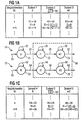
- FIG. 1 shows the calculation of auxiliary deviation measures for word models 10 shown in part b and 12.
- the word model 10 is a so-called “hidden Markov” model to model a reference word "three".
- Word model 12 is also a "hidden Markov” model, however for modeling a reference word "porridge”.
- the word model 10 for the reference word “three” has three states Z1, Z2 and Z3.
- the state Z1 is for the sake of Simplification assigned only one reference vector d, the Components the likely form of predefined Characteristics of the pronunciation of the letter "d” in the word specify “three".
- the characteristics include e.g. the expressions of frequencies within specified frequency ranges in a recorded voice signal. So could the reference vector d have been generated from a voltage curve that when pronouncing the letter "d” at the beginning of the word “three” is generated, represented by a transition arrow 20.
- the reference vector d is only for a talk time of 10 ms related, so that the state Z1 several times in succession occurs as soon as the pronunciation of the word "three” begins will, cf.
- Transition arrow 22 shows the transition from state Z1 to state Z2, if after the Pronunciation of the word component "d” the pronunciation of the word component "r” follows. State 2 is therefore part of the word “R”.
- a reference vector r1 which is highly likely the expression of the considered features in Pronouncing the word component "r” in the word “three” indicates is assigned to state Z2.
- State Z2 can in turn be followed by the state Z2 itself, see. Transition arrow 26. Alternatively, however, after the State Z2 follow state Z3 as indicated by a transition arrow 28 is indicated. State Z3 contains one Reference vector ei1, which is the word component "ei" in the word "three” is assigned. After state Z3 either follows again the state Z3, cf. Transition arrow 30, or the Pronunciation of the word "three” is terminated. In the latter case the state Z3 is exited, cf. Transition arrow 32.
- a reference vector sequence can be generated with the word model 10 by the states Z1 to Z3 along the transition arrows 20 to 32 e.g. be run through by a program.
- the reference vectors generated when the states Z1 to Z3 are run through are then compared with a sequence of comparison vectors compared that from the speech signal to be processed have been generated.
- a measure of deviation for the word "three” can be calculated the deviation of the spoken word from the reference word "three" of the word model 10 indicates.
- the number of from the Word model 10 is generated sequences of reference vectors however very large. It is to reduce the computing effort known, e.g. use the so-called Viterbi algorithm, around the reference vector sequence from the word model 10 determine which is the smallest deviation resulting from the Has comparison vectors.
- a table is shown with which is the processing of a comparison vector n when performing a simple variant of the Viterbi algorithm explained shall be.
- the currently processed comparison vector n, n + 1 is entered in the left column of the table.
- the second column of the table refers to the state Z1 the reference vector d.
- the third column concerns values that for the state Z2, i.e. using the reference vector r1, be calculated.
- the right column of the table concerns the State Z3, i.e. the reference vector ei1.
- the comparison vector n and the reference vector d become one current local deviation measure I1 determined for the state Z1, that in the exemplary embodiment the numerical value "4" Has.
- the local deviation measure I1 is e.g. the geometric Distance of the comparison vector n from the reference vector d. On a more precise local deviation measure I1 results, if also a probability function is taken into account.
- the deviation of the comparison vector n from Reference vector d is like the pronunciation of the word component "r" expected greater than the deviation of the comparison vector n from the reference vector r1.
- the new auxiliary deviation dimensions H1 to H3 for machining of the next comparison vector n + 1 are taken into account of the word model 10 determined.
- the state Z1 can only via the transition arrow 20 or the transition arrow 22 can be reached.
- the influence of Transition arrow 20 is only in a start phase of the Viterbi algorithm observed for the first comparison vector.
- As a previous state for state Z1 only state Z1 therefore comes into play Question.
- the calculation of the new auxiliary deviation measure H1 for The comparison vector n + 1 is therefore processed by simply adding the current local deviation measure I1 for state Z1 to the old auxiliary deviation measure H1 for this condition.
- There is a new auxiliary deviation measure H1 fourteenth
- the transition to state Z2 can start from state Z1 via the transition arrow 24 or starting from the state Z2 the transition arrow 26 take place, the self transition indicates.
- the word model 12 shown in part b of FIG. 1 has three States Z4, Z5 and Z6, to which reference vectors in this order B, r2 and ei2 belong.
- the components of the Reference vectors B contain the expression of the given one Features when pronouncing the word component "B" during the pronunciation of the word "porridge”.
- the components of the reference vector r2 contain the expression of the same characteristics in the pronunciation of the word component "r” of the word “Mush”.
- the components of the feature vector also contain ei2 the expression of the characteristics in the pronunciation of the word component "egg" of the word "porridge".
- the reference vector r1 of the word model 10 and the reference vector r2 of the word model 12 will usually differ slightly from each other, because the word component "r” in the words “three” and “porridge” is pronounced differently. They also differ Reference vectors ei1 and ei2 from each other.
- the state Z4 is reached via a transition arrow 50, when you start modeling.
- a transition arrow 52 gives a self transition from state Z4 to itself on, i.e. back to state Z4.
- a transition arrow 54 gives the transition from state Z4 to state Z5.
- the self transition from state Z5 to itself is through one Transition arrow 56 shown.
- the transition from state Z5 a transition arrow 58 to state Z6 illustrates Self transition from state Z6 to state Z6 is through one Transition arrow 60 shown.
- the modeling is finished if the state Z6 is left, cf. Transition arrow 62.
- the auxiliary deviation measures H4 to H5 are calculated after that already explained with the help of the word model 10 Scheme. However, there are other numerical values.
- a Table in the lower part c of Figure 1 shows values at the processing of the comparison vector n using the word model 12 can be used or calculated.
- the left column The table in part c of FIG. 1 again shows the current edited comparison vector n, n + 1 etc.
- the second column shows the current auxiliary deviation values H4 and the local ones Deviation values 14 for state Z4, i.e. for the reference vector B.
- the third column of the table in part c of the Figure 1 shows the auxiliary deviation measures H5 and the local ones Deviation measures 15 for the state Z5 or for the reference vector r2.
- the fourth column of the table shows in Part c of Figure 1, the auxiliary deviation measures H6 and the local Deviation measures 16 for state Z6, i.e. for the Reference vector ei2.
- the calculation of the new auxiliary deviation measures H4 to H6 for the next comparison vector n + 1 is processed with the help of the word model 12.
- the word model 12 has the same structure as the word model 10 calculating the new auxiliary deviation values H4 to H6 that have already been explained with reference to the upper table in FIG. 1 Way.
- the auxiliary deviation measure H6 of the state Z6 for the last comparison vector gives the deviation of the spoken word from with the word model 12 modeled reference word "porridge" and is therefore as Word deviation measure 12 denotes.
- Word models 10 and 12 model the reference words “three” or “porridge” with similar word components, namely “rei”, and thus also have similar word model parts, cf. Dash line 66.
- the calculation of the auxiliary deviation measures explained so far H1 to H6 corresponds to the procedure as for State of the art is applied.
- the Calculation of the auxiliary deviation measures H2, H3, H5 and H6 as follows changed.
- auxiliary deviation measure H6 When calculating a from new auxiliary deviation measure H6 deviating new auxiliary deviation measure H6 'for the state Z6 and the processing of the Comparison vector n + 1 therefore becomes the value "26" of the old one
- Auxiliary deviation measure H5 is the numerical value "6" of the adopted current local deviation measure I3 added, so that the auxiliary deviation measure H6 'receives the numerical value "32".
- a generalization is that before calculating the new Auxiliary deviation value, e.g. H2, a state Z2 to which it in other word models there are 12 similar states Z5, all current local deviation measures I2, I5 to these states Z2, Z5 can be calculated. Then these deviation measures I2, I5 the deviation dimension I5 with the smallest Value determined. The smallest value determined in this way then becomes the calculation of the new auxiliary deviation values H2, H5 in all similar states Z2, Z5 used.
- FIG. 2 shows a further type of consideration in parts a to c Similar word components in those with the word models 10 and 12 modeled reference words. In doing so within the similar word model parts of the word models 10 and 12, cf. Dash line 66, only the local deviation dimensions I2 and I3 calculated for the states Z2 and Z3, so that the local deviation measures I5 and I6 for the states Z5 and Z6 do not have to be calculated. Identifying the new Auxiliary deviation values H2 and H3 for word model 10 are in a table given in part a of Figure 2, which is essentially corresponds to the table in part a of FIG. 1.
- FIG. 3 shows a so-called trellis diagram for the word model 10 of the word "three".
- the word model 10 is shown again in the left part of FIG.
- a time arrow 100 illustrates the chronological sequence of the states Z1 to Z3.
- a self transition can also take place as often as desired within a state Z1 to Z3, cf. Transition arrows 22, 26 and 30.
- Another representation of the word model 10 can be achieved by "unwinding" the word model 10 on a horizontal time line, indicated by a time arrow 100 '.
- a word model 10 'thus created for the reference word "three” is shown as a so-called trellis diagram.
- the trellis diagram has the advantage that all state sequences of states Z1 to Z3 are shown.
- the Viterbi algorithm explained with reference to FIG. 1 can be generalized if emission probabilities p ( y (n)
- the generation probability P for the sequence of comparison vectors y (1 to y (N) can be defined as follows with the same transition probabilities between the states Z1 to Z3 and when using normal distributions for the occurring probability functions: where P ( y (1),..., y ( n ), ..., y ( N )) the total generation probability for the comparison vector sequence y (1 to y (N) is.
- the operator "max" means that the path in the trellis diagram of the word model 10 'is followed, in which the product of the generation probabilities p ( y (n)
- the generation probability P ( y (1),..., y (N)) is inversely proportional to the word deviation measure W10.
- a disadvantage of the approach according to formula (1) is that word components, whose pronunciation takes longer, influence the calculated deviation measure W10 more than word components that are pronounced within a short time. However, the time it takes to pronounce a word component is only of limited relevance for the distinction.
- the following approach is chosen instead of the approach in formula (1): where D (j) is the average speaking time of the word component that is modeled by state j.
- the average speech duration D (j) is determined using many utterances from different speakers, for example from 500 speakers.
- the mean speaking duration is a measure of the proportion of the speaking duration of the word component modeled by the relevant state j in the total speaking duration of the spoken word.
- the average speaking time D (j) can also be referred to as the average length of stay in state j. This can be explained with the aid of FIG. 3 in that for the sequence of states which maximizes the formula (1), a certain number of time steps n are retained in each state.
- the constants CONST_2 (j) are also used in advance for the States j determined after the average speech duration D (j) has been determined for the respective state.
- Figure 4 shows in part b the calculation of auxiliary deviation measures H1 to H3 for the word model shown in part a 10 of the reference word "three" taking into account mean speaking times D (j).
- the word similarity measure W10 becomes according to formula (11) with that already with reference to FIGS. 1 and 2 explained simplified Viterbi algorithm.
- a table is shown below the word model 10 in FIG. 4, in the left column of which the currently processed comparison vectors y (N) y (n + 1) are entered.
- the second column of the table relates to the state Z1 with the reference vector d.
- the third column relates to values which are calculated for the state Z2, ie with the aid of the reference vector r1.
- the right column of the table contains values for the state Z3, ie the reference vector ei1.
- the state Z2 can start from the state Z1 via the transition arrow 24 or starting from state Z2 via the transition arrow 26 can be achieved.
- the word model results for the state Z3 10 that only the state Z2 or the state Z3 itself.
Landscapes
- Engineering & Computer Science (AREA)
- Physics & Mathematics (AREA)
- Multimedia (AREA)
- Computational Linguistics (AREA)
- Health & Medical Sciences (AREA)
- Audiology, Speech & Language Pathology (AREA)
- Human Computer Interaction (AREA)
- Acoustics & Sound (AREA)
- Probability & Statistics with Applications (AREA)
- Machine Translation (AREA)
- Information Retrieval, Db Structures And Fs Structures Therefor (AREA)
- Selective Calling Equipment (AREA)
- Electrically Operated Instructional Devices (AREA)
- Electrophonic Musical Instruments (AREA)
- Compression, Expansion, Code Conversion, And Decoders (AREA)
- Mobile Radio Communication Systems (AREA)
Claims (10)
- Procédé de traitement d'un signal de parole,
dans lequel on définit pour au moins deux mots de référence possédant un ou plusieurs éléments de mot similaires, un premier modèle de mot (10) et un deuxième modèle de mot (12) comprenant une suite d'états (Z1 à Z3, Z4 à Z6) pour lesdits éléments de mot, de préférence des modèles dits de Markov cachés,
à chaque état (Z1 à Z6) appartenant au moins un vecteur de référence (d, r1, ei1 ; B, r2, ei2) dont les composantes indiquent la spécificité de caractéristiques dans un signal de référence appartenant à l'état respectif (Z1 à Z6),
et dans le premier modèle de mot (10) étant défini un premier état (Z2) pour l'élément de mot similaire contenu dans le premier mot de référence et dans le deuxième modèle de mot (12) étant défini un deuxième état (Z5) pour l'élément de mot similaire contenu dans le deuxième mot de référence,
on divise un signal de parole, généré en prononçant un mot, en segments de signal successifs, pour lesquels on crée des vecteurs de comparaison (n, n+1) dont les composantes indiquent la spécificité des caractéristiques dans le segment de signal respectif,
on traite successivement les vecteurs de comparaison (n, n+1), dans l'ordre chronologique de leurs segments de signal,
en calculant pour des états prédéterminés (Z1 à Z6), à partir du vecteur de référence associé (d, r1, ei1 ; B, r2, ei2) et à partir du vecteur de comparaison actuel (n), respectivement un écart local actuel (I1 à I6) dont la valeur augmente à mesure qu'augmente l'écart du vecteur de comparaison (n) par rapport au vecteur de référence (d, r1, ei1 ; B, r2, ei2).
et en calculant pour chaque état (Z1 à Z6) un écart auxiliaire actuel (H1 à H6), qui indique la différence entre un mot partiel appartenant à la partie jusqu'alors traitée du signal de parole et un mot partiel de référence, lequel sera modélisé par les états (Z1 à Z6) apparaissant dans le modèle de mot (10, 12) jusqu'à l'état respectif (Z1 à Z6),
l'écart auxiliaire calculé en dernier (H3, H6) du dernier état (Z3, Z6) d'un modèle de mot (10, 12) indique en tant qu'écart de mot (W10, W12) l'écart du mot énoncé par rapport au mot de référence modélisé par le modèle de mot respectif (10, 12),
et dans lequel, après traitement intégral du signal de parole, on signale le mot de référence ayant le plus faible écart de mot (W10, W12) comme le mot prononcé,
caractérisé en ce que durant le traitement d'au moins un vecteur de comparaison sélectionné (n) avant le calcul de l'écart auxiliaire actuel (H2) pour le premier état (Z2), on calcule l'écart local actuel (I2, I5) pour le premier et le deuxième état (Z2, Z5),
et en ce que parmi l'écart local actuel (I2) pour le premier état (Z2) et l'écart local actuel (I5) pour le deuxième état (Z5), on sélectionne l'écart (I2, I5) présentant la valeur plus faible. - Procédé selon l'une des revendications précédentes, caractérisé en ce que durant le traitement du vecteur de comparaison sélectionné (n) pour calculer l'écart auxiliaire actuel (H5) du deuxième état (Z5), on tient compte de l'écart local actuel (I2) du premier état (Z2).
- Procédé selon la revendication 2, caractérisé en ce que pour calculer l'écart auxiliaire (H2) du premier état (Z2) et pour calculer l'écart auxiliaire (H5) du deuxième état (Z5), on utilise la valeur du même écart local (I2 resp. I5).
- Procédé selon la revendication 1, caractérisé en ce que durant le traitement du vecteur de comparaison actuel (n) pour calculer l'écart auxiliaire (H5) du deuxième état (Z5), on utilise à la place de l'écart local actuel (I5) de cet état (Z5) l'écart local actuel (I2) du premier état.
- Procédé selon la revendication 4, caractérisé en ce qu'on ne calcule pas l'écart local actuel (I5) pour le deuxième état (Z5).
- Procédé selon l'une des revendications précédentes, caractérisé en ce qu'on modélise plusieurs éléments de mot similaires dans les deux mots de référence par plusieurs états successifs (Z2, Z3 ; Z5, Z6) dans les modèles de mots (10, 12) associés.
- Procédé selon l'une des revendications précédentes, caractérisé en ce que l'élément de mot similaire dans les mots de référence a la même position par rapport au début de mot.
- Procédé selon l'une des revendications précédentes, caractérisé en ce qu'on sélectionne tous les vecteurs de comparaison (n, n+1).
- Procédé selon l'une des revendications précédentes, caractérisé en ce qu'on l'utilise dans une installation de télécommunication.
- Unité de traitement de la parole, en particulier pour la mise en oeuvre du procédé selon l'une des revendications précédentes,
dotée d'une unité d'entrée pour générer un signal de parole à partir d'un mot énoncé ou pour entrer un signal de parole ayant été généré en prononçant un mot,
et dotée d'une unité de traitement, laquelle contient pour au moins deux mots de référence possédant un ou plusieurs éléments de mot similaires, un premier modèle de mot (10) et un deuxième modèle de mot (12) comprenant une suite d'états (Z1 à Z3, Z4 à Z6), laquelle détermine la similarité du signal de parole avec les modèles de mot (10, 12) et laquelle signale le modèle de mot (10, 12) présentant la plus forte similarité,
caractérisée en ce que ladite unité de traitement est agencée de manière à calculer durant la détermination de la similarité du signal de parole avec le premier modèle de mot (10) un premier écart local (I2) indiquant la similarité du signal de parole avec un élément contenu dans le premier modèle de mot (10) et un deuxième écart local (I5) indiquant la similarité du signal de parole avec un élément contenu dans le deuxième modèle de mot (I2),
et en ce qu'on sélectionne parmi le premier écart local (I2) et le deuxième écart local (I5) l'écart local présentant la valeur plus faible.
Priority Applications (1)
| Application Number | Priority Date | Filing Date | Title |
|---|---|---|---|
| EP03003961A EP1327975B1 (fr) | 1997-09-12 | 1998-08-13 | Traitement d'un signal de parole |
Applications Claiming Priority (2)
| Application Number | Priority Date | Filing Date | Title |
|---|---|---|---|
| DE19740175 | 1997-09-12 | ||
| DE19740175 | 1997-09-12 |
Related Child Applications (1)
| Application Number | Title | Priority Date | Filing Date |
|---|---|---|---|
| EP03003961A Division EP1327975B1 (fr) | 1997-09-12 | 1998-08-13 | Traitement d'un signal de parole |
Publications (3)
| Publication Number | Publication Date |
|---|---|
| EP0902417A2 EP0902417A2 (fr) | 1999-03-17 |
| EP0902417A3 EP0902417A3 (fr) | 2000-02-09 |
| EP0902417B1 true EP0902417B1 (fr) | 2003-12-10 |
Family
ID=7842174
Family Applications (2)
| Application Number | Title | Priority Date | Filing Date |
|---|---|---|---|
| EP03003961A Expired - Lifetime EP1327975B1 (fr) | 1997-09-12 | 1998-08-13 | Traitement d'un signal de parole |
| EP98115323A Expired - Lifetime EP0902417B1 (fr) | 1997-09-12 | 1998-08-13 | Procédé et dispositif de reconnaissance vocale de mots portant à confusion |
Family Applications Before (1)
| Application Number | Title | Priority Date | Filing Date |
|---|---|---|---|
| EP03003961A Expired - Lifetime EP1327975B1 (fr) | 1997-09-12 | 1998-08-13 | Traitement d'un signal de parole |
Country Status (3)
| Country | Link |
|---|---|
| EP (2) | EP1327975B1 (fr) |
| AT (2) | ATE344958T1 (fr) |
| DE (2) | DE59813799D1 (fr) |
Families Citing this family (1)
| Publication number | Priority date | Publication date | Assignee | Title |
|---|---|---|---|---|
| CN115240696B (zh) * | 2022-07-26 | 2023-10-03 | 北京集智数字科技有限公司 | 一种语音识别方法及可读存储介质 |
Citations (1)
| Publication number | Priority date | Publication date | Assignee | Title |
|---|---|---|---|---|
| EP0763816A2 (fr) * | 1995-09-15 | 1997-03-19 | AT&T Corp. | Vérification discriminante des paroles pour la reconnaissance des chiffres liés |
Family Cites Families (2)
| Publication number | Priority date | Publication date | Assignee | Title |
|---|---|---|---|---|
| DE4131387A1 (de) * | 1991-09-20 | 1993-03-25 | Siemens Ag | Verfahren zur erkennung von mustern in zeitvarianten messsignalen |
| EP0559349B1 (fr) * | 1992-03-02 | 1999-01-07 | AT&T Corp. | Procédé d'entraínement et appareil pour la reconnaissance du langage |
-
1998
- 1998-08-13 EP EP03003961A patent/EP1327975B1/fr not_active Expired - Lifetime
- 1998-08-13 DE DE59813799T patent/DE59813799D1/de not_active Expired - Lifetime
- 1998-08-13 AT AT03003961T patent/ATE344958T1/de not_active IP Right Cessation
- 1998-08-13 EP EP98115323A patent/EP0902417B1/fr not_active Expired - Lifetime
- 1998-08-13 AT AT98115323T patent/ATE256330T1/de not_active IP Right Cessation
- 1998-08-13 DE DE59810386T patent/DE59810386D1/de not_active Expired - Lifetime
Patent Citations (1)
| Publication number | Priority date | Publication date | Assignee | Title |
|---|---|---|---|---|
| EP0763816A2 (fr) * | 1995-09-15 | 1997-03-19 | AT&T Corp. | Vérification discriminante des paroles pour la reconnaissance des chiffres liés |
Also Published As
| Publication number | Publication date |
|---|---|
| EP0902417A2 (fr) | 1999-03-17 |
| DE59813799D1 (de) | 2006-12-21 |
| ATE344958T1 (de) | 2006-11-15 |
| EP1327975A1 (fr) | 2003-07-16 |
| DE59810386D1 (de) | 2004-01-22 |
| EP0902417A3 (fr) | 2000-02-09 |
| ATE256330T1 (de) | 2003-12-15 |
| EP1327975B1 (fr) | 2006-11-08 |
Similar Documents
| Publication | Publication Date | Title |
|---|---|---|
| DE69938374T2 (de) | Verfahren und Vorrichtung zur Spracherkennung mittels sowohl eines neuralen Netzwerks als auch verborgener Markov-Modelle | |
| DE69414752T2 (de) | Sprecherunabhängiges Erkennungssystem für isolierte Wörter unter Verwendung eines neuronalen Netzes | |
| DE69420842T2 (de) | Spracherkennung unter anwendung einer zweidurchgängigen suchmethode | |
| DE69726526T2 (de) | Schema und Modelladaption bei Mustererkennung welche auf Taylorausdehnung basiert | |
| DE69725802T2 (de) | Vorfilterung mittels lexikalischer Bäumen für die Spracherkennung | |
| DE602005002706T2 (de) | Verfahren und System für die Umsetzung von Text-zu-Sprache | |
| EP0797185B1 (fr) | Procédé et dispositif pour la reconnaissance de la parole | |
| DE69807765T2 (de) | Kombination von Frequenzverzerrung und spektraler Formung in einem HMM - basierten Spracherkenner | |
| EP0862161B1 (fr) | Procédé de reconnaissance de la parole avec adaptation de modèle | |
| EP0604476B1 (fr) | Procede de reconnaissance des formes dans des signaux de mesure variables dans le temps | |
| EP0994461A2 (fr) | Procédé de reconnaissance automatique d'une expression vocale épellée | |
| DE19942178C1 (de) | Verfahren zum Aufbereiten einer Datenbank für die automatische Sprachverarbeitung | |
| DE602004000716T2 (de) | Rauschadaptierungssystem für ein Sprachmodell, Verfahren zur Rauschadaptierung und Programm zur Rauschadaptierung für Spracherkennung | |
| DE4130631A1 (de) | Verfahren zum erkennen der gesprochenen woerter in einem sprachsignal | |
| EP1884924A1 (fr) | Procédé destiné à produire une réception de dialogue oral en contexte dans un système de dialogue oral | |
| DE19639844A1 (de) | Verfahren zum Ableiten wenigstens einer Folge von Wörtern aus einem Sprachsignal | |
| DE69613644T2 (de) | Verfahren zur Erzeugung eines Sprachmodels und Spracherkennungsvorrichtung | |
| EP0285222B1 (fr) | Procédé pour la reconnaissance de la parole continue | |
| EP1264301A1 (fr) | Procede pour reconnaitre les enonces verbaux de locuteurs non natifs dans un systeme de traitement de la parole | |
| DE10040063A1 (de) | Verfahren zur Zuordnung von Phonemen | |
| EP1282897A1 (fr) | Procede pour produire une banque de donnees vocales pour un lexique cible pour l'apprentissage d'un systeme de reconnaissance vocale | |
| EP0813734B1 (fr) | Procede de reconnaissance d'au moins un motif modelise au moyen de la modelisation markovienne, dans un signal de mesure variant avec le temps et auquel se superpose au moins un signal parasite | |
| EP1039447B1 (fr) | Détermination d'une structure d'arbre pour des classes de régression d'un dispositif de reconnaissance de la parole | |
| DE19516099A1 (de) | Verfahren zum Bestimmen von Sprachmodellwerten | |
| EP0677835B1 (fr) | Procédé pour rechercher une suite de mots |
Legal Events
| Date | Code | Title | Description |
|---|---|---|---|
| PUAI | Public reference made under article 153(3) epc to a published international application that has entered the european phase |
Free format text: ORIGINAL CODE: 0009012 |
|
| AK | Designated contracting states |
Kind code of ref document: A2 Designated state(s): AT BE CH DE FR GB IT LI NL |
|
| AX | Request for extension of the european patent |
Free format text: AL;LT;LV;MK;RO;SI |
|
| PUAL | Search report despatched |
Free format text: ORIGINAL CODE: 0009013 |
|
| AK | Designated contracting states |
Kind code of ref document: A3 Designated state(s): AT BE CH CY DE DK ES FI FR GB GR IE IT LI LU MC NL PT SE |
|
| AX | Request for extension of the european patent |
Free format text: AL;LT;LV;MK;RO;SI |
|
| 17P | Request for examination filed |
Effective date: 20000303 |
|
| AKX | Designation fees paid |
Free format text: AT BE CH DE FR GB IT LI NL |
|
| 17Q | First examination report despatched |
Effective date: 20021025 |
|
| GRAH | Despatch of communication of intention to grant a patent |
Free format text: ORIGINAL CODE: EPIDOS IGRA |
|
| RIC1 | Information provided on ipc code assigned before grant |
Ipc: 7G 10L 15/08 A |
|
| GRAS | Grant fee paid |
Free format text: ORIGINAL CODE: EPIDOSNIGR3 |
|
| GRAA | (expected) grant |
Free format text: ORIGINAL CODE: 0009210 |
|
| AK | Designated contracting states |
Kind code of ref document: B1 Designated state(s): AT BE CH DE FR GB IT LI NL |
|
| PG25 | Lapsed in a contracting state [announced via postgrant information from national office to epo] |
Ref country code: NL Free format text: LAPSE BECAUSE OF FAILURE TO SUBMIT A TRANSLATION OF THE DESCRIPTION OR TO PAY THE FEE WITHIN THE PRESCRIBED TIME-LIMIT Effective date: 20031210 |
|
| REG | Reference to a national code |
Ref country code: GB Ref legal event code: FG4D Free format text: NOT ENGLISH |
|
| REG | Reference to a national code |
Ref country code: CH Ref legal event code: EP |
|
| REF | Corresponds to: |
Ref document number: 59810386 Country of ref document: DE Date of ref document: 20040122 Kind code of ref document: P |
|
| GBT | Gb: translation of ep patent filed (gb section 77(6)(a)/1977) |
Effective date: 20040310 |
|
| NLV1 | Nl: lapsed or annulled due to failure to fulfill the requirements of art. 29p and 29m of the patents act | ||
| PG25 | Lapsed in a contracting state [announced via postgrant information from national office to epo] |
Ref country code: AT Free format text: LAPSE BECAUSE OF NON-PAYMENT OF DUE FEES Effective date: 20040813 |
|
| PG25 | Lapsed in a contracting state [announced via postgrant information from national office to epo] |
Ref country code: LI Free format text: LAPSE BECAUSE OF NON-PAYMENT OF DUE FEES Effective date: 20040831 Ref country code: CH Free format text: LAPSE BECAUSE OF NON-PAYMENT OF DUE FEES Effective date: 20040831 Ref country code: BE Free format text: LAPSE BECAUSE OF NON-PAYMENT OF DUE FEES Effective date: 20040831 |
|
| ET | Fr: translation filed | ||
| PLBE | No opposition filed within time limit |
Free format text: ORIGINAL CODE: 0009261 |
|
| STAA | Information on the status of an ep patent application or granted ep patent |
Free format text: STATUS: NO OPPOSITION FILED WITHIN TIME LIMIT |
|
| 26N | No opposition filed |
Effective date: 20040913 |
|
| BERE | Be: lapsed |
Owner name: *SIEMENS A.G. Effective date: 20040831 |
|
| REG | Reference to a national code |
Ref country code: CH Ref legal event code: PL |
|
| BERE | Be: lapsed |
Owner name: *SIEMENS A.G. Effective date: 20040831 |
|
| PGFP | Annual fee paid to national office [announced via postgrant information from national office to epo] |
Ref country code: DE Payment date: 20100922 Year of fee payment: 13 |
|
| PGFP | Annual fee paid to national office [announced via postgrant information from national office to epo] |
Ref country code: GB Payment date: 20110824 Year of fee payment: 14 Ref country code: FR Payment date: 20110829 Year of fee payment: 14 |
|
| PGFP | Annual fee paid to national office [announced via postgrant information from national office to epo] |
Ref country code: IT Payment date: 20110825 Year of fee payment: 14 |
|
| REG | Reference to a national code |
Ref country code: GB Ref legal event code: 732E Free format text: REGISTERED BETWEEN 20121025 AND 20121031 |
|
| REG | Reference to a national code |
Ref country code: FR Ref legal event code: TP Owner name: SIEMENS ENTERPRISE COMMUNICATIONS GMBH & CO. K, DE Effective date: 20130108 |
|
| REG | Reference to a national code |
Ref country code: DE Ref legal event code: R119 Ref document number: 59810386 Country of ref document: DE |
|
| REG | Reference to a national code |
Ref country code: DE Ref legal event code: R082 Ref document number: 59810386 Country of ref document: DE Representative=s name: FRITZSCHE PATENT, DE |
|
| GBPC | Gb: european patent ceased through non-payment of renewal fee |
Effective date: 20120813 |
|
| REG | Reference to a national code |
Ref country code: DE Ref legal event code: R082 Ref document number: 59810386 Country of ref document: DE Representative=s name: FRITZSCHE PATENT, DE Effective date: 20130313 Ref country code: DE Ref legal event code: R081 Ref document number: 59810386 Country of ref document: DE Owner name: SIEMENS ENTERPRISE COMMUNICATIONS GMBH & CO. K, DE Free format text: FORMER OWNER: SIEMENS AKTIENGESELLSCHAFT, 80333 MUENCHEN, DE Effective date: 20130313 |
|
| REG | Reference to a national code |
Ref country code: FR Ref legal event code: ST Effective date: 20130430 |
|
| PG25 | Lapsed in a contracting state [announced via postgrant information from national office to epo] |
Ref country code: IT Free format text: LAPSE BECAUSE OF NON-PAYMENT OF DUE FEES Effective date: 20120813 |
|
| PG25 | Lapsed in a contracting state [announced via postgrant information from national office to epo] |
Ref country code: DE Free format text: LAPSE BECAUSE OF NON-PAYMENT OF DUE FEES Effective date: 20130301 Ref country code: GB Free format text: LAPSE BECAUSE OF NON-PAYMENT OF DUE FEES Effective date: 20120813 |
|
| PG25 | Lapsed in a contracting state [announced via postgrant information from national office to epo] |
Ref country code: FR Free format text: LAPSE BECAUSE OF NON-PAYMENT OF DUE FEES Effective date: 20120831 |
|
| REG | Reference to a national code |
Ref country code: DE Ref legal event code: R119 Ref document number: 59810386 Country of ref document: DE Effective date: 20130301 |
|
| REG | Reference to a national code |
Ref country code: FR Ref legal event code: CD Owner name: UNIFY GMBH & CO.KG, DE Effective date: 20140429 |