EP0902440A1 - Composition de silicone présentant une amélioration de la tolérance aux hautes températures - Google Patents
Composition de silicone présentant une amélioration de la tolérance aux hautes températures Download PDFInfo
- Publication number
- EP0902440A1 EP0902440A1 EP98307465A EP98307465A EP0902440A1 EP 0902440 A1 EP0902440 A1 EP 0902440A1 EP 98307465 A EP98307465 A EP 98307465A EP 98307465 A EP98307465 A EP 98307465A EP 0902440 A1 EP0902440 A1 EP 0902440A1
- Authority
- EP
- European Patent Office
- Prior art keywords
- silicone
- mineral
- insulation
- silicone polymer
- ground
- Prior art date
- Legal status (The legal status is an assumption and is not a legal conclusion. Google has not performed a legal analysis and makes no representation as to the accuracy of the status listed.)
- Granted
Links
- 239000000203 mixture Substances 0.000 title claims abstract description 53
- 229920001296 polysiloxane Polymers 0.000 title claims description 34
- 229920005573 silicon-containing polymer Polymers 0.000 claims abstract description 61
- 229910052604 silicate mineral Inorganic materials 0.000 claims abstract description 51
- 239000002131 composite material Substances 0.000 claims abstract description 48
- 229910052500 inorganic mineral Inorganic materials 0.000 claims abstract description 14
- 239000011707 mineral Substances 0.000 claims abstract description 14
- 229910052607 cyclosilicate Inorganic materials 0.000 claims abstract description 5
- 229910000204 garnet group Inorganic materials 0.000 claims abstract description 5
- 229910052610 inosilicate Inorganic materials 0.000 claims abstract description 5
- 229910052609 olivine Inorganic materials 0.000 claims abstract description 5
- 229910052615 phyllosilicate Inorganic materials 0.000 claims abstract description 5
- 229910000323 aluminium silicate Inorganic materials 0.000 claims abstract description 4
- 238000009413 insulation Methods 0.000 claims description 55
- 239000000654 additive Substances 0.000 claims description 15
- 239000000945 filler Substances 0.000 claims description 12
- 239000011777 magnesium Substances 0.000 claims description 12
- 239000004020 conductor Substances 0.000 claims description 10
- 239000000454 talc Substances 0.000 claims description 10
- 229910052623 talc Inorganic materials 0.000 claims description 10
- 239000010445 mica Substances 0.000 claims description 9
- 229910052618 mica group Inorganic materials 0.000 claims description 9
- 229910052903 pyrophyllite Inorganic materials 0.000 claims description 9
- XEEYBQQBJWHFJM-UHFFFAOYSA-N Iron Chemical compound [Fe] XEEYBQQBJWHFJM-UHFFFAOYSA-N 0.000 claims description 8
- 239000011575 calcium Substances 0.000 claims description 8
- 229910052783 alkali metal Inorganic materials 0.000 claims description 6
- 150000001340 alkali metals Chemical class 0.000 claims description 6
- 229910052742 iron Inorganic materials 0.000 claims description 6
- 229910052850 kyanite Inorganic materials 0.000 claims description 6
- 229910052851 sillimanite Inorganic materials 0.000 claims description 6
- 239000010456 wollastonite Substances 0.000 claims description 6
- 229910052882 wollastonite Inorganic materials 0.000 claims description 6
- 239000000843 powder Substances 0.000 claims description 5
- 229910052710 silicon Inorganic materials 0.000 claims description 5
- 229910052782 aluminium Inorganic materials 0.000 claims description 4
- 229910052849 andalusite Inorganic materials 0.000 claims description 4
- 229910052791 calcium Inorganic materials 0.000 claims description 4
- 229910001598 chiastolite Inorganic materials 0.000 claims description 4
- 229910052839 forsterite Inorganic materials 0.000 claims description 4
- 229910052909 inorganic silicate Inorganic materials 0.000 claims description 4
- 229910052863 mullite Inorganic materials 0.000 claims description 4
- OYPRJOBELJOOCE-UHFFFAOYSA-N Calcium Chemical compound [Ca] OYPRJOBELJOOCE-UHFFFAOYSA-N 0.000 claims description 2
- FYYHWMGAXLPEAU-UHFFFAOYSA-N Magnesium Chemical compound [Mg] FYYHWMGAXLPEAU-UHFFFAOYSA-N 0.000 claims description 2
- 229910020489 SiO3 Inorganic materials 0.000 claims description 2
- WYTGDNHDOZPMIW-RCBQFDQVSA-N alstonine Natural products C1=CC2=C3C=CC=CC3=NC2=C2N1C[C@H]1[C@H](C)OC=C(C(=O)OC)[C@H]1C2 WYTGDNHDOZPMIW-RCBQFDQVSA-N 0.000 claims description 2
- XAGFODPZIPBFFR-UHFFFAOYSA-N aluminium Chemical compound [Al] XAGFODPZIPBFFR-UHFFFAOYSA-N 0.000 claims description 2
- INJRKJPEYSAMPD-UHFFFAOYSA-N aluminum;silicic acid;hydrate Chemical compound O.[Al].[Al].O[Si](O)(O)O INJRKJPEYSAMPD-UHFFFAOYSA-N 0.000 claims description 2
- 239000010425 asbestos Substances 0.000 claims description 2
- 229910052878 cordierite Inorganic materials 0.000 claims description 2
- FDKCTEWMJWRPDS-UHFFFAOYSA-N dialuminum;trimagnesium;trisilicate Chemical compound [Mg+2].[Mg+2].[Mg+2].[Al+3].[Al+3].[O-][Si]([O-])([O-])[O-].[O-][Si]([O-])([O-])[O-].[O-][Si]([O-])([O-])[O-] FDKCTEWMJWRPDS-UHFFFAOYSA-N 0.000 claims description 2
- JSKIRARMQDRGJZ-UHFFFAOYSA-N dimagnesium dioxido-bis[(1-oxido-3-oxo-2,4,6,8,9-pentaoxa-1,3-disila-5,7-dialuminabicyclo[3.3.1]nonan-7-yl)oxy]silane Chemical compound [Mg++].[Mg++].[O-][Si]([O-])(O[Al]1O[Al]2O[Si](=O)O[Si]([O-])(O1)O2)O[Al]1O[Al]2O[Si](=O)O[Si]([O-])(O1)O2 JSKIRARMQDRGJZ-UHFFFAOYSA-N 0.000 claims description 2
- KZHJGOXRZJKJNY-UHFFFAOYSA-N dioxosilane;oxo(oxoalumanyloxy)alumane Chemical compound O=[Si]=O.O=[Si]=O.O=[Al]O[Al]=O.O=[Al]O[Al]=O.O=[Al]O[Al]=O KZHJGOXRZJKJNY-UHFFFAOYSA-N 0.000 claims description 2
- 230000009970 fire resistant effect Effects 0.000 claims description 2
- 229910052835 grossular Inorganic materials 0.000 claims description 2
- NLYAJNPCOHFWQQ-UHFFFAOYSA-N kaolin Chemical compound O.O.O=[Al]O[Si](=O)O[Si](=O)O[Al]=O NLYAJNPCOHFWQQ-UHFFFAOYSA-N 0.000 claims description 2
- 229910052622 kaolinite Inorganic materials 0.000 claims description 2
- 239000010443 kyanite Substances 0.000 claims description 2
- 229910052749 magnesium Inorganic materials 0.000 claims description 2
- HCWCAKKEBCNQJP-UHFFFAOYSA-N magnesium orthosilicate Chemical compound [Mg+2].[Mg+2].[O-][Si]([O-])([O-])[O-] HCWCAKKEBCNQJP-UHFFFAOYSA-N 0.000 claims description 2
- 229910052832 pyrope Inorganic materials 0.000 claims description 2
- 229910052895 riebeckite Inorganic materials 0.000 claims description 2
- 230000000087 stabilizing effect Effects 0.000 claims description 2
- 229910052902 vermiculite Inorganic materials 0.000 claims description 2
- 239000010455 vermiculite Substances 0.000 claims description 2
- 235000019354 vermiculite Nutrition 0.000 claims description 2
- 239000011810 insulating material Substances 0.000 abstract description 2
- 239000000463 material Substances 0.000 description 23
- 238000007792 addition Methods 0.000 description 11
- 238000005336 cracking Methods 0.000 description 10
- 238000000197 pyrolysis Methods 0.000 description 10
- 239000002861 polymer material Substances 0.000 description 8
- VYPSYNLAJGMNEJ-UHFFFAOYSA-N Silicium dioxide Chemical compound O=[Si]=O VYPSYNLAJGMNEJ-UHFFFAOYSA-N 0.000 description 7
- 229910021485 fumed silica Inorganic materials 0.000 description 7
- -1 but not limited to Inorganic materials 0.000 description 6
- 230000000694 effects Effects 0.000 description 6
- 229910052751 metal Inorganic materials 0.000 description 6
- 239000002184 metal Substances 0.000 description 6
- BPQQTUXANYXVAA-UHFFFAOYSA-N Orthosilicate Chemical compound [O-][Si]([O-])([O-])[O-] BPQQTUXANYXVAA-UHFFFAOYSA-N 0.000 description 5
- 230000015556 catabolic process Effects 0.000 description 4
- 238000010438 heat treatment Methods 0.000 description 4
- 238000004519 manufacturing process Methods 0.000 description 4
- 150000004760 silicates Chemical class 0.000 description 4
- 238000012360 testing method Methods 0.000 description 4
- XUIMIQQOPSSXEZ-UHFFFAOYSA-N Silicon Chemical compound [Si] XUIMIQQOPSSXEZ-UHFFFAOYSA-N 0.000 description 3
- 238000000576 coating method Methods 0.000 description 3
- 238000004891 communication Methods 0.000 description 3
- 239000000470 constituent Substances 0.000 description 3
- 238000000354 decomposition reaction Methods 0.000 description 3
- 230000003247 decreasing effect Effects 0.000 description 3
- 239000007789 gas Substances 0.000 description 3
- 239000011368 organic material Substances 0.000 description 3
- 239000010703 silicon Substances 0.000 description 3
- OKTJSMMVPCPJKN-UHFFFAOYSA-N Carbon Chemical compound [C] OKTJSMMVPCPJKN-UHFFFAOYSA-N 0.000 description 2
- 239000006087 Silane Coupling Agent Substances 0.000 description 2
- 230000000996 additive effect Effects 0.000 description 2
- QVGXLLKOCUKJST-UHFFFAOYSA-N atomic oxygen Chemical compound [O] QVGXLLKOCUKJST-UHFFFAOYSA-N 0.000 description 2
- 230000008901 benefit Effects 0.000 description 2
- 230000015572 biosynthetic process Effects 0.000 description 2
- 229910052799 carbon Inorganic materials 0.000 description 2
- 239000000919 ceramic Substances 0.000 description 2
- 239000003795 chemical substances by application Substances 0.000 description 2
- 230000001627 detrimental effect Effects 0.000 description 2
- 239000012760 heat stabilizer Substances 0.000 description 2
- 239000012535 impurity Substances 0.000 description 2
- 238000007689 inspection Methods 0.000 description 2
- 230000003993 interaction Effects 0.000 description 2
- 238000005259 measurement Methods 0.000 description 2
- 150000002739 metals Chemical class 0.000 description 2
- 229910052760 oxygen Inorganic materials 0.000 description 2
- 239000001301 oxygen Substances 0.000 description 2
- 230000002787 reinforcement Effects 0.000 description 2
- 230000035939 shock Effects 0.000 description 2
- 238000004381 surface treatment Methods 0.000 description 2
- XLYOFNOQVPJJNP-UHFFFAOYSA-N water Substances O XLYOFNOQVPJJNP-UHFFFAOYSA-N 0.000 description 2
- BOOBDAVNHSOIDB-UHFFFAOYSA-N (2,3-dichlorobenzoyl) 2,3-dichlorobenzenecarboperoxoate Chemical compound ClC1=CC=CC(C(=O)OOC(=O)C=2C(=C(Cl)C=CC=2)Cl)=C1Cl BOOBDAVNHSOIDB-UHFFFAOYSA-N 0.000 description 1
- 102100034033 Alpha-adducin Human genes 0.000 description 1
- 101000799076 Homo sapiens Alpha-adducin Proteins 0.000 description 1
- DGAQECJNVWCQMB-PUAWFVPOSA-M Ilexoside XXIX Chemical compound C[C@@H]1CC[C@@]2(CC[C@@]3(C(=CC[C@H]4[C@]3(CC[C@@H]5[C@@]4(CC[C@@H](C5(C)C)OS(=O)(=O)[O-])C)C)[C@@H]2[C@]1(C)O)C)C(=O)O[C@H]6[C@@H]([C@H]([C@@H]([C@H](O6)CO)O)O)O.[Na+] DGAQECJNVWCQMB-PUAWFVPOSA-M 0.000 description 1
- ZLMJMSJWJFRBEC-UHFFFAOYSA-N Potassium Chemical compound [K] ZLMJMSJWJFRBEC-UHFFFAOYSA-N 0.000 description 1
- 101000629598 Rattus norvegicus Sterol regulatory element-binding protein 1 Proteins 0.000 description 1
- 238000002441 X-ray diffraction Methods 0.000 description 1
- 230000003679 aging effect Effects 0.000 description 1
- 229910045601 alloy Inorganic materials 0.000 description 1
- 239000000956 alloy Substances 0.000 description 1
- 230000009286 beneficial effect Effects 0.000 description 1
- 239000003518 caustics Substances 0.000 description 1
- 239000011248 coating agent Substances 0.000 description 1
- 238000002485 combustion reaction Methods 0.000 description 1
- 230000008602 contraction Effects 0.000 description 1
- 238000004132 cross linking Methods 0.000 description 1
- 230000007812 deficiency Effects 0.000 description 1
- 238000006731 degradation reaction Methods 0.000 description 1
- 238000010292 electrical insulation Methods 0.000 description 1
- 238000001125 extrusion Methods 0.000 description 1
- 239000011521 glass Substances 0.000 description 1
- 150000004820 halides Chemical class 0.000 description 1
- 230000036541 health Effects 0.000 description 1
- 230000001771 impaired effect Effects 0.000 description 1
- 238000010348 incorporation Methods 0.000 description 1
- 230000000266 injurious effect Effects 0.000 description 1
- 239000012212 insulator Substances 0.000 description 1
- 238000012423 maintenance Methods 0.000 description 1
- 239000011159 matrix material Substances 0.000 description 1
- 239000000155 melt Substances 0.000 description 1
- 238000000034 method Methods 0.000 description 1
- 229920000620 organic polymer Polymers 0.000 description 1
- 230000000737 periodic effect Effects 0.000 description 1
- 230000000704 physical effect Effects 0.000 description 1
- 239000004033 plastic Substances 0.000 description 1
- 229920003023 plastic Polymers 0.000 description 1
- 238000006116 polymerization reaction Methods 0.000 description 1
- 239000005373 porous glass Substances 0.000 description 1
- 229910052700 potassium Inorganic materials 0.000 description 1
- 239000011591 potassium Substances 0.000 description 1
- 230000008569 process Effects 0.000 description 1
- 239000002994 raw material Substances 0.000 description 1
- 239000012763 reinforcing filler Substances 0.000 description 1
- 239000004065 semiconductor Substances 0.000 description 1
- 229920002050 silicone resin Polymers 0.000 description 1
- 238000005245 sintering Methods 0.000 description 1
- 239000000779 smoke Substances 0.000 description 1
- 229910052708 sodium Inorganic materials 0.000 description 1
- 239000011734 sodium Substances 0.000 description 1
- 230000035882 stress Effects 0.000 description 1
- 239000000126 substance Substances 0.000 description 1
- 231100000331 toxic Toxicity 0.000 description 1
- 230000002588 toxic effect Effects 0.000 description 1
- 238000009423 ventilation Methods 0.000 description 1
- 239000002023 wood Substances 0.000 description 1
Images

Classifications
-
- H—ELECTRICITY
- H01—ELECTRIC ELEMENTS
- H01B—CABLES; CONDUCTORS; INSULATORS; SELECTION OF MATERIALS FOR THEIR CONDUCTIVE, INSULATING OR DIELECTRIC PROPERTIES
- H01B3/00—Insulators or insulating bodies characterised by the insulating materials; Selection of materials for their insulating or dielectric properties
- H01B3/18—Insulators or insulating bodies characterised by the insulating materials; Selection of materials for their insulating or dielectric properties mainly consisting of organic substances
- H01B3/30—Insulators or insulating bodies characterised by the insulating materials; Selection of materials for their insulating or dielectric properties mainly consisting of organic substances plastics; resins; waxes
- H01B3/46—Insulators or insulating bodies characterised by the insulating materials; Selection of materials for their insulating or dielectric properties mainly consisting of organic substances plastics; resins; waxes silicones
Definitions
- the invention is related to silicone compositions.
- the invention is related to silicone compositions with additions for improving high temperature tolerance of the silicone compositions with respect to a use as an insulation, such as for electrical wire and cable.
- Fire is a complex and emotive entity. The consequences of fire are often catastrophic and disastrous. Fire destroys many seemingly indestructible objects and materials. Fire burns wood to ash, melts metals and vaporizes many other substances, often into dangerous gases. These gases are often toxic and cause severe problems, even to people trained to fight and control fires. Accordingly, it is very desirable to provide materials that are heat and fire resistant, especially in systems that enable fire fighters to carry out their jobs, for example lighting and communication systems in buildings.
- Electric cables for lighting and communication systems which are capable of operating during a fire, are becoming the standard, and often required by statute, in order to facilitate fire fighting and to limit fire propagation in buildings.
- Government regulations in various countries now specify that essential electrical circuits be protected in order to ensure that the electrical system be capable of operating thus assuring the safety of persons inside the building. This protection also permits firefighters to be more efficient in controlling and extinguishing fires.
- Standards such as French: NF C 32-070 ADD1 and British: BS 6387:1994, describe certification tests for electrical cables with respect to fire tolerance. These certification tests involve heating a sample of a cable, including the insulation sheath. The heating is done by an appropriate device, such as a furnace or by direct exposure to flame. During heating, the cable is energized at a rated voltage. The cable suffers a periodic mechanical shock induced, in part, by impact from a motorized arm. Failure of a cable is defined with respect to a state of fuses or breakers, which are connected in series the conductors of the cable to the power supply. The cable and wire must be able to withstand a predetermined temperature over a predetermined time in order to meet the standards.
- Electrical cables and wires used in these systems should maintain integrity and have continued conductivity performance during high temperatures that are associated with fires, at least for elongated periods of time. This will permit emergency personnel to use existing electrical systems for communications, lighting and other associated applications.
- Polymeric materials such as organic plastics and silicones, have been used as electrical insulation, for example in the insulation of the cables and wires. See for example, U.S. Patent Nos. 5,227,586 to Beauchamp, 5,369,161 to Kumieda et al., 5,260,373 to Toporcer et al. While these organic materials are acceptable for their general insulation properties, the nature of organic materials in areas of fire can lead to a spread of fire, emission of smoke and release of combustion products that are dangerous to humans and injurious to equipment and human health, all of which are, of course, undesirable. Further, these insulating materials may not provide for a high temperature resistance at an elongated period of time.
- many cables which are presently in use may be capable of resisting temperatures in the neighborhood up to about 1000°C.
- the insulation integrity of the wire or cable at such high temperatures is typically limited to a period of less than about 30 minutes.
- the insulation often fails at high temperatures over a relatively short time period. The failure results in an electrical short or electrical discharge, and thereby disables an electric supply. This is undesirable, especially in fire environments as it may prevent operation of emergency alarms and lighting systems that will assist in the evacuation of people, rescue efforts and fire fighting efforts.
- High temperature resistance is limited to a period of less than about 30 minutes.
- Polymeric insulation based on silicone polymers with additions of both heat stabilizers and a fumed silica filler is known.
- polymeric insulation based on silicone polymers decomposes to a lower molecular weight species at temperatures above about 650°C after a relatively short time period.
- the decomposition of a polymeric insulation based on silicone polymers is accompanied by the evolution of water and silicon containing vapors, which is less damaging compared to caustic vapors produced by halide containing organic polymers, such as PVC.
- a non-volatile ash remains after decomposition.
- the non-volatile ash can be described as a porous glass or ceramic comprising silicon, oxygen and carbon.
- An x-ray diffraction of the pyrolyzed silicone ash in indicates a very fine grain size or amorphous structure.
- the electrical conductivity, thermal conductivity and mechanical properties of the polymeric material are largely determined by its microstructure and density, as well as exact ratios of silicon, oxygen and carbon remaining in the ash.
- an insulating composition that comprises a silicone polymer material, such as but not limited to a silicone gum, with additions of ground silicate minerals.
- a high temperature insulating composition comprising at least one ground silicate mineral and at least one silicone polymer gum, such as but not limited to a silicone polymer.
- a high temperature composite insulating composition comprising at least one ground silicate mineral and at least one silicone polymer material, such as but not limited to a silicone gum, where the at least one ground silicate mineral is at least one mineral selected from the group of olivine group; garnet group; aluminosilicates; ring silicates; chain silicates; and sheet silicates.
- Decreased conductivity of the composite insulation can be a consequence of at east one of intrinsic low conductivity of additives or benefits imparted as a result of an additive's interaction with silicone polymer material, such as but not limited to a silicone gum, with respect to the effects during pyrolysis.
- an additive can reduce an amount of shrinkage in the composite structure.
- a structure with greater specific volume either contains increased porosity or contains an amorphous glass matrix with lower density. Decreased shrinkage in the composite insulation results in lower electrical conductivity of the composite structure.
- an increase in thermal conductivity of insulation will advantageously prevent formation of localized hot spots in insulation.
- the increase in thermal conductivity of insulation to prevent formation of localized hot spots in insulation is provided by effectively removing heat from the insulation to surrounding elements and associated structures.
- a reinforcement effect provided by particular additives has been determined to increase strength and to maintain low conductivity at high temperatures, especially those associated with fires.
- the specification for ease of discussion, hereinafter refers to silicone polymer materials, in which the silicone polymer materials include, but is not limited to, a silicone gum.
- the reinforcement effect of particular additives, especially polymeric insulation that comprises silicone polymer material, such as but not limited to a silicone gum, as embodied by the invention has been determined to enhance crack resistance.
- the enhanced crack resistance has been determined to make the insulation more tolerant to thermal and mechanical shock, which is very desirable and advantageous in maintaining the integrity and operation of electrical wires and cables (hereafter wires) in high temperature environments associated with fires.
- thermal expansion characteristics of insulation on wires during pyrolysis will be altered by the additives.
- the thermal expansion characteristics of insulation during pyrolysis will be altered so as to at least one of generally approximate and approximately match thermal expansion characteristics of metal conductor in the wire.
- a general approximation or match of thermal expansion characteristics of metal conductor in a wire has been determined to result in reduced transverse cracking.
- the traverse cracking is associated with differential expansion of metal conductive wire versus insulation in the insulated wire. Since traverse cracking is undesirable, it has been determined that traverse cracking in an insulative material should occur less frequently during pyrolysis. Further, the general approximation or match of thermal expansion characteristics of the insulation to that of a metal conductor in the wire results in transverse cracking occurring less frequently during pyrolysis along the insulted wire or insulated cable. Accordingly, it is desirable to provide a material that avoids problems associated with traverse cracking.
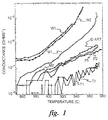
- Fig. 1 is a graph of conductance versus temperature for various composite materials comprising additions of ground silicate minerals to silicone polymers.
- the composite materials comprising additions of ground silicate minerals to silicone polymers that are tested are in the form of silicone sheets filled with silicate mineral compositions.
- data from two separate runs are shown for each of three samples of composite materials comprising additions of ground silicate minerals to silicone polymers, as embodied by the invention.
- silicone sheets filled with wollastonite include silicone sheets filled with mica (curves M1 and M2), silicone sheets filled with pyrophyllite (curves P1 and P2), and silicone sheets filled with talc (curves T1 and T2).
- the silicone sheet samples filled with talc (curves T1 and T2) and pyrophyllite (curves P1 and P2) exhibit improved combinations of electrical conductivity characteristics and behavior.
- the silicone sheet samples filled with talc and pyrophyllite possess a low conductivity at high temperatures.
- the surface treated talc provided a lower conductivity than untreated (raw) talc. This lower conductivity is illustrated in Fig 1, by the curves T1 and T2.
- the mica and talc ground silicates were surface treated with silane coupling agents. These surface modified minerals made the compositions more compatible with composite silicone polymer compositions, as embodied by the invention. Also, the surface modified minerals improved mechanical properties of the composite silicone polymer compositions, as embodied by the invention.
- compositions with ground silicate minerals were prepared to demonstrate the suitability of the compositions as insulators for wires.
- the samples prepared also comprised fumed silica.
- the composite silicone polymer compositions were prepared as cured sheets of silicone, where the sheets of cured silicone had a thickness of about 2 mm.
- the sheets of cured silicone comprising composite silicone polymer compositions, as embodied by the invention were prepared having the following approximate weight ratio: 100 parts silicone polymer, 40 parts fumed silica and 40 parts of the powdered silicate mineral.
- Powders of the ground silicate mineral and the fumed silica were compounded into the uncured silicone resin along with a curing agent, for example a 2-4, Dichlorobenzoyl Peroxide curing agent.
- a curing agent for example a 2-4, Dichlorobenzoyl Peroxide curing agent.
- the composite was then pressed into sheets, which are then heated to about 275°F for about 12 minutes to effect cross-linking and polymerization.
- the sheets of cured silicone comprising composite silicone polymer compositions, as embodied by the invention, were cut into approximately 3/4" disks.
- the electrical conductivity of the disks was measured as a function of temperature, up to a maximum of about 975°C.
- the conductivity data is illustrated Fig. 1, where the curve LPnat is illustrative of known insulative material, which does not comprise a silicate filler.
- the known LP material (curve LPnat) showed cracking upon inspection. Further, electrical breakdown at relatively low temperatures was common for the LP material.
- the silicate filled material sheets of cured silicone comprising composite silicone polymer compositions, as embodied by the invention rarely failed. If the silicate filled material sheets of cured silicone comprising composite silicone polymer compositions, as embodied by the invention, exhibited any failure evident, the failure is believed to be caused by thermal instability.
- both the wollastonite and mica, as fillers in a silicone polymer composite material result in conductivity that is substantially higher than standard LP material.
- electrical breakdown due to thermal instability was enhanced.
- the use of these two fillers should be restricted to applications where temperatures do not exceed about 800°C.
- the use of wollastonite and mica as composite materials fillers provides increased mechanical strength and enhanced thermal expansions.
- the silicone polymer composite material with a filler of pyrophyllite provided approximately a similar conductivity as the standard LP material. However, the silicone polymer composite material with a filler of pyrophyllite exhibited far superior mechanical properties.
- a talc filled silicone polymer composite material For a talc filled silicone polymer composite material a lower conductivity was exhibited at higher temperatures. Therefore, a talc filled silicone polymer composite material was determined to be a very resistant to electrical breakdown material in a silicone polymer composite material, as embodied by the invention.
- the ground silicate minerals that are added to silicone polymer are added in as ground powders constituents.
- the ground powders constituents are homogeneously mixed into an uncured silicone polymer composition.
- conventional and well-known fillers and heat stabilizing additives may also be added to the silicone polymer composition comprising the ground silicate minerals.
- the resulting composite composition is then provided onto wires, such as by coating, coextrusion or other well-known application processes, as insulation, for cable applications.
- the coating process includes conventional manufacturing and coating processes.
- the ratio of the ground silicate minerals to silicone polymer is limited by a trade off between low temperature and high temperature properties of the composite.
- the low temperature viscosity of an uncured composite increases with an increased silicate mineral content, which above a certain level is undesirable for the manufacturing of wire and cable.
- the ratio is adjusted to provide an acceptable viscosity for wire and cable manufacture, but is still sufficient to provide high electrical resistance and desirable mechanical characteristics at high temperatures.
- a desired ratio of the ground silicate minerals to silicone polymer is in a range between about 5% to about 40% by weight. Further, it has been determined that a desired ratio of the ground silicate minerals to silicone polymer is in a range between about 15% to about 20% by weight is further preferable.
- compositions, as embodied by the invention with as little as about 5% by weight of a silicate mineral are believed to provide desirable high temperature insulating properties. Also, it has been determined that compositions, as embodied by the invention, with greater than about 40% by weight of silicate minerals are less easy to manufacture that lower weight percentage compositions due, at least in part to high viscosity of the composition.
- the ground silicate minerals are added in the form of ground powders and comprise at least one mineral that is formed by a coordination of SiO 4 tetrahedra.
- the coordination of SiO 4 tetrahedra is often associated with minerals, such as but not limited to, aluminum, magnesium, calcium and iron.
- the ground silicate minerals as embodied by the invention, comprise at least one ground silicate mineral from the group consisting of olivine group; garnet group; aluminosilicates; ring silicates; chain silicates; and sheet silicates.
- the olivine group comprises ground silicate minerals, such as but not limited to, forsterite and Mg 2 SiO 4 .
- the garnet group comprises ground silicate minerals, such as but not limited to, pyrope; Mg 3 Al 2 Si 3 O 12 ; grossular; and Ca 2 Al 2 Si 3 O 12 .
- Aluninosilicates comprise ground silicate minerals, such as but not limited to, sillimanite; Al 2 SiO 5 ; mullite; 3Al 2 O 3 2SiO 2 ; kyanite; and Al 2 SiO 5 .
- the ring silicates group comprises ground silicate minerals, such as but not limited to, cordierite and Al 3 (Mg,Fe) 2 [Si 4 AlO 18 ].
- the chain silicates group comprises ground silicate minerals, such as but not limited to, wollastonite and Ca[SiO 3 ].
- the sheet silicates group comprises ground silicate minerals, such as but not limited to, mica; K 2 AI l4 [Si 6 Al 2 O 20 ](OH) 4 ; pyrophyllite; Al 4 [Si 8 O 20 ](OH) 4 ; talc; Mg 6 [Si 8 O 20 ](OH) 4 ; serpentine for example, asbestos; Kaolinite; Al 4 [Si 4 O 10 ](OH) 8 ; vermiculite; and Mg,Ca) 0.7 (Mg,Fe,Al) 6 [(Al,Si) 8 O 20 ](OH) 4 8H 2 O.
- ground silicate minerals such as but not limited to, mica; K 2 AI l4 [Si 6 Al 2 O 20 ](OH) 4 ; pyrophyllite; Al 4 [Si 8 O 20 ](OH) 4 ; talc; Mg 6 [Si 8 O 20 ](OH) 4 ; serpentine for example, asbestos; Kaolinite; Al
- Natural sources for these ground silicate minerals are generally found in an essentially impure state. It has been determined that, in particular, alkali metals such as but not limited to potassium and sodium, if found as an impurity in ground silicate minerals, impart a significant high temperature conductivity to a composite silicone polymer composition comprising the ground silicate minerals. Accordingly, the alkali metals are detrimental to performance of the composite silicone polymer composition comprising the ground silicate minerals as an insulation.
- ground silicate minerals as additives for a composite silicone polymer composition, as embodied by the invention, that contain these alkali metal impurities should be avoided. If ground silicate minerals are determined to contain the alkali metals, the alkali metals should be removed from the ground silicate minerals, if possible, prior to the incorporation into a composite silicone polymer composition comprising the ground silicate minerals.
- ground silicate minerals may be performed, for example with silane coupling agents, in order to reduce adsorbed water.
- the surface treatment of ground silicate minerals also makes the ground silicate minerals easily wetted by the silicone polymer. These surface modified minerals do not clump, and can be homogeneously incorporated into the silicone polymer. This results in improved room temperature mechanical properties of the uncured composite. Furthermore, the surface treated minerals give a lower conductivity than untreated or raw material.
- additives are commonly used to modify the low temperature mechanical strength, viscosity and aging properties of silicone based insulation systems. These additives should not be detrimental to the high temperature properties described above. They should not impart an increased electrical conductivity at high temperature to the insulation nor should they result in shrinkage of the composite material.
- Fig. 2 is an illustration of a section of an electrical conductor 10 with an insulation formed from a composition, as embodied by the invention.
- the conductor 10 comprises an insulation 12 and conductive means 14.
- the insulation 12 is formed from a composition, as embodied by the invention, and described above.
- the conductive means 14 is a structure capable of carrying a current.
- the conductive means 14 comprises at least one of a wire, cable, or other conductive structure.
- the conductive means 14 can be formed from any conductive composition, such as but not limited to metals, alloys, ceramics, semiconductors, strands of wires and cables and combinations of these structures.
- the insulation is placed on the conductive means by an appropriate manner, for example but not limited to extrusion.
- the exact configuration and constituents of the conductive means 14 are not material to the electrical conductor 10 with an insulation formed from a composition, as embodied by the invention.
Landscapes
- Physics & Mathematics (AREA)
- Spectroscopy & Molecular Physics (AREA)
- Organic Insulating Materials (AREA)
- Insulated Conductors (AREA)
- Compositions Of Macromolecular Compounds (AREA)
- Fireproofing Substances (AREA)
Applications Claiming Priority (2)
| Application Number | Priority Date | Filing Date | Title |
|---|---|---|---|
| US931085 | 1978-08-04 | ||
| US08/931,085 US6051642A (en) | 1997-09-15 | 1997-09-15 | Silicone composition with improved high temperature tolerance |
Publications (2)
| Publication Number | Publication Date |
|---|---|
| EP0902440A1 true EP0902440A1 (fr) | 1999-03-17 |
| EP0902440B1 EP0902440B1 (fr) | 2004-05-06 |
Family
ID=25460206
Family Applications (1)
| Application Number | Title | Priority Date | Filing Date |
|---|---|---|---|
| EP98307465A Expired - Lifetime EP0902440B1 (fr) | 1997-09-15 | 1998-09-15 | Composition de silicone présentant une amélioration de la tolérance aux hautes températures |
Country Status (4)
| Country | Link |
|---|---|
| US (2) | US6051642A (fr) |
| EP (1) | EP0902440B1 (fr) |
| JP (1) | JP3524396B2 (fr) |
| DE (1) | DE69823602T2 (fr) |
Cited By (7)
| Publication number | Priority date | Publication date | Assignee | Title |
|---|---|---|---|---|
| WO2000046817A1 (fr) * | 1999-02-02 | 2000-08-10 | Dow Corning Corporation | Composition de revetement pour fils et cables a base de caoutchouc de silicone et resistante a l'inflammation |
| WO2000046302A3 (fr) * | 1999-02-02 | 2000-12-14 | Dow Corning | Composition de scellement ignifuge |
| FR2800742A1 (fr) * | 1999-11-09 | 2001-05-11 | Rhodia Chimie Sa | Compositions polyorganosiloxanes vulcanisables a chaud utilisables notamment pour la fabrication de fils ou cables electriques |
| EP1113048A3 (fr) * | 1999-12-27 | 2002-01-30 | General Electric Company | Composition particulaire hydrophobante |
| EP1367034A3 (fr) * | 2002-06-01 | 2005-05-25 | Rauschert GmbH | Procédé précise pour la production des composites céramiques |
| FR2899905A1 (fr) * | 2006-04-12 | 2007-10-19 | Rhodia Recherches & Tech | Compositions polyorganosiloxanes vulcanisables a chaud utilisables notamment pour la fabrication de fils ou cables electriques |
| CN104888381A (zh) * | 2015-04-23 | 2015-09-09 | 铜陵祥云消防科技有限责任公司 | 一种阻火包及其制造方法 |
Families Citing this family (9)
| Publication number | Priority date | Publication date | Assignee | Title |
|---|---|---|---|---|
| US6051642A (en) * | 1997-09-15 | 2000-04-18 | General Electric Company | Silicone composition with improved high temperature tolerance |
| DE19937322C2 (de) * | 1999-08-10 | 2001-06-13 | K Busch Gmbh Druck & Vakuum Dr | Polymerkeramische Werkstoffe und Formteile mit metallähnlichem Wärmeausdehnungsverhalten, ihre Herstellung und Verwendung sowie Einzelteile aus solchen Formteilen im Verbund mit Metallteilen |
| CA2420319C (fr) * | 2003-02-27 | 2007-11-27 | Csl Silicones Inc. | Methode de protection des surfaces contre l'incendie |
| US20050148706A1 (en) * | 2003-02-28 | 2005-07-07 | Csl Silicones Inc. | Method for protecting surfaces from effects of fire |
| FR2910013A1 (fr) * | 2006-12-14 | 2008-06-20 | Rhodia Recherches & Tech | Compositions polyorganosiloxanes vulcanisables a chaud utilisables notamment pour la fabrication de fils ou cables electriques |
| AU2008275937A1 (en) * | 2007-07-19 | 2009-01-22 | Luzenac America, Inc. | Silicone coatings, methods of making silicone coated articles and coated articles therefrom |
| PL225733B1 (pl) | 2013-03-15 | 2017-05-31 | Akademia Górniczo Hutnicza Im Stanisława Staszica W Krakowie | Ceramizująca kompozycja silikonowa na osłony przewodów elektrycznych |
| CA3071397A1 (fr) | 2017-07-31 | 2019-02-07 | Dow Global Technologies Llc | Composition durcissable a l'humidite pour couches d'isolation et de gaine de fils et de cables |
| CN112778764A (zh) * | 2020-12-30 | 2021-05-11 | 江苏福润达新材料科技有限责任公司 | 一种耐高温耐湿绝缘材料、其制备方法与应用 |
Citations (2)
| Publication number | Priority date | Publication date | Assignee | Title |
|---|---|---|---|---|
| GB2046771A (en) * | 1979-03-13 | 1980-11-19 | Toray Silicone Co | Siloxane Composition |
| GB2190092A (en) * | 1986-05-09 | 1987-11-11 | Dow Corning | Improvements in electric cables |
Family Cites Families (21)
| Publication number | Priority date | Publication date | Assignee | Title |
|---|---|---|---|---|
| US3689618A (en) * | 1970-08-05 | 1972-09-05 | Air Reduction | Use of an unadvanced silicone resin binder in resistor manufacture |
| US3691512A (en) * | 1970-09-16 | 1972-09-12 | Pyle National Co | Impregnated ceramic insulators and method of making same |
| ES444945A1 (es) * | 1975-03-03 | 1977-08-16 | Gen Electric | Procedimiento para preparar un compuesto de poliolefina cu- rado por reticulacion. |
| US4131588A (en) * | 1976-12-13 | 1978-12-26 | General Electric Company | Low vapor transmission rate silicone composition |
| US4131589A (en) * | 1976-12-13 | 1978-12-26 | General Electric Company | Low temperature transmission room temperature vulcanizable silicone compositions |
| JPS6036527A (ja) * | 1983-08-09 | 1985-02-25 | Toshiba Chem Corp | 封止用樹脂組成物 |
| JPS62132991A (ja) * | 1985-12-03 | 1987-06-16 | 金 在運 | 耐火剤及び建築内装材用不燃剤とそれらの製造方法 |
| JPH0753811B2 (ja) * | 1986-04-10 | 1995-06-07 | 日本ゼオン株式会社 | 耐熱性が改善されたゴム組成物 |
| US4954327A (en) * | 1988-08-12 | 1990-09-04 | Blount David H | Production of silica aerogels |
| US5202186A (en) * | 1989-05-23 | 1993-04-13 | The Boeing Company | Thermal protection sleeve for reducing overheating of wire bundles utilized in aircraft applications |
| EP0399578A1 (fr) * | 1989-05-23 | 1990-11-28 | The Boeing Company | Manchette calorifuge pour faisceaux de fils à utiliser dans des aéronefs |
| FR2649470B1 (fr) * | 1989-07-05 | 1991-10-18 | Hutchinson Sa | Revetement de protection contre la chaleur et le feu pour tuyaux et structures analogues de forme allongee |
| US4957554A (en) * | 1989-08-16 | 1990-09-18 | Minnesota Mining And Manufacturing Company | Dimensionally-controlled ceramics |
| US5741616A (en) * | 1990-06-14 | 1998-04-21 | Ricoh Company, Ltd. | Method of developing latent electrostatic images and developer-bearing member |
| JP2689281B2 (ja) * | 1990-07-26 | 1997-12-10 | 日本碍子株式会社 | 屋外で使用する碍子用シリコーンゴム組成物 |
| JPH04242009A (ja) * | 1991-01-14 | 1992-08-28 | Toshiba Chem Corp | 絶縁ペースト |
| US5227586A (en) * | 1991-10-07 | 1993-07-13 | Harbour Industries, (Canada) Ltd. | Flame resistant electric cable |
| US5260372A (en) * | 1991-11-18 | 1993-11-09 | Wacker Silicones Corporation | Flame retardant elastomeric composition |
| AU687973B2 (en) * | 1993-12-17 | 1998-03-05 | Hitco Carbon Composites, Inc. | Silicone composite materials having high temperature resistance |
| JPH0845342A (ja) * | 1994-08-03 | 1996-02-16 | Sumitomo Electric Ind Ltd | 絶縁ゴム材料 |
| US6051642A (en) * | 1997-09-15 | 2000-04-18 | General Electric Company | Silicone composition with improved high temperature tolerance |
-
1997
- 1997-09-15 US US08/931,085 patent/US6051642A/en not_active Expired - Lifetime
-
1998
- 1998-09-14 JP JP25981598A patent/JP3524396B2/ja not_active Expired - Fee Related
- 1998-09-15 EP EP98307465A patent/EP0902440B1/fr not_active Expired - Lifetime
- 1998-09-15 DE DE69823602T patent/DE69823602T2/de not_active Expired - Lifetime
-
2000
- 2000-02-11 US US09/503,617 patent/US6395815B1/en not_active Expired - Fee Related
Patent Citations (3)
| Publication number | Priority date | Publication date | Assignee | Title |
|---|---|---|---|---|
| GB2046771A (en) * | 1979-03-13 | 1980-11-19 | Toray Silicone Co | Siloxane Composition |
| US4269757A (en) * | 1979-03-13 | 1981-05-26 | Toray Silicone Company, Ltd. | Siloxane compositions which form ceramics at high temperatures |
| GB2190092A (en) * | 1986-05-09 | 1987-11-11 | Dow Corning | Improvements in electric cables |
Cited By (13)
| Publication number | Priority date | Publication date | Assignee | Title |
|---|---|---|---|---|
| WO2000046817A1 (fr) * | 1999-02-02 | 2000-08-10 | Dow Corning Corporation | Composition de revetement pour fils et cables a base de caoutchouc de silicone et resistante a l'inflammation |
| WO2000046302A3 (fr) * | 1999-02-02 | 2000-12-14 | Dow Corning | Composition de scellement ignifuge |
| US6239378B1 (en) | 1999-02-02 | 2001-05-29 | Dow Corning Corporation | Flame resistant silicone rubber wire and cable coating composition |
| US6271299B1 (en) | 1999-02-02 | 2001-08-07 | Dow Corning Corporation | Fire resistant sealant composition |
| FR2800742A1 (fr) * | 1999-11-09 | 2001-05-11 | Rhodia Chimie Sa | Compositions polyorganosiloxanes vulcanisables a chaud utilisables notamment pour la fabrication de fils ou cables electriques |
| WO2001034705A1 (fr) * | 1999-11-09 | 2001-05-17 | Rhodia Chimie | Compositions polyorganosiloxanes vulcanisables a chaud utilisables notamment pour la fabrication de fils ou cables electriques |
| EP1113048A3 (fr) * | 1999-12-27 | 2002-01-30 | General Electric Company | Composition particulaire hydrophobante |
| US6582825B2 (en) | 1999-12-27 | 2003-06-24 | General Electric Company | Hydrophobicity imparting particulate |
| EP1367034A3 (fr) * | 2002-06-01 | 2005-05-25 | Rauschert GmbH | Procédé précise pour la production des composites céramiques |
| FR2899905A1 (fr) * | 2006-04-12 | 2007-10-19 | Rhodia Recherches & Tech | Compositions polyorganosiloxanes vulcanisables a chaud utilisables notamment pour la fabrication de fils ou cables electriques |
| WO2007115834A3 (fr) * | 2006-04-12 | 2007-12-21 | Rhodia Recherches & Tech | Compositions polyorganosiloxanes vulcanisables a chaud utilisables notamment pour la fabrication de fils ou cables electriques |
| US8193268B2 (en) | 2006-04-12 | 2012-06-05 | Bluestar Silicones France Sas | Hot-vulcanizable polyorganosiloxane compositions useful particularly for manufacturing electrical cables or wires |
| CN104888381A (zh) * | 2015-04-23 | 2015-09-09 | 铜陵祥云消防科技有限责任公司 | 一种阻火包及其制造方法 |
Also Published As
| Publication number | Publication date |
|---|---|
| JPH11172107A (ja) | 1999-06-29 |
| US6395815B1 (en) | 2002-05-28 |
| EP0902440B1 (fr) | 2004-05-06 |
| US6051642A (en) | 2000-04-18 |
| DE69823602D1 (de) | 2004-06-09 |
| JP3524396B2 (ja) | 2004-05-10 |
| DE69823602T2 (de) | 2005-04-07 |
Similar Documents
| Publication | Publication Date | Title |
|---|---|---|
| EP0902440B1 (fr) | Composition de silicone présentant une amélioration de la tolérance aux hautes températures | |
| CA2502739C (fr) | Compositions polymeres resistant au feu | |
| KR900000189B1 (ko) | 난연성 조성물과 이것을 사용한 케이블 | |
| KR100963609B1 (ko) | 안전 전기 케이블을 위한 절연 합성물 | |
| CN102220008B (zh) | 高强度耐火电缆绝缘材料及其制备方法 | |
| CN100370007C (zh) | 耐火聚合物组合物 | |
| KR102033211B1 (ko) | 특히 전선 또는 전기 케이블의 제조에 사용하기 위한 고온-가황성 폴리오가노실록산 조성물 | |
| ES2112594T5 (es) | Composicion antiinflamable para la fabricacion de cables electricos con mantenimiento del aislamiento y/o del funcionamiento. | |
| KR101261592B1 (ko) | 내화성 케이블 | |
| JP2006503121A (ja) | 耐火性シリコーンポリマー組成物 | |
| EP2879135A1 (fr) | Compositions résistant au feu | |
| KR101688505B1 (ko) | 화재시에 전력 분배의 연속성을 보장하기에 적합한 전기 케이블 | |
| CA1118854A (fr) | Cables electriques a gaine en matiere donnant peu de prise a la flamme | |
| CN114709022B (zh) | 一种阻燃可陶瓷化硅橡胶护套线缆及其制备方法 | |
| CN115044313A (zh) | 一种自粘绝缘陶瓷硅橡胶带及其制备方法和緾绕方法 | |
| CN121237501A (zh) | 一种无卤低烟的阻燃聚烯烃电缆 | |
| US6774159B2 (en) | Composition presenting high resistance to the propagation of fire | |
| CN115312231A (zh) | 一种耐火电缆用的可陶瓷化绝缘组合物及其制备方法和应用 | |
| KR20110053439A (ko) | 전력 및/또는 통신 케이블용 세라믹화성 조성물 | |
| WO2004044927A1 (fr) | Cable ignifuge | |
| CN221651225U (zh) | 低烟无卤电线电缆 | |
| JPS6137135Y2 (fr) | ||
| AU2003271422B2 (en) | Fire resistant polymeric compositions | |
| CN110085359A (zh) | 隔氧层电缆 | |
| KR20250123341A (ko) | 내화 케이블용 조성물 및 이로부터 형성된 절연층을 포함하는 케이블 |
Legal Events
| Date | Code | Title | Description |
|---|---|---|---|
| PUAI | Public reference made under article 153(3) epc to a published international application that has entered the european phase |
Free format text: ORIGINAL CODE: 0009012 |
|
| AK | Designated contracting states |
Kind code of ref document: A1 Designated state(s): DE FR GB |
|
| AX | Request for extension of the european patent |
Free format text: AL;LT;LV;MK;RO;SI |
|
| 17P | Request for examination filed |
Effective date: 19990917 |
|
| AKX | Designation fees paid |
Free format text: DE FR GB |
|
| 17Q | First examination report despatched |
Effective date: 20011115 |
|
| GRAP | Despatch of communication of intention to grant a patent |
Free format text: ORIGINAL CODE: EPIDOSNIGR1 |
|
| GRAS | Grant fee paid |
Free format text: ORIGINAL CODE: EPIDOSNIGR3 |
|
| GRAA | (expected) grant |
Free format text: ORIGINAL CODE: 0009210 |
|
| AK | Designated contracting states |
Kind code of ref document: B1 Designated state(s): DE FR GB |
|
| REG | Reference to a national code |
Ref country code: GB Ref legal event code: FG4D |
|
| REF | Corresponds to: |
Ref document number: 69823602 Country of ref document: DE Date of ref document: 20040609 Kind code of ref document: P |
|
| ET | Fr: translation filed | ||
| PLBE | No opposition filed within time limit |
Free format text: ORIGINAL CODE: 0009261 |
|
| STAA | Information on the status of an ep patent application or granted ep patent |
Free format text: STATUS: NO OPPOSITION FILED WITHIN TIME LIMIT |
|
| 26N | No opposition filed |
Effective date: 20050208 |
|
| REG | Reference to a national code |
Ref country code: DE Ref legal event code: R082 Ref document number: 69823602 Country of ref document: DE Representative=s name: MAI DOERR BESIER PATENTANWAELTE, DE |
|
| PGFP | Annual fee paid to national office [announced via postgrant information from national office to epo] |
Ref country code: DE Payment date: 20130927 Year of fee payment: 16 |
|
| PGFP | Annual fee paid to national office [announced via postgrant information from national office to epo] |
Ref country code: FR Payment date: 20130919 Year of fee payment: 16 Ref country code: GB Payment date: 20130927 Year of fee payment: 16 |
|
| REG | Reference to a national code |
Ref country code: DE Ref legal event code: R119 Ref document number: 69823602 Country of ref document: DE |
|
| GBPC | Gb: european patent ceased through non-payment of renewal fee |
Effective date: 20140915 |
|
| REG | Reference to a national code |
Ref country code: DE Ref legal event code: R119 Ref document number: 69823602 Country of ref document: DE Effective date: 20150401 |
|
| REG | Reference to a national code |
Ref country code: FR Ref legal event code: ST Effective date: 20150529 |
|
| PG25 | Lapsed in a contracting state [announced via postgrant information from national office to epo] |
Ref country code: DE Free format text: LAPSE BECAUSE OF NON-PAYMENT OF DUE FEES Effective date: 20150401 Ref country code: GB Free format text: LAPSE BECAUSE OF NON-PAYMENT OF DUE FEES Effective date: 20140915 |
|
| PG25 | Lapsed in a contracting state [announced via postgrant information from national office to epo] |
Ref country code: FR Free format text: LAPSE BECAUSE OF NON-PAYMENT OF DUE FEES Effective date: 20140930 |