EP0902853B1 - Thermally stable acoustical insulation - Google Patents
Thermally stable acoustical insulation Download PDFInfo
- Publication number
- EP0902853B1 EP0902853B1 EP96933976A EP96933976A EP0902853B1 EP 0902853 B1 EP0902853 B1 EP 0902853B1 EP 96933976 A EP96933976 A EP 96933976A EP 96933976 A EP96933976 A EP 96933976A EP 0902853 B1 EP0902853 B1 EP 0902853B1
- Authority
- EP
- European Patent Office
- Prior art keywords
- melt
- microfibers
- blown
- thermally stable
- polypropylene
- Prior art date
- Legal status (The legal status is an assumption and is not a legal conclusion. Google has not performed a legal analysis and makes no representation as to the accuracy of the status listed.)
- Expired - Lifetime
Links
- 238000009413 insulation Methods 0.000 title claims description 47
- 229920001410 Microfiber Polymers 0.000 claims description 80
- 239000003658 microfiber Substances 0.000 claims description 80
- 239000004743 Polypropylene Substances 0.000 claims description 63
- -1 polypropylene Polymers 0.000 claims description 63
- 229920001155 polypropylene Polymers 0.000 claims description 63
- 239000000835 fiber Substances 0.000 claims description 60
- 239000003963 antioxidant agent Substances 0.000 claims description 41
- 230000003078 antioxidant effect Effects 0.000 claims description 29
- 239000000203 mixture Substances 0.000 claims description 18
- 239000003017 thermal stabilizer Substances 0.000 claims description 17
- 229920000642 polymer Polymers 0.000 claims description 16
- 238000000034 method Methods 0.000 claims description 14
- XLYOFNOQVPJJNP-UHFFFAOYSA-N water Substances O XLYOFNOQVPJJNP-UHFFFAOYSA-N 0.000 claims description 12
- 238000001125 extrusion Methods 0.000 claims description 9
- 238000002156 mixing Methods 0.000 claims description 8
- 229920005606 polypropylene copolymer Polymers 0.000 claims description 3
- 229920005629 polypropylene homopolymer Polymers 0.000 claims description 3
- 229920001577 copolymer Polymers 0.000 claims description 2
- 230000000593 degrading effect Effects 0.000 claims 1
- 238000006731 degradation reaction Methods 0.000 description 21
- 230000015556 catabolic process Effects 0.000 description 20
- 239000011347 resin Substances 0.000 description 14
- 229920005989 resin Polymers 0.000 description 14
- 239000000463 material Substances 0.000 description 11
- 239000000654 additive Substances 0.000 description 8
- 239000000853 adhesive Substances 0.000 description 8
- 230000001070 adhesive effect Effects 0.000 description 8
- 229920001169 thermoplastic Polymers 0.000 description 8
- 239000011230 binding agent Substances 0.000 description 7
- 230000002829 reductive effect Effects 0.000 description 7
- 239000004416 thermosoftening plastic Substances 0.000 description 7
- 238000007664 blowing Methods 0.000 description 6
- VLKZOEOYAKHREP-UHFFFAOYSA-N n-Hexane Chemical compound CCCCCC VLKZOEOYAKHREP-UHFFFAOYSA-N 0.000 description 6
- 230000004888 barrier function Effects 0.000 description 5
- 150000002978 peroxides Chemical class 0.000 description 5
- 239000003381 stabilizer Substances 0.000 description 5
- 238000010521 absorption reaction Methods 0.000 description 4
- 238000004519 manufacturing process Methods 0.000 description 4
- VNWKTOKETHGBQD-UHFFFAOYSA-N methane Chemical compound C VNWKTOKETHGBQD-UHFFFAOYSA-N 0.000 description 4
- 230000003068 static effect Effects 0.000 description 4
- 238000004458 analytical method Methods 0.000 description 3
- 230000005540 biological transmission Effects 0.000 description 3
- 230000001965 increasing effect Effects 0.000 description 3
- 238000002347 injection Methods 0.000 description 3
- 239000007924 injection Substances 0.000 description 3
- NFHFRUOZVGFOOS-UHFFFAOYSA-N palladium;triphenylphosphane Chemical compound [Pd].C1=CC=CC=C1P(C=1C=CC=CC=1)C1=CC=CC=C1.C1=CC=CC=C1P(C=1C=CC=CC=1)C1=CC=CC=C1.C1=CC=CC=C1P(C=1C=CC=CC=1)C1=CC=CC=C1.C1=CC=CC=C1P(C=1C=CC=CC=1)C1=CC=CC=C1 NFHFRUOZVGFOOS-UHFFFAOYSA-N 0.000 description 3
- 229920000728 polyester Polymers 0.000 description 3
- 229920000098 polyolefin Polymers 0.000 description 3
- 239000012815 thermoplastic material Substances 0.000 description 3
- PRWJPWSKLXYEPD-UHFFFAOYSA-N 4-[4,4-bis(5-tert-butyl-4-hydroxy-2-methylphenyl)butan-2-yl]-2-tert-butyl-5-methylphenol Chemical compound C=1C(C(C)(C)C)=C(O)C=C(C)C=1C(C)CC(C=1C(=CC(O)=C(C=1)C(C)(C)C)C)C1=CC(C(C)(C)C)=C(O)C=C1C PRWJPWSKLXYEPD-UHFFFAOYSA-N 0.000 description 2
- 239000004831 Hot glue Substances 0.000 description 2
- XBDQKXXYIPTUBI-UHFFFAOYSA-M Propionate Chemical compound CCC([O-])=O XBDQKXXYIPTUBI-UHFFFAOYSA-M 0.000 description 2
- 230000032683 aging Effects 0.000 description 2
- 230000015572 biosynthetic process Effects 0.000 description 2
- 238000003490 calendering Methods 0.000 description 2
- 230000000052 comparative effect Effects 0.000 description 2
- 238000006073 displacement reaction Methods 0.000 description 2
- 238000009826 distribution Methods 0.000 description 2
- 239000000428 dust Substances 0.000 description 2
- 239000007788 liquid Substances 0.000 description 2
- 230000007246 mechanism Effects 0.000 description 2
- 239000004750 melt-blown nonwoven Substances 0.000 description 2
- 125000000325 methylidene group Chemical group [H]C([H])=* 0.000 description 2
- 239000002245 particle Substances 0.000 description 2
- 239000002530 phenolic antioxidant Substances 0.000 description 2
- 239000000243 solution Substances 0.000 description 2
- 238000010998 test method Methods 0.000 description 2
- 238000012360 testing method Methods 0.000 description 2
- 238000003856 thermoforming Methods 0.000 description 2
- GNFSQVSEWQSGKR-UHFFFAOYSA-N 1-(3,5-ditert-butyl-4-hydroxyphenyl)nonadecylsulfanyl acetate Chemical compound CCCCCCCCCCCCCCCCCCC(SOC(C)=O)C1=CC(C(C)(C)C)=C(O)C(C(C)(C)C)=C1 GNFSQVSEWQSGKR-UHFFFAOYSA-N 0.000 description 1
- APTGHASZJUAUCP-UHFFFAOYSA-N 1-n,4-n-di(octan-2-yl)benzene-1,4-diamine Chemical compound CCCCCCC(C)NC1=CC=C(NC(C)CCCCCC)C=C1 APTGHASZJUAUCP-UHFFFAOYSA-N 0.000 description 1
- VETPHHXZEJAYOB-UHFFFAOYSA-N 1-n,4-n-dinaphthalen-2-ylbenzene-1,4-diamine Chemical compound C1=CC=CC2=CC(NC=3C=CC(NC=4C=C5C=CC=CC5=CC=4)=CC=3)=CC=C21 VETPHHXZEJAYOB-UHFFFAOYSA-N 0.000 description 1
- XLXUJYAVVOTDJL-UHFFFAOYSA-N 19-(3,5-ditert-butyl-4-hydroxyphenyl)heptatriacontan-19-yl dihydrogen phosphite Chemical compound CCCCCCCCCCCCCCCCCCC(CCCCCCCCCCCCCCCCCC)(OP(O)O)C1=CC(C(C)(C)C)=C(O)C(C(C)(C)C)=C1 XLXUJYAVVOTDJL-UHFFFAOYSA-N 0.000 description 1
- TUYBEVLJKZQJPO-UHFFFAOYSA-N 19-(3,5-ditert-butyl-4-hydroxyphenyl)heptatriacontan-19-ylphosphonic acid Chemical compound CCCCCCCCCCCCCCCCCCC(CCCCCCCCCCCCCCCCCC)(P(O)(O)=O)C1=CC(C(C)(C)C)=C(O)C(C(C)(C)C)=C1 TUYBEVLJKZQJPO-UHFFFAOYSA-N 0.000 description 1
- ZNRLMGFXSPUZNR-UHFFFAOYSA-N 2,2,4-trimethyl-1h-quinoline Chemical compound C1=CC=C2C(C)=CC(C)(C)NC2=C1 ZNRLMGFXSPUZNR-UHFFFAOYSA-N 0.000 description 1
- JFGVTUJBHHZRAB-UHFFFAOYSA-N 2,6-Di-tert-butyl-1,4-benzenediol Chemical compound CC(C)(C)C1=CC(O)=CC(C(C)(C)C)=C1O JFGVTUJBHHZRAB-UHFFFAOYSA-N 0.000 description 1
- SLUKQUGVTITNSY-UHFFFAOYSA-N 2,6-di-tert-butyl-4-methoxyphenol Chemical compound COC1=CC(C(C)(C)C)=C(O)C(C(C)(C)C)=C1 SLUKQUGVTITNSY-UHFFFAOYSA-N 0.000 description 1
- DKCPKDPYUFEZCP-UHFFFAOYSA-N 2,6-di-tert-butylphenol Chemical compound CC(C)(C)C1=CC=CC(C(C)(C)C)=C1O DKCPKDPYUFEZCP-UHFFFAOYSA-N 0.000 description 1
- IAVGWBMOOWJCFN-UHFFFAOYSA-N 2,6-ditert-butyl-4-(1-dioctadecoxyphosphorylethyl)phenol Chemical compound CCCCCCCCCCCCCCCCCCOP(=O)(OCCCCCCCCCCCCCCCCCC)C(C)C1=CC(C(C)(C)C)=C(O)C(C(C)(C)C)=C1 IAVGWBMOOWJCFN-UHFFFAOYSA-N 0.000 description 1
- XODOYQBURKBONX-UHFFFAOYSA-N 2,6-ditert-butyl-4-[[4-(3,5-ditert-butyl-4-hydroxyphenoxy)-6-(2-octylsulfanylethylsulfanyl)-1,3,5-triazin-2-yl]oxy]phenol Chemical compound N=1C(OC=2C=C(C(O)=C(C=2)C(C)(C)C)C(C)(C)C)=NC(SCCSCCCCCCCC)=NC=1OC1=CC(C(C)(C)C)=C(O)C(C(C)(C)C)=C1 XODOYQBURKBONX-UHFFFAOYSA-N 0.000 description 1
- JMCKNCBUBGMWAY-UHFFFAOYSA-N 2,6-ditert-butyl-4-[[4-(3,5-ditert-butyl-4-hydroxyphenoxy)-6-octylsulfanyl-1,3,5-triazin-2-yl]oxy]phenol Chemical compound N=1C(OC=2C=C(C(O)=C(C=2)C(C)(C)C)C(C)(C)C)=NC(SCCCCCCCC)=NC=1OC1=CC(C(C)(C)C)=C(O)C(C(C)(C)C)=C1 JMCKNCBUBGMWAY-UHFFFAOYSA-N 0.000 description 1
- RTOZVEXLKURGKW-UHFFFAOYSA-N 2,6-ditert-butyl-4-[[4-[(3,5-ditert-butyl-4-hydroxyphenyl)methyl]-2,3,5,6-tetramethylphenyl]methyl]phenol Chemical compound CC=1C(C)=C(CC=2C=C(C(O)=C(C=2)C(C)(C)C)C(C)(C)C)C(C)=C(C)C=1CC1=CC(C(C)(C)C)=C(O)C(C(C)(C)C)=C1 RTOZVEXLKURGKW-UHFFFAOYSA-N 0.000 description 1
- KSHSOORFYDAJOE-UHFFFAOYSA-N 2-[3-(3,5-ditert-butyl-4-hydroxyphenyl)propanoyloxy]propyl 3-(3,5-ditert-butyl-4-hydroxyphenyl)propanoate Chemical compound C=1C(C(C)(C)C)=C(O)C(C(C)(C)C)=CC=1CCC(=O)OC(C)COC(=O)CCC1=CC(C(C)(C)C)=C(O)C(C(C)(C)C)=C1 KSHSOORFYDAJOE-UHFFFAOYSA-N 0.000 description 1
- VWSWIUTWLQJWQH-UHFFFAOYSA-N 2-butyl-6-[(3-butyl-2-hydroxy-5-methylphenyl)methyl]-4-methylphenol Chemical compound CCCCC1=CC(C)=CC(CC=2C(=C(CCCC)C=C(C)C=2)O)=C1O VWSWIUTWLQJWQH-UHFFFAOYSA-N 0.000 description 1
- HXIQYSLFEXIOAV-UHFFFAOYSA-N 2-tert-butyl-4-(5-tert-butyl-4-hydroxy-2-methylphenyl)sulfanyl-5-methylphenol Chemical compound CC1=CC(O)=C(C(C)(C)C)C=C1SC1=CC(C(C)(C)C)=C(O)C=C1C HXIQYSLFEXIOAV-UHFFFAOYSA-N 0.000 description 1
- MQWCQFCZUNBTCM-UHFFFAOYSA-N 2-tert-butyl-6-(3-tert-butyl-2-hydroxy-5-methylphenyl)sulfanyl-4-methylphenol Chemical compound CC(C)(C)C1=CC(C)=CC(SC=2C(=C(C=C(C)C=2)C(C)(C)C)O)=C1O MQWCQFCZUNBTCM-UHFFFAOYSA-N 0.000 description 1
- ASJLOCLGGDDTSW-UHFFFAOYSA-N 2-tert-butyl-6-[[6-[(3-tert-butyl-2-hydroxy-5-methylphenyl)methyl]-6-hydroxy-3-methylcyclohexa-1,3-dien-1-yl]methyl]-4-methylphenol Chemical compound C=1C(C)=CC(C(C)(C)C)=C(O)C=1CC1=CC(C)=CCC1(O)CC1=CC(C)=CC(C(C)(C)C)=C1O ASJLOCLGGDDTSW-UHFFFAOYSA-N 0.000 description 1
- WPMYUUITDBHVQZ-UHFFFAOYSA-N 3-(3,5-ditert-butyl-4-hydroxyphenyl)propanoic acid Chemical compound CC(C)(C)C1=CC(CCC(O)=O)=CC(C(C)(C)C)=C1O WPMYUUITDBHVQZ-UHFFFAOYSA-N 0.000 description 1
- QRLSTWVLSWCGBT-UHFFFAOYSA-N 4-((4,6-bis(octylthio)-1,3,5-triazin-2-yl)amino)-2,6-di-tert-butylphenol Chemical compound CCCCCCCCSC1=NC(SCCCCCCCC)=NC(NC=2C=C(C(O)=C(C=2)C(C)(C)C)C(C)(C)C)=N1 QRLSTWVLSWCGBT-UHFFFAOYSA-N 0.000 description 1
- RSFMBVKVSSHYLS-UHFFFAOYSA-N 4-[[4,6-bis(3,5-ditert-butyl-4-hydroxyphenoxy)-1,3,5-triazin-2-yl]oxy]-2,6-ditert-butylphenol Chemical compound CC(C)(C)C1=C(O)C(C(C)(C)C)=CC(OC=2N=C(OC=3C=C(C(O)=C(C=3)C(C)(C)C)C(C)(C)C)N=C(OC=3C=C(C(O)=C(C=3)C(C)(C)C)C(C)(C)C)N=2)=C1 RSFMBVKVSSHYLS-UHFFFAOYSA-N 0.000 description 1
- DMLLDZGHGNLZNW-UHFFFAOYSA-N 4-octyl-n-phenylaniline Chemical compound C1=CC(CCCCCCCC)=CC=C1NC1=CC=CC=C1 DMLLDZGHGNLZNW-UHFFFAOYSA-N 0.000 description 1
- 235000006506 Brasenia schreberi Nutrition 0.000 description 1
- 244000267222 Brasenia schreberi Species 0.000 description 1
- NLZUEZXRPGMBCV-UHFFFAOYSA-N Butylhydroxytoluene Chemical compound CC1=CC(C(C)(C)C)=C(O)C(C(C)(C)C)=C1 NLZUEZXRPGMBCV-UHFFFAOYSA-N 0.000 description 1
- OOTYPUACFYBYNL-UHFFFAOYSA-N CC(C)(C)C1=C(O)C(C(C)(C)C)=CC(ON2N=C(OC=3C=C(C(O)=C(C=3)C(C)(C)C)C(C)(C)C)C=CN2)=C1 Chemical compound CC(C)(C)C1=C(O)C(C(C)(C)C)=CC(ON2N=C(OC=3C=C(C(O)=C(C=3)C(C)(C)C)C(C)(C)C)C=CN2)=C1 OOTYPUACFYBYNL-UHFFFAOYSA-N 0.000 description 1
- OQOHSJKFSDKCCT-UHFFFAOYSA-N CCCCCCCCCCCCC(CCCCCCCCCCCC)(C(C(C(C)(C)C)=C1)=C(C)C(C)=C1O)OP(O)=O Chemical compound CCCCCCCCCCCCC(CCCCCCCCCCCC)(C(C(C(C)(C)C)=C1)=C(C)C(C)=C1O)OP(O)=O OQOHSJKFSDKCCT-UHFFFAOYSA-N 0.000 description 1
- 229920008651 Crystalline Polyethylene terephthalate Polymers 0.000 description 1
- LFQSCWFLJHTTHZ-UHFFFAOYSA-N Ethanol Chemical compound CCO LFQSCWFLJHTTHZ-UHFFFAOYSA-N 0.000 description 1
- UTGQNNCQYDRXCH-UHFFFAOYSA-N N,N'-diphenyl-1,4-phenylenediamine Chemical compound C=1C=C(NC=2C=CC=CC=2)C=CC=1NC1=CC=CC=C1 UTGQNNCQYDRXCH-UHFFFAOYSA-N 0.000 description 1
- KEQFTVQCIQJIQW-UHFFFAOYSA-N N-Phenyl-2-naphthylamine Chemical compound C=1C=C2C=CC=CC2=CC=1NC1=CC=CC=C1 KEQFTVQCIQJIQW-UHFFFAOYSA-N 0.000 description 1
- QAPVYZRWKDXNDK-UHFFFAOYSA-N P,P-Dioctyldiphenylamine Chemical compound C1=CC(CCCCCCCC)=CC=C1NC1=CC=C(CCCCCCCC)C=C1 QAPVYZRWKDXNDK-UHFFFAOYSA-N 0.000 description 1
- 229910019142 PO4 Inorganic materials 0.000 description 1
- ISWSIDIOOBJBQZ-UHFFFAOYSA-N Phenol Chemical compound OC1=CC=CC=C1 ISWSIDIOOBJBQZ-UHFFFAOYSA-N 0.000 description 1
- 239000004952 Polyamide Substances 0.000 description 1
- 239000004698 Polyethylene Substances 0.000 description 1
- 239000004820 Pressure-sensitive adhesive Substances 0.000 description 1
- 229920000297 Rayon Polymers 0.000 description 1
- KKEYFWRCBNTPAC-UHFFFAOYSA-N Terephthalic acid Chemical class OC(=O)C1=CC=C(C(O)=O)C=C1 KKEYFWRCBNTPAC-UHFFFAOYSA-N 0.000 description 1
- BGYHLZZASRKEJE-UHFFFAOYSA-N [3-[3-(3,5-ditert-butyl-4-hydroxyphenyl)propanoyloxy]-2,2-bis[3-(3,5-ditert-butyl-4-hydroxyphenyl)propanoyloxymethyl]propyl] 3-(3,5-ditert-butyl-4-hydroxyphenyl)propanoate Chemical compound CC(C)(C)C1=C(O)C(C(C)(C)C)=CC(CCC(=O)OCC(COC(=O)CCC=2C=C(C(O)=C(C=2)C(C)(C)C)C(C)(C)C)(COC(=O)CCC=2C=C(C(O)=C(C=2)C(C)(C)C)C(C)(C)C)COC(=O)CCC=2C=C(C(O)=C(C=2)C(C)(C)C)C(C)(C)C)=C1 BGYHLZZASRKEJE-UHFFFAOYSA-N 0.000 description 1
- 150000001242 acetic acid derivatives Chemical class 0.000 description 1
- 229920006397 acrylic thermoplastic Polymers 0.000 description 1
- 230000000996 additive effect Effects 0.000 description 1
- 239000002998 adhesive polymer Substances 0.000 description 1
- 239000002390 adhesive tape Substances 0.000 description 1
- 150000001412 amines Chemical class 0.000 description 1
- 238000013459 approach Methods 0.000 description 1
- 230000002238 attenuated effect Effects 0.000 description 1
- 235000010354 butylated hydroxytoluene Nutrition 0.000 description 1
- 230000003197 catalytic effect Effects 0.000 description 1
- 238000004587 chromatography analysis Methods 0.000 description 1
- 239000002131 composite material Substances 0.000 description 1
- 238000007796 conventional method Methods 0.000 description 1
- 238000001816 cooling Methods 0.000 description 1
- 238000003851 corona treatment Methods 0.000 description 1
- 238000000354 decomposition reaction Methods 0.000 description 1
- 230000007547 defect Effects 0.000 description 1
- WHAVPSKSOLVJMT-UHFFFAOYSA-N dioctadecyl 2-[(3,5-dibutyl-4-hydroxyphenyl)methyl]propanedioate Chemical compound CCCCCCCCCCCCCCCCCCOC(=O)C(C(=O)OCCCCCCCCCCCCCCCCCC)CC1=CC(CCCC)=C(O)C(CCCC)=C1 WHAVPSKSOLVJMT-UHFFFAOYSA-N 0.000 description 1
- 208000028659 discharge Diseases 0.000 description 1
- 238000002845 discoloration Methods 0.000 description 1
- 230000002708 enhancing effect Effects 0.000 description 1
- 238000011156 evaluation Methods 0.000 description 1
- 239000011152 fibreglass Substances 0.000 description 1
- 238000009472 formulation Methods 0.000 description 1
- 238000005227 gel permeation chromatography Methods 0.000 description 1
- 239000012760 heat stabilizer Substances 0.000 description 1
- 238000010438 heat treatment Methods 0.000 description 1
- 238000011065 in-situ storage Methods 0.000 description 1
- 239000012774 insulation material Substances 0.000 description 1
- QQVIHTHCMHWDBS-UHFFFAOYSA-L isophthalate(2-) Chemical compound [O-]C(=O)C1=CC=CC(C([O-])=O)=C1 QQVIHTHCMHWDBS-UHFFFAOYSA-L 0.000 description 1
- 230000000670 limiting effect Effects 0.000 description 1
- 239000007791 liquid phase Substances 0.000 description 1
- 239000000155 melt Substances 0.000 description 1
- 239000011490 mineral wool Substances 0.000 description 1
- 238000012544 monitoring process Methods 0.000 description 1
- CVVFFUKULYKOJR-UHFFFAOYSA-N n-phenyl-4-propan-2-yloxyaniline Chemical compound C1=CC(OC(C)C)=CC=C1NC1=CC=CC=C1 CVVFFUKULYKOJR-UHFFFAOYSA-N 0.000 description 1
- 231100000252 nontoxic Toxicity 0.000 description 1
- 230000003000 nontoxic effect Effects 0.000 description 1
- SSDSCDGVMJFTEQ-UHFFFAOYSA-N octadecyl 3-(3,5-ditert-butyl-4-hydroxyphenyl)propanoate Chemical compound CCCCCCCCCCCCCCCCCCOC(=O)CCC1=CC(C(C)(C)C)=C(O)C(C(C)(C)C)=C1 SSDSCDGVMJFTEQ-UHFFFAOYSA-N 0.000 description 1
- 230000036961 partial effect Effects 0.000 description 1
- 239000008188 pellet Substances 0.000 description 1
- 230000002093 peripheral effect Effects 0.000 description 1
- 150000002989 phenols Chemical class 0.000 description 1
- 235000021317 phosphate Nutrition 0.000 description 1
- AQSJGOWTSHOLKH-UHFFFAOYSA-N phosphite(3-) Chemical class [O-]P([O-])[O-] AQSJGOWTSHOLKH-UHFFFAOYSA-N 0.000 description 1
- 150000003013 phosphoric acid derivatives Chemical class 0.000 description 1
- 229920003229 poly(methyl methacrylate) Polymers 0.000 description 1
- 229920002647 polyamide Polymers 0.000 description 1
- 229920000573 polyethylene Polymers 0.000 description 1
- 229920000139 polyethylene terephthalate Polymers 0.000 description 1
- 239000005020 polyethylene terephthalate Substances 0.000 description 1
- 229920002959 polymer blend Polymers 0.000 description 1
- 229920002635 polyurethane Polymers 0.000 description 1
- 239000004814 polyurethane Substances 0.000 description 1
- 239000002964 rayon Substances 0.000 description 1
- 238000011160 research Methods 0.000 description 1
- 238000000926 separation method Methods 0.000 description 1
- 230000000087 stabilizing effect Effects 0.000 description 1
- 239000000126 substance Substances 0.000 description 1
- 239000004094 surface-active agent Substances 0.000 description 1
- ISXSCDLOGDJUNJ-UHFFFAOYSA-N tert-butyl prop-2-enoate Chemical compound CC(C)(C)OC(=O)C=C ISXSCDLOGDJUNJ-UHFFFAOYSA-N 0.000 description 1
- 150000003585 thioureas Chemical class 0.000 description 1
- 238000011144 upstream manufacturing Methods 0.000 description 1
- 238000003466 welding Methods 0.000 description 1
- 239000002759 woven fabric Substances 0.000 description 1
Images
Classifications
-
- B—PERFORMING OPERATIONS; TRANSPORTING
- B60—VEHICLES IN GENERAL
- B60J—WINDOWS, WINDSCREENS, NON-FIXED ROOFS, DOORS, OR SIMILAR DEVICES FOR VEHICLES; REMOVABLE EXTERNAL PROTECTIVE COVERINGS SPECIALLY ADAPTED FOR VEHICLES
- B60J5/00—Doors
- B60J5/04—Doors arranged at the vehicle sides
- B60J5/0412—Lower door structure
- B60J5/0418—Water or sound barrier, e.g. watershields or seals between dry/wet compartment, sound or vibration dampers
-
- D—TEXTILES; PAPER
- D04—BRAIDING; LACE-MAKING; KNITTING; TRIMMINGS; NON-WOVEN FABRICS
- D04H—MAKING TEXTILE FABRICS, e.g. FROM FIBRES OR FILAMENTARY MATERIAL; FABRICS MADE BY SUCH PROCESSES OR APPARATUS, e.g. FELTS, NON-WOVEN FABRICS; COTTON-WOOL; WADDING ; NON-WOVEN FABRICS FROM STAPLE FIBRES, FILAMENTS OR YARNS, BONDED WITH AT LEAST ONE WEB-LIKE MATERIAL DURING THEIR CONSOLIDATION
- D04H1/00—Non-woven fabrics formed wholly or mainly of staple fibres or like relatively short fibres
- D04H1/40—Non-woven fabrics formed wholly or mainly of staple fibres or like relatively short fibres from fleeces or layers composed of fibres without existing or potential cohesive properties
- D04H1/42—Non-woven fabrics formed wholly or mainly of staple fibres or like relatively short fibres from fleeces or layers composed of fibres without existing or potential cohesive properties characterised by the use of certain kinds of fibres insofar as this use has no preponderant influence on the consolidation of the fleece
- D04H1/4282—Addition polymers
- D04H1/4291—Olefin series
-
- B—PERFORMING OPERATIONS; TRANSPORTING
- B60—VEHICLES IN GENERAL
- B60J—WINDOWS, WINDSCREENS, NON-FIXED ROOFS, DOORS, OR SIMILAR DEVICES FOR VEHICLES; REMOVABLE EXTERNAL PROTECTIVE COVERINGS SPECIALLY ADAPTED FOR VEHICLES
- B60J5/00—Doors
-
- B—PERFORMING OPERATIONS; TRANSPORTING
- B60—VEHICLES IN GENERAL
- B60R—VEHICLES, VEHICLE FITTINGS, OR VEHICLE PARTS, NOT OTHERWISE PROVIDED FOR
- B60R13/00—Elements for body-finishing, identifying, or decorating; Arrangements or adaptations for advertising purposes
- B60R13/08—Insulating elements, e.g. for sound insulation
- B60R13/0815—Acoustic or thermal insulation of passenger compartments
-
- B—PERFORMING OPERATIONS; TRANSPORTING
- B60—VEHICLES IN GENERAL
- B60R—VEHICLES, VEHICLE FITTINGS, OR VEHICLE PARTS, NOT OTHERWISE PROVIDED FOR
- B60R13/00—Elements for body-finishing, identifying, or decorating; Arrangements or adaptations for advertising purposes
- B60R13/08—Insulating elements, e.g. for sound insulation
- B60R13/0892—Insulating elements, e.g. for sound insulation for humidity insulation
-
- C—CHEMISTRY; METALLURGY
- C08—ORGANIC MACROMOLECULAR COMPOUNDS; THEIR PREPARATION OR CHEMICAL WORKING-UP; COMPOSITIONS BASED THEREON
- C08K—Use of inorganic or non-macromolecular organic substances as compounding ingredients
- C08K5/00—Use of organic ingredients
- C08K5/04—Oxygen-containing compounds
- C08K5/13—Phenols; Phenolates
- C08K5/134—Phenols containing ester groups
- C08K5/1345—Carboxylic esters of phenolcarboxylic acids
-
- D—TEXTILES; PAPER
- D04—BRAIDING; LACE-MAKING; KNITTING; TRIMMINGS; NON-WOVEN FABRICS
- D04H—MAKING TEXTILE FABRICS, e.g. FROM FIBRES OR FILAMENTARY MATERIAL; FABRICS MADE BY SUCH PROCESSES OR APPARATUS, e.g. FELTS, NON-WOVEN FABRICS; COTTON-WOOL; WADDING ; NON-WOVEN FABRICS FROM STAPLE FIBRES, FILAMENTS OR YARNS, BONDED WITH AT LEAST ONE WEB-LIKE MATERIAL DURING THEIR CONSOLIDATION
- D04H1/00—Non-woven fabrics formed wholly or mainly of staple fibres or like relatively short fibres
- D04H1/40—Non-woven fabrics formed wholly or mainly of staple fibres or like relatively short fibres from fleeces or layers composed of fibres without existing or potential cohesive properties
- D04H1/42—Non-woven fabrics formed wholly or mainly of staple fibres or like relatively short fibres from fleeces or layers composed of fibres without existing or potential cohesive properties characterised by the use of certain kinds of fibres insofar as this use has no preponderant influence on the consolidation of the fleece
- D04H1/4382—Stretched reticular film fibres; Composite fibres; Mixed fibres; Ultrafine fibres; Fibres for artificial leather
- D04H1/43825—Composite fibres
- D04H1/43828—Composite fibres sheath-core
-
- D—TEXTILES; PAPER
- D04—BRAIDING; LACE-MAKING; KNITTING; TRIMMINGS; NON-WOVEN FABRICS
- D04H—MAKING TEXTILE FABRICS, e.g. FROM FIBRES OR FILAMENTARY MATERIAL; FABRICS MADE BY SUCH PROCESSES OR APPARATUS, e.g. FELTS, NON-WOVEN FABRICS; COTTON-WOOL; WADDING ; NON-WOVEN FABRICS FROM STAPLE FIBRES, FILAMENTS OR YARNS, BONDED WITH AT LEAST ONE WEB-LIKE MATERIAL DURING THEIR CONSOLIDATION
- D04H1/00—Non-woven fabrics formed wholly or mainly of staple fibres or like relatively short fibres
- D04H1/40—Non-woven fabrics formed wholly or mainly of staple fibres or like relatively short fibres from fleeces or layers composed of fibres without existing or potential cohesive properties
- D04H1/42—Non-woven fabrics formed wholly or mainly of staple fibres or like relatively short fibres from fleeces or layers composed of fibres without existing or potential cohesive properties characterised by the use of certain kinds of fibres insofar as this use has no preponderant influence on the consolidation of the fleece
- D04H1/4382—Stretched reticular film fibres; Composite fibres; Mixed fibres; Ultrafine fibres; Fibres for artificial leather
- D04H1/43835—Mixed fibres, e.g. at least two chemically different fibres or fibre blends
-
- D—TEXTILES; PAPER
- D04—BRAIDING; LACE-MAKING; KNITTING; TRIMMINGS; NON-WOVEN FABRICS
- D04H—MAKING TEXTILE FABRICS, e.g. FROM FIBRES OR FILAMENTARY MATERIAL; FABRICS MADE BY SUCH PROCESSES OR APPARATUS, e.g. FELTS, NON-WOVEN FABRICS; COTTON-WOOL; WADDING ; NON-WOVEN FABRICS FROM STAPLE FIBRES, FILAMENTS OR YARNS, BONDED WITH AT LEAST ONE WEB-LIKE MATERIAL DURING THEIR CONSOLIDATION
- D04H1/00—Non-woven fabrics formed wholly or mainly of staple fibres or like relatively short fibres
- D04H1/40—Non-woven fabrics formed wholly or mainly of staple fibres or like relatively short fibres from fleeces or layers composed of fibres without existing or potential cohesive properties
- D04H1/42—Non-woven fabrics formed wholly or mainly of staple fibres or like relatively short fibres from fleeces or layers composed of fibres without existing or potential cohesive properties characterised by the use of certain kinds of fibres insofar as this use has no preponderant influence on the consolidation of the fleece
- D04H1/4382—Stretched reticular film fibres; Composite fibres; Mixed fibres; Ultrafine fibres; Fibres for artificial leather
- D04H1/43838—Ultrafine fibres, e.g. microfibres
-
- D—TEXTILES; PAPER
- D04—BRAIDING; LACE-MAKING; KNITTING; TRIMMINGS; NON-WOVEN FABRICS
- D04H—MAKING TEXTILE FABRICS, e.g. FROM FIBRES OR FILAMENTARY MATERIAL; FABRICS MADE BY SUCH PROCESSES OR APPARATUS, e.g. FELTS, NON-WOVEN FABRICS; COTTON-WOOL; WADDING ; NON-WOVEN FABRICS FROM STAPLE FIBRES, FILAMENTS OR YARNS, BONDED WITH AT LEAST ONE WEB-LIKE MATERIAL DURING THEIR CONSOLIDATION
- D04H1/00—Non-woven fabrics formed wholly or mainly of staple fibres or like relatively short fibres
- D04H1/40—Non-woven fabrics formed wholly or mainly of staple fibres or like relatively short fibres from fleeces or layers composed of fibres without existing or potential cohesive properties
- D04H1/54—Non-woven fabrics formed wholly or mainly of staple fibres or like relatively short fibres from fleeces or layers composed of fibres without existing or potential cohesive properties by welding together the fibres, e.g. by partially melting or dissolving
- D04H1/56—Non-woven fabrics formed wholly or mainly of staple fibres or like relatively short fibres from fleeces or layers composed of fibres without existing or potential cohesive properties by welding together the fibres, e.g. by partially melting or dissolving in association with fibre formation, e.g. immediately following extrusion of staple fibres
-
- D—TEXTILES; PAPER
- D04—BRAIDING; LACE-MAKING; KNITTING; TRIMMINGS; NON-WOVEN FABRICS
- D04H—MAKING TEXTILE FABRICS, e.g. FROM FIBRES OR FILAMENTARY MATERIAL; FABRICS MADE BY SUCH PROCESSES OR APPARATUS, e.g. FELTS, NON-WOVEN FABRICS; COTTON-WOOL; WADDING ; NON-WOVEN FABRICS FROM STAPLE FIBRES, FILAMENTS OR YARNS, BONDED WITH AT LEAST ONE WEB-LIKE MATERIAL DURING THEIR CONSOLIDATION
- D04H1/00—Non-woven fabrics formed wholly or mainly of staple fibres or like relatively short fibres
- D04H1/70—Non-woven fabrics formed wholly or mainly of staple fibres or like relatively short fibres characterised by the method of forming fleeces or layers, e.g. reorientation of fibres
- D04H1/72—Non-woven fabrics formed wholly or mainly of staple fibres or like relatively short fibres characterised by the method of forming fleeces or layers, e.g. reorientation of fibres the fibres being randomly arranged
- D04H1/724—Non-woven fabrics formed wholly or mainly of staple fibres or like relatively short fibres characterised by the method of forming fleeces or layers, e.g. reorientation of fibres the fibres being randomly arranged forming webs during fibre formation, e.g. flash-spinning
-
- B—PERFORMING OPERATIONS; TRANSPORTING
- B60—VEHICLES IN GENERAL
- B60R—VEHICLES, VEHICLE FITTINGS, OR VEHICLE PARTS, NOT OTHERWISE PROVIDED FOR
- B60R11/00—Arrangements for holding or mounting articles, not otherwise provided for
- B60R11/02—Arrangements for holding or mounting articles, not otherwise provided for for radio sets, television sets, telephones, or the like; Arrangement of controls thereof
- B60R11/0217—Arrangements for holding or mounting articles, not otherwise provided for for radio sets, television sets, telephones, or the like; Arrangement of controls thereof for loud-speakers
-
- B—PERFORMING OPERATIONS; TRANSPORTING
- B60—VEHICLES IN GENERAL
- B60R—VEHICLES, VEHICLE FITTINGS, OR VEHICLE PARTS, NOT OTHERWISE PROVIDED FOR
- B60R13/00—Elements for body-finishing, identifying, or decorating; Arrangements or adaptations for advertising purposes
- B60R13/08—Insulating elements, e.g. for sound insulation
- B60R13/0815—Acoustic or thermal insulation of passenger compartments
- B60R13/083—Acoustic or thermal insulation of passenger compartments for fire walls or floors
-
- B—PERFORMING OPERATIONS; TRANSPORTING
- B60—VEHICLES IN GENERAL
- B60R—VEHICLES, VEHICLE FITTINGS, OR VEHICLE PARTS, NOT OTHERWISE PROVIDED FOR
- B60R13/00—Elements for body-finishing, identifying, or decorating; Arrangements or adaptations for advertising purposes
- B60R13/08—Insulating elements, e.g. for sound insulation
- B60R13/0838—Insulating elements, e.g. for sound insulation for engine compartments
-
- B—PERFORMING OPERATIONS; TRANSPORTING
- B60—VEHICLES IN GENERAL
- B60R—VEHICLES, VEHICLE FITTINGS, OR VEHICLE PARTS, NOT OTHERWISE PROVIDED FOR
- B60R11/00—Arrangements for holding or mounting articles, not otherwise provided for
- B60R2011/0001—Arrangements for holding or mounting articles, not otherwise provided for characterised by position
- B60R2011/0003—Arrangements for holding or mounting articles, not otherwise provided for characterised by position inside the vehicle
- B60R2011/0019—Side or rear panels
- B60R2011/0021—Doors
-
- D—TEXTILES; PAPER
- D04—BRAIDING; LACE-MAKING; KNITTING; TRIMMINGS; NON-WOVEN FABRICS
- D04H—MAKING TEXTILE FABRICS, e.g. FROM FIBRES OR FILAMENTARY MATERIAL; FABRICS MADE BY SUCH PROCESSES OR APPARATUS, e.g. FELTS, NON-WOVEN FABRICS; COTTON-WOOL; WADDING ; NON-WOVEN FABRICS FROM STAPLE FIBRES, FILAMENTS OR YARNS, BONDED WITH AT LEAST ONE WEB-LIKE MATERIAL DURING THEIR CONSOLIDATION
- D04H1/00—Non-woven fabrics formed wholly or mainly of staple fibres or like relatively short fibres
- D04H1/40—Non-woven fabrics formed wholly or mainly of staple fibres or like relatively short fibres from fleeces or layers composed of fibres without existing or potential cohesive properties
- D04H1/42—Non-woven fabrics formed wholly or mainly of staple fibres or like relatively short fibres from fleeces or layers composed of fibres without existing or potential cohesive properties characterised by the use of certain kinds of fibres insofar as this use has no preponderant influence on the consolidation of the fleece
- D04H1/4382—Stretched reticular film fibres; Composite fibres; Mixed fibres; Ultrafine fibres; Fibres for artificial leather
- D04H1/43825—Composite fibres
- D04H1/43832—Composite fibres side-by-side
-
- Y—GENERAL TAGGING OF NEW TECHNOLOGICAL DEVELOPMENTS; GENERAL TAGGING OF CROSS-SECTIONAL TECHNOLOGIES SPANNING OVER SEVERAL SECTIONS OF THE IPC; TECHNICAL SUBJECTS COVERED BY FORMER USPC CROSS-REFERENCE ART COLLECTIONS [XRACs] AND DIGESTS
- Y10—TECHNICAL SUBJECTS COVERED BY FORMER USPC
- Y10S—TECHNICAL SUBJECTS COVERED BY FORMER USPC CROSS-REFERENCE ART COLLECTIONS [XRACs] AND DIGESTS
- Y10S428/00—Stock material or miscellaneous articles
- Y10S428/903—Microfiber, less than 100 micron diameter
-
- Y—GENERAL TAGGING OF NEW TECHNOLOGICAL DEVELOPMENTS; GENERAL TAGGING OF CROSS-SECTIONAL TECHNOLOGIES SPANNING OVER SEVERAL SECTIONS OF THE IPC; TECHNICAL SUBJECTS COVERED BY FORMER USPC CROSS-REFERENCE ART COLLECTIONS [XRACs] AND DIGESTS
- Y10—TECHNICAL SUBJECTS COVERED BY FORMER USPC
- Y10T—TECHNICAL SUBJECTS COVERED BY FORMER US CLASSIFICATION
- Y10T442/00—Fabric [woven, knitted, or nonwoven textile or cloth, etc.]
- Y10T442/60—Nonwoven fabric [i.e., nonwoven strand or fiber material]
- Y10T442/608—Including strand or fiber material which is of specific structural definition
- Y10T442/614—Strand or fiber material specified as having microdimensions [i.e., microfiber]
-
- Y—GENERAL TAGGING OF NEW TECHNOLOGICAL DEVELOPMENTS; GENERAL TAGGING OF CROSS-SECTIONAL TECHNOLOGIES SPANNING OVER SEVERAL SECTIONS OF THE IPC; TECHNICAL SUBJECTS COVERED BY FORMER USPC CROSS-REFERENCE ART COLLECTIONS [XRACs] AND DIGESTS
- Y10—TECHNICAL SUBJECTS COVERED BY FORMER USPC
- Y10T—TECHNICAL SUBJECTS COVERED BY FORMER US CLASSIFICATION
- Y10T442/00—Fabric [woven, knitted, or nonwoven textile or cloth, etc.]
- Y10T442/60—Nonwoven fabric [i.e., nonwoven strand or fiber material]
- Y10T442/608—Including strand or fiber material which is of specific structural definition
- Y10T442/614—Strand or fiber material specified as having microdimensions [i.e., microfiber]
- Y10T442/615—Strand or fiber material is blended with another chemically different microfiber in the same layer
-
- Y—GENERAL TAGGING OF NEW TECHNOLOGICAL DEVELOPMENTS; GENERAL TAGGING OF CROSS-SECTIONAL TECHNOLOGIES SPANNING OVER SEVERAL SECTIONS OF THE IPC; TECHNICAL SUBJECTS COVERED BY FORMER USPC CROSS-REFERENCE ART COLLECTIONS [XRACs] AND DIGESTS
- Y10—TECHNICAL SUBJECTS COVERED BY FORMER USPC
- Y10T—TECHNICAL SUBJECTS COVERED BY FORMER US CLASSIFICATION
- Y10T442/00—Fabric [woven, knitted, or nonwoven textile or cloth, etc.]
- Y10T442/60—Nonwoven fabric [i.e., nonwoven strand or fiber material]
- Y10T442/608—Including strand or fiber material which is of specific structural definition
- Y10T442/614—Strand or fiber material specified as having microdimensions [i.e., microfiber]
- Y10T442/619—Including other strand or fiber material in the same layer not specified as having microdimensions
-
- Y—GENERAL TAGGING OF NEW TECHNOLOGICAL DEVELOPMENTS; GENERAL TAGGING OF CROSS-SECTIONAL TECHNOLOGIES SPANNING OVER SEVERAL SECTIONS OF THE IPC; TECHNICAL SUBJECTS COVERED BY FORMER USPC CROSS-REFERENCE ART COLLECTIONS [XRACs] AND DIGESTS
- Y10—TECHNICAL SUBJECTS COVERED BY FORMER USPC
- Y10T—TECHNICAL SUBJECTS COVERED BY FORMER US CLASSIFICATION
- Y10T442/00—Fabric [woven, knitted, or nonwoven textile or cloth, etc.]
- Y10T442/60—Nonwoven fabric [i.e., nonwoven strand or fiber material]
- Y10T442/659—Including an additional nonwoven fabric
-
- Y—GENERAL TAGGING OF NEW TECHNOLOGICAL DEVELOPMENTS; GENERAL TAGGING OF CROSS-SECTIONAL TECHNOLOGIES SPANNING OVER SEVERAL SECTIONS OF THE IPC; TECHNICAL SUBJECTS COVERED BY FORMER USPC CROSS-REFERENCE ART COLLECTIONS [XRACs] AND DIGESTS
- Y10—TECHNICAL SUBJECTS COVERED BY FORMER USPC
- Y10T—TECHNICAL SUBJECTS COVERED BY FORMER US CLASSIFICATION
- Y10T442/00—Fabric [woven, knitted, or nonwoven textile or cloth, etc.]
- Y10T442/60—Nonwoven fabric [i.e., nonwoven strand or fiber material]
- Y10T442/674—Nonwoven fabric with a preformed polymeric film or sheet
Definitions
- the invention relates to acoustical insulation particularly designed for use in a motorized vehicle, particularly an automobile.
- Nonwoven webs are used in automotive vehicles as an acoustical insulation located in and surrounding the passenger cabin and/or the engine compartment or fire wall.
- an extremely high temperature stable nonwoven material is required such as mineral wool, fiberglass and the like.
- a certain degree of resistance to thermal degradation is required.
- the passenger compartments of vehicles can become quite hot, particularly when parked in a sunny location.
- polypropylene is used to enhance the degradability of a polymer blend by increasing the susceptibility of the blend to be oxidatively degraded.
- this patent proposes the use of phenol-like antioxidants and others.
- U.S. Patent No. 5,393,831 describes polypropylene films and fibers which are formed without any phenolic antioxidants. The resulting material is designed to rapidly degrade when exposed to a high temperature environment, see also U.S. Patent No. 4,038,228.
- thermal stabilizers any given thermal stabilizer or blend of stabilizers works in any particular instance is often not well understood. However, most if not all thermal stabilizers are considered to be sacrificial. In this sacrificial sense, the stabilizers will preferentially remove essential components involved in the degradation process and are depleted in the process. When all the stabilizers are depleted, the protected materials will then generally rapidly degrade. Further, if the antioxidants or thermal stabilizers are not well distributed throughout the polymer localized degradation can occur. This problem can be compounded where the antioxidants tend to segregate due to incompatibility and/or are of a lower molecular weight such that the stabilizers can migrate and volatilize during use of the article.
- Additives including antioxidants or thermal stabilizers and other conventional additives, are typically added to a polymer prior to feeding the polymer into the extruder when forming either films or fibers. This is also true with respect to melt-blown microfibers as is described in U.S. Patent No. 5,145,727 and German laid-open publication No. 254378, both of which describe adding additives to polypropylene prior to extrusion and melt-blowing of the fibers. In U.S. Patent No. 5,145,727 the additives are materials which preferentially migrate to the surface of the melt-blown microfibers.
- additives provide specific surface characteristics to the melt-blown microfibers including hydrophilicity, water wettability, alcohol repellency, hydrophobicity, anti-static properties and the like. These types of additives have also been described as sprayed onto the surface of fibers following formation of the melt-blown microfiber web, for example, in U.S. Patent Nos. 4,753,843; 4,328,279 and RE 31,885.
- a very common additive added prior to extrusion of polypropylene in a melt-blowing process is a prodegradent material such as peroxide, see, e.g., WO 96/09428 .
- peroxides are used to controllably degrade the polypropylene during the extrusion process to provide a suitable molecular weight distribution so as to allow the polypropylene to be efficiently melt-blown into high quality microfiber webs.
- 5,271,883 describes peroxides used at levels up to 3000 parts per million in order to control the molecular weight distribution of polypropylene to a range of from 2.2 to 3.5 Mw/Mn and providing a melt flow rate of up to 5000 grams per ten minutes at 230°C. If these peroxides are not added, or sometimes in conjunction with peroxides, polypropylene is generally subject to a controlled thermal degradation in the extruder, as is described in U.S. Patent Nos. 3,870,567; 4,048,364; 3,849,241 and 5,149,468. This thermal degradation is carried out at quite extreme temperatures as discussed in detail in U.S. Patent No. 3,849,241.
- Both forms of degradation help to eliminate the formation of shot or other fiber defects in the melt-blown microfiber web.
- This controlled degradation also enables the use of higher viscosity and low melt flow rate polypropylene polymers to produce high quality melt-blown nonwoven webs which have average fiber diameters of preferably less than 10 microns.
- the addition of thermal stabilizers in polymers fed into this control degradation environment would be counter productive. The result would likely be a non-degraded polymer which would produce a lower quality melt-blown nonwoven web with little thermal stability in that all or a substantially all of the antioxidant or thermal stabilizer would be consumed in the extreme degradation environment of the extruder.
- German patent No. 25 43 781 proposes thermal degradation where a non-toxic surfactant is used to aid degradation allowing slightly lower thermal degradation temperatures.
- antioxidants has been suggested with respect to melt-blowing fibers from polymers which initially have suitable viscosities for melt-blowing. These antioxidants are fed with the polymer into the extruder such as described in Japanese Kokai No. 2-271607, European patent application No. 484952 and U.S. Patent Nos. 5,288,791; 4,981,747; 5,116,662; 5,169,706; 4,883,549 and 4,707,398.
- the present invention relates to the use of thermally stabilized polypropylene melt-blown microfiber acoustical insulation webs for sound attenuation.
- the webs exhibit superior acoustical properties, namely sound absorption and transmission loss properties.
- Sound absorption relates to the ability of a material to absorb incident sound waves
- transmission loss relates to the ability of a material to reflect incident sound waves.
- High sound absorption and high transmission loss values are considered desirable for acoustical insulation.
- the term "sound attenuation" refers to absorption and/or reflection of incident sound waves.
- acoustical insulation used in a motor vehicle passenger cabin it is desired to have a polypropylene melt-blown microfiber nonwoven web material which has a resistance to thermal degradation (thermal stability) at a temperature of 135°C for at least 10 days, preferably 50 days, most preferably 100 days where the antioxidant or thermal stabilizer is uniformly dispersed within the polypropylene melt-blown microfiber polymer.
- the amount of antioxidant or thermal stabilizer added to the polymer feedstream prior to forming the melt-blown microfiber web acoustical insulation substantially corresponds to that found in the final insulation product.
- the antioxidant or thermal stabilizer is also added so that it does not interfere with any controlled thermal or prodegradent catalyzed degradation of the polypropylene during the extrusion process efficiently producing a melt-blown microfiber web which is substantially shot-free and has an average effective fiber diameter of less than about 15 microns.
- the invention further relates to an acoustical insulation comprising thermoplastic melt-blown microfibers wherein the acoustical insulation web has an average effective fiber diameter of less than about 15 microns, a density of less than about 20 kg/m 3 , and an air flow pressure drop of at least about 1 mm water at a flow rate of about 32 liters/min (as outlined in ASTM F 778-88).
- the average effective fiber diameter of the acoustical insulation web is about 1 to 10 microns
- the density of the web is less than about 10 kg/m 3
- the pressure drop of the web is about 3 mm water to about 10 mm water at a flow rate of about 32 liters/min.
- the polypropylene microfibers have at least 0.2 weight percent of a non-volatile (at temperatures up to 130°C) antioxidant or thermal stabilizer uniformly dispersed within the microfibers.
- the acoustical insulation web preferably comprises a mixture of the polypropylene melt-blown microfibers and crimped bulking fibers such that the melt-blown microfibers form at least 40 weight percent of the nonwoven acoustical insulation web.
- the nonwoven acoustical insulation web can comprises very fine denier staple fibers having deniers of about 2 or less as well as additional staple fibers such as binder fibers and static discharge fibers.
- an acoustical insulation web laminate comprising:
- the second layer would comprise a scrim, a nonwoven fibrous web, a film or a woven fabric.
- the nonwoven acoustical insulation web of thermally stabilizing melt-blown polypropylene microfibers typically has a density of about 50 kg/m 3 or less, preferably about 20 kg/m 3 or less; an average effective fiber diameter of about 15 microns or less, preferably about 1 to about 10 microns and a pressure drop of at least about 1 mm water at a flow rate of about 32 liters/min., preferably at least about 3 mm water, most preferably about 3 to about 10 mm water.
- melt-blown microfiber webs can be formed as described in Wente, Van A. "Superfine Thermoplastic Fibers” in Industrial Engineering Chemistry, vol. 48, pages 1342 et seq. (1956) or in Report No. 4364 of the Naval Research Laboratories, published May 25, 1954, entitled “Manufacture of Superfine Organic Fibers” by Wente, Van A., Boone, C. D. and Fluharty, E. L.
- the aspect ratio (ratio of length to diameter) of the melt-blown microfibers could approach infinity, although melt-blown microfibers are known to be discontinuous.
- the melt-blown microfibers are generally about 1 to about 25 microns in diameter.
- the average effective diameters of the melt-blown microfibers are preferably about 1 to about 15 microns, more preferably about 3 to 10 microns.
- the melt-blown microfibers are formed from polypropylene fiber-forming thermoplastic polymers generally comprising polypropylene homopolymers, copolymers and blends (generally termed polypropylene unless otherwise indicated).
- the polypropylene homopolymer or copolymer comprises at least 50 weight percent of the microfiber and can be blended with other thermoplastic materials compatible for melt-blowing. Generally preferred would be blends with compatible polyolefins. However, blends as a whole are generally less preferred.
- the invention acoustical insulation webs of melt-blown polypropylene microfibers may also contain staple fibers such as crimped bulking fibers as disclosed in U.S. Patent No. 4,118,531 (Hauser) or binder fibers.
- crimped bulking fibers have a continuous wavy, curly or jagged character along their length.
- the size of the crimped bulking fiber is generally in the range of about 1 denier to about 100 denier, preferably about 3 to about 35 denier.
- the crimped bulking fibers have an average length of about 2 to about 15 cm, preferably about 7 to about 10 cm.
- the crimped bulking fibers can be formed from polyesters, acrylics, polyolefins, polyamides, polyurethanes, rayons, acetates and mixtures thereof.
- Typical binder staple fibers include amorphous meltable fibers, or hot melt adhesive-coated fibers which may be discontinuously coated and bicomponent binder fibers which have an adhesive component and a supporting component arranged in a coextensive side-by-side, concentric sheath-core or elliptical sheath-core configuration along the length of the fiber with the adhesive component forming at least a portion of the outer surface of the fiber.
- binder fibers are disclosed in U.S. Patent No. 4,837,067 (Carey, Jr. et al.).
- a preferred binder fiber comprises a crimped sheath-core bonding fiber having a core of crystalline polyethylene terephthalate surrounded by a sheath of an adhesive polymer formed from isophthalate and terephthalate esters available as MeltyTM fibers from Unitika Corporation of Osaka, Japan.
- the amount of crimped bulking fibers and/or binder fibers can vary widely depending on the size of the fibers and the amount of increased bulk provided by the fibers. The amount must be such that the required density, average effective fiber diameter and pressure drop are met.
- the ratio of melt-blown microfibers to crimped bulking fibers in the acoustical insulation web could be in the range of about 40:60 to about 95:5, respectively.
- Acoustical insulation webs used in the invention may also contain microfiber microwebs as disclosed in U.S. Patent No. 4,813,948 (Insley).
- Microfiber microwebs are typically prepared by divellicating a microfiber source web to form discrete particles of microfiber microwebs.
- Such microfiber microwebs have relatively dense nuclei with individual fibers and/or fiber bundles protruding therefrom.
- the nuclei have an average diameter of about 0.05 to about 4 mm and the fibers and/or fiber bundles extend outwardly to provide a total diameter of the microweb in the range of about 0.07 to about 10 cm.
- These microwebs if formed of polypropylene microfibers are preferably heat stabilized in accordance with the invention.
- the basis weight of the acoustical insulation web can vary widely depending on the desired end use but typically the web will have a basis weight of at least about 100 g/m 2 , more preferably at least about 200 g/m 2 .
- the thickness of the acoustical insulation web can also vary widely but typically is in the range of about 0.5 cm to about 15 cm, preferably is at least about 2 cm, more preferably at least about 7 cm. The thickness of the web can be reduced as necessary to achieve the required density as, for example, by calendering.
- the nonwoven acoustical insulation web can further comprise a second layer laminated thereto to form a laminate.
- the second layer comprises a liquid barrier thermoplastic film.
- the second layer faces the sound receiving area.
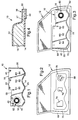
- the invention relates to an acoustical insulation laminate 10 illustrated in Fig. 1 which is adapted to be secured to the interior panel of, for example, a vehicle such as vehicle door 12 illustrated in Fig. 2.
- the laminate 10 has desirable acoustical insulation properties and can also act as a water shield or barrier to prevent water from entering a vehicle body.
- the laminate 10 is described with specific reference to its preferred use in a vehicle it is to be appreciated that the laminate 10 has broader applications and could be equally adapted for use in providing acoustical insulating and water barrier properties to other articles, such as small appliances or architectural applications.
- the laminate 10 preferably includes a water barrier layer such as a planar thermoplastic film 14 formed of a relatively thin thermoplastic material.
- a water barrier layer such as a planar thermoplastic film 14 formed of a relatively thin thermoplastic material.
- the film 14 can comprise a variety of thermoplastic materials, it has been found that the strength, flexibility and durability of polyolefins makes them preferred materials for use as the film 14; polyethylene, polypropylene and ethylenepropylene copolymer films are particularly preferred with suitable levels of thermal stabilizers added by conventional techniques.
- the film 14 could be of a variety of thicknesses, it preferably has a thickness in the range of between about 20 microns and about 250 microns, and most preferably of between about 25 microns and about 150 microns.
- melt-blown polypropylene acoustical insulation web 15 is laminated to the thermoplastic film 14.
- the web 15 preferably comprises polypropylene melt-blown microfibers and crimped bulking fibers which are thoroughly mixed.
- the laminate 10 can include an optional scrim layer 52 secured to the web 15 opposite the film 14.
- the optional scrim layer 52 increases the integrity of the laminate 10.
- the scrim layer 52 can comprise a 17 g/m 2 polypropylene spunbond nonwoven scrim material having a thickness of about 180 microns which is available from Fiberweb North America, Inc. (Greenville, SC) under the trade name CelestraTM.
- the laminate 10 is typically made by first forming the web 15 in situ on the optional scrim layer 52 by placing the scrim layer 52 on the web collector surface prior to collecting the microfibers of the web 15 on the web collector surface. Next, web 15 can be subjected to a conventional calendaring or ultrasonic point bonding operations to laminate the film 14 to the web 15 composite and thus form the laminate 10. Alternatively, the laminate 10 can be made by securing the layers of the laminate together with an adhesive, e.g., a hot melt or pressure-sensitive adhesive, or a double-sided adhesive tape comprising such an adhesive. In addition, if desired, a second optional scrim layer (not shown) can be secured between the film 14 and the web 15.
- an adhesive e.g., a hot melt or pressure-sensitive adhesive, or a double-sided adhesive tape comprising such an adhesive.
- a second optional scrim layer (not shown) can be secured between the film 14 and the web 15.
- the laminate 10 is typically pressure molded in a heated die (i.e., thermoformed) to form reduced thickness areas 17 along its outer periphery 16, of approximately 20 mils (508 microns) in thickness.
- the laminate 10 is preferably subjected to a clamping force of about 90 tons over a 4 ft 2 (0.4 m 2 ) area at a temperature of about 250°F (120°C) for about 1.2 minutes.
- the film 14, web 15 and optional scrim layer 52 are thermally consolidated to form an integral structure of a thin gauge.
- the reduced thickness areas 17 promote the integrity of the laminate 10 in those areas and permit the laminate 10 to be easily handled by vehicle manufacturers during assembly operations.
- areas of the laminate 10 that do not contact the die surface during the thermoforming operation are actually unaltered in web thickness. In these areas of the laminate 10, the acoustical insulating properties of the web 15 are not affected.
- areas of the laminate 10 inside the outer periphery 16 can also be thermally consolidated to a thin gauge to accommodate the contours of a vehicle door.
- the invention in another of its aspects, relates to an acoustical insulation laminate comprising:
- the acoustical insulation laminate 10 includes side edges 18 and 20, bottom edge 25 and top edge 33.
- the film 14 of the laminate 10 can have adhesive 40 applied to selected areas thereof after the laminate 10 is thermoformed as described above.
- the surface of the, e.g., film 14 to which the adhesive is to be applied can be treated prior to applying the adhesive to modify the surface characteristics of the film surface for enhancing bonding of the adhesive to the film 14. Corona discharge treatment is preferred for this purpose.
- the invention relates to a process for manufacturing a vehicle door or other body panel, wherein the laminate 10 is secured to the inner panel of ,e.g., a vehicle door to provide acoustical insulation for the vehicle door and to act as a water barrier.
- a vehicle door 12, such as shown in Fig. 2, is generally conventional and comprises an outer panel 68.
- An inner panel 70 is suitably secured to the outer panel 68 such as by welding along the peripheral edge of the inner panel 70.
- the panels are spaced to provide an internal channel for accommodating various internal window operating mechanisms and the like.
- the inner panel 70 is generally formed with an uneven shape or contour for accommodating and mounting various accessories or the like, for example, in Fig. 2 a speaker opening 80 is formed through the recessed area 72 of the inner panel 70 centrally of the generally cylindrical portion 78.
- Fig. 3 illustrates the laminate 10 in its installed position on the door 12.
- the polypropylene melt-blown microfibers of the acoustical insulation web are characterized by having substantial resistance to thermal degradation such that they are resistant to thermal degradation at a temperature of at least 135°C for at least 10 days or at a temperature of at least 155°C for at least 5 days, preferably at least 10 days, most preferably 30 days.
- typically in use the highest average temperatures that an acoustical insulation web in the automotive passenger compartment would be exposed to would be well below 120°C.
- the thermal stability of the polypropylene melt-blown microfibers is due to use of a suitable non-volatile stabilizer uniformly distributed throughout the microfibers of the polypropylene melt-blown web.
- a suitable non-volatile heat stabilizer can be used such as phenol antioxidants such as hindered phenols such as di-n-octadecyl(3,5-di-butyl-4-hydroxybenzyl)malonate; 2,6-di-t-butylphenol; 2,2'-methylene-bis(6-butyl-4-methylphenol); 2,6-di-t-butylhydroquinone; octadecyl-(3,5-di-t-butyl-4-hydroxybenzylthio) acetate; 1,1,3-tris(3-t-butyl-6-methyl-4-hydroxyphenyl) butane; 1,4-bis(3,5-di-t-butyl-4-hydroxybenzyl)-2,3,5,6
- amine antioxidants such as N-phenyl-beta-naphthylamine; N,N'-diphenyl-p-phenylenediamine; p-isopropoxy diphenylamine; N,N'-di-beta-naphthyl-p-phenylenediamine; N,N'-di-(2-octyl)-p-phenylenediamine; N,N'-di-3(5-methylheptyl)-p-phenylenediamine; aldol-alpha-naphthylamine; 4,4'-dioctyldiphenylamine; 4-octyldiphenylamine; 4-t-butoxydiphenylamine; the polymer of 1,2-dihydro-2,2,4-trimethylquinoline; and the like.
- antioxidants includes thioureas, phosphites, phosphates and other conventional antioxidants.
- the antioxidants or thermal stabilizers are present in the polypropylene melt-blown microfibers at a concentration sufficient to thermally stabilize the polypropylene microfibers as described above, typically the concentration is from 0.2 to 10 weight percent, preferably from 0.3 to 1.5 weight percent.
- the polypropylene of the melt-blown microfibers has a Tm of at least about 155°C and is characterized by having a weight average molecular weight of from about 30,000 to 150,000, preferably 50,000 to 120,000.
- novel acoustical insulation of thermally stable polypropylene melt-blown microfibers is formed by melt-blowing techniques described above where a polypropylene polymer (generally having a weight average molecular weight of greater than 150,000, preferably greater than 170,000) is fed into an extruder to undergo at least partial degradation as is described, for example, in U.S. Patent No. 3,849,241. Following extrusion and thermal and/or catalytic degradation the polymer is intimately mixed with an antioxidant or thermal stabilizer immediately prior to the die. This mixing can occur in a KenixTM type static mixer as disclosed in U.S. Patent No. 5,064,578.
- the temperature in the resin conveying tube containing the static mixer is well below that in the extruder (which is from 350 to 475°C) and is generally from 280 to 340°C with the antioxidant or thermal stabilizer having a mean residence time in the resin conveying tube of less than 25 seconds, preferably from 10 to 25 seconds.
- the blown microfibers are then formed by extruding fibers from the die with the high velocity air flow.
- the thermal stability of melt-blown microfiber webs was determined by placing test samples of the web in an oven maintained at 135°C or 155°C and monitoring the condition of the samples on a daily basis. Webs having no or low antioxidant levels would shrink, melt, embrittle and show discoloration with increasing time at the test temperature. Web thermal stability was reported as the number of days the web samples substantially maintained their original color, dimensions, and suppleness at the respective temperatures.
- test method ASTM F 778-88 The pressure drop of the air passing through the major face of the web and across the web as outlined in test method ASTM F 778-88 was determined.
- the "Average Effective Fiber Diameter” was calculated according to the test method set forth in Davis, C.N., The Separation of Airborne Dust and Particles, Institution of Mechanical Engineers, London, Proceedings 1B, 1952.
- the webs of the present invention were prepared using an apparatus similar to that described in U.S. Patent Nos. 4,933,229 (Insley et al.) and 5,064,578 (Insley et al.), which are incorporated herein by reference.
- the apparatus was similar to a conventional melt-blown microfiber web production except a resin conveying tube equipped with an injection port located near the inlet end (i.e., the end connected to the extruder) of the tube was used to connect the die to the extruder.
- the conveying tube contained a static mixer of the type sold as a KenixTM mixer (18 cm in length, 0.94 cm in diameter and having 9 mixing elements or 56 cm in length, 1.58 cm in diameter and having 22 mixing elements) positioned down stream of the injection port and upstream of the outlet end of the tube (i.e., the end connected to the melt-blown microfiber (BMF) die).
- the injection port of the conveying tube was connected to a heated (about 140°C) RuskaTM positive displacement pump, a grid melter (Meltex GRO, available from Nordsen Co.
- antioxidant or alternatively an antioxidant/polypropylene blend
- the temperature of antioxidant (or antioxidant/polypropylene blend) and its associated feed mechanism i.e., pump or extruder was adjusted to a temperature such that the antioxidant was delivered as a liquid stream into the conveying tube without decomposing the antioxidant.
- the rpm of the pump or second extruder was adjusted to deliver the antioxidant (or antioxidant/polypropylene blend) into the molten stream of resin exiting the first extruder at a rate so as to produce the desired antioxidant level in the polypropylene exiting the BMF die.
- the combined polypropylene/antioxidant stream was split and recombined several times by the KenixTM type mixer to uniformly incorporate the antioxidant into the polypropylene before it exited the resin conveying tube. After exiting the resin conveying tube the combined molten polypropylene stream was conveyed through the BMF die into a high velocity hot air stream which attenuated the molten polypropylene into microfibers that were subsequently collected on a collector surface.
- Microfiber diameter was controlled by adjusting, independently or concurrently, the velocity of the attenuating air stream and the flow rate of the polypropylene through the die orifices.
- Molten polypropylene was typically delivered from the BMF die at a rate of approximately 0.2 or 1.3 kg/hour/cm die width.
- the temperature of the first extruder barrel was maintained between about 360°C and 500°C, or at the higher throughput rate, ramped from about 220-470°C.
- the temperature of the resin conveying tube was maintained between 310°C and 315°C, and the temperature of the BMF die was maintained between about 310-360°C and 370°C.
- the primary air supply was maintained at a temperature of approximately 400°C and a pressure of approximately 70 kPa.
- Extrusion conditions were typically adjusted to produce a maximum residence time of the antioxidant in the resin conveying tube of approximately 22 seconds or less at the lower throughput rate and approximately 10 seconds or less at the higher throughput rate.
- High temperature stable polypropylene BMF acoustical insulation webs of the present invention were prepared according to the above described procedure using Exxon 3505 polypropylene resin (available from Exxon Chemicals, Dallas, TX), and IrganoxTM 1010 (tetrakis[methylene(3,5-di-tert-butyl-4-hydroxyhydrocinnamate)]methane, a high molecular weight phenolic antioxidant, available from the Additives Div., Ciba-Geigy Corp., Hawthorne, NY) at input loading levels were as indicated in Table 1 (actual antioxidant levels in the BMF web were somewhat lower due to slight decomposition or other losses).
- Polypropylene resin was delivered from the BMF die at a rate of approximately 0.2 kg/cm/hr, the KenixTM type mixer was 18 cm in length, 0.94 cm in diameter and had 9 mixing elements and the IrganoxTM 1010 was introduced into the resin conveying tube, by means of a RuskaTM positive displacement pump, in the calculated weight percent shown in Table 1.
- the BMF webs had a basis weight of approximately 110 g/m 2 and an average effective fiber diameter of approximately 5.6-8.8, determined as described above.
- Control example C-1 was prepared using substantially the same procedure except that no antioxidant was introduced into the molten polypropylene stream as it passed through the conveying tube.
- Examples 9 through 14 and Control C-2 were prepared in substantially the same manner as described for Examples 1 through 8 and C-1 except that the polypropylene resin used was Fina 3860 (available from Fina Corp., Dallas TX), the polypropylene was delivered from the BMF die at a rate of approximately 0.72 kg/cm/hr, the KenixTM type mixer was 56 cm in length, 1.58 cm in diameter, and had 22 mixing elements, and the antioxidants were introduced into the resin conveying tube by a grid melter. Examples 10, 12 and 14 incorporated approximately 35 percent by weight 6 denier crimped polyester (polyethylene terephthalate) staple fibers (3.8 cm in length) into the BMF webs using a procedure similar to that described in U.S. Patent No.
- the BMF web for Example 15 was prepared substantially as described for Example 5.
- the extruder barrel temperature was controlled at 360°C, IrganoxTM 1010 was injected at a 1 weight percent level, the web had a basis weight of 200 g/m 2 , and the average EFD of the fibers was 8.2 ⁇ m. Subsequent analysis for the actual IrganoxTM 1010 level in the web indicated a 0.66 weight percent level.
- Comparative Example Comp-1 was prepared in a similar manner to Example 15 except that the IrganoxTM 1010 was loaded in the hopper of the extruder as a 1 weight percent pre-blend with the polypropylene pellets instead of being injected into the resin conveying tube.
- the thus produced BMF web had a basis weight of 193 g/m 2 , an average EFD of 7.6 ⁇ m and analysis for the actual IrganoxTM 1010 level indicated a 0.21 weight percent level.
Landscapes
- Engineering & Computer Science (AREA)
- Textile Engineering (AREA)
- Mechanical Engineering (AREA)
- Chemical & Material Sciences (AREA)
- Acoustics & Sound (AREA)
- Physics & Mathematics (AREA)
- Health & Medical Sciences (AREA)
- Chemical Kinetics & Catalysis (AREA)
- Medicinal Chemistry (AREA)
- Polymers & Plastics (AREA)
- Organic Chemistry (AREA)
- Nonwoven Fabrics (AREA)
- Laminated Bodies (AREA)
- Compositions Of Macromolecular Compounds (AREA)
- Artificial Filaments (AREA)
Applications Claiming Priority (3)
| Application Number | Priority Date | Filing Date | Title |
|---|---|---|---|
| US655047 | 1996-05-29 | ||
| US08/655,047 US5773375A (en) | 1996-05-29 | 1996-05-29 | Thermally stable acoustical insulation |
| PCT/US1996/015707 WO1997045581A1 (en) | 1996-05-29 | 1996-09-30 | Thermally stable acoustical insulation |
Publications (2)
| Publication Number | Publication Date |
|---|---|
| EP0902853A1 EP0902853A1 (en) | 1999-03-24 |
| EP0902853B1 true EP0902853B1 (en) | 2000-05-24 |
Family
ID=24627279
Family Applications (1)
| Application Number | Title | Priority Date | Filing Date |
|---|---|---|---|
| EP96933976A Expired - Lifetime EP0902853B1 (en) | 1996-05-29 | 1996-09-30 | Thermally stable acoustical insulation |
Country Status (9)
| Country | Link |
|---|---|
| US (2) | US5773375A (2) |
| EP (1) | EP0902853B1 (2) |
| JP (1) | JP3911548B2 (2) |
| KR (1) | KR100409061B1 (2) |
| AU (1) | AU7250696A (2) |
| CA (1) | CA2254840C (2) |
| DE (1) | DE69608577T2 (2) |
| ES (1) | ES2146905T3 (2) |
| WO (1) | WO1997045581A1 (2) |
Families Citing this family (80)
| Publication number | Priority date | Publication date | Assignee | Title |
|---|---|---|---|---|
| GB2333741B (en) | 1998-01-30 | 2002-09-04 | Jason Inc | Vehicle headliner and laminate therefor |
| CH693409A5 (de) * | 1998-11-12 | 2003-07-31 | Rieter Automotive Int Ag | Schallabsorbierendes Dünnschichtlaminat. |
| ES2215375T3 (es) * | 1998-03-03 | 2004-10-01 | Rieter Automotive (International) Ag | Laminado de capa delgada de absorcion acustica. |
| USH2086H1 (en) * | 1998-08-31 | 2003-10-07 | Kimberly-Clark Worldwide | Fine particle liquid filtration media |
| DE19840050C2 (de) * | 1998-09-02 | 2001-04-19 | Sandler C H Gmbh | Hitze- und dimensionsstabiler thermisch verfestigter Vliesstoff |
| JP3566608B2 (ja) * | 1999-12-28 | 2004-09-15 | Necエレクトロニクス株式会社 | 半導体集積回路 |
| US20030134557A1 (en) * | 2000-03-28 | 2003-07-17 | Collison Alan B. | Fibrous carpet underlayment |
| US20020056500A1 (en) | 2000-03-28 | 2002-05-16 | Collison Alan B. | Insulating floor underlayment |
| US6669265B2 (en) | 2000-06-30 | 2003-12-30 | Owens Corning Fiberglas Technology, Inc. | Multidensity liner/insulator |
| US6572723B1 (en) | 2000-06-30 | 2003-06-03 | Owens Corning Fiberglas Technology, Inc. | Process for forming a multilayer, multidensity composite insulator |
| AUPQ883000A0 (en) * | 2000-07-19 | 2000-08-10 | I.N.C. Corporation Pty Ltd | A thermoformable acoustic sheet |
| AU2007100274B4 (en) * | 2000-07-19 | 2007-04-26 | I.N.C. Corporation Pty Ltd | A thermoformable acoustic sheet |
| US6490828B1 (en) | 2000-07-20 | 2002-12-10 | Steelcase Development Corporation | Partition wall system |
| DE10035679A1 (de) * | 2000-07-21 | 2002-01-31 | Inst Neue Mat Gemein Gmbh | Nanoskalige Korundpulver, daraus gefertigte Sinterkörper und Verfahren zu deren Herstellung |
| US20020137421A1 (en) * | 2000-12-13 | 2002-09-26 | Desroches Katrina G. | Method for controlling thermohysteresis during thermoforming of three-dimensional fibrous compound constructs and the product thereof |
| WO2002059870A1 (fr) * | 2001-01-23 | 2002-08-01 | Kasai Kogyo Co., Ltd. | Materiau insonorise pour vehicule et son procede de fabrication |
| US6753067B2 (en) * | 2001-04-23 | 2004-06-22 | Sipix Imaging, Inc. | Microcup compositions having improved flexure resistance and release properties |
| MXPA03010234A (es) * | 2001-06-01 | 2004-03-10 | Owens Corning Fiberglass Corp | Forro de capota, tablero, mampara contrafuegos o cubierta de maquina. |
| US6726980B2 (en) * | 2001-11-09 | 2004-04-27 | Owens Corning Fiberglass Technology, Inc. | Acoustic doorliner with integral water barrier |
| DE10163576B4 (de) * | 2001-12-21 | 2006-07-20 | Sandler Ag | Isolations-Material |
| DE10217831A1 (de) * | 2002-04-16 | 2003-11-06 | Sai Automotive Sal Gmbh | Fahrzeugtür und Verfahren zu deren Herstellung |
| US7618907B2 (en) * | 2002-08-02 | 2009-11-17 | Owens Corning Intellectual Capital, Llc | Low porosity facings for acoustic applications |
| US6893711B2 (en) * | 2002-08-05 | 2005-05-17 | Kimberly-Clark Worldwide, Inc. | Acoustical insulation material containing fine thermoplastic fibers |
| US20050026527A1 (en) * | 2002-08-05 | 2005-02-03 | Schmidt Richard John | Nonwoven containing acoustical insulation laminate |
| US20040077247A1 (en) * | 2002-10-22 | 2004-04-22 | Schmidt Richard J. | Lofty spunbond nonwoven laminate |
| FR2847866B1 (fr) * | 2002-12-02 | 2005-08-19 | Sofitec Sa | Feuille d'etancheite et d'insonorisation pour un element de carrosserie, tel qu'une porte de vehicule automobile |
| US20040131836A1 (en) * | 2003-01-02 | 2004-07-08 | 3M Innovative Properties Company | Acoustic web |
| US20040231914A1 (en) * | 2003-01-02 | 2004-11-25 | 3M Innovative Properties Company | Low thickness sound absorptive multilayer composite |
| US7320739B2 (en) * | 2003-01-02 | 2008-01-22 | 3M Innovative Properties Company | Sound absorptive multilayer composite |
| US20040192132A1 (en) * | 2003-03-20 | 2004-09-30 | Fay Ralph Michael | Fungi resistant asphalt and asphalt sheet materials |
| US20040185225A1 (en) * | 2003-03-20 | 2004-09-23 | Fay Ralph Michael | Spunbond facing and faced insulation assembly |
| US7282252B2 (en) * | 2003-03-20 | 2007-10-16 | Johns Manville | Faced insulation assembly and method |
| US20040185204A1 (en) * | 2003-03-20 | 2004-09-23 | Fay Ralph Michael | Fungi growth resistant faced insulation assembly |
| US7169715B2 (en) * | 2003-03-21 | 2007-01-30 | Intel Corporation | Forming a dielectric layer using porogens |
| JP2006526081A (ja) * | 2003-03-31 | 2006-11-16 | リーター テクノロジーズ アー ゲー | 車両の内張用の音響的効果を有する不織布 |
| US20050153151A1 (en) * | 2003-06-19 | 2005-07-14 | Johns Manville International, Inc. | Fungi resistant sheet, facing and faced insulation assembly |
| US7402537B1 (en) | 2003-12-17 | 2008-07-22 | Creative Foam Corporation | Air permeable, water repellent, acoustic door watershield |
| KR100574764B1 (ko) * | 2004-07-09 | 2006-04-28 | 남양노비텍 주식회사 | 흡음성과 단열성이 우수한 멜트블로운 부직포 |
| US20060037630A1 (en) * | 2004-08-03 | 2006-02-23 | Rowland Griffin | Acoustic insulation blanket for dishwashers |
| US7500541B2 (en) * | 2004-09-30 | 2009-03-10 | Kimberly-Clark Worldwide, Inc. | Acoustic material with liquid repellency |
| US7837009B2 (en) * | 2005-04-01 | 2010-11-23 | Buckeye Technologies Inc. | Nonwoven material for acoustic insulation, and process for manufacture |
| CA2603421C (en) | 2005-04-01 | 2013-05-21 | James R. Gross | Nonwoven material for acoustic insulation, and process for manufacture |
| US20080022645A1 (en) * | 2006-01-18 | 2008-01-31 | Skirius Stephen A | Tacky allergen trap and filter medium, and method for containing allergens |
| MX2008009176A (es) | 2006-01-18 | 2008-09-25 | Buckeye Technologies Inc | Trampa pegajosa para alergenos y metodo para contener alergenos. |
| WO2008005936A2 (en) * | 2006-06-30 | 2008-01-10 | Buckeye Technologies Inc. | Fire retardant nonwoven material and process for manufacture |
| US20080166939A1 (en) * | 2007-01-09 | 2008-07-10 | Freudenberg Nonwovens L.P. | Acoustical Substrate |
| ES2292368B2 (es) * | 2007-05-09 | 2008-09-16 | Universidad Politecnica De Madrid | Vierteaguas con adecuacion de su derrame para proteger los huecos de edificios y su interior de la radiacion solar directa reflejada desde su superficie. |
| JP4680963B2 (ja) * | 2007-07-09 | 2011-05-11 | 株式会社神戸製鋼所 | 枠体付き二重壁構造体 |
| US20090019825A1 (en) * | 2007-07-17 | 2009-01-22 | Skirius Stephen A | Tacky allergen trap and filter medium, and method for containing allergens |
| US7810281B2 (en) * | 2007-09-24 | 2010-10-12 | Brose Fahrzeugteile GmbH & Co. Kommanditgesellschaft, Würzburg | Electric motor drive system assembly with vibration dampening |
| US8507075B2 (en) | 2008-01-30 | 2013-08-13 | GM Global Technology Operations LLC | Adhesion method for attaching barrier sheets to motor vehicle door panels |
| MX2010009754A (es) * | 2008-03-05 | 2010-10-15 | 3M Innovative Porperties Company | Fibras de polimero de multiples capas de cambio de color y articulos de seguridad que contienen fibras de polimero de multiples capas de cambio de color. |
| JP5441833B2 (ja) * | 2009-07-03 | 2014-03-12 | 日東電工株式会社 | ドアホールカバーおよび車両のドア構造 |
| CZ303670B6 (cs) * | 2011-06-30 | 2013-02-20 | Technická univerzita v Liberci | Zpusob výroby vlákenné zvukove absorpcní textilie a vlákenná zvukove absorpcní textilie vyrobená tímto zpusobem |
| US8496088B2 (en) | 2011-11-09 | 2013-07-30 | Milliken & Company | Acoustic composite |
| CN102560895B (zh) * | 2011-11-22 | 2014-04-02 | 广州市三泰汽车内饰材料有限公司 | 一种无纺纤维织物生产设备 |
| EP2785431B1 (en) * | 2011-12-02 | 2016-03-16 | W.L. Gore & Associates, Inc. | Heat-stabilized composite filter media and method of making the filter media |
| KR101665895B1 (ko) * | 2012-08-23 | 2016-10-12 | 미쓰이 가가쿠 가부시키가이샤 | 멜트블로운 부직포 및 그의 용도 |
| US9186608B2 (en) | 2012-09-26 | 2015-11-17 | Milliken & Company | Process for forming a high efficiency nanofiber filter |
| US9217253B2 (en) | 2013-06-25 | 2015-12-22 | Chad A. Collison | Floor underlayment having self-sealing vapor barrier |
| US10961644B2 (en) | 2014-01-29 | 2021-03-30 | Biax-Fiberfilm Corporation | High loft, nonwoven web exhibiting excellent recovery |
| US10704173B2 (en) | 2014-01-29 | 2020-07-07 | Biax-Fiberfilm Corporation | Process for forming a high loft, nonwoven web exhibiting excellent recovery |
| US20170191197A1 (en) * | 2014-06-27 | 2017-07-06 | 3M Innovative Properties Company | Thermally stable meltblown web comprising multilayer fibers |
| PL3015314T3 (pl) | 2014-10-30 | 2017-12-29 | Autoneum Management Ag | Lekki, akustyczny element wykończeniowy |
| WO2016094395A1 (en) | 2014-12-08 | 2016-06-16 | Zephyros, Inc. | Vertically lapped fibrous flooring |
| EP3245105B1 (en) | 2015-01-12 | 2021-03-03 | Zephyros Inc. | Acoustic floor underlay system |
| WO2016118587A1 (en) | 2015-01-20 | 2016-07-28 | Zephyros, Inc. | Sound absorption materials based on nonwovens |
| JP6424653B2 (ja) * | 2015-02-02 | 2018-11-21 | キョーラク株式会社 | 樹脂製パネル |
| WO2016187526A1 (en) | 2015-05-20 | 2016-11-24 | Zephyros, Inc. | Multi-impedance composite |
| JP6210422B2 (ja) * | 2015-12-21 | 2017-10-11 | パナソニックIpマネジメント株式会社 | 繊維集合体 |
| JP6817709B2 (ja) * | 2016-03-11 | 2021-01-20 | スリーエム イノベイティブ プロパティズ カンパニー | 車両部材 |
| US10112371B2 (en) | 2016-07-26 | 2018-10-30 | Mp Global Products, L.L.C. | Floor underlayment |
| US10286760B2 (en) * | 2016-12-19 | 2019-05-14 | Ford Global Technologies, Llc | Automotive water-shield with drip ledge to prevent water leaks |
| US11634091B2 (en) | 2017-04-03 | 2023-04-25 | Cascade Engineering, Inc. | Acoustic fiber silencer |
| EP4026937B1 (en) * | 2017-09-15 | 2024-10-30 | 3M Innovative Properties Company | Non-woven fibrous web |
| US11447893B2 (en) | 2017-11-22 | 2022-09-20 | Extrusion Group, LLC | Meltblown die tip assembly and method |
| WO2020079588A1 (en) | 2018-10-16 | 2020-04-23 | 3M Innovative Properties Company | Flame-retardant non-woven fibrous webs |
| EP3867434A4 (en) | 2018-10-16 | 2022-08-03 | 3M Innovative Properties Company | FLAME RETARDANT NON-WOVEN FIBROUS VEILS |
| WO2020081437A1 (en) | 2018-10-16 | 2020-04-23 | Cummins Filtration Ip, Inc. | Adhesive alloys and filter medias including such adhesive alloys |
| US11511610B2 (en) | 2018-11-12 | 2022-11-29 | Shape Corp. | Vehicle door carrier with integrated edge seal and method of manufacture |
Family Cites Families (63)
| Publication number | Priority date | Publication date | Assignee | Title |
|---|---|---|---|---|
| US31885A (en) * | 1861-04-02 | goulard | ||
| US3382305A (en) * | 1954-10-29 | 1968-05-07 | Du Pont | Process for preparing oriented microfibers |
| US3849241A (en) * | 1968-12-23 | 1974-11-19 | Exxon Research Engineering Co | Non-woven mats by melt blowing |
| US4069026A (en) * | 1970-06-29 | 1978-01-17 | Bayer Aktiengesellschaft | Filter made of electrostatically spun fibres |
| US3773605A (en) * | 1971-03-05 | 1973-11-20 | Minnesota Mining & Mfg | Acoustical material |
| US4038228A (en) * | 1971-11-19 | 1977-07-26 | Owens-Illinois, Inc. | Degradable plastic composition containing a transition metal salt of a highly unsaturated organic acid |
| US4067836A (en) * | 1972-06-28 | 1978-01-10 | Union Carbide Corporation | Environmentally degradable compositions exposed to actinic or ionizing radiation and process |
| GB1453447A (en) * | 1972-09-06 | 1976-10-20 | Kimberly Clark Co | Nonwoven thermoplastic fabric |
| US3870567A (en) * | 1972-12-21 | 1975-03-11 | Grace W R & Co | Battery separator manufacturing process |
| DE2543781A1 (de) * | 1972-12-21 | 1976-04-15 | Grace W R & Co | Verfahren zur herstellung einer bahn aus nichtgewebten faeden |
| US4011067A (en) * | 1974-01-30 | 1977-03-08 | Minnesota Mining And Manufacturing Company | Filter medium layered between supporting layers |
| US4048364A (en) * | 1974-12-20 | 1977-09-13 | Exxon Research And Engineering Company | Post-drawn, melt-blown webs |
| CA1073648A (en) * | 1976-08-02 | 1980-03-18 | Edward R. Hauser | Web of blended microfibers and crimped bulking fibers |
| USRE31885E (en) * | 1977-10-17 | 1985-05-14 | Kimberly-Clark Corporation | Microfiber oil and water wipe |
| US4196245A (en) * | 1978-06-16 | 1980-04-01 | Buckeye Cellulos Corporation | Composite nonwoven fabric comprising adjacent microfine fibers in layers |
| US4323534A (en) * | 1979-12-17 | 1982-04-06 | The Procter & Gamble Company | Extrusion process for thermoplastic resin composition for fabric fibers with exceptional strength and good elasticity |
| US4420520A (en) * | 1980-07-03 | 1983-12-13 | The Excello Specialty Company | Area coated paint mask and method |
| DE3039651C2 (de) * | 1980-10-21 | 1985-07-25 | Fa. Carl Freudenberg, 6940 Weinheim | Luftschallschluckende, verformte Platte |
| US4328279A (en) * | 1981-01-29 | 1982-05-04 | Kimberly-Clark Corporation | Clean room wiper |
| US4379192A (en) * | 1982-06-23 | 1983-04-05 | Kimberly-Clark Corporation | Impervious absorbent barrier fabric embodying films and fibrous webs |
| US4604302B1 (en) * | 1982-09-07 | 1991-04-30 | Method of manufacturing water deflector for vehicle doors | |
| US4469732B1 (en) * | 1982-09-07 | 1991-03-26 | Water deflector for vehicle doors | |
| US4551378A (en) * | 1984-07-11 | 1985-11-05 | Minnesota Mining And Manufacturing Company | Nonwoven thermal insulating stretch fabric and method for producing same |
| US4568581A (en) * | 1984-09-12 | 1986-02-04 | Collins & Aikman Corporation | Molded three dimensional fibrous surfaced article and method of producing same |
| US4588635A (en) * | 1985-09-26 | 1986-05-13 | Albany International Corp. | Synthetic down |
| US4753843A (en) * | 1986-05-01 | 1988-06-28 | Kimberly-Clark Corporation | Absorbent, protective nonwoven fabric |
| US4873132A (en) * | 1986-07-09 | 1989-10-10 | The Excello Specialty Company | Surface protector with expansible pocket |
| US4696848A (en) * | 1986-07-09 | 1987-09-29 | The Excello Specialty Company | Surface protector with expansible pocket |
| US4859512A (en) * | 1986-08-01 | 1989-08-22 | The Excello Specialty Company | Transfer adhesive sandwich for applying adhesive to substrates |
| US4707398A (en) * | 1986-10-15 | 1987-11-17 | Kimberly-Clark Corporation | Elastic polyetherester nonwoven web |
| US4992327A (en) * | 1987-02-20 | 1991-02-12 | Albany International Corp. | Synthetic down |
| US4837067A (en) * | 1987-06-08 | 1989-06-06 | Minnesota Mining And Manufacturing Company | Nonwoven thermal insulating batts |
| US4813948A (en) * | 1987-09-01 | 1989-03-21 | Minnesota Mining And Manufacturing Company | Microwebs and nonwoven materials containing microwebs |
| ZA887069B (en) * | 1987-09-25 | 1989-05-30 | Uniroyal Chem Co Inc | Polypropylene stabilized against oxidative degradation with mixtures of diarylemine derivatives and sterically hindered phenols |
| US4828910A (en) * | 1987-12-16 | 1989-05-09 | Reinhold Haussling | Sound absorbing laminate |
| US4865791A (en) * | 1988-02-03 | 1989-09-12 | The Excello Specialty Company | Method of forming a surface protector with an expansible pocket |
| JP2672329B2 (ja) * | 1988-05-13 | 1997-11-05 | 東レ株式会社 | エレクトレット材料 |
| US4981747A (en) * | 1988-09-23 | 1991-01-01 | Kimberly-Clark Corporation | Composite elastic material including a reversibly necked material |
| DE3840079A1 (de) * | 1988-11-28 | 1990-06-07 | Illbruck Gmbh | Verfahren zur herstellung von elastischen schaumstoffen auf polyurethan-basis durch mikrowellenverschaeumung |
| US4851283A (en) * | 1988-12-05 | 1989-07-25 | Monsanto Company | Headliners having improved sound-absorbing characteristics |
| US4883549A (en) * | 1988-12-06 | 1989-11-28 | Kimberly-Clark Corporation | Method of attaching a composite elastic material to an article |
| US5122593A (en) * | 1989-02-22 | 1992-06-16 | The B. F. Goodrich Company | Stabilized gamma-irradiatable polypropylene fibers and sterilizable articles thereof |
| IT1229141B (it) * | 1989-04-06 | 1991-07-22 | Himont Inc | Poliolefine atte alla filatura e fibre termosaldabili da esse ottenute. |
| JPH02271607A (ja) * | 1989-04-13 | 1990-11-06 | Toray Ind Inc | エレクトレット材料およびその製造方法 |
| US5064578A (en) * | 1989-04-21 | 1991-11-12 | Minnesota Mining And Manufacturing Company | Method for making a high wet-strength polyolefin blown microfiber web |
| US4933229A (en) * | 1989-04-21 | 1990-06-12 | Minnesota Mining And Manufacturing Company | High wet-strength polyolefin blown microfiber web |
| US5073436A (en) * | 1989-09-25 | 1991-12-17 | Amoco Corporation | Multi-layer composite nonwoven fabrics |
| US5149468A (en) * | 1989-11-17 | 1992-09-22 | Moldex/Metric Products, Inc. | Method for producing filter material formed of melt-blown non-woven mat sandwiching additional material |
| US5116662A (en) * | 1989-12-15 | 1992-05-26 | Kimberly-Clark Corporation | Multi-direction stretch composite elastic material |
| US5260126A (en) * | 1990-01-10 | 1993-11-09 | Kimberly-Clark Corporation | Low stress relaxation elastomeric nonwoven webs and fibers |
| FI112252B (fi) * | 1990-02-05 | 2003-11-14 | Fibervisions L P | Korkealämpötilasietoisia kuitusidoksia |
| US5271883A (en) * | 1990-06-18 | 1993-12-21 | Kimberly-Clark Corporation | Method of making nonwoven web with improved barrier properties |
| DE9015406U1 (de) * | 1990-11-09 | 1992-03-05 | Siemens AG, 8000 München | Elektromagnetisches Relais mit auf dem Anker befestigter Kontaktfeder |
| US5145727A (en) * | 1990-11-26 | 1992-09-08 | Kimberly-Clark Corporation | Multilayer nonwoven composite structure |
| US5200443A (en) * | 1991-03-29 | 1993-04-06 | Kimberly-Clark Corporation | Radiation stabilized fabric having improved odor characteristics containing an hindered amine compound |
| JP3056862B2 (ja) * | 1991-12-27 | 2000-06-26 | 日産自動車株式会社 | 新規な吸音材 |
| US5459291A (en) * | 1992-09-29 | 1995-10-17 | Schuller International, Inc. | Sound absorption laminate |
| US5298694A (en) * | 1993-01-21 | 1994-03-29 | Minnesota Mining And Manufacturing Company | Acoustical insulating web |
| US5393831A (en) * | 1993-05-05 | 1995-02-28 | Kimberly-Clark Corporation | Shelf stable nonwoven fabrics and films |
| CA2126013C (en) * | 1993-06-17 | 2000-08-15 | Leonardo Spagnoli | Spinning process for the preparation of high termoweldability polyolefin fibers |
| US5480466A (en) * | 1994-05-04 | 1996-01-02 | Schuller International, Inc. | Air filtration media |
| US5437922A (en) * | 1994-05-04 | 1995-08-01 | Schuller International, Inc. | Fibrous, non-woven polymeric insulation |
| US5498468A (en) * | 1994-09-23 | 1996-03-12 | Kimberly-Clark Corporation | Fabrics composed of ribbon-like fibrous material and method to make the same |
-
1996
- 1996-05-29 US US08/655,047 patent/US5773375A/en not_active Expired - Lifetime
- 1996-09-30 WO PCT/US1996/015707 patent/WO1997045581A1/en not_active Ceased
- 1996-09-30 CA CA002254840A patent/CA2254840C/en not_active Expired - Fee Related
- 1996-09-30 ES ES96933976T patent/ES2146905T3/es not_active Expired - Lifetime
- 1996-09-30 JP JP54229197A patent/JP3911548B2/ja not_active Expired - Lifetime
- 1996-09-30 KR KR10-1998-0709625A patent/KR100409061B1/ko not_active Expired - Lifetime
- 1996-09-30 AU AU72506/96A patent/AU7250696A/en not_active Abandoned
- 1996-09-30 EP EP96933976A patent/EP0902853B1/en not_active Expired - Lifetime
- 1996-09-30 DE DE69608577T patent/DE69608577T2/de not_active Expired - Fee Related
-
1998
- 1998-04-23 US US09/065,326 patent/US5961904A/en not_active Expired - Lifetime
Also Published As
| Publication number | Publication date |
|---|---|
| US5961904A (en) | 1999-10-05 |
| JP2000511244A (ja) | 2000-08-29 |
| ES2146905T3 (es) | 2000-08-16 |
| KR20000016058A (ko) | 2000-03-25 |
| WO1997045581A1 (en) | 1997-12-04 |
| JP3911548B2 (ja) | 2007-05-09 |
| US5773375A (en) | 1998-06-30 |
| DE69608577D1 (en) | 2000-06-29 |
| AU7250696A (en) | 1998-01-05 |
| EP0902853A1 (en) | 1999-03-24 |
| KR100409061B1 (ko) | 2004-03-24 |
| CA2254840C (en) | 2006-11-21 |
| DE69608577T2 (de) | 2001-01-18 |
| CA2254840A1 (en) | 1997-12-04 |
Similar Documents
| Publication | Publication Date | Title |
|---|---|---|
| US5961904A (en) | Method of making a thermally stable acoustical insulation microfiber web | |
| EP0833973B1 (en) | Method of attenuating sound, and acoustical insulation therefor | |
| EP3562979B1 (en) | Dimensionally-stable, fire-resistant melt-blown fibers and nonwoven structures including a flame retarding polymer | |
| US20210095405A1 (en) | Ceramic-coated fibers including a flame-retarding polymer, and methods of making nonwoven structures | |
| EP0607946B1 (en) | Acoustical insulating web | |
| JP5329400B2 (ja) | 吸音組織及びその吸音組織を使用する方法 | |
| EP2860294B1 (en) | Soundproof cover for automobile and method for manufacturing soundproof cover for automobile | |
| US20020160682A1 (en) | Acoustical fibrous insulation product for use in a vehicle | |
| WO2007047263A1 (en) | Multilayer articles having acoustical absorbance properties and methods of making and using the same | |
| JPH0797754A (ja) | 吸音材 | |
| US20070212963A1 (en) | Flame retardant multicomponent articles | |
| KR101345215B1 (ko) | 자동차용 흡음재, 그 제조방법 및 상기 자동차용 흡음재가 부착된 자동차 부품의 제조방법 | |
| CN116472169A (zh) | 吸声多层复合材料中的聚酰胺非织造布 | |
| KR101350817B1 (ko) | 높은 벌키성을 갖는 멜트블로운 부직포 및 그의 제조방법 | |
| EP3015582B1 (en) | Moldable fabric comprising petg | |
| EP4155072A1 (en) | Composite material with molten polymer barrier effect and with flame-retardant properties, and method for making such a composite material | |
| JP3895207B2 (ja) | 難燃性ポリオレフィン繊維およびこれを用いた繊維組成物と繊維積層体 | |
| WO2025104577A1 (en) | Acoustic article | |
| KR101958482B1 (ko) | 흡음성능이 우수한 섬유집합체 및 그 제조방법 | |
| KR20150103943A (ko) | 차량용 흡음재 및 이의 제조방법 | |
| KR101743827B1 (ko) | 이형단면 중공섬유층 및 수지 발포층을 포함하는 복합체 및 이를 포함하는 흡차음재 | |
| EP4357505A1 (en) | Meltblown non-woven fabric, multi-layered spunbonded non-woven fabric comprising same, and method for manufacturing same | |
| JP2002202780A (ja) | 難燃性吸音材 | |
| EP1203546A2 (en) | Bed mattress filling materials | |
| US10385489B1 (en) | Non-woven flame-retardant material |
Legal Events
| Date | Code | Title | Description |
|---|---|---|---|
| PUAI | Public reference made under article 153(3) epc to a published international application that has entered the european phase |
Free format text: ORIGINAL CODE: 0009012 |
|
| 17P | Request for examination filed |
Effective date: 19981215 |
|
| AK | Designated contracting states |
Kind code of ref document: A1 Designated state(s): CH DE ES FR GB IT LI SE |
|
| GRAG | Despatch of communication of intention to grant |
Free format text: ORIGINAL CODE: EPIDOS AGRA |
|
| 17Q | First examination report despatched |
Effective date: 19990611 |
|
| GRAG | Despatch of communication of intention to grant |
Free format text: ORIGINAL CODE: EPIDOS AGRA |
|
| GRAG | Despatch of communication of intention to grant |
Free format text: ORIGINAL CODE: EPIDOS AGRA |
|
| GRAH | Despatch of communication of intention to grant a patent |
Free format text: ORIGINAL CODE: EPIDOS IGRA |
|
| GRAH | Despatch of communication of intention to grant a patent |
Free format text: ORIGINAL CODE: EPIDOS IGRA |
|
| GRAA | (expected) grant |
Free format text: ORIGINAL CODE: 0009210 |
|
| AK | Designated contracting states |
Kind code of ref document: B1 Designated state(s): CH DE ES FR GB IT LI SE |
|
| REG | Reference to a national code |
Ref country code: CH Ref legal event code: EP |
|
| REF | Corresponds to: |
Ref document number: 69608577 Country of ref document: DE Date of ref document: 20000629 |
|
| REG | Reference to a national code |
Ref country code: CH Ref legal event code: NV Representative=s name: E. BLUM & CO. PATENTANWAELTE |
|
| ITF | It: translation for a ep patent filed | ||
| ET | Fr: translation filed | ||
| REG | Reference to a national code |
Ref country code: ES Ref legal event code: FG2A Ref document number: 2146905 Country of ref document: ES Kind code of ref document: T3 |
|
| PLBE | No opposition filed within time limit |
Free format text: ORIGINAL CODE: 0009261 |
|
| STAA | Information on the status of an ep patent application or granted ep patent |
Free format text: STATUS: NO OPPOSITION FILED WITHIN TIME LIMIT |
|
| 26N | No opposition filed | ||
| REG | Reference to a national code |
Ref country code: GB Ref legal event code: IF02 |
|
| PGFP | Annual fee paid to national office [announced via postgrant information from national office to epo] |
Ref country code: SE Payment date: 20040921 Year of fee payment: 9 |
|
| PG25 | Lapsed in a contracting state [announced via postgrant information from national office to epo] |
Ref country code: SE Free format text: LAPSE BECAUSE OF NON-PAYMENT OF DUE FEES Effective date: 20051001 |
|
| EUG | Se: european patent has lapsed | ||
| PGFP | Annual fee paid to national office [announced via postgrant information from national office to epo] |
Ref country code: IT Payment date: 20060930 Year of fee payment: 11 |
|
| REG | Reference to a national code |
Ref country code: CH Ref legal event code: PFA Owner name: MINNESOTA MINING AND MANUFACTURING COMPANY Free format text: MINNESOTA MINING AND MANUFACTURING COMPANY#3M CENTER, P.O. BOX 33427#ST. PAUL, MINNESOTA 55133-3427 (US) -TRANSFER TO- MINNESOTA MINING AND MANUFACTURING COMPANY#3M CENTER, P.O. BOX 33427#ST. PAUL, MINNESOTA 55133-3427 (US) |
|
| PGFP | Annual fee paid to national office [announced via postgrant information from national office to epo] |
Ref country code: CH Payment date: 20070924 Year of fee payment: 12 |
|
| PGFP | Annual fee paid to national office [announced via postgrant information from national office to epo] |
Ref country code: ES Payment date: 20080926 Year of fee payment: 13 |
|
| PGFP | Annual fee paid to national office [announced via postgrant information from national office to epo] |
Ref country code: FR Payment date: 20080917 Year of fee payment: 13 |
|
| PGFP | Annual fee paid to national office [announced via postgrant information from national office to epo] |
Ref country code: GB Payment date: 20080929 Year of fee payment: 13 |
|
| PGFP | Annual fee paid to national office [announced via postgrant information from national office to epo] |
Ref country code: DE Payment date: 20081031 Year of fee payment: 13 |
|
| REG | Reference to a national code |
Ref country code: CH Ref legal event code: PL |
|
| PG25 | Lapsed in a contracting state [announced via postgrant information from national office to epo] |
Ref country code: IT Free format text: LAPSE BECAUSE OF NON-PAYMENT OF DUE FEES Effective date: 20070930 |
|
| PG25 | Lapsed in a contracting state [announced via postgrant information from national office to epo] |
Ref country code: LI Free format text: LAPSE BECAUSE OF NON-PAYMENT OF DUE FEES Effective date: 20080930 Ref country code: CH Free format text: LAPSE BECAUSE OF NON-PAYMENT OF DUE FEES Effective date: 20080930 |
|
| GBPC | Gb: european patent ceased through non-payment of renewal fee |
Effective date: 20090930 |
|
| REG | Reference to a national code |
Ref country code: FR Ref legal event code: ST Effective date: 20100531 |
|
| PG25 | Lapsed in a contracting state [announced via postgrant information from national office to epo] |
Ref country code: FR Free format text: LAPSE BECAUSE OF NON-PAYMENT OF DUE FEES Effective date: 20090930 Ref country code: DE Free format text: LAPSE BECAUSE OF NON-PAYMENT OF DUE FEES Effective date: 20100401 |
|
| PG25 | Lapsed in a contracting state [announced via postgrant information from national office to epo] |
Ref country code: GB Free format text: LAPSE BECAUSE OF NON-PAYMENT OF DUE FEES Effective date: 20090930 |
|
| REG | Reference to a national code |
Ref country code: ES Ref legal event code: FD2A Effective date: 20110718 |
|
| PG25 | Lapsed in a contracting state [announced via postgrant information from national office to epo] |
Ref country code: ES Free format text: LAPSE BECAUSE OF NON-PAYMENT OF DUE FEES Effective date: 20110706 |
|
| PG25 | Lapsed in a contracting state [announced via postgrant information from national office to epo] |
Ref country code: ES Free format text: LAPSE BECAUSE OF NON-PAYMENT OF DUE FEES Effective date: 20091001 |