EP0903046B1 - Perfectionnements apportes ou relatifs a la transmission en mode asynchrone par radio - Google Patents
Perfectionnements apportes ou relatifs a la transmission en mode asynchrone par radio Download PDFInfo
- Publication number
- EP0903046B1 EP0903046B1 EP97928562A EP97928562A EP0903046B1 EP 0903046 B1 EP0903046 B1 EP 0903046B1 EP 97928562 A EP97928562 A EP 97928562A EP 97928562 A EP97928562 A EP 97928562A EP 0903046 B1 EP0903046 B1 EP 0903046B1
- Authority
- EP
- European Patent Office
- Prior art keywords
- atm
- radio modem
- adapted radio
- layer
- subscriber equipment
- Prior art date
- Legal status (The legal status is an assumption and is not a legal conclusion. Google has not performed a legal analysis and makes no representation as to the accuracy of the status listed.)
- Expired - Lifetime
Links
Images
Classifications
-
- H—ELECTRICITY
- H04—ELECTRIC COMMUNICATION TECHNIQUE
- H04W—WIRELESS COMMUNICATION NETWORKS
- H04W88/00—Devices specially adapted for wireless communication networks, e.g. terminals, base stations or access point devices
- H04W88/02—Terminal devices
-
- H—ELECTRICITY
- H04—ELECTRIC COMMUNICATION TECHNIQUE
- H04Q—SELECTING
- H04Q11/00—Selecting arrangements for multiplex systems
- H04Q11/04—Selecting arrangements for multiplex systems for time-division multiplexing
- H04Q11/0428—Integrated services digital network, i.e. systems for transmission of different types of digitised signals, e.g. speech, data, telecentral, television signals
- H04Q11/0478—Provisions for broadband connections
-
- H—ELECTRICITY
- H04—ELECTRIC COMMUNICATION TECHNIQUE
- H04L—TRANSMISSION OF DIGITAL INFORMATION, e.g. TELEGRAPHIC COMMUNICATION
- H04L12/00—Data switching networks
- H04L12/54—Store-and-forward switching systems
- H04L12/56—Packet switching systems
- H04L12/5601—Transfer mode dependent, e.g. ATM
- H04L2012/5603—Access techniques
- H04L2012/5604—Medium of transmission, e.g. fibre, cable, radio
- H04L2012/5607—Radio
-
- H—ELECTRICITY
- H04—ELECTRIC COMMUNICATION TECHNIQUE
- H04L—TRANSMISSION OF DIGITAL INFORMATION, e.g. TELEGRAPHIC COMMUNICATION
- H04L12/00—Data switching networks
- H04L12/54—Store-and-forward switching systems
- H04L12/56—Packet switching systems
- H04L12/5601—Transfer mode dependent, e.g. ATM
- H04L2012/5614—User Network Interface
- H04L2012/5615—Network termination, e.g. NT1, NT2, PBX
-
- H—ELECTRICITY
- H04—ELECTRIC COMMUNICATION TECHNIQUE
- H04L—TRANSMISSION OF DIGITAL INFORMATION, e.g. TELEGRAPHIC COMMUNICATION
- H04L12/00—Data switching networks
- H04L12/54—Store-and-forward switching systems
- H04L12/56—Packet switching systems
- H04L12/5601—Transfer mode dependent, e.g. ATM
- H04L2012/5614—User Network Interface
- H04L2012/5616—Terminal equipment, e.g. codecs, synch.
-
- H—ELECTRICITY
- H04—ELECTRIC COMMUNICATION TECHNIQUE
- H04L—TRANSMISSION OF DIGITAL INFORMATION, e.g. TELEGRAPHIC COMMUNICATION
- H04L12/00—Data switching networks
- H04L12/54—Store-and-forward switching systems
- H04L12/56—Packet switching systems
- H04L12/5601—Transfer mode dependent, e.g. ATM
- H04L2012/5638—Services, e.g. multimedia, GOS, QOS
- H04L2012/5646—Cell characteristics, e.g. loss, delay, jitter, sequence integrity
- H04L2012/5652—Cell construction, e.g. including header, packetisation, depacketisation, assembly, reassembly
- H04L2012/5653—Cell construction, e.g. including header, packetisation, depacketisation, assembly, reassembly using the ATM adaptation layer [AAL]
Definitions
- the present invention relates to a telecommunications system which includes an ATM-network and radio transmission links, a method for establishing radio access to an ATM-network and an ATM-adapted radio modem.
- ATM Asynchronous Transfer Mode
- ATM is a method of transporting user and signalling information in fixed length cells.
- ATM is a key technology for the development of broadband systems. It provides a focal point for convergence between different services and different transmission systems and the form in which information will be switched and routed in multi-service networks.
- ATM is already in use as a system for multiplexing in private networks, and various ATM multiplexers and routers are already available.
- ATM operates at a sub-layer of OSI layer 2, called the ATM layer, and provides connection orientated virtual connections between two points.
- An ATM layer connection consists of a concatenation of ATM layer links used to provide an end-to-end connection.
- the ATM virtual connection is identified at the ATM layer by a combination of a Virtual Path Identifier and a Virtual Channel Identifier.
- AAL ATM Adaptation Layer
- AAL may relate the ATM layer virtual connection to the network connection between terminals at network access points, e.g. exchange lines identified by ITU-T E.164 numbers. Signalling and user information from the network layer will normally be carried on separate virtual connections at the ATM layer.
- the information is carried in fixed length cells, the number of such cells per unit of time reflecting the bandwidth requirement of the user, and variations in their arrival rate reflecting the bursty nature of the traffic.
- the number of cells may correspond to sub-multiples, or multiples, of 64 kbit/s channels, or may correspond to an essentially random process, e.g. packets in transaction processing.
- An ATM cell consists of 53 octets and is divided into a header of 5 octets and an information field of 48 octets.
- the primary purpose of the header is to identify the connection number for the sequence of cells that constitute a virtual channel for a specific call.
- a number of virtual paths, multiplexed at the ATM layer may be connected into the same physical layer with each path being identified by a Virtual Path Identifier, VPI, of 8 bits at the user-network interface and 12 bits at the network-node interface.
- a number of channels may exist within each path with each being identified by a Virtual Channel Identifier, VCI, of 16 bits.
- VPI VCI
- VCI VCI
- the header also contains header error control, generic flow control, cell loss priority and payload type fields.
- SDH may be used to provide the physical layer for the transmission of ATM cells. Because the SDH container capacity may not be an integer multiple of the ATM cell length, cells are allowed to cross container boundaries. In order to provide security against false cell delineation and the possibility of the information field replicating the STM-N frame alignment word, the cell information field, (but not the header), is scrambled before mapping into the container.
- the ATM Adaptation Layer maps user and signalling information into ATM cells.
- the ATM Adaptation Layer is itself divided into two sub-layers:
- the AAL Adaptation Layer communicates with its peer layer through the use of headers and other information that is carried in the payload part of the ATM cell.
- the ITU-T has defined two physical interfaces to ATM. one based on SDH, and the other on a version of Asynchronous Time Division (ATD) consisting of an unframed concatenation of ATM cells. At the user-network interface the rate in both cases is 155.520 Mbit/s.
- Asynchronous Time Division Asynchronous Time Division
- EP-A-700225 discloses a data transmission system including a low bandwidth two way transmission network which is employed to arrange access to and use of a wide bandwidth bearer channel to facilitate the transmission of data at a wide bandwidth enhancing the efficiency of data transmission.
- WO-A-9319559 discloses a telecommunication system having an ATM network and at least one radio link, wherein a subscriber equipment is connected to the radio link by an ATM adapted radio modem and wherein the subscriber equipment includes an ATM card containing an ATM-layer and an AAL-layer.
- the prior art documents do not relate to the same problem as the present invention. That is none of the documents relates to the problem of minimising the processing of transmitted information and of avoiding unnecessary delays in the transmission of information. Further, none of the prior art documents provides a solution to the problem.
- the present invention solves the above-mentioned problem by means of a telecommunications system and a method according to the independent claims 1 and 13, respectively.
- the present invention also refers to a mobile ATM-connection, a remote controlled robot, a public transport system and an ATM-adapted radio modem according to the independent claims 6, 7, 8 and 9, respectively.
- Preferred embodiments of the present invention are set out in the dependent claims.
- a telecommunications system having an ATM-network and at least one radio link, wherein a subscriber equipment is connected to said radio link by an ATM-adapted radio modem, said subscriber equipment including an ATM-card containing an ATM-layer and an AAL-layer, said ATM-adapted radio modem has a mobile part and a fixed part, and said mobile part is linked to said subscriber equipment by a UNI-interface, said fixed part is located in a radio base station and linked to an ATM-node, of said ATM network, by a UNI-interface.
- Said ATM-adapted radio modem is adapted to determine traffic type by identifying a VCI-value in an ATM-header and to vary channel encoding and/or interleaving in dependence on traffic type; and in that said ATM-adapted radio modem is arranged so that telecommunications traffic is transmitted in the ATM-adapted radio modem via the ATM-layer only.
- Said subscriber apparatus may be adapted for connection, either to said ATM-adapted radio modem, or directly to said ATM network, by a fixed link.
- Complete AAL-PDUs for traffic routed via said ATM-adapted radio modem may not be created in said ATM-adapted radio modem.
- an ATM-adapted radio modem for use with a telecommunications system as set forth in the previous paragraphs, characterised in that said ATM-adapted radio modem has a mobile part and a fixed part.
- Said mobile part may be linked to a subscriber equipment by a UNI-interface.
- Said fixed part may be linked to an ATM-node of an ATM network by a UNI-interface, said fixed part being located in a radio base station.
- Said ATM-adapted radio modem may be arranged to identify different types of telecommunications traffic and optimise traffic management in dependence on traffic type.
- Said ATM-adapted radio modem may be adapted to determine traffic type by identifying a VCI-value in an ATM-header.
- Said ATM-adapted radio modem may be adapted to vary channel encoding and/or interleaving in dependence on traffic type.
- Said ATM-adapted radio modem may be so arranged that telecommunications traffic, transmitted via an AAL-layer in said subscriber equipment, is not transmitted via an AAL-layer in said ATM-adapted radio modem.
- Said ATM-adapted radio modem may be so arranged that said AAL-layer, in said ATM-adapted radio modem, is only used for transmission of signalling and/or control data whose transmission path terminates at said ATM-adapted radio modem.
- Said ATM-adapted radio modem may have an internal interface, parallel to said UNI-interface, via which control signals originating from either said subscriber equipment, or said ATM network, are transmiited to the mobile part of said ATM-adapted radio modem.
- Said ATM-adapted radio modem may be arranged so that complete AAL-PDUs are not created in said ATM-adapted radio modem for traffic which does not originate in said ATM-adapted radio modem.
- a method of transmitting ATM traffic from a subscriber apparatus to an ATM-network over a radio link characterised in that said subscriber traffic is transmitted via an ATM-adapted radio modem having a mobile part connected to said subscriber apparatus and a fixed part connected to said ATM-network.
- Traffic may be transmitted from said subscriber apparatus to said mobile part via a UNI-interface.
- Said ATM-adapted radio modem may identify said traffic by type, e.g. audio, video, or data, and optimises traffic management to that traffic type.
- Said ATM-adapted radio modem may determine traffic type by identifying a VCI-value in an ATM-header.
- Said ATM-adapted radio modem may vary channel encoding and/or interleaving in dependence of traffic type.
- Telecommunications traffic that is transmitted via the AAL-layer in said subscriber equipment may not be transmitted via an AAL-layer in said ATM-adapted radio modem.
- Said AAL-layer in said ATM-adapted radio modem may be used only for transmission of signalling and/or control data whose transmission path terminates at said ATM-adapted radio modem.
- Said ATM-adapted radio modem may have an internal interface, parallel to said UNI-interface, via which the mobile part of said ATM-adapted radio modem can be controlled from either said subscriber equipment, or said ATM network.
- Complete AAL-PDUs may not be created in said ATM-adapted radio modem for traffic originating from outside said ATM-adapated radio modem.
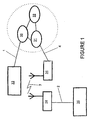
- FIG. 1 there is shown an ATM-network having ATM-nodes, 30, 31 and 32.
- a subscriber apparatus, 33 is connected to ATM-node 30, via a fixed link and UNI-interface, 1.
- a subscriber apparatus, 36 is connected to an ATM-adapted radio modem having a mobile part 34, and a fixed part, 35, located in a radio base station.
- the subscriber apparatus is linked to ATM-adapted radio modem, 34, 35, by a UNI-interface, 2
- the fixed part of the ATM-adapted radio modem, 35 is connected to ATM-node, 31, by a UNI-interface 4.
- the mobile, 34, and fixed, 35, parts of the ATM adapted radio modem are linked by radio link 3.
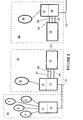
- a subscriber apparatus 20, corresponding to 36 in Figure 1 is connected to the mobile part of an ATM-adapted radio modem 21, corresponding to 34 in Figure 1.
- the fixed part of the ATM-adapted radio modem, 22, corresponding to 35 in Figure 1 is connected to an ATM network via a UNI-interface 23.
- the subscriber apparatus, 20, may have sources of different types of traffic, 5, 6, and 7.
- the traffic components originating from 5, 6, and 7 are video, audio and data, respectively.
- Signalling traffic, 8 may also originate from subscriber apparatus 20.
- the subscriber apparatus has an ATM-card equipped with an AAL-layer 9, and an ATM-layer 10.
- the subscriber apparatus 20 is linked to the mobile part of the ATM-adapted radio modem, 21, via a UNI-interface between ATM-layer 10, in subscriber apparatus 20, and ATM-layer 13, in the ATM-adapted radio modem.
- the mobile part of the ATM-adapted radio modem has an AAL-layer 12, which may be used for processing signalling traffic, 11, originating from, or directed to, the fixed part of the ATM-adapted radio modem.
- the .ATM-layer, 13, links directly to a radio modem 14. It should be noted that traffic originating from subscriber apparatus 20,is not processed by the AAL-layer 12.
- the mobile part of the ATM-adapted radio modem, 22, has a radio modem 15, linked 24, 25, 26 to an ATM-layer 18.
- An AAL-layer 17, is provided for processing signalling traffic, 16.
- a subscriber equipment 33 For a subscriber equipment 33, to communicate via an ATM-network, having ATM nodes, 30, 31 and 32, it must include an ATM-card containing an ATM-layer 9, and an AAL-layer 10, see both Figure 2 and Figure 1.
- the ATM card may be connected by means of a fixed connection, for example an optical fibre link, to the ATM network via a UNI-interface, 1.
- the UNI-interface, 1, defines the signals which control the subscriber's access to the ATM network.
- the subscriber equipment can be connected to an ATM card 12, 13, via a UNI-interface 30, see Figure 2.
- this is illustrated as a connection between subscriber equipment 36, and a radio modem 34, via a UNI interface 2.
- the ATM-card is an integral part of the mobile part of an ATM-adapted radio modem 21, which comprises the ATM-card 12, 13 and modem 14.
- the ATM-card comprises an AAL-layer, 12 and an ATM-layer, 13.
- the links, 27, 28 and 29, between the ATM layer and the modem 14 are adapted to handle video, audio and data traffic.
- the mobile part of the ATM-adapted radio modem, 34 provides a link between mobile subscriber apparatus, 36 and a base station part of the ATM-adapted radio modem, 35, see Figure. 1.
- the two parts of the radio modem communicate over a radio link 3.
- the base station part of the radio modem can be thought of as a reflected image of the mobile part.
- the data flow generated by a subscriber equipment may contain a variety of application components, e.g. video, 5, audio, 6 and data 7, see Figure 2.
- This data flow will enter the ATM-adapted radio modem as a stream of ATM-cells.
- the ATM-header will enable the identification of the application component which has generated the data content of a particular ATM-cell by means of a VCI-value contained in the header.
- the subscriber equipment identifies the application component, i.e. the type of traffic, to the ATM-adapted modem, by means of the VCI-value corresponding to the particular application component employed. This enables the radio modem to optimise the management of different types of traffic, depending on application type.
- radio modem may refer to the combination of modems 14, and 15 at each end of the radio link.
- traffic originates from an application component that has a low real time requirement, e.g. data
- retransmission over the radio channel can be used when an error, introduced by the radio link, is detected.
- the AAL-layer in the ATM-adapted radio modem 12, 17, is only used for information which terminates there, for example, control signals between the subscriber terminal, e.g. from 8, and the ATM-adapted radio modem 11, or control signals between the base station part of the ATM-adapted radio modem 16, and the control and supervisory functions in the ATM network.
- the present invention can be used in a number of ways, examples of these applications are set out below.
Landscapes
- Engineering & Computer Science (AREA)
- Computer Networks & Wireless Communication (AREA)
- Signal Processing (AREA)
- Data Exchanges In Wide-Area Networks (AREA)
- Mobile Radio Communication Systems (AREA)
Abstract
Claims (14)
- Système de télécommunication, comprenant un réseau ATM et au moins une liaison radio (3), dans lequel un équipement d'abonné (20, 36) est connecté à la dite liaison radio (3) par un modem radio adapté ATM (21, 34, 22, 35), le dit équipement d'abonné (20, 36) incluant une carte ATM contenant une couche ATM (10) et une couche AAL (9), le dit modem radio adapté ATM (21, 34, 22, 35) comporte une partie mobile (21, 34) et une partie fixe (22, 35) et la dite partie mobile (21, 34) est reliée au dit équipement d'abonné (20, 36) par une interface UNI (2, 30), la dite partie fixe (22, 35) est située dans une station de base radio et reliée à un noeud ATM (31) du dit réseau ATM par une interface utilisateur-réseau UNI (4), caractérisé en ce que le dit modem radio adapté ATM (21, 34, 22, 35) est prévu pour déterminer le type de trafic par identification d'une valeur VCI dans un en-tête ATM et pour modifier le codage de canal et/ou l'imbrication en fonction du type de trafic ; et en que le dit modem radio adapté ATM (21, 34, 22, 35) est agencé de sorte que le trafic de télécommunication est transmis dans le modem radio adapté ATM (21, 34, 22, 35) via la couche ATM seulement.
- Système de télécommunication selon la revendication 1, caractérisé en ce que ledit équipement d'abonné (20, 33) est prévu pour connexion soit au dit modem radio adapté ATM (21, 34, 22, 35) soit directement au dit réseau ATM par une liaison fixe (1).
- Système de télécommunication selon une quelconque des revendications précédentes, caractérisé en ce qu'une couche AAL (12, 17) dans le dit modem radio adapté ATM (21, 34, 22, 35) est utilisée seulement pour transmission de données de signalisation et/ou de commande dont le chemin de transmission se termine au dit modem radio adapté ATM (21, 34, 22, 35).
- Système de télécommunication selon la revendication 3, caractérisé en ce que le dit modem radio adapté ATM (21, 34, 22, 35) comprend une interface interne parallèle à la dite interface UNI (2, 30), par l'intermédiaire de laquelle la dite partie mobile (21, 34) du dit modem radio adapté ATM (21, 34, 22, 35) peut être commandé à partir soit du dit équipement d'abonné (20, 36) soit du dit réseau ATM.
- Système de télécommunication selon une quelconque des revendications précédentes, caractérisé en ce que des AAL-PDU complets pour trafic acheminé via le dit modem radio adapté ATM (21, 34, 22, 35) ne sont pas créés dans le dit modem radio adapté ATM (21, 34, 22, 35).
- Modem radio adapté ATM (21, 34, 22, 35) utilisable avec un système de télécommunication selon une quelconque des revendications 1 à 5, dans lequel le dit modem radio adapté ATM (21, 34, 22, 35) comprend une partie mobile (21, 34) et une partie fixe (22, 35) ; la dite partie mobile (21, 34) est reliée à un équipement d'abonné (20, 36) par une interface UNI (2, 30) ; la dite partie fixe (22, 35) est située dans une station de base radio et reliée à un noeud ATM (31) d'un réseau ATM par une interface UNI (4, 23) ; caractérisé en ce que le dit modem radio adapté ATM (21, 34, 22, 35) est prévu pour déterminer le type de trafic par identification d'une valeur VCI dans un en-tête ATM, et pour modifier le codage de canal et/ou l'imbrication en fonction du type de trafic ; et en ce que le dit modem radio adapté ATM (21, 34, 22, 35) est agencé de sorte que le trafic de télécommunication est transmis dans le modem radio adapté ATM (21, 34, 22, 35) via la couche ATM seulement.
- Modem radio adapté ATM (21, 34, 22, 35) selon la revendication 6, caractérisé en ce que le dit modem radio adapté ATM (21, 34, 22, 35) est agencé de sorte qu'une couche AAL (12, 17), dans le dit modem radio adapté ATM (21, 34, 22, 35), est utilisée seulement pour transmission de données de signalisation et/ou de commande dont le chemin de transmission se termine au dit modem radio adapté ATM (21, 34, 22, 35).
- Modem radio adapté ATM (21, 34, 22, 35) selon la revendication 7, caractérisé en ce que le dit modem radio adapté ATM (21, 34, 22, 35) comprend une interface interne, parallèle à la dite iriterface UNI (2, 30), par l'intermédiaire de laquelle des signaux de commande provenant soit du dit équipement d'abonné (20, 36) soit du dit réseau ATM sont transmis à la partie mobile (21, 34) du dit modem radio adapté ATM (21 , 34, 22, 35).
- Modem radio adapté ATM (21, 34, 22, 35) selon une quelconque des revendications 6 à 8, caractérisé en ce que le dit modem radio adapté ATM (21, 34, 22, 35) est agencé de sorte que des AAL-PDU complets ne sont pas créés dans le dit modem radio adapté ATM (21, 34, 22, 35) pour un trafic qui n'a pas son origine dans le dit modem radio adapté ATM (21, 34, 22, 35).
- Procédé de transmission d'un trafic de télécommunication dans un système de télécommunication ayant un réseau ATM et au moins une liaison radio (3), dans lequel un équipement d'abonné (20, 36) est connecté à la dite liaison radio (3) par un modem radio adapté ATM (21, 34, 22, 35), le dit équipement d'abonné (20, 36) comprend une carte ATM contenant une couche ATM (10) et une couche AAL (9), dans lequel le dit modem radio adapté ATM (21, 34, 22, 35) comprend une partie mobile (21, 34) connectée au dit équipement d'abonné (20, 36) et une partie fixe (22, 35) connectée au dit réseau ATM, et dans lequel la dite partie fixe (22, 35) est située dans une station de base radio, caractérisé en ce que le dit modem radio adapté ATM (21, 34, 22, 35) détermine le type de trafic par identification d'une valeur VCI dans un en-tête ATM et modifie le codage de canal et/ou l'imbrication en fonction du type de trafic ; et le trafic de télécommunication est transmis dans le modem radio adapté ATM (21, 34, 22, 35) via la couche ATM seulement.
- Procédé selon la revendication 10, caractérisé en ce que le trafic est transmis du dit équipement d'abonné (20, 36) à la dite partie mobile (21, 34) via la dite interface UNI (2, 30).
- Procédé selon une quelconque des revendications 10 à 11, caractérisé en ce qu'une couche AAL (12, 17) dans le dit modem radio adapté ATM (21, 34, 22, 35) est utilisée seulement pour transmission de données de signalisation et/ou de commande dont le chemin de transmission se termine au dit modem radio adapté ATM (21, 34, 22, 35).
- Procédé selon la revendication 12, caractérisé en ce que le dit modem radio adapté ATM (21, 34, 22, 35) comprend une interface interne, parallèle à la dite interface UNI (2, 30), par l'intermédiaire de laquelle la partie mobile (21, 34) du dit modem radio adapté ATM (21, 34, 22, 35) peut être commandée à partir soit du dit équipement d'abonné (20, 36) soit du dit réseau ATM.
- Procédé selon une quelconque des revendications 10 à 13, caractérisé en ce que des AAL-PDU complets ne sont pas créés dans le dit modem radio adapté ATM (21, 34, 22, 35) pour un trafic provenant de l'extérieur du dit modem radio adapté ATM (21, 34, 22, 35).
Applications Claiming Priority (3)
| Application Number | Priority Date | Filing Date | Title |
|---|---|---|---|
| SE9602500 | 1996-06-20 | ||
| SE9602500A SE517327C2 (sv) | 1996-06-20 | 1996-06-20 | Förbättringar i, eller avseende, ATM-Transmission via radio |
| PCT/SE1997/000868 WO1997049254A1 (fr) | 1996-06-20 | 1997-05-27 | Perfectionnements apportes ou relatifs a la transmission en mode asynchrone par radio |
Publications (2)
| Publication Number | Publication Date |
|---|---|
| EP0903046A1 EP0903046A1 (fr) | 1999-03-24 |
| EP0903046B1 true EP0903046B1 (fr) | 2006-04-19 |
Family
ID=20403144
Family Applications (1)
| Application Number | Title | Priority Date | Filing Date |
|---|---|---|---|
| EP97928562A Expired - Lifetime EP0903046B1 (fr) | 1996-06-20 | 1997-05-27 | Perfectionnements apportes ou relatifs a la transmission en mode asynchrone par radio |
Country Status (5)
| Country | Link |
|---|---|
| EP (1) | EP0903046B1 (fr) |
| DE (1) | DE69735713D1 (fr) |
| NO (1) | NO985888L (fr) |
| SE (1) | SE517327C2 (fr) |
| WO (1) | WO1997049254A1 (fr) |
Families Citing this family (1)
| Publication number | Priority date | Publication date | Assignee | Title |
|---|---|---|---|---|
| JP3857524B2 (ja) * | 1997-12-30 | 2006-12-13 | ノキア コーポレイション | 広帯域セルラーネットワーク装置 |
Family Cites Families (2)
| Publication number | Priority date | Publication date | Assignee | Title |
|---|---|---|---|---|
| WO1993019559A1 (fr) * | 1992-03-21 | 1993-09-30 | Roke Manor Research Limited | Reseau de radiocommunications de type mta |
| US5600707A (en) * | 1994-08-31 | 1997-02-04 | Lucent Technologies Inc. | Wireless channel setup using low bandwidth network for selecting high bandwidth data bearer channel of another network system for data transmission |
-
1996
- 1996-06-20 SE SE9602500A patent/SE517327C2/sv not_active IP Right Cessation
-
1997
- 1997-05-27 DE DE69735713T patent/DE69735713D1/de not_active Expired - Fee Related
- 1997-05-27 EP EP97928562A patent/EP0903046B1/fr not_active Expired - Lifetime
- 1997-05-27 WO PCT/SE1997/000868 patent/WO1997049254A1/fr not_active Ceased
-
1998
- 1998-12-16 NO NO985888A patent/NO985888L/no not_active Application Discontinuation
Also Published As
| Publication number | Publication date |
|---|---|
| WO1997049254A1 (fr) | 1997-12-24 |
| EP0903046A1 (fr) | 1999-03-24 |
| NO985888L (no) | 1999-02-17 |
| NO985888D0 (no) | 1998-12-16 |
| SE9602500D0 (sv) | 1996-06-20 |
| DE69735713D1 (de) | 2006-05-24 |
| SE517327C2 (sv) | 2002-05-28 |
| SE9602500L (sv) | 1997-12-21 |
Similar Documents
| Publication | Publication Date | Title |
|---|---|---|
| US6148001A (en) | Multipoint-to-point system which multiplexes complete packets comprised of ATM cells on to a single virtual channel connection | |
| EP1393192B1 (fr) | Procede et systeme pour connecter des circuits virtuels par un commutateur ethernet | |
| US6243382B1 (en) | Interfacing to SAR devices in ATM switching apparatus | |
| EP0976227B1 (fr) | Mecanisme permettant de multiplexer des circuits virtuels de aal5 mta sur ethernet | |
| US5953339A (en) | Logical link connection server | |
| US6377574B1 (en) | Packet switch and method for relaying management cells and data cells in a form of IP packet | |
| US6028861A (en) | Method and apparatus for performing packet synchronized switch-over | |
| US5953337A (en) | Traffic distribution in ATM network | |
| EP0543957A1 (fr) | Commutation sans connexions pour un interrupteur atm | |
| CN1145157A (zh) | B-isdn接入 | |
| US6707800B1 (en) | ATM network with central call processor | |
| WO1996019886A2 (fr) | Procede pour signaler la congestion du trafic dans un reseau mta a un reseau a repetition de trame | |
| EP0903046B1 (fr) | Perfectionnements apportes ou relatifs a la transmission en mode asynchrone par radio | |
| KR100222223B1 (ko) | Atm 망을 통해 접속부를 결합시키는 방법 및 시스템 | |
| WO1999003237A1 (fr) | Cellule mta augmentee de donnees tampon | |
| Potts | EXPLOITation of an ATM testbed for broadband experiments and applications | |
| Venieris et al. | ATM traffic transfer via queued-arbitrated DQDB | |
| Venieris et al. | DQDB MAN as a Transit Network for ATM CPNs | |
| EP1161818B1 (fr) | Procede et appareil de commutation synchronisee de paquets | |
| Batubara et al. | An Introduction To B-ISDN And ATM | |
| McGuire | Fundamentals of ATM-Part 1 | |
| AU681946C (en) | Traffic distribution in ATM network | |
| Albanese et al. | Evolution of the Network Supporting SMDS to B-ISDN | |
| Saydam et al. | Specification and Design of a Gateway for ATM/Frame Relay | |
| JP3469166B2 (ja) | 結合ネットワークを有するatm交換装置 |
Legal Events
| Date | Code | Title | Description |
|---|---|---|---|
| PUAI | Public reference made under article 153(3) epc to a published international application that has entered the european phase |
Free format text: ORIGINAL CODE: 0009012 |
|
| 17P | Request for examination filed |
Effective date: 19990120 |
|
| AK | Designated contracting states |
Kind code of ref document: A1 Designated state(s): CH DE DK FI FR GB LI NL SE |
|
| 17Q | First examination report despatched |
Effective date: 20030820 |
|
| GRAP | Despatch of communication of intention to grant a patent |
Free format text: ORIGINAL CODE: EPIDOSNIGR1 |
|
| GRAJ | Information related to disapproval of communication of intention to grant by the applicant or resumption of examination proceedings by the epo deleted |
Free format text: ORIGINAL CODE: EPIDOSDIGR1 |
|
| GRAP | Despatch of communication of intention to grant a patent |
Free format text: ORIGINAL CODE: EPIDOSNIGR1 |
|
| GRAS | Grant fee paid |
Free format text: ORIGINAL CODE: EPIDOSNIGR3 |
|
| GRAA | (expected) grant |
Free format text: ORIGINAL CODE: 0009210 |
|
| AK | Designated contracting states |
Kind code of ref document: B1 Designated state(s): CH DE DK FI FR GB LI NL SE |
|
| PG25 | Lapsed in a contracting state [announced via postgrant information from national office to epo] |
Ref country code: NL Free format text: LAPSE BECAUSE OF FAILURE TO SUBMIT A TRANSLATION OF THE DESCRIPTION OR TO PAY THE FEE WITHIN THE PRESCRIBED TIME-LIMIT Effective date: 20060419 Ref country code: LI Free format text: LAPSE BECAUSE OF FAILURE TO SUBMIT A TRANSLATION OF THE DESCRIPTION OR TO PAY THE FEE WITHIN THE PRESCRIBED TIME-LIMIT Effective date: 20060419 Ref country code: FI Free format text: LAPSE BECAUSE OF FAILURE TO SUBMIT A TRANSLATION OF THE DESCRIPTION OR TO PAY THE FEE WITHIN THE PRESCRIBED TIME-LIMIT Effective date: 20060419 Ref country code: CH Free format text: LAPSE BECAUSE OF FAILURE TO SUBMIT A TRANSLATION OF THE DESCRIPTION OR TO PAY THE FEE WITHIN THE PRESCRIBED TIME-LIMIT Effective date: 20060419 |
|
| REG | Reference to a national code |
Ref country code: GB Ref legal event code: FG4D |
|
| REF | Corresponds to: |
Ref document number: 69735713 Country of ref document: DE Date of ref document: 20060524 Kind code of ref document: P |
|
| PG25 | Lapsed in a contracting state [announced via postgrant information from national office to epo] |
Ref country code: SE Free format text: LAPSE BECAUSE OF FAILURE TO SUBMIT A TRANSLATION OF THE DESCRIPTION OR TO PAY THE FEE WITHIN THE PRESCRIBED TIME-LIMIT Effective date: 20060719 Ref country code: GB Free format text: LAPSE BECAUSE OF NON-PAYMENT OF DUE FEES Effective date: 20060719 Ref country code: DK Free format text: LAPSE BECAUSE OF FAILURE TO SUBMIT A TRANSLATION OF THE DESCRIPTION OR TO PAY THE FEE WITHIN THE PRESCRIBED TIME-LIMIT Effective date: 20060719 |
|
| NLV1 | Nl: lapsed or annulled due to failure to fulfill the requirements of art. 29p and 29m of the patents act | ||
| REG | Reference to a national code |
Ref country code: CH Ref legal event code: PL |
|
| PG25 | Lapsed in a contracting state [announced via postgrant information from national office to epo] |
Ref country code: DE Free format text: LAPSE BECAUSE OF NON-PAYMENT OF DUE FEES Effective date: 20061201 |
|
| PLBE | No opposition filed within time limit |
Free format text: ORIGINAL CODE: 0009261 |
|
| STAA | Information on the status of an ep patent application or granted ep patent |
Free format text: STATUS: NO OPPOSITION FILED WITHIN TIME LIMIT |
|
| GBPC | Gb: european patent ceased through non-payment of renewal fee |
Effective date: 20060719 |
|
| 26N | No opposition filed |
Effective date: 20070122 |
|
| EN | Fr: translation not filed | ||
| PG25 | Lapsed in a contracting state [announced via postgrant information from national office to epo] |
Ref country code: FR Free format text: LAPSE BECAUSE OF FAILURE TO SUBMIT A TRANSLATION OF THE DESCRIPTION OR TO PAY THE FEE WITHIN THE PRESCRIBED TIME-LIMIT Effective date: 20070309 |
|
| PG25 | Lapsed in a contracting state [announced via postgrant information from national office to epo] |
Ref country code: FR Free format text: LAPSE BECAUSE OF FAILURE TO SUBMIT A TRANSLATION OF THE DESCRIPTION OR TO PAY THE FEE WITHIN THE PRESCRIBED TIME-LIMIT Effective date: 20060531 |
|
| PG25 | Lapsed in a contracting state [announced via postgrant information from national office to epo] |
Ref country code: FR Free format text: LAPSE BECAUSE OF FAILURE TO SUBMIT A TRANSLATION OF THE DESCRIPTION OR TO PAY THE FEE WITHIN THE PRESCRIBED TIME-LIMIT Effective date: 20060419 |