EP0976227B1 - Mecanisme permettant de multiplexer des circuits virtuels de aal5 mta sur ethernet - Google Patents
Mecanisme permettant de multiplexer des circuits virtuels de aal5 mta sur ethernet Download PDFInfo
- Publication number
- EP0976227B1 EP0976227B1 EP98907785A EP98907785A EP0976227B1 EP 0976227 B1 EP0976227 B1 EP 0976227B1 EP 98907785 A EP98907785 A EP 98907785A EP 98907785 A EP98907785 A EP 98907785A EP 0976227 B1 EP0976227 B1 EP 0976227B1
- Authority
- EP
- European Patent Office
- Prior art keywords
- atm
- ethernet
- frame
- network
- lan
- Prior art date
- Legal status (The legal status is an assumption and is not a legal conclusion. Google has not performed a legal analysis and makes no representation as to the accuracy of the status listed.)
- Expired - Lifetime
Links
Images





Classifications
-
- H—ELECTRICITY
- H04—ELECTRIC COMMUNICATION TECHNIQUE
- H04L—TRANSMISSION OF DIGITAL INFORMATION, e.g. TELEGRAPHIC COMMUNICATION
- H04L12/00—Data switching networks
- H04L12/28—Data switching networks characterised by path configuration, e.g. LAN [Local Area Networks] or WAN [Wide Area Networks]
- H04L12/46—Interconnection of networks
- H04L12/4633—Interconnection of networks using encapsulation techniques, e.g. tunneling
-
- H—ELECTRICITY
- H04—ELECTRIC COMMUNICATION TECHNIQUE
- H04Q—SELECTING
- H04Q11/00—Selecting arrangements for multiplex systems
- H04Q11/04—Selecting arrangements for multiplex systems for time-division multiplexing
- H04Q11/0428—Integrated services digital network, i.e. systems for transmission of different types of digitised signals, e.g. speech, data, telecentral, television signals
- H04Q11/0478—Provisions for broadband connections
-
- H—ELECTRICITY
- H04—ELECTRIC COMMUNICATION TECHNIQUE
- H04L—TRANSMISSION OF DIGITAL INFORMATION, e.g. TELEGRAPHIC COMMUNICATION
- H04L12/00—Data switching networks
- H04L12/64—Hybrid switching systems
-
- H—ELECTRICITY
- H04—ELECTRIC COMMUNICATION TECHNIQUE
- H04L—TRANSMISSION OF DIGITAL INFORMATION, e.g. TELEGRAPHIC COMMUNICATION
- H04L12/00—Data switching networks
- H04L12/54—Store-and-forward switching systems
- H04L12/56—Packet switching systems
- H04L12/5601—Transfer mode dependent, e.g. ATM
- H04L2012/5614—User Network Interface
- H04L2012/5618—Bridges, gateways [GW] or interworking units [IWU]
-
- H—ELECTRICITY
- H04—ELECTRIC COMMUNICATION TECHNIQUE
- H04L—TRANSMISSION OF DIGITAL INFORMATION, e.g. TELEGRAPHIC COMMUNICATION
- H04L12/00—Data switching networks
- H04L12/54—Store-and-forward switching systems
- H04L12/56—Packet switching systems
- H04L12/5601—Transfer mode dependent, e.g. ATM
- H04L2012/5638—Services, e.g. multimedia, GOS, QOS
- H04L2012/5646—Cell characteristics, e.g. loss, delay, jitter, sequence integrity
- H04L2012/5652—Cell construction, e.g. including header, packetisation, depacketisation, assembly, reassembly
- H04L2012/5653—Cell construction, e.g. including header, packetisation, depacketisation, assembly, reassembly using the ATM adaptation layer [AAL]
- H04L2012/5658—Cell construction, e.g. including header, packetisation, depacketisation, assembly, reassembly using the ATM adaptation layer [AAL] using the AAL5
-
- H—ELECTRICITY
- H04—ELECTRIC COMMUNICATION TECHNIQUE
- H04L—TRANSMISSION OF DIGITAL INFORMATION, e.g. TELEGRAPHIC COMMUNICATION
- H04L12/00—Data switching networks
- H04L12/54—Store-and-forward switching systems
- H04L12/56—Packet switching systems
- H04L12/5601—Transfer mode dependent, e.g. ATM
- H04L2012/5638—Services, e.g. multimedia, GOS, QOS
- H04L2012/5665—Interaction of ATM with other protocols
Definitions
- the invention is directed to a system and method for carrying ATM network information over a local area network (LAN), and more particularly to a mechanism for multiplexing ATM AAL5 virtual circuits over Ethernet.
- LAN local area network
- ATM asynchronous transfer mode
- ATM is a connection oriented data transport which is media independent.
- the key feature of ATM is the segmentation of data into fixed length units of data referred to as cells.
- Each cell is separately steered at each ATM switch via an identifier of local significance to the local transport leg provided in the header of each cell.
- the identifiers are reassigned during the transit of a cell from an input port to an output port on a switch.
- the identifier carried between a switch and an end system is 24 bits in length. For an ATM user network interface (UNI), this is a concatenation of a 16 bit virtual circuit identifier (VCI) and an 8 bit virtual path identifier (VPI).
- VCI virtual circuit identifier
- VPN virtual path identifier
- This routing mechanism differs significantly from other networks, in that there is only one identifier specifying a local path vs. source and destination information. This path information in itself is insufficient to uniquely identify the real source and destination for the payload and therefore the connection is set up via signalling. As such, connection to a remote end-station is requested and upon connection set-up, the network informs the end station what the local identifier of the connection is.
- Ethernet is a connectionless LAN technology designed for data applications in which all stations on the network share the communication medium. This medium, which could be twisted pairs, fiber, or coaxial cables, is shared in a peer to peer fashion. All devices on the Ethernet can be reached by a single transmission of data. Ethernet operates typically at 10Mbs and the data are sent in the form of Ethernet "frames".
- All end-stations detecting a collision will wait a random interval and will then retry sending their frame, once again applying the same rules to determine success, and to free up the channel as quickly as possible when a collision occurs. Additional error detection is built into each frame to ensure that errored frames are not propagated.
- Ethernet end stations are addressed globally and uniquely by a 48 bit media access control (MAC) address.
- the MAC address is comprised of a 24 bit Organization Unique Identifier (OUI) and a 24 bit end station identifier (ID).
- OUI is a globally administered numbering plan which comprises a portion of a number identifying the organization administering the remainder of the number, which is IEEE for Ethernet.
- the ID is a unique identifier that a manufacturing organization can provide to all equipment that it manufactures. Further, this identifier is unique and staticaly assigned and well known to the station. Certain Ethernet addresses are reserved for broadcast and multicast to all end-stations on the segment and for diagnostic purposes.
- An Ethernet connected end station receives all data broadcast onto the media. By convention, the end station discards all traffic not directed to itself, all, or a subset of end stations, as identified in the destination MAC address.
- the OSI model defines a physical layer which specifies the standards for the transmission medium, a data link layer (layers 2 and 3) and a network layer (layers 4 to 7).
- Ethernet operates on FDDI (fiber distributed data interface) physical layer
- the MAC layer placed on top of FDDI, comprises the data layer.
- ATM operates on SONET, copper, twisted pairs, FDDI as physical layer, and the data layer is subdivided into an ATM layer and an ATM adaptation layer (AAL) providing the convergence function (called also convergence sublayer CS).
- AAL ATM adaptation layer
- the ATM bearer service is masked from the convergence function.
- LAN shared bus architecture is insufficient to meet the demands of applications that require more bandwidth, and that LANs are beginning to become a bottleneck in computing environments. For this reason, more economic local interfaces such as a Frame-Relay version (FUNI) and an Ethernet version, Cells-in-Frames (CIF), are used in the access network. In both cases, the separation of data into cells is deferred until within the network, but the higher level information is carried to the end station.
- FUNI Frame-Relay version
- CIF Cells-in-Frames
- PDUs are pre-packaged at the end station and this implies changes in HW and SW at each Ethernet connected end station.
- Switched Ethernet technology developed to provide more capacity to an end-user, does not relay on shared medium, it rather provides point-to-point bandwidth between the user station and the switch, so that instead of sharing a 10 Mbit/s medium, the user gets a dedicated 10 Mbits/s medium.
- Ethernet hubs and switches are growing in use, they become an inexpensive means to provide more bandwidth to workstations.
- a switched Ethernet network is more flexible, in that it may include stations that are using a port at a given full rate, stations that share a port, or stations that have access to more than one port.
- switched Ethernet provides only limited bandwidth and supports data traffic only. A more efficient solution for bursty traffic is needed. There is also a need to simplify and standardize the access link while also obtaining protection of the access traffic.
- ATM provides a very rich environment with numerous traffic classes and the ability to multiplex many data streams with different handling requirements together, this functionality is mainly required in the network backbone. It is sought that ATM networks will be used by more general class end stations for delivering multi-media services. However, in the short term, the extra bandwidth and cost of ATM interfaces is probably not justified for general class end stations, such as desktop computers. It is possible to built ATM switches with lower speed ATM interfaces, but this solution presents a serious deployment problem in that it requires replacement of the substantial installed base of shared media LAN wiring and adapter cards.
- An ATM-Ethernet concentrator is disclosed in United States Patent No. 5,457,681 (Gaddis et al., issued on October 10, 1995 and assigned to Washington University), which provides an interface between an ATM network and a plurality of Ethernet segments.
- Each Ethernet frame transmitted by any of the Ethernet segments is fragmented into a sequence of ATM cells, which are transmitted by an Ethernet controller associated with the respective segment over the ATM network and delivered to the interconnected Ethernet controllers.
- the controller re-assembles them into frames and transmits the frames over the respective Ethernet segment to the end stations. While this patent partially addresses the problems of bandwidth and cost, it does not provide a method and system for transmitting ATM cells in Ethernet frames, for taking advantage of the ATM capabilities.
- PCT/CA95/00029 discloses a communication network comprising ATM switches interfaced with LANs, the ATM cells being encapsulated in LAN frames and being delivered in encapsulated form over the Ethernet LAN direct to the end station.
- the LAN interface adapter of the end station provide bridging, network layer functions and LAN emulation functions to permit transparent communication between the end stations over the ATM network.
- the interface adapter also defined as a "ridge (bridge/router) creates frames from ATM cells and vice-versa.
- This invention is based on the fact that although an Ethernet MAC address is normally globally unique for universal interoperability, it does not absolutely have to be for a closed Ethernet to work. Uniqueness of the address within the Ethernet broadcast domain itself is necessary. According to this invention, an Ethernet end station is allowed to assume multiple MAC level identifiers on a single Ethernet interface. These identifiers which are dynamically assigned, have only transitory significance on the Ethernet.
- the invention provides a multiplexer (E-Mux) for encapsulating ATM cells into a LAN frame, comprising a segmentation and reassembly unit for receiving a plurality of incoming ATM cells with a LAN destination address and generating an ATM adaptation layer 5 (AAL5) protocol data unit (PDU); a PDU manager for receiving the AAL5 PDU and extracting an AAL5 payload; a header processor for extracting a traffic type indicator from the header of the PDU; an address processor for extracting the LAN destination address from the header of an incoming ATM cell; and a frame manager for receiving the traffic type indicator, the AAL5 payload and the LAN destination address and generating an incoming LAN frame.
- E-Mux multiplexer
- the invention also provides a multiplexer (E-Mux) for segmenting a LAN frame into a plurality of ATM cells, comprising: a frame manager for receiving an outgoing LAN frame with an ATM destination address and de-assembling it into a traffic type indicator, an AAL5 payload and an ATM destination address; a header processor for receiving the traffic type indicator from the frame manager; a PDU manager for receiving the AAL5 payload and the traffic type indicator and generating an ATM adaptation layer 5 (AAL5) protocol data unit (PDU); an address processor for receiving the ATM destination address from the frame manager; and a segmentation and reassembly unit for receiving the PDU and the ATM destination address generating a plurality of ATM cells with the ATM destination address.
- E-Mux multiplexer
- a telecommunication network comprising a LAN with a plurality of end-stations connected over a transmission medium and an ATM network, comprising: a multiplexer (E-Mux) for encapsulating a plurality of ATM cells received from the ATM network into an incoming LAN frame and for segmenting a LAN frame received from the LAN network into a plurality of outgoing ATM cells; an E-Mux-to-LAN interface for adapting the transmission format of the LAN frame for transmission over the connection medium of an LAN network; an ATM-to-E-Mux interface for adapting the transmission format of the ATM cells received from an ATM network for processing by the E-Mux; an address controller at each end station for forwarding the incoming LAN frame to the end station when a destination address comprised in the destination MAC field of the LAN frame is recognized by the address controller, and for inserting an ATM destination address into the source MAC field of the outgoing frame.
- E-Mux multiplexer
- a method for transmitting information from an ATM network to an Ethernet network using an E-Mux is also disclosed, the method performing the steps of: establishing connection between an ATM switch of the ATM network and an end station of the Ethernet network based on a VPI/VCI destination address in the header of an incoming ATM cell; receiving a plurality of incoming ATM cells with the destination address, and generating an ATM adaptation layer 5 (AAL5) protocol data unit (PDU) with a segmentation and reassembly unit; extracting an AAL5 payload from the PDU with a PDU manager; extracting a traffic type indicator from the header of the PDU with a header processor; generating with a frame manager an incoming Ethernet frame using the traffic type indicator, the AAL5 payload and the destination address; and transmitting the Ethernet frame over the Ethernet network to the end station according to the destination address.
- AAL5 protocol data unit PDU protocol data unit
- a method for transmitting information from an Ethernet network to an ATM network using an E-Mux performing the steps of: establishing connection between an end station of the Ethernet network and an ATM switch of the ATM network based on a VPI/VCI destination address provided by the end station; generating an outgoing Ethernet frame at the end station and transmitting same to the E-Mux; extracting from the Ethernet outgoing frame a traffic type indicator, a frame payload and a source address, with a frame manager; generating an ATM adaptation layer 5 (AAL5) protocol data unit (PDU) with a segmentation and reassembly unit from the frame payload and a traffic type indicator extracted from the type field of the outgoing frame with a header processor; segmenting the PDU into a plurality of outgoing ATM cells and inserting a VPI/VCI destination address in the header of the cells from an address processor.
- AAL5 ATM adaptation layer 5 protocol data unit
- the system and method of the invention provides a highly efficient carriage of ATM information to an end station using actual MAC address space in the Ethernet frame.
- the system of the invention is efficient, as custom hardware to perform this function does not need to be deployed at each Ethernet connected end station, and the end station software is not burdened with this task.
- Custom hardware to perform SAR (segmentation and reassembly) function is built into the E-Mux.
- Still another advantage of the invention is that legacy Ethernet can coexist with ATM LAN to UNI traffic.
- ATM intelligence can be distributed in such a LAN segment.
- standard packet formats and driver interfaces may be used between layer 3 and the Ethernet interface, making the invention applicable to various LAN technologies. No additional information needs to be propagated outside the system of the invention. Therefore, this permits the system to be tailored as an application specific ATM to Ethernet interface.
- Still another advantage of the invention is that the Ethernet frame is efficiently used since the ATM routing information is embedded in the Ethernet MAC addressing field. No additional ATM header within the Ethernet payload is necessary, since the entire ATM semantics is not carried to the end station. This does not preclude, however, additional semantics being packaged in a separate header in the Ethernet frame.
- ATM virtual circuit (VC) address mapping is carried forward into the Ethernet domain. Intermediate steps are not required to map Ethernet MAC to VC, as VC information flows end-to-end. For uncommitted bit rate (UBR) data services, only the ATM path identifier need to be carried forward across an Ethernet LAN.
- UBR uncommitted bit rate
- Ethernet traffic can coexist-exist with ATM LAN to UNI traffic.
- each Ethernet connected station may assume multiple IDs on the LAN at the MAC level.
- it retains the manufacturers MAC address built into the Ethernet interface at the factory.
- For ATM traffic it assumes one or more IDs depending on the ATM virtual circuits which ultimately terminate at that particular end station interface.
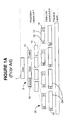
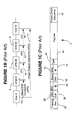
- Figures 1A, 1B, and 1C are provided for defining and illustrating some of the terms necessary for describing the present invention and its mode of operation.
- FIG. 1A shows the convergence function, and the segmentation and reassembly (SAR) function of ATM.
- the convergence function is responsible for accepting the user traffic which could range from one to maximum 65,000 bytes, and placing a header 10 and a trailer 12 around it to obtain a protocol data unit (PDU) 2.
- PDU protocol data unit
- the payload field of the PDU is limited to 1,500 bytes, which is the size of the Ethernet payload field. To push PDU beyond Ethernet limit of 1,500 bytes will require an additional header in the Ethernet frame.
- the length of the header and trailer is between 6 and 40 bytes.
- the adaptation layer adds a header 16 , and possibly a trailer 18 to the data unit 14, depending on the type of payload being supported. In any event, the final data unit from this operation is always a 48 octet block 20 . Finally, the last operation is performed by the data link layer which adds a five-octet header 22 to the 48-octet payload 20 resulting in a 53 bytes cell 24. Each cell is transported over the physical layer between two ATM switches designated by the address information in header 22 .
- FIG. 1B shows a basic linear point-to-point ATM network configuration where the connections are identified through virtual channel identifiers (VCI) and virtual path identifiers (VPI) in the ATM cell header. Switching in the ATM network is illustrated at 5, 7 , and 9.
- a virtual channel connection (VCC) 11 has end-to-end significance between end users A and B.
- a virtual path connection (VPC) has significance between adjacent ATM devices, 5, 7, and 9 , and switching is performed very quickly through the use of a routing table.
- Figure 1C illustrates an Ethernet frame. Ethernet end stations are addressed globally and uniquely by the MAC address.
- Field 28 comprises the destination MAC and field 30 comprises the source MAC.
- the MAC address is has a 24 bit organizationally unique identifier (OUI) 38, 42 and a 24 bit end station identifier 40, 44.
- UMI organizationally unique identifier
- a type field 32 is provided for specifying the traffic type.
- the payload field 34 may comprise up to 1500 bytes.
- the frame begins with a training sequence 26 for allowing receiver synchronization and ends with a frame check sequence 36, for determining the integrity of the data in the frame.
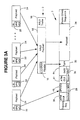
- FIG. 2 shows the block diagram of the system according to the invention.
- An E-Mux 21 exchanges ATM cells with an ATM UNI 27 , which is connected in turn to an ATM network 23.
- E-Mux 21 is also connected to an Ethernet LAN 25 for exchanging frames.
- the traffic travelling from ATM network 23 to LAN 25 is defined by the term "incoming”
- the traffic travelling from LAN 25 to ATM network 23 is defined by the term "outgoing”.
- a unique MAC OUI is established for extending ATM path addressing into the Ethernet MAC address domain.
- This unique MAC OUI identifies the traffic as ATM UNI.
- the ATM OUI is inserted in both the destination and the source MAC fields 38 and 42.
- the OUI field informs LAN 25 that the traffic is coming from a source not registered to it, so as to treat it accordingly. As indicated earlier, this permits the ATM traffic to coexist with traditionally addressed Ethernet traffic.
- E-Mux 21 associated to LAN 25 also requires a unique ID in the destination MAC, such that incoming traffic can be uniquely addressed to it.
- Each end station has an VPI/VCI address for the ATM traffic used to establish connection between a switch in the ATM network and an end station through signalling in a known manner.
- VPI/VCI address for the ATM traffic used to establish connection between a switch in the ATM network and an end station through signalling in a known manner.
- a flow of cells 24, addressed to an end station 39, 39', 39" in Ethernet network 25 is received at UNI 27 from network 23 .
- the cells are assembled into a PDU 2 by SAR unit 29 of E-Mux 21.
- PDU 2 comprises a AAL5 payload field 14 for receiving the payload from the incoming cells 24, the size of the payload field being limited to the maximum size of field 34 (up to 1500 bytes) of an Ethernet frame 3 .
- the normal ATM AAL5 protocol data unit (PDU) is quite large, as discussed in connection to Figure 1, it can be constrained to fit within the 1500 bytes of an Ethernet frame.
- the cell segmentation function is performed by SAR 29 at boundary to the ATM network, such that the need for additional PDU information to be carried in the payload portion of the Ethernet frame is obviated.
- CIF cell-in-frame
- a PDU manager 31 strips the LLC/SNAP (Logical link control, sub-network attachment point) header of the PDU 2 and provides it to a header processor 37 , which determines the type of the payload. The payload and the payload type are forwarded to a frame manager 33.
- LLC/SNAP Logical link control, sub-network attachment point
- Frame manager 33 generates the Ethernet frame 3 by mapping the payload into field 34 and the payload type into field 32 .
- Frame manager 33 also receives the address of the destination end station from an address processor 35, and maps this information into field 40 of destination MAC.
- This address is a concatenation of the VPI/VCI address extracted from the cell header 22 .
- the source MAC field of frame 3 comprises the address of the E-Mux
- the destination MAC comprises the address of the end station in the Ethernet.
- Frame manager 33 sends frame 3 assembled as indicated above, over the Ethernet network 25 .
- An interface 47 is provided for adapting the format of the frame to the connection medium of Ethernet 25.
- each "ATM aware" end station 39, 39', 39" is provisioned with an address controller, as shown at 41, 41', 41” , which allows the end station to signal the network to request/accept connections.
- address controller 41, 41', 41" provides the range of VPI/VCI values that could be assigned for such connections to the associated end station 39, 39', 39 to a defined subset of the whole VPI/VCIs allocated for UNI 27.
- An address controller 41, 41', 41" recognizes a destination ID as being its own, using a look-up table, and directs frame 3 to the associated end station 39, 39', 39".
- an end station 39, 39', 39" For the outgoing direction, an end station 39, 39', 39" generates an outgoing frame 3 , with the destination MAC indicating the ATM OUI address of E-Mux 21, rather than the address of another end station in the Ethernet network 25 . As such, the corresponding Ethernet interface transmits the outgoing frame to E-Mux 21 .
- the source MAC ID field 44 comprises the VCI/VCI address, of the destination ATM device in ATM network 23.
- frame manager 33 receives the frame from interface 47 , segments the frame and provides the payload to PDU manager 31, the VPI/VCI address to address processor 35 and the type information from field 32 to header processor 37 .
- PDU manager 31 generates a PDU 2 by inserting the payload received from frame manager 33 into field 14, and the type information from header processor 37 into LLC/SNAP header field 16 .
- PDU is then forwarded to SAR 29 which segments the PDU 2 into cells 24 , for UNI 27.
- Address processor 35 inserts the VPI/VCI address from the source MAC ID field 44 into each cell header, so that ATM network 23 switches the cell accordingly.
- an Ethernet station when originating signalling, may use the source MAC field for the normal Ethernet MAC and the destination MAC field for the ATM-OUI and '0'.
- the source MAC field permits an E-164 encoded NSAP to give the Ethernet connected end station a unique identification in the ATM network. In this way, the E-Mux can arbitrate and aggregate signalling onto a standard UNI from multiple Ethernet connected devices.
- an encapsulation of the cells into a PDU frame is effected by PDU manager 31
- an encapsulation of the PDU into an Ethernet frame is effected by the frame manager 33, such that the Ethernet end station does not have to be ATM protocol aware, or perform CRC (cyclic redundancy check) and SAR (segmentation and reassembly) functions.
- FIG. 4A is a the flow-chart illustrating the processing of the ATM cells to produce an Ethernet frame.
- step 100 a connection between the station in the ATM network and the E-Mux 21 is established based on the ATM address of the E-Mux.
- An address controller lets say 41 , recognizes its associate end station as the owner of the VPI/VCI, and station 39 establishes communication with ATM network 2 , shown in step 110 .
- E-Mux 21 When E-Mux 21 receives a flow of ATM cells over a specific VC, as shown in step 120 , it assembles the cells into a PDU, step 130 , verifies that the AAL5 CRC is correct, in step 140 , and maps the payload into the payload portion of the Ethernet frame in step 150.
- the destination MAC is set in field 28 to ATM OUI, VCI/VPI in step 160 to uniquely identify the owner of that particular path on the LAN, and the source MAC is set to that of the E-Mux, namely ATM OUI 0x00, in step 170.
- the E-Mux broadcasts the Ethernet frame onto the Ethernet network in step 180.
- Station 39 with ID VPI/VCI in the destination MAC receives the frame, while other stations 39', 39" on the Ethernet, receive the frame and discard it as they are not addressed to them, as shown in step 190.
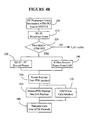
- Figure 4B shows a the flow-chart illustrating the processing of an Ethernet frame to produce ATM cells.
- step 210 station 39 broadcasts the frame on the Ethernet.
- Other stations on the Ethernet receive the frame, check the destination MAC in step 220, and discard it in step 230, as they are not the addressed recipients of this frame.
- E-Mux 21 receives the frame in step 240, and as the recipient, keeps the frame. It performs ATM AAL5 PDU and SAR processing on the payload steps 250 and 260 , extracts the ATM virtual circuit address information from the frame source MAC and inserts it into the cells headers in step 270 . The resulting cells are transmitted in step 280 over the address specified by the VPI/VCI address information.
- Ethernet II/DIX format frame could be converted to RFC1483 encapsulation prior to AAL5 and SAR handling as an additional interworking step.
- the invention may be used for providing ATM WAN (wide area network) access from a LAN.
- ATM WAN wide area network
- Ethernet networks as a distributed multiplexer backbone over several shelves of equipment, permits an Ethernet to be used as the media to demultiplex an ATM UNI over a collection of devices distributed over a large area (e.g. up to 6000 feet for 10BaseT).
- the typical application would see shelf and line card encoded in the ATM VPI/VCI addressing scheme to permit static de-multiplexing of the UNI.
- a variation of the E-Mux of the invention can function as an ATM to Ethernet multiplexer, as shown in Figure 5.
- This variant provides for a highly scaleable and optionally redundant UNI termination for IP (Internet Protocol).
- IP Internet Protocol
- the automated association of IP to VCI/VPI can be utilized to produce ATM interfaces for IP protocol based devices which can support significantly more virtual circuits than are currently available. This eliminates the requirement for the address controllers 41, 41', 41" residing in the attached end station 39, 39', 39". This also moves the IP->ATM association from the custom hardware in the Ethernet interface 43, 43', 43" , to the traditional Ethernet ARP cache resident on the end station.
- Current ATM interfaces are limited to between 500 and 2000 VCs. This invention permits interfaces for relatively low bandwidth connections (as for an ATM based element management channel) to scale up to more than 50,000 virtual circuits.
- FIG. 6A shows the processing of the ATM cells to produce an incoming Ethernet frame
- Figure 6B illustrates the processing of an outgoing Ethernet frame to produce ATM cells, for E-Mux 50 .
- the incoming traffic source OUI field 42 contains the ATM OUI to indicate to the end station that traffic comes from the ATM network 23.
- the VPI/VCI address form the cell header 22 is mapped by E-Mux 50 into the source ID field 44.
- the destination MAC field 28 comprises the Ethernet MAC of the station recipient of the respective frame.
- Figure 6B shows that the end station inserts the ATM OUI identification in field 38 of the destination MAC field 28 and the VPI/VCI address of the destination station in the ATM network 23 in field 40 of the destination MAC.
- the E-Mux 50 inserts the VPI/VCI address into the cell headers, so that the cells are switched accordingly in network 23 .
- the source MAC field 30 comprises the Ethernet address of the end station in the Ethernet network that generated the respective frame.
- the generalized operation is that an attached end station learns the IP->MAC association for devices remotely connected to the ATM network as it would for a normal Ethernet.
- the MAC addresses presented actually contain VPI/VCI information by which those devices can be reached.
- the attached host is "spoofed" into having an Ethernet layer 2 address mapping for ATM connected devices such that Ethernet address resolution and forwarding mechanisms make ATM attached devices reachable.
- This invention can also be used to provide hot standby backup platforms. Normally an ATM connection is unique and cannot automatically be locally switched to another platform. The availability of Ethernet as a broadcast medium permits the ATM traffic to be fanned out to multiple devices simultaneously and only acted upon by the current "active" platform.
Landscapes
- Engineering & Computer Science (AREA)
- Computer Networks & Wireless Communication (AREA)
- Signal Processing (AREA)
- Data Exchanges In Wide-Area Networks (AREA)
- Computer And Data Communications (AREA)
- Time-Division Multiplex Systems (AREA)
Claims (12)
- Multiplexeur (E-Mux) pour encapsuler des cellules ATM dans une trame de réseau local, comprenant :une unité de segmentation et de réassemblage pour recevoir une pluralité de cellules ATM entrantes avec une adresse de destination de réseau local, et générer une unité de données de protocole, ci-après nommée PDU, à couche d'adaptation ATM de type 5, ci-après nommée AAL5 ;un gestionnaire de PDU pour recevoir ladite PDU AAL5 et extraire des données utiles AAL5 ;un processeur d'en-têtes pour extraire un indicateur de type de trafic de l'en-tête de ladite PDU ;un processeur d'adresses pour extraire ladite adresse de destination de réseau local de l'en-tête d'une cellule ATM entrante ; etun gestionnaire de trames pour recevoir ledit indicateur de type de trafic, lesdites données utiles AAL5 et ladite adresse de destination de réseau local et pour générer une trame de réseau local entrante.
- Multiplexeur selon la revendication 1, dans lequel ledit réseau local est un réseau Ethernet et ladite trame de réseau local entrante est une trame Ethernet.
- Multiplexeur (E-Mux) pour segmenter une trame de réseau local en une pluralité de cellules ATM, comprenant :un gestionnaire de trames pour recevoir une trame de réseau local sortante avec une adresse de destination ATM et la désassembler en un indicateur de type de trafic, des données utiles AAL5 et une adresse de destination ATM ;un processeur d'en-têtes pour recevoir ledit indicateur de type de trafic provenant dudit gestionnaire de trames ;un gestionnaire de PDU pour recevoir lesdites données utiles AAL5 et ledit indicateur de type de trafic et générer une unité de données de protocole à couche d'adaptation ATM de type 5, également désignée par PDU AAL5 ;un processeur d'adresses pour recevoir ladite adresse de destination ATM provenant dudit gestionnaire de trames ; etune unité de segmentation et de réassemblage pour recevoir ladite PDU et ladite adresse de destination ATM, générant une pluralité de cellules ATM avec ladite adresse de destination ATM.
- Multiplexeur selon la revendication 3, dans lequel ledit réseau local est un réseau Ethernet et ladite trame de réseau local sortante est une trame Ethernet.
- Multiplexeur selon la revendication 2, comprenant en outre :une interface E-Mux-vers-Ethernet pour formater ladite trame Ethernet pour une transmission sur le support de connexion d'un réseau Ethernet ; etune interface ATM-vers-E-Mux pour formater lesdites cellules ATM reçues depuis un réseau ATM pour être traitées par ledit E-Mux.
- Multiplexeur selon la revendication 4, comprenant en outre :une interface E-Mux-vers-ATM pour formater lesdites cellules ATM pour une transmission sur le support d'un réseau ATM ; etune interface Ethernet-vers-E-Mux pour formater ladite trame Ethernet reçue sur un support de transmission d'un réseau Ethernet pour être traitée par ledit E-Mux.
- Réseau Ethernet comprenant une pluralité de stations d'extrémité et une interface Ethernet/ATM connectées sur un support de transmission, chaque station d'extrémité comprenant un contrôleur d'adresses pour transférer une trame de réseau local entrante reçue depuis ledit réseau ATM à interface Ethernet/ATM vers ladite station d'extrémité lorsqu'une adresse de destination comprise dans le champ MAC de destination de ladite trame est reconnue par ledit contrôleur d'adresses, et pour insérer une adresse de destination ATM dans le champ MAC source d'une trame sortante destinée à ladite interface Ethernet/ATM.
- Réseau de télécommunication comprenant un réseau local avec une pluralité de stations d'extrémité connectées sur d'un support de transmission et d'un réseau ATM, comprenant :un multiplexeur (E-Mux) pour encapsuler une pluralité de cellules ATM entrantes reçues à partir dudit réseau ATM dans une trame de réseau local entrante et pour segmenter une trame de réseau local sortante reçue depuis ledit réseau local en une pluralité de cellules ATM sortantes ;une interface E-Mux-vers-réseau local pour formater ladite trame de réseau local entrante pour une transmission sur le support de connexion dudit réseau local, et pour formater ladite trame de réseau local sortante reçue sur le support de connexion dudit réseau local pour être traitée par ledit E-Mux ;une interface ATM-vers-E-Mux pour formater lesdites cellules ATM entrantes reçues depuis ledit réseau ATM pour être traitées par ledit E-Mux, et pour formater lesdites cellules sortantes pour une transmission sur le support dudit réseau local ; etun contrôleur d'adresses au niveau de chaque station d'extrémité pour transférer ladite trame de réseau local entrante vers ladite station d'extrémité lorsqu'une adresse de destination comprise dans le champ MAC de destination de ladite trame de réseau local entrante est reconnue par ledit contrôleur d'adresses, et pour insérer une adresse de destination ATM dans le champ MAC source de ladite trame de réseau local sortante, lorsque ladite trame de réseau local sortante est destinée au dit réseau ATM.
- Procédé pour transmettre des informations depuis un réseau ATM vers un réseau Ethernet en utilisant un E-Mux exécutant les étapes consistant à :établir une connexion entre un commutateur ATM dudit réseau ATM et une station d'extrémité dudit réseau Ethernet basée sur une adresse de destination VPI/VCI dans l'en-tête d'une cellule ATM entrante ;recevoir une pluralité de cellules ATM entrantes avec ladite adresse de destination, et générer une unité de données de protocole à couche d'adaptation ATM de type 5, également désignée par PDU AAL5 ;extraire des données utiles AAL5 de ladite PDU ;extraire un indicateur de type de trafic de l'entête de ladite PDU ;générer une trame Ethernet entrante en utilisant l'indicateur de type de trafic, lesdites données utiles AAL5 et ladite adresse de destination ; ettransmettre ladite trame Ethernet sur ledit réseau Ethernet vers ladite station d'extrémité en fonction de ladite adresse de destination.
- Procédé selon la revendication 9, dans lequel ladite trame Ethernet entrante comprend :un champ MAC de destination comprenant :un identificateur OUI ATM unique indiquant que ladite trame Ethernet entrante comprend du trafic ATM ; etladite adresse de destination VPI/VCI spécifiant l'adresse de ladite station d'extrémité ; un champ MAC source comprenant :ledit identificateur OUI ATM indiquant que ladite trame Ethernet entrante comprend du trafic ATM ; etune adresse unique dudit E-Mux.
- Procédé pour transmettre des informations depuis un réseau Ethernet vers un réseau ATM en utilisant un E-Mux exécutant les étapes consistant à :établir une connexion entre une station d'extrémité dudit réseau Ethernet et un commutateur ATM dudit réseau ATM basée sur une adresse de destination VPI/VCI délivrée par ladite station d'extrémité ;générer une trame Ethernet sortante au niveau de ladite station d'extrémité et transmettre celle-ci au dit E-Mux ;extraire de ladite trame sortante Ethernet un indicateur de type de trafic, des données utiles de trame et une adresse source ;générer une unité de données de protocole, ci-après désignée PDU, à couche d'adaptation ATM de type 5, ci-après désignée AAL5, à partir desdites données utiles de trame et d'un indicateur de type de trafic extrait du champ de type de ladite trame sortante ; etsegmenter ladite PDU en une pluralité de cellules ATM sortantes et insérer une adresse de destination VPI/VCI dans l'en-tête desdites cellules provenant d'un processeur d'adresses.
- Procédé selon la revendication 11, dans lequel ladite trame Ethernet sortante comprend :un champ MAC de destination comprenant :un identificateur OUI ATM unique indiquant que ladite trame Ethernet sortante comprend du trafic ATM ; etune adresse unique dudit E-Mux ;un champ MAC source comprenant :ledit identificateur OUI ATM indiquant que ladite trame Ethernet sortante comprend du trafic ATM ; etladite adresse de destination VPI/VIC spécifiant l'adresse de ladite cellule ATM.
Applications Claiming Priority (3)
| Application Number | Priority Date | Filing Date | Title |
|---|---|---|---|
| US08/821,145 US5946313A (en) | 1997-03-20 | 1997-03-20 | Mechanism for multiplexing ATM AAL5 virtual circuits over ethernet |
| US821145 | 1997-03-20 | ||
| PCT/CA1998/000197 WO1998043396A1 (fr) | 1997-03-20 | 1998-03-11 | Mecanisme permettant de multiplexer des circuits virtuels de aal5 mta sur ethernet |
Publications (2)
| Publication Number | Publication Date |
|---|---|
| EP0976227A1 EP0976227A1 (fr) | 2000-02-02 |
| EP0976227B1 true EP0976227B1 (fr) | 2004-08-25 |
Family
ID=25232642
Family Applications (1)
| Application Number | Title | Priority Date | Filing Date |
|---|---|---|---|
| EP98907785A Expired - Lifetime EP0976227B1 (fr) | 1997-03-20 | 1998-03-11 | Mecanisme permettant de multiplexer des circuits virtuels de aal5 mta sur ethernet |
Country Status (6)
| Country | Link |
|---|---|
| US (1) | US5946313A (fr) |
| EP (1) | EP0976227B1 (fr) |
| AU (1) | AU730290B2 (fr) |
| CA (1) | CA2279885C (fr) |
| DE (1) | DE69825882T2 (fr) |
| WO (1) | WO1998043396A1 (fr) |
Families Citing this family (100)
| Publication number | Priority date | Publication date | Assignee | Title |
|---|---|---|---|---|
| US6847611B1 (en) | 1990-12-10 | 2005-01-25 | At&T Corp. | Traffic management for frame relay switched data service |
| US6327266B1 (en) * | 1997-04-25 | 2001-12-04 | Alcatel Usa Sourcing, L.P. | Multiple user access network |
| US6104715A (en) * | 1997-04-28 | 2000-08-15 | International Business Machines Corporation | Merging of data cells in an ATM network |
| JP3575225B2 (ja) * | 1997-05-19 | 2004-10-13 | 株式会社日立製作所 | パケット交換機、パケット交換網及びパケット交換方法 |
| US6081524A (en) | 1997-07-03 | 2000-06-27 | At&T Corp. | Frame relay switched data service |
| US6310874B1 (en) * | 1998-03-19 | 2001-10-30 | 3Com Corporation | Learn pending frame throttle |
| US6643292B2 (en) * | 1998-04-28 | 2003-11-04 | Nortel Networks Limited | Efficient packet data transport mechanism and an interface therefor |
| US6539011B1 (en) * | 1998-06-10 | 2003-03-25 | Merlot Communications, Inc. | Method for initializing and allocating bandwidth in a permanent virtual connection for the transmission and control of audio, video, and computer data over a single network fabric |
| US6560228B2 (en) * | 1998-07-01 | 2003-05-06 | Agilent Technologies, Inc. | Generation of informative MAC headers for analysis of ATM routed LAN frames |
| US6389030B1 (en) * | 1998-08-21 | 2002-05-14 | Adc Telecommunications, Inc. | Internet access over a ring network |
| US6570880B1 (en) * | 1998-08-21 | 2003-05-27 | Adc Telecommunications, Inc. | Control data over a ring network |
| US6711178B1 (en) * | 1998-09-08 | 2004-03-23 | Cisco Technology, Inc. | Enhanced claw packing protocol |
| DE19845038A1 (de) * | 1998-09-30 | 2000-04-06 | Siemens Ag | Verfahren zum Anschließen von Kommunikationsendgeräten an eine Vermittlungsanlage über ein Kommunikationsnetz |
| US10511573B2 (en) | 1998-10-30 | 2019-12-17 | Virnetx, Inc. | Agile network protocol for secure communications using secure domain names |
| US6502135B1 (en) | 1998-10-30 | 2002-12-31 | Science Applications International Corporation | Agile network protocol for secure communications with assured system availability |
| ATE492973T1 (de) | 1998-10-30 | 2011-01-15 | Virnetx Inc | Netzwerkprotokoll zur geschützten kommunikation |
| US6826616B2 (en) | 1998-10-30 | 2004-11-30 | Science Applications International Corp. | Method for establishing secure communication link between computers of virtual private network |
| US7418504B2 (en) | 1998-10-30 | 2008-08-26 | Virnetx, Inc. | Agile network protocol for secure communications using secure domain names |
| US7369496B1 (en) * | 1998-12-02 | 2008-05-06 | Notel Networks Limited | Flow control of frame based data over a synchronous digital network |
| US6614791B1 (en) * | 1999-05-11 | 2003-09-02 | Nortel Networks Limited | System, device, and method for supporting virtual private networks |
| US6804211B1 (en) * | 1999-08-03 | 2004-10-12 | Wi-Lan Inc. | Frame structure for an adaptive modulation wireless communication system |
| US6724761B1 (en) * | 1999-09-29 | 2004-04-20 | Northrop Grumman Corporation | Method and apparatus for serial cell replication for multicast in a cell switch |
| WO2001031969A1 (fr) * | 1999-10-25 | 2001-05-03 | E-Cell Technologies | Commutateur d'acces ethernet utilise dans des reseaux a cellules precaracterisees |
| US6683866B1 (en) * | 1999-10-29 | 2004-01-27 | Ensemble Communications Inc. | Method and apparatus for data transportation and synchronization between MAC and physical layers in a wireless communication system |
| US6813279B1 (en) * | 1999-12-29 | 2004-11-02 | Intel Corporation | Ethernet to ATM converter |
| US6775284B1 (en) | 2000-01-07 | 2004-08-10 | International Business Machines Corporation | Method and system for frame and protocol classification |
| US6184409B1 (en) * | 2000-03-01 | 2001-02-06 | General Electric Company | Method and catalyst system for producing aromatic carbonates |
| US6671280B1 (en) | 2000-03-29 | 2003-12-30 | International Business Machines Corporation | Network processor for multiprotocol data flows |
| US6810039B1 (en) * | 2000-03-30 | 2004-10-26 | Azanda Network Devices, Inc. | Processor-based architecture for facilitating integrated data transfer between both atm and packet traffic with a packet bus or packet link, including bidirectional atm-to-packet functionally for atm traffic |
| US6895004B1 (en) * | 2000-04-17 | 2005-05-17 | Alcatel | Internal use only addresses |
| US20020031133A1 (en) * | 2000-05-25 | 2002-03-14 | Mcwilliams Patrick | Embedded communication protocol using a UTOPIA-LVDS bridge |
| US7496095B1 (en) * | 2000-06-22 | 2009-02-24 | Intel Corporation | Local area network emulation over a channel based network |
| US6463063B1 (en) * | 2000-06-30 | 2002-10-08 | Marconi Communications, Inc. | Receiver makes right |
| US6731649B1 (en) | 2000-07-26 | 2004-05-04 | Rad Data Communication Ltd. | TDM over IP (IP circuit emulation service) |
| US6850495B1 (en) | 2000-08-31 | 2005-02-01 | Verizon Communications Inc. | Methods, apparatus and data structures for segmenting customers using at least a portion of a layer 2 address header or bits in the place of a layer 2 address header |
| US7315554B2 (en) * | 2000-08-31 | 2008-01-01 | Verizon Communications Inc. | Simple peering in a transport network employing novel edge devices |
| US8087064B1 (en) | 2000-08-31 | 2011-12-27 | Verizon Communications Inc. | Security extensions using at least a portion of layer 2 information or bits in the place of layer 2 information |
| US7092390B2 (en) * | 2000-09-07 | 2006-08-15 | Sbc Technology Resources, Inc. | Internal substitution bi-level addressing for compatible public networks |
| DE10050608B4 (de) * | 2000-10-12 | 2007-02-22 | Siemens Ag | Verfahren und Anordnung zur Sprachübertragung über ein IP-Netz oder Lokales Netz vom Ethernet-Typ |
| US7310353B1 (en) * | 2000-10-30 | 2007-12-18 | Yair Bourlas | Compression of overhead in layered data communication links |
| US7197022B2 (en) | 2000-11-15 | 2007-03-27 | Wi-Lan, Inc. | Framing for an adaptive modulation communication system |
| US7116683B1 (en) * | 2000-11-21 | 2006-10-03 | Telefonaktiebolaget Lm Ericsson (Publ) | Sequencing of user data packets segmented into AAL2 packets transported over internet protocol (IP) |
| US8009667B1 (en) * | 2001-01-16 | 2011-08-30 | Wi—LAN, Inc. | Packing source data packets into transporting packets with fragmentation |
| US7342942B1 (en) | 2001-02-07 | 2008-03-11 | Cortina Systems, Inc. | Multi-service segmentation and reassembly device that maintains only one reassembly context per active output port |
| US7327760B1 (en) | 2001-05-08 | 2008-02-05 | Cortina Systems, Inc. | Multi-service segmentation and reassembly device operable with either a cell-based or a packet-based switch fabric |
| US7406518B2 (en) * | 2001-05-18 | 2008-07-29 | Lucent Technologies Inc. | Method and system for connecting virtual circuits across an ethernet switch |
| US7586941B2 (en) | 2001-08-24 | 2009-09-08 | Gonda Rumi S | Method and apparatus for translating SDH/SONET frames to ethernet frames |
| JP2003134158A (ja) * | 2001-10-29 | 2003-05-09 | Fujitsu Ltd | パケット多重制御方法及びこれを用いる集線装置 |
| US7042886B2 (en) * | 2001-12-06 | 2006-05-09 | P-Cube Ltd. | Apparatus, method, and computer program for wire-speed classification and pre-processing of data packets in an ATM network |
| AU2002237315A1 (en) * | 2002-03-01 | 2003-09-16 | Infineon Technologies Ag | Atm-port-module with integrated ethernet switch interface |
| DE10242321B4 (de) * | 2002-03-01 | 2005-08-18 | Infineon Technologies Ag | ATM-Anschlussmodul mit integrierter Ethernet-Vermittlungsschnittstelle |
| US7136384B1 (en) * | 2002-03-19 | 2006-11-14 | Cisco Technology, Inc. | System and method for communicating asynchronous transfer mode cells in a network environment |
| GB2389023B (en) * | 2002-05-20 | 2004-04-28 | Sun Microsystems Inc | Computer system, method and network |
| DE10226637A1 (de) * | 2002-06-14 | 2004-01-15 | Siemens Ag | Verfahren, Kommunikationsanordnung und Kommunikationseinrichtung zum Übermitteln von Informationen |
| US7272145B2 (en) * | 2002-07-31 | 2007-09-18 | At&T Knowledge Ventures, L.P. | Resource reservation protocol based guaranteed quality of service internet protocol connections over a switched network through proxy signaling |
| US7298750B2 (en) * | 2002-07-31 | 2007-11-20 | At&T Knowledge Ventures, L.P. | Enhancement of resource reservation protocol enabling short-cut internet protocol connections over a switched network |
| US7065092B2 (en) * | 2002-07-31 | 2006-06-20 | Sbc Properties, L.P. | Resource reservation protocol based guaranteed quality of service internet protocol (IP) connections over a switched network using newly assigned IP addresses |
| US7301951B2 (en) * | 2002-07-31 | 2007-11-27 | At&T Knowledge Ventures, L.P. | Resource reservation protocol based guaranteed quality of service internet protocol connections over a switched network |
| US7313330B2 (en) * | 2002-08-13 | 2007-12-25 | Samsung Electronics Co., Ltd. | Redundant apparatus and method for gigabit ethernet passive optical network system and frame format thereof |
| US7984475B1 (en) * | 2002-10-04 | 2011-07-19 | Sprint Communications Company L.P. | Video channel broadcast using ethernet technology |
| US7457300B2 (en) * | 2003-01-21 | 2008-11-25 | Telefonaktiebolaget L M Ericsson (Publ) | Ethernet address management system |
| EP1480392A1 (fr) * | 2003-05-19 | 2004-11-24 | Alcatel | Procédé, élément de réseau d'accès, serveur d'accès au réseau et produit logiciel pour l'accès à un réseau |
| IL156923A (en) * | 2003-07-15 | 2009-08-03 | Eci Telecom Ltd | Method of handling atm packets at vp layer |
| US7739394B2 (en) * | 2003-07-29 | 2010-06-15 | At&T Intellectual Property I, L.P. | Bi-level addressing for internet protocol broadband access |
| US7447203B2 (en) | 2003-07-29 | 2008-11-04 | At&T Intellectual Property I, L.P. | Broadband access for virtual private networks |
| US8472473B2 (en) * | 2003-10-15 | 2013-06-25 | Qualcomm Incorporated | Wireless LAN protocol stack |
| US8462817B2 (en) | 2003-10-15 | 2013-06-11 | Qualcomm Incorporated | Method, apparatus, and system for multiplexing protocol data units |
| US9226308B2 (en) | 2003-10-15 | 2015-12-29 | Qualcomm Incorporated | Method, apparatus, and system for medium access control |
| US8233462B2 (en) | 2003-10-15 | 2012-07-31 | Qualcomm Incorporated | High speed media access control and direct link protocol |
| US8483105B2 (en) | 2003-10-15 | 2013-07-09 | Qualcomm Incorporated | High speed media access control |
| US7864785B1 (en) * | 2003-10-31 | 2011-01-04 | Cisco Technology, Inc. | Method and apparatus for creating bundle of soft permanent virtual circuits |
| US8903440B2 (en) | 2004-01-29 | 2014-12-02 | Qualcomm Incorporated | Distributed hierarchical scheduling in an ad hoc network |
| US7649843B2 (en) * | 2004-02-09 | 2010-01-19 | Transwitch Corporation | Methods and apparatus for controlling the flow of multiple signal sources over a single full duplex ethernet link |
| DE102004020288A1 (de) * | 2004-04-26 | 2005-11-17 | Siemens Ag | Verfahren zur Zuordnung einer Anzahl von M teilnehmerseitig angeordneten Datenverbindungen zu einer Anzahl von N transportseitig angeordneten Datenverbindungen |
| US7613186B2 (en) * | 2004-05-06 | 2009-11-03 | Via Telecom Co., Ltd. | Processing multiplex sublayer data unit data in hardware |
| US8401018B2 (en) | 2004-06-02 | 2013-03-19 | Qualcomm Incorporated | Method and apparatus for scheduling in a wireless network |
| US20050281267A1 (en) * | 2004-06-22 | 2005-12-22 | Mcfadden Gordon | ATM switching protocol |
| CN100414939C (zh) * | 2004-07-26 | 2008-08-27 | 华为技术有限公司 | Atm数据与帧格式转换的电路、方法及传输交换系统及方法 |
| US7602720B2 (en) * | 2004-10-22 | 2009-10-13 | Cisco Technology, Inc. | Active queue management methods and devices |
| US8238347B2 (en) | 2004-10-22 | 2012-08-07 | Cisco Technology, Inc. | Fibre channel over ethernet |
| US7564869B2 (en) | 2004-10-22 | 2009-07-21 | Cisco Technology, Inc. | Fibre channel over ethernet |
| US7830793B2 (en) * | 2004-10-22 | 2010-11-09 | Cisco Technology, Inc. | Network device architecture for consolidating input/output and reducing latency |
| US7801125B2 (en) * | 2004-10-22 | 2010-09-21 | Cisco Technology, Inc. | Forwarding table reduction and multipath network forwarding |
| US7969971B2 (en) * | 2004-10-22 | 2011-06-28 | Cisco Technology, Inc. | Ethernet extension for the data center |
| WO2006069473A1 (fr) * | 2004-12-28 | 2006-07-06 | Zte Corporation | Procede et dispositif de double encapsulation d'informations dans un dispositif de communication |
| WO2006116396A2 (fr) * | 2005-04-26 | 2006-11-02 | Anders Joseph C | Systeme voix sur ip et procede de traitement de donnees vocales telephoniques sur un reseau de donnees |
| US8600336B2 (en) | 2005-09-12 | 2013-12-03 | Qualcomm Incorporated | Scheduling with reverse direction grant in wireless communication systems |
| US7961621B2 (en) * | 2005-10-11 | 2011-06-14 | Cisco Technology, Inc. | Methods and devices for backward congestion notification |
| CN101102261A (zh) | 2006-07-03 | 2008-01-09 | 华为技术有限公司 | 以太网承载异步传输模式信元的方法及装置 |
| DE102006037029A1 (de) * | 2006-08-08 | 2008-02-14 | Benq Mobile Gmbh & Co. Ohg | Vorrichtung und Verfahren zur Realisierung einer Datenversorgung |
| US8259720B2 (en) | 2007-02-02 | 2012-09-04 | Cisco Technology, Inc. | Triple-tier anycast addressing |
| US8503423B2 (en) | 2007-02-02 | 2013-08-06 | Interdigital Technology Corporation | Method and apparatus for versatile MAC multiplexing in evolved HSPA |
| US8149710B2 (en) | 2007-07-05 | 2012-04-03 | Cisco Technology, Inc. | Flexible and hierarchical dynamic buffer allocation |
| US8121038B2 (en) | 2007-08-21 | 2012-02-21 | Cisco Technology, Inc. | Backward congestion notification |
| US7996520B2 (en) | 2007-09-19 | 2011-08-09 | Cisco Technology, Inc. | Behavioral classification of communication sessions using active session initiation |
| EP2606614A4 (fr) | 2010-08-20 | 2017-01-11 | Nec Corporation | Système de communication, contrôleur, procédé et programme de contrôle de n ud |
| CN103026669B (zh) * | 2010-08-20 | 2015-07-01 | 日本电气株式会社 | 通信系统、控制设备以及通信方法 |
| DE102011015966B4 (de) | 2011-04-04 | 2017-07-06 | Wago Verwaltungsgesellschaft Mbh | Automatisierungssystem |
| JP5857661B2 (ja) * | 2011-11-18 | 2016-02-10 | 沖電気工業株式会社 | パケット処理装置及び方法 |
| US11258888B2 (en) * | 2019-11-11 | 2022-02-22 | Cisco Technology, Inc. | Parallel redundancy protocol (PRP) using non-overlapping resource unit (RU) groupings on a radio |
Family Cites Families (6)
| Publication number | Priority date | Publication date | Assignee | Title |
|---|---|---|---|---|
| US5457681A (en) * | 1992-06-05 | 1995-10-10 | Washington University | ATM-Ethernet portal/concentrator |
| US5295895A (en) * | 1993-06-21 | 1994-03-22 | Klyce Thomas A | Method and apparatus for skinning encased frankfurters and the like |
| JP3142433B2 (ja) * | 1993-12-29 | 2001-03-07 | 株式会社東芝 | ブリッジ装置及びブリッジ接続方法 |
| GB9401092D0 (en) * | 1994-01-21 | 1994-03-16 | Newbridge Networks Corp | A network management system |
| US5490141A (en) * | 1994-09-30 | 1996-02-06 | International Business Machines Corporation | System and method for providing SVC service through an ATM network for frame relay DTEs with a terminal adapter |
| US5490140A (en) * | 1994-09-30 | 1996-02-06 | International Business Machines Corporation | System and method for providing ATM support for frame relay DTEs with a terminal adapter |
-
1997
- 1997-03-20 US US08/821,145 patent/US5946313A/en not_active Expired - Lifetime
-
1998
- 1998-03-11 WO PCT/CA1998/000197 patent/WO1998043396A1/fr not_active Ceased
- 1998-03-11 AU AU66053/98A patent/AU730290B2/en not_active Ceased
- 1998-03-11 DE DE69825882T patent/DE69825882T2/de not_active Expired - Fee Related
- 1998-03-11 EP EP98907785A patent/EP0976227B1/fr not_active Expired - Lifetime
- 1998-03-11 CA CA002279885A patent/CA2279885C/fr not_active Expired - Fee Related
Also Published As
| Publication number | Publication date |
|---|---|
| US5946313A (en) | 1999-08-31 |
| DE69825882D1 (de) | 2004-09-30 |
| CA2279885C (fr) | 2003-02-04 |
| CA2279885A1 (fr) | 1998-10-01 |
| DE69825882T2 (de) | 2005-09-01 |
| EP0976227A1 (fr) | 2000-02-02 |
| AU6605398A (en) | 1998-10-20 |
| AU730290B2 (en) | 2001-03-01 |
| WO1998043396A1 (fr) | 1998-10-01 |
Similar Documents
| Publication | Publication Date | Title |
|---|---|---|
| EP0976227B1 (fr) | Mecanisme permettant de multiplexer des circuits virtuels de aal5 mta sur ethernet | |
| US5490141A (en) | System and method for providing SVC service through an ATM network for frame relay DTEs with a terminal adapter | |
| US5490140A (en) | System and method for providing ATM support for frame relay DTEs with a terminal adapter | |
| US6137798A (en) | Connectionless network for routing cells with connectionless address, VPI and packet-identifying VCI | |
| US5999535A (en) | Short cut forwarding of local cells-in-frames traffic within local-area-networks | |
| US5809024A (en) | Memory architecture for a local area network module in an ATM switch | |
| US7620051B2 (en) | ATM permanent virtual circuit and layer 3 auto-configuration for digital subscriber line customer premises equipment | |
| US6028861A (en) | Method and apparatus for performing packet synchronized switch-over | |
| GB2254529A (en) | Connectionless switching for an atm or dqdb switch | |
| EP1047280B1 (fr) | Systèmes de communication | |
| US6707800B1 (en) | ATM network with central call processor | |
| KR100299907B1 (ko) | 랜 에뮬레이션시의 브로드캐스트 패킷전송방법과 그 lsi 장치 | |
| KR100345455B1 (ko) | 브이씨 머징 장치 및 그의 연결 설정 및 해제 방법 | |
| Venieris et al. | Bridging remote connectionless LAN/MANs through connection oriented ATM networks | |
| US7424005B1 (en) | Layer 2 link handler and path connection method thereof | |
| Esaki et al. | Datagram Delivery in an ATM-Internet | |
| Albanese et al. | Evolution of the Network Supporting SMDS to B-ISDN | |
| EP0903046B1 (fr) | Perfectionnements apportes ou relatifs a la transmission en mode asynchrone par radio | |
| Venieris et al. | DQDB MAN as a Transit Network for ATM CPNs | |
| Venieris et al. | ATM traffic transfer via queued-arbitrated DQDB | |
| EP1161818B1 (fr) | Procede et appareil de commutation synchronisee de paquets | |
| KR0131855B1 (ko) | 연상기억장치를 이용한 비동기 전달모드 셀 라우팅 장치 | |
| Renyong et al. | ATM protocol on LAN | |
| KR20010046945A (ko) | 기지국과 교환기간의 셀 라우팅 장치 | |
| JPH0690236A (ja) | Lan間接続制御方式 |
Legal Events
| Date | Code | Title | Description |
|---|---|---|---|
| PUAI | Public reference made under article 153(3) epc to a published international application that has entered the european phase |
Free format text: ORIGINAL CODE: 0009012 |
|
| 17P | Request for examination filed |
Effective date: 19991020 |
|
| AK | Designated contracting states |
Kind code of ref document: A1 Designated state(s): DE FR GB |
|
| RAP1 | Party data changed (applicant data changed or rights of an application transferred) |
Owner name: NORTEL NETWORKS LIMITED |
|
| RAP1 | Party data changed (applicant data changed or rights of an application transferred) |
Owner name: NORTEL NETWORKS LIMITED |
|
| GRAP | Despatch of communication of intention to grant a patent |
Free format text: ORIGINAL CODE: EPIDOSNIGR1 |
|
| GRAS | Grant fee paid |
Free format text: ORIGINAL CODE: EPIDOSNIGR3 |
|
| GRAA | (expected) grant |
Free format text: ORIGINAL CODE: 0009210 |
|
| AK | Designated contracting states |
Kind code of ref document: B1 Designated state(s): DE FR GB |
|
| REG | Reference to a national code |
Ref country code: GB Ref legal event code: FG4D |
|
| REF | Corresponds to: |
Ref document number: 69825882 Country of ref document: DE Date of ref document: 20040930 Kind code of ref document: P |
|
| PG25 | Lapsed in a contracting state [announced via postgrant information from national office to epo] |
Ref country code: GB Free format text: LAPSE BECAUSE OF NON-PAYMENT OF DUE FEES Effective date: 20050311 |
|
| ET | Fr: translation filed | ||
| PLBE | No opposition filed within time limit |
Free format text: ORIGINAL CODE: 0009261 |
|
| STAA | Information on the status of an ep patent application or granted ep patent |
Free format text: STATUS: NO OPPOSITION FILED WITHIN TIME LIMIT |
|
| 26N | No opposition filed |
Effective date: 20050526 |
|
| PG25 | Lapsed in a contracting state [announced via postgrant information from national office to epo] |
Ref country code: DE Free format text: LAPSE BECAUSE OF NON-PAYMENT OF DUE FEES Effective date: 20051001 |
|
| GBPC | Gb: european patent ceased through non-payment of renewal fee |
Effective date: 20050311 |
|
| PG25 | Lapsed in a contracting state [announced via postgrant information from national office to epo] |
Ref country code: FR Free format text: LAPSE BECAUSE OF NON-PAYMENT OF DUE FEES Effective date: 20051130 |
|
| REG | Reference to a national code |
Ref country code: FR Ref legal event code: ST Effective date: 20051130 |