EP0906671B1 - Agencement de commande d'acces au support pour transmission de donnees sur des systemes sans fil a acces multiple par code de repartition (amcr) - Google Patents
Agencement de commande d'acces au support pour transmission de donnees sur des systemes sans fil a acces multiple par code de repartition (amcr) Download PDFInfo
- Publication number
- EP0906671B1 EP0906671B1 EP96937952A EP96937952A EP0906671B1 EP 0906671 B1 EP0906671 B1 EP 0906671B1 EP 96937952 A EP96937952 A EP 96937952A EP 96937952 A EP96937952 A EP 96937952A EP 0906671 B1 EP0906671 B1 EP 0906671B1
- Authority
- EP
- European Patent Office
- Prior art keywords
- base station
- mobile terminal
- channel
- assigned
- synchronization
- Prior art date
- Legal status (The legal status is an assumption and is not a legal conclusion. Google has not performed a legal analysis and makes no representation as to the accuracy of the status listed.)
- Expired - Lifetime
Links
Images


Classifications
-
- H—ELECTRICITY
- H04—ELECTRIC COMMUNICATION TECHNIQUE
- H04W—WIRELESS COMMUNICATION NETWORKS
- H04W56/00—Synchronisation arrangements
- H04W56/0055—Synchronisation arrangements determining timing error of reception due to propagation delay
- H04W56/0065—Synchronisation arrangements determining timing error of reception due to propagation delay using measurement of signal travel time
- H04W56/007—Open loop measurement
- H04W56/0075—Open loop measurement based on arrival time vs. expected arrival time
- H04W56/0085—Open loop measurement based on arrival time vs. expected arrival time detecting a given structure in the signal
Definitions
- the present invention relates to the use of code division multiple access to support data transmission systems. More particularly, the present invention relates to wireless access synchronization techniques to support integrated services in third generation personal communications systems and as the wireless access technology for local area networks.
- CDMA systems also known as CDMA wireless access systems, are comprised of a plurality of base stations interconnected by one or more switching systems. Each base station serves a particular geographic region referred to as a cell. Within each base station's cell are any number of mobile terminals. The function of each base station is to transmit data between its respective switching system and the mobile terminals assigned to its cell. The base station transmits the data to the mobile terminal over radio channels, which are also known as downlinks. Conversely, the mobile terminals communicate with their assigned base station over radio channels known as uplinks.
- radio channels which are also known as downlinks.
- the base station maintains track of its assigned mobile terminals by continuously transmitting a pilot signal containing timing markers on a specific downlink channel. This continuous transmission allows the base station to maintain synchronization with its assigned mobile terminals. Such synchronization in turn enables the base station to transmit data to any given mobile terminal as needed.
- a base station In addition to achieving synchronization on the downlink channel for sending data, a base station also synchronizes with its assigned mobile terminals via the uplink channel to receive data by using a synchronization message. Synchronization messages are transmitted by a mobile terminal when it initiates a call. Like the pilot signal, the synchronization message also contains timing markers to which the receiver on the assigned base station synchronizes at the beginning of a call. Once the uplink channel from the mobile terminal to the base station is established, the base station uses additional timing information contained in on-going transmissions from the connected mobile terminal to maintain synchronization.
- synchronization messages are inapplicable for other types of cellular services because such cellular services do not maintain frequent enough contact with their respective base station to maintain synchronization. Accordingly, if the system is used to provide packet data services, or any other services in which the mobile terminal to base station transmissions are infrequent bursts, the base station may lose synchronization with its mobile terminals.
- CTX-MAC scheme is not very practical in that it requires the reservation of an uplink channel for each mobile terminal engaged in bursty data transmission. Accordingly, even if a mobile terminal's use of its assigned channel to transmit data bursts was very infrequent, the assigned channel could not be used by any other mobile terminal and in effect would be rendered useless whenever the assigned mobile terminal ceased transmitting. Additionally, the receiver on the base station must remain active at all times for each "on-off" source. An "on-off' source is one that alternates between periods when it transmits data and periods when it has no data to transmit.
- a variation of the CTX-MAC scheme which serves on-off sources with small duty cycles, i.e., the ratio of the on-period to the off-period, can achieve considerable savings in base station hardware, such as eliminating individually assigned receivers, if the transmission from the individual mobile terminals is discontinued during the off-periods and the hardware is shared among different users.
- DTX-MAC discontinuous transmission medium access control
- a synchronization message must be transmitted at the beginning of each on-period to allow the base station to acquire synchronization with the transmitting mobile terminal.
- the synchronization message also serves to inform the base station that a particular mobile terminal intends to transmit.
- one approach allows the mobile units to send synchronization messages in an asynchronous fashion, which is also known as the ADTX-MAC scheme.
- ADTX-MAC scheme one of the shortcomings of the ADTX-MAC scheme is that collisions may occur among the numerous synchronization messages sent by their respective mobile terminals.
- the ADTX-MAC scheme is that collisions may occur among the numerous synchronization messages sent by their respective mobile terminals.
- the IS-95 standard refers to as a preamble
- a collision occurs.
- two or more of the mobile terminals have a relative delay of less than a chip duration, then destructive collisions occur and all terminals must retransmit at a later time. If all relative delays are greater than one chip duration, then depending on the receiver design used, the first arriving mobile terminal may be able to successfully synchronize but the second arriving mobile terminal will not be able to synchronize.
- Another method to reduce the probability of destructive collisions functions by delaying the synchronization message according to some probabilistic rule.
- the initial delay tends to propagate additional synchronization acquisition delays.
- the collision of the numerous synchronization messages will also result in added interference. These secondary interferences are referred to as interfering collisions.
- the ADTX-MAC's performance depends on the number of synchronization-reservation channels required to establish uplinks for all the mobile terminals.
- the number of synchronization-reservation channels required depends significantly on the synchronization message traffic generated by the mobile terminals.
- the ADTX-MAC scheme is inherently unstable due to the potential for destructive or interfering collisions. As a result of this uncertainty in the amount of synchronization traffic generated, not only is the system designer forced to underdimension the system as a whole, the design of the protocol needed to stabilize the system also becomes more complicated.
- EP-A-0 592 209 discloses a method of establishing synchronisation between radio base stations by including synchronisation establishing information in a control signal transmitted at a predetermined time interval from each of the radio base stations.
- a receiving radio base station receives the control signal transmitted from a transmitting radio base station and determines whether the transmitting radio base station has established synchronisation. If so, synchronisation with the transmitting radio base station is established in the receiving radio base station.
- EP-A-0 678 991 discloses a method of controlling synchronisation signal power in a spread spectrum communication system.
- a first station To initiate communication, a first station generates a synchronisation signal and sends it to a second station.
- the second station detects the synchronisation signal, it acquires synchronisation and sends a synchronisation-acquisition message back to the first station.
- the first station then reduces the power of the synchronisation signal, but continues to send it, and also begins sending a modulated data signal.
- the second station uses the synchronisation signal to maintain synchronisation for demodulating the data signal.
- WO-A-95/34154 discloses a method for synchronising subscriber equipment with the transmission of a base station in which the base station transmits a separate pilot channel provided with a predetermined spreading code. In order to facilitate the synchronisation of the subscriber equipment, the base station transmits a data-modulated signal on the pilot channel.
- the present invention is directed to a method and apparatus to acquire synchronization by a base station with a mobile terminal at the beginning of the on-period on the uplink channel which substantially overcomes one or more of the above mentioned problems arising from limitations and disadvantages of the related art.
- the invention is a method and apparatus for transmitting a synchronization message on an uplink channel which not only reduces the number of receivers on the base station but also avoids the need for identifying the mobile terminal transmitting the synchronization message, which as a consequence avoids collisions among other mobile terminals in the same cell and reduces inteference.
- This embodiment is a synchronous approach to the transmission of a synchronization message in order to overcome the shortcomings of the ADTX-MAC scheme described above.
- the preferred embodiment is synchronous discontinuous transmission MAC (SDTX-MAC)scheme in which a TDMA frame on a synchronous synchronization-reservation (SSR) channel on the reverse link is divided into short time slots, and each time slot is assigned to a mobile terminal.
- SDTX-MAC synchronous discontinuous transmission MAC
- the first step in establishing a SDTX-MAC scheme is depicted in Fig. 1.
- the base station maintains constant contact with its assigned mobile terminals by constantly broadcasting, as shown in step 101, a pilot signal on the downlink pilot channel.
- the user initiates, as shown in step 103, a transmission from the mobile terminal to the base station by powering on the mobile terminal.
- the mobile terminal registers with the base station by broadcasting, as shown in step 105, an origination message on one of the uplink access channels.
- the base station Upon receiving the origination message, the base station broadcasts, as shown in step 107, an assignment message to the mobile terminal on one of the downlink paging channels.
- This assignment message consists of an SSR channel assignment and an assigned time slot on the assigned SSR channel for use by the mobile terminal in communicating with the base station.
- the mobile terminal Upon receiving the assignment message, the mobile terminal tunes its transmitter, as shown in step 109, to its assigned SSR channel, and stores both the SSR channel identifier and the time slot identifier in memory. The mobile terminal is now prepared to begin its data burst transmission to the base station.
- Fig. 2 shows how a mobile terminal achieves packet data transmission on the uplink.
- each mobile terminal is initially programmed to operate, as shown in step 201, at its lowest power setting. Then using the information contained in the assignment message, the mobile terminal's transmitter broadcasts, as shown in step 203, a synchronization message to the base station on the assigned SSR channel at the assigned time slot.
- an acknowledgement timer begins to run as shown in step 205. If the base station does not send an acknowledgement message within a period of time set by the mobile terminal, as shown in step 207, the acknowledgement timer expires. If the acknowledgement timer does expire as shown in step 209, the power setting of the mobile terminal's transmitter is increased by X dB where (0 ⁇ X ⁇ 7) dB. After the power level is reset the message is rebroadcast, and the acknowledgement timer begins again.
- the base station receives the synchronization message it synchronizes to the mobile terminal using the preamble in the synchronization message and then sends, as shown in step 211, an acknowledgment to the mobile terminal.
- This acknowledgment is in the form of a channel assignment message containing a traffic channel and a send time.
- the channel assignment message is then broadcast by the base station to the mobile terminal on a response reservation channel (RR).
- RR response reservation channel
- the paging channel could be used to broadcast the channel assignment message as well.
- the mobile terminal Upon receiving the channel assignment message, the mobile terminal tunes its transmitter to the assigned traffic channel and at the assigned send time transmits, as shown in step 213, its data frames to the base station on a reverse traffic channel.
- a layer two ARQ (Automatic Repeat request) protocol may be used to ensure that the data frames are received correctly and in sequence, as shown in step 215.
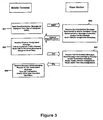
- Fig. 3 depicts the call termination mode which begins with the mobile terminal using the time slot assigned in the assignment message to broadcast, as shown in step 301, a synchronization message on the SSR channel to the base station.
- the base station uses the preamble in the synchronization message broadcast by the mobile terminal to synchronize, as shown in step 303, with the mobile terminal.
- the base station then assigns a traffic channel and a transmit time to the mobile terminal in a channel assignment message. This channel assignment message is subsequently broadcast on a response reservation channel by the base station to mobile terminal.
- the mobile terminal Upon receiving the channel assignment message, the mobile terminal tunes its transmitter to the assigned traffic channel and at the assigned send time transmits its call termination message on a reverse traffic channel to the base station, as shown in step 305.
- the base station Upon receiving the call termination message, the base station broadcasts, as shown in step 307, an acknowledgement message to the mobile terminal on a forward traffic channel, and then deletes both the traffic channel and the SSR channel time slot assignments for that particular mobile terminal.
- the mobile terminal upon receiving the message from the base station acknowledging the receipt of the call termination message, the mobile terminal, as shown in step 309, turns off its transmitter and deletes both its SSR channel assignment and its time slot assignment, thereby terminating the call.
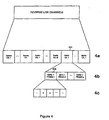
- Fig. 4 depicts the format of all the reverse TDMA channels on which the mobile terminal can broadcast, including the r SSR channels.
- Fig. 4b depicts the first SSR channel 401 further divided into s frames.
- Fig. 4c depicts the first frame of the first SSR channel 402 further divided into a series of t consecutive time slots.
- the preferred embodiment of the invention functions by assigning a time slot on a certain SSR channel to each mobile terminal during the call orientation period. It should be noted that the SSR channel frame repeats itself after t SSR channel time slots.
- An SSR channel PN code or SSRC-PN, is assigned for each SSR channel in a sector of a given cell in which the mobile terminals are located.
- An SSRC-PN is a short code which is transmitted by the mobile terminal on its assigned SSR channel time slot. Because the same PN code is used on the SSR channel by all the mobile terminals in the same sector, only one receiver is required for every SSR channel used.
- the preamble transmitted on the SSR channel by a mobile terminal only needs to be long enough to provide initial synchronization. This results in the SSR channel time slots being long enough to allow k repetitions of the SSRC-PN in one time slot.
- the mobile terminal when the mobile terminal transmits its preamble on its assigned SSR channel time slot, it will consist of k repetitions of the SSRC-PN.
- the reason for transmitting the preamble k times is to allow the base station to first detect energy on the SSR channel time slot so it can then acquire synchronization with the mobile terminal.
- a long PN code that differentiates different sectors is used to mask the SSRC-PN before transmission of the preamble on the time slot.
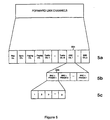
- Fig. 5 is a representation of the breakdown of the typical channels found on a forward link.
- Fig. 5a depicts the format of all the forward link channels, including the e RR channels on which the base stations can broadcast.
- Fig. 5b depicts the first RR channel 501 divided into f frames.
- Fig. 5c depicts the first frame of the first RR channel 502 further divided into a series of g consecutive time slots.
- the number of time slots on an RR channel may be larger or smaller than the number of time slots on the SSR channel.
- the mobile terminal is assigned to an RR channel time slot at the call setup time, and is used by the base station to respond to the reservation request sent by the mobile terminal on the SSR channel time slot.
- the RR channel time slot can also be used by the base station to inform the mobile terminal when there is a request on the network side of the system for transmission of data to the terminal. Whenever the mobile terminal receives a message on the RR channel time slot, it knows to begin sensing the traffic channel on the forward link based on information received in the message on the RR time slot.
- the RR channel may be designed so that the base station only transmits k repetitions of an RR channel PN code (RRC-PN) so as to allow the terminal to receive energy on its assigned RR channel time slot which then directs the terminal to the forward link traffic channel to receive messages.
- RRC-PN RR channel PN code
- the RR channel may also be designed to include a short message.
- the PN code should be repeated 31 times within the minislot.
- Simulation results indicate that 37% of the time the synchronization delay is 20 msec (one transmission attempt), 36% of the time the synchronization delay is 40 msec, 18% of the time the synchronization delay is 60 msec, 6% of the time the synchronization delay is 80 msec, and 3% of the time the synchronization delay is 100 msec. Accordingly, the present invention has lower access delay, higher throughput, reduced base station complexity, and is robust to traffic variations.
- Two types of handoffs may occur during a packet data call. If the terminal is in the process of data transmission and is put in soft handoff with other cells/sectors or a hand handoff is carried out, the base station will send a new synchronization channel assignment message to the terminal through the traffic channel. The message specifies a new synchronization channel, a time slot and a sector by which the mobile terminal will make future access attempts. If the terminal is not on a traffic channel, i.e. it is in idle mode and carries out an idle handoff according to the IS-95 standard to another sector, then the terminal will be required to relinquish both its synchronization channel and its time slot on the old cell/sector, and then obtain a new synchronization channel and time slot on the new cell.
Landscapes
- Engineering & Computer Science (AREA)
- Computer Networks & Wireless Communication (AREA)
- Signal Processing (AREA)
- Mobile Radio Communication Systems (AREA)
Abstract
Claims (14)
- Un système de communication à accès multiple par répartition par codes (AMRC) comprenant une station de base et une multiplicité de terminaux mobiles assignés couplés à au moins ladite station de base, dans lequel ladite station de base communique avec ladite multiplicité de terminaux mobiles assignés en utilisant au moins un émetteur et au moins un récepteur pour transférer l'une au moins de nombreuses salves de données, et lesdits émetteur et récepteur communiquent en utilisant une multiplicité de canaux de communication, comprenant :des canaux de liaison d'aller qui incluent un canal pilote, un canal de synchronisation, au moins un canal de recherche de terminal canal de paging, au moins un canal de trafic d'aller, et au moins un canal de réponse de réservation;des canaux de liaison de retour qui incluent au moins un canal d'accès, au moins un canal de trafic de retour et au moins un canal de synchronisation - réservation synchrone; etun moyen pour établir une liaison de communication entre ladite station de base et ladite multiplicité de terminaux mobiles assignés, caractérisé en ce que les canaux de synchronisation - réservation synchrones pour émettre un préambule sont divisés chacun en une multiplicité de trames et ces trames sont en outre divisées en une multiplicité de créneaux temporels, chaque créneau temporel correspondant à un terminal mobile individuel.
- Un système de communication à accès multiple par répartition par codes (AMRC) selon la revendication 1, dans lequel le moyen pour établir une liaison de communication comprend en outre :un moyen pour maintenir le contact entre la station de base et un premier de ladite multiplicité de terminaux mobiles assignés;un moyen pour synchroniser des transmissions entre ladite station de base et le premier de ladite multiplicité de terminaux mobiles assignés;un moyen pour effectuer un réglage fin de la synchronisation entre ladite station de base et le premier de la multiplicité de terminaux mobiles assignés;un moyen pour régler la puissance d'émission du premier de ladite multiplicité de terminaux mobiles assignés, de façon à permettre le transfert des salves de données; etun moyen pour mettre fin à la liaison de communication.
- Un système de communication à accès multiple par répartition par codes (AMRC) selon la revendication 1 ou 2, dans lequel les canaux de synchronisation - réservation synchrones transmettent un code PN identifiant le secteur de la cellule dans lequel se trouve le terminal mobile émetteur.
- Un système de communication à accès multiple par répartition par codes (AMRC) selon l'une quelconque des revendications précédentes, dans lequel ledit préambule émis sur le créneau temporel de canal de synchronisation - réservation assigné comprend au moins une répétition du code PN dans un créneau temporel.
- Un système de communication à accès multiple par répartition par codes (AMRC) selon la revendication 4, dans lequel ladite station de base se synchronise sur ledit terminal mobile en utilisant ledit préambule, et ladite station de base émet un message d'assignation de canal sur l'un desdits canaux de réponse de réservation.
- Un système de communication à accès multiple par répartition par codes (AMRC) selon la revendication 4, dans lequel le terminal mobile utilise ledit message d'assignation de canal pour émettre des données dans le créneau temporel assigné.
- Un procédé d'exploitation d'un système de communication à accès multiple par répartition par codes (AMRC) comprenant une multiplicité de terminaux mobiles fonctionnant dans un secteur d'une cellule qui est assignée à une station de base, dans lequel ladite station de base communique avec ladite multiplicité de terminaux mobiles assignés en utilisant au moins un émetteur et au moins un récepteur pour transférer l'une au moins de nombreuses salves de données, le procédé comprenant les étapes suivantes :on maintient une liaison constante entre ladite station de base et ladite multiplicité de terminaux mobiles avec un signal pilote;un premier desdits terminaux mobiles accède à ladite station de base avec un message d'origine;ladite station de base assigne un créneau temporel de canal de synchronisation - réservation synchrone au premier terminal mobile, en réponse audit message d'origine;on synchronise le premier terminal mobile avec ladite station de base en utilisant ledit créneau temporel assigné;on envoie un message d'assignation de canal au premier terminal mobile après que la station de base s'est synchronisée avec le premier terminal mobile;on diffuse des trames de données à partir de la multiplicité de terminaux mobiles vers la station de base sur un canal de trafic désigné par le message d'assignation de canal envoyé par ladite station de base; eton met hors fonction l'émetteur du premier terminal mobile une fois que ladite diffusion est achevée par le premier terminal mobile;le procédé étant caractérisé en ce que la sous-étape d'envoi comprend en outrela division desdits canaux de synchronisation - réservation synchrones en une multiplicité de trames;la subdivision de la multiplicité de trames en une multiplicité de créneaux temporels;l'assignation de chacun des terminaux mobiles à un créneau temporel correspondant; etl'émission d'un préambule sur ledit créneau temporel de canal de synchronisation - réservation assigné, pendant ledit créneau temporel assigné.
- Un procédé d'exploitation d'un système de communication à accès multiple par répartition par codes (AMRC) selon la revendication 7, dans lequel l'étape d'accès comprend les sous-étapes suivantes :on envoie le message d'origine dudit premier terminal mobile vers ladite station de base, ledit message d'appel contenant des données en paquets; eton reçoit à ladite station de base ledit message d'origine envoyé par ledit premier terminal mobile.
- Un procédé d'exploitation d'un système de communication à accès multiple par répartition par codes (AMRC) selon la revendication 8, dans lequel l'étape d'assignation comprend les sous-étapes suivantes :ladite station de base réserve le créneau temporel de canal de synchronisation - réservation synchrone et une assignation de canal pour l'utilisation par ledit premier terminal mobile, dans un message d'assignation;ou émet depuis ladite station de base le message d'assignation vers ledit premier terminal mobile; eton reçoit ledit message d'assignation audit premier terminal mobile.
- Un procédé d'exploitation d'un système de communication à accès multiple par répartition par codes (AMRC) selon la revendication 9, dans lequel l'étape de synchronisation comprend les sous-étapes suivantes :on accorde ledit émetteur dudit premier terminal mobile sur ladite assignation de canal assignée dans ledit message d'assignation;on émet un message de synchronisation à partir dudit premier terminal mobile vers ladite station de base, dans le créneau temporel assigné et sur ledit canal de synchronisation - réservation synchrone contenu dans le message d'assignation;on reçoit à ladite station de base le message de synchronisation envoyé par ledit premier terminal mobile; eton synchronise ladite station de base sur le mobile en utilisant un préambule contenu dans ledit message de synchronisation envoyé par ledit premier terminal mobile.
- Un procédé d'exploitation d'un système de communication à accès multiple par répartition par codes (AMRC) selon la revendication 9 ou 10, dans lequel l'étape d'émission comprend les sous-étapes suivantes :on assigne un canal de trafic de retour et un instant d'émission audit premier terminal mobile dans ledit message d'assignation de canal;on émet ledit message d'assignation de canal à partir de ladite station de base vers ledit premier terminal mobile en utilisant un canal de réponse de réservation;on reçoit ledit message d'assignation de canal au premier terminal mobile sur ledit canal de réponse de réservation; eton accorde ledit émetteur dans ledit premier terminal mobile sur ledit canal de trafic de retour assigné dans ledit message d'assignation.
- Un procédé d'exploitation d'un système de communication à accès multiple par répartition par codes (AMRC) selon l'une quelconque des revendications 7 à 11, dans lequel l'étape de diffusion comprend les sous-étapes suivantes :on émet à partir dudit premier terminal mobile, vers ladite station de base, l'une au moins d'une multiplicité de trames de données sur ledit canal de trafic de retour assigné, désigné par le message d'assignation de canal; eton reçoit à ladite station de base l'au moins une trame de données émise par ledit premier terminal mobile.
- Un procédé d'exploitation d'un système de communication à accès multiple par répartition par codes (AMRC) selon la revendication 11, dans lequel la sous-étape d'émission comprend
l'émission d'un code PN identifiant le secteur de la cellule à partir duquel ledit terminal mobile émet, ce qui entraíne une réduction du nombre de récepteurs que la station de base doit avoir. - Un procédé d'exploitation d'un système de communication à accès multiple par répartition par codes (AMRC) selon l'une quelconque des revendications 7 à 13, dans lequel la sous-étape d'émission comprend
la répétition d'un code PN au moins une fois dans un créneau temporel.
Applications Claiming Priority (3)
| Application Number | Priority Date | Filing Date | Title |
|---|---|---|---|
| US666828 | 1996-06-19 | ||
| US08/666,828 US5828662A (en) | 1996-06-19 | 1996-06-19 | Medium access control scheme for data transmission on code division multiple access (CDMA) wireless systems |
| PCT/CA1996/000755 WO1997049201A1 (fr) | 1996-06-19 | 1996-11-19 | Agencement de commande d'acces au support pour transmission de donnees sur des systemes sans fil a acces multiple par code de repartition (amcr) |
Publications (2)
| Publication Number | Publication Date |
|---|---|
| EP0906671A1 EP0906671A1 (fr) | 1999-04-07 |
| EP0906671B1 true EP0906671B1 (fr) | 2004-01-21 |
Family
ID=24675659
Family Applications (1)
| Application Number | Title | Priority Date | Filing Date |
|---|---|---|---|
| EP96937952A Expired - Lifetime EP0906671B1 (fr) | 1996-06-19 | 1996-11-19 | Agencement de commande d'acces au support pour transmission de donnees sur des systemes sans fil a acces multiple par code de repartition (amcr) |
Country Status (7)
| Country | Link |
|---|---|
| US (1) | US5828662A (fr) |
| EP (1) | EP0906671B1 (fr) |
| CN (1) | CN1179500C (fr) |
| AU (1) | AU7558296A (fr) |
| CA (1) | CA2257203C (fr) |
| DE (1) | DE69631386T2 (fr) |
| WO (1) | WO1997049201A1 (fr) |
Families Citing this family (84)
| Publication number | Priority date | Publication date | Assignee | Title |
|---|---|---|---|---|
| US6831905B1 (en) | 1995-06-30 | 2004-12-14 | Interdigital Technology Corporation | Spread spectrum system assigning information signals to message-code signals |
| US6940840B2 (en) | 1995-06-30 | 2005-09-06 | Interdigital Technology Corporation | Apparatus for adaptive reverse power control for spread-spectrum communications |
| US7072380B2 (en) | 1995-06-30 | 2006-07-04 | Interdigital Technology Corporation | Apparatus for initial power control for spread-spectrum communications |
| ZA965340B (en) | 1995-06-30 | 1997-01-27 | Interdigital Tech Corp | Code division multiple access (cdma) communication system |
| US7020111B2 (en) | 1996-06-27 | 2006-03-28 | Interdigital Technology Corporation | System for using rapid acquisition spreading codes for spread-spectrum communications |
| US7929498B2 (en) | 1995-06-30 | 2011-04-19 | Interdigital Technology Corporation | Adaptive forward power control and adaptive reverse power control for spread-spectrum communications |
| US7123600B2 (en) | 1995-06-30 | 2006-10-17 | Interdigital Technology Corporation | Initial power control for spread-spectrum communications |
| US6885652B1 (en) | 1995-06-30 | 2005-04-26 | Interdigital Technology Corporation | Code division multiple access (CDMA) communication system |
| US6816473B2 (en) | 1995-06-30 | 2004-11-09 | Interdigital Technology Corporation | Method for adaptive forward power control for spread-spectrum communications |
| US5841768A (en) | 1996-06-27 | 1998-11-24 | Interdigital Technology Corporation | Method of controlling initial power ramp-up in CDMA systems by using short codes |
| JP3212238B2 (ja) * | 1995-08-10 | 2001-09-25 | 株式会社日立製作所 | 移動通信システムおよび移動端末装置 |
| US6570865B2 (en) | 1995-08-10 | 2003-05-27 | Hitachi, Ltd. | CDMA mobile communications system and communication method |
| US6021122A (en) * | 1996-06-07 | 2000-02-01 | Qualcomm Incorporated | Method and apparatus for performing idle handoff in a multiple access communication system |
| CA2210179C (fr) * | 1996-07-12 | 2001-09-11 | Ntt Mobile Communications Network Inc. | Arrangement de transmission initiale de configuration pour un systeme radio mobile |
| JPH10173594A (ja) * | 1996-12-06 | 1998-06-26 | Hitachi Ltd | 符号分割多元接続通信システム及び送信電力制御方法 |
| US6091717A (en) * | 1997-05-05 | 2000-07-18 | Nokia Mobile Phones Limited | Method for scheduling packet data transmission |
| US6075792A (en) | 1997-06-16 | 2000-06-13 | Interdigital Technology Corporation | CDMA communication system which selectively allocates bandwidth upon demand |
| US6081536A (en) | 1997-06-20 | 2000-06-27 | Tantivy Communications, Inc. | Dynamic bandwidth allocation to transmit a wireless protocol across a code division multiple access (CDMA) radio link |
| US6542481B2 (en) | 1998-06-01 | 2003-04-01 | Tantivy Communications, Inc. | Dynamic bandwidth allocation for multiple access communication using session queues |
| US6151332A (en) | 1997-06-20 | 2000-11-21 | Tantivy Communications, Inc. | Protocol conversion and bandwidth reduction technique providing multiple nB+D ISDN basic rate interface links over a wireless code division multiple access communication system |
| US6236646B1 (en) * | 1997-09-09 | 2001-05-22 | Telefonaktiebolaget Lm Ericsson (Publ) | Packet data communications scheduling in a spread spectrum communications system |
| US9525923B2 (en) | 1997-12-17 | 2016-12-20 | Intel Corporation | Multi-detection of heartbeat to reduce error probability |
| US7394791B2 (en) * | 1997-12-17 | 2008-07-01 | Interdigital Technology Corporation | Multi-detection of heartbeat to reduce error probability |
| US7079523B2 (en) | 2000-02-07 | 2006-07-18 | Ipr Licensing, Inc. | Maintenance link using active/standby request channels |
| US7936728B2 (en) * | 1997-12-17 | 2011-05-03 | Tantivy Communications, Inc. | System and method for maintaining timing of synchronization messages over a reverse link of a CDMA wireless communication system |
| US6222832B1 (en) | 1998-06-01 | 2001-04-24 | Tantivy Communications, Inc. | Fast Acquisition of traffic channels for a highly variable data rate reverse link of a CDMA wireless communication system |
| US7496072B2 (en) | 1997-12-17 | 2009-02-24 | Interdigital Technology Corporation | System and method for controlling signal strength over a reverse link of a CDMA wireless communication system |
| WO1999043105A1 (fr) * | 1998-02-19 | 1999-08-26 | Qualcomm Incorporated | Procede et systeme de declenchement periodique de transmission dans un reseau de communication sans fil |
| US6545989B1 (en) | 1998-02-19 | 2003-04-08 | Qualcomm Incorporated | Transmit gating in a wireless communication system |
| US6208871B1 (en) * | 1998-02-27 | 2001-03-27 | Motorola, Inc. | Method and apparatus for providing a time adjustment to a wireless communication system |
| KR100381012B1 (ko) * | 1998-05-04 | 2003-08-19 | 한국전자통신연구원 | 부호분할 다중접속 방식에서 상향 공통 채널의 임의 접속 장치및 방법 |
| KR100606661B1 (ko) * | 1998-05-09 | 2006-09-22 | 엘지전자 주식회사 | 통신네트워크에서 제어동작을 수행하는 방법 |
| US7221664B2 (en) | 1998-06-01 | 2007-05-22 | Interdigital Technology Corporation | Transmittal of heartbeat signal at a lower level than heartbeat request |
| US7773566B2 (en) * | 1998-06-01 | 2010-08-10 | Tantivy Communications, Inc. | System and method for maintaining timing of synchronization messages over a reverse link of a CDMA wireless communication system |
| US8134980B2 (en) | 1998-06-01 | 2012-03-13 | Ipr Licensing, Inc. | Transmittal of heartbeat signal at a lower level than heartbeat request |
| KR100293998B1 (ko) * | 1998-08-13 | 2001-07-12 | 윤종용 | 코드분할다중접속시스템의기지국섹터와주파수할당간의채널공유방법 |
| JP4037965B2 (ja) * | 1998-08-18 | 2008-01-23 | 富士通株式会社 | 符号分割多元接続通信システム並びに符号分割多元接続通信システム用基地局及び符号分割多元接続通信システム用端末装置並びに符号分割多元接続通信方法並びに端末装置の通信方法 |
| KR100291478B1 (ko) * | 1998-09-08 | 2001-06-01 | 윤종용 | 셀룰러시스템에서유휴상태핸드오프방법및시스템 |
| US6366779B1 (en) * | 1998-09-22 | 2002-04-02 | Qualcomm Incorporated | Method and apparatus for rapid assignment of a traffic channel in digital cellular communication systems |
| US6256301B1 (en) * | 1998-10-15 | 2001-07-03 | Qualcomm Incorporated | Reservation multiple access |
| US6788937B1 (en) | 1998-10-15 | 2004-09-07 | Qualcomm, Incorporated | Reservation multiple access |
| CN1284395C (zh) * | 1998-11-09 | 2006-11-08 | 三星电子株式会社 | 用于移动通信系统的备用多址控制设备和方法 |
| US6504827B1 (en) * | 1998-12-18 | 2003-01-07 | Lucent Technologies Inc. | Discontinuous transmission on high speed data channels |
| US6625200B1 (en) | 1999-01-25 | 2003-09-23 | Ericsson Inc. | Multi-stage CDMA synchronization with parallel execution |
| US6574267B1 (en) * | 1999-03-22 | 2003-06-03 | Golden Bridge Technology, Inc. | Rach ramp-up acknowledgement |
| KR100617916B1 (ko) | 1999-03-24 | 2006-08-30 | 퀄컴 인코포레이티드 | 예약방식 다중 액세스 |
| US6965778B1 (en) | 1999-04-08 | 2005-11-15 | Ipr Licensing, Inc. | Maintenance of channel usage in a wireless communication system |
| US6516196B1 (en) | 1999-04-08 | 2003-02-04 | Lucent Technologies Inc. | Intelligent burst control functions for wireless communications systems |
| US6614776B1 (en) | 1999-04-28 | 2003-09-02 | Tantivy Communications, Inc. | Forward error correction scheme for high rate data exchange in a wireless system |
| US6463042B1 (en) * | 1999-05-28 | 2002-10-08 | Nokia Mobile Phones Ltd. | Mobile station having power saving mode for packet data |
| GB2352944B (en) | 1999-05-31 | 2004-02-11 | Korea Electronics Telecomm | Apparatus and method for moduating data message by employing orthogonal variable spreading factor (OVSF) codes in mobile communication sytem |
| US7173919B1 (en) * | 1999-06-11 | 2007-02-06 | Texas Instruments Incorporated | Random access preamble coding for initiation of wireless mobile communications sessions |
| CN1132391C (zh) * | 1999-08-09 | 2003-12-24 | 华为技术有限公司 | 一种实现移动通信系统的导频同步信道的方法 |
| US6526034B1 (en) | 1999-09-21 | 2003-02-25 | Tantivy Communications, Inc. | Dual mode subscriber unit for short range, high rate and long range, lower rate data communications |
| US7065342B1 (en) * | 1999-11-23 | 2006-06-20 | Gofigure, L.L.C. | System and mobile cellular telephone device for playing recorded music |
| US8463255B2 (en) | 1999-12-20 | 2013-06-11 | Ipr Licensing, Inc. | Method and apparatus for a spectrally compliant cellular communication system |
| US6681256B1 (en) * | 1999-12-21 | 2004-01-20 | Nokia Corporation | Method for dynamically selecting allocation of random access channels in a communication system |
| WO2001058044A2 (fr) | 2000-02-07 | 2001-08-09 | Tantivy Communications, Inc. | Liaison a entretien minime destinee a maintenir la synchronisation |
| JP3732707B2 (ja) * | 2000-03-16 | 2006-01-11 | 富士通株式会社 | 加入者側通信装置における再同期制御装置および再同期方法 |
| US6940845B2 (en) * | 2000-03-23 | 2005-09-06 | At & T, Corp. | Asymmetric measurement-based dynamic packet assignment system and method for wireless data services |
| US20030169700A1 (en) * | 2000-09-08 | 2003-09-11 | Bjorn Nilsson | Power margin control |
| US8155096B1 (en) | 2000-12-01 | 2012-04-10 | Ipr Licensing Inc. | Antenna control system and method |
| US7075975B2 (en) * | 2000-12-11 | 2006-07-11 | The Titan Corporation | Fast adaptive transceiver architecture with symmetric preamble design |
| US6934539B2 (en) * | 2001-01-08 | 2005-08-23 | Lucent Technologies Inc. | Apparatus and method for use in identifying presence of wireless terminals in mobile wireless communication systems |
| US6631139B2 (en) * | 2001-01-31 | 2003-10-07 | Qualcomm Incorporated | Method and apparatus for interoperability between voice transmission systems during speech inactivity |
| US6954448B2 (en) | 2001-02-01 | 2005-10-11 | Ipr Licensing, Inc. | Alternate channel for carrying selected message types |
| US7551663B1 (en) | 2001-02-01 | 2009-06-23 | Ipr Licensing, Inc. | Use of correlation combination to achieve channel detection |
| KR100665077B1 (ko) | 2001-06-13 | 2007-01-09 | 탄티비 커뮤니케이션즈 인코포레이티드 | 하트비트 요구보다 낮은 레벨로의 하트비트 신호의 전송 |
| US7180879B2 (en) * | 2001-08-17 | 2007-02-20 | Ragulan Sinnarajah | Method and apparatus for call setup latency reduction |
| KR100452639B1 (ko) * | 2001-10-20 | 2004-10-14 | 한국전자통신연구원 | 위성 이동 통신 시스템에서 공통 패킷 채널 접속 방법 |
| JP4027647B2 (ja) * | 2001-11-22 | 2007-12-26 | 株式会社エヌ・ティ・ティ・ドコモ | 通信制御方法、通信制御システム、移動機及び基地局 |
| US20030166406A1 (en) * | 2002-03-01 | 2003-09-04 | Burgess John K. | Multi-format wireless synchronization channel |
| US8023466B2 (en) * | 2004-06-22 | 2011-09-20 | Jianglei Ma | Soft handoff in OFDMA system |
| EP1779055B1 (fr) * | 2004-07-15 | 2017-03-01 | Cubic Corporation | Point de visee ameliore dans des systemes d'apprentissage simules |
| WO2006052774A2 (fr) * | 2004-11-09 | 2006-05-18 | Motorola, Inc. | Emetteur et recepteur permettant de communiquer un signal a partir de multiples antennes a l'aide d'un preambule |
| ES2442855T3 (es) | 2004-12-23 | 2014-02-13 | Electronics And Telecommunications Research Institute | Aparato para transmitir y recibir datos para proporcionar una comunicación de datos de alta velocidad y método para ello |
| EP3119141B1 (fr) * | 2005-10-21 | 2019-12-04 | Telefonaktiebolaget LM Ericsson (publ) | Technique destinée à effectuer une procédure d'accès aléatoire sur une interface radio |
| EP3240341A3 (fr) * | 2006-08-09 | 2017-11-08 | Mitsubishi Electric Corporation | Procédé de communication de données, système et dispositifs |
| KR101420953B1 (ko) | 2006-10-27 | 2014-07-17 | 인터디지탈 테크날러지 코포레이션 | 무선 시스템에서 불연속 수신을 향상시키는 방법 및 장치 |
| CN101018362B (zh) * | 2007-02-06 | 2010-12-29 | 北京邮电大学 | 一种基于正交频分多址技术的媒体接入控制方法 |
| US8696436B2 (en) | 2009-11-16 | 2014-04-15 | Patent Investment & Licensing Company | Method for displaying gaming result |
| JP5481240B2 (ja) * | 2010-03-12 | 2014-04-23 | 株式会社日立製作所 | マルチレート用バーストモード受信機 |
| US11317346B2 (en) * | 2019-02-20 | 2022-04-26 | Advanced Semiconductor Engineering, Inc. | Communication system |
| DE102025104362B3 (de) * | 2025-02-06 | 2026-03-12 | Robert Bosch Gesellschaft mit beschränkter Haftung | Verfahren zum Übertragen einer Erneutübertragungsinformation an eine drahtlose Vorrichtung, vorzugsweise eine Ambient-Internet-der-Dinge- bzw. A-IoT-Vorrichtung, eines Kommunikationsnetzwerks |
Family Cites Families (15)
| Publication number | Priority date | Publication date | Assignee | Title |
|---|---|---|---|---|
| US5103459B1 (en) * | 1990-06-25 | 1999-07-06 | Qualcomm Inc | System and method for generating signal waveforms in a cdma cellular telephone system |
| FI87616C (fi) * | 1991-04-05 | 1993-01-25 | Nokia Mobile Phones Ltd | Foerfarande foer att styra funktionen hos ett paketkopplat cdma-datanaet foer styrning av saendarnas och mottagarnas funktion |
| FI87615C (fi) * | 1991-04-05 | 1993-01-25 | Nokia Mobile Phones Ltd | Styrsystem foer ett paketkopplat cdma-datanaet |
| US5260967A (en) * | 1992-01-13 | 1993-11-09 | Interdigital Technology Corporation | CDMA/TDMA spread-spectrum communications system and method |
| US5267261A (en) * | 1992-03-05 | 1993-11-30 | Qualcomm Incorporated | Mobile station assisted soft handoff in a CDMA cellular communications system |
| MX9301888A (es) * | 1992-04-10 | 1993-11-30 | Ericsson Telefon Ab L M | Acceso multiple de division de tiempo para acceso de un movil en un sistema de acceso multiple de division de codigo. |
| GB2268371B (en) * | 1992-04-10 | 1995-09-20 | Roke Manor Research | Radio communication systems |
| US5603081A (en) * | 1993-11-01 | 1997-02-11 | Telefonaktiebolaget Lm Ericsson | Method for communicating in a wireless communication system |
| CA2107606A1 (fr) * | 1992-10-07 | 1994-04-08 | Keishi Matsuno | Methode de synchronisation de stations de base et systeme de radiocommunication mobile utilisant cette methode |
| JPH07297776A (ja) * | 1994-04-22 | 1995-11-10 | Oki Electric Ind Co Ltd | 通信システム |
| FI96154C (fi) * | 1994-05-30 | 1996-05-10 | Nokia Telecommunications Oy | Menetelmä tilaajapäätelaitteiden synkronisoimiseksi, tukiasema sekä tilaajapäätelaite |
| US5511067A (en) * | 1994-06-17 | 1996-04-23 | Qualcomm Incorporated | Layered channel element in a base station modem for a CDMA cellular communication system |
| US5604730A (en) * | 1994-07-25 | 1997-02-18 | Qualcomm Incorporated | Remote transmitter power control in a contention based multiple access system |
| US5673259A (en) * | 1995-05-17 | 1997-09-30 | Qualcomm Incorporated | Random access communications channel for data services |
| US5586120A (en) * | 1995-07-05 | 1996-12-17 | Motorola, Inc. | Method for a channel hopping communication system with variable transmission bandwidth |
-
1996
- 1996-06-19 US US08/666,828 patent/US5828662A/en not_active Expired - Lifetime
- 1996-11-19 CA CA002257203A patent/CA2257203C/fr not_active Expired - Fee Related
- 1996-11-19 CN CNB961803355A patent/CN1179500C/zh not_active Expired - Lifetime
- 1996-11-19 WO PCT/CA1996/000755 patent/WO1997049201A1/fr not_active Ceased
- 1996-11-19 DE DE69631386T patent/DE69631386T2/de not_active Expired - Lifetime
- 1996-11-19 AU AU75582/96A patent/AU7558296A/en not_active Abandoned
- 1996-11-19 EP EP96937952A patent/EP0906671B1/fr not_active Expired - Lifetime
Also Published As
| Publication number | Publication date |
|---|---|
| WO1997049201A1 (fr) | 1997-12-24 |
| CA2257203A1 (fr) | 1997-12-24 |
| DE69631386D1 (de) | 2004-02-26 |
| AU7558296A (en) | 1998-01-07 |
| CN1222271A (zh) | 1999-07-07 |
| EP0906671A1 (fr) | 1999-04-07 |
| CN1179500C (zh) | 2004-12-08 |
| DE69631386T2 (de) | 2004-07-01 |
| US5828662A (en) | 1998-10-27 |
| CA2257203C (fr) | 2002-05-14 |
Similar Documents
| Publication | Publication Date | Title |
|---|---|---|
| US5828662A (en) | Medium access control scheme for data transmission on code division multiple access (CDMA) wireless systems | |
| US6970438B2 (en) | Method and device for downlink packet switching | |
| US7583631B2 (en) | Quality packet radio service for a general packet radio system | |
| JP4405592B2 (ja) | 移動体衛星通信用のランダムアクセス方式 | |
| EP1625766B1 (fr) | Montage rapide de canaux de communication physique | |
| CA2268269C (fr) | Procede adaptatif d'attribution des canaux dans un systeme de telecommunication cellulaire sans fils | |
| US6747963B1 (en) | Apparatus and method for gated transmission in a CDMA communication system | |
| EP1446897B1 (fr) | Procede permettant d'etablir un canal radio dans un reseau amrc sans fil dans lequel le signal de preambule augmente en puissance au cours de la transmission | |
| EP1248476B1 (fr) | Procédé de transmission/réception de paquets de données dans un système de communication mobile | |
| EP0663737A2 (fr) | Système de communications radio de mobile à mobile | |
| EP1255363B1 (fr) | Système de télécommunication sans fil et procédé pour transmission asymétrique des données | |
| US7085254B1 (en) | Apparatus and method for gated transmission in CDMA communication system | |
| JP2002535900A (ja) | 無線通信システムにおけるシグナリング・コンフィギュレーション | |
| KR20010050524A (ko) | Rach 채널에 액세스하기 위해서 다수의 지속 확률을갖는 무선 네트워크 | |
| KR100326324B1 (ko) | 광대역 부호분할다중접속 통신시스템의 전용채널 신호의단속송신 제어방법 | |
| KR19990077587A (ko) | 시분할다중억세스통신시스템 | |
| HK1021096A (en) | Medium access control scheme for data transmission on code division multiple access(cdma) wireless systems | |
| EP0860061B1 (fr) | Telephonie numerique utilisant des messages de commande transmis en tranches de temps pour l'attribution de frequences h.f. |
Legal Events
| Date | Code | Title | Description |
|---|---|---|---|
| PUAI | Public reference made under article 153(3) epc to a published international application that has entered the european phase |
Free format text: ORIGINAL CODE: 0009012 |
|
| 17P | Request for examination filed |
Effective date: 19990119 |
|
| AK | Designated contracting states |
Kind code of ref document: A1 Designated state(s): DE FR GB |
|
| RAP3 | Party data changed (applicant data changed or rights of an application transferred) |
Owner name: NORTEL NETWORKS CORPORATION |
|
| RAP1 | Party data changed (applicant data changed or rights of an application transferred) |
Owner name: NORTEL NETWORKS LIMITED |
|
| 17Q | First examination report despatched |
Effective date: 20020510 |
|
| GRAP | Despatch of communication of intention to grant a patent |
Free format text: ORIGINAL CODE: EPIDOSNIGR1 |
|
| RAP1 | Party data changed (applicant data changed or rights of an application transferred) |
Owner name: NORTEL NETWORKS LIMITED |
|
| GRAS | Grant fee paid |
Free format text: ORIGINAL CODE: EPIDOSNIGR3 |
|
| GRAA | (expected) grant |
Free format text: ORIGINAL CODE: 0009210 |
|
| AK | Designated contracting states |
Kind code of ref document: B1 Designated state(s): DE FR GB |
|
| REG | Reference to a national code |
Ref country code: GB Ref legal event code: FG4D |
|
| REF | Corresponds to: |
Ref document number: 69631386 Country of ref document: DE Date of ref document: 20040226 Kind code of ref document: P |
|
| ET | Fr: translation filed | ||
| PLBE | No opposition filed within time limit |
Free format text: ORIGINAL CODE: 0009261 |
|
| STAA | Information on the status of an ep patent application or granted ep patent |
Free format text: STATUS: NO OPPOSITION FILED WITHIN TIME LIMIT |
|
| 26N | No opposition filed |
Effective date: 20041022 |
|
| PGFP | Annual fee paid to national office [announced via postgrant information from national office to epo] |
Ref country code: DE Payment date: 20111130 Year of fee payment: 16 |
|
| REG | Reference to a national code |
Ref country code: GB Ref legal event code: 732E Free format text: REGISTERED BETWEEN 20130502 AND 20130508 |
|
| REG | Reference to a national code |
Ref country code: GB Ref legal event code: 732E Free format text: REGISTERED BETWEEN 20130509 AND 20130515 |
|
| REG | Reference to a national code |
Ref country code: FR Ref legal event code: TP Owner name: APPLE INC., US Effective date: 20130515 |
|
| REG | Reference to a national code |
Ref country code: DE Ref legal event code: R082 Ref document number: 69631386 Country of ref document: DE Representative=s name: BARDEHLE PAGENBERG PARTNERSCHAFT PATENTANWAELT, DE |
|
| REG | Reference to a national code |
Ref country code: DE Ref legal event code: R119 Ref document number: 69631386 Country of ref document: DE Effective date: 20130601 |
|
| PG25 | Lapsed in a contracting state [announced via postgrant information from national office to epo] |
Ref country code: DE Free format text: LAPSE BECAUSE OF NON-PAYMENT OF DUE FEES Effective date: 20130601 |
|
| REG | Reference to a national code |
Ref country code: DE Ref legal event code: R082 Ref document number: 69631386 Country of ref document: DE Representative=s name: BARDEHLE PAGENBERG PARTNERSCHAFT MBB PATENTANW, DE Effective date: 20130801 Ref country code: DE Ref legal event code: R082 Ref document number: 69631386 Country of ref document: DE Representative=s name: BARDEHLE PAGENBERG PARTNERSCHAFT MBB PATENTANW, DE Effective date: 20140313 Ref country code: DE Ref legal event code: R081 Ref document number: 69631386 Country of ref document: DE Owner name: APPLE INC., US Free format text: FORMER OWNER: NORTEL NETWORKS LTD., ST. LAURENT, CA Effective date: 20140313 |
|
| REG | Reference to a national code |
Ref country code: FR Ref legal event code: PLFP Year of fee payment: 20 |
|
| PGFP | Annual fee paid to national office [announced via postgrant information from national office to epo] |
Ref country code: GB Payment date: 20151118 Year of fee payment: 20 |
|
| PGFP | Annual fee paid to national office [announced via postgrant information from national office to epo] |
Ref country code: FR Payment date: 20151008 Year of fee payment: 20 |
|
| REG | Reference to a national code |
Ref country code: GB Ref legal event code: PE20 Expiry date: 20161118 |
|
| PG25 | Lapsed in a contracting state [announced via postgrant information from national office to epo] |
Ref country code: GB Free format text: LAPSE BECAUSE OF EXPIRATION OF PROTECTION Effective date: 20161118 |