EP0907258B1 - Audiosignalkompression, Sprachsignalkompression und Spracherkennung - Google Patents
Audiosignalkompression, Sprachsignalkompression und Spracherkennung Download PDFInfo
- Publication number
- EP0907258B1 EP0907258B1 EP98118674A EP98118674A EP0907258B1 EP 0907258 B1 EP0907258 B1 EP 0907258B1 EP 98118674 A EP98118674 A EP 98118674A EP 98118674 A EP98118674 A EP 98118674A EP 0907258 B1 EP0907258 B1 EP 0907258B1
- Authority
- EP
- European Patent Office
- Prior art keywords
- mel
- speech
- coefficients
- frequency
- lpc
- Prior art date
- Legal status (The legal status is an assumption and is not a legal conclusion. Google has not performed a legal analysis and makes no representation as to the accuracy of the status listed.)
- Expired - Lifetime
Links
Images



Classifications
-
- H—ELECTRICITY
- H04—ELECTRIC COMMUNICATION TECHNIQUE
- H04B—TRANSMISSION
- H04B1/00—Details of transmission systems, not covered by a single one of groups H04B3/00 - H04B13/00; Details of transmission systems not characterised by the medium used for transmission
- H04B1/66—Details of transmission systems, not covered by a single one of groups H04B3/00 - H04B13/00; Details of transmission systems not characterised by the medium used for transmission for reducing bandwidth of signals; for improving efficiency of transmission
- H04B1/665—Details of transmission systems, not covered by a single one of groups H04B3/00 - H04B13/00; Details of transmission systems not characterised by the medium used for transmission for reducing bandwidth of signals; for improving efficiency of transmission using psychoacoustic properties of the ear, e.g. masking effect
-
- H—ELECTRICITY
- H03—ELECTRONIC CIRCUITRY
- H03M—CODING; DECODING; CODE CONVERSION IN GENERAL
- H03M7/00—Conversion of a code where information is represented by a given sequence or number of digits to a code where the same, similar or subset of information is represented by a different sequence or number of digits
- H03M7/30—Compression; Expansion; Suppression of unnecessary data, e.g. redundancy reduction
-
- G—PHYSICS
- G10—MUSICAL INSTRUMENTS; ACOUSTICS
- G10L—SPEECH ANALYSIS TECHNIQUES OR SPEECH SYNTHESIS; SPEECH RECOGNITION; SPEECH OR VOICE PROCESSING TECHNIQUES; SPEECH OR AUDIO CODING OR DECODING
- G10L19/00—Speech or audio signals analysis-synthesis techniques for redundancy reduction, e.g. in vocoders; Coding or decoding of speech or audio signals, using source filter models or psychoacoustic analysis
- G10L2019/0001—Codebooks
- G10L2019/0004—Design or structure of the codebook
- G10L2019/0005—Multi-stage vector quantisation
Definitions
- the present invention relates to a method and an apparatus for recognizing a speech, which are capable of providing a higher recognition rate than conventional methods and apparatuses, in particular, when performing recognition using parameters having different resolutions for different frequencies, which parameters are obtained by a linear prediction coding analysis utilizing human auditory characteristics.
- a time series of an input audio signal is transformed into a frequency characteristic signal sequence for each length of a specific period (frame) by MDCT (modified discrete cosine transform), FFT (fast Fourier transform) or the like.
- MDCT modified discrete cosine transform
- FFT fast Fourier transform
- the input audio signal is subjected to linear predictive analysis (LPC analysis), frame by frame, to extract LPC coefficients (linear predictive coefficients), LSP coefficients (line spectrum pair coefficients), PARCOR coefficients (partial auto-correlation coefficients) or the like, and an LPC spectrum envelop is obtained from these coefficients.
- LPC analysis linear predictive analysis
- LPC coefficients linear predictive coefficients
- LSP coefficients line spectrum pair coefficients
- PARCOR coefficients partial auto-correlation coefficients
- residual signals output coefficients at the power normalization are called "residual signals”. Further, the flattened residual signals are vector-quantized using the spectrum envelope as a weight.
- TwinVQ Inwagami, Moriya, Miki: “Audio Coding by Frequency-Weighted Interleave Vector Quantization (TwinVQ) "Anthology of Lectured Papars of Acoustic Society, 1-P-1, pp.3390-340, 1994).
- LPC spectrum envelope components such as LPC coefficients, LSP coefficients, or PARCOR coefficients
- residual signals the frequency characteristic of which is flattened.
- LPC spectrum envelope components are Scalar-quantized, and the flattened residual signals are quantized according to a previously prepared sound source code book, whereby the components and the signals are transformed into digital signals, respectively.
- CELP Code-excited Linear Prediction
- a speech coding algorithm based on adaptive mel-cepstral analysis is described in the article K. Tokuda, T. Kobayashi, S. Imai, and T. Fukada, "Speech Coding Based on Adaptive Mel-Cepstral Analysis and Its Evaluation", Electronics and Communications in Japan, Part 3, Vol. 78, pp. 50-60 (1995).
- the method uses coefficients of an exponential transfer function for encoding by multi-stage quantization. These coefficients are estimated by an adaptive mel-cepstral analysis.
- speech recognition is performed as follows.
- a standard model for each phoneme or word is formed in advance by using speech data as a base, and a parameter corresponding to a spectrum envelope is obtained from an input speech. Then, the similarity between the time series of the input speech and the standard model is calculated, and a phoneme or word corresponding to the standard model having the highest similarity is found.
- hidden Markov model HMM
- the time series itself of a representative parameter is used as the standard model (Seiichi Nakagawa "Speech Recognition by Probability Model", Edited by Electronics Information and Communication Society, pp.18-20.)
- cepstrum coefficients which are obtained by transforming a time series of an input speech into LPC coefficients for each length of a specific period (frame) by LPC analysis and then subjecting the resulting LPC coefficients to cepstrum transform ("Digital Signal Processing of Speech and Audio Information", by Kiyohiro Sikano, Satosi Nakamura, Siro Ise, Shyokodo, pp.10-16), or cepstrum coefficients which are obtained by transforming an input speech into power spectrums for each length of a specific period (frame) by DFT or band pass filter bank and then subjecting the resulting power spectrums to cepstrum transformation.
- cepstrum transform Digital Signal Processing of Speech and Audio Information
- residual signals are obtained by dividing a frequency characteristic signal sequence calculated by MDCT or FFT with an LPC spectrum envelop, and normalizing the result.
- an input audio signal is separated into an LPC spectrum envelope calculated by LPC analysis and residual signals.
- the prior art audio signal compression method and the prior art speech signal compression method are similar in that spectrum envelop components are removed from the input signal by the standard LPC analysis, i.e., residual signals are obtained by normalizing (flattening) the input signal by the spectrum envelope. Therefore, if the performance of this LPC analysis is improved or the estimated precision of the spectrum envelop obtained by the LPC analysis is increased, it is possible to compress information more efficiently than the prior art methods while maintaining a high sound quality.
- an envelop is estimated with a frequency resolution of the same precision for each frequency band. Therefore, in order to increase the frequency resolution for a low frequency band which is auditively important, i.e., in order to obtain a spectrum envelop of a low frequency band precisely, the analysis order must be increased, resulting in increased amount of information.
- Mel-frequency scale is a scale obtained from pitch perceptivity characteristics of human beings. It is well known that the pitch depends on the intensity of sound as well as the frequency. So, a pure sound of 100 Hz and 40 dB SPL is used as a reference sound of 1000 mel, and sounds perceived as double and half in pitch are measured by magnitude measurement or the like and decided as 2000 mel and 500 mel, respectively.
- human auditory characteristics are not sufficiently considered in the LPC analysis for producing the LPC cepstrum coefficients as described above, improvement of the substantial recognition performance cannot be expected even if mel-transformation is performed.
- a spectrum envelop is estimated with the same frequency resolution for each frequency band. Therefore, in order to increase the frequency resolution for a low frequency band which is auditively important, i.e., obtain a spectrum envelop of a low frequency band precisely, the analysis order must be increased, resulting in increased parameters and increased throughput for recognition. Furthermore, to increase the analysis order results in an unnecessary increase in resolution for a high frequency band and, thereby, the high frequency band may have an unnecessary feature, degrading the recognition performance.
- the mel-cepstrum coefficient is estimated by the inverse Fourier transformation which transforms a log spectrum of an inputted signal on the mel-frequency axis, and the mel-cepstrum coefficient obtained from mel-LPC analysis is employed for the comparison of the recognition result.
- the present invention is made to solve the above-described problems, in view of the fact that the speech recognition performance can be improved by using the following coefficients: mel-LPC coefficients obtained as a result of an LPC analysis of improved performance, i.e., based on human auditory characteristics (hereinafter referred to as "mel-LPC analysis"); mel-PARCOR coefficients obtained from mel-LPC coefficients by a well-known method similar to the method of obtaining PARCOR coefficients from standard LPC coefficients; mel-LSP coefficients obtained from mel-LSP coefficients by a well-known method similar to the method of obtaining LSP coefficients from standard LPC coefficients; or mel-LPC cepstrum coefficients obtained by subjecting mel-LPC coefficients to cepstrum transformation.
- mel-LPC analysis human auditory characteristics
- Figure 1 is a block diagram illustrating the construction of an audio signal compression apparatus.
- reference numeral 1 designates a time to frequency transformation unit for transforming a time series of an input digital audio signal or speech signal into a frequency characteristic signal sequence for each length of a specific period (frame) by MDCT, FFT, or the like.
- Reference numeral 2 designates a spectrum envelope calculation unit for obtaining, for each frame, a spectrum envelope having different resolutions for different frequencies, from the input audio signal, using mel-LPC analysis including a frequency warping function for a prediction model.
- Reference numeral 3 designates a normalization unit for normalizing the frequency characteristic signal sequence calculated by the time to frequency transformation unit 1 by dividing it with the spectrum envelope obtained by the spectrum envelope calculation unit 2 to flatten the frequency characteristic.
- Reference numeral 4 designates a power normalization unit for subjecting the frequency characteristic signal sequence flattened by the normalization unit 3 to power normalization based on the maximum value or mean value of the power.
- Reference numeral 5 designates a multi-stage quantization unit for vector-quantizing the frequency characteristic signal sequence flattened by the normalization unit 3 and the power normalization unit 4.
- the multi-stage quantization unit 5 comprises a first-stage quantizer 51, a second-stage quantizer 52, ..., an N th -stage quantizer 53 connected in series.
- Reference numeral 6 designates an auditory weighting calculation unit for receiving the frequency characteristic signal sequence output from the time to frequency transformation unit 1 and the spectrum envelope obtained in the spectrum envelope calculation unit 2, and obtaining weighting coefficients used for the quantization in the quantization unit 5, based on human auditory characteristics.
- a time series of an input digital audio signal (hereinafter referred to simply as an input signal) is transformed to a frequency characteristic signal sequence, for each length of a specific period (frame), in the time to frequency transformation unit 1 by MDCT, FFT, or the like.
- a spectrum envelope having different resolutions for different frequencies is obtained in the spectrum envelope calculation unit, frame by frame, using mel-LPC analysis including frequency warping in a prediction model.
- Figure 2 illustrates the spectrum envelope calculation unit 2 for obtaining a spectrum envelope having different resolutions for different frequencies from the input signal by using the mel-LPC analysis.
- the spectrum envelope calculation unit 2 includes a mel-coefficient calculation unit 21 for obtaining mel-transformed LPC coefficients, i.e., LPC coefficients having different resolutions for different frequencies, using the mel-LPC analysis.
- the calculation unit 2 further includes an envelope calculation unit 22 for calculating a spectrum envelope of a linear frequency that is used for spectrum flattening.
- the mel-coefficient calculation unit 21 and the envelope calculation unit 22 are explained.
- Figure 3 illustrates the outline of the process performed by the mel-coefficient calculation unit 21.
- reference numeral 211 designates multiple stages of all-pass filters used for transforming the input signal into a frequency-warped signal.
- Reference numeral 212 designates a linear coupling unit for making linear coupling between output signals from the all-pass filters 211 and the predictive coefficients and then outputting predictors of the input signal.
- Reference numeral 213 designates a least square operation unit for outputting mel-LPC coefficients by applying a method of least square to the predictors output from the linear connecting unit 212 and to the signals output from the all-pass filters 211.
- an input signal x[n] is filtered using the i-th order all-pass filter z ⁇ - i to obtain an output signal y i [n], and this output signal y i [n] is linearly coupled with a predictive coefficient - ⁇ i produced by the linear coupling unit 212, resulting in a predictor ⁇ 0 [n] of the input signal x[n], represented by the following formula (1).
- y ⁇ 0 n - a ⁇ 1 ⁇ y 1 [ n ] + a ⁇ 2 ⁇ y 2 [ n ] + ⁇ + a ⁇ p ⁇ y p [ n ] wherein [n] indicates the numerical sequence on the time axis.
- the output signal y i [n] is obtained from formulae (5) and (11) which are described later.
- Figure 5 illustrates frequency characteristics of the all-pass filters 211.
- the abscissa shows a frequency axis before transformation
- the ordinate shows a frequency axis after transformation.
- frequency resolutions adapted to human auditory characteristics are available when obtaining a spectrum envelope, by determining a value of ⁇ corresponding to each signal in accordance with the sampling frequency.
- a bark-frequency scale is commonly known as a scale derived from measurement of a critical bandwidth relating to the auditory frequency resolution, and it is possible to determine the value of ⁇ according to this characteristic.
- the bark-frequency scale is a scale based on the conception of an auditory filter proposed by Fletcher, and the auditory filter proposed by Fletcher is a band filter with a center frequency varying continuously.
- the band filter having a center frequency closest to a signal sound performs frequency analysis of the signal sound, and noise components affecting sound masking are limited to the frequency components within this band filter.
- Fletcher named the bandwidth of this band filter "a critical band”.
- a mel-frequency scale is commonly known as a psychological scale which is obtained by directly quantizing the sense of pitch according to personal subjective point of view, and it is possible to determine the value of ⁇ according to this characteristic.
- a coefficient ⁇ i is obtained in the least square operation unit 213 using the method of least square.
- the value of p may be preexperimentally set considering the computational amount for the signal compression. When the input signal is a speech signal, the value may be set to 8 ⁇ 14, and when the input signal is an audio signal, the value may be set to 10 ⁇ 20.
- the mel-LPC coefficient minimizing the total square error ⁇ of formula (3) is given by the following normal equation (6).
- the coefficient ⁇ ( i,i ) is an autocorrelation function (mel-autocorrelation function) on a mel-frequency axis (mel-frequency domain), and is expressed by the following formula (7).
- the function ⁇ ( i,j ) is related to the spectrum X ( e j ⁇ ) on the linear frequency axis by the following formula (8).
- ⁇ i , j 1 2 ⁇ ⁇ ⁇ - ⁇ ⁇ X e j ⁇ 2 ⁇ cos i - j ⁇ ⁇ ⁇ d ⁇
- (i,j) indicates the numerical sequence in the frequency domain.
- Formula (9) is obtained by Fourier transformation of the all-pass filter shown by formula (2).
- Formula (9) means that the mel-autocorrelation function ⁇ ( i,j ) is equal to the inverse Fourier transformation of the power spectrum on the mel-frequency axis. Therefore, the coefficient matrix of formula (6) becomes a Toeplitz-type autocorrelation matrix, and mel-LPC coefficients can be obtained by a simple recurrent formula.
- step S1 An input signal x[n] is obtained in step S1, and the signal is filtered using the i-th order all-pass filter to obtain an output signal y i [n].
- step S3 the output signal y i [n] is derived from the following formula (11).
- y 0 [n] x(n).
- step S4 product-sum operation of the input signal x[n] and the filter output signal y i [n] is carried out, whereby an autocorrelation function on the mel-frequency axis is obtained in Step S5.
- the mel-autocorrelation function ⁇ ( i,j ) depends only on the difference in number of stages of the all-pass filters
- the mel-autocorrelation function can be calculated by the product-sum operation of N-terms as shown in the following formula (12), so that approximation by terminat-ing the operation is not required.
- Formula (12) is obtained by transforming formula (7) using formulae (5) and (11).
- Step S6 the normal equation of formula (6) is solved using the mel-autocorrelation function ⁇ ( i,j ) by a conventionally known algorithm, for example, Durbin's method, whereby mel-LPC coefficients are obtained in step S7.
- a conventionally known algorithm for example, Durbin's method
- Figure 6 shows the outline of the envelope calculation unit 22.
- reference numeral 221 designates an inverse mel-transformation unit for subjecting the mel-LPC coefficients to inverse mel-transformation and outputting LPC coefficients of a linear frequency.
- Reference numeral 222 designates an FFT unit for subjecting the LPC coefficients of the linear frequency to Fourier transform and outputting a spectrum envelope.
- an LPC coefficient b ⁇ i of a linear frequency is obtained from the mel-LPC coefficient ⁇ i , according to the following inverse mel-transformation.
- Formula 13 can be practically solved by calculating Oppenheim's recurrent formula which is well known.
- z ⁇ -1 indicates the all-pass filter, and this is expressed by the following formula (14). This all-pass filter is obtained by replacing - ⁇ in formula (2) with + ⁇ .
- z ⁇ - 1 z - 1 + ⁇ 1 + ⁇ ⁇ z - 1
- the frequency characteristic is flattened by dividing the calculated frequency characteristic signal sequence with the spectrum envelope for normalization.
- the frequency characteristic signal sequence flattened by the normalization unit 3 is subjected to power normalization in the power normalization unit 4, based on the maximum value or mean value of the power.
- normalization with a spectrum envelope is performed in like manner as that performed by the normalization unit 3.
- a time series of an input speech signal is subjected to LPC analysis for each frame and thereby separated into LPC spectrum envelope components such as LPC coefficients, LSP coefficients, or PARCOR coefficients, and residual signals having flattened frequency characteristic. That is, this process is equivalent to the division on frequency using the spectrum envelope components, and also equivalent to the inverse filtering on the time axis using the spectrum envelope components obtained by LPC analysis, such as LPC coefficients, LSP coefficients, or PARCOR coefficients.
- speech signal compression can be realized by performing the inverse filtering on time axis or separating the input signal into spectrum envelope components and residual signals, using the following coefficients: mel-LSP coefficients obtained from the input speech, mel-PARCOR coefficients obtained from the mel-LPC coefficients by the well-known method similar to the method of obtaining PARCOR coefficients from standard LPC coefficients, or mel-LSP coefficients obtained from the mel-LPC coefficients by the well-known method similar to the method of obtaining LSP coefficients from the standard LPC coefficients.
- the frequency characteristic signal sequence output from the time to frequency transformation unit 1 and the spectrum envelope obtained in the spectrum envelope calculation unit 2 are input to the auditory weighting calculation unit 6.
- characteristic signals of spectrum of the frequency characteristic signal sequence output from the time to frequency transformation unit 1 are calculated, based on human auditory characteristics such as minimum audible limit characteristics and auditory masking characteristics, and weighting coefficients used for quantization are obtained based on the characteristic signals and the spectrum envelope.
- the residual signals output from the power normalization unit 4 are quantized in the first-stage quantizer 51 of the multi-stage quantization unit 5, using the weighting coefficients obtained by the auditory weighting calculation unit 6, and then the quantization error components obtained as the result of the quantization at the first-stage quantizer 51 are quantized in the second-stage quantizer 52, using the weighting coefficients obtained by the auditory weighting calculation unit 6. Thereafter, in each of the plural stages of quantizers, the quantization error components obtained by quantization in the previous stage are quantized. Each of the quantizers outputs codes as the result of quantization. When the quantization error components obtained by quantization in the (N-1)th -stage quantizer have been quantized in the Nth-stage quantizer 53 using the weighting coefficients obtained by the auditory weighting calculation unit 6, the compressive coding of the audio signal is completed.
- the normalization unit 3 normalizes a frequency characteristic signal sequence calculated from an input audio signal, using a spectrum envelope having different resolutions for different frequencies based on human auditory characteristics. Therefore, the frequency characteristic signal sequence can be flattened with precision, resulting in efficient quantization.
- the burden on the vector quantization in the multi-stage quantization unit 5 is reduced, resulting in efficient quantization. Since the frequency characteristic signal sequence is represented by limited information (codes) in the vector quantization, the frequency characteristic signal sequence having a simpler shape can be represented with less codes.
- the vector quantizers 51 ⁇ 53 of the multi-stage quantization unit 5 perform vector quantization using, as weights for quantization, the weighting coefficients on frequency which are calculated by the auditory weighting calculation unit 6, based on the spectrum of the input audio signal, human auditory characteristics, and the spectrum envelope having different resolutions for different frequencies based on the human auditory characteristics. Therefore, efficient quantization can be performed utilizing the human auditory characteristics.
- the LPC coefficients having different resolutions for different frequencies are obtained from the input signal by using the mel-LPC analysis, that is, the mel-LPC coefficients are obtained.
- the mel-LPC coefficients may be obtained by the following method. That is, the input signal is transformed into a frequency-warped signal by the all-pass filter, and the frequency-warped signal is subjected to the standard LPC analysis to obtain a spectrum envelope having different resolutions for different frequencies.
- a description is given of a method for estimating LPC coefficients having different resolutions for different frequencies, i.e., mel-LPC coefficients.
- an input signal x[n] is subjected to transformation from the frequency axis to the mel-frequency axis according to the following formula (16), thereby to obtain an output signal x ⁇ i [ n ].
- the all-pass filter z ⁇ -1 is represented by formula (2).
- this output signal x ⁇ i [ n ] is subjected to the standard LPC analysis to obtain mel-LPC coefficients ⁇ i , i.e., LPC coefficients having different resolutions for different frequencies.
- formula (16) can be solved by calculating the well-known Oppenheim's recurrent formula.
- the mel-coefficient calculation unit 21 may use the LPC coefficients having different resolutions for different frequencies obtained in such a method.
- the spectrum envelope calculation unit 2 obtains a spectrum envelope having different resolutions for different frequencies, from an input signal, by directly warping the input signal using the all-pass filter
- the unit 2 may obtain such a spectrum envelope by another method in which the power spectrum of the input signal is resampled on the frequency axis, i.e., subjected to interpolation, to obtain a power spectrum with a warped frequency-axis, i.e., a mel-transformed power spectrum, and then the obtained power spectrum is subj ected to inverse-DFT to obtain the spectrum envelope.
- the spectrum envelope calculation unit 2 can obtain an autocorrelation function with a warped frequency-axis by filtering an autocorrelation function obtained from an input signal using multiple stages of all-pass filters, and then obtain a spectrum envelope having different resolutions for different frequencies from the resultant autocorrelation function.
- the auditory weighting calculation unit 6 uses a spectrum envelope for calculating weighting coefficients, this unit 6 may calculate weighting coefficients using only the spectrum of the input audio signal and human auditory characteristics.
- all of the vector quantizers of the multi-stage quantization unit 5 perform quantization using the weighting coefficients based on human auditory characteristics which are obtained in the auditory weighting calculation unit 6.
- one of the vector quantizers performs quantization using the weighting coefficients based on human auditory characteristics, more efficient quantization can be realized than in the case of not using such weighting coefficients based on human auditory characteristics.
- a signal to be compressed by the audio signal compression apparatus of figure 1 is a signal within an audio band, it may be a signal within a speech band and, in this case, the apparatus of figure 1 can be used as a speech signal compression apparatus without any modification.
- the audio signal compression apparatus of figure 1 uses the mel-frequency scale as a weighting function on frequency based on human auditory characteristics, this apparatus can be changed into an audio signal compression apparatus performing signal compression based on a bark-frequency scale without changing the block structure of figure 1, only by adaptively changing the value of ⁇ of the all-pass filter.
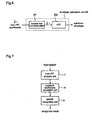
- Figure 7 is a block diagram illustrating the construction of a speech recognition apparatus according to an embodiment of the present invention.
- reference numeral 7 designates a mel-LPC analysis unit for calculating mel-LPC coefficients having different resolutions for different frequencies, from an input speech, frame by frame, using a mel predictive filter including frequency warping in a prediction model.
- Reference numeral 8 designates a cepstrum coefficient calculation unit for transforming the mel-LPC coefficients calculated in the mel-LPC analysis unit 7 into cepstrum coefficients.
- Reference numeral 9 designates a speech recognition unit for calculating similarities between the time series of cepstrum coefficients calculated in the cepstrum coefficient calculation unit 8 and plural standard models or patterns such as words or phonemes which are prepared in advance, and recognizing the words or phonemes having the largest similarities.
- the speech recognition unit 9 can be used for either specific speaker recognition or non-specific speaker recognition.
- Figure 7 schematically shows the mel-LPC analysis unit 7.
- a method for calculating LPC coefficients having different resolutions for different frequencies i.e., mel-LPC coefficients.
- ⁇ i the mel-LPC coefficient
- ⁇ the warping coefficient for changing the resolution of the LPC analysis for each frequency.
- the frequency characteristics of the all-pass filter are shown in figure 5.
- the warping coefficient ⁇ 0.31 for a sampling frequency of 8 kHz
- ⁇ 0.35 for 10 kHz
- ⁇ 0.41 for 12 kHz
- ⁇ 0.45 for 16 kHz
- ⁇ 0.6-0.7 for 44.1 kHz.
- ⁇ i having the minimum predictive error is derived from the following simultaneous equation.
- ⁇ ij is a covariance of y i [n] and y j [n].
- ⁇ ij is obtained by a finite product-sum operation as in the following.
- ⁇ ij r [ i-j ]
- r[m] can have a property of an autocorrelation function, thereby the stability of 1/(1- ⁇ ( z ⁇ )) is secured.
- this operation has to be performed at an infinite number of times according to the normal calculation technique shown in the middle of formula (22), but the operation can be completed by a finite number of calculations shown at the right part of formula (22), not requiring massive computational amount. Further, any approximation necessary for terminating the operation after a finite number of calculations instead of performing an infinite number of calculations, such as cutting off of waveform, is not needed, and no error accompanying the cutting off of waveform occurs. Furthermore, since the computational amount is just several times as much as the normal computational amount for autocorrelation coefficients, it is possible to obtain the coefficients directly from the waveform. This is an important point definitely different from the conventional calculation method.
- Figure 8 shows the procedure of the practical calculation for obtaining mel-LPC coefficients. This part is identical to that of the illustrative embodiment shown in figure 3.
- reference numeral 71 designates multiple stages of all-pass filters for transforming an input signal into a frequency-warped signal.
- Reference numeral 72 designates a linear coupling unit for forming linear coupling between the output signals from the all-pass filters 71 and the predictive coefficients, and outputting the predictors of the input signal.
- Reference numeral 73 designates a least square operation unit for outputting mel-LPC coefficients by applying the method of least square to the predictors output from the linear coupling unit 72 and to the input signal.
- An input signal x[n] is filtered using the i-th order all-pass filter 71 to obtain an output signal y i [n] as follows.
- y 0 [n] x[n].
- mel-LPC coefficients are obtained by solving the normal equation of formula (6) with the mel-autocorrelation function ⁇ (i,j), by a well-known algorithm, for example, Durbin's method.
- the mel-LPC coefficients ⁇ i thus obtained are transformed to cepstrum coefficients.
- the transformation method has already been known, and the detail of this method is given in, for example, "Digital Signal Processing for Audio and Speech Information, by Kiyohiro Sikano, Tetsu Nakamura, Siro Ise, Shokodo, pp.10-16".
- the transformation may be performed by treating the mel-LPC coefficients in like manner as the standard LPC coefficients.
- cepstrum coefficients on the mel-frequency axis can be obtained.
- mel-LPC cepstrum coefficients time series of the cepstrum coefficients thus calculated (hereinafter referred to as mel-LPC cepstrum coefficients) and the plural standard models of words or phonemes prepared in advance, and the word or phoneme having the highest similarity is recognized.
- HMM hidden Markov model
- time series of parameters respectively corresponding to plural words to be recognized are represented as probabilistic transitions
- this method is well known and widely utilized (e.g., Seiichi Nakagawa "Speech Recognition by Probability Model", Edited by Electronics Information and Communication Society).
- HMM is a method in which HMM models learn time series of parameters of phonemes or words which reflect differences among individuals, and recognition is performed by measuring how similar a speech is to the model in terms of a probability value.
- the above-described time series of mel-LPC cepstrum coefficients is used as the time series of the parameter.
- a time series of a representative parameter among the time series of parameters respectively corresponding to plural words or phonemes to be recognized, may be used.
- a normalized time series of a parameter obtained by normalizing (warping) a time series of the parameter time-wise or frequency-wise may be used as the standard model.
- DP matching dynamic programming
- any of the standard models may be used with no problem because the time series of the above-described mel-LPC cepstrum coefficients can be used as the time series of parameters.
- recognition is performed using the mel-LPC cepstrum coefficients as the time series of parameters obtained from the input signal
- the mel-PARCOR coefficients obtained from the mel-LPC coefficients by the well-known method similar to the method of obtaining PARCOR coefficients from standard LPC coefficients, or mel-LSP coefficients obtained from the mel-LPC coefficients by the well-known method similar to the method of obtaining LSP coefficients from the standard LPC coefficients.
- the mel-LPC coefficients, mel-PARCOR coefficients, mel-LSP coefficients, and mel-LPC cepstrum coefficients which are obtained by mel-LPC analysis, can be replaced with the LPC coefficients, PARCOR coefficients, LSP coefficients, and LPC cepstrum coefficients which are all obtained from the conventional LPC analysis, in various fields including not only speech recognition but speech synthesizing and speech encoding.
- the mel-LPC analysis unit 7 obtains the LPC coefficients having different resolutions for different frequencies, i.e., the mel-LPC coefficients, from the input signal using the mel-LPC analysis.
- the unit 7 may obtain the coefficients by the same method as used for the above described illustrative embodiment of an audio signal compression apparatus, which method comprises transforming the input signal into a frequency-warped signal using the all-pass filter, and subjecting the frequency-warped signal to standard LPC analysis to obtain the spectrum envelope.
- parameters corresponding to a spectrum envelope having different resolutions for different frequencies based on human auditory characteristics are obtained by the mel-LPC analysis using a weighting function on frequency based on the human auditory characteristics. Therefore, it is possible to recognize the feature of the spectrum envelope efficiently even with smaller number of parameters, and application of these parameters to speech recognition realizes higher recognition performance with a smaller processing amount.
Landscapes
- Engineering & Computer Science (AREA)
- Computer Networks & Wireless Communication (AREA)
- Signal Processing (AREA)
- Theoretical Computer Science (AREA)
- Compression, Expansion, Code Conversion, And Decoders (AREA)
Claims (6)
- Spracherkennungsverfahren zum Erkennen von Sprache aus einem eingegebenen Sprachsignal, umfassend die Schritte:Ausschneiden eines vorbestimmten Zeitabschnittes des Sprachsignals aus dem eingegebenen Sprachsignal (x[n]),Filtern des vorbestimmten Zeitabschnittes des Sprachsignals durch eine Mehrzahl von Allpassfiltern (71, 211), um Filterausgabesignale (yi[n]) von den jeweiligen Filtern zu erhalten,Gewinnen von mel-linearen Vorhersagekoeffizienten (ãi) aus einer Autokorrelationsfunktion auf einer Mel-Frequenzachse, undErkennen der Sprache unter Verwendung der gewonnenen mel-linearen Vorhersagekoeffizienten (ãi),dadurch gekennzeichnet, dass weiterhin umfassend den Schritt
Erhalten der Autokorrelationsfunktion auf der Mel-Frequenzachse unter Verwendung einer endlichen Anzahl von Produkt-Summenoperationen, Formel A, zwischen dem eingegebenen Sprachsignal (x[n]) und den Filterausgabesignalen (yi[n]) von den jeweiligen Filtern, wobei die Formel A wie folgt lautet:
wobei Φ(i,j) die Autokorrelationsfunktion ist, x[n] das eingegebene Signal ist, und y(i-j) [n] das Filterausgabesignal vom Allpassfilter der Ordnung i-j ist. - Spracherkennungsverfahren nach Anspruch 1, wobei das Allpassfilter der Ordnung i (71, 211) i Stufen eines Allpassfilters erster Ordnung umfasst.
- Spracherkennungsverfahren nach Anspruch 1 oder 2, weiterhin umfassend
Berechnen von Parametern, die eine spektrale Hülle darstellen, abgeleitet von den mel-linearen Vorhersagekoeffizienten,
Berechnung von Ähnlichkeiten zwischen Zeitreihen der berechneten Parameter und mehreren Standardmodellen, und
Erkennen eines unter den mehreren Standardmodellen, welches die größte Ähnlichkeit aufweist. - Spracherkennungsvorrichtung zum Erkennen von Sprache aus einem eingegebenen Sprachsignal, umfassend:eine mel-lineare prädiktive Analyseeinrichtung (7) zum Ausschneiden eines vorbestimmten Zeitabschnittes des Sprachsignals aus dem eingegebenen Sprchsignal (x[n]), zum Filtern des vorbestimmen Zeitabschnittes des Sprachsignals durch eine Mehrzahl von Allpassfiltern (71, 211) mit einer jeweiligen Ordnung i, um Filterausgabesignale (yi [n]) von den jeweiligen Filtern zu erhalten, zum Gewinnen von mel-linearen Vorhersagekoeffizienten (ãi) von einer Autokorrelationsfunktion auf einer Mel-Frequenzachse, undeiner Spracherkennungseinrichtung (9) zum Erkennen der Sprache unter Verwendung der mel-linearen Vorhersagekoeffizienten (ãi),dadurch gekennzeichnet, dass
die mel-lineare prädiktive Analyseeinrichtung (7) angepasst ist zum Erhalten der Autokorrelationsfunktion auf der Mel-Frequenzachse unter Verwendung einer endlichen Anzahl von Produkt-Summenoperationen, Formel A, zwischen dem eingegebenen Sprachsignal (x[n]) und den Filterausgabesignalen (yi [n]) von den jeweiligen Filtern, wobei die Formel A wie folgt lautet:
wobei Φ(i, j) die Autokorrelationsfunktion ist, x[n] das eingegebene Signal ist, und y(i-j) [n] das Filterausgabesignal vom Allpassfilter der Ordnung i-j ist. - Spracherkennungsvorrichtung nach Anspruch 4, weiterhin umfassend:eine Parameterberechnungseinrichtung (8) zum Berechnen von Parametern, die eine spektrale Hülle darstellen, abgeleitet von den mel-linearen Vorhersagekoeffizienten,wobei die Spracherkennungseinrichtung (9) angepasst ist zur Berechnung von Ähnlichkeiten zwischen Zeitreihen der in der Parameterberechnungseinrichtung (8) berechneten Parameter und mehreren Standardmodellen, und Erkennen eines unter den mehreren Standardmodellen, welches die größte Ähnlichkeit aufweist.
- Spracherkennungsvorrichtung nach Anspruch 4 oder 5, wobei das Allpassfilter der Ordnung i (71, 211) i-Stufen eines Allpassfilters erster Ordnung umfasst.
Applications Claiming Priority (6)
| Application Number | Priority Date | Filing Date | Title |
|---|---|---|---|
| JP27094597 | 1997-10-03 | ||
| JP27094597 | 1997-10-03 | ||
| JP270945/97 | 1997-10-03 | ||
| JP6500598 | 1998-03-16 | ||
| JP65005/98 | 1998-03-16 | ||
| JP6500598 | 1998-03-16 |
Publications (3)
| Publication Number | Publication Date |
|---|---|
| EP0907258A2 EP0907258A2 (de) | 1999-04-07 |
| EP0907258A3 EP0907258A3 (de) | 2004-01-02 |
| EP0907258B1 true EP0907258B1 (de) | 2007-01-03 |
Family
ID=26406147
Family Applications (1)
| Application Number | Title | Priority Date | Filing Date |
|---|---|---|---|
| EP98118674A Expired - Lifetime EP0907258B1 (de) | 1997-10-03 | 1998-10-02 | Audiosignalkompression, Sprachsignalkompression und Spracherkennung |
Country Status (5)
| Country | Link |
|---|---|
| US (2) | US6311153B1 (de) |
| EP (1) | EP0907258B1 (de) |
| KR (1) | KR100361883B1 (de) |
| CA (1) | CA2249792C (de) |
| DE (1) | DE69836785T2 (de) |
Cited By (1)
| Publication number | Priority date | Publication date | Assignee | Title |
|---|---|---|---|---|
| RU2505868C2 (ru) * | 2011-12-07 | 2014-01-27 | Ооо "Цифрасофт" | Способ встраивания цифровой информации в аудиосигнал |
Families Citing this family (44)
| Publication number | Priority date | Publication date | Assignee | Title |
|---|---|---|---|---|
| JP3580777B2 (ja) * | 1998-12-28 | 2004-10-27 | フラウンホーファー−ゲゼルシャフト・ツール・フェルデルング・デル・アンゲヴァンテン・フォルシュング・アインゲトラーゲネル・フェライン | オーディオ信号又はビットストリームの符号化又は復号化のための方法及び装置 |
| US6836761B1 (en) * | 1999-10-21 | 2004-12-28 | Yamaha Corporation | Voice converter for assimilation by frame synthesis with temporal alignment |
| KR100333049B1 (ko) * | 2000-01-25 | 2002-04-22 | 박종섭 | 심리 음향 캡스트럴 평균 차감법을 이용한 이동통신시스템에서의 음질 평가방법 |
| US6868380B2 (en) * | 2000-03-24 | 2005-03-15 | Eliza Corporation | Speech recognition system and method for generating phonotic estimates |
| US20020065649A1 (en) * | 2000-08-25 | 2002-05-30 | Yoon Kim | Mel-frequency linear prediction speech recognition apparatus and method |
| JP3576941B2 (ja) * | 2000-08-25 | 2004-10-13 | 株式会社ケンウッド | 周波数間引き装置、周波数間引き方法及び記録媒体 |
| KR20020052203A (ko) * | 2000-09-08 | 2002-07-02 | 요트.게.아. 롤페즈 | 오디오 신호 압축 |
| US20030202683A1 (en) * | 2002-04-30 | 2003-10-30 | Yue Ma | Vehicle navigation system that automatically translates roadside signs and objects |
| EP1661124A4 (de) * | 2003-09-05 | 2008-08-13 | Stephen D Grody | Verfahren und vorrichtungen zur bereitstellung von diensten durch verwendung von spracherkennung |
| CN101556800B (zh) * | 2003-10-23 | 2012-05-23 | 松下电器产业株式会社 | 音频频谱编解码方法和装置、声音信号发送和接收装置 |
| US7672838B1 (en) * | 2003-12-01 | 2010-03-02 | The Trustees Of Columbia University In The City Of New York | Systems and methods for speech recognition using frequency domain linear prediction polynomials to form temporal and spectral envelopes from frequency domain representations of signals |
| KR20060131793A (ko) * | 2003-12-26 | 2006-12-20 | 마츠시타 덴끼 산교 가부시키가이샤 | 음성ㆍ악음 부호화 장치 및 음성ㆍ악음 부호화 방법 |
| EP1846921B1 (de) | 2005-01-31 | 2017-10-04 | Skype | Verfahren zur verkettung von datenrahmen in einem kommunikationssystem |
| TWI285568B (en) * | 2005-02-02 | 2007-08-21 | Dowa Mining Co | Powder of silver particles and process |
| KR100612889B1 (ko) | 2005-02-05 | 2006-08-14 | 삼성전자주식회사 | 선스펙트럼 쌍 파라미터 복원 방법 및 장치와 그 음성복호화 장치 |
| US7813931B2 (en) * | 2005-04-20 | 2010-10-12 | QNX Software Systems, Co. | System for improving speech quality and intelligibility with bandwidth compression/expansion |
| US8249861B2 (en) * | 2005-04-20 | 2012-08-21 | Qnx Software Systems Limited | High frequency compression integration |
| US8086451B2 (en) * | 2005-04-20 | 2011-12-27 | Qnx Software Systems Co. | System for improving speech intelligibility through high frequency compression |
| KR20080097178A (ko) * | 2006-01-18 | 2008-11-04 | 연세대학교 산학협력단 | 부호화/복호화 장치 및 방법 |
| JP2009539132A (ja) * | 2006-05-30 | 2009-11-12 | コーニンクレッカ フィリップス エレクトロニクス エヌ ヴィ | オーディオ信号の線形予測符号化 |
| KR100921869B1 (ko) | 2006-10-24 | 2009-10-13 | 주식회사 대우일렉트로닉스 | 음원의 오류 검출 장치 |
| RU2343565C2 (ru) * | 2006-11-07 | 2009-01-10 | Новочеркасское Высшее Военное Командное Училище Связи (Институт Связи) | Способ сжатия и восстановления речевых сообщений |
| EP2092439A2 (de) * | 2006-12-08 | 2009-08-26 | Patrick J. Hall | Computergestützte online-übersetzung |
| JP5355387B2 (ja) * | 2007-03-30 | 2013-11-27 | パナソニック株式会社 | 符号化装置および符号化方法 |
| US8849432B2 (en) * | 2007-05-31 | 2014-09-30 | Adobe Systems Incorporated | Acoustic pattern identification using spectral characteristics to synchronize audio and/or video |
| JP4882899B2 (ja) * | 2007-07-25 | 2012-02-22 | ソニー株式会社 | 音声解析装置、および音声解析方法、並びにコンピュータ・プログラム |
| JP4623124B2 (ja) * | 2008-04-07 | 2011-02-02 | ソニー株式会社 | 楽曲再生装置、楽曲再生方法および楽曲再生プログラム |
| NO2313887T3 (de) * | 2008-07-10 | 2018-02-10 | ||
| EP2144231A1 (de) * | 2008-07-11 | 2010-01-13 | Fraunhofer-Gesellschaft zur Förderung der angewandten Forschung e.V. | Audiokodierungs-/-dekodierungschema geringer Bitrate mit gemeinsamer Vorverarbeitung |
| KR101764926B1 (ko) * | 2009-12-10 | 2017-08-03 | 삼성전자주식회사 | 음향 통신을 위한 장치 및 방법 |
| US8532985B2 (en) * | 2010-12-03 | 2013-09-10 | Microsoft Coporation | Warped spectral and fine estimate audio encoding |
| US10026407B1 (en) | 2010-12-17 | 2018-07-17 | Arrowhead Center, Inc. | Low bit-rate speech coding through quantization of mel-frequency cepstral coefficients |
| DK2503794T3 (en) | 2011-03-24 | 2017-01-30 | Oticon As | Audio processing device, system, application and method |
| JP5922263B2 (ja) | 2012-02-21 | 2016-05-24 | タタ コンサルタンシー サービシズ リミテッドTATA Consultancy Services Limited | 特定の対象音を検出するシステム及び方法 |
| US9042867B2 (en) * | 2012-02-24 | 2015-05-26 | Agnitio S.L. | System and method for speaker recognition on mobile devices |
| EP3193332B1 (de) * | 2012-07-12 | 2020-09-02 | Nokia Technologies Oy | Vektorquantisierung |
| US10019983B2 (en) * | 2012-08-30 | 2018-07-10 | Aravind Ganapathiraju | Method and system for predicting speech recognition performance using accuracy scores |
| EP2891147B1 (de) * | 2012-08-30 | 2020-08-12 | Interactive Intelligence, INC. | Verfahren und system zur vorhersage der spracherkennungsleistung durch genauigkeitsscores |
| US9591052B2 (en) | 2013-02-05 | 2017-03-07 | Apple Inc. | System and method for providing a content distribution network with data quality monitoring and management |
| MY198868A (en) * | 2013-02-05 | 2023-10-02 | Ericsson Telefon Ab L M | Method and appartus for controlling audio frame loss concealment |
| CN108922549B (zh) * | 2018-06-22 | 2022-04-08 | 浙江工业大学 | 一种基于ip对讲系统中音频压缩的方法 |
| CN111210836B (zh) * | 2020-03-09 | 2023-04-25 | 成都启英泰伦科技有限公司 | 一种麦克风阵列波束形成动态调整方法 |
| US20210349883A1 (en) * | 2020-05-05 | 2021-11-11 | At&T Intellectual Property I, L.P. | Automated, user-driven curation and compilation of media segments |
| CN112444742B (zh) * | 2020-11-09 | 2022-05-06 | 国网山东省电力公司信息通信公司 | 一种继电保护通道监视预警系统 |
Family Cites Families (14)
| Publication number | Priority date | Publication date | Assignee | Title |
|---|---|---|---|---|
| US5384891A (en) * | 1988-09-28 | 1995-01-24 | Hitachi, Ltd. | Vector quantizing apparatus and speech analysis-synthesis system using the apparatus |
| JPH04264599A (ja) | 1991-02-20 | 1992-09-21 | Hitachi Ltd | 音声分析合成装置 |
| JPH0435527A (ja) | 1990-05-31 | 1992-02-06 | Fujitsu Ltd | 多段符号化・復号化方式 |
| US5450522A (en) * | 1991-08-19 | 1995-09-12 | U S West Advanced Technologies, Inc. | Auditory model for parametrization of speech |
| JPH07111462A (ja) * | 1993-10-08 | 1995-04-25 | Takayama:Kk | 音声圧縮方法および装置 |
| JPH07160297A (ja) | 1993-12-10 | 1995-06-23 | Nec Corp | 音声パラメータ符号化方式 |
| KR960012475B1 (ko) | 1994-01-18 | 1996-09-20 | 대우전자 주식회사 | 디지탈 오디오 부호화장치의 채널별 비트 할당 장치 |
| JP3087814B2 (ja) | 1994-03-17 | 2000-09-11 | 日本電信電話株式会社 | 音響信号変換符号化装置および復号化装置 |
| US5684920A (en) | 1994-03-17 | 1997-11-04 | Nippon Telegraph And Telephone | Acoustic signal transform coding method and decoding method having a high efficiency envelope flattening method therein |
| JPH07261797A (ja) * | 1994-03-18 | 1995-10-13 | Mitsubishi Electric Corp | 信号符号化装置及び信号復号化装置 |
| JPH08123494A (ja) | 1994-10-28 | 1996-05-17 | Mitsubishi Electric Corp | 音声符号化装置、音声復号化装置、音声符号化復号化方法およびこれらに使用可能な位相振幅特性導出装置 |
| JP3353266B2 (ja) | 1996-02-22 | 2002-12-03 | 日本電信電話株式会社 | 音響信号変換符号化方法 |
| GB2326572A (en) * | 1997-06-19 | 1998-12-23 | Softsound Limited | Low bit rate audio coder and decoder |
| US6092039A (en) * | 1997-10-31 | 2000-07-18 | International Business Machines Corporation | Symbiotic automatic speech recognition and vocoder |
-
1998
- 1998-10-02 KR KR10-1998-0041659A patent/KR100361883B1/ko not_active Expired - Fee Related
- 1998-10-02 CA CA002249792A patent/CA2249792C/en not_active Expired - Fee Related
- 1998-10-02 EP EP98118674A patent/EP0907258B1/de not_active Expired - Lifetime
- 1998-10-02 DE DE69836785T patent/DE69836785T2/de not_active Expired - Lifetime
- 1998-10-02 US US09/165,297 patent/US6311153B1/en not_active Expired - Lifetime
-
2001
- 2001-06-28 US US09/892,745 patent/US6477490B2/en not_active Expired - Lifetime
Cited By (1)
| Publication number | Priority date | Publication date | Assignee | Title |
|---|---|---|---|---|
| RU2505868C2 (ru) * | 2011-12-07 | 2014-01-27 | Ооо "Цифрасофт" | Способ встраивания цифровой информации в аудиосигнал |
Also Published As
| Publication number | Publication date |
|---|---|
| EP0907258A3 (de) | 2004-01-02 |
| DE69836785T2 (de) | 2007-04-26 |
| KR100361883B1 (ko) | 2003-01-24 |
| DE69836785D1 (de) | 2007-02-15 |
| US20010044727A1 (en) | 2001-11-22 |
| US6311153B1 (en) | 2001-10-30 |
| US6477490B2 (en) | 2002-11-05 |
| EP0907258A2 (de) | 1999-04-07 |
| CA2249792A1 (en) | 1999-04-03 |
| CA2249792C (en) | 2009-04-07 |
| KR19990036857A (ko) | 1999-05-25 |
Similar Documents
| Publication | Publication Date | Title |
|---|---|---|
| EP0907258B1 (de) | Audiosignalkompression, Sprachsignalkompression und Spracherkennung | |
| CN1327405C (zh) | 分布式语音识别系统中语音识别的方法和设备 | |
| EP1041540B1 (de) | Linear prädiktive Cepstral-Merkmale in hierarchische Subbänder organisiert für die HMM-basierte Spracherkennung | |
| EP0942411B1 (de) | Vorrichtung zur Kodierung und Dekodierung von Audiosignalen | |
| Nadeu et al. | Time and frequency filtering of filter-bank energies for robust HMM speech recognition | |
| US5517595A (en) | Decomposition in noise and periodic signal waveforms in waveform interpolation | |
| EP1588354B1 (de) | Verfahren und vorrichtung zur sprachrekonstruktion | |
| US20020010577A1 (en) | Apparatus and method for encoding a signal as well as apparatus and method for decoding a signal | |
| EP0640952A2 (de) | Verfahren zur Unterscheidung zwischen stimmhaften und stimmlosen Lauten | |
| JPH0869299A (ja) | 音声符号化方法、音声復号化方法及び音声符号化復号化方法 | |
| JPH09127989A (ja) | 音声符号化方法及び音声符号化装置 | |
| JPH10124092A (ja) | 音声符号化方法及び装置、並びに可聴信号符号化方法及び装置 | |
| US6023671A (en) | Voiced/unvoiced decision using a plurality of sigmoid-transformed parameters for speech coding | |
| JPH08123484A (ja) | 信号合成方法および信号合成装置 | |
| US20050114123A1 (en) | Speech processing system and method | |
| Hai et al. | Improved linear predictive coding method for speech recognition | |
| JPH07261800A (ja) | 変換符号化方法、復号化方法 | |
| JP3351746B2 (ja) | オーディオ信号圧縮方法、オーディオ信号圧縮装置、音声信号圧縮方法、音声信号圧縮装置,音声認識方法および音声認識装置 | |
| WO1996004647A1 (en) | Sensitivity weighted vector quantization of line spectral pair frequencies | |
| EP0729132A2 (de) | Breitbandsignalkodierer | |
| Ramachandran | Quantization of discrete time signals | |
| Koishida et al. | Spectral representation of speech based on mel‐generalized cepstral coefficients and its properties | |
| JP2899024B2 (ja) | ベクトル量子化方法 | |
| Nakatoh et al. | Low bit rate coding for speech and audio using mel linear predictive coding (MLPC) analysis. | |
| Kamarsu et al. | Vector quantization of speech using artificial neural learning |
Legal Events
| Date | Code | Title | Description |
|---|---|---|---|
| PUAI | Public reference made under article 153(3) epc to a published international application that has entered the european phase |
Free format text: ORIGINAL CODE: 0009012 |
|
| AK | Designated contracting states |
Kind code of ref document: A2 Designated state(s): AT BE CH CY DE DK ES FI FR GB GR IE IT LI LU MC NL PT SE |
|
| AX | Request for extension of the european patent |
Free format text: AL;LT;LV;MK;RO;SI |
|
| RIN1 | Information on inventor provided before grant (corrected) |
Inventor name: YAGI, JUNKO Inventor name: NAKAHASHI, JUNICHI Inventor name: KATAYAMA, TARO Inventor name: SERIKAWA, MITSUHIKO Inventor name: ISHIKAWA, TOMOKAZU Inventor name: TSUSHIMA, MINEO Inventor name: NORIMATSU, TAKESHI Inventor name: NAKATOH, YOSHIHISA |
|
| PUAL | Search report despatched |
Free format text: ORIGINAL CODE: 0009013 |
|
| AK | Designated contracting states |
Kind code of ref document: A3 Designated state(s): AT BE CH CY DE DK ES FI FR GB GR IE IT LI LU MC NL PT SE |
|
| AX | Request for extension of the european patent |
Extension state: AL LT LV MK RO SI |
|
| 17P | Request for examination filed |
Effective date: 20040702 |
|
| AKX | Designation fees paid |
Designated state(s): DE FR GB IT NL |
|
| 17Q | First examination report despatched |
Effective date: 20040903 |
|
| GRAP | Despatch of communication of intention to grant a patent |
Free format text: ORIGINAL CODE: EPIDOSNIGR1 |
|
| RIC1 | Information provided on ipc code assigned before grant |
Ipc: H04B 1/66 20060101AFI20060222BHEP |
|
| GRAS | Grant fee paid |
Free format text: ORIGINAL CODE: EPIDOSNIGR3 |
|
| RIN1 | Information on inventor provided before grant (corrected) |
Inventor name: YAGI, YORIKO Inventor name: NAKAHASHI, JUNICHI Inventor name: KATAYAMA, TARO Inventor name: SERIKAWA, MITSUHIKO Inventor name: ISHIKAWA, TOMOKAZU Inventor name: TSUSHIMA, MINEO Inventor name: NORIMATSU, TAKESHI Inventor name: NAKATOH, YOSHIHISA |
|
| GRAA | (expected) grant |
Free format text: ORIGINAL CODE: 0009210 |
|
| AK | Designated contracting states |
Kind code of ref document: B1 Designated state(s): DE FR GB IT NL |
|
| PG25 | Lapsed in a contracting state [announced via postgrant information from national office to epo] |
Ref country code: NL Free format text: LAPSE BECAUSE OF FAILURE TO SUBMIT A TRANSLATION OF THE DESCRIPTION OR TO PAY THE FEE WITHIN THE PRESCRIBED TIME-LIMIT Effective date: 20070103 |
|
| REG | Reference to a national code |
Ref country code: GB Ref legal event code: FG4D |
|
| REF | Corresponds to: |
Ref document number: 69836785 Country of ref document: DE Date of ref document: 20070215 Kind code of ref document: P |
|
| ET | Fr: translation filed | ||
| NLV1 | Nl: lapsed or annulled due to failure to fulfill the requirements of art. 29p and 29m of the patents act | ||
| PLBE | No opposition filed within time limit |
Free format text: ORIGINAL CODE: 0009261 |
|
| STAA | Information on the status of an ep patent application or granted ep patent |
Free format text: STATUS: NO OPPOSITION FILED WITHIN TIME LIMIT |
|
| 26N | No opposition filed |
Effective date: 20071005 |
|
| PG25 | Lapsed in a contracting state [announced via postgrant information from national office to epo] |
Ref country code: IT Free format text: LAPSE BECAUSE OF FAILURE TO SUBMIT A TRANSLATION OF THE DESCRIPTION OR TO PAY THE FEE WITHIN THE PRESCRIBED TIME-LIMIT Effective date: 20070103 |
|
| PGFP | Annual fee paid to national office [announced via postgrant information from national office to epo] |
Ref country code: DE Payment date: 20100929 Year of fee payment: 13 |
|
| PGFP | Annual fee paid to national office [announced via postgrant information from national office to epo] |
Ref country code: GB Payment date: 20110928 Year of fee payment: 14 |
|
| PGFP | Annual fee paid to national office [announced via postgrant information from national office to epo] |
Ref country code: FR Payment date: 20111103 Year of fee payment: 14 |
|
| GBPC | Gb: european patent ceased through non-payment of renewal fee |
Effective date: 20121002 |
|
| REG | Reference to a national code |
Ref country code: FR Ref legal event code: ST Effective date: 20130628 |
|
| PG25 | Lapsed in a contracting state [announced via postgrant information from national office to epo] |
Ref country code: GB Free format text: LAPSE BECAUSE OF NON-PAYMENT OF DUE FEES Effective date: 20121002 Ref country code: DE Free format text: LAPSE BECAUSE OF NON-PAYMENT OF DUE FEES Effective date: 20130501 |
|
| REG | Reference to a national code |
Ref country code: DE Ref legal event code: R119 Ref document number: 69836785 Country of ref document: DE Effective date: 20130501 |
|
| PG25 | Lapsed in a contracting state [announced via postgrant information from national office to epo] |
Ref country code: FR Free format text: LAPSE BECAUSE OF NON-PAYMENT OF DUE FEES Effective date: 20121031 |