EP0908424A1 - Keramischer Gegenstand - Google Patents
Keramischer Gegenstand Download PDFInfo
- Publication number
- EP0908424A1 EP0908424A1 EP98203200A EP98203200A EP0908424A1 EP 0908424 A1 EP0908424 A1 EP 0908424A1 EP 98203200 A EP98203200 A EP 98203200A EP 98203200 A EP98203200 A EP 98203200A EP 0908424 A1 EP0908424 A1 EP 0908424A1
- Authority
- EP
- European Patent Office
- Prior art keywords
- ceramic article
- zirconia
- sintering
- core
- sintered
- Prior art date
- Legal status (The legal status is an assumption and is not a legal conclusion. Google has not performed a legal analysis and makes no representation as to the accuracy of the status listed.)
- Withdrawn
Links
Images

Classifications
-
- C—CHEMISTRY; METALLURGY
- C04—CEMENTS; CONCRETE; ARTIFICIAL STONE; CERAMICS; REFRACTORIES
- C04B—LIME, MAGNESIA; SLAG; CEMENTS; COMPOSITIONS THEREOF, e.g. MORTARS, CONCRETE OR LIKE BUILDING MATERIALS; ARTIFICIAL STONE; CERAMICS; REFRACTORIES; TREATMENT OF NATURAL STONE
- C04B41/00—After-treatment of mortars, concrete, artificial stone or ceramics; Treatment of natural stone
- C04B41/45—Coating or impregnating, e.g. injection in masonry, partial coating of green or fired ceramics, organic coating compositions for adhering together two concrete elements
- C04B41/50—Coating or impregnating, e.g. injection in masonry, partial coating of green or fired ceramics, organic coating compositions for adhering together two concrete elements with inorganic materials
- C04B41/5025—Coating or impregnating, e.g. injection in masonry, partial coating of green or fired ceramics, organic coating compositions for adhering together two concrete elements with inorganic materials with ceramic materials
- C04B41/5042—Zirconium oxides or zirconates; Hafnium oxides or hafnates
-
- C—CHEMISTRY; METALLURGY
- C04—CEMENTS; CONCRETE; ARTIFICIAL STONE; CERAMICS; REFRACTORIES
- C04B—LIME, MAGNESIA; SLAG; CEMENTS; COMPOSITIONS THEREOF, e.g. MORTARS, CONCRETE OR LIKE BUILDING MATERIALS; ARTIFICIAL STONE; CERAMICS; REFRACTORIES; TREATMENT OF NATURAL STONE
- C04B35/00—Shaped ceramic products characterised by their composition; Ceramics compositions; Processing powders of inorganic compounds preparatory to the manufacturing of ceramic products
- C04B35/01—Shaped ceramic products characterised by their composition; Ceramics compositions; Processing powders of inorganic compounds preparatory to the manufacturing of ceramic products based on oxide ceramics
- C04B35/48—Shaped ceramic products characterised by their composition; Ceramics compositions; Processing powders of inorganic compounds preparatory to the manufacturing of ceramic products based on oxide ceramics based on zirconium or hafnium oxides, zirconates, zircon or hafnates
- C04B35/486—Fine ceramics
-
- C—CHEMISTRY; METALLURGY
- C04—CEMENTS; CONCRETE; ARTIFICIAL STONE; CERAMICS; REFRACTORIES
- C04B—LIME, MAGNESIA; SLAG; CEMENTS; COMPOSITIONS THEREOF, e.g. MORTARS, CONCRETE OR LIKE BUILDING MATERIALS; ARTIFICIAL STONE; CERAMICS; REFRACTORIES; TREATMENT OF NATURAL STONE
- C04B41/00—After-treatment of mortars, concrete, artificial stone or ceramics; Treatment of natural stone
- C04B41/80—After-treatment of mortars, concrete, artificial stone or ceramics; Treatment of natural stone of only ceramics
- C04B41/81—Coating or impregnation
- C04B41/85—Coating or impregnation with inorganic materials
- C04B41/87—Ceramics
Definitions
- the present invention pertains to functionally gradient ceramic items and methods for preparing such ceramic items and more particularly pertains to ceramic articles, tools, and methods for preparing ceramic articles and for sintering.
- Zirconia is a ceramic material which, in its tetragonal crystal structure, is strong and tough but has the shortcoming that it is relatively soft. This means that zirconia in the tetragonal crystal structure is not as hard as zirconia in other crystal structures. Zirconia can also exist in the cubic and monoclinic crystallographic structures, both of which are harder but more brittle than the tetragonal structure. Fully stabilized metastable tetragonal zirconia can be obtained by appropriate alloying of pure zirconia with selected dopants. Cubic and monoclinic phases of zirconia require thermal, thermo-mechanical or some alloying treatments for its formation. For tools and more particularly for cutting tool applications it is desired that the tool materials possess hardness at the work surfaces and toughness at the core of the articles.
- a method for preparing a ceramic article comprising compacting a particulate including a primary oxide and a secondary oxide to form a green blank.
- the primary oxide is ZrO 2 .
- the secondary oxide is selected from the group consisting of MgO, CaO, Y 2 O 3 , Sc 2 O 3 , rare earth oxides and combinations thereof.
- the green blank is coated by any convenient means, such as spin coating, dip coating, etc. by a sol containing a smectite clay, specifically a hydrous magnesium lithium silicate or fluorosilicate with a layered structure, and subsequently sintered.
- the sintered zirconia alloy ceramic article thus produced has a case containing essentially monoclininc zirconia phase and zircon (zirconia silicate-chemical formula ZrSiO 4 ) and a core containing tetragonal zirconia phase.
- the case because of the nature of the phases, is extremely hard and the core is tough. Moreover, there is a gradient of phases existing in the article.
- the present invention is a sintered ceramic article having an elemental composition including Zr, O, and at least one element selected from the group consisting of Mg, Ca, Y, Sc, Ce and rare earth elements.
- the ceramic article includes a core and a casing.
- the casing is exterior to and continuous with the core.
- the core is a mass of sintered particles having an essentially tetragonal zirconia crystalline structure and the casing is a mass of sintered particles having a mixture of monoclinic zirconia crystalline structure and zircon crystalline structure.
- the present invention is a method of preparing a ceramic article which includes compacting a particulate alloy of a primary oxide and a secondary oxide to form a blank.
- the primary oxide is zirconium oxide and the secondary oxide is selected from MgO, CaO, Y 2 O 3 , Sc 2 O 3 ,CeO 2 and rare earth oxides and combinations thereof.
- the blank is sintered in contact with a smectite containing sol.
- particulate zirconia alloy is computed and the "green" article is coated with a sol containing a synthetic smectite clay which is subsequently sintered.
- the resulting ceramic article of the invention has a case containing essentially monoclinic zirconia (ZrO 2 )and zircon (ZrSiO 4 ) and a core containing essentially tetragonal zirconia (ZrO 2 ).
- the transition from the case to the core of the articles is gradual, particularly in terms of the crystal structures of the transition layers, making it a functionally gradient structure.
- a hard outer surface is needed; however if the core is not tough the article will break. Further, if the transition from core to surface is not gradual the tool can crack and spall.
- the methods of the invention utilize particulate alloys of ZrO 2 and additional oxide selected from: MgO, CaO, Y 2 O 3 , Sc 2 O 3 and CeO 2 and other rare earth oxides (also referred to herein as "Mg-Ca-Y-Sc-Ce-rare earth oxides").
- Zirconia alloys useful in the methods of the invention have a fully stabilized tetragonal crystal structure in the temperature and pressure ranges at which the ceramic article produced will be used. For example, at temperatures up to about 200 °C and pressures up to about 1000 MPa, zirconia alloys having about 2 to about 20 mole percent Mg-Ca-Y-Sc-Ce-rare earth oxide exhibit a tetragonal structure.
- Preferred oxides for alloying with zirconia are Y 2 O 3 , MgO, CaO, CeO 2 and combinations of these oxides. It is preferred that the zirconia alloys have from 2 to 5 mole percent of the Mg-Ca-Y-Sc-Ce-rare earth oxides.
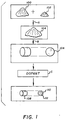
- Step "A" in FIG. 1, illustrates the alloying process. Zirconia powder 100 is combined with one or more secondary oxide powders 102 to provide zirconia alloy powder 104. It is preferred that the zirconia powder has a high purity, greater than about 99.9 percent. The preparation of zirconia alloys is well known to those skilled in the art and zirconia alloys are available commercially.
- particulate zirconia alloy having 3 mole percent Y 2 O 3 is marketed by several vendors such as HANWHA Advanced Ceramics, PTY Ltd. (as HWA-ZY 3P), Zirconia Sales Corporation of America (as HSY-3SD), and TOSHO Corporation (as 3YB).
- grain and agglomerate sizes and distributions, moisture content and use of binder in the zirconia alloy are selected in a manner well known to those skilled in the art.
- "Grain” is defined as an individual crystal, which may be within a particle, having a spatial orientation that is distinct from that of adjacent grains.
- "Agglomerate” is defined as an aggregation of individual particles, each of which may comprise multiple grains.
- An example of useful grain and agglomeration sizes and distributions for a particular embodiment of the invention is the following.
- the grain size is from about 0.1 micrometers to about 0.6 micrometers.
- the average grain size is 0.3 micrometers.
- the distribution of grain size is: 5-15 percent less than 0.1 micrometers, 40-60 percent less than 0.3 micrometers, and 85-95 percent less than 0.6 micrometers.
- the surface area of each individual grain ranges from about 10 to about 15 m 2 /g or is preferably 14 m 2 /g.
- Agglomerate size is from about 30 to about 60 micrometers and average agglomerate size is 40-60 micrometers.
- Moisture content of the powder is about 0.2 to 1.0 percent by volume of blank and is preferably 0.5 percent.
- the alloy powder is compacted in the presence of a binder such as gelatin or polyvinyl ionomer or more preferably polyvinyl alcohol.
- the binder is added to and mixed with the powder, for example by spraying or ball milling prior to placement of the powder in a compacting device.
- alloys useful in the methods of the invention include: tetragonal structure zirconia alloys having from about 2 to about 5 mole percent Y 2 O 3 , or more preferably about 3 mole percent Y 2 O 3 .
- tetragonal structure zirconia alloys useful in the methods of the invention are disclosed in U.S. Patent No. 5,336,282, which is hereby incorporated herein by reference. In the above U.S. patent, the alloy is selected so as to provide a "net shape" ceramic article as that term is defined therein: a ceramic article that is dimensionally true after sintering and therefore does not necessitate further machining prior to use in its intended working environment.
- the amount of shrinkage during sintering is predictable, producing a ceramic part that conforms to a predetermined shape and dimensions.
- the particulate zirconia alloy is substantially uniform. Purity of the alloy is well controlled at 99.9 to 99.99 percent, that is, impurities are no more than about 0.1 to 0.01 percent.
- Grain size is from about 0.1 micrometers to about 0.6 micrometers. Average grain size is 0.3 micrometers. The distribution of grain size is: 10 percent less than 0.1 micrometers, 50 percent less than 0.3 micrometers, and 90 percent less than 0.6 micrometers. Surface area of each individual grain ranges from about 10 to about 15 m 2 /g and is preferably 14 m 2 /g.
- Agglomerate size is from about 30 to about 60 micrometers. Average agglomerate size is 50 micrometers. Moisture content of the powder is about 0.2 to 1.0 percent by volume of blank and is preferably 0.5 percent.
- the particulate zirconia alloy powder 104 is compacted in a die, using a press to form a "green" blank 106.
- the "green" blanks can be formed by several methods known in the art including cold or dry pressing, and injection molding.
- the zirconia alloy powder 104 is heated to a temperature range at which sintering will occur. Sintering is a process where an article is maintained at within a temperature range for a period of time; and then cooled. During all or part of sintering, the zirconia alloy powder "green" compact, 106 is in contact with dopant, as discussed below in detail.
- Compaction and sintering are generally discussed herein as two consecutive operations, as indicated by "B" and "C" in FIG. 1; however, the invention is not limited to a particular sequence of compacting and sintering. For example, compaction and sintering can be simultaneous in a single operation or partial compaction can be followed by sintering and further compaction.
- Blank 106 is at least partially compacted and is either unsintered or not fully sintered.
- Completion of compacting and sintering provides the finished ceramic article 108, which has a substantially monoclinic zirconia and zircon phase case 110 and a substantially tetragonal phase zirconia core 112. These types of articles are defined as functionally gradient ceramic articles.
- the particular method of compacting the zirconia alloy powder 104 is not critical.
- the particulate zirconia alloy is cold compacted to provide an unsintered blank, which is also referred to herein as a "green" preform.
- the terms "cold compaction” refers to compression of the particulate alloy at a temperature below glass transition or decomposition temperature of the binder.
- the green preform can be produced by such methods as cold uniaxial pressing, cold isostatic pressing, injection molding or cold extrusion.
- the alloy powder is preferably subjected to uniform compacting forces in order to provide a blank 106 which has a uniform density.
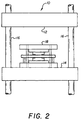
- a preferred compacting device that achieves uniform compacting forces is a floating mold die press 10, as disclosed in U.S. Patent No. 5,336,282 and as shown in FIG. 2.
- Die press comprises fixed platform 12 and movable platform 14 mounted on supports 16. Movable platform 14 is driven by hydraulic means (not illustrated) and supports mold and die assembly 18.
- FIG. 3 further illustrates assembly 18 as comprising plates 20, 22, which are slideably mounted on rods 24. Die sets 26, 28 are mounted respectively on plates 20, 22. Center platen 30 is mounted by spacer plates 32 on plate 22, and together with die sets 26, 28 defines cavity 34 there between.
- the zirconia alloy powder 104 premixed with binder is compacted by first placing in cavity 34. Platform 14 is then moved in the direction illustrated by the direction arrows in FIG.
- Mold and die assembly 18 should have dimensionally close tolerances in order to minimize or eliminate the need for post-sintered machining of working surfaces of the finished ceramic article.
- compaction surfaces 44, 46 of respective die sets 26, 28 can be parallel with a maximum design deviation from parallel of plus or minus 0.00005 inches.
- Compaction surfaces 48, 50 of center platen 30 can be perpendicular to surfaces 44, 46 and have a maximum design deviation from perpendicularity of plus or minus 0.00005 inches.
- the fill ratio should be established to produce a blank of a desired dimension, which after sintering will result in a ceramic of the final desired dimension.
- Frill ratio is the ratio of the height of cavity 34 taken along the axis of movement of platform 14 with platform 14 in its initial, lowermost position, to the height of the green part formed in cavity 34 taken along the axis of compaction of the powder in cavity 34. In other words, such height of the green preform also equals the distance between compaction surfaces 44, 46 of mold and die assembly 18 at the final end-of-compacting position.
- the alloy powder is cold compacted to a "green" density which is substantially less than the final sintered density of the tetragonal structure zirconia, that is, the density of the green preform 106 is substantially less than the density of a functionally gradient ceramic article 108 produced from that green preform 106 after sintering.
- the final sintered density of a completely tetragonal structure ceramic article differs slightly from the final sintered density of a ceramic article 108 of the invention in that articles 108 produced by the methods of the invention have a substantially monoclinic zirconia and zircon structure case 110 and a substantially tetragonal zirconia structure core 112.
- the green density be between about 40 and about 65 percent of the final density of the tetragonal structure zirconia, or more preferably be about 60 percent of the final density of the tetragonal structure zirconia.
- an article 108 produced from a zirconia alloy having 3 mole percent Y 2 O 3 has a final sintered density of 6.08 g/cm 3 , a range of preferred green densities of from about 2.5 to about 4.0 g/cm 3 , and a more preferred green density of about 3.65 g/cm 3 .
- the green density is largely dependent upon the compaction pressure and the fill ratio.
- Preferred compaction pressures in the methods of the invention are about 10,000-30,000 psi (69-207 MPa). A more preferred compaction pressure is about 15,000 psi (about 100 MPa).
- the fill ratio is maintained at from about 2.5 to 1 to about 3.5 to 1.
- a preferred fill ratio is about 3.0 to 1.
- Compaction time can be readily determined by the operator depending upon the compaction pressure selected. Compaction time, for example, can be in the range of from about 60 seconds to about 10 seconds for compaction pressures in the range of about 12,000 psi to about 18,000 psi, respectively. For a compaction pressure of 15,000 psi (100 MPa), the compaction time can be 30 seconds. It is well known that the compaction pressure and time selected by the operator can be dependent upon the size of the finished part 108. Generally, as the part size increases, compaction time is increased.
- the sol used in coating the "green" part contains a commercially available synthetic smectite clay which closely resembles the natural clay mineral hectorite in structure and composition.
- Hectorite is a natural swelling clay which is relatively rare and occurs contaminated with other minerals such as quartz which are difficult and expensive to remove.
- Synthetic smectite is free from natural impurities, and is prepared under controlled conditions.
- One such synthetic smectite clay is commercially marketed under the tradename Laponite by Laporte Industries, Ltd. of United Kingdom through its US subsidiary Southern Clay Products, Inc., Texas.
- the specific smectite clay used in this invention is a layered hydrous magnesium lithium silicate or fluorosilicate, such as Laponite S supplied by Southern Clay Products, Inc., with a typical chemical composition as shown below:
- Laponite products contain a polyphosphate peptizing agent such as tetrasodium pyrophosphate for rapid dispersion capability; alternatively, a suitable peptizer can be incorporated into Laponite subsequently for the same purpose.
- a polyphosphate peptizing agent such as tetrasodium pyrophosphate for rapid dispersion capability
- a suitable peptizer can be incorporated into Laponite subsequently for the same purpose.
- Laponite separates into tiny platelets of lateral dimension of 25-50 nm and a thickness of 1-5 nm in deionized aqueous dispersion, commonly referred to as sols.
- Typical concentration of Laponite in a sol can vary from 0.1% to 30%, but preferably 20 %.
- an electrically double layer forms around the clay platelets resulting in repulsion between them and no structure build-up.
- the double layer can be reduced resulting in attraction between the platelets forming a "house of card” structure with significant increase in viscosity.
- One can carefully control the viscosity of the sol by adjusting the level of electrolyte in the sol. This advantage of distinctive rheological property is utilized in the present invention in varying the thickness of the hard case.
- the coating of the sol, containing the synthetic smectite clay described above, on the "green" zirconia ceramic article 106 can be accomplished by any of the conventional techniques, such as spin coating, dip coating, spray coating, etc.
- the sol containing the synthetic smectite clay will penetrate a certain depth from the surface of application into the "green” zirconia ceramic article 106, because of the inherent porosity of the "green” article. This depth of penetration, after sintering, will determine the thickness of the case of the ceramic article 108.
- an article produced from a zirconia alloy having 3 mole percent Y 2 O 3 has a final sintered density of 6.05-6.08 g/cm 3 with a grain size of less than 1 micrometer and preferably less than 0.5 micrometers.
- Sintering is conducted in air or other oxygen containing atmosphere.
- the methods of the invention are not limited to any particular sintering pressure and temperature conditions. Sintering can be performed at atmospheric pressure or alternatively a higher pressure can be used during all or part of the sintering to reduce porosity.
- the sintering is continued for a sufficient time period for the case of the article being sintered to reach a thermodynamic equilibrium composition and structure.
- the core which is free from the synthetic smectite clay continues to have a tetragonal equilibrium structure.
- An example of a useful range of elevated sintering pressures is from about 69 MPa to about 207 MPa, or more preferably about 100-103 MPa.
- the sintered blank be slowly heated to sintering temperature and slowly cooled so as to avoid undesirable dimensional changes and crack development.
- preferred temperature ramps during heating are: about 0.3 °C/minute for room temperature to about 300 °C, about 0.1 °C/minute for about 300 °C to about 400 °C, about 0.4 °C/minute for about 400 °C to about 600 °C, and about 1.5 °C/minute for about 600 °C to about 1500 °C.
- Preferred temperature ramps during cooling are: about 2 °C/minute from about 1500 °C to about 800 °C and about 1.6 °C/minute from about 800 °C to room temperature.
- FIG. 4 illustrates a ceramic perforator 38 having cutting edge 40 mounted on mounting shank 42.
- Perforator can be mounted by shank 42 on any typical punch assembly, such as a reciprocating punch or a rotary punch upon which can be mounted a plurality of punches 36.
- perforator 38 can be limited to cutting edge 40 or can encompass the entire outside of perforator.
- Typical hardnesses for monoclinic zirconia casts with zirconia silicate of articles prepared by the methods of the invention are 15-17 GPa. This contrasts with hardnesses of 12-13 GPa typical of tetragonal zirconia.
- the configuration of articles prepared by the methods of the invention is limited by the requirements of cold compaction and sintering; for example, mold size and shape and sintering oven size and shape; but is not believed to be subject to other limitations.
- the methods and articles of the invention are not limited to discrete ceramic items, thus the terms blank and ceramic article and the like, used herein can also refer to portions of larger items.
- Zirconia alloy having 3 mole percent Y 2 O 3 was obtained as a prepared alloy powder, HWA-ZY3P from HANWHA Advanced Ceramics, PTY Ltd.
- the alloy powder had an agglomerate size ranging from 30 micrometers to 60 micrometers, an average agglomerate size of 50 micrometers, a grain size ranging from 0.1 micrometer to 0.6 micrometer, an average grain size of 0.3 micrometers, and a moisture content of 0.5 percent by volume.
- Polyvinyl alcohol in the amount of 4 percent by volume of the green part was added to the ceramic powder as a binder and mixed thoroughly by ball milling.
- the powder was compacted in the floating mold die press above described, at a compacting pressure of 15,000 psi (100 MPa) for 30 seconds and with a fill ratio of about 3 to 1, to compact the powder into a blank.
- the blank was placed on a zirconia plate during sintering and was sintered by sequentially heating the green part from room temperature to 300 °C at a rate of 0.3 °C/min., from 300 °C to 400 °C at a rate of 0.1 °C/min., from 400 °C to 600 °C at a rate of 0.4 °C/min, from 600 °C to 1500 °C at a rate of 1.5 °C/ min.; then maintaining the preform at 1500 °C.
- a number of "green" blanks similar to the above were prepared following the procedures described above. These blanks were spin coated with one sol from a group of Laponite RDS 10%, Laponite S 10%, Laponite JS 15%, Montmorillonite SC PX 2.37% (all supplied by Southern Clay Products), Ludox 10%, Ludox 30% (all supplied by Dupont). Spin coating of the above sols on "green” ceramic blanks was performed at 600-2000 rpm for 0.25 to 1 minute. The viscosities of the clay sols was altered by the addition of different levels of electrolyte in the sols. The differing viscosities of the sols allowed differing penetration of the sols in the porous "green” ceramic blanks.
- the spin coated "green” ceramic blanks were then dried in an oven at about 750 to 150°C for about 0.5 to 1 hour before placing on a zirconia plate and sintered per schedule described above.
- the Working Examples 2 and 3 show that for the sintered ceramic articles: case crystalline structure consists essentially of monoclinic ZrO 2 and zircon (ZrSiO 4 ); interface crystalline structure consists essentially of tetragonal ZrO 2 and minor to trace amount of zircon (ZrSiO 4 ); and the core crystalline structure consists essentially of tetragonal ZrO 2 with trace amounts of monoclinic ZrO 2 .
- the Comparative Examples 1, 4, 5, 6 and 7 indicate that the case, interface and core crystalline structures of the sintered ceramic articles are essentially tetragonal ZrO 2 with trace amount of monoclinic ZrO 2 .
- Zirconia alloy and its composites are known to have excellent corrosion resistance.
- Monoclinic ZrO 2 is substantially harder than tetragonal ZrO 2 .
- Zircon (ZrSiO 4 ) provides better wear and abrasion resistance than tetragonal zirconia.
- Monoclinic ZrO 2 is also known to have much superior wear and abrasion resistance.
- tetragonal ZrO 2 possesses high fracture toughness.
- Having a hard working surface or case for a ceramic article (such as cutting tool etc.) with an underlaying tough core is ideal for many applications such as slitting, perforating, cutting of paper or polymeric web with or without coatings of photographic emulsion, magnetic particles, etc.
Landscapes
- Chemical & Material Sciences (AREA)
- Engineering & Computer Science (AREA)
- Ceramic Engineering (AREA)
- Materials Engineering (AREA)
- Structural Engineering (AREA)
- Organic Chemistry (AREA)
- Inorganic Chemistry (AREA)
- Composite Materials (AREA)
- Manufacturing & Machinery (AREA)
- Compositions Of Oxide Ceramics (AREA)
Applications Claiming Priority (4)
| Application Number | Priority Date | Filing Date | Title |
|---|---|---|---|
| US946046 | 1997-10-07 | ||
| US08/946,321 US5798308A (en) | 1997-10-07 | 1997-10-07 | Ceramic article |
| US08/946,046 US5804131A (en) | 1997-10-07 | 1997-10-07 | Method of manufacturing a ceramic article |
| US946321 | 2001-09-05 |
Publications (1)
| Publication Number | Publication Date |
|---|---|
| EP0908424A1 true EP0908424A1 (de) | 1999-04-14 |
Family
ID=27130231
Family Applications (1)
| Application Number | Title | Priority Date | Filing Date |
|---|---|---|---|
| EP98203200A Withdrawn EP0908424A1 (de) | 1997-10-07 | 1998-09-24 | Keramischer Gegenstand |
Country Status (2)
| Country | Link |
|---|---|
| EP (1) | EP0908424A1 (de) |
| JP (1) | JPH11199321A (de) |
Cited By (1)
| Publication number | Priority date | Publication date | Assignee | Title |
|---|---|---|---|---|
| CN117720336A (zh) * | 2023-11-30 | 2024-03-19 | 武汉理工大学 | 用于封装储能pcm的储热陶瓷、复合储热材料及制备方法 |
Citations (2)
| Publication number | Priority date | Publication date | Assignee | Title |
|---|---|---|---|---|
| EP0559215A1 (de) * | 1992-03-05 | 1993-09-08 | Eastman Kodak Company | Keramische Gegenstände sowie Verfahren zur Herstellung von keramischen Gegenständen und zum Sintern |
| EP0603818A1 (de) * | 1992-12-22 | 1994-06-29 | Eastman Kodak Company | Verfahren zur Herstellung von Gegenständen aus Zirkoniumoxid mit tetragonalen Kernen und monoclinen Umhüllungen |
-
1998
- 1998-09-24 EP EP98203200A patent/EP0908424A1/de not_active Withdrawn
- 1998-10-06 JP JP10284172A patent/JPH11199321A/ja active Pending
Patent Citations (3)
| Publication number | Priority date | Publication date | Assignee | Title |
|---|---|---|---|---|
| EP0559215A1 (de) * | 1992-03-05 | 1993-09-08 | Eastman Kodak Company | Keramische Gegenstände sowie Verfahren zur Herstellung von keramischen Gegenständen und zum Sintern |
| EP0603818A1 (de) * | 1992-12-22 | 1994-06-29 | Eastman Kodak Company | Verfahren zur Herstellung von Gegenständen aus Zirkoniumoxid mit tetragonalen Kernen und monoclinen Umhüllungen |
| US5674794A (en) * | 1992-12-22 | 1997-10-07 | Eastman Kodak Company | Zirconia articles having tetragonal cores and monoclinic cases and preparation and sintering methods |
Cited By (1)
| Publication number | Priority date | Publication date | Assignee | Title |
|---|---|---|---|---|
| CN117720336A (zh) * | 2023-11-30 | 2024-03-19 | 武汉理工大学 | 用于封装储能pcm的储热陶瓷、复合储热材料及制备方法 |
Also Published As
| Publication number | Publication date |
|---|---|
| JPH11199321A (ja) | 1999-07-27 |
Similar Documents
| Publication | Publication Date | Title |
|---|---|---|
| US5798308A (en) | Ceramic article | |
| EP0603818B1 (de) | Verfahren zur Herstellung von Gegenständen aus Zirkoniumoxid mit tetragonalen Kernen und monoclinen Umhüllungen | |
| US5290332A (en) | Ceramic articles and methods for preparing ceramic articles and for sintering | |
| JP3291049B2 (ja) | ジルコニア系セラミック及びその製造方法 | |
| US5795362A (en) | Alumina ceramic articles having cubic spinel on surfaces and methods for preparing alumina ceramic articles and for sintering | |
| DE69710398T2 (de) | Verfahren zum Gravieren vorgesinterter Keramikgegenstände | |
| US5804131A (en) | Method of manufacturing a ceramic article | |
| US5683481A (en) | Method of making core shell structured articles based on alumina ceramics having spinel surfaces | |
| US5827470A (en) | Method for preparing a zirconia/zirconium diboride composite | |
| US5672302A (en) | In-situ surface nitridation of zirconia ceramics | |
| US5723393A (en) | Zirconia ceramic article | |
| US5730929A (en) | Low pressure injection molding of fine particulate ceramics and its composites at room temperature | |
| US6017839A (en) | Ceramic article | |
| EP0908424A1 (de) | Keramischer Gegenstand | |
| US5688731A (en) | Ceramic articles containing doped zirconia having high electrical conductivity | |
| US5958311A (en) | Method of manufacturing a ceramic article | |
| US5726110A (en) | Zirconia-alumina ceramic article | |
| US5679611A (en) | Ceramic article containing a core comprising tetragonal zirconia and a shell comprising zirconium nitride | |
| Mondal et al. | Densification Of Alumina-Zirconia |
Legal Events
| Date | Code | Title | Description |
|---|---|---|---|
| PUAI | Public reference made under article 153(3) epc to a published international application that has entered the european phase |
Free format text: ORIGINAL CODE: 0009012 |
|
| AK | Designated contracting states |
Kind code of ref document: A1 Designated state(s): DE FR GB |
|
| AX | Request for extension of the european patent |
Free format text: AL;LT;LV;MK;RO;SI |
|
| 17P | Request for examination filed |
Effective date: 19990924 |
|
| AKX | Designation fees paid |
Free format text: DE FR GB |
|
| 17Q | First examination report despatched |
Effective date: 20000928 |
|
| STAA | Information on the status of an ep patent application or granted ep patent |
Free format text: STATUS: THE APPLICATION IS DEEMED TO BE WITHDRAWN |
|
| 18D | Application deemed to be withdrawn |
Effective date: 20010209 |