EP0908478B1 - Verfahren zur Herstellung von Polyurethan-Weichschaumstoffen - Google Patents
Verfahren zur Herstellung von Polyurethan-Weichschaumstoffen Download PDFInfo
- Publication number
- EP0908478B1 EP0908478B1 EP98118125A EP98118125A EP0908478B1 EP 0908478 B1 EP0908478 B1 EP 0908478B1 EP 98118125 A EP98118125 A EP 98118125A EP 98118125 A EP98118125 A EP 98118125A EP 0908478 B1 EP0908478 B1 EP 0908478B1
- Authority
- EP
- European Patent Office
- Prior art keywords
- cyclic
- foams
- heterocyclic compounds
- contain
- reactive hydrogen
- Prior art date
- Legal status (The legal status is an assumption and is not a legal conclusion. Google has not performed a legal analysis and makes no representation as to the accuracy of the status listed.)
- Revoked
Links
- 229920005830 Polyurethane Foam Polymers 0.000 title claims description 11
- 239000011496 polyurethane foam Substances 0.000 title claims description 11
- 238000002360 preparation method Methods 0.000 title description 2
- 150000001875 compounds Chemical class 0.000 claims abstract description 20
- 125000004435 hydrogen atom Chemical group [H]* 0.000 claims abstract description 18
- 238000000034 method Methods 0.000 claims abstract description 18
- 150000001923 cyclic compounds Chemical class 0.000 claims abstract description 15
- 150000002391 heterocyclic compounds Chemical class 0.000 claims abstract description 14
- 229920001228 polyisocyanate Polymers 0.000 claims abstract description 11
- 239000005056 polyisocyanate Substances 0.000 claims abstract description 10
- PEDCQBHIVMGVHV-UHFFFAOYSA-N Glycerine Chemical compound OCC(O)CO PEDCQBHIVMGVHV-UHFFFAOYSA-N 0.000 claims description 21
- -1 cyclic acetals Chemical class 0.000 claims description 19
- 239000012948 isocyanate Substances 0.000 claims description 13
- 150000002513 isocyanates Chemical class 0.000 claims description 13
- 238000006243 chemical reaction Methods 0.000 claims description 11
- 125000004122 cyclic group Chemical group 0.000 claims description 8
- 125000002887 hydroxy group Chemical group [H]O* 0.000 claims description 8
- 150000002576 ketones Chemical class 0.000 claims description 6
- 150000002917 oxazolidines Chemical class 0.000 claims description 6
- 239000004721 Polyphenylene oxide Substances 0.000 claims description 5
- ZJCCRDAZUWHFQH-UHFFFAOYSA-N Trimethylolpropane Chemical compound CCC(CO)(CO)CO ZJCCRDAZUWHFQH-UHFFFAOYSA-N 0.000 claims description 5
- 150000001299 aldehydes Chemical class 0.000 claims description 5
- 150000002780 morpholines Chemical class 0.000 claims description 5
- 150000003053 piperidines Chemical class 0.000 claims description 5
- 229920000570 polyether Polymers 0.000 claims description 5
- 150000004040 pyrrolidinones Chemical class 0.000 claims description 5
- 150000002460 imidazoles Chemical class 0.000 claims description 4
- 150000002918 oxazolines Chemical class 0.000 claims description 4
- 125000004432 carbon atom Chemical group C* 0.000 claims description 2
- 150000003235 pyrrolidines Chemical class 0.000 claims 2
- 239000007795 chemical reaction product Substances 0.000 claims 1
- 239000006260 foam Substances 0.000 abstract description 42
- 239000004814 polyurethane Substances 0.000 abstract description 18
- 229920002635 polyurethane Polymers 0.000 abstract description 18
- 238000004519 manufacturing process Methods 0.000 abstract description 13
- 239000000376 reactant Substances 0.000 abstract 1
- 229920005862 polyol Polymers 0.000 description 23
- 150000003077 polyols Chemical class 0.000 description 23
- 239000000203 mixture Substances 0.000 description 14
- LRHPLDYGYMQRHN-UHFFFAOYSA-N N-Butanol Chemical compound CCCCO LRHPLDYGYMQRHN-UHFFFAOYSA-N 0.000 description 11
- 239000003054 catalyst Substances 0.000 description 10
- 239000004604 Blowing Agent Substances 0.000 description 8
- 235000011187 glycerol Nutrition 0.000 description 8
- XLYOFNOQVPJJNP-UHFFFAOYSA-N water Substances O XLYOFNOQVPJJNP-UHFFFAOYSA-N 0.000 description 8
- 239000000654 additive Substances 0.000 description 7
- 238000009472 formulation Methods 0.000 description 7
- UPMLOUAZCHDJJD-UHFFFAOYSA-N 4,4'-Diphenylmethane Diisocyanate Chemical compound C1=CC(N=C=O)=CC=C1CC1=CC=C(N=C=O)C=C1 UPMLOUAZCHDJJD-UHFFFAOYSA-N 0.000 description 6
- VTDOEFXTVHCAAM-UHFFFAOYSA-N 4-methylpent-3-ene-1,2,3-triol Chemical compound CC(C)=C(O)C(O)CO VTDOEFXTVHCAAM-UHFFFAOYSA-N 0.000 description 6
- RAXXELZNTBOGNW-UHFFFAOYSA-N imidazole Natural products C1=CNC=N1 RAXXELZNTBOGNW-UHFFFAOYSA-N 0.000 description 6
- DVKJHBMWWAPEIU-UHFFFAOYSA-N toluene 2,4-diisocyanate Chemical compound CC1=CC=C(N=C=O)C=C1N=C=O DVKJHBMWWAPEIU-UHFFFAOYSA-N 0.000 description 6
- 239000003190 viscoelastic substance Substances 0.000 description 6
- IAYPIBMASNFSPL-UHFFFAOYSA-N Ethylene oxide Chemical compound C1CO1 IAYPIBMASNFSPL-UHFFFAOYSA-N 0.000 description 5
- YNAVUWVOSKDBBP-UHFFFAOYSA-N Morpholine Chemical compound C1COCCN1 YNAVUWVOSKDBBP-UHFFFAOYSA-N 0.000 description 5
- NQRYJNQNLNOLGT-UHFFFAOYSA-N Piperidine Chemical compound C1CCNCC1 NQRYJNQNLNOLGT-UHFFFAOYSA-N 0.000 description 5
- 150000001298 alcohols Chemical class 0.000 description 5
- 239000003381 stabilizer Substances 0.000 description 5
- WVDDGKGOMKODPV-UHFFFAOYSA-N Benzyl alcohol Chemical compound OCC1=CC=CC=C1 WVDDGKGOMKODPV-UHFFFAOYSA-N 0.000 description 4
- 125000002947 alkylene group Chemical group 0.000 description 4
- LYCAIKOWRPUZTN-UHFFFAOYSA-N Ethylene glycol Chemical compound OCCO LYCAIKOWRPUZTN-UHFFFAOYSA-N 0.000 description 3
- 229920003171 Poly (ethylene oxide) Polymers 0.000 description 3
- DNIAPMSPPWPWGF-UHFFFAOYSA-N Propylene glycol Chemical compound CC(O)CO DNIAPMSPPWPWGF-UHFFFAOYSA-N 0.000 description 3
- GOOHAUXETOMSMM-UHFFFAOYSA-N Propylene oxide Chemical compound CC1CO1 GOOHAUXETOMSMM-UHFFFAOYSA-N 0.000 description 3
- 150000001412 amines Chemical class 0.000 description 3
- ZTQSAGDEMFDKMZ-UHFFFAOYSA-N butyric aldehyde Natural products CCCC=O ZTQSAGDEMFDKMZ-UHFFFAOYSA-N 0.000 description 3
- HPXRVTGHNJAIIH-UHFFFAOYSA-N cyclohexanol Chemical compound OC1CCCCC1 HPXRVTGHNJAIIH-UHFFFAOYSA-N 0.000 description 3
- 238000013016 damping Methods 0.000 description 3
- KZTWONRVIPPDKH-UHFFFAOYSA-N hydroxyethyl piperidine Natural products OCCN1CCCCC1 KZTWONRVIPPDKH-UHFFFAOYSA-N 0.000 description 3
- 239000007788 liquid Substances 0.000 description 3
- 229920005906 polyester polyol Polymers 0.000 description 3
- 229920001451 polypropylene glycol Polymers 0.000 description 3
- 239000000243 solution Substances 0.000 description 3
- 239000000126 substance Substances 0.000 description 3
- NOOLISFMXDJSKH-UTLUCORTSA-N (+)-Neomenthol Chemical compound CC(C)[C@@H]1CC[C@@H](C)C[C@@H]1O NOOLISFMXDJSKH-UTLUCORTSA-N 0.000 description 2
- FAPNDZXPXUNLRE-UHFFFAOYSA-N (2,2-dimethyl-1,3-dioxolan-4-yl)methanol;4-methylpent-3-ene-1,2,3-triol Chemical compound CC(C)=C(O)C(O)CO.CC1(C)OCC(CO)O1 FAPNDZXPXUNLRE-UHFFFAOYSA-N 0.000 description 2
- RUUJECRHYIYRSH-UHFFFAOYSA-N (5-ethyl-2,2-dimethyl-1,3-dioxan-5-yl)methanol Chemical compound CCC1(CO)COC(C)(C)OC1 RUUJECRHYIYRSH-UHFFFAOYSA-N 0.000 description 2
- WDQFELCEOPFLCZ-UHFFFAOYSA-N 1-(2-hydroxyethyl)pyrrolidin-2-one Chemical compound OCCN1CCCC1=O WDQFELCEOPFLCZ-UHFFFAOYSA-N 0.000 description 2
- NFDXQGNDWIPXQL-UHFFFAOYSA-N 1-cyclooctyldiazocane Chemical compound C1CCCCCCC1N1NCCCCCC1 NFDXQGNDWIPXQL-UHFFFAOYSA-N 0.000 description 2
- BAUWRHPMUVYFOD-UHFFFAOYSA-N 1-methylpiperidin-4-ol Chemical compound CN1CCC(O)CC1 BAUWRHPMUVYFOD-UHFFFAOYSA-N 0.000 description 2
- BPRJQFIHEGORJE-UHFFFAOYSA-N 2-(1-hydroxypropan-2-yloxy)propan-1-ol 1-(2-hydroxypropoxy)propan-2-ol Chemical compound CC(O)COCC(C)O.CC(CO)OC(C)CO BPRJQFIHEGORJE-UHFFFAOYSA-N 0.000 description 2
- DZARITHRMKPIQB-UHFFFAOYSA-N 2-(2-propan-2-yl-1,3-oxazolidin-3-yl)ethanol Chemical compound CC(C)C1OCCN1CCO DZARITHRMKPIQB-UHFFFAOYSA-N 0.000 description 2
- KKFDCBRMNNSAAW-UHFFFAOYSA-N 2-(morpholin-4-yl)ethanol Chemical compound OCCN1CCOCC1 KKFDCBRMNNSAAW-UHFFFAOYSA-N 0.000 description 2
- ZWEHNKRNPOVVGH-UHFFFAOYSA-N 2-Butanone Chemical compound CCC(C)=O ZWEHNKRNPOVVGH-UHFFFAOYSA-N 0.000 description 2
- GTEXIOINCJRBIO-UHFFFAOYSA-N 2-[2-(dimethylamino)ethoxy]-n,n-dimethylethanamine Chemical compound CN(C)CCOCCN(C)C GTEXIOINCJRBIO-UHFFFAOYSA-N 0.000 description 2
- AMSDWLOANMAILF-UHFFFAOYSA-N 2-imidazol-1-ylethanol Chemical compound OCCN1C=CN=C1 AMSDWLOANMAILF-UHFFFAOYSA-N 0.000 description 2
- QCDWFXQBSFUVSP-UHFFFAOYSA-N 2-phenoxyethanol Chemical compound OCCOC1=CC=CC=C1 QCDWFXQBSFUVSP-UHFFFAOYSA-N 0.000 description 2
- KDHWOCLBMVSZPG-UHFFFAOYSA-N 3-imidazol-1-ylpropan-1-amine Chemical compound NCCCN1C=CN=C1 KDHWOCLBMVSZPG-UHFFFAOYSA-N 0.000 description 2
- BGFBWRWYROQISE-UHFFFAOYSA-N 5-ethyl-1,3-dioxane-5-methanol Chemical compound CCC1(CO)COCOC1 BGFBWRWYROQISE-UHFFFAOYSA-N 0.000 description 2
- CSCPPACGZOOCGX-UHFFFAOYSA-N Acetone Chemical compound CC(C)=O CSCPPACGZOOCGX-UHFFFAOYSA-N 0.000 description 2
- CURLTUGMZLYLDI-UHFFFAOYSA-N Carbon dioxide Chemical compound O=C=O CURLTUGMZLYLDI-UHFFFAOYSA-N 0.000 description 2
- 239000004970 Chain extender Substances 0.000 description 2
- 239000004971 Cross linker Substances 0.000 description 2
- RGSFGYAAUTVSQA-UHFFFAOYSA-N Cyclopentane Chemical compound C1CCCC1 RGSFGYAAUTVSQA-UHFFFAOYSA-N 0.000 description 2
- NOOLISFMXDJSKH-UHFFFAOYSA-N DL-menthol Natural products CC(C)C1CCC(C)CC1O NOOLISFMXDJSKH-UHFFFAOYSA-N 0.000 description 2
- PIICEJLVQHRZGT-UHFFFAOYSA-N Ethylenediamine Chemical compound NCCN PIICEJLVQHRZGT-UHFFFAOYSA-N 0.000 description 2
- AMIMRNSIRUDHCM-UHFFFAOYSA-N Isopropylaldehyde Chemical compound CC(C)C=O AMIMRNSIRUDHCM-UHFFFAOYSA-N 0.000 description 2
- XTUVJUMINZSXGF-UHFFFAOYSA-N N-methylcyclohexylamine Chemical compound CNC1CCCCC1 XTUVJUMINZSXGF-UHFFFAOYSA-N 0.000 description 2
- NBBJYMSMWIIQGU-UHFFFAOYSA-N Propionic aldehyde Chemical compound CCC=O NBBJYMSMWIIQGU-UHFFFAOYSA-N 0.000 description 2
- XSTXAVWGXDQKEL-UHFFFAOYSA-N Trichloroethylene Chemical compound ClC=C(Cl)Cl XSTXAVWGXDQKEL-UHFFFAOYSA-N 0.000 description 2
- 238000010521 absorption reaction Methods 0.000 description 2
- 150000001241 acetals Chemical class 0.000 description 2
- 230000000996 additive effect Effects 0.000 description 2
- 125000003118 aryl group Chemical group 0.000 description 2
- 229910052799 carbon Inorganic materials 0.000 description 2
- 238000010276 construction Methods 0.000 description 2
- QCRFMSUKWRQZEM-UHFFFAOYSA-N cycloheptanol Chemical compound OC1CCCCCC1 QCRFMSUKWRQZEM-UHFFFAOYSA-N 0.000 description 2
- JHIVVAPYMSGYDF-UHFFFAOYSA-N cyclohexanone Chemical compound O=C1CCCCC1 JHIVVAPYMSGYDF-UHFFFAOYSA-N 0.000 description 2
- VSSAZBXXNIABDN-UHFFFAOYSA-N cyclohexylmethanol Chemical compound OCC1CCCCC1 VSSAZBXXNIABDN-UHFFFAOYSA-N 0.000 description 2
- FHADSMKORVFYOS-UHFFFAOYSA-N cyclooctanol Chemical compound OC1CCCCCCC1 FHADSMKORVFYOS-UHFFFAOYSA-N 0.000 description 2
- XCIXKGXIYUWCLL-UHFFFAOYSA-N cyclopentanol Chemical compound OC1CCCC1 XCIXKGXIYUWCLL-UHFFFAOYSA-N 0.000 description 2
- BGTOWKSIORTVQH-UHFFFAOYSA-N cyclopentanone Chemical compound O=C1CCCC1 BGTOWKSIORTVQH-UHFFFAOYSA-N 0.000 description 2
- ISQVBYGGNVVVHB-UHFFFAOYSA-N cyclopentylmethanol Chemical compound OCC1CCCC1 ISQVBYGGNVVVHB-UHFFFAOYSA-N 0.000 description 2
- SZXQTJUDPRGNJN-UHFFFAOYSA-N dipropylene glycol Chemical compound OCCCOCCCO SZXQTJUDPRGNJN-UHFFFAOYSA-N 0.000 description 2
- 125000000623 heterocyclic group Chemical group 0.000 description 2
- QWTDNUCVQCZILF-UHFFFAOYSA-N iso-pentane Natural products CCC(C)C QWTDNUCVQCZILF-UHFFFAOYSA-N 0.000 description 2
- 229940041616 menthol Drugs 0.000 description 2
- OFBQJSOFQDEBGM-UHFFFAOYSA-N n-pentane Natural products CCCCC OFBQJSOFQDEBGM-UHFFFAOYSA-N 0.000 description 2
- 229920001296 polysiloxane Polymers 0.000 description 2
- 239000007858 starting material Substances 0.000 description 2
- 238000012360 testing method Methods 0.000 description 2
- IMNIMPAHZVJRPE-UHFFFAOYSA-N triethylenediamine Chemical compound C1CN2CCN1CC2 IMNIMPAHZVJRPE-UHFFFAOYSA-N 0.000 description 2
- DHKHKXVYLBGOIT-UHFFFAOYSA-N 1,1-Diethoxyethane Chemical compound CCOC(C)OCC DHKHKXVYLBGOIT-UHFFFAOYSA-N 0.000 description 1
- APLGLYQWGHRYOA-UHFFFAOYSA-N 2-(hydroxymethyl)-2-(3-methylbut-2-en-2-yl)propane-1,3-diol Chemical compound CC(C)=C(C)C(CO)(CO)CO APLGLYQWGHRYOA-UHFFFAOYSA-N 0.000 description 1
- JFMGYULNQJPJCY-UHFFFAOYSA-N 4-(hydroxymethyl)-1,3-dioxolan-2-one Chemical compound OCC1COC(=O)O1 JFMGYULNQJPJCY-UHFFFAOYSA-N 0.000 description 1
- UFHFLCQGNIYNRP-UHFFFAOYSA-N Hydrogen Chemical compound [H][H] UFHFLCQGNIYNRP-UHFFFAOYSA-N 0.000 description 1
- PAMIQIKDUOTOBW-UHFFFAOYSA-N N-methylcyclohexylamine Natural products CN1CCCCC1 PAMIQIKDUOTOBW-UHFFFAOYSA-N 0.000 description 1
- WYNCHZVNFNFDNH-UHFFFAOYSA-N Oxazolidine Chemical compound C1COCN1 WYNCHZVNFNFDNH-UHFFFAOYSA-N 0.000 description 1
- CBENFWSGALASAD-UHFFFAOYSA-N Ozone Chemical compound [O-][O+]=O CBENFWSGALASAD-UHFFFAOYSA-N 0.000 description 1
- ISWSIDIOOBJBQZ-UHFFFAOYSA-N Phenol Chemical compound OC1=CC=CC=C1 ISWSIDIOOBJBQZ-UHFFFAOYSA-N 0.000 description 1
- IKHGUXGNUITLKF-XPULMUKRSA-N acetaldehyde Chemical compound [14CH]([14CH3])=O IKHGUXGNUITLKF-XPULMUKRSA-N 0.000 description 1
- 230000002378 acidificating effect Effects 0.000 description 1
- 125000001931 aliphatic group Chemical group 0.000 description 1
- 150000001414 amino alcohols Chemical class 0.000 description 1
- 239000000022 bacteriostatic agent Substances 0.000 description 1
- 235000019445 benzyl alcohol Nutrition 0.000 description 1
- 230000015572 biosynthetic process Effects 0.000 description 1
- 238000009835 boiling Methods 0.000 description 1
- 235000013877 carbamide Nutrition 0.000 description 1
- 150000001718 carbodiimides Chemical class 0.000 description 1
- 239000001569 carbon dioxide Substances 0.000 description 1
- 229910002092 carbon dioxide Inorganic materials 0.000 description 1
- 150000001735 carboxylic acids Chemical class 0.000 description 1
- 238000009833 condensation Methods 0.000 description 1
- 230000005494 condensation Effects 0.000 description 1
- 239000000470 constituent Substances 0.000 description 1
- 230000003247 decreasing effect Effects 0.000 description 1
- 230000006735 deficit Effects 0.000 description 1
- 239000012973 diazabicyclooctane Substances 0.000 description 1
- ZBCBWPMODOFKDW-UHFFFAOYSA-N diethanolamine Chemical compound OCCNCCO ZBCBWPMODOFKDW-UHFFFAOYSA-N 0.000 description 1
- AFABGHUZZDYHJO-UHFFFAOYSA-N dimethyl butane Natural products CCCC(C)C AFABGHUZZDYHJO-UHFFFAOYSA-N 0.000 description 1
- 239000000975 dye Substances 0.000 description 1
- 150000002170 ethers Chemical class 0.000 description 1
- 238000011156 evaluation Methods 0.000 description 1
- 238000002474 experimental method Methods 0.000 description 1
- 239000000945 filler Substances 0.000 description 1
- 239000003063 flame retardant Substances 0.000 description 1
- 239000012530 fluid Substances 0.000 description 1
- 238000005187 foaming Methods 0.000 description 1
- 230000001408 fungistatic effect Effects 0.000 description 1
- 150000008282 halocarbons Chemical class 0.000 description 1
- DMEGYFMYUHOHGS-UHFFFAOYSA-N heptamethylene Natural products C1CCCCCC1 DMEGYFMYUHOHGS-UHFFFAOYSA-N 0.000 description 1
- 229930195733 hydrocarbon Natural products 0.000 description 1
- 150000002430 hydrocarbons Chemical class 0.000 description 1
- 229910052739 hydrogen Inorganic materials 0.000 description 1
- 239000001257 hydrogen Substances 0.000 description 1
- 238000010348 incorporation Methods 0.000 description 1
- 239000004615 ingredient Substances 0.000 description 1
- IQPQWNKOIGAROB-UHFFFAOYSA-N isocyanate group Chemical group [N-]=C=O IQPQWNKOIGAROB-UHFFFAOYSA-N 0.000 description 1
- 239000011159 matrix material Substances 0.000 description 1
- 238000000691 measurement method Methods 0.000 description 1
- 239000002184 metal Substances 0.000 description 1
- WSFSSNUMVMOOMR-NJFSPNSNSA-N methanone Chemical compound O=[14CH2] WSFSSNUMVMOOMR-NJFSPNSNSA-N 0.000 description 1
- 238000002156 mixing Methods 0.000 description 1
- 239000013518 molded foam Substances 0.000 description 1
- 229910052756 noble gas Inorganic materials 0.000 description 1
- 150000002835 noble gases Chemical class 0.000 description 1
- 230000000399 orthopedic effect Effects 0.000 description 1
- FVEINXLJOJPHLH-UHFFFAOYSA-N p-tert-Butylbenzyl alcohol Chemical compound CC(C)(C)C1=CC=C(CO)C=C1 FVEINXLJOJPHLH-UHFFFAOYSA-N 0.000 description 1
- 150000002989 phenols Chemical class 0.000 description 1
- 239000000049 pigment Substances 0.000 description 1
- 229920003023 plastic Polymers 0.000 description 1
- 239000004033 plastic Substances 0.000 description 1
- 239000004014 plasticizer Substances 0.000 description 1
- 229920000642 polymer Polymers 0.000 description 1
- 229920006389 polyphenyl polymer Polymers 0.000 description 1
- 238000012545 processing Methods 0.000 description 1
- HNJBEVLQSNELDL-UHFFFAOYSA-N pyrrolidin-2-one Chemical compound O=C1CCCN1 HNJBEVLQSNELDL-UHFFFAOYSA-N 0.000 description 1
- 239000011541 reaction mixture Substances 0.000 description 1
- 230000000630 rising effect Effects 0.000 description 1
- 150000003839 salts Chemical class 0.000 description 1
- 239000004094 surface-active agent Substances 0.000 description 1
- 150000003512 tertiary amines Chemical class 0.000 description 1
- 150000003606 tin compounds Chemical class 0.000 description 1
- RUELTTOHQODFPA-UHFFFAOYSA-N toluene 2,6-diisocyanate Chemical compound CC1=C(N=C=O)C=CC=C1N=C=O RUELTTOHQODFPA-UHFFFAOYSA-N 0.000 description 1
- 150000004072 triols Chemical class 0.000 description 1
- 150000003672 ureas Chemical class 0.000 description 1
- 150000003673 urethanes Chemical class 0.000 description 1
- HGBOYTHUEUWSSQ-UHFFFAOYSA-N valeric aldehyde Natural products CCCCC=O HGBOYTHUEUWSSQ-UHFFFAOYSA-N 0.000 description 1
Classifications
-
- C—CHEMISTRY; METALLURGY
- C08—ORGANIC MACROMOLECULAR COMPOUNDS; THEIR PREPARATION OR CHEMICAL WORKING-UP; COMPOSITIONS BASED THEREON
- C08G—MACROMOLECULAR COMPOUNDS OBTAINED OTHERWISE THAN BY REACTIONS ONLY INVOLVING UNSATURATED CARBON-TO-CARBON BONDS
- C08G18/00—Polymeric products of isocyanates or isothiocyanates
- C08G18/06—Polymeric products of isocyanates or isothiocyanates with compounds having active hydrogen
- C08G18/28—Polymeric products of isocyanates or isothiocyanates with compounds having active hydrogen characterised by the compounds used containing active hydrogen
- C08G18/2805—Compounds having only one group containing active hydrogen
- C08G18/2815—Monohydroxy compounds
- C08G18/283—Compounds containing ether groups, e.g. oxyalkylated monohydroxy compounds
- C08G18/2835—Compounds containing ether groups, e.g. oxyalkylated monohydroxy compounds having less than 5 ether groups
-
- C—CHEMISTRY; METALLURGY
- C08—ORGANIC MACROMOLECULAR COMPOUNDS; THEIR PREPARATION OR CHEMICAL WORKING-UP; COMPOSITIONS BASED THEREON
- C08G—MACROMOLECULAR COMPOUNDS OBTAINED OTHERWISE THAN BY REACTIONS ONLY INVOLVING UNSATURATED CARBON-TO-CARBON BONDS
- C08G18/00—Polymeric products of isocyanates or isothiocyanates
- C08G18/06—Polymeric products of isocyanates or isothiocyanates with compounds having active hydrogen
- C08G18/28—Polymeric products of isocyanates or isothiocyanates with compounds having active hydrogen characterised by the compounds used containing active hydrogen
- C08G18/2805—Compounds having only one group containing active hydrogen
- C08G18/2815—Monohydroxy compounds
- C08G18/282—Alkanols, cycloalkanols or arylalkanols including terpenealcohols
- C08G18/2825—Alkanols, cycloalkanols or arylalkanols including terpenealcohols having at least 6 carbon atoms
-
- C—CHEMISTRY; METALLURGY
- C08—ORGANIC MACROMOLECULAR COMPOUNDS; THEIR PREPARATION OR CHEMICAL WORKING-UP; COMPOSITIONS BASED THEREON
- C08G—MACROMOLECULAR COMPOUNDS OBTAINED OTHERWISE THAN BY REACTIONS ONLY INVOLVING UNSATURATED CARBON-TO-CARBON BONDS
- C08G18/00—Polymeric products of isocyanates or isothiocyanates
- C08G18/06—Polymeric products of isocyanates or isothiocyanates with compounds having active hydrogen
- C08G18/28—Polymeric products of isocyanates or isothiocyanates with compounds having active hydrogen characterised by the compounds used containing active hydrogen
- C08G18/40—High-molecular-weight compounds
- C08G18/48—Polyethers
- C08G18/4804—Two or more polyethers of different physical or chemical nature
- C08G18/482—Mixtures of polyethers containing at least one polyether containing nitrogen
-
- C—CHEMISTRY; METALLURGY
- C08—ORGANIC MACROMOLECULAR COMPOUNDS; THEIR PREPARATION OR CHEMICAL WORKING-UP; COMPOSITIONS BASED THEREON
- C08G—MACROMOLECULAR COMPOUNDS OBTAINED OTHERWISE THAN BY REACTIONS ONLY INVOLVING UNSATURATED CARBON-TO-CARBON BONDS
- C08G2110/00—Foam properties
- C08G2110/0008—Foam properties flexible
-
- C—CHEMISTRY; METALLURGY
- C08—ORGANIC MACROMOLECULAR COMPOUNDS; THEIR PREPARATION OR CHEMICAL WORKING-UP; COMPOSITIONS BASED THEREON
- C08G—MACROMOLECULAR COMPOUNDS OBTAINED OTHERWISE THAN BY REACTIONS ONLY INVOLVING UNSATURATED CARBON-TO-CARBON BONDS
- C08G2110/00—Foam properties
- C08G2110/0083—Foam properties prepared using water as the sole blowing agent
Definitions
- US-A-5112879 discloses flexible polyurethane foams prepared from a polyol, an organic polyisocyanate and glycerin carbonate
- polyurethane flexible foams requires an excellent structure-borne sound, airborne and Have to have energy absorption.
- foams are used for insulating and damping elements.
- loss factor is a measure of the Absorption of energy, for example structure-borne noise, in a standard manner Represents volume element.
- a targeted adjustment of the loss factor for the respective application is very expensive to perform.
- the monofunctional cyclic used in the invention In particular, acetals or ketals are converted by reaction of Triols made with aldehydes or ketones. As triplets become in this case those having at least two adjacent hydroxyl groups used. Preferably used are glycerin and trimethylolpropane (TMP).
- TMP trimethylolpropane
- aldehydes and ketones in particular those having 1 to 12 carbon atoms, preferably formaldehyde, Acetaldehyde, propionaldehyde, butyraldehyde or isobutyraldehyde; and acetone, 2-butanone (MEK) or cyclopentanone and cyclohexanone, used.
- the implementation of aldehydes and ketones with the alcohols are, for example, in solution using acidic catalysts, the resulting water from the reaction mixture should be removed.
- Oxazolidines are analogous to the above-mentioned acetals or Ketals prepared by reaction of e.g. Diethanolamine with Aldehydes or ketones, where also the resulting water of reaction Will get removed. See also E.D. Bergmann, Chem. Rev. 53 (1953), 309-352, DE-OS 2 245636, DE-PS 2 446 438 and US 3,037,006
- polyether chains is particularly preferred Reaction of monofunctional cyclic compounds with Alkylene oxides, in particular ethylene oxide and / or propylene oxide.
- the reaction can be carried out according to the well-known reaction mechanism the base-catalyzed Alkylenoxidhielrung below Use of basic, in particular alkaline catalysts, respectively.
- the monofunctional cyclic and Heterocyclic compounds can be used to make all viscoelastic flexible polyurethane foams are used, in particular of block foams and soft foam foams, both based on diphenylmethane diisocyanate (MDI) as also those based on toluene diisocyanate (TDI).
- MDI diphenylmethane diisocyanate
- TDI toluene diisocyanate
- TDI flexible slab foams with low density ( ⁇ 25 g / l) these compounds also as plasticizers.
- the monofunctional cyclic and Heterocyclic compounds are good with the remaining polyurethane building components compatible.
- polyol component refers to the mixture of polyols, optionally chain extenders and / or Crosslinkers, catalysts, blowing agents and auxiliaries and / or additives.
- isocyanates the known (cyclo) aliphatic and in particular used aromatic polyisocyanates.
- aromatic polyisocyanates especially preferred for the production of flexible polyurethane foams are 2,4-and 2,6-toluene diisocyanate (TDI), mostly as a mixture of the two Isomers, and 4,4'-diphenylmethane diisocyanate (MDI), optionally as a mixture with other isomers or with polymethylene polyphenyl polyisocyanates (polymer MDI).
- TDI 2,4-and 2,6-toluene diisocyanate
- MDI 4,4'-diphenylmethane diisocyanate
- polymer MDI polymethylene polyphenyl polyisocyanates
- modified isocyanates In place of pure Isocyanates are often used modified isocyanates.
- modified isocyanates may be formed, for example by formation of urethanes, allophanates, carbodiimides, isocyanurates, Ureas and biurets, but especially by Reaction of the isocyanates with a deficit of H-functional Compounds of so-called prepolymers.
- polyester polyols and polyether polyols are used for the process according to the invention in particular polyester polyols and polyether polyols used.
- the polyether polyols used usually have a Functionality of 2 to 4, preferably 2 to 3, and a molecular weight from 2200 to 8000 g / mol, preferably 3600 to 6500 g / mol. They are mostly produced by alkaline, mostly alkaline, catalyzed addition of lower alkylene oxides, mostly Ethylene oxide and / or propylene oxide, to hydroxyl functional starter substances. As starting substances are mostly water and / or 2-or 3-functional alcohols, such as ethylene glycol, propylene glycol, Glycerol or trimethylolpropane (TMP) used. As alkylene oxides come, as mentioned, mostly ethylene oxide and / or propylene oxide for use. These can be individually, successively or in the Mixture be attached to each other. For soft foam polyetherols is used to increase the proportion of primary hydroxyl groups often attached to the chain ends of an ethylene oxide block.
- the polyester polyols used are obtained by condensation of at least difunctional carboxylic acids having at least two-functional Alcohols made.
- inventive Methods are especially those with a functionality of an average of 2.0 to 3.5, preferably 2.0 to 2.8, and one Average molecular weight of 800 to 4000 g / mol, in particular 1500 to 2800 g / mol, used.
- To the compound having at least 2 isocyanate-reactive groups also include chain extenders and crosslinkers. It acts they are preferably H-functional compounds having molecular weights from 62 to 400 g / mol, especially 2 to 3 functional Alcohols, amines or amino alcohols. In particular, their amount is 0 to 25, preferably 4 to 10 parts by weight, based to 100 parts by weight of polyether polyol and / or polyester polyol.
- polyurethane systems according to the invention contain blowing agents, Catalysts and auxiliaries and / or additives.
- catalysts are preferably the customary and known Polyurethane catalysts used. This is it for example, tertiary amines, such as triethylenediamine, metal salts, such as tin compounds, as well as mixtures of these Links.
- the blowing agent used is in particular water, which isocyanate groups reacts to form carbon dioxide.
- the amount of water is expediently 0.1 to 8 parts by weight, in particular 2 to 3 parts by weight, based on 100 parts by weight of the Compounds having at least two isocyanate-reactive groups.
- inert liquids with boiling points below 100 ° C, preferably below 50 ° C, in particular in the range between -50 and 30 ° C, which under the influence evaporate the exothermic polyaddition reaction.
- examples for Such liquids are hydrocarbons, such as n-, iso- and / or cyclopentane, ethers, ketones, halogenated hydrocarbons, if they have no ozone depletion potential, or noble gases.
- the amount of these physically acting blowing agents is usually 0 to 30 parts by weight, preferably 0 to 20 parts by weight, based on 100 parts by weight of the compound with at least 2 with Isocyanate-reactive hydrogen atoms.
- the starting compounds for the preparation of the flexible polyurethane foams according to the invention be the starting compounds at temperatures from 0 to 100 ° C, preferably 15 to 80 ° C, in such proportions reacted, that per NCO group 0.5 to 2, preferably 0.8 to 1.3 and in particular about 1 reactive hydrogen atom (s) and if water is used as blowing agent is the molar ratio of equivalents of water to equivalents NCO group 0.5 to 5: 1, preferably 0.7 to 0.95: 1, is.
- the polyurethane flexible foams according to the invention are expediently by the one-shot method by mixing a Polyol and an isocyanate component prepared, wherein the Polyol component the compounds with at least two with isocyanate reactive hydrogen atoms, at least one reactive Hydrogen atom-containing cyclic or heterocyclic compound and optionally catalysts, blowing agents and Auxiliary and / or additives and the isocyanate component the Polyisocyanate and optionally catalysts, blowing agents and Contains auxiliaries and / or additives.
- the two components are intensely mixed and can be in open or closed Foam molds are foamed.
- the polyurethane systems of the invention have an extended Setting and rising time, indicating good flowability of the fluid system indicates. This can also be complex and complicated Mold geometries, as with parts for vehicle construction are common, smoothly filled with the polyurethane system and thus reduce the committee. Since the invention used cyclic compounds quantitatively in the foam scaffold are incorporated, have the inventively prepared Foams have a very low fogging behavior. Besides that is the shrinkage of these foams very low.
- the polyurethane systems listed in the table were reacted. The reaction took place in an open-topped mold measuring 40 ⁇ 40 cm.
- the isocyanate component the above-described polyisocyanate was used.
- the characteristic values of the foams obtained are likewise to be found in Table 1. For curing, the soft foam obtained was stored overnight.
- the compounds according to the invention extend the setting and rise time and significantly improve the flowability of the still liquid mixture during the polyaddition.
- Isopropylidene glycerine significantly improves the required open cell content of the slab foams and thus prevents a dimensional stability loss.
- the decreasing elasticity of the foams with increasing amount of isopropylidene-glycerol makes it clear that the desired damping properties are improved.
Landscapes
- Chemical & Material Sciences (AREA)
- Health & Medical Sciences (AREA)
- Chemical Kinetics & Catalysis (AREA)
- Medicinal Chemistry (AREA)
- Polymers & Plastics (AREA)
- Organic Chemistry (AREA)
- Polyurethanes Or Polyureas (AREA)
Description
- cycloaliphatische Alkohole, wie Cyclopentanol, Cyclohexanol, Cycloheptanol, Cyclooctanol, Cyclopentanmethanol, Cyclohexanmethanol oder Menthol,
- aromatische Alkohole, wie Benzylalkohol oder 4-Tert.Butylbenzylalkohol,
- alkoxylierte Phenole, wie Hydroxyethylphenylether.
- cycloaliphatische Amine, wie N-Methylcyclohexylamin
- OH-funktionelle Imidazole, wie N-(2-Hydroxyethyl)imidazol,
- OH-funktionelle Oxazolidine, wie N-(2-Hydroxyethyl)-2-isopropyl-1,3-oxazolidin,
- OH-funktionelle Morpholine, wie N-(2-Hydroxyethyl)morpholin,
- OH-funktionelle Piperidine, wie N-(2-Hydroxyethyl)piperidin oder 4-Hydroxy-1-methylpiperidin,
vorzugsweise
- OH-funktionelle Pyrrolidinone, wie N-(2-Hydroxyethyl)-2-pyrrolidinon,
- OH-funktionelle cyclische Acetale, wie 5-Ethyl-5-hydroxymethyl-1,3-dioxan (TMP-Formal),
- OH-funktionelle cyclische Ketale, wie 2,2-Dimethyl-5-ethyl-5-hydroxymethyl-1,3-dioxan (Isopropyliden-TMP) oder 2,2-Dimethyl-4-hydroxymethyl-1,3-dioxolan (Isopropyliden-Glycerin).
- Polyol A
- ein mit Glycerin gestartetes Polyoxypropylenpolyoxyethylentriol mit 14 % Polyoxethylengruppen (endständig), OH-Zahl= 28 mgKOH/g
- Polyol B
- ein mit Glycerin gestartetes Polyoxypropylen-polyoxyethylentriol mit einer OH-Zahl von 42 mgKOH/g und einem Polyoxyethylenanteil von 75 %
- Polyol C
- ein mit Ethylendiamin gestartetes Polyoxypropylenpolyol mit einer OH-Zahl von 480 mgKOH/g
- Polyol D
- ein mit Glycerin gestartetes Polyoxypropylen/Polyoxyethylentriol mit 10 % Ethylenoxid-Anteil und einer OH-Zahl von 56 mgKOH/g
- Polyisocyanat:
- Isocyanat-Prepolymer, bestehend aus
74.7 % Lupranat® MI (Gemisch aus 4,4'- und 2,4'-MDI),
12.4 % LUPRANAT® M20W (Polymer-MDI)
12.9 % Polyol D
Der NCO-Gehalt beträgt 28.4 Gew.-% - Katalysator 1:
- 33 %ige Lösung von Diazabicyclooctan in Dipropylenglykol
- Katalysator 2:
- Bis(N,N-dimethylaminoethyl)ether, 70 %ig in Dipropylenglykol
- Stabilisator 1:
- Siliconstabilisator Tegostab® B8701 der Fa. Goldschmidt, Essen.
- Stabilisator 2:
- Siliconstabilisator Tegostab® B8418 der Fa. Goldschmidt, Essen
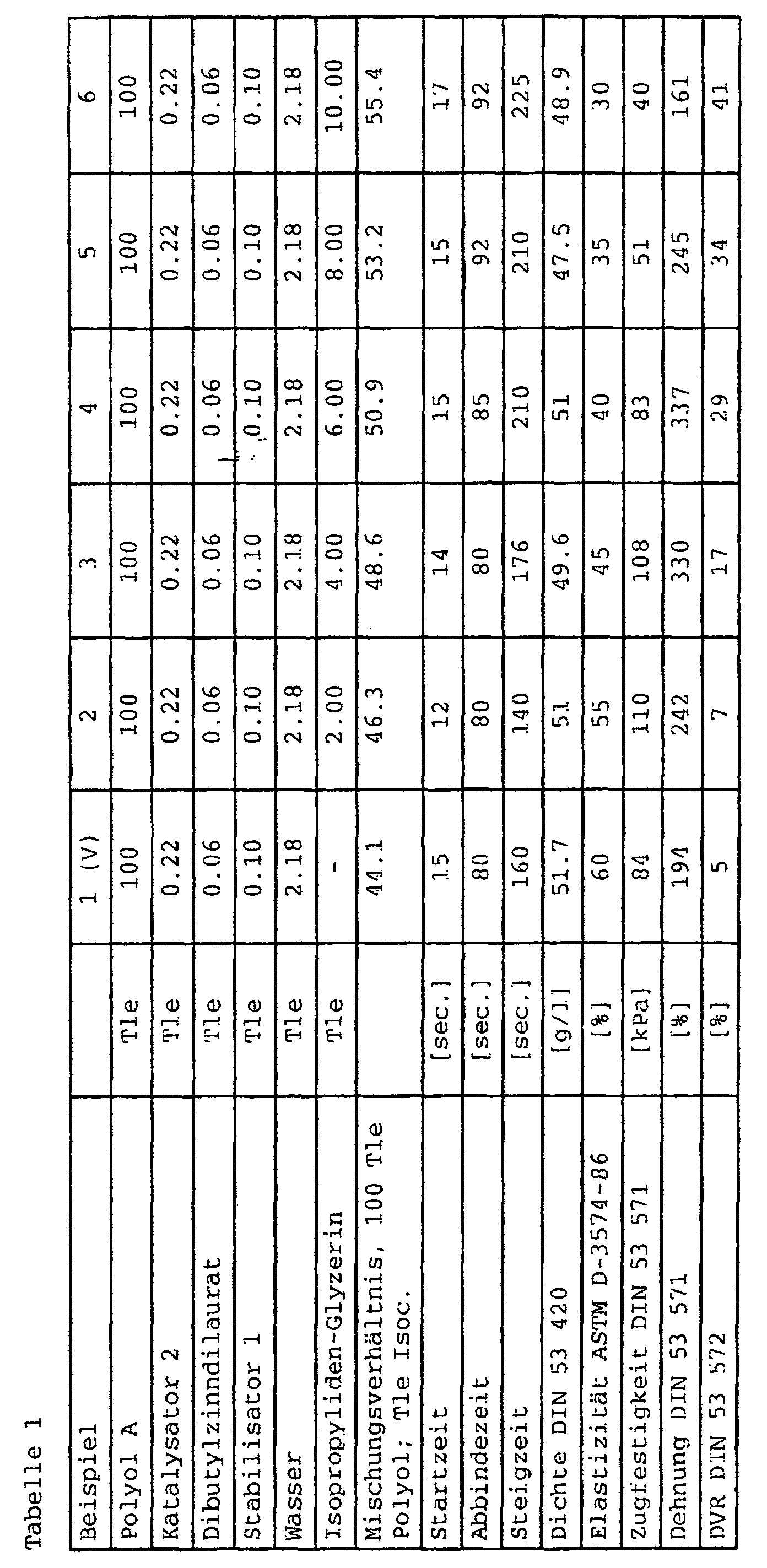


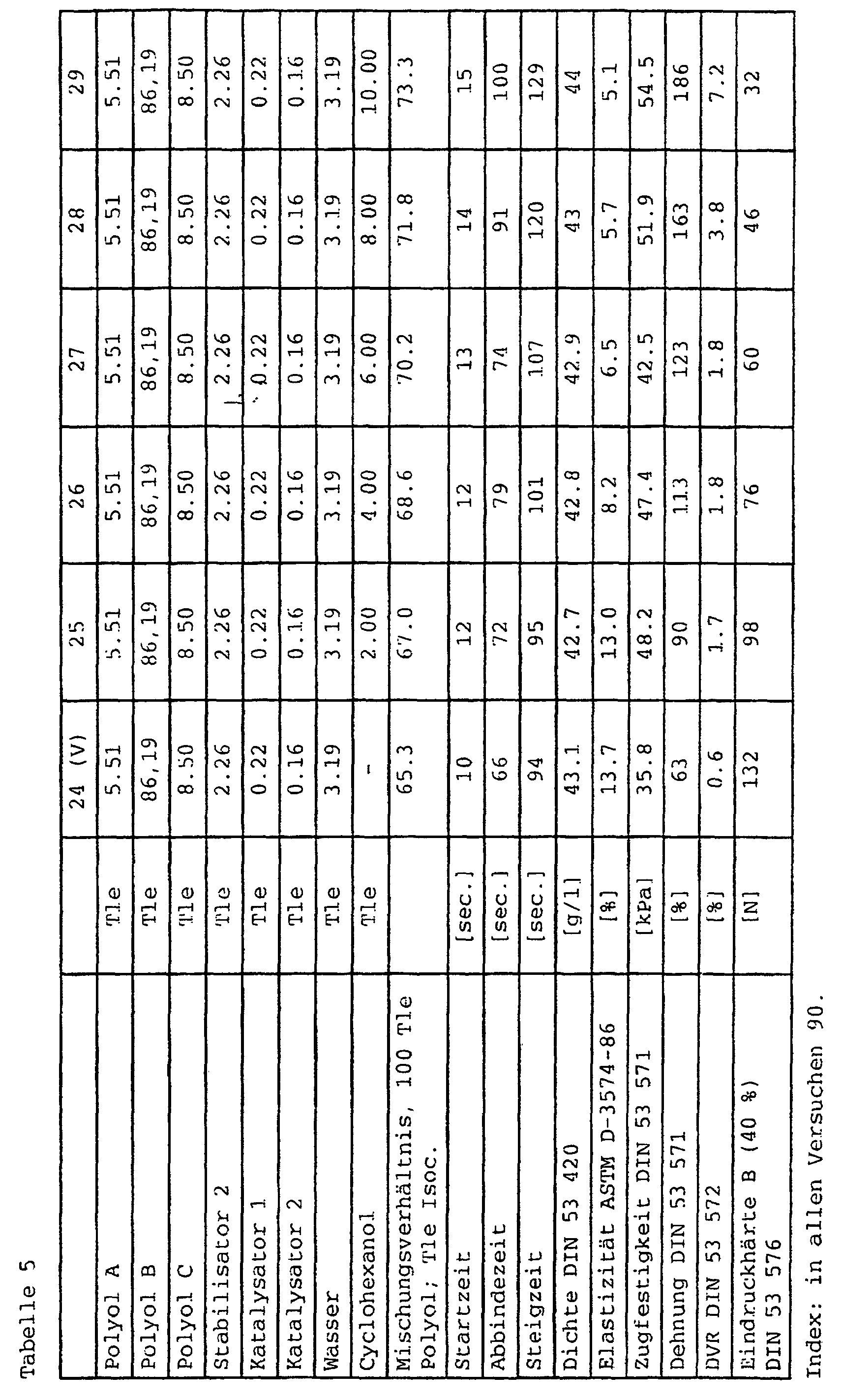


Der quantitative Einbau der erfindungsgemäßen cyclischen oder heterocyclischen Verbindungen wird durch Messung des Fogginggehaltes unterstrichen bzw. bestätigt. Mit zunehmender Menge des Additivs in der Formulierung wird nur eine unbedeutend größere Menge des Foggingkondensates gefunden. Der Verlustfaktor - als Maß der viskoelastischen Eigenschaften gemessen - verdoppelt sich zwar sowohl nach Zusatz der erfindungsgemäßen Produkte, als auch nach Zusatz von 1-Butanol, doch sind Schaumstoffe, die mit mehr als 6 % 1-Butanol hergestellt wurden, nicht mehr dimensionsstabil und härten erst nach sehr langer Zeit aus.

Die mit steigender Menge Isopropyliden-Glycerin abnehmende Elastizität der Schaumstoffe macht deutlich, daß die gewünschten dämpfenden Eigenschaften verbessert werden.
Claims (7)
- Verfahren zur Herstellung von Polyurethan-Weichschaumstoffen durch an sich bekannte Umsetzung von Polyisocyanaten mit Verbindungen, die mindestens zwei mit Isocyanat reaktive Wasserstoffatome aufweisen, dadurch gekennzeichnet, daß die Umsetzung in Gegenwart von mindestens ein reaktives Wasserstoffatom aufweisenden cyclischen oder heterocyclischen Verbindungen, ausgewählt aus der Gruppe der Cycloaliphaten, Aromaten, Imidazole, Oxazoline, Oxazolidine, Morpholine, Piperidine, Pyrrolidine, Pyrrolidinone, cyclischen Acetale und cyclischen Ketale durchgeführt wird.
- Verfahren nach einem der Ansprüche 1, dadurch gekennzeichnet, daß die cyclischen oder heterocyclischen Verbindungen eine Hydroxylgruppe aufweisen.
- Verfahren nach Anspruch 1 bis 2, dadurch gekennzeichnet, daß die mindestens ein reaktives Wasserstoffatom aufweisenden cyclischen oder heterocyclischen Verbindungen in einer Menge von 0,5 bis 10 Gew.-Teilen, bezogen auf 100 Gew.-Teile der Verbindung mit mindestens zwei mit Isocyanat reaktiven Wasserstoffatomen, eingesetzt werden.
- Verfahren nach einem der Ansprüche 1 bis 3, dadurch gekennzeichnet, daß die mindestens ein reaktives Wasserstoffatom aufweisenden cyclischen oder heterocyclischen Verbindungen eine mindestens eine Hydroxylgruppe tragende Polyetherkette aufweisen.
- Verfahren nach einem der Ansprüche 1 bis 4, dadurch gekennzeichnet, daß als mindestens ein reaktives Wasserstoffatom aufweisende cyclische oder heterocyclische Verbindungen Umsetzungsprodukte von Glyzerin und/oder Trimethylolpropan mit Aldehyden und/oder Ketonen mit 1 bis 12 Kohlenstoffatomen in der Hauptkette eingesetzt werden.
- Hochelastische und viskoelastische Polyurethan-Weichschaumstoffe, herstellbar nach einem der Ansprüche 1 bis 5.
- Verwendung von mindestens ein reaktives Wasserstoffatom aufweisenden cyclischen oder heterocyclischen Verbindungen, ausgewählt aus der Gruppe der Cycloaliphaten, Aromaten, Imidazole, Oxazoline, Oxazolidine, Morpholine, Piperidine, Pyrrolidine, Pyrrolidinone, cyclischen Acetale und cyclischen Ketale zur Herstellung von hochelastischen und viskoelastischen Polyurethan-Weichschaumstoffen.
Applications Claiming Priority (2)
| Application Number | Priority Date | Filing Date | Title |
|---|---|---|---|
| DE19744747A DE19744747A1 (de) | 1997-10-10 | 1997-10-10 | Verfahren zur Herstellung von Polyurethan-Weichschaumstoffen |
| DE19744747 | 1997-10-10 |
Publications (2)
| Publication Number | Publication Date |
|---|---|
| EP0908478A1 EP0908478A1 (de) | 1999-04-14 |
| EP0908478B1 true EP0908478B1 (de) | 2005-05-11 |
Family
ID=7845136
Family Applications (1)
| Application Number | Title | Priority Date | Filing Date |
|---|---|---|---|
| EP98118125A Revoked EP0908478B1 (de) | 1997-10-10 | 1998-09-24 | Verfahren zur Herstellung von Polyurethan-Weichschaumstoffen |
Country Status (6)
| Country | Link |
|---|---|
| US (1) | US6586485B1 (de) |
| EP (1) | EP0908478B1 (de) |
| AT (1) | ATE295381T1 (de) |
| CA (1) | CA2246636A1 (de) |
| DE (2) | DE19744747A1 (de) |
| ES (1) | ES2241087T3 (de) |
Cited By (1)
| Publication number | Priority date | Publication date | Assignee | Title |
|---|---|---|---|---|
| US7415742B2 (en) | 2002-05-24 | 2008-08-26 | Tempur World, Llc | Comfort pillow |
Families Citing this family (12)
| Publication number | Priority date | Publication date | Assignee | Title |
|---|---|---|---|---|
| US6391935B1 (en) | 2000-01-31 | 2002-05-21 | Bayer Antwerp, N.V. | Viscoelastic polyurethane foams |
| TW592813B (en) * | 2001-08-15 | 2004-06-21 | Dow Global Technologies Inc | Process to manufacture polyurethane products |
| US7078443B2 (en) | 2003-10-22 | 2006-07-18 | Intellectual Property Holdings, Llc | Viscoelastic foam layer and composition |
| EP1706863A1 (de) * | 2004-01-12 | 2006-10-04 | Dow Gloval Technologies Inc. | Automotive-armaturenbrettisolatoren mit viscoelastischen schäumen |
| CN100540581C (zh) * | 2004-02-17 | 2009-09-16 | 株式会社普利司通 | 低回弹性、高透气性的聚氨酯泡沫及其应用 |
| US7469437B2 (en) | 2005-06-24 | 2008-12-30 | Tempur-Pedic Management, Inc. | Reticulated material body support and method |
| US20070234629A1 (en) * | 2006-02-06 | 2007-10-11 | Brooks Joseph D | Self-securing spring bobber |
| CN101835820B (zh) * | 2007-10-26 | 2012-11-21 | 东曹株式会社 | 聚酯类软质聚氨酯泡沫塑料的制造方法和其中使用的催化剂组合物 |
| EP2599810A1 (de) | 2011-12-02 | 2013-06-05 | Basf Se | Waschbare, viskoelastische Polyurethanweichschaumstoffe |
| MX2016014167A (es) | 2014-04-30 | 2017-02-22 | Honeywell Int Inc | Espumas termoestables, de celda abierta, flexibles, y agentes de soplado, y los metodos para prepararlas. |
| CN106632975A (zh) * | 2016-11-28 | 2017-05-10 | 江苏恒康家居科技股份有限公司 | 一种mdi体系的透气慢回弹聚氨酯 |
| EP4130082A1 (de) * | 2021-08-02 | 2023-02-08 | Covestro Deutschland AG | Verfahren zur verminderung von aminspuren in polyurethanschaumstoffen |
Family Cites Families (13)
| Publication number | Priority date | Publication date | Assignee | Title |
|---|---|---|---|---|
| DE2245636A1 (de) | 1972-09-16 | 1974-03-21 | Bayer Ag | Verfahren zur herstellung von polyaetheraminen |
| DE2446438C2 (de) | 1974-09-28 | 1985-04-11 | Bayer Ag, 5090 Leverkusen | Verfahren zur Herstellung von Oxazolidingruppen enthaltenden Urethanen und ihre Verwendung |
| DE3111093A1 (de) * | 1981-03-20 | 1982-10-07 | Bayer Ag, 5090 Leverkusen | Verfahren zur herstellung von gegebenenfalls zellfoermigen polyurethankunststoffen unter verwendung von diolen der dianhydro-hexit-reihe |
| DE3127750A1 (de) * | 1981-07-14 | 1983-02-03 | Bayer Ag, 5090 Leverkusen | Stabilisatorhaltige reaktivkomponenten fuer pu-schaumstoffe, neue stabilisatoren und ein verfahren zur herstellung der stabilisatoren |
| DE3312215A1 (de) * | 1983-04-05 | 1984-10-11 | Bayer Ag, 5090 Leverkusen | Verfahren zur herstellung eines zelligen polyurethans |
| DE3641581C3 (de) * | 1986-12-05 | 1996-08-01 | Byk Chemie Gmbh | Verfahren zur Herstellung von Dispergiermitteln und deren Salzen und ihre Verwendung |
| GB8921182D0 (en) * | 1989-09-19 | 1989-11-08 | Ici Plc | Novel chemical blowing agent |
| GB9102362D0 (en) * | 1991-02-04 | 1991-03-20 | Ici Plc | Polymeric foams |
| US5346928A (en) * | 1993-09-09 | 1994-09-13 | Imperial Chemical Industries Plc | Rigid polyurethane foams |
| DE4432647A1 (de) | 1994-09-14 | 1996-03-21 | Bayer Ag | 1,3-Dioxan-2-on-Gruppen enthaltende Oligourethane |
| DE4440212A1 (de) * | 1994-11-10 | 1996-05-15 | Basf Schwarzheide Gmbh | Verfahren zur Herstellung von zelligen Polyurethanen |
| US5591779A (en) * | 1994-11-22 | 1997-01-07 | Imperial Chemical Industries Plc | Process for making flexible foams |
| DE4443432A1 (de) * | 1994-12-06 | 1996-06-13 | Elastogran Gmbh | Unter Druck stehende, Treibmittel enthaltende Isocyanat-Semirpräpolymermischungen auf Basis von Mischungen aus Polyhydroxylverbindungen und Monoalkoholen und/oder Hydroxyketonen, ihre Verwendung zur Herstellung von Polyurethanschaumstoffen und ein Verfahren hierfür |
-
1997
- 1997-10-10 DE DE19744747A patent/DE19744747A1/de not_active Withdrawn
-
1998
- 1998-09-24 AT AT98118125T patent/ATE295381T1/de not_active IP Right Cessation
- 1998-09-24 DE DE59812780T patent/DE59812780D1/de not_active Expired - Fee Related
- 1998-09-24 EP EP98118125A patent/EP0908478B1/de not_active Revoked
- 1998-09-24 ES ES98118125T patent/ES2241087T3/es not_active Expired - Lifetime
- 1998-10-06 US US09/166,995 patent/US6586485B1/en not_active Expired - Fee Related
- 1998-10-07 CA CA002246636A patent/CA2246636A1/en not_active Abandoned
Cited By (1)
| Publication number | Priority date | Publication date | Assignee | Title |
|---|---|---|---|---|
| US7415742B2 (en) | 2002-05-24 | 2008-08-26 | Tempur World, Llc | Comfort pillow |
Also Published As
| Publication number | Publication date |
|---|---|
| ATE295381T1 (de) | 2005-05-15 |
| DE59812780D1 (de) | 2005-06-16 |
| EP0908478A1 (de) | 1999-04-14 |
| DE19744747A1 (de) | 1999-04-15 |
| ES2241087T3 (es) | 2005-10-16 |
| US6586485B1 (en) | 2003-07-01 |
| CA2246636A1 (en) | 1999-04-10 |
Similar Documents
| Publication | Publication Date | Title |
|---|---|---|
| EP1888664B1 (de) | Verfahren zur herstellung von viskoelastischen polyurethan-weichschaumstoffen | |
| EP2822982B1 (de) | Additiv zur einstellung der glasübergangstemperatur von viskoelastischen polyurethanweichschaumstoffen | |
| EP0296449B1 (de) | Verfahren zur Herstellung von kalthärtenden Polyurethan-Weichformschaumstoffen | |
| EP1266918B1 (de) | Verfahren zur Herstellung von hochelastischen Polyurethanschaumstoffen | |
| DE3819940C2 (de) | ||
| EP1473313B1 (de) | Flexible Formteile aus mit Stickstoff, Luft oder Kohlendioxid geschäumtem Polyurethan und ihre Verwendung | |
| DE102007046860A1 (de) | Aminkatalysatoren geeignet zur Herstellung emissionsarmer, rekatalysestabiler Polyurethanweichschaumstoffe | |
| DE102008008391A1 (de) | Geschäumte, lichtechte Polyurethanformteile | |
| EP1650240B1 (de) | Weichelastische Polyurethan Schaumstoffe geringer Rohdichten und Stauchhärte | |
| EP0819712B1 (de) | Verfahren zur Herstellung von Polyurethanweichschaumstoffen | |
| EP1000955A1 (de) | Carbamatlösungen | |
| DE19744747A1 (de) | Verfahren zur Herstellung von Polyurethan-Weichschaumstoffen | |
| DE69506470T2 (de) | Polyurethanweichschaumstoff sowie Verfahren zu dessen Herstellung | |
| EP3870624B1 (de) | Polyurethanschaumstoffe mit vermindertem gehalt an aromatischen aminen | |
| DE102012212077A1 (de) | Verfahren zur Herstellung emissionsarmer Polyurethanweichschaumstoffe | |
| EP1471086B1 (de) | Verfahren zur Herstellung von Polyurethan-Weichschaumstoffen | |
| DE2156477B2 (de) | Verfahren zur Herstellung von harten Schaumstoff-Fonnkörpern | |
| DE102006016617B4 (de) | Polyurethanformteil, Verfahren zu dessen Herstellung und dessen Verwendung | |
| EP4251669B1 (de) | Polyurethane mit reduzierter aldehydemission | |
| DE2509478A1 (de) | Verfahren zur herstellung von polyaetherurethanschaeumen mit hoher rueckprallelastizitaet | |
| EP3512896B1 (de) | Verfahren zur erniedrigung der aldehydemissionen von polyurethanschaumstoffen | |
| EP1630185B2 (de) | Verfahren zur Herstellung von Polyurethan-Weichschaumstoffen | |
| DE4001044C2 (de) | Verfahren zur Herstellung von viskoelastischen Polyurethan-Weichschaumstoffen mit einem verbesserten Schallabsorptionsvermögen sowie hierzu verwendbare Polyether-polyol-Polyester-polyol-Mischungen | |
| WO2020010345A1 (en) | Elastomeric polyurethane foams and methods for producing the same | |
| EP3760659A1 (de) | Amingestartete polyole als einbaubare katalysatoren im hr-schaum |
Legal Events
| Date | Code | Title | Description |
|---|---|---|---|
| PUAI | Public reference made under article 153(3) epc to a published international application that has entered the european phase |
Free format text: ORIGINAL CODE: 0009012 |
|
| 17P | Request for examination filed |
Effective date: 19990212 |
|
| AK | Designated contracting states |
Kind code of ref document: A1 Designated state(s): AT BE CH DE ES FR GB IT LI NL |
|
| AX | Request for extension of the european patent |
Free format text: AL;LT;LV;MK;RO;SI |
|
| AKX | Designation fees paid |
Free format text: AT BE CH DE ES FR GB IT LI NL |
|
| 17Q | First examination report despatched |
Effective date: 20040206 |
|
| GRAP | Despatch of communication of intention to grant a patent |
Free format text: ORIGINAL CODE: EPIDOSNIGR1 |
|
| GRAS | Grant fee paid |
Free format text: ORIGINAL CODE: EPIDOSNIGR3 |
|
| GRAA | (expected) grant |
Free format text: ORIGINAL CODE: 0009210 |
|
| AK | Designated contracting states |
Kind code of ref document: B1 Designated state(s): AT BE CH DE ES FR GB IT LI NL |
|
| REG | Reference to a national code |
Ref country code: GB Ref legal event code: FG4D Free format text: NOT ENGLISH |
|
| REG | Reference to a national code |
Ref country code: CH Ref legal event code: NV Representative=s name: SCHMAUDER & PARTNER AG PATENTANWALTSBUERO Ref country code: CH Ref legal event code: EP |
|
| REF | Corresponds to: |
Ref document number: 59812780 Country of ref document: DE Date of ref document: 20050616 Kind code of ref document: P |
|
| GBT | Gb: translation of ep patent filed (gb section 77(6)(a)/1977) |
Effective date: 20050725 |
|
| REG | Reference to a national code |
Ref country code: ES Ref legal event code: FG2A Ref document number: 2241087 Country of ref document: ES Kind code of ref document: T3 |
|
| PLBI | Opposition filed |
Free format text: ORIGINAL CODE: 0009260 |
|
| PLAX | Notice of opposition and request to file observation + time limit sent |
Free format text: ORIGINAL CODE: EPIDOSNOBS2 |
|
| 26 | Opposition filed |
Opponent name: HUNTSMAN INTERNATIONAL LLC Effective date: 20060127 |
|
| ET | Fr: translation filed | ||
| PLBB | Reply of patent proprietor to notice(s) of opposition received |
Free format text: ORIGINAL CODE: EPIDOSNOBS3 |
|
| NLR1 | Nl: opposition has been filed with the epo |
Opponent name: HUNTSMAN INTERNATIONAL LLC |
|
| PLAY | Examination report in opposition despatched + time limit |
Free format text: ORIGINAL CODE: EPIDOSNORE2 |
|
| RAP2 | Party data changed (patent owner data changed or rights of a patent transferred) |
Owner name: BASF SE |
|
| PLBC | Reply to examination report in opposition received |
Free format text: ORIGINAL CODE: EPIDOSNORE3 |
|
| NLT2 | Nl: modifications (of names), taken from the european patent patent bulletin |
Owner name: BASF SE Effective date: 20080305 |
|
| PGFP | Annual fee paid to national office [announced via postgrant information from national office to epo] |
Ref country code: NL Payment date: 20080903 Year of fee payment: 11 Ref country code: FR Payment date: 20080915 Year of fee payment: 11 Ref country code: AT Payment date: 20080912 Year of fee payment: 11 |
|
| PGFP | Annual fee paid to national office [announced via postgrant information from national office to epo] |
Ref country code: GB Payment date: 20080924 Year of fee payment: 11 |
|
| PGFP | Annual fee paid to national office [announced via postgrant information from national office to epo] |
Ref country code: DE Payment date: 20081002 Year of fee payment: 11 Ref country code: CH Payment date: 20081016 Year of fee payment: 11 |
|
| PGFP | Annual fee paid to national office [announced via postgrant information from national office to epo] |
Ref country code: ES Payment date: 20081021 Year of fee payment: 11 Ref country code: BE Payment date: 20080922 Year of fee payment: 11 |
|
| PGFP | Annual fee paid to national office [announced via postgrant information from national office to epo] |
Ref country code: IT Payment date: 20080927 Year of fee payment: 11 |
|
| REG | Reference to a national code |
Ref country code: CH Ref legal event code: PCAR Free format text: SCHMAUDER & PARTNER AG PATENT- UND MARKENANWAELTE VSP;ZWAENGIWEG 7;8038 ZUERICH (CH) |
|
| PLAB | Opposition data, opponent's data or that of the opponent's representative modified |
Free format text: ORIGINAL CODE: 0009299OPPO |
|
| BERE | Be: lapsed |
Owner name: *BASF A.G. Effective date: 20090930 |
|
| REG | Reference to a national code |
Ref country code: CH Ref legal event code: PL |
|
| GBPC | Gb: european patent ceased through non-payment of renewal fee |
Effective date: 20090924 |
|
| RDAF | Communication despatched that patent is revoked |
Free format text: ORIGINAL CODE: EPIDOSNREV1 |
|
| REG | Reference to a national code |
Ref country code: NL Ref legal event code: V1 Effective date: 20100401 |
|
| REG | Reference to a national code |
Ref country code: FR Ref legal event code: ST Effective date: 20100531 |
|
| PG25 | Lapsed in a contracting state [announced via postgrant information from national office to epo] |
Ref country code: AT Free format text: LAPSE BECAUSE OF NON-PAYMENT OF DUE FEES Effective date: 20090924 |
|
| PG25 | Lapsed in a contracting state [announced via postgrant information from national office to epo] |
Ref country code: FR Free format text: LAPSE BECAUSE OF NON-PAYMENT OF DUE FEES Effective date: 20090930 Ref country code: DE Free format text: LAPSE BECAUSE OF NON-PAYMENT OF DUE FEES Effective date: 20100401 |
|
| PG25 | Lapsed in a contracting state [announced via postgrant information from national office to epo] |
Ref country code: BE Free format text: LAPSE BECAUSE OF NON-PAYMENT OF DUE FEES Effective date: 20090930 |
|
| RDAG | Patent revoked |
Free format text: ORIGINAL CODE: 0009271 |
|
| STAA | Information on the status of an ep patent application or granted ep patent |
Free format text: STATUS: PATENT REVOKED |
|
| PG25 | Lapsed in a contracting state [announced via postgrant information from national office to epo] |
Ref country code: NL Free format text: LAPSE BECAUSE OF NON-PAYMENT OF DUE FEES Effective date: 20100401 Ref country code: LI Free format text: LAPSE BECAUSE OF NON-PAYMENT OF DUE FEES Effective date: 20090930 Ref country code: CH Free format text: LAPSE BECAUSE OF NON-PAYMENT OF DUE FEES Effective date: 20090930 |
|
| 27W | Patent revoked |
Effective date: 20100705 |
|
| PG25 | Lapsed in a contracting state [announced via postgrant information from national office to epo] |
Ref country code: GB Free format text: LAPSE BECAUSE OF NON-PAYMENT OF DUE FEES Effective date: 20090924 |
|
| PG25 | Lapsed in a contracting state [announced via postgrant information from national office to epo] |
Ref country code: IT Free format text: LAPSE BECAUSE OF NON-PAYMENT OF DUE FEES Effective date: 20090924 |
|
| REG | Reference to a national code |
Ref country code: DE Ref legal event code: R107 Ref document number: 59812780 Country of ref document: DE Effective date: 20110728 |
|
| PG25 | Lapsed in a contracting state [announced via postgrant information from national office to epo] |
Ref country code: ES Free format text: LAPSE BECAUSE OF NON-PAYMENT OF DUE FEES Effective date: 20090925 |