EP0908733A2 - Elektrooptisches Sampling-Oszilloskop - Google Patents
Elektrooptisches Sampling-Oszilloskop Download PDFInfo
- Publication number
- EP0908733A2 EP0908733A2 EP98308132A EP98308132A EP0908733A2 EP 0908733 A2 EP0908733 A2 EP 0908733A2 EP 98308132 A EP98308132 A EP 98308132A EP 98308132 A EP98308132 A EP 98308132A EP 0908733 A2 EP0908733 A2 EP 0908733A2
- Authority
- EP
- European Patent Office
- Prior art keywords
- circuit
- signal
- delay
- reference clock
- output
- Prior art date
- Legal status (The legal status is an assumption and is not a legal conclusion. Google has not performed a legal analysis and makes no representation as to the accuracy of the status listed.)
- Withdrawn
Links
Images


Classifications
-
- G—PHYSICS
- G01—MEASURING; TESTING
- G01R—MEASURING ELECTRIC VARIABLES; MEASURING MAGNETIC VARIABLES
- G01R13/00—Arrangements for displaying electric variables or waveforms
- G01R13/02—Arrangements for displaying electric variables or waveforms for displaying measured electric variables in digital form
- G01R13/0281—Arrangements for displaying electric variables or waveforms for displaying measured electric variables in digital form using electro-optic elements
Definitions
- the present invention is related to an electro-optic sampling oscilloscope which measures a signal to be measured by employing optical pulses generated based on a signal from a delay circuit in which a trigger signal is delayed in response to the measured position of the waveform of the signal to be measured. More particularly, the present invention relates to an electro-optic sampling oscilloscope characterized in having a delay circuit in which a trigger signal is delayed.
- EOS electro-optic sampling oscilloscope
- An EOS oscilloscope is composed of an EOS oscilloscope main body 1 and an electro-optic probe 2.
- a trigger circuit 3 outputs a trigger signal which initiates measurement of the measurement signal.
- Delay circuit 4 then delays the signal from trigger circuit 3 by the time set by setting unit 9.
- Setting unit 9 is composed of switches and the like. The delay time set at setting unit 9 is set in delay circuit 4 via processing circuit 8.
- Timing generation circuit 5 generates the timing for generating the optical pulse and the timing for A/D conversion based on the signal from delay circuit 4.
- Optical pulse generating circuit 6 generates an optical pulse based on a timing signal from timing generation circuit 5.
- the optical pulse from optical pulse outputting circuit 6 is supplied to electro-optic probe 2 and is subjected to polarization change by an electro-optic element.
- the optical pulse subjected to polarization change undergoes polarized light detection etc., by a polarized light detecting optical system (not shown) inside electro-optic probe 2, and that signal is input to EOS oscilloscope main body 1.
- This signal is subjected to signal amplification or A/D conversion by A/D converter 7, and processing by processing circuit 8 for displaying the signal which is the target of measurement, an so on.
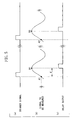
- Fig. 5 will be used to explain the reason for delaying the trigger signal from trigger circuit 3 using delay circuit 4.
- the trigger signal from trigger circuit 3 is generated roughly in synchronization with the signal to be measured.
- the waveform from measurement point A1 or A2 is displayed on the display member (not shown) of EOS oscilloscope main body 1.
- the user of the EOS oscilloscope may not wish to display the waveform from measurement point A1 or A2, but rather may want to display the waveform from measurement point B1 or B2 which is slightly delayed from measurement point A1 or A2.
- delay circuit 4 is employed to shift the initial position of the display of the waveform.
- setting unit 9 in Fig. 4 is set to delay the initial position of the display of the signal to be measured.
- the setting information is analyzed by processing circuit 8, delay time T' for measurement point B1 with respect to measurement point A1 is determined, and a delay time T' is set in delay circuit 4.
- delay circuit 4 outputs a trigger signal after delaying it by just delay time T'. Timing for sampling is then generated using the output from delay circuit 4.
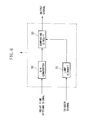
- Fig. 6 shows an example of one conventional structure for delay circuit 4.
- delay circuit 4 is composed of a lamp circuit 31 which designates the trigger signal as an input signal; a D/A converter 32 which converts the delay time setting signal from processing circuit 8 from a digital to an analog signal; and a comparing circuit 33 which compares the signal output from lamp circuit 31 and D/A converter 32.
- D/A converter 32 outputs an output signal in which the delay time setting signal from processing circuit 8 has been converted from a digital to an analog signal.
- D/A converter 32 outputs a signal which is higher than the reference level by just a component corresponding to the delay time T' only.
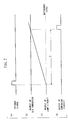
- the outputs from lamp circuit 31 and D/A converter 32 are compared at comparing circuit 33, and a signal is output in which the trigger signal has been delayed by just a time T', as shown in part (c) in Fig. 7.
- a relatively long delay may be desirable, on the order of milli-seconds [ms] or seconds [s], for example.
- a lamp signal from lamp circuit 31 is employed to carry out the setting of the delay time.
- the ability to reproduce the signal is not good due to the generation of a shift or fluctuation (jitter) in the lamp signal.
- a delay time on the order of milli-seconds [ms] or seconds [s] cannot be set with good accuracy.
- the present invention was conceived in consideration of the above-described circumstances, and has as its objective the provision of an electro-optic sampling oscilloscope in which it is possible to set a stable delay time even in the case where a relatively long delay time is being set.
- the present invention provides an electro-optic sampling oscilloscope having a delay circuit which comprises a delay time detecting circuit, a regulation time determining circuit, a counter circuit and a delay regulating circuit.
- the delay time detecting circuit detects in the trigger signal a value corresponding to the delay time of a reference clock from a reference clock generating circuit.
- the regulation time determining circuit determines a regulation time based on the value detected by the delay time detecting circuit so that the regulation time is an integer multiple of the reference clock.
- the counter circuit is triggered by the trigger signal to count the reference clock through a specific value.
- the delay regulating circuit employs a signal related to the regulation time from the regulation time determining circuit, to delay the signal output from the counter circuit by the regulation time.
- the invention provides the electro-optic sampling oscilloscope having the delay circuit to which a micro-regulation value is enable to set.
- Fig. 1 is a circuit diagram of the delay circuit in the EOS oscilloscope according to one embodiment of the present invention.
- Fig. 2 is a diagram explaining the operation of the delay circuit in Fig. 1.
- Fig. 3 is another circuit diagram of the delay time detecting circuit and the regulation time determining circuit in the delay circuit in Fig. 1.
- Fig. 4 is a diagram showing the structure of the EOS oscilloscope.
- Fig. 5 is a diagram explaining the function of the delay circuit in the EOS oscilloscope.
- Fig. 6 is a figure showing the circuit structure in a conventional example of a delay circuit in an EOS oscilloscope.
- Fig. 7 is a diagram explaining the operation of the delay circuit of Fig. 6.
- an EOS oscilloscope is composed of an EOS oscilloscope main body 1 and an electro-optic probe 2.
- the EOS oscilloscope main body is formed of a trigger circuit 3, delay circuit 4, timing generation circuit 5, optical pulse generating circuit 6, A/D converter 7, processing circuit 8, and setting unit 9.
- trigger circuit 3 outputs a trigger signal which serves to initiate measurement of the measured signal.
- Delay circuit 4 delays the signal from trigger circuit 3 by just the time set in setting unit 9.
- Setting unit 9 is composed of switches and the like. The delay time set by setting unit 9 is set in delay circuit 4 via processing circuit 8.
- Timing generation circuit 5 generates the timing for generating the optical pulse and the timing for A/D conversion based on the signal from delay circuit 4.
- Optical pulse generating circuit 6 generates an optical pulse based on the timing signal from timing generation circuit 5.
- the optical pulse from optical pulse generating circuit 6 is supplied to electro-optic probe 2 and undergoes polarization change by an electro-optic crystal.
- the optical pulse thus subjected to polarization change undergoes polarized light detection etc., by a polarized light detecting optical system (not shown) inside electro-optic probe 2, and that signal is input to EOS oscilloscope main body 1.
- the signal from electro-optic probe 2 undergoes signal amplification and A/D conversion by A/D converter 7, and processing by processing circuit 8 for displaying the signal which is being measured.
- Fig. 1 will be used to explain the structure of delay circuit 4 in the EOS oscilloscope of this embodiment.
- the trigger signal from trigger circuit 3, and the reference clock from the reference clock generating circuit (not shown) inside the EOS oscilloscope, in addition to the delay time from processing circuit 7, are input as input signals to delay circuit 4.
- the output signal is a signal which results when the trigger signal is delayed by just the set time.
- a micro-regulation value T3 which is set via processing circuit 7 is also input, and it will be explained separately.
- the trigger signal and the reference clock are generated by different circuits, and they are not in synchronization.
- Delay circuit 4 is composed of delay time detecting circuit 11 which detects a value corresponding to the delay time between the asynchronous reference signal and trigger signal; a regulation time determining circuit 12 which determines the regulation time based on the value detected by delay time detecting circuit 11 so that the regulation time becomes an integer multiple of the period of the reference clock; a counter circuit 13 which counts the reference clock in response to the delay time set from processing circuit 7; and a delay regulating circuit 14 which further delays the time which has already been delayed by counter circuit 13 by the regulation time from regulation time determining circuit 12, and outputs a signal in which a trigger signal has been delayed by an integer multiple of the reference clock.
- Delay time detecting circuit 11 is composed of a lamp circuit 1•11a which is triggered by a trigger signal to output a lamp waveform; and an A/D converter 11b which converts the lamp signal from lamp circuit 1•11a from an analog to a digital signal at the timing from the reference clock input immediately after the trigger signal.
- Delay regulating circuit 14 is composed of a lamp circuit 2•14a which is triggered by the signal from counter circuit 13 to output the lamp signal; and a comparing circuit 14b which outputs the signal which is the result of a further delay by a regulation time T2 of the signal from counter circuit 13, by comparing the signals from lamp circuit 2.14a and regulation time determining circuit 12.
- EOS oscilloscope indicates both the case where an electro-optic probe 2 is provided along with the EOS oscilloscope main body 1, as well as the case where only the EOS oscilloscope main body 1 is provided.
- a trigger signal such as shown in part (a) in Fig. 2 and a reference clock such as shown in part (b) in Fig. 2 are input to delay circuit 4.
- the frequency of the reference clock is defined here to be a relatively high frequency, such as megahertz (MHz) or kilohertz (KHz) order.
- this signal triggers lamp circuit 1•11a to start outputting a lamp signal as shown in part (c) in Fig. 2.
- Time t2 is defined to be the first rise in the reference clock following the input of the trigger signal.
- the value D1 output from lamp circuit 1•11a is converted from an analog to a digital signal by A/D converter 11b according to the timing of time t2. Because frequency of the reference clock is relatively high, the lamp signal from lamp circuit 1•11a is converted from an analog to a digital signal by A/D converter 11b within a range in which the lamp signal is stable.
- counter 13 Triggered by the input of the trigger signal, counter 13 counts the reference clock a number of times corresponding to the set delay time.
- the reference clock it is basically the rise in the signal which is counted. For example, if the count number determined by processing circuit 8 based on the delay time set by setting unit 9 in Fig. 4 is "N", then a count number "N-1", obtained by subtracting one period from the standard signal regulated by delay regulating circuit 14, is set in counter circuit 13.
- Counter circuit 13 then counts the reference clock for the count number "N-1" only, as shown in part (d) in Fig. 2.
- calculating circuit 12a which has received the value D1 shown in part (c) in Fig. 2 from delay time detecting circuit 11, determines the delay time T1 (t2-t1) of the reference clock with respect to the trigger signal. Note that delay time T1 and value D1 have a proportional relationship. This proportion constant can be determined by lamp circuit 1•11a. Calculating circuit 12a stores the proportion constant which can be determined by lamp circuit 1•11a as known information.
- the result of this calculation is converted by D/A converter 12b in response to the characteristics of lamp circuit 2 ⁇ 14a, and outputs a signal which is higher than the standard level by D2, as shown in part (e) in Fig. 2.
- Comparing circuit 14b compares the signal from regulation time determining circuit 12 and the signal from lamp circuit 2•14a shown in part (e) in Fig. 2, and outputs a signal at a timing of time t4 which is obtained by delaying time t3, at which lamp circuit 2•14a receives the signal from counter circuit 13, by a further regulation time T2.
- the signal is output after counting the reference clock (N-1) times.
- the trigger signal is output after delaying the reference clock by an integer multiple (N) using delay circuit 4.
- delay time detecting circuit 11 and regulation time determining circuit 12 carry out intermediate processing using digital signals.
- the structures of a delay time detecting circuit 11 and regulation time determining circuit 12 in the case where this is all carried out in analog signals are shown in Fig. 3.
- Delay time detecting circuit 11 is formed a lamp circuit 1•11a and a sample hold circuit 11c which holds the output from lamp circuit 1•11a at the timing of the rise in the reference clock immediately after the trigger signal is input.
- Regulation time determining circuit 12 is formed of a subtracting circuit 12c which subtracts the signal level from sample hold circuit 11c from the signal level responding to the period T of the reference clock. The output from this subtracting circuit 12c is input to delay regulating circuit 14 as the signal related to regulation time T2.
- lamp circuit 1•11a forming delay time detecting circuit 11 and lamp circuit 2•14a forming delay regulation circuit 14 are employed within a range in which the signal is stable, so that detection of the delay time and delay of the signal from counter circuit 13 can be carried out with excellent accuracy. Further, even in the case of a long delay time, setting of the delay time is mainly carried out by counter circuit 13 so that it is possible to realize with excellent accuracy a delay which is an integer multiple of the period of the reference clock.
- micro-regulation value T3 (0 ⁇ T3 ⁇ T, where T is the period of the reference clock) set by setting unit 9 is input to calculating circuit 12a via processing circuit 7.
- a level signal corresponding to micro-regulation value T3 is input to subtracting circuit 12c shown in Fig. 3.
- Subtracting circuit 12c adds this signal as well, so that it is possible to set the delay time even more finely than period T of the reference clock.
- regulation time determining circuit 12 inside delay circuit 4 preferably defines a single period "T" of the reference clock as the standard, and determines regulation time T2.
- regulation time T2 may also be determined by taking an integer multiple of period T as the standard within the range in which the lamp signal from lamp circuit 2•14a is stable.
- micro-regulation value T3 which is input to regulation time determining circuit 12
- the desirable range was defined to be within a single period T of the reference clock, however, the present invention is not limited thereto.
- delay circuit 4 it is also acceptable to delay not only the trigger signal, but also to carry out delay processing on signals which must be delayed inside the EOS oscilloscope.
- Lamp circuit 1•11a forming the delay time detecting circuit 11 and lamp circuit 2•14a forming the delay regulation circuit 14 are employed within the range in which the lamp waveform is stable, so that the detection of the delay time and the delay of the signal from counter circuit 13 can be carried out with excellent accuracy. Further, because the setting of the delay time is mainly carried out by counter circuit 13, it is possible to realize a delay which is an integer multiple of the period of the reference clock stably and with excellent accuracy.
Landscapes
- Physics & Mathematics (AREA)
- General Physics & Mathematics (AREA)
- Measurement Of Current Or Voltage (AREA)
- Tests Of Electronic Circuits (AREA)
- Measurement Of Unknown Time Intervals (AREA)
Applications Claiming Priority (3)
| Application Number | Priority Date | Filing Date | Title |
|---|---|---|---|
| JP27315897 | 1997-10-06 | ||
| JP273158/97 | 1997-10-06 | ||
| JP27315897A JP3406491B2 (ja) | 1997-10-06 | 1997-10-06 | 電気光学サンプリングオシロスコープ |
Publications (2)
| Publication Number | Publication Date |
|---|---|
| EP0908733A2 true EP0908733A2 (de) | 1999-04-14 |
| EP0908733A3 EP0908733A3 (de) | 1999-11-17 |
Family
ID=17523921
Family Applications (1)
| Application Number | Title | Priority Date | Filing Date |
|---|---|---|---|
| EP98308132A Withdrawn EP0908733A3 (de) | 1997-10-06 | 1998-10-06 | Elektrooptisches Sampling-Oszilloskop |
Country Status (3)
| Country | Link |
|---|---|
| US (1) | US6377036B1 (de) |
| EP (1) | EP0908733A3 (de) |
| JP (1) | JP3406491B2 (de) |
Families Citing this family (2)
| Publication number | Priority date | Publication date | Assignee | Title |
|---|---|---|---|---|
| US20100239891A1 (en) * | 2009-03-23 | 2010-09-23 | Fujifilm Corporation | Magnetic recording medium |
| CN114509589B (zh) * | 2020-11-17 | 2025-11-25 | 北京普源精电科技有限公司 | 示波器的触发系统、触发方法、示波器以及存储介质 |
Family Cites Families (10)
| Publication number | Priority date | Publication date | Assignee | Title |
|---|---|---|---|---|
| US2591738A (en) * | 1949-07-22 | 1952-04-08 | Sperry Corp | Cathode-ray tube voltage measuring device |
| US3605014A (en) * | 1969-07-17 | 1971-09-14 | Robert H Mccracken | Phase-sampling voltmeter |
| US4000439A (en) * | 1975-07-17 | 1976-12-28 | Autek Systems Corporation | Time base and delay control |
| US4141347A (en) * | 1976-09-21 | 1979-02-27 | Sri International | Real-time ultrasonic B-scan imaging and Doppler profile display system and method |
| US4263548A (en) * | 1979-10-24 | 1981-04-21 | Cardiac Pacemakers, Inc. | Midpoint measuring circuit |
| US4476432A (en) * | 1982-02-10 | 1984-10-09 | Tektronix, Inc. | Waveform measurement system |
| US5095262A (en) * | 1988-09-01 | 1992-03-10 | Photon Dynamics, Inc. | Electro-optic sampling system clock and stimulus pattern generator |
| US5243343A (en) * | 1990-12-03 | 1993-09-07 | Zeelan Technology, Inc. | Signal acquisition system utilizing ultra-wide time range time base |
| FR2680248B1 (fr) * | 1991-08-09 | 1993-10-08 | Slimane Loualiche | Procede et systeme de mesure de signaux electrique a haute frequence par effet electro-optique. |
| JPH0582606A (ja) * | 1991-09-19 | 1993-04-02 | Fujitsu Ltd | 半導体集積回路試験装置 |
-
1997
- 1997-10-06 JP JP27315897A patent/JP3406491B2/ja not_active Expired - Fee Related
-
1998
- 1998-10-06 EP EP98308132A patent/EP0908733A3/de not_active Withdrawn
- 1998-10-06 US US09/167,307 patent/US6377036B1/en not_active Expired - Fee Related
Also Published As
| Publication number | Publication date |
|---|---|
| US6377036B1 (en) | 2002-04-23 |
| JP3406491B2 (ja) | 2003-05-12 |
| EP0908733A3 (de) | 1999-11-17 |
| JPH11108960A (ja) | 1999-04-23 |
Similar Documents
| Publication | Publication Date | Title |
|---|---|---|
| US9797996B2 (en) | Distance-measuring-device | |
| JP2909742B2 (ja) | 遅延時間測定装置 | |
| US5847569A (en) | Electrical contact probe for sampling high frequency electrical signals | |
| US6865496B2 (en) | Zero-crossing direction and time interval jitter measurement apparatus using offset sampling | |
| EP0891654B1 (de) | Verfahren und vorrichtung zum hochgenauen messen von zeitintervallen | |
| GB2163315A (en) | Time domain reflectometer | |
| WO2024113650A1 (zh) | 一种实现模拟触发的示波器 | |
| JPWO2001020288A1 (ja) | オプチカルタイムドメインリフレクトメータ | |
| EP1184669B1 (de) | Verfahren und Vorrichtung zum Messen von Wellenformen | |
| US6377036B1 (en) | Electro-optic sampling oscilloscope | |
| EP0908732A2 (de) | Elektrooptisches Sampling-Oszilloskop | |
| EP0921402A2 (de) | Elektro-optisches Abtast-oszilloskop | |
| US5399978A (en) | Probe apparatus and method for measuring high-frequency signals | |
| US6232765B1 (en) | Electro-optical oscilloscope with improved sampling | |
| EP0962782A1 (de) | Elektro-optisches Abtast-Oszilloskop | |
| Reddy et al. | A simple and inexpensive circuit for emission and capture deep level transient spectroscopy | |
| CZ287073B6 (en) | Method and apparatus for measuring short time intervals | |
| JP2753344B2 (ja) | フラッシュ装置の閃光時間を測定する方法及びこの方法を実施するための装置 | |
| US6252387B1 (en) | Oscilloscope utilizing probe with electro-optic crystal | |
| JP3379905B2 (ja) | 電気光学サンプリングオシロスコープ | |
| JP2602339Y2 (ja) | 半導体試験装置用遅延量測定回路 | |
| JPH0455274B2 (de) | ||
| JPH04132931A (ja) | 光ファイバ障害点位置検査機 | |
| JP2000028721A (ja) | 測距装置 | |
| JP4763683B2 (ja) | 波形測定装置の評価装置および評価方法ならびにジッター測定方法 |
Legal Events
| Date | Code | Title | Description |
|---|---|---|---|
| PUAI | Public reference made under article 153(3) epc to a published international application that has entered the european phase |
Free format text: ORIGINAL CODE: 0009012 |
|
| AK | Designated contracting states |
Kind code of ref document: A2 Designated state(s): DE FR GB |
|
| AX | Request for extension of the european patent |
Free format text: AL;LT;LV;MK;RO;SI |
|
| PUAL | Search report despatched |
Free format text: ORIGINAL CODE: 0009013 |
|
| AK | Designated contracting states |
Kind code of ref document: A3 Designated state(s): AT BE CH CY DE DK ES FI FR GB GR IE IT LI LU MC NL PT SE |
|
| AX | Request for extension of the european patent |
Free format text: AL;LT;LV;MK;RO;SI |
|
| 17P | Request for examination filed |
Effective date: 20000210 |
|
| AKX | Designation fees paid |
Free format text: DE FR GB |
|
| 17Q | First examination report despatched |
Effective date: 20031006 |
|
| RAP1 | Party data changed (applicant data changed or rights of an application transferred) |
Owner name: NIPPON TELEGRAPH ANDTELEPHONE CORPORATION Owner name: YOKOGAWA ELECTRIC CORPORATION |
|
| STAA | Information on the status of an ep patent application or granted ep patent |
Free format text: STATUS: THE APPLICATION IS DEEMED TO BE WITHDRAWN |
|
| 18D | Application deemed to be withdrawn |
Effective date: 20051201 |