EP0908868A2 - Computer arrangement for speech recognition - Google Patents
Computer arrangement for speech recognition Download PDFInfo
- Publication number
- EP0908868A2 EP0908868A2 EP98203355A EP98203355A EP0908868A2 EP 0908868 A2 EP0908868 A2 EP 0908868A2 EP 98203355 A EP98203355 A EP 98203355A EP 98203355 A EP98203355 A EP 98203355A EP 0908868 A2 EP0908868 A2 EP 0908868A2
- Authority
- EP
- European Patent Office
- Prior art keywords
- memory
- test
- distance
- vectors
- address
- Prior art date
- Legal status (The legal status is an assumption and is not a legal conclusion. Google has not performed a legal analysis and makes no representation as to the accuracy of the status listed.)
- Withdrawn
Links
Images

Classifications
-
- G—PHYSICS
- G10—MUSICAL INSTRUMENTS; ACOUSTICS
- G10L—SPEECH ANALYSIS TECHNIQUES OR SPEECH SYNTHESIS; SPEECH RECOGNITION; SPEECH OR VOICE PROCESSING TECHNIQUES; SPEECH OR AUDIO CODING OR DECODING
- G10L15/00—Speech recognition
- G10L15/26—Speech to text systems
-
- G—PHYSICS
- G10—MUSICAL INSTRUMENTS; ACOUSTICS
- G10L—SPEECH ANALYSIS TECHNIQUES OR SPEECH SYNTHESIS; SPEECH RECOGNITION; SPEECH OR VOICE PROCESSING TECHNIQUES; SPEECH OR AUDIO CODING OR DECODING
- G10L15/00—Speech recognition
- G10L15/08—Speech classification or search
- G10L15/10—Speech classification or search using distance or distortion measures between unknown speech and reference templates
Definitions
- the invention relates to a computer arrangement for speech recognition with a Microprocessor, input and output interfaces and a data bus with which incoming test signals digitally converted into segments and properties of the Segments are assigned test vectors to which there is a distance Reference vectors is calculated.
- the distance calculation is used in speech recognition as a measure of similarity between part of a speech and a language reference and provides one central, constantly recurring task in pattern and speech recognition requires the most computing time, so that a reduction in computing time is a significant one Efficiency improves.
- image processing and Pattern recognition is used for data compression (MPEG).
- the object of the invention is therefore to provide an arrangement with which one Calculation of the distances is accelerated.
- a distance calculator and a memory chip are provided, which are integrated on a common block, this at least one data connection for supplying test vectors and reference vectors and for delivering calculated distances.
- This universal computer system makes it possible to use an ordinary one Microprocessor with its usual peripherals by combination with a memory to operate speech recognition with integrated distance calculator. This will make the Microprocessor released from the computation-intensive distance calculation and its Computing power is available for other processes.
- analog data is sent to the computer system via the input and output interfaces supplied with the memory module after its preparation for distance calculation integrated distance calculator.
- An additional advantage is the short communication path. Because the to be compared Data is fed directly to the distance calculation from the respective memories, no valuable computing time is lost as a result. The system passes the test vectors and get the calculated distances back. Because the distance calculation is local within a memory chip is performed, the system processor with the exception of affected memory module all components of the system for other operations Available.
- this integration means no data transfers via an external data or Address bus required to perform the distance calculation, i.e. the Memory accesses are limited to the internal local memory areas, so that the Distance calculation is carried out directly and in a significantly short time.
- the Reference data is stored in the. Before or at least not during a recognition run Reference data memory loaded. Also a possible update of this Reference data stock takes place at non-critical times.
- Another advantage of this computer system is the possible retrofitting one for normal ones Purposes of the designed computer.
- a conventional memory chip is replaced by a Memory module with integrated distance calculator replaced. That’s it Computer system capable without severely restricting its performance Perform speech recognition operations.
- the intervals of a test vector become, for example, every 16 ms 2000 reference vectors required. For this purpose there is approximately a data rate of at least 3 MByte per second required.
- This task would involve using a standard signal processor a clock frequency of 20 MHz employ about 12 ms.
- a standard microprocessor takes considerably more time. By integrating the distance calculation the time taken to complete this task is reduced to approximately the same clock frequency one tenth, i.e. approx. 1.2 ms.
- the speed gain is optimized on the Addressing, compact data storage and the shortened data path attributed.
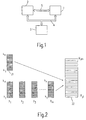
- FIG. 1 shows a basic structure of a computer system.
- elements are the Memory with integrated distance calculation 1, the system processor 2 and all others necessary or optional components shown as unit 3.
- the link of said elements 1 to 3 takes place via the data or address bus 4 Control lines 5 is used, among other things.
- an initialization of the distance calculation 1 is carried out.
- Incoming test signals are the interfaces contained in unit 3, the Overall system fed. These signals are converted according to the type of signal and divided into segments. The different properties of a segment are each assigned components of a test vector.
- a test vector is added to the memory integrated distance calculation 1 supplied via the bus 4.
- In this store with integrated distance calculation 1 becomes the distance calculation between this Test vector and at least part of the reference data performed, and the Calculated distances are used for the entire system via bus 4 Processing fed.
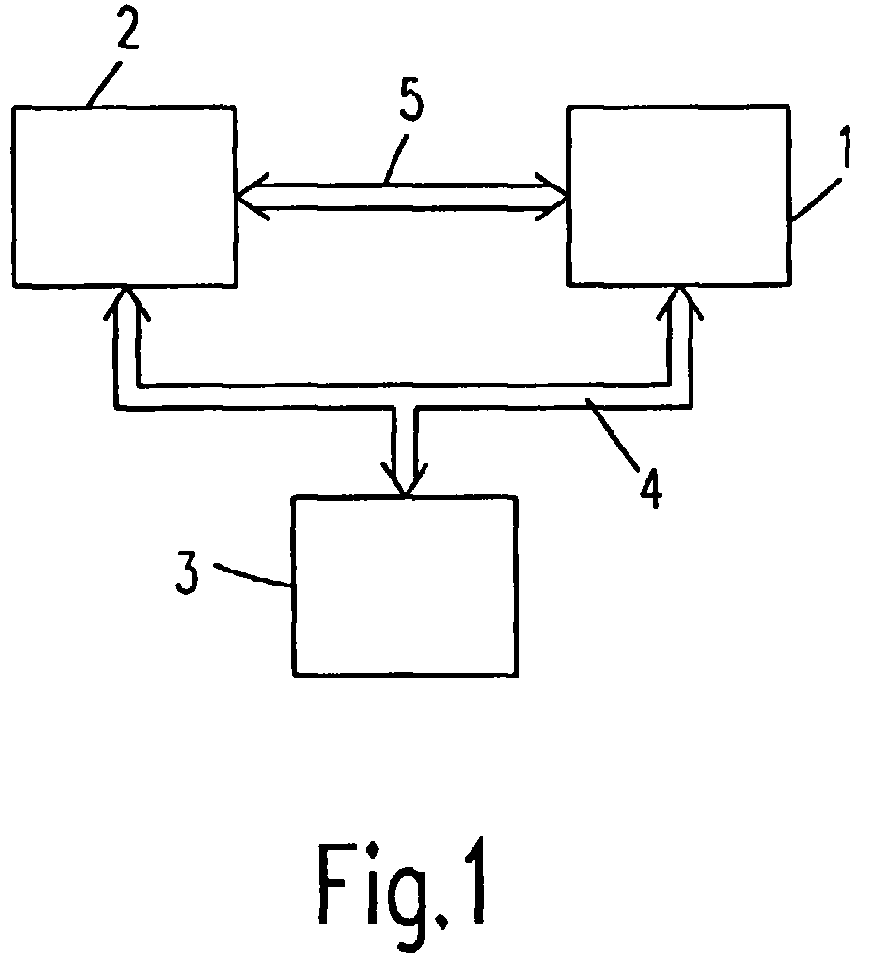
- the reference vectors y 1 to y m consist of the same number of components k n as the test vector 21.
- the components k n of these vectors contain properties of the speech signal parts to be compared.
- the components k 1 to k n of the test vector 21 are compared with the components k 1 to k n of at least some of the reference vectors y 1 to y m .
- the partial distances r n of the component values of the test vector 21 are formed with the corresponding component values of the considered reference vectors y 1 to y m .
- the calculated partial distances r n of the components k n of a reference vector y 1 to y m go directly into a distance R ym by summation.
- This distance R ym represents a measure of similarity of the reference vector y 1 to y m to the test vector 21.
- the distances R y1 to R ym are stored in a list 22, the number of distances R ym from the number of reference vectors y 1 to y m depends, which are compared with the test vector 21. It can be seen from FIG.
- This Memory module contains a reference memory 31 and a test memory 32, the with a distance calculator 34 are connected. This is with a distance memory 33 coupled, the calculated distances via the data output 42 and a driver 38 to Data connection 39 and above to the bus 4 (Fig. 1) for further processing to the System forwards. Furthermore, this memory chip contains an address calculator 36, Address multiplexer 37 and a control unit 35.
- the reference memory is connected via a data connection 39 before a recognition run Reference vectors loaded.
- the test memory 32 also receives the test vectors via the Data connection 39 at the data input 43.
- the reference vectors to be compared and the respective test vectors are fed to the distance calculator 34.
- Distance calculator 34 becomes the respective reference vector and the test vector compared with each other and the distances between the components formed.
- the Distances of the compared vectors are stored in a distance memory 33.
- the test memory 32 is designed as a ring memory and is everyone at the beginning Distance calculation loaded by the system processor with the test vector. The most current Component to be compared is shifted at data output 45 of the test memory 32 is provided. Another option is to increment the current address of the component to be considered.
- the test memory is like this built that the test vector after a complete comparison of all components of the Test vector with all components of a reference vector back in its original form Test memory is present or the current address is that of the first component of the test vector is.
- a next reference vector with the test vector compared.
- Both the reference memory 31 and the distance memory 33 are over Address multiplexer 37 addressed.
- the address multiplexers 37 route those from the address calculator 36 provided addresses via address inputs 44 to the reference memory 31 and / or to the distance memory 33.
- the address for the distance memory can be found on simplest from the address for the reference memory by omitting the for the Derive addressing of the individual vector components required address lines.
- the address multiplexers 37 enable the reference memory 31 and the distance memory 33 also from the outside via the address connection 40, which is connected to the external bus 4 (FIG. 1) is connected to address.
- the control unit 35 is operated by the system via control lines 41 initializes and takes over the control of the address multiplexer 37, the Distance calculator 34 and the test memory 32. After the distance calculation shows the control unit 35 the system the availability of the distances Rym by means of Status line 46 on.
- the reference memory 31 can also be loaded with reference vectors via an I 2 C interface. Via this two-wire connection, the reference memory 31 can also be loaded with reference vectors in the off-line state or the database can be updated.
- the reference memory 31 can be designed as an EEPROM, so that the reference vectors do not have to be loaded each time the device is switched on again. The reference vectors are not transferred to the reference memory 31 during a recognition run. For this loading process, no computing time is required during the recognition run. After the corresponding test vector has been loaded via the data connection 39, the recognition run begins, in which the distances of this test vector to the reference vectors loaded in the reference memory 31 are calculated. The calculated distances are read out by the system from the distance memory 33 via the data connection 39 and processed further.
Landscapes
- Engineering & Computer Science (AREA)
- Computational Linguistics (AREA)
- Health & Medical Sciences (AREA)
- Audiology, Speech & Language Pathology (AREA)
- Human Computer Interaction (AREA)
- Physics & Mathematics (AREA)
- Acoustics & Sound (AREA)
- Multimedia (AREA)
- Complex Calculations (AREA)
- Tests Of Electronic Circuits (AREA)
- Compression, Expansion, Code Conversion, And Decoders (AREA)
Abstract
Die Abstandsberechnung stellt eine zentrale, ständig wiederkehrende Aufgabe bei der
Muster- und Spracherkennung dar. Sie wird in der Spracherkennung als Ähnlichkeitsmaß
zwischen einem Teil einer Sprachäußerung und einer Sprachreferenz eingesetzt. In der
Bildverarbeitung und Mustererkennung wird sie zur Datenkompression (MPEG)
eingesetzt. Die Abstandsberechnung benötigt die meiste Rechenzeit, so daß eine
Reduzierung der Rechenzeit eine erhebliche Verbesserung der Leistungsfähigkeit bewirkt.
Eine Reduzierung der Rechenzeit wird durch die Integration der Abstandsberechnung in
einen Speicherbaustein (1), in dem insbesondere die Referenzdaten gespeichert sind,
erreicht. Die anderen Komponenten (2, 3, 4) des Gesamtsystems werden durch diese
Integration von dieser sich ständig wiederholenden Aufgabe entlastet und stehen in dieser
Zeit für komplexere Vorgänge zur Verfügung. Die Abstandsberechnung wird durch diese
Integration wesentlich verkürzt, da die Kommunikation zwischen Speicherteilen und
Berechnungseinheit direkt ohne Nutzung eines Bussystems erfolgt.
Description
Die Erfindung bezieht sich auf Rechneranordnung zur Spracherkennung mit einem Mikroprozessor, Ein - und Ausgangsschnittstellen und einem Datenbus, bei dem eingehende Testsignale digital gewandelt in Segmente unterteilt und Eigenschaften der Segmente Testvektoren zugeordnet werden, zu denen ein Abstand bezüglich Referenzvektoren berechnet wird.The invention relates to a computer arrangement for speech recognition with a Microprocessor, input and output interfaces and a data bus with which incoming test signals digitally converted into segments and properties of the Segments are assigned test vectors to which there is a distance Reference vectors is calculated.
Die Abstandsberechnung wird in der Spracherkennung als Ähnlichkeitsmaß zwischen einem Teil einer Sprachäußerung und einer Sprachreferenz eingesetzt und stellt eine zentrale, ständig wiederkehrende Aufgabe bei der Muster- und Spracherkennung dar. Sie benötigt die meiste Rechenzeit, so daß eine Reduzierung der Rechenzeit eine erhebliche Verbesserung der Leistungsfähigkeit bewirkt. In der Bildverarbeitung und Mustererkennung wird sie zur Datenkompression (MPEG) eingesetzt.The distance calculation is used in speech recognition as a measure of similarity between part of a speech and a language reference and provides one central, constantly recurring task in pattern and speech recognition requires the most computing time, so that a reduction in computing time is a significant one Efficiency improves. In image processing and Pattern recognition is used for data compression (MPEG).
Bisher wurden zur Spracherkennung zusätzliche spezielle Hardwarebaugruppen verwendet. Auf diesen befindet sich die Wandlung der eingehenden analogen Sprachsignale in digitale Signale, die Merkmalsextraktion, bei der das in Segmente unterteilte, eingehende digitalisierte Sprachsignal mit seinen bezeichnenden Eigenschaften entsprechenden Komponenten von Vektoren zugeordnet wird. Für die so gebildeten Testvektoren wird mittels eines digitalen Signalprozessor der Abstand zu Referenzvektoren berechnet.So far, additional special hardware modules have been used for speech recognition. These convert the incoming analog voice signals into digital ones Signals, the feature extraction where the segmented incoming digitized voice signal with its characteristic properties corresponding Components of vectors is assigned. For the test vectors thus formed the distance to reference vectors is calculated using a digital signal processor.
Andererseits gibt es softwarebasierte Spracherkennungssysteme, bei denen der Erkennungsprozeß ohne spezielle Hardware, also mit den Systemkomponenten eines universellen Rechners erfolgt. Die Digitalisierung der eingehenden Testsignale wird beispielsweise auf der Soundkarte vorgenommen. Die rechenintensive Abstandsberechnung wird auf dem Hauptprozessor des System vorgenommen. Dies setzt einen sehr leistungsstarken Prozessor voraus und nimmt außerdem einen beachtlichen Teil seiner Rechenleistung in Anspruch, die dann nicht mehr für andere Vorgänge zur Verfügung steht. Meist wird die Erkennung des gesprochenen Textes jedoch im offline Modus durchgeführt, da in wenigen Anwendungen ein ausreichend leistungsstarker Prozessor vorhanden ist.On the other hand, there are software-based speech recognition systems in which the Detection process without special hardware, i.e. with the system components of a universal computer. The digitization of the incoming test signals is for example made on the sound card. The computation-intensive distance calculation is done on the main processor of the system. This sets you up a lot powerful processor ahead and also takes up a substantial portion of its Computing power required, which is then no longer available for other processes stands. Mostly, the recognition of the spoken text is in offline mode performed, because in a few applications a sufficiently powerful processor is available.
Die Aufgabe der Erfindung ist es deshalb, eine Anordnung anzugeben, mit der eine Berechnung der Abstände beschleunigt wird.The object of the invention is therefore to provide an arrangement with which one Calculation of the distances is accelerated.
Diese Aufgabe wird dadurch gelöst daß, ein Abstandsberechner und ein Speicherbaustein vorgesehen sind, die auf einem gemeinsamen Baustein integriert sind, wobei dieser wenigstens einen Datenanschluß zum Zuführen von Testvektoren und Referenzvektoren und zum Abgeben von berechneten Abständen aufweist.This object is achieved in that a distance calculator and a memory chip are provided, which are integrated on a common block, this at least one data connection for supplying test vectors and reference vectors and for delivering calculated distances.
Dieses erfindungsgemäße universelle Rechnersystem gestattet es, mit einem gewöhnlichen Mikroprozessor mit seiner üblichen Peripherie durch Kombination mit einem Speicher mit integriertem Abstandsberechner Spracherkennung zu betreiben. Dadurch wird der Mikroprozessor von der rechenintensiven Abstandsberechnung entbunden und seine Rechenleistung steht für andere Vorgänge zur Verfügung.This universal computer system according to the invention makes it possible to use an ordinary one Microprocessor with its usual peripherals by combination with a memory to operate speech recognition with integrated distance calculator. This will make the Microprocessor released from the computation-intensive distance calculation and its Computing power is available for other processes.
Dazu werden dem Rechnersystem über die Ein - und Ausgabeschnittstellen analoge Daten zugeführt, die nach ihrer Aufbereitung zur Abstandsberechnung dem Speicherbaustein mit integriertem Abstandsberechner zugeführt werden.For this purpose, analog data is sent to the computer system via the input and output interfaces supplied with the memory module after its preparation for distance calculation integrated distance calculator.
Ein zusätzlicher Vorteil ist der kurze Kommunikationsweg. Da die zu vergleichenden Daten direkt der Abstandsberechnung aus den jeweiligen Speichern zugeführt werden, geht dadurch keine wertvolle Rechenzeit verloren. Das System übergibt die Testvektoren und erhält die berechneten Abstände zurück. Da die Abstandsberechnung lokal innerhalb eines Speicherbausteins durchgeführt wird, stehen dem Systemprozessor mit Ausnahme des betroffenen Speicherbausteins alle Komponenten des Systems für andere Vorgänge zur Verfügung.An additional advantage is the short communication path. Because the to be compared Data is fed directly to the distance calculation from the respective memories, no valuable computing time is lost as a result. The system passes the test vectors and get the calculated distances back. Because the distance calculation is local within a memory chip is performed, the system processor with the exception of affected memory module all components of the system for other operations Available.
Außerdem sind durch diese Integration keine Datentransfers über einen externen Daten- oder Adreßbus für die Durchführung der Abstandsberechnung erforderlich, d.h. die Speicherzugriffe beschränken sich auf die internen lokalen Speicherbereiche, so daß die Abstandsberechnung direkt und in signifikant kurzer Zeit durchgeführt wird. Die Referenzdaten werden vor oder zumindest nicht während eines Erkennungslaufs in den Referenzdatenspeicher geladen. Auch eine eventuelle Aktualisierung dieses Referenzdatenbestandes erfolgt zu unkritischen Zeitpunkten.In addition, this integration means no data transfers via an external data or Address bus required to perform the distance calculation, i.e. the Memory accesses are limited to the internal local memory areas, so that the Distance calculation is carried out directly and in a significantly short time. The Reference data is stored in the. Before or at least not during a recognition run Reference data memory loaded. Also a possible update of this Reference data stock takes place at non-critical times.
Ein weiterer Vorteil dieses Rechnersystems ist die mögliche Umrüstung eines für normale Zwecke konzipierten Rechners. Ein konventioneller Speicherbaustein wird durch einen Speicherbaustein mit integriertem Abstandsberechner ausgetauscht. Dadurch ist das Rechnersystem in der Lage ohne gravierende Einschränkung seiner Leistungsfähigkeit Spracherkennungsvorgänge vorzunehmen.Another advantage of this computer system is the possible retrofitting one for normal ones Purposes of the designed computer. A conventional memory chip is replaced by a Memory module with integrated distance calculator replaced. That’s it Computer system capable without severely restricting its performance Perform speech recognition operations.
Die Integration eines Abstandsberechners in einen Speicherbaustein bringt weitere Vorteile des optimierten Speicherherstellungsprozesses mit sich. Speicherbausteine werden mit einer höheren Dichte an Bauelementen, als Logikbausteine produziert, womit sich eine optimalere Platzausnutzung ergibt.The integration of a distance calculator in a memory block brings further advantages the optimized memory manufacturing process. Memory modules are with a higher density of components than logic modules, which is one optimal use of space results.
Anhand eines Beispiels soll die Effektivität dieser Integration gezeigt werden.The effectiveness of this integration will be shown using an example.
In einem typischen Fall werden alle 16 ms die Abstände eines Testvektors zu beispielsweise 2000 Referenzvektoren benötigt. Hierzu ist in etwa eine Datenrate von mindestens 3 MByte pro Sekunde erforderlich. Diese Aufgabe würde einen Standardsignalprozessor mit einer Taktfrequenz von 20 MHz etwa 12 ms beschäftigen. Ein Standardmikroprozessor benötigt dafür erheblich mehr Zeit. Durch die Integration der Abstandsberechnung reduziert sich die Dauer zur Bewältigung dieser Aufgabe bei gleicher Taktfrequenz auf etwa ein Zehntel, d.h. ca. 1,2 ms. Der Geschwindigkeitsgewinn ist auf die optimierte Adressierung, die kompakte Datenspeicherung und den verkürzten Datenpfad zurückzuführen.In a typical case, the intervals of a test vector become, for example, every 16 ms 2000 reference vectors required. For this purpose there is approximately a data rate of at least 3 MByte per second required. This task would involve using a standard signal processor a clock frequency of 20 MHz employ about 12 ms. A standard microprocessor takes considerably more time. By integrating the distance calculation the time taken to complete this task is reduced to approximately the same clock frequency one tenth, i.e. approx. 1.2 ms. The speed gain is optimized on the Addressing, compact data storage and the shortened data path attributed.
Im folgenden wird nun ein Ausführungsbeispiel anhand der Figuren erläutert.An exemplary embodiment is now explained below with reference to the figures.
Es zeigen:
Fig. 1 zeigt einen prinzipiellen Aufbau eines Rechnersystems. Als Elemente sind der
Speicher mit integrierter Abstandsberechnung 1, der Systemprozessor 2 und alle weiteren
notwendigen bzw. optionalen Komponenten als Einheit 3 dargestellt. Die Verknüpfung
der genannten Elemente 1 bis 3 erfolgt über den Daten- bzw. Adreßbus 4. Über
Steuerleitungen 5 wird u.a. eine Initialisierung der Abstandsberechnung 1 vorgenommen.
Eingehende Testsignale werden über Schnittstellen, die in Einheit 3 enthalten sind, dem
Gesamtsystem zugeführt. Diese Signale werden der Signalart entsprechend umgewandelt
und in Segmente unterteilt. Die verschiedenen Eigenschaften eines Segments werden
jeweils Komponenten eines Testvektors zugeordnet. Ein Testvektor wird dem Speicher mit
integrierter Abstandsberechnung 1 über den Bus 4 zugeführt. In diesem Speicher mit
integrierter Abstandsberechnung 1 wird die Abstandsberechnung zwischen diesem
Testvektor und wenigstens einem Teil der Referenzdaten durchgeführt, und die
berechneten Abstände werden dem Gesamtsystem über den Bus 4 zur weiteren
Verarbeitung zugeführt.1 shows a basic structure of a computer system. As elements are the
Memory with integrated
Fig. 2 zeigt einen Testvektor 21, der aus mehreren Komponenten kn besteht. Die
Referenzvektoren y1 bis ym bestehen aus der gleichen Anzahl Komponenten kn wie der
Testvektor 21. In den Komponenten kn dieser Vektoren sind Eigenschaften der zu
vergleichenden Sprachsignalteile enthalten. Die Komponenten k1 bis kn des Testvektors 21
werden mit den Komponenten k1 bis kn wenigstens eines Teils der Referenzvektoren y1 bis
ym verglichen. Für die Abstandsberechnung werden die Partialabstände rn der
Komponentenwerte des Testvektors 21 mit den korrespondierenden Komponentenwerten
der betrachteten Referenzvektoren y1 bis ym gebildet. Die errechneten Partialabstände rn der
Komponenten kn eines Referenzvektors y1 bis ym gehen unmittelbar mittels
Aufsummierung in einen Abstand Rym ein. Zur Bildung des Abstandes Rym sind
grundsätzlich Abstandsberechnungen nach Gauß, Laplace o.a. möglich. Dieser Abstand
Rym stellt ein Ähnlichkeitsmaß des Referenzvektors y1 bis ym zum Testvektor 21 dar. Die
Abstände Ry1 bis Rym werden in einer Liste 22 gespeichert, wobei die Anzahl der Abstände
Rym von der Anzahl der Referenzvektoren y1 bis ym abhängt, die mit dem Testvektor 21
verglichen werden. Aus Fig. 2 ist ersichtlich daß eine sehr große Anzahl von
Berechnungen notwendig ist, um die Komponenten kn des Testvektors 21 mit den
relevanten Komponenten kn der Referenzvektoren y1 bis ym zu vergleichen. Zusätzlich muß
für jeden Referenzvektor y1 bis ym noch der Abstand Rym aus den Partialabständen rn
berechnet werden. Für diese große Anzahl einfacher, ständig wiederkehrender
Berechnungen, die außerdem in sehr kurzer Zeit realisiert werden müssen, wird sehr viel
Rechenzeit benötigt.2 shows a
Fig.3 zeigt den internen Aufbau eines erfindungsgemäßen Speicherbausteins. Dieser
Speicherbaustein enthält einen Referenzspeicher 31 und einen Testspeicher 32, die mit
einem Abstandsberechner 34 verbunden sind. Dieser ist mit einem Abstandsspeicher 33
gekoppelt, der berechnete Abstände über den Datenausgang 42 und einen Treiber 38 zum
Datenanschluß 39 und darüber zum Bus 4 (Fig. 1) zur weiteren Verarbeitung an das
System weiterleitet. Weiterhin enthält dieser Speicherbaustein einen Adreßberechner 36,
Adreßmultiplexer 37 und eine Steuereinheit 35.3 shows the internal structure of a memory module according to the invention. This
Memory module contains a
Der Referenzspeicher wird vor einem Erkennungslauf über den Datenanschluß 39 mit
Referenzvektoren geladen. Der Testspeicher 32 erhält die Testvektoren ebenfalls über den
Datenanschluß 39 am Dateneingang 43. Die zu vergleichenden Referenzvektoren und der
jeweilige Testvektor werden dem Abstandsberechner 34 zugeführt. In dem
Abstandsberechner 34 werden der jeweilige Referenzvektor und der Testvektor
miteinander verglichen und die Abstände der Komponenten zueinander gebildet. Die
Abstände der verglichenen Vektoren werden in einem Abstandsspeicher 33 gespeichert.The reference memory is connected via a
Der Testspeicher 32 ist als Ringspeicher ausgeführt und wird zu Beginn jeder
Abstandsberechnung vom Systemprozessor mit dem Testvektor geladen. Die jeweils aktuell
zu vergleichende Komponente wird durch einen Schiebevorgang an dem Datenausgang 45
des Testspeichers 32 bereitgestellt. Eine andere Möglichkeit ist ein Inkrementieren der
jeweils aktuellen Adresse der zu betrachtenden Komponente. Der Testspeicher ist so
aufgebaut, daß der Testvektor nach einem kompletten Vergleich aller Komponenten des
Testvektors mit allen Komponenten eines Referenzvektors wieder in der Ausgangsform im
Testspeicher vorliegt oder die aktuelle Adresse die der ersten Komponente des Testvektors
ist.The
Nachdem für jede Komponente eines Testvektors ein Partialabstand zu der
entsprechenden Komponente eines Referenzvektors gebildet und aus deren Kombination
ein Abstand gebildet wurde, wird ein nächster Referenzvektor mit dem Testvektor
verglichen. Sowohl der Referenzspeicher 31 als auch der Abstandsspeicher 33 werden über
Adreßmultiplexer 37 adressiert. Die Adreßmultiplexer 37 leiten die vom Adreßberechner
36 bereitgestellten Adressen über Adreßeingänge 44 an den Referenzspeicher 31 und/oder
an den Abstandsspeicher 33 weiter. Die Adresse für den Abstandsspeicher läßt sich am
einfachsten aus der Adresse für den Referenzspeicher durch Weglassen der für die
Adressierung der einzelnen Vektorkomponenten erforderlichen Adreßleitungen ableiten.
Die Adreßmultiplexer 37 ermöglichen, den Referenzspeicher 31 und den Abstandsspeicher
33 auch von außen über den Adreßanschluß 40, der mit dem externen Bus 4 (Fig. 1)
verbunden ist, zu adressieren. Die Steuereinheit 35 wird vom System über Steuerleitungen
41 initialisiert und übernimmt die Ansteuerung der Adreßmultiplexer 37, des
Abstandsberechners 34 und des Testspeichers 32. Nach erfolgter Abstandsberechnung zeigt
die Steuereinheit 35 dem System die Verfügbarkeit der Abstände Rym mittels der
Zustandsleitung 46 an.After a partial distance to the for each component of a test vector
corresponding component of a reference vector and from their combination
a distance has been formed, a next reference vector with the test vector
compared. Both the
Der Referenzspeicher 31 kann auch über ein I2C-Interface mit Referenzvektoren geladen
werden. Über diesen Zwei-Draht Anschluß kann der Referenzspeicher 31 auch im off-line
Zustand mit Referenzvektoren geladen werden oder der Datenbestand aktualisiert werden.
Der Referenzspeicher 31 kann als EEPROM ausgeführt sein, so daß die Referenzvektoren
nicht bei jedem erneuten Einschalten geladen werden müssen. Die Referenzvektoren
werden nicht während eines Erkennungslaufs in den Referenzspeicher 31 übergeben. Für
diesen Ladevorgang wird somit keine Rechenzeit während des Erkennungslaufs benötigt.
Nach dem Laden des entsprechenden Testvektors über den Datenanschluß 39 beginnt der
Erkennungslauf, in dem die Abstände dieses Testvektors zu den im Referenzspeicher 31
geladenen Referenzvektoren berechnet werden. Die berechneten Abstände werden vom
System aus dem Abstandsspeicher 33 über den Datenanschluß 39 ausgelesen und
weiterverarbeitet.The
Claims (6)
Applications Claiming Priority (2)
| Application Number | Priority Date | Filing Date | Title |
|---|---|---|---|
| DE19744690A DE19744690A1 (en) | 1997-10-10 | 1997-10-10 | Integrated distance calculator |
| DE19744690 | 1997-10-10 |
Publications (2)
| Publication Number | Publication Date |
|---|---|
| EP0908868A2 true EP0908868A2 (en) | 1999-04-14 |
| EP0908868A3 EP0908868A3 (en) | 2001-04-18 |
Family
ID=7845090
Family Applications (1)
| Application Number | Title | Priority Date | Filing Date |
|---|---|---|---|
| EP98203355A Withdrawn EP0908868A3 (en) | 1997-10-10 | 1998-10-06 | Computer arrangement for speech recognition |
Country Status (3)
| Country | Link |
|---|---|
| US (1) | US6490559B2 (en) |
| EP (1) | EP0908868A3 (en) |
| DE (1) | DE19744690A1 (en) |
Families Citing this family (2)
| Publication number | Priority date | Publication date | Assignee | Title |
|---|---|---|---|---|
| WO2010042631A2 (en) | 2008-10-10 | 2010-04-15 | Fastow Richard M | Real-time data pattern analysis system and method of operation thereof |
| US8818802B2 (en) | 2008-10-10 | 2014-08-26 | Spansion Llc | Real-time data pattern analysis system and method of operation thereof |
Family Cites Families (11)
| Publication number | Priority date | Publication date | Assignee | Title |
|---|---|---|---|---|
| JPS57201300A (en) * | 1981-06-05 | 1982-12-09 | Hitachi Ltd | Voice recognizer |
| JPS5870296A (en) * | 1981-10-22 | 1983-04-26 | シャープ株式会社 | Integrated circuit for voice emitting electronic equipment |
| US4592086A (en) * | 1981-12-09 | 1986-05-27 | Nippon Electric Co., Ltd. | Continuous speech recognition system |
| US5027407A (en) * | 1987-02-23 | 1991-06-25 | Kabushiki Kaisha Toshiba | Pattern recognition apparatus using a plurality of candidates |
| US5014327A (en) | 1987-06-15 | 1991-05-07 | Digital Equipment Corporation | Parallel associative memory having improved selection and decision mechanisms for recognizing and sorting relevant patterns |
| DE3829032A1 (en) * | 1988-08-26 | 1990-07-05 | Fraunhofer Ges Forschung | Device for storing and reproducing analog signals, preferably audio signals |
| US5216748A (en) * | 1988-11-30 | 1993-06-01 | Bull, S.A. | Integrated dynamic programming circuit |
| US5546499A (en) | 1994-05-27 | 1996-08-13 | Kurzweil Applied Intelligence, Inc. | Speech recognition system utilizing pre-calculated similarity measurements |
| US5459798A (en) * | 1993-03-19 | 1995-10-17 | Intel Corporation | System and method of pattern recognition employing a multiprocessing pipelined apparatus with private pattern memory |
| US5581485A (en) | 1994-12-08 | 1996-12-03 | Omni Microelectronics, Inc. | Analog vector distance measuring and vector quantization architecture |
| DE19546168C1 (en) * | 1995-12-11 | 1997-02-20 | Siemens Ag | Digital signal processor for speech processing or pattern recognition |
-
1997
- 1997-10-10 DE DE19744690A patent/DE19744690A1/en not_active Withdrawn
-
1998
- 1998-10-06 EP EP98203355A patent/EP0908868A3/en not_active Withdrawn
- 1998-10-13 US US09/170,464 patent/US6490559B2/en not_active Expired - Fee Related
Also Published As
| Publication number | Publication date |
|---|---|
| US20020007274A1 (en) | 2002-01-17 |
| EP0908868A3 (en) | 2001-04-18 |
| DE19744690A1 (en) | 1999-04-15 |
| US6490559B2 (en) | 2002-12-03 |
Similar Documents
| Publication | Publication Date | Title |
|---|---|---|
| EP0115609B1 (en) | Addressing device for the storage of several data processing units in a bus system | |
| DE3011552C2 (en) | ||
| DE3854481T2 (en) | Data processing method in a decentralized processing system. | |
| EP0013737A1 (en) | Multilevel storage hierarchy for a data processing system | |
| DE1549523B2 (en) | DATA PROCESSING SYSTEM | |
| DE2939411C2 (en) | Data processing system with virtual memory addressing | |
| DE2524046A1 (en) | ELECTRONIC DATA PROCESSING SYSTEM | |
| DE69119149T2 (en) | Structure for direct memory-to-memory transfer | |
| DE2218630C3 (en) | Circuit arrangement for controlling interrupt signals in data processing systems | |
| DE68925376T2 (en) | Effective information processor and method for switching the mapping schemes in direct mapping and in banking mapping | |
| DE2846054A1 (en) | METHOD AND CIRCUIT ARRANGEMENT FOR EXTENDING THE ADDRESSING VOLUME OF A CENTRAL UNIT, IN PARTICULAR A MICROPROCESSOR | |
| DE2539929C2 (en) | Data processing system with a central unit and peripheral device control arrangements connected to the central unit via a bus | |
| EP0409330B1 (en) | Memory access control circuit | |
| DE3026055A1 (en) | CIRCUIT FOR MECHANICAL CHARACTER RECOGNITION | |
| EP0908868A2 (en) | Computer arrangement for speech recognition | |
| EP0057755B1 (en) | Microcomputer system for rapidly finding blocks of signs | |
| EP1456756A2 (en) | Method for storing or transferring data | |
| EP0232518A2 (en) | Address mapping method and system for controlling a working memory | |
| DE69131527T2 (en) | Data transmission system and method | |
| EP0609703A2 (en) | Monolithic integrated memory device and its operation method | |
| EP0760502A1 (en) | Ranking method for membership function values of linguistic input values in a fuzzy logic processor and device for carrying out the method | |
| DE4106346C2 (en) | Arrangement for recognizing words in a speech signal | |
| DE4106347A1 (en) | Real time speech recognition system - has parallel bus coupled modules that provide comparisons with part of references values for fast operating cycle | |
| DE3216238C1 (en) | Data processing system with virtual partial addressing of the buffer memory | |
| EP0141984A2 (en) | Multiprocessor central control unit for a telephone switching system |
Legal Events
| Date | Code | Title | Description |
|---|---|---|---|
| PUAI | Public reference made under article 153(3) epc to a published international application that has entered the european phase |
Free format text: ORIGINAL CODE: 0009012 |
|
| AK | Designated contracting states |
Kind code of ref document: A2 Designated state(s): DE FR GB IT |
|
| AX | Request for extension of the european patent |
Free format text: AL;LT;LV;MK;RO;SI |
|
| RAP3 | Party data changed (applicant data changed or rights of an application transferred) |
Owner name: KONINKLIJKE PHILIPS ELECTRONICS N.V. Owner name: PHILIPS CORPORATE INTELLECTUAL PROPERTY GMBH |
|
| PUAL | Search report despatched |
Free format text: ORIGINAL CODE: 0009013 |
|
| AK | Designated contracting states |
Kind code of ref document: A3 Designated state(s): AT BE CH CY DE DK ES FI FR GB GR IE IT LI LU MC NL PT SE |
|
| AX | Request for extension of the european patent |
Free format text: AL;LT;LV;MK;RO;SI |
|
| RIC1 | Information provided on ipc code assigned before grant |
Free format text: 7G 10L 15/26 A |
|
| 17P | Request for examination filed |
Effective date: 20011018 |
|
| 17Q | First examination report despatched |
Effective date: 20011127 |
|
| AKX | Designation fees paid |
Free format text: DE FR GB IT |
|
| STAA | Information on the status of an ep patent application or granted ep patent |
Free format text: STATUS: THE APPLICATION IS DEEMED TO BE WITHDRAWN |
|
| RAP1 | Party data changed (applicant data changed or rights of an application transferred) |
Owner name: KONINKLIJKE PHILIPS ELECTRONICS N.V. Owner name: PHILIPS CORPORATE INTELLECTUAL PROPERTY GMBH |
|
| 18D | Application deemed to be withdrawn |
Effective date: 20020409 |