EP0908868A2 - Arrangement d'ordinateur pour la reconnaissance de la parole - Google Patents
Arrangement d'ordinateur pour la reconnaissance de la parole Download PDFInfo
- Publication number
- EP0908868A2 EP0908868A2 EP98203355A EP98203355A EP0908868A2 EP 0908868 A2 EP0908868 A2 EP 0908868A2 EP 98203355 A EP98203355 A EP 98203355A EP 98203355 A EP98203355 A EP 98203355A EP 0908868 A2 EP0908868 A2 EP 0908868A2
- Authority
- EP
- European Patent Office
- Prior art keywords
- memory
- test
- distance
- vectors
- address
- Prior art date
- Legal status (The legal status is an assumption and is not a legal conclusion. Google has not performed a legal analysis and makes no representation as to the accuracy of the status listed.)
- Withdrawn
Links
Images

Classifications
-
- G—PHYSICS
- G10—MUSICAL INSTRUMENTS; ACOUSTICS
- G10L—SPEECH ANALYSIS TECHNIQUES OR SPEECH SYNTHESIS; SPEECH RECOGNITION; SPEECH OR VOICE PROCESSING TECHNIQUES; SPEECH OR AUDIO CODING OR DECODING
- G10L15/00—Speech recognition
- G10L15/26—Speech to text systems
-
- G—PHYSICS
- G10—MUSICAL INSTRUMENTS; ACOUSTICS
- G10L—SPEECH ANALYSIS TECHNIQUES OR SPEECH SYNTHESIS; SPEECH RECOGNITION; SPEECH OR VOICE PROCESSING TECHNIQUES; SPEECH OR AUDIO CODING OR DECODING
- G10L15/00—Speech recognition
- G10L15/08—Speech classification or search
- G10L15/10—Speech classification or search using distance or distortion measures between unknown speech and reference templates
Definitions
- the invention relates to a computer arrangement for speech recognition with a Microprocessor, input and output interfaces and a data bus with which incoming test signals digitally converted into segments and properties of the Segments are assigned test vectors to which there is a distance Reference vectors is calculated.
- the distance calculation is used in speech recognition as a measure of similarity between part of a speech and a language reference and provides one central, constantly recurring task in pattern and speech recognition requires the most computing time, so that a reduction in computing time is a significant one Efficiency improves.
- image processing and Pattern recognition is used for data compression (MPEG).
- the object of the invention is therefore to provide an arrangement with which one Calculation of the distances is accelerated.
- a distance calculator and a memory chip are provided, which are integrated on a common block, this at least one data connection for supplying test vectors and reference vectors and for delivering calculated distances.
- This universal computer system makes it possible to use an ordinary one Microprocessor with its usual peripherals by combination with a memory to operate speech recognition with integrated distance calculator. This will make the Microprocessor released from the computation-intensive distance calculation and its Computing power is available for other processes.
- analog data is sent to the computer system via the input and output interfaces supplied with the memory module after its preparation for distance calculation integrated distance calculator.
- An additional advantage is the short communication path. Because the to be compared Data is fed directly to the distance calculation from the respective memories, no valuable computing time is lost as a result. The system passes the test vectors and get the calculated distances back. Because the distance calculation is local within a memory chip is performed, the system processor with the exception of affected memory module all components of the system for other operations Available.
- this integration means no data transfers via an external data or Address bus required to perform the distance calculation, i.e. the Memory accesses are limited to the internal local memory areas, so that the Distance calculation is carried out directly and in a significantly short time.
- the Reference data is stored in the. Before or at least not during a recognition run Reference data memory loaded. Also a possible update of this Reference data stock takes place at non-critical times.
- Another advantage of this computer system is the possible retrofitting one for normal ones Purposes of the designed computer.
- a conventional memory chip is replaced by a Memory module with integrated distance calculator replaced. That’s it Computer system capable without severely restricting its performance Perform speech recognition operations.
- the intervals of a test vector become, for example, every 16 ms 2000 reference vectors required. For this purpose there is approximately a data rate of at least 3 MByte per second required.
- This task would involve using a standard signal processor a clock frequency of 20 MHz employ about 12 ms.
- a standard microprocessor takes considerably more time. By integrating the distance calculation the time taken to complete this task is reduced to approximately the same clock frequency one tenth, i.e. approx. 1.2 ms.
- the speed gain is optimized on the Addressing, compact data storage and the shortened data path attributed.
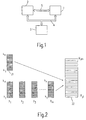
- FIG. 1 shows a basic structure of a computer system.
- elements are the Memory with integrated distance calculation 1, the system processor 2 and all others necessary or optional components shown as unit 3.
- the link of said elements 1 to 3 takes place via the data or address bus 4 Control lines 5 is used, among other things.
- an initialization of the distance calculation 1 is carried out.
- Incoming test signals are the interfaces contained in unit 3, the Overall system fed. These signals are converted according to the type of signal and divided into segments. The different properties of a segment are each assigned components of a test vector.
- a test vector is added to the memory integrated distance calculation 1 supplied via the bus 4.
- In this store with integrated distance calculation 1 becomes the distance calculation between this Test vector and at least part of the reference data performed, and the Calculated distances are used for the entire system via bus 4 Processing fed.
- the reference vectors y 1 to y m consist of the same number of components k n as the test vector 21.
- the components k n of these vectors contain properties of the speech signal parts to be compared.
- the components k 1 to k n of the test vector 21 are compared with the components k 1 to k n of at least some of the reference vectors y 1 to y m .
- the partial distances r n of the component values of the test vector 21 are formed with the corresponding component values of the considered reference vectors y 1 to y m .
- the calculated partial distances r n of the components k n of a reference vector y 1 to y m go directly into a distance R ym by summation.
- This distance R ym represents a measure of similarity of the reference vector y 1 to y m to the test vector 21.
- the distances R y1 to R ym are stored in a list 22, the number of distances R ym from the number of reference vectors y 1 to y m depends, which are compared with the test vector 21. It can be seen from FIG.
- This Memory module contains a reference memory 31 and a test memory 32, the with a distance calculator 34 are connected. This is with a distance memory 33 coupled, the calculated distances via the data output 42 and a driver 38 to Data connection 39 and above to the bus 4 (Fig. 1) for further processing to the System forwards. Furthermore, this memory chip contains an address calculator 36, Address multiplexer 37 and a control unit 35.
- the reference memory is connected via a data connection 39 before a recognition run Reference vectors loaded.
- the test memory 32 also receives the test vectors via the Data connection 39 at the data input 43.
- the reference vectors to be compared and the respective test vectors are fed to the distance calculator 34.
- Distance calculator 34 becomes the respective reference vector and the test vector compared with each other and the distances between the components formed.
- the Distances of the compared vectors are stored in a distance memory 33.
- the test memory 32 is designed as a ring memory and is everyone at the beginning Distance calculation loaded by the system processor with the test vector. The most current Component to be compared is shifted at data output 45 of the test memory 32 is provided. Another option is to increment the current address of the component to be considered.
- the test memory is like this built that the test vector after a complete comparison of all components of the Test vector with all components of a reference vector back in its original form Test memory is present or the current address is that of the first component of the test vector is.
- a next reference vector with the test vector compared.
- Both the reference memory 31 and the distance memory 33 are over Address multiplexer 37 addressed.
- the address multiplexers 37 route those from the address calculator 36 provided addresses via address inputs 44 to the reference memory 31 and / or to the distance memory 33.
- the address for the distance memory can be found on simplest from the address for the reference memory by omitting the for the Derive addressing of the individual vector components required address lines.
- the address multiplexers 37 enable the reference memory 31 and the distance memory 33 also from the outside via the address connection 40, which is connected to the external bus 4 (FIG. 1) is connected to address.
- the control unit 35 is operated by the system via control lines 41 initializes and takes over the control of the address multiplexer 37, the Distance calculator 34 and the test memory 32. After the distance calculation shows the control unit 35 the system the availability of the distances Rym by means of Status line 46 on.
- the reference memory 31 can also be loaded with reference vectors via an I 2 C interface. Via this two-wire connection, the reference memory 31 can also be loaded with reference vectors in the off-line state or the database can be updated.
- the reference memory 31 can be designed as an EEPROM, so that the reference vectors do not have to be loaded each time the device is switched on again. The reference vectors are not transferred to the reference memory 31 during a recognition run. For this loading process, no computing time is required during the recognition run. After the corresponding test vector has been loaded via the data connection 39, the recognition run begins, in which the distances of this test vector to the reference vectors loaded in the reference memory 31 are calculated. The calculated distances are read out by the system from the distance memory 33 via the data connection 39 and processed further.
Landscapes
- Engineering & Computer Science (AREA)
- Computational Linguistics (AREA)
- Health & Medical Sciences (AREA)
- Audiology, Speech & Language Pathology (AREA)
- Human Computer Interaction (AREA)
- Physics & Mathematics (AREA)
- Acoustics & Sound (AREA)
- Multimedia (AREA)
- Complex Calculations (AREA)
- Tests Of Electronic Circuits (AREA)
- Compression, Expansion, Code Conversion, And Decoders (AREA)
Applications Claiming Priority (2)
| Application Number | Priority Date | Filing Date | Title |
|---|---|---|---|
| DE19744690 | 1997-10-10 | ||
| DE19744690A DE19744690A1 (de) | 1997-10-10 | 1997-10-10 | Integrierter Abstandsberechner |
Publications (2)
| Publication Number | Publication Date |
|---|---|
| EP0908868A2 true EP0908868A2 (fr) | 1999-04-14 |
| EP0908868A3 EP0908868A3 (fr) | 2001-04-18 |
Family
ID=7845090
Family Applications (1)
| Application Number | Title | Priority Date | Filing Date |
|---|---|---|---|
| EP98203355A Withdrawn EP0908868A3 (fr) | 1997-10-10 | 1998-10-06 | Arrangement d'ordinateur pour la reconnaissance de la parole |
Country Status (3)
| Country | Link |
|---|---|
| US (1) | US6490559B2 (fr) |
| EP (1) | EP0908868A3 (fr) |
| DE (1) | DE19744690A1 (fr) |
Families Citing this family (2)
| Publication number | Priority date | Publication date | Assignee | Title |
|---|---|---|---|---|
| US8818802B2 (en) | 2008-10-10 | 2014-08-26 | Spansion Llc | Real-time data pattern analysis system and method of operation thereof |
| WO2010042631A2 (fr) | 2008-10-10 | 2010-04-15 | Fastow Richard M | Système d'analyse en temps réel des schémas de données, et procédé d'exploitation correspondant |
Family Cites Families (11)
| Publication number | Priority date | Publication date | Assignee | Title |
|---|---|---|---|---|
| JPS57201300A (en) * | 1981-06-05 | 1982-12-09 | Hitachi Ltd | Voice recognizer |
| JPS5870296A (ja) * | 1981-10-22 | 1983-04-26 | シャープ株式会社 | 音を発する電子機器用の集積回路 |
| US4592086A (en) * | 1981-12-09 | 1986-05-27 | Nippon Electric Co., Ltd. | Continuous speech recognition system |
| US5027407A (en) * | 1987-02-23 | 1991-06-25 | Kabushiki Kaisha Toshiba | Pattern recognition apparatus using a plurality of candidates |
| US5014327A (en) * | 1987-06-15 | 1991-05-07 | Digital Equipment Corporation | Parallel associative memory having improved selection and decision mechanisms for recognizing and sorting relevant patterns |
| DE3829032A1 (de) * | 1988-08-26 | 1990-07-05 | Fraunhofer Ges Forschung | Einrichtung zum speichern und wiedergeben von analogsignalen, vorzugsweise audiosignalen |
| US5216748A (en) * | 1988-11-30 | 1993-06-01 | Bull, S.A. | Integrated dynamic programming circuit |
| US5546499A (en) | 1994-05-27 | 1996-08-13 | Kurzweil Applied Intelligence, Inc. | Speech recognition system utilizing pre-calculated similarity measurements |
| US5459798A (en) * | 1993-03-19 | 1995-10-17 | Intel Corporation | System and method of pattern recognition employing a multiprocessing pipelined apparatus with private pattern memory |
| US5581485A (en) | 1994-12-08 | 1996-12-03 | Omni Microelectronics, Inc. | Analog vector distance measuring and vector quantization architecture |
| DE19546168C1 (de) * | 1995-12-11 | 1997-02-20 | Siemens Ag | Digitale Signalprozessor-Anordnung zum Vergleich von Merkmalsvektoren und deren Verwendung sowie zugehöriges Betriebsverfahren |
-
1997
- 1997-10-10 DE DE19744690A patent/DE19744690A1/de not_active Withdrawn
-
1998
- 1998-10-06 EP EP98203355A patent/EP0908868A3/fr not_active Withdrawn
- 1998-10-13 US US09/170,464 patent/US6490559B2/en not_active Expired - Fee Related
Also Published As
| Publication number | Publication date |
|---|---|
| US20020007274A1 (en) | 2002-01-17 |
| EP0908868A3 (fr) | 2001-04-18 |
| DE19744690A1 (de) | 1999-04-15 |
| US6490559B2 (en) | 2002-12-03 |
Similar Documents
| Publication | Publication Date | Title |
|---|---|---|
| EP0115609B1 (fr) | Dispositif d'adressage des mémoires de plusieurs unités de traitement de données dans un système de bus | |
| DE3011552C2 (fr) | ||
| DE3854481T2 (de) | Datenverarbeitungsverfahren in einem dezentralisierten Verarbeitungssystem. | |
| EP0013737A1 (fr) | Hiérarchie de mémoire à plusieurs étages pour un système de traitement des données | |
| DE1549523B2 (de) | Datenverarbeitungsanlage | |
| DE2939411C2 (de) | Datenverarbeitungsanlage mit virtueller Speicheradressierung | |
| DE2524046A1 (de) | Elektronische datenverarbeitungsanlage | |
| DE69119149T2 (de) | Struktur zur direkten Speicher-zu-Speicher-Übertragung | |
| DE2218630C3 (de) | Schaltungsanordnung zur Steuerung von Unterbrechungssignalen in Datenverarbeitungsanlagen | |
| DE68925376T2 (de) | In Direktabbildung und in Bankabbildung wirksamer Informationsprozessor und Verfahren zum Schalten der Abbildungsschemas | |
| DE2846054A1 (de) | Verfahren und schaltungsanordnung zur erweiterung des adressierungsvolumens einer zentraleinheit, insbesondere eines mikroprozessors | |
| DE2539929C2 (de) | Datenverarbeitungsanlage mit einer zentralen Einheit und über einen Bus mit der zentralen Einheit verbundenen Peripheriegeräte-Steueranordnungen | |
| EP0409330B1 (fr) | Circuit de commande d'accès d'une mémoire | |
| DE3026055A1 (de) | Schaltungsanordnung zur maschinellen zeichererkennung | |
| EP0908868A2 (fr) | Arrangement d'ordinateur pour la reconnaissance de la parole | |
| EP0057755B1 (fr) | Système à microculculateur pour trouver rapidement des blocs de signes | |
| EP1456756A2 (fr) | Procede pour sauvegarder ou transferer des donnees | |
| EP0232518A2 (fr) | Procédé et système de formation d'adresses pour commander une mémoire de travail | |
| EP0609703A2 (fr) | Dispositif de mémoire intégrée monolithique et méthode de son fonctionnement | |
| EP0760502A1 (fr) | Procédé de classement pour valeurs de fonctions d'appartenance de valeurs d'entrée linguistiques dans un processeur à logique floue et dispositif mettant en oeuvre un tel procédé | |
| DE4106346C2 (de) | Anordnung zur Erkennung von Wörtern in einem Sprachsignal | |
| DE4106347A1 (de) | Anordnung zur erkennung der woerter in einem sprachsignal | |
| DE3216238C1 (de) | Datenverarbeitungsanlage mit virtueller Teiladressierung des Pufferspeichers | |
| EP0141984A2 (fr) | Unité de commande centrale à processeurs multiples pour un système de commutation téléphonique | |
| EP1191537A1 (fr) | Circuit de mémoire intégré et dispositif de mémoire à une pluralité de circuits de mémoire et méthode de commande pour ce dispositif |
Legal Events
| Date | Code | Title | Description |
|---|---|---|---|
| PUAI | Public reference made under article 153(3) epc to a published international application that has entered the european phase |
Free format text: ORIGINAL CODE: 0009012 |
|
| AK | Designated contracting states |
Kind code of ref document: A2 Designated state(s): DE FR GB IT |
|
| AX | Request for extension of the european patent |
Free format text: AL;LT;LV;MK;RO;SI |
|
| RAP3 | Party data changed (applicant data changed or rights of an application transferred) |
Owner name: KONINKLIJKE PHILIPS ELECTRONICS N.V. Owner name: PHILIPS CORPORATE INTELLECTUAL PROPERTY GMBH |
|
| PUAL | Search report despatched |
Free format text: ORIGINAL CODE: 0009013 |
|
| AK | Designated contracting states |
Kind code of ref document: A3 Designated state(s): AT BE CH CY DE DK ES FI FR GB GR IE IT LI LU MC NL PT SE |
|
| AX | Request for extension of the european patent |
Free format text: AL;LT;LV;MK;RO;SI |
|
| RIC1 | Information provided on ipc code assigned before grant |
Free format text: 7G 10L 15/26 A |
|
| 17P | Request for examination filed |
Effective date: 20011018 |
|
| 17Q | First examination report despatched |
Effective date: 20011127 |
|
| AKX | Designation fees paid |
Free format text: DE FR GB IT |
|
| STAA | Information on the status of an ep patent application or granted ep patent |
Free format text: STATUS: THE APPLICATION IS DEEMED TO BE WITHDRAWN |
|
| RAP1 | Party data changed (applicant data changed or rights of an application transferred) |
Owner name: KONINKLIJKE PHILIPS ELECTRONICS N.V. Owner name: PHILIPS CORPORATE INTELLECTUAL PROPERTY GMBH |
|
| 18D | Application deemed to be withdrawn |
Effective date: 20020409 |