EP0909052A2 - Procédé de transfert d'un signal numérique de données par étalement spectral - Google Patents
Procédé de transfert d'un signal numérique de données par étalement spectral Download PDFInfo
- Publication number
- EP0909052A2 EP0909052A2 EP98308238A EP98308238A EP0909052A2 EP 0909052 A2 EP0909052 A2 EP 0909052A2 EP 98308238 A EP98308238 A EP 98308238A EP 98308238 A EP98308238 A EP 98308238A EP 0909052 A2 EP0909052 A2 EP 0909052A2
- Authority
- EP
- European Patent Office
- Prior art keywords
- signal
- code sequence
- data signal
- receiver
- data
- Prior art date
- Legal status (The legal status is an assumption and is not a legal conclusion. Google has not performed a legal analysis and makes no representation as to the accuracy of the status listed.)
- Withdrawn
Links
Images


Classifications
-
- H—ELECTRICITY
- H04—ELECTRIC COMMUNICATION TECHNIQUE
- H04B—TRANSMISSION
- H04B1/00—Details of transmission systems, not covered by a single one of groups H04B3/00 - H04B13/00; Details of transmission systems not characterised by the medium used for transmission
- H04B1/69—Spread spectrum techniques
- H04B1/707—Spread spectrum techniques using direct sequence modulation
Definitions
- the invention relates to a method for the transfer of a digital data signal with predetermined band width from a transmitter to a receiver using the spread spectrum technique, in which the data signal is modulo-2 added with a PN code sequence, the bit rate of which is very much higher than the bit rate of the data signal, then a carrier is modulated with the thereby resulting spread data signal, the modulated carrier is transmitted, in the receiver the modulated carrier is demodulated and the demodulated signal, to obtain the digital data signal, is multiplied with a PN code sequence produced in the receiver, synchronised with the PN code sequence of the transmitter through autocorrelation.
- a type of spread spectrum technique is the so-called direct sequence method (DS method), in which the signal which is to be transferred, which is present in digital form, is modulated with a PN code sequence (in which PN stands for "Pseudo Noise”), which is provided so that a spreading of the signal which is to be transferred is achieved.
- DS method direct sequence method
- PN PN code sequence
- the data signal is recovered by the spread signal being unspread again by mixing in the PN code sequence. This unspreading process is carried out using an autocorrelation stage.
- the PN code sequences used in the spread spectrum transfer methods hitherto have a very great length and are generally produced with binary shift registers. For this, a relatively great circuitry expenditure is necessary, so that the spread spectrum technique has not been used hitherto in data transfer systems which are to be realized expending as little cost as possible.
- the invention is therefore based on the problem of providing a method of the type initially mentioned, by means of which favourably-priced apparatus can be constructed, which nevertheless permit a transfer of data which is insensitive to interference.
- this problem is solved in that with the method initially mentioned, a periodic rectangular signal with a constant duty cycle is used as PN code sequence.
- the method according to the invention makes possible the production of the PN code sequence by means of a simple rectangular generator, i.e. without a great switching expenditure.
- this particular PN code sequence makes possible a very quick synchronising of the genrator which on the receiver side produces the PN code sequence which is required for the unspreading of the data signal.
- This very short synchronising time permits a considerable shortening of the overall length of the transmitted data telegram, so that the target which is aimed for, namely of energy-saving data transfer insensitive to interference, is achieved.
- the duty cycle of the PN code sequence is set at 1 : 4, which produces a favourable energy distribution in the spectrum of the spread signal and makes possible a quick synchronising in the autocorrelation stage of the receiver.
- the transmitter is accommodated in a calorimeter which is secured to a radiator and can pick up and store intermediately the amount of heat emitted from the radiator.
- the intermediately stored measurement result can be transmitted for example as a reaction to a call signal and can be picked up be a reading apparatus.
- the way in which the transmission process is triggered is not important for the method to be described here, so it is not entered into in further detail here.
- the measurement values to be transferred are picked up by a sensor 12 and brought into a digital form by an analog/digital converter 14.
- the digitalised data are subjected to a modulo-2-addition with the output signal of a PN generator 18.
- the PN generator 18 produces a PN code sequence (Pseudo Noise code sequence) in the form of a rectangular signal with constant duty cycle and with a bit rate which is substantially higher than the bit rate of the data signal.
- the duty cycle is set at 1 : 4.
- the spectrum of the data signal is spread so that a data signal with spread spectrum is available at the output of the antivalence circuit 16.
- This spread data signal is modulated in a BPSK modulator 20 onto a carrier produced by a carrier oscillator 22.
- the modulation used in the described example is the binary phase shift keying modulation (Binary Phase Shift Keying), in which with each edge of the spread data, the modulated carrier undergoes a phase shift of 180°.
- time diagrams are illustrated of its signals appearing in points a to d of Figure 1.
- the signal occurring at a represents the binary coded data emitted from the analog/digital converter 14, and at b the output signal of the PN generator occurs which, as can be seen, is a rectangular signal with the constant duty cycle 1 : 4.
- the spread data which occur at c are the result of the modulo-2 addition of the binary coded data and of the PN code sequence.
- the signal emitted from the BPSK modulator 20, which occurs on the line leading to the antenna 24, shows that the carrier signal emitted from the carrier oscillator 22, with each occurrence of a flank of the spread data, is phase shifted by 180°.
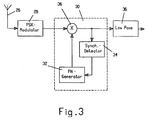
- a signal transmitted from the transmitter 10 and picked up by the antenna 26 is firstly demodulated in a BPSK demodulator 28.
- the spread data are again available in the base band.
- an autocorrelation stage 30 is used in the receiver, in which stage 30 the spread data are multiplied with a PN code group produced by the PN generator 18.
- This PN code group is produced in a PN generator 32 in the autocorrelation stage 30; the multiplication takes place in a multiplication unit 34.
- the autocorrelation stage 30 contains a synchronous detector 34 which, by means of the signal edges occurring in the output signal of the multiplying unit 34, can detect whether the synchronised state has been reached. Recurring signal edges which are distinguished in the output signal of the multipying unit 34 in fact only occur in the synchronised state, as are contained in the unspread, binary coded data.
- the multiplication in the multiplying unit 34 only brings about a further spreading of the data supplied to it from the PSK demodultor 28, whilst in the synchronised state the binary coded data are emitted from the multiplying unit 34.
- the synchronous detector 34 does not detect any marked, recurring edges, it emits to the PN generator a signal which has the result that the phase relationship of the output signal of this generator is gradually shifted. This shifting command is repeated until the synchronous detector 34 detects the synchronous state by means of the occurrence of the binary coded data.
- the synchroninsing can also take place very quickly in the autocorrelation stage 30 of the receiver.
- the data telegram can therefore be very short, so that in the transmitter only a small amount of energy is required for transmission.
- the production of the PN code sequence only requires a simple square wave generator, which contributes to making possible a favourably-priced manufacture of the transmitter.
- all the advantages of the spread spectrum technique are achieved with regard to the signal-to-noise ratio and freedom from interference.
Landscapes
- Engineering & Computer Science (AREA)
- Computer Networks & Wireless Communication (AREA)
- Signal Processing (AREA)
- Digital Transmission Methods That Use Modulated Carrier Waves (AREA)
- Synchronisation In Digital Transmission Systems (AREA)
Applications Claiming Priority (2)
| Application Number | Priority Date | Filing Date | Title |
|---|---|---|---|
| DE19744915 | 1997-10-10 | ||
| DE19744915A DE19744915C1 (de) | 1997-10-10 | 1997-10-10 | Verfahren zum Übertragen eines digitalen Datensignals |
Publications (2)
| Publication Number | Publication Date |
|---|---|
| EP0909052A2 true EP0909052A2 (fr) | 1999-04-14 |
| EP0909052A3 EP0909052A3 (fr) | 2005-03-23 |
Family
ID=7845225
Family Applications (1)
| Application Number | Title | Priority Date | Filing Date |
|---|---|---|---|
| EP98308238A Withdrawn EP0909052A3 (fr) | 1997-10-10 | 1998-10-09 | Procédé de transfert d'un signal numérique de données par étalement spectral |
Country Status (3)
| Country | Link |
|---|---|
| US (1) | US6393048B1 (fr) |
| EP (1) | EP0909052A3 (fr) |
| DE (1) | DE19744915C1 (fr) |
Cited By (1)
| Publication number | Priority date | Publication date | Assignee | Title |
|---|---|---|---|---|
| WO2007063093A1 (fr) * | 2005-12-02 | 2007-06-07 | Telefonaktiebolaget Lm Ericsson (Publ) | Procede et appareil de modulation |
Families Citing this family (1)
| Publication number | Priority date | Publication date | Assignee | Title |
|---|---|---|---|---|
| DE19855292C1 (de) * | 1998-11-24 | 2000-10-05 | Jens Kurrat | Digitales Funkkopfhöhrersystem |
Family Cites Families (7)
| Publication number | Priority date | Publication date | Assignee | Title |
|---|---|---|---|---|
| US3952298A (en) * | 1975-04-17 | 1976-04-20 | Spectradyne, Inc. | Clock gated digital data encoding circuit |
| US4164628A (en) * | 1977-06-06 | 1979-08-14 | International Telephone And Telegraph Corporation | Processor for multiple, continuous, spread spectrum signals |
| US5093841A (en) * | 1990-01-30 | 1992-03-03 | Nynex Corporation | Clock acquisition in a spread spectrum system |
| US5335249A (en) * | 1993-07-29 | 1994-08-02 | Seattle Silicon Corporation | Method and apparatus for spread spectrum communications |
| US5754603A (en) * | 1995-08-03 | 1998-05-19 | Northern Telecom Limited | Pseudo random number sequence synchronization in communications systems |
| US6005883A (en) * | 1996-01-26 | 1999-12-21 | Aironet Wireless Communications, Inc. | Direct sequence network and method using PN sequence selection to represent data |
| JP3311951B2 (ja) * | 1996-12-20 | 2002-08-05 | 富士通株式会社 | 符号多重送信装置 |
-
1997
- 1997-10-10 DE DE19744915A patent/DE19744915C1/de not_active Expired - Fee Related
-
1998
- 1998-10-08 US US09/168,839 patent/US6393048B1/en not_active Expired - Fee Related
- 1998-10-09 EP EP98308238A patent/EP0909052A3/fr not_active Withdrawn
Cited By (3)
| Publication number | Priority date | Publication date | Assignee | Title |
|---|---|---|---|---|
| WO2007063093A1 (fr) * | 2005-12-02 | 2007-06-07 | Telefonaktiebolaget Lm Ericsson (Publ) | Procede et appareil de modulation |
| US7904036B2 (en) | 2005-12-02 | 2011-03-08 | Telefonaktiebolaget Lm Ericsson (Publ) | Modulation method and apparatus |
| US8588712B2 (en) | 2005-12-02 | 2013-11-19 | Telefonaktiebolaget L M Ericsson (Publ) | Modulation method and apparatus |
Also Published As
| Publication number | Publication date |
|---|---|
| DE19744915C1 (de) | 1998-11-26 |
| US6393048B1 (en) | 2002-05-21 |
| EP0909052A3 (fr) | 2005-03-23 |
Similar Documents
| Publication | Publication Date | Title |
|---|---|---|
| US5712869A (en) | Data transmitter and receiver of a spread spectrum communication system using a pilot channel | |
| EP1114524B1 (fr) | Filtre accorde a etalement de spectre pour correction doppler | |
| US7672361B2 (en) | System and method for despreading in a spread spectrum matched filter | |
| EP0810741A2 (fr) | Récepteur pour un système de communication à accès multiple par division de code | |
| EP0540664A4 (en) | Sawc phase-detection method and apparatus | |
| GB2240240A (en) | Radio receiver for direct sequence spread spectrum signals | |
| RU96112174A (ru) | Квадратурное мультиплексирование двух сигналов данных, расширенных посредством различных pn-последовательностей | |
| CA2875900A1 (fr) | Signal de navigation par satellite et procede de generation, dispositif de generation, procede de reception et dispositif de reception correspondants | |
| CN101854326B (zh) | 信号调制方法和信号解调方法 | |
| CN101958859A (zh) | 用于接收信号的方法和接收机 | |
| CN109547060B (zh) | 跳扩频信号发射装置、跳扩频信号接收装置、跳扩频通信系统及跳扩频通信方法 | |
| JPH06204978A (ja) | スペクトル拡散通信方式 | |
| CN103439718A (zh) | 一种高阶boc调制信号的无模糊跟踪单元 | |
| KR970068216A (ko) | 부호분할 다중통신장치 | |
| JP2835789B2 (ja) | パルス圧縮制御方式 | |
| EP0909052A2 (fr) | Procédé de transfert d'un signal numérique de données par étalement spectral | |
| US6198764B1 (en) | Method for the transfer of a digital data signal from a transmitter to a receiver | |
| KR0142943B1 (ko) | 반송파주파수의 오차보상을 위한 대역확산통신시스템 | |
| US7221696B1 (en) | Communication system and method for acquiring pseudonoise codes or carrier signals under conditions of relatively large chip rate uncertainty | |
| JP2850958B2 (ja) | スペクトラム拡散通信用受信装置 | |
| KR100232362B1 (ko) | Non-coherent DLL을 이용한 위성신호 수신장치 | |
| US20030152137A1 (en) | Low cost DSSS communication system | |
| JP3450299B2 (ja) | 収集方法及びこの方法を実施するための装置 | |
| US10855326B1 (en) | Reduced complexity in generating chaotic sequences for communication systems using sub-sampling techniques | |
| JPH03174835A (ja) | スペクトラム拡散通信方式 |
Legal Events
| Date | Code | Title | Description |
|---|---|---|---|
| PUAI | Public reference made under article 153(3) epc to a published international application that has entered the european phase |
Free format text: ORIGINAL CODE: 0009012 |
|
| AK | Designated contracting states |
Kind code of ref document: A2 Designated state(s): AT BE CH CY DE DK ES FI FR GB GR IE IT LI LU MC NL PT SE |
|
| AX | Request for extension of the european patent |
Free format text: AL;LT;LV;MK;RO;SI |
|
| RIN1 | Information on inventor provided before grant (corrected) |
Inventor name: MAYER, JUERGEN ANTON Inventor name: SCHUERMANN, JOSEFH |
|
| PUAL | Search report despatched |
Free format text: ORIGINAL CODE: 0009013 |
|
| RIC1 | Information provided on ipc code assigned before grant |
Ipc: 7H 04L 5/02 B Ipc: 7G 08C 17/02 B Ipc: 7H 04B 1/707 A |
|
| AK | Designated contracting states |
Kind code of ref document: A3 Designated state(s): AT BE CH CY DE DK ES FI FR GB GR IE IT LI LU MC NL PT SE |
|
| AX | Request for extension of the european patent |
Extension state: AL LT LV MK RO SI |
|
| AKX | Designation fees paid | ||
| REG | Reference to a national code |
Ref country code: DE Ref legal event code: 8566 |
|
| STAA | Information on the status of an ep patent application or granted ep patent |
Free format text: STATUS: THE APPLICATION IS DEEMED TO BE WITHDRAWN |
|
| 18D | Application deemed to be withdrawn |
Effective date: 20050924 |