EP0909237B1 - Saugfähige einlagen, verfahren zu ihrer herstellung und ihre verwendung - Google Patents
Saugfähige einlagen, verfahren zu ihrer herstellung und ihre verwendung Download PDFInfo
- Publication number
- EP0909237B1 EP0909237B1 EP19970930431 EP97930431A EP0909237B1 EP 0909237 B1 EP0909237 B1 EP 0909237B1 EP 19970930431 EP19970930431 EP 19970930431 EP 97930431 A EP97930431 A EP 97930431A EP 0909237 B1 EP0909237 B1 EP 0909237B1
- Authority
- EP
- European Patent Office
- Prior art keywords
- absorbent
- insert according
- type
- polymers
- absorbent insert
- Prior art date
- Legal status (The legal status is an assumption and is not a legal conclusion. Google has not performed a legal analysis and makes no representation as to the accuracy of the status listed.)
- Expired - Lifetime
Links
Classifications
-
- B—PERFORMING OPERATIONS; TRANSPORTING
- B32—LAYERED PRODUCTS
- B32B—LAYERED PRODUCTS, i.e. PRODUCTS BUILT-UP OF STRATA OF FLAT OR NON-FLAT, e.g. CELLULAR OR HONEYCOMB, FORM
- B32B27/00—Layered products comprising a layer of synthetic resin
- B32B27/06—Layered products comprising a layer of synthetic resin as the main or only constituent of a layer, which is next to another layer of the same or of a different material
- B32B27/08—Layered products comprising a layer of synthetic resin as the main or only constituent of a layer, which is next to another layer of the same or of a different material of synthetic resin
-
- B—PERFORMING OPERATIONS; TRANSPORTING
- B32—LAYERED PRODUCTS
- B32B—LAYERED PRODUCTS, i.e. PRODUCTS BUILT-UP OF STRATA OF FLAT OR NON-FLAT, e.g. CELLULAR OR HONEYCOMB, FORM
- B32B3/00—Layered products comprising a layer with external or internal discontinuities or unevennesses, or a layer of non-planar shape; Layered products comprising a layer having particular features of form
- B32B3/26—Layered products comprising a layer with external or internal discontinuities or unevennesses, or a layer of non-planar shape; Layered products comprising a layer having particular features of form characterised by a particular shape of the outline of the cross-section of a continuous layer; characterised by a layer with cavities or internal voids ; characterised by an apertured layer
- B32B3/266—Layered products comprising a layer with external or internal discontinuities or unevennesses, or a layer of non-planar shape; Layered products comprising a layer having particular features of form characterised by a particular shape of the outline of the cross-section of a continuous layer; characterised by a layer with cavities or internal voids ; characterised by an apertured layer characterised by an apertured layer, the apertures going through the whole thickness of the layer, e.g. expanded metal, perforated layer, slit layer regular cells B32B3/12
-
- B—PERFORMING OPERATIONS; TRANSPORTING
- B01—PHYSICAL OR CHEMICAL PROCESSES OR APPARATUS IN GENERAL
- B01J—CHEMICAL OR PHYSICAL PROCESSES, e.g. CATALYSIS OR COLLOID CHEMISTRY; THEIR RELEVANT APPARATUS
- B01J20/00—Solid sorbent compositions or filter aid compositions; Sorbents for chromatography; Processes for preparing, regenerating or reactivating thereof
- B01J20/28—Solid sorbent compositions or filter aid compositions; Sorbents for chromatography; Processes for preparing, regenerating or reactivating thereof characterised by their form or physical properties
- B01J20/28014—Solid sorbent compositions or filter aid compositions; Sorbents for chromatography; Processes for preparing, regenerating or reactivating thereof characterised by their form or physical properties characterised by their form
- B01J20/28016—Particle form
- B01J20/28021—Hollow particles, e.g. hollow spheres, microspheres or cenospheres
-
- B—PERFORMING OPERATIONS; TRANSPORTING
- B01—PHYSICAL OR CHEMICAL PROCESSES OR APPARATUS IN GENERAL
- B01J—CHEMICAL OR PHYSICAL PROCESSES, e.g. CATALYSIS OR COLLOID CHEMISTRY; THEIR RELEVANT APPARATUS
- B01J20/00—Solid sorbent compositions or filter aid compositions; Sorbents for chromatography; Processes for preparing, regenerating or reactivating thereof
- B01J20/28—Solid sorbent compositions or filter aid compositions; Sorbents for chromatography; Processes for preparing, regenerating or reactivating thereof characterised by their form or physical properties
- B01J20/28014—Solid sorbent compositions or filter aid compositions; Sorbents for chromatography; Processes for preparing, regenerating or reactivating thereof characterised by their form or physical properties characterised by their form
- B01J20/28023—Fibres or filaments
-
- B—PERFORMING OPERATIONS; TRANSPORTING
- B01—PHYSICAL OR CHEMICAL PROCESSES OR APPARATUS IN GENERAL
- B01J—CHEMICAL OR PHYSICAL PROCESSES, e.g. CATALYSIS OR COLLOID CHEMISTRY; THEIR RELEVANT APPARATUS
- B01J20/00—Solid sorbent compositions or filter aid compositions; Sorbents for chromatography; Processes for preparing, regenerating or reactivating thereof
- B01J20/28—Solid sorbent compositions or filter aid compositions; Sorbents for chromatography; Processes for preparing, regenerating or reactivating thereof characterised by their form or physical properties
- B01J20/28014—Solid sorbent compositions or filter aid compositions; Sorbents for chromatography; Processes for preparing, regenerating or reactivating thereof characterised by their form or physical properties characterised by their form
- B01J20/28033—Membrane, sheet, cloth, pad, lamellar or mat
-
- B—PERFORMING OPERATIONS; TRANSPORTING
- B01—PHYSICAL OR CHEMICAL PROCESSES OR APPARATUS IN GENERAL
- B01J—CHEMICAL OR PHYSICAL PROCESSES, e.g. CATALYSIS OR COLLOID CHEMISTRY; THEIR RELEVANT APPARATUS
- B01J20/00—Solid sorbent compositions or filter aid compositions; Sorbents for chromatography; Processes for preparing, regenerating or reactivating thereof
- B01J20/28—Solid sorbent compositions or filter aid compositions; Sorbents for chromatography; Processes for preparing, regenerating or reactivating thereof characterised by their form or physical properties
- B01J20/28014—Solid sorbent compositions or filter aid compositions; Sorbents for chromatography; Processes for preparing, regenerating or reactivating thereof characterised by their form or physical properties characterised by their form
- B01J20/2805—Sorbents inside a permeable or porous casing, e.g. inside a container, bag or membrane
-
- B—PERFORMING OPERATIONS; TRANSPORTING
- B32—LAYERED PRODUCTS
- B32B—LAYERED PRODUCTS, i.e. PRODUCTS BUILT-UP OF STRATA OF FLAT OR NON-FLAT, e.g. CELLULAR OR HONEYCOMB, FORM
- B32B23/00—Layered products comprising a layer of cellulosic plastic substances, i.e. substances obtained by chemical modification of cellulose, e.g. cellulose ethers, cellulose esters, viscose
-
- B—PERFORMING OPERATIONS; TRANSPORTING
- B32—LAYERED PRODUCTS
- B32B—LAYERED PRODUCTS, i.e. PRODUCTS BUILT-UP OF STRATA OF FLAT OR NON-FLAT, e.g. CELLULAR OR HONEYCOMB, FORM
- B32B27/00—Layered products comprising a layer of synthetic resin
-
- B—PERFORMING OPERATIONS; TRANSPORTING
- B32—LAYERED PRODUCTS
- B32B—LAYERED PRODUCTS, i.e. PRODUCTS BUILT-UP OF STRATA OF FLAT OR NON-FLAT, e.g. CELLULAR OR HONEYCOMB, FORM
- B32B3/00—Layered products comprising a layer with external or internal discontinuities or unevennesses, or a layer of non-planar shape; Layered products comprising a layer having particular features of form
- B32B3/26—Layered products comprising a layer with external or internal discontinuities or unevennesses, or a layer of non-planar shape; Layered products comprising a layer having particular features of form characterised by a particular shape of the outline of the cross-section of a continuous layer; characterised by a layer with cavities or internal voids ; characterised by an apertured layer
- B32B3/30—Layered products comprising a layer with external or internal discontinuities or unevennesses, or a layer of non-planar shape; Layered products comprising a layer having particular features of form characterised by a particular shape of the outline of the cross-section of a continuous layer; characterised by a layer with cavities or internal voids ; characterised by an apertured layer characterised by a layer formed with recesses or projections, e.g. hollows, grooves, protuberances, ribs
-
- B—PERFORMING OPERATIONS; TRANSPORTING
- B32—LAYERED PRODUCTS
- B32B—LAYERED PRODUCTS, i.e. PRODUCTS BUILT-UP OF STRATA OF FLAT OR NON-FLAT, e.g. CELLULAR OR HONEYCOMB, FORM
- B32B5/00—Layered products characterised by the non- homogeneity or physical structure, i.e. comprising a fibrous, filamentary, particulate or foam layer; Layered products characterised by having a layer differing constitutionally or physically in different parts
- B32B5/22—Layered products characterised by the non- homogeneity or physical structure, i.e. comprising a fibrous, filamentary, particulate or foam layer; Layered products characterised by having a layer differing constitutionally or physically in different parts characterised by the presence of two or more layers which are next to each other and are fibrous, filamentary, formed of particles or foamed
-
- B—PERFORMING OPERATIONS; TRANSPORTING
- B65—CONVEYING; PACKING; STORING; HANDLING THIN OR FILAMENTARY MATERIAL
- B65D—CONTAINERS FOR STORAGE OR TRANSPORT OF ARTICLES OR MATERIALS, e.g. BAGS, BARRELS, BOTTLES, BOXES, CANS, CARTONS, CRATES, DRUMS, JARS, TANKS, HOPPERS, FORWARDING CONTAINERS; ACCESSORIES, CLOSURES, OR FITTINGS THEREFOR; PACKAGING ELEMENTS; PACKAGES
- B65D81/00—Containers, packaging elements, or packages, for contents presenting particular transport or storage problems, or adapted to be used for non-packaging purposes after removal of contents
- B65D81/24—Adaptations for preventing deterioration or decay of contents; Applications to the container or packaging material of food preservatives, fungicides, pesticides or animal repellants
- B65D81/26—Adaptations for preventing deterioration or decay of contents; Applications to the container or packaging material of food preservatives, fungicides, pesticides or animal repellants with provision for draining away, or absorbing, or removing by ventilation, fluids, e.g. exuded by contents; Applications of corrosion inhibitors or desiccators
-
- C—CHEMISTRY; METALLURGY
- C08—ORGANIC MACROMOLECULAR COMPOUNDS; THEIR PREPARATION OR CHEMICAL WORKING-UP; COMPOSITIONS BASED THEREON
- C08F—MACROMOLECULAR COMPOUNDS OBTAINED BY REACTIONS ONLY INVOLVING CARBON-TO-CARBON UNSATURATED BONDS
- C08F261/00—Macromolecular compounds obtained by polymerising monomers on to polymers of oxygen-containing monomers as defined in group C08F16/00
- C08F261/02—Macromolecular compounds obtained by polymerising monomers on to polymers of oxygen-containing monomers as defined in group C08F16/00 on to polymers of unsaturated alcohols
- C08F261/04—Macromolecular compounds obtained by polymerising monomers on to polymers of oxygen-containing monomers as defined in group C08F16/00 on to polymers of unsaturated alcohols on to polymers of vinyl alcohol
-
- C—CHEMISTRY; METALLURGY
- C08—ORGANIC MACROMOLECULAR COMPOUNDS; THEIR PREPARATION OR CHEMICAL WORKING-UP; COMPOSITIONS BASED THEREON
- C08F—MACROMOLECULAR COMPOUNDS OBTAINED BY REACTIONS ONLY INVOLVING CARBON-TO-CARBON UNSATURATED BONDS
- C08F281/00—Macromolecular compounds obtained by polymerising monomers on to polymers of monomers having carbon-to-carbon triple bonds as defined in group C08F38/00
-
- C—CHEMISTRY; METALLURGY
- C08—ORGANIC MACROMOLECULAR COMPOUNDS; THEIR PREPARATION OR CHEMICAL WORKING-UP; COMPOSITIONS BASED THEREON
- C08F—MACROMOLECULAR COMPOUNDS OBTAINED BY REACTIONS ONLY INVOLVING CARBON-TO-CARBON UNSATURATED BONDS
- C08F290/00—Macromolecular compounds obtained by polymerising monomers on to polymers modified by introduction of aliphatic unsaturated end or side groups
- C08F290/02—Macromolecular compounds obtained by polymerising monomers on to polymers modified by introduction of aliphatic unsaturated end or side groups on to polymers modified by introduction of unsaturated end groups
- C08F290/06—Polymers provided for in subclass C08G
- C08F290/062—Polyethers
-
- B—PERFORMING OPERATIONS; TRANSPORTING
- B32—LAYERED PRODUCTS
- B32B—LAYERED PRODUCTS, i.e. PRODUCTS BUILT-UP OF STRATA OF FLAT OR NON-FLAT, e.g. CELLULAR OR HONEYCOMB, FORM
- B32B2264/00—Composition or properties of particles which form a particulate layer or are present as additives
- B32B2264/02—Synthetic macromolecular particles
-
- B—PERFORMING OPERATIONS; TRANSPORTING
- B32—LAYERED PRODUCTS
- B32B—LAYERED PRODUCTS, i.e. PRODUCTS BUILT-UP OF STRATA OF FLAT OR NON-FLAT, e.g. CELLULAR OR HONEYCOMB, FORM
- B32B2307/00—Properties of the layers or laminate
- B32B2307/70—Other properties
- B32B2307/726—Permeability to liquids, absorption
-
- B—PERFORMING OPERATIONS; TRANSPORTING
- B32—LAYERED PRODUCTS
- B32B—LAYERED PRODUCTS, i.e. PRODUCTS BUILT-UP OF STRATA OF FLAT OR NON-FLAT, e.g. CELLULAR OR HONEYCOMB, FORM
- B32B2439/00—Containers; Receptacles
- B32B2439/70—Food packaging
-
- Y—GENERAL TAGGING OF NEW TECHNOLOGICAL DEVELOPMENTS; GENERAL TAGGING OF CROSS-SECTIONAL TECHNOLOGIES SPANNING OVER SEVERAL SECTIONS OF THE IPC; TECHNICAL SUBJECTS COVERED BY FORMER USPC CROSS-REFERENCE ART COLLECTIONS [XRACs] AND DIGESTS
- Y10—TECHNICAL SUBJECTS COVERED BY FORMER USPC
- Y10T—TECHNICAL SUBJECTS COVERED BY FORMER US CLASSIFICATION
- Y10T428/00—Stock material or miscellaneous articles
- Y10T428/23—Sheet including cover or casing
- Y10T428/237—Noninterengaged fibered material encased [e.g., mat, batt, etc.]
-
- Y—GENERAL TAGGING OF NEW TECHNOLOGICAL DEVELOPMENTS; GENERAL TAGGING OF CROSS-SECTIONAL TECHNOLOGIES SPANNING OVER SEVERAL SECTIONS OF THE IPC; TECHNICAL SUBJECTS COVERED BY FORMER USPC CROSS-REFERENCE ART COLLECTIONS [XRACs] AND DIGESTS
- Y10—TECHNICAL SUBJECTS COVERED BY FORMER USPC
- Y10T—TECHNICAL SUBJECTS COVERED BY FORMER US CLASSIFICATION
- Y10T428/00—Stock material or miscellaneous articles
- Y10T428/31504—Composite [nonstructural laminate]
-
- Y—GENERAL TAGGING OF NEW TECHNOLOGICAL DEVELOPMENTS; GENERAL TAGGING OF CROSS-SECTIONAL TECHNOLOGIES SPANNING OVER SEVERAL SECTIONS OF THE IPC; TECHNICAL SUBJECTS COVERED BY FORMER USPC CROSS-REFERENCE ART COLLECTIONS [XRACs] AND DIGESTS
- Y10—TECHNICAL SUBJECTS COVERED BY FORMER USPC
- Y10T—TECHNICAL SUBJECTS COVERED BY FORMER US CLASSIFICATION
- Y10T442/00—Fabric [woven, knitted, or nonwoven textile or cloth, etc.]
- Y10T442/20—Coated or impregnated woven, knit, or nonwoven fabric which is not [a] associated with another preformed layer or fiber layer or, [b] with respect to woven and knit, characterized, respectively, by a particular or differential weave or knit, wherein the coating or impregnation is neither a foamed material nor a free metal or alloy layer
- Y10T442/2484—Coating or impregnation is water absorbency-increasing or hydrophilicity-increasing or hydrophilicity-imparting
-
- Y—GENERAL TAGGING OF NEW TECHNOLOGICAL DEVELOPMENTS; GENERAL TAGGING OF CROSS-SECTIONAL TECHNOLOGIES SPANNING OVER SEVERAL SECTIONS OF THE IPC; TECHNICAL SUBJECTS COVERED BY FORMER USPC CROSS-REFERENCE ART COLLECTIONS [XRACs] AND DIGESTS
- Y10—TECHNICAL SUBJECTS COVERED BY FORMER USPC
- Y10T—TECHNICAL SUBJECTS COVERED BY FORMER US CLASSIFICATION
- Y10T442/00—Fabric [woven, knitted, or nonwoven textile or cloth, etc.]
- Y10T442/20—Coated or impregnated woven, knit, or nonwoven fabric which is not [a] associated with another preformed layer or fiber layer or, [b] with respect to woven and knit, characterized, respectively, by a particular or differential weave or knit, wherein the coating or impregnation is neither a foamed material nor a free metal or alloy layer
- Y10T442/2525—Coating or impregnation functions biologically [e.g., insect repellent, antiseptic, insecticide, bactericide, etc.]
-
- Y—GENERAL TAGGING OF NEW TECHNOLOGICAL DEVELOPMENTS; GENERAL TAGGING OF CROSS-SECTIONAL TECHNOLOGIES SPANNING OVER SEVERAL SECTIONS OF THE IPC; TECHNICAL SUBJECTS COVERED BY FORMER USPC CROSS-REFERENCE ART COLLECTIONS [XRACs] AND DIGESTS
- Y10—TECHNICAL SUBJECTS COVERED BY FORMER USPC
- Y10T—TECHNICAL SUBJECTS COVERED BY FORMER US CLASSIFICATION
- Y10T442/00—Fabric [woven, knitted, or nonwoven textile or cloth, etc.]
- Y10T442/60—Nonwoven fabric [i.e., nonwoven strand or fiber material]
- Y10T442/659—Including an additional nonwoven fabric
- Y10T442/664—Including a wood fiber containing layer
-
- Y—GENERAL TAGGING OF NEW TECHNOLOGICAL DEVELOPMENTS; GENERAL TAGGING OF CROSS-SECTIONAL TECHNOLOGIES SPANNING OVER SEVERAL SECTIONS OF THE IPC; TECHNICAL SUBJECTS COVERED BY FORMER USPC CROSS-REFERENCE ART COLLECTIONS [XRACs] AND DIGESTS
- Y10—TECHNICAL SUBJECTS COVERED BY FORMER USPC
- Y10T—TECHNICAL SUBJECTS COVERED BY FORMER US CLASSIFICATION
- Y10T442/00—Fabric [woven, knitted, or nonwoven textile or cloth, etc.]
- Y10T442/60—Nonwoven fabric [i.e., nonwoven strand or fiber material]
- Y10T442/659—Including an additional nonwoven fabric
- Y10T442/673—Including particulate material other than fiber
Definitions
- the invention relates to a new and improved absorbent insert for food packaging, especially for meat, poultry, fish. It consists of a flat bag made of a water-permeable film and has a filling that is at least partially thanks to a superabsorbent polymer with high gel strength, high retention and low soluble shares is formed.
- the insert is characterized by a quick and permanent absorption of liquid escaping from the food and prolonged the freshness time through sustainable prevention of microbial growth.
- the inserts soaked with water are suitable when frozen excellent as an ice substitute for cooling food.
- Groceries are often sold in pre-packaged form.
- Such packaging consist mainly of flat bowls, in which the food after outside of air, water and aroma-tight films are covered. With that neither those present in the food, and those adhering to them by washing beforehand aqueous components escape from the packaging. It is visually very impressive the accumulation of liquid at the film-red meat interface. On the one hand, this results in an unappetizing appearance of the packaged foods and on the other hand leads due to the fact that the food together with the liquids leaking ingredients to an undesirable, impairing the freshness time microbial growth and also represents a source of microbial infections The high level of contamination of poultry is of general knowledge Bacteria of the Salmonella species.
- absorbent pads for packaged food have been developed developed, which are mainly composed of several layers of cellulose.
- absorbent pads for packaged food have been developed developed, which are mainly composed of several layers of cellulose.
- absorbent pads for packaged food have been developed developed, which are mainly composed of several layers of cellulose.
- a usually six-ply layer of cellulose wadding can be used in one Dimensions of 7x10 cm absorb a maximum of only about 8 to 10 g of liquid.
- a piece of meat packed in a packaging tray and then for sale in one Refrigerated display case kept ready, so up to 10% of the filling weight, with a piece of meat from 500 g up to 50 g, be given to meat juice.
- Such an amount exceeds the absorption capacity of the absorption layer made of cellulose fleece by far.
- bacterial growth affects the shelf life of the food on these damp, non-sterile pads.
- DE 30 34 170 C2 describes a water-absorbent insert for food packaging, especially for meat, poultry, fish and sausages, all in one flat Pouch made of a water-permeable film contains a mixture of diatomaceous earth and Aerosil. Since the inorganic filler material only adsorbs the liquid, its absorption capacity is low, i.e. it becomes uneconomical for sufficient fluid binding high amounts of adsorbent is required, which makes the weight of the packaging undesirable elevated. Another disadvantage of inorganic adsorbers is their inability to to hold adsorbed liquid permanently or under pressure.
- EP 302 504 B1 proposes a suction pad that is located in a package under a Arranging food that tends to exude liquid, e.g. Meat, poultry and the same.
- the absorbent pad is covered by a mat of paper liquid absorbent wood flake material formed.
- the suction pad covered with paper is in turn coated with a liquid-impermeable material such as polyethylene, which, however, has a plurality of those running in the longitudinal direction of the casing Has perforations. Because of the relatively low suction capacity and the low Bulk density of wood flakes is only a practical liquid intake an uneconomically high packaging volume.
- thermoplastic plastic foams as packaging material for moisture-containing goods, in which the cell structure of the hydrophobic foam structure is partially open and thereby absorb liquids, but cannot bind tightly.
- the hydrophobic foams must also contain up to 10% by weight of surfactant wetting agents be modified.
- foams of higher density i.e. higher strength required.
- the absorption capacity of these thermoplastic foams decreases with increasing Foam density, i.e. with increasing strength of the foam.
- superabsorbent polymers were used as Filling material proposed for suction pads. They have the ability to to store larger amounts of aqueous liquid.
- EP 434 733 B1 describes suction pads as the base layer of a meat and poultry meat pack to collect the exuded liquids from these meat products known.
- Inside the absorbent pad the outside of which is partially perforated plastic film is limited, there are layers of cellulose and thermoplastic fibers, in which superabsorbent polymer grains made of carboxymethyl cellulose or acrylate absorbers are fixed, which improves the retention properties of the absorbent pad so that no liquid that has already been absorbed is released again even under pressure becomes. Special requirements with regard to absorbency, gel stability and soluble parts are not provided to the superabsorbers. To avoid migration at higher loads the suction pad is recommended, the upper one, the food not to perforate facing film and the liquid on the not completely closed Let the edges penetrate into the suction pad.
- a flexible absorbent product which in a water-insoluble, non-swellable matrix of a thermoplastic polymer, and a polyester, uniformly dispersed particles of a water-insoluble, water-swellable contains organic polymers.
- the matrix is preferably in the form of a film.
- the absorbent product is made by coextrusion of the mixture of water-insoluble Matrix material (polyester) and water-insoluble, used as absorbent material, however, water-swellable organic polymers are produced.
- the absorbent material can also be applied to the extruded matrix layer.
- the absorbent Product can be used in a diaper, the absorbent Material containing matrix on one side with a liquid impermeable Layer on the other hand is covered with a liquid-permeable layer.
- Such absorbent products have the disadvantage that some of the absorber particles is prevented from swelling by the hydrophobic polyester matrix and that the continuous polyester matrix a kind of barrier layer in the distribution of the to be absorbed Liquid forms.
- the proposed superabsorbent polymers including cross-linked polyalkylene oxides, epichlorohydrin crosslinked carboxymethyl cellulose, partially saponified polyacrylamide, made of acrylamide and N, N'-methylenebisacrylamide do not correspond the polymers approved for food packaging or do not meet the requirements of low soluble components and gel stability under load.
- water-absorbing, non-woven layers are made from superficial saponified absorbent polyacrylonitrile fibers described, if necessary are provided with an upper and lower protective layer. Because of the low aqueous Absorbing capacity of 3 to 5 g / g of these polyacrylonitrile fibers can in many Large quantities of liquid occurring in food packaging are not quantitative be bound. In addition, the close-lying fibers block in the outer Area of the layer after the first swelling the further access of the aqueous liquid in the inner area, causing a not insignificant loss of capacity occurs.
- EP 395 223 A2 describes an absorbent pad for aqueous and organic liquids, that of a liquid absorbent core of liquid absorbent polymer material and an insoluble but permeable and flexible for the liquid Wrapping exists.
- the suction pad takes place in the area of hygiene products, transport and of food packaging use.
- Cross-linked polyacrylates can also be on one or between two inner ones water-permeable fabric surfaces can be distributed, which in turn from the outer suction pad cover are enclosed.
- the outer casing is flexible enough to accommodate the volume increase to yield by swelling of the absorber polymer.
- Polymer powders are said to have a particle distribution between 20 and 100 mesh and a strong one Absorption of 50 to 600 g saline solution or 600 to 800 g water / g polymer at low have soluble fractions. Specific requirements for the amount of soluble components and the gel strength of the swollen absorbers are not given.
- the preferred Polymers are identical to those also found in EP 562, cited below 846 A1 can be mentioned as preferred.
- EP 562 846 A1 describes a flat and light pillow with a filling of cross-linked superabsorbent polymers and a liquid-permeable coating that can open at a predetermined point from a certain stretch, which among other things also for the food packaging can be used.
- the water-insoluble, but water-swellable Absorbers are slightly to moderately cross-linked, have a low solubility and are preferably polymers of acrylic acid or methacrylic acid or their salts. In a particularly good embodiment in terms of retention and absorption an absorber is used which is copolymerized with styrene according to US 4,677,174.
- US Pat. No. 4,321,997 therefore describes a complex construction of a suction pad with an inner one Spacers suggested to squeeze out the absorbed liquid to prevent from the absorbent pad.
- the super absorber, if used is on or in the fluff position of the suction pad. To avoid microbial There is growth, generally more questionable in the field of food packaging Addition of preservative.
- the US Re. 32 649 therefore describes a polymerization process under acidic pH conditions for the production of superabsorbent polymers with low soluble fractions for sanitary applications based on polyacrylates. But also the limit values drawn there for soluble fractions after an extraction time of 16 h of a maximum of 17% by weight, preferably a maximum of 10% by weight would be for an application in the field of food packaging still way too high.
- the limit values mentioned above are based on so-called simulant solvents in accordance with the directive 85/572 / EEC determined the distilled water, 3% acetic acid in aqueous solution, Include 15% ethanol in aqueous solution and rectified olive oil. For fish, Meat and vegetables are e.g. least. Water provided as a simulant.
- the Directive 82/711 / EEC for the determination of migration from materials for food packaging is a test period of 10 days for a contact time of> 24 hours intended.
- the simulant should also take into account that saline aqueous solutions emerge from these foods, which are physiological, i.e. correspond to a 0.9% by weight saline solution. That is also often wash water adhering to the food. The mixture of wash water In extreme cases, exudate can correspond to a 0.2% by weight saline solution.
- the salt content of the aqueous liquid is crucial, the absorption behavior of superabsorbent polymers and their soluble fractions are for the Assessment of the deposits Migration attempts with these saline liquids are unavoidable.
- the object of the present invention is therefore to contain new superabsorbent polymers
- To provide inserts for food packaging that are recognizable Do not have disadvantages from the prior art shown.
- the deposits made with it are intended to be the exudates from the food absorb quickly and permanently, compared to the absorbed liquid have low weight and volume as well as negligibly low migration values and provide adequate protection against bacterial growth and prevent the formation of odors when storing food.
- an absorbent insert for packaging consisting of an upper and a lower cover layer and an aqueous liquid-absorbent core which contains absorbent polymers and is characterized in that the absorbent polymers have a quotient Q SAP 0.3 calculated from retention and absorption under pressure at 0.3 psi (21 g / cm 2 ) and from the amount of soluble components of at least 20 and a retention of at least 22 g / g each measured and calculated according to the methods given below.
- the quotient is off the absorption values and the soluble proportions of crucial importance for the Functionality of the document is.
- Suction pads it is also possible to stack several packaging units on top of each other, without the absorbed liquid in the bottom packaging the pad is pushed out.
- superabsorbent polymers are used which also satisfy the quotient required according to the invention for AAP 0.7 (Q SAP 0.7 ). Suction pads that are filled with these absorbers are particularly suitable for the above-mentioned applications under high food stress.
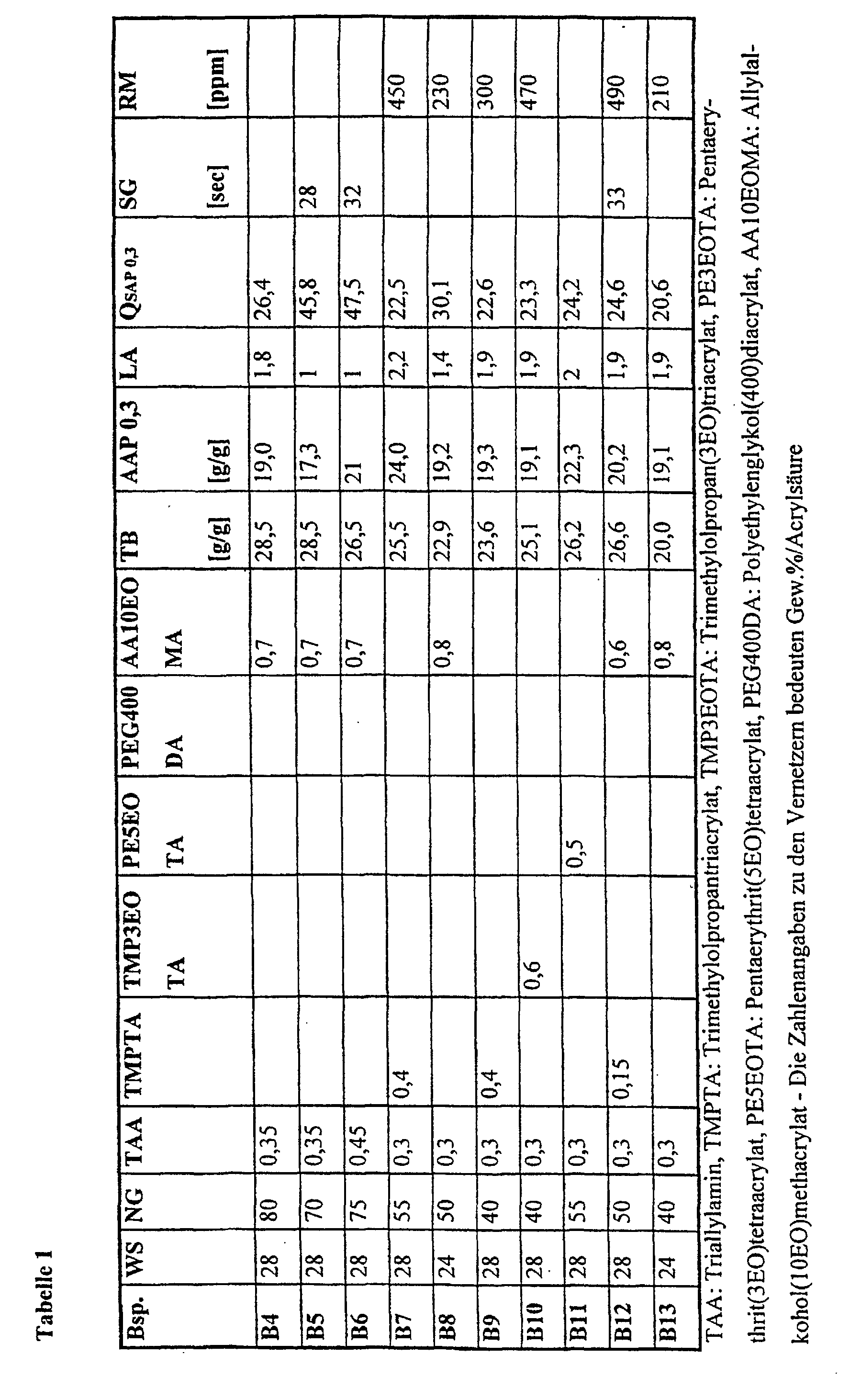
- the absorbers used according to the invention have a retention (TB) of at least 22 g / g, preferably at least 25 g / g and particularly preferably of at least 28 g / g, and an absorption under pressure (AAP 0.3) of advantageously at least 15 g / g, preferably at least 20 g / g and particularly preferably at least 22 g / g and the soluble fractions (LA) are advantageously at most 3.5% by weight, preferably at most 2.5% by weight and particularly preferably at most 1.5 wt.%.
- TB retention
- AAP 0.3 absorption under pressure
- LA soluble fractions
- the inserts produced with the superabsorbent polymers according to the invention have low migration values of mostly less than 15 mg / g, preferably less than 10 mg / g and particularly preferably less than 5 mg / g absorbent pad and protect the foodstuffs from bacterial attack.
- the absorbent insert according to the invention consists of an absorbent core and an envelope.
- the absorbent core contains the superabsorbent according to the invention Polymer particles, which are optionally surrounded by fibers or fabrics, wherein the polymer particles optionally embedded or fixed in the fibers or in the fabric are.
- a layered arrangement of the superabsorbent has also proven advantageous Particles shown within the absorbent core of fibers or fabric, where in the layered arrangement of absorbers often advantageous with different particle sizes or different absorbency can be used to achieve an optimal Achieve absorption and permanent storage of exudates.
- the fibers used preferably have a length to diameter ratio of Greater than or equal to 50.
- the absorbent or non-absorbent natural fiber material or synthetic, crimped or uncrimped staple fibers can be used.
- Suitable fibers include cellulose fibers (e.g. cotton, wood), regenerated fibers (e.g. viscose, rayon) and synthetic fibers e.g. Polyolefins, polyacrylates, polyamides, Polyester, polystyrene).
- Staple fibers made of polypropylene are particularly preferred (PP), polyethylene (PE) and polyethylene terephthalate (PET).
- fibers are in the form of hollow fibers used that can store or pass on liquids in their cavities.
- the fineness of the fibers to be used according to the invention is preferably in the range from 0.005 to 3 den (0.006 to 3.3 dtex) and the length can be between 0.1 and 15 cm, preferred vary between 0.5 and 7.0 cm.
- the fibrous fabrics to be used according to the invention can be made according to all known Processes are made. Carded needle fleece, thermal or fleece fixed by latex and meltblown fleece.
- the fiber content of the insert is preferably in the range from 30 to 300 g / m 2 , particularly preferably between 40 and 100 g / m 2 .
- Fibrous tissues can absorb the liquids separated from the food, both absorption by the fiber material and a suction effect with storage in the interstices between the fibers.
- the characteristics of the superabsorbers to be used according to the invention are not specific to them polymer structures or manufacturing processes bound.
- everyone can use the synthetic or natural superabsorbers that meet the requirements on the quotient from (TB + AAP 0.3) / LA are sufficient and thus the ones according to the invention Give suction pads sufficient functionality.
- the aqueous liquid-absorbent polymer to be used according to the invention can be obtained by polymerizing ethylenically unsaturated monomers bearing acid groups, for example acrylic acid, methacrylic acid, vinyl acetic acid, maleic acid, 2-acrylamido-2-methylpropanesulfonic acid, Vinylsulfonic acid, (meth) allylsulfonic acid or their Mixtures can be obtained in the presence of crosslinkers.
- acid groups for example acrylic acid, methacrylic acid, vinyl acetic acid, maleic acid, 2-acrylamido-2-methylpropanesulfonic acid, Vinylsulfonic acid, (meth) allylsulfonic acid or their Mixtures can be obtained in the presence of crosslinkers.
- the polymers according to the invention can contain further ones in the aqueous monomer solution contain largely soluble comonomers to modify the properties, unless this is contrary to food law provisions.
- comonomers which are common in the production of synthetic superabsorbents can be non-ionic, be anionic or also cationic, for example vinyl pyrrolidone, vinyl acetamide, Hydroxyethyl acrylate, called alkyl amino alkyl (meth) acrylates.
- mixtures of these comonomers can be used.
- Such comonomers should not exceed a proportion of 40% by weight, since they swell the Superabsorbents can possibly impair.
- the proportion of acidic monomers in the monomer mixture is 55-99% by weight.
- the constituents of the crosslinker mixtures are those of the di- and triallylamine type (crosslinker group A) , acrylate and methacrylate esters of polyols (crosslinker group B), in particular esters of polyhydroxy compounds with unsaturated carboxylic acids which, in a preferred embodiment, are alkoxylated.
- crosslinker group A di- and triallylamine type
- crosslinker group B acrylate and methacrylate esters of polyols
- esters of polyhydroxy compounds with unsaturated carboxylic acids which, in a preferred embodiment, are alkoxylated.
- C3-6 polyhydroxy compounds with 2-4 hydroxyl groups are preferred as starting compounds for the synthesis of such crosslinkers, for example trimethylolpropane, glycerol, pentaerythritol, 1,3-propanediol, propylene glycol or 1,4-butanediol.
- ethylene oxide is preferably used.
- Alkoxylated polyhydroxy compounds which have attached at least 1 mol of ethylene oxide, preferably at least 3 mol of ethylene oxide, per mol of polyhydroxy compound are preferably used.
- Further preferred crosslinkers are polyethylene glycol diacrylate or dimethacrylate, which contain polyethylene glycol residues with 3 to 20 EO units.
- Acrylate or methacrylate esters of alkoxylated allyl or methallyl alcohol (crosslinker group C) have also proven to be outstandingly suitable crosslinkers. These crosslinkers preferably contain at least three, particularly preferably 5 to 20, ethylene oxide units between the unsaturated groups.
- the crosslinkers show different crosslinking activities, so that certain adjustments have to be made from case to case.
- a methacrylate ester from an alkoxylated methallyl alcohol reacts better at high degrees of neutralization than at low ones.
- the acrylate or methacrylate ester crosslinkers to be used according to the invention are partially commercially available, e.g. Trimethylolpropane oxyethylate triacrylate from Cray Valley under the designation Sartomer SR 415 (20EO), Craynor 435 (15EO), Sartomer RO 208 (9EO), Sartomer 454 (3EO) or pentaerythritol oxyethylate tetraacrylate under the designation Craynor SR 494 (5EO) and Servocure RTT 192 (5EO) from Servo Delden BV, glycerol ethoxylate triacrylate (5.5EO) under the name Sartomer 921 and glycerol propoxylate triacrylate under the name Sartomer 9021 from Cray Valley and polyethylene glycol 400 diacrylate as Craynor SR 344 or polyethylene glycol 600 dimethacrylate as Craynor SR 252 from Cray Valley.
- crosslinker combination in addition to a crosslinker from the Group A always at least one other crosslinker from the different Crosslinker groups B) and C) must contain.
- a preferred crosslinker combination I) is exposed 0.05 to 0.8% by weight, preferably 0.2 to 0.6% by weight, type A crosslinking agent, 0.05 to 1.4% by weight, preferably 0.1 to 1.0% by weight, type B crosslinker and optional 0 to 0.5% by weight of type C crosslinker together.
- crosslinker combination II is exposed 0.05 to 0.8, preferably 0.3 to 0.8% by weight crosslinker of type A, 0.05 to 1.5% by weight, preferably 0.4 to 0.9% by weight, type C crosslinker and optional 0 to 0.5% by weight of type B crosslinker.
- crosslinking agent The relationship of the crosslinking agents to one another can be achieved without great effort in individual cases a few optimization attempts can be determined.
- the total amount to be used according to the invention crosslinking agent is in the range from 0.7 to 2.0% by weight, preferably 0.9 to 1.5 % By weight based on the monomers used.
- the degree of neutralization of the acidic monomers during the polymerization has a great influence on the properties of the superabsorbers which are formed. Very good properties are obtained if the acidic monomers are neutralized to 15 to 80 mol%, preferably to 30 to 70 mol% and particularly preferably to 40 to 70 mol% and, for example, as the sodium, potassium or ammonium salt or their mixtures are present.
- the neutralization is carried out either by adding alkali or ammonium hydroxides or with the corresponding carbonates or hydrogen carbonates. In some cases it may be more favorable not to use the monomers before the polymerization, or to use them only slightly neutralized and to carry out the final neutralization only after the polymerization.
- the maximum monomer concentration depends on, as in the polymerization process used the heat of polymerization can be removed.
- the monomer concentration can preferably be up to 35 % By weight, but very good product properties are in a range of 23 up to 29% by weight.
- the polymers according to the invention can use water-soluble polymers as a graft base contained in amounts up to 30% by weight. These include partially or fully saponified Polyvinyl alcohols, starch or starch derivatives, cellulose or cellulose derivatives, polyacrylic acids, Polyglycols or mixtures thereof.
- the molecular weights of the graft base added polymers must be adapted to the conditions of the polymerization conditions his. For example, in the case of an aqueous solution polymerization for reasons the viscosity of the polymer solution may be required, only low or medium molecular weight To use polymers, whereas in suspension polymerization this factor is a plays a subordinate role.
- the preferred production of the superabsorbers to be used according to the invention takes place basically according to two methods:
- the partially neutralized acrylic acid is present in aqueous solution the crosslinker according to the invention and, if appropriate, further crosslinkers, comonomers and graft polymers converted into a gel by radical polymerization, which then crushed, dried, ground and optionally post-crosslinked and optionally treated with conditioning agents and sieved to the desired particle size becomes.
- the solution polymerization can be carried out continuously or batchwise become.
- the second method involves the inverse suspension and emulsion polymerization process.
- an aqueous, partially neutralized acrylic acid solution is used of protective colloids and / or emulsifiers in a hydrophobic, organic solvent dispersed and started the polymerization by radical initiators.
- the crosslinker are either dissolved in the monomer solution and metered together with it or separately and possibly added later.
- the addition of if necessary existing polymeric graft bases are carried out via the monomer solution or by direct submission into the oil phase.
- the water Removed azeotropically from the reaction mixture and the polymer product filtered off.
- the addition of the postcrosslinker is often advantageously carried out in the form of a solution in water, organic solvents or their mixtures, especially when low Amounts of post-crosslinking agent are used.
- Suitable mixing units for applying the postcrosslinking agent e.g. Patterson-Kelley mixer, DRAIS turbulence mixer, Lödigem mixer, Ruberg mixer, screw mixer, plate mixer and Fluid bed mixers, as well as continuously operating vertical mixers in which the Powder is mixed at high frequency using a rotating knife (Schugi mixer).
- the postcrosslinker has been mixed with the pre-crosslinked polymer to carry out the post-crosslinking reaction at temperatures of 120 to 250 ° C, preferably heated to 135 to 200 ° C and particularly preferably to 150 to 185 ° C.
- the length of time the reheating is limited by the point at which the desired property profile of the super absorber is destroyed again as a result of heat damage.
- Suitable postcrosslinkers generally contain at least two functional groups. Alcohol, amine, aldehyde, glycidyl and epichlor functions are preferred, with crosslinker molecules with several different functions are also conceivable.
- the post-crosslinking agent is used in an amount of 0.01 to 30 Weight percent, preferably 0.1-10 weight percent, particularly preferably 0.1-1 weight percent based on the polymer to be crosslinked.
- the superabsorbers to be used according to the invention are still described with the person skilled in the art known and conventional conditioning agents, e.g. the static charge or to prevent unwanted agglomeration.
- conditioning agents e.g. the static charge or to prevent unwanted agglomeration.
- this stearates and polyalkylene glycols are still described with the person skilled in the art known and conventional conditioning agents, e.g. the static charge or to prevent unwanted agglomeration.
- the superabsorbent polymers to be used according to the invention are preferably in a particle size range from 10 to 1000 ⁇ m and particularly preferably between 100 and 850 ⁇ m.
- the particles are distributed in the insert and swell to a gel when the liquid is absorbed.
- the proportion of the superabsorbent polymer is 30 to 150% by weight, preferably 50 to 100% by weight, based on the fiber weight.
- the use of 30 to 50 g / m 2 of the superabsorbent polymer according to the invention in a fiber matrix of 60 to 90 g / m 2 has been found to be sufficient to absorb the liquid secretions from foods.
- the outer covering of the insert consists of a lower and an upper perforated film and / or a fleece made of plastic, through which the liquid can penetrate into the absorbent core. It is entirely possible to perform the perforation only on one side of the wrapper, but due to the extremely low migration values of the absorbent pads according to the invention, perforation of the wrapper on the food side is also advantageously possible, since virtually no migrates can get to the food. To improve absorption, it is often also advantageous to design the perforation density from the top and bottom differently. For example, polyethylene, polypropylene, polyamide, polyester and polyvinyl chloride with basis weights of 12 to 25 g / m 2 , preferably 15 to 20 g / m 2, are used as plastics.
- the upper and lower foils are preferably connected to one another at the edges.
- the edges of the wrapping materials are welded to one another, for example under temperature and pressure, or frequently also glued with hot-melt adhesives.
- a mechanical connection can also be considered, for example by sewing the edges of wrappings. Occasionally, adhesive and / or welding and mechanical connections are combined. In any case, however, it is ensured that the powders of the superabsorbent polymers cannot leave the casing and reach the food.
- suction pads can be used if necessary in which the absorbent core consists only of the superabsorbent Polymer exists and contains no other internal fibrous materials.
- suction pads are used as ice substitutes, they preferably exist only from the enveloping film or fleece and the superabsorbers to be used according to the invention. After swelling with water, the documents are frozen and used to cool food instead of ice. In contrast to cooling with Ice does not have condensation here.
- the rectangular or square is preferred, however, for special packaging containers also other, for example round, shapes be used. It is often advantageous to modify the insert in such a way that instead of a continuous uniform, a kind of honeycomb structure is created in which quasi many individual suction pads are side by side. This honeycomb division is particularly advantageous when a relatively large area Suction pad as absorbent component only with super absorber, i.e. without fiber or Fleece components is filled, because it ensures a permanent good distribution of the absorber the area is guaranteed.
- the retention is determined using the teabag method.
- 200 mg of test substance are sealed in a tea bag and immersed in a 0.9% NaCl solution for 30 minutes, drained for 10 minutes and spun in a centrifuge (23 cm diameter, 1400 rpm) for 5 minutes and weighed.
- the residual monomers (RM) are from the filtrate by determining the soluble fractions determined using the HPLC method and evaluated according to the internal standard procedure.
- test liquid is poured over the absorbent pad in a 250 ml screw-top glass jar and stored there for 10 days at room temperature without movement.
- the test liquid can be made from dist. Water, 0.2% or 0.9% saline solution and is used with an excess, based on the absorption capacity of the absorbent pad. This excess is intended to simulate the case where the pad is exposed to a greater amount of liquid than anticipated. Then the test liquid not sucked up by the suction pad is sucked off through a 45 ⁇ filter and examined with regard to the parts migrated from the suction pad. If you use dist. Water as test liquid, the migrated parts result from the dry residue of the extracted water phase.
- a petri dish is loaded with the respective suction pad and a nutrient broth.
- the amount of nutrient broth is such that it is completely absorbed by the absorbent pad becomes.
- incubate at 30 ° C for 48 h in the incubator. to The broth is made visible with triphenyl tetrazolium to show microbial growth chloride (TTC) added (2 drops of 1% TTC solution / 9 ml broth).
- TTC is controlled by the Microbial activity reduced from a colorless solution to a very reddish color and can thus be used as a qualitative measure of microbial activity.
- tea bags with and without superabsorbers are incubated with blood and tissue water (thawing water) from a commercially available soup chicken (frozen).
- the typical thawing water contains approx. 10 4 germs / ml.
- the relative peak heights obtained are related to each other and used as a measure of the microbial activity with regard to the increase in the number of bacteria (depth of the red color) and the areal spread (size of the red-colored area).
- suction pads according to the invention advantageous low migration values in water and aqueous solutions and the antimicrobial Effect. Furthermore, the production of in the suction pads are advantageous Superabsorbers to be used using the special crosslinking combinations described and the favorable combination of properties of retention, absorption shown under pressure and soluble parts.
- the core of the insert made of B + C has the dimensions 76x127 mm, the insert itself measures 89x140 mm and is closed at the edges by a weld.
- the core of the insert made of B + C + D has the dimensions 76x127 mm, the insert itself measures 89x140 mm and is closed at the edge.
- the individual layers were mechanically connected to each other by needling (Needlepunched).
- Superabsorbent polymers to be used in the present invention have been prepared as follows Guide formulation polymerized:
- a polymerization batch totaling 1000 g is prepared in a cylindrical plastic container.
- 280 g of acrylic acid for batches with 28% WS or 240 g of acrylic acid for batches with 24% WS and the crosslinking agents, comonomers and other components used are mixed in deionized water.
- the mixture is partially neutralized with 50% sodium hydroxide solution to the degree of neutralization (NG) given in Table 1.
- NG degree of neutralization
- the solution is cooled to 7-8 ° C. and bubbled with nitrogen until the oxygen content in the monomer solution has dropped to a value of less than 0.2 ppm.
- a superabsorbent is crosslinked with an amount of N, N-methylenebisacryiamide, as is used in the exemplary embodiments of US Pat. No. 4,677,174.
- Such slightly cross-linked absorbers are described in EP 562 846 A1 for use in suction pads for food.
- 280 g of acrylic acid are neutralized to 90% with equimolar amounts of sodium hydroxide solution and ammonium hydroxide and polymerized with 26.5 mg of N, N-methylenebisacrylamide (0.009% by weight on acrylic acid) as the crosslinking component.
- the polymer is poorly cross-linked and has extremely high soluble fractions 74% by weight, which is not acceptable for use in suction pads for food are.
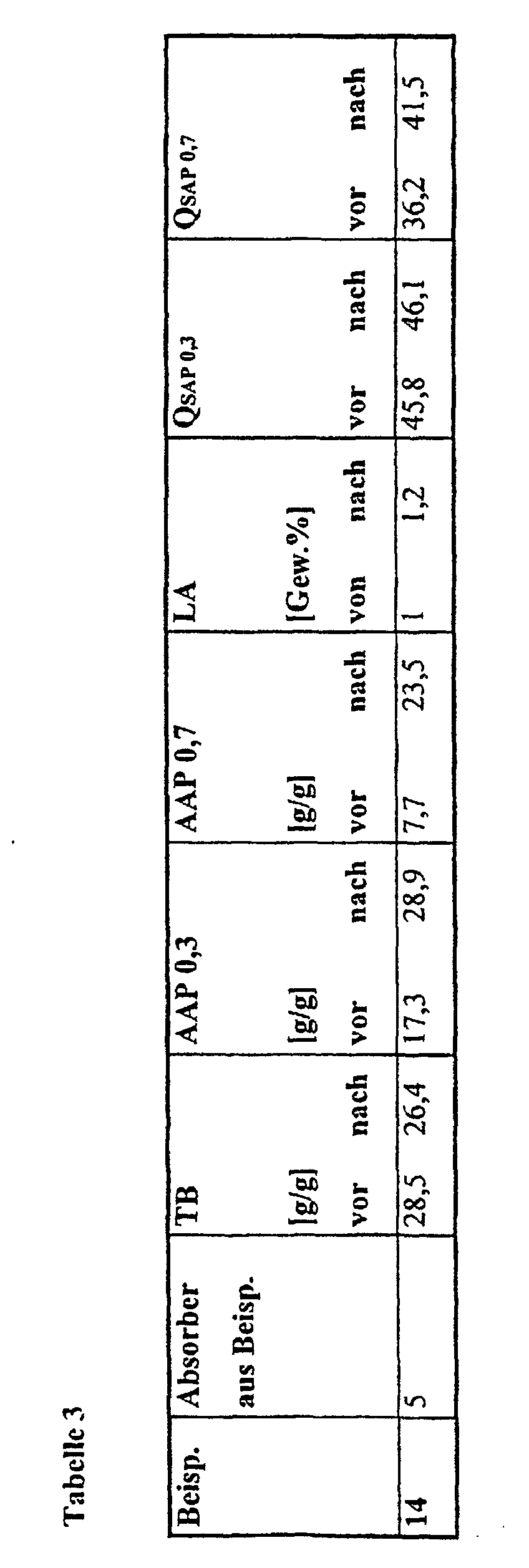
- the inventive superabsorber from example 5 is subjected to a post-crosslinking reaction, as a result of which the properties of the absorber when absorbing liquid under pressure, in particular under high pressure (AAP 0.7), are significantly improved.
- 100 g of the polymer screened to 150 to 800 ⁇ are mixed with vigorous mixing with a solution of 0.5 g ethylene carbonate, 2 g demineralized water and 4 g acetone and then heated in an oven to a temperature of 180 ° C. for 25 minutes.
- Table 3 shows the properties of the superabsorbent before and after the post-crosslinking.
- the improvement in the quotient Q SAP for the crosslinked superabsorbent is unmistakable.
- the absorbent pads filled with such superabsorbers are particularly suitable for the safe packaging of heavy foods.
- a superabsorbent to be used according to the invention is produced with the proviso that with a WS of 28% by weight and a degree of neutralization of 40% for crosslinking 0.3% by weight of triallylamine and 0.5 % By weight of PESEOTA are used and that the resulting polymer is then post-crosslinked according to Example 14 with ethylene carbonate.
- a superabsorbent to be used according to the invention is produced at an AC of 28% by weight and a degree of neutralization of 55% with the proviso that 5% by weight of acrylic acid are exchanged for acrylamidopropanesulfonic acid.
- the absorber is subsequently crosslinked with ethylene carbonate in accordance with the test description for Example 14.
- a superabsorbent to be used according to the invention is produced at an AC of 28% by weight and a degree of neutralization of 55% with the proviso that an additional 1% by weight of partially saponified Mowiol 5/88 polyvinyl alcohol is used as the graft base (Hoechst AG, Germany) is present in the monomer mixture to be polymerized.
- the absorber is subsequently crosslinked with ethylene carbonate in accordance with the test description for Example 14.
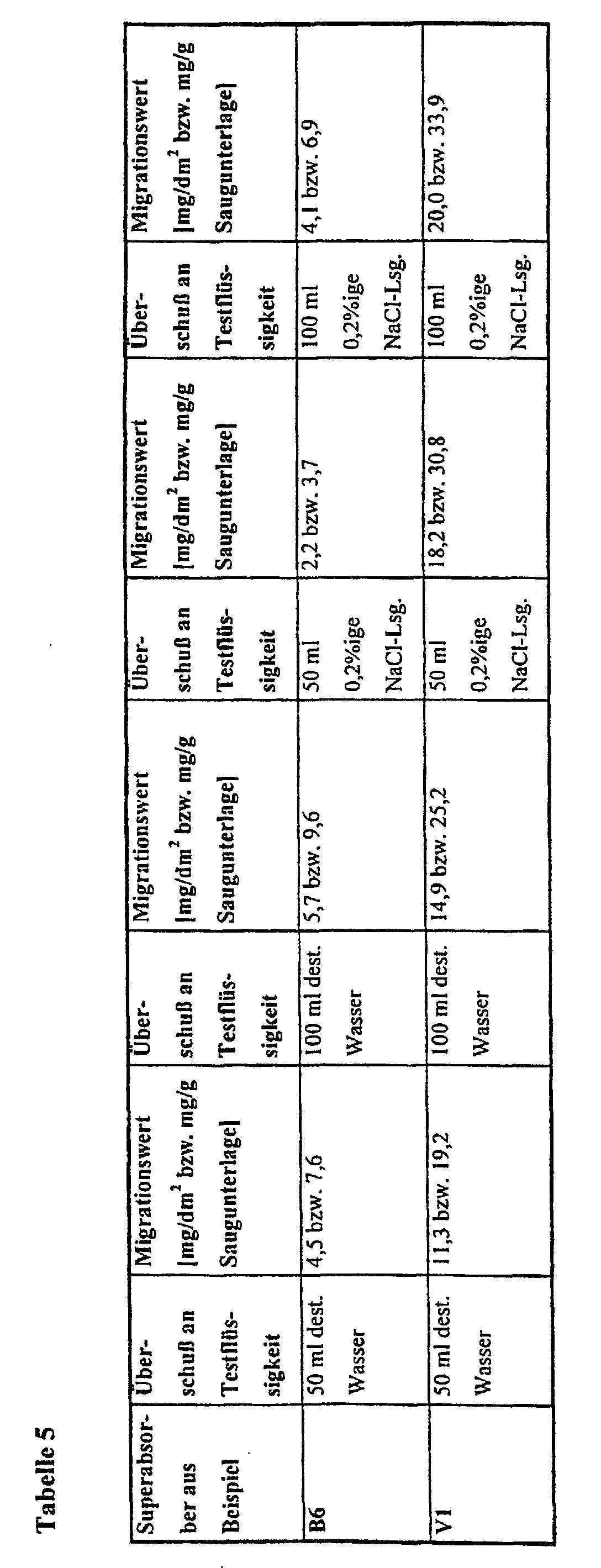
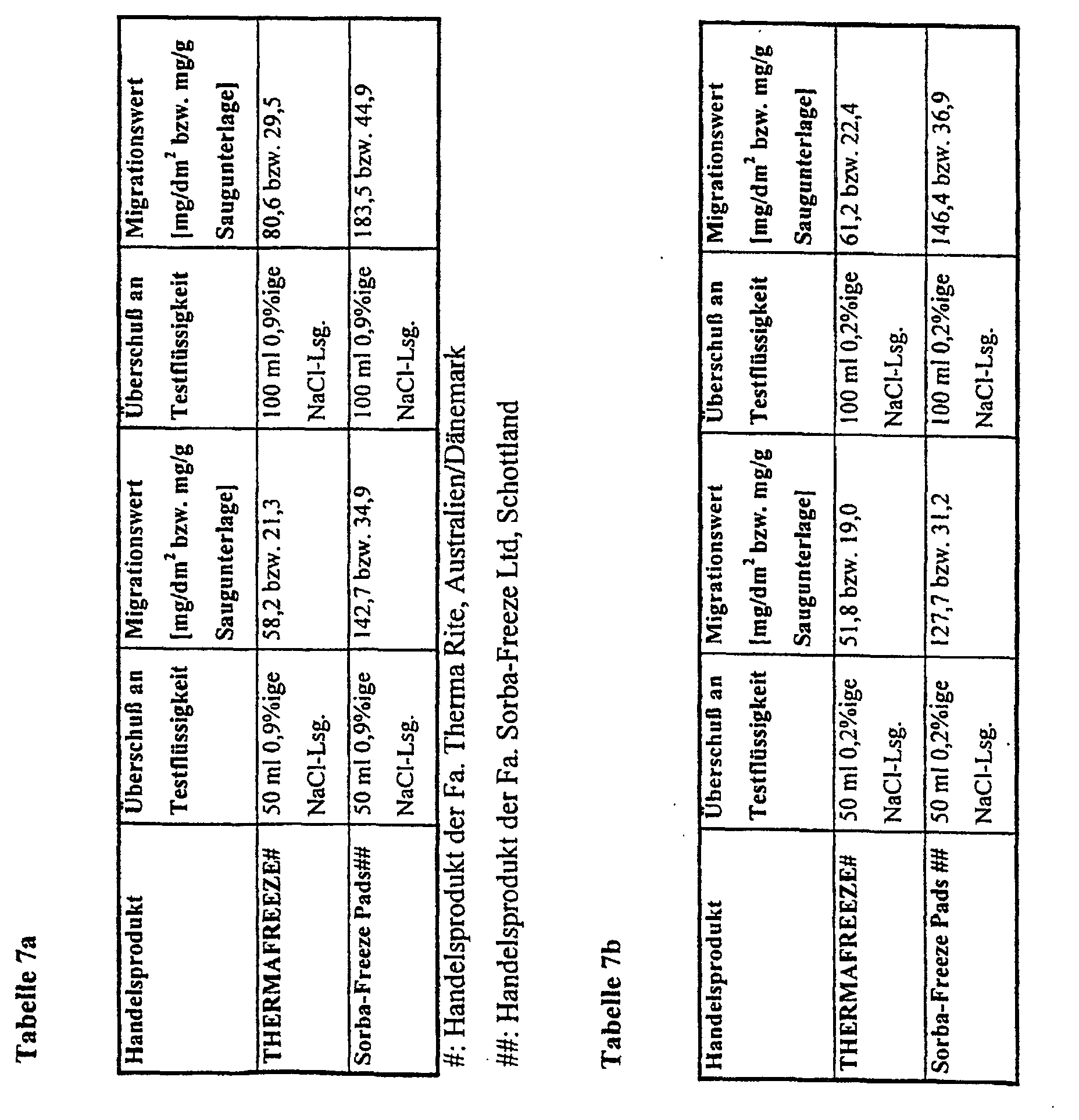
- the results show the superiority of the suction pads according to the invention with regard to the lowest migration values.
- the super absorber contained in the THERMAFREEZE absorbent pad is isolated and its properties are determined.
- TB 24.5 g / g
- AAP 0.3 19.5 g / g
- LA 2.4% by weight
- Q SAP 0.3 18.3.
- the migration values are clearly above the limit value of 15 mg / g and the Q SAP 0.3 of the superabsorber used is below the limit value of 20.
- a non-sterile paper plate (commercially available as a food base) is placed in a sterile petri dish. impregnated with 18 ml sterile caso broth and incubated for 48 h at 30 ° C. Result: Bacteria grow on the paper plate, recognizable by the formation of slime and the intense smell of bacterial decomposition activity.
- Tea bags without and with superabsorbent according to Example 5 were placed in a Petri dish with a diameter of 20 cm and subjected to the conditions specified in the following table under incubation.
- the incubation itself was carried out in an incubator at 37 ° C. for 24 h. There was no additional contamination from germs.
- the measurement of the microbial activity was carried out according to a thin layer chromatographic method in which the indication of the relative peak heights correlated with the bacterial count.
- a non-sterile, superabsorbent (example 6, 0.5 g / dm 2 ) cellulose fleece is impregnated with 18 ml sterile casein soy flour peptone broth (caso broth), to which 4 drops of 1% TTC solution have been added and incubated at 30 ° C for 48 h. Result: Only two red bacterial colonies are visible on the fleece. A change in smell due to bacterial decomposition activity is imperceptible.
- a comparison test with absorber-free cellulose fleece shows bacterial growth, evident from the strong red color of the entire fleece and from an intense smell due to bacterial metabolic activity.
Landscapes
- Chemical & Material Sciences (AREA)
- Chemical Kinetics & Catalysis (AREA)
- Organic Chemistry (AREA)
- Analytical Chemistry (AREA)
- Health & Medical Sciences (AREA)
- Medicinal Chemistry (AREA)
- Polymers & Plastics (AREA)
- Engineering & Computer Science (AREA)
- Food Science & Technology (AREA)
- Mechanical Engineering (AREA)
- Solid-Sorbent Or Filter-Aiding Compositions (AREA)
- Laminated Bodies (AREA)
- Packages (AREA)
- Food Preservation Except Freezing, Refrigeration, And Drying (AREA)
- Absorbent Articles And Supports Therefor (AREA)
- Pharmaceuticals Containing Other Organic And Inorganic Compounds (AREA)
- Materials For Medical Uses (AREA)
- Blow-Moulding Or Thermoforming Of Plastics Or The Like (AREA)
- General Preparation And Processing Of Foods (AREA)
Description
Die mit den erfindungsgemäßen superabsorbierenden Polymeren hergestellten Einlagen weisen niedrige Migrationswerte von zumeist kleiner 15 mg/g, bevorzugt von kleiner 10 mg/g und besonders bevorzugt von kleiner 5 mg/g Saugunterlage auf und schützen die Lebensmittel vor bakteriellem Befall.
0,05 bis 0,8 Gew.%, vorzugsweise 0,2 bis 0,6 Gew.% Vernetzer vom Typ A,
0,05 bis 1,4 Gew.%, vorzugsweise 0,1 bis 1,0 Gew.% Vernetzer Typ B und optional
0 bis 0,5 Gew.% Vernetzer vom Typ C zusammen.
0,05 bis 0,8, vorzugsweise 0,3 bis 0,8 Gew.% Vernetzer vom Typ A,
0,05 bis 1,5 Gew.%, vorzugsweise 0,4 bis 0,9 Gew.% Vernetzer Typ C und optional
0 bis 0,5 Gew.% Vernetzer vom Typ B zusammen.
Sehr gute Eigenschaften erhält man, wenn die sauren Monomeren zu 15 bis 80 Mol.% und bevorzugt zu 30 bis 70 Mol.% und besonders bevorzugt zu 40 bis 70 Mol.% neutralisiert sind und beispielsweise als Natrium-, Kalium- oder Ammoniumsalz bzw. deren Gemische vorliegen. Die Neutralisation wird entweder durch die Zugabe von Alkali- bzw. Ammoniumhydroxyden oder mit den entsprechenden Carbonaten oder Hydrogencarbonaten ausgeführt. In manchen Fällen kann es günstiger sein, die Monomere vor der Polymerisation nicht, oder nur gering neutralisiert einzusetzen und die endgültige Neutralisation erst nach der Polymerisation durchzuführen.
- V2 =
- Verbrauch an HCl bis zum 2. Wendepunkt [ml]
- V1 =
- Verbrauch an HCl bis zum 1, Wendepunkt [ml]
- C =
- Normalität der HCl [Mol/1000 ml
- EW =
- Einwaage Superabsorber [g]
- VF =
- Menge Filtrat [g]
- (*) =
- Äquivalentgewicht wird aus dem Neutralisationsgrad des Superabsorbers berechnet
Die Testflüssigkeit kann aus dest. Wasser, 0,2 %iger oder 0,9%iger Kochsalzlösung bestehen und wird mit einem Überschuß, bezogen auf die Absorptionskapazität der Saugunterlage eingesetzt. Dieser Überschuß soll den Fall simulieren, bei dem die Unterlage einer größeren Flüssigkeitsmenge als vorhergesehen ausgesetzt ist.
Anschließend wird die vom Saugkissen nicht aufgesaugte Testflüssigkeit über ein 45µ-Filter abgesaugt und hinsichtlich der aus der Saugunterlage migrierten Anteile untersucht. Verwendet man dest. Wasser als Testflüssigkeit, so ergeben sich die migrierten Anteile aus dem Trockenrückstand der abgesaugten Wasserphase. Werden dagegen 0,2%ige bzw. 0,9%ige wäßrige Kochsalzlösungen als Testflüssigkeit eingesetzt, so ist von dem Trockenrückstand der Natriumchloridgehalt abzuziehen, um den Migrationswert zu erhalten. Die Ergebnisse werden als mg Migrat pro dm2 oder pro g Saugunterlage angegeben.
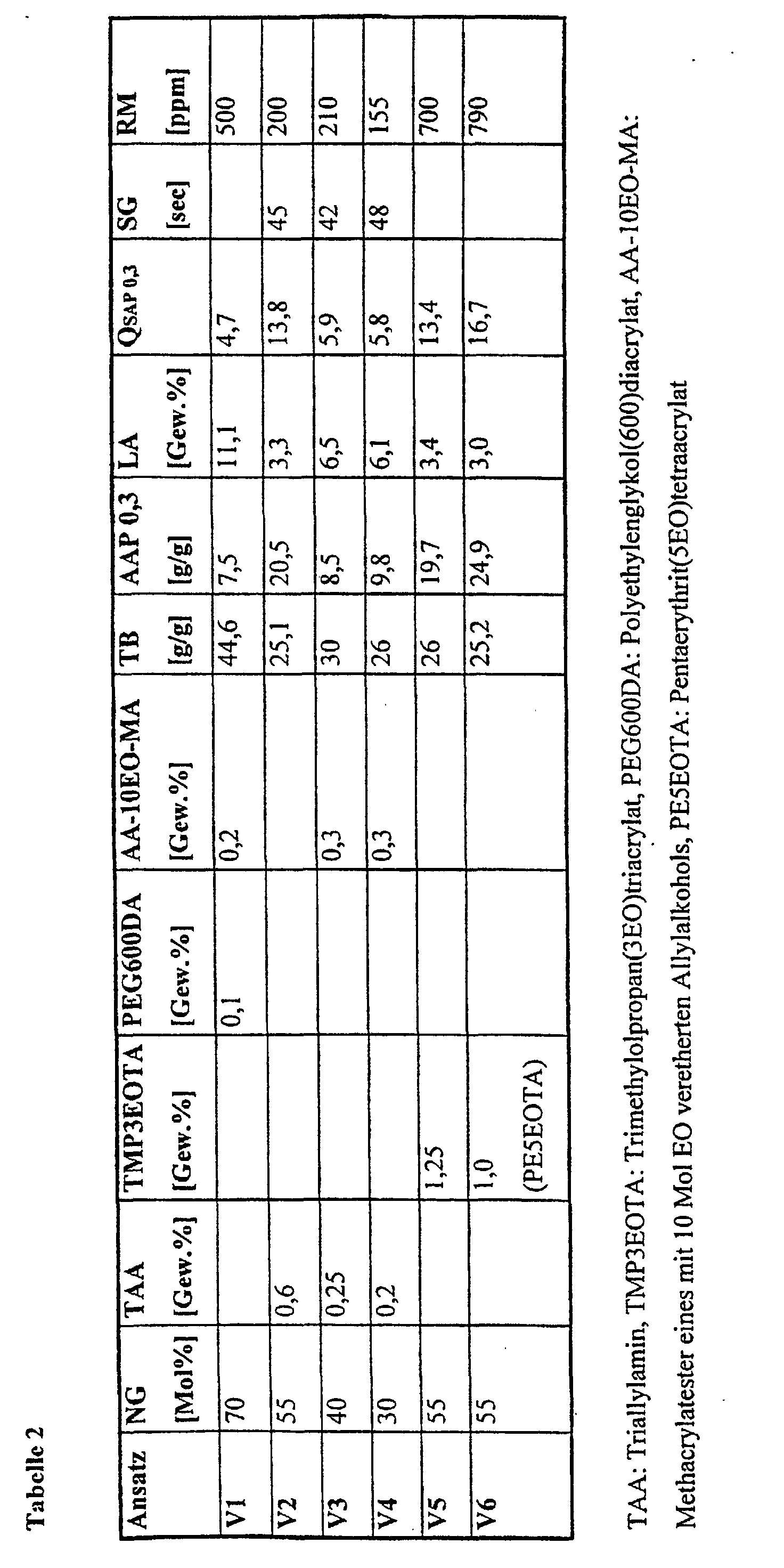
In Anlehnung an den Ablauf des erfindungsgemäßen Beispiels 4 werden 280 g Acrylsäure mit äquimolaren Mengen Natronlauge und Ammoniumhydroxid zu 90% neutralisiert und mit 26,5 mg N,N-Methylenbisacrylamid (0,009 Gew.% auf Acrylsäure) als Vernetzerkomponente polymerisiert.
TB = 24,4 g/g, AAP 0,3 = 26 g/g, AAP 0,7 = 22 g/g, LA = 1,7 Gew.%, QSAP 0,3 = 29,6, QSAP 0,7 = 27,3.
| Vergleich | Absorber | TB [g/g] | AAP 0,3 [g/g] | LA [Gew.%] | QSAP 0,3 | SG [sec] |
| V8 | Sanwet IM 1000 #1 | 49,0 | 7,0 | 5,2 | 10,8 | 31 |
| V9 | Sanwet IM 3900 #2 | 33,5 | 13,0 | 5,1 | 9,1 | 32 |
| V10 | Sanwet IM 5000S #3 | 31,0 | 20,0 | 6,6 | 7,7 | |
| V11 | Salsorb 90P #4 | 26,5 | 24,0 | 8,1 | 5,9 | 22 |
| #1-#3: Superabsorber aus Stärke/Polyacrylat der Fa. Hoechst AG | ||||||
| #4: Superabsorber aus vernetztem Polyacrylat der Fa. Allied Colloids Ltd. |
| Superabsorber aus Beispiel | Menge an Test- flüssigkeit | Migrationswert [mg/dm2 bzw. mg/g Saugunterlage] |
| B6 | 80 ml 0,9%ige NaCl-Lsg. | 9,1 bzw. 15,0 |
| V1 | 80 ml 0,9%ige NaCl-Lsg. | 20,2 bzw. 34,2 |
Messungen in dest. Wasser waren nicht möglich, da die Saugunterlagen durch die gequollenen Absorberteilchen zum Platzen gebracht wurden.
Ergebnis: In der Bouillon wachsen Bakterien und Schimmelpilze, erkennbar an der Trübung der Bouillon und am intensiven Geruch bakterieller Zersetzungstätigkeit.
| Versuch | Inkubation | relative Peakhöhe |
| A | Teebeutel ohne Polymer Zugabe von 5 ml Auftauwasser und Zugabe von 2 Tropfen TTC-Lösung | 5626 |
| B | Teebeutel mit Polymer Zugabe von 5 ml Auftauwasser und Zugabe von 2 Tropfen TTC-Lösung | 745 |
| C | wie B, jedoch ohne Inkubation im Brutschrank, sondern sofortige Messung | 728 |
Claims (22)
- Saugfähige Einlage für Verpackungen bestehend aus einer oberen und einer unteren Deckschicht und einem wäßrige Flüssigkeiten absorbierenden Kern, der absorbierende Polymere enthält, dadurch gekennzeichnet, daß die absorbierenden Polymeren einen Quotient QSAP 0,3 berechnet aus Retention und Absorption unter Druck bei 0,3 psi (21 g/cm2) und aus der Menge an löslichen Anteilen von mindestens 20 und eine Retention von mindestens 22 g/g jeweils gemessen und berechnet nach den in der Beschreibung angegebenen Methoden aufweisen.
- Saugfähige Einlage nach Anspruch 1, dadurch gekennzeichnet, daß die Polymeren einen QSAP 0,3 von mindestens 30, bevorzugt von mindestens 40, aufweisen.
- Absorbierende Einlage nach Ansprüchen 1 oder 2, dadurch gekennzeichnet, daß die absorbierenden Polymere eine Retention von mindestens 25 g/g, bevorzugt von mindestens 28 g/g aufweisen.
- Absorbierende Einlage nach einem der Ansprüche 1 bis 3, dadurch gekennzeichnet, daß die absorbierenden Polymere eine Absorption unter Druck von mindestens 15 g/g, vorzugsweise von mindestens 19 g/g und besonders bevorzugt von mindestens 22 g/g aufweisen.
- Absorbierende Einlage nach einem der Ansprüche 1 bis 4, dadurch gekennzeichnet, daß die löslichen Anteile der absorbierenden Polymeren höchstens 3,5, vorzugsweise höchstens 2,5, besonders bevorzugt höchstens 1,5 Gew.% betragen.
- Absorbierende Einlage nach einem der Ansprüche 1 bis 5, dadurch gekennzeichnet, daß sie Migrationswerte von ≤ 15 mg/g, vorzugsweise ≤ 10 mg/g, besonders bevorzugt ≤ 5 mg/g absorbierender Einlage aufweisen.
- Absorbierende Einlage nach einem der Ansprüche 1 bis 6, dadurch gekennzeichnet, daß die obere und untere Deckschicht aus Kunststoff- oder Zellulosefolien bzw. Geweben oder Vliesen besteht und daß zumindest ein Teil der Deckschichtfolie aufgrund von Perforationen durchlässig für Wasser oder wäßrige Flüssigkeiten ist.
- Absorbierende Einlage nach einem der Ansprüche 1 und 7, dadurch gekennzeichnet, daß der absorbierende Kern aus Vlies, Fasern oder Gewebe besteht, in dem die die wäßrige Flüssigkeiten absorbierenden Polymere verteilt und gegebenenfalls fixiert sind.
- Absorbierende Einlage nach Anspruch 8, dadurch gekennzeichnet, daß der absorbierende Kern eine schichtweise Anordnung der absorbierenden Polymerteilchen innerhalb des Kerns aus Fasern oder Gewebe aufweist.
- Absorbierende Einlage nach Anspruch 8 oder 9, dadurch gekennzeichnet, daß die Fasern Hohlfasern sind.
- Absorbierende Einlage nach einem der Ansprüche 1 bis 10, dadurch gekennzeichnet, daß die absorbierenden Polymeren aus teilneutralisierten, monoethylenisch ungesättigten, Säuregruppen tragenden Monomeren, gegebenenfalls weiteren, damit copolymerisierbaren Monomeren, aus Vernetzern sowie gegebenfalls als Pfropfgrundlage geeigneten Polymeren aufgebaut sind.
- Absorbierende Einlage nach Ansprüchen 1 bis 11, dadurch gekennzeichnet, daß als ungesättigte, Säuregruppen tragende Monomeren Acrylsäure, Methacrylsäure, Vinylessigsäure, Vinylsulfonsäure, Methallylsulfonsäure, Maleinsäure, 2-Acrylamido-2-methylpropansulfonsäure oder deren Gemische eingesetzt worden sind.
- Absorbierende Einlage nach einem der Ansprüche 11 oder 12, dadurch gekennzeichnet, daß die absorbierenden Polymere 0 bis 40 Gew.% weiterer copolymerisierbarer Monomere, vorzugsweise Vinylpyrrolidon, Hydroxyethylacrylat, Vinylacetamid, Alkylaminoalkyl(meth-)acrylate oder deren Gemische enthalten.
- Absorbierende Einlage nach einem der Ansprüche 11 bis 13, dadurch gekennzeichnet, daß die absorbierenden Polymere bis zu 30 Gew.% wasserlöslicher Polymere als Pfropfgrundlage, vorzugsweise Polysaccharide und/oder Polyvinylalkohol enthalten.
- Absorbierende Einlage nach einem der Ansprüche 11 bis 14, dadurch gekennzeichnet, daß die absorbierenden Polymeren unter Einsatz einer Vernetzerkombination aus einem Vernetzer vom Typ A mit wenigstens einem weiteren Vernetzer vom Typ B oder Typ C erhalten worden sind, wobei als Typ A ein Di- und/oder Triallylamin, als Typ B ein (Meth)acrylatester von Polyolen und als Typ C ein (Meth)acrylatester alkoxylierter (Meth)allylalkohole verwendet worden ist.
- Absorbierende Einlage nach Anspruch 15, dadurch gekennzeichnet, daß die absorbierenden Polymeren mit einer Vernetzerkombination hergestellt worden sind, die sich auszusammensetzen, mit der Maßgabe, daß die Gesamtkonzentration der Vernetzer, bezogen auf die eingesetzten Monomeren, 0,7 bis 2,0 Gew.%, vorzugsweise 0,9 bis 1,5 Gew.% beträgt.I 0,05 bis 0,8 Gew.%, vorzugsweise 0,2 bis 0,6 Gew.% Vernetzern vom Typ A,
0,05 bis 1,4 Gew.%, vorzugsweise 0,1 bis 1,0 Gew.% Vernetzern vom Typ B und optional 0 bis 0,5 Gew.% Vernetzern vom Typ C,
oder ausII 0,05 bis 0,8, vorzugsweise 0,3 bis 0,8 Gew.% Vernetzern vom Typ A, 0,05 bis 1,5 Gew.%, vorzugsweise 0,4 bis 0,9 Gew.% Vernetzern vom Typ C und optional 0 bis 0,5 Gew.% Vernetzern vom Typ B, - Absorbierende Einlage nach Anspruch 15 oder 16, dadurch gekennzeichnet, daß die absorbierenden Polymeren mit einer Vernetzerkombination hergestellt worden sind, die sich aus Diallylamin und/oder Triallylamin als Vernetzertyp A, Trimethylolpropan-oxethylat-(meth)acrylsäureester und/oder der Glycerinoxethylat-(meth)acrylsäureester und/oder der Pentaerythrit-oxethylat-(meth)acrylsäureester und/oder Polyethylenglykol-α,ω-di(meth)acrylsäureester als Vernetzertyp B und (Meth)allylpolyethylenglykol-(meth)acrylsäureester als Vernetzertyp C zusammensetzt mit der Maßgabe, daß in der Vernetzerkombination ein Vernetzer vom Typ A mit mindestens einem Vernetzer vom Typ B oder C vorhanden sind.
- Absorbierende Einlage nach einem der Ansprüche 1 bis 17, dadurch gekennzeichnet, daß die absorbierenden Polymeren an der Oberfläche mit einem Nachvernetzer vernetzt worden sind und diese Nachvernetzung gegebenenfalls mehrfach wiederholt worden ist.
- Absorbierende Einlage nach Anspruch 11, dadurch gekennzeichnet, daß die absorbierenden Polymeren an der Oberfläche mit einem Nachvernetzer aus der Gruppe der Polyole, Polyepoxide, Polyamine oder Alkylencarbonate vernetzt worden ist.
- Absorbierende Einlage nach einem der Ansprüche 1 bis 19, dadurch gekennzeichnet, daß sie eine durchgehend einheitliche Struktur oder eine wabenförmige Struktur aufweist.
- Verwendung der absorbierenden Einlage nach einem der Ansprüche 1 bis 20 als Saugunterlage.
- Verwendung der absorbierenden Einlage nach einem der Ansprüche 1 bis 21 in Lebensmittelverpackungen, als Eis-Ersatz oder als Auslaufschutz in Transportverpackungen.
Applications Claiming Priority (5)
| Application Number | Priority Date | Filing Date | Title |
|---|---|---|---|
| DE19627409 | 1996-07-06 | ||
| DE19627409 | 1996-07-06 | ||
| DE19645240A DE19645240A1 (de) | 1996-07-06 | 1996-11-02 | Saugfähige Einlagen, Verfahren zu ihrer Herstellung und ihre Verwendung |
| DE19645240 | 1996-11-02 | ||
| PCT/EP1997/003380 WO1998001299A1 (de) | 1996-07-06 | 1997-06-27 | Saugfähige einlagen, verfahren zu ihrer herstellung und ihre verwendung |
Publications (2)
| Publication Number | Publication Date |
|---|---|
| EP0909237A1 EP0909237A1 (de) | 1999-04-21 |
| EP0909237B1 true EP0909237B1 (de) | 2002-06-12 |
Family
ID=26027300
Family Applications (1)
| Application Number | Title | Priority Date | Filing Date |
|---|---|---|---|
| EP19970930431 Expired - Lifetime EP0909237B1 (de) | 1996-07-06 | 1997-06-27 | Saugfähige einlagen, verfahren zu ihrer herstellung und ihre verwendung |
Country Status (14)
| Country | Link |
|---|---|
| US (3) | US6350710B1 (de) |
| EP (1) | EP0909237B1 (de) |
| JP (1) | JP2000514007A (de) |
| KR (1) | KR20000022356A (de) |
| CN (1) | CN1086633C (de) |
| AT (1) | ATE218972T1 (de) |
| AU (1) | AU721524B2 (de) |
| BR (1) | BR9710220A (de) |
| CA (1) | CA2259476A1 (de) |
| CZ (1) | CZ438598A3 (de) |
| NO (1) | NO990033L (de) |
| PL (1) | PL331001A1 (de) |
| TR (1) | TR199900010T2 (de) |
| WO (1) | WO1998001299A1 (de) |
Families Citing this family (25)
| Publication number | Priority date | Publication date | Assignee | Title |
|---|---|---|---|---|
| US6491993B1 (en) | 1999-08-12 | 2002-12-10 | Pactiv Corporation | Absorbent pouches |
| WO2004037900A1 (de) * | 2002-10-25 | 2004-05-06 | Stockhausen Gmbh | Zweistufiges mischverfahren zur herstellung eines absorbierenden polymers |
| DE10249822A1 (de) * | 2002-10-25 | 2004-05-13 | Stockhausen Gmbh & Co. Kg | Zweistufiges Mischverfahren zur Herstellung eines absorbierenden Polymers |
| US20040243080A1 (en) * | 2003-05-27 | 2004-12-02 | Bba Nonwovens Simpsonville, Inc. | Absorbent pads |
| US20040254551A1 (en) * | 2003-06-11 | 2004-12-16 | Wellman, Inc | [absorbent core structure for hygiene products ] |
| DE10331456A1 (de) * | 2003-07-10 | 2005-02-24 | Basf Ag | (Meth)acrylsäureester alkoxilierter ungesättigter Polyolether und deren Herstellung |
| US7263843B1 (en) * | 2004-04-20 | 2007-09-04 | Mark T. Nordstrom | Display case with improved sanitation |
| US7454596B2 (en) * | 2006-06-29 | 2008-11-18 | Intel Corporation | Method and apparatus for partitioned pipelined fetching of multiple execution threads |
| ATE465188T1 (de) * | 2006-10-19 | 2010-05-15 | Basf Se | Verfahren zur herstellung von superabsorbern |
| JP5627239B2 (ja) * | 2006-12-06 | 2014-11-19 | ビーエーエスエフ ソシエタス・ヨーロピアBasf Se | 懸濁重合による吸水性ポリマー粒子の製造方法 |
| US7863350B2 (en) * | 2007-01-22 | 2011-01-04 | Maxwell Chase Technologies, Llc | Food preservation compositions and methods of use thereof |
| CN102089013B (zh) * | 2008-07-11 | 2014-12-10 | 巴斯夫欧洲公司 | 吸水性聚合物颗粒的表面后交联方法 |
| US8329219B2 (en) * | 2009-12-22 | 2012-12-11 | Cook Biotech Incorporated | Methods for producing ECM-based biomaterials |
| US9332782B2 (en) * | 2010-05-12 | 2016-05-10 | Multisorb Technologies, Inc. | Controlled release of water to an oxygen scavenger |
| US20150017855A1 (en) * | 2013-07-15 | 2015-01-15 | Francisco Guerra | Novel wicking fabric and clothing |
| US20160198727A1 (en) * | 2015-01-08 | 2016-07-14 | Paper-Pak Industries | Absorbent food pad with slow, controlled release of a desired gas |
| WO2017011364A1 (en) | 2015-07-10 | 2017-01-19 | Bleich Noah | Tea display and storage device |
| WO2018132812A1 (en) | 2017-01-16 | 2018-07-19 | Domtar Paper Company, Llc | Disposable ice pack |
| US10882295B2 (en) | 2018-03-09 | 2021-01-05 | Novipax Llc | Absorbent fluff and tissue laminate pads for food packaging |
| US12059877B2 (en) | 2018-06-19 | 2024-08-13 | Board Of Trustees Of Western Michigan University | Expandable and/or disposable ice pack |
| CN109400813B (zh) * | 2018-10-23 | 2021-05-07 | 浙江金晟环保股份有限公司 | 一种应用于冷餐盘的吸血水材料及其制备方法 |
| DE102020131755A1 (de) * | 2020-12-01 | 2022-06-02 | Rkw Se | Verpackungseinlage |
| US20230067242A1 (en) * | 2021-08-27 | 2023-03-02 | Upl Ltd | Process for preparation of superabsorbent polymer |
| TWI896228B (zh) | 2024-07-12 | 2025-09-01 | 臺灣塑膠工業股份有限公司 | 吸水性樹脂、其製造方法及含其之食品包裝材料 |
| TWI897642B (zh) | 2024-09-24 | 2025-09-11 | 臺灣塑膠工業股份有限公司 | 吸水性聚合物、其製造方法及含其食品包裝材料 |
Family Cites Families (46)
| Publication number | Priority date | Publication date | Assignee | Title |
|---|---|---|---|---|
| JPS51125468A (en) | 1975-03-27 | 1976-11-01 | Sanyo Chem Ind Ltd | Method of preparing resins of high water absorbency |
| JPS5259651A (en) | 1975-11-11 | 1977-05-17 | Kao Corp | Absorbent material |
| DE2706135C2 (de) | 1977-02-14 | 1982-10-28 | Chemische Fabrik Stockhausen GmbH, 4150 Krefeld | Verdickungsmittel für ausgeschiedenen Darminhalt und Harn |
| US4131576A (en) | 1977-12-15 | 1978-12-26 | National Starch And Chemical Corporation | Process for the preparation of graft copolymers of a water soluble monomer and polysaccharide employing a two-phase reaction system |
| US4286082A (en) | 1979-04-06 | 1981-08-25 | Nippon Shokubai Kagaku Kogyo & Co., Ltd. | Absorbent resin composition and process for producing same |
| US4449977A (en) | 1979-10-29 | 1984-05-22 | Johnson & Johnson | Absorbent products, processes and compositions |
| US4321997A (en) | 1979-11-23 | 1982-03-30 | Miller Alan H | Receptacle for moisture-exuding food products |
| JPS6025045B2 (ja) | 1980-03-19 | 1985-06-15 | 製鉄化学工業株式会社 | 塩水吸収能のすぐれたアクリル酸重合体の製造方法 |
| DE3034169A1 (de) | 1980-09-11 | 1982-04-15 | Rudolf 6670 St Ingbert Marx | Wasseradsorbierende einlage fuer lebensmittelpackungen |
| DE3034170C2 (de) | 1980-09-11 | 1987-04-09 | Rudolf 6670 St Ingbert Marx | Wasseradsorbierende Einlage für Lebensmittelpackungen |
| US4677174A (en) | 1986-04-21 | 1987-06-30 | American Colloid Company | Water absorbent styrene-acrylic acid copolymers |
| US4548847A (en) | 1984-01-09 | 1985-10-22 | Kimberly-Clark Corporation | Delayed-swelling absorbent systems |
| JPS60163956A (ja) | 1984-02-04 | 1985-08-26 | Arakawa Chem Ind Co Ltd | 吸水性樹脂の製法 |
| USRE32649E (en) * | 1985-06-18 | 1988-04-19 | The Procter & Gamble Company | Hydrogel-forming polymer compositions for use in absorbent structures |
| DE3710574A1 (de) | 1987-03-30 | 1988-10-13 | Jung Willi | Trockenbeutel fuer oel und andere fluessigkeiten |
| DE3713601A1 (de) | 1987-04-23 | 1988-11-10 | Stockhausen Chem Fab Gmbh | Verfahren zur herstellung eines stark wasserabsorbierenden polymerisats |
| GB2207088B (en) * | 1987-06-23 | 1991-08-21 | Brabis Investment Ltd | Process for the manufacture of a liquid absorbing pad |
| US4756939A (en) * | 1987-08-04 | 1988-07-12 | Goodwin Jerry L | Absorbent pad for use in packaging food products |
| DE3854186T2 (de) | 1987-12-10 | 1996-02-29 | Japan Exlan Co. Ltd., Osaka | Wasserabsorbierender Bogen für Nahrungsmittel. |
| US4865855A (en) * | 1988-01-11 | 1989-09-12 | Kimberly-Clark Corporation | Antimicrobial absorbent food pad |
| NZ229745A (en) * | 1988-07-02 | 1992-06-25 | Uni Charm Corp | Cooling pack; liquid-permeable container encloses coolant carrier |
| EP0353334A1 (de) * | 1988-08-05 | 1990-02-07 | Kimberly-Clark Corporation | Struktur zur Absorbierung von Lebensmittelflüssigkeit |
| US5055332A (en) * | 1988-09-19 | 1991-10-08 | Clean-Pak, Inc. | Absorbent pad and method for constructing same |
| US4940621A (en) * | 1988-09-19 | 1990-07-10 | Clean-Pak, Inc. | Absorbent pad and method for constructing same |
| EP0395223A3 (de) | 1989-04-24 | 1992-04-08 | American Colloid Company | Beutel zum Absorbieren von Flüssigkeit |
| US5356678A (en) | 1989-04-24 | 1994-10-18 | American Colloid Company | Pouch for absorbing fluid |
| US5100397A (en) * | 1989-06-14 | 1992-03-31 | Mcneil-Ppc, Inc. | Absorbent mixture |
| US5149335A (en) * | 1990-02-23 | 1992-09-22 | Kimberly-Clark Corporation | Absorbent structure |
| EP0494270A1 (de) * | 1990-07-27 | 1992-07-15 | Royce Ag | Wasserabsorptionssack |
| DE4120319A1 (de) | 1991-06-20 | 1992-12-24 | Hoechst Ag | Recyclebarer schalenfoermiger verpackungsbehaelter mit fluessigkeit-absorbersystem |
| GB9208449D0 (en) * | 1992-04-16 | 1992-06-03 | Dow Deutschland Inc | Crosslinked hydrophilic resins and method of preparation |
| US5256466A (en) | 1992-04-30 | 1993-10-26 | Minnesota Mining And Manufacturing Company | Article for liquid containment and recovery |
| DE4234632B4 (de) | 1992-10-14 | 2004-09-30 | Depron B.V. | Schalenförmiger Verpackungsbehälter, Verfahren zu seiner Herstellung sowie Verwendung desselben |
| DE4244548C2 (de) | 1992-12-30 | 1997-10-02 | Stockhausen Chem Fab Gmbh | Pulverförmige, unter Belastung wäßrige Flüssigkeiten sowie Blut absorbierende Polymere, Verfahren zu ihrer Herstellung und ihre Verwendung in textilen Konstruktionen für die Körperhygiene |
| US5629377A (en) * | 1993-03-10 | 1997-05-13 | The Dow Chemical Company | Water absorbent resin particles of crosslinked carboxyl containing polymers and method of preparation |
| US5447531A (en) * | 1993-03-15 | 1995-09-05 | Hot Springs Thermalsoft, Inc. | Therapeutic heat pack |
| IL110134A (en) * | 1993-07-09 | 1998-07-15 | Stockhausen Chem Fab Gmbh | Polymers capable of absorbing aqueous liquids and body fluids their preparation and use |
| DE4418818C2 (de) | 1993-07-09 | 1997-08-21 | Stockhausen Chem Fab Gmbh | Pulverförmige, vernetzte, wäßrige Flüssigkeiten und/oder Körperflüssigkeiten absorbierende Polymere, Verfahren zu ihrer Herstellung und ihre Anwendung |
| DE4325879C3 (de) | 1993-08-02 | 1999-05-20 | Depron Bv | Folie aus einem thermoplastischen Kunststoffschaum, Verfahren zu ihrer Herstellung sowie ihre Verwendung |
| DE4333056C2 (de) * | 1993-09-29 | 1998-07-02 | Stockhausen Chem Fab Gmbh | Pulverförmige, wäßrige Flüssigkeiten absorbierende Polymere, Verfahren zu ihrer Herstellung und ihre Verwendung als Absorptionsmittel |
| DE4418319C3 (de) | 1994-05-26 | 2001-08-09 | Stockhausen Chem Fab Gmbh | Schichtförmig aufgebauter Körper zur Absorption von Flüssigkeiten sowie seine Herstellung und seine Verwendung |
| DE19505708A1 (de) | 1995-02-20 | 1996-08-22 | Stockhausen Chem Fab Gmbh | Flächenförmige, superabsorbierende Gebilde |
| US5709897A (en) * | 1995-09-12 | 1998-01-20 | Pearlstein; Leonard | Absorbent packaging for food products |
| DE19646484C2 (de) * | 1995-11-21 | 2000-10-19 | Stockhausen Chem Fab Gmbh | Flüssigkeitsabsorbierende Polymere, Verfahren zu deren Herstellung und deren Verwendung |
| WO1997030909A1 (en) * | 1996-02-22 | 1997-08-28 | Sealed Air Corporation | An absorbent pad |
| US5709089A (en) * | 1996-03-04 | 1998-01-20 | Dawson; Gregory D. | Package for cooling containing superabsorbent polymer |
-
1997
- 1997-06-27 AU AU34386/97A patent/AU721524B2/en not_active Ceased
- 1997-06-27 PL PL33100197A patent/PL331001A1/xx unknown
- 1997-06-27 AT AT97930431T patent/ATE218972T1/de not_active IP Right Cessation
- 1997-06-27 CA CA 2259476 patent/CA2259476A1/en not_active Abandoned
- 1997-06-27 US US09/147,476 patent/US6350710B1/en not_active Expired - Lifetime
- 1997-06-27 JP JP50471798A patent/JP2000514007A/ja active Pending
- 1997-06-27 EP EP19970930431 patent/EP0909237B1/de not_active Expired - Lifetime
- 1997-06-27 TR TR1999/00010T patent/TR199900010T2/xx unknown
- 1997-06-27 CN CN97197551A patent/CN1086633C/zh not_active Expired - Fee Related
- 1997-06-27 WO PCT/EP1997/003380 patent/WO1998001299A1/de not_active Ceased
- 1997-06-27 KR KR1019980710784A patent/KR20000022356A/ko not_active Withdrawn
- 1997-06-27 CZ CZ984385A patent/CZ438598A3/cs unknown
- 1997-06-27 BR BR9710220A patent/BR9710220A/pt not_active Application Discontinuation
-
1999
- 1999-01-05 NO NO990033A patent/NO990033L/no not_active Application Discontinuation
-
2001
- 2001-09-25 US US09/961,431 patent/US20020031635A1/en not_active Abandoned
-
2003
- 2003-09-08 US US10/656,179 patent/US20050074614A1/en not_active Abandoned
Also Published As
| Publication number | Publication date |
|---|---|
| WO1998001299A1 (de) | 1998-01-15 |
| NO990033L (no) | 1999-03-05 |
| TR199900010T2 (xx) | 1999-05-21 |
| KR20000022356A (ko) | 2000-04-25 |
| BR9710220A (pt) | 1999-08-10 |
| CN1086633C (zh) | 2002-06-26 |
| NO990033D0 (no) | 1999-01-05 |
| PL331001A1 (en) | 1999-06-21 |
| AU3438697A (en) | 1998-02-02 |
| AU721524B2 (en) | 2000-07-06 |
| CA2259476A1 (en) | 1998-01-15 |
| JP2000514007A (ja) | 2000-10-24 |
| CN1228734A (zh) | 1999-09-15 |
| US6350710B1 (en) | 2002-02-26 |
| US20020031635A1 (en) | 2002-03-14 |
| EP0909237A1 (de) | 1999-04-21 |
| US20050074614A1 (en) | 2005-04-07 |
| ATE218972T1 (de) | 2002-06-15 |
| CZ438598A3 (cs) | 1999-08-11 |
Similar Documents
| Publication | Publication Date | Title |
|---|---|---|
| EP0909237B1 (de) | Saugfähige einlagen, verfahren zu ihrer herstellung und ihre verwendung | |
| DE19646484C2 (de) | Flüssigkeitsabsorbierende Polymere, Verfahren zu deren Herstellung und deren Verwendung | |
| EP0873187B1 (de) | Mit ungesättigten aminoalkoholen vernetzte, wasserquellbare polymerisate, deren herstellung und verwendung | |
| DE4333056C2 (de) | Pulverförmige, wäßrige Flüssigkeiten absorbierende Polymere, Verfahren zu ihrer Herstellung und ihre Verwendung als Absorptionsmittel | |
| DE3875749T2 (de) | Absorbierende zusammensetzung. | |
| DE10043710B4 (de) | Verwendung pulverförmiger an der Oberfläche nachvernetzter Polymerisate und Hygieneartikel | |
| EP0481225B1 (de) | Quellmittel und Wasserabsorptionsmittel auf Polymerbasis und ihre Verwendung zur Herstellung von Hygieneartikeln und zur Bodenverbesserung | |
| EP1357133B1 (de) | Verwendung pulverförmiger, vernetzter, wässrige Flüssigkeiten sowie Blut absorbierender Polymere | |
| EP1425320A1 (de) | Saure hochquellfähige hydrogele | |
| EP1427452A1 (de) | Super-absorbierende hydrogele bestimmter teilchengroessenverteilung | |
| EP1434606A2 (de) | Polymerenmischung von hydrogelen unterschiedlichen ph-wertes | |
| EP1315528A1 (de) | Pulverformige, vernetzte, wässrige flüssigkeiten sowie blut absorbierende polymere | |
| DE69635897T2 (de) | Wasserabsorbierendes harz, absorbierendes material und verfahren zur herstellung derselben | |
| DE19645240A1 (de) | Saugfähige Einlagen, Verfahren zu ihrer Herstellung und ihre Verwendung | |
| DE19813443A1 (de) | Wasser- und wäßrige Flüssigkeiten absorbierende Polymerisatteilchen, Verfahren zu ihrer Herstellung und ihre Verwendung | |
| DE10202839A1 (de) | Hydrogele bestimmter Teilchengrössenverteilung | |
| EP1210129A1 (de) | Wasserabsorbierende polymere mit hohlraumverbindungen | |
| DE69918080T2 (de) | Absorbierende struktur und produkt aus rohmaterialien mit einem hohen erneuerungsgrad | |
| MXPA99000320A (en) | Absorbent inserts, method to produce them and your |
Legal Events
| Date | Code | Title | Description |
|---|---|---|---|
| PUAI | Public reference made under article 153(3) epc to a published international application that has entered the european phase |
Free format text: ORIGINAL CODE: 0009012 |
|
| 17P | Request for examination filed |
Effective date: 19981217 |
|
| AK | Designated contracting states |
Kind code of ref document: A1 Designated state(s): AT BE CH DE DK ES FI FR GB IT LI NL PT SE |
|
| 17Q | First examination report despatched |
Effective date: 19991129 |
|
| GRAG | Despatch of communication of intention to grant |
Free format text: ORIGINAL CODE: EPIDOS AGRA |
|
| GRAG | Despatch of communication of intention to grant |
Free format text: ORIGINAL CODE: EPIDOS AGRA |
|
| GRAH | Despatch of communication of intention to grant a patent |
Free format text: ORIGINAL CODE: EPIDOS IGRA |
|
| GRAH | Despatch of communication of intention to grant a patent |
Free format text: ORIGINAL CODE: EPIDOS IGRA |
|
| GRAA | (expected) grant |
Free format text: ORIGINAL CODE: 0009210 |
|
| AK | Designated contracting states |
Kind code of ref document: B1 Designated state(s): AT BE CH DE DK ES FI FR GB IT LI NL PT SE |
|
| PG25 | Lapsed in a contracting state [announced via postgrant information from national office to epo] |
Ref country code: FI Free format text: LAPSE BECAUSE OF FAILURE TO SUBMIT A TRANSLATION OF THE DESCRIPTION OR TO PAY THE FEE WITHIN THE PRESCRIBED TIME-LIMIT Effective date: 20020612 |
|
| RAP1 | Party data changed (applicant data changed or rights of an application transferred) |
Owner name: STOCKHAUSEN GMBH & CO. KG |
|
| REF | Corresponds to: |
Ref document number: 218972 Country of ref document: AT Date of ref document: 20020615 Kind code of ref document: T |
|
| REG | Reference to a national code |
Ref country code: GB Ref legal event code: FG4D Free format text: NOT ENGLISH |
|
| REG | Reference to a national code |
Ref country code: CH Ref legal event code: EP |
|
| PG25 | Lapsed in a contracting state [announced via postgrant information from national office to epo] |
Ref country code: AT Free format text: LAPSE BECAUSE OF NON-PAYMENT OF DUE FEES Effective date: 20020627 |
|
| PG25 | Lapsed in a contracting state [announced via postgrant information from national office to epo] |
Ref country code: LI Free format text: LAPSE BECAUSE OF NON-PAYMENT OF DUE FEES Effective date: 20020630 Ref country code: CH Free format text: LAPSE BECAUSE OF NON-PAYMENT OF DUE FEES Effective date: 20020630 Ref country code: BE Free format text: LAPSE BECAUSE OF NON-PAYMENT OF DUE FEES Effective date: 20020630 |
|
| REF | Corresponds to: |
Ref document number: 59707510 Country of ref document: DE Date of ref document: 20020718 |
|
| PG25 | Lapsed in a contracting state [announced via postgrant information from national office to epo] |
Ref country code: DK Free format text: LAPSE BECAUSE OF FAILURE TO SUBMIT A TRANSLATION OF THE DESCRIPTION OR TO PAY THE FEE WITHIN THE PRESCRIBED TIME-LIMIT Effective date: 20020912 |
|
| PG25 | Lapsed in a contracting state [announced via postgrant information from national office to epo] |
Ref country code: PT Free format text: LAPSE BECAUSE OF FAILURE TO SUBMIT A TRANSLATION OF THE DESCRIPTION OR TO PAY THE FEE WITHIN THE PRESCRIBED TIME-LIMIT Effective date: 20020916 |
|
| GBT | Gb: translation of ep patent filed (gb section 77(6)(a)/1977) |
Effective date: 20020912 |
|
| ET | Fr: translation filed | ||
| PG25 | Lapsed in a contracting state [announced via postgrant information from national office to epo] |
Ref country code: ES Free format text: LAPSE BECAUSE OF FAILURE TO SUBMIT A TRANSLATION OF THE DESCRIPTION OR TO PAY THE FEE WITHIN THE PRESCRIBED TIME-LIMIT Effective date: 20021220 |
|
| BERE | Be: lapsed |
Owner name: *STOCKHAUSEN G.M.B.H. & CO. K.G. Effective date: 20020630 |
|
| REG | Reference to a national code |
Ref country code: CH Ref legal event code: PL |
|
| PLBE | No opposition filed within time limit |
Free format text: ORIGINAL CODE: 0009261 |
|
| STAA | Information on the status of an ep patent application or granted ep patent |
Free format text: STATUS: NO OPPOSITION FILED WITHIN TIME LIMIT |
|
| 26N | No opposition filed |
Effective date: 20030313 |
|
| PGFP | Annual fee paid to national office [announced via postgrant information from national office to epo] |
Ref country code: FR Payment date: 20050610 Year of fee payment: 9 |
|
| PGFP | Annual fee paid to national office [announced via postgrant information from national office to epo] |
Ref country code: DE Payment date: 20050613 Year of fee payment: 9 |
|
| PGFP | Annual fee paid to national office [announced via postgrant information from national office to epo] |
Ref country code: SE Payment date: 20050614 Year of fee payment: 9 |
|
| PGFP | Annual fee paid to national office [announced via postgrant information from national office to epo] |
Ref country code: NL Payment date: 20050615 Year of fee payment: 9 |
|
| PGFP | Annual fee paid to national office [announced via postgrant information from national office to epo] |
Ref country code: GB Payment date: 20050621 Year of fee payment: 9 |
|
| PG25 | Lapsed in a contracting state [announced via postgrant information from national office to epo] |
Ref country code: GB Free format text: LAPSE BECAUSE OF NON-PAYMENT OF DUE FEES Effective date: 20060627 |
|
| PG25 | Lapsed in a contracting state [announced via postgrant information from national office to epo] |
Ref country code: SE Free format text: LAPSE BECAUSE OF NON-PAYMENT OF DUE FEES Effective date: 20060628 |
|
| PGFP | Annual fee paid to national office [announced via postgrant information from national office to epo] |
Ref country code: IT Payment date: 20060630 Year of fee payment: 10 |
|
| PG25 | Lapsed in a contracting state [announced via postgrant information from national office to epo] |
Ref country code: NL Free format text: LAPSE BECAUSE OF NON-PAYMENT OF DUE FEES Effective date: 20070101 |
|
| PG25 | Lapsed in a contracting state [announced via postgrant information from national office to epo] |
Ref country code: DE Free format text: LAPSE BECAUSE OF NON-PAYMENT OF DUE FEES Effective date: 20070103 |
|
| EUG | Se: european patent has lapsed | ||
| GBPC | Gb: european patent ceased through non-payment of renewal fee |
Effective date: 20060627 |
|
| NLV4 | Nl: lapsed or anulled due to non-payment of the annual fee |
Effective date: 20070101 |
|
| REG | Reference to a national code |
Ref country code: FR Ref legal event code: ST Effective date: 20070228 |
|
| PG25 | Lapsed in a contracting state [announced via postgrant information from national office to epo] |
Ref country code: FR Free format text: LAPSE BECAUSE OF NON-PAYMENT OF DUE FEES Effective date: 20060630 |
|
| PG25 | Lapsed in a contracting state [announced via postgrant information from national office to epo] |
Ref country code: IT Free format text: LAPSE BECAUSE OF NON-PAYMENT OF DUE FEES Effective date: 20070627 |