EP0910099B1 - Revêtements polymère conducteurs - Google Patents
Revêtements polymère conducteurs Download PDFInfo
- Publication number
- EP0910099B1 EP0910099B1 EP98115715A EP98115715A EP0910099B1 EP 0910099 B1 EP0910099 B1 EP 0910099B1 EP 98115715 A EP98115715 A EP 98115715A EP 98115715 A EP98115715 A EP 98115715A EP 0910099 B1 EP0910099 B1 EP 0910099B1
- Authority
- EP
- European Patent Office
- Prior art keywords
- group
- charge transport
- carbon atoms
- substituted
- tpd
- Prior art date
- Legal status (The legal status is an assumption and is not a legal conclusion. Google has not performed a legal analysis and makes no representation as to the accuracy of the status listed.)
- Expired - Lifetime
Links
- 0 C*c1ccccc1 Chemical compound C*c1ccccc1 0.000 description 12
- UEPIYUCDDIRSGY-SREVYHEPSA-N CCC/C(/C)=N\C Chemical compound CCC/C(/C)=N\C UEPIYUCDDIRSGY-SREVYHEPSA-N 0.000 description 1
Classifications
-
- G—PHYSICS
- G03—PHOTOGRAPHY; CINEMATOGRAPHY; ANALOGOUS TECHNIQUES USING WAVES OTHER THAN OPTICAL WAVES; ELECTROGRAPHY; HOLOGRAPHY
- G03G—ELECTROGRAPHY; ELECTROPHOTOGRAPHY; MAGNETOGRAPHY
- G03G15/00—Apparatus for electrographic processes using a charge pattern
- G03G15/06—Apparatus for electrographic processes using a charge pattern for developing
- G03G15/08—Apparatus for electrographic processes using a charge pattern for developing using a solid developer, e.g. powder developer
- G03G15/0806—Apparatus for electrographic processes using a charge pattern for developing using a solid developer, e.g. powder developer on a donor element, e.g. belt, roller
- G03G15/0818—Apparatus for electrographic processes using a charge pattern for developing using a solid developer, e.g. powder developer on a donor element, e.g. belt, roller characterised by the structure of the donor member, e.g. surface properties
-
- G—PHYSICS
- G03—PHOTOGRAPHY; CINEMATOGRAPHY; ANALOGOUS TECHNIQUES USING WAVES OTHER THAN OPTICAL WAVES; ELECTROGRAPHY; HOLOGRAPHY
- G03G—ELECTROGRAPHY; ELECTROPHOTOGRAPHY; MAGNETOGRAPHY
- G03G5/00—Recording-members for original recording by exposure, e.g. to light, to heat or to electrons; Manufacture thereof; Selection of materials therefor
- G03G5/10—Bases for charge-receiving or other layers
-
- H—ELECTRICITY
- H01—ELECTRIC ELEMENTS
- H01B—CABLES; CONDUCTORS; INSULATORS; SELECTION OF MATERIALS FOR THEIR CONDUCTIVE, INSULATING OR DIELECTRIC PROPERTIES
- H01B1/00—Conductors or conductive bodies characterised by the conductive materials; Selection of materials as conductors
- H01B1/06—Conductors or conductive bodies characterised by the conductive materials; Selection of materials as conductors mainly consisting of other non-metallic substances
- H01B1/12—Conductors or conductive bodies characterised by the conductive materials; Selection of materials as conductors mainly consisting of other non-metallic substances organic substances
- H01B1/121—Charge-transfer complexes
-
- H—ELECTRICITY
- H01—ELECTRIC ELEMENTS
- H01G—CAPACITORS; CAPACITORS, RECTIFIERS, DETECTORS, SWITCHING DEVICES, LIGHT-SENSITIVE OR TEMPERATURE-SENSITIVE DEVICES OF THE ELECTROLYTIC TYPE
- H01G11/00—Hybrid capacitors, i.e. capacitors having different positive and negative electrodes; Electric double-layer [EDL] capacitors; Processes for the manufacture thereof or of parts thereof
- H01G11/22—Electrodes
- H01G11/30—Electrodes characterised by their material
- H01G11/48—Conductive polymers
-
- H—ELECTRICITY
- H01—ELECTRIC ELEMENTS
- H01G—CAPACITORS; CAPACITORS, RECTIFIERS, DETECTORS, SWITCHING DEVICES, LIGHT-SENSITIVE OR TEMPERATURE-SENSITIVE DEVICES OF THE ELECTROLYTIC TYPE
- H01G9/00—Electrolytic capacitors, rectifiers, detectors, switching devices, light-sensitive or temperature-sensitive devices; Processes of their manufacture
- H01G9/004—Details
- H01G9/022—Electrolytes; Absorbents
- H01G9/025—Solid electrolytes
- H01G9/028—Organic semiconducting electrolytes, e.g. TCNQ
-
- G—PHYSICS
- G03—PHOTOGRAPHY; CINEMATOGRAPHY; ANALOGOUS TECHNIQUES USING WAVES OTHER THAN OPTICAL WAVES; ELECTROGRAPHY; HOLOGRAPHY
- G03G—ELECTROGRAPHY; ELECTROPHOTOGRAPHY; MAGNETOGRAPHY
- G03G2215/00—Apparatus for electrophotographic processes
- G03G2215/08—Details of powder developing device not concerning the development directly
- G03G2215/0855—Materials and manufacturing of the developing device
- G03G2215/0858—Donor member
- G03G2215/0861—Particular composition or materials
-
- Y—GENERAL TAGGING OF NEW TECHNOLOGICAL DEVELOPMENTS; GENERAL TAGGING OF CROSS-SECTIONAL TECHNOLOGIES SPANNING OVER SEVERAL SECTIONS OF THE IPC; TECHNICAL SUBJECTS COVERED BY FORMER USPC CROSS-REFERENCE ART COLLECTIONS [XRACs] AND DIGESTS
- Y02—TECHNOLOGIES OR APPLICATIONS FOR MITIGATION OR ADAPTATION AGAINST CLIMATE CHANGE
- Y02E—REDUCTION OF GREENHOUSE GAS [GHG] EMISSIONS, RELATED TO ENERGY GENERATION, TRANSMISSION OR DISTRIBUTION
- Y02E60/00—Enabling technologies; Technologies with a potential or indirect contribution to GHG emissions mitigation
- Y02E60/13—Energy storage using capacitors
-
- Y—GENERAL TAGGING OF NEW TECHNOLOGICAL DEVELOPMENTS; GENERAL TAGGING OF CROSS-SECTIONAL TECHNOLOGIES SPANNING OVER SEVERAL SECTIONS OF THE IPC; TECHNICAL SUBJECTS COVERED BY FORMER USPC CROSS-REFERENCE ART COLLECTIONS [XRACs] AND DIGESTS
- Y10—TECHNICAL SUBJECTS COVERED BY FORMER USPC
- Y10S—TECHNICAL SUBJECTS COVERED BY FORMER USPC CROSS-REFERENCE ART COLLECTIONS [XRACs] AND DIGESTS
- Y10S428/00—Stock material or miscellaneous articles
- Y10S428/917—Electroluminescent
Definitions
- JP-A-60131544 discloses an electrophotographic toner comprising a para-substituted oxidized aryl amine compound with a hexafluoroantimonate counter ion, and a polymeric binder resin.
- US-A-5587224 relates to a conductive polymer coating comprising an arylamine, a photo acid catalyst comprising a hexafluoroantimonate salt and a polycarbonate as a polymeric binder.
- the coating is prepared by dissolving the compounds in methylene chloride, followed by a drying step.
- the aryl amine compound can further be para-substituted.
- US-A-3341464 discloses a coating composition
- a coating composition comprising an aryl amine, silver hexafluoroarsenate as an oxidant and PMMA as a polymer binder.
- the aryl amine can further be para-substituted and the coating can be prepared by dissolving the compounds in acetone casting a film on a substrate and drying at 70° C.
- the present invention provides electrically and mechanically stable conductive polymer coatings comprising an arylamine charge transport compound, an oxidized arylamine charge transport compound salt, and a polymer binder.
- the oxidized arylamine charge transport compound salt comprises the oxidation product arising from the self-same arylamine charge transport compound.
- the oxidized arylamine charge transport compound salt is formed from a compound other than the arylamine charge transport compound.
- the oxidized arylamine charge transport compound salt in embodiments, can be formed in situ from the arylamine charge transport compound.
- the oxidized arylamine charge transport compound salt can be formed ex situ from the arylamine charge transport compound or from a different arylamine charge transport compound.
- the oxidized arylamine charge transport compound salt comprises an oxidized form of an arylamine charge transport compound and a counter ion, for example, hexafluoroantimonate and hexafluoroarsenate, which hexafluoro- salts are preferred counter anions.
- a counter ion for example, hexafluoroantimonate and hexafluoroarsenate, which hexafluoro- salts are preferred counter anions.
- arylamine charge transport molecules are para-substituted arylamine charge transport compounds.
- Oxidation of the transport molecule can be accomplished by known chemical oxidizing reagents or can be an oxidation process accomplished, for example, chemically, photochemically, or electrochemically.
- Oxidizing compounds can be, for example, known chemical oxidants including ionic salts, Br ⁇ nsted acids, halogens, Lewis acids, and mixtures thereof.
- Br ⁇ nsted acids include sulfonic acids, phosphoric acids, carboxylic acids, and the like, and mixtures thereof.
- Lewis acids include for example, AlCl 3 , GaCl 3 , SnCl 4 , BF 3 , FeCl 3 , AsF 3 , SnCl 4 , ZrCl 4 , ZnCl 2 , TiCl 4 , AuCl 3 , CuCl 2 , VCl 3 , InCl 3 , TaCl 5 , SbF 5, and the like, and mixtures thereof.
- the oxidant can be a sublimable material, such as, O 2 SbF 6 , O 2 SbF 6 , O 2 AsF 6 , NOSbF 6 , NOAsF 6 , Lewis acids, carboxylic acids, squaric acids, quinones, quinone dimethanes, carbon 60 cage and related fullerane compounds, and mixtures thereof.
- Photo-oxidants include, for example, diphenyliodonium salts and diarylsulfonium salts.
- the conductive coatings of the present invention have conductivities of 10 -12 to 1.0 S/cm, which conductivity is controlled by the concentrations of the oxidant and the charge transport units contained in the coatings.
- the conductive coatings of the present invention using, for example, the aforementioned oxidants exhibited excellent electrical stability compared to conductive coatings prepared with other oxidants and as illustrated herein.
- the conductive polymer coatings, in embodiments of the present invention have electrical conductivities and mechanical stabilities that can be retained or maintained for an extended time, for example, from 8 to 10 weeks at a temperature of, for example, 85 to 100 °C and in a relative humidity of 50 to 100 percent.
- the coating compositions can additionally include optional additives such as an alkaline anti-corrosion additive, and a voltage stabilizing additive.
- alkaline anti-corrosion additive include, heterocyclic compounds with at least one nitrogen heteroatom, metallocene compounds, and mixtures thereof, for example, 2-(4-biphenylyl)-5,6-phenyl oxazole, 1,4-dichlorophthalazine, 1-phenyl pyrazole, di-pyridyl anthracenes, 1-phenyl-imidazole, 3-methyl-1-phenyl-pyrazole, 2,4,6-triphenyl-1,3,5-triazine, 2,6-di-t-butylpyridine, 4,7-diphenyl-1,10-phenanthroline, 2,6-bis(chloromethyl)pyridine, 2,5-diphenyl oxazole, 2,4,6-triphenoxy-1,3,5-triazine, 8-hydroxyquinoline aluminum, ferrocene,
- Examples of voltage stabilizing additives include substituted aromatic hydrocarbons of the formula Ar(X) n wherein Ar is an aryl group with, for example, from 6 to 24 carbon atoms, X is a substituent selected from the group consisting of -H, -F, -Br, -Cl, -I, -NO 2 , -SO 2 -R, wherein R is alkyl group with from 1 to 20 carbon atoms or an aryl group with from 6 to 24 carbon atoms, and n is an integer from 1 to 20, such as known aromatic hydrocarbon compounds, halogenated aromatic compounds, nitro aromatic compounds, sulfone aromatic compounds, cyano aromatic compounds, and mixtures thereof, for example, naphthalene, anthracene, phenanthrene, pyrene, 1,4-dichloronaphthalene, nitroanthracenes, 4,4'-dibromobiphenyl, 4-nitrobiphenyl, cyanobiphenyl, 2-nitro
- Inert polymer binder materials include, but are not limited to solvent processable and melt processable thermoplastics and elastomeric thermoplastics such as polystyrenes, polycarbonates, polyesters, polyimides, polyurethanes, polysulfones, polyethersulfones, polyether ketones, polyamides and their copolymers and polymer blends.
- the polymer binder in embodiments, can be an inert polymer, one or more, for example up to 5, charge transport polymer, and mixtures thereof, and selected in an amount of 30 to 80 weight percent of the total weight of the coating.
- the polymer binder selected is a polymeric charge transport compound examples thereof include polyvinylcarbazoles, polythiophenes, polysilanes, polyanilines, poly(phenylene vinylenes), polyphenylenes, poly(phenylene sulfides), polyanilines, poly(phenylene sulfide phenylenamine), copolymers thereof containing triarylamine charge transport groups, and mixtures thereof.
- the arylamine charge transport compound is a para-substituted arylamine charge transport material, including polymers having para-substituted arylamine charge transport molecules molecularly doped therein, for example, in amounts of from 20 to 70 weight percent based on the total weight of the coating, and charge transport polymers containing para-substituted arylamine groups, that is, covalently bound arylamine groups in a main or pendant polymer chain, and mixtures thereof.
- the charge transport polymers include but are not limited to polyvinylcarbazoles, polythiophenes, polysilanes, polyanilines, poly(phenylene vinylenes), polyphenylenes, poly(phenylene sulfides), polyanilines, poly(phenylene sulfide phenylenamine), and polymers containing arylamine charge transport groups.
- the arylamine charge transport compound is a para-substituted arylamine charge transport material selected from the group of para-substituted arylamine charge transport compounds, molecularly doped polymers having para-substituted arylamine charge transport molecules, charge transport polymers containing para-substituted arylamine groups, and mixtures thereof.
- the arylamine charge transport compound can be of the alternative formulas: wherein Ar, Ar', and Ar" are independently selected from unsubstituted and substituted aromatic groups with from 6 to 30 carbon atoms, for example, phenyl, 3-methylphenyl, 4-methylphenyl, 3,4-dimethylphenyl, 4-ethylphenyl, 4-t-butylphenyl, 4-methoxyphenyl, 4-bromophenyl, 4-chlorophenyl, 3-iodophenyl, 4-flourophenyl, 4-phenylphenyl, 2-naphthyl, 1-naphthyl and mixtures thereof, and R 1 , R 2 , R 3 , R 1 ', R 2 ', and R 3 ' are independently selected from the group consisting of hydrogen, bromine, chlorine, fluorine, alkyl groups with from 1 to 24 carbon atoms, and alkoxy groups with from 1 to 24 carbon atoms, Z is selected from the
- the arylamine charge transport compound can include the following arylamine compounds and mixtures thereof,
- the arylamine charge transport compound can be para-substituted triarylamine compounds with at least one of the para-substituted molecular segments selected from the partial formulas: wherein R 1 is selected from the group consisting of bromine, chlorine, fluorine, alkyl groups with from 1 to 24 carbon atoms, such as methyl, ethyl, butyl, isobutyl, and alkoxy groups with from 1 to 24 carbon atoms, such as methoxy, ethoxy, butoxy, isobutoxy, R 2 and R 3 are independently selected from the group consisting of hydrogen, bromine, chlorine, fluorine, alkyl groups with from 1 to 24 carbon atoms, such as methyl, ethyl, butyl, isobutyl, , and alkoxy groups with from 1 to 24 carbon atoms, such as methoxy, ethoxy, butoxy, isobutoxy, and Z is an atom of O, S, Se, or a methylene substituent
- a preferred charge transport polymer in embodiments, is selected from polymers that contain a para-substituted aryldiamine unit of the formula: wherein R 1 is selected from the group consisting of bromine, chlorine, fluorine, alkyl groups containing from 1 to 24 carbon atoms, such as methyl, ethyl, butyl, isobutyl, and alkoxy groups containing from 1 to 24 carbon atoms, such as methoxy, ethoxy, butoxy, isobutoxy R 2 and R 3 are independently selected from the group consisting of hydrogen, bromine, chlorine, fluorine, alkyl groups containing from 1 to 24 carbon atoms, such as methyl, ethyl, butyl, isobutyl, cyclohexyl, and alkoxy groups containing from 1 to 24 carbon atoms, such as methoxy, ethoxy, butoxy, isobutoxy, G is selected from the group consisting of alkaline groups of 1 to 12 carbon atoms and
- a preferred para-substituted arylamine charge transport compound is of the formula: wherein the oxidized form of the para-substituted arylamine charge transport compound results from photo-oxidation with photo-oxidants such as diphenyliodonium salts and diarylsulfonium salts.
- the present invention provides conductive polymer coatings comprising a para-substituted arylamine charge transport compound, and an oxidization product of the para-substituted arylamine charge transport compound and an oxidizing agent or salt.
- the coating composition can further comprise optional additives, such as, an alkaline anti-corrosion compound, a voltage stabilizing compound, and a polymer binder.
- the coatings provided are useful in various charge transport and electron transport applications and devices, for example, as a thin film electrode or contact modification layer in electroluminescent devices to facilitate charge injection.
- the present invention provides a process for the preparation of a conductive polymer coating comprising:
- the preparative process is preferably accomplished by removing any precipitated particles arising from, for example, the reaction of the oxidant and the arylamine charge transport molecule in the coating mixture, and thereafter dissolving a polymer binder and optional additives in the coating solution to provide a coating solution that is free of particulate matter.
- the coatings can have a thickness of, for example, from 0.01 cm to 0.5 cm, and conductivities of from 10 -12 to 100.0 S/cm and which conductivity is highly stable over a broad relative humidity range of from 0 to 100 percent.
- the improved conductivity stability is maintained, for example, from 60 to 90 days, at substantially higher temperatures, and at higher humidity values compared to control materials and as illustrated herein.
- the improved conductivity and humidity stability performance represent a stability improvements, for example, from 4 to 8 fold.
- the preparative process can be accomplished by mixing the components of the composition in an extruder for achieving uniform mixing and dispersion followed by a coating step as illustrated herein.
- TM-TPD Both m-TPD and p-TPD are commercially available from H.W. Sands Corp. as Catalogue Nos. ST16/1 and ST16/3, respectively.
- the synthesis of TM-TPD is given in Example I.
- p-DE-TPD was also analogously prepared according to the procedure given in Example 1.
- Silver trifluoroacetate (AgTFA), iodine (I 2 ), bis(p-t-butylphenyl)iodonium hexafluoroarsenate, hereinafter referred to as photoacid, silver hexafluoroantimonate (AgSbF 6 ), nitrosonium hexafluoroantimonate (NOSbF 6 ) were used as oxidants.
- Polymer binders include MAKROLON® a polyester commercially available from Bayer Corp. and PCZ-200 a polycarbonate derived from bisphenol Z, and is commercially available from Mitsubishi Chemical Corp.
- TM-TPD N, N, N', N'-tetra-p-tolyl-biphenyldiamine
- the obtained wet crystals were ground with a mortar and pestle, filtered, washed with hexanes (100 mL), and dried in air for 24 hours to give brown crystals (360 g, 6 mol).
- the filtrate was concentrated under reduced pressure and recrystallized from the mixture of toluene (20 mL) and hexanes (150 mL) to give a brown solid (120 g, second crop).
- the combined solid was distilled at 165 oC and 1 Torr to give a white solid (445 g) while the forerun first portion (15 g, distilled at 65-80 °C and 1 Torr) was discarded.
- TM-TPD N, N, N', N'-tetra-p-tolyl-(1,1'-biphenyl)-4,4'-diamine
- This example describes the preparation of coating solution with different compositions.
- m-TPD (32.0 g) and methylene chloride (544 g) were magnetically stirred in a 500 mL bottle until complete solubilization of m-TPD.
- AgSbF 6 in an amount of 1.6 g, 0.5 weight percent with respect to m-TPD as then added.
- the resulting solution was stirred for 16 hours and the resulting solution was allowed to stand for at least two hours to settle the silver precipitate and used as the stock solution. Alternatively, the silver precipitate can be removed by filtration.
- the same stock solution was used to formulate another coating solution as follow: Into a 2 ounce bottle was added a portion of the stock solution (72.0 g), MAKROLON 5705 (7.5 g) and 2-(4-biphenylyl)-5-phenyloxazole (0.12 g) as a anticorrosion additive, and the mixture was shaken for 5 hour to dissolve the MAKROLON and to give a coating solution with the following solid weight percents: MAKROLON (65%), m-TPD (35%), AgSbF 6 in an amount of 5 weight percent with respect to m-TPD, and 2-(4-biphenylyl)-5-phenyloxazole in an amount of 3 weight percent with respect m-TPD.
- m-TPD (16.0 g) and chlorobenzene (229 g) were magnetically stirred in a 250 mL bottle until complete solubilization of m-TPD.
- AgSbF 6 in an amount of 0.8 g, 0.5 weight percent with respect to m-TPD, was added.
- the resulting solution was stirred 16 hours.
- the resulting solution was allowed to stand for at least two hours to settle the silver precipitate and used as the stock solution.
- Coating solutions using other charge transport molecules, polymer binders, solvents, and/or anticorrossion additives at different weight percents were similarly prepared.
- m-TPD 4.0 g
- MAKROLON 3108 7.44 g
- photoacid 0.08 g, 2 weight percent with respect to m-TPD
- polyester PE 200 from DuPont (0.074 g, as the voltage stabilizer)
- methylene chloride 68 g
- the mixture was shaken for 20 hours to give a coating solution with the following solid weight percents: m-TPD (35%), MAKROLON 3108 (65%), photoacid (2%), and PE 200 (in an amount of 1 weight percent with respect to MAKROLON).
- m-TPD 4.0 g
- MAKROLON 3108 7.44 g
- photoacid 0.08 g, 2 weight percent with respect to m-TPD
- polysiloxane fluid 0.074 g, as a low surface energy additive
- methylene chloride 68 g
- the mixture was shaken for 20 hours to give a coating solution with the following solid weight percents: m-TPD (35%), MAKROLON 3108 (65%), photoacid (2%), polysiloxane fluid (in an amount of 1 weight percent with respect to MAKROLON).
- MYLAR (75 microns) substrates with titanium coatings of about 200 to 300 Angstroms were from ICI Inc. Substrates were overcoated with a silane blocking layer (200 to 500 Angstroms derived from 2-aminoisopropyltriethoxylsilane) and then an adhesive layer (200 to 500 Angstroms) of 49K polyester (from DuPont). The resulting substrates were used for depositing the conductive coatings using a Gardner mechanical driven film applicator which is enclosed in a plexiglass box. A substrate was placed on the vacuum plate of the Gardner coater and a size 0.004 Bird film applicator was placed on top of the substrate then coated with a conductive polymer layer using a coating solution prepared as described in Example II.
- the resulting coating was air dried for 1 hour and then dried in a forced air oven at 125 °C for 30 min to give a coating with a thickness of about 20-25 microns.
- UV exposure for 99 seconds was needed to induce the conductivity in the coatings.
- the charge relaxation time constants for samples 1 through 8 increase at least by a factor of 3 with respect to their respective initial values after 1 week of stress test. This indicates that the coatings have less than I week of stability and become at least 3 time less conductive.
- Sample 9 using AgAsF 6 shows 1 week of stability, but becomes 5 time more insulative after 2 weeks.
- Samples 10 through 13 using AgSbF 6 or NOSbF 6 as the oxidant show only small change in the charge relaxation time constant indicating very high stability in the conductivity.
- the stability of the AgSbF 6 based coatings is highly reproducible as exemplified by the data for samples 11 a and 12a which were coated from coating solutions that had been aged two-months.
- samples 16 and 16a having TM-TPD as the charge transport molecules show improved stability over the m-TPD based sample 15 by a factor of about 2.
- This example illustrates that coatings resulting from para-substituted charge transport molecule such as TM-TPD show improved stability over non-para-substituted charge transport molecule such as m-TPD.
- sample 21 which has the highest TM-TPD percentage is the most stable of the three samples; while sample 23 which has the lowest TM-TPD percentage is the least stable.
- Sample NO. Charge transport molecule(35%)/MAKROLON (65%)/oxidant (2%) AgSbF 6 (2%) Charge relaxation time constant (millisecond) As coated 1 wk 2 wk 3 wk 4 wk 5 wk 6 wk 7 wk 8wk 15 m-TPD/AgSbF 6 0.41 0.37 0.39 0.48 0.57 0.78 0.98 1.56 1.78 16 TM-TPD/AgSbF 6 (coating dry at 100 °C) 0.14 0.16 0.17 0.19 0.18 0.18 0.26 0.25 0.28 16a TM-TPD/AgSbF 6 (coating dry at 125°C) 0.19 0.22 0.22 0.26 0.25 0.24 0.29 0.31 0.27 17 m-TPD/photoacid 0.29
Landscapes
- Engineering & Computer Science (AREA)
- Chemical & Material Sciences (AREA)
- Power Engineering (AREA)
- Chemical Kinetics & Catalysis (AREA)
- Electrochemistry (AREA)
- Physics & Mathematics (AREA)
- Microelectronics & Electronic Packaging (AREA)
- General Physics & Mathematics (AREA)
- Materials Engineering (AREA)
- Spectroscopy & Molecular Physics (AREA)
- Paints Or Removers (AREA)
- Macromolecular Compounds Obtained By Forming Nitrogen-Containing Linkages In General (AREA)
Claims (7)
- Revêtement polymère conducteur comprenant un composé transportant des charges de type arylamine, un sel de composé transportant des charges de type arylamine oxydée, et un liant polymère, dans lequel le sel de composé transportant des charges de type arylamine oxydée a un anion opposé choisi dans le groupe constitué par les ions hexafluoroantimoniate et hexafluoroarséniate,
dans lequel le composé transportant des charges de type arylamine est un materiau transportant des charges de type arylamine para-substituée,
dans lequel le sel de composé transportant des charges de type arylamine oxydée comprend un produit d'oxydation dudit composé transportant des charges de type arylamine et d'un composé oxydant, dans lequel le composé oxydant est choisi dans le groupe comprenant des sels ioniques, et
dans lequel le sel ionique est choisi dans le groupe constitué par :AgSbF6, AgAsF6, AgPF6, AgBF4, AgBr, AgI, AgF, AgCl, O2SbF6, O2AsF6, NOSbF6, NOAsF6, NO2SbF6, NO2AsF6, (CH3CH2)O+(CF3SO3)Al-, (CH3CH2)O+(CF3SO3)Ga-, (CH3CH2)O+(CF3SO3)B-, CH3(C=O)+(CF3SO3)Al-, et des mélanges de ceux-ci. - Revêtement polymère conducteur selon la revendication 1, dans lequel le composé transportant des charges de type arylamine est choisi dans le groupe constitué par ceux représentés par les formules :dans lesquelles Ar, Ar', et Ar'' sont indépendamment choisis parmi des groupes aromatiques non substitués et substitués comportant, de 6 à 30 atomes de carbone, et R1, R2, R3, R1',
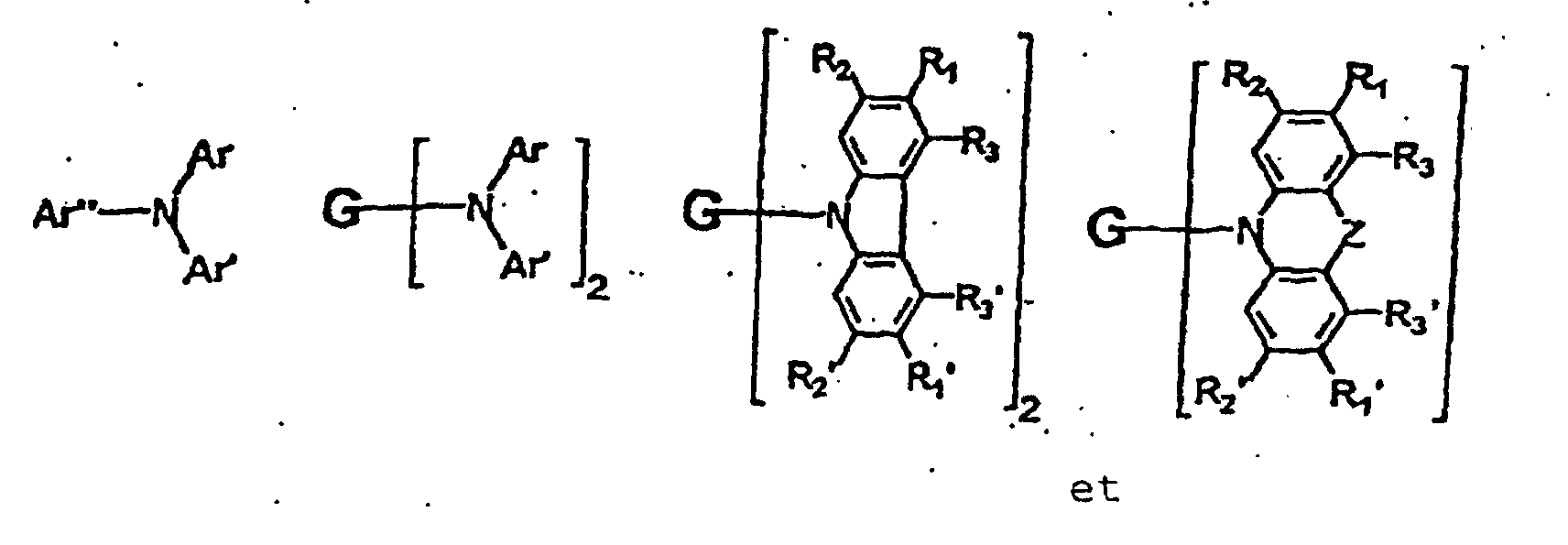
R2' et R3' sont indépendamment choisis dans le groupe constitué par des atomes d'hydrogène, de brome, de chlore, de fluor, des groupes alkyle comportant de 1 à 24 atomes de carbone et des groupes alcoxy comportant de 1 à 24 atomes de carbone, Z est choisi parmi les atomes 0, S, Se, ou le substituant -CH2-, G représente un groupe alcalin comportant 1 à 12 atomes de carbone ou un groupe choisi parmi ceux répondant aux formules partielles :
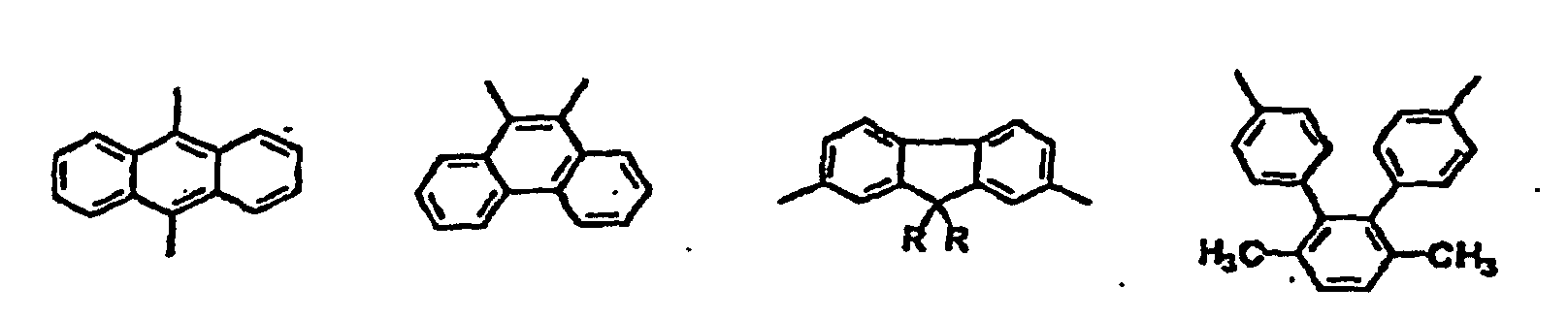


 dans lesquelles n' représente un nombre entier de 1 à 12, et R et R' représentent des groupes alkyle comportant 1 à 12 atomes de carbone.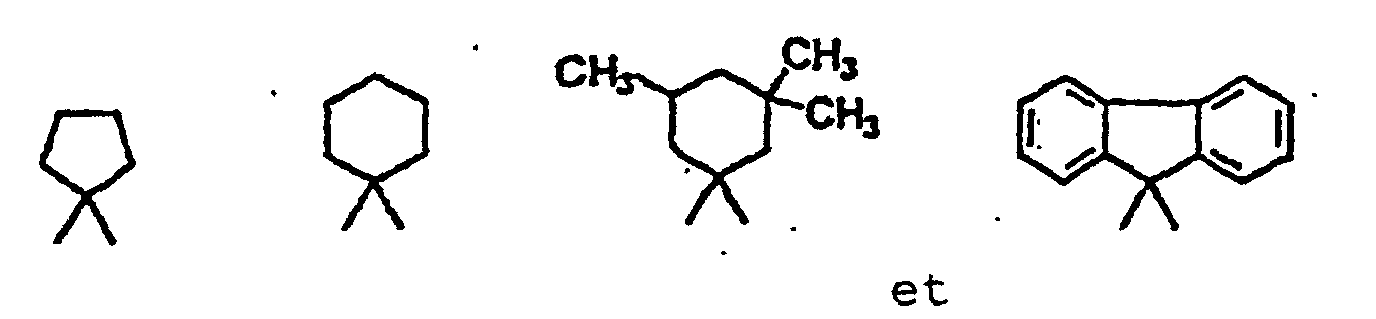
- Revêtement polymère conducteur selon la revendication 1, dans lequel le composé transportant des charges de type arylamine est choisi parmi ceux répondant aux formules suivantes, et des mélanges de ceux-ci :a) des composés de type aryldiamine répondant aux formules :
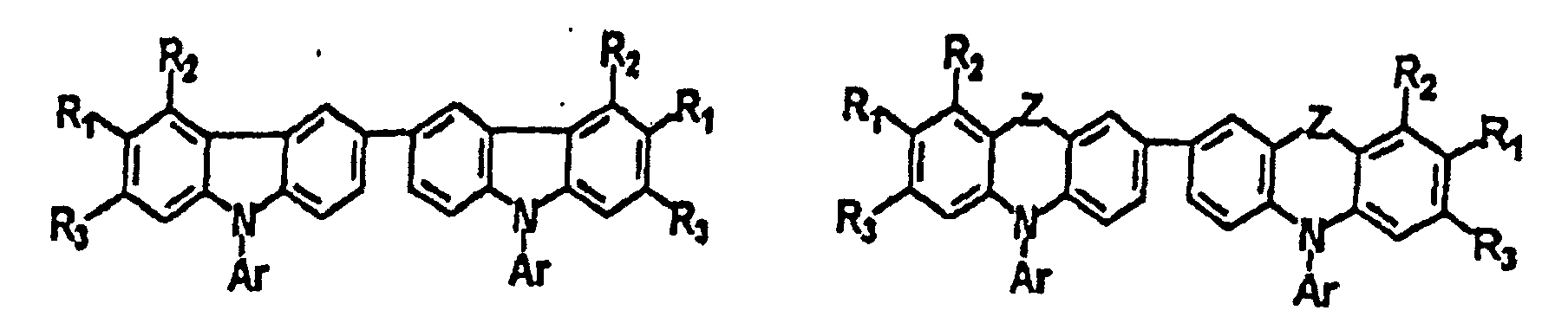 et
et dans lesquelles Ar représente un groupe aromatique substitué ou non substitué, R1, R2 et R3 sont indépendamment choisis dans le groupe constitué par des atomes d'hydrogène, de brome, de chlore, de fluor, des groupes alkyle comportant de 1 à 24 atomes de carbone et des groupes alcoxy comportant de 1 à 24 atomes de carbone, et Z est choisi parmi les atomes O, S, Se, ou le substituant méthylène -CH2- ;
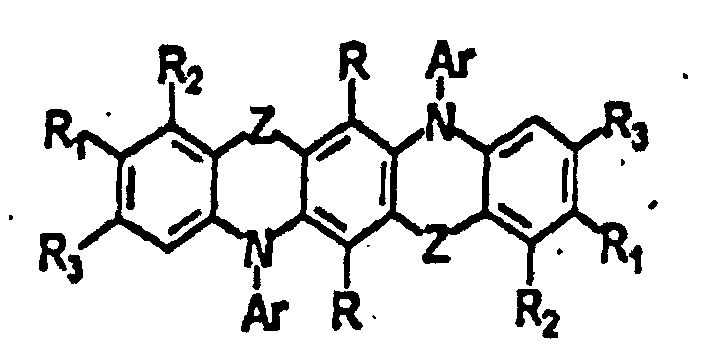 b) des composés de type aryltriamine répondant aux formules :
 dans lesquelles Ar et Ar' sont indépendamment choisis parmi des groupes aromatiques substitués et non substitués, R est choisi parmi un atome d'hydrogène, un groupe phényle et des groupes alkyle comportant 1 à 12 atomes de carbone, et dans lesquelles i et j représentent des nombres entiers de 1 à 2 ;
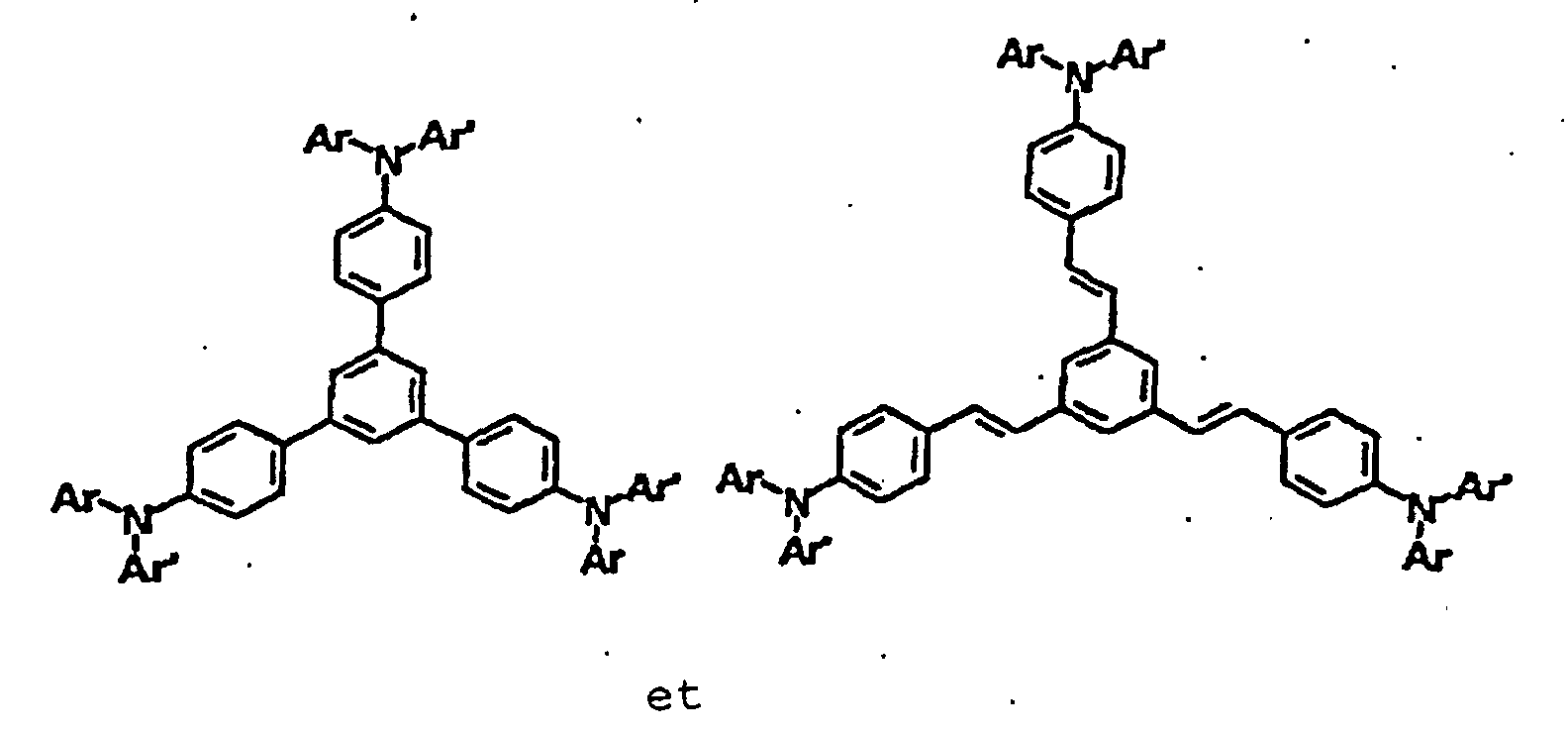 c) des composés de type aryltétraamine répondant aux formules :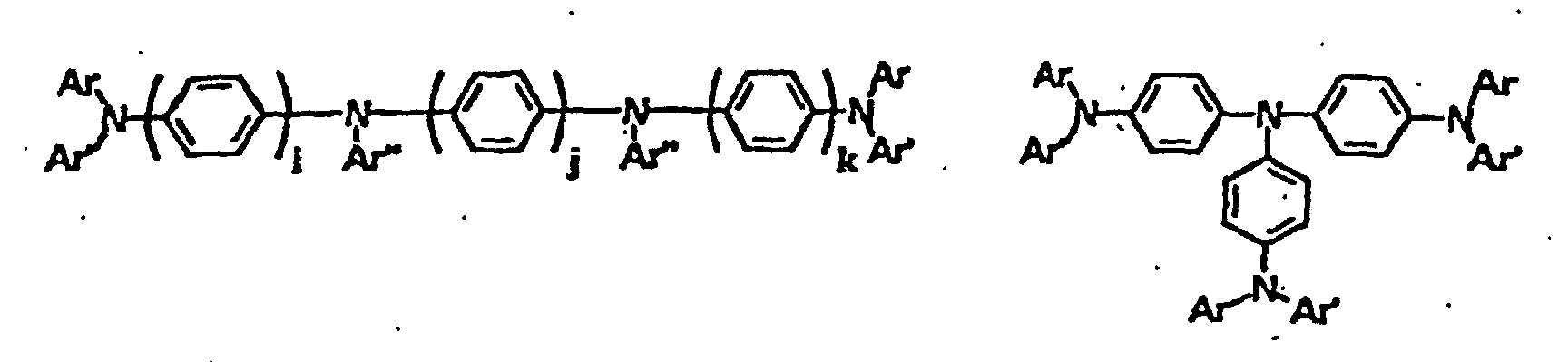
 dans lesquelles Ar, Ar', et Ar'' sont indépendamment choisis parmi des groupes aromatiques substitués et non substitués, p-Ar et p-Ar' sont indépendamment choisis parmi des groupes aromatiques para-substitués, R est choisi parmi un atome d'hydrogène, un groupe phényle et des groupes alkyle comportant 1 à 12 atomes de carbone, i, j et k représentent des nombres entiers de 1 ou 2, G représente un groupe alcalin comportant 1 à 12 atomes de carbone ou un groupe choisi parmi ceux répondant aux formules partielles :




 dans lesquelles n' représente un nombre entier de 1 à 12, et R et R' représentent des groupes alkyle comportant 1 à 12 atomes de carbone ;
 d) des composés de type arylpentaamine répondant à la formule :dans laquelle Ar, Ar', Ar'', et Ar''' sont indépendamment choisis parmi des groupes aromatiques substitués et non substitués, et i, j, k et l représentent des nombres entiers de 1 ou 2 ; et
 e) des composés de type arylhexaamine répondant aux formules :
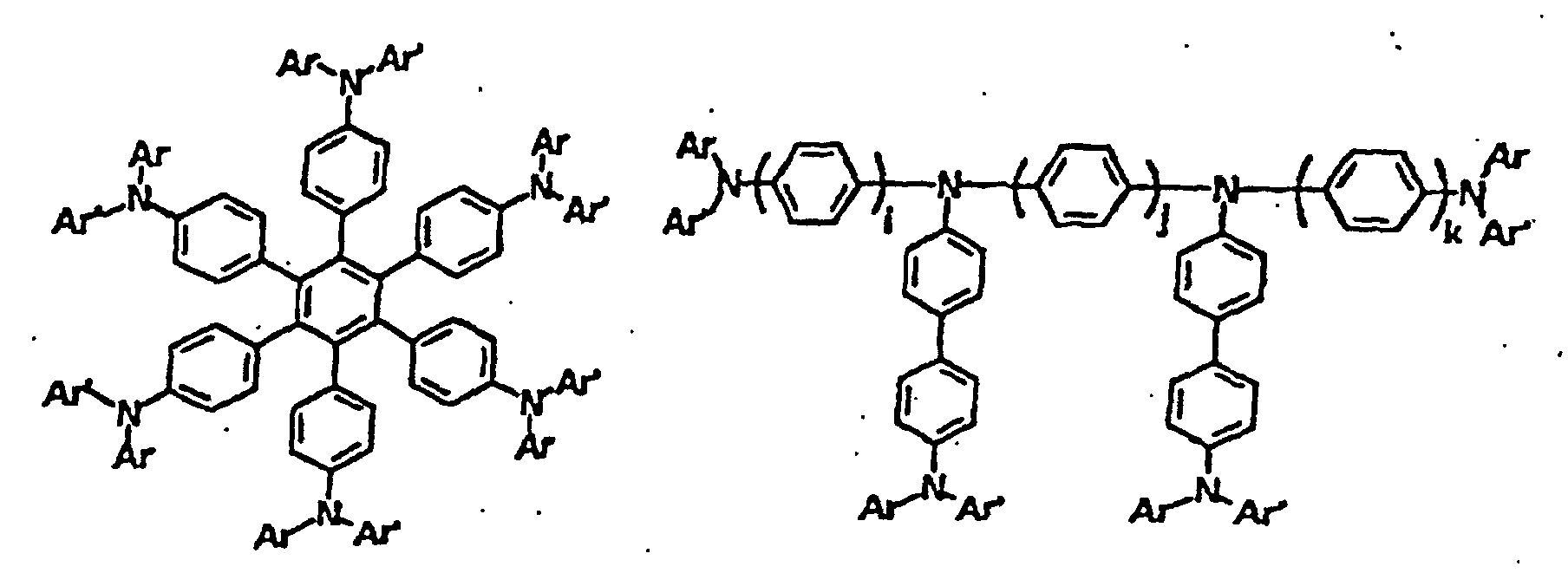 dans lesquelles Ar et Ar' sont indépendamment choisis parmi des groupes aromatiques substitués et non substitués, p-Ar et p-Ar' représentent des groupes aromatiques para-substitués, i, j et k représentent des nombres entiers de 1 ou 2, G représente un groupe alcalin comportant 1 à 12 atomes de carbone ou un groupe aromatique choisi parmi ceux répondant aux formules :




 dans lesquelles n' représente un nombre entier de 1 à 12, et R et R' représentent des groupes alkyle comportant 1 à 12 atomes de carbone.
- Revêtement polymère conducteur comprenant un composé transportant des charges de type arylamine para-substituée et un produit d'oxydation du composé transportant des charges de type arylamine para-substituée et d'un composé oxydant, dans lequel le composé oxydant est choisi dans le groupe comprenant des sels ioniques, et
dans lequel le sel ionique est choisi dans le groupe constitué par :AgSbF6, AgAsF6, AgPF6, AgBF4, AgBr, AgI, AgF, AgCl, O2SbF6, O2AsF6, NOSbF6, NOAsF6, NO2SbF6, NO2AsF6, (CH3CH2)O+(CF3SO3)Al-, (CH3CH2)O+(CF3SO3)Ga-, (CH3CH2)O+(CF3SO3)B-, CH3(C=O)+(CF3SO3)Al-, et des mélanges de ceux-ci. - Dispositif électroluminescent composé d'un revêtement polymère conducteur selon la revendication 4, dans lequel ledit revêtement est une électrode sous la forme d'un film mince ou une couche de modification de contact, et dans lequel le revetement facilite l'injection de charges.
- Procédé pour la preparation d'un revêtement polymere conducteur selon la revendication 1, comprenant les étapes consistant à :dans lequel le composé oxydant est choisi dans le groupe comprenant des sels ioniques, etmélanger une molécule transportant des charges de type arylamine para-substituée, et un agent oxydant, des additifs éventuels et un liant polymere dans un solvant pour produire un mélange de revetement ;déposer le mélange de solution de revetement polymere conducteur sur un substrat ; et sécher le substrat revêtu ;
dans lequel le sel ionique est choisi dans le groupe constitue par :AgSbF6, AgAsF6, AgPF6, AgBF4, AgBr, AgI, AgF, AgCl, O2SbF6, O2AsF6, NOSbF6, NOAsF6, NO2SbF6, NO2AsF6, (CH3CH2)O+(CF3SO3)Al-, (CH3CH2)O+(CF3SO3)Ga-, (CH3CH2)O+(CF3SO3)B-, CH3(C=O)+(CF3SO3)Al-, et des mélanges de ceux-ci. - Appareil d'impression comprenant un élément formant des images comprenant un revêtement conducteur selon la revendication 1.
Applications Claiming Priority (2)
| Application Number | Priority Date | Filing Date | Title |
|---|---|---|---|
| US08/950,300 US5968674A (en) | 1997-10-14 | 1997-10-14 | Conductive polymer coatings and processes thereof |
| US950300 | 1997-10-14 |
Publications (2)
| Publication Number | Publication Date |
|---|---|
| EP0910099A1 EP0910099A1 (fr) | 1999-04-21 |
| EP0910099B1 true EP0910099B1 (fr) | 2004-08-18 |
Family
ID=25490243
Family Applications (1)
| Application Number | Title | Priority Date | Filing Date |
|---|---|---|---|
| EP98115715A Expired - Lifetime EP0910099B1 (fr) | 1997-10-14 | 1998-08-20 | Revêtements polymère conducteurs |
Country Status (4)
| Country | Link |
|---|---|
| US (1) | US5968674A (fr) |
| EP (1) | EP0910099B1 (fr) |
| JP (1) | JPH11222566A (fr) |
| DE (1) | DE69825694T2 (fr) |
Families Citing this family (35)
| Publication number | Priority date | Publication date | Assignee | Title |
|---|---|---|---|---|
| US6180302B1 (en) * | 1997-10-27 | 2001-01-30 | Canon Kabushiki Kaisha | Electrophotographic photosensitive member, and process cartridge and electrophotographic apparatus provided with the electrophotographic member |
| KR100697861B1 (ko) * | 1998-03-13 | 2007-03-22 | 캠브리지 디스플레이 테크놀로지 리미티드 | 전장 발광 디바이스들 |
| US6290342B1 (en) | 1998-09-30 | 2001-09-18 | Xerox Corporation | Particulate marking material transport apparatus utilizing traveling electrostatic waves |
| US6751865B1 (en) | 1998-09-30 | 2004-06-22 | Xerox Corporation | Method of making a print head for use in a ballistic aerosol marking apparatus |
| US6291088B1 (en) | 1998-09-30 | 2001-09-18 | Xerox Corporation | Inorganic overcoat for particulate transport electrode grid |
| US6136442A (en) * | 1998-09-30 | 2000-10-24 | Xerox Corporation | Multi-layer organic overcoat for particulate transport electrode grid |
| US6467862B1 (en) | 1998-09-30 | 2002-10-22 | Xerox Corporation | Cartridge for use in a ballistic aerosol marking apparatus |
| US6265050B1 (en) | 1998-09-30 | 2001-07-24 | Xerox Corporation | Organic overcoat for electrode grid |
| US6523928B2 (en) | 1998-09-30 | 2003-02-25 | Xerox Corporation | Method of treating a substrate employing a ballistic aerosol marking apparatus |
| US6416156B1 (en) | 1998-09-30 | 2002-07-09 | Xerox Corporation | Kinetic fusing of a marking material |
| US6340216B1 (en) | 1998-09-30 | 2002-01-22 | Xerox Corporation | Ballistic aerosol marking apparatus for treating a substrate |
| US6454384B1 (en) | 1998-09-30 | 2002-09-24 | Xerox Corporation | Method for marking with a liquid material using a ballistic aerosol marking apparatus |
| US6116718A (en) * | 1998-09-30 | 2000-09-12 | Xerox Corporation | Print head for use in a ballistic aerosol marking apparatus |
| US6416157B1 (en) | 1998-09-30 | 2002-07-09 | Xerox Corporation | Method of marking a substrate employing a ballistic aerosol marking apparatus |
| US6511149B1 (en) | 1998-09-30 | 2003-01-28 | Xerox Corporation | Ballistic aerosol marking apparatus for marking a substrate |
| US6328409B1 (en) | 1998-09-30 | 2001-12-11 | Xerox Corporation | Ballistic aerosol making apparatus for marking with a liquid material |
| US6593690B1 (en) * | 1999-09-03 | 2003-07-15 | 3M Innovative Properties Company | Large area organic electronic devices having conducting polymer buffer layers and methods of making same |
| US6328436B1 (en) | 1999-09-30 | 2001-12-11 | Xerox Corporation | Electro-static particulate source, circulation, and valving system for ballistic aerosol marking |
| US6293659B1 (en) | 1999-09-30 | 2001-09-25 | Xerox Corporation | Particulate source, circulation, and valving system for ballistic aerosol marking |
| US6670607B2 (en) * | 2000-01-05 | 2003-12-30 | The Research Foundation Of State University Of New York | Conductive polymer coated nano-electrospray emitter |
| US7078536B2 (en) * | 2001-03-14 | 2006-07-18 | Genesoft Pharmaceuticals, Inc. | Charged compounds comprising a nucleic acid binding moiety and uses therefor |
| JP4635312B2 (ja) * | 2000-09-21 | 2011-02-23 | 日立化成工業株式会社 | 接着剤組成物、回路接続材料、回路接続用接着剤組成物、接続体及び半導体装置 |
| US6830830B2 (en) | 2002-04-18 | 2004-12-14 | Canon Kabushiki Kaisha | Semiconducting hole injection materials for organic light emitting devices |
| JP2004063363A (ja) * | 2002-07-31 | 2004-02-26 | Semiconductor Energy Lab Co Ltd | 電界発光素子用材料、およびそれを用いた電界発光素子 |
| US6969160B2 (en) | 2003-07-28 | 2005-11-29 | Xerox Corporation | Ballistic aerosol marking apparatus |
| EP2918590A1 (fr) * | 2004-03-11 | 2015-09-16 | Mitsubishi Chemical Corporation | Composition pour film de transport de charge et composé ionique, film de transport de charge et dispositif électroluminescent organique l'utilisant et procédé de production du dispositif électroluminescent organique et procédé de production du film de transport de charge |
| JP2006111790A (ja) * | 2004-10-18 | 2006-04-27 | Seiko Epson Corp | 導電性粘着剤 |
| US7686994B2 (en) * | 2005-03-02 | 2010-03-30 | Cabot Microelectronics Corporation | Method of preparing a conductive film |
| KR101356238B1 (ko) * | 2007-03-26 | 2014-01-28 | 삼성전자주식회사 | Uv 패터닝 가능한 전도성 고분자 필름의 제조방법 및이에 의해 제조되는 전도성 고분자 필름 |
| KR101683026B1 (ko) * | 2008-04-11 | 2016-12-07 | 닛산 가가쿠 고교 가부시키 가이샤 | 도핑된 공액 중합체, 소자, 및 소자의 제조 방법 |
| KR101762964B1 (ko) | 2008-10-27 | 2017-07-28 | 닛산 가가쿠 고교 가부시키 가이샤 | 전하 주입 및 수송 층 |
| EP2350166B1 (fr) * | 2008-10-27 | 2016-01-06 | Solvay USA Inc. | Polyarylamine-cétones |
| US8283002B2 (en) * | 2008-11-18 | 2012-10-09 | Plextronics, Inc. | Aminobenzene compositions and related devices and methods |
| KR101728498B1 (ko) | 2013-02-13 | 2017-04-19 | 삼성전자주식회사 | 유기광전자소자용 화합물, 이를 포함하는 유기발광소자 및 상기 유기발광소자를 포함하는 표시장치 |
| CN107357145B (zh) * | 2017-08-24 | 2020-12-18 | 中船重工汉光科技股份有限公司 | 一种负电性单层有机光导鼓及其制备方法 |
Family Cites Families (12)
| Publication number | Priority date | Publication date | Assignee | Title |
|---|---|---|---|---|
| US3341464A (en) * | 1962-08-09 | 1967-09-12 | American Cyanamid Co | Heat resistant aminium salt infrared absorbers |
| US4338222A (en) * | 1980-04-11 | 1982-07-06 | Xerox Corporation | Semiconductive organic compositions |
| JPS60131544A (ja) * | 1983-12-21 | 1985-07-13 | Fujitsu Ltd | 電子写真用トナ− |
| US5264312A (en) * | 1990-12-27 | 1993-11-23 | Xerox Corporatoin | Charge transporting layers formed from curable compositions |
| US5334699A (en) * | 1992-06-29 | 1994-08-02 | Xerox Corporation | Polymeric initiator compounds |
| US5300339A (en) * | 1993-03-29 | 1994-04-05 | Xerox Corporation | Development system coatings |
| US5386277A (en) * | 1993-03-29 | 1995-01-31 | Xerox Corporation | Developing apparatus including a coated developer roller |
| US5362421A (en) * | 1993-06-16 | 1994-11-08 | Minnesota Mining And Manufacturing Company | Electrically conductive adhesive compositions |
| US5549851A (en) * | 1994-01-25 | 1996-08-27 | Shin-Etsu Chemical Co., Ltd. | Conductive polymer composition |
| US5587224A (en) * | 1995-03-27 | 1996-12-24 | Xerox Corporation | Developing apparatus including a coated developer roller |
| US5728801A (en) * | 1996-08-13 | 1998-03-17 | The Dow Chemical Company | Poly (arylamines) and films thereof |
| US5853906A (en) * | 1997-10-14 | 1998-12-29 | Xerox Corporation | Conductive polymer compositions and processes thereof |
-
1997
- 1997-10-14 US US08/950,300 patent/US5968674A/en not_active Expired - Lifetime
-
1998
- 1998-08-20 DE DE1998625694 patent/DE69825694T2/de not_active Expired - Fee Related
- 1998-08-20 EP EP98115715A patent/EP0910099B1/fr not_active Expired - Lifetime
- 1998-10-05 JP JP10282693A patent/JPH11222566A/ja not_active Withdrawn
Also Published As
| Publication number | Publication date |
|---|---|
| DE69825694D1 (de) | 2004-09-23 |
| EP0910099A1 (fr) | 1999-04-21 |
| JPH11222566A (ja) | 1999-08-17 |
| US5968674A (en) | 1999-10-19 |
| DE69825694T2 (de) | 2005-01-13 |
Similar Documents
| Publication | Publication Date | Title |
|---|---|---|
| EP0910099B1 (fr) | Revêtements polymère conducteurs | |
| US5853906A (en) | Conductive polymer compositions and processes thereof | |
| US5728801A (en) | Poly (arylamines) and films thereof | |
| EP0061089B1 (fr) | Matériau d'enregistrement électrophotographique | |
| EP0894107B1 (fr) | Composes a spiro-atomes et leur utilisation comme materiaux electroluminescents | |
| CA2248242C (fr) | Sels d'anions derives du malononitrile, et leurs utilisations comme materiaux a conduction ionique | |
| US6107439A (en) | Cross linked conducting compositions | |
| EP0925319B1 (fr) | Polymeres de triazine et leur utilisation dans des dispositifs electroluminescents | |
| DE69802125T2 (de) | Unsymmetrische Perylendimer | |
| DE3341627A1 (de) | Elektroaktives polymeres | |
| DE19614249A1 (de) | Polysilane, Herstellungsverfahren derselben und Ausgangsmaterialien hierfür | |
| EP1477993B1 (fr) | Materiau organique conducteur et vernis conducteur | |
| DE60317856T2 (de) | Organische ladungstransportpolymere mit Ladungstransportresten und Silangruppen sowie daraus hergestellten Silsesquioxanzusammensetzungen | |
| US5976418A (en) | Conducting compositions | |
| FR2536078A1 (fr) | Polymeres heterodiazoliques electroactifs | |
| JP4258583B2 (ja) | 電界発光素子 | |
| EP1767565B1 (fr) | Oligoanilines et procédé de purification desdites oligoanilines | |
| US4505842A (en) | Heteroazole electroactive polymers | |
| DE19643097A1 (de) | Vernetzbare Triarylaminverbindungen und deren Verwendung als Ladungstransportmaterialien | |
| US6642332B1 (en) | Organic semiconductors based on statistical copolymers | |
| US4889785A (en) | Electrophotographic light-sensitive material | |
| Zhu et al. | Design, synthesis and characterization of novel nitrogen-and sulfur-containing polymers with well-defined conjugated length | |
| EP0319992A2 (fr) | Matériau photosensible électrophotographique | |
| EP0655749A2 (fr) | Composite comportant du papier et des polymères électroconducteurs et son procédé de fabrication | |
| JPH0515700B2 (fr) |
Legal Events
| Date | Code | Title | Description |
|---|---|---|---|
| PUAI | Public reference made under article 153(3) epc to a published international application that has entered the european phase |
Free format text: ORIGINAL CODE: 0009012 |
|
| AK | Designated contracting states |
Kind code of ref document: A1 Designated state(s): DE FR GB |
|
| AX | Request for extension of the european patent |
Free format text: AL;LT;LV;MK;RO;SI |
|
| 17P | Request for examination filed |
Effective date: 19991021 |
|
| AKX | Designation fees paid |
Free format text: DE FR GB |
|
| 17Q | First examination report despatched |
Effective date: 20020611 |
|
| GRAP | Despatch of communication of intention to grant a patent |
Free format text: ORIGINAL CODE: EPIDOSNIGR1 |
|
| GRAS | Grant fee paid |
Free format text: ORIGINAL CODE: EPIDOSNIGR3 |
|
| GRAA | (expected) grant |
Free format text: ORIGINAL CODE: 0009210 |
|
| PGFP | Annual fee paid to national office [announced via postgrant information from national office to epo] |
Ref country code: FR Payment date: 20040810 Year of fee payment: 7 |
|
| AK | Designated contracting states |
Kind code of ref document: B1 Designated state(s): DE FR GB |
|
| PG25 | Lapsed in a contracting state [announced via postgrant information from national office to epo] |
Ref country code: FR Free format text: LAPSE BECAUSE OF FAILURE TO SUBMIT A TRANSLATION OF THE DESCRIPTION OR TO PAY THE FEE WITHIN THE PRESCRIBED TIME-LIMIT Effective date: 20040818 |
|
| REG | Reference to a national code |
Ref country code: GB Ref legal event code: FG4D |
|
| REF | Corresponds to: |
Ref document number: 69825694 Country of ref document: DE Date of ref document: 20040923 Kind code of ref document: P |
|
| REG | Reference to a national code |
Ref country code: GB Ref legal event code: 746 Effective date: 20050512 |
|
| PLBE | No opposition filed within time limit |
Free format text: ORIGINAL CODE: 0009261 |
|
| STAA | Information on the status of an ep patent application or granted ep patent |
Free format text: STATUS: NO OPPOSITION FILED WITHIN TIME LIMIT |
|
| 26N | No opposition filed |
Effective date: 20050519 |
|
| EN | Fr: translation not filed | ||
| PGFP | Annual fee paid to national office [announced via postgrant information from national office to epo] |
Ref country code: GB Payment date: 20060816 Year of fee payment: 9 |
|
| PGFP | Annual fee paid to national office [announced via postgrant information from national office to epo] |
Ref country code: DE Payment date: 20060817 Year of fee payment: 9 |
|
| GBPC | Gb: european patent ceased through non-payment of renewal fee |
Effective date: 20070820 |
|
| PG25 | Lapsed in a contracting state [announced via postgrant information from national office to epo] |
Ref country code: DE Free format text: LAPSE BECAUSE OF NON-PAYMENT OF DUE FEES Effective date: 20080301 |
|
| PG25 | Lapsed in a contracting state [announced via postgrant information from national office to epo] |
Ref country code: GB Free format text: LAPSE BECAUSE OF NON-PAYMENT OF DUE FEES Effective date: 20070820 |