EP0910327B1 - Wärmende zahnpaste - Google Patents
Wärmende zahnpaste Download PDFInfo
- Publication number
- EP0910327B1 EP0910327B1 EP97928178A EP97928178A EP0910327B1 EP 0910327 B1 EP0910327 B1 EP 0910327B1 EP 97928178 A EP97928178 A EP 97928178A EP 97928178 A EP97928178 A EP 97928178A EP 0910327 B1 EP0910327 B1 EP 0910327B1
- Authority
- EP
- European Patent Office
- Prior art keywords
- weight
- salt
- dental care
- care preparation
- water
- Prior art date
- Legal status (The legal status is an assumption and is not a legal conclusion. Google has not performed a legal analysis and makes no representation as to the accuracy of the status listed.)
- Expired - Lifetime
Links
Classifications
-
- A—HUMAN NECESSITIES
- A61—MEDICAL OR VETERINARY SCIENCE; HYGIENE
- A61Q—SPECIFIC USE OF COSMETICS OR SIMILAR TOILETRY PREPARATIONS
- A61Q11/00—Preparations for care of the teeth, of the oral cavity or of dentures; Dentifrices, e.g. toothpastes; Mouth rinses
-
- A—HUMAN NECESSITIES
- A61—MEDICAL OR VETERINARY SCIENCE; HYGIENE
- A61K—PREPARATIONS FOR MEDICAL, DENTAL OR TOILETRY PURPOSES
- A61K8/00—Cosmetics or similar toiletry preparations
- A61K8/18—Cosmetics or similar toiletry preparations characterised by the composition
- A61K8/19—Cosmetics or similar toiletry preparations characterised by the composition containing inorganic ingredients
- A61K8/23—Sulfur; Selenium; Tellurium; Compounds thereof
-
- A—HUMAN NECESSITIES
- A61—MEDICAL OR VETERINARY SCIENCE; HYGIENE
- A61K—PREPARATIONS FOR MEDICAL, DENTAL OR TOILETRY PURPOSES
- A61K8/00—Cosmetics or similar toiletry preparations
- A61K8/18—Cosmetics or similar toiletry preparations characterised by the composition
- A61K8/30—Cosmetics or similar toiletry preparations characterised by the composition containing organic compounds
- A61K8/33—Cosmetics or similar toiletry preparations characterised by the composition containing organic compounds containing oxygen
- A61K8/34—Alcohols
- A61K8/345—Alcohols containing more than one hydroxy group
-
- A—HUMAN NECESSITIES
- A61—MEDICAL OR VETERINARY SCIENCE; HYGIENE
- A61K—PREPARATIONS FOR MEDICAL, DENTAL OR TOILETRY PURPOSES
- A61K2800/00—Properties of cosmetic compositions or active ingredients thereof or formulation aids used therein and process related aspects
- A61K2800/20—Chemical, physico-chemical or functional or structural properties of the composition as a whole
- A61K2800/24—Thermal properties
- A61K2800/242—Exothermic; Self-heating; Heating sensation
Definitions
- the invention relates to oral and dental care products in the form of a powder, a paste or a gel applied using a toothbrush and the heat of hydration when mixed with water or with the saliva of the mouth develop.
- anhydrous molecular sieve 5A (zeolite A) in one Amount of 5 to 40 wt .-% used in a toothpaste.
- zeolite A anhydrous molecular sieve 5A in one Amount of 5 to 40 wt .-% used in a toothpaste.
- Such dentifrices have the disadvantage that relatively high amounts of more than 10% by weight can be achieved sufficient heat must be used and therefore one should be considered the recipe design is not very flexible.
- Zeolite A is also strongly alkaline - which too undesirable irritation of the oral mucosa and gums.
- dentifrices with exothermic hydrating salts can be formulated in the mouth a pleasant warming by hydration with the Generate saliva.
- the invention relates to dentifrices which, when water is accessed, during brushing
- the teeth release heat and in a carrier containing water miscible mono- or polyhydric alcohols a salt with negative enthalpy of solution contain.
- the dentifrices according to the invention can be used as pastes or as semi-liquid Lotions are present, e.g. from a flexible container by light pressure have a toothbrush applied.
- An anhydrous one serves as the liquid carrier Composition containing glycols or polyols with 2 to 10 carbon atoms or mixtures of such products and is liquid at 20 ° C.
- water-miscible alcohols e.g. Glycols and polyols with 2 - 10 carbon atoms
- e.g. 1,2-propylene glycol, 1,3-propylene glycol, dipropylene glycol, tripropylene glycol, Ethylene glycol, diethylene glycol, triethylene glycol, tetraethylene glycol or mixtures of these connections are used.
- Suitable polyols are e.g. Glycerin, erythritol, Trimethylolpropane, pentaerythritol, diglycerol, triglycerol or dipentaerythritol.
- Sorbitol and polyethylene glycols can be contained therein.
- Dental care products containing 35 to 80% by weight of a polyol from the group consisting of ethylene glycol, Contain propylene glycol and glycerin or mixtures thereof.
- Monovalent, short chain alcohols such as Ethanol can also contain limited amounts his.
- Salts with negative enthalpy of solution are understood to be those that dissolve in water with the development of heat. This is usually the case when solvates, i.e. hydrates, are formed during dissolution and the heat of formation released is greater than the heat used to overcome the lattice energy. Usually they are wholly or partly dehydrated salts that form hydrates in water.
- the dentifrices according to the invention particularly preferably contain 1 to 20% by weight of a dehydrated salt from the group MgSO 4 , MgCl 2 and CaCl 2 or mixtures thereof.
- a suitable carrier is e.g. a powdery composition of polishing components and solid, powdered polyols and powdered auxiliaries, such as they are common for tooth cleaning powder.
- Oral and dental care products according to the invention in the form of pastes or gels require a liquid, pasty or gel-like formulation as the carrier, which is preferred using liquid polyhydric alcohols, especially liquid glycols or polyols - optionally in a mixture with solid polyols or polyethylene glycols - As well as the usual auxiliaries and additives.
- the carrier formulation must be largely anhydrous so that it does not become a premature heat is coming.
- the composition of the carrier can also be water included without it in the manufacture and storage of the pastes for hydration and Heat development comes. The heat development only takes place when brushing of the teeth destroys the coating and the hydration of the dehydrated salt is initiated.
- Dentifrices can contain all known auxiliaries and additives that the Cleaning and care of the teeth and gums as well as maintaining the health of the Oral cavity, improving appearance and taste, and stability and shelf life.
- dentifrices contain cleaning agents or polishing agents.
- Suitable polishing agents are, for example, precipitation and gel silicas, chalk (CaCO 3 ), aluminum hydroxide, aluminum oxide and calcium phosphates.
- Dentifrices according to the invention preferably contain 10 to 50% by weight of a polishing component from the group consisting of silica, chalk, aluminum hydroxide or mixtures thereof.
- inorganic thickeners e.g. Layered silicates, Veegum or thickening silicas can be used.
- Dentifrices according to the invention 0.5 to 10% by weight of a thickening silica, preferably an airgel silica or a fumed silica (e.g. of the type Aerosil®).
- the dentifrices according to the invention can be used like conventional toothpastes but they develop when brushing your teeth through reaction (hydration) with the Water the saliva heat, which at the specified dosage as well is felt pleasant.
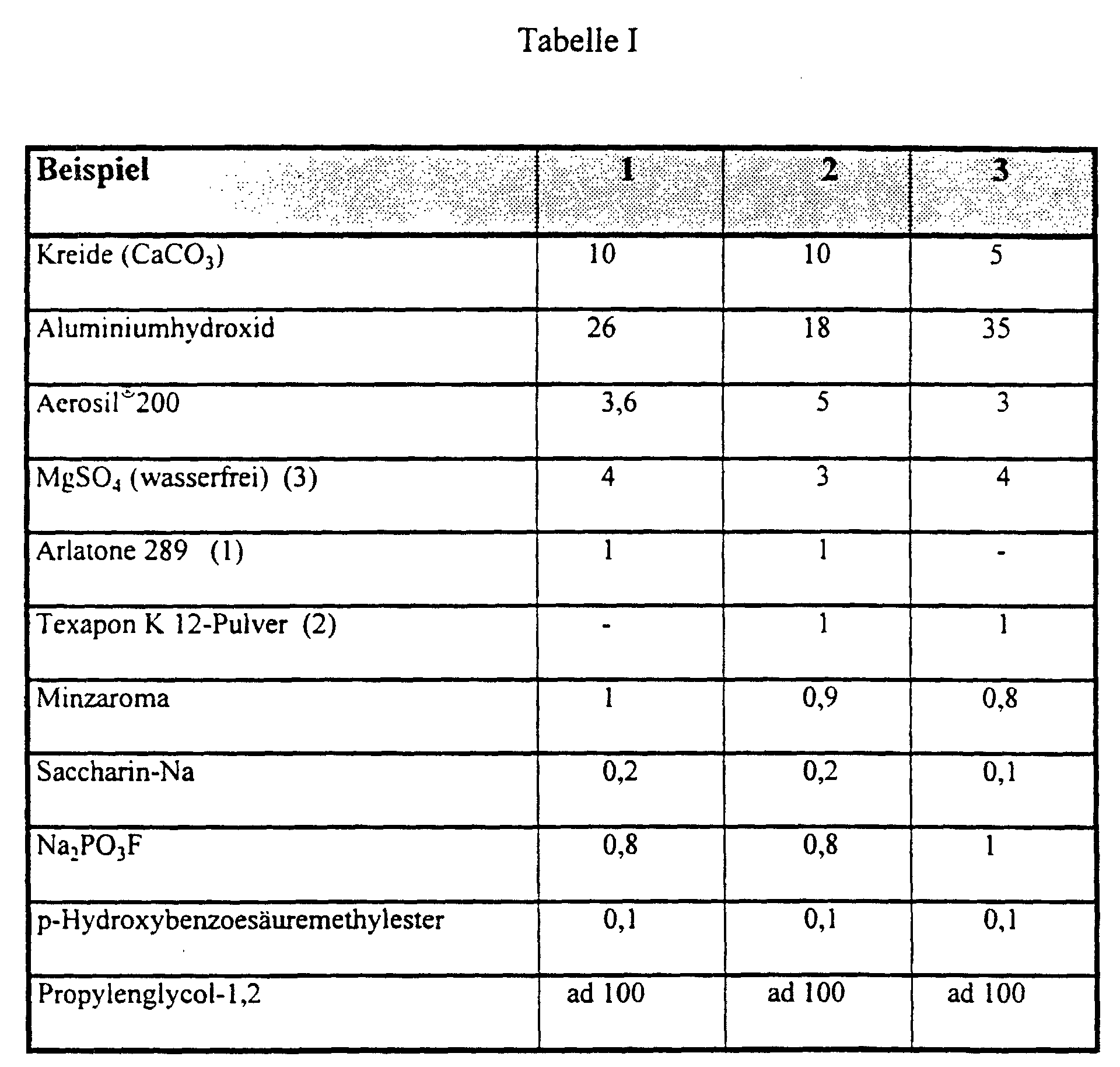
- Toothpaste formulations were prepared by mixing the components according to the table:
Landscapes
- Health & Medical Sciences (AREA)
- Life Sciences & Earth Sciences (AREA)
- Veterinary Medicine (AREA)
- Animal Behavior & Ethology (AREA)
- General Health & Medical Sciences (AREA)
- Public Health (AREA)
- Birds (AREA)
- Epidemiology (AREA)
- Inorganic Chemistry (AREA)
- Chemical & Material Sciences (AREA)
- Emergency Medicine (AREA)
- Oral & Maxillofacial Surgery (AREA)
- Cosmetics (AREA)
- Dental Preparations (AREA)
- General Preparation And Processing Of Foods (AREA)
- Jellies, Jams, And Syrups (AREA)
- Air-Conditioning For Vehicles (AREA)
- Conductive Materials (AREA)
- Adhesives Or Adhesive Processes (AREA)
- Thermotherapy And Cooling Therapy Devices (AREA)
Description
- ein bereits teilhydratisiertes Salz einsetzt, bei dem nur noch ein Teil der Lösungswärme freigesetzt werden kann
- ein mit hydrophilen, amphiphilen oder hydrophoben Stoffen gecoatetes (beschichtetes) bzw. teilgecoatetes (imprägniertes) Salz verwendet, bei dem der Lösungsvorgang verzögert abläuft, so daß auch die Lösungswärme sich erst nach und nach entwickeln kann.
- Tenside, z.B. Aniontenside, Betaintenside, nichtionogene Tenside. Bevorzugt werden schaumstarke anionische Tenside wie z.B. Natriumlaurylsulfat, Natrium-lauroylsarcosinat, Natrium-Acyltaurat, Natrium-monoglycerid-sulfat oder Acylisethionate eingesetzt. Geeignete nichtionische Tenside sind z.B. (oxethylierte) Sorbitanfettsäureester, Fettsäureoxethylate, Fettsäure(mono)glyceride oder deren Oxethylate oder Alkyl-(oligo)-glucoside. Geeignete Betaintenside sind z.B. Fettacylaminopropyldimethyl-acetobetain oder Fettalkyl-dimethyl-acetobetain.
- Aromaöle und Pflanzenextrakte, z.B. Pfefferminzöl, Krauseminzöl, Eukalyptusöl, Anisöl, Fenchelöl, Kümmelöl, Methylacetat, Zimtaldehyd, Vanillin und Thymol sowie Aromastoffe mit Erdbeer-, Himbeer-, Ananas, Apfel- oder Orangengeschmack.
- Lösungsvermittler für Aromen, z.B. PEG-30-Glycerinmonostearat, PEG-60-Glycerintri-hydroxystearinsäureester, oxethyliertes Rizinusöl u.ä.
- Süßungsmittel, z.B. Saccharin-Natrium, Acesulfam-Kalium, Cyclamat, Aspartam oder Süßholzextrakt,
- Antikarieswirkstoffe, wie z.B. Natriumfluorid, Zinnfluorid, Natrium-monofluorophosphat,
- Antizahnsteinwirkstoffe, wie z.B. Natriumpyrophosphat, Natriumtripolyphosphat, 1-Hydroxyethan-1,1-diphosphonsäure oder Azacycloheptan-2,2-diphosphonsäure oder 1-Phosphonopropan-1,2,3-tricarbonsäure oder deren Alkalimetallsalze.
- Organische Verdickungsmittel, z.B. wasserlösliche Polymere wie Carboxymethylcellulose, Hydroxyethylcellulose, Hydroxypropylguar, Carboxymethylstärke, Biopolymere wie Xanthan-Gum, Pflanzengumme wie Gummi arabicum, Traganth, Keraya-Gum, Guar oder synthetische Polymere wie z.B. Polyvinyl-pyrrolidon, Polyvinylalkohol oder hochmolekulares Polyethylenglycol.
- Antimikrobielle Stoffe wie z.B. Chlorhexidin® , Triclosan® , p-Hydroxybenzoesäureester, Natriumsorbat, Natriumbenzoat oder Phenyl-salicylsäureester.
- Pigmente wie z.B. Titandioxid,
- Farbstoffe
- Puffersubstanzen, wie z.B. primäre und sekundäre Alkaliorthophosphate, Natriumcitrat und
- wundheilende und entzündungshemmende Stoffe wie z.B. Allantoin, Azulen, Panthenol oder Harnstoff.

Claims (7)
- Zahnpflegemittel, das bei Zutritt von Wasser beim Bürsten der Zähne Wärme freisetzt und in einem Träger mit einem Gehalt an mit Wasser mischbaren ein- oder mehrwertigen Alkoholen ein dehydratisiertes Salz mit negativer Lösungsenthalpie enthält, dadurch gekennzeichnet, daß das Salz Magnesiumsulfat (MgSO4) ist.
- Zahnpflegemittel, das bei Zutritt von Wasser beim Bürsten der Zähne Wärme freisetzt und in einem Träger mit einem Gehalt an mit Wasser mischbaren ein- oder mehrwertigen Alkoholen ein dehydratisiertes Salz mit negativer Lösungsenthalpie enthält, dadurch gekennzeichnet, daß das Salz ein mit hydrophilen, amphiphilen oder hydrophoben Stoffen beschichtetetes oder imprägniertes Salz ist, bei dem der Lösungsvorgang verzögert abläuft,
- Zahnpflegemittel nach Anspruch 1 oder 2, dadurch gekennzeichnet, daß es 35 - 80 Gew.-% eines Polyols aus der Gruppe Ethylenglycol, Propylenglycol, Glycerin oder deren Mischungen enthält.
- Zahnpflegemittel nach einem der Ansprüche 1 - 3, dadurch gekennzeichnet, daß es 1 - 20 Gew.-% Magnesiumsulfat (MgS04) enthält.
- Zahnpflegemittel nach einem der Ansprüche 1 bis 4, dadurch gekennzeichnet, daß es 10 - 50 Gew.-% einer Polierkomponente aus der Gruppe Aluminiumhydroxid, Kieselsäure, Kreide oder Mischungen davon enthält.
- Zahnpflegemittel nach einem der Ansprüche 1 bis 5, dadurch gekennzeichnet, daß es 0,5 - 10 Gew.-% einer verdickenden Kieselsäure, bevorzugt einer Gelkieselsäure oder pyro-genen Kieselsäure, enthält.
- Zahnpflegemittel nach einem der Ansprüche 1 - 6, gekennzeichnet durch einen Gehalt von35 - 60 Gew.-% Propylenglycol-1,2 oder Glycerin30 - 40 Gew.-% einer Poliermittelkomponente0,5 - 5 Gew.-% einer verdickenden Kieselsäure2 - 10 Gew.-% MgSO4 (dehydratisiert)0,5 - 2 Gew.-% Tenside0,2 - 2 Gew.-% Aromaöl0,05 - 0,5 Gew.-% Süßstoff und0,2 - 2,0 Gew.-% NaF oder Na2PO3F
Applications Claiming Priority (3)
| Application Number | Priority Date | Filing Date | Title |
|---|---|---|---|
| DE19624870A DE19624870A1 (de) | 1996-06-21 | 1996-06-21 | Wärmende Zahnpasta |
| DE19624870 | 1996-06-21 | ||
| PCT/EP1997/003047 WO1997049374A1 (de) | 1996-06-21 | 1997-06-12 | Wärmende zahnpaste |
Publications (2)
| Publication Number | Publication Date |
|---|---|
| EP0910327A1 EP0910327A1 (de) | 1999-04-28 |
| EP0910327B1 true EP0910327B1 (de) | 2001-12-19 |
Family
ID=7797630
Family Applications (1)
| Application Number | Title | Priority Date | Filing Date |
|---|---|---|---|
| EP97928178A Expired - Lifetime EP0910327B1 (de) | 1996-06-21 | 1997-06-12 | Wärmende zahnpaste |
Country Status (8)
| Country | Link |
|---|---|
| EP (1) | EP0910327B1 (de) |
| AT (1) | ATE210952T1 (de) |
| AU (1) | AU3257497A (de) |
| DE (2) | DE19624870A1 (de) |
| ES (1) | ES2170398T3 (de) |
| NO (1) | NO985963L (de) |
| PT (1) | PT910327E (de) |
| WO (1) | WO1997049374A1 (de) |
Families Citing this family (8)
| Publication number | Priority date | Publication date | Assignee | Title |
|---|---|---|---|---|
| GB9817817D0 (en) * | 1998-08-14 | 1998-10-14 | Unilever Plc | Cosmetic composition |
| US6475470B1 (en) * | 1998-09-25 | 2002-11-05 | Kao Corporation | Compositions for oral cavity |
| DE10009252A1 (de) | 2000-03-01 | 2001-09-06 | Henkel Kgaa | Wärmendes Hautreinigungsgel |
| MXPA03006891A (es) † | 2001-02-01 | 2003-11-13 | Procter & Gamble | Composiciones cosmeticas anhidras. |
| US6770264B2 (en) | 2001-11-13 | 2004-08-03 | Noville, Inc. | Chewing gum compositions comprising diglycerol |
| US20030091514A1 (en) * | 2001-11-13 | 2003-05-15 | Stier Roger E. | Oral care compositions comprising diglycerol |
| WO2011012421A1 (en) * | 2009-07-29 | 2011-02-03 | Unilever Nv | A dentifrice composition comprising polyethyleneglycol and a cooling agent |
| CN113398011A (zh) * | 2021-07-16 | 2021-09-17 | 邓家能 | 一种热感牙膏及其制备方法 |
Family Cites Families (3)
| Publication number | Priority date | Publication date | Assignee | Title |
|---|---|---|---|---|
| DE359071C (de) * | 1919-09-26 | 1922-09-16 | G W Carl Block | Verfahren zur Herstellung von Waessern zum Spuelen, z. B. des Mundes |
| US4647451A (en) * | 1984-05-11 | 1987-03-03 | Colgate-Palmolive Company | Anhydrous dentifrice |
| EP0839021B1 (de) * | 1995-07-10 | 2002-01-23 | Unilever N.V. | Wärmeerzeugende zahnpasta |
-
1996
- 1996-06-21 DE DE19624870A patent/DE19624870A1/de not_active Withdrawn
-
1997
- 1997-06-12 AU AU32574/97A patent/AU3257497A/en not_active Abandoned
- 1997-06-12 DE DE59705900T patent/DE59705900D1/de not_active Expired - Lifetime
- 1997-06-12 EP EP97928178A patent/EP0910327B1/de not_active Expired - Lifetime
- 1997-06-12 PT PT97928178T patent/PT910327E/pt unknown
- 1997-06-12 ES ES97928178T patent/ES2170398T3/es not_active Expired - Lifetime
- 1997-06-12 WO PCT/EP1997/003047 patent/WO1997049374A1/de not_active Ceased
- 1997-06-12 AT AT97928178T patent/ATE210952T1/de not_active IP Right Cessation
-
1998
- 1998-12-18 NO NO985963A patent/NO985963L/no not_active Application Discontinuation
Also Published As
| Publication number | Publication date |
|---|---|
| WO1997049374A1 (de) | 1997-12-31 |
| DE59705900D1 (de) | 2002-01-31 |
| DE19624870A1 (de) | 1998-01-02 |
| NO985963D0 (no) | 1998-12-18 |
| AU3257497A (en) | 1998-01-14 |
| EP0910327A1 (de) | 1999-04-28 |
| ES2170398T3 (es) | 2002-08-01 |
| PT910327E (pt) | 2002-06-28 |
| NO985963L (no) | 1998-12-18 |
| ATE210952T1 (de) | 2002-01-15 |
Similar Documents
| Publication | Publication Date | Title |
|---|---|---|
| DE69522956T2 (de) | Orale zusammensetzung enthaltend stabilisierte zinn komponente | |
| DE69618786T2 (de) | Wärmeerzeugende zahnpasta | |
| DE69830992T2 (de) | Desensibilisierende zahnpaste mit beschränkter astringenz | |
| US4490353A (en) | Antiplaque dentifrice with improved fluoride stability | |
| US11910724B2 (en) | Thickener systems for oral care compositions and a method for preparing the same | |
| TWI486174B (zh) | 過氧化物-穩定之口腔保健組成物 | |
| DE3600165A1 (de) | Mittel zur oralen hygiene | |
| DE69712054T2 (de) | Zahnpflegemittel gegen zahnsteinbildung enthaltend hochlösliche pyrophosphate | |
| US5932192A (en) | Lower astringent two component stannous and potassium salt containing dentifrice | |
| JPS6254766B2 (de) | ||
| DE3221503A1 (de) | Zahnpflegemittel mit doppelter wirkung | |
| WO1992004884A1 (en) | Antimicrobial toothpaste | |
| DE69514387T2 (de) | Bildung stabiler wässriger lösungen von zinnverbindungen | |
| EP1312354A1 (de) | Mundpflegezusammensetzungen enthaltend Diglycerin | |
| CA1330047C (en) | Oral compositions | |
| DE69531620T2 (de) | Mundplegemittel | |
| DE2212259A1 (de) | Verfahren zur Herstellung stabiler Zahnreinigungsmittel | |
| DE3874071T2 (de) | Zahnsteinverhindernde zusammensetzung. | |
| DE3046770C2 (de) | ||
| EP0910327A1 (de) | Wärmende zahnpaste | |
| DE1956016A1 (de) | Praeparat zur Zahn- und Mundpflege | |
| DE3309910A1 (de) | Zahnpastenzusammensetzung mit einem gehalt an peroxydiphosphat | |
| JPH04139120A (ja) | 口腔用組成物 | |
| JP2003212741A (ja) | 歯磨組成物 | |
| WO2019094568A1 (en) | Thickener systems for oral care compositions and a method for preparing the same |
Legal Events
| Date | Code | Title | Description |
|---|---|---|---|
| PUAI | Public reference made under article 153(3) epc to a published international application that has entered the european phase |
Free format text: ORIGINAL CODE: 0009012 |
|
| 17P | Request for examination filed |
Effective date: 19990107 |
|
| AK | Designated contracting states |
Kind code of ref document: A1 Designated state(s): AT BE CH DE DK ES FI FR GB GR IE IT LI NL PT SE |
|
| GRAG | Despatch of communication of intention to grant |
Free format text: ORIGINAL CODE: EPIDOS AGRA |
|
| GRAG | Despatch of communication of intention to grant |
Free format text: ORIGINAL CODE: EPIDOS AGRA |
|
| 17Q | First examination report despatched |
Effective date: 20000117 |
|
| GRAG | Despatch of communication of intention to grant |
Free format text: ORIGINAL CODE: EPIDOS AGRA |
|
| GRAH | Despatch of communication of intention to grant a patent |
Free format text: ORIGINAL CODE: EPIDOS IGRA |
|
| GRAH | Despatch of communication of intention to grant a patent |
Free format text: ORIGINAL CODE: EPIDOS IGRA |
|
| GRAA | (expected) grant |
Free format text: ORIGINAL CODE: 0009210 |
|
| AK | Designated contracting states |
Kind code of ref document: B1 Designated state(s): AT BE CH DE DK ES FI FR GB GR IE IT LI NL PT SE |
|
| PG25 | Lapsed in a contracting state [announced via postgrant information from national office to epo] |
Ref country code: IT Free format text: LAPSE BECAUSE OF FAILURE TO SUBMIT A TRANSLATION OF THE DESCRIPTION OR TO PAY THE FEE WITHIN THE PRESCRIBED TIME-LIMIT;WARNING: LAPSES OF ITALIAN PATENTS WITH EFFECTIVE DATE BEFORE 2007 MAY HAVE OCCURRED AT ANY TIME BEFORE 2007. THE CORRECT EFFECTIVE DATE MAY BE DIFFERENT FROM THE ONE RECORDED. Effective date: 20011219 Ref country code: IE Free format text: LAPSE BECAUSE OF FAILURE TO SUBMIT A TRANSLATION OF THE DESCRIPTION OR TO PAY THE FEE WITHIN THE PRESCRIBED TIME-LIMIT Effective date: 20011219 Ref country code: GR Free format text: LAPSE BECAUSE OF FAILURE TO SUBMIT A TRANSLATION OF THE DESCRIPTION OR TO PAY THE FEE WITHIN THE PRESCRIBED TIME-LIMIT Effective date: 20011219 Ref country code: GB Free format text: LAPSE BECAUSE OF FAILURE TO SUBMIT A TRANSLATION OF THE DESCRIPTION OR TO PAY THE FEE WITHIN THE PRESCRIBED TIME-LIMIT Effective date: 20011219 Ref country code: FR Free format text: LAPSE BECAUSE OF FAILURE TO SUBMIT A TRANSLATION OF THE DESCRIPTION OR TO PAY THE FEE WITHIN THE PRESCRIBED TIME-LIMIT Effective date: 20011219 Ref country code: FI Free format text: LAPSE BECAUSE OF FAILURE TO SUBMIT A TRANSLATION OF THE DESCRIPTION OR TO PAY THE FEE WITHIN THE PRESCRIBED TIME-LIMIT Effective date: 20011219 |
|
| REF | Corresponds to: |
Ref document number: 210952 Country of ref document: AT Date of ref document: 20020115 Kind code of ref document: T |
|
| REG | Reference to a national code |
Ref country code: CH Ref legal event code: EP |
|
| REG | Reference to a national code |
Ref country code: GB Ref legal event code: IF02 |
|
| REG | Reference to a national code |
Ref country code: IE Ref legal event code: FG4D Free format text: GERMAN |
|
| REF | Corresponds to: |
Ref document number: 59705900 Country of ref document: DE Date of ref document: 20020131 |
|
| PG25 | Lapsed in a contracting state [announced via postgrant information from national office to epo] |
Ref country code: SE Free format text: LAPSE BECAUSE OF FAILURE TO SUBMIT A TRANSLATION OF THE DESCRIPTION OR TO PAY THE FEE WITHIN THE PRESCRIBED TIME-LIMIT Effective date: 20020319 Ref country code: DK Free format text: LAPSE BECAUSE OF FAILURE TO SUBMIT A TRANSLATION OF THE DESCRIPTION OR TO PAY THE FEE WITHIN THE PRESCRIBED TIME-LIMIT Effective date: 20020319 |
|
| PG25 | Lapsed in a contracting state [announced via postgrant information from national office to epo] |
Ref country code: AT Free format text: LAPSE BECAUSE OF NON-PAYMENT OF DUE FEES Effective date: 20020612 |
|
| PG25 | Lapsed in a contracting state [announced via postgrant information from national office to epo] |
Ref country code: ES Free format text: LAPSE BECAUSE OF NON-PAYMENT OF DUE FEES Effective date: 20020613 |
|
| GBV | Gb: ep patent (uk) treated as always having been void in accordance with gb section 77(7)/1977 [no translation filed] |
Effective date: 20011219 |
|
| REG | Reference to a national code |
Ref country code: PT Ref legal event code: SC4A Free format text: AVAILABILITY OF NATIONAL TRANSLATION Effective date: 20020311 |
|
| PG25 | Lapsed in a contracting state [announced via postgrant information from national office to epo] |
Ref country code: LI Free format text: LAPSE BECAUSE OF NON-PAYMENT OF DUE FEES Effective date: 20020630 Ref country code: CH Free format text: LAPSE BECAUSE OF NON-PAYMENT OF DUE FEES Effective date: 20020630 Ref country code: BE Free format text: LAPSE BECAUSE OF NON-PAYMENT OF DUE FEES Effective date: 20020630 |
|
| REG | Reference to a national code |
Ref country code: ES Ref legal event code: FG2A Ref document number: 2170398 Country of ref document: ES Kind code of ref document: T3 |
|
| REG | Reference to a national code |
Ref country code: IE Ref legal event code: FD4D |
|
| EN | Fr: translation not filed | ||
| PLBE | No opposition filed within time limit |
Free format text: ORIGINAL CODE: 0009261 |
|
| STAA | Information on the status of an ep patent application or granted ep patent |
Free format text: STATUS: NO OPPOSITION FILED WITHIN TIME LIMIT |
|
| 26N | No opposition filed | ||
| BERE | Be: lapsed |
Owner name: *HENKEL K.G.A.A. Effective date: 20020630 |
|
| PG25 | Lapsed in a contracting state [announced via postgrant information from national office to epo] |
Ref country code: NL Free format text: LAPSE BECAUSE OF NON-PAYMENT OF DUE FEES Effective date: 20030101 |
|
| REG | Reference to a national code |
Ref country code: CH Ref legal event code: PL |
|
| NLV4 | Nl: lapsed or anulled due to non-payment of the annual fee |
Effective date: 20030101 |
|
| PG25 | Lapsed in a contracting state [announced via postgrant information from national office to epo] |
Ref country code: PT Free format text: LAPSE BECAUSE OF NON-PAYMENT OF DUE FEES Effective date: 20031231 |
|
| REG | Reference to a national code |
Ref country code: PT Ref legal event code: MM4A Free format text: LAPSE DUE TO NON-PAYMENT OF FEES Effective date: 20031231 |
|
| REG | Reference to a national code |
Ref country code: ES Ref legal event code: FD2A Effective date: 20030711 |
|
| PG25 | Lapsed in a contracting state [announced via postgrant information from national office to epo] |
Ref country code: PT Free format text: LAPSE BECAUSE OF NON-PAYMENT OF DUE FEES Effective date: 20020612 |
|
| REG | Reference to a national code |
Ref country code: DE Ref legal event code: R084 Ref document number: 59705900 Country of ref document: DE Effective date: 20130702 |
|
| PGFP | Annual fee paid to national office [announced via postgrant information from national office to epo] |
Ref country code: DE Payment date: 20150619 Year of fee payment: 19 |
|
| REG | Reference to a national code |
Ref country code: DE Ref legal event code: R119 Ref document number: 59705900 Country of ref document: DE |
|
| PG25 | Lapsed in a contracting state [announced via postgrant information from national office to epo] |
Ref country code: DE Free format text: LAPSE BECAUSE OF NON-PAYMENT OF DUE FEES Effective date: 20170103 |