EP0910946A2 - Angelrolle - Google Patents
Angelrolle Download PDFInfo
- Publication number
- EP0910946A2 EP0910946A2 EP98120260A EP98120260A EP0910946A2 EP 0910946 A2 EP0910946 A2 EP 0910946A2 EP 98120260 A EP98120260 A EP 98120260A EP 98120260 A EP98120260 A EP 98120260A EP 0910946 A2 EP0910946 A2 EP 0910946A2
- Authority
- EP
- European Patent Office
- Prior art keywords
- brake
- spool
- members
- force
- support member
- Prior art date
- Legal status (The legal status is an assumption and is not a legal conclusion. Google has not performed a legal analysis and makes no representation as to the accuracy of the status listed.)
- Withdrawn
Links
- 230000007246 mechanism Effects 0.000 claims description 17
- 230000004048 modification Effects 0.000 description 28
- 238000012986 modification Methods 0.000 description 28
- 238000005266 casting Methods 0.000 description 15
- 230000002093 peripheral effect Effects 0.000 description 15
- 230000003449 preventive effect Effects 0.000 description 9
- 241000276420 Lophius piscatorius Species 0.000 description 5
- 230000006835 compression Effects 0.000 description 4
- 238000007906 compression Methods 0.000 description 4
- 230000007423 decrease Effects 0.000 description 4
- 230000008859 change Effects 0.000 description 3
- 230000000694 effects Effects 0.000 description 3
- 238000000034 method Methods 0.000 description 3
- 230000000630 rising effect Effects 0.000 description 3
- 230000003247 decreasing effect Effects 0.000 description 2
- 229920001875 Ebonite Polymers 0.000 description 1
- 230000009471 action Effects 0.000 description 1
- 230000008901 benefit Effects 0.000 description 1
- 230000005540 biological transmission Effects 0.000 description 1
- 238000000465 moulding Methods 0.000 description 1
- XLYOFNOQVPJJNP-UHFFFAOYSA-N water Substances O XLYOFNOQVPJJNP-UHFFFAOYSA-N 0.000 description 1
- 238000004804 winding Methods 0.000 description 1
Images








Classifications
-
- A—HUMAN NECESSITIES
- A01—AGRICULTURE; FORESTRY; ANIMAL HUSBANDRY; HUNTING; TRAPPING; FISHING
- A01K—ANIMAL HUSBANDRY; AVICULTURE; APICULTURE; PISCICULTURE; FISHING; REARING OR BREEDING ANIMALS, NOT OTHERWISE PROVIDED FOR; NEW BREEDS OF ANIMALS
- A01K89/00—Reels
- A01K89/015—Reels with a rotary drum, i.e. with a rotating spool
-
- A—HUMAN NECESSITIES
- A01—AGRICULTURE; FORESTRY; ANIMAL HUSBANDRY; HUNTING; TRAPPING; FISHING
- A01K—ANIMAL HUSBANDRY; AVICULTURE; APICULTURE; PISCICULTURE; FISHING; REARING OR BREEDING ANIMALS, NOT OTHERWISE PROVIDED FOR; NEW BREEDS OF ANIMALS
- A01K89/00—Reels
- A01K89/015—Reels with a rotary drum, i.e. with a rotating spool
- A01K89/0155—Antibacklash devices
-
- A—HUMAN NECESSITIES
- A01—AGRICULTURE; FORESTRY; ANIMAL HUSBANDRY; HUNTING; TRAPPING; FISHING
- A01K—ANIMAL HUSBANDRY; AVICULTURE; APICULTURE; PISCICULTURE; FISHING; REARING OR BREEDING ANIMALS, NOT OTHERWISE PROVIDED FOR; NEW BREEDS OF ANIMALS
- A01K89/00—Reels
- A01K89/015—Reels with a rotary drum, i.e. with a rotating spool
- A01K89/0155—Antibacklash devices
- A01K89/01557—Centrifugal
Definitions
- the present invention relates to a fishing reel including a brake device capable of applying a brake force to a spool while the spool is rotating.
- a spool In a casting operation, due to the weight of terminal tackles, reaction of a fishing rod, wind and the like, a spool can be rotated suddenly, so that the rotation speed of the spool can be faster than the play-out speed of a fishing line to thereby cause a backlash.
- the backlash raises some troubles: for example, the backlash can cause the different portions of the fishing line to be entwined together, or can cause the fishing line to be inserted into between the outer peripheral portion of the flange of the spool and the reel main body.
- a fishing reel which includes a centrifugal brake device.
- centrifugal brake device including a plurality of brake blocks which can be switched over between their respective brake operation positions and brake non-operation positions.
- the brake blocks can be respectively slided in the spool radial direction due to a centrifugal force generated when the spool is rotated and thus can be frictionally contacted with a brake shoe fixed to the reel main body, thereby being able to apply a brake force, which corresponds to the then frictional contact pressure, to the spool.
- the brake blocks can be switched by a restrict member provided in the present centrifugal brake device between their respective brake operation positions, where they are frictionally contacted with the brake shoe to thereby be able to apply a given brake force to the spool, and their respective brake non-operation positions where they are distant from the brake shoe to thereby allow the spool to rotate freely.
- the conventional centrifugal brake device is structured such that it simply can switch the brake blocks over between the brake operation positions, where they are frictionally contacted with the brake shoe, and the brake non-operation positions where they are moved away from the brake shoe; that is, in the brake operation, since the brake blocks are contacted with the brake shoe instantaneously and with the same force, the brake force to be applied to the spool cannot be adjusted finely.
- the brake blocks can be frictionally contacted with the brake shoe due to the centrifugal force produced in the spool rotation operation, which makes it impossible to rotate the spool smoothly and lightly (freely). Due to this, the efficiency of the casting operation is degraded.
- the present invention aims at eliminating the problems found in the above-mentioned conventional fishing reel. Accordingly, it is an object of the invention to provide a fishing reel which is able to adjust finely a brake force to be applied to a spool during rotation of the spool, thereby being able to provide an excellent efficiency in a casting operation, in particular, does not brake the rotation of the spool in a spool rotation rising area ranging from the early stage of the casting operation to the high-speed rotation of the spool, thereby being able not only to extend the carrying distance of the terminal tackles but also to prevent the occurrence of the backlash in the spool.
- a fishing reel includes: a spool rotatably supported in a reel main body; a support member integrally rotating with the spool; a plurality of brake members slidably supported to the support member; and a brake surface provided in the reel main body, the brake surface being slidingly contactable with the brake members; wherein according to the rotation of the spool, an urging force is applied to the brake members in a direction where the brake members move away from the brake surface, and the brake members is slidingly contactable with the brake surface against the urging force, when a centrifugal force more than a predetermined value is applied to the spool.
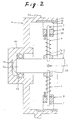
- Figs. 1 to 3 respectively show a first embodiment of the invention: in particular, Fig. 1 is a sectional plan view of the main portions of a fishing reel of a double-bearing type; Fig. 2 is an enlarged sectional plan view of the main portions of the left side of a fishing reel of a double-bearing type; and, Fig. 3 is an enlarged sectional plan view of the main portions of the left side of a fishing reel of a double-bearing type.
- a fishing reel of a double-bearing type left and right side frames 1 and 2, which cooperate together in forming a reel main body A, are held in parallel to each other by a support column (not shown), a reel leg fixing plate 10 and a finger placement plate 11, while reel side plates 12 and 3 are mounted on the outside portions of the left and right side frames 1 and 2 respectively.
- the flange portion 4a of a brake disk body 4 including a bearing hold portion 4b and a cylindrical brake portion 4c is removably fitted into the through hole 1a of the left side frame 1 and is secured thereto by a screw (not shown).
- a bearing 13 and a thrust plate 14 are respectively mounted on the bearing hold portion 4b and, at the same time, one end 5a of a spool shaft 5 is supported by the bearing hold portion 4b.
- the other end 5b of the spool shaft 5 is supported by a bearing 15 on which the bearing hold portion 2a of the right side frame 2 is mounted.
- a spool 16 which is fixed to the spool shaft 5, is rotatably interposed between the left and right side frames 1 and 2.
- a fishing line 17 is wound around the outer periphery of the winding barrel portion of the spool 16.
- a brake ring 18 is fitted with and fixed to the inside portion of the cylindrical brake portion 4c of the brake disk body 4.
- the spool shaft 5 includes an engaging portion 5d and a small-diameter portion 5e which are respectively located on the right side portion of the spool shaft 5. And, the spool shaft 5 further includes a spool shaft end portion 5f located on the right of the small-diameter portion 5e; and, the spool shaft end portion 5f is not only carried on a bearing 19 provided in the reel side plate 3 but also is contacted with a thrust receive member 21 disposed within a brake knob 20 which is threadedly engaged with the outer periphery of the cylindrical portion 3a of the reel side plate 3.
- a pinion 6 is slidably fitted with the small-diameter portion 5e of the spool shaft 5 within the reel side plate 3, while the engaging portion 5d of the spool shaft 5 and the engaging portion 6a of the pinion 6 can be engaged with or removed from each other by means of the operation of a clutch lever 22.
- the pinion 6 is in meshing engagement with a drive gear 24 which is frictionally coupled to a handle drive shaft 23.
- the handle drive shaft 23 is supported by a bearing 25 mounted on the right side frame 2 and a bearing 26 mounted on the reel side plate 3, and a brake adjust handle 27 is threadedly engaged with the handle drive shaft 23, whereby the brake force of the handle drive shaft 23 and drive gear 24 can be adjusted.
- a handle 28 is mounted on the end portion of the handle drive shaft 23.
- a plurality of cubic-shaped brake members 8 are loosely fitted with their corresponding support members 7 in such a manner that they are respectively free to move in the radial direction of the spool shaft 5 of spool 16.
- Each of the brake members 8 is formed of hard rubber or the like and a spring hitch plate 30 is embedded in the brake member 8.
- lead or the like may be contained in the brake member 8 to thereby adjust the weight thereof.
- each of the support members 7 there is opened up a spring hitch transverse hole 7a.
- the brake members 8 are respectively urged toward the spool shaft 5 by their corresponding springs a, b, c, d.
- the weights of the brake members 8 and the urging forces of the springs a, b, c, d are respectively set in such a manner that, before the rotation of the spool 16 becomes faster than the play-out speed of the fishing line 17, the brake members 8 can be slidingly contacted with the annular brake surface ⁇ of the brake ring 18 of the brake disk body 4 due to a centrifugal force; whereas, in the rotation areas of the spool 16 which are lower in the rotation speed than the area thereof just before the rotation of the spool 16 becomes faster than the play-out speed of the fishing line 17, the brake members 8 can be spaced apart from the annular brake surface ⁇ of the brake ring 18.
- the urging forces of the springs a, b, c, d may be changed respectively into a ⁇ b ⁇ c ⁇ d; in this case, it is possible to set such brake characteristic that can cope with different degrees of the skill of various anglers or varying conditions in an actual fishing spot.
- the engaging portion 6a of the pinion 6 is separated from the engaging portion 5b of the spool shaft 5 by operating the clutch lever 22 to thereby set the spool 16 free and, after then, the fishing rod is thrown or swung down to thereby cast the terminal tackles (not shown).
- the spool 16 When the terminal tackles are cast, then the spool 16 is suddenly rotated due to the weight of the terminal tackles, the reaction of the fishing rod or the like to thereby cause the rotation of the spool 16 to be faster than the play-out speed of the fishing line 17, with the result that the backlash is produced in the spool 16; however, actually, before the rotation of a spool 16 becomes faster than the play-out speed of a fishing line 17, the brake members 8 are slidingly contacted with the annular brake surface ⁇ of the brake ring 18 of the brake disk body 4 against the elastic forces of the springs a, b, c, d due to a centrifugal force to thereby brake the rotation of the spool 16 so as to be able to prevent the occurrence of the backlash in the spool 16.
- the brake knob 20 is rotated to thereby brake the rotation of the spool shaft 5 and, at the same time, the drive gear 24, pinion 6 and spool 16 are respectively rotated with a brake force set by the brake adjust handle 27.
- the brake members 8 are slidingly contacted with the annular brake surface ⁇ of the brake ring 18 provided in the brake disk body 4 against the elastic forces of springs a, b, c, d due to a centrifugal force to thereby brake the rotation of the spool 16 so as to be able to prevent the backlash of the spool 16; and, the brake members 8 are set in such a manner as to be spaced apart from the annular brake surface ⁇ in the rotation areas of the spool 16 which are lower in the rotation speed than the area thereof before the rotation of the spool 16 becomes faster than the play-out speed of the fishing line 17, the rotation of the spool 16 is not restricted in the rotation areas of the spool 16 ranging from the early stage of the casting operation to the high-speed rotation of the spool 16.
- the spool rotation speed is allowed to become faster and thus the carrying distance of terminal tackles can be extended, so that not only the carrying distance of the terminal tackles can be extended but also the backlash of the spool can be prevented.
- FIG. 4 shows a first modification of the first embodiment according to the invention and, in particular, Fig. 4 is an enlarged sectional side view of the main portions of the left side of a fishing reel of a double-bearing type.
- peripheral grooves 7b in the respective leading ends of the plurality of rod-shaped support members 7, there are formed peripheral grooves 7b.
- the brake member 8' its recessed portion 8a and its flange portion 8b formed on the upper surface thereof are formed integrally with each other, the spring 31 is disposed within the recessed portion 8a, and the brake member 8' is urged in the direction of the spool shaft 5.
- FIG. 5 shows a second modification of the first embodiment according to the invention and, in particular, Fig. 5 is an enlarged sectional side view of the main portions of the left side of a fishing reel of a double-bearing type.
- peripheral grooves 7b in the respective leading ends of the plurality of rod-shaped support members 7, there are formed peripheral grooves 7b.
- the brake member 8' its recessed portion 8a and its flange portion 8b formed on the upper surface thereof are formed integrally with each other, the soft member 33 is disposed within the recessed portion 8a, and the brake member 8' is urged in the direction of the spool shaft 5.
- Fig. 6 shows a third modification of the first embodiment according to the invention and, in particular, Fig. 6 is an enlarged sectional side view of the main portions of the left side of a fishing reel of a double-bearing type.
- peripheral grooves 7b in the respective leading ends of the plurality of rod-shaped support members 7, there are formed peripheral grooves 7b.
- the spring 35 is disposed within the recessed portion 8a, and the brake member 8'' is urged in the direction of the spool shaft 5 and is held in a state where it is spaced apart from the brake surface of the annular brake body by a given distance due to the engagement with the E ring 32.
- the support members 7 there are shown four support members 7.
- the number of the support members 7 may be two, three, five or more.
- the fishing reel there is shown a fishing reel of a double-bearing type.
- the invention can also apply to other types of fishing reels.
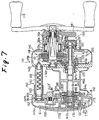
- a double-bearing type reel 101 comprises a frame 102 including left and right frames 102a and 102b and a rod mounting portion (not shown) formed integrally with the central portions of the left and right frames 102a and 102b, and a reel main body 104 including left and right side plates 103a and 103b which are respectively mounted on the left and right frames 102a and 102b.
- a spool shaft 106 Between the left and right frames 102a and 102b (left and right side plates 103a and 103b), there is rotatably supported a spool shaft 106 through bearings 107a and 107b; and, on the spool shaft 106, there is mounted a spool 106a around which a fishing line can be wound.
- the spool 106a is structured such that it can be rotated by operating or rotating a handle 110 which is mounted on the end portion of a handle shaft 110a projecting from the right side plate 103b.
- the handle shaft 110a is disposed within a cylindrical portion 115a provided on and projected from a set plate 115 which can be screwed to the right frame 102b; and, the handle shaft 110a is structured such that not only it is supported through bearings 116a and 116b in such a manner as to be rotatable with respect to the cylindrical portion 115a of the set plate 115 as well as with respect to the right frame 102b, but also it can be rotated only in a fishing line take-up direction by a one-way clutch 117.
- a drive mechanism 120 which is used to transmit the rotational movement of the handle 110 to the spool shaft 106
- a drag mechanism 140 which, when the fishing line is played out from the spool 106a in an fishing operation, applies a drag force to the spool 106a.
- the pinion 122 is supported by bearings 123 and 125 in such a manner that it can be freely rotated with respect to the right frame 102b and set plate 115.
- the bearing 125 is disposed within a cylindrical portion 115b which is provided on and projected from the set plate 115.
- a circumferential groove 122a On the outer periphery of the pinion 122, there is formed a circumferential groove 122a; and, with the circumferential groove 122a, there is engaged a clutch plate 126 which can be moved in the axial direction by a clutch operation member (not shown).
- the clutch operation member if the clutch operation member is operated to thereby move the pinion 122 in the axial direction, then the drive mechanism 120 can switch the fishing reel over to a drive force transmitting state as shown in Fig. 7 (that is, a clutch-on state) or to a spool free rotation state (that is, a clutch-off state) in which the pinion 122 is disengaged from the spool shaft 106.
- the drag mechanism 140 is composed of a friction plate, a lining member and the like. And, the drag mechanism 140 is structured such that, by operating or rotating a drag operation member 141 mounted on the handle shaft 110a, it can be pressed against the drive gear 121 with a given pressure. This pressure is applied onto a ratchet 143 which can be rotated integrally with the handle shaft 110a, thereby generating a drag force between the handle shaft 110a and drive gear 121.
- the pressure mechanism 150 includes a thrust shaft 151, which is inserted into the pinion 122 and is contacted with the end face of the spool shaft 106, and a cap 152 which is threadedly engaged with the cylindrical portion 115b of the set plate 115 and is pressed against the thrust shaft 151 in the thrust direction.
- the level wind device 160 includes a guide cylinder 161 in which an elongated hole (not shown) is formed in such a manner as to extend in the right and left direction thereof, a worm shaft 162 rotatably supported within the guide cylinder 161, an engaging member 163 which is mounted on the guide cylinder 161 in such a manner as to enclose the guide cylinder 161 and is engaged with the worm shaft 162 through the above-mentioned elongated hole, and a fishing line guide part (not shown) mounted on the engaging member 163.
- a gear 167 is mounted on the worm shaft 162; and, the gear 167 is connected through an intermediate gear 168 with a gear 170 mounted on the spool shaft 106.
- the handle 110 is operated or rotated to thereby rotate the spool 106a together with the spool shaft 106, then the rotational movement of the spool shaft 106 is transmitted through the gears 170, 168 and 167 to the worm shaft 162, thereby rotating the worm shaft 162.
- the engaging member 163 of the level wind device 160 is slided right and left in accordance with the rotational movement of the worm shaft 162, so that the fishing line can be wound uniformly around the spool 106a through the fishing line guide part of the engaging member 163.
- the right side plate 103b is mounted on the right frame 102b in such a manner as to cover the set plate 115 screwed to the right frame 102b.
- the right side plate 103b there are formed holes (not shown) respectively at the positions thereof that correspond to the cylindrical portions 115a and 115b of the set plate 115, whereby the cylindrical portions 115a and 115b are allowed to project from the surface of the right side plate 103b respectively through these holes.
- a collar 180 and an O ring 181 are respectively engaged with the outer periphery of the cylindrical portion 115b, then the right side plate 103b can be prevented against removal.
- the left side plate 103a is structured such that it can be mounted on the left frame 102a while it is connected integrally with the set plate 175.
- the left side plate 103a and set plate 175 are mounted respectively on the outer edge portion 102e of the left frame 102a and in a fit hole 102f formed in the left frame 102a, they must be positioned accurately with respect to each other when they are mounted.
- the mounting error thereof can be absorbed.
- the set plate 175 is composed of a main body 175a to be fitted into the fit hole 102f of the left frame 102a and a cover body 175b to be engaged with the left side plate 103a, but also there is formed a hole in the left side plate 103a. And, while a projecting portion 175c provided on the back surface of the cover body 175b is inserted into the hole of the left side plate 103a, the main body 175a and projecting portion 175c are connected together by a screw 195.
- the left side plate 103a and cover body 175b are structured such that not only slight gaps G1 can exist between the outer peripheral portion of the cover body 175b and the engaging portion of the left side plate 103a but also slight gaps G2 can exist between the left side plate 103a and projecting portion 175c.
- the above-mentioned mounting error can be absorbed by the slight gaps G1 and G2, which makes it possible to mount the left side plate 103a and set plate 175 on the left frame 102a easily and accurately.
- a backlash preventive mechanism which, in the fishing line play-out operation, can prevent the over-rotation of the spool 106a.
- a brake device that is, a centrifugal brake device 190 which uses a centrifugal force generated due to the rotational movement of the spool 106a (spool shaft 106).
- the centrifugal brake device 190 includes a support member 192 fixed to the spool shaft 106 in a rotation preventive manner, an annular brake body 194 which is fixed to the reel main body 104 and also in the inner periphery of which there is formed a brake surface 194a, a plurality of brake members 196 which are respectively supported on the support member 192 in a removal preventive manner and can be moved not only in a direction where they approach the brake surface 194a of the annular brake body 194 but also in a direction where they are moved away from the brake surface 194a, and a plurality of urging springs 198 which are used to urge their respective brake members 196 in the direction to move away from the brake surface 194a of the annular brake body 194 so as to be able to hold the brake members 196 in such a manner that they are respectively spaced apart from the brake surface 194a of the annular brake body 194 by a given distance.
- the centrifugal brake device 190 is structured such that, in the rotational operation of the spool 106a, when a centrifugal force is applied to the brake members 196, it can move the brake members 196 against the urging forces of the urging springs 198 into sliding contact with the brake surface 194a, thereby being able to adjust a brake force to be applied to the spool 106a.
- a restrict member 200 which can restrict the brake members 196 individually.
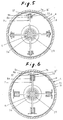
- the number of the brake members 196 can be increased or decreased according to their using objects or the like and, in the present embodiment, there are provided four brake members 196 which are supported on the support member 192 in such a manner as to extend along the peripheral direction of the support member 192 at regular intervals.
- the support member 192 is formed in a substantially disk-like shape, while the four brake members 196 are supported on the substantially disk-shaped support member 192 in such a manner that they extend along the peripheral direction of the support member 192 at regular intervals and can be moved in the radial direction of the support member 192.
- the urging springs 198 are respectively arranged in a spiral manner between the flange portions 202 of their corresponding brake members 196 and the outer side wall 192a of the support member 192; and, the urging springs 198 apply their respective urging forces in a direction where the flanges 202 are moved away from the outer side wall 192a.
- the respective brake members 196 can be held in such a manner that the flanges 202 are pressed against the contact surface 192b of the support member 192 due to the urging forces of their respective urging springs 198. In this state, the respective brake members 196 can be held in such a manner that they are spaced apart from the brake surface 194a of the annular brake body 194 by a given distance (see Fig. 7).
- the restrict member 200 is formed in such a manner as to have a substantially disk-like shape and is also structured such that it can be rotatably fitted into the support member 192.
- the restrict member 200 after the restrict member 200 is fitted into the support member 192, if a removal preventive ring 204 is mounted on the spool shaft 106, then the restrict member 200, while maintaining its rotatable state, can be fitted into the support member 192 in a removal preventive manner.
- an operator may put his or her finger onto a finger contact portion 200a formed on the outer surface of the restrict member 200 and then may operate or rotate the restrict member 200.
- the respective brake members 196 in more particular, in the lower end portions thereof, there are formed recessed portions 206, one recessed portion 206; and, on the other hand, in the restrict member 200, there are provided four projecting portions 208 at the positions thereof where the projecting portions 208 can be engaged with the respective recessed portions 206 of the four brake members 196.
- the four projecting portions 208 respectively have different lengths along the peripheral direction of the restrict member 200 and, by operating or rotating the restrict member 200, the projecting portions 208 can be selectively engaged with or disengaged from the recessed portions 206 of their corresponding brake members 196.
- a guide groove 210 in such a manner as to extend along the peripheral direction thereof, whereas, on the outer periphery of the restrict member 200, there is provided a guide piece 212 which can be engaged with the guide groove 210.
- the guide piece 212 when operating or rotating the restrict member 200 that is fitted with the support member 192 in a removal preventive manner, the guide piece 212 is guided along the guide groove 210, which makes it possible not only to stabilize the restrict member 200 with no play but also to rotate and move the same in a given direction.
- the outer side wall 192a of the support member 192 there are formed a plurality of (in the present embodiment, five, that is, first to fifth) click grooves 214a, 214b, 214c, 214d and 214e in such a manner that they are respectively arranged along the peripheral direction of the outer side wall 192; and, on the outer periphery of the restrict member 200, there are provided a plurality of click pieces 216 which can be respectively engaged with the first to fifth click grooves 214a, 214b, 214c, 214d and 214e.
- the rotational operation amount of the restrict member 200 can be switched stepwise, so that, while the four projecting portions 208 of the restrict member 200 are selectively engaged with or disengaged from the recessed portions 206 of their corresponding brake members 196, the restrict member 200 can be stabilized provisionally in its non-rotating state (that is, in its rest state).
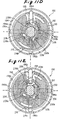
- the four brake members 196 are expressed as first to fourth brake members 196a, 196b, 196c and 196d, while the four projecting portions 208 of the restrict member 200 are expressed as first to fourth projecting portions 208a, 208b, 208c and 208d, respectively.
- Fig. 11A there is shown a state in which the restrict member 200 is operated or rotated to thereby bring the click piece 216 of the restrict member 200 into engagement with the first click groove 214a of the support member 192.
- the first to fourth projecting portions 208a, 208b, 208c and 208d of the restrict member 200 are all engaged with the recessed portions 206 of the first to fourth brake members 196a, 196b, 196c and 196d. That is, the first to fourth brake members 196a, 196b, 196c and 196d are all held in such a manner that they are spaced apart from the brake surface 194a of the annular brake body 194.
- the centrifugal brake device 190 in the fishing line play-out operation, is switched over to a state in which it does not apply a brake force to the spool 106a at all. As a result of this, the spool 106a can be always maintained in a freely rotatable state.
- Fig. 11B there is shown a state in which the restrict member 200 is operated or rotated to thereby bring the click piece 216 thereof into engagement with the second click groove 214a of the support member 192.
- the second to fourth projecting portions 208b, 208c and 208d of the restrict member 200 are respectively engaged with the recessed portions 206 of the second to fourth brake members 196b, 196c and 196d, whereas only the engagement between the first projecting portion 208a and the recessed portion 106 of the first brake member 196a is removed. That is, the second to fourth brake members 196b, 196c and 196d are all held in such a manner that they are spaced apart from the brake surface 194a of the annular brake body 194, whereas only the first brake member 196a is switched over to its contactable state with respect to the brake surface 194a of the annular brake body 194.
- the centrifugal brake device 190 in the fishing line play-out operation, is switched over to a state in which it can bring only the first brake member 196a into sliding contact with the brake surface 194a of the annular brake body 194 to thereby be able to apply a brake force corresponding to the sliding contact force to the spool 106a.
- Fig. 11C there is shown a state in which the restrict member 200 is operated or rotated to thereby bring the click piece 216 thereof into engagement with the third click groove 214c of the support member 192.
- the third and fourth projecting portions 208c and 208d of the restrict member 200 are respectively engaged with the recessed portions 206 of the third and fourth brake members 196c and 196d, whereas the engagement between the first projecting portion 208a and the recessed portion 206 of the first brake member 196a as well as the engagement between the second projecting portion 208b and the recessed portion 206 of the second brake member 196b are removed.
- the third and fourth brake members 196c and 196d are held in such a manner that they are spaced apart from the brake surface 194a of the annular brake body 194, whereas the first and second brake members 196a and 196b are respectively switched over to their respective contactable states with respect to the brake surface 194a of the annular brake body 194.
- the centrifugal brake device 190 in the fishing line play-out operation, is switched over to a state in which it can bring the first and second brake members 196a, 196b into sliding contact with the brake surface 194a of the annular brake body 194 to thereby be able to apply a brake force corresponding to their sliding contact forces to the spool 106a.
- Fig. 11D there is shown a state in which the restrict member 200 is operated or rotated to thereby bring the click piece 216 thereof into engagement with the fourth click groove 214d of the support member 192.
- the centrifugal brake device 190 in the fishing line play-out operation, is switched over to a state in which it can bring the first to third brake members 196a, 196b and 196c into sliding contact with the brake surface 194a of the annular brake body 194 to thereby be able to apply a brake force corresponding to their sliding contact forces to the spool 106a.
- Fig. 11E there is shown a state in which the restrict member 200 is operated or rotated to thereby bring the click piece 216 thereof into engagement with the fifth click groove 214e of the support member 192.
- the first to fourth projecting portions 208a, 208b, 208c and 208d are all disengaged from the recessed portions 206 of the first to fourth brake members 196a, 196b, 196c and 196d. That is, the first to fourth brake members 196a, 196b, 196c and 196d are all held in such a manner that they are contactable with the brake surface 194a of the annular brake body 194.
- the centrifugal brake device 190 in the fishing line play-out operation, is switched over to a state in which it can bring the first to fourth brake members 196a, 196b, 196c and 196d into sliding contact with the brake surface 194a of the annular brake body 194 to thereby apply a brake force corresponding to their sliding contact forces to the spool 106a.
- the restrict member 200 is operated or rotated to thereby selectively engage or disengage the first to fourth projecting portions 208a, 208b, 208c and 208d with respect to the recessed portion 206 of the first to fourth brake members 196a, 196b, 196c and 196d respectively, then a desired number of brake members 196a, 196b, 196c and 196d can be selectively switched over to their respective contactable states or to their respective uncontactable states with respect to the brake surface 194a of the annular brake body 194.
- one or more of the brake members 196a, 196b, 196c and 196d selected can be brought into sliding contact with the brake surface 194a of the annular brake body 194 and a brake force corresponding to their sliding contact forces can be applied to the spool 106a, which makes it possible to adjust finely the brake force that is applied to the spool 106a.
- the selected brake members 196a, 196b, 196c and 196d are not slidingly contacted with the brake surface 194a of the annular brake body 194 instantaneously and with the same force due to the centrifugal force, but the brake members 196a, 196b, 196c and 196d are respectively slidingly contacted with the brake surface 194a of the annular brake body 194 gradually or steadily against the urging forces of the urging springs 198.
- the brake force to be applied to the spool 106a can be adjusted further finely.
- the brake members 196a, 196b, 196c and 196d can be held in such a manner that they are spaced apart from the brake surface 194a of the annular brake body 194, thereby being able to maintain the free rotation of the spool 106a corresponding to the rotation speed (especially, low rotation speed) of the spool 106a in the fishing line play-out operation.
- the fishing reel incorporating the thus structured centrifugal brake device 190 it is possible to carry out a casting operation which can properly deal with the varying conditions (such as, the weight of terminal tackles, a distance up to a fishing point, wind, the skill of an angler, and the like) in an actual fishing spot.
- the varying conditions such as, the weight of terminal tackles, a distance up to a fishing point, wind, the skill of an angler, and the like
- the brake members 196a, 196b, 196c and 196d are switched sequentially in this order over to their respective contactable states with respect to the brake surface 194a of the annular brake body 194.
- the invention is not limited to this but, according to the invention, even if the shape dimensions and arrangements of the projecting portions 208 are changed to thereby change the switching order of the first to fourth brake members 196a, 196b, 196c and 196d, similar operation effects can also be provided.
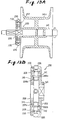
- the centrifugal brake device 290 comprises a support member 292 fixed to the spool shaft 106 in a rotation preventive manner; an annular brake body 294 which is fixed to the reel main body 104 and also in the inner periphery of which there is formed a brake surface 294a; a plurality of brake members 296 which are respectively supported on the support member 292 in a removal preventive manner and can be moved not only in a direction where they approach the brake surface 294a of the annular brake body 294 but also in a direction where they are moved away from the brake surface 294a; a plurality of urging means respectively for holding their respective brake members 296 in such a manner that the brake members 296 are spaced apart from the brake surface 294a of the annular brake body 294 by a given distance, and also for urging the brake members 296 in the direction where the brake members 296 move away from the brake surface 294a of the annular brake body 294 against a centrifugal force acting on
- the number of the brake members 296 can be increased or decreased according to their using objects or the like and, in the present embodiment, there are provided four brake members 296 which are supported on the support member 292 in such a manner as to extend along the peripheral direction of the support member 292 at regular intervals.
- Each of the urging means which are applied to the present embodiment, includes an elastic hold member 300 which is formed in such a manner as to extend out from a plate 298 rotatably mounted on the support member 292 by a given length and also which is used to elastically hold its corresponding brake member 296 with a given elastic force.
- the plate 298 there is formed an arc groove 302 in such a manner as to extend along the peripheral direction thereof; whereas, in the support member 292, there is provided a pawl member 304 in such a manner as to project therefrom. That is, due to the engagement of the pawl member 304 into the arc groove 302, the plate 298 is rotatably mounted on the support member 292.
- Each of the elastic hold members 300 includes a base end portion 300a supported integrally on the plate 298 and an extension end portion 300b extended from the base end portion 300a by a given length, while the elastic hold force of the elastic hold member 300 decreases gradually as it goes from the base end portion 300a to the extension end portion 300b. Also, in each elastic hold member 300, there is formed a substantially U-shaped engaging groove 306 in such a manner that it extends from the base end portion 300a to the extension end portion 300b. In particular, if the brake member 296 is engaged with this engaging groove 306, then the elastic hold member 300 is able to hold the brake member 296 in such a manner that the brake member 296 is spaced apart from the brake surface 294a of the annular brake body 294 by a given distance.
- each brake member 296 includes a sliding contact portion 108 with which the elastic hold member 300 can be slidingly contacted, and a contact portion 310 contactable with hold portions 292a and 298a respectively formed in the support member 292 and plate 298 (especially, see Fig. 13B). That is, if the brake member 296 is engaged with the engaging groove 306 of the elastic hold member 300, then the sliding contact portion 308 of the brake member 296 can be slidingly contacted with the elastic hold member 300 and, at the same time, the contact portion 310 thereof can be contacted with the hold portions 292a and 98a of the support member 292 and plate 298.
- the contact portion 310 of the brake member 296 is restricted in position (in this position restriction, there may be present slight gaps between the contact portion 310 and the hold portions 292a, 298a) in a state where the elastic force of the elastic hold member 300 acts on the hold portions 292a and 298a of the support member 292 and plate 298 and the contact portion 310 is thereby contacted with the hold portions 292a and 298a, or in a state where such elastic force is not cause to act thereon, so that the contact portion 310 of the brake member 296 holds the brake member 296 in such a manner as to be spaced apart from the brake surface 294a of the annular brake body 294 by a given distance.
- the adjusting means that is applied to the present embodiment includes a plurality of engaging recessed portions 112 respectively formed in the support member 292, and a single engaging projecting portion 314 which is provided on the plate 298 and can be engaged with the engaging recessed portions 312; and, the adjusting means is further structured such that, if the plate 298 is rotated to thereby switch the engaging position of the engaging projecting portion 314 with respect to the engaging recessed portions 312, then the holding position of the brake member 296 can be changed with respect to the elastic hold member 300. And, by changing the holding position of the brake member 296, the elastic holding force of the elastic hold member 300 can be adjusted.
- the plate 298 there are formed a plurality of finger guides 316; that is, by putting fingers onto the finger guides 316, the plate 298 can be rotated manually.
- the adjusting means further includes a guide projection 318 which is provided on and projected from the plate 298 and, a guide groove 320 of a given length which is formed in the support member 292 and also into which the guide projection 318 can be freely slided. Due to provision of the guide groove 320, the plate 298 can be rotated by an amount equivalent to the length of the guide groove 320, with the result that, when the plate 298 is rotated, the brake member 296 can be prevented from being removed from the engaging groove 306 of the elastic hold member 300.
- the holding position of the brake member 296 with respect to the elastic hold member 300 can be changed; and, in this holding position changing operation, by bringing the engaging projecting portion 314 of the plate 298 into engagement with the recessed portions 312 of the support member 292, the brake member 296 can be positioned positively at a given holding position with respect to the elastic hold member 300.
- each elastic hold member 300 decreases gradually as it goes from the base end portion 300a thereof to the extension end portion 300b thereof, by changing the holding position of the brake member 296 with respect to the elastic hold member 300 through the adjusting means, an elastic holding force corresponding to the varying conditions (such as, the weight of terminal tackles, a distance up to a fishing point, wind, the skill of an angler, and the like) in an actual fishing spot can be applied to the brake member 296.
- the varying conditions such as, the weight of terminal tackles, a distance up to a fishing point, wind, the skill of an angler, and the like
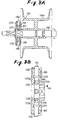
- Figs. 14A and 14B there is shown a state in which the brake members 296 are elastically held by the extension end portions 300b of their corresponding elastic hold members 300.
- the extension end portion 300b of each elastic hold member 300 is the weakest in the elastic holding force and it can be elastically deformed by a centrifugal force (a relatively small centrifugal force) acting on the brake member 296 when the spool 106a is rotating at a relatively low speed.
- the brake member 296 can be slidingly contacted with the brake surface 294a of the annular brake body 294 with an optimum sliding contact force. This makes it possible to maintain the free rotation state of the spool 106a when it is rotating at the lowest speed.
- each elastic hold member 300 is formed in such a manner as to have an elastic holding force of an intermediate level and thus it can be elastically deformed by a centrifugal force (a centrifugal force of a relatively intermediate level) acting on the brake member 296 when the spool 106a is rotating at a middle speed.
- a centrifugal force a centrifugal force of a relatively intermediate level
- the brake member 296 can be slidingly contacted with the brake surface 294a of the annular brake body 294 with an optimum sliding contact force. This makes it possible to maintain the free rotation state of the spool 106a when it is rotating at the low speed.
- each elastic hold member 300 is formed in such a manner as to have the strongest holding force and it can be elastically deformed by a centrifugal force (a centrifugal force of a relatively large level) acting on the brake member 296 when the spool 106a is rotating at a relatively high speed.
- a centrifugal force a centrifugal force of a relatively large level
- the brake member 296 can be slidingly contacted with the brake surface 294a of the annular brake body 294 with an optimum sliding contact force. This makes it possible to maintain the free rotation state of the spool 106a when it is rotating at the low and middle speeds.
- the elastic holding force that corresponds to the varying conditions such as, the weight of terminal tackles, a distance up to a fishing point, wind, the skill of an angler, and the like
- the brake force to be given to the spool 106a during rotation of the spool 106a can be adjusted finely.
- the terminal tackles can be thrown up to a desired point smoothly and positively, so that the efficiency of the casting operation can be enhanced.
- the invention is not limited to the third embodiment but can be changed or modified variously in the following manner:
- urging means including a long-plate-shaped elastic hold member 300 may be provided and the brake member 296 may be secured to the one-side edge portion 322 of the elastic hold member 300, whereby the brake member 296 can be held in such a manner that it is spaced apart from the brake surface 294a of the annular brake body 294 by a given distance.
- the simplified shape of the elastic hold member 300 makes it possible to facilitate the molding of the elastic hold member 300 as well as the assembling of the centrifugal brake device 290.
- the other operations and effects of the first modification are similar to those of the third embodiment and thus the description thereof is omitted here.
- the urging means is structured such that it includes the elastic hold member 300 formed integrally with the plate 298.
- the urging means can also be structured in different manners.
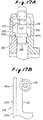
- the urging means includes a rigid body 326 rotatably mounted on the plate 298 through a screw 324, and a coiled compression spring 328 for elastically holding the rigid body 326 in such a manner that it can be moved with the screw 324 as a fulcrum thereof.
- the rigid body 326 is composed of a hold portion 330 which is extended on the one-end side thereof with the screw 324 as a fulcrum thereof, and a support portion 332 extended on the other-end side thereof.
- the hold portion 330 is formed in a long-plate shape, and includes a base end portion 330a connected to the plate 298 through the screw 324 and an extension end portion 330b which is extended from the base end portion 330a by a given length.
- the support portion 332 there is connected the coiled compression spring 328 which is fixed to the plate 298.
- the hold portion 330 is structured such that the brake member 296 can be secured to the one-side edge portion 334 of the hold portion 330.
- the hold portion 330 for example, as shown in Fig. 16B, there can also be employed a structure that the brake member 296 is engaged with a substantially U-shaped engaging groove.
- the compression force of the coiled compression spring 328 acts on the hold portion 330 centering on the screw 324 serving as the fulcrum and, therefore, as it goes from the base end portion 330a toward the extension end portion 330b, the elastic holding force thereof decreases successively.
- the other portions of the present modification are similar to those of the third embodiment and, therefore, they are given the same designations and thus the description thereof is omitted here.
- the elastic holding forces corresponding to the varying conditions in an actual fishing spot can be applied to the brake members 296.
- the urging means includes an urging mechanism which is disposed in a plate 336 unrotatably fixed to the support member 292 and holds its corresponding brake member 296 with a given urging force.
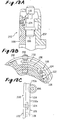
- a coiled tension spring 338 which holds the brake member 296 in such a manner that the brake member 296 is spaced apart from the brake surface 294a of the annular brake body 294: that is, using the tensile force of the coiled tension spring 338, the base end portion 296a of the brake member 296 is contacted with the contact portions 292a and 336a of the support member 292 and plate 336, thereby being able to hold the brake member 296 in such a manner that the brake member 296 is spaced apart from the brake surface 294a of the annular brake body 294.
- one end thereof is connected to the base end portion 296a of the brake member 296, whereas the other end thereof is connected to adjusting means which will be discussed later.
- adjusting means employed in the third modification includes a support column 340 to which the other end of the coiled tension spring 338 is connected, and a rotary body 342 which supports the support column 340 in a swingable manner, while the rotary body 342 is screwed to an adjust knob 344 which is exposed to the outside of the plate 336.
- the rotary body 342 is rotatably stored within a circular groove 346 formed in the plate 336.
- the adjust knob 344 is structured such that it can be rotated by hand: that is, if the adjust knob 344 is rotated manually (see a two-dot chained line shown in Fig. 19B) to thereby swing the support column 340, then the coiled tension spring 338 can be expanded and contracted.
- a click mechanism 348 by means of which the adjust knob 344 (rotary body 342) can be made to stand still at a desired rotation position.
- the click mechanism 348 for example, there can be formed a single click pawl in an outer periphery of the rotary body 342 and a plurality of click grooves (not shown) each of which can be engaged with the click pawl in the inner periphery of the circular groove 346.
- the adjust knob 344 is operated or rotated to thereby swing the support column 340 by a given amount, then the coiled tension spring 338 can be expanded and contracted by a given amount, so that the brake member 296 can be held in such a manner that it is urged with a given tensile force.
- the tensile force to be applied to the brake member 296 can be made to vary finely, which makes it possible to adjust finely the sliding contact force necessary to bring the brake member 296 into sliding contact with the brake surface 294a of the annular brake body 294 against the tensile force of the coiled tension spring 338 during rotation of the spool 106a.
- a fishing reel which can adjust finely the brake force to be applied the spool 106a during the rotation of the spool 106a; that is, it is possible to provide a fishing reel which is improved in the efficiency of the casting operation.
- the brake force to be applied to the spool 106a can be adjusted further finely.
- a fishing reel which can control or adjust finely a brake force to be applied to a spool during rotation of the spool, thereby being able to carry out a casting operation with high efficiency.
Landscapes
- Life Sciences & Earth Sciences (AREA)
- Environmental Sciences (AREA)
- Animal Husbandry (AREA)
- Biodiversity & Conservation Biology (AREA)
Applications Claiming Priority (9)
| Application Number | Priority Date | Filing Date | Title |
|---|---|---|---|
| JP31151597 | 1997-10-27 | ||
| JP31151597A JP3581544B2 (ja) | 1997-10-27 | 1997-10-27 | 魚釣用リ−ル |
| JP311515/97 | 1997-10-27 | ||
| JP218936/98 | 1998-08-03 | ||
| JP21893698 | 1998-08-03 | ||
| JP21893698A JP3525056B2 (ja) | 1998-08-03 | 1998-08-03 | 魚釣用リール |
| JP25113898 | 1998-09-04 | ||
| JP251138/98 | 1998-09-04 | ||
| JP25113898A JP3525059B2 (ja) | 1998-09-04 | 1998-09-04 | 魚釣用リール |
Publications (2)
| Publication Number | Publication Date |
|---|---|
| EP0910946A2 true EP0910946A2 (de) | 1999-04-28 |
| EP0910946A3 EP0910946A3 (de) | 2000-02-02 |
Family
ID=27330217
Family Applications (1)
| Application Number | Title | Priority Date | Filing Date |
|---|---|---|---|
| EP98120260A Withdrawn EP0910946A3 (de) | 1997-10-27 | 1998-10-26 | Angelrolle |
Country Status (4)
| Country | Link |
|---|---|
| US (1) | US7086621B1 (de) |
| EP (1) | EP0910946A3 (de) |
| KR (1) | KR100310260B1 (de) |
| CN (1) | CN1214713C (de) |
Cited By (1)
| Publication number | Priority date | Publication date | Assignee | Title |
|---|---|---|---|---|
| GB2563120A (en) * | 2017-04-26 | 2018-12-05 | Shimano Kk | Spinning reel |
Families Citing this family (6)
| Publication number | Priority date | Publication date | Assignee | Title |
|---|---|---|---|---|
| JP4403027B2 (ja) * | 2004-06-25 | 2010-01-20 | 株式会社シマノ | 両軸受リールの遠心制動装置 |
| JP5350881B2 (ja) * | 2009-05-15 | 2013-11-27 | 株式会社シマノ | 両軸受リールのスプール制動装置 |
| CN102180388B (zh) * | 2011-04-15 | 2013-01-30 | 马鞍山鼎泰稀土新材料股份有限公司 | 离心式收线轮 |
| CN103380765B (zh) * | 2012-05-04 | 2015-02-04 | Doyo工程有限公司 | 具备精密离心制动系统的鱼线轮 |
| JP6267937B2 (ja) * | 2013-11-08 | 2018-01-24 | 株式会社シマノ | 両軸受リールのドラグ装置 |
| US11974558B2 (en) * | 2021-12-21 | 2024-05-07 | Accurate Grinding and Mfg. Corp. | Star drag fishing reel |
Citations (4)
| Publication number | Priority date | Publication date | Assignee | Title |
|---|---|---|---|---|
| JPS56100187U (de) | 1979-12-28 | 1981-08-07 | ||
| JPS57202234A (en) | 1981-06-04 | 1982-12-11 | Shimano Industrial Co | Fishing reel |
| JP2535505Y2 (ja) | 1991-06-19 | 1997-05-14 | 株式会社シマノ | リールのブレーキ構造 |
| JPH09275860A (ja) | 1996-04-12 | 1997-10-28 | Isuzu Kogyo Kk | 釣り用リールのブレーキ構造 |
Family Cites Families (14)
| Publication number | Priority date | Publication date | Assignee | Title |
|---|---|---|---|---|
| US467849A (en) * | 1892-01-26 | Fishing-reel | ||
| US871167A (en) * | 1906-09-28 | 1907-11-19 | David F Anderson | Fishing-reel. |
| US948026A (en) * | 1909-07-14 | 1910-02-01 | John H Scotchmer | Fishing-reel. |
| GB191405531A (en) * | 1914-03-04 | 1914-11-05 | Hardy Brothers Alnwick Ltd | Improvements in Fishing Reels. |
| US1347529A (en) * | 1919-03-18 | 1920-07-27 | John A Wherry | Fishing-reel |
| US2967676A (en) * | 1955-12-15 | 1961-01-10 | Klingberg Anders Ingemar | Braking device for fishing reels |
| US3477659A (en) * | 1965-04-28 | 1969-11-11 | K P Morritt Ltd | Rotatable spool fishing reel |
| DE2966777D1 (en) | 1978-05-19 | 1984-04-19 | Faigle Heinz Kg | Tribological systems composed of sliding surfaces consisting of plastics |
| HU188150B (en) * | 1981-10-19 | 1986-03-28 | Magyar Optikai Muevek,Hu | Automatic anti-runback device e.g. for fishing reels |
| US4601438A (en) * | 1985-04-29 | 1986-07-22 | Charles C. Worth Corporation | Bait casting reel with braking device |
| JP2572090Y2 (ja) * | 1991-12-18 | 1998-05-20 | 株式会社シマノ | 両軸受リール |
| JP2572095Y2 (ja) * | 1992-01-28 | 1998-05-20 | 株式会社シマノ | 両軸受リール |
| US5542619A (en) * | 1994-12-01 | 1996-08-06 | Abu Ab | Fishing reel of the multiplier type |
| JP3159625B2 (ja) * | 1995-05-24 | 2001-04-23 | ダイワ精工株式会社 | 魚釣用リールの制動装置 |
-
1998
- 1998-10-26 KR KR1019980044815A patent/KR100310260B1/ko not_active Expired - Fee Related
- 1998-10-26 EP EP98120260A patent/EP0910946A3/de not_active Withdrawn
- 1998-10-27 US US09/179,465 patent/US7086621B1/en not_active Expired - Fee Related
- 1998-10-27 CN CNB981235409A patent/CN1214713C/zh not_active Expired - Fee Related
Patent Citations (4)
| Publication number | Priority date | Publication date | Assignee | Title |
|---|---|---|---|---|
| JPS56100187U (de) | 1979-12-28 | 1981-08-07 | ||
| JPS57202234A (en) | 1981-06-04 | 1982-12-11 | Shimano Industrial Co | Fishing reel |
| JP2535505Y2 (ja) | 1991-06-19 | 1997-05-14 | 株式会社シマノ | リールのブレーキ構造 |
| JPH09275860A (ja) | 1996-04-12 | 1997-10-28 | Isuzu Kogyo Kk | 釣り用リールのブレーキ構造 |
Cited By (2)
| Publication number | Priority date | Publication date | Assignee | Title |
|---|---|---|---|---|
| GB2563120A (en) * | 2017-04-26 | 2018-12-05 | Shimano Kk | Spinning reel |
| GB2563120B (en) * | 2017-04-26 | 2022-04-20 | Shimano Kk | Spinning reel |
Also Published As
| Publication number | Publication date |
|---|---|
| CN1215551A (zh) | 1999-05-05 |
| EP0910946A3 (de) | 2000-02-02 |
| KR100310260B1 (ko) | 2001-12-28 |
| US7086621B1 (en) | 2006-08-08 |
| KR19990037378A (ko) | 1999-05-25 |
| CN1214713C (zh) | 2005-08-17 |
Similar Documents
| Publication | Publication Date | Title |
|---|---|---|
| US6286773B1 (en) | Double bearing reel having improved drag mechanism configuration | |
| KR101951264B1 (ko) | 듀얼 베어링 릴의 스풀 제동 장치 및 듀얼 베어링 릴 | |
| JP3159625B2 (ja) | 魚釣用リールの制動装置 | |
| US6530535B2 (en) | Fishing reel | |
| US5601246A (en) | Adjustable thumb placement member for a fishing reel | |
| EP0910946A2 (de) | Angelrolle | |
| EP0707791B1 (de) | Doppelt gelagerte Angelrolle | |
| US20070007377A1 (en) | Fishing reel | |
| US4402469A (en) | Self-aligning drag drive for fishing reels | |
| US8695910B2 (en) | Fishing reel having externally controllable brake system | |
| EP0707790B1 (de) | Rücklaufsperre für Angelrolle | |
| JPH10304799A (ja) | 両軸受けリールの遠心制動装置 | |
| US5139212A (en) | Fishing reel | |
| US6247663B1 (en) | Reel for fishing | |
| KR100671948B1 (ko) | 양 베어링 릴의 제동장치 | |
| US4101087A (en) | Braking device in a non-rotary type fishing reel | |
| US6056222A (en) | Spinning reel anti-reverse device | |
| JPH10178982A (ja) | 魚釣り用両軸受リール | |
| JP3198234B2 (ja) | 魚釣用リール | |
| US4738409A (en) | Fishing reel | |
| JP3525056B2 (ja) | 魚釣用リール | |
| US4545545A (en) | Drag for spinning reels | |
| JP2001095442A (ja) | 魚釣用リール | |
| EP0071686A2 (de) | Hinten angebrachte Bremse für Wurfangelwinden | |
| JP3525059B2 (ja) | 魚釣用リール |
Legal Events
| Date | Code | Title | Description |
|---|---|---|---|
| PUAI | Public reference made under article 153(3) epc to a published international application that has entered the european phase |
Free format text: ORIGINAL CODE: 0009012 |
|
| AK | Designated contracting states |
Kind code of ref document: A2 Designated state(s): DE FR GB |
|
| AX | Request for extension of the european patent |
Free format text: AL;LT;LV;MK;RO;SI |
|
| PUAL | Search report despatched |
Free format text: ORIGINAL CODE: 0009013 |
|
| AK | Designated contracting states |
Kind code of ref document: A3 Designated state(s): AT BE CH CY DE DK ES FI FR GB GR IE IT LI LU MC NL PT SE |
|
| AX | Request for extension of the european patent |
Free format text: AL;LT;LV;MK;RO;SI |
|
| 17P | Request for examination filed |
Effective date: 20000314 |
|
| AKX | Designation fees paid |
Free format text: DE FR GB |
|
| 17Q | First examination report despatched |
Effective date: 20030507 |
|
| STAA | Information on the status of an ep patent application or granted ep patent |
Free format text: STATUS: THE APPLICATION IS DEEMED TO BE WITHDRAWN |
|
| 18D | Application deemed to be withdrawn |
Effective date: 20030918 |