EP0911088A2 - Verfahren zur Beschichtung von Oberflächen - Google Patents
Verfahren zur Beschichtung von Oberflächen Download PDFInfo
- Publication number
- EP0911088A2 EP0911088A2 EP98119873A EP98119873A EP0911088A2 EP 0911088 A2 EP0911088 A2 EP 0911088A2 EP 98119873 A EP98119873 A EP 98119873A EP 98119873 A EP98119873 A EP 98119873A EP 0911088 A2 EP0911088 A2 EP 0911088A2
- Authority
- EP
- European Patent Office
- Prior art keywords
- coating
- metallic
- molecules
- groups
- coated
- Prior art date
- Legal status (The legal status is an assumption and is not a legal conclusion. Google has not performed a legal analysis and makes no representation as to the accuracy of the status listed.)
- Withdrawn
Links
Images


Classifications
-
- B—PERFORMING OPERATIONS; TRANSPORTING
- B05—SPRAYING OR ATOMISING IN GENERAL; APPLYING FLUENT MATERIALS TO SURFACES, IN GENERAL
- B05D—PROCESSES FOR APPLYING FLUENT MATERIALS TO SURFACES, IN GENERAL
- B05D1/00—Processes for applying liquids or other fluent materials
- B05D1/18—Processes for applying liquids or other fluent materials performed by dipping
- B05D1/185—Processes for applying liquids or other fluent materials performed by dipping applying monomolecular layers
-
- B—PERFORMING OPERATIONS; TRANSPORTING
- B05—SPRAYING OR ATOMISING IN GENERAL; APPLYING FLUENT MATERIALS TO SURFACES, IN GENERAL
- B05D—PROCESSES FOR APPLYING FLUENT MATERIALS TO SURFACES, IN GENERAL
- B05D3/00—Pretreatment of surfaces to which liquids or other fluent materials are to be applied; After-treatment of applied coatings, e.g. intermediate treating of an applied coating preparatory to subsequent applications of liquids or other fluent materials
- B05D3/06—Pretreatment of surfaces to which liquids or other fluent materials are to be applied; After-treatment of applied coatings, e.g. intermediate treating of an applied coating preparatory to subsequent applications of liquids or other fluent materials by exposure to radiation
- B05D3/061—Pretreatment of surfaces to which liquids or other fluent materials are to be applied; After-treatment of applied coatings, e.g. intermediate treating of an applied coating preparatory to subsequent applications of liquids or other fluent materials by exposure to radiation using U.V.
-
- B—PERFORMING OPERATIONS; TRANSPORTING
- B82—NANOTECHNOLOGY
- B82Y—SPECIFIC USES OR APPLICATIONS OF NANOSTRUCTURES; MEASUREMENT OR ANALYSIS OF NANOSTRUCTURES; MANUFACTURE OR TREATMENT OF NANOSTRUCTURES
- B82Y30/00—Nanotechnology for materials or surface science, e.g. nanocomposites
-
- B—PERFORMING OPERATIONS; TRANSPORTING
- B82—NANOTECHNOLOGY
- B82Y—SPECIFIC USES OR APPLICATIONS OF NANOSTRUCTURES; MEASUREMENT OR ANALYSIS OF NANOSTRUCTURES; MANUFACTURE OR TREATMENT OF NANOSTRUCTURES
- B82Y40/00—Manufacture or treatment of nanostructures
-
- H—ELECTRICITY
- H10—SEMICONDUCTOR DEVICES; ELECTRIC SOLID-STATE DEVICES NOT OTHERWISE PROVIDED FOR
- H10P—GENERIC PROCESSES OR APPARATUS FOR THE MANUFACTURE OR TREATMENT OF DEVICES COVERED BY CLASS H10
- H10P14/00—Formation of materials, e.g. in the shape of layers or pillars
- H10P14/60—Formation of materials, e.g. in the shape of layers or pillars of insulating materials
-
- Y—GENERAL TAGGING OF NEW TECHNOLOGICAL DEVELOPMENTS; GENERAL TAGGING OF CROSS-SECTIONAL TECHNOLOGIES SPANNING OVER SEVERAL SECTIONS OF THE IPC; TECHNICAL SUBJECTS COVERED BY FORMER USPC CROSS-REFERENCE ART COLLECTIONS [XRACs] AND DIGESTS
- Y10—TECHNICAL SUBJECTS COVERED BY FORMER USPC
- Y10T—TECHNICAL SUBJECTS COVERED BY FORMER US CLASSIFICATION
- Y10T428/00—Stock material or miscellaneous articles
- Y10T428/12—All metal or with adjacent metals
- Y10T428/12007—Component of composite having metal continuous phase interengaged with nonmetal continuous phase
-
- Y—GENERAL TAGGING OF NEW TECHNOLOGICAL DEVELOPMENTS; GENERAL TAGGING OF CROSS-SECTIONAL TECHNOLOGIES SPANNING OVER SEVERAL SECTIONS OF THE IPC; TECHNICAL SUBJECTS COVERED BY FORMER USPC CROSS-REFERENCE ART COLLECTIONS [XRACs] AND DIGESTS
- Y10—TECHNICAL SUBJECTS COVERED BY FORMER USPC
- Y10T—TECHNICAL SUBJECTS COVERED BY FORMER US CLASSIFICATION
- Y10T428/00—Stock material or miscellaneous articles
- Y10T428/31504—Composite [nonstructural laminate]
- Y10T428/31678—Of metal
-
- Y—GENERAL TAGGING OF NEW TECHNOLOGICAL DEVELOPMENTS; GENERAL TAGGING OF CROSS-SECTIONAL TECHNOLOGIES SPANNING OVER SEVERAL SECTIONS OF THE IPC; TECHNICAL SUBJECTS COVERED BY FORMER USPC CROSS-REFERENCE ART COLLECTIONS [XRACs] AND DIGESTS
- Y10—TECHNICAL SUBJECTS COVERED BY FORMER USPC
- Y10T—TECHNICAL SUBJECTS COVERED BY FORMER US CLASSIFICATION
- Y10T436/00—Chemistry: analytical and immunological testing
- Y10T436/25—Chemistry: analytical and immunological testing including sample preparation
Definitions
- the invention relates to a new method for coating a metallic or semi-metallic surface as well as a structured coated surface.
- EP-A-0 664 452 describes the covalent bond of Silicic acid compounds on the OH groups of an oxidized Silicon surface described.
- a disadvantage of these methods is that that the surface is chemically pretreated before coating must and undesirable crosslinking reactions can also take place.
- the present invention was therefore based on the object of a method to provide for the coating of metallic surfaces, which the does not have disadvantages occurring in the prior art.
- the object is achieved by a method for Coating a metallic or semi-metallic surface, which is characterized in that coating molecules, the reactive Groups contain covalently to the surface by irradiation with light binds.
- reactive group means in the context of the present invention that under suitable conditions and at Irradiation with light of a suitable wavelength forms a covalent bond reactive group to a surface.
- the binding of the coating molecules to the surface can be done on a direct photoactivation of reactive groups in the coating molecules are based. Furthermore, the bond can also be through
- the surface itself is photoactivated if it is reactive, e.g. groups activated by light, e.g. Metal or / and Contains semimetal hydride compounds such as silicon hydride.
- Light activated groups of the surface are then able to be covalent Enter into bonds with reactive groups of the coating molecules.
- a combination of both reaction mechanisms, i.e. Photoactivation the coating molecules and photoactivation of the surface is possible.
- the surfaces to be coated have a metallic or semi-metallic character and can be one or more metals, Semi-metals or / and metallic or semi-metallic compounds include.
- suitable elements that have a metallic or form semi-metallic surface are the metals and semi-metals of Groups 3 to 16 of the periodic table. Particularly preferred examples are silicon, germanium and metallic compounds that contain these elements contain.
- Examples of surfaces that span more than one element are alloys that are two or more metals and / or semi-metals include.
- An example of a connection that has a metallic character is gallium arsenide.
- the surface is particularly preferably one hydrogenated surface, i.e. the metal or / and semimetal atoms of the Surface layers are at least partially bound to hydrogen.
- a An example of a metal or semimetal hydride is silicon hydride. Both metallic surfaces used according to the invention especially around surfaces that do not contain oxidized elements or Have connections.
- the molecules containing reactive groups are covalently bonded to the metallic or semi-metallic surface, for example via a surface element-carbon or surface element-oxygen bond.
- the molecules used can in principle include any reactive group, ie a group which can be converted directly or / and due to interactions with the surface into a reactive species, in particular into a radical, by irradiation with light.
- predetermined, defined and uniform coatings can be obtained with the process according to the invention.
- the coating molecules bound to the surface via a carbon atom.
- the process according to the invention makes coated metallic or semi-metallic surfaces manufactured for a variety of Applications, e.g. for the production of microelectronic Components, as well as for applications in diagnostics and medicine.
- Applications for functionalized surfaces by chemical Coupling of coating molecules to the surface have been e.g. in WO 92/10092, Fodor et al. (Nature 364 (1993), 555-556) and Cheng and Stevens (Adv. Mater. 9 (1997), 481-483).
- photoactivation according to the invention coated surfaces there are also photoactivation according to the invention coated surfaces.
- molecules are advantageously used for the coating which, in addition to one or more reactive groups, contain at least one further functional group.
- the further functional group is preferably selected from haptens, biotin, chelation groups, nucleotides, nucleic acids, nucleic acid analogs, polyethylene glycol, conjugated ⁇ systems, charged groups, nonlinear optical structures, crosslinkable groups, electrically conductive groups, amino acids, peptides and polypeptides.
- Molecules can be used for applications in microelectronics that include conjugated ⁇ systems. Especially with such Connections is the activation known in the prior art with Peroxides disadvantageous because the occurrence of undesirable radicals Side reactions are observed.
- Peroxides disadvantageous because the occurrence of undesirable radicals Side reactions are observed.
- the radiation according to the invention with light of a defined wavelength it is possible to be selective those reactive groups that bind to the metallic surface are intended to be activated and at the same time additional groups, e.g. ⁇ bonds or conjugated ⁇ bonds in the molecule.
- Organic conjugated ⁇ systems are preferred Molecules polyenes, aromatics e.g. Polyphenylenes, heterocycles, e.g. Polyheteroaryls and / or polyacetylenes are used.
- crosslinkable groups such as double bonds, e.g. Acrylic esters and / or triple bonds
- Crosslinking can also take place via oxidation, e.g. B. from sulfur-containing groups such as thiol or thiophene groups.
- polypeptides and / or biotin specifically bindable solid phases are formed, for example in diagnostic procedures, e.g. B. immunoassays can be used.
- nucleic acids or Nucleic acid analogs such as peptide nucleic acids Get surfaces, for example, for nucleic acid hybridization tests are suitable.
- polyethylene glycol or other inert molecules can be chemically inert and resistant surfaces as well as biocompatible Surfaces, e.g. made for use as implant surfaces become.
- Electrically conductive group and certain polypeptides e.g. Bacteriorhodopsin are particularly suitable for electronic ones Applications.
- the other functional groups can during the binding of the organic molecules to the surface if necessary Protecting groups are blocked. However, such blocking is often not required if the wavelength used for photoactivation can be selected so that the photoactivatable group is activated the other functional group, however, is in the wavelength range of incident light does not respond.
- a metallic or semi-metallic surface is preferably used, the at least one element selected from B, Al, Ga, Si, Ge and As includes.
- a surface is particularly preferred Silicon hydride surface used. Such a surface can for example by etching oxidized Si (111) with ammonium fluoride (G. J. Pietsch, Appl. Phys. A: Mater. Sci. Process. A 60 (1995) 367-363; G. J. Pietsch, Structure and Chemistry of Technological Silicon surfaces, VDI progress reports series 9, 148, VDI-Verlag, Düsseldorf 1992).
- the coating is preferably carried out in an inert gas atmosphere, for example under argon.
- the light source used for the irradiation in the method according to the invention must be of sufficient intensity to be sufficient To achieve coating efficiency. Basically is for the coating suitable for any kind of light source, e.g. Lamps such as an HBO lamp. However, the use of lasers has proven to be particularly favorable proven.
- the light source is able to light one defined wavelength or a defined wavelength range to radiate. This can be done by using monochromatic Light sources such as a laser or corresponding filter reached become. When using monochromatic light or a light with a narrow, defined wavelength range, it succeeds in selective Way, the photoactivatable groups of the coating molecules or / and to excite the surface while others in the coating molecules contained functional groups are not affected.
- Light with a wavelength in the range of 350 is preferably used to 400 nm, in particular from 370 to 395 nm.
- the radiation duration and intensity depends on the desired degree of coverage, the metallic or semi-metallic used Surface, the coating molecules used and the Reaction conditions. Usually you get the desired one Results when irradiated for a period of 1 minute to 30 Hours.
- one over the coating area laterally homogeneous layer of coating molecules, preferably a monolayer.
- a single species of Coating molecules but also a mixture of several species of Coating molecules are used.
- one species of Coating molecules specifically with a free reactant bindable group e.g. Biotin, hapten, polypeptide, nucleic acid etc.
- a free reactant bindable group e.g. Biotin, hapten, polypeptide, nucleic acid etc.
- the molar ratio of functional coating molecules to Diluent is preferably from 1: 100 to 100: 1.
- a major advantage of the method according to the invention is that it is possible to selectively and precisely define certain areas of a surface coat.
- a metallic or semi-metallic surface selectively in the smallest spatial areas up to be coated in the micrometer range.
- coating molecules which contain electrically conductive groups, at desired Locations are applied by radiation, so that one in the Microelectronic usable circuit arises.
- lasers and / or focusing optics can be a problem structured coating also through the use of masks or / and optical gratings are applied. That way it is possible, coated metallic surfaces with any to generate predetermined patterns.
- the method according to the invention is particularly suitable for the production of array structures that used for example in diagnostics for the production of biosensors can be.
- molecules to the specifically bindable groups have, such as haptens, biotins, nucleobases, nucleic acids, Nucleic acid analogs, polypeptides and the like can be used on coated surfaces for diagnostics.
- biocompatible organic molecules it is possible to create surfaces that are made of one material exist, which is rejected by the body, biocompatible do.
- Another object of the invention is a coated object comprising a carrier with a metallic or semi-metallic surface and coating molecules covalently bonded thereto, which is characterized in that the surface has an arrangement of coated and uncoated areas.
- the coated areas are preferably miniaturized, ie they have an area of 1 ⁇ m 2 to 10 mm 2 , particularly preferably 10 ⁇ m 2 to 1 mm 2 .
- a structured coated surface can be obtained with the method according to the invention.
- a surface with a defined coating pattern can be produced, in which the coating is applied only in predetermined areas of the surface.
- the surface preferably has an array structure.
- the surface preferably comprises coating molecules which contain at least one further functional group, or mixtures of functional coating molecules with inert diluent molecules.
- suitable functional groups can be used as described above.
- Si-H surface was formed by etching oxidized Si (111) wafers Ammonium fluoride produced by known methods (G. J. Pietsch, Appl. Phys. A: Mater. Sci. Process. A 60 (1995) 347-363; G. J. Pietsch, Structure and chemistry of technological silicon surfaces, VDI progress reports, Row 9, 148, VDI-Verlag, Düsseldorf 1992).
- the Silicon wafers (Si (111) p-type) were manufactured by Wacker-Chemitronic GmbH and Siltronix.
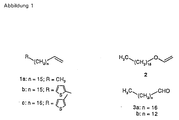
- the H-terminated silicon surface etched with fluoride ions became the pure compounds 1, 2 and 3 (see FIG. 1) in a glass cuvette and irradiated for 20 to 24 hours in an inert gas atmosphere.
- Test conditions used resulted in an optimal response time of 20 to 24 hours, with shorter or longer reaction times in one reduced coverage resulted.
- the formation of self-assembling Monolayers were initiated by irradiating an HBO lamp (150 W). Then the silicon substrate was removed, several times with Dichloromethane rinsed and wiped with cotton to physically remove adsorbed material.
- the inventive Process approximately the same degree of coating for alkenes can be achieved as with the method known in the prior art using Peroxides, being careful of these dangerous and unspecific chemical reagents can be dispensed with.
- the monolayer formation also with the pure ⁇ -thienyl-substituted 1-alkenes 1b and c and with the hexadecyl vinyl ether 2 by irradiation under comparable conditions examined. It was also found that even a slight dilution of the 1-alkenes with an alkane as Solvent the formation of the self-assembling monolayer clearly affects what results in less coverage.
- the usage a mixture comprising nine parts of compound 1a and one part For example, hexadecane has a coverage of only 20%.
- Example 1 The experiment described in Example 1 was carried out under the same conditions as described for compound 1a, except that pure 1-octadecanal (3a) (R. Redcliff et al., J. Org. Chem. 35 (1970), 4000) was used as the coating molecule -4002) was used.
- High-resolution AFM images (50x50nm 2 ) showed that a homogeneous self-assembling monolayer with a high degree of coverage of 97% based on 100% coverage with octadecyltrichlorosilane (OTS) is obtained.
- a monolayer of compound 3a is shown schematically in FIG.
- Example 4 Formation of a Self-Assembling Monolayer of Aldehydes as a function of the irradiation time.
- Example 1 The H-terminated Si surface prepared as in Example 1 was cleaned Put octadecanal (compound 3a) in a glass cuvette. She was on Heated to 70 ° C and for the time periods specified in Table 3 irradiated with polychromatic light. The surface was removed and cleaned as described in Example 1.
- the light-induced production of self-assembly monolayers according to the invention enables a when using suitable masks direct structuring of surfaces.
- Particularly suitable as a mask are films that are used in the manufacture of circuit boards.
- the structures of the masks were created using the Freehand computer program 5.0 drawn and directly with a laser-assisted photo typesetting system (Linotronic 530, Linotype-Hell, resolution 2540 dots / inch) on polymer films (Fuji laser recorder film F100) printed. Then the SiH substrate was with covered the mask, added octadecanal and melted. The Monolayer formation and cleaning was carried out as previously described.
- Uncoated silicon Due to the different wettability of the coated or Uncoated silicon can be used to structure the silicon surface Also visible for viewing with the naked eye or in a microscope do.
Landscapes
- Engineering & Computer Science (AREA)
- Chemical & Material Sciences (AREA)
- Nanotechnology (AREA)
- Physics & Mathematics (AREA)
- Condensed Matter Physics & Semiconductors (AREA)
- General Physics & Mathematics (AREA)
- Crystallography & Structural Chemistry (AREA)
- Plasma & Fusion (AREA)
- Composite Materials (AREA)
- Materials Engineering (AREA)
- Manufacturing & Machinery (AREA)
- Application Of Or Painting With Fluid Materials (AREA)
- Physical Or Chemical Processes And Apparatus (AREA)
- Chemical Treatment Of Metals (AREA)
- Paints Or Removers (AREA)
Abstract
Description
- Figur 1
- zeigt die Verbindungen 1 bis 3, die zur Beschichtung von Metalloberflächen eingesetzt wurden. Bei den Verbindungen 1a, 1b und 1c handelt es sich um Alkene, bei der Verbindung 2 um einen Vinylether und bei den Verbindungen 3a und 3b jeweils um einen Aldehyd.
- Figur 2
- zeigt schematisch die Bildung einer Schicht von Octadecanal 3a auf einer H-terminierten Si-(111) Oberfläche.
- Figur 3
- zeigt die Abhängigkeit des Bedeckungsgrads einer Tetradecanal-Schicht auf einer Si-Oberfläche von der eingestrahlten Wellenlänge.
- Figur 4
- zeigt die Abhängigkeit des Bedeckungsgrades einer Octadecen-Schicht auf einer Si-Oberfläche von der eingestrahlten Wellenlänge.
| Reaktanten | Reaktionszeit (Stunden) | Temperatur (°C) | V as (CH2) (cm-1) | Bedeckung (%) | Kontaktwinkel Θa(H2O) (Grad) |
| [C17H35C(O)O]2 | 1,5 | 100 | 2918,7 | 50,5 | 91 |
| [C17H35C[O]O]2/ 1a (1:1) | 1,0 | 102 | 2918,6 | 57 | 96 |
| [C17H35C(O)O]2/ 1a (1:9) | 1,5 | 101,0 | 2920,0 | 48 | 91 |
| OTS | 15 | 20 | 2917,7 | 100 | 106 |
| 1a | 24 | 20-50 | 2920,5 | 55 | 95 |
| 1a | 20 | 20-50 | 2922,4 | 21 | - |
| 1b | 13 | 20-50 | 2920,0 | 40 | - |
| 1c | 20 | 20-50 | 2921,6 | 29 | - |
| 2 | 20 | 30 | 2921,0 | 45 | 80 |
| Wellenlänge (nm) | Bestrahlungsdauer (h) | v as(CH2) (cm-1) | Fläche v s und v as (CH2) | Bedeckungsgrad (%) |
| 355 | 15,5 | 2922 | 0,0297 | 46 |
| 365 | 16,5 | 2925 | 0,03468 | 53 |
| 375 | 16,8 | 2922 | 0,03069 | 48 |
| 380 | 14,8 | 2921 | 0,03652 | 57 |
| 385 | 16,4 | 2920 | 0,0656 | 103 |
| 395 | 16,0 | 2922 | 0,03207 | 50 |
| 405 | 14,5 | - | - | 0 |
| 415 | 15,0 | - | - | 0 |
| Bestrahlungsdauer (min) | v as(CH2) (cm-2) | Fläche v s und v as (CH2) | Bedeckungsgrad (%) |
| 1 | 2922 | 0,0357 | 39 |
| 3 | 2918 | 0,0746 | 82 |
| 5 | 2917 | 0,0943 | 103 |
| 30 | 2916 | 0,0975 | 106 |
| 60 | 2916 | 0,0978 | 107 |
| 120 | 2916 | 0,0833 | 91 |
Claims (11)
- Verfahren zur Beschichtung einer metallischen oder halbmetallischen Oberfläche,
dadurch gekennzeichnet,
daß man Beschichtungsmoleküle, die reaktive Gruppen enthalten, durch Bestrahlung mit Licht kovalent an die Oberfläche bindet. - Verfahren nach Anspruch 1,
dadurch gekennzeichnet,
daß die Bindung der Beschichtungsmoleküle an die Oberfläche über(a) eine Photoaktivierung von reaktiven Gruppen in den Beschichtungsmolekülen,(b) eine Photoaktivierung von reaktiven Gruppen auf der Oberfläche oder(c) eine Kombination von (a) und (b) erfolgt. - Verfahren nach Anspruch 1 oder 2,
dadurch gekennzeichnet,
daß die Beschichtungsmoleküle neben reaktiven Gruppen mindestens eine weitere funktionelle Gruppe enthalten. - Verfahren nach einem der vorhergehenden Ansprüche,
dadurch gekennzeichnet,
daß die Oberfläche mindestens ein Element ausgewählt aus B, Al, Ga, Si, Ge und As umfaßt. - Verfahren nach einem der vorhergehenden Ansprüche,
dadurch gekennzeichnet,
daß die Oberfläche mindestens eine Metall- oder/und Halbmetallhydridverbindung umfaßt. - Verfahren nach einem der vorhergehenden Ansprüche,
dadurch gekennzeichnet,
daß man ein Gemisch von unterschiedlichen Spezies von Beschichtungsmolekülen verwendet. - Verfahren nach einem der vorhergehenden Ansprüche,
dadurch gekennzeichnet,
daß man eine strukturierte Beschichtung durch Verwendung von Masken oder/und optischen Gittern aufbringt. - Verfahren nach einem der vorhergehenden Ansprüche,
dadurch gekennzeichnet,
daß man eine beschichtete Oberfläche zur Verwendung in der Mikroelektronik herstellt, wobei man Bindemoleküle, die elektrisch leitfähige Gruppen aufweisen, aufbringt. - Verfahren nach einem der Ansprüche 1-7,
dadurch gekennzeichnet,
daß man eine beschichtete Oberfläche für die Diagnostik herstellt, wobei man Bindemoleküle aufbringt, die spezifisch bindefähige Gruppen aufweisen. - Verfahren nach einem der Ansprüche 1-7,
dadurch gekennzeichnet,
daß man eine biokompatible Beschichtung aufbringt. - Beschichteter Gegenstand, umfassend einen Träger mit einer metallischen oder halbmetallischen Oberfläche und daran kovalent gebundene Beschichtungsmoleküle,
dadurch gekennzeichnet,
daß die Oberfläche eine Anordnung beschichteter und unbeschichteter Bereiche aufweist, wobei die beschichteten Bereiche miniaturisiert sind.
Applications Claiming Priority (4)
| Application Number | Priority Date | Filing Date | Title |
|---|---|---|---|
| DE19746388 | 1997-10-21 | ||
| DE19746388 | 1997-10-21 | ||
| DE19827900 | 1998-06-23 | ||
| DE19827900A DE19827900A1 (de) | 1997-10-21 | 1998-06-23 | Verfahren zur Beschichtung von Oberflächen |
Publications (2)
| Publication Number | Publication Date |
|---|---|
| EP0911088A2 true EP0911088A2 (de) | 1999-04-28 |
| EP0911088A3 EP0911088A3 (de) | 2002-07-31 |
Family
ID=26040969
Family Applications (1)
| Application Number | Title | Priority Date | Filing Date |
|---|---|---|---|
| EP98119873A Withdrawn EP0911088A3 (de) | 1997-10-21 | 1998-10-20 | Verfahren zur Beschichtung von Oberflächen |
Country Status (3)
| Country | Link |
|---|---|
| US (2) | US6465054B2 (de) |
| EP (1) | EP0911088A3 (de) |
| JP (1) | JPH11200063A (de) |
Cited By (1)
| Publication number | Priority date | Publication date | Assignee | Title |
|---|---|---|---|---|
| EP1056548A4 (de) * | 1998-01-22 | 2004-12-29 | Purdue Research Foundation | Funktionalisierte poröse siliziumoberflächen |
Families Citing this family (8)
| Publication number | Priority date | Publication date | Assignee | Title |
|---|---|---|---|---|
| US6689858B2 (en) | 2000-09-08 | 2004-02-10 | Wisconsin Alumni Research Foundation | Halogen-modified silicon, surfaces |
| US6656539B1 (en) * | 2000-11-13 | 2003-12-02 | International Business Machines Corporation | Method and apparatus for performing laser CVD |
| DE60142186D1 (de) * | 2001-07-17 | 2010-07-01 | Surmodics Inc | Verfahren zur herstellung von selbst zusammengesetzten einzelschichten auf substraten und beschichteter oberfläche |
| GB0406841D0 (en) * | 2004-03-26 | 2004-04-28 | Univ St Andrews | Surface patterning system |
| US7371331B2 (en) * | 2004-04-01 | 2008-05-13 | Valerie J Marty | Method of creating a patterned monolayer on a surface |
| US7713753B2 (en) * | 2008-09-04 | 2010-05-11 | Seagate Technology Llc | Dual-level self-assembled patterning method and apparatus fabricated using the method |
| DE102008046707A1 (de) * | 2008-09-11 | 2010-03-18 | Universität Bielefeld | Vollständig vernetzte chemisch strukturierte Monoschichten |
| US20130004885A1 (en) | 2011-06-29 | 2013-01-03 | Dusan Strmcnik | Fuel cell electrodes |
Family Cites Families (20)
| Publication number | Priority date | Publication date | Assignee | Title |
|---|---|---|---|---|
| US3953309A (en) * | 1972-12-14 | 1976-04-27 | Dynachem Corporation | Polymerization compositions and processes having polymeric binding agents |
| GB1451623A (en) * | 1973-10-01 | 1976-10-06 | Mullard Ltd | Method of prov8ding a patterned layer of silicon-containing oxide on a substrate |
| US4363634A (en) * | 1980-07-18 | 1982-12-14 | Akzona Incorporated | Glass support coated with synthetic polymer for bioprocess |
| US4390343A (en) * | 1981-07-06 | 1983-06-28 | Miles Laboratories, Inc. | Multilayer analytical element having an impermeable radiation diffusing and blocking layer |
| US4672024A (en) * | 1984-04-18 | 1987-06-09 | General Electric Company | Immunological detection device and method for its preparation |
| US4791069A (en) * | 1984-09-21 | 1988-12-13 | Ortho Diagnostic Systems Inc. | Methods for attaching ligands or anti-ligands to a solid phase |
| US5077085A (en) * | 1987-03-06 | 1991-12-31 | Schnur Joel M | High resolution metal patterning of ultra-thin films on solid substrates |
| US5079600A (en) | 1987-03-06 | 1992-01-07 | Schnur Joel M | High resolution patterning on solid substrates |
| US5240747A (en) * | 1989-05-11 | 1993-08-31 | Kanegafuchi Kagaku Kogyo Kabushiki Kaisha | Process for modifying surfaces of materials |
| DE3923342A1 (de) * | 1989-07-14 | 1991-01-24 | Boehringer Mannheim Gmbh | Verfahren zur herstellung mit einer immunologisch aktiven substanz beschichteten festphasenmatrix |
| JP2740764B2 (ja) * | 1990-11-19 | 1998-04-15 | 工業技術院長 | 高分子成形品表面の選択的無電解めっき方法 |
| DE69132531T2 (de) | 1990-12-06 | 2001-09-13 | Affymetrix, Inc. (N.D.Ges.D.Staates Delaware) | Verbindungen und ihre Verwendung in einer binären Synthesestrategie |
| JPH05202483A (ja) * | 1991-04-25 | 1993-08-10 | Shipley Co Inc | 無電解金属化方法と組成物 |
| DE69220717T2 (de) | 1991-04-30 | 1997-11-06 | Matsushita Electric Industrial Co., Ltd., Kadoma, Osaka | Chemisch adsorbierte Schicht und Verfahren zu deren Herstellung |
| JP3722850B2 (ja) * | 1993-11-04 | 2005-11-30 | 株式会社豊田中央研究所 | 有機−無機重合体およびその製造方法 |
| US5919712A (en) * | 1993-05-18 | 1999-07-06 | University Of Utah Research Foundation | Apparatus and methods for multi-analyte homogeneous fluoro-immunoassays |
| FR2706618B1 (fr) * | 1993-06-11 | 1995-09-01 | Bio Merieux | Dispositif pour le dosage d'haptènes et son utilisation. |
| US5643580A (en) * | 1994-10-17 | 1997-07-01 | Surface Genesis, Inc. | Biocompatible coating, medical device using the same and methods |
| JPH09214140A (ja) * | 1995-11-29 | 1997-08-15 | Toppan Printing Co Ltd | 多層プリント配線板及びその製造方法 |
| DE19607279A1 (de) * | 1996-02-27 | 1997-08-28 | Bayer Ag | Durch Festkörper unterstützte Membran-Biosensoren |
-
1998
- 1998-10-20 EP EP98119873A patent/EP0911088A3/de not_active Withdrawn
- 1998-10-20 US US09/175,457 patent/US6465054B2/en not_active Expired - Fee Related
- 1998-10-21 JP JP29969398A patent/JPH11200063A/ja active Pending
-
2002
- 2002-06-17 US US10/171,685 patent/US6887427B2/en not_active Expired - Fee Related
Cited By (1)
| Publication number | Priority date | Publication date | Assignee | Title |
|---|---|---|---|---|
| EP1056548A4 (de) * | 1998-01-22 | 2004-12-29 | Purdue Research Foundation | Funktionalisierte poröse siliziumoberflächen |
Also Published As
| Publication number | Publication date |
|---|---|
| US20020015778A1 (en) | 2002-02-07 |
| US6465054B2 (en) | 2002-10-15 |
| US6887427B2 (en) | 2005-05-03 |
| JPH11200063A (ja) | 1999-07-27 |
| US20030035967A1 (en) | 2003-02-20 |
| EP0911088A3 (de) | 2002-07-31 |
Similar Documents
| Publication | Publication Date | Title |
|---|---|---|
| DE19945935B4 (de) | Verfahren zur Herstellung eines oberflächenmodifizierten Schichtsystems | |
| DE68915873T2 (de) | Verfahren zur Herstellung von monomolekularen Adsorptionsfilmen oder aus monomolekularen Schichten aufgebauten Filmen unter Anwendung von Silanen, die Acetylen- oder Diacetylenbindungen enthalten. | |
| WO2001037050A1 (de) | Verwendung von polyimid für haftschichten, lithographisches verfahren zur herstellung von mikrobauteilen sowie verfahren zur herstellung von verbundmaterial | |
| EP0911088A2 (de) | Verfahren zur Beschichtung von Oberflächen | |
| DE4330961C1 (de) | Verfahren zur Herstellung von strukturierten Metallisierungen auf Oberflächen | |
| DE19827900A1 (de) | Verfahren zur Beschichtung von Oberflächen | |
| DE68924198T2 (de) | Masse aus feinen Teilchen eines anorganischen Materials und Verfahren zu ihrer Herstellung, ultradünner Film aus feinen anorganischen Teilchen und Verfahren zu seiner Herstellung, magnetischer Aufnahmeträger und Verfahren zu seiner Herstellung, Verfahren zur Herstellung von Motiven aus anorganischem Material und Verfahren zur Herstellung von Verdrahtungen aus anorganischem Material. | |
| EP2323776B1 (de) | Vollständig vernetzte chemisch strukturierte monoschichten | |
| DE4034834A1 (de) | Verfahren zur halterung metallischer schichten auf substraten | |
| WO1999008317A1 (de) | Integrierte elektrische schaltung mit passivierungsschicht | |
| WO2016142267A1 (de) | Optoelektronische vorrichtung und verfahren zur herstellung einer optoelektronischen vorrichtung | |
| DE4333107A1 (de) | Auf Trägern angebrachte ein- oder mehrlagige Schichtelemente und ihre Herstellung | |
| WO2018015441A1 (de) | Plättchen für ein optoelektronisches bauelement, verfahren zur herstellung eines optoelektronischen bauelements und optoelektronisches bauelement | |
| DE60123921T2 (de) | Verfahren zur Herstellung von ultrafeinen Metallchalkogenidteilchen | |
| DE69118442T2 (de) | Organometallische Verbinder | |
| EP0349882A1 (de) | Verfahren zur Herstellung von metallischen Schichten | |
| DE102005056879A1 (de) | Verfahren zur Erzeugung einer Mehrzahl regelmäßig angeordneter Nanoverbindungen auf einem Substrat | |
| DE102009019166B3 (de) | Verfahren zur Herstellung eines Referenzkörpers für Röntgenfluoreszenzuntersuchungen an Substraten und mit dem Verfahren hergestellter Referenzkörper | |
| DE19752412A1 (de) | Verfahren zur Verbindung zweier Festkörper sowie ein Bauelement und ein Verfahren zur Trennung der zwei Festkörper | |
| DE10064456B4 (de) | Verfahren zur maskenlosen Formation von Metall-Nanostrukturen in dünnen dielektrischen Schichten mittels Bestrahlung mit ultrakurzen Laserimpulsen | |
| DE19726634A1 (de) | Verfahren und Vorrichtung zur Immobilisierung von Makromolekülen | |
| DE102005025693B4 (de) | Verfahren zur Herstellung einer metallorganischen Schicht | |
| EP0466044A1 (de) | Verfahren zur Herstellung anorganischer Mikrostrukturen aus Langmuir-Blodgett-Schichten | |
| EP3417454A1 (de) | Verfahren zum beschichten von metalloberflächen mit spinübergangsverbindungen | |
| DD293608A5 (de) | Verfahren zur herstellung hochtemperatur-supraleitender schichten |
Legal Events
| Date | Code | Title | Description |
|---|---|---|---|
| PUAI | Public reference made under article 153(3) epc to a published international application that has entered the european phase |
Free format text: ORIGINAL CODE: 0009012 |
|
| AK | Designated contracting states |
Kind code of ref document: A2 Designated state(s): AT BE CH CY DE DK ES FI FR GB GR IE IT LI LU MC NL PT SE |
|
| AX | Request for extension of the european patent |
Free format text: AL;LT;LV;MK;RO;SI |
|
| PUAL | Search report despatched |
Free format text: ORIGINAL CODE: 0009013 |
|
| RIC1 | Information provided on ipc code assigned before grant |
Free format text: 7B 05D 1/18 A, 7B 05D 3/06 B |
|
| AK | Designated contracting states |
Kind code of ref document: A3 Designated state(s): AT BE CH CY DE DK ES FI FR GB GR IE IT LI LU MC NL PT SE |
|
| AX | Request for extension of the european patent |
Free format text: AL;LT;LV;MK;RO;SI |
|
| 17P | Request for examination filed |
Effective date: 20020917 |
|
| AKX | Designation fees paid |
Designated state(s): AT CH DE ES FR GB IT LI NL |
|
| 17Q | First examination report despatched |
Effective date: 20040518 |
|
| 17Q | First examination report despatched |
Effective date: 20040518 |
|
| GRAP | Despatch of communication of intention to grant a patent |
Free format text: ORIGINAL CODE: EPIDOSNIGR1 |
|
| STAA | Information on the status of an ep patent application or granted ep patent |
Free format text: STATUS: THE APPLICATION IS DEEMED TO BE WITHDRAWN |
|
| 18D | Application deemed to be withdrawn |
Effective date: 20091019 |