EP0911223A2 - Système de retenue de passager avec ses unités de sécurité conntectées en série - Google Patents
Système de retenue de passager avec ses unités de sécurité conntectées en série Download PDFInfo
- Publication number
- EP0911223A2 EP0911223A2 EP98119493A EP98119493A EP0911223A2 EP 0911223 A2 EP0911223 A2 EP 0911223A2 EP 98119493 A EP98119493 A EP 98119493A EP 98119493 A EP98119493 A EP 98119493A EP 0911223 A2 EP0911223 A2 EP 0911223A2
- Authority
- EP
- European Patent Office
- Prior art keywords
- restraint system
- devices
- communication
- central control
- control means
- Prior art date
- Legal status (The legal status is an assumption and is not a legal conclusion. Google has not performed a legal analysis and makes no representation as to the accuracy of the status listed.)
- Granted
Links
Images


Classifications
-
- B—PERFORMING OPERATIONS; TRANSPORTING
- B60—VEHICLES IN GENERAL
- B60R—VEHICLES, VEHICLE FITTINGS, OR VEHICLE PARTS, NOT OTHERWISE PROVIDED FOR
- B60R21/00—Arrangements or fittings on vehicles for protecting or preventing injuries to occupants or pedestrians in case of accidents or other traffic risks
- B60R21/01—Electrical circuits for triggering passive safety arrangements, e.g. airbags, safety belt tighteners, in case of vehicle accidents or impending vehicle accidents
-
- B—PERFORMING OPERATIONS; TRANSPORTING
- B60—VEHICLES IN GENERAL
- B60R—VEHICLES, VEHICLE FITTINGS, OR VEHICLE PARTS, NOT OTHERWISE PROVIDED FOR
- B60R21/00—Arrangements or fittings on vehicles for protecting or preventing injuries to occupants or pedestrians in case of accidents or other traffic risks
- B60R21/01—Electrical circuits for triggering passive safety arrangements, e.g. airbags, safety belt tighteners, in case of vehicle accidents or impending vehicle accidents
- B60R21/015—Electrical circuits for triggering passive safety arrangements, e.g. airbags, safety belt tighteners, in case of vehicle accidents or impending vehicle accidents including means for detecting the presence or position of passengers, passenger seats or child seats, and the related safety parameters therefor, e.g. speed or timing of airbag inflation in relation to occupant position or seat belt use
- B60R21/01512—Passenger detection systems
-
- B—PERFORMING OPERATIONS; TRANSPORTING
- B60—VEHICLES IN GENERAL
- B60R—VEHICLES, VEHICLE FITTINGS, OR VEHICLE PARTS, NOT OTHERWISE PROVIDED FOR
- B60R21/00—Arrangements or fittings on vehicles for protecting or preventing injuries to occupants or pedestrians in case of accidents or other traffic risks
- B60R21/01—Electrical circuits for triggering passive safety arrangements, e.g. airbags, safety belt tighteners, in case of vehicle accidents or impending vehicle accidents
- B60R2021/0104—Communication circuits for data transmission
- B60R2021/01047—Architecture
- B60R2021/01054—Bus
- B60R2021/01068—Bus between different sensors and airbag control unit
-
- B—PERFORMING OPERATIONS; TRANSPORTING
- B60—VEHICLES IN GENERAL
- B60R—VEHICLES, VEHICLE FITTINGS, OR VEHICLE PARTS, NOT OTHERWISE PROVIDED FOR
- B60R21/00—Arrangements or fittings on vehicles for protecting or preventing injuries to occupants or pedestrians in case of accidents or other traffic risks
- B60R21/01—Electrical circuits for triggering passive safety arrangements, e.g. airbags, safety belt tighteners, in case of vehicle accidents or impending vehicle accidents
- B60R2021/0104—Communication circuits for data transmission
- B60R2021/01047—Architecture
- B60R2021/01054—Bus
- B60R2021/01075—Bus between the airbag control unit and pyrotechnic fuses or equivalent actuators
Definitions
- the present invention is generally directed to an occupant restraint system, having a central controller that communicates with a plurality of restraint system devices, and associated methods of providing and using the restraint system.
- the present invention is particularly directed to a system in which the restraint system devices are connected in a daisy chain arrangement.
- An occupant restraint system includes one or more sensor devices for sensing vehicle characteristics and/or occupant characteristics. The sensed characteristics are used to determine whether a vehicle occupant is to be restrained and/or a deployment profile for restraining the occupant. Examples of such sensor devices include a vehicle acceleration sensor, an occupant position sensor, and an occupant weight sensor.
- the restraint system also includes one or more actuatable restraint devices for restraining the occupant. Examples of such restraint devices include an air bag module, a knee bolster, and a seat belt pretensioner.
- the present invention provides an occupant restraint system for a vehicle.
- a plurality of controllable restraint system devices is provided within the restraint system.
- Each of the restraint system devices has programmable means, which is programmable, for permitting control of the respective restraint system device.
- Central control means of the system provides programming signals and control signals for the restraint system devices.
- a connection line connects the central control means and the restraint system devices. The connection line is for communication between the central control means and the restraint system devices.
- the system includes a plurality of communication regulation means.
- the communication regulation means are connected in series along the connection line.
- Each of the communication regulation means is associated with one of the restraint system devices.
- Each of the communication regulation means regulates communication between the central control means and any restraint system device(s) downstream of the associated restraint system device along the connection line from the central control means.
- the system includes a plurality of enable means.
- Each of the enable means is associated with one of the restraint system devices.
- Each enable means causes the communication regulation means associated with the one restraint system device to permit communication between the central control means and the any restraint system device(s) downstream of the one restraint system device. The permission of communication is in response to the central control means providing a programming signal to the one restraint system device, via the connection line.
- the present invention includes a method for providing a vehicle occupant restraint system for a vehicle.
- a plurality of controllable restraint system devices is provided. Each of the restraint system devices has programmable means, which is programmable, to permit control of the respective restraint system device.
- a central control means is provided. The central control means provides programming signals and control signals for the restraint system devices.
- a connection line is connected to the central control means and the restraint system devices. The connection line is for communication between the central control means and the restraint system devices.
- a plurality of communication regulation means is connected in series along the connection line. Each of the communication regulation means is associated with one of the restraint system devices. Each communication regulation means regulates communication along the connection line between the central control means and any restraint system device(s) downstream of the associated restraint system device from the central control means.
- a plurality of enable means is provided. Each of the enable means is associated with one of the restraint system devices. Each of the enable means cause the communication regulation means associated with the one restraint system device to permit communication between the central control means and any restraint system device(s) downstream of the one restraint system device. The permission of communication is in response to the central control means providing a programming signal to the one restraint system device, via the connection line.
- the present invention includes a method of configuring and controlling an occupant restraint system for a vehicle.
- the system has a plurality of controllable restraint system devices.
- Each of the restraint system devices has a programmable means for permitting control of the respective restraint system device.
- the system includes central control means, which provides programming signals and control signals for the restraint system devices.
- the system includes a connection line connecting the central control means and the restraint system devices.
- a plurality of communication regulation means is connected in series along the connection line.
- Each of the communication regulation means is associated with a respective restraint system device.
- Communication is regulated at one of the communication regulation means.
- the regulated communication is between the central control means and any restraint system device(s) downstream of the restraint system device associated with the one communication regulation means along the connection line from the central control means.
- the regulation is such that the communication between the central controller and the any restraint system device(s) downstream of the associated restraint system device is permitted after the central control means provides a programming signal to the one restraint system device, via the connection line.
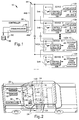
- a representation of the present invention is schematically shown in Fig. 1 as an occupant restraint system 10.
- the system 10 includes a plurality of restraint system devices 12.
- the restraint system devices 12 may be comprised of any combination of devices.
- some of the restraint system devices 12 may be actuatable occupant restraint devices (e.g., devices 1 and 2 of Fig. 1) for restraining a vehicle occupant.
- occupant restraint devices include an air bag device, a knee bolster, a seat belt lock, a seat belt pretensioner, and a D-ring adjuster.
- the example shown in Fig. 1 has occupant restraint devices 12A and 12B, which are air bag restraint devices.
- Each restraint device 12 A and 12B includes an associated inflatable restraint 14, commonly referred to as an air bag.
- the air bag 14 is stored in a folded condition within the device 12 in a manner well known in the art.
- a source 16 of inflation fluid e.g., nitrogen gas
- the source 16 of inflation fluid is commonly referred to as an inflator, and includes a stored quantity of pressurized inflation fluid and/or an inflation fluid generating material.
- the inflator 16 has an associated initiator (e.g., a pyrotechnic squib), which is electrically activated to initiate flow of the inflation fluid from the inflator.
- the flow of inflation fluid to the air bag 14 inflates the air bag, as will be appreciated by a person of ordinary skill in the art.
- the example of Fig. 1 contains two restraint system devices 12(N-1) and 12N that are sensor devices. Each sensor device senses a characteristic that is used to determine whether a vehicle occupant is to be restrained and/or deployment profile for restraining the occupant.
- sensor devices include a vehicle crash sensor, such as an accelerometer, an occupant position sensor, such as an ultrasound and infrared sensor, and an occupant weight sensor, such as a pressure sensor.
- the sensor device 12(N-1) of Fig. 1 is an occupant characteristic sensor (e.g., an ultrasound sensor) with an occupant characteristic sensor function 15
- the sensor device 12N of Fig. 1 is a vehicle characteristic sensor (e.g., an accelerometer) with a vehicle characteristic sensor function 17.
- restraint system devices for discussions which are applicable to any or all of the devices in the restraint system 10.
- restraint system devices 12A-12N of the illustrated example have elements which are identified by numbers with corresponding alphabetic suffixes.
- alphabetic suffixes are sometimes omitted for generic discussions, i.e., applicable to all of the restraint system devices.
- a first occupant restraint device 12A is a vehicle side-impact air bag restraint device mounted in a driver's side door 24.
- the air bag 14A Upon inflation of the air bag 14A of the driver's side door mounted restraint device 12A, the air bag 14A extends at a side of a driver's seat 26 of the vehicle.
- a second one of the devices is a hub-mounted restraint device 12B located within a hub of the vehicle's steering wheel 28.
- the air bag 14B of the hub-mounted restraint device 12B Upon inflation of the air bag 14B of the hub-mounted restraint device 12B, the air bag 14B inflates at a location in front of the driver's seat 26, with respect to the fore-to-aft axis of the vehicle 22.
- a third one of the restraint devices (i.e., 12C) is mounted in a passenger side of an instrument panel 30 of the vehicle 22.
- the air bag 14C of the instrument panel-mounted restraint device 12C inflates at a location in front of a front passenger seat 32 of the vehicle 22.
- a fourth one of the restraint devices is a door mounted restraint device 12D located in a passenger door 34 of the vehicle 22.
- the air bag 14D of the door-mounted restraint device 12D inflates at a location to the side of the passenger seat 32.
- a first one 12E of the two sensor devices is an ultrasound sensor (e.g., an ultrasonic transducer 20 and associated drive/monitor circuitry) for sensing the presence and position of a front seat passenger.
- the second sensor device 12F is an accelerometer for sensing vehicle acceleration in the fore-to-aft direction. It will be appreciated that additional and/or different actuatable occupant restraint devices and that additional and/or different sensor devices can be included within the restraint system 10.
- each restraint system device 12 includes control circuitry 18, which controls the respective device.
- the control circuitry controls actuation of the inflator 16.
- the control circuitry 18 contains logic and memory circuitry, and is addressable/programmable.
- the control circuitry 18 is connected to communicate in a network within the restraint system 10. The addressable aspect of the control circuitry 18 is provided such that the restraint system device 12 "knows" when a communication is directed to that particular device.
- the restraint system 10 includes a central controller 38 (Fig. 1).
- the central controller 38 includes a microcomputer.
- the central controller 38 receives sensory input from the sensor devices (e.g., 12(N-1) 12N), and using the sensory input regarding the sensed characteristics, makes determination regarding restraint module control (e.g., the central controller operates a crash algorithm).
- the restraint devices e.g., 12A, 12B
- the restraint devices could have adjustable aspects that are adjustable to tailor deployment of the respective restraint device. Information derived from such sensed characteristic(s) would be used by the controller 38 to determine adjustment of the deployment variable(s).
- Such adjustable deployment variables include timing, air bag dynamic profile, pressure, etc.
- the controller 38 would control the adjustment of the deployment variable(s) accordingly.
- the central controller 38 analyzes the information derived from the sensed characteristics and determines if a deployment crash condition is occurring.
- a deployment crash condition is one in which deployment of one or more air bag(s) 14 is desired to hopefully, in combination with the vehicle seat belts (not shown) or other actuatable restraints, enhance the restraint function of the occupant restraint system 10. Also, any adjustment of the deployment profiles is accomplished.
- the restraint system 10 is configured such that the central controller 38 appropriately actuates the plurality of restraint system devices 12.
- the central controller 38 is connected to the plurality of restraint system devices 12 via a control interconnection 44.
- the control interconnection 44 between the central controller 38 and the restraint system devices 12, has at least one connection that is a serial or "daisy-chain" connection along the restraint system devices.
- two connection lines 46A, 46B (Fig. 1) provide the control interconnection 44 between the central controller 38 and the restraint system devices 12.
- the central controller 38 includes a communication portion 48 connected to the two connection lines 46A, 46B.
- the communication portion 48 outputs communication signals, from the central controller 38 to the restraint system devices 12, via the connection lines 46A, 46B.
- the communication portion 48 also receives communication signals from the restraint system devices 12, via the connection lines 46A, 46B.
- the central controller 38 is connected to both the vehicle power source 50 (i.e., the vehicle battery) and to vehicle ground 52.
- the central controller 38 via the communication portion 48, also provides electrical power for the plurality of restraint system devices 12, via the connection lines 46A, 46B.
- Any known method of providing electrical power and communication signals over the same electrical interconnection(s), can be employed within the system. Thus, the known methods of electrical power and communication signal provision are not discussed in detail herein.
- connection lines 46A and 46B of the control interconnection 44 one of the connection lines connects the central controller 38 to each of the restraint system devices 12 in parallel.
- the parallel-connection is provided by the line 46B.
- the other connection line 46A connects the central controller 38 to the restraint system devices 12 in series (i.e., the daisy chain connection).
- the connection lines 46A, 46B are connected to the control circuitry 18 of the respective device.
- the central controller 38 can communication with, and can supply power to, the control circuitry 18 of the respective device 12.
- each restraint system device 12 Associated with each restraint system device 12 is an electronic switch 54.
- Each electronic switch 54 has an “ON” or “closed” state, and an “OFF” or “open” state. In its “ON” state, each switch 54 permits electrical signals to flow through the switch, and in the "OFF” state, the switch blocks/interrupts flow of the electrical signals.
- the electronic switch 54 for each restraint system device 12 is shown within the respective device.
- the electronic switch 54 can be a separate element from the respective restraint system device 12, and yet be associated with the restraint system device.
- the electronic switches 54 are connected in series, along one of the connection lines 46A, 46B. In Fig. 1, the switches 54 are in series along the connection line 46A.
- the electronic switch 54 associated with a particular restraint system device 12 is interposed between the central controller 38 and all of the restraint system devices 12, if any, which are "downstream" of the particular restraint system device.
- the restraint system devices 12 are, therefore electrically "daisy-chained". It should be noted that although, the illustrated examples have their sensor devices located at a "far" end of the daisy-chain from the controller 38, other connection orders are possible.
- Each of the electronic switches 54 is in its "OFF" state until its associated restraint system device 12 is programmed.
- Programming of each of the restraint system devices 12 includes establishing an unique address for each device 12. Programming may also include initialization of the restraint system device 12 (e.g., setting of initial states within the restraint system device).
- Programming by the central controller 38 allows the programmed restraint system device 12 to engage in operational communication with the central controller.
- the inflator 16 is controllable either by the controller 38, or by its associated control circuit 18 in response to data received from controller 38.
- Initial assembly of the system 10 shown in Figure 1 requires an initial programming of addresses for the restraint system devices 12. Also whenever a module is replaced, the new module must be programmed with the address of the module that it replaced. The establishment of these module addresses is referred to as a programming sequence. Once programmed by the central controller 38 during the programming sequence, the control circuitry 18 of the respective device 12 causes its associated electronic switch 54 to "close” (i.e., turn "ON").
- the restraint system 10 of the present invention permits the restraint system devices 12 to be quickly and easily assembled into the system, and permits quick and easy removal and replacement of the restraint system devices (e.g., replacement of a restraint device after deployment). Further, communication between the central controller 38 and the restraint system devices 12 is readily established both initially or when a particular restraint system device 12 is replaced. For example, assume for the purpose of illustration, that the restraint system 10 is newly assembled, or that at least one of the restraint system devices 12 is being replaced. All of the electronic switches 54 either are set or are reset to an initial "open" state or condition by any suitable means for accomplishing the task (e.g., a default or reset command).
- the central controller 38 outputs a polling signal on the control interconnection 44 (e.g., a coded signal on connection line 46A). Because all of the electronic switches 54 are in an "open" state, only the first restraint system device 12A (i.e., device 1 of Fig. 1) receives the polling signal. The first restraint system device 12A (device 1) replies to the central controller 38, and, through a sequence of communications between the central controller and the first restraint system device, the first restraint system device is programmed.
- a polling signal on the control interconnection 44 e.g., a coded signal on connection line 46A.
- the control circuitry 18 "closes" the electronic switch 54A associated with the first restraint system device 12A.
- the central controller 38 again outputs a polling signal on the control interconnection 44 (e.g., a signal on line 46A).
- the first restraint system device 12A which is now programmed, does not respond to the present polling signal.
- the second restraint system device 12B i.e., device 2 of Fig. 1 receives the polling signal.
- the currently un-programmed second restraint system device 12B responds to the central controller 38 and, via a sequence of communication between the controller 38 and the second restraint system device 12B, the central controller 38 programs the second restraint system device.
- the second to last restraint system device 12(N-1) i.e., device (N-1) of Fig. 1) is programmed (i.e., an address established) and causes its associated electronic switch 54(N-1) to "close” such that the last restraint system device 12N (i.e., device N of Fig. 1) may subsequently be programmed (i.e., an address established).
- the electronic switch 54N of the last restraint system device may be "closed”. However, closing this switch 54N has no consequence.
- connection lines 46A, 46B are shown as having free ends which are connectable to an added device.
- the free ends of the connection lines 46A, 46B may be plug-in ports for wires extending from an added device.
- all of the restraint system devices 12 may communicate with the central controller 38. Communication may be by single bit signals, or by a multi-bit series of signals. The communication between the central controller 38 and the restraint system devices 12 may be governed by any suitable communication scheme. For example, in order to avoid signal "collisions" on the control interconnection 44, a communication protocol may be imposed such that each restraint system device 12 may only communicate at its assigned time.
- the central controller 38 may provide a communication signal intended for any one, any combination, or all of the restraint system devices 12.
- An example of a signal provided to some of the restraint system devices 12 is an "actuate" signal provided to the steering wheel hub-mounted and the instrument panel-mounted restraint system devices 12B and 12C (Fig. 2) when the central controller 38 determines that the vehicle 22 is involved in a head-on collision.
- the devices 12A and 12B may be any type of restraint system device (e.g., a sensor device or a restraint device).
- the connection line 46B is the communication drive line and the connection line 46A is the return line.
- the connection line 46B connects the central controller 38 to each of the control circuits 18 of the restraint system devices 12 (i.e., the parallel connection).
- the connection line 46A is daisy-chained between the plurality of restraint system devices 12 (i.e., the series connection).
- the connection line 46B is connected to an input port 60 of the restraint system device.
- the connection line 46A is connected to a return port 62 of the restraint system device 12.
- the electronic switch 54 includes an N-channel MOSFET 64. Focusing on the first restraint system device 12A, the source 66A and substrate 68A of the N-channel MOSFET 64A are connected together and are connected to the return port 62A of the device 12A. The drain 70A of the N-channel MOSFET 64A is connected to a daisy chain port 72A of the restraint system device 12A. A segment of the connection line 46A extends from the daisy chain port 72A of the restraint system device 12A to the return port 62B of the next, downstream restraint system device 12B (i.e., in the direction away from the central controller 38).
- the gate 74A of the N-channel MOSFET 64A is connected to a control node 76A, which is connected, in turn to the control circuitry 18A of the restraint system device 12A.
- a resistor 78A couples the control node 76A to the input port 60A.
- a zener diode 80A is operative between the control node 76A and the return port 62A. The zener diode 80A protects the N-channel MOSFET 64A from damage when the voltage at input port 60A relative to return port 62A exceeds the maximum gate to source voltage of the MOSFET.
- the control circuitry 18A is connected to the input port 60A and the return port 62A.
- the second restraint system device 12B has the same structure identified by a suffix "B".
- the control circuitry 18A After the central controller 38 has finished programming (i.e., establishing an address) the restraint system device 12A, the control circuitry 18A "closes” the electronic switch 54A by controlling the control node 76A (i.e., the gate 74A of the N-channel MOSFET 64). Specifically, prior to the restraint system device 12A being programmed, the control circuitry 18A biases the MOSFET 64 "OFF". When the MOSFET 64 is "OFF", the return port 62A of the restraint system device 12A is not connected to the daisy chain port 72A of the restraint system device 12A. Once the restraint system device 12A is programmed, the control circuitry 18A biases the MOSFET 64A "ON".
- This daisy chain process of programming the respective devices 12 continues until all have been programmed (i.e., given associated addresses). Assume that within the system 10, a restraint system device 12X was to be replaced. Restraint system device 12X can be any one of the devices 12A-12N. Once placed in the daisy chain, the MOSFET 64X of the device 12X would be biased “OFF” since the control circuit 18X of device 12X has not yet been programmed. This would "break” the daisy chain connection, and all, if any, devices downstream of device 12X would be non-responsive to the central controller 38 since their control circuits 18 would lose their ground connection.
- controller 38 can detect such occurrence and proceed to send the appropriate signal(s) to program the controller 18X. It should be appreciated that once device 12X is connected in the system 10, its associated control circuit 18X is grounded through the device 18(X-1), if any. Once device 18X is programmed, the control circuit 18X would bias its associated MOSFET 64X "ON" to complete the serially connected daisy chain.
- Fig. 4 illustrates another embodiment of the present invention using a P-channel MOSFET as the switch 54'.
- a prime i.e., " ' ”
- the prime designates that the identified element of this embodiment has a function similar to its earlier mentioned counterpart, but has a different structure.
- the use of alphabetic suffixes is the same as its use above.
- connection line 46A' (Fig. 4) is connected to the central controller 38' as the driven connection line and the connection line 46B' is connected to the controller as the return line.
- the connection line 46A' is daisy-chained among the plurality of restraint system devices 12' and the connection line 46B' is connected to the plurality of restraint system devices in a parallel connection arrangement.
- a P-channel MOSFET 84 is provided within the electronic switch 54' at each restraint system device 12'.
- the source 86 and substrate 88 of the P-channel MOSFET 84 are connected together and are connected to an input port 90 of the restraint system device 12'.
- the input port 90A is connected to the line 46A' from the central controller 38.
- the drain 92A of the P-channel MOSFET 84A is connected to a daisy chain port 94A.
- the daisy chain port 94A of the first restraint system device 12A' (device 1) is connected to the input port 90B of the second restraint system device 12B' (device 2'). Accordingly, the daisy chain along the connection line 46A' is through the P-channel MOSFETs 84.
- the gate 96A of the P-channel MOSFET 84A is connected to a gate node 98A.
- Zener diode 100A is operatively connected between the input port 90A and the gate node 98A.
- the gate node 98A is connected to a return port 102A, via a resistor 104A.
- the gate node 98A is also connected to a collector 106A of a PNP transistor 108A.
- the emitter 110A of the PNP transistor 108A is connected to the input port 90A, and the base 112A of the PNP transistor is connected to a control node 114A.
- the control node 114A is connected to the control circuitry 18A' and is also connected to the input port 90A, through a resistor 116A. Accordingly, the resistor 116A is connected between the emitter 110A and base 112A of the PNP transistor 108A. Further, the control node 114A serves as both the control node for the electronic switch 54A' and the input node for the control circuitry 18A'.
- the second restraint system device 12B' has the same structure identified by a suffix "B".
- the control circuitry 18' biases the control node 114 so as to, in turn, bias the P-channel MOSFET 84 "OFF". Once the restraint system device 12' is programmed, the control circuitry 18' biases the control node 114 so as to maintain the P-channel MOSFET 84 "ON". Thus, the input port 90 is connected to the daisy chain port 94. The input port 90 of the next restraint system device is, thus, connected to the central controller 38 through the upstream P-channel MOSFET 84. Programming of all devices 12' is completed initially through the series daisy chain. A replacement devices 12X' would initially break the daisy chain until it is programmed with an address which, in turn, results in its associated switch 54' to close.
- the invention relates to an occupant restraint system for a vehicle, said system comprising: a plurality of controllable occupant restraint system devices, each of said restraint system devices having programmable means, which is programmable, for permitting control of the respective restraint system device; and central control means for providing programming signals and control signals for receipt by said restraint system devices.
Landscapes
- Engineering & Computer Science (AREA)
- Mechanical Engineering (AREA)
- Air Bags (AREA)
Applications Claiming Priority (2)
| Application Number | Priority Date | Filing Date | Title |
|---|---|---|---|
| US955470 | 1997-10-21 | ||
| US08/955,470 US5964815A (en) | 1997-10-21 | 1997-10-21 | Occupant restraint system having serially connected devices, a method for providing the restraint system and a method for using the restraint system |
Publications (3)
| Publication Number | Publication Date |
|---|---|
| EP0911223A2 true EP0911223A2 (fr) | 1999-04-28 |
| EP0911223A3 EP0911223A3 (fr) | 2001-03-14 |
| EP0911223B1 EP0911223B1 (fr) | 2007-02-28 |
Family
ID=25496865
Family Applications (1)
| Application Number | Title | Priority Date | Filing Date |
|---|---|---|---|
| EP98119493A Expired - Lifetime EP0911223B1 (fr) | 1997-10-21 | 1998-10-15 | Système de retenue de passager avec ses unités de sécurité conntectées en série |
Country Status (3)
| Country | Link |
|---|---|
| US (1) | US5964815A (fr) |
| EP (1) | EP0911223B1 (fr) |
| DE (1) | DE69837182T2 (fr) |
Cited By (4)
| Publication number | Priority date | Publication date | Assignee | Title |
|---|---|---|---|---|
| WO2002080007A1 (fr) * | 2001-03-29 | 2002-10-10 | Robert Bosch Gmbh | Station bus a connecter a un systeme a bus pour elements de retenue et/ou detecteurs |
| WO2003106227A1 (fr) * | 2002-06-18 | 2003-12-24 | Siemens Vdo Automotive Corporation | Algorithme de capteurs satellite multiples pour systeme de retenue gonflable |
| DE10225888A1 (de) * | 2002-06-11 | 2004-01-08 | Daimlerchrysler Ag | Modulares Fahrwerksystem |
| EP2110284A1 (fr) * | 2008-04-18 | 2009-10-21 | Keihin Corporation | Dispositif et système de contrôle de protection passager |
Families Citing this family (82)
| Publication number | Priority date | Publication date | Assignee | Title |
|---|---|---|---|---|
| US6168198B1 (en) * | 1992-05-05 | 2001-01-02 | Automotive Technologies International, Inc. | Methods and arrangements for controlling an occupant restraint device in a vehicle |
| US7134687B2 (en) * | 1992-05-05 | 2006-11-14 | Automotive Technologies International, Inc. | Rear view mirror monitor |
| US6910711B1 (en) | 1992-05-05 | 2005-06-28 | Automotive Technologies International, Inc. | Method for controlling deployment of an occupant protection device |
| US6422595B1 (en) | 1992-05-05 | 2002-07-23 | Automotive Technologies International, Inc. | Occupant position sensor and method and arrangement for controlling a vehicular component based on an occupant's position |
| US7467809B2 (en) | 1992-05-05 | 2008-12-23 | Automotive Technologies International, Inc. | Vehicular occupant characteristic determination system and method |
| US6942248B2 (en) | 1992-05-05 | 2005-09-13 | Automotive Technologies International, Inc. | Occupant restraint device control system and method |
| US6820897B2 (en) | 1992-05-05 | 2004-11-23 | Automotive Technologies International, Inc. | Vehicle object detection system and method |
| US6533316B2 (en) | 1995-06-07 | 2003-03-18 | Automotive Technologies International, Inc. | Automotive electronic safety network |
| US6905135B2 (en) | 1995-06-07 | 2005-06-14 | Automotive Technologies International, Inc. | Inflator system |
| US6733036B2 (en) * | 1995-06-07 | 2004-05-11 | Automotive Technologies International, Inc. | Automotive electronic safety network |
| US6648367B2 (en) | 1995-06-07 | 2003-11-18 | Automotive Technologies International Inc. | Integrated occupant protection system |
| US7832762B2 (en) * | 1995-06-07 | 2010-11-16 | Automotive Technologies International, Inc. | Vehicular bus including crash sensor or occupant protection system control module |
| US9443358B2 (en) | 1995-06-07 | 2016-09-13 | Automotive Vehicular Sciences LLC | Vehicle software upgrade techniques |
| US7580782B2 (en) * | 1995-10-30 | 2009-08-25 | Automotive Technologies International, Inc. | Vehicular electronic system with crash sensors and occupant protection systems |
| US7774115B2 (en) * | 1995-10-30 | 2010-08-10 | Automotive Technologies International, Inc. | Electronics-containing airbag module |
| US7744122B2 (en) | 1995-12-12 | 2010-06-29 | Automotive Technologies International, Inc. | Driver side aspirated airbags |
| DE19616293A1 (de) * | 1996-04-24 | 1997-10-30 | Bosch Gmbh Robert | Bussystem für die Übertragung von Nachrichten |
| DE19648268A1 (de) * | 1996-11-21 | 1998-05-28 | Siemens Ag | Fahrzeugsitz mit einer Steuervorrichtung |
| US6412391B1 (en) | 1997-05-12 | 2002-07-02 | Southwest Research Institute | Reactive personnel protection system and method |
| JP3572921B2 (ja) * | 1998-01-06 | 2004-10-06 | 日産自動車株式会社 | エアバック装置 |
| JP4112020B2 (ja) * | 1998-01-16 | 2008-07-02 | シンボル テクノロジーズ インコーポレイテッド | 無線lan用インフラストラクチャ |
| DE19813957C2 (de) * | 1998-03-28 | 2003-06-18 | Conti Temic Microelectronic | Insassenschutzsystem mit einer Zentraleinheit, Sensoren und mehreren mittels eines BUS-Systems kommunikationsfähig verbundenen Steuermodulen zur Auslösung von Insassenschutzeinrichtungen |
| DE19813921A1 (de) * | 1998-03-28 | 1999-09-30 | Telefunken Microelectron | Verfahren zum Betreiben eines über eine Busleitung vernetzten Rückhaltesystems bei einer fehlerhaften Stromversorgung |
| US6305708B2 (en) * | 1998-06-29 | 2001-10-23 | Motorola, Inc. | Air bag deployment system and method for monitoring same |
| US10240935B2 (en) | 1998-10-22 | 2019-03-26 | American Vehicular Sciences Llc | Vehicle software upgrade techniques |
| US6273460B1 (en) * | 1999-05-27 | 2001-08-14 | Daimlerchrysler Corporation | Smart remote indicator module |
| US6439602B2 (en) | 1999-05-27 | 2002-08-27 | Daimlerchrysler Corporation | Remote indicator module |
| US6212457B1 (en) * | 1999-08-05 | 2001-04-03 | Trw Inc. | Mixed parallel and daisy chain bus architecture in a vehicle safety system |
| US6448671B1 (en) * | 1999-08-05 | 2002-09-10 | Trw Inc. | Distributed vehicle safety system having fault protection |
| US6220628B1 (en) * | 1999-12-01 | 2001-04-24 | Trw Inc. | Vehicle occupant protection apparatus and method having multiple stage control |
| US6302439B1 (en) * | 2000-02-01 | 2001-10-16 | Trw Inc. | Distributed occupant protection system and method with cooperative central and distributed protection module actuation control |
| US7278657B1 (en) * | 2000-02-01 | 2007-10-09 | Trw Automotive U.S. Llc | Method and apparatus for controlling an actuatable occupant protection device using an ultrasonic sensor |
| US6296273B1 (en) * | 2000-02-22 | 2001-10-02 | David G. Lewallen | Automobile airbag deactivation system |
| US7173922B2 (en) * | 2000-03-17 | 2007-02-06 | Symbol Technologies, Inc. | Multiple wireless local area networks occupying overlapping physical spaces |
| US7173923B2 (en) * | 2000-03-17 | 2007-02-06 | Symbol Technologies, Inc. | Security in multiple wireless local area networks |
| US6584907B2 (en) * | 2000-03-17 | 2003-07-01 | Ensign-Bickford Aerospace & Defense Company | Ordnance firing system |
| DE10115409A1 (de) * | 2001-03-29 | 2002-10-10 | Bosch Gmbh Robert | Busmaster für einen Bus zum Anschluß von Sensoren und/oder Zündmitteln |
| US6480144B1 (en) | 2002-01-30 | 2002-11-12 | Ford Global Technologies, Inc. | Wireless communication between countermeasure devices |
| US20040224557A1 (en) * | 2002-11-05 | 2004-11-11 | Wight Barbara Jane | System and method of detecting and particularly identifying controlled devices |
| JP2004312804A (ja) * | 2003-04-02 | 2004-11-04 | Asmo Co Ltd | アクチュエータ装置及びアクチュエータシステム |
| US20050165538A1 (en) * | 2004-01-28 | 2005-07-28 | Aisin Seiki Kabushiki Kaisha | Load-detecting device for an object on a seat |
| DE102004015125B4 (de) * | 2004-03-27 | 2017-09-14 | Robert Bosch Gmbh | Vorrichtung zur Ansteuerung von Personenschutzmitteln |
| US20080259787A1 (en) * | 2004-05-28 | 2008-10-23 | Symbol Technologies, Inc. | Backup cell controller |
| EP1683684A1 (fr) * | 2005-01-21 | 2006-07-26 | IEE INTERNATIONAL ELECTRONICS & ENGINEERING S.A. | Détecteur vérifiable de l'occupation d'un siège |
| DE102005036287B3 (de) * | 2005-08-02 | 2007-05-16 | Infineon Technologies Ag | Verfahren zur Leistungsversorgung von Sensoren in einer Sensoranordnung und Sensoranordnung |
| US20070067082A1 (en) * | 2005-09-20 | 2007-03-22 | Robert Bosch Gmbh | Integrated vehicle system |
| JP2007215102A (ja) * | 2006-02-13 | 2007-08-23 | Denso Corp | 通信装置 |
| US20070198139A1 (en) * | 2006-02-21 | 2007-08-23 | Colm Boran | Auto-address multi-sensor network |
| DE102007045561B4 (de) * | 2007-09-24 | 2018-02-15 | Robert Bosch Gmbh | Verfahren zum Betrieb eines Fahrerassistenzsystems |
| US7746114B2 (en) | 2007-11-14 | 2010-06-29 | Denso Corporation | Bus switch and electronic switch |
| JP4596068B2 (ja) | 2008-11-12 | 2010-12-08 | 株式会社デンソー | 乗員保護システムの通信装置 |
| US9817085B2 (en) * | 2012-03-15 | 2017-11-14 | Infineon Technologies Ag | Frequency doubling of xMR signals |
| GB201207450D0 (en) * | 2012-04-26 | 2012-06-13 | Secr Defence | An electrical pulse splitter for an explosives system |
| DE102015204714A1 (de) * | 2015-03-16 | 2016-09-22 | Robert Bosch Gmbh | Teilnehmerstation für ein Bussystem und Verfahren zur Datenübertragung in einem Bussystem |
| US9840220B2 (en) * | 2015-04-27 | 2017-12-12 | L & B Manufacturing, Inc. | Wireless airbag control system |
| JP2018135060A (ja) * | 2017-02-23 | 2018-08-30 | 株式会社デンソー | 乗員保護システム |
| US12233756B2 (en) | 2018-05-04 | 2025-02-25 | Lear Corporation | Track system with a support member |
| US10926667B2 (en) | 2018-05-04 | 2021-02-23 | Lear Corporation | Track assembly |
| US10882420B2 (en) | 2019-03-08 | 2021-01-05 | Lear Corporation | Track assembly |
| US11358497B2 (en) | 2018-05-04 | 2022-06-14 | Lear Corporation | Track system having a rolling member |
| US11040638B2 (en) | 2018-05-04 | 2021-06-22 | Lear Corporation | Track assembly |
| US10562414B2 (en) | 2018-05-04 | 2020-02-18 | Lear Corporation | Track assembly |
| US11040639B2 (en) | 2018-05-04 | 2021-06-22 | Lear Corporation | Track assembly |
| US10906431B2 (en) | 2018-05-04 | 2021-02-02 | Lear Corporation | Track assembly |
| US11225201B2 (en) | 2018-12-10 | 2022-01-18 | Lear Corporation | Track assembly |
| US11440482B2 (en) | 2018-12-10 | 2022-09-13 | Lear Corporation | Track assembly |
| US10855037B2 (en) | 2018-12-17 | 2020-12-01 | Lear Corporation | Support assembly with a support member and a track assembly |
| US11117538B2 (en) | 2018-12-17 | 2021-09-14 | Lear Corporation | Electrical assembly |
| US11613220B2 (en) | 2018-12-17 | 2023-03-28 | Lear Corporation | Electrical assembly |
| US10950977B2 (en) | 2018-12-18 | 2021-03-16 | Lear Corporation | Track assembly for a vehicle component |
| US11975665B2 (en) | 2019-02-20 | 2024-05-07 | Lear Corporation | Electrical assembly |
| US11040653B2 (en) | 2019-02-25 | 2021-06-22 | Lear Corporation | Track assembly |
| US11807142B2 (en) | 2019-03-06 | 2023-11-07 | Lear Corporation | Electrical track assembly |
| US11299075B2 (en) | 2019-03-06 | 2022-04-12 | Lear Corporation | Electrical assembly |
| US10795845B1 (en) * | 2019-08-23 | 2020-10-06 | Texas Instruments Incorporated | Method and system for auto-addressing nodes on a communication bus |
| US11323114B2 (en) | 2019-10-04 | 2022-05-03 | Lear Corporation | Electrical system |
| US11463083B2 (en) | 2019-10-04 | 2022-10-04 | Lear Corporation | Electrical system |
| US11634101B2 (en) | 2019-10-04 | 2023-04-25 | Lear Corporation | Removable component system |
| US11677233B2 (en) * | 2019-11-12 | 2023-06-13 | Eaton Intelligent Power Limited | Smart bus plug remote actuation, monitoring, and control |
| DE102021104018B4 (de) | 2020-02-21 | 2023-11-09 | Lear Corporation | Schienensystem mit einem Stützelement, Verfahren zum Betreiben eines Schienensystems |
| US11906028B2 (en) | 2020-02-21 | 2024-02-20 | Lear Corporation | Track system with a support member |
| US11505141B2 (en) | 2020-10-23 | 2022-11-22 | Lear Corporation | Electrical system with track assembly and support assembly |
Family Cites Families (22)
| Publication number | Priority date | Publication date | Assignee | Title |
|---|---|---|---|---|
| US3768409A (en) * | 1972-11-10 | 1973-10-30 | Us Navy | Binary explosive logic network |
| DE2945122A1 (de) * | 1978-02-01 | 1980-05-22 | Ici Ltd | Elektrische verzoegerungsvorrichtung |
| US4496010A (en) * | 1982-07-02 | 1985-01-29 | Schlumberger Technology Corporation | Single-wire selective performation system |
| US4527636A (en) * | 1982-07-02 | 1985-07-09 | Schlumberger Technology Corporation | Single-wire selective perforation system having firing safeguards |
| US4674047A (en) * | 1984-01-31 | 1987-06-16 | The Curators Of The University Of Missouri | Integrated detonator delay circuits and firing console |
| US4689786A (en) * | 1985-03-21 | 1987-08-25 | Apple Computer, Inc. | Local area network with self assigned address method |
| GB2190730B (en) * | 1986-05-22 | 1990-10-24 | Detonix Close Corp | Detonator firing element |
| ZA875014B (fr) * | 1987-07-09 | 1988-01-18 | ||
| JPH01162967A (ja) * | 1987-12-18 | 1989-06-27 | Fujitsu Ltd | 割込み処理方法及び装置 |
| US4843964A (en) * | 1988-02-01 | 1989-07-04 | The United States Of America As Represented By The United States Department Of Energy | Smart explosive igniter |
| JPH02262444A (ja) * | 1989-03-31 | 1990-10-25 | Aisin Seiki Co Ltd | 車上装備の姿勢制御方法とその姿勢制御装置 |
| US4986183A (en) * | 1989-10-24 | 1991-01-22 | Atlas Powder Company | Method and apparatus for calibration of electronic delay detonation circuits |
| JPH0694996B2 (ja) * | 1989-11-24 | 1994-11-24 | 繁明 國友 | 花火点火装置 |
| US5287531A (en) * | 1990-10-31 | 1994-02-15 | Compaq Computer Corp. | Daisy-chained serial shift register for determining configuration of removable circuit boards in a computer system |
| US5446442A (en) * | 1992-03-31 | 1995-08-29 | Siemens Aktiengesellschaft | Circuit arrangement for triggering a vehicle passenger protection system |
| US5291680A (en) * | 1992-09-19 | 1994-03-08 | The United States Of America As Represented By The Secretary Of The Army | Grenade launching apparatus |
| US5404460A (en) * | 1994-01-28 | 1995-04-04 | Vlsi Technology, Inc. | Method for configuring multiple identical serial I/O devices to unique addresses through a serial bus |
| DE4425845A1 (de) * | 1994-07-21 | 1996-01-25 | Telefunken Microelectron | Datenübertragungsverfahren in einem für den Einsatz in Kraftfahrzeugen geeigneten Datenverarbeitungssystem |
| EP0788929A1 (fr) * | 1996-02-12 | 1997-08-13 | Applied Power Inc. | Système de communication pour transmission de données d'un appareil de commande d'un véhicule |
| AU1260697A (en) * | 1996-02-21 | 1997-08-28 | Consolidated Technologies International | Multiplexed electrical system having a central controller and programmable control nodes |
| US5825098A (en) * | 1997-02-21 | 1998-10-20 | Breed Automotive Technologies, Inc. | Vehicle safety device controller |
| US5835873A (en) * | 1997-02-21 | 1998-11-10 | Breed Automotive Technology, Inc. | Vehicle safety system with safety device controllers |
-
1997
- 1997-10-21 US US08/955,470 patent/US5964815A/en not_active Expired - Lifetime
-
1998
- 1998-10-15 EP EP98119493A patent/EP0911223B1/fr not_active Expired - Lifetime
- 1998-10-15 DE DE69837182T patent/DE69837182T2/de not_active Expired - Lifetime
Cited By (8)
| Publication number | Priority date | Publication date | Assignee | Title |
|---|---|---|---|---|
| WO2002080007A1 (fr) * | 2001-03-29 | 2002-10-10 | Robert Bosch Gmbh | Station bus a connecter a un systeme a bus pour elements de retenue et/ou detecteurs |
| US7421366B2 (en) | 2001-03-29 | 2008-09-02 | Robert Bosch Gmbh | Bus station connection to a bus system for restraining means and/or sensors |
| DE10225888A1 (de) * | 2002-06-11 | 2004-01-08 | Daimlerchrysler Ag | Modulares Fahrwerksystem |
| DE10225888B4 (de) * | 2002-06-11 | 2007-06-21 | Daimlerchrysler Ag | Modulares Fahrwerksystem |
| WO2003106227A1 (fr) * | 2002-06-18 | 2003-12-24 | Siemens Vdo Automotive Corporation | Algorithme de capteurs satellite multiples pour systeme de retenue gonflable |
| US6961645B2 (en) | 2002-06-18 | 2005-11-01 | Siemens Vdo Automotive Corporation | Multiple-satellite sensor algorithm wake up and reset strategy for an inflatable restraint system |
| US7203584B2 (en) | 2002-06-18 | 2007-04-10 | Siemens Vdo Automotive Corporation | Multiple-satellite sensors algorithm wake up and reset strategy for an inflatable restraint system |
| EP2110284A1 (fr) * | 2008-04-18 | 2009-10-21 | Keihin Corporation | Dispositif et système de contrôle de protection passager |
Also Published As
| Publication number | Publication date |
|---|---|
| EP0911223B1 (fr) | 2007-02-28 |
| DE69837182T2 (de) | 2007-11-22 |
| DE69837182D1 (de) | 2007-04-12 |
| EP0911223A3 (fr) | 2001-03-14 |
| US5964815A (en) | 1999-10-12 |
Similar Documents
| Publication | Publication Date | Title |
|---|---|---|
| US5964815A (en) | Occupant restraint system having serially connected devices, a method for providing the restraint system and a method for using the restraint system | |
| US6212457B1 (en) | Mixed parallel and daisy chain bus architecture in a vehicle safety system | |
| EP0675820B1 (fr) | Systeme d'air bag pour automobile | |
| US6302439B1 (en) | Distributed occupant protection system and method with cooperative central and distributed protection module actuation control | |
| US6449545B1 (en) | Method for data transfer in a restraint system connected to a bus line | |
| US6804595B1 (en) | Controller for occupant restraint system | |
| KR100521856B1 (ko) | 탑승자 보호장치를 위한 작동제어유닛 및 그것의 제어방법 | |
| KR100343268B1 (ko) | 자동차에 배치된 2 모듈 사이의 데이터 전송을 제어하기위한 방법 및 장치 | |
| US6448671B1 (en) | Distributed vehicle safety system having fault protection | |
| EP1208021B1 (fr) | Commande pour systeme de retenue d'un occupant | |
| US6249228B1 (en) | Vehicle occupant protection device and system having an anti-theft, anti-tamper feature | |
| US11167710B2 (en) | Airbag driving apparatus for vehicle and control method thereof | |
| EP0957013B1 (fr) | Système de pilotage d'allumage pour un système de sécurité passif avec des commandes d'airbag et de retournement interconnectées | |
| US6070687A (en) | Vehicle occupant restraint device, system, and method having an anti-theft feature | |
| US6218738B1 (en) | Ignition control method in passive safety device for vehicle | |
| US6293583B1 (en) | Apparatus for activating passive safety device | |
| US6045156A (en) | Supplement restraint system having deployment inhibit apparatus | |
| US6236920B1 (en) | Distributed vehicle safety with bus connection components having a remotely-located initiation electronics arrangement and a bus tap arrangement | |
| EP1104725B1 (fr) | Système de retenue avec un générateur de gaz à niveaux multiples | |
| US6363307B1 (en) | Control system for occupant protection apparatus | |
| US6304004B1 (en) | Apparatus for actuating a passenger safety system | |
| US20020079679A1 (en) | Automatic impact severity compensation system | |
| KR100187105B1 (ko) | 자동차의 신경망 안전시스템 | |
| JP2006304069A (ja) | 通信装置 | |
| EP0926012B1 (fr) | Circuit d' allumage d' airbag |
Legal Events
| Date | Code | Title | Description |
|---|---|---|---|
| PUAI | Public reference made under article 153(3) epc to a published international application that has entered the european phase |
Free format text: ORIGINAL CODE: 0009012 |
|
| AK | Designated contracting states |
Kind code of ref document: A2 Designated state(s): DE FR GB |
|
| AX | Request for extension of the european patent |
Free format text: AL;LT;LV;MK;RO;SI |
|
| PUAL | Search report despatched |
Free format text: ORIGINAL CODE: 0009013 |
|
| AK | Designated contracting states |
Kind code of ref document: A3 Designated state(s): AT BE CH CY DE DK ES FI FR GB GR IE IT LI LU MC NL PT SE |
|
| AX | Request for extension of the european patent |
Free format text: AL;LT;LV;MK;RO;SI |
|
| RIC1 | Information provided on ipc code assigned before grant |
Free format text: 7B 60R 21/00 A, 7B 60R 16/02 B |
|
| 17P | Request for examination filed |
Effective date: 20010911 |
|
| AKX | Designation fees paid |
Free format text: DE FR GB |
|
| RAP1 | Party data changed (applicant data changed or rights of an application transferred) |
Owner name: TRW AUTOMOTIVE U.S. LLC |
|
| GRAP | Despatch of communication of intention to grant a patent |
Free format text: ORIGINAL CODE: EPIDOSNIGR1 |
|
| GRAS | Grant fee paid |
Free format text: ORIGINAL CODE: EPIDOSNIGR3 |
|
| GRAA | (expected) grant |
Free format text: ORIGINAL CODE: 0009210 |
|
| AK | Designated contracting states |
Kind code of ref document: B1 Designated state(s): DE FR GB |
|
| REG | Reference to a national code |
Ref country code: GB Ref legal event code: FG4D |
|
| REF | Corresponds to: |
Ref document number: 69837182 Country of ref document: DE Date of ref document: 20070412 Kind code of ref document: P |
|
| EN | Fr: translation not filed | ||
| PLBE | No opposition filed within time limit |
Free format text: ORIGINAL CODE: 0009261 |
|
| STAA | Information on the status of an ep patent application or granted ep patent |
Free format text: STATUS: NO OPPOSITION FILED WITHIN TIME LIMIT |
|
| 26N | No opposition filed |
Effective date: 20071129 |
|
| PG25 | Lapsed in a contracting state [announced via postgrant information from national office to epo] |
Ref country code: FR Free format text: LAPSE BECAUSE OF FAILURE TO SUBMIT A TRANSLATION OF THE DESCRIPTION OR TO PAY THE FEE WITHIN THE PRESCRIBED TIME-LIMIT Effective date: 20071019 |
|
| GBPC | Gb: european patent ceased through non-payment of renewal fee |
Effective date: 20071015 |
|
| PG25 | Lapsed in a contracting state [announced via postgrant information from national office to epo] |
Ref country code: GB Free format text: LAPSE BECAUSE OF NON-PAYMENT OF DUE FEES Effective date: 20071015 Ref country code: FR Free format text: LAPSE BECAUSE OF FAILURE TO SUBMIT A TRANSLATION OF THE DESCRIPTION OR TO PAY THE FEE WITHIN THE PRESCRIBED TIME-LIMIT Effective date: 20070228 |
|
| PGFP | Annual fee paid to national office [announced via postgrant information from national office to epo] |
Ref country code: DE Payment date: 20171027 Year of fee payment: 20 |
|
| REG | Reference to a national code |
Ref country code: DE Ref legal event code: R071 Ref document number: 69837182 Country of ref document: DE |