EP0911706B1 - Vorrichtung zum direkten elektrostatischen Drucken mit einer konventionellen Druckkopfstruktur und Wechselspannung zur Steuerelektrode - Google Patents
Vorrichtung zum direkten elektrostatischen Drucken mit einer konventionellen Druckkopfstruktur und Wechselspannung zur Steuerelektrode Download PDFInfo
- Publication number
- EP0911706B1 EP0911706B1 EP19970203268 EP97203268A EP0911706B1 EP 0911706 B1 EP0911706 B1 EP 0911706B1 EP 19970203268 EP19970203268 EP 19970203268 EP 97203268 A EP97203268 A EP 97203268A EP 0911706 B1 EP0911706 B1 EP 0911706B1
- Authority
- EP
- European Patent Office
- Prior art keywords
- toner
- voltage
- toner particles
- control electrodes
- printing
- Prior art date
- Legal status (The legal status is an assumption and is not a legal conclusion. Google has not performed a legal analysis and makes no representation as to the accuracy of the status listed.)
- Expired - Lifetime
Links
- 238000010168 coupling process Methods 0.000 title 1
- 238000005859 coupling reaction Methods 0.000 title 1
- 239000002245 particle Substances 0.000 claims description 122
- 239000000758 substrate Substances 0.000 claims description 44
- 238000000034 method Methods 0.000 description 16
- 239000011810 insulating material Substances 0.000 description 11
- 230000000903 blocking effect Effects 0.000 description 6
- 230000001276 controlling effect Effects 0.000 description 5
- 230000008569 process Effects 0.000 description 5
- 238000004140 cleaning Methods 0.000 description 4
- 238000000151 deposition Methods 0.000 description 4
- 239000000463 material Substances 0.000 description 4
- RYGMFSIKBFXOCR-UHFFFAOYSA-N Copper Chemical compound [Cu] RYGMFSIKBFXOCR-UHFFFAOYSA-N 0.000 description 3
- 238000009825 accumulation Methods 0.000 description 3
- 239000004020 conductor Substances 0.000 description 3
- 239000010949 copper Substances 0.000 description 3
- 229910052802 copper Inorganic materials 0.000 description 3
- 238000009826 distribution Methods 0.000 description 3
- 238000002955 isolation Methods 0.000 description 3
- 229920001721 polyimide Polymers 0.000 description 3
- 239000004642 Polyimide Substances 0.000 description 2
- VYPSYNLAJGMNEJ-UHFFFAOYSA-N Silicium dioxide Chemical compound O=[Si]=O VYPSYNLAJGMNEJ-UHFFFAOYSA-N 0.000 description 2
- 229910001035 Soft ferrite Inorganic materials 0.000 description 2
- 239000004411 aluminium Substances 0.000 description 2
- XAGFODPZIPBFFR-UHFFFAOYSA-N aluminium Chemical compound [Al] XAGFODPZIPBFFR-UHFFFAOYSA-N 0.000 description 2
- 229910052782 aluminium Inorganic materials 0.000 description 2
- 239000011248 coating agent Substances 0.000 description 2
- 238000000576 coating method Methods 0.000 description 2
- 238000002474 experimental method Methods 0.000 description 2
- 238000004519 manufacturing process Methods 0.000 description 2
- 239000004033 plastic Substances 0.000 description 2
- 229920003023 plastic Polymers 0.000 description 2
- 239000000843 powder Substances 0.000 description 2
- 230000001902 propagating effect Effects 0.000 description 2
- 230000001105 regulatory effect Effects 0.000 description 2
- 238000009877 rendering Methods 0.000 description 2
- 229920005989 resin Polymers 0.000 description 2
- 239000011347 resin Substances 0.000 description 2
- 125000006850 spacer group Chemical group 0.000 description 2
- 239000011230 binding agent Substances 0.000 description 1
- 238000007664 blowing Methods 0.000 description 1
- 239000000919 ceramic Substances 0.000 description 1
- 230000008859 change Effects 0.000 description 1
- 230000015271 coagulation Effects 0.000 description 1
- 238000005345 coagulation Methods 0.000 description 1
- 230000000052 comparative effect Effects 0.000 description 1
- 239000002131 composite material Substances 0.000 description 1
- 238000011109 contamination Methods 0.000 description 1
- 230000008021 deposition Effects 0.000 description 1
- 229920001971 elastomer Polymers 0.000 description 1
- 230000009881 electrostatic interaction Effects 0.000 description 1
- 239000003822 epoxy resin Substances 0.000 description 1
- 238000005530 etching Methods 0.000 description 1
- 239000011521 glass Substances 0.000 description 1
- 230000002209 hydrophobic effect Effects 0.000 description 1
- 230000006872 improvement Effects 0.000 description 1
- 239000003595 mist Substances 0.000 description 1
- 239000000203 mixture Substances 0.000 description 1
- 230000003287 optical effect Effects 0.000 description 1
- 238000001020 plasma etching Methods 0.000 description 1
- 229920003207 poly(ethylene-2,6-naphthalate) Polymers 0.000 description 1
- 229920000647 polyepoxide Polymers 0.000 description 1
- 229920000728 polyester Polymers 0.000 description 1
- -1 polyethylene naphthalate Polymers 0.000 description 1
- 239000011112 polyethylene naphthalate Substances 0.000 description 1
- 229920000098 polyolefin Polymers 0.000 description 1
- 239000011527 polyurethane coating Substances 0.000 description 1
- 238000010298 pulverizing process Methods 0.000 description 1
- 238000012216 screening Methods 0.000 description 1
- 239000000377 silicon dioxide Substances 0.000 description 1
- KKEYFWRCBNTPAC-UHFFFAOYSA-L terephthalate(2-) Chemical compound [O-]C(=O)C1=CC=C(C([O-])=O)C=C1 KKEYFWRCBNTPAC-UHFFFAOYSA-L 0.000 description 1
Images

Classifications
-
- G—PHYSICS
- G03—PHOTOGRAPHY; CINEMATOGRAPHY; ANALOGOUS TECHNIQUES USING WAVES OTHER THAN OPTICAL WAVES; ELECTROGRAPHY; HOLOGRAPHY
- G03G—ELECTROGRAPHY; ELECTROPHOTOGRAPHY; MAGNETOGRAPHY
- G03G15/00—Apparatus for electrographic processes using a charge pattern
- G03G15/22—Apparatus for electrographic processes using a charge pattern involving the combination of more than one step according to groups G03G13/02 - G03G13/20
- G03G15/34—Apparatus for electrographic processes using a charge pattern involving the combination of more than one step according to groups G03G13/02 - G03G13/20 in which the powder image is formed directly on the recording material, e.g. by using a liquid toner
- G03G15/344—Apparatus for electrographic processes using a charge pattern involving the combination of more than one step according to groups G03G13/02 - G03G13/20 in which the powder image is formed directly on the recording material, e.g. by using a liquid toner by selectively transferring the powder to the recording medium, e.g. by using a LED array
- G03G15/346—Apparatus for electrographic processes using a charge pattern involving the combination of more than one step according to groups G03G13/02 - G03G13/20 in which the powder image is formed directly on the recording material, e.g. by using a liquid toner by selectively transferring the powder to the recording medium, e.g. by using a LED array by modulating the powder through holes or a slit
-
- B—PERFORMING OPERATIONS; TRANSPORTING
- B41—PRINTING; LINING MACHINES; TYPEWRITERS; STAMPS
- B41J—TYPEWRITERS; SELECTIVE PRINTING MECHANISMS, i.e. MECHANISMS PRINTING OTHERWISE THAN FROM A FORME; CORRECTION OF TYPOGRAPHICAL ERRORS
- B41J2/00—Typewriters or selective printing mechanisms characterised by the printing or marking process for which they are designed
- B41J2/385—Typewriters or selective printing mechanisms characterised by the printing or marking process for which they are designed characterised by selective supply of electric current or selective application of magnetism to a printing or impression-transfer material
- B41J2/41—Typewriters or selective printing mechanisms characterised by the printing or marking process for which they are designed characterised by selective supply of electric current or selective application of magnetism to a printing or impression-transfer material for electrostatic printing
- B41J2/415—Typewriters or selective printing mechanisms characterised by the printing or marking process for which they are designed characterised by selective supply of electric current or selective application of magnetism to a printing or impression-transfer material for electrostatic printing by passing charged particles through a hole or a slit
- B41J2/4155—Typewriters or selective printing mechanisms characterised by the printing or marking process for which they are designed characterised by selective supply of electric current or selective application of magnetism to a printing or impression-transfer material for electrostatic printing by passing charged particles through a hole or a slit for direct electrostatic printing [DEP]
-
- G—PHYSICS
- G03—PHOTOGRAPHY; CINEMATOGRAPHY; ANALOGOUS TECHNIQUES USING WAVES OTHER THAN OPTICAL WAVES; ELECTROGRAPHY; HOLOGRAPHY
- G03G—ELECTROGRAPHY; ELECTROPHOTOGRAPHY; MAGNETOGRAPHY
- G03G2217/00—Details of electrographic processes using patterns other than charge patterns
- G03G2217/0008—Process where toner image is produced by controlling which part of the toner should move to the image- carrying member
- G03G2217/0025—Process where toner image is produced by controlling which part of the toner should move to the image- carrying member where the toner starts moving from behind the electrode array, e.g. a mask of holes
Definitions
- This invention relates to an apparatus used in the process of electrostatic printing and more particularly in Direct Electrostatic Printing (DEP).
- DEP Direct Electrostatic Printing
- electrostatic printing on an image receiving substrate is performed by creating a flow of toner particles from a toner bearing surface to the image receiving substrate and image-wise modulating the flow of toner particles by means of an electronically addressable printhead structure.
- the toner or developing material is deposited directly in an image-wise way on a receiving substrate, the latter not bearing any image-wise latent electrostatic image.
- the substrate can be an intermediate endless flexible belt (e.g. aluminium, polyimide etc.).
- the image-wise deposited toner must be transferred onto another final substrate.
- the toner is deposited directly on the final receiving substrate, thus offering a possibility to create directly the image on the final receiving substrate, e.g. plain paper, transparency, etc.
- This deposition step is followed by a final fusing step.
- the method makes the method different from classical electrography, in which a latent electrostatic image on a charge retentive surface is developed by a suitable material to make the latent image visible. Further on, either the powder image is fused directly to said charge retentive surface, which then results in a direct electrographic print, or the powder image is subsequently transferred to the final substrate and then fused to that medium. The latter process results in an indirect electrographic print.
- the final substrate may be a transparent medium, opaque polymeric film, paper, etc.
- DEP is also markedly different from electrophotography in which an additional step and additional member is introduced to create the latent electrostatic image. More specifically, a photoconductor is used and a charging/exposure cycle is necessary.
- a DEP device is disclosed in e.g. US-A-3 689 935 This document discloses an electrostatic line printer having a multi-layered particle modulator or printhead structure comprising :
- Each control electrode is formed around one aperture and is isolated from each other control electrode.
- Selected electric potentials are applied to each of the control electrodes while a fixed potential is applied to the shield electrode.
- An overall applied propulsion field between a toner delivery means and a support for a toner receiving substrate projects charged toner particles through a row of apertures of the printhead structure.
- the intensity of the particle stream is modulated according to the pattern of potentials applied to the control electrodes.
- the modulated stream of charged particles impinges upon a receiving substrate, interposed in the modulated particle stream.
- the receiving substrate is transported in a direction orthogonal to the printhead structure, to provide a line-by-line scan printing.
- the shield electrode may face the toner delivery means and the control electrodes may face the receiving substrate.
- a DC-field is applied between the printhead structure and a single back electrode on the receiving substrate. This propulsion field is responsible for the attraction of toner to the receiving substrate that is placed between the printhead structure and the back electrode.
- a DEP printer wherein the printhead structure is a mesh instead of a insulating base with printing apertures through this base has been disclosed in US-A-5 036 341 .
- this disclosure it is taught to introduce an AC-field with frequency between 2 and 5 kHz and peak voltages between 500 and 2000 V on the toner delivery means in order to speed up the printing.
- the toner particles are made to oscillate by an AC-field over the gap between the toner bearing surface and the printhead structure, the AC-field is even chosen so that the toner particles can enter the printing apertures and be seized by the propulsion field towards the image receiving substrate, the printing apertures are closed by applying a DC-voltage on the printing apertures.
- the printing apertures are easily clogged by toner particles when the DEP device is used over a longer period of time.
- EP-A-715 218 the toner particles are made to oscillate by an AC-field over the gap between the toner bearing surface and the printhead structure, the AC-field is even chosen so that the toner particles can enter the printing apertures and be seized by the propulsion field towards the image receiving substrate.
- this disclosure it is proposed to change the physical shape of the toner particles that are used to minimise clogging.
- an AC voltage is used for the backing electrode during the cleaning cycle.
- the AC voltage on the back electrode is phase shifted by 180° if compared with the AC field (400 V peak to peak, no frequency disclosed) that is used upon the charged toner conveyor which is needed to obtain a high toner mist production, leading to high optical densities and short printing times. Further on the AC voltage can also have a certain DC-offset.
- SA and SB sides of said insulating material
- control electrodes characterised in that only one of said two sides forming said slit carries control electrodes.
- Said edge electrode system proposed in US-A-5 625 392 suffers however from the drawback that, in order to obtain a good image contrast between image parts of low density and image parts of high density, the overall applied propulsion field between the toner applicator and the receiver on the back electrode must be set to a rather low value, leading to only a moderate printing speed.
- a DEP device i.e. a device for direct electrostatic printing that can print at high speed with low clogging of the control electrodes and with high maximum density and with a high degree of density resolution (i.e. for producing an image comprising a high amount of differentiated density levels) and spatial resolution.
- a further object of the invention is to provide a DEP device that can be used with a wide variety of types of toner particles, and that can print at high speed with low clogging of the control electrodes, with high maximum density and with a printing quality that is constant over a long period of time.
- a device for direct electrostatic printing comprising :
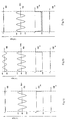
- Figure 1 shows the electric potentials in DEP devices according to the prior art.
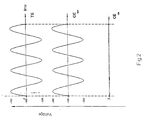
- Figure 2 shows the electric potentials in a DEP device according to the invention.
- Figure 3 shows a DEP device according to the invention.
- Toner bearing surface is used throughout this document to indicate the surface of the means for delivering toner particles from where a flow of toner particles to the image receiving substrate originates.
- OFF-period is used to indicate the time during which the control electrode is kept at an electric potential for blocking the passage of charged toner particles through the printing apertures controlled by said control electrode.
- ON-period is used to indicate the time during which the control electrode is kept at an electric potential for letting charged toner particles pass through the printing apertures controlled by said control electrode.
- This dense flow of toner particles from the surface bearing charged toner particles to a back electrode is a continuous flow, and this dense flow is image-wise modulated by putting a DC-voltage upon the control electrodes present in said printhead structure.
- Said DC-voltage either has a further propagating field (leading to image density) or a blocking field (leading to no-image density).
- the flow of toner particles could image-wise be modulated by image-wise modulating an AC-field existing over the spacing between the toner bearing surface and the printing apertures.
- an AC-field is formed between a particular control electrode around a printing aperture and the toner bearing surface, that printing aperture is totally blocked.
- an AC-field is formed between a particular control electrode around a printing aperture and the toner bearing surface, that printing aperture lets charged toner particles pass in amounts related to the force of the electric AC-field.
- Grey levels can be printed by, e.g., time modulating the presence of the AC-field over the spacing between the toner bearing surface and the printing apertures.
- the present invention includes a device for direct electrostatic printing comprising; apart from the usual components (i.e. means for creating a flow of toner particles from a toner bearing surface towards an image receiving member, a printhead structure with printing apertures and control electrodes interposed in said flow for image-wise controlling said flow), means for image-wise switching an AC-field over the gap the gap between the toner bearing surface and the printing apertures.
- a device for direct electrostatic printing comprising; apart from the usual components (i.e. means for creating a flow of toner particles from a toner bearing surface towards an image receiving member, a printhead structure with printing apertures and control electrodes interposed in said flow for image-wise controlling said flow), means for image-wise switching an AC-field over the gap the gap between the toner bearing surface and the printing apertures.
- FIG 1a, 1b and 1c the electric potentials on the shield electrode (SE), the surface bearing the toner particles (TS) and the control electrode (CE) are shown for prior art DEP devices.
- the notation CE OFF designates the potential of the control electrode when the printing apertures blocks the flow of toner particles and CE ON the potential of the control electrode when the printing apertures lets the flow of toner particles pass uninfluenced.
- the X-axis in the figure show the line time (LT), i.e. the time necessary to print one line.
- the potentials on the shield electrode, on the control electrodes, on the toner bearing surface, etc. are 20 given for DEP devices using negatively charged toner particles. It is obvious that, by changing the polarity of the potentials, the present invention also works with positively charged toner particles.
- Figure 1a shows the electric potentials for a DEP device as disclosed in US-A-4 491 855.
- the shield electrode (SE) is kept at ground potential (i.e. 0 V, DC), the toner bearing surface is kept at a DC-potential - 100 V, whereon an AC-potential with peak to peak voltage 400 V and a frequency 1/ ⁇ 1 is applied.
- CE OFF ground potential
- CE ON DC voltage of - 300 V
- CE ON a DC voltage of - 0 V is applied to the control electrode, (i.e. the control electrode is grounded).
- Figure 1b shows the electric potentials for a DEP device as disclosed in US-A-5 095 322.
- the shield electrode (SE) is kept at ground potential (i.e. 0 V, DC) whereon an AC-potential with peak to peak value of 200 V and frequency 1/ ⁇ 2 is applied.
- the toner bearing surface is kept at a DC-potential - 100 V, whereon an ACpotential with peak to peak voltage 400 V and a frequency 1/ ⁇ 1 is applied. Both AC-voltages are 180 degrees out of phase.
- Figure 1c shows the electric potentials for a DEP device as disclosed in US-A-5 374 949.
- the shield electrode (SE) is kept at ground potential (i.e. 0 V, DC).
- the toner bearing surface is kept at a DC-potential - 100 V, whereon an AC-potential with peak to peak voltage 400 V and a frequency 1/ ⁇ 1 is applied.
- a DC voltage of - 300 V is applied to the control electrode and on this DC voltage a small AC-voltage (e.g., 20 V peak to peak) with frequency 1/ ⁇ 3 is applied.
- Figure 2 shows the electric potentials for an embodiment of a DEP device according to this invention.
- the device according to this invention can comprise a shield electrode, then, the shield electrode (SE) is preferably kept at ground potential (i.e. 0 V, DC).
- the device can also be operated without shield electrode, therefore the figure only shows the potentials on the toner bearing surface (TS) and the potential of the control electrode when the printing apertures blocks the flow of toner particles (CE OFF ) and the potential of the control electrode when the printing apertures lets the flow of toner particles pass uninfluenced (CE ON ).
- the toner bearing surface is kept at a DC-potential - 100 V, whereon an AC-potential with peak to peak voltage 400 V and a frequency 1/ ⁇ 1 is applied.
- DEP devices According to the present invention the toner flow is completely blocked when no AC-field is present over the gap between the toner bearing surface and the control electrode that is strong enough to displace charged toner particles over that gap into the printing aperture controlled by that control electrode.
- DEP device wherein during the OFF-period of a control electrode (the period wherein the control electrode blocks the printing aperture that it controls) a weak AC-field is present over the gap between the toner bearing surface and the control electrode, is within the scope of this invention even when, due to that AC-field, charged toner particles are indeed detached from the toner bearing surface, but do not travel into the printing aperture.
- Grey levels can then be printed by bringing the control electrode and the toner bearing surface only a fraction of the line time (LT) to the same electric potential, thus blocking the toner flow for only a fraction of the line time (LT).
- This time modulation is a preferred embodiment of the present invention. It is possible, for increasing the number of grey levels that can be printed, to have a DC-voltage on the control electrodes deviating froth the DC-voltage on the toner bearing surface and/or to have an AC-voltage on the control electrodes deviating from the AC-voltage on the toner bearing surface. Thus it is possible to choose the strength of the AC-field over the gap between the toner bearing surface and the control electrodes so that, e.g.
- D max is formed, but only three quarter of D max ., half of D max , a quarter of D max , etc.
- FIG 3 a DEP device according to the present invention is shown.
- the electric potentials on the different parts of the device are taken as described above in the first embodiment of the invention.
- the DEP device shown comprises means for delivering toner particles with a container (101)for developer (102) wherein a magnetic brush (103) having a core (103a) wherein magnets are present and a sleeve (103b) rotatably mounted around the core is present.
- the developer (102) can be a mono component developer with magnetic toner particles and then on the surface of the sleeve of the magnetic brush, toner particles are present, i.e. the surface of the sleeve (103b) of the magnetic brush is the toner bearing surface.
- the developer (102) can also be a multi-component developer containing magnetic carrier particles and non-magnetic toner particles and then on the sleeve of the magnetic brush carrier and toner particles are present, but the sleeve is still the toner bearing surface in the sense of this invention.
- the magnetic brush (103) can have a fixed core (103a) and a sleeve (103b) rotatably mounted around the core equipped with means for rotating the core.
- the core (103a) of the magnetic brush is also equipped with means for rotating the core and can thus also be rotated and the sleeve (103b) can be rotated around the core or kept stationary. (The means for rotating the core and/or the sleeve are not shown in the figure).
- a device (118)for generating a DC-voltage and an AC-voltage is connected to the sleeve of the magnetic brush and applies a DC-voltage (DC1) and an AC-field (AC1) to said sleeve (the toner bearing surface).
- DC1 and AC1 and AC1 and the toner bearing surface optionally a further means for providing a DC and/or AC-potential (116) to the toner bearing surface may be present.
- the amount of developer on the toner bearing surface is regulated by a doctor blade (113).
- the device further comprises a back electrode (105) connected to a DC voltage source applying a voltage DC4 to the back electrode.
- An image receiving substrate (108) is passed by means for moving the substrate (107) in the direction of arrow A between the printhead structure (106) and the back electrode by conveying means (107).
- the difference between voltage DC4 and voltage DC1 applies a DC-propulsion field wherein a flow of toner particles (104) is created from the sleeve of the magnetic brush (the toner bearing surface) to the image receiving substrate on the back electrode.
- the AC-field (AC1) on the sleeve of the magnetic brush makes the flow (104)of toner particles denser than when no AC-field would be present.
- a printhead structure (106), with an insulating material (106c) carrying control electrodes (106a) is interposed in the flow (104) of toner particles.
- the control electrodes (106a) can selectively be connected, over switch (115) either to a device (119) for generating a DC-voltage (DC3) and an AC-field (AC3) or to said device (118) for generating a DC-voltage (DC1) and an AC-voltage (AC1).
- a further means for providing a DC and/or AC-potential (117) to the control electrode may be present.
- the flow of charged toner particles is image-wise modulated in the vicinity of the control electrodes.
- the voltage applied to the control electrodes can be varied between a value totally blocking the passage of the toner particles (i.e. when switch 115 connects the control electrodes to when DC1 and AC1).
- the control electrode is grounded for printing full density through the printing aperture it controls and the grey levels are printed by time modulating the switching of a switch (115) between the devices providing DC3 and AC3 and the devices providing DC1 and AC1.
- no device (119) for generating a DC-voltage (DC3) and an AC-field (AC3) is incorporated, and the switch (115) switches the control electrode between the device (118) connected to the toner bearing surface and the ground. It is possible, as described above, to apply a DC-voltage (DC3) having a value different from DC1 and/or an AC-field (AC3) having a value different from the AC-field (AC1) to the control electrode, for partially blocking the printing apertures and at the same time again time modulating the switching of switch 115. By doing so, the number of grey levels that can be printed can be enhanced.
- DC3 DC-voltage
- AC3 AC-field
- control electrodes in said printhead structure are placed apart from the toner bearing surface, leaving a gap (d) between the control electrodes and the toner bearing surface; a spacer (110) keeps the gap (d) constant during operation of the device.
- the device comprises further means (109) for fixing the toner particles to the image receiving substrate.
- the toner bearing surface is the surface of the sleeve of a magnetic brush. It may also be the surface of an applicator for non-magnetic mono-component developer.
- a DEP device according to this invention can also be equipped with a charged toner conveyer (CTC) on the surface of which charged toner particles are applied by a magnetic brush or an applicator for non-magnetic mono-component developer.
- CTC charged toner conveyer
- AC1 AC-field
- the control electrodes can be coupled to a means for generating an AC-field on said control electrodes and a means for selectively switching said AC-field on and off in accordance with image data, as in this invention, in any DEP device known in the art.
- Typical DEP devices that can be adapted for producing a device according to this invention are disclosed in, e.g., EP-A-795 802, EP-A-780 740, EP-A-740 224, EP-A-731 394, EP-A-712 055, US-A-5 606 402, US-A-5 523 777, GB-A-2 108 432, US-A-4 743 926, etc..
- the insulating material used for producing printhead structure, useful in a DEP device according to the present invention, can be glass, ceramic, plastic, etc.
- said insulating material is a plastic material, and can be a polyimide, a polyester (e.g. polyethylelene terephthalate, polyethylene naphthalate, etc.), polyolefines, an epoxy resin, an organosilicon resin, rubber, etc.
- Insulating material useful in the present invention, has a elasticity modulus between 0.1 and 10 GPa, both limits included, preferably between 2 and 8 GPa and most preferably between 4 and 6 Gpa.
- the insulating material has a thickness between 25 and 1000 ⁇ m, preferably between 50 and 200 ⁇ m.
- the back electrode (105) of a DEP device according to this invention can also be made to co-operate with the printhead structure, said back electrode being constructed from different styli or wires that are galvanically isolated and connected to a voltage source as disclosed in e.g. US-A- 4, 568 ,955 and US-A-4, 733, 256.
- the back electrode, co-operating with the printhead structure can also comprise one or more flexible PCB's (Printed Circuit Board).
- a DEP device can also be operated without back electrode in a method for DEP printing on an insulating image receiving substrate, having a first and a second face, comprising the steps of :
- a DEP device can further be operated in a method for direct electrostatic printing with reduced banding comprising the steps of :
- the core is preferably kept stationary.
- a method and device for direct electrostatic printing wherein the toner bearing surface is the sleeve of a magnetic brush with a rotating core, has been described in EP-A-827 046.
- any type of known carrier particles and toner particles can successfully be used. It is however preferred to use "soft" magnetic carrier particles.
- Soft magnetic carrier particles useful in a DEP device according to a preferred embodiment of the present invention are soft ferrite carrier particles. Such soft ferrite particles exhibit only a small amount of remanent behaviour, characterised in coercivity values ranging from about 4 up to 20 kA/m (from 50 up to 250 Oe).
- Further very useful soft magnetic carrier particles for use in a DEP device according to a preferred embodiment of the present invention, are composite carrier particles, comprising a resin binder and a mixture of two magnetites having a different particle size as described in EP-B-289 663.
- the particle size of both magnetites will vary between 0.05 and 3 ⁇ m.
- the carrier particles have preferably an average volume diameter (d v50 ) between 10 and 300 ⁇ m, preferably between 20 and 100 ⁇ m. More detailed descriptions of carrier particles, as mentioned above, can be found EP 675 417.
- toner particles with an absolute average charge corresponding to 1 fC ⁇
- the absolute average charge of the toner particles is measured by an apparatus sold by Dr. R. Epping PES-Laboratorium D-8056 Neufahrn, Germany under the name "q-meter”. The q-meter is used to measure the distribution of the toner particle charge (q in fC) with respect to a measured toner diameter (d in 10 ⁇ m). From the absolute average charge per 10 ⁇ m (
- the charge distribution measured with the apparatus cited above, is narrow, i.e. shows a distribution wherein the coefficient of variability (v), i.e. the ratio of the standard deviation to the average value, is equal to or lower than 0.33.
- the toner particles used in a device according to the present invention have an average volume diameter (d v50 ) between 1 and 20 ⁇ m, more preferably between 3 and 15 ⁇ m. More detailed descriptions of toner particles, as mentioned above, can be found in EP-A-675 417.
- any toner known in the art can be used in a DEP-device according to this invention, it can be toners produced by a pulverisation process, a polymerisation process, a coagulation process, etc.
- Very good toner particles for use in any DEP device and thus also for use in a DEP device according to this invention, are toner paticles as described in US-A-5 633 110.
- the ratio of the length of the long axis of the projected microscopic image of said particles to the length of the short axis is between 1.00 and 1.40, said ratio being the average of the ratios measured on at least 20 different toner particles and said toner particles after addition of 0.5 % by weight of fumed hydrophobic silica having a specific surface area of 260 m 2 /g show a ratio of apparent density ( ⁇ app ) over real density ( ⁇ real ) ⁇ app ⁇ real > 0.52.
- a DEP device making use of the above mentioned marking toner particles can be addressed in a way that enables it to give black and white. It can thus be operated in a "binary way", useful for black and white text and graphics and useful for classical bilevel halftoning to render continuous tone images.
- a DEP device is especially suited for rendering an image with a plurality of grey levels.
- Grey level printing can be controlled by either an amplitude modulation of the AC and/or DC-voltage applied on the control electrodes 106a and/or by a time modulation of said AC an/or DC-voltage. By changing the duty cycle of the time modulation at a specific frequency, it is possible to print accurately fine differences in grey levels. It is also possible to control the grey level printing by a combination of an amplitude modulation and a time modulation of the voltages, applied on the control electrode.
- the printhead structure The printhead structure.
- a printhead structure (106) was made from a polyimide film of 50 ⁇ m thickness (106c), double sided coated with a 5 ⁇ m thick copper film.
- the printhead structure (106) had two rows of printing apertures.
- a rectangular shaped control electrode (106a) was arranged around each aperture.
- Each of said control electrodes was connected over 2 M ⁇ resistors to a HV 507 (trade name) high voltage switching IC, commercially available through Supertex, USA, that was powered from a high voltage power amplifier.
- HV 507 trade name
- a common shield electrode (106b) was present.
- the printing apertures were rectangular shaped with dimensions of 200 by 100 ⁇ m.
- the total width of the rectangular shaped copper control electrodes and connecting lines was 80 ⁇ m.
- the width of the aperture in the common shield electrode was 1600 ⁇ m.
- Said printhead structure was fabricated in the following way. First of all the control electrode pattern and shield electrode pattern was etched by conventional copper etching techniques. The apertures were made by a step and repeat focused excimer laser making use of the control electrode patterns as focusing aid. After excimer burning the printhead structure was cleaned by a short isotropic plasma etching cleaning. Finally a thin coating of PLASTIK70, commercially available from Griffin Chemie, was applied over the control electrode side of said printhead structure.
- the toner delivery means The toner delivery means
- the toner delivery means was a commercially available toner cartridge comprising non magnetic mono component developer, the COLOR LASER TONER CARTRIDGE MAGENTA (M3760GIA), for the COLOR LASER WRITER (Trade names of Apple Computer, USA).
- the toner bearing surface is the surface of an aluminium roller (112), whereon tone particles are applied by a feeding roller (111) The toner particles carried a negative charge.
- the printhead structure mounted in a PVC-frame (116), was bent with frictional contact over the surface of the roller of the toner delivery means.
- the 50 ⁇ m thick polyurethane coating was used as self-regulating spacer means (110).
- a back electrode was present behind the paper whereon the printing proceeded, the distance between the back electrode (105) and the back side of the printhead structure (i.e. control electrodes (106a)) was set to 1000 ⁇ m and the paper travelled at 200 cm/min.
- the back electrode was connected to a high voltage power supply, applying a voltage DC4 of + 1000 V to the back electrode.
- a sinusoidally changing AC voltage AC1 with 400 V peak to peak and a frequency of 3 kHz was applied and a DC-offset (DC1) of -100 V.
- the DC-propulsion field i.e. the potential difference between DC4 and DC1, was 1100 V.
- an (image-wise-selected) voltage was applied selected from 0 V (printing a pixel of maximum density) or the same voltage as applied to the toner delivery means (DC1 and AC1 with the same amplitude and phase as the voltages applied to the toner bearing surface: printing a pixel with minimum density).
- Grey scale images of a human face and control wedges from maximum to minimum density were printed during several minutes after which the image quality and toner accumulation upon said printhead structure was observed. Said printing example showed extremely good results.
Landscapes
- Physics & Mathematics (AREA)
- General Physics & Mathematics (AREA)
- Printers Or Recording Devices Using Electromagnetic And Radiation Means (AREA)
- Dry Development In Electrophotography (AREA)
- Electrophotography Using Other Than Carlson'S Method (AREA)
Claims (4)
- Ein Gerät für elektrostatischen Direktdruck, das folgendes umfaßt :dadurch gekennzeichnet, daßein Zuliefermittel (101) für geladene Tonerteilchen, das eine tonertragende Oberfläche (103b) enthält, die an eine erste Wechselspannungsquelle (AC1) angeschlossen ist, mit der an die Oberfläche eine erste Wechselspannung angelegt wird,ein Mittel (104), mit dem ein von der Oberfläche wegfliegender Strom aus geladenen Tonerteilchen erzeugt wird,ein Mittel (107), das ein bildaufnehmendes Substrat (108) durch diesen Strom fördert,eine zwischen der tonertragenden Oberfläche und dem bildaufnehmenden Substrat angeordnete Druckkopfstruktur (106) mit Drucköffnungen und Steuerelektroden (106a), wobei zwischen der tonertragenden Oberfläche und den Steuerelektroden ein Spalt (d) ausgebildet wird, über dem mittels der ersten Wechselspannungsquelle (AC1) ein erstes Wechselstromfeld angelegt wird,
die Steuerelektroden entsprechend den zugeführten Bilddaten an eine Wechselspannungsquelle (AC3) gekoppelt werden, um in selektiver Weise und mit gleicher Phase wie die erste Wechselspannung eine zweite Wechselspannung an die Steuerelektroden anzulegen, und das zweite Wechselstromfeld, das durch die Wechselspannungsquelle (AC3) angelegt wird, so moduliert wird, daß dem ersten Wechselstromfeld über dem Spalt (d) entweder eine Intensität verliehen wird, die den Strom aus Tonerteilchen durch die Drucköffnungen fließen läßt, oder aber eine Intensität verliehen wird, die verhindert, daß der Strom aus Tonerteilchen durch die Drucköffnungen fließt, wenn die zweite Wechselspannung (AC3) die erste Wechselspannung (AC1) ausgleicht. - Gerät nach Anspruch 1, dadurch gekennzeichnet, daß das Gerät ferner ein Mittel (115) enthält, das die Steuerelektroden in selektiver Weise je nach zugeführten Bilddaten an die Wechselspannungsquelle (AC3) koppelt und abkoppelt.
- Gerät nach Anspruch 2, dadurch gekennzeichnet, daß das Mittel, das die Steuerelektroden in selektiver Weise je nach zugeführten Bilddaten an die Wechselspannungsquelle (AC3) koppelt und abkoppelt, so ausgelegt ist, das es Koppeln und Abkoppeln durch Zeitmodulation steuert.
- Gerät nach irgendeinem der Ansprüche 1 bis 3, dadurch gekennzeichnet, daß das Gerät keine zweite Wechselspannungsquelle (AC3) enthält und die Steuerelektroden so ausgelegt sind, daß sie je nach zugeführten Bilddaten an die Wechselspannungsquelle (AC1) gekoppelt werden, die eine Spannung mit derselben Phase wie die erste Wechselspannung an die Steuerelektroden anlegt und so das erste Wechselstromfeld über dem Spalt (d) ausgleicht.
Priority Applications (4)
| Application Number | Priority Date | Filing Date | Title |
|---|---|---|---|
| DE1997605045 DE69705045T2 (de) | 1997-10-20 | 1997-10-20 | Vorrichtung zum direkten elektrostatischen Drucken mit einer konventionellen Druckkopfstruktur und Wechselspannung zur Steuerelektrode |
| EP19970203268 EP0911706B1 (de) | 1997-10-20 | 1997-10-20 | Vorrichtung zum direkten elektrostatischen Drucken mit einer konventionellen Druckkopfstruktur und Wechselspannung zur Steuerelektrode |
| JP10309545A JPH11198428A (ja) | 1997-10-20 | 1998-10-16 | 直接静電印刷用の装置 |
| US09/175,259 US6109731A (en) | 1997-10-20 | 1998-10-20 | Device for direct electrostatic printing with a conventional printhead structure and AC-coupling to the control electrodes |
Applications Claiming Priority (1)
| Application Number | Priority Date | Filing Date | Title |
|---|---|---|---|
| EP19970203268 EP0911706B1 (de) | 1997-10-20 | 1997-10-20 | Vorrichtung zum direkten elektrostatischen Drucken mit einer konventionellen Druckkopfstruktur und Wechselspannung zur Steuerelektrode |
Publications (2)
| Publication Number | Publication Date |
|---|---|
| EP0911706A1 EP0911706A1 (de) | 1999-04-28 |
| EP0911706B1 true EP0911706B1 (de) | 2001-05-30 |
Family
ID=8228845
Family Applications (1)
| Application Number | Title | Priority Date | Filing Date |
|---|---|---|---|
| EP19970203268 Expired - Lifetime EP0911706B1 (de) | 1997-10-20 | 1997-10-20 | Vorrichtung zum direkten elektrostatischen Drucken mit einer konventionellen Druckkopfstruktur und Wechselspannung zur Steuerelektrode |
Country Status (3)
| Country | Link |
|---|---|
| EP (1) | EP0911706B1 (de) |
| JP (1) | JPH11198428A (de) |
| DE (1) | DE69705045T2 (de) |
Families Citing this family (4)
| Publication number | Priority date | Publication date | Assignee | Title |
|---|---|---|---|---|
| AU1420900A (en) * | 1999-09-13 | 2001-04-17 | Array Ab | Direct printing method and device and a toner container for use in a direct printing device |
| EP1090770A1 (de) * | 1999-10-08 | 2001-04-11 | Agfa-Gevaert N.V. | Vorrichtung zum direkten elektrostatischen Drucken mit einer konventionellen Druckkopfstruktur und einer Wechselspannung, die sowohl an die tonertragende Oberfläche als an die Steuerelektroden gekoppelt ist |
| EP1128232A1 (de) * | 2000-02-23 | 2001-08-29 | Agfa-Gevaert N.V. | Vorrichtung zum direkten elektrostatischen Drucken, wo die Schichte von geladenen Tonerteilchen auf einer Tonerträgeroberfläche homogenisiert wird |
| JP3710801B2 (ja) * | 2003-10-30 | 2005-10-26 | シャープ株式会社 | 現像方法 |
Family Cites Families (6)
| Publication number | Priority date | Publication date | Assignee | Title |
|---|---|---|---|---|
| US4491855A (en) * | 1981-09-11 | 1985-01-01 | Canon Kabushiki Kaisha | Image recording method and apparatus |
| US4755837A (en) * | 1986-11-03 | 1988-07-05 | Xerox Corporation | Direct electrostatic printing apparatus and printhead cleaning structure therefor |
| US5374949A (en) * | 1989-11-29 | 1994-12-20 | Kyocera Corporation | Image forming apparatus |
| US5095322A (en) * | 1990-10-11 | 1992-03-10 | Xerox Corporation | Avoidance of DEP wrong sign toner hole clogging by out of phase shield bias |
| EP0715218B1 (de) * | 1994-11-29 | 1998-04-08 | Agfa-Gevaert N.V. | Trockenentwickler für direkt-elektrostatischen Druckverfahren |
| JP3411434B2 (ja) * | 1994-12-27 | 2003-06-03 | シャープ株式会社 | 画像形成装置 |
-
1997
- 1997-10-20 DE DE1997605045 patent/DE69705045T2/de not_active Expired - Fee Related
- 1997-10-20 EP EP19970203268 patent/EP0911706B1/de not_active Expired - Lifetime
-
1998
- 1998-10-16 JP JP10309545A patent/JPH11198428A/ja active Pending
Also Published As
| Publication number | Publication date |
|---|---|
| EP0911706A1 (de) | 1999-04-28 |
| DE69705045D1 (de) | 2001-07-05 |
| JPH11198428A (ja) | 1999-07-27 |
| DE69705045T2 (de) | 2001-11-22 |
Similar Documents
| Publication | Publication Date | Title |
|---|---|---|
| JP2002341656A (ja) | 静電搬送装置、現像装置及び画像形成装置 | |
| EP0754557B1 (de) | Druckkopfstruktur zur Verwendung in einem direkten elektrostatischen Druckgerät (DEP) | |
| EP0911706B1 (de) | Vorrichtung zum direkten elektrostatischen Drucken mit einer konventionellen Druckkopfstruktur und Wechselspannung zur Steuerelektrode | |
| JP2002307740A (ja) | 静電搬送装置、現像装置、画像形成装置及びトナー供給装置 | |
| US6109731A (en) | Device for direct electrostatic printing with a conventional printhead structure and AC-coupling to the control electrodes | |
| EP0780740B1 (de) | Vorrichtung zum direkten elektrostatischen Drucken mit einer Druckkopfstruktur mit Schlitzöffnungen | |
| EP0812696B1 (de) | Druckkopfstruktur mit einer spezifischen Abschirmelektrode | |
| EP0895867A2 (de) | Direkte elektrostatische Druckvorrichtung mit einer Kantenelektrode und einem Wechselstromfeld auf dem Tonerzufuhrmitteloberflach | |
| EP0736822B1 (de) | Vorrichtung zum direkten elektrostatischen Drucken | |
| EP0963852B1 (de) | Druckverfahren und Steuerung für Druckkopf mit Ablenkelektroden zum direkten elektrostatischen Drucken | |
| US6102523A (en) | Printer for large format printing using a direct electrostatic printing (DEP) engine | |
| JP3159940B2 (ja) | 特別なシールド電極を有するプリントヘッド構造体 | |
| US6059398A (en) | Printhead structure having electrodes not extending to the edge of printing apertures | |
| EP0753413B1 (de) | Druckkopfstruktur zur Anwendung in einer DEP Vorrichtung | |
| EP0849645A1 (de) | Drucker zum Grossformatdrucken für ein Gerät zum direkten elektrostatischen Drucken | |
| JP2007147991A (ja) | 現像装置、プロセスカートリッジ、画像形成装置および現像方法 | |
| JPH11115237A (ja) | エツジ電極を有しトナー移送装置の表面に交流電場をかける直接静電印刷装置 | |
| EP0963853B1 (de) | Druckverfahren für eines Gerät zum direkten elektrostatischen Drucken, das eine Druckkopfanordnung erhaltet mit Ablenkelektroden und Mitteln zur elektrischen Steuerung dieser Ablenkelektroden | |
| EP0924089A1 (de) | Druckkopfstruktur zur Verwendung in einer Vorrichtung zum direkten elektrostatischen Drucken mit symmetrischen Steuerelektroden am Druckoberflach | |
| EP0983858B1 (de) | Druckverfahren und Steuerung für Druckkopf mit Ablenkelektroden zum direkten elektrostatischen Drucken | |
| EP1090770A1 (de) | Vorrichtung zum direkten elektrostatischen Drucken mit einer konventionellen Druckkopfstruktur und einer Wechselspannung, die sowohl an die tonertragende Oberfläche als an die Steuerelektroden gekoppelt ist | |
| EP0719648B1 (de) | Direkte elektrostatische Druckvorrichtung (DEP) mit einer Druckkopfstruktur mit einem maximalen Stromfluss von 50 microA zwischen der Steuerelektrode und der Abschirmelektrode | |
| EP0731394B1 (de) | Vorrichtung zum direkten elektrostatischen Drucken mit aus einer magnetischer Bürste und Druckkopf bestehende Struktur mit spezieller Geometrie | |
| EP0978769A1 (de) | Druckverfahren für eine Vorrichtung zum direkten elektrostatichen Drucken mit Tonerzufuhrmitteln enthaltend eine geladener-Tonertransportrolle, eine magnetische Bürste und eine Reinigungseinheit | |
| JPH04329154A (ja) | 画像形成装置 |
Legal Events
| Date | Code | Title | Description |
|---|---|---|---|
| PUAI | Public reference made under article 153(3) epc to a published international application that has entered the european phase |
Free format text: ORIGINAL CODE: 0009012 |
|
| AK | Designated contracting states |
Kind code of ref document: A1 Designated state(s): BE DE FR GB |
|
| 17P | Request for examination filed |
Effective date: 19991028 |
|
| AKX | Designation fees paid |
Free format text: BE DE FR GB |
|
| 17Q | First examination report despatched |
Effective date: 20000131 |
|
| GRAG | Despatch of communication of intention to grant |
Free format text: ORIGINAL CODE: EPIDOS AGRA |
|
| GRAG | Despatch of communication of intention to grant |
Free format text: ORIGINAL CODE: EPIDOS AGRA |
|
| GRAG | Despatch of communication of intention to grant |
Free format text: ORIGINAL CODE: EPIDOS AGRA |
|
| GRAH | Despatch of communication of intention to grant a patent |
Free format text: ORIGINAL CODE: EPIDOS IGRA |
|
| GRAH | Despatch of communication of intention to grant a patent |
Free format text: ORIGINAL CODE: EPIDOS IGRA |
|
| GRAA | (expected) grant |
Free format text: ORIGINAL CODE: 0009210 |
|
| AK | Designated contracting states |
Kind code of ref document: B1 Designated state(s): BE DE FR GB |
|
| PG25 | Lapsed in a contracting state [announced via postgrant information from national office to epo] |
Ref country code: FR Free format text: LAPSE BECAUSE OF FAILURE TO SUBMIT A TRANSLATION OF THE DESCRIPTION OR TO PAY THE FEE WITHIN THE PRESCRIBED TIME-LIMIT Effective date: 20010530 Ref country code: BE Free format text: LAPSE BECAUSE OF FAILURE TO SUBMIT A TRANSLATION OF THE DESCRIPTION OR TO PAY THE FEE WITHIN THE PRESCRIBED TIME-LIMIT Effective date: 20010530 |
|
| REF | Corresponds to: |
Ref document number: 69705045 Country of ref document: DE Date of ref document: 20010705 |
|
| PGFP | Annual fee paid to national office [announced via postgrant information from national office to epo] |
Ref country code: DE Payment date: 20010829 Year of fee payment: 5 |
|
| PGFP | Annual fee paid to national office [announced via postgrant information from national office to epo] |
Ref country code: GB Payment date: 20010831 Year of fee payment: 5 |
|
| EN | Fr: translation not filed | ||
| REG | Reference to a national code |
Ref country code: GB Ref legal event code: IF02 |
|
| RAP2 | Party data changed (patent owner data changed or rights of a patent transferred) |
Owner name: AGFA-GEVAERT |
|
| PLBE | No opposition filed within time limit |
Free format text: ORIGINAL CODE: 0009261 |
|
| STAA | Information on the status of an ep patent application or granted ep patent |
Free format text: STATUS: NO OPPOSITION FILED WITHIN TIME LIMIT |
|
| 26N | No opposition filed | ||
| PG25 | Lapsed in a contracting state [announced via postgrant information from national office to epo] |
Ref country code: GB Free format text: LAPSE BECAUSE OF NON-PAYMENT OF DUE FEES Effective date: 20021020 |
|
| PG25 | Lapsed in a contracting state [announced via postgrant information from national office to epo] |
Ref country code: DE Free format text: LAPSE BECAUSE OF NON-PAYMENT OF DUE FEES Effective date: 20030501 |
|
| GBPC | Gb: european patent ceased through non-payment of renewal fee |
Effective date: 20021020 |