EP0913403B1 - Verfahren zur Synthese von Alkylpolyglucosiden - Google Patents
Verfahren zur Synthese von Alkylpolyglucosiden Download PDFInfo
- Publication number
- EP0913403B1 EP0913403B1 EP98203567A EP98203567A EP0913403B1 EP 0913403 B1 EP0913403 B1 EP 0913403B1 EP 98203567 A EP98203567 A EP 98203567A EP 98203567 A EP98203567 A EP 98203567A EP 0913403 B1 EP0913403 B1 EP 0913403B1
- Authority
- EP
- European Patent Office
- Prior art keywords
- process according
- monosaccharide
- linear
- acids
- alcohol
- Prior art date
- Legal status (The legal status is an assumption and is not a legal conclusion. Google has not performed a legal analysis and makes no representation as to the accuracy of the status listed.)
- Expired - Lifetime
Links
- 238000000034 method Methods 0.000 title claims description 37
- 230000015572 biosynthetic process Effects 0.000 title claims description 23
- 238000003786 synthesis reaction Methods 0.000 title claims description 18
- 239000003054 catalyst Substances 0.000 claims description 39
- 238000006243 chemical reaction Methods 0.000 claims description 39
- LFQSCWFLJHTTHZ-UHFFFAOYSA-N Ethanol Chemical compound CCO LFQSCWFLJHTTHZ-UHFFFAOYSA-N 0.000 claims description 37
- UHOVQNZJYSORNB-UHFFFAOYSA-N Benzene Chemical compound C1=CC=CC=C1 UHOVQNZJYSORNB-UHFFFAOYSA-N 0.000 claims description 30
- 239000002253 acid Substances 0.000 claims description 30
- 150000002772 monosaccharides Chemical class 0.000 claims description 27
- WQZGKKKJIJFFOK-VFUOTHLCSA-N beta-D-glucose Chemical compound OC[C@H]1O[C@@H](O)[C@H](O)[C@@H](O)[C@@H]1O WQZGKKKJIJFFOK-VFUOTHLCSA-N 0.000 claims description 25
- WQZGKKKJIJFFOK-GASJEMHNSA-N Glucose Natural products OC[C@H]1OC(O)[C@H](O)[C@@H](O)[C@@H]1O WQZGKKKJIJFFOK-GASJEMHNSA-N 0.000 claims description 24
- 239000008103 glucose Substances 0.000 claims description 24
- 150000007513 acids Chemical class 0.000 claims description 21
- 239000000203 mixture Substances 0.000 claims description 21
- 150000001298 alcohols Chemical class 0.000 claims description 14
- 238000004821 distillation Methods 0.000 claims description 12
- 125000004432 carbon atom Chemical group C* 0.000 claims description 10
- 229920006395 saturated elastomer Polymers 0.000 claims description 10
- XLYOFNOQVPJJNP-UHFFFAOYSA-N water Substances O XLYOFNOQVPJJNP-UHFFFAOYSA-N 0.000 claims description 8
- 150000001336 alkenes Chemical class 0.000 claims description 6
- 125000000217 alkyl group Chemical group 0.000 claims description 6
- 150000001875 compounds Chemical class 0.000 claims description 6
- 229920002472 Starch Polymers 0.000 claims description 5
- 239000008107 starch Substances 0.000 claims description 5
- 235000019698 starch Nutrition 0.000 claims description 5
- 238000006277 sulfonation reaction Methods 0.000 claims description 5
- SRBFZHDQGSBBOR-IOVATXLUSA-N D-xylopyranose Chemical compound O[C@@H]1COC(O)[C@H](O)[C@H]1O SRBFZHDQGSBBOR-IOVATXLUSA-N 0.000 claims description 4
- 229910006069 SO3H Inorganic materials 0.000 claims description 4
- PYMYPHUHKUWMLA-UHFFFAOYSA-N arabinose Natural products OCC(O)C(O)C(O)C=O PYMYPHUHKUWMLA-UHFFFAOYSA-N 0.000 claims description 4
- SRBFZHDQGSBBOR-UHFFFAOYSA-N beta-D-Pyranose-Lyxose Natural products OC1COC(O)C(O)C1O SRBFZHDQGSBBOR-UHFFFAOYSA-N 0.000 claims description 4
- 125000001424 substituent group Chemical group 0.000 claims description 4
- 235000000346 sugar Nutrition 0.000 claims description 4
- 150000001720 carbohydrates Chemical class 0.000 claims description 3
- 125000006732 (C1-C15) alkyl group Chemical group 0.000 claims description 2
- OWEGMIWEEQEYGQ-UHFFFAOYSA-N 100676-05-9 Natural products OC1C(O)C(O)C(CO)OC1OCC1C(O)C(O)C(O)C(OC2C(OC(O)C(O)C2O)CO)O1 OWEGMIWEEQEYGQ-UHFFFAOYSA-N 0.000 claims description 2
- GUBGYTABKSRVRQ-XLOQQCSPSA-N Alpha-Lactose Chemical compound O[C@@H]1[C@@H](O)[C@@H](O)[C@@H](CO)O[C@H]1O[C@@H]1[C@@H](CO)O[C@H](O)[C@H](O)[C@H]1O GUBGYTABKSRVRQ-XLOQQCSPSA-N 0.000 claims description 2
- LKDRXBCSQODPBY-VRPWFDPXSA-N D-fructopyranose Chemical compound OCC1(O)OC[C@@H](O)[C@@H](O)[C@@H]1O LKDRXBCSQODPBY-VRPWFDPXSA-N 0.000 claims description 2
- WQZGKKKJIJFFOK-QTVWNMPRSA-N D-mannopyranose Chemical compound OC[C@H]1OC(O)[C@@H](O)[C@@H](O)[C@@H]1O WQZGKKKJIJFFOK-QTVWNMPRSA-N 0.000 claims description 2
- HMFHBZSHGGEWLO-SOOFDHNKSA-N D-ribofuranose Chemical compound OC[C@H]1OC(O)[C@H](O)[C@@H]1O HMFHBZSHGGEWLO-SOOFDHNKSA-N 0.000 claims description 2
- 238000005727 Friedel-Crafts reaction Methods 0.000 claims description 2
- GUBGYTABKSRVRQ-QKKXKWKRSA-N Lactose Natural products OC[C@H]1O[C@@H](O[C@H]2[C@H](O)[C@@H](O)C(O)O[C@@H]2CO)[C@H](O)[C@@H](O)[C@H]1O GUBGYTABKSRVRQ-QKKXKWKRSA-N 0.000 claims description 2
- GUBGYTABKSRVRQ-PICCSMPSSA-N Maltose Natural products O[C@@H]1[C@@H](O)[C@H](O)[C@@H](CO)O[C@@H]1O[C@@H]1[C@@H](CO)OC(O)[C@H](O)[C@H]1O GUBGYTABKSRVRQ-PICCSMPSSA-N 0.000 claims description 2
- PYMYPHUHKUWMLA-LMVFSUKVSA-N Ribose Natural products OC[C@@H](O)[C@@H](O)[C@@H](O)C=O PYMYPHUHKUWMLA-LMVFSUKVSA-N 0.000 claims description 2
- CZMRCDWAGMRECN-UGDNZRGBSA-N Sucrose Chemical compound O[C@H]1[C@H](O)[C@@H](CO)O[C@@]1(CO)O[C@@H]1[C@H](O)[C@@H](O)[C@H](O)[C@@H](CO)O1 CZMRCDWAGMRECN-UGDNZRGBSA-N 0.000 claims description 2
- 229930006000 Sucrose Natural products 0.000 claims description 2
- 150000004996 alkyl benzenes Chemical class 0.000 claims description 2
- HMFHBZSHGGEWLO-UHFFFAOYSA-N alpha-D-Furanose-Ribose Natural products OCC1OC(O)C(O)C1O HMFHBZSHGGEWLO-UHFFFAOYSA-N 0.000 claims description 2
- WQZGKKKJIJFFOK-PHYPRBDBSA-N alpha-D-galactose Chemical compound OC[C@H]1O[C@H](O)[C@H](O)[C@@H](O)[C@H]1O WQZGKKKJIJFFOK-PHYPRBDBSA-N 0.000 claims description 2
- PYMYPHUHKUWMLA-WDCZJNDASA-N arabinose Chemical compound OC[C@@H](O)[C@@H](O)[C@H](O)C=O PYMYPHUHKUWMLA-WDCZJNDASA-N 0.000 claims description 2
- GUBGYTABKSRVRQ-QUYVBRFLSA-N beta-maltose Chemical compound OC[C@H]1O[C@H](O[C@H]2[C@H](O)[C@@H](O)[C@H](O)O[C@@H]2CO)[C@H](O)[C@@H](O)[C@@H]1O GUBGYTABKSRVRQ-QUYVBRFLSA-N 0.000 claims description 2
- 238000006356 dehydrogenation reaction Methods 0.000 claims description 2
- 229930182830 galactose Natural products 0.000 claims description 2
- 150000002402 hexoses Chemical class 0.000 claims description 2
- 125000004435 hydrogen atom Chemical group [H]* 0.000 claims description 2
- 238000011065 in-situ storage Methods 0.000 claims description 2
- 239000008101 lactose Substances 0.000 claims description 2
- 150000002972 pentoses Chemical class 0.000 claims description 2
- 239000005720 sucrose Substances 0.000 claims description 2
- 150000008163 sugars Chemical class 0.000 claims description 2
- 125000000020 sulfo group Chemical group O=S(=O)([*])O[H] 0.000 claims description 2
- 125000002791 glucosyl group Chemical group C1([C@H](O)[C@@H](O)[C@H](O)[C@H](O1)CO)* 0.000 claims 1
- 229960001031 glucose Drugs 0.000 description 24
- 239000007795 chemical reaction product Substances 0.000 description 14
- 238000004128 high performance liquid chromatography Methods 0.000 description 12
- 238000000926 separation method Methods 0.000 description 11
- 239000000047 product Substances 0.000 description 9
- 239000002904 solvent Substances 0.000 description 9
- -1 or more commonly Chemical group 0.000 description 7
- CSCPPACGZOOCGX-UHFFFAOYSA-N Acetone Chemical compound CC(C)=O CSCPPACGZOOCGX-UHFFFAOYSA-N 0.000 description 6
- HEMHJVSKTPXQMS-UHFFFAOYSA-M Sodium hydroxide Chemical compound [OH-].[Na+] HEMHJVSKTPXQMS-UHFFFAOYSA-M 0.000 description 6
- 150000004676 glycans Chemical class 0.000 description 5
- 229920001282 polysaccharide Polymers 0.000 description 5
- 239000005017 polysaccharide Substances 0.000 description 5
- UEUIKXVPXLWUDU-UHFFFAOYSA-O 4-sulfobenzenediazonium Chemical compound OS(=O)(=O)C1=CC=C([N+]#N)C=C1 UEUIKXVPXLWUDU-UHFFFAOYSA-O 0.000 description 4
- 239000003377 acid catalyst Substances 0.000 description 4
- 239000002244 precipitate Substances 0.000 description 4
- 230000035484 reaction time Effects 0.000 description 4
- JOXIMZWYDAKGHI-UHFFFAOYSA-N toluene-4-sulfonic acid Chemical compound CC1=CC=C(S(O)(=O)=O)C=C1 JOXIMZWYDAKGHI-UHFFFAOYSA-N 0.000 description 4
- 238000005406 washing Methods 0.000 description 4
- 241000640882 Condea Species 0.000 description 3
- 230000000052 comparative effect Effects 0.000 description 3
- 238000000605 extraction Methods 0.000 description 3
- 238000004519 manufacturing process Methods 0.000 description 3
- 150000004682 monohydrates Chemical class 0.000 description 3
- 238000001556 precipitation Methods 0.000 description 3
- 150000003460 sulfonic acids Chemical class 0.000 description 3
- 239000004094 surface-active agent Substances 0.000 description 3
- KBPLFHHGFOOTCA-UHFFFAOYSA-N 1-Octanol Chemical compound CCCCCCCCO KBPLFHHGFOOTCA-UHFFFAOYSA-N 0.000 description 2
- PEDCQBHIVMGVHV-UHFFFAOYSA-N Glycerine Chemical compound OCC(O)CO PEDCQBHIVMGVHV-UHFFFAOYSA-N 0.000 description 2
- 239000004435 Oxo alcohol Substances 0.000 description 2
- ULUAUXLGCMPNKK-UHFFFAOYSA-N Sulfobutanedioic acid Chemical compound OC(=O)CC(C(O)=O)S(O)(=O)=O ULUAUXLGCMPNKK-UHFFFAOYSA-N 0.000 description 2
- QAOWNCQODCNURD-UHFFFAOYSA-N Sulfuric acid Chemical compound OS(O)(=O)=O QAOWNCQODCNURD-UHFFFAOYSA-N 0.000 description 2
- 229940045714 alkyl sulfonate alkylating agent Drugs 0.000 description 2
- 150000008052 alkyl sulfonates Chemical class 0.000 description 2
- 239000006227 byproduct Substances 0.000 description 2
- 239000003153 chemical reaction reagent Substances 0.000 description 2
- MWKFXSUHUHTGQN-UHFFFAOYSA-N decan-1-ol Chemical compound CCCCCCCCCCO MWKFXSUHUHTGQN-UHFFFAOYSA-N 0.000 description 2
- 238000001704 evaporation Methods 0.000 description 2
- 230000008020 evaporation Effects 0.000 description 2
- 238000001914 filtration Methods 0.000 description 2
- 239000007791 liquid phase Substances 0.000 description 2
- 229910052751 metal Inorganic materials 0.000 description 2
- 239000002184 metal Substances 0.000 description 2
- 150000002739 metals Chemical class 0.000 description 2
- 238000006384 oligomerization reaction Methods 0.000 description 2
- 150000007524 organic acids Chemical class 0.000 description 2
- 239000002243 precursor Substances 0.000 description 2
- 238000002360 preparation method Methods 0.000 description 2
- 229920005989 resin Polymers 0.000 description 2
- 239000011347 resin Substances 0.000 description 2
- 150000003839 salts Chemical class 0.000 description 2
- 239000007787 solid Substances 0.000 description 2
- 238000001308 synthesis method Methods 0.000 description 2
- HLZKNKRTKFSKGZ-UHFFFAOYSA-N tetradecan-1-ol Chemical compound CCCCCCCCCCCCCCO HLZKNKRTKFSKGZ-UHFFFAOYSA-N 0.000 description 2
- 238000003420 transacetalization reaction Methods 0.000 description 2
- JSPLKZUTYZBBKA-UHFFFAOYSA-N trioxidane Chemical class OOO JSPLKZUTYZBBKA-UHFFFAOYSA-N 0.000 description 2
- ALSTYHKOOCGGFT-KTKRTIGZSA-N (9Z)-octadecen-1-ol Chemical compound CCCCCCCC\C=C/CCCCCCCCO ALSTYHKOOCGGFT-KTKRTIGZSA-N 0.000 description 1
- DNIAPMSPPWPWGF-GSVOUGTGSA-N (R)-(-)-Propylene glycol Chemical compound C[C@@H](O)CO DNIAPMSPPWPWGF-GSVOUGTGSA-N 0.000 description 1
- 150000000180 1,2-diols Chemical class 0.000 description 1
- WBIQQQGBSDOWNP-UHFFFAOYSA-N 2-dodecylbenzenesulfonic acid Chemical compound CCCCCCCCCCCCC1=CC=CC=C1S(O)(=O)=O WBIQQQGBSDOWNP-UHFFFAOYSA-N 0.000 description 1
- 244000060011 Cocos nucifera Species 0.000 description 1
- 235000013162 Cocos nucifera Nutrition 0.000 description 1
- VEXZGXHMUGYJMC-UHFFFAOYSA-N Hydrochloric acid Chemical compound Cl VEXZGXHMUGYJMC-UHFFFAOYSA-N 0.000 description 1
- NBIIXXVUZAFLBC-UHFFFAOYSA-N Phosphoric acid Chemical compound OP(O)(O)=O NBIIXXVUZAFLBC-UHFFFAOYSA-N 0.000 description 1
- 240000008042 Zea mays Species 0.000 description 1
- 235000005824 Zea mays ssp. parviglumis Nutrition 0.000 description 1
- 235000002017 Zea mays subsp mays Nutrition 0.000 description 1
- DHKHKXVYLBGOIT-UHFFFAOYSA-N acetaldehyde Diethyl Acetal Natural products CCOC(C)OCC DHKHKXVYLBGOIT-UHFFFAOYSA-N 0.000 description 1
- 150000001241 acetals Chemical class 0.000 description 1
- 125000003158 alcohol group Chemical group 0.000 description 1
- 238000006136 alcoholysis reaction Methods 0.000 description 1
- 150000008051 alkyl sulfates Chemical class 0.000 description 1
- 125000005233 alkylalcohol group Chemical group 0.000 description 1
- 229910052782 aluminium Inorganic materials 0.000 description 1
- XAGFODPZIPBFFR-UHFFFAOYSA-N aluminium Chemical compound [Al] XAGFODPZIPBFFR-UHFFFAOYSA-N 0.000 description 1
- 150000008107 benzenesulfonic acids Chemical class 0.000 description 1
- 238000009835 boiling Methods 0.000 description 1
- WTEOIRVLGSZEPR-UHFFFAOYSA-N boron trifluoride Chemical compound FB(F)F WTEOIRVLGSZEPR-UHFFFAOYSA-N 0.000 description 1
- 125000000484 butyl group Chemical group [H]C([*])([H])C([H])([H])C([H])([H])C([H])([H])[H] 0.000 description 1
- 238000005119 centrifugation Methods 0.000 description 1
- 235000013339 cereals Nutrition 0.000 description 1
- 239000007810 chemical reaction solvent Substances 0.000 description 1
- 239000003795 chemical substances by application Substances 0.000 description 1
- 235000005822 corn Nutrition 0.000 description 1
- 230000008878 coupling Effects 0.000 description 1
- 238000010168 coupling process Methods 0.000 description 1
- 238000005859 coupling reaction Methods 0.000 description 1
- 238000002425 crystallisation Methods 0.000 description 1
- 230000008025 crystallization Effects 0.000 description 1
- 239000003599 detergent Substances 0.000 description 1
- LQZZUXJYWNFBMV-UHFFFAOYSA-N dodecan-1-ol Chemical compound CCCCCCCCCCCCO LQZZUXJYWNFBMV-UHFFFAOYSA-N 0.000 description 1
- 229940060296 dodecylbenzenesulfonic acid Drugs 0.000 description 1
- 230000000694 effects Effects 0.000 description 1
- CJMZLCRLBNZJQR-UHFFFAOYSA-N ethyl 2-amino-4-(4-fluorophenyl)thiophene-3-carboxylate Chemical compound CCOC(=O)C1=C(N)SC=C1C1=CC=C(F)C=C1 CJMZLCRLBNZJQR-UHFFFAOYSA-N 0.000 description 1
- 239000010408 film Substances 0.000 description 1
- 235000011187 glycerol Nutrition 0.000 description 1
- 150000002334 glycols Chemical class 0.000 description 1
- 229910052500 inorganic mineral Inorganic materials 0.000 description 1
- 239000007788 liquid Substances 0.000 description 1
- 125000002496 methyl group Chemical group [H]C([H])([H])* 0.000 description 1
- 239000011707 mineral Substances 0.000 description 1
- 229940043348 myristyl alcohol Drugs 0.000 description 1
- 238000006386 neutralization reaction Methods 0.000 description 1
- 229940055577 oleyl alcohol Drugs 0.000 description 1
- XMLQWXUVTXCDDL-UHFFFAOYSA-N oleyl alcohol Natural products CCCCCCC=CCCCCCCCCCCO XMLQWXUVTXCDDL-UHFFFAOYSA-N 0.000 description 1
- 235000005985 organic acids Nutrition 0.000 description 1
- 239000012071 phase Substances 0.000 description 1
- 238000006116 polymerization reaction Methods 0.000 description 1
- 238000000746 purification Methods 0.000 description 1
- 239000011541 reaction mixture Substances 0.000 description 1
- 238000011084 recovery Methods 0.000 description 1
- 238000004064 recycling Methods 0.000 description 1
- 238000010517 secondary reaction Methods 0.000 description 1
- 239000012265 solid product Substances 0.000 description 1
- 239000000126 substance Substances 0.000 description 1
- 150000005846 sugar alcohols Polymers 0.000 description 1
- 239000006188 syrup Substances 0.000 description 1
- 235000020357 syrup Nutrition 0.000 description 1
- 239000010409 thin film Substances 0.000 description 1
Classifications
-
- C—CHEMISTRY; METALLURGY
- C07—ORGANIC CHEMISTRY
- C07H—SUGARS; DERIVATIVES THEREOF; NUCLEOSIDES; NUCLEOTIDES; NUCLEIC ACIDS
- C07H3/00—Compounds containing only hydrogen atoms and saccharide radicals having only carbon, hydrogen, and oxygen atoms
- C07H3/06—Oligosaccharides, i.e. having three to five saccharide radicals attached to each other by glycosidic linkages
-
- C—CHEMISTRY; METALLURGY
- C07—ORGANIC CHEMISTRY
- C07H—SUGARS; DERIVATIVES THEREOF; NUCLEOSIDES; NUCLEOTIDES; NUCLEIC ACIDS
- C07H15/00—Compounds containing hydrocarbon or substituted hydrocarbon radicals directly attached to hetero atoms of saccharide radicals
- C07H15/02—Acyclic radicals, not substituted by cyclic structures
- C07H15/04—Acyclic radicals, not substituted by cyclic structures attached to an oxygen atom of the saccharide radical
-
- C—CHEMISTRY; METALLURGY
- C07—ORGANIC CHEMISTRY
- C07H—SUGARS; DERIVATIVES THEREOF; NUCLEOSIDES; NUCLEOTIDES; NUCLEIC ACIDS
- C07H3/00—Compounds containing only hydrogen atoms and saccharide radicals having only carbon, hydrogen, and oxygen atoms
- C07H3/04—Disaccharides
Definitions
- the present invention relates to an improved process for the synthesis of alkylpolyglucosides.
- the present invention relates to a process for the synthesis of alkylpolyglucosides characterized by the use of a sterically hindered polyalkylarylsulfonic acid or a mixture of sterically hindered polyalkylarylsulfonic acids as catalyst.
- Said catalyst allows a more selective reaction and consequently a reaction raw product which is practically without undesired by-products.
- Alkylpolyglucosides are a group of substances consisting of a chain of rings of a sugar linked to each other with glucosidic bonds in which the last ring of the glucosidic chain is acetalized with an alcohol.
- the general structure of alkylpolyglucosides is represented by the following general formula (I): H-(G) n -O-R wherein G represents a glucosidic unit, R represents the radical corresponding to the alcohol used for forming glucosidic acetal and n represents the polymerization degree, i.e. the number of glucosidic units linked.
- alkylpolyglucosides in which n is between 1 and 5 and R represents the residue of a long-chain, aliphatic alcohol (linear or branched).
- the alkylpolyglucosides of this type are non-ionic surface-active agents which can be used in the normal fields of use of surface-active agents and, in particular, in the field of detergents.
- These particular alkylglucosidic oligomers shall hereafter be indicated with the abbreviation APG.
- the control of the value of n can be effected by varying the molar ratio alcohol/saccharide in the preparation reaction of APG: by increasing this ratio, in fact, APG are obtained with a lower average value of n.
- APG offer, with respect to traditional surface-active agents, two important advantages: in the first place, they are obtained from renewable natural sources essentially consisting of starch and oil extracted from coconuts; secondly, APG are 100% biodegradable. As a result the industrial interest in these compounds is high and continually increasing.
- APG APG The preparation of APG has been studied for many years and consequently various synthesis methods of these compounds are known starting from various combinations of reagents.
- a first possibility is the direct synthesis starting from sugar and alcohol (or from a mixture of alcohols): the end product is obtained using the alcohol in excess with respect to the stoichiometric value.
- the source of the glucosidic part of the molecule consists of starch obtained from cereals.
- the polysaccharide is generally first depolymerized with lower alcohols (methyl, or more commonly, butyl) in the presence of an acid as catalyst; in this way, a mixture of APG is obtained with a short-chain R group.
- This mixture is subsequently treated under vacuum with the long-chain alcohol, in the presence of an acid as catalyst, by the exchange of the alcohol group: this reaction is called “transacetalization” and is favoured by the removal, by evaporation, of the alcohol with a shorter chain which is formed and which is lower-boiling than the long-chain alcohol; also in this case there is an excess of long-chain alcohol with respect to the stoichiometric value.
- the acids used for this purpose in industrial processes are mineral acids such as, for example, H 2 SO 4 , HCl, H 3 PO 4 or BF 3 , or, more commonly, sulfonic acids or their salts.
- the group of sulfonic acids used is very wide and comprises, for example, ortho-, meta- and paratoluenesulfonic acids, alkylbenzenesulfonic acids, secondary alkyl-sulfonic acids, sulfonic resins, alkylsulfates, alkylbenzenesulfonates, alkylsulfonates and sulfosuccinic acid.
- the acid catalyst is neutralized with a base.
- the base which is most commonly used is sodium hydroxide (NaOH) but some patents claim the use of particular bases.
- NaOH sodium hydroxide
- US patent 4.713.447 describes the use of alcoholates of alkaline, earth-alkaline metals or of aluminum, or, alternatively, of salts of organic acids of the same metals.
- the last passage in the synthesis process of APG consists in the separation of the APG themselves from the excess alcohol.
- This separation is generally carried out by distillation under vacuum, preferably thin film distillation, at a temperature of about 150°C-180°C; optionally, to facilitate this separation, it is possible to operate in the presence of fluidifying agents such as, for example, glycerine or glycols, or 1,2-diols with a long chain (C 12 -C 18 ), as described, for example, in US patent 4.889.925.
- Another technique used to separate the APG from the excess alcohol is the extraction with a solvent such as, for example, water, acetone or hypercritical CO 2 .
- the polyglucose formed is a solid product whose presence in the mixture of products obtained, even in a small percentage, causes an increase in the viscosity of the mixture and the precipitation of products in a gelatinous form.
- all the subsequent operations of the synthesis process of APG i.e. the separation of the desired product, the recovery and possible recycling of non-reacted alkylglucosides and alcohols, become extremely difficult.
- this solution involves the use of high volumes of alcohol, with consequent problems relating to the safety and overdimensioning of the APG production plants.
- European patent EP 449.866 describes a new group of sulfonic acids showing a high lipophylia which, operating with a molar ratio alcohol/glucose of 5 to 1, enable the content of polyglucose to be lowered to 2.2% again calculated on the end-product after distillation of the excess alcohol; these catalyst, however, are very costly.
- US patent 5.432.269 using a binary catalyst consisting of the coupling of a weak base and a strong organic acid, operating with a ratio alcohol/glucose of 5 to 1, a percentage of polyglucose of 0.7% is obtained.
- the Applicant has now found that a new group of catalysts consisting of a sterically hindered polyalkylarylsulfonic acid or a mixture of sterically hindered polyalkylarylsulfonic acids, allows the formation of polyglucose to be reduced in the synthesis process of APG, even when operating with low alcohol/glucose ratios.
- the present invention therefore relates to a process for the synthesis of alkylpolyglucosides having general formula (I): H-(G) n -O-R wherein:
- polyalkylarylsulfonic acids are obtained by the sulfonation, using gaseous SO 3 in a film reactor, of heavy alkylates, linear or branched, present in the distillation residue coming from the synthesis of linear monoalkylbenzenes carried out starting from olefins and/or chloroparaffins in the presence of an excess of benzene and in the presence of a Friedel-Crafts catalyst: this synthesis is described, for example, in US patent 5.574.198.
- Preferred examples of polyalkylarylsulfonic acids which can be used alone or mixed with each other, in the process of the present invention are those obtained by the sulfonation of ALCHISOR HD® of Condea Augusta S.p.A., which forms the distillation residue coming from the synthesis of linear alkylbenzene starting from benzene and olefins where these olefins are obtained by the dehydrogenation of n-paraffins.
- This residue contains:
- polyalkylarylsulfonic acids described above can be defined by the following molecular formula: C n H 2n-7 SO 3 H wherein n represents an integer between 16 and 45, extremes included.
- polyalkylarylsulfonic acids can be defined by the following general formula (II): wherein:
- a mixture of dialkylbenzenesulfonic acids is preferably used, obtained by the sulfonation of ALCHISOR HD® which will hereinafter be indicated as DABS.
- the reaction between a monosaccharide or an equivalent thereof and an alcohol is carried out at a temperature ranging from 110°C to 130°C under vacuum, with the continuous removal of the water which is formed.
- Monosaccharides which can be conveniently used in the process of the present invention are, for example, glucose, mannose, galactose, arabinose, xylose, ribose, etc.
- glucose is preferred for its low cost and wide availability.
- alkylglucosides of lower alcohols such as, for example, butylglucosides
- higher sugars or saccharides which, under the reaction conditions, can be hydrolyzed to monosaccharides such as, for example, starch, maltose, sucrose, lactose, etc.
- monosaccharides such as, for example, starch, maltose, sucrose, lactose, etc.
- butylpolyglucosides obtained from the alcoholysis of starch or "corn syrup" can be mentioned as an example.
- Alcohols which can be conveniently used in the process of the present invention are primary or secondary, monohydric alcohols, linear or branched, saturated or unsaturated, containing from 8 to 20 carbon atoms, and their mixtures.
- Examples of the above alcohols are: octanol, decanol, lauryl alcohol, myristyl alcohol, oleyl alcohol, and alcohols deriving from oxosynthesis having a linear/branched ratio equal to 45/55 such as, for example, LIAL 111®, LIAL 123®, LIAL 145®, or their mixtures such as, for example, LIAL 125® (all sold by Condea Augusta S.p.A.), or fractions of linear alcohols obtained by fractionated crystallization of the above.
- LIALs such as, for example, ALCHEM 111®, ALCHEM 123®, ALCHEM 145®, or their mixtures.
- the catalysts used in the process of the present invention make the use of fractions of C 8 - C 20 totally branched alcohols such as, for example, ISALCHEM 123®, ISALCHEM 145®, or their mixtures (all sold by Condea Augusta S.p.A.), industrially convenient.
- the alcohol is used in a higher quantity with respect to the stoichiometric value and, precisely, with a molar ratio between the alcohol and the monosaccharide ranging from 1 to 7, preferably between 1.5 and 3.3.
- the alcohol also acts as reaction solvent.
- the catalyst can be used in a quantity ranging from 0.001 to 0.1 moles per mole of monosaccharide (or its equivalent) and, preferably, in a quantity ranging from 0.001 to 0.01 moles per mole of monosaccharide.
- reaction between the monosaccharide or its equivalent and the alcohol described above can be carried out in batch or in continuous.
- the APG can be separated from the raw product by distillation or by treatment with a solvent in which the APG are almost totally insoluble.
- the distillation is carried out according to methods known in the art (for example, distillation under vacuum).
- This characteristic represents another important advantage of the process of the present invention: in fact, the washing liquid can be joined to the liquid phase obtained in the previous separation operation of the APG from the raw reaction product; this liquid phase, which contains excess alcohol, alkylmonosaccharides and practically all the catalyst, can be recycled to the reaction after evaporation of the solvent.
- This liquid phase which contains excess alcohol, alkylmonosaccharides and practically all the catalyst, can be recycled to the reaction after evaporation of the solvent.
- neutralization of the acid catalyst with bases which must be effected in many of the known processes in the art, is not necessary.
- the loss of catalyst, due to its englobement in the APG is extremely limited: operating in continuous, under optimum precipitation conditions and with the process in regime, there are losses of catalyst of about 0.5 g - 1 g per 1 kg of end-product.
- LIAL 123® (4.12 moles; LIAL 123® is a mixture of linear and branched C 12 -C 13 oxo-alcohols having an average molecular weight equal to 194) and 408 g of glucose monohydrate (2.06 moles) are charged into a 2-litre flask equipped with a stirrer, thermometer and distiller at the head; the molar ratio alcohol/glucose is 2.
- the reaction mass is heated to 115°C and subsequently, after removing the reaction water, 3.6 g (0.0078 moles) of DABS are introduced; the molar ratio catalyst/glucose is 0.0038.
- the reaction flask is connected to a vacuum pump which maintains the internal pressure of the system at about 3.33 KPa (25 mm/Hg).
- the reaction proceeds, at a constant temperature (115°C) and under vacuum, until the complete conversion of the glucose (about 6 hours); the reaction water which is formed is sent to a trap maintained at about -80°C.
- the end-product which is obtained is a light viscous mass having a content of polyglucose, determined by high pressure liquid chromatography (HPLC), equal to 7%.
- the reaction is carried out operating as described in Example 1, but using 6.9 g (0.015 moles) of DABS as catalyst; the molar ratio catalyst/glucose is 0.0073.
- the reaction time, determined from the complete conversion of the glucose, is about 5 hours.
- the end-product obtained is a light viscous mass having a content of polyglucose, determined by high pressure liquid chromatography (HPLC), equal to 6%.
- ALCHEM 123® (4.12 moles; ALCHEM 123® is a mixture of linear C 12 -C 13 oxo-alcohols having an average molecular weight equal to 194) and 408 g of glucose monohydrate (2.06 moles) are charged into a 2-litre flask equipped with a stirrer, thermometer and distiller at the head; the molar ratio alcohol/glucose is 2.
- the reaction mass is heated to 115°C and subsequently, after removing the reaction water, 6.9 g (0.015 moles) of DABS are introduced; the molar ratio catalyst/glucose is 0.0073.
- the reaction flask is connected to a vacuum pump which maintains the internal pressure of the system at about 3.33 KPa (25 mm/Hg).
- the reaction proceeds, at a constant temperature (115°C) and under vacuum, until the complete conversion of the glucose (about 5 hours); the reaction water which is formed is sent to a trap maintained at about -80°C.
- the end-product which is obtained is a light mass semi-solid at room temperature, having a content of polyglucose, determined by high pressure liquid chromatography (HPLC), equal to 5%.
- the reaction is carried out operating as described in Example 1, but using 1.48 g of para-toluenesulfonic monohydrate acid as catalyst (0.0078 moles); the molar ratio catalyst/glucose is 0.0038.
- the reaction time determined from the complete conversion of the glucose, is about 4 hours.
- the end-product obtained is an amber-coloured, viscous mass having a content of polyglucose, determined by high pressure liquid chromatography (HPLC), equal to 15%.
- the reaction is carried out operating as described in Example 2, but using 2.85 g of para-toluenesulfonic monohydrate acid as catalyst (0.015 moles); the molar ratio catalyst/glucose is 0.0073.
- the reaction time, determined from the complete conversion of the glucose, is about 3 hours.
- the end-product obtained is an amber-coloured, viscous mass having a content of polyglucose, determined by high pressure liquid chromatography (HPLC), equal to 25%.
- the reaction is carried out operating as described in Example 3, but using 1.48 g of para-toluenesulfonic monohydrate acid as catalyst (0.0078 moles); the molar ratio catalyst/glucose is 0.0073.
- the reaction time, determined from the complete conversion of the glucose, is about 3 hours.
- the end-product obtained is a light gelatinous mass having a content of polyglucose, determined by high pressure liquid chromatography (HPLC), equal to 10%.
Landscapes
- Chemical & Material Sciences (AREA)
- Organic Chemistry (AREA)
- Genetics & Genomics (AREA)
- Molecular Biology (AREA)
- Engineering & Computer Science (AREA)
- Biochemistry (AREA)
- Biotechnology (AREA)
- General Health & Medical Sciences (AREA)
- Health & Medical Sciences (AREA)
- Life Sciences & Earth Sciences (AREA)
- Crystallography & Structural Chemistry (AREA)
- Saccharide Compounds (AREA)
- Catalysts (AREA)
- Organic Low-Molecular-Weight Compounds And Preparation Thereof (AREA)
- Low-Molecular Organic Synthesis Reactions Using Catalysts (AREA)
- Silicon Compounds (AREA)
Claims (15)
- Ein Verfahren zur Synthese von Alkylpolyglucosiden mit der allgemeinen Formel (I):wobei das Verfahren die Reaktion eines Alkohols mit einem Monosaccharid oder einem Äquivalent von diesem, welches ein Alkylglucosid oder eine Verbindung, die in der Lage ist, das Monosaccharid "in situ" zu erzeugen, sein kann, umfasst, dadurch gekennzeichnet, dass die Reaktion durchgeführt wird in Gegenwart eines Katalysators, welcher aus einer sterisch gehinderten Polyalkylarylsulfonsäure oder einer Mischung von sterisch gehinderten Polyalkylarylsulfonsäuren besteht, wobei die Polyalkylarylsulfonsäuren ausgewählt werden aus jenen, die wenigstens eine lineare oder verzweigte Alkylgruppe mit einer Anzahl von Kohlenstoffatomen, die von 10 bis 15 reicht, in der ortho-Position in Bezug auf die Sulfonsäuregruppe (SO3H) aufweisen.R für eine lineare oder verzweigte, gesättigte oder ungesättigte Alkylgruppe steht, welche eine Anzahl an Kohlenstoffatomen aufweist, die von 8 bis 20 reicht;G für eine Gruppe steht, welche aus der Entfernung eines Moleküls H2O aus einem Monosaccharid, typischerweise einer Hexose mit der Formel C6H12O6 oder einer Pentose mit der Formel C5H10O5, resultiert;n eine ganze Zahl von 1 bis 5 ist;
- Das Verfahren gemäß Anspruch 1, wobei die Polyalkylarylsulfonsäuren ausgewählt werden aus jenen, die erhalten werden durch die Sulfonierung, wobei gasförmiges SO3 in einem Dünnschichtreaktor verwendet wird, von schweren linearen oder verzweigten Alkylaten, die in dem Destillationsrückstand vorliegen, welcher aus der Synthese von linearen Monoalkylbenzolen stammt, die ausgehend von Olefinen und/oder Chlorparaffinen in Gegenwart eines Überschusses an Benzol und eines Friedel-Crafts-Katalysators durchgeführt wird.
- Das Verfahren gemäß Anspruch 1 oder 2, wobei die Polyalkylarylsulfonsäuren, welche allein oder miteinander gemischt verwendet werden können, ausgewählt werden aus jenen, welche durch die Sulfonierung des Destillationsrückstands gewonnen werden, der aus der Synthese von linearem Alkylbenzol ausgehend von Benzol und Olefinen stammt, wobei diese Olefine erhalten werden durch die Dehydrierung von n-Paraffinen und dieser Rückstand enthält:Polyalkylbenzole (≥ 80% molar) mit der allgemeinen Formel CnH2n-6, wobei n für eine ganze Zahl von 16 bis 45 steht;Dialkylbenzole (≥ 60% molar) mit der allgemeinen Formel CnH2n-6, wobei n für eine ganze Zahl von 20 bis 33 steht.
- Das Verfahren gemäß Anspruch 1, 2 oder 3, wobei die Polyalkylarylsulfonsäuren definiert werden durch die folgende Molekülformel:
- Das Verfahren gemäß Anspruch 1, 2 oder 3, wobei die Polyalkylarylsulfonsäuren definiert werden durch die folgende allgemeine Formel (II):wobei:
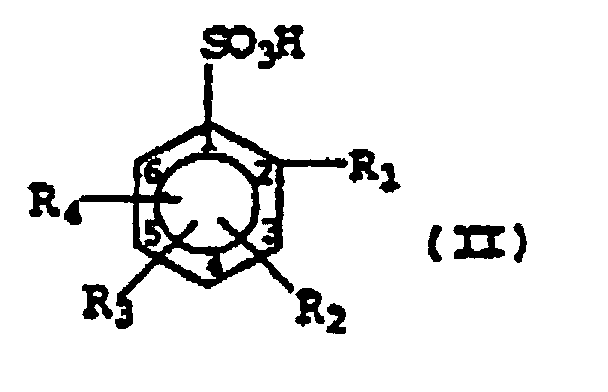 R1 für eine lineare oder verzweigte, gesättigte oder ungesättigte C10-C15-Alkylgruppe steht;R2 für eine lineare oder verzweigte, gesättigte oder ungesättigte C1-C15-Alkylgruppe in ortho-Position (Position 3 des Benzolrings) oder meta-Position (Position 4 oder 6 des Benzolrings) oder para-Position (Position 5 des Benzolrings) in Bezug auf den Substituenten R1 steht;R3 und R4, die gleich oder verschieden sind, für ein Wasserstoffatom oder eine lineare oder verzweigte, gesättigte oder ungesättigte Alkylgruppe stehen, welche eine Anzahl an Kohlenstoffatomen aufweist, die derart ist, dass die Summe der Kohlenstoffatome der Substituenten R1, R2, R3 und R4 gleich (n-6) ist, wobei n für eine ganze Zahl von 16 bis 45 steht.
 - Das Verfahren gemäß Anspruch 1, wobei der Katalysator aus einer Mischung von Dialkylbenzolsufonsäuren besteht, die wie in Anspruch 3 beschrieben erhalten wird.
- Das Verfahren gemäß Anspruch 1, wobei die Reaktion zwischen einem Monosaccharid oder einem Äquivalent von diesem und einem Alkohol bei einer Temperatur, die von 110°C bis 130°C reicht, unter Vakuum bei der kontinuierlichen Entfernung des gebildeten Wassers durchgeführt wird.
- Das Verfahren gemäß Anspruch 1, wobei die Monosaccharide ausgewählt werden aus Glucose, Mannose, Galactose, Arabinose, Xylose, Ribose usw.
- Das Verfahren gemäß Anspruch 8, wobei das Monosaccharid Glucose ist.
- Das Verfahren gemäß Anspruch 1, wobei die äquivalente Verbindung des Monosaccharids ausgewählt wird aus Alkylglucosiden niederer Alkohole wie z.B. Butylglucosiden und höheren Zuckern oder Sacchariden, welche unter den Reaktionsbedingungen zu Monosacchariden wie z.B. Stärke, Maltose, Sucrose, Lactose hydrolysiert werden können.
- Das Verfahren gemäß Anspruch 1, wobei die Alkohole ausgewählt werden aus primären oder sekundären, einwertigen, linearen oder verzweigten, gesättigten oder ungesättigten Alkoholen, die von 8 bis 20 Kohlenstoffatome enthalten, und deren Mischungen.
- Das Verfahren gemäß Anspruch 1, wobei das molare Verhältnis zwischen Alkohol und Monosaccharid zwischen 1 und 7 liegt.
- Das Verfahren gemäß Anspruch 12, wobei das molare Verhältnis zwischen Alkohol und Monosaccharid zwischen 1,5 und 3,3 liegt.
- Das Verfahren gemäß Anspruch 1, wobei der Katalysator in einer Menge verwendet wird, die von 0,001 bis zu 0,1 Molen pro Mol an Monosaccharid oder einem Äquivalent von diesem reicht.
- Das Verfahren gemäß Anspruch 14, wobei der Katalysator in einer Menge verwendet wird, die von 0,001 bis zu 0,01 Molen pro Mol an Monosaccharid oder einem Äquivalent von diesem reicht.
Applications Claiming Priority (2)
| Application Number | Priority Date | Filing Date | Title |
|---|---|---|---|
| IT97MI002437A IT1295934B1 (it) | 1997-10-30 | 1997-10-30 | Procedimento migliorato per la sintesi di alchilpoliglucosidi |
| ITMI972437 | 1997-10-30 |
Publications (2)
| Publication Number | Publication Date |
|---|---|
| EP0913403A1 EP0913403A1 (de) | 1999-05-06 |
| EP0913403B1 true EP0913403B1 (de) | 2004-06-09 |
Family
ID=11378129
Family Applications (1)
| Application Number | Title | Priority Date | Filing Date |
|---|---|---|---|
| EP98203567A Expired - Lifetime EP0913403B1 (de) | 1997-10-30 | 1998-10-22 | Verfahren zur Synthese von Alkylpolyglucosiden |
Country Status (7)
| Country | Link |
|---|---|
| US (1) | US6156885A (de) |
| EP (1) | EP0913403B1 (de) |
| JP (1) | JP3110722B2 (de) |
| CA (1) | CA2249753C (de) |
| DE (1) | DE69824366T2 (de) |
| ES (1) | ES2218759T3 (de) |
| IT (1) | IT1295934B1 (de) |
Families Citing this family (10)
| Publication number | Priority date | Publication date | Assignee | Title |
|---|---|---|---|---|
| US6039805A (en) * | 1998-01-12 | 2000-03-21 | International Business Machines Corporation | Transfer fluxing method and apparatus for component placement on substrate |
| KR20020088328A (ko) * | 2001-05-21 | 2002-11-27 | 한국산노프코 주식회사 | 알킬폴리글루코자이드의 제법 |
| KR20030016819A (ko) * | 2001-08-22 | 2003-03-03 | 한국산노프코 주식회사 | 반응성을 향상시킨 글루코즈 적하방식을 통한알킬폴리글루코자이드의 제조방법 |
| WO2003058647A1 (en) | 2001-12-28 | 2003-07-17 | Yazaki Corporation | Method for order receipt production of electric wire and its order receipt production system |
| EP2415879A1 (de) | 2010-08-06 | 2012-02-08 | LANXESS Deutschland GmbH | Zusammensetzungen enthaltend wenigstens eine Carbamoylsulfonatgruppen-haltige Verbindung und ihre Verwendung als Gerbstoffe |
| EP2508626A1 (de) | 2011-04-04 | 2012-10-10 | LANXESS Deutschland GmbH | Feste, partikuläre Gerbstoffpräparationen |
| EP2508627A1 (de) | 2011-04-04 | 2012-10-10 | LANXESS Deutschland GmbH | Festes, partikuläres Material auf Basis Carbamoylsulfonatgruppen-haltiger Verbindungen |
| EP2557181A1 (de) | 2011-08-12 | 2013-02-13 | LANXESS Deutschland GmbH | Verfahren zum Hydrophobieren von collagenfaserhaltigen Substraten |
| EP2557224A1 (de) | 2011-08-12 | 2013-02-13 | LANXESS Deutschland GmbH | Verfahren zum Färben von collagenfaserhaltigen Substraten |
| CN103613620B (zh) * | 2013-11-13 | 2016-06-08 | 广州大学 | 木薯淀粉制备十二烷基糖苷的方法 |
Family Cites Families (9)
| Publication number | Priority date | Publication date | Assignee | Title |
|---|---|---|---|---|
| US3547828A (en) * | 1968-09-03 | 1970-12-15 | Rohm & Haas | Alkyl oligosaccharides and their mixtures with alkyl glucosides and alkanols |
| CA1195323A (en) * | 1982-04-12 | 1985-10-15 | Leonard F. Vander Burgh | Glycosidic surfactants |
| EP0132043B2 (de) * | 1983-06-15 | 1994-08-31 | THE PROCTER & GAMBLE COMPANY | Verfahren zur Herstellung von Alkyl-Glycoside |
| US4713447A (en) * | 1983-06-30 | 1987-12-15 | The Procter & Gamble Company | Process for preparing alkyl glycosides |
| US5003057A (en) * | 1988-12-23 | 1991-03-26 | Henkel Kommanditgesellschaft Auf Aktien | Process for production of glycosides |
| DE3927919C2 (de) * | 1989-08-24 | 2002-10-31 | Cognis Deutschland Gmbh | Verfahren zur Herstellung von Alkylglykosiden |
| IT1255754B (it) * | 1992-05-15 | 1995-11-15 | Enichem Augusta Ind | Processo per la preparazione di alchilpoliglucosidi |
| IT1255512B (it) * | 1992-09-24 | 1995-11-09 | Pierino Radici | Processo migliorato per la produzione di alchilbenzeni lineari |
| IT1272109B (it) * | 1993-03-19 | 1997-06-11 | Eniricerche Spa | Processo per la preparazione di apg |
-
1997
- 1997-10-30 IT IT97MI002437A patent/IT1295934B1/it active IP Right Grant
-
1998
- 1998-10-22 DE DE69824366T patent/DE69824366T2/de not_active Expired - Fee Related
- 1998-10-22 EP EP98203567A patent/EP0913403B1/de not_active Expired - Lifetime
- 1998-10-22 ES ES98203567T patent/ES2218759T3/es not_active Expired - Lifetime
- 1998-10-27 CA CA002249753A patent/CA2249753C/en not_active Expired - Fee Related
- 1998-10-28 JP JP10307076A patent/JP3110722B2/ja not_active Expired - Fee Related
- 1998-10-29 US US09/181,916 patent/US6156885A/en not_active Expired - Fee Related
Also Published As
| Publication number | Publication date |
|---|---|
| ES2218759T3 (es) | 2004-11-16 |
| US6156885A (en) | 2000-12-05 |
| CA2249753C (en) | 2002-04-16 |
| CA2249753A1 (en) | 1999-04-30 |
| ITMI972437A1 (it) | 1999-04-30 |
| JPH11209391A (ja) | 1999-08-03 |
| DE69824366T2 (de) | 2005-06-02 |
| JP3110722B2 (ja) | 2000-11-20 |
| DE69824366D1 (de) | 2004-07-15 |
| EP0913403A1 (de) | 1999-05-06 |
| IT1295934B1 (it) | 1999-05-28 |
Similar Documents
| Publication | Publication Date | Title |
|---|---|---|
| EP0619318B1 (de) | Verfahren zur Herstellung von Alkylpolyglucosiden | |
| NO831274L (no) | Fremgangsmaate for fremstilling av en fett-glykosidblanding | |
| EP0132043B1 (de) | Verfahren zur Herstellung von Alkyl-Glycoside | |
| EP0449866B1 (de) | Verfahren zur herstellung von glycosiden | |
| US4923976A (en) | Process for preparing surface-active glycosides and the use of the glycosides in cosmetic, pharmaceutical and household products | |
| US6156885A (en) | Process for the synthesis of alkylpolyglucosides | |
| US5166337A (en) | Process for the preparation of carbohydrate surfactants | |
| WO1990006933A1 (en) | Process for the direct production of glycoside product in the presence of solid saccharide | |
| JP3538783B2 (ja) | アルキルポリグルコシドの製法 | |
| Hogendorf et al. | Synthesis of an α-kojibiosyl substituted glycerol teichoic acid hexamer | |
| US4663444A (en) | Non-ionic carbohydrate based surfactants | |
| US5498704A (en) | Preparation of alkyl glycosides | |
| CA1285558C (en) | Process for the preparation of alkyloligoglycosides | |
| CA1296719C (en) | Process for the preparation of butyloligogycosides | |
| USH619H (en) | Preparation of alkyl glycosides | |
| JP2001515469A (ja) | アルキルポリグリコシドの製造方法 | |
| EP0537820B1 (de) | Glycosiduronsäuren (Herstellungsverfahren) | |
| US5898070A (en) | Process for the production of alkyl and/or alkenyl oligoglycosides | |
| WO2001009153A1 (en) | Process for reducing cycle times in reactions during the production of alkyl polyglycosides | |
| WO2023018326A1 (en) | Synthesis of alkyl triazole glycoside (atg) for oil in water application | |
| JPH0641177A (ja) | ヒドロキシアルキルグルコシドの製法 | |
| KR960016211B1 (ko) | 알콕시 알킬 폴리글루코시드의 제조방법 | |
| SU681039A1 (ru) | Способ получени алкилфенолов | |
| JPH08502267A (ja) | アルキルおよび/またはアルケニルオリゴグリコシドエステルスルホネート塩 |
Legal Events
| Date | Code | Title | Description |
|---|---|---|---|
| PUAI | Public reference made under article 153(3) epc to a published international application that has entered the european phase |
Free format text: ORIGINAL CODE: 0009012 |
|
| AK | Designated contracting states |
Kind code of ref document: A1 Designated state(s): DE ES FR GB SE |
|
| AX | Request for extension of the european patent |
Free format text: AL;LT;LV;MK;RO;SI |
|
| 17P | Request for examination filed |
Effective date: 19990930 |
|
| AKX | Designation fees paid |
Free format text: DE ES FR GB SE |
|
| 17Q | First examination report despatched |
Effective date: 20010323 |
|
| RAP1 | Party data changed (applicant data changed or rights of an application transferred) |
Owner name: CONDEA AUGUSTA S.P.A. |
|
| RAP1 | Party data changed (applicant data changed or rights of an application transferred) |
Owner name: SASOL ITALY S.P.A. |
|
| GRAP | Despatch of communication of intention to grant a patent |
Free format text: ORIGINAL CODE: EPIDOSNIGR1 |
|
| GRAS | Grant fee paid |
Free format text: ORIGINAL CODE: EPIDOSNIGR3 |
|
| GRAA | (expected) grant |
Free format text: ORIGINAL CODE: 0009210 |
|
| AK | Designated contracting states |
Kind code of ref document: B1 Designated state(s): DE ES FR GB SE |
|
| REG | Reference to a national code |
Ref country code: GB Ref legal event code: FG4D |
|
| REF | Corresponds to: |
Ref document number: 69824366 Country of ref document: DE Date of ref document: 20040715 Kind code of ref document: P |
|
| REG | Reference to a national code |
Ref country code: SE Ref legal event code: TRGR |
|
| REG | Reference to a national code |
Ref country code: ES Ref legal event code: FG2A Ref document number: 2218759 Country of ref document: ES Kind code of ref document: T3 |
|
| ET | Fr: translation filed | ||
| PLBE | No opposition filed within time limit |
Free format text: ORIGINAL CODE: 0009261 |
|
| STAA | Information on the status of an ep patent application or granted ep patent |
Free format text: STATUS: NO OPPOSITION FILED WITHIN TIME LIMIT |
|
| 26N | No opposition filed |
Effective date: 20050310 |
|
| PGFP | Annual fee paid to national office [announced via postgrant information from national office to epo] |
Ref country code: DE Payment date: 20081016 Year of fee payment: 11 |
|
| PGFP | Annual fee paid to national office [announced via postgrant information from national office to epo] |
Ref country code: ES Payment date: 20081121 Year of fee payment: 11 |
|
| PGFP | Annual fee paid to national office [announced via postgrant information from national office to epo] |
Ref country code: SE Payment date: 20081022 Year of fee payment: 11 |
|
| PGFP | Annual fee paid to national office [announced via postgrant information from national office to epo] |
Ref country code: FR Payment date: 20081014 Year of fee payment: 11 |
|
| PGFP | Annual fee paid to national office [announced via postgrant information from national office to epo] |
Ref country code: GB Payment date: 20081022 Year of fee payment: 11 |
|
| EUG | Se: european patent has lapsed | ||
| REG | Reference to a national code |
Ref country code: FR Ref legal event code: ST Effective date: 20100630 |
|
| PG25 | Lapsed in a contracting state [announced via postgrant information from national office to epo] |
Ref country code: FR Free format text: LAPSE BECAUSE OF NON-PAYMENT OF DUE FEES Effective date: 20091102 Ref country code: DE Free format text: LAPSE BECAUSE OF NON-PAYMENT OF DUE FEES Effective date: 20100501 |
|
| PG25 | Lapsed in a contracting state [announced via postgrant information from national office to epo] |
Ref country code: GB Free format text: LAPSE BECAUSE OF NON-PAYMENT OF DUE FEES Effective date: 20091022 |
|
| REG | Reference to a national code |
Ref country code: ES Ref legal event code: FD2A Effective date: 20110303 |
|
| PG25 | Lapsed in a contracting state [announced via postgrant information from national office to epo] |
Ref country code: SE Free format text: LAPSE BECAUSE OF NON-PAYMENT OF DUE FEES Effective date: 20091023 |
|
| PG25 | Lapsed in a contracting state [announced via postgrant information from national office to epo] |
Ref country code: ES Free format text: LAPSE BECAUSE OF NON-PAYMENT OF DUE FEES Effective date: 20110302 |
|
| PG25 | Lapsed in a contracting state [announced via postgrant information from national office to epo] |
Ref country code: ES Free format text: LAPSE BECAUSE OF NON-PAYMENT OF DUE FEES Effective date: 20091023 |