EP0913475A1 - Dna fragmente die das biotinsynthasegen enthalten und deren verwendung - Google Patents
Dna fragmente die das biotinsynthasegen enthalten und deren verwendung Download PDFInfo
- Publication number
- EP0913475A1 EP0913475A1 EP98905729A EP98905729A EP0913475A1 EP 0913475 A1 EP0913475 A1 EP 0913475A1 EP 98905729 A EP98905729 A EP 98905729A EP 98905729 A EP98905729 A EP 98905729A EP 0913475 A1 EP0913475 A1 EP 0913475A1
- Authority
- EP
- European Patent Office
- Prior art keywords
- gene
- dna fragment
- amino acid
- acid sequence
- seq
- Prior art date
- Legal status (The legal status is an assumption and is not a legal conclusion. Google has not performed a legal analysis and makes no representation as to the accuracy of the status listed.)
- Granted
Links
Images

Classifications
-
- C—CHEMISTRY; METALLURGY
- C12—BIOCHEMISTRY; BEER; SPIRITS; WINE; VINEGAR; MICROBIOLOGY; ENZYMOLOGY; MUTATION OR GENETIC ENGINEERING
- C12N—MICROORGANISMS OR ENZYMES; COMPOSITIONS THEREOF; PROPAGATING, PRESERVING, OR MAINTAINING MICROORGANISMS; MUTATION OR GENETIC ENGINEERING; CULTURE MEDIA
- C12N15/00—Mutation or genetic engineering; DNA or RNA concerning genetic engineering, vectors, e.g. plasmids, or their isolation, preparation or purification; Use of hosts therefor
- C12N15/09—Recombinant DNA-technology
- C12N15/11—DNA or RNA fragments; Modified forms thereof; Non-coding nucleic acids having a biological activity
- C12N15/52—Genes encoding for enzymes or proenzymes
-
- C—CHEMISTRY; METALLURGY
- C12—BIOCHEMISTRY; BEER; SPIRITS; WINE; VINEGAR; MICROBIOLOGY; ENZYMOLOGY; MUTATION OR GENETIC ENGINEERING
- C12N—MICROORGANISMS OR ENZYMES; COMPOSITIONS THEREOF; PROPAGATING, PRESERVING, OR MAINTAINING MICROORGANISMS; MUTATION OR GENETIC ENGINEERING; CULTURE MEDIA
- C12N1/00—Microorganisms; Compositions thereof; Processes of propagating, maintaining or preserving microorganisms or compositions thereof; Processes of preparing or isolating a composition containing a microorganism; Culture media therefor
- C12N1/20—Bacteria; Culture media therefor
-
- C—CHEMISTRY; METALLURGY
- C12—BIOCHEMISTRY; BEER; SPIRITS; WINE; VINEGAR; MICROBIOLOGY; ENZYMOLOGY; MUTATION OR GENETIC ENGINEERING
- C12N—MICROORGANISMS OR ENZYMES; COMPOSITIONS THEREOF; PROPAGATING, PRESERVING, OR MAINTAINING MICROORGANISMS; MUTATION OR GENETIC ENGINEERING; CULTURE MEDIA
- C12N15/00—Mutation or genetic engineering; DNA or RNA concerning genetic engineering, vectors, e.g. plasmids, or their isolation, preparation or purification; Use of hosts therefor
- C12N15/09—Recombinant DNA-technology
- C12N15/63—Introduction of foreign genetic material using vectors; Vectors; Use of hosts therefor; Regulation of expression
-
- C—CHEMISTRY; METALLURGY
- C12—BIOCHEMISTRY; BEER; SPIRITS; WINE; VINEGAR; MICROBIOLOGY; ENZYMOLOGY; MUTATION OR GENETIC ENGINEERING
- C12P—FERMENTATION OR ENZYME-USING PROCESSES TO SYNTHESISE A DESIRED CHEMICAL COMPOUND OR COMPOSITION OR TO SEPARATE OPTICAL ISOMERS FROM A RACEMIC MIXTURE
- C12P17/00—Preparation of heterocyclic carbon compounds with only O, N, S, Se or Te as ring hetero atoms
- C12P17/18—Preparation of heterocyclic carbon compounds with only O, N, S, Se or Te as ring hetero atoms containing at least two hetero rings condensed among themselves or condensed with a common carbocyclic ring system, e.g. rifamycin
Definitions
- the present invention relates to a DNA fragment containing at least one gene concerned in biotin biosynthesis and utilization thereof.
- Biotin is an essential vitamin for human beings, animals, plants and some microorganisms and is useful as a food additive for human beings or animals.
- a process for producing biotin by using a microorganism there have been known a process using a streptomyces or a micromonospore (JP-B-41-21756), a process using a sporobolomyces (JP-B-42-3074), a process using a bacillus, a chromobacterium or a pseudomonas (JP-A-56-160998), a process using a sphingomonas (JP-A-6-133790), etc.
- bio A genes concerned in biotin biosynthesis in microorganism cells
- bio B genes concerned in biotin biosynthesis in microorganism cells
- bio F genes derived from Escherichia coli
- bio C genes derived from Escherichia coli
- the bio A gene codes for an enzyme having 7,8-diaminopelargonate aminotransferase activity.
- the bio B gene codes for an enzyme having biotin synthase activity.
- the bio F gene codes for an enzyme having 7-keto-8-aminopelargonate synthetase activity.
- bio D gene codes for an enzyme having desthiobiotin synthetase activity.
- the bio C gene participates in a biosynthesis stage upstream to pimelyl Co-A in the biotin biosynthetic pathway.
- the action of the bio H gene is not clear.
- intracellular pimelyl Co-A is converted to 7-keto-8-aminopelargonic acid by 7-keto-8-aminopelargonate synthetase
- this 7-keto-8-aminopelargonic acid is converted to diaminopelargonic acid by 7,8-diaminopelargonate aminotransferase
- this diaminopelargonic acid is converted to desthiobiotin by desthiobiotin synthetase
- this desthiobiotin is converted to biotin by biotin synthase, whereby biotin is synthesized.
- the bio C gene codes for an enzyme having activity to catalyze a reaction in a biosynthesis stage upstream to pimelyl Co-A ("Fermentation and Industry", 46, 102-111(1988)).
- the base sequences of the bio A, bio B, bio F, bio D, bio C and bio H genes derived from Escherichia coli have already been specified. It is known that the bio A, bio B, bio F, bio D and bio C genes form an operon the transcription of which is controlled by an operator.
- genes concerned in biotin biosynthesis and derived from microorganisms belonging to genera other than the genus Escherichia there have been reported genes derived from Serratia marcescens (GenBank database, accession No. D17468) and genes derived from Bacillus subtilis (JP-A-7-231789).
- the base sequence of each of these genes has been specified. It is known that although the base sequences of these genes are different from those of the genes of Escherichia coli, the functions of gene products and the biosynthetic pathway of biotin in the case of the former genes are substantially the same as in the case of the latter genes (Escherichia coli).
- genes concerned in biotin biosynthesis and derived from Bacillus sphaericus have been reported (Ohsawa et al., Gene 80, 39-48(1989), Gloeckler et al., Gene 87, 63-70(1990)).
- the genes of Bacillus sphaericus are different from those of Escherichia coli in the following respects: genes concerned in a biosynthesis stage upstream to pimelyl Co-A, the order and cluster formation of bio genes, etc. (Gloeckler et al., Gene 87, 63-70(1990)).
- genes concerned in biotin biosynthesis and derived from a microorganism belonging to the genus Sphingomonas their base sequences and either the functions or the structure of gene products have not been known at all. Therefore, there have been no technique for utilizing a gene concerned in biotin biosynthesis and derived from a microorganism belonging to the genus Sphingomonas, for breeding of a biotin-producing microorganism by genetic engineering.
- transformants used for producing biotin or a biotin precursor can be prepared by isolating a DNA fragment containing a gene concerned in biotin biosynthesis from a microorganism belonging to the genus Sphingomonas, inserting the DNA fragment to a vector, and then introducing the vector into host cells.
- the present invention has been accomplished.
- the present invention provides the following:
- the gene concerned in biotin biosynthesis and derived from a microorganism belonging to the genus Sphingomonas refers to a gene coding for an enzyme concerned in biotin biosynthesis in cells of the microorganism belonging to the genus Sphingomonas.
- Said gene includes, for example, a 7-keto-8-aminopelargonate synthetase gene (hereinafter referred to as “the present invention bio F gene”), a 7,8-diaminopelargonate aminotransferase gene (hereinafter referred to as “the present invention bio A gene”), a desthiobiotin synthetase gene (hereinafter referred to as “the present invention bio D gene”), a biotin synthase gene (hereinafter referred to as “the present invention bio B gene”), and a gene coding for an enzyme having activity to catalyze a reaction in a biosynthesis stage upstream to pimelyl Co-A in the biotin biosynthetic pathway (hereinafter referred to as "the present invention bio C gene”).
- the present invention bio F gene 7-keto-8-aminopelargonate synthetase gene
- the present invention bio A gene a 7,8-diaminopel
- the present invention bio F gene includes, for example, genes containing a region of approximately 1.1 - 1.2 kbp coding for 7-keto-8-aminopelargonate synthetase which are derived from microorganisms belonging to the genus Sphingomonas.
- More specific examples thereof are genes coding for a protein having the amino acid sequence shown as SEQ ID NO: 1 or 2 or an amino acid sequence formed by deletion, substitution, modification or addition of one or more amino acids in the amino acid sequence shown as SEQ ID NO: 1 or 2, and having 7-keto-8-aminopelargonate synthetase activity; and 7-keto-8-aminopelargonate synthetase genes having the base sequence shown as SEQ ID NO: 3, 4 or 5.
- the present invention bio A gene includes, for example, genes containing a region of approximately 1.2 - 1.3 kbp coding for 7,8-diaminopelargonate aminotransferase which are derived from microorganisms belonging to the genus Sphingomonas. More specific examples thereof are genes coding for a protein having the amino acid sequence shown as SEQ ID NO: 6 or 7 or an amino acid sequence formed by deletion, substitution, modification or addition of one or more amino acids in the amino acid sequence shown as SEQ ID NO: 6 or 7, and having 7,8-diaminopelargonate aminotransferase activity; and 7,8-diaminopelargonate aminotransferase genes having the base sequence shown as SEQ ID NO: 8 or 9.
- the present invention bio D gene includes, for example, genes containing a region of about 0.6 kbp coding for desthiobiotin synthetase which are derived from microorganisms belonging to the genus Sphingomonas. More specific examples thereof are genes coding for a protein having the amino acid sequence shown as SEQ ID NO: 10 or 11 or an amino acid sequence formed by deletion, substitution, modification or addition of one or more amino acids in the amino acid sequence shown as SEQ ID NO: 10 or 11, and having desthiobiotin synthetase activity; and desthiobiotin synthetase genes having the base sequence shown as SEQ ID NO: 12 or 13.
- the present invention bio B gene includes, for example, genes containing a region of approximately 1.0 - 1.1 kbp coding for biotin synthase which are derived from microorganisms belonging to the genus Sphingomonas. More specific examples thereof are genes coding for a protein having the amino acid sequence shown as SEQ ID NO: 14, 15 or 18 or an amino acid sequence formed by deletion, substitution, modification or addition of one or more amino acids in the amino acid sequence shown as SEQ ID NO: 14, 15 or 18, and having biotin synthase activity; and biotin synthase genes having the base sequence shown as SEQ ID NO: 16, 17 or 19.
- the present invention bio C gene includes, for example, genes containing a region of approximately 0.8 - 0.9 kbp coding for an enzyme having activity to catalyze a reaction in a biosynthesis stage upstream to pimelyl Co-A in the biotin biosynthetic pathway which are derived from microorganisms belonging to the genus Sphingomonas.
- a microorganism used for isolating any of the present invention bio F, bio A, bio D, bio B and bio C genes therefrom may be either a strain separated from the nature or a strain obtained by introducing a mutation into said separated strain, so long as it is a biotin-producing bacterium belonging to the genus Sphingomonas, namely, it has a gene concerned in biotin biosynthesis.
- Said microorganism includes, for example, the Sphingomonas paucimobilis JCM7511 strain and Sphingomonas sp. SC42405 strain described in JP-A-133790.
- the Sphingomonas paucimobilis JCM7511 strain is stored in a distributable state in the biological line storing facilities of the Institute of Physical and Chemical Research.
- the Sphingomonas sp. SC42405 strain is deposited under the Budapest Treaty as FERM-BP3995 (accession number) (date of deposition: Sept 3, 1992) in National Institute of Bioscience and Human-Technology, Agency of Industrial Science and Technology, Ministry of International Trade and Industry (1-3, Higashi-1-chome, Tsukuba-shi, Ibaraki, Japan) and has been disclosed in U.S. Patent 5,432,067.
- the genomic DNA of a microorganism belonging to the genus Sphingomonas is isolated, for example, by the conventional extraction method of genomic DNA described in Biochemica. Biophysica. Acta., vol. 72, 619-629 (1963), etc.
- the isolated genomic DNA is partially cleaved with a suitable restriction enzyme such as Sau 3AI, and the DNA fragments thus obtained are inserted to a suitable vector to prepare a genomic DNA library.
- a suitable vector such as Sau 3AI
- any vector may be used so long as it can be proliferated and replicated in a strain into which the genomic DNA library is introduced.
- the vector includes, for example, plasmids, bacteriophages and cosmids.
- a method for identifying and isolating a gene concerned in biotin biosynthesis from the genomic DNA library thus prepared there can be mentioned a method of introducing the genomic DNA library into a gene deletion mutant which lacks a gene concerned in biotin biosynthesis and has biotin requirement, and selecting a strain possessing regained biotin productivity from the transformants obtained.
- any strain may be used so long as the genomic DNA fragments of the microorganism of the genus Sphingomonas introduced thereinto can be expressed in cells of the strain.
- Such a mutant can be prepared, for example, by the conventional method described in Proceeding of the National Academy of Sciences U.S.A., vol.
- the obtained transformants of the biotin-requiring mutant are cultured in a suitable selective medium containing no biotin, and the grown transformants are selected.
- the thus selected transformants are candidates of strains retaining the vector having as an insert the DNA fragment containing a gene concerned in biotin biosynthesis and derived from the microorganism belonging to the genus Sphingomonas.
- the recombinant vector is extracted from the above-mentioned transformants by a conventional method such as alkali lysis method or boiling method (Molecular Cloning, 2nd ed., Cold Spring Harbor Laboratory Press(1989)).
- a conventional method such as alkali lysis method or boiling method (Molecular Cloning, 2nd ed., Cold Spring Harbor Laboratory Press(1989)).
- the vector is a bacteriophage
- the recombinant vector is extracted from the transformants by a conventional method such as a method using density-gradient centrifugation or ion exchange chromatography (Current Protocols in Molecular Biology, vol. 1, John Wiley & Sons. Inc. ISBNO-471-50338-X(1987)).
- the base sequence of the recombinant vector extracted is analyzed by Sanger dideoxy-mediated chain-termination method (Molecular Cloning, 2nd ed., Cold Spring Harbor Laboratory Press(1989)). Thus, the base sequence of the DNA fragment inserted to the vector can be determined.
- a region coding for a protein and having a highly homologous base sequence with each known gene described below is selected from open reading frames of 500 bp or more found in the determined base sequence, it can be specified as a gene concerned in biotin biosynthesis of the bacterium of the genus Sphingomonas: when the DNA fragment is that obtained by using a bio F deletion mutant, the gene is a known bio F gene; when the DNA fragment is that obtained by using a bio A deletion mutant, the gene is a known bio A gene; when the DNA fragment is that obtained by using a bio D deletion mutant, the gene is a known bio D gene; when the DNA fragment is that obtained by using a bio B deletion mutant, the gene is a known bio B gene; and when the DNA fragment is that obtained by using a bio C deletion mutant, the gene is a known bio C gene.
- Each coding region is excised with suitable restriction enzymes and subclones including each coding region are prepared.
- Each subclone is introduced into a gene deletion mutant as follows: when the subclone is that of the DNA fragment obtained by using a bio F deletion mutant, it is introduced into a bio F deletion mutant; when the subclone is that of the DNA fragment obtained by using a bio A deletion mutant, it is introduced into a bio A deletion mutant; when the subclone is that of the DNA fragment obtained by using a bio D deletion mutant, it is introduced into a bio D deletion mutant; when the subclone is that of the DNA fragment obtained by using a bio B deletion mutant, it is introduced into a bio B deletion mutant; and when the subclone is that of the DNA fragment obtained by using a bio C deletion mutant, it is introduced into a bio C deletion mutant.
- the growth of the mutant having the gene thus introduced thereinto on a suitable selective medium containing no biotin is investigated, whereby the coding region included in the subclone retained by the mutant which has becomes growable is specified as a gene concerned in biotin biosynthesis of the bacterium of the genus Sphingomonas.
- the desired gene thus obtained can be improved in function, for example, by the conventional mutation introduction method described in Molecular Cloning, 2nd ed., Cold Spring Harbor Laboratory Press(1989), etc.
- a mutation can be introduced into any gene which participates in biotin biosynthesis.
- it is particularly effective to introduce a mutation into a bio B gene coding for biotin synthase capable of catalyzing the conversion of desthiobiotin to biotin which is often a rate-determining step in the biotin biosynthetic pathway.
- the mutation to be introduced may be a mutation in a region coding for a protein which enhances enzyme activity or improves protein stability, or a mutation in a gene expression regulatory region which promotes the gene expression.
- the gene having a mutation introduced thereinto is expressed by its introduction into a gene deletion mutant having biotin requirement, as described above, and its ability to complement gene deletion is compared with that of the wild-type gene.
- the mutant gene which can contribute to the improvement of the biotin productivity can be selected also by expressing the gene having a mutation introduced thereinto, in a microorganism, and comparing the amount produced of an enzyme coded for by the gene introduced, the enzyme activity, the amount of a compound produced by a reaction catalyzed by said enzyme, or the like, with that in the case of using the wild-type gene.
- the activity of an enzyme having activity to catalyze a reaction in a biosynthesis stage upstream to pimelyl Co-A in the biotin biosynthetic pathway 7-keto-8-aminopelargonate synthetase, 7,8-diaminopelargonate aminotransferase and desthiobiotin synthetase can be measured, for example, by the method described in Y. Izumi et al., Methods in Enzymolozy, vol. 62, 326-338 (1979), etc.
- the activity of biotin synthase can be measured, for example, by the method described in I. Sanyal et al., Archives of Biochemistry and Biophysics., vol. 326, 48-56 (1996), A. Mejean et al., Biochemical and Biophysical Research Communications, vol. 217, 1231-1237 (1995), etc.
- a specific example of the above-mentioned gene having a mutation introduced thereinto is a biotin synthase gene having the base sequence shown as SEQ ID NO: 19.
- a of the initiation codon (ATG) is taken as the +1st base
- the -57th base and the 706th base are substituents, as compared with a biotin synthase gene having the base sequence shown as SEQ ID NO: 16.
- a of the initiation codon (ATG) is taken as the +1st base
- the -57th base and the 706th base are substituents, as compared with a biotin synthase gene having the base sequence shown as SEQ ID NO: 16.
- As the gene having a mutation introduced thereinto there can also be exemplified a 7-keto-8-aminopelargonate synthetase gene having the base sequence shown as SEQ ID NO: 5.
- DNA fragment containing at least one gene concerned in biotin biosynthesis and derived from a microorganism belonging to the genus Sphingomonas means a DNA fragment containing at least one gene coding for an enzyme concerned in biotin biosynthesis in cells of a microorganism belonging to the genus Sphingomonas.
- Said DNA fragment may be either a DNA fragment isolated from a microorganism in the manner described above, or a DNA fragment prepared by ligating genes coding for an enzyme participating in biotin biosynthesis which are derived from any of various microorganism strains, or genes obtained by introducing a mutation into the aforesaid gene.
- the present invention also provides a DNA fragment having a partial base sequence of a gene concerned in biotin biosynthesis and derived from a microorganism belonging to the genus Sphingomonas.
- Said DNA fragment is useful as, for example, a probe used in a hyblidization method or a primer used in a PCR method.
- the number of its bases is preferably large in general for assuring the specificity of annealing.
- the primer With an increase of the number of the bases, the primer itself easily has a higher-order structure during PCR reactions, so that the efficiency of annealing is lowered in some cases. Therefore, troublesome operations are required for purification after synthesis.
- the number of the bases is preferably not too large.
- a gene fragment composed of a single-stranded DNA having not more than 50 and not less than 15 bases is preferable. Specific examples of such DNA fragment are DNA fragments having any of the base sequences of primers BF, BR, BF1, BR1, C1 and C6 shown in Table 1, and DNA fragments having any of the base sequences of primers BF4, BR4, F2, F3, CDA1, CDA6, CDA3 and CDA7 shown in Table 2.
- PCR primers Primer Base sequence BF 5'-ATTCTAGAACAGGACTATCAGGCACTCT-3' BR 5'-TTTCTAGATTCCCCGCGATTGGCGATCA-3' BF1 5'-AGCGGCCGAGGATGTGCTTAGGCTGCT-3' BR1 5'-CCGTGCCCTTGACCGACACCAGCGCGT-3' C1 5'-GCAAGCTTTGTCGCTGCCGCTCGTCATGCTGT-3' C6 5'-CGCTCGAGATTCGCGCTTCCTGTTCCTGAC-3' PCR primers Primer Base sequence BF4 5'-CGTGATGCTGCGCCTGCTCGGCCACAACAT-3' BR4 5'-GCTCTAGACCTCATCGTCCCCCTGAACTTGTT-3' F2 5'-GGACTAGTACCGGAATGACAGGCGGACA-3' F3 5'-GCCTGCAGCAGAACGTGTGGTCGAAGCC-3' CDA1 5'-ATCTGCAGTTGCGCGATGAGGAGGCCACC
- the gene concerned in biotin biosynthesis and derived from a microorganism belonging to the genus Sphingomonas contains a region coding for a protein and a gene expression regulatory region upstream or downstream thereto.
- a DNA fragment composed of the region coding for a protein of the gene concerned in biotin biosynthesis and derived from a microorganism belonging to the genus Sphingomonas can be used, for example, in a step of linking the aforesaid region to a promoter capable of functioning in host cells, in the construction of a vector for expressing the gene in the host cells.
- the gene expression regulatory region refers to a region of tens to hundreds base pairs which is located upstream or downstream to a region coding for a protein and has an important influence on the regulation of the gene expression for the protein.
- a promoter located upstream to the region coding for a protein is an important gene expression regulatory region.
- the gene expression regulatory region are a region having a base sequence from the -222th base to the -1st base in the case of taking A of the initiation codon (ATG) as the +1st base in the SEQ ID NO: 16, and a region having a base sequence from the -201th base to the -1st base in the case of taking A of the initiation codon (ATG) as the +1st base in the SEQ ID NO: 4.
- the gene expression regulatory region is specified, for example, by introducing a mutation such as point mutation, deletion or insertion into base sequences before and after the region coding for a protein of the gene concerned in biotin biosynthesis and derived from a microorganism belonging to the genus Sphingomonas, expressing said gene in a microorganism, measuring the amount produced of the enzyme coded for by the gene, the enzyme activity, the amount of a compound produced by a reaction catalyzed by the enzyme, or the like, and finding a region in which the introduction of the mutation remarkably changes the measured value.
- the gene expression regulatory region obtained can be modified into a gene expression regulatory region which permits a higher degree of the gene expression, by introducing a mutation such as substitution, deletion or insertion, for example, by a PCR method as described above. It is also possible to obtain a gene expression regulatory region which permits a high degree of the gene expression, by isolating a gene from a mutant capable of producing an increased amount of a desired protein or an increased enzyme activity owing to mutation or the like. As such a gene expression regulatory region, there can be mentioned gene expression regulatory regions having base sequences shown as sequence Nos. 24 and 25, respectively.
- a DNA fragment composed of the above-mentioned gene expression regulatory region of the gene concerned in biotin biosynthesis and derived from a microorganism belonging to the genus Sphingomonas can be used, for example, for constructing a vector for expressing the gene in a microorganism belonging to the genus Sphingomonas.
- DNA fragment containing the gene concerned in biotin biosynthesis and derived from a microorganism belonging to the genus Sphingomonas or a partial base sequence of said gene is inserted to a vector replicable in host cells, whereby there can be constructed a vector for introducing said gene or a portion thereof into the host cells. Furthermore, the gene expression regulatory region is linked upstream to the region coding for a protein of the aforesaid gene, followed by insertion to a vector, whereby a vector for expressing said gene in host cells can be constructed.
- DNA fragments obtained by previously cleaving a DNA fragment containing a gene concerned in biotin biosynthesis and derived from a microorganism belonging to the genus Sphingomonas which is obtained in the manner described above, to a suitable size with suitable restriction enzymes to facilitate the ligation of the DNA fragment with a vector; and DNA fragments obtained by introducing an arbitrary restriction site into each end of the gene concerned in biotin biosynthesis, by PCR, in the case where no suitable restriction site is present.
- the gene to be inserted to a vector it is sufficient that there is used at least one gene selected from the group consisting of the above-mentioned present invention bio F, bio A, bio D, bio B and bio C genes.
- a gene selected from the group consisting of the above-mentioned present invention bio F, bio A, bio D, bio B and bio C genes For example, either all or some of the above genes may be inserted to a vector.
- a plurality of specific genes may be inserted for increasing a specific enzyme activity.
- selective marker genes such as drug-resistant genes useful for the selection of transformants described hereinafter, and genomic DNA's utilizable for homologous recombination with the genomes of host cells may be inserted to one and the same vector together with the above-mentioned gene(s).
- any base sequence may be used so long as it has a function of regulating the gene expression in host cells.
- the host cells are cells of a microorganism belonging to the genus Sphingomonas
- the gene expression regulatory region of a gene concerned in biotin biosynthesis and derived from a microorganism belonging to the genus Sphingomonas such as is described above.
- the host cells are E. coli cells, there can be utilized commercially available promoters having gene expression regulatory activity in E. coli.
- any vector may be used so long as it is replicable in host cells, for instance, microorganism cells.
- the host cells are cells of a microorganism belonging to the genus Sphingomonas
- RK2 classified in group P of incompatible plasmids and plasmid vectors derived from RK2 (Plasmids, vol. 13, 149-153 (1985), Journal of Bacteriology, vol. 167, 604-610 (1986)), RSF1010 classified in group Q of incompatible plasmids, and plasmid vectors derived from RSF1010 (Gene, vol. 16, 237-247 (1981)), etc.
- the host cells are E. coli cells
- Transformants can be prepared by introducing the thus constructed vector containing the gene concerned in biotin biosynthesis into host cells, for example, host microorganism cells.
- the host cells into which the DNA fragment containing the gene concerned in biotin biosynthesis is introduced are not particularly limited so long as the DNA fragment introduced is stably held by them and the gene is expressed in them.
- As the host cells there can be mentioned cells of microorganisms belonging to the genus Sphingomonas, E. coli, etc.
- a conventional genetic engineering method can be employed as a method for introducing the vector into host cells.
- a method for introducing the vector into a host microorganism there can be mentioned conventional methods such as a method of treating cells with calcium chloride (Molecular Cloning, 2nd ed., Cold Spring Harbor Laboratory Press(1989)), electroporation method (Current Protocols in Molecular Biology, vol. 1, John Wiley & Sons. Inc. ISBNO-471-50338-X(1987)), etc.
- a gene introduction method in which a desired DNA fragment is introduced into the genomes of host cells by utilizing homologous recombination.
- a genomic DNA fragment derived from host cells is linked to each end of the DNA fragment containing the gene concerned in biotin biosynthesis and the linked fragments are inserted to a vector, after which the vector is introduced into host cells.
- the DNA fragment containing the gene concerned in biotin biosynthesis is introduced into genomes of the host cells to give transformants.
- the transformed microorganism obtained by introducing the DNA fragment containing the gene concerned in biotin biosynthesis, in the manner described above, can be efficiently selected on the basis of the phenotype of a selective marker gene contained in the vector and introduced into the host cells together with the gene.
- the selective marker gene is an ampicillin-resistant gene
- the cells are streaked on a suitable nutrient medium containing ampicillin, after the gene introduction, and the colonies developed are separated by a hooking up method, whereby transformants can be obtained.
- the transformants having as an introduced DNA fragment the DNA fragment containing the gene concerned in biotin biosynthesis can be utilized for producing biotin, and 7-keto-8-aminopelargonic acid, 7,8-diaminopelargonic acid and desthiobiotin which are precursors for biotin biosynthesis.
- a loopful of Sphingomonas paucimobilis JCM7511 was inoculated into 200 ml of LB culture medium (1% tryptone, 0.5% yeast extract, 1% NaCl) and subjected to shaking culture at 30°C for 15 hours, and bacterial cells were harvested at the logarithmic growth phase by centrifugation (8,000 rpm, 10 min.). The harvested cells were suspended in 20 ml of A buffer (25% sucrose, 50 mM Tris-HCl (pH 8.0)) and 2.5 ml of a lysozyme chloride solution (50 mg/ml) was added, followed by incubation at 37°C for 30 minutes.
- the DNA was recovered by winding it round a glass rod, washed with 70% ethanol, air-dried and then dissolved in 20 ml of TE buffer, and 20 ⁇ l of RNase (10 mg/ml) was added, followed by incubation at 37°C for 16 hours. Thus, a DNA solution containing about 21 mg of genomic DNA of Sphingomonas paucimobilis JCM7511 was obtained.
- genomic DNA obtained in (1-A) Forty-three micrograms of the genomic DNA obtained in (1-A) was treated with 15 U of a restriction enzyme Sau 3 AI at 37°C for 2 minutes to be partially digested.
- the genomic DNA fragments obtained by the partial digestion were mixed with a plasmid vector pUC19 (available from TAKARA SHUZO Co., Ltd.) cleaved by a restriction enzyme Bam HI and then dephosphorylated.
- a ligation kit available from TAKARA SHUZO Co., Ltd.
- the genomic DNA fragments obtained by the partial digestion were ligated with the plasmid vector pUC19 according to the attached operating manual to prepare recombinant plasmids containing various DNA fragments.
- the recombinant plasmids obtained in (1-B) were introduced into strains of bio F deletion mutant E. coli (R874), bio A deletion mutant E. coli (R879), bio B deletion mutant E. coli (R875) and bio C deletion mutant E. coli (R876), respectively (Journal of Bacteriology, vol. 94, 2065-2066 (1972), Journal of Bacteriology, vol. 112, 830-839 (1972)) with a gene pulser (mfd. by Bio-Rad Laboratories Inc.) by an electroporation method (applied voltage 18 kV/cm, capacitance 25 ⁇ F, resistance 400 ⁇ ).
- the strains thus treated was streaked on biotin-free selective agar plate (1.48% Na 2 HPO 4 -7H 2 O, 0.3% KH 2 PO 4 , 0.05 NaCl, 0.1% NH 4 Cl, 0.005% ampicillin, 1.5% agar) and the agar plate was incubated at 37°C for 2 days. Strains growing on the medium and forming colonies were picked up and then incubated on LB medium at 37°C for 16 hours.
- Plasmids were extracted from these strains by the alkali lysis method (Molecular Cloning, 2nd ed., Cold Spring Harbor Laboratory Press(1989)), cleaved with restriction enzymes and investigated by agarose gel electrophoresis to find that the recombinant plasmid introduced into each deletion mutant contained an inserted fragment having a size shown in Table 3.
- Recombinant plasmids complementing defective strains for growth Defective strain Plasmid obtained Size of inserted fragment (kbp) R874 pBC01 1.8 R879 pBC02 2.8 R875 pBC03 1.4 R876 pBC04 1.4 pBC05 3.7
- deletion clones containing inserted fragments of various sizes were prepared by the use of a deletion kit for kilo sequence (available from TAKARA SHUZO Co., Ltd.) in the manner described below.
- pBC01 Sma I and Kpn I
- pBC02 Pst I and Xba I
- pBC03, pBC04 and pBC05 Xba I and Sse 8387 I.
- the enzymes were removed by extraction with phenol, followed by precipitation of DNA with ethanol.
- the obtained DNA was dissolved in 100 ⁇ l of Exo III buffer (50 mM Tris-HCl (pH 8.0), 100 mM NaCl, 5 mM MgCl 2 , 10 mM 2-mercaptoethanol), followed by adding thereto 180 units of exonuclease III, and the resulting mixture was stirred and then incubated at 37°C.
- Exo III buffer 50 mM Tris-HCl (pH 8.0), 100 mM NaCl, 5 mM MgCl 2 , 10 mM 2-mercaptoethanol
- the obtained DNA was dissolved in 50 ⁇ l of Klenow buffer (7 mM Tris-HCl (pH 7.5), 0.1 mM EDTA, 20 mM NaCl, 7 mM MgCl 2 , dNTP's 0.1 mM each) and 2 units of Klenow fragment was added, followed by incubation at 37°C for 15 minutes.
- Klenow buffer 7 mM Tris-HCl (pH 7.5), 0.1 mM EDTA, 20 mM NaCl, 7 mM MgCl 2 , dNTP's 0.1 mM each
- 2 units of Klenow fragment was added, followed by incubation at 37°C for 15 minutes.
- To 100 ⁇ l of ligation solution A were added 10 ⁇ l of the resulting solution and then 12 ⁇ l of ligation solution B, followed by incubation at 16°C for 1 hour.
- DNA was concentrated by precipitation with ethanol and dissolved in 5 ⁇ l of sterilized water, and
- coli JM109 was streaked on agar plate of ampicillin (0.005%)-containing LB culture medium (1% tryptone, 0.5% yeast extract, 1% NaCl, 1.5% agar) and the agar plate was incubated at 37°C for 16 hours. Plasmids were extracted from the developed colonies and the sizes of the inserted DNA fragments were investigated. Eight clones containing inserted fragments, respectively, varying in size from 250 bp to 1.8 kbp by about 250 bp each were selected as deletion clones of pBC01. Twelve clones containing inserted fragments, respectively, varying in size from 250 bp to 2.8 kbp by about 250 bp each were selected as deletion clones of pBC02.
- Each deletion clone was extracted by the alkali lysis method (Molecular Cloning, 2nd ed., Cold Spring Harbor Laboratory Press(1989)). Using 300 ng of the extract as a template and M13 primer M4 (available from TAKARA SHUZO Co., Ltd.) or M13 primer RV (available from TAKARA SHUZO Co., Ltd.) as a primer, sequence reaction was carried out by the use of an ABI prism dye terminator cycle sequencing ready reaction kit (mfd. by Perkin-Elmer Corporation), and the base sequence was analyzed by means of an automatic base sequence analyzer 373A (mfd. by Perkin-Elmer Corporation).
- regions coding for a protein which were highly homologous in base sequence with known bio F gene, bio A gene, bio D gene, bio B gene and bio C gene, respectively, were selected from open reading frames of 500 bp or more present in the fragments and specified as the genes of the bacterium of the genus Sphingomonas which correspond to the above genes, respectively.
- pBC01 contained bio F (SEQ ID NO: 3).
- pBC02 contained bio D (SEQ ID NO: 12) and bio A (SEQ ID NO: 8).
- pBC03 contained bio D (SEQ ID NO: 16).
- Each of pBC04 and pBC05 contained bio D (SEQ ID NO: 22).
- the base sequences of the inserted fragments of pBC01 and pBC02 which had been independently obtained were compared to find that a combination of the inserted fragments of pBC01 and pBC02 is continuous DNA on genome.
- bio F, bio D and bio A form an operon.
- a loopful of Sphingomonas sp. SC42405 was inoculated into 200 ml of LB culture medium (1% tryptone, 0.5% yeast extract, 1% NaCl) and subjected to shaking culture at 30°C for 15 hours, and bacterial cells were harvested at the logarithmic growth phase by centrifugation (8,000 rpm, 10 min.). The harvested cells were suspended in 20 ml of A buffer (25% sucrose, 50 mM Tris-HCl (pH 8.0)) and 2.5 ml of a lysozyme chloride solution (50 mg/ml) was added, followed by incubation at 37°C for 30 minutes.
- the DNA was recovered by winding it round a glass rod, washed with 70% ethanol, air-dried and then dissolved in 20 ml of TE buffer, and 20 ⁇ l of RNase (10 mg/ml) was added, followed by incubation at 37°C for 16 hours. Thus, a DNA solution containing about 21 mg of genomic DNA of Sphingomonas sp. SC42405 was obtained.
- genomic DNA obtained in (2-A) was treated with 15 U of a restriction enzyme Sau 3 AI at 37°C for 2.5 minutes to be partially digested.
- the genomic DNA fragments obtained by the partial digestion were mixed with a plasmid vector pUC19 (available from TAKARA SHUZO Co., Ltd.) cleaved by a restriction enzyme Bam HI and then dephosphorylated.
- a ligation kit available from TAKARA SHUZO Co., Ltd.
- the genomic DNA fragments obtained by the partial digestion were ligated with the plasmid vector pUC19 according to the attached operating manual to prepare recombinant plasmids containing various DNA fragments.
- the recombinant plasmids obtained in (2-B) were introduced into strains of bio F deletion mutant E. coli (R874), bio A deletion mutant E. coli (R879), bio B deletion mutant E. coli (R875) and bio C deletion mutant E. coli (R876), respectively (Journal of Bacteriology, vol. 94, 2065-2066 (1972), Journal of Bacteriology, vol. 112, 830-839 (1972)) with a gene pulser (mfd. by Bio-Rad Laboratories Inc.) by an electroporation method (applied voltage 18 kV/cm, capacitance 25 ⁇ F, resistance 400 ⁇ ).
- the strains thus treated were streaked on biotin-free selective agar plate (1.71% Na 2 HPO 4 -12H 2 O, 0.3% KH 2 PO 4 , 0.05 NaCl, 0.1% NH 4 Cl, 0.005% ampicillin, 0.2 mM IPTG, 1.5% agar) and the agar plate was incubated at 37°C for 2 days. Strains growing on the plate and forming colonies were picked up and then incubated on LB medium at 37°C for 16 hours.
- Plasmids were extracted from these strains by the alkali lysis method (Molecular Cloning, 2nd ed., Cold Spring Harbor Laboratory Press(1989)), cleaved with restriction enzymes and investigated by agarose gel electrophoresis to find that the recombinant plasmid introduced into each deletion mutant contained an inserted fragment having a size shown in Table 4.
- Recombinant plasmids complementing defective strains for growth Defective strain Plasmid obtained Size of inserted fragment R874 pBC11 2.3 R879 pBC12 2.2 pBC13 2.6 R875 pBC14 1.9 R876 pBC15 2.0
- deletion clones containing inserted fragments of various sizes were prepared by the use of a deletion kit for kilo sequence (available from TAKARA SHUZO Co., Ltd.) in the manner described below.
- the obtained DNA was dissolved in 100 ⁇ l of Exo III buffer (50 mM Tris-HCl (pH 8.0), 100 mM NaCl, 5 mM MgCl 2 , 10 mM 2-mercaptoethanol), followed by adding thereto 180 units of exonuclease III, and the resulting mixture was stirred and then incubated at 37°C.
- Exo III buffer 50 mM Tris-HCl (pH 8.0), 100 mM NaCl, 5 mM MgCl 2 , 10 mM 2-mercaptoethanol
- the obtained DNA was dissolved in 50 ⁇ l of Klenow buffer (7 mM Tris-HCl (pH 7.5), 0.1 mM EDTA, 20 mM NaCl, 7 mM MgCl 2 , dNTP's 0.1 mM each) and 2 units of Klenow fragment was added, followed by incubation at 37°C for 15 minutes.
- Klenow buffer 7 mM Tris-HCl (pH 7.5), 0.1 mM EDTA, 20 mM NaCl, 7 mM MgCl 2 , dNTP's 0.1 mM each
- 2 units of Klenow fragment was added, followed by incubation at 37°C for 15 minutes.
- To 100 ⁇ l of ligation solution A were added 10 ⁇ l of the resulting solution and then 12 ⁇ l of ligation solution B, followed by incubation at 16°C for 1 hour.
- DNA was concentrated by precipitation with ethanol and dissolved in 5 ⁇ l of sterilized water, and
- coli JM109 was streaked on agar plate of ampicillin (0.005%)-containing LB culture medium (1% tryptone, 0.5% yeast extract, 1% NaCl, 1.5% agar) and the agar plate was incubated at 37°C for 16 hours. Plasmids were extracted from the developed colonies and the sizes of the inserted DNA fragments were investigated.
- Nine clones containing inserted fragments, respectively, varying in size from 250 bp to 2.3 kbp by about 250 bp each were selected as deletion clones of pBC11.
- Eight clones containing inserted fragments, respectively, varying in size from 250 bp to 2.2 kbp by about 250 bp each were selected as deletion clones of pBC12.
- Each deletion clone was extracted by the alkali lysis method (Molecular Cloning, 2nd ed., Cold Spring Harbor Laboratory Press(1989)). Using 300 ng of the extract as a template and M13 primer M4 (available from TAKARA SHUZO Co., Ltd.) or M13 primer RV (available from TAKARA SHUZO Co., Ltd.) as a primer, sequence reaction was carried out by the use of an ABI prism dye terminator cycle sequencing ready reaction kit (mfd. by Perkin-Elmer Corporation), and the base sequence was analyzed by means of an automatic base sequence analyzer 373A (mfd. by Perkin-Elmer Corporation).
- regions coding for a protein which were highly homologous in base sequence with known bio F gene, bio A gene, bio D gene, bio B gene and bio C gene, respectively, were selected from open reading frames of 500 bp or more present in the fragments and specified as the genes of the bacterium of the genus Sphingomonas which correspond to the above genes, respectively.
- pBC11 contained bio F (SEQ ID NO: 4).
- Each of pBC12 and pBC13 contained bio D (SEQ ID NO: 13) and bio A (SEQ ID NO: 9).
- pBC14 contained bio B (SEQ ID NO: 17).
- pBC15 contained bio C (SEQ ID NO: 23).
- bio C SEQ ID NO: 23.
- a combination of the inserted fragments of pBC12, pBC13 and pBC15 is continuous DNA on genome; the termination codon TGA of bio C and the initiation codon ATG of bio D overlap with each other at the base sequence TG; the termination codon TGA of bio D and the initiation codon ATG of bio A overlap with each other at the base sequence TG; and bio C, bio D and bio A forms an operon.
- a plasmid vector pJAJ7 derived from a plasmid vector RK2 (Journal of Bacteriology, vol. 162, 604-614 (1986)) was cleaved with restriction enzymes Pst I and Bam HI, and both ends of the resulting fragments were blunted by the use of a DNA blunting kit (available from TAKARA SHUZO Co., Ltd.) according to the attached operating manual.
- the thus treated fragments were separated by agarose gel electrophoresis to isolate a DNA fragment of about 10 kbp.
- 0.7 kbp DNA fragment thus obtained were mixed and then ligated with each other by the use of a ligation kit (available from TAKARA SHUZO Co., Ltd.) according to the attached operating manual.
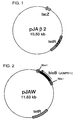
- the resulting plasmid was named pJA ⁇ 2 (Fig. 1).
- reaction composition 10 mM Tris-HCl (pH 8.8), 10 mM KCl, 0,002(v/v)% Tween 20, 1.5 mM MgCl 2 , 40 ⁇ M each dNTP, 20 pmol each primer, 0.5 to 100 ng genomic DNA, 3U UlTmaTMDNA polymerase (available from Perkin-Elmer Corporation)/100 ⁇ l; reaction cycles: 1 cycle of reaction at 97°C for 2 minutes, 30 cycles of reactions at 97°C for 1 minute, at 55°C for 1 minute and then at 72°C for 1.5 minutes, respectively, and 1 cycle of reaction at 72°C for 7 minutes].
- PCR primers Primer Base sequence BF 5'-ATTCTAGAACAGGACTATCAGGCACTCT-3' BR 5'-TTTCTAGATTCCCCGCGATTGGCGATCA-3' BF1 5'-AGCGGCCGAGGATGTGCTTAGGCTGCT-3' BR1 5'-CCGTGCCCTTGACCGACACCAGCGCGT-3' C1 5'-GCAAGCTTTGTCGCTGCCGCTCGTCATGCTGT-3' C6 5'-CGCTCGAGATTCGCGCTTCCTGTTCCTGAC-3'
- Sphingomonas paucimobilis JCM7511/pJAW was obtained as transformants by introducing the plasmid pJAW obtained in Example 3 into Sphingomonas paucimobilis JCM7511 with a gene pulser (mfd. by Bio-Rad Laboratories Inc.) by an electroporation method (applied voltage 18 kV/cm, capacitance 25 ⁇ F, resistance 400 ⁇ ).
- Example 5 Preparation of a recombinant plasmid pJA41 DNA fragments obtained by partially digesting the plasmid pJAW obtained in Example 3 with restriction enzymes Eco 52I and Bsp 1286I were separated by agarose gel electrophoresis to recover a DNA fragment of about 11.8 kbp formed by the deletion from pJAW of a base sequence from the -72th base to the 718th base in the case of taking A of the initiation codon ATG of bio B as the +1st base.
- Sphingomonas paucimobilis JCM7511/pJA41 was obtained by introducing the plasmid pJA41 obtained in Example 5 into Sphingomonas paucimobilis JCM7511 with a gene pulser (mfd. by Bio-Rad Laboratories Inc.) by an electroporation method (applied voltage 18 kV/cm, capacitance 25 ⁇ F, resistance 400 ⁇ ).
- a loopful of each of Sphingomonas paucimobilis JCM7511/pJAW and Sphingomonas paucimobilis JCM7511/pJA41 was inoculated into a small test tube (18 ⁇ 150 mm) containing 3 ml of a culture medium (1% glycerol, 2% peptone, 0.15% K 2 HPO 4 , 0.15% MgSO 4 7H 2 O, 0.005% tetracycline (pH 7.2)).
- a culture medium 1% glycerol, 2% peptone, 0.15% K 2 HPO 4 , 0.15% MgSO 4 7H 2 O, 0.005% tetracycline (pH 7.2)
- a loopful of Sphingomonas paucimobilis JCM7511 having no gene introduced thereinto was inoculated into a small test tube (18 ⁇ 150 mm) containing 3 ml of a culture medium (1% glycerol, 2% peptone, 0.15% K 2 HPO 4 0.15% MgSO 4 7H 2 O (pH 7.2)).
- a culture medium 1% glycerol, 2% peptone, 0.15% K 2 HPO 4 0.15% MgSO 4 7H 2 O (pH 7.2)
- the concentration of biotin produced and accumulated in each culture broth was determined by a microbiological quantitation method using Lactobacillus plantarum IFO 3070 strain (Izumi and Yamada "Vitaminological Experimental Method II. Water-soluble Vitamins", p. 481-499, Vitaminological Society of Japan, Tokyo Kagaku Dojin, 1985) to find that the concentration of biotin produced was as shown in Table 6.
- Strain Biotin productivity Biotin concentration (mg/L) Sphingomonas paucimobilis JCM7511 1 0.037 Sphingomonas paucimobilis JCM7511/pJAW 2.1 0.078 Sphingomonas paucimobilis JCM7511/pJA41 6.9 0.260
- the plasmid pBC01 obtained in Example 1 was cleaved with restriction enzymes Bam HI and Pst I and the resulting DNA fragments were separated by agarose gel electrophoresis to obtain a DNA fragment of about 1.4 kbp containing a large portion of a coding region of bio F and a region controlling the expression of bio F, bio D and bio A which region was upstream to bio F.
- the plasmid thus obtained was named pBC06.
- the plasmid pBC02 obtained in Example 1 was cleaved with restriction enzymes Pst I and Eco RI and the resulting DNA fragments were separated by agarose gel electrophoresis to obtain a DNA fragment of about 2.2 kbp containing a portion of coding region of bio F, coding regions of bio D and bio A, and a 3'-untranslated region of bio F, bio D and bio A which was downstream to bio A.
- the thus obtained DNA fragment and a plasmid pBC06 cleaved by restriction enzymes Pst I and Eco RI were mixed and then ligated with each other by the use of a ligation kit (available from TAKARA SHUZO Co., Ltd.) according to the attached operating manual.
- the plasmid thus obtained was named pSP105.
- the plasmid pSP105 was cleaved with restriction enzymes Bam HI and Hind III and the resulting DNA fragments were separated by agarose gel electrophoresis to obtain a DNA fragment of about 3.6 kbp containing coding regions of bio F, bio D and bio A and a region regulating the expression of bio F, bio D and bio A.
- the thus obtained DNA fragment and a plasmid pJA41 cleaved by restriction enzymes Bam HI and Hind III were mixed and then ligated with each other by the use of a ligation kit (available from TAKARA SHUZO Co., Ltd.) according to the attached operating manual.
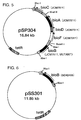
- the plasmid thus obtained was named pSP302 (Fig. 4).
- Sphingomonas paucimobilis JCM7511/pSP302 was obtained by introducing the plasmid pSP302 obtained in Example 8 into Sphingomonas paucimobilis JCM7511 with a gene pulser (mfd. by Bio-Rad Laboratories Inc.) by an electroporation method (applied voltage 18 kV/cm, capacitance 25 ⁇ F, resistance 400 ⁇ ).
- PCR was carried out using the genomic DNA obtained in Example 1, (1-A), as a template and the primers C1 and C6 shown in Table 5, to prepare a DNA fragment containing 1435 bp in total from 387 bp upstream to a coding region of bio C to 196 bp downstream to the coding region and having a Hind III site introduced into the upstream end of the 1435 bp sequence and a Xho I site introduced into the downstream end.
- a fragment obtained by cleaving this DNA fragment with restriction enzymes Hind III and Xho I and a DNA fragment obtained by cleaving the plasmid pSP302 with restriction enzymes Hind III and Xho I were mixed and then ligated with each other by the use of a ligation kit (available from TAKARA SHUZO Co., Ltd.) according to the attached operating manual.
- the plasmid thus obtained was named pSP304 (Fig. 5).
- Sphingomonas paucimobilis JCM7511/pSP304 was obtained by introducing the plasmid pSP304 obtained in Example 10 into Sphingomonas paucimobilis JCM7511 with a gene pulser (mfd. by Bio-Rad Laboratories Inc.) by an electroporation method (applied voltage 18 kV/cm, capacitance 25 ⁇ F, resistance 400 ⁇ ).
- a loopful of each of Sphingomonas paucimobilis JCM7511/pSP302 and Sphingomonas paucimobilis JCM7511/pSP302 was inoculated into a small test tube (18 ⁇ 150 mm) containing 3 ml of a culture medium (1% glycerol, 2% peptone, 0.15% K 2 HPO 4 , 0.15% MgSO 4 ⁇ 7H 2 O, 0.005% tetracycline (pH 7.2)).
- a culture medium 1% glycerol, 2% peptone, 0.15% K 2 HPO 4 , 0.15% MgSO 4 ⁇ 7H 2 O, 0.005% tetracycline (pH 7.2)
- a loopful of Sphingomonas paucimobilis JCM7511 having no gene introduced thereinto was inoculated into a small test tube (18 ⁇ 150 mm) containing 3 ml of a culture medium (1% glycerol, 2% peptone, 0.15% K 2 HPO 4 0.15% MgSO 4 ⁇ 7H 2 O (pH 7.2)).
- a culture medium 1% glycerol, 2% peptone, 0.15% K 2 HPO 4 0.15% MgSO 4 ⁇ 7H 2 O (pH 7.2)
- the concentration of biotin produced and accumulated in each culture broth was determined by the microbiological quantitation method using Lactobacillus plantarum IFO 3070 strain (Izumi and Yamada "Vitaminological Experimental Method II. Water-soluble Vitamins", p. 481-499, Vitaminological Society of Japan, Tokyo Kagaku Dojin, 1985) to find that the concentration of biotin produced was as shown in Table 7.
- Biotin productivity of Sphingomonas paucimobilis JCM7511/pSP305 Strain Biotin productivity Biotin concentration (mg/L) Sphingomonas paucimobilis JCM7511 1 0.12 Sphingomonas paucimobilis JCM7511/pSP302 2.8 0.33 Sphingomonas paucimobilis JCM7511/pSP304 8.6 1.0
- reaction composition 1 x Expand HF buffer, 1.5 mM MgCl 2 , 200 ⁇ M each dNTP, 300 nM each primer, 0.5 to 100 ng genomic DNA, 2.6 U ExpandTM high fidelity PCR System enzyme mix (available from Boehringer Mannheim Co., Ltd.)/50 ⁇ l; reaction cycles: 1 cycle of reaction at 97°C for 2 minutes, 10 cycles of reactions at 97°C for 15 seconds, at 60°C for 30 seconds and then at 72°C for 1.5 minutes, respectively, 15 cycles of reactions at 97°C for 15 seconds, at 60°C for 30 seconds and then at 72°C for 1.5 minutes (the time of the reaction at 72°C for 1.5 minutes was increased by 20 seconds in every cycle), respectively, and 1 cycle of reaction at 72°C for 7 minutes].
- reaction cycles 1 cycle of reaction at 97°C for 2 minutes, 10 cycles of reactions at 97°C for 15 seconds, at 60°C for 30 seconds and then at 72°C for 1.5 minutes, respectively, 15 cycles of reactions at 97°C for 15
- Sphingomonas sp. SC42405/pSS301 was obtained as transformants by introducing the plasmid pSS301 obtained in Example 13 into Sphingomonas sp. SC42405 with a gene pulser (mfd. by Bio-Rad Laboratories Inc.) by an electroporation method (applied voltage 18 kV/cm, capacitance 25 ⁇ F, resistance 400 ⁇ ).
- a loopful of Sphingomonas sp. SC42405/pSS301 was inoculated into a small test tube (18 ⁇ 150 mm) containing 3 ml of a culture medium (1% glycerol, 2% peptone, 0.15% K 2 HPO 4 , 0.15% MgSO 4 ⁇ 7H 2 O, 0.005% tetracycline (pH 7.2)).
- a culture medium 1% glycerol, 2% peptone, 0.15% K 2 HPO 4 , 0.15% MgSO 4 ⁇ 7H 2 O, 0.005% tetracycline (pH 7.2)
- SC42405 having no gene introduced thereinto was inoculated into a small test tube (18 ⁇ 150 mm) containing 3 ml of a culture medium (1% glycerol, 2% peptone, 0.15% K 2 HPO 4 0.15% MgSO 4 ⁇ 7H 2 O (pH 7.2)).
- a culture medium 1% glycerol, 2% peptone, 0.15% K 2 HPO 4 0.15% MgSO 4 ⁇ 7H 2 O (pH 7.2)
- the above two kinds of the bacteria were cultured at 30°C for 2 days (250 rpm) to obtain pre-culture broths. Then, 160 ⁇ l of the thus obtained pre-culture broth of Sphingomonas sp.
- SC42405/pSS301 was inoculated into a large test tube (22 ⁇ 220 mm) containing 8 ml of a culture medium (6% glycerol, 2% yeast extract, 0.5% casamino acid, 0.1% K 2 HPO 4 , 0.05% KCl, 0.05% MgSO 4 ⁇ 7H 2 O, 0.01% FeSO 4 ⁇ 7H 2 O, 0.1% MnSO 4 ⁇ 4 ⁇ 6H 2 O, 0.005% tetracycline (pH 7.0)).
- a culture medium 6% glycerol, 2% yeast extract, 0.5% casamino acid, 0.1% K 2 HPO 4 , 0.05% KCl, 0.05% MgSO 4 ⁇ 7H 2 O, 0.01% FeSO 4 ⁇ 7H 2 O, 0.1% MnSO 4 ⁇ 4 ⁇ 6H 2 O, 0.005% tetracycline (pH 7.0)
- SC42405 was inoculated into a large test tube (22 ⁇ 220 mm) containing 8 ml of a culture medium (6% glycerol, 2% yeast extract, 0.5% casamino acid, 0.1% K 2 HPO 4 , 0.05% KCl, 0.05% MgSO 4 ⁇ 7H 2 O, 0.01% FeSO 4 ⁇ 7H 2 O, 0.1% MnSO 4 ⁇ 4 ⁇ 6H 2 O (pH 7.0)).
- the above two kinds of the bacteria were cultured at 30°C for 4 days (250 rpm).
- the concentration of biotin produced and accumulated in each culture broth was determined by the microbiological quantitation method using Lactobacillus plantarum IFO 3070 strain (Izumi and Yamada "Vitaminological Experimental Method II. Water-soluble Vitamins", p. 481-499, Vitaminological Society of Japan, Tokyo Kagaku Dojin, 1985) to find that the concentration of biotin produced was as shown in Table 9.
- Strain Biotin productivity Biotin concentration (mg/L) Sphingomonas sp. SC42405 1 4.1 Sphingomonas sp. C42405/pSS301 4.0 17
- reaction composition 1 x Expand HF buffer, 1.5 mM MgCl 2 , 200 ⁇ M each dNTP, 300 nM each primer, 0.5 to 100 ng genomic DNA, 2.6 U ExpandTM high fidelity PCR System enzyme mix (available from Boehringer Mannheim Co., Ltd.)/50 ⁇ l; reaction cycles: 1 cycle of reaction at 97°C for 2 minutes, 10 cycles of reactions at 97°C for 15 seconds, at 60°C for 30 seconds and then at 72°C for 1.5 minutes, respectively, 15 cycles of reactions at 97°C for 15 seconds, at 60°C for 30 seconds and then at 72°C for 1.5 minutes (the time of the reaction at 72°C for 1.5 minutes was increased by 20 seconds in every cycle), respectively, and 1 cycle of reaction at 72°C for 7 minutes].
- reaction cycles 1 cycle of reaction at 97°C for 2 minutes, 10 cycles of reactions at 97°C for 15 seconds, at 60°C for 30 seconds and then at 72°C for 1.5 minutes, respectively, 15 cycles of reactions at 97°C for 15
- This DNA fragment was cleaved with a restriction enzymes Spe I and Pst I, and the resulting DNA fragment and a DNA fragment obtained by cleaving a plasmid vector pBluescript SK(+) (available from Stratagene Cloning Systems) with restriction enzymes Spe I and Pst I were mixed and then ligated with each other by the use of a ligation kit (available from TAKARA SHUZO Co., Ltd.) according to the attached operating manual.
- the plasmid thus obtained was named pSS202.
- reaction composition 1 x Expand HF buffer, 1.5 mM MgCl 2 , 200 ⁇ M each dNTP, 300 nM each primer, 0.5 to 100 ng genomic DNA, 2.6 in ExpanTM high fidelity PCR System enzyme mix (available from Boehringer Mannheim Co., Ltd.)/50 ⁇ l; reaction cycles: 1 cycle of reaction at 97°C for 2 minutes, 10 cycles of reactions at 97°C for 15 seconds, at 60°C for 30 seconds and then at 72°C for 1.5 minutes, respectively, 15 cycles of reactions at 97°C for 15 seconds, at 60°C for 30 seconds and then at 72°C for 1.5 minutes (the time of the reaction at 72°C for 1.5 minutes was increased by 20 seconds in every cycle), respectively, and 1 cycle of reaction at 72°C for 7 minutes].
- reaction cycles 1 cycle of reaction at 97°C for 2 minutes, 10 cycles of reactions at 97°C for 15 seconds, at 60°C for 30 seconds and then at 72°C for 1.5 minutes, respectively, 15 cycles of reactions at 97°C for
- This DNA fragment was cleaved with a restriction enzyme Pst I and Hind III, and the resulting DNA fragment and a DNA fragment obtained by cleaving a plasmid vector pBluescript SK(+) (available from Stratagene Cloning Systems) with restriction enzymes Pst I and Hind III were mixed and then ligated with each other by the use of a ligation kit (available from TAKARA SHUZO Co., Ltd.) according to the attached operating manual.
- the plasmid thus obtained was named pSS205.
- reaction composition 1 x Expand HF buffer, 1.5 mM MgCl 2 , 200 ⁇ M each dNTP, 300 nM each primer, 0.5 to 100 ng genomic DNA, 2.6 U ExpandTM high fidelity PCR system enzyme mix (available from Boehringer Mannheim Co., Ltd.)/50 ⁇ l; reaction cycles: 1 cycle of reaction at 97°C for 2 minutes, 10 cycles of reactions at 97°C for 15 seconds, at 60°C for 30 seconds and then at 72°C for 1.5 minutes, respectively, 15 cycles of reactions at 97°C for 15 seconds, at 60°C for 30 seconds and then at 72°C for 1.5 minutes (the time of the reaction at 72°C for 1.5 minutes was increased by 20 seconds in every cycle), respectively, and 1 cycle of reaction at 72°C for 7 minutes].
- reaction cycles 1 cycle of reaction at 97°C for 2 minutes, 10 cycles of reactions at 97°C for 15 seconds, at 60°C for 30 seconds and then at 72°C for 1.5 minutes, respectively, 15 cycles of reactions at 97°C for 15
- This DNA fragment was cleaved with restriction enzymes Hind III and Xho I, and the resulting fragment and a DNA fragment obtained by cleaving a plasmid vector pBluescript SK(+) (available from Stratagene cloning Systems) with restriction enzymes Hind III and Xho I were mixed and then ligated with each other by the use of a ligation kit (available from TAKARA SHUZO Co., Ltd.) according to the attached operating manual.
- the plasmid thus obtained was named pSS206.
- the plasmid pSS205 obtained in the manner described above was cleaved with restriction enzymes Pst I and Hind III, and the resulting DNA fragments were separated by agarose electrophoresis to prepare a DNA fragment which contained 1287 bp (in total) composed of a 209 bp sequence upstream to a coding region of bio C, the 762 bp coding region of bio C and the first half about 300 bp of a cording region of bio D, and had a Pst I site introduced into the upstream end of the 1287 sequence and a Hind III site introduced into the downstream end.
- the thus obtained DNA fragment and pSS206 cleaved by restriction enzymes Pst I and Hind III were mixed and these DNA fragments were ligated with each other by the use of a ligation kit (available from TAKARA SHUZO Co., Ltd.) according to the attached operating manual.
- the plasmid thus obtained was named pSS2071.
- pSS2071 was cleaved with a restriction enzyme Cla I and the resulting DNA fragments were subjected to self ligation by the use of a ligation kit (available from TAKARA SHUZO Co., Ltd.) according to the attached operating manual.
- the plasmid thus obtained was named pSS207.
- the plasmid pSS202 was cleaved with restriction enzymes Spe I and Pst I, and the resulting DNA fragments were separated by agarose electrophoresis to prepare a DNA fragment containing 1408 bp in total from 201 bp upstream to a coding region of bio F to 46 bp downstream to the coding region, and having Spe I site introduced into the upstream end of the 1406 bp sequence and a Pst I site introduced into the downstream end.
- the thus obtained DNA fragment was mixed with pSS207 cleaved by restriction enzymes Spe I and Pst I and these DNA fragments were ligated with each other by the use of a ligation kit (available from TAKARA SHUZO Co., Ltd.) according to the attached operating manual.
- the plasmid thus obtained was named pSS209.
- the plasmid pSS209 was cleaved with restriction enzymes Spe I and Xho I, and the resulting DNA fragments were separated by agarose electrophoresis to prepare a DNA fragment containing bio F, bio C, bio D and bio A and having a Spe I site introduced into the upstream end and a Xho I site introduced into the downstream end.
- the thus obtained DNA fragment was mixed with pJA ⁇ 2 cleaved by restriction enzymes Spe I and Xho I and these DNA fragments were ligated with each other by the use of a ligation kit (available from TAKARA SHUZO Co., Ltd.) according to the attached operating manual.
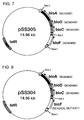
- the plasmid thus obtained was named pSS305 (Fig. 7).
- reaction cycles 1 cycle of reaction at 97°C for 2 minutes, 10 cycles of reactions at 97°C for 15 seconds, at 60°C for 30 seconds and then at 72°C for 1.5 minutes, respectively, 15 cycles of reactions at 97°C for 15 seconds, at 60°C for 30 seconds and then at 72°C for 1.5 minutes (the time of the reaction at 72°C for 1.5 minutes was increased by 20 seconds in every cycle), respectively, and 1 cycle of reaction at 72°C for 7 minutes].
- the DNA fragment thus obtained was cleaved with restriction enzymes Not I and Hind III and mixed with a plasmid vector pBluescript SK(+) (available from Stratagene Cloning systems) cleaved by restriction enzymes Not I and Hind III, followed by ligation by the use of a ligation kit (available from TAKARA SHUZO Co., Ltd.) according to the attached operating manual.
- a clone having a base sequence (SEQ ID NO: 5) of mutant bio F having G as a substituent for the -11th base C in the case of taking A of the initiation codon (ATG) of bio F as the +1st base was selected by base sequence analysis.
- the plasmid thus obtained was named plasmid pSS201.
- the plasmid pSS201 was cleaved with restriction enzymes Spe I and Pst I and the resulting DNA fragments were separated by agarose gel electrophoresis to prepare a DNA fragment containing 1408 bp in total from 201 bp upstream to a coding region of bio F to 46 bp downstream to the coding region, and having Spe I site introduced into the upstream end and a Pst I site introduced into the downstream end.
- the thus obtained DNA fragment was mixed with pSS207 cleaved by restriction enzymes Spe I and Pst I and these DNA fragments were ligated with each other by the use of a ligation kit (available from TAKARA SHUZO Co., Ltd.) according to the attached operating manual.
- the plasmid thus obtained was named pSS208.
- the plasmid pSS208 was cleaved with restriction enzymes Spe I and Xho I and the resulting DNA fragments were separated by agarose gel electrophoresis to prepare a DNA fragment containing mutant bio F as well as bio C, bio D and bio A and having Spe I site introduced into the upstream end and a Xho I site introduced into the downstream end.
- the thus obtained DNA fragment was mixed with pJA ⁇ 2 cleaved by restriction enzymes Spe I and Xho I and these DNA fragments were ligated with each other by the use of a ligation kit (available from TAKARA SHUZO Co., Ltd.) according to the attached operating manual.
- the plasmid thus obtained was named pSS304 (Fig. 8).
- Example 18 Preparation of transformants having pSS304 introduced thereinto and transformants having pSS305 introduced thereinto
- Sphingomonas sp. SC42405/pSS304 and Sphingomonas sp. SC42405/pSS305 were obtained by introducing the plasmid pSS304 obtained in Example 17 and the plasmid pSS305, respectively, into Sphingomonas sp. SC42405 with a gene pulser (mfd. by Bio-Rad Laboratories Inc.) by an electroporation method (applied voltage 18 kV/cm, capacitance 25 ⁇ F, resistance 400 ⁇ ).
- a loopful of each of Sphingomonas sp. SC42405/pSS304 and Sphingomonas sp. SC42405/pSS305 was inoculated into a small test tube (18 ⁇ 150 mm) containing 3 ml of a culture medium (1% glycerol, 2% peptone, 0.15% K 2 HPO 4 , 0.15% MgSO 4 ⁇ 7H 2 O, 0.005% tetracycline (pH 7.2)).
- SC42405 having no gene introduced thereinto was inoculated into a small test tube (18 ⁇ 150 mm) containing 3 ml of a culture medium (1% glycerol, 2% peptone, 0.15% K 2 HPO 4 0.15% MgSO 4 ⁇ 7H 2 O (pH 7.2)).
- a culture medium 1% glycerol, 2% peptone, 0.15% K 2 HPO 4 0.15% MgSO 4 ⁇ 7H 2 O (pH 7.2)
- the above three kinds of the bacteria were cultured at 30°C for 2 days (250 rpm) to obtain pre-culture broths.
- SC42405/pSS305 was inoculated into a large test tube (22 ⁇ 220 mm) containing 8 ml of a culture medium (6% glycerol, 2% yeast extract, 0.5% casamino acid, 0.1% K 2 HPO 4 , 0.05% KCl, 0.05% MgSO 4 ⁇ 7H 2 O, 0.01% FeSO 4 ⁇ 7H 2 O, 0.1% MnSO 4 ⁇ 4 ⁇ 6H 2 O, 0.005% tetracycline (pH 7.0)).
- a culture medium 6% glycerol, 2% yeast extract, 0.5% casamino acid, 0.1% K 2 HPO 4 , 0.05% KCl, 0.05% MgSO 4 ⁇ 7H 2 O, 0.01% FeSO 4 ⁇ 7H 2 O, 0.1% MnSO 4 ⁇ 4 ⁇ 6H 2 O, 0.005% tetracycline (pH 7.0)
- SC42405 was inoculated into a large test tube (22 ⁇ 220 mm) containing 8 ml of a culture medium (6% glycerol, 2% yeast extract, 0.5% casamino acid, 0.1% K 2 HPO 4 , 0.05% KCl, 0.05% MgSO 4 ⁇ 7H 2 O, 0.01% FeSO 4 ⁇ 7H 2 O, 0.1% MnSO 4 ⁇ 4 ⁇ 6H 2 O (pH 7.0)).
- the above three kinds of the bacteria were cultured at 30°C for 4 days (250 rpm).
- concentrations of biotin and biotin-related compounds produced and accumulated in each culture broth were determined by the microbiological quantitation method (Izumi and Yamada "Vitaminological Experimental Method II. Water-soluble Vitamins", p. 481-499, Vitaminological Society of Japan, Tokyo Kagaku Dojin, 1985) by using Lactobacillus plantarum IFO 3070 strain and Saccharomyces cerevisiae, respectively.
- biotin-vitamers 7-keto-8-aminopelargonic acid, 7,8-diaminopelargonic acid and desthiobiotin (hereinafter referred to as "biotin-vitamers") were found to be as shown in Table 10.
- Biotin productivity and biotin-vitamer productivity of Sphingomonas sp. SC42405/pSS304 and Sphingomonas sp. SC42405/pSS305 Strain Biotin productivity Biotin concentration (mg/L) Biotin-vitamer productivity Biotin-vitamer concentration Sphingomonas sp. 1 4.1 1 25.2 Sphingomonas sp. SC42405/pSS304 0.9 3.5 11 271 Sphingomonas sp. SC42405/pSS305 0.8 3.5 5.9 149
- the plasmid pSS209 was cleaved with restriction enzymes Spe I and Xho I, and the resulting DNA fragments were separated by agarose electrophoresis to prepare a DNA fragment containing bio F, bio C, bio D and bio A and having a Spe I site introduced into the upstream end and a Xho I site introduced into the downstream end.
- the thus obtained DNA fragment was mixed with pSS301 cleaved by restriction enzymes Spe I and Xho I and these DNA fragments were ligated with each other by the use of a ligation kit (available from TAKARA SHUZO Co., Ltd.) according to the attached operating manual.
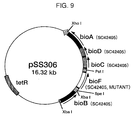
- the plasmid thus obtained was named pSS306 (Fig. 9).
- Sphingomonas sp. SC42405/pSS306 was obtained by introducing the plasmid pSS306 obtained in Example 20 into Sphingomonas sp. SC42405 with a gene pulser (mfd. by Bio-Rad Laboratories Inc.) by an electroporation method (applied voltage 18 kV/cm, capacitance 25 ⁇ F, resistance 400 ⁇ ).
- a loopful of Sphingomonas sp. SC42405/pSS306 was inoculated into a small test tube (18 ⁇ 150 mm) containing 3 ml of a culture medium (1% glycerol, 2% peptone, 0.15% K 2 HPO 4 , 0.15% MgSO 4 ⁇ 7H 2 O, 0.005% tetracycline (pH 7.2)).
- a culture medium 1% glycerol, 2% peptone, 0.15% K 2 HPO 4 , 0.15% MgSO 4 ⁇ 7H 2 O, 0.005% tetracycline (pH 7.2)
- SC42405 having no gene introduced thereinto was inoculated into a small test tube (18 ⁇ 150 mm) containing 3 ml of a culture medium (1% glycerol, 2% peptone, 0.15% K 2 HPO 4 0.15% MgSO 4 ⁇ 7H 2 O (pH 7.2)).
- a culture medium 1% glycerol, 2% peptone, 0.15% K 2 HPO 4 0.15% MgSO 4 ⁇ 7H 2 O (pH 7.2)
- the above two kinds of the bacteria were cultured at 30°C for 2 days (250 rpm) to obtain pre-culture broths. Then, 160 ⁇ l of the thus obtained pre-culture broth of Sphingomonas sp.
- SC42405/pSS306 was inoculated into a large test tube (22 ⁇ 220 mm) containing 8 ml of a culture medium (6% glycerol, 2% yeast extract, 0.5% casamino acid, 0.1% K 2 HPO 4 , 0.05% KCl, 0.05% MgSO 4 ⁇ 7H 2 O, 0.01% FeSO 4 ⁇ 7H 2 O, 0.1% MnSO 4 ⁇ 4 ⁇ 6H 2 O, 0.005% tetracycline (pH 7.0)).
- a culture medium 6% glycerol, 2% yeast extract, 0.5% casamino acid, 0.1% K 2 HPO 4 , 0.05% KCl, 0.05% MgSO 4 ⁇ 7H 2 O, 0.01% FeSO 4 ⁇ 7H 2 O, 0.1% MnSO 4 ⁇ 4 ⁇ 6H 2 O, 0.005% tetracycline (pH 7.0)
- SC42405 was inoculated into a large test tube (22 ⁇ 220 mm) containing 8 ml of a culture medium (6% glycerol, 2% yeast extract, 0.5% casamino acid, 0.1% K 2 HPO 4 , 0.05% KCl, 0.05% MgSO 4 ⁇ 7H 2 O, 0.01% FeSO 4 ⁇ 7H 2 O, 0.1% MnSO 4 ⁇ 4 ⁇ 6H 2 O (pH 7.0)).
- the above two kinds of the bacteria were cultured at 30°C for 4 days (250 rpm).
- the concentrations of biotin and biotin-related compounds produced and accumulated in each culture broth were determined by the microbiological quantitation method (Izumi and Yamada "Vitaminological Experimental Method II. Water-soluble Vitamins", p. 481-499, Vitaminological Society of Japan, Tokyo Kagaku Dojin, 1985) by using Lactobacillus plantarum IFO 3070 strain and Saccharomyces cerevisiae, respectively.
- the concentrations of biotin produced were found to be as shown in Table 11.
- Biotin productivity of Sphingomonas sp. SC42405/pSS306 Strain Biotin productivity Biotin concentration Sphingomonas sp. SC42405 1 4.1 Sphingomonas sp. SC42405/pSS306 3.9 16
- the present invention provides a DNA fragment containing at least one gene concerned in biotin biosynthesis and derived from a microorganism belonging to the genus Sphingomonas, and biotin-producing transformants obtained by utilizing said DNA fragment, and is useful for improving the productivity of biotin, an essential vitamin for animals, plants and some microorganisms.
Landscapes
- Health & Medical Sciences (AREA)
- Genetics & Genomics (AREA)
- Life Sciences & Earth Sciences (AREA)
- Engineering & Computer Science (AREA)
- Chemical & Material Sciences (AREA)
- Organic Chemistry (AREA)
- Wood Science & Technology (AREA)
- Zoology (AREA)
- Biotechnology (AREA)
- Bioinformatics & Cheminformatics (AREA)
- Biomedical Technology (AREA)
- General Engineering & Computer Science (AREA)
- Molecular Biology (AREA)
- General Health & Medical Sciences (AREA)
- Biochemistry (AREA)
- Microbiology (AREA)
- Physics & Mathematics (AREA)
- Biophysics (AREA)
- Plant Pathology (AREA)
- Chemical Kinetics & Catalysis (AREA)
- General Chemical & Material Sciences (AREA)
- Tropical Medicine & Parasitology (AREA)
- Medicinal Chemistry (AREA)
- Virology (AREA)
- Micro-Organisms Or Cultivation Processes Thereof (AREA)
- Preparation Of Compounds By Using Micro-Organisms (AREA)
- Enzymes And Modification Thereof (AREA)
Priority Applications (1)
| Application Number | Priority Date | Filing Date | Title |
|---|---|---|---|
| EP05003876A EP1577394B1 (de) | 1997-03-03 | 1998-03-02 | DNA Fragmente die das Biotin Synthasegen enthalten und deren Verwendung |
Applications Claiming Priority (3)
| Application Number | Priority Date | Filing Date | Title |
|---|---|---|---|
| JP47838/97 | 1997-03-03 | ||
| JP4783897 | 1997-03-03 | ||
| PCT/JP1998/000858 WO1998039452A1 (fr) | 1997-03-03 | 1998-03-02 | Fragments d'adn contenant le gene de la biotine biosynthetase et utilisation de ceux-ci |
Related Child Applications (1)
| Application Number | Title | Priority Date | Filing Date |
|---|---|---|---|
| EP05003876A Division EP1577394B1 (de) | 1997-03-03 | 1998-03-02 | DNA Fragmente die das Biotin Synthasegen enthalten und deren Verwendung |
Publications (3)
| Publication Number | Publication Date |
|---|---|
| EP0913475A1 true EP0913475A1 (de) | 1999-05-06 |
| EP0913475A4 EP0913475A4 (de) | 2003-04-02 |
| EP0913475B1 EP0913475B1 (de) | 2009-06-03 |
Family
ID=12786519
Family Applications (2)
| Application Number | Title | Priority Date | Filing Date |
|---|---|---|---|
| EP05003876A Expired - Lifetime EP1577394B1 (de) | 1997-03-03 | 1998-03-02 | DNA Fragmente die das Biotin Synthasegen enthalten und deren Verwendung |
| EP98905729A Expired - Lifetime EP0913475B1 (de) | 1997-03-03 | 1998-03-02 | Dna fragmente die das biotinsynthasegen enthalten und deren verwendung |
Family Applications Before (1)
| Application Number | Title | Priority Date | Filing Date |
|---|---|---|---|
| EP05003876A Expired - Lifetime EP1577394B1 (de) | 1997-03-03 | 1998-03-02 | DNA Fragmente die das Biotin Synthasegen enthalten und deren Verwendung |
Country Status (12)
| Country | Link |
|---|---|
| US (1) | US6410293B1 (de) |
| EP (2) | EP1577394B1 (de) |
| JP (1) | JP4329129B2 (de) |
| KR (1) | KR100567612B1 (de) |
| CN (2) | CN1590546B (de) |
| AT (1) | ATE432989T1 (de) |
| CA (1) | CA2252927C (de) |
| DE (2) | DE69840862D1 (de) |
| DK (2) | DK0913475T3 (de) |
| ES (2) | ES2326535T3 (de) |
| HU (1) | HUP0000718A2 (de) |
| WO (1) | WO1998039452A1 (de) |
Families Citing this family (2)
| Publication number | Priority date | Publication date | Assignee | Title |
|---|---|---|---|---|
| KR102688631B1 (ko) * | 2021-11-15 | 2024-07-24 | 씨제이제일제당 (주) | 클래스 I 타입의 BirA를 포함하는 미생물 및 이를 이용한 바이오틴 생산방법 |
| CN115491402B (zh) * | 2022-09-21 | 2025-10-14 | 盐城工学院 | 一种基于多酶级联反应的生物合成方法 |
Family Cites Families (9)
| Publication number | Priority date | Publication date | Assignee | Title |
|---|---|---|---|---|
| JPS56160998A (en) | 1980-05-15 | 1981-12-11 | Nippon Zeon Co Ltd | Production of biotin active substance biotin vitamer |
| US4446759A (en) | 1981-10-02 | 1984-05-08 | Ford Motor Company | Clutch stroke control metering valve for an automatic transmission |
| JPH0740922B2 (ja) | 1985-03-05 | 1995-05-10 | 株式会社資生堂 | ビオチン生産性微生物 |
| EP0240105B1 (de) * | 1986-03-25 | 1993-07-21 | Nippon Zeon Co., Ltd. | Biotin-Synthetase kodierendes Gen und dessen Verwendung |
| GB2216530B (en) * | 1988-03-22 | 1992-07-08 | Mini Agriculture & Fisheries | Genetic material for expression of biotin synthetase enzymes |
| JP2722504B2 (ja) | 1988-07-14 | 1998-03-04 | 田辺製薬株式会社 | 新規微生物及びそれを用いるd−ビオチンの製法 |
| JP3428078B2 (ja) * | 1992-09-10 | 2003-07-22 | 住友化学工業株式会社 | ビオチンの製造方法および使用される微生物 |
| EP0635572A3 (de) * | 1993-06-25 | 1995-03-08 | Hoffmann La Roche | Biotinbiosynthese in Bacillus subtilis. |
| JP4121756B2 (ja) | 2002-03-15 | 2008-07-23 | フクビ化学工業株式会社 | コンクリート打設用型枠の設置構造 |
-
1998
- 1998-02-27 JP JP04726398A patent/JP4329129B2/ja not_active Expired - Fee Related
- 1998-03-02 DE DE69840862T patent/DE69840862D1/de not_active Expired - Lifetime
- 1998-03-02 CN CN2004100634785A patent/CN1590546B/zh not_active Expired - Fee Related
- 1998-03-02 ES ES05003876T patent/ES2326535T3/es not_active Expired - Lifetime
- 1998-03-02 HU HU0000718A patent/HUP0000718A2/hu unknown
- 1998-03-02 EP EP05003876A patent/EP1577394B1/de not_active Expired - Lifetime
- 1998-03-02 KR KR1019980708838A patent/KR100567612B1/ko not_active Expired - Fee Related
- 1998-03-02 DK DK98905729T patent/DK0913475T3/da active
- 1998-03-02 CA CA2252927A patent/CA2252927C/en not_active Expired - Fee Related
- 1998-03-02 DK DK05003876T patent/DK1577394T3/da active
- 1998-03-02 DE DE69840986T patent/DE69840986D1/de not_active Expired - Lifetime
- 1998-03-02 US US09/180,109 patent/US6410293B1/en not_active Expired - Fee Related
- 1998-03-02 WO PCT/JP1998/000858 patent/WO1998039452A1/ja not_active Ceased
- 1998-03-02 CN CNB988002272A patent/CN1166778C/zh not_active Expired - Fee Related
- 1998-03-02 ES ES98905729T patent/ES2326289T3/es not_active Expired - Lifetime
- 1998-03-02 AT AT98905729T patent/ATE432989T1/de active
- 1998-03-02 EP EP98905729A patent/EP0913475B1/de not_active Expired - Lifetime
Non-Patent Citations (4)
| Title |
|---|
| BOWER STANLEY ET AL: "Cloning, sequencing, and characterization of the Bacillus subtilis biotin biosynthetic operon." JOURNAL OF BACTERIOLOGY, vol. 178, no. 14, 1996, pages 4122-4130, XP002229556 ISSN: 0021-9193 * |
| See also references of WO9839452A1 * |
| SHIUAN D ET AL: "TRANSCRIPTIONAL REGULATION AND GENE ARRANGEMENT OF ESCHERICHIA COLI, CITROBACTER FREUNDII AND SALMONELLA TYPHIMURIUM BIOTIN OPERONS" GENE, ELSEVIER BIOMEDICAL PRESS. AMSTERDAM, NL, vol. 67, no. 2, 1988, pages 203-211, XP002036300 ISSN: 0378-1119 * |
| WU CHWEN-HUEY ET AL: "Isolation and characterization of the Erwinia herbicola bio operon and the sequences of the bioA and bioB genes." GENE (AMSTERDAM), vol. 174, no. 2, 1996, pages 251-258, XP002229555 ISSN: 0378-1119 * |
Also Published As
| Publication number | Publication date |
|---|---|
| ES2326535T3 (es) | 2009-10-14 |
| US6410293B1 (en) | 2002-06-25 |
| CN1217749A (zh) | 1999-05-26 |
| DK1577394T3 (da) | 2009-08-24 |
| CA2252927C (en) | 2011-04-05 |
| ES2326289T3 (es) | 2009-10-06 |
| CN1166778C (zh) | 2004-09-15 |
| WO1998039452A1 (fr) | 1998-09-11 |
| CA2252927A1 (en) | 1998-09-11 |
| DE69840986D1 (de) | 2009-08-27 |
| DK0913475T3 (da) | 2009-08-24 |
| KR20000065186A (ko) | 2000-11-06 |
| EP1577394B1 (de) | 2009-07-15 |
| JP4329129B2 (ja) | 2009-09-09 |
| EP0913475B1 (de) | 2009-06-03 |
| DE69840862D1 (de) | 2009-07-16 |
| EP0913475A4 (de) | 2003-04-02 |
| EP1577394A1 (de) | 2005-09-21 |
| ATE432989T1 (de) | 2009-06-15 |
| CN1590546B (zh) | 2010-08-18 |
| CN1590546A (zh) | 2005-03-09 |
| HUP0000718A2 (hu) | 2000-06-28 |
| KR100567612B1 (ko) | 2006-07-25 |
| JPH10304886A (ja) | 1998-11-17 |
Similar Documents
| Publication | Publication Date | Title |
|---|---|---|
| EP0405370B1 (de) | Riboflavin überproduzierende Bakterienstämme | |
| US6551813B1 (en) | Nutrient medium for bacterial strains which overproduce riboflavin | |
| USRE34851E (en) | Biosynthesis of 2 keto-L-gulonic acid | |
| JP3593146B2 (ja) | 枯草菌でのビオチンの生合成 | |
| EP0373181B1 (de) | Neue coenzym unabhängige l-sorbosone dehydrogenase | |
| HU214244B (hu) | Eljárás másodlagos metabolitok termelésének fokozására bioszintetikus géncsoporttal | |
| JPH02167078A (ja) | 二次代謝産物生産増加のための生合成遺伝子又は制御遺伝子の単離法及び使用法 | |
| EP0286303A1 (de) | DNA und ihre Verwendung | |
| SK43196A3 (en) | Fragment dna, vector and microorganism containing genes for butyrobetaine/crotonobetaine-l-carnitine metabolism and process for producing of l-carnitine | |
| EP1577394B1 (de) | DNA Fragmente die das Biotin Synthasegen enthalten und deren Verwendung | |
| EP0604060A1 (de) | Verfahren zur Herstellung von Riboflavin | |
| EP0537553A2 (de) | Farnesylpyrophosphatsynthetase und dafür kodierende DNA-Sequenz | |
| US8927254B2 (en) | Pyrococcus furiosus strains and methods of using same | |
| EP0240105B1 (de) | Biotin-Synthetase kodierendes Gen und dessen Verwendung | |
| EP0544250B1 (de) | Für eine Esterase kodierendes Gen und dieses Gen enthaltender Mikroorganismus | |
| Freter et al. | Identification of a novel gene, aut, involved in autotrophic growth of Alcaligenes eutrophus | |
| US5846811A (en) | Gene participating in the mechanism of secretion of esterase | |
| EP1024194A1 (de) | Plasmidvektoren. | |
| HK1008343A (en) | Gene participating in the mechanism of secretion of esterase | |
| HK1008344A (en) | Gene coding for esterase and microorganism containing it | |
| HK1008345A (en) | Gene coding for esterase and novel microorganism containing said gene | |
| HU209941B (en) | Method for identifying and using biosynthetic or regulatory genes for enhanced production of beta-lactam antibiotics, these comprising vector, and transformation of fungi cells | |
| JPWO2001077345A1 (ja) | Escherichiacoliの染色体組換えに用いられるプラスミド | |
| JPH04325086A (ja) | セラチア属に属する形質転換微生物及びそれを用いるビオチンの製造方法 |
Legal Events
| Date | Code | Title | Description |
|---|---|---|---|
| PUAI | Public reference made under article 153(3) epc to a published international application that has entered the european phase |
Free format text: ORIGINAL CODE: 0009012 |
|
| 17P | Request for examination filed |
Effective date: 19981130 |
|
| AK | Designated contracting states |
Kind code of ref document: A1 Designated state(s): AT BE CH DE DK ES FR GB IT LI NL SE |
|
| A4 | Supplementary search report drawn up and despatched |
Effective date: 20030214 |
|
| 17Q | First examination report despatched |
Effective date: 20030717 |
|
| RAP1 | Party data changed (applicant data changed or rights of an application transferred) |
Owner name: SUMITOMO CHEMICAL COMPANY, LIMITED |
|
| RIC1 | Information provided on ipc code assigned before grant |
Ipc: C12N 1/20 20060101ALI20060411BHEP Ipc: C12N 15/63 20060101ALI20060411BHEP Ipc: C12N 15/52 20060101AFI20060411BHEP |
|
| 17Q | First examination report despatched |
Effective date: 20030717 |
|
| GRAP | Despatch of communication of intention to grant a patent |
Free format text: ORIGINAL CODE: EPIDOSNIGR1 |
|
| GRAS | Grant fee paid |
Free format text: ORIGINAL CODE: EPIDOSNIGR3 |
|
| GRAA | (expected) grant |
Free format text: ORIGINAL CODE: 0009210 |
|
| RIN1 | Information on inventor provided before grant (corrected) |
Inventor name: MITSUDA, SATOSHI Inventor name: AKIMARU, JIRO Inventor name: NISHIO, SHOICHI Inventor name: MUKUMOTO, FUJIO |
|
| AK | Designated contracting states |
Kind code of ref document: B1 Designated state(s): AT BE CH DE DK ES FR GB IT LI NL SE |
|
| REG | Reference to a national code |
Ref country code: GB Ref legal event code: FG4D |
|
| REG | Reference to a national code |
Ref country code: CH Ref legal event code: NV Representative=s name: BOHEST AG Ref country code: CH Ref legal event code: EP |
|
| REF | Corresponds to: |
Ref document number: 69840862 Country of ref document: DE Date of ref document: 20090716 Kind code of ref document: P |
|
| REG | Reference to a national code |
Ref country code: SE Ref legal event code: TRGR |
|
| RIN2 | Information on inventor provided after grant (corrected) |
Inventor name: MITSUDA, SATOSHI Inventor name: AKIMARU, JIRO Inventor name: NISHIO, SHOICHI Inventor name: MUKUMOTO, FUJIO |
|
| REG | Reference to a national code |
Ref country code: DK Ref legal event code: T3 |
|
| RIN2 | Information on inventor provided after grant (corrected) |
Inventor name: MITSUDA, SATOSHI Inventor name: AKIMARU, JIRO Inventor name: NISHIO, SHOICHI Inventor name: MUKUMOTO, FUJIO |
|
| REG | Reference to a national code |
Ref country code: ES Ref legal event code: FG2A Ref document number: 2326289 Country of ref document: ES Kind code of ref document: T3 |
|
| PLBE | No opposition filed within time limit |
Free format text: ORIGINAL CODE: 0009261 |
|
| STAA | Information on the status of an ep patent application or granted ep patent |
Free format text: STATUS: NO OPPOSITION FILED WITHIN TIME LIMIT |
|
| 26N | No opposition filed |
Effective date: 20100304 |
|
| PGFP | Annual fee paid to national office [announced via postgrant information from national office to epo] |
Ref country code: CH Payment date: 20120313 Year of fee payment: 15 Ref country code: FR Payment date: 20120319 Year of fee payment: 15 |
|
| PGFP | Annual fee paid to national office [announced via postgrant information from national office to epo] |
Ref country code: GB Payment date: 20120301 Year of fee payment: 15 Ref country code: BE Payment date: 20120328 Year of fee payment: 15 Ref country code: SE Payment date: 20120313 Year of fee payment: 15 Ref country code: DK Payment date: 20120312 Year of fee payment: 15 Ref country code: IT Payment date: 20120322 Year of fee payment: 15 |
|
| PGFP | Annual fee paid to national office [announced via postgrant information from national office to epo] |
Ref country code: DE Payment date: 20120404 Year of fee payment: 15 Ref country code: NL Payment date: 20120321 Year of fee payment: 15 |
|
| PGFP | Annual fee paid to national office [announced via postgrant information from national office to epo] |
Ref country code: ES Payment date: 20120419 Year of fee payment: 15 |
|
| PGFP | Annual fee paid to national office [announced via postgrant information from national office to epo] |
Ref country code: AT Payment date: 20120228 Year of fee payment: 15 |
|
| BERE | Be: lapsed |
Owner name: SUMITOMO CHEMICAL COMPANY, LTD Effective date: 20130331 |
|
| REG | Reference to a national code |
Ref country code: NL Ref legal event code: V1 Effective date: 20131001 |
|
| REG | Reference to a national code |
Ref country code: DK Ref legal event code: EBP Effective date: 20130331 Ref country code: DK Ref legal event code: EBP |
|
| REG | Reference to a national code |
Ref country code: SE Ref legal event code: EUG |
|
| PG25 | Lapsed in a contracting state [announced via postgrant information from national office to epo] |
Ref country code: SE Free format text: LAPSE BECAUSE OF NON-PAYMENT OF DUE FEES Effective date: 20130303 |
|
| REG | Reference to a national code |
Ref country code: CH Ref legal event code: PL |
|
| REG | Reference to a national code |
Ref country code: AT Ref legal event code: MM01 Ref document number: 432989 Country of ref document: AT Kind code of ref document: T Effective date: 20130302 |
|
| GBPC | Gb: european patent ceased through non-payment of renewal fee |
Effective date: 20130302 |
|
| REG | Reference to a national code |
Ref country code: FR Ref legal event code: ST Effective date: 20131129 |
|
| REG | Reference to a national code |
Ref country code: DE Ref legal event code: R119 Ref document number: 69840862 Country of ref document: DE Effective date: 20131001 |
|
| PG25 | Lapsed in a contracting state [announced via postgrant information from national office to epo] |
Ref country code: DE Free format text: LAPSE BECAUSE OF NON-PAYMENT OF DUE FEES Effective date: 20131001 Ref country code: LI Free format text: LAPSE BECAUSE OF NON-PAYMENT OF DUE FEES Effective date: 20130331 Ref country code: BE Free format text: LAPSE BECAUSE OF NON-PAYMENT OF DUE FEES Effective date: 20130331 Ref country code: GB Free format text: LAPSE BECAUSE OF NON-PAYMENT OF DUE FEES Effective date: 20130302 Ref country code: CH Free format text: LAPSE BECAUSE OF NON-PAYMENT OF DUE FEES Effective date: 20130331 Ref country code: FR Free format text: LAPSE BECAUSE OF NON-PAYMENT OF DUE FEES Effective date: 20130402 Ref country code: AT Free format text: LAPSE BECAUSE OF NON-PAYMENT OF DUE FEES Effective date: 20130302 |
|
| PG25 | Lapsed in a contracting state [announced via postgrant information from national office to epo] |
Ref country code: IT Free format text: LAPSE BECAUSE OF NON-PAYMENT OF DUE FEES Effective date: 20130302 Ref country code: NL Free format text: LAPSE BECAUSE OF NON-PAYMENT OF DUE FEES Effective date: 20131001 |
|
| PG25 | Lapsed in a contracting state [announced via postgrant information from national office to epo] |
Ref country code: DK Free format text: LAPSE BECAUSE OF NON-PAYMENT OF DUE FEES Effective date: 20130331 |
|
| REG | Reference to a national code |
Ref country code: ES Ref legal event code: FD2A Effective date: 20140610 |
|
| PG25 | Lapsed in a contracting state [announced via postgrant information from national office to epo] |
Ref country code: ES Free format text: LAPSE BECAUSE OF NON-PAYMENT OF DUE FEES Effective date: 20130303 |