EP0914241B1 - Procede de traitement de surface par voie seche et dispositif pour la mise en oeuvre d'un tel procede - Google Patents
Procede de traitement de surface par voie seche et dispositif pour la mise en oeuvre d'un tel procede Download PDFInfo
- Publication number
- EP0914241B1 EP0914241B1 EP97928321A EP97928321A EP0914241B1 EP 0914241 B1 EP0914241 B1 EP 0914241B1 EP 97928321 A EP97928321 A EP 97928321A EP 97928321 A EP97928321 A EP 97928321A EP 0914241 B1 EP0914241 B1 EP 0914241B1
- Authority
- EP
- European Patent Office
- Prior art keywords
- gas
- instrument
- excited
- unstable
- species
- Prior art date
- Legal status (The legal status is an assumption and is not a legal conclusion. Google has not performed a legal analysis and makes no representation as to the accuracy of the status listed.)
- Expired - Lifetime
Links
- 238000000034 method Methods 0.000 title claims description 22
- 238000001035 drying Methods 0.000 title 1
- 239000007789 gas Substances 0.000 claims description 117
- 230000005284 excitation Effects 0.000 claims description 23
- 238000011282 treatment Methods 0.000 claims description 20
- 230000000694 effects Effects 0.000 claims description 14
- 238000004381 surface treatment Methods 0.000 claims description 13
- 230000008569 process Effects 0.000 claims description 12
- 238000004891 communication Methods 0.000 claims description 9
- 229920000642 polymer Polymers 0.000 claims description 7
- 230000001590 oxidative effect Effects 0.000 claims description 3
- 239000011261 inert gas Substances 0.000 claims description 2
- 239000002184 metal Substances 0.000 description 9
- 230000015572 biosynthetic process Effects 0.000 description 6
- 239000000203 mixture Substances 0.000 description 6
- 229920006254 polymer film Polymers 0.000 description 5
- 238000012545 processing Methods 0.000 description 5
- XLYOFNOQVPJJNP-UHFFFAOYSA-N water Substances O XLYOFNOQVPJJNP-UHFFFAOYSA-N 0.000 description 5
- IJGRMHOSHXDMSA-UHFFFAOYSA-N Atomic nitrogen Chemical compound N#N IJGRMHOSHXDMSA-UHFFFAOYSA-N 0.000 description 4
- 230000009471 action Effects 0.000 description 4
- 239000003989 dielectric material Substances 0.000 description 4
- 230000008901 benefit Effects 0.000 description 3
- 239000000463 material Substances 0.000 description 3
- 239000002861 polymer material Substances 0.000 description 3
- 239000000919 ceramic Substances 0.000 description 2
- 230000000295 complement effect Effects 0.000 description 2
- 229910052757 nitrogen Inorganic materials 0.000 description 2
- 230000010287 polarization Effects 0.000 description 2
- UFHFLCQGNIYNRP-UHFFFAOYSA-N Hydrogen Chemical compound [H][H] UFHFLCQGNIYNRP-UHFFFAOYSA-N 0.000 description 1
- 230000006978 adaptation Effects 0.000 description 1
- 239000000956 alloy Substances 0.000 description 1
- 229910045601 alloy Inorganic materials 0.000 description 1
- 239000003638 chemical reducing agent Substances 0.000 description 1
- 239000013626 chemical specie Substances 0.000 description 1
- 239000011248 coating agent Substances 0.000 description 1
- 238000000576 coating method Methods 0.000 description 1
- 229920000891 common polymer Polymers 0.000 description 1
- 238000013461 design Methods 0.000 description 1
- 230000001627 detrimental effect Effects 0.000 description 1
- 230000005611 electricity Effects 0.000 description 1
- 235000021183 entrée Nutrition 0.000 description 1
- 239000012530 fluid Substances 0.000 description 1
- 239000001257 hydrogen Substances 0.000 description 1
- 229910052739 hydrogen Inorganic materials 0.000 description 1
- 230000001939 inductive effect Effects 0.000 description 1
- 238000011221 initial treatment Methods 0.000 description 1
- 239000012212 insulator Substances 0.000 description 1
- 239000007769 metal material Substances 0.000 description 1
- 238000012986 modification Methods 0.000 description 1
- 230000004048 modification Effects 0.000 description 1
- 238000010422 painting Methods 0.000 description 1
- 238000002360 preparation method Methods 0.000 description 1
- 238000005215 recombination Methods 0.000 description 1
- 230000006798 recombination Effects 0.000 description 1
- 230000009467 reduction Effects 0.000 description 1
- 238000005476 soldering Methods 0.000 description 1
- 239000007921 spray Substances 0.000 description 1
- 230000003068 static effect Effects 0.000 description 1
- 238000012360 testing method Methods 0.000 description 1
- 238000009736 wetting Methods 0.000 description 1
Images

Classifications
-
- B—PERFORMING OPERATIONS; TRANSPORTING
- B29—WORKING OF PLASTICS; WORKING OF SUBSTANCES IN A PLASTIC STATE IN GENERAL
- B29C—SHAPING OR JOINING OF PLASTICS; SHAPING OF MATERIAL IN A PLASTIC STATE, NOT OTHERWISE PROVIDED FOR; AFTER-TREATMENT OF THE SHAPED PRODUCTS, e.g. REPAIRING
- B29C59/00—Surface shaping of articles, e.g. embossing; Apparatus therefor
- B29C59/10—Surface shaping of articles, e.g. embossing; Apparatus therefor by electric discharge treatment
- B29C59/12—Surface shaping of articles, e.g. embossing; Apparatus therefor by electric discharge treatment in an environment other than air
Definitions
- the present invention relates to a method of treatment dry surface of at least a portion of surface of an object, it is intended in particular for the processing of surfaces of parts made of polymer material, for example for modify the wettability.
- the method of treating such surfaces the most common polymer is the so-called treatment "by crown discharge".
- Such a method makes it possible to modify, to relatively low cost, wettability of a surface polymer and is already widely used on a scale industrial.
- the purpose of the present invention is to overcome the disadvantages already reported, and to provide a method and a device for surface treatment of objects capable of besides presenting a relatively low gas consumption low in order to be compatible with use at industrial scale for large quantities of objects to treat.
- It therefore relates to a method of processing dry surface of at least a portion of the surface of a object, according to which a primary gas is passed into at minus an apparatus for forming excited gaseous species or unstable, and we bring the surface portion opposite the gas outlet from the device, for processing by a secondary gas delivered to the gas outlet, and comprising excited or unstable gaseous species, and is characterized in that the secondary gas delivered at the outlet of the appliance and used for treatment is breathed in by venturi effect and reinjected into the device.
- the device includes a system for conveying the object to the interior of the interior space delimited by the enclosure, able to provide the surface to be treated opposite the gas outlet passage from the appliance.
- the apparatus for forming excited gaseous species or unstable includes, connected to a high voltage source high frequency alternative, a first electrode internal exciter of cylindrical shape and a second external exciter electrode of cylindrical shape and provided substantially opposite longitudinal slots constituting the gas inlet and outlet passages, the first and second electrodes being arranged coaxially and delimiting a gas excitation chamber, a layer of a dielectric material being disposed on the surface of minus one of the electrodes opposite the other electrode.
- Figure 1 there is shown a device for surface treatment of polymer films by discharge crowned.
- This surface treatment device comprises a first metal electrode 10, fictitiously truncated on this figure 1, of generally cylindrical shape and connected to ground, and a second metal electrode 12 of section parallelepiped, extending parallel to the axis of the first electrode 10 and connected to a high source high frequency alternating voltage, designated by reference numeral 14.
- the first electrode 10 is coated with a layer of dielectric material 16, for example a layer of ceramic, on which circulates a polymer film 18 to treat.
- the second electrode metallic 12 is arranged opposite the contact zone between the polymer film 18 and the dielectric layer 16 and is separated from the first electrode 10 of an inter-electrode space on the order of a few millimeters.
- This device is supplemented by a source supply of treatment gas mixture, not shown, suitable for delivering to the inter-electrode area 20 the process gas (most often air).
- electrodes 10 and 12 polarized gas discharge in preparation for the formation of excited or unstable chemical species (especially electrically charged species) suitable for ensuring the treatment of surfaces of the film 18 with a view to modify its wettability.
- FIG. 2 shows a device for surface treatment to overcome this drawback, and designated by the general reference numeral 22.
- the device of Figure 2 is a configuration simplified without venturi effect throttling, to comfortably view the different gases involved in the processing.
- This device is illustrated here in the case of treatment of the surface of a cup 24 made of material polymer in order to modify its wettability.
- the device for treatment 22 includes an apparatus 26 for forming species excited or unstable gas supplied with primary gas by a source 28 for supplying primary gas and communication with an enclosure 30 in which is disposed a conveying system 32, very schematically shown, suitable for moving the cup object 24 so that present its entire surface opposite the gas outlet of the apparatus 26 for forming excited gaseous species or unstable.
- the apparatus 26 for forming excited species or unstable includes, for the embodiment shown, a first internal excitation electrode 34 of shape cylindrical and made of metallic material. She is here externally coated with a layer 36 of material dielectric, for example a ceramic.
- the apparatus 26 further comprises a second external excitation electrode 38 also in shape cylindrical.
- This second external electrode 38 is formed by the concave internal face of a metal block 40 longitudinal and formed by the association of two parts 42 and 44 complementary arranged opposite and spaced one from the other.
- the two parts 42 and 44 constituting the metal block 40 are spaced and delimit a gas entry passage 48 in the chamber excitation 46, in communication with the source 28 primary gas supply, and an outlet passage for secondary gas 50 in communication with the interior space of the enclosure 30 and opposite which the object is placed or brought 24 to deal with.
- the device surface treatment 22 is supplemented by a source 52 of high voltage alternating high frequency connected to the internal excitation electrode 34 and to the electrode of external excitation 38 with a view to their polarization.
- the gas delivered by the gas supply source primary 28 is supplied at a pressure of the order of a few bars. It is preferably delivered, by techniques known suitable, with constant speed along the gas inlet passage 48.
- This gas is a gas suitable for use envisaged, whether it is of the inert or oxidizing type or else reducing agent (or a mixture of such types of gas), by example of air or nitrogen or even hydrogen.
- the primary gas supplied by the source 28 circulates in the excitation chamber 46 between the excitation electrodes internal 34 and external 38.
- the electrodes 34 and 36 polarized by the source 52 high voltage create in a known manner a discharge in the gas or the gas mixture circulating in this chamber 46 for generate, at the outlet of the excitation chamber 46, a gas mixture or a gas (called secondary) comprising unstable or excited gaseous species, this gas or mixture gas being here substantially devoid of species electrically charged.
- Secondary gas delivered through passage 50 of gas outlet therefore consists of a substantially gas devoid of electrically charged species and located atmospheric pressure or very close to pressure atmospheric.
- the cup 24 is then presented, under the action of the conveyor system 32 opposite the passage of outlet 50 so as to be in contact with the secondary gas excited.
- conveyor system 32 it is possible to present the entire surface of the cup 24 in contact with the gas excited.
- a cup thus treated and soaked in water has a continuous film of water on its surface and no droplet was not significantly detected.
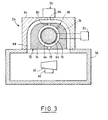
- FIG. 3 shows a device for surface treatment of polymer parts according to the invention incorporating a Venturi effect throttle.
- this device for treatment comprises an excitation device 54 supplied with gas by a source 56 of primary gas and in communication, downstream, with an enclosure 58 in which is disposed a system 60 for conveying an object 62 opposite the outlet gas 78 from the appliance 54.
- This processing device differs from the treatment described with reference to Figure 2 by the presence a venturi effect throttle.
- the excitation apparatus 54 has a first internal excitation electrode 64 coated with a layer of dielectric material 66 and shaped cylindrical. It is arranged within a second external excitation electrode 68 also shaped cylindrical. The two excitation electrodes 64 and 68 are arranged coaxially and delimit between them a gas excitation chamber 70 in communication with the primary gas source 56.
- the second external electrode 68 is formed here by the concave internal face of a longitudinal metal block 72 generally convex in external form and consisting of the association of two complementary parts 74 and 76 arranged opposite and spaced from each other.
- the two parts 74 and 76 are separated one from the other by two passages, respectively 78 and 80, constituting respectively a gas inlet passage 80 in the excitation chamber 70 and a gas outlet passage 78 in communication with enclosure 58.
- the two electrodes are connected to a source 82 of high voltage alternating high frequency for their polarization.
- the metal block 72 is placed in a cage 84 and is provided with a longitudinal slot 86 arranged opposite of the entry passage 80 and in communication with the source 56 gas.
- the slot 86 of the cage 84 has a shape substantially V-shaped profile which delimits a Venturi effect throttle causing in known manner an increase in the speed of gas delivered by the source 56 to the excitation chamber 70 as well as a corresponding lowering of the pressure of this gas.
- the cage 84 and the metal block 72 are spaced and define a form 88 gas suction channel here curved and extending between the gas inlet passage 80, in downstream of the Venturi effect throttle 86, and the enclosure 58.
- the gas undergoes under the action of the Venturi 86 throttle a pressure reduction, as previously mentioned.
- This pressure drop causes suction, by Venturi effect, of the gas present in the suction channel 88, and therefore the gas present in enclosure 58.
- the surface treatment device that comes to be described allows, according to this embodiment, a considerable savings in primary treatment gas since the de-excited gas present in enclosure 58 is reinjected (and therefore reused) in the excitation chamber 70.
Landscapes
- Health & Medical Sciences (AREA)
- Toxicology (AREA)
- Physical Or Chemical Processes And Apparatus (AREA)
- Treatments Of Macromolecular Shaped Articles (AREA)
Description
- le gaz secondaire délivré à la sortie de gaz de l'appareil est substantiellement dépourvu d'espèces électriquement chargées ;
- le gaz secondaire est à une pression voisine de la pression atmosphérique. On entend par « pression voisine de la pression atmosphérique » selon l'invention une pression se situant dans l'intervalle allant de 0,1 x 10⁵ Pa à 3 x 10⁵ Pa;
- le gaz primaire comporte au moins un gaz choisi parmi les gaz inertes, les gaz oxydants, les gaz réducteurs;
- la surface à traiter est en un matériau polymère;
- la surface de l'objet à traiter est amenée en regard de la sortie de gaz de l'appareil, le cas échéant en regard des sorties de gaz de plusieurs appareils de formation d'espèces gazeuses excitées ou instables disposés en parallèle sur la largeur de l'objet et/ou successivement en regard des sorties de gaz de plusieurs appareils de formation d'espèces gazeuses excitées ou instables disposés en série, au moyen d'un système de convoyage traversant un espace intérieur délimité par une enceinte, l'enceinte étant raccordée de façon étanche à ou aux appareils ou incluant le ou les appareils.
et se caractérisant en ce que en ce qu'il comporte, au niveau d'au moins un des appareils :
- un étranglement à effet Venturi disposé sur le trajet du gaz entre la source d'alimentation en gaz primaire et le passage d'entrée, et
- un canal de recirculation de gaz reliant l'espace intérieur de l'enceinte et une zone située en aval de l'étranglement,
- la figure 1 est une vue schématique en coupe transversale d'un dispositif de traitement de surfaces selon l'art antérieur ;
- la figure 2 est une vue schématique en coupe transversale d'un dispositif de traitement de surface selon l'invention en représentation simplifiée sans étranglement à effet Venturi; et
- la figure 3 est une vue schématique en coupe transversale d'un dispositif de traitement de surface selon l'invention.
- le fait déjà signalé que le gaz secondaire utilisé pour réaliser le traitement est recueilli en sortie de gaz de l'appareil, donc après recombinaison substantielle des espèces électriquement chargées;
- le fait que cette configuration permet de nettement séparer le lieu de génération (décharge) des espèces excitées ou instable du lieu de leur utilisation, ce qui limite considérablement les risques de pollution des électrodes du fait de dégagements divers résultant de l'opération de traitement de surface;
- enfin le fait que l'objet à traiter n'étant pas traité au sein de l'appareil (au sein de la décharge entre électrode ) comme c'est le cas du dispositif de la figure 1, le procédé selon l'invention bénéficie d'une bien meilleure flexibilité sur l'aspect distance et donc volume des objets que l'on peut traiter.
Claims (9)
- Procédé de traitement de surface par voie sèche d'au moins une portion de surface d'un objet, selon lequel on fait passer un gaz primaire dans au moins un appareil (26;54) de formation d'espèces gazeuses excitées ou instables, et on amène ladite portion de surface (24;62) en regard de la sortie de gaz dudit appareil (26;54), en vue de son traitement par un gaz secondaire délivré à la dite sortie de gaz, et comportant des espèces gazeuses excitées ou instables,
caractérisé en ce que le gaz secondaire délivré en sortie du dit appareil et utilisé pour le traitement est reaspiré par effet venturi et reinjecté dans le dit appareil. - Procédé selon la revendication 1 caractérisé en ce que le dit gaz secondaire est substantiellement dépourvu d'espèces électriquement chargées.
- Procédé selon l'une des revendications 1 et 2, caractérisé en ce que ledit gaz secondaire est à une pression voisine de la pression atmosphérique.
- Procédé selon l'une des revendications précédentes, caractérisé en ce que la surface (24;62) de l'objet à traiter est amenée en regard de la dite sortie de gaz du dit appareil, le cas échéant en regard des sorties de gaz de plusieurs appareils de formation d'espèces gazeuses excitées ou instables disposés en parallèle sur la largeur de l'objet et/ou successivement en regard des sorties de gaz de plusieurs appareils de formation d'espèces gazeuses excitées ou instables disposés en série, au moyen d'un système de convoyage traversant un espace intérieur délimité par une enceinte, ladite enceinte étant raccordée de façon étanche audit(s) appareil(s) ou incluant ledit(s) appareil(s).
- Procédé selon l'une des revendications précédentes, caractérisé en ce que ledit gaz primaire comporte au moins un gaz inerte et/ou un gaz oxydant et/ou un gaz réducteur.
- Procédé selon l'une quelconque des revendications 1 à 5, caractérisé en ce que ladite surface (24;62) à traiter est en un matériau polymère.
- Dispositif de traitement par voie sèche d'au moins une portion de surface (24;62) d'un objet, pour la mise en oeuvre du procédé de traitement de surface selon l'une quelconque des revendications 1 à 6, comportant au moins un appareil (26;54) de formation d'espèces gazeuses excitées ou instables comprenant un passage d'entrée de gaz (48;86) en communication avec une source (28;56) d'alimentation en gaz primaire et un passage de sortie de gaz secondaire excité (50;78) comportant des espèces excitées ou instables, et une enceinte (30;58) définissant un espace intérieur, raccordée de façon étanche audit(s) appareil(s) ou incluant ledit(s) appareil(s), ledit passage de sortie de gaz (50;78) débouchant à l'intérieur de l'enceinte,
caractérisé en ce qu'il comporte, au niveau d'au moins un des dits appareils :afin de permettre, sous l'action du gaz primaire délivré par la source d'alimentation en gaz primaire(56), l'aspiration par effet Venturi du gaz situé dans ladite enceinte (58) pour le reinjecter dans l'appareil (26;54) considéré de formation d'espèces gazeuses excitées ou instables.un étranglement (86) à effet Venturi disposé sur le trajet du gaz entre la source d'alimentation en gaz primaire (56) et ledit passage d'entrée (80), etun canal (88) de recirculation de gaz reliant l'espace intérieur de l'enceinte (58) et une zone située en aval dudit étranglement (86), - Dispositif selon la revendication 7, caractérisé en ce qu'il comporte un système de convoyage (32;60) dudit objet à l'intérieur de l'espace intérieur délimité par l'enceinte, apte à pourvoir amener ladite surface (24;62) dudit objet en regard dudit passage de sortie de gaz (50;78).
- Dispositif selon la revendication 7 ou 8, caractérisé en ce que ledit appareil (26;54) de formation d'espèces gazeuses excitées ou instables comporte, connectées à une source (52;82) de haute tension alternative à haute fréquence, une première électrode excitatrice interne (34;64) de forme cylindrique, et une seconde électrode excitatrice externe (38;68) de forme cylindrique et munie de fentes longitudinales sensiblement opposées constituant lesdits passages d'entrée (48;80) et de sortie (50;78) de gaz, lesdites première (34;64) et seconde (38;68) électrodes étant disposées de façon coaxiale et délimitant une chambre d'excitation de gaz (46;70), une couche d'un matériau diélectrique 36;66) étant disposée sur la surface d'au moins une des électrodes en regard de l'autre électrode.
Applications Claiming Priority (3)
| Application Number | Priority Date | Filing Date | Title |
|---|---|---|---|
| FR9608230A FR2750622B1 (fr) | 1996-07-02 | 1996-07-02 | Procede de traitement de surface par voie seche et dispositif pour la mise en oeuvre d'un tel procede |
| FR9608230 | 1996-07-02 | ||
| PCT/FR1997/001027 WO1998000284A1 (fr) | 1996-07-02 | 1997-06-10 | Procede de traitement de surface par voie seche et dispositif pour la mise en oeuvre d'un tel procede |
Publications (2)
| Publication Number | Publication Date |
|---|---|
| EP0914241A1 EP0914241A1 (fr) | 1999-05-12 |
| EP0914241B1 true EP0914241B1 (fr) | 2000-03-01 |
Family
ID=9493639
Family Applications (1)
| Application Number | Title | Priority Date | Filing Date |
|---|---|---|---|
| EP97928321A Expired - Lifetime EP0914241B1 (fr) | 1996-07-02 | 1997-06-10 | Procede de traitement de surface par voie seche et dispositif pour la mise en oeuvre d'un tel procede |
Country Status (7)
| Country | Link |
|---|---|
| US (1) | US6146503A (fr) |
| EP (1) | EP0914241B1 (fr) |
| JP (1) | JP2000514477A (fr) |
| DE (1) | DE69701363T2 (fr) |
| ES (1) | ES2144868T3 (fr) |
| FR (1) | FR2750622B1 (fr) |
| WO (1) | WO1998000284A1 (fr) |
Families Citing this family (15)
| Publication number | Priority date | Publication date | Assignee | Title |
|---|---|---|---|---|
| CA2300978C (fr) * | 1998-06-11 | 2007-08-21 | Universal Dynamics, Inc. | Procede et dispositif de sechage de solides granuleux par circulation de gaz propulse par venturi |
| US6468833B2 (en) | 2000-03-31 | 2002-10-22 | American Air Liquide, Inc. | Systems and methods for application of substantially dry atmospheric plasma surface treatment to various electronic component packaging and assembly methods |
| GB0211354D0 (en) * | 2002-05-17 | 2002-06-26 | Surface Innovations Ltd | Atomisation of a precursor into an excitation medium for coating a remote substrate |
| GB0212848D0 (en) * | 2002-06-01 | 2002-07-17 | Surface Innovations Ltd | Introduction of liquid/solid slurry into an exciting medium |
| US8361340B2 (en) | 2003-04-28 | 2013-01-29 | Air Products And Chemicals, Inc. | Removal of surface oxides by electron attachment |
| US7897029B2 (en) * | 2008-03-04 | 2011-03-01 | Air Products And Chemicals, Inc. | Removal of surface oxides by electron attachment |
| US7079370B2 (en) | 2003-04-28 | 2006-07-18 | Air Products And Chemicals, Inc. | Apparatus and method for removal of surface oxides via fluxless technique electron attachment and remote ion generation |
| US7387738B2 (en) | 2003-04-28 | 2008-06-17 | Air Products And Chemicals, Inc. | Removal of surface oxides by electron attachment for wafer bumping applications |
| US7303943B2 (en) * | 2004-10-07 | 2007-12-04 | Seiko Instruments Inc | Method of manufacturing electric device |
| US7434719B2 (en) * | 2005-12-09 | 2008-10-14 | Air Products And Chemicals, Inc. | Addition of D2 to H2 to detect and calibrate atomic hydrogen formed by dissociative electron attachment |
| US8454850B2 (en) * | 2009-09-02 | 2013-06-04 | Air Products And Chemicals, Inc. | Method for the removal of surface oxides by electron attachment |
| US9053894B2 (en) | 2011-02-09 | 2015-06-09 | Air Products And Chemicals, Inc. | Apparatus and method for removal of surface oxides via fluxless technique involving electron attachment |
| US9006975B2 (en) | 2011-02-09 | 2015-04-14 | Air Products And Chemicals, Inc. | Apparatus and method for removal of surface oxides via fluxless technique involving electron attachment |
| EP2960358A1 (fr) | 2014-06-25 | 2015-12-30 | Nederlandse Organisatie voor toegepast- natuurwetenschappelijk onderzoek TNO | Source plasma et procédé de traitement de surface |
| CN105448744B (zh) * | 2015-11-17 | 2017-11-07 | 通富微电子股份有限公司 | 无助焊剂式凸块回流成球率控制方法 |
Family Cites Families (10)
| Publication number | Priority date | Publication date | Assignee | Title |
|---|---|---|---|---|
| FR1421884A (fr) * | 1965-01-21 | 1965-12-17 | Multifol Patentverwert Ag | Procédé et installation pour la fabrication de bandes continues notamment à partir de deux couches de consitution chimique différente ainsi que les bandes conformes à celles obtenues par le présent procédé ou procédé similaire |
| US3484363A (en) * | 1966-11-14 | 1969-12-16 | Lectro Eng Co | Electrical discharge treating apparatus designed to provide a plurality of uniform spark discharges |
| DE3619694A1 (de) * | 1986-06-11 | 1987-12-17 | Suppan Friedrich | Verfahren und vorrichtung zur erzeugung funktioneller atomgruppierungen in makromolekularen stoffen |
| DE3622737C1 (de) * | 1986-07-05 | 1987-10-08 | Klaus Kalwar | Verfahren zur Korona-Behandlung von bahnfoermigen Materialien sowie Vorrichtung zur Durchfuehrung des Verfahrens |
| FR2692730B1 (fr) * | 1992-06-19 | 1994-08-19 | Air Liquide | Dispositif de formation de molécules gazeuses excitées ou instables et utilisations d'un tel dispositif. |
| JP2875438B2 (ja) * | 1992-09-24 | 1999-03-31 | 日本ペイント株式会社 | 熱可塑性樹脂製品の表面処理方法 |
| US5466424A (en) * | 1992-12-28 | 1995-11-14 | Bridgestone Corporation | Corona discharge surface treating method |
| CZ281826B6 (cs) * | 1993-10-27 | 1997-02-12 | Masarykova Univerzita V Brně Katedra Fyzikální Elektroniky Přírod. Fakulty | Způsob bělení a zvyšování adheze vlákenných materiálů k barvivům |
| US5667563A (en) * | 1995-07-13 | 1997-09-16 | Silva, Jr.; John C. | Air ionization system |
| FR2750620B1 (fr) * | 1996-07-02 | 1998-09-25 | Air Liquide | Dispositif d'excitation de gaz |
-
1996
- 1996-07-02 FR FR9608230A patent/FR2750622B1/fr not_active Expired - Fee Related
-
1997
- 1997-06-10 US US09/147,463 patent/US6146503A/en not_active Expired - Fee Related
- 1997-06-10 DE DE69701363T patent/DE69701363T2/de not_active Expired - Fee Related
- 1997-06-10 ES ES97928321T patent/ES2144868T3/es not_active Expired - Lifetime
- 1997-06-10 EP EP97928321A patent/EP0914241B1/fr not_active Expired - Lifetime
- 1997-06-10 JP JP10503867A patent/JP2000514477A/ja active Pending
- 1997-06-10 WO PCT/FR1997/001027 patent/WO1998000284A1/fr not_active Ceased
Also Published As
| Publication number | Publication date |
|---|---|
| US6146503A (en) | 2000-11-14 |
| JP2000514477A (ja) | 2000-10-31 |
| DE69701363T2 (de) | 2000-08-10 |
| FR2750622B1 (fr) | 1998-09-25 |
| EP0914241A1 (fr) | 1999-05-12 |
| WO1998000284A1 (fr) | 1998-01-08 |
| DE69701363D1 (de) | 2000-04-06 |
| ES2144868T3 (es) | 2000-06-16 |
| FR2750622A1 (fr) | 1998-01-09 |
Similar Documents
| Publication | Publication Date | Title |
|---|---|---|
| EP0914241A1 (fr) | Procede de traitement de surface par voie seche et dispositif pour la mise en oeuvre d'un tel procede | |
| EP0575260B1 (fr) | Dispositif de formation de molécules gazeuses excitées ou instables et utilisations d'un tel dispositif | |
| CA2137980C (fr) | Procede et dispositif de fluxage par voie seche de surfaces metalliques avant brasage ou etamage | |
| EP0506552B1 (fr) | Procédé pour traiter par exemple la surface d'un substrat par projection d'un flux de plasma, et dispositif pour la mise en oeuvre du procédé | |
| EP1481112B1 (fr) | Procede de nettoyage par plasma de la surface d'un materiau enduit d'une substance organique, et installation de mise en oeuvre | |
| EP1108264A1 (fr) | Procede et dispositif de traitement de surface par plasma a pression atmospherique | |
| EP0747160A2 (fr) | Procédé et dispositif de brasage à la vague intégrant une opération de fluxage par voie sèche | |
| EP1332650B1 (fr) | Procede de traitement par plasma atmospherique de materiaux conducteurs d'electricite et dispositif pour sa mise en oeuvre | |
| EP0734462A1 (fr) | Utilisation d'un appareil de formation de gaz excite | |
| EP0734461A1 (fr) | Utilisation d'un appareil de formation de gaz excite | |
| WO2020148487A1 (fr) | Procede et dispositif de traitement pour le depot d'un revetement a effet barriere | |
| WO2002010474A1 (fr) | Procede de revetement par plasma | |
| EP1072175A1 (fr) | Procede de traitement de surface d'un materiau ou d'un objet et dispositif pour la mise en oeuvre du procede | |
| WO2016170242A1 (fr) | Procédé de traitement de surface d'un film en mouvement et installation pour la mise en oeuvre de ce procédé | |
| FR2962004A1 (fr) | Dispositif pour la generation d'un jet de plasma | |
| EP1435800A1 (fr) | Dispositif et procede de traitement par champ electrique pulse d'une substance contenantdes organismes indesirables | |
| EP3560299B1 (fr) | Réacteur plasma de dbd | |
| EP3532652B1 (fr) | Installation de traitement de surface d'un substrat en mouvement sous atmosphere controlee, et son procede de dimensionnement | |
| EP1684915A1 (fr) | Procede et dispositif de traitement en continu de la surface d'un objet allonge | |
| EP0658637B1 (fr) | Procédé et dispositif de traitement de surfaces métalliques par voie sèche | |
| EP0996770A1 (fr) | Procede et appareil de traitement de surfaces metalliques par voie seche |
Legal Events
| Date | Code | Title | Description |
|---|---|---|---|
| PUAI | Public reference made under article 153(3) epc to a published international application that has entered the european phase |
Free format text: ORIGINAL CODE: 0009012 |
|
| 17P | Request for examination filed |
Effective date: 19990202 |
|
| AK | Designated contracting states |
Kind code of ref document: A1 Designated state(s): DE ES GB IT |
|
| GRAG | Despatch of communication of intention to grant |
Free format text: ORIGINAL CODE: EPIDOS AGRA |
|
| GRAG | Despatch of communication of intention to grant |
Free format text: ORIGINAL CODE: EPIDOS AGRA |
|
| GRAH | Despatch of communication of intention to grant a patent |
Free format text: ORIGINAL CODE: EPIDOS IGRA |
|
| 17Q | First examination report despatched |
Effective date: 19990716 |
|
| GRAH | Despatch of communication of intention to grant a patent |
Free format text: ORIGINAL CODE: EPIDOS IGRA |
|
| GRAA | (expected) grant |
Free format text: ORIGINAL CODE: 0009210 |
|
| AK | Designated contracting states |
Kind code of ref document: B1 Designated state(s): DE ES GB IT |
|
| ITF | It: translation for a ep patent filed | ||
| REF | Corresponds to: |
Ref document number: 69701363 Country of ref document: DE Date of ref document: 20000406 |
|
| GBT | Gb: translation of ep patent filed (gb section 77(6)(a)/1977) |
Effective date: 20000406 |
|
| REG | Reference to a national code |
Ref country code: ES Ref legal event code: FG2A Ref document number: 2144868 Country of ref document: ES Kind code of ref document: T3 |
|
| EN | Fr: translation not filed | ||
| EN4 | Fr: notification of non filing translation in an earlier bopi is erroneous | ||
| PLBE | No opposition filed within time limit |
Free format text: ORIGINAL CODE: 0009261 |
|
| STAA | Information on the status of an ep patent application or granted ep patent |
Free format text: STATUS: NO OPPOSITION FILED WITHIN TIME LIMIT |
|
| 26N | No opposition filed | ||
| PGFP | Annual fee paid to national office [announced via postgrant information from national office to epo] |
Ref country code: GB Payment date: 20010518 Year of fee payment: 5 |
|
| PGFP | Annual fee paid to national office [announced via postgrant information from national office to epo] |
Ref country code: DE Payment date: 20010523 Year of fee payment: 5 |
|
| PGFP | Annual fee paid to national office [announced via postgrant information from national office to epo] |
Ref country code: ES Payment date: 20010608 Year of fee payment: 5 |
|
| REG | Reference to a national code |
Ref country code: GB Ref legal event code: IF02 |
|
| PG25 | Lapsed in a contracting state [announced via postgrant information from national office to epo] |
Ref country code: GB Free format text: LAPSE BECAUSE OF NON-PAYMENT OF DUE FEES Effective date: 20020610 |
|
| PG25 | Lapsed in a contracting state [announced via postgrant information from national office to epo] |
Ref country code: ES Free format text: LAPSE BECAUSE OF NON-PAYMENT OF DUE FEES Effective date: 20020611 |
|
| PG25 | Lapsed in a contracting state [announced via postgrant information from national office to epo] |
Ref country code: DE Free format text: LAPSE BECAUSE OF NON-PAYMENT OF DUE FEES Effective date: 20030101 |
|
| GBPC | Gb: european patent ceased through non-payment of renewal fee |
Effective date: 20020610 |
|
| REG | Reference to a national code |
Ref country code: ES Ref legal event code: FD2A Effective date: 20030711 |
|
| PG25 | Lapsed in a contracting state [announced via postgrant information from national office to epo] |
Ref country code: IT Free format text: LAPSE BECAUSE OF NON-PAYMENT OF DUE FEES;WARNING: LAPSES OF ITALIAN PATENTS WITH EFFECTIVE DATE BEFORE 2007 MAY HAVE OCCURRED AT ANY TIME BEFORE 2007. THE CORRECT EFFECTIVE DATE MAY BE DIFFERENT FROM THE ONE RECORDED. Effective date: 20050610 |