EP0917199A2 - Améliorations aux ou relatives aux dispositifs semi-conducteurs - Google Patents
Améliorations aux ou relatives aux dispositifs semi-conducteurs Download PDFInfo
- Publication number
- EP0917199A2 EP0917199A2 EP98203870A EP98203870A EP0917199A2 EP 0917199 A2 EP0917199 A2 EP 0917199A2 EP 98203870 A EP98203870 A EP 98203870A EP 98203870 A EP98203870 A EP 98203870A EP 0917199 A2 EP0917199 A2 EP 0917199A2
- Authority
- EP
- European Patent Office
- Prior art keywords
- dielectric
- layer
- low
- conductor
- sacrificial layer
- Prior art date
- Legal status (The legal status is an assumption and is not a legal conclusion. Google has not performed a legal analysis and makes no representation as to the accuracy of the status listed.)
- Withdrawn
Links
Images

Classifications
-
- H—ELECTRICITY
- H10—SEMICONDUCTOR DEVICES; ELECTRIC SOLID-STATE DEVICES NOT OTHERWISE PROVIDED FOR
- H10W—GENERIC PACKAGES, INTERCONNECTIONS, CONNECTORS OR OTHER CONSTRUCTIONAL DETAILS OF DEVICES COVERED BY CLASS H10
- H10W20/00—Interconnections in chips, wafers or substrates
- H10W20/40—Interconnections external to wafers or substrates, e.g. back-end-of-line [BEOL] metallisations or vias connecting to gate electrodes
- H10W20/495—Capacitive arrangements or effects of, or between wiring layers
-
- H—ELECTRICITY
- H10—SEMICONDUCTOR DEVICES; ELECTRIC SOLID-STATE DEVICES NOT OTHERWISE PROVIDED FOR
- H10W—GENERIC PACKAGES, INTERCONNECTIONS, CONNECTORS OR OTHER CONSTRUCTIONAL DETAILS OF DEVICES COVERED BY CLASS H10
- H10W20/00—Interconnections in chips, wafers or substrates
- H10W20/40—Interconnections external to wafers or substrates, e.g. back-end-of-line [BEOL] metallisations or vias connecting to gate electrodes
- H10W20/45—Interconnections external to wafers or substrates, e.g. back-end-of-line [BEOL] metallisations or vias connecting to gate electrodes characterised by their insulating parts
- H10W20/48—Insulating materials thereof
Definitions
- the present invention relates, generally, to semiconductor device structures and processing, and, more particularly, to an interconnect structure and process with lower line resistance and lower line-to-line capacitance.
- Silicon dioxide is the most common dielectric material used to isolate wires from each other. Silicon dioxide has a characteristic relative dielectric permittivity or dielectric constant of about 4.1. The relative dielectric constant is based on a scale where 1.0 represents the dielectric constant of a vacuum. As used herein, the term "thin film low permittivity dielectric" means a dielectric that can be applied to a semiconductor substrate surface using available thin film techniques and has a characteristic relative dielectric permittivity constant less than about 3.5.
- a wide range of organic and inorganic materials are being developed to provide low permittivity (i.e., low ⁇ ) performance. Examples include fluorine doped silicon dioxide, parylene, aerogel, and fluorinated polymers. Materials and processes are needed that can combine these low- ⁇ films with integrated circuit processing in combination with high conductivity metals and conductors to reduce RC time constants. The use of low RC materials is vital to the continued scaling and performance improvement of integrated circuits.
- Aluminum (Al) is the most common metal used to form patterned interconnect wiring in view of its low cost and well understood processing.
- Al has relatively low conductivity compared to other conductors such as gold, copper and their alloys. Copper and its alloys are attractive substitutes for Al interconnect wiring because copper is inexpensive and has higher reliability and conductivity.
- copper interconnects involve more complex processing than aluminum.
- copper is difficult to etch using dry etch processes such as reactive ion etching (RIE) as available etch processes do not yield gas phase copper by-products. Wet etching is inconsistent with smaller geometry device structures.
- RIE reactive ion etching
- Damascene processes are desirable for copper interconnects because they provide fine patterned features without dry-etching the copper.
- a Damascene process begins with etching both contacts and troughs for the wiring into a thick, planarized silicon dioxide layer. Metal is deposited to fill the contacts and troughs and then removed from the surface using chemical mechanical planarization (CMP) techniques. This leaves the wiring inlaid in the insulator with wiring size and contact size determined by the etch process(es) used to form the contacts and troughs. The resulting surface is flat so there is no need for expensive planarization processing between the first and second layer of wiring. Hence, subsequent interlayer dielectric layers can be formed with a single deposition. Because the metal is removed from the surface with CMP instead of RIE, difficult etching depth control problems and related RIE-induced defects are eliminated.
- Low- ⁇ materials can be used to reduce line-to-line capacitance between adjacent lines in a single metal layer as well as reducing capacitance created by interlevel dielectric materials between overlying metal wires. Lowering the line-to-line capacitance by selectively embedding a low- ⁇ material between adjacent lines is an effective way to lower the total interconnect capacitance and thereby reduce the RC time delays, allowing faster intra-chip communications. Cross-talk voltage interference between adjacent metal wires can also be reduced by embedding a low- ⁇ material solely between the wires but not above or below the wires.
- Currently, most low- ⁇ dielectric materials are difficult to integrate into conventional IC processing flows because of such limitations as out-gassing, low thermal stability, low mechanical strength, and the like. For this reason, many processes use the low- ⁇ materials in conjunction with conventional insulators such as oxides that cap the low- ⁇ material to prevent outgassing and provide mechanical strength and ruggedness in areas where device structures such as contacts are to be formed.
- the teachings disclosed herein involve a semiconductor device including a plurality of devices formed on an integrated circuit.
- a low- ⁇ dielectric on a surface of the integrated circuit has interconnect wires inlaid in the dielectric.
- the interconnect wires are formed so as to interconnect at least portions of the devices.
- the interconnect wires comprise copper.
- Another aspect of these teachings involve a method for forming an integrated circuit including the steps of forming a sacrificial layer over a surface of a semiconductor substrate and patterning the sacrificial layer to form troughs in the sacrificial layer.
- the troughs are filled with a conductor comprising copper to form interconnect lines.
- a remainder of the sacrificial layer is removed and spaces between the conductor are filled with a low- ⁇ dielectric.
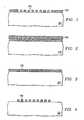
- FIG. 1-FIG. 15 illustrate the interconnect structure in cross section without showing the particular devices formed in and on the semiconductor body 101. Formation of a wide variety of devices including diffused transistors, thin film transistors, capacitors, resistors, inductors and the like are well known. These teachings are useful for providing low RC connections between any combination of these devices to meet the needs of a particular application.
- Semiconductor body 101 comprises silicon, germanium, III-V compound semiconductor, II-VI compound semiconductor or the like in any combination. Semiconductor body 101 may be formed as a single layer or may comprise multiple layers of distinct materials. Semiconductor body 101 may be self supporting or formed on a supporting substrate such as ceramic, sapphire, diamond, glass, or the like to meet the needs of a particular application.
- the interconnect structure and method is described in terms of a Damascene-like process that enables use of conductive materials that are difficult to dry etch.
- the disclosed teachings use a copper or copper alloy metal to form interconnect wiring, although the disclosed principles may be extended to other metal systems including conventional metal systems that can be dry etched.
- These teachings are an extension of U.S. Patent 5,486,493 assigned to the assignee of the present application entitled "PLANARIZED MULTI-LEVEL INTERCONNECT SCHEME WITH EMBEDDED LOW-DIELECTRIC CONSTANT INSULATORS". Accordingly, materials and material thicknesses are specified herein for example only, and are not limitations on the essential teachings disclosed herein unless expressly stated.
- semiconductor body 101 is coated with a sacrificial or disposable layer 102 that is patterned to provide openings 103.
- sacrificial layer 102 is patterned by photolithography techniques.
- sacrificial layer 102 comprises photoresist applied in a uniform layer by spinning or spraying and patterned using conventional photoresist processing techniques.
- Sacrificial layer 102 is applied at a thickness selected to provide sufficiently low resistance per unit length to wires 106 (shown in FIG. 3). Thickness of sacrificial layer 102 is typically in the range of 0.1 to 2.0 microns in a particular example, although this thickness may change to meet the needs of a particular application.
- sacrificial layer 102 may comprise any material that can be applied in a substantially uniform layer, is patternable, and that can be sacrificially etched away without substantially etching or damaging wires 106 (shown in FIG. 3). Unlike conventional Damascene processes, the material chosen for sacrificial layer 102 will be removed and so will not affect the line-to-line capacitance between wires 106. This feature of the disclosed teachings gives great flexibility in the selection of sacrificial layer 102. By enabling selection among photoresist, polymers, oxides, and even conductors such as silicon and metal, the teachings disclosed herein are easily adaptable to integration with other processes and devices that may be formed in or on semiconductor body 101.
- the patterned layer 102 is covered with a conductive layer 104 that comprises copper or a copper alloy in the preferred embodiment.
- Conductive layer 104 is deposited using a deposition technique suited to fill openings 103. Suitable methods of depositing conductive layer 104 include sputtering, chemical vapor deposition, electroplating and the like. To ensure completely filling openings 103, conductive layer 104 is desirably applied at a thickness somewhat greater than the depth of openings 103.
- an upper portion of conductive layer 104 is removed by a planarizing process such as chemical mechanical planarization (CMP) or by mechanical polishing.
- CMP chemical mechanical planarization
- These processes comprise wet chemical removal and/or physical removal steps and so are applicable to conductive layer such as copper than are difficult to etch using dry etch techniques.
- the resulting structure shown in FIG. 3 has a substantially planar upper surface with interconnect wiring 106 embedded in sacrificial layer 102.
- sacrificial layer 102 is removed by wet or dry etching techniques that do not substantially etch or damage interconnect wires 106.
- the resulting structure shown in FIG. 4 comprises interconnect wires 106 having dimensions determined by the patterned formed in sacrificial layer 102.
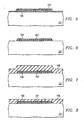
- the sidewalls of wires 106 may be protected by a thin layer of material (not shown) such as oxide, nitride or the like using a sidewall spacer formation process. This protective layer may be used to prevent chemical interaction between low- ⁇ dielectric spacers 107 (shown in FIG. 6) if desired. Similar protection may be achieved by oxidizing interconnect wires 106.
- Low- ⁇ dielectric layer 107 is applied in a thickness sufficient to fill gaps between interconnect wires 106.
- Suitable low- ⁇ dielectric materials include:
- low- ⁇ dielectric layer 107 comprises a material that can be dry etched by, for example, reactive ion etching, without damaging conductive wires 106.
- dry etching is especially convenient because, as set out before, copper is difficult to etch in most dry etch chemistries.
- Low- ⁇ dielectric layer 107 is etched until the surface of wires 106 is exposed leaving line-to-line dielectric spacers 107 as illustrated in FIG. 6.
- the etch of low- ⁇ dielectric layer 107 can timed or an endpoint can be determined using time or by measuring etch by-products that will drop significantly when the upper surfaces of wires 106 are cleared. This results in a Damascene structure having low- ⁇ material in the open areas where there are no metal lines.
- an insulating cap layer 108 is applied to cover interconnect wires 106 and low- ⁇ dielectric spacers 107.
- Cap layer 108 comprises a conventional material used for interlayer dielectrics such as silicon oxides applied by chemical vapor deposition.
- Cap layer 108 provides an upper surface that protects low- ⁇ dielectric spacers 107, is thermally stable, and mechanically rugged.
- Cap layer 108 is planarized by, for example, CMP processing to provide the structure shown in FIG. 8.
- Cap layer should also be of a material with higher dielectric constant than low- ⁇ spacer material.
- the upper surface of the structure shown in FIG. 8 is substantially planar and is compatible with existing Damascene and via fill techniques to form electrical connections to interconnect wires 106 as shown in FIG. 9 and FIG. 10.
- Vias 109 are etched using available patterning and etch techniques to expose the upper surface of selected portions of interconnect wires 106.
- Vias 109 are filled with a suitable conductive material to provide electrical connection to the selected wires 106 as shown in FIG. 10.
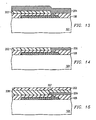
- FIG. 11 through FIG. 15 show an alternative dual Damascene implementation to the previous teachings.
- This embodiment begins with a structure substantially as shown in FIG. 8.
- a second sacrificial layer 202 is formed covering an upper surface of cap dielectric 108 as shown in FIG 11.
- Second sacrificial layer 202 comprises the same material applied in a similar manner as sacrificial layer 102 described hereinbefore in a preferred implementation.
- sacrificial layer 202 is patterned to open areas 203 where wiring will eventually be formed.
- a via may also be opened to expose selected portions of wires 106 to form inter-layer conductive connections.
- conductive layer 204 is applied using, for example, blanket deposition techniques such as CVD or sputtering.
- conductive layer 204 also comprises copper or a copper alloy to provide low resistance wiring.
- the composition of conductive layer 204 is chosen to be metallurgically compatible with conductive wires 106 to provide a high quality conductive coupling.
- the upper portion of conductive layer 204 is removed using a process comprising a mechanical removal step such as CMP.
- the removal process is desirably stopped when the upper surface of second sacrificial layer 202 is exposed as shown in FIG. 14.
- the removal process leaves a second layer of patterned conductive wiring 206 that is selectively coupled with the first layer of patterned wiring 106.
- second sacrificial layer 202 is removed and embedded low- ⁇ dielectric 207 shown in FIG. 15 is applied and formed in a manner similar to low- ⁇ spacers 107 described herein before.
- a second cap layer 208 comprising, for example an oxide is applied and planarized to cover conductive wires 206 and low- ⁇ spacers 207.
- Second cap layer 208 is conveniently planarized in a manner similar to first dielectric cap 108 described hereinbefore.
- third sacrificial layer 302 shown in FIG. 15 the process may be extended through repetition of the steps outlined herein to any number of conductive layers required by a particular device design.
Landscapes
- Internal Circuitry In Semiconductor Integrated Circuit Devices (AREA)
Applications Claiming Priority (2)
| Application Number | Priority Date | Filing Date | Title |
|---|---|---|---|
| US6592797P | 1997-11-17 | 1997-11-17 | |
| US65927P | 1997-11-17 |
Publications (2)
| Publication Number | Publication Date |
|---|---|
| EP0917199A2 true EP0917199A2 (fr) | 1999-05-19 |
| EP0917199A3 EP0917199A3 (fr) | 2001-04-11 |
Family
ID=22066071
Family Applications (1)
| Application Number | Title | Priority Date | Filing Date |
|---|---|---|---|
| EP98203870A Withdrawn EP0917199A3 (fr) | 1997-11-17 | 1998-11-13 | Améliorations aux ou relatives aux dispositifs semi-conducteurs |
Country Status (2)
| Country | Link |
|---|---|
| EP (1) | EP0917199A3 (fr) |
| JP (1) | JPH11219955A (fr) |
Families Citing this family (5)
| Publication number | Priority date | Publication date | Assignee | Title |
|---|---|---|---|---|
| JP2007281513A (ja) * | 1999-06-25 | 2007-10-25 | Toshiba Corp | Lsiの配線構造 |
| US6413854B1 (en) * | 1999-08-24 | 2002-07-02 | International Business Machines Corp. | Method to build multi level structure |
| KR100571259B1 (ko) * | 1999-12-23 | 2006-04-13 | 주식회사 하이닉스반도체 | 반도체 소자의 다마신 패턴 형성방법 |
| US6355555B1 (en) * | 2000-01-28 | 2002-03-12 | Advanced Micro Devices, Inc. | Method of fabricating copper-based semiconductor devices using a sacrificial dielectric layer |
| JP6268725B2 (ja) * | 2013-03-18 | 2018-01-31 | 富士通株式会社 | 半導体装置及び半導体装置の製造方法 |
Family Cites Families (4)
| Publication number | Priority date | Publication date | Assignee | Title |
|---|---|---|---|---|
| US5149615A (en) * | 1991-01-08 | 1992-09-22 | The Boeing Company | Method for producing a planar surface on which a conductive layer can be applied |
| US5486493A (en) * | 1994-02-25 | 1996-01-23 | Jeng; Shin-Puu | Planarized multi-level interconnect scheme with embedded low-dielectric constant insulators |
| EP0701277B1 (fr) * | 1994-05-27 | 2008-02-27 | Texas Instruments Incorporated | Procédé d'interconnection utilisant un isolant poreux pour la réduction des capacités entre les lignes |
| US5494858A (en) * | 1994-06-07 | 1996-02-27 | Texas Instruments Incorporated | Method for forming porous composites as a low dielectric constant layer with varying porosity distribution electronics applications |
-
1998
- 1998-11-13 EP EP98203870A patent/EP0917199A3/fr not_active Withdrawn
- 1998-11-17 JP JP10326688A patent/JPH11219955A/ja active Pending
Also Published As
| Publication number | Publication date |
|---|---|
| JPH11219955A (ja) | 1999-08-10 |
| EP0917199A3 (fr) | 2001-04-11 |
Similar Documents
| Publication | Publication Date | Title |
|---|---|---|
| US6331481B1 (en) | Damascene etchback for low ε dielectric | |
| US5759906A (en) | Planarization method for intermetal dielectrics between multilevel interconnections on integrated circuits | |
| JP3778487B2 (ja) | 金属キャパシタの形成方法 | |
| US5858869A (en) | Method for fabricating intermetal dielectric insulation using anisotropic plasma oxides and low dielectric constant polymers | |
| US5592016A (en) | Antifuse with improved antifuse material | |
| US6016000A (en) | Ultra high-speed chip semiconductor integrated circuit interconnect structure and fabrication method using free-space dielectrics | |
| US6124198A (en) | Ultra high-speed chip interconnect using free-space dielectrics | |
| KR100307490B1 (ko) | 반도체 장치의 기생 용량 감소 방법 | |
| US5891805A (en) | Method of forming contacts | |
| EP0680085B1 (fr) | Formation de vias dans des matériaux polymères | |
| US20060194430A1 (en) | Metal interconnect structure and method | |
| KR100822331B1 (ko) | 금속-산화물-금속 커패시터의 조립 방법 및 그 결합 장치 | |
| JP4386680B2 (ja) | 半導体素子のためのキャパシタおよびその製造方法 | |
| US6764774B2 (en) | Structures with improved adhesion to Si and C containing dielectrics and method for preparing the same | |
| US6040628A (en) | Interconnect structure using a combination of hard dielectric and polymer as interlayer dielectrics | |
| KR20010109281A (ko) | 마이크로일렉트로닉 구조 | |
| US6054380A (en) | Method and apparatus for integrating low dielectric constant materials into a multilevel metallization and interconnect structure | |
| US6391713B1 (en) | Method for forming a dual damascene structure having capacitors | |
| WO2000035000A1 (fr) | Structure de connexion de circuit integre a semi-conducteurs a vitesse ultra-elevee et procede de fabrication utilisant un dielectrique en espace libre | |
| EP0917199A2 (fr) | Améliorations aux ou relatives aux dispositifs semi-conducteurs | |
| US5652173A (en) | Monolithic microwave circuit with thick conductors | |
| US7256118B2 (en) | Semiconductor device using low-K material as interlayer insulating film and its manufacture method | |
| US20020173079A1 (en) | Dual damascene integration scheme using a bilayer interlevel dielectric | |
| US6750544B1 (en) | Metallization system for use in a semiconductor component | |
| KR100546940B1 (ko) | 반도체 소자의 구리 배선 형성 방법 |
Legal Events
| Date | Code | Title | Description |
|---|---|---|---|
| PUAI | Public reference made under article 153(3) epc to a published international application that has entered the european phase |
Free format text: ORIGINAL CODE: 0009012 |
|
| AK | Designated contracting states |
Kind code of ref document: A2 Designated state(s): DE FR GB IT NL |
|
| AX | Request for extension of the european patent |
Free format text: AL;LT;LV;MK;RO;SI |
|
| PUAL | Search report despatched |
Free format text: ORIGINAL CODE: 0009013 |
|
| AK | Designated contracting states |
Kind code of ref document: A3 Designated state(s): AT BE CH CY DE DK ES FI FR GB GR IE IT LI LU MC NL PT SE |
|
| AX | Request for extension of the european patent |
Free format text: AL;LT;LV;MK;RO;SI |
|
| RIC1 | Information provided on ipc code assigned before grant |
Free format text: 7H 01L 23/532 A, 7H 01L 23/522 B |
|
| 17P | Request for examination filed |
Effective date: 20011011 |
|
| AKX | Designation fees paid |
Free format text: DE FR GB IT NL |
|
| STAA | Information on the status of an ep patent application or granted ep patent |
Free format text: STATUS: THE APPLICATION IS DEEMED TO BE WITHDRAWN |
|
| 18D | Application deemed to be withdrawn |
Effective date: 20060906 |