EP0918207A2 - Splittergeschoss - Google Patents
Splittergeschoss Download PDFInfo
- Publication number
- EP0918207A2 EP0918207A2 EP98122013A EP98122013A EP0918207A2 EP 0918207 A2 EP0918207 A2 EP 0918207A2 EP 98122013 A EP98122013 A EP 98122013A EP 98122013 A EP98122013 A EP 98122013A EP 0918207 A2 EP0918207 A2 EP 0918207A2
- Authority
- EP
- European Patent Office
- Prior art keywords
- splinter
- projectile
- section
- projectile according
- casing
- Prior art date
- Legal status (The legal status is an assumption and is not a legal conclusion. Google has not performed a legal analysis and makes no representation as to the accuracy of the status listed.)
- Granted
Links
- 206010041662 Splinter Diseases 0.000 claims description 58
- 238000010276 construction Methods 0.000 claims description 16
- 239000002360 explosive Substances 0.000 claims description 15
- 239000012634 fragment Substances 0.000 claims description 15
- 229910000831 Steel Inorganic materials 0.000 claims description 4
- 230000035939 shock Effects 0.000 claims description 4
- 239000010959 steel Substances 0.000 claims description 4
- 239000000463 material Substances 0.000 claims description 3
- 239000000945 filler Substances 0.000 claims description 2
- 230000003313 weakening effect Effects 0.000 claims description 2
- 230000000694 effects Effects 0.000 description 8
- 238000005474 detonation Methods 0.000 description 3
- 230000035515 penetration Effects 0.000 description 3
- 230000015572 biosynthetic process Effects 0.000 description 2
- 230000000977 initiatory effect Effects 0.000 description 2
- 230000007903 penetration ability Effects 0.000 description 2
- 230000001133 acceleration Effects 0.000 description 1
- 230000015556 catabolic process Effects 0.000 description 1
- 230000003111 delayed effect Effects 0.000 description 1
- 230000001419 dependent effect Effects 0.000 description 1
- 238000011161 development Methods 0.000 description 1
- 230000018109 developmental process Effects 0.000 description 1
- 230000001771 impaired effect Effects 0.000 description 1
- 239000003112 inhibitor Substances 0.000 description 1
- 230000005855 radiation Effects 0.000 description 1
- 230000008093 supporting effect Effects 0.000 description 1
Images


Classifications
-
- F—MECHANICAL ENGINEERING; LIGHTING; HEATING; WEAPONS; BLASTING
- F42—AMMUNITION; BLASTING
- F42B—EXPLOSIVE CHARGES, e.g. FOR BLASTING, FIREWORKS, AMMUNITION
- F42B12/00—Projectiles, missiles or mines characterised by the warhead, the intended effect, or the material
- F42B12/02—Projectiles, missiles or mines characterised by the warhead, the intended effect, or the material characterised by the warhead or the intended effect
- F42B12/20—Projectiles, missiles or mines characterised by the warhead, the intended effect, or the material characterised by the warhead or the intended effect of high-explosive type
- F42B12/22—Projectiles, missiles or mines characterised by the warhead, the intended effect, or the material characterised by the warhead or the intended effect of high-explosive type with fragmentation-hull construction
- F42B12/32—Projectiles, missiles or mines characterised by the warhead, the intended effect, or the material characterised by the warhead or the intended effect of high-explosive type with fragmentation-hull construction the hull or case comprising a plurality of discrete bodies, e.g. steel balls, embedded therein or disposed around the explosive charge
Definitions
- the invention relates to a fragmentary projectile according to the preamble of the claim 1.
- an explosive projectile in which the outside and at least one layer of preformed splinter bodies in a recess in the casing are arranged.
- the fragments arranged at the back of the igniter are replaced by the intermediate charge radially accelerated, with a front, thick-walled section for attachment of the detonator can act as an inhibitor to the spread of the splinters.
- the invention has for its object to propose a shell for a fragmentary projectile, which has a large splintering effect when the splinters are arranged in the front area of the envelope has the greatest possible forward effect in the direction of flight owns and with delayed ignition the breakdown of a concrete component enables.
- the splintering effect after the breakthrough of the concrete component to be guaranteed.
- the invention enables high splinter speeds in which the wall, is minimized so far in particular in the front projectile envelope area that by Stiffening ribs / webs or by another support still one there is sufficient structural strength to the penetration ability of the fragmentary floor to ensure penetration of concrete parts such as concrete ceilings.
- the window can be ring-shaped or divided by rungs or ribs or can be provided several times in succession in the splinter casing in the axial direction.
- the window itself is formed by a considerable weakening of the material of the splinter casing, the outer contour of the splinter casing not being impaired by the formation of the window, ie there are no features recognizable on the outer contour that indicate the formation of a window. Gaps or steps on the outer contour are therefore omitted, so that no notch effect of the splinter casing is provoked.
- the arrangement of the window in the front area of the projectile shell in connection with the initiation of the explosive charge on the rear or the bottom providing a high level of directionality and speed of the splinters to the front . Due to the initiation of the explosive charge on the bottom side, the detonation wave or the detonation front runs from the bottom side forward through the projectile and results in a particularly small radiation angle of the fragments in relation to the longitudinal axis of the fragmentary storey.
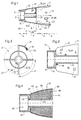
- a shell 1 has a not shown Splinter floor in its front area differently structured sections namely on a thick-walled section 2 for receiving a not shown detonator or a floor hood also not shown in a thread 3, a thin-walled section 4, a section 5 with increasing Thickness and a section 6 with the usual thickness of a known projectile casing according to DE 38 04 351 A1.
- the section 4 is formed by an inner recess 7, the outer contour 8 remains unchanged.
- the thickness 9 of the shell in section 4 is a few millimeters. Starting from this thickness 9, this thickness then increases in the direction of the arrow 10 continuously until the beginning of section 6.
- a support body 12 is screwed into a recess 11 against the direction of the arrow 10.
- the support body 12 consists of a hollow pin 13 with a thread 14, a central tube 15 and four stiffening ribs 16 with intermediate, segment-shaped free spaces 17 for receiving fragments 21 from construction splinters 18.
- the stiffening ribs 16 support the thin wall 19 in the section 4.
- the thickness 9 of the wall 19 is a fraction of the thickness 20 of the shell 1 in section 6.
- the decisive factor for the thickness 9 is the penetration to be guaranteed of a concrete target. Depending on the projectile caliber, it can be 30 to 70% the thickness be 20.
- a support effect also comes from between the stiffening ribs 16 arranged splitter packs 21.
- the splinter packs 21 extend in the longitudinal direction between the levels 30, 31 according to a section 29
- the splitter packs 21 can also be dash-dotted drawn, drawn round contour 32.
- the construction splinters 18 are designed as spheres, cubes, ellipsoids and embedded in a filler material 24, which is the shock wave impedance or largely the shock wave impedance of the construction splitter 18. This leads to, in conjunction with the measures described above to a large kinetic Energy of the constructional fragments 18 upon detonation of the fragmentary floor.
- the central tube 15 serves to accommodate an ignition path or not shown Ignition cable for a base-side igniter or also for an implied one Explosive charge 33 of a main explosive charge 34.
- the ignition tube 15 can also be omitted in favor of the volume of the fragments 21.
- the Ignition point is at or in the area of the floor of the fragmentary floor, one great effect in the direction of flight or towards the ground.
- the Construction splinters 18 reach a long range, because to break up the Wall 19 in section 29 requires a relatively small amount of deformation work is.
- the pin 13 is threaded 43 connected to a central tube 44 with flange 45.
- a ring-shaped fragment package 46 lies around the ignition tube 44 and between walls 47, 48.
- a splinter shirt 49 made of steel which also bears against the wall 47 covers this Splitter packet 46 on the circumferential side and lies in a shoulder 50 of the flange 45 of the homogeneous splinter package 46 with continuous construction splinters 18 there is a higher number of construction splinters 18 than in the splinter packs 21 within the support body 12 according to FIGS. 1-3.
- the supporting effect of the wall 19 of the shell 1 is due to the fragment package 46 with the splinter shirt 49 and the flange 45 in front.
- a fragmentary projectile 51 has a proximity fuse 53 and in the projectile casing 1 one-piece stiffening ribs 52. These extend through sections 4 and 5.
- the main explosive charge 34 corresponds to the beveled stiffening ribs 52 and an ignition tube 54 through a neck 35 in the shape of a bottle neck.
- Splinter packs 56 lie between the stiffening ribs 52 and between the levels 30 and a plane 55. Seen radially, the fragment packets 56 are delimited by a thin-walled sleeve 57 between the main explosive charge 34, 35 and the fragments 56 and through the wall 19 and a cone wall 22.
- An ignition transformer is designated 58 and fills the sleeve 57 in a short section 59. The sleeve 57 is thus only partially filled with explosives 36 by approximately 67%.
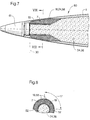
- a much larger explosive charge level of 100% lies with the fragmentary floor 60 with not shown Boder Zünder according to FIGS. 7, 8 before.
- the Projectile casing 1 is screwed to a projectile hood 61.
- the main explosive charge 34 extends - bottle-shaped tapered - to level 30. Thereby If the main explosive charge 34 detonates, there is an acceleration of the construction splinters 18 also in the front section 59, see FIG. 5 before. Otherwise corresponds the splitter device of the splitter device described for FIGS. 5, 6.
- a top detonator can also be used instead of the ground igniter.
- a fragment packet 76 is plug-shaped, that is to say without a central one Recess or bore formed and with a washer 77 made of steel on the rear side completely covered against the explosive charge 34.
- the fragment packet 76 lies against one after the penetration of a concrete target easily dismantled or detachable screw-in body 78 and on a wall 79 of the shell 1.
- the one-piece with the projectile casing 1 ribs 52.1 are embedded in the construction splinters 18.
- the splinter effect to the front at an angle 80 of approx. 120 ° is due to - without a dead splinter area given a ground igniter used.
- the screw-in body 78 consists of Carbide or a suitable steel.
- construction splinters 18 instead of the drawn spherical construction splinters 18 there is also one other shapes of the construction splinters 18 such as cubes, plate shape, possible.
Landscapes
- Engineering & Computer Science (AREA)
- Chemical & Material Sciences (AREA)
- Combustion & Propulsion (AREA)
- General Engineering & Computer Science (AREA)
- Aiming, Guidance, Guns With A Light Source, Armor, Camouflage, And Targets (AREA)
- Geophysics And Detection Of Objects (AREA)
- Disintegrating Or Milling (AREA)
- Buildings Adapted To Withstand Abnormal External Influences (AREA)
Abstract
Description
Erfindungsgemäß ist es erstmals möglich, durch konstruktiv einfache Maßnahmen eine winkelmäßig bevorzugte Splitterstreuung zu erreichen, wobei durch die Anordnung des Fensters im vorderen Bereich der Geschoßhülle in Verbindung mit der heckseitigen bzw. bodenseitigen Initiierung der Sprengladung eine hohe Richtwirkung und Geschwindigkeit der Splitter nach vorn erreicht wird. Durch die bodenseitige Initiierung der Sprengladung verläuft die Detonationswelle bzw. die Detonationsfront von der Bodenseite nach vorn durch das Geschoß und ergibt einen besonders kleinen Abstrahlwinkel der Splitter in Bezug auf die Längsachse des Splittergeschosses.
- Fig. 1
- eine Geschoßhülle im vorderen Ogivenbereich im Längsschnitt,
- Fig. 2
- einen vergrößert gezeichneten Stützkörper nach Fig. 1,
- Fig. 3
- eine Seitenansicht des Stützkörpers nach Fig. 2,
- Fig. 4
- einen weiteren Stützkörper,
- Fig. 5
- einen Abschnitt eines Splittergeschosses im Teillängsschnitt,
- Fig. 6
- einen Schnitt VI - VI nach Fig. 5,
- Fig. 7
- ein weiteres Splittergeschoß im Teillängsschnitt,
- Fig. 8
- einen Schnitt VIII - VIII nach Fig. 1,
- Fig. 9
- ein weiteres, im Ausschnitt gezeigtes Splittergeschoß und
- Fig. 10
- einen Schnitt X - X nach Fig. 9.
Claims (15)
- Splittergeschoß mit einer Geschoßhülle (1), wobei separate Konstruktionssplitter (18) in einer Ausnehmung (7) der Geschoßhülle (1) angeordnet sind,
dadurch gekennzeichnet,daß die Außenkontur (22) der Splitterhülle (1) spaltfrei ist,die Innenkontur (23) aufgrund der Schwächung der Geschoßhülle (1) wenigstens eine Ausnehmung (7) zur Aufnahme der Konstruktionssplitter (18) entsprechend wenigstens eines Abschnittes (4, 5) aufweist,dieser Abschnitt (4, 5) durch innere Einrichtungen (12, 21; 45, 46, 49; 52, 56) abgestützt bzw. verstärkt ist. - Splittergeschoß nach Anspruch 1,
dadurch gekennzeichnet,daß der Abschnitt (4, 5) durch Rippen (16; 52) verstärkt ist. - Splittergeschoß nach Anspruch 2,
dadurch gekennzeichnet,daß die Rippen (16; 52) längs verlaufen und zwischen sich Freiräume (17) zur Lagerung von Konstruktionssplittern (18) aufweisen. - Splittergeschoß nach Anspruch 2,
dadurch gekennzeichnet,daß der Abschnitt (4) durch einen separaten Stützkörper (12; 42) verstärkt ist. - Splittergeschoß nach Anspruch 4,
dadurch gekennzeichnet,daß der Stützkörper (12; 42) wenigstens einen, an der Innenwand (19) anliesenden Flansch (45) aufweist. - Splittergeschoß nach Anspruch 4,
dadurch gekennzeichnet,daß der Stützkörper (42) einen Flansch (45) aufweist und T-förmig ausgebildet ist,mit der Geschoßhülle (1) verschraubt ist,und die Konstruktionssplitter (18) innerhalb des Stützkörpers (42) angeordnet sind. - Splittergeschoß nach Anspruch 6,
dadurch gekennzeichnet,daß die Splitter (18) wenigstens umfangsseitig von einem Splitterhemd (49) eingehüllt sind unddas Splitterhemd (49) zusammen mit einem bodenseitigen Flansch (45) die Geschoßhülle (1) in dem geschwächten Abschnitt (4, 5) stützt. - Splittergeschoß nach Anspruch 6,
dadurch gekennzeichnet,daß ein Zentralrohr (15; 44) mit einem glockenförmigen Gewindezapfen (13) verbunden ist undein ringförmiges Splitterpaket (46) zwischen dem Flansch (45) und einer Wand (47) des Zapfens (13) liegt und von dem Zentralrohr (15, 44) durchsetzt ist. - Splittergeschoß nach Anspruch 1,
dadurch gekennzeichnet,daß die in der Geschoßhülle (1) angeordneten Splitterpakete (46; 56) von einem aufgrund eines Zentralrohres (15; 44) bzw. Hülse (57) ummantel ten Sprengstoff (36) durchsetzt sind. - Splittergeschoß nach Anspruch 1,
dadurch gekennzeichnet,daß das durch die Ausnehmung (7) bewirkte Splitterfenster im vorderen Abschnitt (4, 5) und/oder in einem anderen Abschnitt des Splittergeschosses oder mehrere Abschnitte (4, 5) axial hintereinander liegen. - Splittergeschoß nach Anspruch 2,
dadurch gekennzeichnet,daß die Splitter (18) ein pfropfenförmiges Splitterpaket (76) bilden und die Freiräume zwischen den Rippen (52.1) ausfüllen. - Splittergeschoß nach Anspruch 11,
dadurch gekennzeichnet,daß das Splitterpaket (76) bodenseitig mit einer Scheibe (77) aus Stahl gegenüber der vollflächig an der Scheibe (77) anliegenden Sprengladung (34) abgedeckt ist. - Splittergeschoß nach Anspruch 1,
dadurch gekennzeichnet,daß das Splittergeschoß bodenseitig durch eine Bodenschraube mit oder ohne Bodenzünder verschließbar ist. - Splittergeschoß nach Anspruch 1,
dadurch gekennzeichnet,daß die Dicke (9) der Geschoßhülle (1) im Abschnitt (4) so bemessen ist, daß die Penetrationsfähigkeit des Splittergeschosses von Betonzielen gewährleistet ist und die Dicke (9) etwa 30 - 70% der Dicke (20) der Geschoßhülle (1) im Abschnitt (6) beträgt. - Splittergeschoß nach Anspruch 1,
dadurch gekennzeichnet,daß die Konstruktionssplitter (18) als Kugeln, Kuben, Ellipsoide ausgebildet und in einem Füllmaterial (24) eingebettet sind, das die Stoßwellenimpedanz bzw. weitgehend die Stoßwellenimpedanz der Konstruktionssplitter (18) aufweist.
Applications Claiming Priority (2)
| Application Number | Priority Date | Filing Date | Title |
|---|---|---|---|
| DE19753187A DE19753187A1 (de) | 1997-11-21 | 1997-11-21 | Splittergeschoß |
| DE19753187 | 1997-11-21 |
Publications (3)
| Publication Number | Publication Date |
|---|---|
| EP0918207A2 true EP0918207A2 (de) | 1999-05-26 |
| EP0918207A3 EP0918207A3 (de) | 1999-12-15 |
| EP0918207B1 EP0918207B1 (de) | 2003-02-12 |
Family
ID=7850352
Family Applications (1)
| Application Number | Title | Priority Date | Filing Date |
|---|---|---|---|
| EP98122013A Expired - Lifetime EP0918207B1 (de) | 1997-11-21 | 1998-11-20 | Splittergeschoss |
Country Status (3)
| Country | Link |
|---|---|
| EP (1) | EP0918207B1 (de) |
| DE (2) | DE19753187A1 (de) |
| ES (1) | ES2192730T3 (de) |
Cited By (1)
| Publication number | Priority date | Publication date | Assignee | Title |
|---|---|---|---|---|
| RU2414673C1 (ru) * | 2009-10-29 | 2011-03-20 | Государственное Образовательное Учреждение Высшего Профессионального Образования "Московский Государственный Технический Университет Имени Н.Э. Баумана" | Танковый осколочно-пучковый снаряд "выдропужск" |
Families Citing this family (6)
| Publication number | Priority date | Publication date | Assignee | Title |
|---|---|---|---|---|
| RU2194240C2 (ru) * | 2000-12-13 | 2002-12-10 | Научно-исследовательский институт специального машиностроения Московского государственного технического университета им. Н.Э.Баумана | Кассетный осколочно-пучковый снаряд |
| RU2247929C1 (ru) * | 2003-06-19 | 2005-03-10 | Научно-исследовательский институт специального машиностроения Московского технического университета им. Н.Э. Баумана | Осколочно-пучковый снаряд с раздвиганием метательных блоков "рарог" |
| RU2362962C1 (ru) * | 2007-10-23 | 2009-07-27 | Государственное образовательное учреждение высшего профессионального образования "Московский Государственный Технический Университет им. Н.Э. Баумана" | Осколочно-пучковая надкалиберная граната "тверитянка" |
| RU2363918C1 (ru) * | 2007-11-22 | 2009-08-10 | Государственное образовательное учреждение высшего профессионального образования "Московский Государственный Технический Университет им. Н.Э. Баумана" | Осколочно-пучковый снаряд "ржев" |
| RU2499972C1 (ru) * | 2012-03-22 | 2013-11-27 | Федеральное государственное бюджетное образовательное учреждение высшего профессионального образования "Московский государственный технический университет имени Н.Э. Баумана" (МГТУ им. Н.Э. Баумана) | Устройство траекторного подрыва "молога" надкалиберных осколочных гранат к ручному гранатомету |
| DE102016015042B4 (de) | 2016-12-16 | 2018-08-23 | Diehl Defence Gmbh & Co. Kg | Munitionsmodul, Gefechtskopf und Munition |
Citations (2)
| Publication number | Priority date | Publication date | Assignee | Title |
|---|---|---|---|---|
| EP0101795B1 (de) | 1982-07-02 | 1986-01-02 | Rheinmetall GmbH | Sprenggeschoss mit verbesserter Splitterwirkung |
| DE3804351A1 (de) | 1988-02-12 | 1989-08-24 | Rheinmetall Gmbh | Sprenggeschoss |
Family Cites Families (9)
| Publication number | Priority date | Publication date | Assignee | Title |
|---|---|---|---|---|
| DE312389C (de) * | ||||
| DE129807C (de) * | ||||
| GB764292A (en) * | 1950-06-16 | 1956-12-28 | Vickers Armstrongs Aircraft | Improvements relating to missiles for bomber interception |
| FR2442428A1 (fr) * | 1978-11-23 | 1980-06-20 | France Etat | Nouveau projectile a energie cinetique |
| DE8003835U1 (de) * | 1979-02-28 | 1980-06-26 | Fabrique Nationale Herstal S.A., Herstal-Lez-Liege (Belgien) | Sprenggranate mit vorherbestimmter zersplitterungsweise |
| US4664035A (en) * | 1982-03-01 | 1987-05-12 | Science Applications International Corp. | Missile warheads |
| DE3736842A1 (de) * | 1987-10-30 | 1989-05-11 | Diehl Gmbh & Co | Sprenggeschoss mit einem geschosskoerper |
| DE4426014B4 (de) * | 1994-07-22 | 2004-09-30 | Diehl Stiftung & Co.Kg | System zum Schutz eines Zieles gegen Flugkörper |
| DE19648355A1 (de) * | 1996-11-22 | 1999-07-15 | Diehl Stiftung & Co | Artilleriegeschoß |
-
1997
- 1997-11-21 DE DE19753187A patent/DE19753187A1/de not_active Withdrawn
-
1998
- 1998-11-20 DE DE59807174T patent/DE59807174D1/de not_active Expired - Fee Related
- 1998-11-20 EP EP98122013A patent/EP0918207B1/de not_active Expired - Lifetime
- 1998-11-20 ES ES98122013T patent/ES2192730T3/es not_active Expired - Lifetime
Patent Citations (2)
| Publication number | Priority date | Publication date | Assignee | Title |
|---|---|---|---|---|
| EP0101795B1 (de) | 1982-07-02 | 1986-01-02 | Rheinmetall GmbH | Sprenggeschoss mit verbesserter Splitterwirkung |
| DE3804351A1 (de) | 1988-02-12 | 1989-08-24 | Rheinmetall Gmbh | Sprenggeschoss |
Cited By (1)
| Publication number | Priority date | Publication date | Assignee | Title |
|---|---|---|---|---|
| RU2414673C1 (ru) * | 2009-10-29 | 2011-03-20 | Государственное Образовательное Учреждение Высшего Профессионального Образования "Московский Государственный Технический Университет Имени Н.Э. Баумана" | Танковый осколочно-пучковый снаряд "выдропужск" |
Also Published As
| Publication number | Publication date |
|---|---|
| EP0918207A3 (de) | 1999-12-15 |
| DE19753187A1 (de) | 1999-05-27 |
| EP0918207B1 (de) | 2003-02-12 |
| ES2192730T3 (es) | 2003-10-16 |
| DE59807174D1 (de) | 2003-03-20 |
Similar Documents
| Publication | Publication Date | Title |
|---|---|---|
| DE2727970C2 (de) | ||
| DE3224704A1 (de) | Sprenggeschoss mit einer ein- oder mehrschichtigen aussenhuelle | |
| DE2900802C1 (de) | Gefechtskopf gegen befestigte oder gepanzerte Ziele,insbesondere zum Beschaedigen von Startbahnen,Fahrbahndecken,Bunkerwaenden oder dergleichen | |
| EP0763705B1 (de) | Sekundärgeschoss für einen Tandemgefechtskopf | |
| DE2919807C2 (de) | Drallstabilisiertes Treibspiegelgeschoß zur Überwindung eines heterogenen Widerstandes | |
| DE1703840B1 (de) | Sprenggeschoss mit mindestens einem Sekundaergeschoss | |
| DE1240760B (de) | Panzerbrandgeschoss | |
| DE3617415C2 (de) | Unterkalibriges Treibspiegelgeschoß | |
| EP0918207B1 (de) | Splittergeschoss | |
| EP0763704B1 (de) | Splitterhülle eines Sekundärgeschosses eines Tandemgefechtskopfes | |
| DE2824703A1 (de) | Geschoss | |
| DE19917144B4 (de) | Kombinationswirksystem | |
| DE977946C (de) | Verfahren zur Erzeugung einer Sekundaerwirkung in Verbindung mit der an sich bekannten Wirkung einer Hohlladung | |
| DE3919314A1 (de) | Zerlegergeschoss | |
| EP1001244B1 (de) | Artilleriegeschoss | |
| DE2824738A1 (de) | Geschoss | |
| DE2629280C1 (de) | Gefechtskopf zum Bekaempfen von Zielobjekten,insbesondere Flugzeugen,die in Schutzraeumen untergebracht sind | |
| DE3603610C1 (de) | Flugkörper mit einer Tandemladung | |
| DE3822375C2 (de) | ||
| DE4033754A1 (de) | Geschoss | |
| DE3932825C2 (de) | ||
| EP0831291B1 (de) | Handgranate mit vorgefertigten Splittern | |
| DE3153378C2 (de) | ||
| EP1531316A1 (de) | Struktur eines Geschosses | |
| DE19633054A1 (de) | Splittergeschoß mit Bodenzünder und Treibladungshülse |
Legal Events
| Date | Code | Title | Description |
|---|---|---|---|
| PUAI | Public reference made under article 153(3) epc to a published international application that has entered the european phase |
Free format text: ORIGINAL CODE: 0009012 |
|
| AK | Designated contracting states |
Kind code of ref document: A2 Designated state(s): CH DE ES FR GB IT LI SE |
|
| AX | Request for extension of the european patent |
Free format text: AL;LT;LV;MK;RO;SI |
|
| PUAL | Search report despatched |
Free format text: ORIGINAL CODE: 0009013 |
|
| AK | Designated contracting states |
Kind code of ref document: A3 Designated state(s): AT BE CH CY DE DK ES FI FR GB GR IE IT LI LU MC NL PT SE |
|
| AX | Request for extension of the european patent |
Free format text: AL;LT;LV;MK;RO;SI |
|
| 17P | Request for examination filed |
Effective date: 19991201 |
|
| AKX | Designation fees paid |
Free format text: CH DE ES FR GB IT LI SE |
|
| GRAG | Despatch of communication of intention to grant |
Free format text: ORIGINAL CODE: EPIDOS AGRA |
|
| 17Q | First examination report despatched |
Effective date: 20020211 |
|
| GRAG | Despatch of communication of intention to grant |
Free format text: ORIGINAL CODE: EPIDOS AGRA |
|
| GRAH | Despatch of communication of intention to grant a patent |
Free format text: ORIGINAL CODE: EPIDOS IGRA |
|
| GRAH | Despatch of communication of intention to grant a patent |
Free format text: ORIGINAL CODE: EPIDOS IGRA |
|
| GRAA | (expected) grant |
Free format text: ORIGINAL CODE: 0009210 |
|
| AK | Designated contracting states |
Designated state(s): CH DE ES FR GB IT LI SE |
|
| REG | Reference to a national code |
Ref country code: GB Ref legal event code: FG4D Free format text: NOT ENGLISH |
|
| REG | Reference to a national code |
Ref country code: CH Ref legal event code: EP |
|
| REF | Corresponds to: |
Ref document number: 59807174 Country of ref document: DE Date of ref document: 20030320 Kind code of ref document: P |
|
| REG | Reference to a national code |
Ref country code: CH Ref legal event code: NV Representative=s name: A. BRAUN, BRAUN, HERITIER, ESCHMANN AG PATENTANWAE |
|
| REG | Reference to a national code |
Ref country code: SE Ref legal event code: TRGR |
|
| GBT | Gb: translation of ep patent filed (gb section 77(6)(a)/1977) | ||
| ET | Fr: translation filed | ||
| RAP2 | Party data changed (patent owner data changed or rights of a patent transferred) |
Owner name: DIEHL STIFTUNG & CO. KG |
|
| REG | Reference to a national code |
Ref country code: ES Ref legal event code: FG2A Ref document number: 2192730 Country of ref document: ES Kind code of ref document: T3 |
|
| PGFP | Annual fee paid to national office [announced via postgrant information from national office to epo] |
Ref country code: GB Payment date: 20031030 Year of fee payment: 6 |
|
| PGFP | Annual fee paid to national office [announced via postgrant information from national office to epo] |
Ref country code: ES Payment date: 20031104 Year of fee payment: 6 |
|
| PGFP | Annual fee paid to national office [announced via postgrant information from national office to epo] |
Ref country code: SE Payment date: 20031126 Year of fee payment: 6 |
|
| PGFP | Annual fee paid to national office [announced via postgrant information from national office to epo] |
Ref country code: FR Payment date: 20031128 Year of fee payment: 6 |
|
| PGFP | Annual fee paid to national office [announced via postgrant information from national office to epo] |
Ref country code: CH Payment date: 20031211 Year of fee payment: 6 |
|
| PLBE | No opposition filed within time limit |
Free format text: ORIGINAL CODE: 0009261 |
|
| STAA | Information on the status of an ep patent application or granted ep patent |
Free format text: STATUS: NO OPPOSITION FILED WITHIN TIME LIMIT |
|
| PGFP | Annual fee paid to national office [announced via postgrant information from national office to epo] |
Ref country code: DE Payment date: 20040121 Year of fee payment: 6 |
|
| 26N | No opposition filed |
Effective date: 20031113 |
|
| PG25 | Lapsed in a contracting state [announced via postgrant information from national office to epo] |
Ref country code: GB Free format text: LAPSE BECAUSE OF NON-PAYMENT OF DUE FEES Effective date: 20041120 |
|
| PG25 | Lapsed in a contracting state [announced via postgrant information from national office to epo] |
Ref country code: SE Free format text: LAPSE BECAUSE OF NON-PAYMENT OF DUE FEES Effective date: 20041121 |
|
| PG25 | Lapsed in a contracting state [announced via postgrant information from national office to epo] |
Ref country code: ES Free format text: LAPSE BECAUSE OF NON-PAYMENT OF DUE FEES Effective date: 20041122 |
|
| PG25 | Lapsed in a contracting state [announced via postgrant information from national office to epo] |
Ref country code: LI Free format text: LAPSE BECAUSE OF NON-PAYMENT OF DUE FEES Effective date: 20041130 Ref country code: CH Free format text: LAPSE BECAUSE OF NON-PAYMENT OF DUE FEES Effective date: 20041130 |
|
| PG25 | Lapsed in a contracting state [announced via postgrant information from national office to epo] |
Ref country code: DE Free format text: LAPSE BECAUSE OF NON-PAYMENT OF DUE FEES Effective date: 20050601 |
|
| EUG | Se: european patent has lapsed | ||
| GBPC | Gb: european patent ceased through non-payment of renewal fee |
Effective date: 20041120 |
|
| REG | Reference to a national code |
Ref country code: CH Ref legal event code: PL |
|
| PG25 | Lapsed in a contracting state [announced via postgrant information from national office to epo] |
Ref country code: FR Free format text: LAPSE BECAUSE OF NON-PAYMENT OF DUE FEES Effective date: 20050729 |
|
| REG | Reference to a national code |
Ref country code: FR Ref legal event code: ST |
|
| PG25 | Lapsed in a contracting state [announced via postgrant information from national office to epo] |
Ref country code: IT Free format text: LAPSE BECAUSE OF NON-PAYMENT OF DUE FEES;WARNING: LAPSES OF ITALIAN PATENTS WITH EFFECTIVE DATE BEFORE 2007 MAY HAVE OCCURRED AT ANY TIME BEFORE 2007. THE CORRECT EFFECTIVE DATE MAY BE DIFFERENT FROM THE ONE RECORDED. Effective date: 20051120 |
|
| REG | Reference to a national code |
Ref country code: ES Ref legal event code: FD2A Effective date: 20041122 |