EP0918268A2 - Procédé de fabrication de lithophanies - Google Patents
Procédé de fabrication de lithophanies Download PDFInfo
- Publication number
- EP0918268A2 EP0918268A2 EP98122077A EP98122077A EP0918268A2 EP 0918268 A2 EP0918268 A2 EP 0918268A2 EP 98122077 A EP98122077 A EP 98122077A EP 98122077 A EP98122077 A EP 98122077A EP 0918268 A2 EP0918268 A2 EP 0918268A2
- Authority
- EP
- European Patent Office
- Prior art keywords
- relief
- lithophane
- contour
- information
- determined
- Prior art date
- Legal status (The legal status is an assumption and is not a legal conclusion. Google has not performed a legal analysis and makes no representation as to the accuracy of the status listed.)
- Withdrawn
Links
Images

Classifications
-
- G—PHYSICS
- G05—CONTROLLING; REGULATING
- G05B—CONTROL OR REGULATING SYSTEMS IN GENERAL; FUNCTIONAL ELEMENTS OF SUCH SYSTEMS; MONITORING OR TESTING ARRANGEMENTS FOR SUCH SYSTEMS OR ELEMENTS
- G05B19/00—Program-control systems
- G05B19/02—Program-control systems electric
- G05B19/42—Recording and playback systems, i.e. in which the program is recorded from a cycle of operations, e.g. the cycle of operations being manually controlled, after which this record is played back on the same machine
- G05B19/4202—Recording and playback systems, i.e. in which the program is recorded from a cycle of operations, e.g. the cycle of operations being manually controlled, after which this record is played back on the same machine preparation of the program medium using a drawing, a model
- G05B19/4205—Recording and playback systems, i.e. in which the program is recorded from a cycle of operations, e.g. the cycle of operations being manually controlled, after which this record is played back on the same machine preparation of the program medium using a drawing, a model in which a drawing is traced or scanned and corresponding data recorded
-
- G—PHYSICS
- G05—CONTROLLING; REGULATING
- G05B—CONTROL OR REGULATING SYSTEMS IN GENERAL; FUNCTIONAL ELEMENTS OF SUCH SYSTEMS; MONITORING OR TESTING ARRANGEMENTS FOR SUCH SYSTEMS OR ELEMENTS
- G05B2219/00—Program-control systems
- G05B2219/30—Nc systems
- G05B2219/37—Measurements
- G05B2219/37042—Photographic, picture on film, photogrammetry
-
- G—PHYSICS
- G05—CONTROLLING; REGULATING
- G05B—CONTROL OR REGULATING SYSTEMS IN GENERAL; FUNCTIONAL ELEMENTS OF SUCH SYSTEMS; MONITORING OR TESTING ARRANGEMENTS FOR SUCH SYSTEMS OR ELEMENTS
- G05B2219/00—Program-control systems
- G05B2219/30—Nc systems
- G05B2219/37—Measurements
- G05B2219/37058—Digitize not only position but also colour
-
- G—PHYSICS
- G05—CONTROLLING; REGULATING
- G05B—CONTROL OR REGULATING SYSTEMS IN GENERAL; FUNCTIONAL ELEMENTS OF SUCH SYSTEMS; MONITORING OR TESTING ARRANGEMENTS FOR SUCH SYSTEMS OR ELEMENTS
- G05B2219/00—Program-control systems
- G05B2219/30—Nc systems
- G05B2219/37—Measurements
- G05B2219/37558—Optical sensor, scanner
-
- G—PHYSICS
- G05—CONTROLLING; REGULATING
- G05B—CONTROL OR REGULATING SYSTEMS IN GENERAL; FUNCTIONAL ELEMENTS OF SUCH SYSTEMS; MONITORING OR TESTING ARRANGEMENTS FOR SUCH SYSTEMS OR ELEMENTS
- G05B2219/00—Program-control systems
- G05B2219/30—Nc systems
- G05B2219/49—Nc machine tool, till multiple
- G05B2219/49005—Map 2-D pattern on 3-D
-
- G—PHYSICS
- G05—CONTROLLING; REGULATING
- G05B—CONTROL OR REGULATING SYSTEMS IN GENERAL; FUNCTIONAL ELEMENTS OF SUCH SYSTEMS; MONITORING OR TESTING ARRANGEMENTS FOR SUCH SYSTEMS OR ELEMENTS
- G05B2219/00—Program-control systems
- G05B2219/30—Nc systems
- G05B2219/49—Nc machine tool, till multiple
- G05B2219/49008—Making 3-D object with model in computer memory
Definitions
- the invention relates to a method for producing lithophanes, being on a shape with the contour of the relief-like Surface of the lithophane or one removed from the mold Form the material for the lithophane is applied.
- Thin porcelain bodies with high transparency become lithophanes labeled from e.g. unglazed biscuit porcelain, which have a modeled, relief-like surface.
- the lithophanes can be flat, plate-like Bodies or spatial, for example domed bodies act. Illuminated from behind by illuminating the lithophane the viewer an image that is different due to the strong absorption of light due to the different thickness of the porcelain body is created.
- the contour of the Relief-like surface modeled in a wax body.
- the wax body forms a positive form, of which a plaster cast as a negative form is created.
- a variety of lithophanes can then by applying the material for the lithophanes several times, usually a porcelain mass, made in the negative form become. The porcelain mass so formed is after the Drying from the negative form in the so-called leather-hard state removed and burned.
- the invention is therefore based on the object of a method for the simplified production of high-quality lithophanes create.
- the method according to the invention is used to achieve this object characterized in that the relief-like surface descriptive Automatically captures information from a template are automated and the contour of the relief-like surface of the mold is formed.
- the relief-like surface descriptive Automatically captures information from a template are automated and the contour of the relief-like surface of the mold is formed.
- the contour the relief-like surface by means of a transformation determined from information of the two-dimensional template.
- the information of the two-dimensional image from at least one measuring element, for example a CCD camera or a scanner.
- Information of the two-dimensional Images can use brightness, colors, contours or contrast differences.
- the measuring element can be used for pixels or partial areas of the two-dimensional image quantified the information of the two-dimensional template in three-dimensional relief information being transformed.
- the output signal of the measuring element fed to a data processing system.
- This output signal contains the necessary information of the three-dimensional reliefs.
- the contour of the relief-like surface as information
- Brightness of a pixel or a partial area of the the measuring element determines the image and the image point or assigned to the partial area of the two-dimensional image
- the height of the contour of the relief-like surface is then from the Multiplication of the determined brightness value with a Function value determined. So is in a partial area of two-dimensional template from the measuring element an average light intensity measured, then the height of the contour of the relief-like Surface should be chosen so that when illuminated the lithophane the image generated in the area assigned Area also has a medium light intensity.
- a suitable function value can be found in a function which the optical behavior of the material for the lithophane describes.
- the relief-like surface determined in this way can be for example a milling machine, in a Form, in particular a positive form, are introduced, the used as a form for another form - a negative form into which the material for the lithophane is placed can be.
- the relief-like surface directly in to introduce a negative form, so that a further step can be saved.
- the subtractive process for producing the relief-like Surface can also be done by an application process, for example stereolithography.
- the exposure of the photosensitive Medium can be done using a slide. This has the Advantage that the step of collecting information of the two-dimensional image is omitted.
- the color of a pixel or a partial area of a measuring element assigned a color value and the relief-like image Surface of the lithophane in the image point or partial area assigned area according to the determined color value post-colored For each sub-area of the template, on the one hand determines the brightness from which the height of the contour in assigned area of the relief-like surface determined becomes. On the other hand, the color of the partial area is also determined. The corresponding color must then be on each lithophane in the area of the relief-like surface assigned to the partial area be applied. This can have an optical effect the lithophane can be improved.
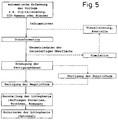
- the process for making a lithophane is as follows based on a highly schematic two-dimensional Template 10 are presented.
- the template points to simplification 10 a light background 11, a semi-dark circular area 12 and a dark square 13.
- the information of the Template 10, in this simple example the location, shape and Brightness of the circular area 12 and the square 13 becomes fully automatic from a measuring element, for example a CCD camera or a scanner.
- the total area can be used for this the template 10 into individual partial areas 14 or pixels 15 can be divided.
- Each patch 14 or each Pixel 15 is assigned an X and a Y coordinate.
- the partial area 14 or the pixel 15 the information a measuring element, for example the CCD camera or the Scanners, in the area of partial area 14 or pixel 15 be assigned.
- the partial areas 14 and Pixels 15 in the measuring elements in rows and / or columns scanned so that the entire template 10 by n lines and / or m columns is detected.
- the intensity signal 17 measured is shown in FIG. 2.
- the evaluation line 16 runs through both the circular area 12 as well as the square 13.
- the output signal of the measuring element changes.
- the intensity signal points at entry points 18 and exit points 19 from the circular area 12 and the square 13 an increase 20 or a jump 21 on.
- the information of the template 10, namely a change in brightness in the area of the entry points 18 and the exit points 19 is thus associated with the Coordinates contained in the intensity signal 17.
- the contour 22 of a relief-like surface must be determined from the intensity signal 17 shown in such a way that when a translucent body is illuminated with the contour 22 of the relief-like surface, the information of the template is reproduced on a side of the body opposite a light source.
- the optical behavior of the created lithophane 24 is intended to reflect the rise 20 or the jump 21 of the intensity signal 17, that is to say the information about the entry point 18 or the exit point 19, this is done by means of an increase 25 or a jump 26 in the thickness of the lithophane 24.
- a function 27 can be used for modeling the optical behavior, which describes the light transmission or the intensity of the transmitted light with constant illumination as a function of the material thickness d.
- the necessary material thicknesses d 1 and d 2 of the lithophane 24, ie the heights 30 and 31 of the relief-like surface can be determined from the function 27.
- the course of the contour 22 of the lithophane 24 can thus be calculated along the evaluation line 16 via the intensity signal 17.
- the measuring area is the total area with n lines and m Digitized areas per line. This means that the characteristic features of the template by m x n discrete Values, for example intensity values 28, 29, are represented becomes. From these discrete intensity values 28, 29, discrete Points on the relief-like surface of lithophane 24 or the contour 22 can be determined.
- a suitable data processing system can be used to measure curved surface through the discrete points 30, 31 are placed.
- the determination of the Contour 22 of the relief-like surface on the spline approximation the discrete points in the x-y plane has the advantage that extreme courses of the intensity signal 17 or the contour 22 of the relief-like surface, for example a crack 21, 26, be smoothed.
- the smoothing simplifies production the relief-like surface. For example, kinks, Jumps, narrow bars or deep grooves thanks to the spline approximation be avoided.
- the contour of a relief-like surface determined in this way can then use a suitable manufacturing process, for example a milling machine in a positive form 32 any Be brought into shape.
- the determined heights correspond here the heights of an upper layer of the positive form 32.
- For the manufacture of the mold is particularly suitable for materials that a fine surface treatment to achieve a high optical quality of the lithophane created with this form 24 enable.
- the material should not be too hard to enable the milling tool to have a long service life. Suitable materials are, for example Non-ferrous metals, especially aluminum, plastics or the like.
- Negative mold 33 can be removed from preferably plaster. On the Negative form 33 becomes the material of lithophane 24 for production the same applied.
- the production of the positive mold 24 can take place within the production can be saved if the contour 22 of the relief-like surface is introduced directly into the negative mold 32, the can also have any shape.
- Sublime Areas 34 of the positive form correspond to depressions 35 of the negative form with the same contour 22.
- the negative form be made from a material that is mechanical Manufacturing and at the same time the molding of Lithophanie 24 enables.
- a change in the shape and / or size of the relief-like Surface of Lithophanie 24 can be manipulated by data respectively. This is necessary, for example, if the size of the Lithophanie 24, for example compared to two-dimensional Template 10 to be changed. Such changes can easily be done by multiplying the x and / or y coordinates with a compression and / or extension factor respectively. Furthermore, by an appropriate Factor of the shrinkage of the porcelain mass must be taken into account.
- the detection of a template 10 by a suitable measuring element is unnecessary in the event that the template with a suitable Software has been generated digitally. In this case it can be done directly from the digital representation of the template, the contour 22 of the relief-like Surface to be determined.
- the template 10 are evaluated, for example the Color in the pixel 15 or a partial area 14 of the template 10.
- the relief-like surface of the Lithophanie 24 for example by means of a movable printing device or by manual application of paint particles, the color corresponding to the information of the template 10 on the Lithophane 24 applied.
- the colored areas created in this way the surface of the lithophane 24 will be according to the thickness the lithophane 24 in assigned areas with light of different Illuminated brightness so that accordingly the relief-like surface the brightness of a color very much can be finely adjusted.
- lithophane plates can to be created.
- the manufacturing is equally spherical, conical, cylindrical or other Lithophane bodies with a three-dimensional geometry possible.
- the geometric surface description projected mathematically onto the desired surface shape.
- the described method it is also possible to use the described method to make copies of old lithophanes that have already been created Original form is no longer available.
- the lithophane backlit the image created, for example a photo is taken and digitized by the measuring organ. Then the method described above is taken into account the shrinking of the material for the lithophane and possibly different optical properties of the copy porcelain applied by a correction factor.
- the contour lies with the copy of an existing lithophane the relief-like surface.
- the lithophane to be copied can be geometrical by means of a measuring element, for example a button or a laser that is moved over the surface and the contour the surface can be grasped, scanned.
- the so determined Contour of the relief-like surface can then according to the already described processes are processed, so that in this case the digitization of a two-dimensional Template does not apply.
- the method according to the invention can on the basis of the certain relief-like surface simulated optical effect of the lithophane to be produced become.
- the result of the simulation can be sent to an output device, for example, a screen or a printer.
- the optical device is then used to control the optical device Effect of the lithophane possible before the first production. This eliminates the costly and time-consuming Production of prototypes.
- a photosensitive Material used after exposure electromagnétique radiation of all kinds such as infrared light, ultraviolet light, X-rays etc.
- Material properties changed so that unexposed and more or less exposed material with or without one subsequent development process cures differently. Cured material and insufficiently cured material can be separated from each other in a subsequent step become.
- a Lithophane form a plate or other body, for example a domed, cylindrical or otherwise trained Body a few millimeters thick with an optical sensitive material coated (e.g. photo gelatin). At optically sensitive liquids becomes a flat tub filled accordingly.
- the optically sensitive material can now, for example, be exposed with a slide of the original image become.
- the light penetrates deeply according to its brightness the optically sensitive material.
- Partial volumes of the photosensitive material in which light is sufficient Penetrate deep into the optically sensitive material, are cured accordingly deep.
- weak illuminated partial volume is the depth of the curing process correspondingly lower.
- the image of the slide thus creates one three-dimensional exposure in the optically sensitive material.
- Positive mold for casting the lithophane Depending on the properties of the optically sensitive material becomes a without or with subsequent development process Positive mold for casting the lithophane.
- the burned lithophane consists of the surface is coated with a slide film emulsion, then using a slide that only contains the chrominate information, the color of the original, contains, exposed, and then developed.
- the invention is suitable for all types of lithophanes not limited to plate-like lithophanes. Especially the lithophanes can also be curved as desired.
Landscapes
- Physics & Mathematics (AREA)
- General Physics & Mathematics (AREA)
- Engineering & Computer Science (AREA)
- Automation & Control Theory (AREA)
- Moulds For Moulding Plastics Or The Like (AREA)
Applications Claiming Priority (2)
| Application Number | Priority Date | Filing Date | Title |
|---|---|---|---|
| DE1997151966 DE19751966A1 (de) | 1997-11-24 | 1997-11-24 | Verfahren zur Herstellung von Lithophanien |
| DE19751966 | 1997-11-24 |
Publications (2)
| Publication Number | Publication Date |
|---|---|
| EP0918268A2 true EP0918268A2 (fr) | 1999-05-26 |
| EP0918268A3 EP0918268A3 (fr) | 2001-10-10 |
Family
ID=7849630
Family Applications (1)
| Application Number | Title | Priority Date | Filing Date |
|---|---|---|---|
| EP98122077A Withdrawn EP0918268A3 (fr) | 1997-11-24 | 1998-11-21 | Procédé de fabrication de lithophanies |
Country Status (2)
| Country | Link |
|---|---|
| EP (1) | EP0918268A3 (fr) |
| DE (1) | DE19751966A1 (fr) |
Cited By (3)
| Publication number | Priority date | Publication date | Assignee | Title |
|---|---|---|---|---|
| WO2000020185A1 (fr) * | 1998-10-05 | 2000-04-13 | Mystix Limited | Articles de type-litophanie et procede de fabrication |
| WO2005014306A1 (fr) * | 2003-08-07 | 2005-02-17 | Julian Dakowski | Procede et appareil de production d'un article pour affichage d'une image |
| EP1493595A3 (fr) * | 2003-06-30 | 2009-11-04 | Paperlux GmbH | Procédé et dispositif destiné à la production d'une image 3D simulée sur un substrat mince |
Family Cites Families (4)
| Publication number | Priority date | Publication date | Assignee | Title |
|---|---|---|---|---|
| DE81975C (fr) * | ||||
| EP0116561A1 (fr) * | 1982-05-18 | 1984-08-29 | THOMAS, Gareth David | Procede et appareil permettant d'effecteur des operations sur des surfaces tridimensionnelles |
| JPH02198743A (ja) * | 1988-10-20 | 1990-08-07 | Yoichi Madokoro | 三次元加工方法及び装置 |
| JP3347522B2 (ja) * | 1995-04-11 | 2002-11-20 | キヤノン株式会社 | 工具経路作成装置及び工具経路作成方法 |
-
1997
- 1997-11-24 DE DE1997151966 patent/DE19751966A1/de not_active Withdrawn
-
1998
- 1998-11-21 EP EP98122077A patent/EP0918268A3/fr not_active Withdrawn
Cited By (8)
| Publication number | Priority date | Publication date | Assignee | Title |
|---|---|---|---|---|
| WO2000020185A1 (fr) * | 1998-10-05 | 2000-04-13 | Mystix Limited | Articles de type-litophanie et procede de fabrication |
| GB2345458A (en) * | 1998-10-05 | 2000-07-12 | Mystix Limited | Lithophane-like article and method of manufacture |
| GB2345458B (en) * | 1998-10-05 | 2002-05-29 | Mystix Ltd | Article and method of manufacture |
| EP1318003A1 (fr) * | 1998-10-05 | 2003-06-11 | Mystix Limited | Objet de type lithophanie et méthode pour sa fabrication |
| EP1493595A3 (fr) * | 2003-06-30 | 2009-11-04 | Paperlux GmbH | Procédé et dispositif destiné à la production d'une image 3D simulée sur un substrat mince |
| WO2005014306A1 (fr) * | 2003-08-07 | 2005-02-17 | Julian Dakowski | Procede et appareil de production d'un article pour affichage d'une image |
| AU2004263361B2 (en) * | 2003-08-07 | 2008-08-28 | Julian Dakowski | Method and apparatus for producing an article for displaying an image |
| RU2358884C2 (ru) * | 2003-08-07 | 2009-06-20 | Джулиан ДАКОВСКИ | Способ и устройство для производства изделия, предназначенного для отображения изображения |
Also Published As
| Publication number | Publication date |
|---|---|
| DE19751966A1 (de) | 1999-05-27 |
| EP0918268A3 (fr) | 2001-10-10 |
Similar Documents
| Publication | Publication Date | Title |
|---|---|---|
| DE102006019963B4 (de) | Vorrichtung und Verfahren zur Herstellung eines dreidimensionalen Objekts durch schichtweises Verfestigen eines unter Einwirkung von elektromagnetischer Strahlung verfestigbaren Materials mittels Maskenbelichtung | |
| DE69020033T2 (de) | Apparat für das Messen dreidimensionaler gekrümmter Formen. | |
| DE2018317C3 (de) | Verfahren zur Farbreproduktion von farbigen Vorlagen, bei dem die Vorlage punktweise abgetastet wird | |
| EP3984492B1 (fr) | Comparaison des images couleurs des structures dentaires tridimensionnelles | |
| EP3822080A1 (fr) | Procédé de détermination des paramètres d'impression d'une machine d'impression et banc d'essai | |
| DE102017213779A1 (de) | Dreidimensionale Messvorrichtung | |
| DD150956A5 (de) | Verfahren und schaltungsanordnung zur partiellen elektronischen retusche bei der farbbildreproduktion | |
| DE102016117395A1 (de) | Verfahren und Vorrichtung zur Oberflächenfunktionalisierung dentaler Restaurationen | |
| EP2035239B1 (fr) | Procédé permettant de réaliser des surfaces de structure tridimensionnelle | |
| DE102016100132A1 (de) | Verfahren und Vorrichtung zum Untersuchen eines Objekts unter Verwendung von maschinellem Sehen | |
| DE102012205985A1 (de) | Fahrbahnbelagelemente für einen Rollenprüfstand | |
| EP0713788B1 (fr) | Procédé et dispositif pour fabriquer une carte aux indications chiffrées pour peintures et carte ainsi obtenue | |
| EP0918268A2 (fr) | Procédé de fabrication de lithophanies | |
| DE19848243A1 (de) | Biegewinkelerfassungssystem | |
| WO2023139216A1 (fr) | Procédé de fabrication de composants décoratifs | |
| EP2035810B1 (fr) | Procédé d'analyse des propriétés de réflexion | |
| DE69906198T2 (de) | Verfahren zur Steuerung von einem Druckerzeugnis | |
| WO2018069511A1 (fr) | Procédé d'ajustage d'un outil de formage à l'aide d'une matière de dressage | |
| DE19624489B4 (de) | Verfahren zur Herstellung von Baumaterial | |
| DE69227747T2 (de) | Apparat zur Herstellung einer Modellplatte und Verfahren zur Herstellung von Drucksachen | |
| DE102023125057B4 (de) | Verfahren zur herstellung eines plattenförmigen dreidimensionalen objekts | |
| DE102016111353B4 (de) | Softwaregestütztes Verfahren zur fotorealistischen 3D-Darstellung | |
| DE102014015473A1 (de) | Verfahren zum Erfassen von Kontaktstellen | |
| EP1774472A2 (fr) | Ensemble servant a representer des structures superficielles d'objets tridimensionnels | |
| DE112019006288T5 (de) | Informationsverarbeitungsvorrichtung, programm undinformationsverarbeitungsverfahren |
Legal Events
| Date | Code | Title | Description |
|---|---|---|---|
| PUAI | Public reference made under article 153(3) epc to a published international application that has entered the european phase |
Free format text: ORIGINAL CODE: 0009012 |
|
| AK | Designated contracting states |
Kind code of ref document: A2 Designated state(s): AT BE CH CY DE DK ES FI FR GB GR IE IT LI LU MC NL PT SE |
|
| AX | Request for extension of the european patent |
Free format text: AL;LT;LV;MK;RO;SI |
|
| PUAL | Search report despatched |
Free format text: ORIGINAL CODE: 0009013 |
|
| AK | Designated contracting states |
Kind code of ref document: A3 Designated state(s): AT BE CH CY DE DK ES FI FR GB GR IE IT LI LU MC NL PT SE |
|
| AX | Request for extension of the european patent |
Free format text: AL;LT;LV;MK;RO;SI |
|
| AKX | Designation fees paid | ||
| REG | Reference to a national code |
Ref country code: DE Ref legal event code: 8566 |
|
| STAA | Information on the status of an ep patent application or granted ep patent |
Free format text: STATUS: THE APPLICATION IS DEEMED TO BE WITHDRAWN |
|
| 18D | Application deemed to be withdrawn |
Effective date: 20020411 |