EP0918430A2 - Echokompensatorn einem Netz für Datenanwendungen - Google Patents
Echokompensatorn einem Netz für Datenanwendungen Download PDFInfo
- Publication number
- EP0918430A2 EP0918430A2 EP98308520A EP98308520A EP0918430A2 EP 0918430 A2 EP0918430 A2 EP 0918430A2 EP 98308520 A EP98308520 A EP 98308520A EP 98308520 A EP98308520 A EP 98308520A EP 0918430 A2 EP0918430 A2 EP 0918430A2
- Authority
- EP
- European Patent Office
- Prior art keywords
- data call
- echo
- signal
- echo canceler
- network
- Prior art date
- Legal status (The legal status is an assumption and is not a legal conclusion. Google has not performed a legal analysis and makes no representation as to the accuracy of the status listed.)
- Ceased
Links
- 238000000034 method Methods 0.000 claims abstract description 12
- 238000012549 training Methods 0.000 claims description 16
- 238000004891 communication Methods 0.000 claims description 8
- 230000005540 biological transmission Effects 0.000 claims description 7
- 238000006243 chemical reaction Methods 0.000 claims description 4
- 238000012545 processing Methods 0.000 claims description 3
- 230000011664 signaling Effects 0.000 abstract description 7
- 230000003044 adaptive effect Effects 0.000 description 13
- 230000006978 adaptation Effects 0.000 description 8
- 230000006870 function Effects 0.000 description 8
- 238000001514 detection method Methods 0.000 description 4
- 238000002592 echocardiography Methods 0.000 description 3
- 238000012546 transfer Methods 0.000 description 3
- 238000010586 diagram Methods 0.000 description 2
- 238000005516 engineering process Methods 0.000 description 2
- 230000004044 response Effects 0.000 description 2
- 230000000694 effects Effects 0.000 description 1
- 238000012544 monitoring process Methods 0.000 description 1
- 238000013139 quantization Methods 0.000 description 1
Images
Classifications
-
- H—ELECTRICITY
- H04—ELECTRIC COMMUNICATION TECHNIQUE
- H04B—TRANSMISSION
- H04B3/00—Line transmission systems
- H04B3/02—Details
- H04B3/20—Reducing echo effects or singing; Opening or closing transmitting path; Conditioning for transmission in one direction or the other
- H04B3/23—Reducing echo effects or singing; Opening or closing transmitting path; Conditioning for transmission in one direction or the other using a replica of transmitted signal in the time domain, e.g. echo cancellers
Definitions
- This invention relates generally to communications and, more particularly, to echo cancellation in a communications system.
- DCEs data communications equipment
- POTS plain-old-telephone system
- a user of a high-speed modem cannot realistically expect to consistently establish data connections at, e.g., 56 kbps.
- the 56 kbps modem evaluates the response of the communications channel for negotiating the data rate with the opposite endpoint.
- limiting factors like line conditions over the local loop, may result in negotiated data rates that are less than the 56 kbps.
- a full-duplex modem startup, or handshaking, sequence includes a tone with phase reversals that is recognized by echo cancellation equipment in the PSTN as a signal to disable the network echo cancelers.
- the network equipment of the PSTN does not perform echo cancellation during a data call.
- the modem at each end of the data connection includes a far-echo canceler to compensate for far echoes.
- the network equipment also converts the analog local loop signal into a digital signal and then compands the digital signal using either A-law or ⁇ -law companding rules.
- the network device that performs this function is known as a CODEC (coder-decoder).
- CODEC coder-decoder
- This companding by the network equipment introduces non-linearities into the signal. These non-linearities limit the amount of far-echo that can be removed by a modem under different line conditions and, therefore, may negatively affect the negotiated data rate.
- apparatus for use in a network, the apparatus comprising: a network echo canceler that performs echo cancellation during a data call, where the network echo canceler is trained off-line.
- the network echo canceler can comprise a CODEC integrated circuit comprising: analog-to-digital conversion element for providing a digital signal; an echo canceler for processing the digital signal to provide an echo-canceled signal; and a coding element for coding the echo-canceled signal for transmission through the network.
- the apparatus can further comprise a memory element for storing coefficients used by the echo canceler such that the stored coefficients are not continuously adapted during the data call.
- the coding element can be an A-law coder, or a ⁇ -law coder.
- the echo canceler can use a fixed set of tap coefficient values for the duration of the data call.
- the echo canceler can use a set of tap coefficient values determined as a function of a previous data call.
- the apparatus can further comprise a memory element for storing coefficients used by the echo canceler such that the stored coefficients are not continuously adapted during the data call.
- a method for use in equipment for echo canceling a data signal for use during a data call comprising the steps of: detecting the presence of a data call; and if a data call was detected, echo canceling a respective signal of the data call after analog-to-digital conversion of the signal and before coding of the signal; wherein the echo canceling step uses tap coefficient values determined from a prior data call.
- the method can further comprise the step of performing off-line training during the detected data call for determining new tap coefficient values for use on a future data call.
- the performing off-line training step can further include the step of performing additional echo canceling for determining the new tap coefficient values for use on the future data call.
- the method can further comprise the step of updating the tap coefficient values to the new tap coefficient values after termination of the data call for use on the future data call.
- the performing additional echo canceling step can provide a new echo canceled signal and the method can further comprise the steps of: comparing the echo-canceled signal with the new echo canceled signal: and updating the tap coefficient values to the new tap coefficient values if the comparison indicates that the additional echo cancellation is performing better.
- the updating step can be performed after termination of the data call for use on the future data call.
- the precision and signal to quantization ratio of the above-mentioned digital signal can be significantly higher than the companded version of the digital signal.
- the probability of connecting a data call at a higher data rate increases.
- training of such a network echo canceler during a data call presents a problem.
- such a network echo canceler would create an apparent time-varying channel from the perspective of the DCE, which would have difficulty training the far-echo canceler of the DCE correctly. Therefore, and in accordance with the principles of the invention, a network echo canceler performs echo cancellation on a digital signal during a data call, where the network echo canceler is trained off-line.
- a CODEC includes an echo canceler.
- This CODEC recognizes the presence of a data call by detecting predefined signaling portions of a modem handshaking process.
- the CODEC performs echo cancellation on the respective digital signal of the detected data call before performing a companding operation.
- the CODEC uses a stored channel model for performing the echo cancellation.
- the CODEC trains off-line during selected segments of the modem startup signaling and then stores the new channel model for use in a future data call.
- the modem training sequence includes signals that are almost optimal for high-speed good quality adaptations.
- each CODEC is generally allocated for the same subscriber loop from call to call, the characteristics of the impedance match with the local loop should be very similar from one data call to the next. This means that adaptation during prior data calls should provide a channel model that will work very well for canceling echo during subsequent calls.
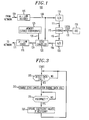
- FIG. 1 An illustrative high-level block diagram of a portion, 100, of a communication system embodying the principles of the invention is shown in FIG. 1.
- Portion 100 comprises ⁇ -law decoder 105, D/A (digital-to-analog converter) 110, hybrid 115, A/D (analog-to-digital conyerter) 155, echo canceler 120, ⁇ -law coder 170, memory 125, and DCE 130.
- DCE 130 digital-to-analog converter
- this opposite DCE endpoint could be within the network, or digitally connected thereto, as is the case for commercially available 56 kbps modem technology.
- the representations shown in FIG. 1 are at a system-level. As such these elements and paths may further represent other circuitry (as illustrated in FIG. 2, described further below). Other than the inventive concept, the elements shown in FIG. 1 are well-known and will not be described in detail.
- DCE 130 is coupled to local loop 131 for transmitting and receiving in full-duplex fashion.
- Hybrid 115 terminates the other end of local loop 131 and, as known in the art, couples signals to, and from local loop 131.
- ⁇ -law decoder 105 receives a ⁇ -law coded signal 104 from network elements (not shown), and decodes this signal to provide a digital signal 106 for application to D/A 110. The latter converts this digital signal to an analog signal 111, which is applied to hybrid 115 for transmission to DCE 130 via local loop 131.
- hybrid 115 provides an analog signal 116 to A/D 155.
- This analog signal is representative of the signal transmitted by DCE 130 and, as known in the art, includes an "echo" of analog signal 111.
- This "echo” is also referred to herein as a "far echo,” but the inventive concept is not limited to removal of far echoes.
- the phrase "far echo" is with respect to the viewpoint of the opposite DCE endpoint.
- the "echo" of analog signal 111 is an effect of the presence of hybrid 115, which is at the far-end of the data connection from the point of view of the opposite DCE endpoint.
- the analog-to-digital converter, A/D 155 converts analog signal 116 into a digital representation, digital signal 156, for application to echo canceler 120.
- echo canceler 120 operates on digital signal 156 (before any companding operation) to remove echoes of analog signal 111.
- Echo canceler 120 operates using tap coefficients that are stored in memory 125. These stored coefficients, as described further below, are determined off-line and provided to echo canceler 120 via signaling path 126.
- An echo-canceled signal 121 is provided to ⁇ -law coder 170, which compands the digital signal and provides a ⁇ -law coded signal 171 for transmission across the network (not shown) to the opposite DCE endpoint (not shown).
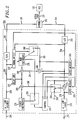
- FIG. 2 An illustrative embodiment of the inventive concept is shown in FIG. 2, which illustrates the inventive concept as part of a CODEC integrated circuit, CODEC 200.
- CODEC 200 includes ⁇ -law decoder 205, D/A (digital-to-analog converter) 210, A/D (analog-to-digital converter) 255, ⁇ -law coder 270, and hybrid 215. These elements function in a similar fashion to those described in FIG. 1 and will not be described again.
- CODEC 200 also includes: delay line 225, stored coefficients element 220, dot product multipliers 285 and 290, new coefficient storage 235, combiners (or adders) 275 and 280, signal detect element 230, control element 245, switches 240, 250, and 295, and gated measure elements 260 and 265.
- CODEC 200 is coupled to, e.g., local loop 221, via hybrid 215.
- CODEC 200 is coupled to other elements of the network (not shown) via ⁇ -law decoder 205 and ⁇ -law coder 270.
- the elements shown in FIG. 2 are well-known and will not be described in detail. (It should be noted that only those portions of CODEC 200 related to the inventive concept are shown.
- CODEC 200 operates in a conventional fashion during a voice call including possible use of echo canceler components for conventional voice echo cancellation. Those parts of CODEC 200 only related to voice call processing are not shown.) In the following description, reference should also be made to FIG. 3, which shows an illustrative flow chart embodying the principles of the invention.
- CODEC 200 switches between a data call state (i.e., a data call is being processed) and a non-data call state (e.g., a voice call is being processed).
- a data call state i.e., a data call is being processed
- a non-data call state e.g., a voice call is being processed.
- CODEC 200 functions as in the prior art with respect to a non-data call (e.g., a voice call) and, as such, this operation is not described herein except as noted below in accordance with the inventive concept.
- CODEC 200 performs echo cancellation and comprises a fixed echo canceler and an adaptive echo canceler.
- the fixed echo canceler comprises: delay line 225, stored coefficients element 220, dot product multiplier 285, and combiner 275 (ignoring for the moment switch 295).
- these element make up a transversal FIR (finite impulse response) filter.
- stored coefficients element 220 is representative of storage for tap coefficient values
- delay line 225 is representative of a tapped delay line
- dot product multiplier 285 multiplies the tap values with respective tap coefficient values and sums the result.
- the resulting signal 286 is referred to herein as echo estimate 286.
- the echo cancellation is performed by combiner 275, which subtracts echo estimate 286 from received digital signal 256 to provide echo canceled signal 276.
- the adaptive echo canceler comprises: delay line 225, new coefficients element 235, dot product multiplier 290, and combiner 280 (ignoring for the moment switch 240).
- the function of the adaptive echo canceler is to adapt off-line.
- the fixed echo canceler performs echo cancellation of the data signal using stored coefficients from stored coefficients element 220, while the adaptive echo canceler trains off-line to create a new set of coefficients for possible use in a subsequent data call.
- they are transferred from new coefficients element 235 to stored coefficients element 220 via switch 250 (described below).
- CODEC 200 includes signal detect element 230 that monitors for particular modem handshaking signaling to enable adaptation of an off-line echo canceler during a data call. This is illustrated by step 305 of FIG. 3.
- CODEC 200 starts in the non-data call state and signal detect element 230 monitors digital signal 206 and digital signal 256 for detection of an echo canceler disable tone as defined in the art (e.g., a 2100 Hz tone with phase reversals as defined in ITU V.25). If there is no detection of the echo canceler disable tone, CODEC 200 operates in a conventional voice echo cancellation mode (not shown). For example, in the context of FIG. 2, signal 281 could be directly routed to ⁇ -law decoder 270, thereby providing a conventional adaptive voice echo canceler.
- an echo canceler disable tone as defined in the art (e.g., a 2100 Hz tone with phase reversals as defined in ITU V.25).
- CODEC 200 operates in a conventional voice echo cancellation mode (not shown). For example, in the context of FIG. 2, signal 281 could be directly routed to ⁇ -law decoder 270, thereby providing a conventional adaptive voice echo canceler.
- CODEC 200 switches to the data call state and signal detect element 230 enables echo cancellation during the detected data call in step 310.
- signal detect element 230 enables gated measure elements 265 and 260, and controls switches 295 and 240.
- signal element 230 controls switch 295 to apply echo estimate signal 286 to combiner 275 for canceling the echo present in digital signal 256.
- output signal 276 is an echo-canceled signal.
- CODEC 200 uses a fixed echo canceler architecture for performing echo cancellation by using the coefficient values stored in stored coefficients element 220.
- signal detect element 230 enables, through switch 240, adaptation of new coefficients element 235, i.e., the adaptive echo canceler.
- signal detect element 230 controls adaptation of the adaptive echo canceler during an appropriate portion of the DCE handshaking sequence.
- the adaptive echo canceler is enabled during a half-duplex portion of a DCE training sequence.
- full-duplex modems generally follow industry-standard training sequences. These training sequences include at least one half-duplex portion, which occurs either at startup or during a re-train.
- this half-duplex portion of the training phase occurs subsequent to the above-mention echo canceler disable tone and after the delay estimation phase, which is signaled by frequency-specific tones.
- the half-duplex portion has two phases. One phase allows the originating DCE endpoint to train its echo canceler while the answering DCE endpoint is silent. Similarly, the remaining phase allows the answering DCE endpoint to train its echo canceler while the originating DCE endpoint is silent.
- Signal detect element 230 determines which phase to use for adaptation of the adaptive echo canceler as a function of which DCE endpoint is originating or answering the data call. The latter is determined by where signal detect element 230 detected the echo canceler disable tone, or, alternatively, subsequent startup signals.
- signal detect element 230 detected the echo canceler disable tone from digital signal 256, then DCE 130 is the answering DCE, and vice versa. Subsequent to the half-duplex portion of the training, signal detect element 230 disables further adaptation of the adaptive echo canceler via switch 240. As a result, the adaptive echo canceler of CODEC 200 trains off-line to produce a set of new coefficient values stored in new coefficients element 235 for use in a future data call. (It should be noted that a table of predefined signaling information may need to be stored within CODEC 200 to accommodate industry-based standards that have different timing constraints).
- signal detect element 230 monitors for disconnect, i.e., termination of the data call, in step 315.
- disconnect i.e., termination of the data call
- CODEC 200 switches to the non-data call state in step 320.
- control element 245 updates, if necessary, the values of the coefficients in stored coefficients element 220 with the values of the coefficients in new coefficients element 235 (described further below).
- signal detect element 230 controls switch 295 to disable echo canceling and adaptation, as described above; and returns to monitoring for the start of another data call in step 305.
- CODEC 200 includes two echo cancelers, a fixed echo canceler and an adaptive echo canceler.
- Control element 245 controls the initialization of the coefficient values represented by stored coefficients element 220 and the transfer of new coefficient values to this element.
- the coefficient values represented by stored coefficients element 220 are set to signal level values representative zero upon power-up, or re-initialization, of the equipment. (It should be noted that with coefficient values of zero, no echo cancellation is performed even though echo cancellation is enabled.)
- control element 245 determines when to transfer the new coefficient values to stored coefficients element 220 by using signaling from gated measure elements 245 and 260.
- Gated measure element 265 provides a measure of the power level of echo canceled signal 276 to control element 245.
- gated measure element 260 provides a measure of the power level of echo canceled signal 281 to control element 245.
- gated measure elements 245 and 265 are enabled only during the above-mentioned half-duplex training portion of the DCE handshaking sequence and are assumed to provide signals representative of zero power values otherwise.
- Control element 245 transfers the new coefficient values from new coefficients element 235 to stored coefficients element 220 subsequent to the current call if the power level of echo canceled signal 281 (as a result of the new coefficient values) is "better" than the power level of echo canceled signal 276 (as a result of the current coefficient values).
- An illustrative range is a power level of 3 dB to 6 dB better than the power level of echo canceled signal 276. (Here, it is assumed that a "better" power level corresponds to the adaptive echo canceler performing better echo cancellation than the fixed echo canceler.) Notification of disconnect is provided to control element 245 by signal detect element 230. The new coefficient values are used in a future data call.
- any one or more of those building blocks can be carried out using one or more appropriately programmed processors, e.g., a digital signal processor; discrete circuit elements; integrated circuits; etc.
- detection of a data call was a function of the above-mentioned echo canceler disable tone
- other portions of DCE hand shaking sequences may be used, such as the above-mentioned half-duplex portion of a DCE training sequence, or the inventive concept can take advantage of new training sequences in soon-to-be defined industry standards such as in the area of 56 kbps modem technology.
Landscapes
- Engineering & Computer Science (AREA)
- Computer Networks & Wireless Communication (AREA)
- Signal Processing (AREA)
- Cable Transmission Systems, Equalization Of Radio And Reduction Of Echo (AREA)
- Telephone Function (AREA)
- Telephonic Communication Services (AREA)
Applications Claiming Priority (2)
| Application Number | Priority Date | Filing Date | Title |
|---|---|---|---|
| US961901 | 1997-10-31 | ||
| US08/961,901 US6628780B2 (en) | 1997-10-31 | 1997-10-31 | Echo cancellation in the network for data applications |
Publications (2)
| Publication Number | Publication Date |
|---|---|
| EP0918430A2 true EP0918430A2 (de) | 1999-05-26 |
| EP0918430A3 EP0918430A3 (de) | 2004-12-08 |
Family
ID=25505166
Family Applications (1)
| Application Number | Title | Priority Date | Filing Date |
|---|---|---|---|
| EP98308520A Ceased EP0918430A3 (de) | 1997-10-31 | 1998-10-19 | Echokompensatorn einem Netz für Datenanwendungen |
Country Status (4)
| Country | Link |
|---|---|
| US (1) | US6628780B2 (de) |
| EP (1) | EP0918430A3 (de) |
| JP (1) | JP3477088B2 (de) |
| CA (1) | CA2250641C (de) |
Cited By (2)
| Publication number | Priority date | Publication date | Assignee | Title |
|---|---|---|---|---|
| EP1111807A3 (de) * | 1999-12-03 | 2002-09-25 | Lucent Technologies Inc. | Leitungskartenverfahren und Vorrichtung für Echounterdrückung |
| EP1850499A1 (de) * | 2006-04-26 | 2007-10-31 | Koninklijke Philips Electronics N.V. | Echokompensation in einem drahtlosen Zugangskommunikationssystem |
Families Citing this family (8)
| Publication number | Priority date | Publication date | Assignee | Title |
|---|---|---|---|---|
| KR100336513B1 (ko) * | 1999-12-07 | 2002-05-11 | 서평원 | 무선가입자망의 보코더를 이용한 톤 신호 전송장치 |
| US7068711B2 (en) * | 2002-03-13 | 2006-06-27 | Agere Systems Inc. | Multi-function equalizer arrangement |
| US7409057B1 (en) | 2002-07-03 | 2008-08-05 | Marvell International Ltd. | Nonlinear echo compensator for class B transmitter line driver |
| JP3922997B2 (ja) * | 2002-10-30 | 2007-05-30 | 沖電気工業株式会社 | エコーキャンセラ |
| US20070112563A1 (en) * | 2005-11-17 | 2007-05-17 | Microsoft Corporation | Determination of audio device quality |
| US7881460B2 (en) * | 2005-11-17 | 2011-02-01 | Microsoft Corporation | Configuration of echo cancellation |
| IT1394658B1 (it) * | 2009-05-29 | 2012-07-05 | Image Services Company Llc | Barriera di delimitazione, particolarmente per circuiti motoristici |
| US9185233B2 (en) * | 2010-05-25 | 2015-11-10 | Intel Deutschland Gmbh | Audio communication device and method using fixed echo cancellation filter coefficients |
Citations (5)
| Publication number | Priority date | Publication date | Assignee | Title |
|---|---|---|---|---|
| US4757527A (en) | 1984-09-12 | 1988-07-12 | Plessey Overseas Limited | Echo canceller |
| US4914692A (en) | 1987-12-29 | 1990-04-03 | At&T Bell Laboratories | Automatic speech recognition using echo cancellation |
| EP0760574A2 (de) | 1995-08-25 | 1997-03-05 | AT&T Corp. | Echokompensatorsystem mit gemeinschaftlichem Koeffizientsspeicher |
| EP0766412A2 (de) | 1995-09-29 | 1997-04-02 | Paradyne Corporation | Echokompensator unter Verwendung von Anfangstraining |
| GB2308283A (en) | 1995-12-16 | 1997-06-18 | Ibm | System and method for echo cancellation |
Family Cites Families (7)
| Publication number | Priority date | Publication date | Assignee | Title |
|---|---|---|---|---|
| GB8427165D0 (en) * | 1984-10-26 | 1984-12-05 | British Telecomm | Adaptive recognising device |
| US5453986A (en) * | 1993-01-08 | 1995-09-26 | Multi-Tech Systems, Inc. | Dual port interface for a computer-based multifunction personal communication system |
| US5404394A (en) * | 1993-05-24 | 1995-04-04 | Comsat Corporation | Secure communication system |
| US5764759A (en) * | 1994-10-06 | 1998-06-09 | Dialogic Corporation | Call processing using previously obtained line characteristics |
| US5757849A (en) * | 1995-03-30 | 1998-05-26 | Lucent Technologies Inc. | Timing recovery in a network-synchronized modem |
| US5933494A (en) * | 1995-12-07 | 1999-08-03 | Rockwell International Corporation | Echo canceling method and apparatus in a communication device |
| JPH09326729A (ja) * | 1996-06-03 | 1997-12-16 | Fujitsu Ltd | 加入者線終端回路 |
-
1997
- 1997-10-31 US US08/961,901 patent/US6628780B2/en not_active Expired - Lifetime
-
1998
- 1998-10-14 CA CA002250641A patent/CA2250641C/en not_active Expired - Fee Related
- 1998-10-19 EP EP98308520A patent/EP0918430A3/de not_active Ceased
- 1998-10-30 JP JP30931598A patent/JP3477088B2/ja not_active Expired - Fee Related
Patent Citations (5)
| Publication number | Priority date | Publication date | Assignee | Title |
|---|---|---|---|---|
| US4757527A (en) | 1984-09-12 | 1988-07-12 | Plessey Overseas Limited | Echo canceller |
| US4914692A (en) | 1987-12-29 | 1990-04-03 | At&T Bell Laboratories | Automatic speech recognition using echo cancellation |
| EP0760574A2 (de) | 1995-08-25 | 1997-03-05 | AT&T Corp. | Echokompensatorsystem mit gemeinschaftlichem Koeffizientsspeicher |
| EP0766412A2 (de) | 1995-09-29 | 1997-04-02 | Paradyne Corporation | Echokompensator unter Verwendung von Anfangstraining |
| GB2308283A (en) | 1995-12-16 | 1997-06-18 | Ibm | System and method for echo cancellation |
Cited By (3)
| Publication number | Priority date | Publication date | Assignee | Title |
|---|---|---|---|---|
| EP1111807A3 (de) * | 1999-12-03 | 2002-09-25 | Lucent Technologies Inc. | Leitungskartenverfahren und Vorrichtung für Echounterdrückung |
| EP1850499A1 (de) * | 2006-04-26 | 2007-10-31 | Koninklijke Philips Electronics N.V. | Echokompensation in einem drahtlosen Zugangskommunikationssystem |
| WO2007122587A3 (en) * | 2006-04-26 | 2009-05-14 | Nxp Bv | Echo compensation for wireless access |
Also Published As
| Publication number | Publication date |
|---|---|
| CA2250641C (en) | 2002-04-09 |
| US6628780B2 (en) | 2003-09-30 |
| JPH11239084A (ja) | 1999-08-31 |
| EP0918430A3 (de) | 2004-12-08 |
| JP3477088B2 (ja) | 2003-12-10 |
| US20020057790A1 (en) | 2002-05-16 |
| CA2250641A1 (en) | 1999-04-30 |
Similar Documents
| Publication | Publication Date | Title |
|---|---|---|
| US5812537A (en) | Echo canceling method and apparatus for data over cellular | |
| EP0518383B1 (de) | Verfahren und Einrichtung zur Echokompensation in einem digitalen Fernmeldesystem | |
| US5315585A (en) | Echo canceller using two residual echoes | |
| EP1349291B1 (de) | Adaptive Verstärkungsregelung auf der Basis von Echounterdrückungs-Leistungsdaten | |
| US5153875A (en) | Adaptive balancing network | |
| US7970124B2 (en) | Adaptive gain control based on echo canceller performance information | |
| US5828657A (en) | Half-duplex echo canceler training using a pilot signal | |
| US5029204A (en) | Operational status controller for echo canceling | |
| WO1992009158A1 (en) | Frequency domain adaptive echo canceller for full-duplex data transmission | |
| CA2250641C (en) | Echo cancellation in the network for data applications | |
| CA2161722A1 (en) | Modem receiver preemphasis | |
| JPS61252722A (ja) | 残差エコ−除去方法 | |
| US5394392A (en) | Method for transferring information using modems | |
| WO1999060720A3 (en) | Echo cancellation in digital data transmission system | |
| US6009083A (en) | Cascade echo canceler arrangement | |
| US6333974B1 (en) | Detection of a call-waiting tone by a modem | |
| JP2002503052A (ja) | アナログ電話端末機を通して供給された電話信号及びデータ端末装置を通して供給されたデータの処理方法 | |
| JPH08502869A (ja) | エコー消去器を制御するための装置および方法 | |
| WO1997035451A1 (en) | Adaptive transmit levels for modems operating over cellular | |
| CN101019338B (zh) | 用于抑制分组交换网络中的回声消除的方法和设备 | |
| EP0929160A2 (de) | Gerät und Verfahren für das Verringern der lokalen Störung im Teilnehmerschleife-Nachrichtenübertragungssystem | |
| JPH01151830A (ja) | エコー相殺方法および加入者ラインオーディオ処理回路 | |
| US5084866A (en) | Transversal filter echo canceller | |
| JPH071882Y2 (ja) | データ通信・音声通信切換装置 | |
| CA2281772A1 (en) | Method for automatically matching the levels of the signals exchanged in a communication network |
Legal Events
| Date | Code | Title | Description |
|---|---|---|---|
| PUAI | Public reference made under article 153(3) epc to a published international application that has entered the european phase |
Free format text: ORIGINAL CODE: 0009012 |
|
| AK | Designated contracting states |
Kind code of ref document: A2 Designated state(s): AT BE CH CY DE DK ES FI FR GB GR IE IT LI LU MC NL PT SE |
|
| AX | Request for extension of the european patent |
Free format text: AL;LT;LV;MK;RO;SI |
|
| PUAL | Search report despatched |
Free format text: ORIGINAL CODE: 0009013 |
|
| AK | Designated contracting states |
Kind code of ref document: A3 Designated state(s): AT BE CH CY DE DK ES FI FR GB GR IE IT LI LU MC NL PT SE |
|
| AX | Request for extension of the european patent |
Extension state: AL LT LV MK RO SI |
|
| 17P | Request for examination filed |
Effective date: 20050528 |
|
| 17Q | First examination report despatched |
Effective date: 20050701 |
|
| AKX | Designation fees paid |
Designated state(s): DE FR GB |
|
| 17Q | First examination report despatched |
Effective date: 20050701 |
|
| APBK | Appeal reference recorded |
Free format text: ORIGINAL CODE: EPIDOSNREFNE |
|
| APBN | Date of receipt of notice of appeal recorded |
Free format text: ORIGINAL CODE: EPIDOSNNOA2E |
|
| APBR | Date of receipt of statement of grounds of appeal recorded |
Free format text: ORIGINAL CODE: EPIDOSNNOA3E |
|
| RAP3 | Party data changed (applicant data changed or rights of an application transferred) |
Owner name: LUCENT TECHNOLOGIES INC. |
|
| APAV | Appeal reference deleted |
Free format text: ORIGINAL CODE: EPIDOSDREFNE |
|
| APBX | Invitation to file observations in appeal sent |
Free format text: ORIGINAL CODE: EPIDOSNOBA2E |
|
| APBZ | Receipt of observations in appeal recorded |
Free format text: ORIGINAL CODE: EPIDOSNOBA4E |
|
| APBT | Appeal procedure closed |
Free format text: ORIGINAL CODE: EPIDOSNNOA9E |
|
| RAP1 | Party data changed (applicant data changed or rights of an application transferred) |
Owner name: ALCATEL-LUCENT USA INC. |
|
| STAA | Information on the status of an ep patent application or granted ep patent |
Free format text: STATUS: THE APPLICATION HAS BEEN REFUSED |
|
| 18R | Application refused |
Effective date: 20120225 |