EP0918768B1 - Aromatische amidinderivate als selektive thrombininhibitoren - Google Patents
Aromatische amidinderivate als selektive thrombininhibitoren Download PDFInfo
- Publication number
- EP0918768B1 EP0918768B1 EP97925316A EP97925316A EP0918768B1 EP 0918768 B1 EP0918768 B1 EP 0918768B1 EP 97925316 A EP97925316 A EP 97925316A EP 97925316 A EP97925316 A EP 97925316A EP 0918768 B1 EP0918768 B1 EP 0918768B1
- Authority
- EP
- European Patent Office
- Prior art keywords
- ethyl
- pyrrolidin
- pyrrolidinyl
- carbonyl
- compound
- Prior art date
- Legal status (The legal status is an assumption and is not a legal conclusion. Google has not performed a legal analysis and makes no representation as to the accuracy of the status listed.)
- Expired - Lifetime
Links
- -1 Aromatic amidine Chemical class 0.000 title claims abstract description 72
- 229940122388 Thrombin inhibitor Drugs 0.000 title claims abstract description 12
- 239000003868 thrombin inhibitor Substances 0.000 title claims abstract description 12
- 150000003839 salts Chemical class 0.000 claims abstract description 22
- 229910052721 tungsten Inorganic materials 0.000 claims abstract description 9
- 229910052727 yttrium Inorganic materials 0.000 claims abstract description 9
- 101000712605 Theromyzon tessulatum Theromin Proteins 0.000 claims abstract description 8
- 150000001875 compounds Chemical class 0.000 claims description 892
- 125000001495 ethyl group Chemical group [H]C([H])([H])C([H])([H])* 0.000 claims description 158
- 125000000719 pyrrolidinyl group Chemical group 0.000 claims description 91
- 125000004485 2-pyrrolidinyl group Chemical group [H]N1C([H])([H])C([H])([H])C([H])([H])C1([H])* 0.000 claims description 81
- 125000002915 carbonyl group Chemical group [*:2]C([*:1])=O 0.000 claims description 80
- 229920006395 saturated elastomer Polymers 0.000 claims description 62
- 229910052739 hydrogen Inorganic materials 0.000 claims description 56
- 239000001257 hydrogen Substances 0.000 claims description 55
- 239000000203 mixture Substances 0.000 claims description 51
- 150000002431 hydrogen Chemical class 0.000 claims description 46
- 125000000623 heterocyclic group Chemical group 0.000 claims description 45
- 125000002837 carbocyclic group Chemical group 0.000 claims description 44
- QTBSBXVTEAMEQO-UHFFFAOYSA-N Acetic acid Chemical compound CC(O)=O QTBSBXVTEAMEQO-UHFFFAOYSA-N 0.000 claims description 36
- 125000004453 alkoxycarbonyl group Chemical group 0.000 claims description 26
- 125000005078 alkoxycarbonylalkyl group Chemical group 0.000 claims description 22
- 125000000217 alkyl group Chemical group 0.000 claims description 21
- QTBSBXVTEAMEQO-UHFFFAOYSA-M Acetate Chemical compound CC([O-])=O QTBSBXVTEAMEQO-UHFFFAOYSA-M 0.000 claims description 18
- 125000004448 alkyl carbonyl group Chemical group 0.000 claims description 18
- 125000004181 carboxyalkyl group Chemical group 0.000 claims description 17
- 229910052736 halogen Inorganic materials 0.000 claims description 17
- 150000002367 halogens Chemical class 0.000 claims description 17
- 125000002924 primary amino group Chemical group [H]N([H])* 0.000 claims description 16
- QGZKDVFQNNGYKY-UHFFFAOYSA-N Ammonia Chemical compound N QGZKDVFQNNGYKY-UHFFFAOYSA-N 0.000 claims description 14
- 125000004178 (C1-C4) alkyl group Chemical group 0.000 claims description 12
- 125000005097 aminocarbonylalkyl group Chemical group 0.000 claims description 10
- 125000004391 aryl sulfonyl group Chemical group 0.000 claims description 10
- JDNLSZJKXWIOSL-RBBKRZOGSA-N ethyl 2-[(2r)-2-[(2s)-2-[2-(6-carbamimidoyl-1-ethylindol-2-yl)ethyl]pyrrolidine-1-carbonyl]pyrrolidin-1-yl]acetate Chemical compound CCOC(=O)CN1CCC[C@@H]1C(=O)N1[C@H](CCC=2N(C3=CC(=CC=C3C=2)C(N)=N)CC)CCC1 JDNLSZJKXWIOSL-RBBKRZOGSA-N 0.000 claims description 10
- 238000002360 preparation method Methods 0.000 claims description 10
- 125000004390 alkyl sulfonyl group Chemical group 0.000 claims description 9
- 125000001325 propanoyl group Chemical group O=C([*])C([H])([H])C([H])([H])[H] 0.000 claims description 9
- 125000004769 (C1-C4) alkylsulfonyl group Chemical group 0.000 claims description 8
- UFHFLCQGNIYNRP-UHFFFAOYSA-N Hydrogen Chemical compound [H][H] UFHFLCQGNIYNRP-UHFFFAOYSA-N 0.000 claims description 8
- 125000005196 alkyl carbonyloxy group Chemical group 0.000 claims description 8
- 125000002947 alkylene group Chemical group 0.000 claims description 8
- QVGXLLKOCUKJST-UHFFFAOYSA-N atomic oxygen Chemical group [O] QVGXLLKOCUKJST-UHFFFAOYSA-N 0.000 claims description 8
- 125000002887 hydroxy group Chemical group [H]O* 0.000 claims description 8
- 125000002768 hydroxyalkyl group Chemical group 0.000 claims description 8
- 125000004170 methylsulfonyl group Chemical group [H]C([H])([H])S(*)(=O)=O 0.000 claims description 8
- 229910052760 oxygen Inorganic materials 0.000 claims description 8
- 239000001301 oxygen Substances 0.000 claims description 8
- 125000001424 substituent group Chemical group 0.000 claims description 8
- ILWAMRMKSVGZCL-ACIOBRDBSA-N ethyl (3s)-3-amino-4-[(2r)-2-[(2s)-2-[2-(6-carbamimidoyl-1-ethylindol-2-yl)ethyl]pyrrolidine-1-carbonyl]pyrrolidin-1-yl]-4-oxobutanoate Chemical compound CCOC(=O)C[C@H](N)C(=O)N1CCC[C@@H]1C(=O)N1[C@H](CCC=2N(C3=CC(=CC=C3C=2)C(N)=N)CC)CCC1 ILWAMRMKSVGZCL-ACIOBRDBSA-N 0.000 claims description 7
- 125000000229 (C1-C4)alkoxy group Chemical group 0.000 claims description 6
- YAEJDEWIEKDYAM-PKOBYXMFSA-N 2-[(2r)-2-[(2s)-2-[2-(6-carbamimidoyl-1-ethylindol-2-yl)ethyl]pyrrolidine-1-carbonyl]-5-oxopyrrolidin-1-yl]acetamide Chemical compound C([C@H]1CCC=2N(C3=CC(=CC=C3C=2)C(N)=N)CC)CCN1C(=O)[C@H]1CCC(=O)N1CC(N)=O YAEJDEWIEKDYAM-PKOBYXMFSA-N 0.000 claims description 6
- FAWAWSGBAQIZDB-KFEBLCFASA-N 2-[(2r)-2-[(2s)-2-[2-(6-carbamimidoyl-1-ethylindol-2-yl)ethyl]pyrrolidine-1-carbonyl]pyrrolidin-1-yl]-4-hydroxybutanamide Chemical compound C([C@H]1CCC=2N(C3=CC(=CC=C3C=2)C(N)=N)CC)CCN1C(=O)[C@H]1CCCN1C(CCO)C(N)=O FAWAWSGBAQIZDB-KFEBLCFASA-N 0.000 claims description 6
- JFOQIOOPUNLSIZ-RUYIAYPLSA-N 2-[(2r)-2-[(2s)-2-[2-(6-carbamimidoyl-1-ethylindol-2-yl)ethyl]pyrrolidine-1-carbonyl]pyrrolidin-1-yl]butanedioic acid Chemical compound C([C@H]1CCC=2N(C3=CC(=CC=C3C=2)C(N)=N)CC)CCN1C(=O)[C@H]1CCCN1C(CC(O)=O)C(O)=O JFOQIOOPUNLSIZ-RUYIAYPLSA-N 0.000 claims description 6
- HCKUDEOXDDXPBJ-KFEBLCFASA-N 2-[2-[(2s)-1-[(2r)-1-(2-aminobutanoyl)pyrrolidine-2-carbonyl]pyrrolidin-2-yl]ethyl]-1-ethylindole-6-carboximidamide Chemical compound CCC(N)C(=O)N1CCC[C@@H]1C(=O)N1[C@H](CCC=2N(C3=CC(=CC=C3C=2)C(N)=N)CC)CCC1 HCKUDEOXDDXPBJ-KFEBLCFASA-N 0.000 claims description 6
- FERIUCNNQQJTOY-UHFFFAOYSA-N Butyric acid Chemical compound CCCC(O)=O FERIUCNNQQJTOY-UHFFFAOYSA-N 0.000 claims description 6
- 125000002853 C1-C4 hydroxyalkyl group Chemical group 0.000 claims description 6
- 125000003545 alkoxy group Chemical group 0.000 claims description 6
- 125000003178 carboxy group Chemical group [H]OC(*)=O 0.000 claims description 6
- YQLVRGNEJCVXBK-AIBWNMTMSA-N ethyl 1-[2-[(2s)-2-[2-(6-carbamimidoyl-1-ethylindol-2-yl)ethyl]pyrrolidin-1-yl]-2-oxoethyl]pyrrolidine-2-carboxylate Chemical compound CCOC(=O)C1CCCN1CC(=O)N1[C@H](CCC=2N(C3=CC(=CC=C3C=2)C(N)=N)CC)CCC1 YQLVRGNEJCVXBK-AIBWNMTMSA-N 0.000 claims description 6
- OQRBLEVGQXVWKI-DNPUCPKASA-N ethyl 2-[(2r)-2-[(2s)-2-[2-(6-carbamimidoyl-1-ethylindol-2-yl)ethyl]pyrrolidine-1-carbonyl]pyrrolidin-1-yl]propanoate Chemical compound CCOC(=O)C(C)N1CCC[C@@H]1C(=O)N1[C@H](CCC=2N(C3=CC(=CC=C3C=2)C(N)=N)CC)CCC1 OQRBLEVGQXVWKI-DNPUCPKASA-N 0.000 claims description 6
- VFLAMOJJTKREPP-FDDCHVKYSA-N ethyl 2-[2-[2-[(2s)-1-[(2r)-1-acetylpyrrolidine-2-carbonyl]pyrrolidin-2-yl]ethyl]-6-carbamimidoyl-1h-indol-3-yl]acetate Chemical compound C([C@H]1CCC2=C(C3=CC=C(C=C3N2)C(N)=N)CC(=O)OCC)CCN1C(=O)[C@H]1CCCN1C(C)=O VFLAMOJJTKREPP-FDDCHVKYSA-N 0.000 claims description 6
- TVUFLBCVRYLTLV-AIBWNMTMSA-N methyl 2-[2-[(2s)-2-[2-(6-carbamimidoyl-1-ethylindol-2-yl)ethyl]pyrrolidine-1-carbonyl]piperidin-1-yl]acetate Chemical compound C([C@H]1CCC=2N(C3=CC(=CC=C3C=2)C(N)=N)CC)CCN1C(=O)C1CCCCN1CC(=O)OC TVUFLBCVRYLTLV-AIBWNMTMSA-N 0.000 claims description 6
- 125000003170 phenylsulfonyl group Chemical group C1(=CC=CC=C1)S(=O)(=O)* 0.000 claims description 6
- FPPKXYJWIPOEIL-SESVDKBCSA-N (3s)-3-amino-4-[(2r)-2-[(2s)-2-[2-(6-carbamimidoyl-1-ethylindol-2-yl)ethyl]pyrrolidine-1-carbonyl]pyrrolidin-1-yl]-4-oxobutanamide Chemical compound C([C@H]1CCC=2N(C3=CC(=CC=C3C=2)C(N)=N)CC)CCN1C(=O)[C@H]1CCCN1C(=O)[C@@H](N)CC(N)=O FPPKXYJWIPOEIL-SESVDKBCSA-N 0.000 claims description 5
- BLAHSENEKSQIKA-GGYWPGCISA-N 1-ethyl-2-[2-[(2s)-1-(piperidine-3-carbonyl)pyrrolidin-2-yl]ethyl]indole-6-carboximidamide Chemical compound C([C@H]1CCC=2N(C3=CC(=CC=C3C=2)C(N)=N)CC)CCN1C(=O)C1CCCNC1 BLAHSENEKSQIKA-GGYWPGCISA-N 0.000 claims description 5
- DYLWPPLDFZDYIV-AZGAKELHSA-N 1-ethyl-2-[2-[(2s)-1-[(2r)-1-(2-propylpentanoyl)pyrrolidine-2-carbonyl]pyrrolidin-2-yl]ethyl]indole-6-carboximidamide Chemical compound CCCC(CCC)C(=O)N1CCC[C@@H]1C(=O)N1[C@H](CCC=2N(C3=CC(=CC=C3C=2)C(N)=N)CC)CCC1 DYLWPPLDFZDYIV-AZGAKELHSA-N 0.000 claims description 5
- CWOBJYODSNTRTN-LNMRYCPJSA-N 1-ethyl-2-[2-[(2s)-1-[(2r)-1-(3-hydroxybutanoyl)pyrrolidine-2-carbonyl]pyrrolidin-2-yl]ethyl]indole-6-carboximidamide Chemical compound C([C@H]1CCC=2N(C3=CC(=CC=C3C=2)C(N)=N)CC)CCN1C(=O)[C@H]1CCCN1C(=O)CC(C)O CWOBJYODSNTRTN-LNMRYCPJSA-N 0.000 claims description 5
- GLCLGGHJPCTTRV-ZBKSJXDOSA-N 1-ethyl-2-[2-[(2s)-1-[(2r)-1-(piperidine-3-carbonyl)pyrrolidine-2-carbonyl]pyrrolidin-2-yl]ethyl]indole-6-carboximidamide Chemical compound C([C@@H]1C(=O)N2CCC[C@H]2CCC=2N(C3=CC(=CC=C3C=2)C(N)=N)CC)CCN1C(=O)C1CCCNC1 GLCLGGHJPCTTRV-ZBKSJXDOSA-N 0.000 claims description 5
- VZSRNZXQCJGXAV-RBDMOPTHSA-N 1-ethyl-2-[2-[(2s)-1-[(2r)-1-[(2s)-2-(methanesulfonamido)propanoyl]pyrrolidine-2-carbonyl]pyrrolidin-2-yl]ethyl]indole-6-carboximidamide Chemical compound C([C@H]1CCC=2N(C3=CC(=CC=C3C=2)C(N)=N)CC)CCN1C(=O)[C@H]1CCCN1C(=O)[C@H](C)NS(C)(=O)=O VZSRNZXQCJGXAV-RBDMOPTHSA-N 0.000 claims description 5
- OYRZWGUWEVQEBM-AZUAARDMSA-N 1-ethyl-2-[2-[(2s)-1-[(2r)-1-methylsulfonylpyrrolidine-2-carbonyl]pyrrolidin-2-yl]ethyl]indole-6-carboximidamide Chemical compound C([C@H]1CCC=2N(C3=CC(=CC=C3C=2)C(N)=N)CC)CCN1C(=O)[C@H]1CCCN1S(C)(=O)=O OYRZWGUWEVQEBM-AZUAARDMSA-N 0.000 claims description 5
- IENBNUSOOJQKFM-NBHGPNQESA-N 2-[(2r)-2-[(2s,4s)-2-[2-(6-carbamimidoyl-1-ethylindol-2-yl)ethyl]-4-methylpyrrolidine-1-carbonyl]pyrrolidin-1-yl]acetic acid Chemical compound C([C@@H](C)C[C@@H]1CCC=2N(C3=CC(=CC=C3C=2)C(N)=N)CC)N1C(=O)[C@H]1CCCN1CC(O)=O IENBNUSOOJQKFM-NBHGPNQESA-N 0.000 claims description 5
- GMBLKQZZGJLICC-AZUAARDMSA-N 2-[2-[(2s)-1-[(2r)-1-acetylpyrrolidine-2-carbonyl]pyrrolidin-2-yl]ethyl]-1-methylindole-6-carboximidamide Chemical compound CC(=O)N1CCC[C@@H]1C(=O)N1[C@H](CCC=2N(C3=CC(=CC=C3C=2)C(N)=N)C)CCC1 GMBLKQZZGJLICC-AZUAARDMSA-N 0.000 claims description 5
- WJZPWPNMYKWMJQ-MHZLTWQESA-N 3-[[(2s)-2-[2-(6-carbamimidoyl-1-ethylindol-2-yl)ethyl]pyrrolidin-2-yl]methyl]-1-benzothiophene-2-carboxamide Chemical compound C=1C2=CC=C(C(N)=N)C=C2N(CC)C=1CC[C@]1(CC=2C3=CC=CC=C3SC=2C(N)=O)CCCN1 WJZPWPNMYKWMJQ-MHZLTWQESA-N 0.000 claims description 5
- CONPSHPINOJPIN-SANMLTNESA-N 3-[[(2s)-2-[2-(6-carbamimidoyl-1-methylindol-2-yl)ethyl]pyrrolidin-2-yl]methyl]-1-benzothiophene-2-carboxamide Chemical compound C=1C2=CC=C(C(N)=N)C=C2N(C)C=1CC[C@]1(CC=2C3=CC=CC=C3SC=2C(N)=O)CCCN1 CONPSHPINOJPIN-SANMLTNESA-N 0.000 claims description 5
- 208000007536 Thrombosis Diseases 0.000 claims description 5
- 125000004103 aminoalkyl group Chemical group 0.000 claims description 5
- QAHJPSYDFVDUTM-FYFGAKMPSA-N ethyl 2-[(2r)-2-[(2s)-2-[2-(6-carbamimidoyl-1-ethylindol-2-yl)ethyl]pyrrolidine-1-carbonyl]pyrrolidin-1-yl]butanoate Chemical compound CCOC(=O)C(CC)N1CCC[C@@H]1C(=O)N1[C@H](CCC=2N(C3=CC(=CC=C3C=2)C(N)=N)CC)CCC1 QAHJPSYDFVDUTM-FYFGAKMPSA-N 0.000 claims description 5
- UDXHDKFUIFOFSV-NRFANRHFSA-N ethyl 2-[[2-[(2s)-2-[2-(6-carbamimidoyl-1-ethylindol-2-yl)ethyl]pyrrolidin-1-yl]-2-oxoethyl]-cyclopropylamino]acetate Chemical compound N1([C@@H](CCC1)CCC=1N(C2=CC(=CC=C2C=1)C(N)=N)CC)C(=O)CN(CC(=O)OCC)C1CC1 UDXHDKFUIFOFSV-NRFANRHFSA-N 0.000 claims description 5
- SXUCSVVXCYOFEV-XEGCMXMBSA-N ethyl 3-[(2s)-2-[2-(6-carbamimidoyl-1-ethylindol-2-yl)ethyl]pyrrolidin-1-yl]-2-cyclopentyl-3-oxopropanoate Chemical compound N1([C@@H](CCC1)CCC=1N(C2=CC(=CC=C2C=1)C(N)=N)CC)C(=O)C(C(=O)OCC)C1CCCC1 SXUCSVVXCYOFEV-XEGCMXMBSA-N 0.000 claims description 5
- LFERLQTVMXSNAM-UKILVPOCSA-N ethyl 5-[(2r)-2-[(2s)-2-[2-(6-carbamimidoyl-1-ethylindol-2-yl)ethyl]pyrrolidine-1-carbonyl]pyrrolidin-1-yl]pentanoate Chemical compound CCOC(=O)CCCCN1CCC[C@@H]1C(=O)N1[C@H](CCC=2N(C3=CC(=CC=C3C=2)C(N)=N)CC)CCC1 LFERLQTVMXSNAM-UKILVPOCSA-N 0.000 claims description 5
- 125000004765 (C1-C4) haloalkyl group Chemical group 0.000 claims description 4
- XRCLULPWILRVFD-PKOBYXMFSA-N 1-ethyl-2-[2-[(2s)-1-[(2r)-pyrrolidine-2-carbonyl]pyrrolidin-2-yl]ethyl]indole-6-carboximidamide Chemical compound C([C@H]1CCC=2N(C3=CC(=CC=C3C=2)C(N)=N)CC)CCN1C(=O)[C@H]1CCCN1 XRCLULPWILRVFD-PKOBYXMFSA-N 0.000 claims description 4
- ICUADESKVLWYTP-AZUAARDMSA-N 2-[(2r)-2-[(2s)-2-[2-(6-carbamimidoyl-1-ethylindol-2-yl)ethyl]pyrrolidine-1-carbonyl]pyrrolidin-1-yl]acetamide Chemical compound C([C@H]1CCC=2N(C3=CC(=CC=C3C=2)C(N)=N)CC)CCN1C(=O)[C@H]1CCCN1CC(N)=O ICUADESKVLWYTP-AZUAARDMSA-N 0.000 claims description 4
- XITHEEQBLGHODC-NRFANRHFSA-N 2-[2-[(2s)-1-(2-cyclohexylacetyl)pyrrolidin-2-yl]ethyl]-1-ethylindole-6-carboximidamide Chemical compound C([C@H]1CCC=2N(C3=CC(=CC=C3C=2)C(N)=N)CC)CCN1C(=O)CC1CCCCC1 XITHEEQBLGHODC-NRFANRHFSA-N 0.000 claims description 4
- VHGIFJFLBWPOHK-FQEVSTJZSA-N 2-[2-[(2s)-1-(2-cyclopentylacetyl)pyrrolidin-2-yl]ethyl]-1-ethylindole-6-carboximidamide Chemical compound C([C@H]1CCC=2N(C3=CC(=CC=C3C=2)C(N)=N)CC)CCN1C(=O)CC1CCCC1 VHGIFJFLBWPOHK-FQEVSTJZSA-N 0.000 claims description 4
- RRMYMPVTIFBRSB-PZJWPPBQSA-N 2-[2-[(2s)-1-[(2r)-1-acetylpyrrolidine-2-carbonyl]pyrrolidin-2-yl]ethyl]-1-ethylindole-6-carboximidamide Chemical compound C([C@H]1CCC=2N(C3=CC(=CC=C3C=2)C(N)=N)CC)CCN1C(=O)[C@H]1CCCN1C(C)=O RRMYMPVTIFBRSB-PZJWPPBQSA-N 0.000 claims description 4
- BMGSGPDCHRJXFP-AZUAARDMSA-N 3-[(2r)-2-[(2s)-2-[2-(6-carbamimidoyl-1-ethylindol-2-yl)ethyl]pyrrolidine-1-carbonyl]pyrrolidin-1-yl]-3-oxopropanamide Chemical compound C([C@H]1CCC=2N(C3=CC(=CC=C3C=2)C(N)=N)CC)CCN1C(=O)[C@H]1CCCN1C(=O)CC(N)=O BMGSGPDCHRJXFP-AZUAARDMSA-N 0.000 claims description 4
- MXUYJABZBFPPSQ-HSZRJFAPSA-N 6-[2-[(2s)-1-(2-phenylacetyl)pyrrolidin-2-yl]ethyl]naphthalene-2-carboximidamide Chemical compound C([C@@H]1CCC2=CC3=CC=C(C=C3C=C2)C(=N)N)CCN1C(=O)CC1=CC=CC=C1 MXUYJABZBFPPSQ-HSZRJFAPSA-N 0.000 claims description 4
- NINIDFKCEFEMDL-UHFFFAOYSA-N Sulfur Chemical group [S] NINIDFKCEFEMDL-UHFFFAOYSA-N 0.000 claims description 4
- 125000002777 acetyl group Chemical group [H]C([H])([H])C(*)=O 0.000 claims description 4
- 125000004466 alkoxycarbonylamino group Chemical group 0.000 claims description 4
- 125000003282 alkyl amino group Chemical group 0.000 claims description 4
- 125000004429 atom Chemical group 0.000 claims description 4
- 125000000499 benzofuranyl group Chemical group O1C(=CC2=C1C=CC=C2)* 0.000 claims description 4
- 125000004196 benzothienyl group Chemical group S1C(=CC2=C1C=CC=C2)* 0.000 claims description 4
- 125000003917 carbamoyl group Chemical group [H]N([H])C(*)=O 0.000 claims description 4
- 125000004432 carbon atom Chemical group C* 0.000 claims description 4
- 125000006310 cycloalkyl amino group Chemical group 0.000 claims description 4
- 125000004663 dialkyl amino group Chemical group 0.000 claims description 4
- BWZRHUOOCFZZLI-FCMLDSNUSA-N ethyl 2-[(2r)-2-[(2s)-2-[2-(6-carbamimidoyl-1-ethylindol-2-yl)ethyl]pyrrolidine-1-carbonyl]pyrrolidin-1-yl]-2-phenylacetate Chemical compound N1([C@H](CCC1)C(=O)N1[C@@H](CCC1)CCC=1N(C2=CC(=CC=C2C=1)C(N)=N)CC)C(C(=O)OCC)C1=CC=CC=C1 BWZRHUOOCFZZLI-FCMLDSNUSA-N 0.000 claims description 4
- PVQZNURIIOPZPO-PZJWPPBQSA-N ethyl 2-[(2r)-2-[(2s)-2-[2-(6-carbamimidoyl-1-methylindol-2-yl)ethyl]pyrrolidine-1-carbonyl]pyrrolidin-1-yl]acetate Chemical compound CCOC(=O)CN1CCC[C@@H]1C(=O)N1[C@H](CCC=2N(C3=CC(=CC=C3C=2)C(N)=N)C)CCC1 PVQZNURIIOPZPO-PZJWPPBQSA-N 0.000 claims description 4
- LPGPWAUCXCBRSR-ZYZRXSCRSA-N ethyl 2-[[1-[(2s)-2-[2-(6-carbamimidoyl-1-ethylindol-2-yl)ethyl]pyrrolidin-1-yl]-1-oxopropan-2-yl]-cyclopropylamino]acetate Chemical compound N1([C@@H](CCC1)CCC=1N(C2=CC(=CC=C2C=1)C(N)=N)CC)C(=O)C(C)N(CC(=O)OCC)C1CC1 LPGPWAUCXCBRSR-ZYZRXSCRSA-N 0.000 claims description 4
- XOQPETLIOUNPBG-JTHBVZDNSA-N ethyl 4-[(2r)-2-[(2s)-2-[2-(6-carbamimidoyl-1-ethylindol-2-yl)ethyl]pyrrolidine-1-carbonyl]pyrrolidin-1-yl]-4-oxobutanoate Chemical compound CCOC(=O)CCC(=O)N1CCC[C@@H]1C(=O)N1[C@H](CCC=2N(C3=CC(=CC=C3C=2)C(N)=N)CC)CCC1 XOQPETLIOUNPBG-JTHBVZDNSA-N 0.000 claims description 4
- MLOLGHXCOAFTPS-AZGAKELHSA-N ethyl 6-[(2r)-2-[(2s)-2-[2-(6-carbamimidoyl-1-ethylindol-2-yl)ethyl]pyrrolidine-1-carbonyl]pyrrolidin-1-yl]hexanoate Chemical compound CCOC(=O)CCCCCN1CCC[C@@H]1C(=O)N1[C@H](CCC=2N(C3=CC(=CC=C3C=2)C(N)=N)CC)CCC1 MLOLGHXCOAFTPS-AZGAKELHSA-N 0.000 claims description 4
- 125000001188 haloalkyl group Chemical group 0.000 claims description 4
- 229910000039 hydrogen halide Inorganic materials 0.000 claims description 4
- 239000012433 hydrogen halide Substances 0.000 claims description 4
- 125000001041 indolyl group Chemical group 0.000 claims description 4
- 125000001624 naphthyl group Chemical group 0.000 claims description 4
- 125000000449 nitro group Chemical group [O-][N+](*)=O 0.000 claims description 4
- 229910052717 sulfur Chemical group 0.000 claims description 4
- 239000011593 sulfur Chemical group 0.000 claims description 4
- WUOLFLNSGQSQEL-BMHUVXDISA-N 2-[(2r)-2-[(2s)-2-[2-(6-carbamimidoyl-1-ethylindol-2-yl)ethyl]pyrrolidine-1-carbonyl]pyrrolidin-1-yl]-4-hydroxybutanoic acid Chemical compound C([C@H]1CCC=2N(C3=CC(=CC=C3C=2)C(N)=N)CC)CCN1C(=O)[C@H]1CCCN1C(CCO)C(O)=O WUOLFLNSGQSQEL-BMHUVXDISA-N 0.000 claims description 3
- XWSXTKKASBAMIX-JTHBVZDNSA-N 2-[(2r)-2-[(2s)-2-[2-(6-carbamimidoyl-1-ethylindol-2-yl)ethyl]pyrrolidine-1-carbonyl]pyrrolidin-1-yl]-n-cyclopropylacetamide Chemical compound C([C@@H]1C(=O)N2CCC[C@H]2CCC=2N(C3=CC(=CC=C3C=2)C(N)=N)CC)CCN1CC(=O)NC1CC1 XWSXTKKASBAMIX-JTHBVZDNSA-N 0.000 claims description 3
- XDNJNHRBFUVIQV-ALLRNTDFSA-N 2-[2-[(2s)-1-(2-cyclopentyl-2-phenylacetyl)pyrrolidin-2-yl]ethyl]-1-ethylindole-6-carboximidamide Chemical compound C([C@H]1CCC=2N(C3=CC(=CC=C3C=2)C(N)=N)CC)CCN1C(=O)C(C=1C=CC=CC=1)C1CCCC1 XDNJNHRBFUVIQV-ALLRNTDFSA-N 0.000 claims description 3
- IOXCXEHTXPBXMC-RBBKRZOGSA-N 2-[2-[(2s)-1-[(2r)-1-(4-aminobutanoyl)pyrrolidine-2-carbonyl]pyrrolidin-2-yl]ethyl]-1-ethylindole-6-carboximidamide Chemical compound C([C@H]1CCC=2N(C3=CC(=CC=C3C=2)C(N)=N)CC)CCN1C(=O)[C@H]1CCCN1C(=O)CCCN IOXCXEHTXPBXMC-RBBKRZOGSA-N 0.000 claims description 3
- RQGSOTGHZJKTAI-NRFANRHFSA-N 2-[2-[(2s)-1-[2-(3-chlorophenyl)acetyl]pyrrolidin-2-yl]ethyl]-1-ethylindole-6-carboximidamide Chemical compound C([C@H]1CCC=2N(C3=CC(=CC=C3C=2)C(N)=N)CC)CCN1C(=O)CC1=CC=CC(Cl)=C1 RQGSOTGHZJKTAI-NRFANRHFSA-N 0.000 claims description 3
- ZRAXJSPTAAOUQJ-SFHVURJKSA-N 2-[2-[(2s)-1-[2-(cyclopropylamino)acetyl]pyrrolidin-2-yl]ethyl]-1-ethylindole-6-carboximidamide Chemical compound C([C@H]1CCC=2N(C3=CC(=CC=C3C=2)C(N)=N)CC)CCN1C(=O)CNC1CC1 ZRAXJSPTAAOUQJ-SFHVURJKSA-N 0.000 claims description 3
- CJINWBMEAKPQQN-SFHVURJKSA-N 2-[2-[(2s)-1-[2-[cyclopropyl(methylsulfonyl)amino]acetyl]pyrrolidin-2-yl]ethyl]-1-ethylindole-6-carboximidamide Chemical compound C([C@H]1CCC=2N(C3=CC(=CC=C3C=2)C(N)=N)CC)CCN1C(=O)CN(S(C)(=O)=O)C1CC1 CJINWBMEAKPQQN-SFHVURJKSA-N 0.000 claims description 3
- KDKDGTSCTZRKAQ-FQEVSTJZSA-N 2-[2-[(2s)-2-[2-(6-carbamimidoyl-1-ethylindol-2-yl)ethyl]pyrrolidin-1-yl]-2-oxoethyl]benzoic acid Chemical compound C([C@H]1CCC=2N(C3=CC(=CC=C3C=2)C(N)=N)CC)CCN1C(=O)CC1=CC=CC=C1C(O)=O KDKDGTSCTZRKAQ-FQEVSTJZSA-N 0.000 claims description 3
- BGHZEHTZQLOLGK-SQJMNOBHSA-N 2-[[(1r)-2-[(2s)-2-[2-(6-carbamimidoyl-1-ethylindol-2-yl)ethyl]pyrrolidin-1-yl]-2-oxo-1-phenylethyl]amino]acetamide Chemical compound C1([C@@H](NCC(N)=O)C(=O)N2CCC[C@H]2CCC=2N(C3=CC(=CC=C3C=2)C(N)=N)CC)=CC=CC=C1 BGHZEHTZQLOLGK-SQJMNOBHSA-N 0.000 claims description 3
- GHFBDMSMMQGKNJ-CVMIBEPCSA-N 2-[[1-[(2s)-2-[2-(6-carbamimidoyl-1-ethylindol-2-yl)ethyl]pyrrolidin-1-yl]-1-oxopropan-2-yl]-cyclopropylamino]acetic acid Chemical compound C([C@H]1CCC=2N(C3=CC(=CC=C3C=2)C(N)=N)CC)CCN1C(=O)C(C)N(CC(O)=O)C1CC1 GHFBDMSMMQGKNJ-CVMIBEPCSA-N 0.000 claims description 3
- GGIMLGUGUPHEJC-LROBGIAVSA-N 4-[(2s)-2-[2-(6-carbamimidoyl-1-ethylindol-2-yl)ethyl]pyrrolidin-1-yl]-3-(cyclopropylamino)-4-oxobutanoic acid Chemical compound C([C@H]1CCC=2N(C3=CC(=CC=C3C=2)C(N)=N)CC)CCN1C(=O)C(CC(O)=O)NC1CC1 GGIMLGUGUPHEJC-LROBGIAVSA-N 0.000 claims description 3
- 229910021529 ammonia Inorganic materials 0.000 claims description 3
- OBVJVOATCFNINX-NGYIFUPDSA-N ethyl (2s)-2-[[2-[(2r)-2-[(2s)-2-[2-(6-carbamimidoyl-1-ethylindol-2-yl)ethyl]pyrrolidine-1-carbonyl]pyrrolidin-1-yl]acetyl]amino]propanoate Chemical compound CCOC(=O)[C@H](C)NC(=O)CN1CCC[C@@H]1C(=O)N1[C@H](CCC=2N(C3=CC(=CC=C3C=2)C(N)=N)CC)CCC1 OBVJVOATCFNINX-NGYIFUPDSA-N 0.000 claims description 3
- 125000001997 phenyl group Chemical group [H]C1=C([H])C([H])=C(*)C([H])=C1[H] 0.000 claims description 3
- NQPDZGIKBAWPEJ-UHFFFAOYSA-N valeric acid Chemical compound CCCCC(O)=O NQPDZGIKBAWPEJ-UHFFFAOYSA-N 0.000 claims description 3
- 125000004760 (C1-C4) alkylsulfonylamino group Chemical group 0.000 claims description 2
- 125000006729 (C2-C5) alkenyl group Chemical group 0.000 claims description 2
- CXBMCKNFWLXRQY-PZJWPPBQSA-N 1-ethyl-2-[2-[(2s)-1-[(2r)-1-prop-2-enoylpyrrolidine-2-carbonyl]pyrrolidin-2-yl]ethyl]indole-6-carboximidamide Chemical compound C([C@H]1CCC=2N(C3=CC(=CC=C3C=2)C(N)=N)CC)CCN1C(=O)[C@H]1CCCN1C(=O)C=C CXBMCKNFWLXRQY-PZJWPPBQSA-N 0.000 claims description 2
- ORFAXBUUDCNFDJ-XUZZJYLKSA-N 1-ethyl-2-[2-[(2s)-1-[(2r)-2-(methanesulfonamido)-2-phenylacetyl]pyrrolidin-2-yl]ethyl]indole-6-carboximidamide Chemical compound C1([C@@H](NS(C)(=O)=O)C(=O)N2CCC[C@H]2CCC=2N(C3=CC(=CC=C3C=2)C(N)=N)CC)=CC=CC=C1 ORFAXBUUDCNFDJ-XUZZJYLKSA-N 0.000 claims description 2
- AALAGUQWRDAZGA-FJIJXJHWSA-N 2-[2-[(2s)-1-[(2r)-1-[(2s)-2-amino-3-methylbutanoyl]pyrrolidine-2-carbonyl]pyrrolidin-2-yl]ethyl]-1-ethylindole-6-carboximidamide Chemical compound C([C@H]1CCC=2N(C3=CC(=CC=C3C=2)C(N)=N)CC)CCN1C(=O)[C@H]1CCCN1C(=O)[C@@H](N)C(C)C AALAGUQWRDAZGA-FJIJXJHWSA-N 0.000 claims description 2
- 125000004008 6 membered carbocyclic group Chemical group 0.000 claims description 2
- WWZKQHOCKIZLMA-UHFFFAOYSA-N Caprylic acid Natural products CCCCCCCC(O)=O WWZKQHOCKIZLMA-UHFFFAOYSA-N 0.000 claims description 2
- 125000003342 alkenyl group Chemical group 0.000 claims description 2
- 125000004656 alkyl sulfonylamino group Chemical group 0.000 claims description 2
- 125000003710 aryl alkyl group Chemical group 0.000 claims description 2
- 125000004657 aryl sulfonyl amino group Chemical group 0.000 claims description 2
- 125000001164 benzothiazolyl group Chemical group S1C(=NC2=C1C=CC=C2)* 0.000 claims description 2
- 125000004541 benzoxazolyl group Chemical group O1C(=NC2=C1C=CC=C2)* 0.000 claims description 2
- GONOPSZTUGRENK-UHFFFAOYSA-N benzyl(trichloro)silane Chemical compound Cl[Si](Cl)(Cl)CC1=CC=CC=C1 GONOPSZTUGRENK-UHFFFAOYSA-N 0.000 claims description 2
- 125000000723 dihydrobenzofuranyl group Chemical group O1C(CC2=C1C=CC=C2)* 0.000 claims description 2
- 125000004582 dihydrobenzothienyl group Chemical group S1C(CC2=C1C=CC=C2)* 0.000 claims description 2
- MXMILRILELHPPY-AIBWNMTMSA-N ethyl 4-[(2s)-2-[2-(6-carbamimidoyl-1-ethylindol-2-yl)ethyl]pyrrolidin-1-yl]-2-(cyclopropylamino)-4-oxobutanoate Chemical compound N1([C@@H](CCC1)CCC=1N(C2=CC(=CC=C2C=1)C(N)=N)CC)C(=O)CC(C(=O)OCC)NC1CC1 MXMILRILELHPPY-AIBWNMTMSA-N 0.000 claims description 2
- 125000003392 indanyl group Chemical group C1(CCC2=CC=CC=C12)* 0.000 claims description 2
- FUZZWVXGSFPDMH-UHFFFAOYSA-N n-hexanoic acid Natural products CCCCCC(O)=O FUZZWVXGSFPDMH-UHFFFAOYSA-N 0.000 claims description 2
- 125000004482 piperidin-4-yl group Chemical group N1CCC(CC1)* 0.000 claims description 2
- 230000002265 prevention Effects 0.000 claims description 2
- 125000001712 tetrahydronaphthyl group Chemical group C1(CCCC2=CC=CC=C12)* 0.000 claims description 2
- 238000011282 treatment Methods 0.000 claims description 2
- 238000004519 manufacturing process Methods 0.000 claims 3
- FERIUCNNQQJTOY-UHFFFAOYSA-M Butyrate Chemical compound CCCC([O-])=O FERIUCNNQQJTOY-UHFFFAOYSA-M 0.000 claims 1
- 108090000190 Thrombin Proteins 0.000 abstract description 18
- 229960004072 thrombin Drugs 0.000 abstract description 17
- 230000002401 inhibitory effect Effects 0.000 abstract description 14
- 230000003389 potentiating effect Effects 0.000 abstract description 5
- HEDRZPFGACZZDS-MICDWDOJSA-N Trichloro(2H)methane Chemical compound [2H]C(Cl)(Cl)Cl HEDRZPFGACZZDS-MICDWDOJSA-N 0.000 description 514
- 230000015572 biosynthetic process Effects 0.000 description 506
- 238000003786 synthesis reaction Methods 0.000 description 503
- 238000005160 1H NMR spectroscopy Methods 0.000 description 374
- 238000000034 method Methods 0.000 description 349
- YMWUJEATGCHHMB-UHFFFAOYSA-N Dichloromethane Chemical compound ClCCl YMWUJEATGCHHMB-UHFFFAOYSA-N 0.000 description 291
- 239000007787 solid Substances 0.000 description 261
- XEKOWRVHYACXOJ-UHFFFAOYSA-N Ethyl acetate Chemical compound CCOC(C)=O XEKOWRVHYACXOJ-UHFFFAOYSA-N 0.000 description 259
- OKKJLVBELUTLKV-UHFFFAOYSA-N Methanol Chemical compound OC OKKJLVBELUTLKV-UHFFFAOYSA-N 0.000 description 186
- 238000002330 electrospray ionisation mass spectrometry Methods 0.000 description 183
- 239000000243 solution Substances 0.000 description 179
- 238000006243 chemical reaction Methods 0.000 description 122
- OKKJLVBELUTLKV-MZCSYVLQSA-N Deuterated methanol Chemical compound [2H]OC([2H])([2H])[2H] OKKJLVBELUTLKV-MZCSYVLQSA-N 0.000 description 117
- LFQSCWFLJHTTHZ-UHFFFAOYSA-N Ethanol Chemical compound CCO LFQSCWFLJHTTHZ-UHFFFAOYSA-N 0.000 description 104
- CSNNHWWHGAXBCP-UHFFFAOYSA-L Magnesium sulfate Chemical compound [Mg+2].[O-][S+2]([O-])([O-])[O-] CSNNHWWHGAXBCP-UHFFFAOYSA-L 0.000 description 94
- VLKZOEOYAKHREP-UHFFFAOYSA-N n-Hexane Chemical compound CCCCCC VLKZOEOYAKHREP-UHFFFAOYSA-N 0.000 description 92
- 230000002829 reductive effect Effects 0.000 description 91
- 239000003480 eluent Substances 0.000 description 88
- 239000000047 product Substances 0.000 description 74
- 239000003921 oil Substances 0.000 description 73
- 238000010898 silica gel chromatography Methods 0.000 description 70
- ZMANZCXQSJIPKH-UHFFFAOYSA-N Triethylamine Chemical compound CCN(CC)CC ZMANZCXQSJIPKH-UHFFFAOYSA-N 0.000 description 60
- XLYOFNOQVPJJNP-UHFFFAOYSA-N water Substances O XLYOFNOQVPJJNP-UHFFFAOYSA-N 0.000 description 60
- SZSZDBFJCQKTRG-UHFFFAOYSA-N 1h-indole-6-carbonitrile Chemical compound N#CC1=CC=C2C=CNC2=C1 SZSZDBFJCQKTRG-UHFFFAOYSA-N 0.000 description 55
- 239000011541 reaction mixture Substances 0.000 description 47
- WYURNTSHIVDZCO-UHFFFAOYSA-N Tetrahydrofuran Chemical compound C1CCOC1 WYURNTSHIVDZCO-UHFFFAOYSA-N 0.000 description 46
- 229910052943 magnesium sulfate Inorganic materials 0.000 description 46
- ZMXDDKWLCZADIW-UHFFFAOYSA-N N,N-Dimethylformamide Chemical compound CN(C)C=O ZMXDDKWLCZADIW-UHFFFAOYSA-N 0.000 description 45
- VEXZGXHMUGYJMC-UHFFFAOYSA-N Hydrochloric acid Chemical compound Cl VEXZGXHMUGYJMC-UHFFFAOYSA-N 0.000 description 39
- 239000000284 extract Substances 0.000 description 39
- VYPSYNLAJGMNEJ-UHFFFAOYSA-N Silicium dioxide Chemical compound O=[Si]=O VYPSYNLAJGMNEJ-UHFFFAOYSA-N 0.000 description 37
- 239000002904 solvent Substances 0.000 description 35
- HEMHJVSKTPXQMS-UHFFFAOYSA-M Sodium hydroxide Chemical compound [OH-].[Na+] HEMHJVSKTPXQMS-UHFFFAOYSA-M 0.000 description 31
- CSCPPACGZOOCGX-UHFFFAOYSA-N Acetone Chemical compound CC(C)=O CSCPPACGZOOCGX-UHFFFAOYSA-N 0.000 description 30
- 239000000706 filtrate Substances 0.000 description 29
- RTZKZFJDLAIYFH-UHFFFAOYSA-N Diethyl ether Chemical compound CCOCC RTZKZFJDLAIYFH-UHFFFAOYSA-N 0.000 description 28
- IXCSERBJSXMMFS-UHFFFAOYSA-N hydrogen chloride Substances Cl.Cl IXCSERBJSXMMFS-UHFFFAOYSA-N 0.000 description 28
- 229910000041 hydrogen chloride Inorganic materials 0.000 description 28
- 239000012044 organic layer Substances 0.000 description 26
- BTVYRUCUTOKVDP-HNNXBMFYSA-N 1-ethyl-2-[2-[(2s)-pyrrolidin-2-yl]ethyl]indole-6-carbonitrile Chemical compound C=1C2=CC=C(C#N)C=C2N(CC)C=1CC[C@@H]1CCCN1 BTVYRUCUTOKVDP-HNNXBMFYSA-N 0.000 description 25
- PQJJJMRNHATNKG-UHFFFAOYSA-N ethyl bromoacetate Chemical compound CCOC(=O)CBr PQJJJMRNHATNKG-UHFFFAOYSA-N 0.000 description 24
- YLQBMQCUIZJEEH-UHFFFAOYSA-N tetrahydrofuran Natural products C=1C=COC=1 YLQBMQCUIZJEEH-UHFFFAOYSA-N 0.000 description 23
- 239000007788 liquid Substances 0.000 description 22
- BWHMMNNQKKPAPP-UHFFFAOYSA-L potassium carbonate Chemical compound [K+].[K+].[O-]C([O-])=O BWHMMNNQKKPAPP-UHFFFAOYSA-L 0.000 description 20
- FYSNRJHAOHDILO-UHFFFAOYSA-N thionyl chloride Chemical compound ClS(Cl)=O FYSNRJHAOHDILO-UHFFFAOYSA-N 0.000 description 20
- 238000004440 column chromatography Methods 0.000 description 19
- 239000012265 solid product Substances 0.000 description 19
- UIIMBOGNXHQVGW-UHFFFAOYSA-M Sodium bicarbonate Chemical compound [Na+].OC([O-])=O UIIMBOGNXHQVGW-UHFFFAOYSA-M 0.000 description 18
- 239000000377 silicon dioxide Substances 0.000 description 18
- 239000011734 sodium Substances 0.000 description 18
- 239000012230 colorless oil Substances 0.000 description 17
- 238000003756 stirring Methods 0.000 description 17
- HEDRZPFGACZZDS-UHFFFAOYSA-N Chloroform Chemical compound ClC(Cl)Cl HEDRZPFGACZZDS-UHFFFAOYSA-N 0.000 description 16
- 239000007789 gas Substances 0.000 description 15
- PMZURENOXWZQFD-UHFFFAOYSA-L Sodium Sulfate Chemical compound [Na+].[Na+].[O-]S([O-])(=O)=O PMZURENOXWZQFD-UHFFFAOYSA-L 0.000 description 13
- 239000006260 foam Substances 0.000 description 13
- 229910052938 sodium sulfate Inorganic materials 0.000 description 13
- 238000012360 testing method Methods 0.000 description 13
- UHOVQNZJYSORNB-UHFFFAOYSA-N Benzene Chemical compound C1=CC=CC=C1 UHOVQNZJYSORNB-UHFFFAOYSA-N 0.000 description 12
- 241000700159 Rattus Species 0.000 description 12
- QAOWNCQODCNURD-UHFFFAOYSA-N Sulfuric acid Chemical compound OS(O)(=O)=O QAOWNCQODCNURD-UHFFFAOYSA-N 0.000 description 12
- YXFVVABEGXRONW-UHFFFAOYSA-N Toluene Chemical compound CC1=CC=CC=C1 YXFVVABEGXRONW-UHFFFAOYSA-N 0.000 description 12
- 235000011152 sodium sulphate Nutrition 0.000 description 12
- 239000002244 precipitate Substances 0.000 description 11
- 238000010992 reflux Methods 0.000 description 11
- CDBYLPFSWZWCQE-UHFFFAOYSA-L Sodium Carbonate Chemical compound [Na+].[Na+].[O-]C([O-])=O CDBYLPFSWZWCQE-UHFFFAOYSA-L 0.000 description 10
- FAPWRFPIFSIZLT-UHFFFAOYSA-M Sodium chloride Chemical compound [Na+].[Cl-] FAPWRFPIFSIZLT-UHFFFAOYSA-M 0.000 description 10
- 235000011054 acetic acid Nutrition 0.000 description 10
- 239000002253 acid Substances 0.000 description 10
- 239000008280 blood Substances 0.000 description 10
- 210000004369 blood Anatomy 0.000 description 10
- 229910000027 potassium carbonate Inorganic materials 0.000 description 10
- JJOWLYGSHKESRA-IBGZPJMESA-N 2-[2-[(2s)-1-(1,3-benzodioxol-5-ylmethyl)pyrrolidin-2-yl]ethyl]-1-methylindole-6-carboximidamide Chemical compound C1=C(C(N)=N)C=C2N(C)C(CC[C@H]3N(CCC3)CC=3C=C4OCOC4=CC=3)=CC2=C1 JJOWLYGSHKESRA-IBGZPJMESA-N 0.000 description 9
- WEVYAHXRMPXWCK-UHFFFAOYSA-N Acetonitrile Chemical compound CC#N WEVYAHXRMPXWCK-UHFFFAOYSA-N 0.000 description 9
- ZHNUHDYFZUAESO-UHFFFAOYSA-N Formamide Chemical compound NC=O ZHNUHDYFZUAESO-UHFFFAOYSA-N 0.000 description 9
- KDLHZDBZIXYQEI-UHFFFAOYSA-N Palladium Chemical compound [Pd] KDLHZDBZIXYQEI-UHFFFAOYSA-N 0.000 description 9
- KRKNYBCHXYNGOX-UHFFFAOYSA-N citric acid Chemical compound OC(=O)CC(O)(C(O)=O)CC(O)=O KRKNYBCHXYNGOX-UHFFFAOYSA-N 0.000 description 9
- SNNJWJCMHIYBNM-QHCPKHFHSA-N 1-methyl-2-[2-[(2s)-1-(naphthalen-1-ylmethyl)pyrrolidin-2-yl]ethyl]indole-6-carboximidamide Chemical compound C1=C(C(N)=N)C=C2N(C)C(CC[C@H]3N(CCC3)CC=3C4=CC=CC=C4C=CC=3)=CC2=C1 SNNJWJCMHIYBNM-QHCPKHFHSA-N 0.000 description 8
- XASOHFCUIQARJT-UHFFFAOYSA-N 8-methoxy-6-[7-(2-morpholin-4-ylethoxy)imidazo[1,2-a]pyridin-3-yl]-2-(2,2,2-trifluoroethyl)-3,4-dihydroisoquinolin-1-one Chemical compound C(N1C(=O)C2=C(OC)C=C(C=3N4C(=NC=3)C=C(C=C4)OCCN3CCOCC3)C=C2CC1)C(F)(F)F XASOHFCUIQARJT-UHFFFAOYSA-N 0.000 description 8
- 239000012359 Methanesulfonyl chloride Substances 0.000 description 8
- SECXISVLQFMRJM-UHFFFAOYSA-N N-Methylpyrrolidone Chemical compound CN1CCCC1=O SECXISVLQFMRJM-UHFFFAOYSA-N 0.000 description 8
- JUJWROOIHBZHMG-UHFFFAOYSA-N Pyridine Chemical compound C1=CC=NC=C1 JUJWROOIHBZHMG-UHFFFAOYSA-N 0.000 description 8
- DTQVDTLACAAQTR-UHFFFAOYSA-N Trifluoroacetic acid Chemical compound OC(=O)C(F)(F)F DTQVDTLACAAQTR-UHFFFAOYSA-N 0.000 description 8
- QARBMVPHQWIHKH-UHFFFAOYSA-N methanesulfonyl chloride Chemical compound CS(Cl)(=O)=O QARBMVPHQWIHKH-UHFFFAOYSA-N 0.000 description 8
- 229910000030 sodium bicarbonate Inorganic materials 0.000 description 8
- 229910000104 sodium hydride Inorganic materials 0.000 description 8
- RIOQSEWOXXDEQQ-UHFFFAOYSA-N triphenylphosphine Chemical compound C1=CC=CC=C1P(C=1C=CC=CC=1)C1=CC=CC=C1 RIOQSEWOXXDEQQ-UHFFFAOYSA-N 0.000 description 8
- JGFZNNIVVJXRND-UHFFFAOYSA-N N,N-Diisopropylethylamine (DIPEA) Chemical compound CCN(C(C)C)C(C)C JGFZNNIVVJXRND-UHFFFAOYSA-N 0.000 description 7
- 108090000631 Trypsin Proteins 0.000 description 7
- 102000004142 Trypsin Human genes 0.000 description 7
- 239000005457 ice water Substances 0.000 description 7
- 125000004213 tert-butoxy group Chemical group [H]C([H])([H])C(O*)(C([H])([H])[H])C([H])([H])[H] 0.000 description 7
- 239000012588 trypsin Substances 0.000 description 7
- GQHTUMJGOHRCHB-UHFFFAOYSA-N 2,3,4,6,7,8,9,10-octahydropyrimido[1,2-a]azepine Chemical compound C1CCCCN2CCCN=C21 GQHTUMJGOHRCHB-UHFFFAOYSA-N 0.000 description 6
- VMZCDNSFRSVYKQ-UHFFFAOYSA-N 2-phenylacetyl chloride Chemical compound ClC(=O)CC1=CC=CC=C1 VMZCDNSFRSVYKQ-UHFFFAOYSA-N 0.000 description 6
- IAZDPXIOMUYVGZ-WFGJKAKNSA-N Dimethyl sulfoxide Chemical compound [2H]C([2H])([2H])S(=O)C([2H])([2H])[2H] IAZDPXIOMUYVGZ-WFGJKAKNSA-N 0.000 description 6
- PCLIMKBDDGJMGD-UHFFFAOYSA-N N-bromosuccinimide Chemical compound BrN1C(=O)CCC1=O PCLIMKBDDGJMGD-UHFFFAOYSA-N 0.000 description 6
- NBIIXXVUZAFLBC-UHFFFAOYSA-N Phosphoric acid Chemical compound OP(O)(O)=O NBIIXXVUZAFLBC-UHFFFAOYSA-N 0.000 description 6
- KWYUFKZDYYNOTN-UHFFFAOYSA-M Potassium hydroxide Chemical compound [OH-].[K+] KWYUFKZDYYNOTN-UHFFFAOYSA-M 0.000 description 6
- WSEKJVAVOVAGDL-ACIOBRDBSA-N ethyl (2s)-2-amino-4-[(2r)-2-[(2s)-2-[2-(6-carbamimidoyl-1-ethylindol-2-yl)ethyl]pyrrolidine-1-carbonyl]pyrrolidin-1-yl]-4-oxobutanoate Chemical compound CCOC(=O)[C@@H](N)CC(=O)N1CCC[C@@H]1C(=O)N1[C@H](CCC=2N(C3=CC(=CC=C3C=2)C(N)=N)CC)CCC1 WSEKJVAVOVAGDL-ACIOBRDBSA-N 0.000 description 6
- INQOMBQAUSQDDS-UHFFFAOYSA-N iodomethane Chemical compound IC INQOMBQAUSQDDS-UHFFFAOYSA-N 0.000 description 6
- 239000010410 layer Substances 0.000 description 6
- 229910000069 nitrogen hydride Inorganic materials 0.000 description 6
- VZGDMQKNWNREIO-UHFFFAOYSA-N tetrachloromethane Chemical compound ClC(Cl)(Cl)Cl VZGDMQKNWNREIO-UHFFFAOYSA-N 0.000 description 6
- RYHBNJHYFVUHQT-UHFFFAOYSA-N 1,4-Dioxane Chemical compound C1COCCO1 RYHBNJHYFVUHQT-UHFFFAOYSA-N 0.000 description 5
- DYSJMQABFPKAQM-UHFFFAOYSA-M 1-benzothiophene-2-carboxylate Chemical compound C1=CC=C2SC(C(=O)[O-])=CC2=C1 DYSJMQABFPKAQM-UHFFFAOYSA-M 0.000 description 5
- VZSRBBMJRBPUNF-UHFFFAOYSA-N 2-(2,3-dihydro-1H-inden-2-ylamino)-N-[3-oxo-3-(2,4,6,7-tetrahydrotriazolo[4,5-c]pyridin-5-yl)propyl]pyrimidine-5-carboxamide Chemical compound C1C(CC2=CC=CC=C12)NC1=NC=C(C=N1)C(=O)NCCC(N1CC2=C(CC1)NN=N2)=O VZSRBBMJRBPUNF-UHFFFAOYSA-N 0.000 description 5
- QLNJPVAXJJILQX-LNMRYCPJSA-N 2-[2-[(2s)-1-[(2r)-1-(3-aminobutanoyl)pyrrolidine-2-carbonyl]pyrrolidin-2-yl]ethyl]-1-ethylindole-6-carboximidamide Chemical compound C([C@H]1CCC=2N(C3=CC(=CC=C3C=2)C(N)=N)CC)CCN1C(=O)[C@H]1CCCN1C(=O)CC(C)N QLNJPVAXJJILQX-LNMRYCPJSA-N 0.000 description 5
- 102000009123 Fibrin Human genes 0.000 description 5
- 108010073385 Fibrin Proteins 0.000 description 5
- BWGVNKXGVNDBDI-UHFFFAOYSA-N Fibrin monomer Chemical compound CNC(=O)CNC(=O)CN BWGVNKXGVNDBDI-UHFFFAOYSA-N 0.000 description 5
- WETWJCDKMRHUPV-UHFFFAOYSA-N acetyl chloride Chemical compound CC(Cl)=O WETWJCDKMRHUPV-UHFFFAOYSA-N 0.000 description 5
- 239000012346 acetyl chloride Substances 0.000 description 5
- 238000001816 cooling Methods 0.000 description 5
- XBDQKXXYIPTUBI-UHFFFAOYSA-N dimethylselenoniopropionate Natural products CCC(O)=O XBDQKXXYIPTUBI-UHFFFAOYSA-N 0.000 description 5
- GOPKUNHYUFCAKS-LADGPHEKSA-N ethyl 4-[(2r)-2-[(2s)-2-[2-(6-carbamimidoyl-1-ethylindol-2-yl)ethyl]pyrrolidine-1-carbonyl]pyrrolidin-1-yl]butanoate Chemical compound CCOC(=O)CCCN1CCC[C@@H]1C(=O)N1[C@H](CCC=2N(C3=CC(=CC=C3C=2)C(N)=N)CC)CCC1 GOPKUNHYUFCAKS-LADGPHEKSA-N 0.000 description 5
- 229950003499 fibrin Drugs 0.000 description 5
- 238000010438 heat treatment Methods 0.000 description 5
- UYWQUFXKFGHYNT-UHFFFAOYSA-N phenylmethyl ester of formic acid Natural products O=COCC1=CC=CC=C1 UYWQUFXKFGHYNT-UHFFFAOYSA-N 0.000 description 5
- 150000003254 radicals Chemical class 0.000 description 5
- 229910000029 sodium carbonate Inorganic materials 0.000 description 5
- XITZIUPIWGUUCK-RBBKRZOGSA-N 1-ethyl-2-[2-[(2s)-1-[(2r)-1-[3-(methanesulfonamido)propanoyl]pyrrolidine-2-carbonyl]pyrrolidin-2-yl]ethyl]indole-6-carboximidamide Chemical compound C([C@H]1CCC=2N(C3=CC(=CC=C3C=2)C(N)=N)CC)CCN1C(=O)[C@H]1CCCN1C(=O)CCNS(C)(=O)=O XITZIUPIWGUUCK-RBBKRZOGSA-N 0.000 description 4
- CPXSZRMLDKOUHX-LNMRYCPJSA-N 2-[2-[(2s)-1-[(2r)-1-(3-amino-2-methylpropanoyl)pyrrolidine-2-carbonyl]pyrrolidin-2-yl]ethyl]-1-ethylindole-6-carboximidamide Chemical compound C([C@H]1CCC=2N(C3=CC(=CC=C3C=2)C(N)=N)CC)CCN1C(=O)[C@H]1CCCN1C(=O)C(C)CN CPXSZRMLDKOUHX-LNMRYCPJSA-N 0.000 description 4
- XMIIGOLPHOKFCH-UHFFFAOYSA-N 3-phenylpropionic acid Chemical compound OC(=O)CCC1=CC=CC=C1 XMIIGOLPHOKFCH-UHFFFAOYSA-N 0.000 description 4
- YVHAIVPPUIZFBA-UHFFFAOYSA-N Cyclopentylacetic acid Chemical compound OC(=O)CC1CCCC1 YVHAIVPPUIZFBA-UHFFFAOYSA-N 0.000 description 4
- IAZDPXIOMUYVGZ-UHFFFAOYSA-N Dimethylsulphoxide Chemical compound CS(C)=O IAZDPXIOMUYVGZ-UHFFFAOYSA-N 0.000 description 4
- CPELXLSAUQHCOX-UHFFFAOYSA-N Hydrogen bromide Chemical compound Br CPELXLSAUQHCOX-UHFFFAOYSA-N 0.000 description 4
- WTDHULULXKLSOZ-UHFFFAOYSA-N Hydroxylamine hydrochloride Chemical compound Cl.ON WTDHULULXKLSOZ-UHFFFAOYSA-N 0.000 description 4
- OKJPEAGHQZHRQV-UHFFFAOYSA-N Triiodomethane Natural products IC(I)I OKJPEAGHQZHRQV-UHFFFAOYSA-N 0.000 description 4
- 239000003146 anticoagulant agent Substances 0.000 description 4
- 125000005605 benzo group Chemical group 0.000 description 4
- WPYMKLBDIGXBTP-UHFFFAOYSA-N benzoic acid Chemical compound OC(=O)C1=CC=CC=C1 WPYMKLBDIGXBTP-UHFFFAOYSA-N 0.000 description 4
- 239000007810 chemical reaction solvent Substances 0.000 description 4
- 239000003795 chemical substances by application Substances 0.000 description 4
- DOBRDRYODQBAMW-UHFFFAOYSA-N copper(i) cyanide Chemical compound [Cu+].N#[C-] DOBRDRYODQBAMW-UHFFFAOYSA-N 0.000 description 4
- CLFHHOIZHSIWNK-BBQAJUCSSA-N ethyl 1-[2-[(2s)-2-[2-(6-carbamimidoyl-1-ethylindol-2-yl)ethyl]pyrrolidin-1-yl]-2-oxoethyl]piperidine-2-carboxylate Chemical compound CCOC(=O)C1CCCCN1CC(=O)N1[C@H](CCC=2N(C3=CC(=CC=C3C=2)C(N)=N)CC)CCC1 CLFHHOIZHSIWNK-BBQAJUCSSA-N 0.000 description 4
- MYRPUQPPQXBJML-TYYURIGNSA-N ethyl 2-(3-bromo-4-methoxyphenyl)-2-[(2r)-2-[(2s)-2-[2-(6-carbamimidoyl-1-ethylindol-2-yl)ethyl]pyrrolidine-1-carbonyl]pyrrolidin-1-yl]acetate Chemical compound N1([C@H](CCC1)C(=O)N1[C@@H](CCC1)CCC=1N(C2=CC(=CC=C2C=1)C(N)=N)CC)C(C(=O)OCC)C1=CC=C(OC)C(Br)=C1 MYRPUQPPQXBJML-TYYURIGNSA-N 0.000 description 4
- HPUZHZIZYIQTFT-DFYOXDBWSA-N ethyl 2-[(2r)-2-[(2s)-2-[2-(6-carbamimidoyl-1-ethylindol-2-yl)ethyl]pyrrolidine-1-carbonyl]pyrrolidin-1-yl]hexanoate Chemical compound CCCCC(C(=O)OCC)N1CCC[C@@H]1C(=O)N1[C@H](CCC=2N(C3=CC(=CC=C3C=2)C(N)=N)CC)CCC1 HPUZHZIZYIQTFT-DFYOXDBWSA-N 0.000 description 4
- SDTVIURXYSEKJU-BPARTEKVSA-N ethyl 2-[[1-[(2s)-2-[2-(6-cyano-1-ethylindol-2-yl)ethyl]pyrrolidin-1-yl]-1-oxopropan-2-yl]-cyclopropylamino]acetate Chemical compound N1([C@@H](CCC1)CCC=1N(C2=CC(=CC=C2C=1)C#N)CC)C(=O)C(C)N(CC(=O)OCC)C1CC1 SDTVIURXYSEKJU-BPARTEKVSA-N 0.000 description 4
- 238000010253 intravenous injection Methods 0.000 description 4
- ZCSHNCUQKCANBX-UHFFFAOYSA-N lithium diisopropylamide Chemical compound [Li+].CC(C)[N-]C(C)C ZCSHNCUQKCANBX-UHFFFAOYSA-N 0.000 description 4
- 239000000463 material Substances 0.000 description 4
- BDAGIHXWWSANSR-UHFFFAOYSA-N methanoic acid Natural products OC=O BDAGIHXWWSANSR-UHFFFAOYSA-N 0.000 description 4
- 125000002496 methyl group Chemical group [H]C([H])([H])* 0.000 description 4
- 230000008569 process Effects 0.000 description 4
- UMJSCPRVCHMLSP-UHFFFAOYSA-N pyridine Natural products COC1=CC=CN=C1 UMJSCPRVCHMLSP-UHFFFAOYSA-N 0.000 description 4
- JOXIMZWYDAKGHI-UHFFFAOYSA-N toluene-4-sulfonic acid Chemical compound CC1=CC=C(S(O)(=O)=O)C=C1 JOXIMZWYDAKGHI-UHFFFAOYSA-N 0.000 description 4
- BLFBMBYQUHQFTJ-SESVDKBCSA-N (2s)-2-amino-4-[(2r)-2-[(2s)-2-[2-(6-carbamimidoyl-1-ethylindol-2-yl)ethyl]pyrrolidine-1-carbonyl]pyrrolidin-1-yl]-4-oxobutanamide Chemical compound C([C@H]1CCC=2N(C3=CC(=CC=C3C=2)C(N)=N)CC)CCN1C(=O)[C@H]1CCCN1C(=O)C[C@H](N)C(N)=O BLFBMBYQUHQFTJ-SESVDKBCSA-N 0.000 description 3
- CNWUFEYZWLLNNK-SESVDKBCSA-N (3s)-3-amino-4-[(2r)-2-[(2s)-2-[2-(6-carbamimidoyl-1-ethylindol-2-yl)ethyl]pyrrolidine-1-carbonyl]pyrrolidin-1-yl]-4-oxobutanoic acid Chemical compound C([C@H]1CCC=2N(C3=CC(=CC=C3C=2)C(N)=N)CC)CCN1C(=O)[C@H]1CCCN1C(=O)[C@@H](N)CC(O)=O CNWUFEYZWLLNNK-SESVDKBCSA-N 0.000 description 3
- JQAOHGMPAAWWQO-UHFFFAOYSA-N 1-[(2-methylpropan-2-yl)oxycarbonyl]piperidine-2-carboxylic acid Chemical compound CC(C)(C)OC(=O)N1CCCCC1C(O)=O JQAOHGMPAAWWQO-UHFFFAOYSA-N 0.000 description 3
- KJLBCTICQXUKGT-NRFANRHFSA-N 1-ethyl-2-[2-[(2s)-1-(2-phenylacetyl)pyrrolidin-2-yl]ethyl]indole-6-carboximidamide Chemical compound C([C@H]1CCC=2N(C3=CC(=CC=C3C=2)C(N)=N)CC)CCN1C(=O)CC1=CC=CC=C1 KJLBCTICQXUKGT-NRFANRHFSA-N 0.000 description 3
- KKNZYTVNGAFODG-LROBGIAVSA-N 1-ethyl-2-[2-[(2s)-1-(piperidine-2-carbonyl)pyrrolidin-2-yl]ethyl]indole-6-carboximidamide Chemical compound C([C@H]1CCC=2N(C3=CC(=CC=C3C=2)C(N)=N)CC)CCN1C(=O)C1CCCCN1 KKNZYTVNGAFODG-LROBGIAVSA-N 0.000 description 3
- BTZYOAKYRGSXIM-IBGZPJMESA-N 1-ethyl-2-[2-[(2s)-1-(piperidine-4-carbonyl)pyrrolidin-2-yl]ethyl]indole-6-carboximidamide Chemical compound C([C@H]1CCC=2N(C3=CC(=CC=C3C=2)C(N)=N)CC)CCN1C(=O)C1CCNCC1 BTZYOAKYRGSXIM-IBGZPJMESA-N 0.000 description 3
- VCYJFJLUKCIDDE-PZJWPPBQSA-N 1-ethyl-2-[2-[(2s)-1-[(2r)-1-(2-hydroxyethyl)pyrrolidine-2-carbonyl]pyrrolidin-2-yl]ethyl]indole-6-carboximidamide Chemical compound C([C@H]1CCC=2N(C3=CC(=CC=C3C=2)C(N)=N)CC)CCN1C(=O)[C@H]1CCCN1CCO VCYJFJLUKCIDDE-PZJWPPBQSA-N 0.000 description 3
- SRDHJYXEZBIAMN-BMHUVXDISA-N 1-ethyl-2-[2-[(2s)-1-[(2r)-1-(2-oxooxolan-3-yl)pyrrolidine-2-carbonyl]pyrrolidin-2-yl]ethyl]indole-6-carboximidamide Chemical compound C([C@@H]1C(=O)N2CCC[C@H]2CCC=2N(C3=CC(=CC=C3C=2)C(N)=N)CC)CCN1C1CCOC1=O SRDHJYXEZBIAMN-BMHUVXDISA-N 0.000 description 3
- IZKHGNCYXYAVTC-FYFGAKMPSA-N 1-ethyl-2-[2-[(2s)-1-[(2r)-1-(piperidine-2-carbonyl)pyrrolidine-2-carbonyl]pyrrolidin-2-yl]ethyl]indole-6-carboximidamide Chemical compound C([C@@H]1C(=O)N2CCC[C@H]2CCC=2N(C3=CC(=CC=C3C=2)C(N)=N)CC)CCN1C(=O)C1CCCCN1 IZKHGNCYXYAVTC-FYFGAKMPSA-N 0.000 description 3
- BEEVIRGEZJQFKG-LADGPHEKSA-N 1-ethyl-2-[2-[(2s)-1-[(2r)-1-(piperidine-4-carbonyl)pyrrolidine-2-carbonyl]pyrrolidin-2-yl]ethyl]indole-6-carboximidamide Chemical compound C([C@@H]1C(=O)N2CCC[C@H]2CCC=2N(C3=CC(=CC=C3C=2)C(N)=N)CC)CCN1C(=O)C1CCNCC1 BEEVIRGEZJQFKG-LADGPHEKSA-N 0.000 description 3
- ULVZNCMMIGKYRS-PZJWPPBQSA-N 1-ethyl-2-[2-[(2s)-1-[(2r)-1-[2-(methylamino)acetyl]pyrrolidine-2-carbonyl]pyrrolidin-2-yl]ethyl]indole-6-carboximidamide Chemical compound C([C@H]1CCC=2N(C3=CC(=CC=C3C=2)C(N)=N)CC)CCN1C(=O)[C@H]1CCCN1C(=O)CNC ULVZNCMMIGKYRS-PZJWPPBQSA-N 0.000 description 3
- OZEZGSNMQMOBRS-NRFANRHFSA-N 1-methyl-2-[2-[(2s)-1-naphthalen-1-ylsulfonylpyrrolidin-2-yl]ethyl]indole-6-carboximidamide Chemical compound C1=C(C(N)=N)C=C2N(C)C(CC[C@H]3N(CCC3)S(=O)(=O)C=3C4=CC=CC=C4C=CC=3)=CC2=C1 OZEZGSNMQMOBRS-NRFANRHFSA-N 0.000 description 3
- ZZJKHCOWBNVYEN-PZJWPPBQSA-N 2-[(2r)-2-[(2s)-2-[2-(6-carbamimidoyl-1-ethylindol-2-yl)ethyl]piperidine-1-carbonyl]pyrrolidin-1-yl]acetic acid Chemical compound C([C@H]1CCC=2N(C3=CC(=CC=C3C=2)C(N)=N)CC)CCCN1C(=O)[C@H]1CCCN1CC(O)=O ZZJKHCOWBNVYEN-PZJWPPBQSA-N 0.000 description 3
- MAZFRROKNLTSDJ-IBGZPJMESA-N 2-[2-[(2S)-1-(2-phenylacetyl)pyrrolidin-2-yl]ethenyl]-1-benzofuran-5-carboximidamide Chemical compound NC(=N)c1ccc2oc(C=C[C@@H]3CCCN3C(=O)Cc3ccccc3)cc2c1 MAZFRROKNLTSDJ-IBGZPJMESA-N 0.000 description 3
- PYEOEDLBLJFBLQ-INIZCTEOSA-N 2-[2-[(2s)-1-(2-chloroacetyl)pyrrolidin-2-yl]ethyl]-1-ethylindole-6-carbonitrile Chemical compound C=1C2=CC=C(C#N)C=C2N(CC)C=1CC[C@@H]1CCCN1C(=O)CCl PYEOEDLBLJFBLQ-INIZCTEOSA-N 0.000 description 3
- JCDGLEVKXKAOAV-IBGZPJMESA-N 2-[2-[(2s)-1-(2-phenylacetyl)pyrrolidin-2-yl]ethyl]-1-benzofuran-5-carboximidamide Chemical compound C([C@H]1CCC=2OC3=CC=C(C=C3C=2)C(=N)N)CCN1C(=O)CC1=CC=CC=C1 JCDGLEVKXKAOAV-IBGZPJMESA-N 0.000 description 3
- KBACRKBWBWOMEI-IBGZPJMESA-N 2-[2-[(2s)-1-(2-phenylacetyl)pyrrolidin-2-yl]ethyl]-1-benzothiophene-5-carboximidamide Chemical compound C([C@H]1CCC=2SC3=CC=C(C=C3C=2)C(=N)N)CCN1C(=O)CC1=CC=CC=C1 KBACRKBWBWOMEI-IBGZPJMESA-N 0.000 description 3
- YIKSNFOCRMBITQ-HNNXBMFYSA-N 2-[2-[(2s)-1-acetylpyrrolidin-2-yl]ethyl]-1-methylindole-6-carboximidamide Chemical compound CC(=O)N1CCC[C@H]1CCC1=CC2=CC=C(C(N)=N)C=C2N1C YIKSNFOCRMBITQ-HNNXBMFYSA-N 0.000 description 3
- XLPBGAHJVKQCRI-QFIPXVFZSA-N 2-[2-[(2s)-1-benzylpyrrolidin-2-yl]ethyl]-1-ethylindole-6-carbonitrile Chemical compound C([C@H]1CCC=2N(C3=CC(=CC=C3C=2)C#N)CC)CCN1CC1=CC=CC=C1 XLPBGAHJVKQCRI-QFIPXVFZSA-N 0.000 description 3
- HLDOULLJOOEBJP-ZDUSSCGKSA-N 2-[2-[(2s)-pyrrolidin-2-yl]ethyl]-1-benzofuran-5-carbonitrile Chemical compound C=1C2=CC(C#N)=CC=C2OC=1CC[C@@H]1CCCN1 HLDOULLJOOEBJP-ZDUSSCGKSA-N 0.000 description 3
- GVGAIGWBWHXGBK-AZUAARDMSA-N 2-[2-[2-[(2s)-1-[(2r)-1-acetylpyrrolidine-2-carbonyl]pyrrolidin-2-yl]ethyl]-6-carbamimidoylindol-1-yl]acetamide Chemical compound CC(=O)N1CCC[C@@H]1C(=O)N1[C@H](CCC=2N(C3=CC(=CC=C3C=2)C(N)=N)CC(N)=O)CCC1 GVGAIGWBWHXGBK-AZUAARDMSA-N 0.000 description 3
- MEVIBIVPISYJIS-IBGZPJMESA-N 3-[[(2s)-2-[2-(6-carbamimidoyl-1-methylindol-2-yl)ethyl]pyrrolidin-1-yl]methyl]-n-methyl-1-benzothiophene-2-carboxamide Chemical compound C1=C(C(N)=N)C=C2N(C)C(CC[C@@H]3CCCN3CC=3C4=CC=CC=C4SC=3C(=O)NC)=CC2=C1 MEVIBIVPISYJIS-IBGZPJMESA-N 0.000 description 3
- YZBHUFZNEMKHOO-SFHVURJKSA-N 3-methoxy-2-[2-[(2s)-1-(2-phenylacetyl)pyrrolidin-2-yl]ethyl]-1-benzothiophene-6-carboximidamide Chemical compound C([C@H]1CCC2=C(C3=CC=C(C=C3S2)C(N)=N)OC)CCN1C(=O)CC1=CC=CC=C1 YZBHUFZNEMKHOO-SFHVURJKSA-N 0.000 description 3
- KSOVSAXIIUGSOC-RBBKRZOGSA-N 4-[(2r)-2-[(2s)-2-[2-(6-carbamimidoyl-1-ethylindol-2-yl)ethyl]pyrrolidine-1-carbonyl]pyrrolidin-1-yl]butanoic acid Chemical compound C([C@H]1CCC=2N(C3=CC(=CC=C3C=2)C(N)=N)CC)CCN1C(=O)[C@H]1CCCN1CCCC(O)=O KSOVSAXIIUGSOC-RBBKRZOGSA-N 0.000 description 3
- ONNFNEFYXIPHCA-UHFFFAOYSA-N 5-bromo-1-benzothiophene-2-carboxylic acid Chemical compound BrC1=CC=C2SC(C(=O)O)=CC2=C1 ONNFNEFYXIPHCA-UHFFFAOYSA-N 0.000 description 3
- LRKQCZORFYAQHV-HSZRJFAPSA-N 7-[2-[(2s)-1-(2-phenylacetyl)pyrrolidin-2-yl]ethyl]naphthalene-2-carboximidamide Chemical compound C([C@@H]1CCC=2C=CC3=CC=C(C=C3C=2)C(=N)N)CCN1C(=O)CC1=CC=CC=C1 LRKQCZORFYAQHV-HSZRJFAPSA-N 0.000 description 3
- SRWIHMCOOLTDTI-BWDMCYIDSA-N C(N)(=N)C1=CC=C2C=C(N(C2=C1)C)CC[C@H]1N(CCC1)C(C(=O)NCC(=O)OCC)C1CCCC1 Chemical compound C(N)(=N)C1=CC=C2C=C(N(C2=C1)C)CC[C@H]1N(CCC1)C(C(=O)NCC(=O)OCC)C1CCCC1 SRWIHMCOOLTDTI-BWDMCYIDSA-N 0.000 description 3
- WMFOQBRAJBCJND-UHFFFAOYSA-M Lithium hydroxide Chemical compound [Li+].[OH-] WMFOQBRAJBCJND-UHFFFAOYSA-M 0.000 description 3
- 229910000147 aluminium phosphate Inorganic materials 0.000 description 3
- HSDAJNMJOMSNEV-UHFFFAOYSA-N benzyl chloroformate Chemical compound ClC(=O)OCC1=CC=CC=C1 HSDAJNMJOMSNEV-UHFFFAOYSA-N 0.000 description 3
- 235000015165 citric acid Nutrition 0.000 description 3
- 239000012141 concentrate Substances 0.000 description 3
- FAMRKDQNMBBFBR-BQYQJAHWSA-N diethyl azodicarboxylate Substances CCOC(=O)\N=N\C(=O)OCC FAMRKDQNMBBFBR-BQYQJAHWSA-N 0.000 description 3
- RXONMSAZENZTGA-SIKLNZKXSA-N ethyl 2-[(2r)-2-[(2s)-2-[2-(5-carbamimidoyl-1-methylindol-2-yl)ethyl]pyrrolidine-1-carbonyl]pyrrolidin-1-yl]acetate Chemical compound CCOC(=O)CN1CCC[C@@H]1C(=O)N1[C@H](CCC=2N(C3=CC=C(C=C3C=2)C(N)=N)C)CCC1 RXONMSAZENZTGA-SIKLNZKXSA-N 0.000 description 3
- VDQLGUBSAMBUHU-JTHBVZDNSA-N ethyl 2-[(2r)-2-[(2s)-2-[2-(6-carbamimidoyl-1-ethylindol-2-yl)ethyl]piperidine-1-carbonyl]pyrrolidin-1-yl]acetate Chemical compound CCOC(=O)CN1CCC[C@@H]1C(=O)N1[C@H](CCC=2N(C3=CC(=CC=C3C=2)C(N)=N)CC)CCCC1 VDQLGUBSAMBUHU-JTHBVZDNSA-N 0.000 description 3
- ZNMWLSDXJYTLEM-VGAJERRHSA-N ethyl 2-[(2r)-2-[2-[2-(6-carbamimidoyl-1-ethylindol-2-yl)ethyl]azetidine-1-carbonyl]pyrrolidin-1-yl]acetate Chemical compound CCOC(=O)CN1CCC[C@@H]1C(=O)N1C(CCC=2N(C3=CC(=CC=C3C=2)C(N)=N)CC)CC1 ZNMWLSDXJYTLEM-VGAJERRHSA-N 0.000 description 3
- UUYPMZPXPYYDQT-QPTUXGOLSA-N ethyl 2-[(2r,4r)-1-[(2s)-2-[2-(6-carbamimidoyl-1-ethylindol-2-yl)ethyl]piperidine-1-carbonyl]-4-methoxypyrrolidin-2-yl]acetate Chemical compound CCOC(=O)C[C@H]1C[C@@H](OC)CN1C(=O)N1[C@H](CCC=2N(C3=CC(=CC=C3C=2)C(N)=N)CC)CCCC1 UUYPMZPXPYYDQT-QPTUXGOLSA-N 0.000 description 3
- JDNLSZJKXWIOSL-UNMCSNQZSA-N ethyl 2-[(2s)-2-[(2s)-2-[2-(6-carbamimidoyl-1-ethylindol-2-yl)ethyl]pyrrolidine-1-carbonyl]pyrrolidin-1-yl]acetate Chemical compound CCOC(=O)CN1CCC[C@H]1C(=O)N1[C@H](CCC=2N(C3=CC(=CC=C3C=2)C(N)=N)CC)CCC1 JDNLSZJKXWIOSL-UNMCSNQZSA-N 0.000 description 3
- FRHPOMWPZFJQEB-XEGCMXMBSA-N ethyl 2-[(2s)-2-[2-(6-carbamimidoyl-1-methylindol-2-yl)ethyl]pyrrolidin-1-yl]-2-phenylacetate Chemical compound N1([C@@H](CCC1)CCC=1N(C2=CC(=CC=C2C=1)C(N)=N)C)C(C(=O)OCC)C1=CC=CC=C1 FRHPOMWPZFJQEB-XEGCMXMBSA-N 0.000 description 3
- XQACDLWFCBFKPE-OWJIYDKWSA-N ethyl 2-[2-[(2s)-2-[2-(6-carbamimidoyl-1-ethylindol-2-yl)ethyl]piperidine-1-carbonyl]piperidin-1-yl]acetate Chemical compound CCOC(=O)CN1CCCCC1C(=O)N1[C@H](CCC=2N(C3=CC(=CC=C3C=2)C(N)=N)CC)CCCC1 XQACDLWFCBFKPE-OWJIYDKWSA-N 0.000 description 3
- IQQCQOHQAXQBHL-AIBWNMTMSA-N ethyl 4-[(2s)-2-[2-(6-carbamimidoyl-1-ethylindol-2-yl)ethyl]pyrrolidin-1-yl]-3-(cyclopropylamino)-4-oxobutanoate Chemical compound N1([C@@H](CCC1)CCC=1N(C2=CC(=CC=C2C=1)C(N)=N)CC)C(=O)C(CC(=O)OCC)NC1CC1 IQQCQOHQAXQBHL-AIBWNMTMSA-N 0.000 description 3
- IUCDNWPSPSMAPS-UHFFFAOYSA-N ethyl 6-cyano-1h-indole-2-carboxylate Chemical compound C1=C(C#N)C=C2NC(C(=O)OCC)=CC2=C1 IUCDNWPSPSMAPS-UHFFFAOYSA-N 0.000 description 3
- RAXXELZNTBOGNW-UHFFFAOYSA-N imidazole Natural products C1=CNC=N1 RAXXELZNTBOGNW-UHFFFAOYSA-N 0.000 description 3
- 230000005764 inhibitory process Effects 0.000 description 3
- HVTICUPFWKNHNG-UHFFFAOYSA-N iodoethane Chemical compound CCI HVTICUPFWKNHNG-UHFFFAOYSA-N 0.000 description 3
- 239000012263 liquid product Substances 0.000 description 3
- NNHGERMOMGCLTA-FGZHOGPDSA-N methyl 2-[(2r)-2-[(2s)-2-[2-(6-carbamimidoylnaphthalen-2-yl)ethyl]pyrrolidine-1-carbonyl]pyrrolidin-1-yl]acetate Chemical compound COC(=O)CN1CCC[C@@H]1C(=O)N1[C@@H](CCC=2C=C3C=CC(=CC3=CC=2)C(N)=N)CCC1 NNHGERMOMGCLTA-FGZHOGPDSA-N 0.000 description 3
- YDCHPLOFQATIDS-UHFFFAOYSA-N methyl 2-bromoacetate Chemical compound COC(=O)CBr YDCHPLOFQATIDS-UHFFFAOYSA-N 0.000 description 3
- 150000007522 mineralic acids Chemical class 0.000 description 3
- NFHFRUOZVGFOOS-UHFFFAOYSA-N palladium;triphenylphosphane Chemical compound [Pd].C1=CC=CC=C1P(C=1C=CC=CC=1)C1=CC=CC=C1.C1=CC=CC=C1P(C=1C=CC=CC=1)C1=CC=CC=C1.C1=CC=CC=C1P(C=1C=CC=CC=1)C1=CC=CC=C1.C1=CC=CC=C1P(C=1C=CC=CC=1)C1=CC=CC=C1 NFHFRUOZVGFOOS-UHFFFAOYSA-N 0.000 description 3
- 239000012279 sodium borohydride Substances 0.000 description 3
- 229910000033 sodium borohydride Inorganic materials 0.000 description 3
- 239000000725 suspension Substances 0.000 description 3
- 239000003826 tablet Substances 0.000 description 3
- DOUSJCDKRSMTEC-INIZCTEOSA-N tert-butyl (2S)-2-[2-(5-cyano-1-benzofuran-2-yl)ethenyl]pyrrolidine-1-carboxylate Chemical compound CC(C)(C)OC(=O)N1CCC[C@H]1C=Cc1cc2cc(ccc2o1)C#N DOUSJCDKRSMTEC-INIZCTEOSA-N 0.000 description 3
- MFGWMAAZYZSWMY-UHFFFAOYSA-N (2-naphthyl)methanol Chemical compound C1=CC=CC2=CC(CO)=CC=C21 MFGWMAAZYZSWMY-UHFFFAOYSA-N 0.000 description 2
- SRQAKAAEVLROCY-VXGBXAGGSA-N (2r,4r)-4-methoxy-1-phenylmethoxycarbonylpyrrolidine-2-carboxylic acid Chemical compound C1[C@H](OC)C[C@H](C(O)=O)N1C(=O)OCC1=CC=CC=C1 SRQAKAAEVLROCY-VXGBXAGGSA-N 0.000 description 2
- KWPACVJPAFGBEQ-IKGGRYGDSA-N (2s)-1-[(2r)-2-amino-3-phenylpropanoyl]-n-[(3s)-1-chloro-6-(diaminomethylideneamino)-2-oxohexan-3-yl]pyrrolidine-2-carboxamide Chemical compound C([C@@H](N)C(=O)N1[C@@H](CCC1)C(=O)N[C@@H](CCCNC(N)=N)C(=O)CCl)C1=CC=CC=C1 KWPACVJPAFGBEQ-IKGGRYGDSA-N 0.000 description 2
- LYJBUCJXZAHRHM-ILWGZMRPSA-N (2s)-4-[(2r)-2-[(2s)-2-[2-(6-carbamimidoyl-1-ethylindol-2-yl)ethyl]pyrrolidine-1-carbonyl]pyrrolidin-1-yl]-2-(methanesulfonamido)-4-oxobutanoic acid Chemical compound C([C@H]1CCC=2N(C3=CC(=CC=C3C=2)C(N)=N)CC)CCN1C(=O)[C@H]1CCCN1C(=O)C[C@H](NS(C)(=O)=O)C(O)=O LYJBUCJXZAHRHM-ILWGZMRPSA-N 0.000 description 2
- LDRWTKQWSXGSTM-LBPRGKRZSA-N (3s)-3-[(2-methylpropan-2-yl)oxycarbonylamino]-4-oxo-4-phenylmethoxybutanoic acid Chemical compound CC(C)(C)OC(=O)N[C@@H](CC(O)=O)C(=O)OCC1=CC=CC=C1 LDRWTKQWSXGSTM-LBPRGKRZSA-N 0.000 description 2
- AJAZYHXSUPPTFR-UHFFFAOYSA-M (5-cyano-1-benzothiophen-2-yl)methyl-triphenylphosphanium;bromide Chemical compound [Br-].C=1C2=CC(C#N)=CC=C2SC=1C[P+](C=1C=CC=CC=1)(C=1C=CC=CC=1)C1=CC=CC=C1 AJAZYHXSUPPTFR-UHFFFAOYSA-M 0.000 description 2
- UUCIYEKATOKBRL-UHFFFAOYSA-M (6-cyano-3-methoxy-1-benzothiophen-2-yl)methyl-triphenylphosphanium;bromide Chemical compound [Br-].S1C2=CC(C#N)=CC=C2C(OC)=C1C[P+](C=1C=CC=CC=1)(C=1C=CC=CC=1)C1=CC=CC=C1 UUCIYEKATOKBRL-UHFFFAOYSA-M 0.000 description 2
- UAFOHXXTHOBOHP-UHFFFAOYSA-N 1-(5-bromo-1-benzothiophen-2-yl)ethanone Chemical compound BrC1=CC=C2SC(C(=O)C)=CC2=C1 UAFOHXXTHOBOHP-UHFFFAOYSA-N 0.000 description 2
- JWOHBPPVVDQMKB-UHFFFAOYSA-N 1-[(2-methylpropan-2-yl)oxycarbonyl]piperidine-4-carboxylic acid Chemical compound CC(C)(C)OC(=O)N1CCC(C(O)=O)CC1 JWOHBPPVVDQMKB-UHFFFAOYSA-N 0.000 description 2
- GDSLUDDHFMWYAY-ZQRQZVKFSA-N 1-[2-[(2s)-2-[2-(6-carbamimidoyl-1-ethylindol-2-yl)ethyl]pyrrolidin-1-yl]-2-oxoethyl]piperidine-2-carboxylic acid Chemical compound C([C@H]1CCC=2N(C3=CC(=CC=C3C=2)C(N)=N)CC)CCN1C(=O)CN1CCCCC1C(O)=O GDSLUDDHFMWYAY-ZQRQZVKFSA-N 0.000 description 2
- YQXGNZVEHNDNCO-LROBGIAVSA-N 1-[2-[(2s)-2-[2-(6-carbamimidoyl-1-ethylindol-2-yl)ethyl]pyrrolidin-1-yl]-2-oxoethyl]pyrrolidine-2-carboxylic acid Chemical compound C([C@H]1CCC=2N(C3=CC(=CC=C3C=2)C(N)=N)CC)CCN1C(=O)CN1CCCC1C(O)=O YQXGNZVEHNDNCO-LROBGIAVSA-N 0.000 description 2
- BKTDPNAVSAPZHF-UHFFFAOYSA-N 1-ethyl-2-(hydroxymethyl)indole-6-carbonitrile Chemical compound C1=C(C#N)C=C2N(CC)C(CO)=CC2=C1 BKTDPNAVSAPZHF-UHFFFAOYSA-N 0.000 description 2
- LGCQFWRQOIEGLF-PZJWPPBQSA-N 1-ethyl-2-[2-[(2s)-1-[(2r)-1-(3-sulfanylpropanoyl)pyrrolidine-2-carbonyl]pyrrolidin-2-yl]ethyl]indole-6-carboximidamide Chemical compound C([C@H]1CCC=2N(C3=CC(=CC=C3C=2)C(N)=N)CC)CCN1C(=O)[C@H]1CCCN1C(=O)CCS LGCQFWRQOIEGLF-PZJWPPBQSA-N 0.000 description 2
- GWFMUMPADJWJOW-NRFANRHFSA-N 1-ethyl-2-[2-[(2s)-1-[2-(3-hydroxyphenyl)acetyl]pyrrolidin-2-yl]ethyl]indole-6-carbonitrile Chemical compound C([C@H]1CCC=2N(C3=CC(=CC=C3C=2)C#N)CC)CCN1C(=O)CC1=CC=CC(O)=C1 GWFMUMPADJWJOW-NRFANRHFSA-N 0.000 description 2
- IUYBBFZAICCCJX-FQEVSTJZSA-N 1-ethyl-2-[2-[(2s)-1-[2-(3-hydroxyphenyl)acetyl]pyrrolidin-2-yl]ethyl]indole-6-carboximidamide Chemical compound C([C@H]1CCC=2N(C3=CC(=CC=C3C=2)C(N)=N)CC)CCN1C(=O)CC1=CC=CC(O)=C1 IUYBBFZAICCCJX-FQEVSTJZSA-N 0.000 description 2
- RCHMBGOWQQHKRG-DEOSSOPVSA-N 1-methyl-2-[2-[(2s)-1-(naphthalen-2-ylmethyl)pyrrolidin-2-yl]ethyl]indole-6-carboximidamide Chemical compound C1=C(C(N)=N)C=C2N(C)C(CC[C@H]3N(CCC3)CC=3C=C4C=CC=CC4=CC=3)=CC2=C1 RCHMBGOWQQHKRG-DEOSSOPVSA-N 0.000 description 2
- YCQWMKIYELMNLC-PKOBYXMFSA-N 1-methyl-2-[2-[(2s)-1-[(2r)-1-methylsulfonylpyrrolidine-2-carbonyl]pyrrolidin-2-yl]ethyl]indole-6-carboximidamide Chemical compound C([C@H]1CCC=2N(C3=CC(=CC=C3C=2)C(N)=N)C)CCN1C(=O)[C@H]1CCCN1S(C)(=O)=O YCQWMKIYELMNLC-PKOBYXMFSA-N 0.000 description 2
- RIOCQGWYMGKTFO-QFIPXVFZSA-N 1-methyl-2-[2-[(2s)-1-naphthalen-2-ylsulfonylpyrrolidin-2-yl]ethyl]indole-6-carboximidamide Chemical compound C1=C(C(N)=N)C=C2N(C)C(CC[C@H]3N(CCC3)S(=O)(=O)C=3C=C4C=CC=CC4=CC=3)=CC2=C1 RIOCQGWYMGKTFO-QFIPXVFZSA-N 0.000 description 2
- PVMJFJDVCVNWQN-VIFPVBQESA-N 1-o-tert-butyl 2-o-methyl (2s)-piperidine-1,2-dicarboxylate Chemical compound COC(=O)[C@@H]1CCCCN1C(=O)OC(C)(C)C PVMJFJDVCVNWQN-VIFPVBQESA-N 0.000 description 2
- ICEFKSYRAATNAU-UHFFFAOYSA-N 2-(hydroxymethyl)-1h-indole-6-carbonitrile Chemical compound C1=C(C#N)C=C2NC(CO)=CC2=C1 ICEFKSYRAATNAU-UHFFFAOYSA-N 0.000 description 2
- XTIWBGWGFKKMAA-FUHWJXTLSA-N 2-[(2r)-2-[(2s)-2-[2-(6-carbamimidoyl-1-benzofuran-2-yl)ethyl]pyrrolidine-1-carbonyl]pyrrolidin-1-yl]acetamide Chemical compound NC(=O)CN1CCC[C@@H]1C(=O)N1[C@H](CCC=2OC3=CC(=CC=C3C=2)C(N)=N)CCC1 XTIWBGWGFKKMAA-FUHWJXTLSA-N 0.000 description 2
- WMBIAMPTMNKCIZ-PKOBYXMFSA-N 2-[(2r)-2-[(2s)-2-[2-(6-carbamimidoyl-1-ethylindol-2-yl)ethyl]pyrrolidine-1-carbonyl]-5-oxopyrrolidin-1-yl]acetic acid Chemical compound C([C@H]1CCC=2N(C3=CC(=CC=C3C=2)C(N)=N)CC)CCN1C(=O)[C@H]1CCC(=O)N1CC(O)=O WMBIAMPTMNKCIZ-PKOBYXMFSA-N 0.000 description 2
- SWMDALGDSFHSBW-IBGZPJMESA-N 2-[2-[(2s)-1-(2-cyclopentylacetyl)pyrrolidin-2-yl]ethyl]-1-methylindole-6-carboximidamide Chemical compound C([C@H]1CCC=2N(C3=CC(=CC=C3C=2)C(N)=N)C)CCN1C(=O)CC1CCCC1 SWMDALGDSFHSBW-IBGZPJMESA-N 0.000 description 2
- LGIZSNJPCKZDDT-IBGZPJMESA-N 2-[2-[(2s)-1-(3,4-dimethoxybenzoyl)pyrrolidin-2-yl]ethyl]-1-methylindole-6-carboximidamide Chemical compound C1=C(OC)C(OC)=CC=C1C(=O)N1[C@H](CCC=2N(C3=CC(=CC=C3C=2)C(N)=N)C)CCC1 LGIZSNJPCKZDDT-IBGZPJMESA-N 0.000 description 2
- PTVQVXOKBLOEJE-IBGZPJMESA-N 2-[2-[(2s)-1-(4-methoxybenzoyl)pyrrolidin-2-yl]ethyl]-1-methylindole-6-carboximidamide Chemical compound C1=CC(OC)=CC=C1C(=O)N1[C@H](CCC=2N(C3=CC(=CC=C3C=2)C(N)=N)C)CCC1 PTVQVXOKBLOEJE-IBGZPJMESA-N 0.000 description 2
- QACXIFNZYCYRMD-NBHGPNQESA-N 2-[2-[(2s)-1-[(2r)-1-[(2s)-2-aminopropanoyl]pyrrolidine-2-carbonyl]pyrrolidin-2-yl]ethyl]-1-ethylindole-6-carboximidamide Chemical compound C([C@H]1CCC=2N(C3=CC(=CC=C3C=2)C(N)=N)CC)CCN1C(=O)[C@H]1CCCN1C(=O)[C@H](C)N QACXIFNZYCYRMD-NBHGPNQESA-N 0.000 description 2
- ATROAFAKMREBST-IBGZPJMESA-N 2-[2-[(2s)-1-[2-(benzenesulfonyl)acetyl]pyrrolidin-2-yl]ethyl]-1-methylindole-6-carboximidamide Chemical compound C([C@H]1CCC=2N(C3=CC(=CC=C3C=2)C(N)=N)C)CCN1C(=O)CS(=O)(=O)C1=CC=CC=C1 ATROAFAKMREBST-IBGZPJMESA-N 0.000 description 2
- JNXWRSGJJKDLNU-IBGZPJMESA-N 2-[2-[(2s)-1-[2-(cyclopropylamino)acetyl]pyrrolidin-2-yl]ethyl]-1-ethylindole-6-carbonitrile Chemical compound C([C@H]1CCC=2N(C3=CC(=CC=C3C=2)C#N)CC)CCN1C(=O)CNC1CC1 JNXWRSGJJKDLNU-IBGZPJMESA-N 0.000 description 2
- PQLFHDGPUIKCDM-SFHVURJKSA-N 2-[2-[(2s)-1-[2-(cyclopropylamino)acetyl]pyrrolidin-2-yl]ethyl]-1-methylindole-6-carbonitrile Chemical compound C([C@H]1CCC=2N(C3=CC(=CC=C3C=2)C#N)C)CCN1C(=O)CNC1CC1 PQLFHDGPUIKCDM-SFHVURJKSA-N 0.000 description 2
- OIQPDQBLBSRVCH-ZQRQZVKFSA-N 2-[2-[(2s)-2-[2-(6-carbamimidoyl-1-ethylindol-2-yl)ethyl]pyrrolidine-1-carbonyl]piperidin-1-yl]acetic acid Chemical compound C([C@H]1CCC=2N(C3=CC(=CC=C3C=2)C(N)=N)CC)CCN1C(=O)C1CCCCN1CC(O)=O OIQPDQBLBSRVCH-ZQRQZVKFSA-N 0.000 description 2
- KHEUIMHSANCLCC-ZDUSSCGKSA-N 2-[2-[(2s)-pyrrolidin-2-yl]ethyl]-1-benzofuran-6-carbonitrile Chemical compound O1C2=CC(C#N)=CC=C2C=C1CC[C@@H]1CCCN1 KHEUIMHSANCLCC-ZDUSSCGKSA-N 0.000 description 2
- ZTUWNQOLGNWZLT-NRFANRHFSA-N 2-[3-[2-[(2s)-2-[2-(6-carbamimidoyl-1-ethylindol-2-yl)ethyl]pyrrolidin-1-yl]-2-oxoethyl]phenoxy]acetamide Chemical compound C([C@H]1CCC=2N(C3=CC(=CC=C3C=2)C(N)=N)CC)CCN1C(=O)CC1=CC=CC(OCC(N)=O)=C1 ZTUWNQOLGNWZLT-NRFANRHFSA-N 0.000 description 2
- OSGGRLYAWNSAGG-UHFFFAOYSA-N 2-cyclopentyl-2-phenylacetyl chloride Chemical compound C=1C=CC=CC=1C(C(=O)Cl)C1CCCC1 OSGGRLYAWNSAGG-UHFFFAOYSA-N 0.000 description 2
- FPQQSJJWHUJYPU-UHFFFAOYSA-N 3-(dimethylamino)propyliminomethylidene-ethylazanium;chloride Chemical compound Cl.CCN=C=NCCCN(C)C FPQQSJJWHUJYPU-UHFFFAOYSA-N 0.000 description 2
- OSWFIVFLDKOXQC-UHFFFAOYSA-N 4-(3-methoxyphenyl)aniline Chemical compound COC1=CC=CC(C=2C=CC(N)=CC=2)=C1 OSWFIVFLDKOXQC-UHFFFAOYSA-N 0.000 description 2
- BUFICKVPNHNJFA-PZJWPPBQSA-N 4-[(2r)-2-[(2s)-2-[2-(6-carbamimidoyl-1-ethylindol-2-yl)ethyl]pyrrolidine-1-carbonyl]pyrrolidin-1-yl]-4-oxobutanoic acid Chemical compound C([C@H]1CCC=2N(C3=CC(=CC=C3C=2)C(N)=N)CC)CCN1C(=O)[C@H]1CCCN1C(=O)CCC(O)=O BUFICKVPNHNJFA-PZJWPPBQSA-N 0.000 description 2
- FMHKPLXYWVCLME-UHFFFAOYSA-N 4-hydroxy-valeric acid Chemical compound CC(O)CCC(O)=O FMHKPLXYWVCLME-UHFFFAOYSA-N 0.000 description 2
- NRPFNQUDKRYCNX-UHFFFAOYSA-N 4-methoxyphenylacetic acid Chemical compound COC1=CC=C(CC(O)=O)C=C1 NRPFNQUDKRYCNX-UHFFFAOYSA-N 0.000 description 2
- KOFBNBCOGKLUOM-UHFFFAOYSA-N 4-methyl-3-nitrobenzonitrile Chemical compound CC1=CC=C(C#N)C=C1[N+]([O-])=O KOFBNBCOGKLUOM-UHFFFAOYSA-N 0.000 description 2
- SLSLFLWMSNNICE-JTHBVZDNSA-N 5-[(2r)-2-[(2s)-2-[2-(6-carbamimidoyl-1-ethylindol-2-yl)ethyl]pyrrolidine-1-carbonyl]pyrrolidin-1-yl]pentanoic acid Chemical compound C([C@H]1CCC=2N(C3=CC(=CC=C3C=2)C(N)=N)CC)CCN1C(=O)[C@H]1CCCN1CCCCC(O)=O SLSLFLWMSNNICE-JTHBVZDNSA-N 0.000 description 2
- MKKSTJKBKNCMRV-UHFFFAOYSA-N 5-bromo-2-hydroxybenzaldehyde Chemical compound OC1=CC=C(Br)C=C1C=O MKKSTJKBKNCMRV-UHFFFAOYSA-N 0.000 description 2
- UDPKSKZFIGGWCS-QGZVFWFLSA-N 6-[2-[(2s)-pyrrolidin-2-yl]ethyl]naphthalene-2-carbonitrile Chemical compound C1=CC2=CC(C#N)=CC=C2C=C1CC[C@H]1CCCN1 UDPKSKZFIGGWCS-QGZVFWFLSA-N 0.000 description 2
- CVLOTTGSTGUTCZ-QGZVFWFLSA-N 7-[2-[(2s)-pyrrolidin-2-yl]ethyl]naphthalene-2-carbonitrile Chemical compound C=1C2=CC(C#N)=CC=C2C=CC=1CC[C@H]1CCCN1 CVLOTTGSTGUTCZ-QGZVFWFLSA-N 0.000 description 2
- FXFYPTZERULUBS-SQNIBIBYSA-N Ac-(D)Phe-Pro-boroArg-OH Chemical compound C([C@@H](NC(=O)C)C(=O)N1[C@@H](CCC1)C(=O)N[C@@H](CCCN=C(N)N)B(O)O)C1=CC=CC=C1 FXFYPTZERULUBS-SQNIBIBYSA-N 0.000 description 2
- VHUUQVKOLVNVRT-UHFFFAOYSA-N Ammonium hydroxide Chemical compound [NH4+].[OH-] VHUUQVKOLVNVRT-UHFFFAOYSA-N 0.000 description 2
- 239000005711 Benzoic acid Substances 0.000 description 2
- BVKZGUZCCUSVTD-UHFFFAOYSA-M Bicarbonate Chemical compound OC([O-])=O BVKZGUZCCUSVTD-UHFFFAOYSA-M 0.000 description 2
- KFYGOJSVIKNZEQ-OWJIYDKWSA-N C(C)(C)(C)OC(=O)N1C(CCCC1)C(=O)N1[C@@H](CCC1)CCC=1N(C2=CC(=CC=C2C1)C#N)CC Chemical compound C(C)(C)(C)OC(=O)N1C(CCCC1)C(=O)N1[C@@H](CCC1)CCC=1N(C2=CC(=CC=C2C1)C#N)CC KFYGOJSVIKNZEQ-OWJIYDKWSA-N 0.000 description 2
- NNGGVSJHPRCQLK-NRFANRHFSA-N CNC(=N)c1ccc2cc(CC[C@@H]3CCCN3Cc3c(sc4ccccc34)N(C)C=O)n(C)c2c1 Chemical compound CNC(=N)c1ccc2cc(CC[C@@H]3CCCN3Cc3c(sc4ccccc34)N(C)C=O)n(C)c2c1 NNGGVSJHPRCQLK-NRFANRHFSA-N 0.000 description 2
- 241000282472 Canis lupus familiaris Species 0.000 description 2
- OKTJSMMVPCPJKN-UHFFFAOYSA-N Carbon Chemical compound [C] OKTJSMMVPCPJKN-UHFFFAOYSA-N 0.000 description 2
- BVKZGUZCCUSVTD-UHFFFAOYSA-L Carbonate Chemical compound [O-]C([O-])=O BVKZGUZCCUSVTD-UHFFFAOYSA-L 0.000 description 2
- VGCXGMAHQTYDJK-UHFFFAOYSA-N Chloroacetyl chloride Chemical compound ClCC(Cl)=O VGCXGMAHQTYDJK-UHFFFAOYSA-N 0.000 description 2
- HTJDQJBWANPRPF-UHFFFAOYSA-N Cyclopropylamine Chemical compound NC1CC1 HTJDQJBWANPRPF-UHFFFAOYSA-N 0.000 description 2
- RGHNJXZEOKUKBD-SQOUGZDYSA-N D-gluconic acid Chemical compound OC[C@@H](O)[C@@H](O)[C@H](O)[C@@H](O)C(O)=O RGHNJXZEOKUKBD-SQOUGZDYSA-N 0.000 description 2
- VZCYOOQTPOCHFL-OWOJBTEDSA-N Fumaric acid Chemical compound OC(=O)\C=C\C(O)=O VZCYOOQTPOCHFL-OWOJBTEDSA-N 0.000 description 2
- DGAQECJNVWCQMB-PUAWFVPOSA-M Ilexoside XXIX Chemical compound C[C@@H]1CC[C@@]2(CC[C@@]3(C(=CC[C@H]4[C@]3(CC[C@@H]5[C@@]4(CC[C@@H](C5(C)C)OS(=O)(=O)[O-])C)C)[C@@H]2[C@]1(C)O)C)C(=O)O[C@H]6[C@@H]([C@H]([C@@H]([C@H](O6)CO)O)O)O.[Na+] DGAQECJNVWCQMB-PUAWFVPOSA-M 0.000 description 2
- BAVYZALUXZFZLV-UHFFFAOYSA-N Methylamine Chemical compound NC BAVYZALUXZFZLV-UHFFFAOYSA-N 0.000 description 2
- AYCPARAPKDAOEN-LJQANCHMSA-N N-[(1S)-2-(dimethylamino)-1-phenylethyl]-6,6-dimethyl-3-[(2-methyl-4-thieno[3,2-d]pyrimidinyl)amino]-1,4-dihydropyrrolo[3,4-c]pyrazole-5-carboxamide Chemical compound C1([C@H](NC(=O)N2C(C=3NN=C(NC=4C=5SC=CC=5N=C(C)N=4)C=3C2)(C)C)CN(C)C)=CC=CC=C1 AYCPARAPKDAOEN-LJQANCHMSA-N 0.000 description 2
- PXHVJJICTQNCMI-UHFFFAOYSA-N Nickel Chemical compound [Ni] PXHVJJICTQNCMI-UHFFFAOYSA-N 0.000 description 2
- GRYLNZFGIOXLOG-UHFFFAOYSA-N Nitric acid Chemical compound O[N+]([O-])=O GRYLNZFGIOXLOG-UHFFFAOYSA-N 0.000 description 2
- 108010022999 Serine Proteases Proteins 0.000 description 2
- 102000012479 Serine Proteases Human genes 0.000 description 2
- UIIMBOGNXHQVGW-DEQYMQKBSA-M Sodium bicarbonate-14C Chemical compound [Na+].O[14C]([O-])=O UIIMBOGNXHQVGW-DEQYMQKBSA-M 0.000 description 2
- WGLPBDUCMAPZCE-UHFFFAOYSA-N Trioxochromium Chemical compound O=[Cr](=O)=O WGLPBDUCMAPZCE-UHFFFAOYSA-N 0.000 description 2
- NIJJYAXOARWZEE-UHFFFAOYSA-N Valproic acid Chemical compound CCCC(C(O)=O)CCC NIJJYAXOARWZEE-UHFFFAOYSA-N 0.000 description 2
- 238000002835 absorbance Methods 0.000 description 2
- 230000009471 action Effects 0.000 description 2
- 229910052783 alkali metal Inorganic materials 0.000 description 2
- 150000001340 alkali metals Chemical class 0.000 description 2
- 229910052784 alkaline earth metal Inorganic materials 0.000 description 2
- 150000001342 alkaline earth metals Chemical class 0.000 description 2
- VSCWAEJMTAWNJL-UHFFFAOYSA-K aluminium trichloride Chemical compound Cl[Al](Cl)Cl VSCWAEJMTAWNJL-UHFFFAOYSA-K 0.000 description 2
- 238000010171 animal model Methods 0.000 description 2
- 229940127219 anticoagulant drug Drugs 0.000 description 2
- SRSXLGNVWSONIS-UHFFFAOYSA-N benzenesulfonic acid Chemical compound OS(=O)(=O)C1=CC=CC=C1 SRSXLGNVWSONIS-UHFFFAOYSA-N 0.000 description 2
- 229940092714 benzenesulfonic acid Drugs 0.000 description 2
- 235000010233 benzoic acid Nutrition 0.000 description 2
- HIEQSPRMDZZEST-RUHGTMQNSA-N benzyl (2s)-4-[(2r)-2-[(2s)-2-[2-(6-cyano-1-ethylindol-2-yl)ethyl]pyrrolidine-1-carbonyl]pyrrolidin-1-yl]-2-[(2-methylpropan-2-yl)oxycarbonylamino]-4-oxobutanoate Chemical compound O=C([C@@H](NC(=O)OC(C)(C)C)CC(=O)N1CCC[C@@H]1C(=O)N1CCC[C@H]1CCC=1N(C2=CC(=CC=C2C=1)C#N)CC)OCC1=CC=CC=C1 HIEQSPRMDZZEST-RUHGTMQNSA-N 0.000 description 2
- LOACDKVGKYTXEF-RUHGTMQNSA-N benzyl (3s)-4-[(2r)-2-[(2s)-2-[2-(6-cyano-1-ethylindol-2-yl)ethyl]pyrrolidine-1-carbonyl]pyrrolidin-1-yl]-3-[(2-methylpropan-2-yl)oxycarbonylamino]-4-oxobutanoate Chemical compound C([C@@H](C(=O)N1CCC[C@@H]1C(=O)N1CCC[C@H]1CCC=1N(C2=CC(=CC=C2C=1)C#N)CC)NC(=O)OC(C)(C)C)C(=O)OCC1=CC=CC=C1 LOACDKVGKYTXEF-RUHGTMQNSA-N 0.000 description 2
- 230000023555 blood coagulation Effects 0.000 description 2
- 230000037396 body weight Effects 0.000 description 2
- 239000002775 capsule Substances 0.000 description 2
- 150000007942 carboxylates Chemical class 0.000 description 2
- 239000003054 catalyst Substances 0.000 description 2
- LJOODBDWMQKMFB-UHFFFAOYSA-N cyclohexylacetic acid Chemical compound OC(=O)CC1CCCCC1 LJOODBDWMQKMFB-UHFFFAOYSA-N 0.000 description 2
- PAFZNILMFXTMIY-UHFFFAOYSA-N cyclohexylamine Chemical compound NC1CCCCC1 PAFZNILMFXTMIY-UHFFFAOYSA-N 0.000 description 2
- 230000008030 elimination Effects 0.000 description 2
- 238000003379 elimination reaction Methods 0.000 description 2
- 238000006911 enzymatic reaction Methods 0.000 description 2
- VIXJLPNWLSYQGR-AZUAARDMSA-N ethyl 2-[(2r)-2-[(2s)-2-[2-(5-carbamimidoyl-1-benzofuran-2-yl)ethyl]pyrrolidine-1-carbonyl]pyrrolidin-1-yl]acetate Chemical compound CCOC(=O)CN1CCC[C@@H]1C(=O)N1[C@H](CCC=2OC3=CC=C(C=C3C=2)C(N)=N)CCC1 VIXJLPNWLSYQGR-AZUAARDMSA-N 0.000 description 2
- REEXVQNTCOLOII-AZUAARDMSA-N ethyl 2-[(2r)-2-[(2s)-2-[2-(6-carbamimidoyl-1-benzofuran-2-yl)ethyl]pyrrolidine-1-carbonyl]pyrrolidin-1-yl]acetate Chemical compound CCOC(=O)CN1CCC[C@@H]1C(=O)N1[C@H](CCC=2OC3=CC(=CC=C3C=2)C(N)=N)CCC1 REEXVQNTCOLOII-AZUAARDMSA-N 0.000 description 2
- KVBYBLJVMJGEOT-PZJWPPBQSA-N ethyl 2-[(2r)-2-[(2s)-2-[2-(6-cyano-1-benzofuran-2-yl)ethyl]pyrrolidine-1-carbonyl]pyrrolidin-1-yl]acetate Chemical compound CCOC(=O)CN1CCC[C@@H]1C(=O)N1[C@H](CCC=2OC3=CC(=CC=C3C=2)C#N)CCC1 KVBYBLJVMJGEOT-PZJWPPBQSA-N 0.000 description 2
- BFNUUTFRMBKTLK-JTHBVZDNSA-N ethyl 2-[(2r)-2-[(2s)-2-[2-(6-cyano-1-ethylindol-2-yl)ethyl]pyrrolidine-1-carbonyl]pyrrolidin-1-yl]acetate Chemical compound CCOC(=O)CN1CCC[C@@H]1C(=O)N1[C@H](CCC=2N(C3=CC(=CC=C3C=2)C#N)CC)CCC1 BFNUUTFRMBKTLK-JTHBVZDNSA-N 0.000 description 2
- YHECGCMEDZWGOT-JTHBVZDNSA-N ethyl 2-[(2r)-2-[(2s)-2-[2-[1-ethyl-6-[(2-oxohydrazinyl)methyl]indol-2-yl]ethyl]pyrrolidine-1-carbonyl]pyrrolidin-1-yl]acetate Chemical compound CCOC(=O)CN1CCC[C@@H]1C(=O)N1[C@H](CCC=2N(C3=CC(CNN=O)=CC=C3C=2)CC)CCC1 YHECGCMEDZWGOT-JTHBVZDNSA-N 0.000 description 2
- YEPYATSULYCKED-UKILVPOCSA-N ethyl 2-[(2r)-2-[(2s)-2-[2-[1-ethyl-6-[(e)-n'-propan-2-yloxycarbonylcarbamimidoyl]indol-2-yl]ethyl]pyrrolidine-1-carbonyl]pyrrolidin-1-yl]acetate Chemical compound CCOC(=O)CN1CCC[C@@H]1C(=O)N1[C@H](CCC=2N(C3=CC(=CC=C3C=2)C(\N)=N/C(=O)OC(C)C)CC)CCC1 YEPYATSULYCKED-UKILVPOCSA-N 0.000 description 2
- NFSSAVKVOJEVRA-JTHBVZDNSA-N ethyl 2-[(2r)-2-[(2s)-2-[2-[1-ethyl-6-[(trichloromethoxycarbonylhydrazinylidene)methyl]indol-2-yl]ethyl]pyrrolidine-1-carbonyl]pyrrolidin-1-yl]acetate Chemical compound CCOC(=O)CN1CCC[C@@H]1C(=O)N1[C@H](CCC=2N(C3=CC(C=NNC(=O)OC(Cl)(Cl)Cl)=CC=C3C=2)CC)CCC1 NFSSAVKVOJEVRA-JTHBVZDNSA-N 0.000 description 2
- LTTITKYWVCPEQX-XTEPFMGCSA-N ethyl 2-[(2r)-2-[(2s)-2-[2-[6-(n'-benzoylcarbamimidoyl)-1-ethylindol-2-yl]ethyl]pyrrolidine-1-carbonyl]pyrrolidin-1-yl]acetate Chemical compound CCOC(=O)CN1CCC[C@@H]1C(=O)N1[C@H](CCC=2N(C3=CC(=CC=C3C=2)C(N)=NC(=O)C=2C=CC=CC=2)CC)CCC1 LTTITKYWVCPEQX-XTEPFMGCSA-N 0.000 description 2
- RRVGIFUDMCMYRQ-UKILVPOCSA-N ethyl 2-[(2r)-2-[(2s)-2-[2-[6-[(acetylhydrazinylidene)methyl]-1-ethylindol-2-yl]ethyl]pyrrolidine-1-carbonyl]pyrrolidin-1-yl]acetate Chemical compound CCOC(=O)CN1CCC[C@@H]1C(=O)N1[C@H](CCC=2N(C3=CC(C=NNC(C)=O)=CC=C3C=2)CC)CCC1 RRVGIFUDMCMYRQ-UKILVPOCSA-N 0.000 description 2
- TUDXBFDKLLMEFU-UKILVPOCSA-N ethyl 2-[(2r)-2-[(2s)-2-[2-[6-[(ethoxycarbonylhydrazinylidene)methyl]-1-ethylindol-2-yl]ethyl]pyrrolidine-1-carbonyl]pyrrolidin-1-yl]acetate Chemical compound CCOC(=O)CN1CCC[C@@H]1C(=O)N1[C@H](CCC=2N(C3=CC(C=NNC(=O)OCC)=CC=C3C=2)CC)CCC1 TUDXBFDKLLMEFU-UKILVPOCSA-N 0.000 description 2
- HLQKZQYUCMTYRH-RJGXRXQPSA-N ethyl 2-[(2r)-2-[(2s,4s)-2-[2-(6-carbamimidoyl-1-ethylindol-2-yl)ethyl]-4-methoxypyrrolidine-1-carbonyl]pyrrolidin-1-yl]acetate Chemical compound CCOC(=O)CN1CCC[C@@H]1C(=O)N1[C@@H](CCC=2N(C3=CC(=CC=C3C=2)C(N)=N)CC)C[C@H](OC)C1 HLQKZQYUCMTYRH-RJGXRXQPSA-N 0.000 description 2
- SAONJIHSUZIJJS-AVCGJXAMSA-N ethyl 2-[(2r)-2-[(2s,4s)-2-[2-(6-carbamimidoyl-1-ethylindol-2-yl)ethyl]-4-methylpyrrolidine-1-carbonyl]pyrrolidin-1-yl]acetate Chemical compound CCOC(=O)CN1CCC[C@@H]1C(=O)N1[C@@H](CCC=2N(C3=CC(=CC=C3C=2)C(N)=N)CC)C[C@H](C)C1 SAONJIHSUZIJJS-AVCGJXAMSA-N 0.000 description 2
- KPUNCQDEKLZBIA-XADRRFQNSA-N ethyl 2-[(2s)-2-[2-(6-cyano-1-methylindol-2-yl)ethyl]pyrrolidin-1-yl]-2-phenylacetate Chemical compound N1([C@@H](CCC1)CCC=1N(C2=CC(=CC=C2C=1)C#N)C)C(C(=O)OCC)C1=CC=CC=C1 KPUNCQDEKLZBIA-XADRRFQNSA-N 0.000 description 2
- CMZNAGDATGQXKR-NDEPHWFRSA-N ethyl 2-[2-[(2s)-2-[2-(6-carbamimidoyl-1-ethylindol-2-yl)ethyl]pyrrolidin-2-yl]-2-oxoethyl]benzoate Chemical compound CCOC(=O)C1=CC=CC=C1CC(=O)[C@]1(CCC=2N(C3=CC(=CC=C3C=2)C(N)=N)CC)NCCC1 CMZNAGDATGQXKR-NDEPHWFRSA-N 0.000 description 2
- RNOFPTJPOYOLMZ-YADARESESA-N ethyl 2-[2-[2-[(2s)-1-[(2r)-1-acetylpyrrolidine-2-carbonyl]pyrrolidin-2-yl]ethyl]-6-cyano-1h-indol-3-yl]acetate Chemical compound C([C@H]1CCC2=C(C3=CC=C(C=C3N2)C#N)CC(=O)OCC)CCN1C(=O)[C@H]1CCCN1C(C)=O RNOFPTJPOYOLMZ-YADARESESA-N 0.000 description 2
- DJRZMOYNFQJVAL-APWZRJJASA-N ethyl 2-[[(2r)-1-[(2s)-2-[2-(6-carbamimidoyl-1-ethylindol-2-yl)ethyl]pyrrolidin-1-yl]-1-oxopropan-2-yl]amino]acetate Chemical compound CCOC(=O)CN[C@H](C)C(=O)N1CCC[C@H]1CCC1=CC2=CC=C(C(N)=N)C=C2N1CC DJRZMOYNFQJVAL-APWZRJJASA-N 0.000 description 2
- PRRMZBIISNITGZ-AZUAARDMSA-N ethyl 2-[[(2r)-1-[(2s)-2-[2-(6-carbamimidoyl-1-ethylindol-2-yl)ethyl]pyrrolidin-1-yl]-3-hydroxy-1-oxopropan-2-yl]amino]acetate Chemical compound CCOC(=O)CN[C@H](CO)C(=O)N1CCC[C@H]1CCC1=CC2=CC=C(C(N)=N)C=C2N1CC PRRMZBIISNITGZ-AZUAARDMSA-N 0.000 description 2
- CLDTYCUVWYPYMV-RBBKRZOGSA-N ethyl 3-[(2r)-2-[(2s)-2-[2-(6-carbamimidoyl-1-ethylindol-2-yl)ethyl]pyrrolidine-1-carbonyl]pyrrolidin-1-yl]-3-oxopropanoate Chemical compound CCOC(=O)CC(=O)N1CCC[C@@H]1C(=O)N1[C@H](CCC=2N(C3=CC(=CC=C3C=2)C(N)=N)CC)CCC1 CLDTYCUVWYPYMV-RBBKRZOGSA-N 0.000 description 2
- LWRLKENDQISGEU-UHFFFAOYSA-N ethyl 5-bromo-1h-indole-2-carboxylate Chemical compound BrC1=CC=C2NC(C(=O)OCC)=CC2=C1 LWRLKENDQISGEU-UHFFFAOYSA-N 0.000 description 2
- RZAXAPLXTCHTSW-UHFFFAOYSA-N ethyl 6-cyano-1-ethylindole-2-carboxylate Chemical compound C1=C(C#N)C=C2N(CC)C(C(=O)OCC)=CC2=C1 RZAXAPLXTCHTSW-UHFFFAOYSA-N 0.000 description 2
- RIFGWPKJUGCATF-UHFFFAOYSA-N ethyl chloroformate Chemical compound CCOC(Cl)=O RIFGWPKJUGCATF-UHFFFAOYSA-N 0.000 description 2
- 238000002474 experimental method Methods 0.000 description 2
- 235000019253 formic acid Nutrition 0.000 description 2
- 229910000042 hydrogen bromide Inorganic materials 0.000 description 2
- 230000007062 hydrolysis Effects 0.000 description 2
- 238000006460 hydrolysis reaction Methods 0.000 description 2
- XLYOFNOQVPJJNP-UHFFFAOYSA-M hydroxide Chemical compound [OH-] XLYOFNOQVPJJNP-UHFFFAOYSA-M 0.000 description 2
- 239000012442 inert solvent Substances 0.000 description 2
- JVTAAEKCZFNVCJ-UHFFFAOYSA-N lactic acid Chemical compound CC(O)C(O)=O JVTAAEKCZFNVCJ-UHFFFAOYSA-N 0.000 description 2
- HQKMJHAJHXVSDF-UHFFFAOYSA-L magnesium stearate Chemical compound [Mg+2].CCCCCCCCCCCCCCCCCC([O-])=O.CCCCCCCCCCCCCCCCCC([O-])=O HQKMJHAJHXVSDF-UHFFFAOYSA-L 0.000 description 2
- BLWYXBNNBYXPPL-YFKPBYRVSA-N methyl (2s)-pyrrolidine-2-carboxylate Chemical compound COC(=O)[C@@H]1CCCN1 BLWYXBNNBYXPPL-YFKPBYRVSA-N 0.000 description 2
- RXSSPGZLNRFGOK-RBBKRZOGSA-N methyl 2-[(2r)-2-[(2s)-2-[2-(6-cyano-1-ethylindol-2-yl)ethyl]pyrrolidine-1-carbonyl]pyrrolidin-1-yl]acetate Chemical compound C([C@H]1CCC=2N(C3=CC(=CC=C3C=2)C#N)CC)CCN1C(=O)[C@H]1CCCN1CC(=O)OC RXSSPGZLNRFGOK-RBBKRZOGSA-N 0.000 description 2
- LWTSCSSFMGCPKA-RBBKRZOGSA-N methyl 3-[(2r)-2-[(2s)-2-[2-(6-cyano-1-ethylindol-2-yl)ethyl]pyrrolidine-1-carbonyl]pyrrolidin-1-yl]-3-oxopropanoate Chemical compound C([C@H]1CCC=2N(C3=CC(=CC=C3C=2)C#N)CC)CCN1C(=O)[C@H]1CCCN1C(=O)CC(=O)OC LWTSCSSFMGCPKA-RBBKRZOGSA-N 0.000 description 2
- 239000012046 mixed solvent Substances 0.000 description 2
- TVBAKSBAUNIXOR-VWLOTQADSA-N n-ethoxy-n-[[1-ethyl-2-[2-[(2s)-1-(2-phenylacetyl)pyrrolidin-2-yl]ethyl]indol-6-yl]iminomethyl]formamide Chemical compound C([C@H]1CCC2=CC3=CC=C(C=C3N2CC)N=CN(C=O)OCC)CCN1C(=O)CC1=CC=CC=C1 TVBAKSBAUNIXOR-VWLOTQADSA-N 0.000 description 2
- 229910017604 nitric acid Inorganic materials 0.000 description 2
- 239000012299 nitrogen atmosphere Substances 0.000 description 2
- ISTNTWNUUVRSBR-UHFFFAOYSA-N o-(4-bromo-2-formylphenyl) n,n-dimethylcarbamothioate Chemical compound CN(C)C(=S)OC1=CC=C(Br)C=C1C=O ISTNTWNUUVRSBR-UHFFFAOYSA-N 0.000 description 2
- 150000007524 organic acids Chemical class 0.000 description 2
- 229910052763 palladium Inorganic materials 0.000 description 2
- 239000006187 pill Substances 0.000 description 2
- 125000003386 piperidinyl group Chemical group 0.000 description 2
- BASFCYQUMIYNBI-UHFFFAOYSA-N platinum Chemical compound [Pt] BASFCYQUMIYNBI-UHFFFAOYSA-N 0.000 description 2
- 235000019260 propionic acid Nutrition 0.000 description 2
- IUVKMZGDUIUOCP-BTNSXGMBSA-N quinbolone Chemical compound O([C@H]1CC[C@H]2[C@H]3[C@@H]([C@]4(C=CC(=O)C=C4CC3)C)CC[C@@]21C)C1=CCCC1 IUVKMZGDUIUOCP-BTNSXGMBSA-N 0.000 description 2
- RKZDIVDEKBPOOV-UHFFFAOYSA-N s-(4-bromo-2-formylphenyl) n,n-dimethylcarbamothioate Chemical compound CN(C)C(=O)SC1=CC=C(Br)C=C1C=O RKZDIVDEKBPOOV-UHFFFAOYSA-N 0.000 description 2
- 229910052708 sodium Inorganic materials 0.000 description 2
- 235000017557 sodium bicarbonate Nutrition 0.000 description 2
- 239000011780 sodium chloride Substances 0.000 description 2
- 239000007858 starting material Substances 0.000 description 2
- 239000000758 substrate Substances 0.000 description 2
- 239000000375 suspending agent Substances 0.000 description 2
- UEGGEIJWHPDPLL-ZETCQYMHSA-N tert-butyl (2s)-2-formylazetidine-1-carboxylate Chemical compound CC(C)(C)OC(=O)N1CC[C@H]1C=O UEGGEIJWHPDPLL-ZETCQYMHSA-N 0.000 description 2
- KZNDGAGWQPGYTB-VIFPVBQESA-N tert-butyl (2s)-2-formylpiperidine-1-carboxylate Chemical compound CC(C)(C)OC(=O)N1CCCC[C@H]1C=O KZNDGAGWQPGYTB-VIFPVBQESA-N 0.000 description 2
- BCNZYOJHNLTNEZ-UHFFFAOYSA-N tert-butyldimethylsilyl chloride Chemical compound CC(C)(C)[Si](C)(C)Cl BCNZYOJHNLTNEZ-UHFFFAOYSA-N 0.000 description 2
- FPGGTKZVZWFYPV-UHFFFAOYSA-M tetrabutylammonium fluoride Chemical compound [F-].CCCC[N+](CCCC)(CCCC)CCCC FPGGTKZVZWFYPV-UHFFFAOYSA-M 0.000 description 2
- RWRDLPDLKQPQOW-UHFFFAOYSA-N tetrahydropyrrole Natural products C1CCNC1 RWRDLPDLKQPQOW-UHFFFAOYSA-N 0.000 description 2
- 230000001225 therapeutic effect Effects 0.000 description 2
- VZCYOOQTPOCHFL-UHFFFAOYSA-N trans-butenedioic acid Natural products OC(=O)C=CC(O)=O VZCYOOQTPOCHFL-UHFFFAOYSA-N 0.000 description 2
- PYOKUURKVVELLB-UHFFFAOYSA-N trimethyl orthoformate Chemical compound COC(OC)OC PYOKUURKVVELLB-UHFFFAOYSA-N 0.000 description 2
- GETQZCLCWQTVFV-UHFFFAOYSA-N trimethylamine Chemical compound CN(C)C GETQZCLCWQTVFV-UHFFFAOYSA-N 0.000 description 2
- 238000005303 weighing Methods 0.000 description 2
- 239000011701 zinc Substances 0.000 description 2
- VCGRFBXVSFAGGA-UHFFFAOYSA-N (1,1-dioxo-1,4-thiazinan-4-yl)-[6-[[3-(4-fluorophenyl)-5-methyl-1,2-oxazol-4-yl]methoxy]pyridin-3-yl]methanone Chemical compound CC=1ON=C(C=2C=CC(F)=CC=2)C=1COC(N=C1)=CC=C1C(=O)N1CCS(=O)(=O)CC1 VCGRFBXVSFAGGA-UHFFFAOYSA-N 0.000 description 1
- PBLNHHSDYFYZNC-UHFFFAOYSA-N (1-naphthyl)methanol Chemical compound C1=CC=C2C(CO)=CC=CC2=C1 PBLNHHSDYFYZNC-UHFFFAOYSA-N 0.000 description 1
- ASGMFNBUXDJWJJ-JLCFBVMHSA-N (1R,3R)-3-[[3-bromo-1-[4-(5-methyl-1,3,4-thiadiazol-2-yl)phenyl]pyrazolo[3,4-d]pyrimidin-6-yl]amino]-N,1-dimethylcyclopentane-1-carboxamide Chemical compound BrC1=NN(C2=NC(=NC=C21)N[C@H]1C[C@@](CC1)(C(=O)NC)C)C1=CC=C(C=C1)C=1SC(=NN=1)C ASGMFNBUXDJWJJ-JLCFBVMHSA-N 0.000 description 1
- GLGNXYJARSMNGJ-VKTIVEEGSA-N (1s,2s,3r,4r)-3-[[5-chloro-2-[(1-ethyl-6-methoxy-2-oxo-4,5-dihydro-3h-1-benzazepin-7-yl)amino]pyrimidin-4-yl]amino]bicyclo[2.2.1]hept-5-ene-2-carboxamide Chemical compound CCN1C(=O)CCCC2=C(OC)C(NC=3N=C(C(=CN=3)Cl)N[C@H]3[C@H]([C@@]4([H])C[C@@]3(C=C4)[H])C(N)=O)=CC=C21 GLGNXYJARSMNGJ-VKTIVEEGSA-N 0.000 description 1
- SZUVGFMDDVSKSI-WIFOCOSTSA-N (1s,2s,3s,5r)-1-(carboxymethyl)-3,5-bis[(4-phenoxyphenyl)methyl-propylcarbamoyl]cyclopentane-1,2-dicarboxylic acid Chemical compound O=C([C@@H]1[C@@H]([C@](CC(O)=O)([C@H](C(=O)N(CCC)CC=2C=CC(OC=3C=CC=CC=3)=CC=2)C1)C(O)=O)C(O)=O)N(CCC)CC(C=C1)=CC=C1OC1=CC=CC=C1 SZUVGFMDDVSKSI-WIFOCOSTSA-N 0.000 description 1
- WMUZDBZPDLHUMW-UHFFFAOYSA-N (2-nitrophenyl)acetic acid Chemical compound OC(=O)CC1=CC=CC=C1[N+]([O-])=O WMUZDBZPDLHUMW-UHFFFAOYSA-N 0.000 description 1
- XINFPFZCBHKNFR-IDISGSTGSA-N (2R)-2-tert-butyl-2-[(2S)-2-[2-(6-cyano-1-ethylindol-2-yl)ethyl]pyrrolidine-1-carbonyl]pyrrolidine-1-carboxylic acid Chemical compound C([C@H]1CCC=2N(C3=CC(=CC=C3C=2)C#N)CC)CCN1C(=O)[C@]1(C(C)(C)C)CCCN1C(O)=O XINFPFZCBHKNFR-IDISGSTGSA-N 0.000 description 1
- MACVVDRKUYTMEX-ZDUSSCGKSA-N (2S)-2-[2-(5-cyano-1-benzofuran-2-yl)ethyl]pyrrolidine-1-carboxylic acid Chemical compound OC(=O)N1CCC[C@H]1CCC1=CC2=CC(C#N)=CC=C2O1 MACVVDRKUYTMEX-ZDUSSCGKSA-N 0.000 description 1
- GHYOCDFICYLMRF-UTIIJYGPSA-N (2S,3R)-N-[(2S)-3-(cyclopenten-1-yl)-1-[(2R)-2-methyloxiran-2-yl]-1-oxopropan-2-yl]-3-hydroxy-3-(4-methoxyphenyl)-2-[[(2S)-2-[(2-morpholin-4-ylacetyl)amino]propanoyl]amino]propanamide Chemical compound C1(=CCCC1)C[C@@H](C(=O)[C@@]1(OC1)C)NC([C@H]([C@@H](C1=CC=C(C=C1)OC)O)NC([C@H](C)NC(CN1CCOCC1)=O)=O)=O GHYOCDFICYLMRF-UTIIJYGPSA-N 0.000 description 1
- ZQEBQGAAWMOMAI-SSDOTTSWSA-N (2r)-1-[(2-methylpropan-2-yl)oxycarbonyl]pyrrolidine-2-carboxylic acid Chemical compound CC(C)(C)OC(=O)N1CCC[C@@H]1C(O)=O ZQEBQGAAWMOMAI-SSDOTTSWSA-N 0.000 description 1
- HOBFSNNENNQQIU-SNVBAGLBSA-N (2r)-2-[(2-methylpropan-2-yl)oxycarbonylamino]-2-phenylacetic acid Chemical compound CC(C)(C)OC(=O)N[C@@H](C(O)=O)C1=CC=CC=C1 HOBFSNNENNQQIU-SNVBAGLBSA-N 0.000 description 1
- QVHJQCGUWFKTSE-RXMQYKEDSA-N (2r)-2-[(2-methylpropan-2-yl)oxycarbonylamino]propanoic acid Chemical compound OC(=O)[C@@H](C)NC(=O)OC(C)(C)C QVHJQCGUWFKTSE-RXMQYKEDSA-N 0.000 description 1
- IAEDVARDWLITBC-LLVKDONJSA-N (2r)-2-acetamido-2-(4-acetyloxyphenyl)acetic acid Chemical compound CC(=O)N[C@@H](C(O)=O)C1=CC=C(OC(C)=O)C=C1 IAEDVARDWLITBC-LLVKDONJSA-N 0.000 description 1
- GCTFTMWXZFLTRR-GFCCVEGCSA-N (2r)-2-amino-n-[3-(difluoromethoxy)-4-(1,3-oxazol-5-yl)phenyl]-4-methylpentanamide Chemical compound FC(F)OC1=CC(NC(=O)[C@H](N)CC(C)C)=CC=C1C1=CN=CO1 GCTFTMWXZFLTRR-GFCCVEGCSA-N 0.000 description 1
- FHOAKXBXYSJBGX-RXMQYKEDSA-N (2r)-3-hydroxy-2-[(2-methylpropan-2-yl)oxycarbonylamino]propanoic acid Chemical compound CC(C)(C)OC(=O)N[C@H](CO)C(O)=O FHOAKXBXYSJBGX-RXMQYKEDSA-N 0.000 description 1
- WWVCWLBEARZMAH-RRKGBCIJSA-N (2r)-4-hydroxy-1-phenylmethoxycarbonylpyrrolidine-2-carboxylic acid Chemical compound C1C(O)C[C@H](C(O)=O)N1C(=O)OCC1=CC=CC=C1 WWVCWLBEARZMAH-RRKGBCIJSA-N 0.000 description 1
- IUSARDYWEPUTPN-OZBXUNDUSA-N (2r)-n-[(2s,3r)-4-[[(4s)-6-(2,2-dimethylpropyl)spiro[3,4-dihydropyrano[2,3-b]pyridine-2,1'-cyclobutane]-4-yl]amino]-3-hydroxy-1-[3-(1,3-thiazol-2-yl)phenyl]butan-2-yl]-2-methoxypropanamide Chemical compound C([C@H](NC(=O)[C@@H](C)OC)[C@H](O)CN[C@@H]1C2=CC(CC(C)(C)C)=CN=C2OC2(CCC2)C1)C(C=1)=CC=CC=1C1=NC=CS1 IUSARDYWEPUTPN-OZBXUNDUSA-N 0.000 description 1
- WWVCWLBEARZMAH-GHMZBOCLSA-N (2r,4r)-4-hydroxy-1-phenylmethoxycarbonylpyrrolidine-2-carboxylic acid Chemical compound C1[C@H](O)C[C@H](C(O)=O)N1C(=O)OCC1=CC=CC=C1 WWVCWLBEARZMAH-GHMZBOCLSA-N 0.000 description 1
- COHIMMPWCAHSFN-HTQZYQBOSA-N (2r,4r)-4-methoxy-1-[(2-methylpropan-2-yl)oxycarbonyl]pyrrolidine-2-carboxylic acid Chemical compound CO[C@@H]1C[C@H](C(O)=O)N(C(=O)OC(C)(C)C)C1 COHIMMPWCAHSFN-HTQZYQBOSA-N 0.000 description 1
- ZQEBQGAAWMOMAI-ZETCQYMHSA-N (2s)-1-[(2-methylpropan-2-yl)oxycarbonyl]pyrrolidine-2-carboxylic acid Chemical compound CC(C)(C)OC(=O)N1CCC[C@H]1C(O)=O ZQEBQGAAWMOMAI-ZETCQYMHSA-N 0.000 description 1
- SOHLZANWVLCPHK-LBPRGKRZSA-N (2s)-2-[(2-methylpropan-2-yl)oxycarbonylamino]-4-oxo-4-phenylmethoxybutanoic acid Chemical compound CC(C)(C)OC(=O)N[C@H](C(O)=O)CC(=O)OCC1=CC=CC=C1 SOHLZANWVLCPHK-LBPRGKRZSA-N 0.000 description 1
- QVHJQCGUWFKTSE-YFKPBYRVSA-N (2s)-2-[(2-methylpropan-2-yl)oxycarbonylamino]propanoic acid Chemical compound OC(=O)[C@H](C)NC(=O)OC(C)(C)C QVHJQCGUWFKTSE-YFKPBYRVSA-N 0.000 description 1
- ITOFPJRDSCGOSA-KZLRUDJFSA-N (2s)-2-[[(4r)-4-[(3r,5r,8r,9s,10s,13r,14s,17r)-3-hydroxy-10,13-dimethyl-2,3,4,5,6,7,8,9,11,12,14,15,16,17-tetradecahydro-1h-cyclopenta[a]phenanthren-17-yl]pentanoyl]amino]-3-(1h-indol-3-yl)propanoic acid Chemical compound C([C@H]1CC2)[C@H](O)CC[C@]1(C)[C@@H](CC[C@]13C)[C@@H]2[C@@H]3CC[C@@H]1[C@H](C)CCC(=O)N[C@H](C(O)=O)CC1=CNC2=CC=CC=C12 ITOFPJRDSCGOSA-KZLRUDJFSA-N 0.000 description 1
- WWTBZEKOSBFBEM-SPWPXUSOSA-N (2s)-2-[[2-benzyl-3-[hydroxy-[(1r)-2-phenyl-1-(phenylmethoxycarbonylamino)ethyl]phosphoryl]propanoyl]amino]-3-(1h-indol-3-yl)propanoic acid Chemical compound N([C@@H](CC=1C2=CC=CC=C2NC=1)C(=O)O)C(=O)C(CP(O)(=O)[C@H](CC=1C=CC=CC=1)NC(=O)OCC=1C=CC=CC=1)CC1=CC=CC=C1 WWTBZEKOSBFBEM-SPWPXUSOSA-N 0.000 description 1
- SZXBQTSZISFIAO-ZETCQYMHSA-N (2s)-3-methyl-2-[(2-methylpropan-2-yl)oxycarbonylamino]butanoic acid Chemical compound CC(C)[C@@H](C(O)=O)NC(=O)OC(C)(C)C SZXBQTSZISFIAO-ZETCQYMHSA-N 0.000 description 1
- RPLLCMZOIFOBIF-NSHDSACASA-N (2s)-4-oxo-1-phenylmethoxycarbonylpyrrolidine-2-carboxylic acid Chemical compound OC(=O)[C@@H]1CC(=O)CN1C(=O)OCC1=CC=CC=C1 RPLLCMZOIFOBIF-NSHDSACASA-N 0.000 description 1
- BISKEOIROPAOGY-RXQQAGQTSA-N (2s)-n-[(2s)-5-(diaminomethylideneamino)-1-oxopentan-2-yl]-1-[(2r)-2-(methylamino)-3-phenylpropanoyl]pyrrolidine-2-carboxamide;sulfuric acid Chemical compound OS(O)(=O)=O.C([C@@H](NC)C(=O)N1[C@@H](CCC1)C(=O)N[C@@H](CCCN=C(N)N)C=O)C1=CC=CC=C1 BISKEOIROPAOGY-RXQQAGQTSA-N 0.000 description 1
- QFLWZFQWSBQYPS-AWRAUJHKSA-N (3S)-3-[[(2S)-2-[[(2S)-2-[5-[(3aS,6aR)-2-oxo-1,3,3a,4,6,6a-hexahydrothieno[3,4-d]imidazol-4-yl]pentanoylamino]-3-methylbutanoyl]amino]-3-(4-hydroxyphenyl)propanoyl]amino]-4-[1-bis(4-chlorophenoxy)phosphorylbutylamino]-4-oxobutanoic acid Chemical compound CCCC(NC(=O)[C@H](CC(O)=O)NC(=O)[C@H](Cc1ccc(O)cc1)NC(=O)[C@@H](NC(=O)CCCCC1SC[C@@H]2NC(=O)N[C@H]12)C(C)C)P(=O)(Oc1ccc(Cl)cc1)Oc1ccc(Cl)cc1 QFLWZFQWSBQYPS-AWRAUJHKSA-N 0.000 description 1
- IWZSHWBGHQBIML-ZGGLMWTQSA-N (3S,8S,10R,13S,14S,17S)-17-isoquinolin-7-yl-N,N,10,13-tetramethyl-2,3,4,7,8,9,11,12,14,15,16,17-dodecahydro-1H-cyclopenta[a]phenanthren-3-amine Chemical compound CN(C)[C@H]1CC[C@]2(C)C3CC[C@@]4(C)[C@@H](CC[C@@H]4c4ccc5ccncc5c4)[C@@H]3CC=C2C1 IWZSHWBGHQBIML-ZGGLMWTQSA-N 0.000 description 1
- UDQTXCHQKHIQMH-KYGLGHNPSA-N (3ar,5s,6s,7r,7ar)-5-(difluoromethyl)-2-(ethylamino)-5,6,7,7a-tetrahydro-3ah-pyrano[3,2-d][1,3]thiazole-6,7-diol Chemical compound S1C(NCC)=N[C@H]2[C@@H]1O[C@H](C(F)F)[C@@H](O)[C@@H]2O UDQTXCHQKHIQMH-KYGLGHNPSA-N 0.000 description 1
- OOKAZRDERJMRCJ-KOUAFAAESA-N (3r)-7-[(1s,2s,4ar,6s,8s)-2,6-dimethyl-8-[(2s)-2-methylbutanoyl]oxy-1,2,4a,5,6,7,8,8a-octahydronaphthalen-1-yl]-3-hydroxy-5-oxoheptanoic acid Chemical compound C1=C[C@H](C)[C@H](CCC(=O)C[C@@H](O)CC(O)=O)C2[C@@H](OC(=O)[C@@H](C)CC)C[C@@H](C)C[C@@H]21 OOKAZRDERJMRCJ-KOUAFAAESA-N 0.000 description 1
- HUWSZNZAROKDRZ-RRLWZMAJSA-N (3r,4r)-3-azaniumyl-5-[[(2s,3r)-1-[(2s)-2,3-dicarboxypyrrolidin-1-yl]-3-methyl-1-oxopentan-2-yl]amino]-5-oxo-4-sulfanylpentane-1-sulfonate Chemical compound OS(=O)(=O)CC[C@@H](N)[C@@H](S)C(=O)N[C@@H]([C@H](C)CC)C(=O)N1CCC(C(O)=O)[C@H]1C(O)=O HUWSZNZAROKDRZ-RRLWZMAJSA-N 0.000 description 1
- MPDDTAJMJCESGV-CTUHWIOQSA-M (3r,5r)-7-[2-(4-fluorophenyl)-5-[methyl-[(1r)-1-phenylethyl]carbamoyl]-4-propan-2-ylpyrazol-3-yl]-3,5-dihydroxyheptanoate Chemical compound C1([C@@H](C)N(C)C(=O)C2=NN(C(CC[C@@H](O)C[C@@H](O)CC([O-])=O)=C2C(C)C)C=2C=CC(F)=CC=2)=CC=CC=C1 MPDDTAJMJCESGV-CTUHWIOQSA-M 0.000 description 1
- MAYZWDRUFKUGGP-VIFPVBQESA-N (3s)-1-[5-tert-butyl-3-[(1-methyltetrazol-5-yl)methyl]triazolo[4,5-d]pyrimidin-7-yl]pyrrolidin-3-ol Chemical compound CN1N=NN=C1CN1C2=NC(C(C)(C)C)=NC(N3C[C@@H](O)CC3)=C2N=N1 MAYZWDRUFKUGGP-VIFPVBQESA-N 0.000 description 1
- VTESCYNPUGSWKG-UHFFFAOYSA-N (4-tert-butylphenyl)hydrazine;hydrochloride Chemical compound [Cl-].CC(C)(C)C1=CC=C(N[NH3+])C=C1 VTESCYNPUGSWKG-UHFFFAOYSA-N 0.000 description 1
- YQOLEILXOBUDMU-KRWDZBQOSA-N (4R)-5-[(6-bromo-3-methyl-2-pyrrolidin-1-ylquinoline-4-carbonyl)amino]-4-(2-chlorophenyl)pentanoic acid Chemical compound CC1=C(C2=C(C=CC(=C2)Br)N=C1N3CCCC3)C(=O)NC[C@H](CCC(=O)O)C4=CC=CC=C4Cl YQOLEILXOBUDMU-KRWDZBQOSA-N 0.000 description 1
- PTHFKFRQZDDBIP-UHFFFAOYSA-M (5-cyano-1-ethylindol-2-yl)methyl-triphenylphosphanium;bromide Chemical compound [Br-].C=1C2=CC(C#N)=CC=C2N(CC)C=1C[P+](C=1C=CC=CC=1)(C=1C=CC=CC=1)C1=CC=CC=C1 PTHFKFRQZDDBIP-UHFFFAOYSA-M 0.000 description 1
- IMMXGXYLCACBJG-UHFFFAOYSA-M (5-cyano-1-methylindol-2-yl)methyl-triphenylphosphanium;bromide Chemical compound [Br-].C=1C2=CC(C#N)=CC=C2N(C)C=1C[P+](C=1C=CC=CC=1)(C=1C=CC=CC=1)C1=CC=CC=C1 IMMXGXYLCACBJG-UHFFFAOYSA-M 0.000 description 1
- WRIDQFICGBMAFQ-UHFFFAOYSA-N (E)-8-Octadecenoic acid Natural products CCCCCCCCCC=CCCCCCCC(O)=O WRIDQFICGBMAFQ-UHFFFAOYSA-N 0.000 description 1
- XJLSEXAGTJCILF-RXMQYKEDSA-N (R)-nipecotic acid zwitterion Chemical compound OC(=O)[C@@H]1CCCNC1 XJLSEXAGTJCILF-RXMQYKEDSA-N 0.000 description 1
- MOWXJLUYGFNTAL-DEOSSOPVSA-N (s)-[2-chloro-4-fluoro-5-(7-morpholin-4-ylquinazolin-4-yl)phenyl]-(6-methoxypyridazin-3-yl)methanol Chemical compound N1=NC(OC)=CC=C1[C@@H](O)C1=CC(C=2C3=CC=C(C=C3N=CN=2)N2CCOCC2)=C(F)C=C1Cl MOWXJLUYGFNTAL-DEOSSOPVSA-N 0.000 description 1
- SCYULBFZEHDVBN-UHFFFAOYSA-N 1,1-Dichloroethane Chemical compound CC(Cl)Cl SCYULBFZEHDVBN-UHFFFAOYSA-N 0.000 description 1
- KKHFRAFPESRGGD-UHFFFAOYSA-N 1,3-dimethyl-7-[3-(n-methylanilino)propyl]purine-2,6-dione Chemical compound C1=NC=2N(C)C(=O)N(C)C(=O)C=2N1CCCN(C)C1=CC=CC=C1 KKHFRAFPESRGGD-UHFFFAOYSA-N 0.000 description 1
- APWRZPQBPCAXFP-UHFFFAOYSA-N 1-(1-oxo-2H-isoquinolin-5-yl)-5-(trifluoromethyl)-N-[2-(trifluoromethyl)pyridin-4-yl]pyrazole-4-carboxamide Chemical compound O=C1NC=CC2=C(C=CC=C12)N1N=CC(=C1C(F)(F)F)C(=O)NC1=CC(=NC=C1)C(F)(F)F APWRZPQBPCAXFP-UHFFFAOYSA-N 0.000 description 1
- LQCMMXGKEGWUIM-UHFFFAOYSA-N 1-(4-bromo-2-hydroxyphenyl)ethanone Chemical compound CC(=O)C1=CC=C(Br)C=C1O LQCMMXGKEGWUIM-UHFFFAOYSA-N 0.000 description 1
- LMDZBCPBFSXMTL-UHFFFAOYSA-N 1-Ethyl-3-(3-dimethylaminopropyl)carbodiimide Substances CCN=C=NCCCN(C)C LMDZBCPBFSXMTL-UHFFFAOYSA-N 0.000 description 1
- KQZLRWGGWXJPOS-NLFPWZOASA-N 1-[(1R)-1-(2,4-dichlorophenyl)ethyl]-6-[(4S,5R)-4-[(2S)-2-(hydroxymethyl)pyrrolidin-1-yl]-5-methylcyclohexen-1-yl]pyrazolo[3,4-b]pyrazine-3-carbonitrile Chemical compound ClC1=C(C=CC(=C1)Cl)[C@@H](C)N1N=C(C=2C1=NC(=CN=2)C1=CC[C@@H]([C@@H](C1)C)N1[C@@H](CCC1)CO)C#N KQZLRWGGWXJPOS-NLFPWZOASA-N 0.000 description 1
- NXILIHONWRXHFA-UHFFFAOYSA-N 1-[(2-methylpropan-2-yl)oxycarbonyl]piperidine-3-carboxylic acid Chemical compound CC(C)(C)OC(=O)N1CCCC(C(O)=O)C1 NXILIHONWRXHFA-UHFFFAOYSA-N 0.000 description 1
- ADUQFEDZJHZKSO-NRFANRHFSA-N 1-[(2s)-2-[2-(5-ethynyl-1-benzofuran-2-yl)ethyl]pyrrolidin-1-yl]-2-phenylethanone Chemical compound N1([C@@H](CCC1)CCC=1OC2=CC=C(C=C2C=1)C#C)C(=O)CC1=CC=CC=C1 ADUQFEDZJHZKSO-NRFANRHFSA-N 0.000 description 1
- WZZBNLYBHUDSHF-DHLKQENFSA-N 1-[(3s,4s)-4-[8-(2-chloro-4-pyrimidin-2-yloxyphenyl)-7-fluoro-2-methylimidazo[4,5-c]quinolin-1-yl]-3-fluoropiperidin-1-yl]-2-hydroxyethanone Chemical compound CC1=NC2=CN=C3C=C(F)C(C=4C(=CC(OC=5N=CC=CN=5)=CC=4)Cl)=CC3=C2N1[C@H]1CCN(C(=O)CO)C[C@@H]1F WZZBNLYBHUDSHF-DHLKQENFSA-N 0.000 description 1
- ABDDQTDRAHXHOC-QMMMGPOBSA-N 1-[(7s)-5,7-dihydro-4h-thieno[2,3-c]pyran-7-yl]-n-methylmethanamine Chemical compound CNC[C@@H]1OCCC2=C1SC=C2 ABDDQTDRAHXHOC-QMMMGPOBSA-N 0.000 description 1
- ONBQEOIKXPHGMB-VBSBHUPXSA-N 1-[2-[(2s,3r,4s,5r)-3,4-dihydroxy-5-(hydroxymethyl)oxolan-2-yl]oxy-4,6-dihydroxyphenyl]-3-(4-hydroxyphenyl)propan-1-one Chemical compound O[C@@H]1[C@H](O)[C@@H](CO)O[C@H]1OC1=CC(O)=CC(O)=C1C(=O)CCC1=CC=C(O)C=C1 ONBQEOIKXPHGMB-VBSBHUPXSA-N 0.000 description 1
- UNILWMWFPHPYOR-KXEYIPSPSA-M 1-[6-[2-[3-[3-[3-[2-[2-[3-[[2-[2-[[(2r)-1-[[2-[[(2r)-1-[3-[2-[2-[3-[[2-(2-amino-2-oxoethoxy)acetyl]amino]propoxy]ethoxy]ethoxy]propylamino]-3-hydroxy-1-oxopropan-2-yl]amino]-2-oxoethyl]amino]-3-[(2r)-2,3-di(hexadecanoyloxy)propyl]sulfanyl-1-oxopropan-2-yl Chemical compound O=C1C(SCCC(=O)NCCCOCCOCCOCCCNC(=O)COCC(=O)N[C@@H](CSC[C@@H](COC(=O)CCCCCCCCCCCCCCC)OC(=O)CCCCCCCCCCCCCCC)C(=O)NCC(=O)N[C@H](CO)C(=O)NCCCOCCOCCOCCCNC(=O)COCC(N)=O)CC(=O)N1CCNC(=O)CCCCCN\1C2=CC=C(S([O-])(=O)=O)C=C2CC/1=C/C=C/C=C/C1=[N+](CC)C2=CC=C(S([O-])(=O)=O)C=C2C1 UNILWMWFPHPYOR-KXEYIPSPSA-M 0.000 description 1
- QXOGPTXQGKQSJT-UHFFFAOYSA-N 1-amino-4-[4-(3,4-dimethylphenyl)sulfanylanilino]-9,10-dioxoanthracene-2-sulfonic acid Chemical compound Cc1ccc(Sc2ccc(Nc3cc(c(N)c4C(=O)c5ccccc5C(=O)c34)S(O)(=O)=O)cc2)cc1C QXOGPTXQGKQSJT-UHFFFAOYSA-N 0.000 description 1
- GRNONARPFXAEBM-UHFFFAOYSA-N 1-benzothiophene-6-carbonitrile Chemical compound N#CC1=CC=C2C=CSC2=C1 GRNONARPFXAEBM-UHFFFAOYSA-N 0.000 description 1
- URYHBMCAMTZZEJ-UHFFFAOYSA-N 1-bromo-3-(2-bromoprop-2-enoxy)benzene Chemical compound BrC(=C)COC1=CC=CC(Br)=C1 URYHBMCAMTZZEJ-UHFFFAOYSA-N 0.000 description 1
- PLDWAJLZAAHOGG-UHFFFAOYSA-N 1-bromo-3-methoxybenzene Chemical compound COC1=CC=CC(Br)=C1 PLDWAJLZAAHOGG-UHFFFAOYSA-N 0.000 description 1
- XUGPAJYYIHHMIE-UHFFFAOYSA-N 1-ethyl-2-(2-piperidin-2-ylethyl)indole-6-carbonitrile Chemical compound C=1C2=CC=C(C#N)C=C2N(CC)C=1CCC1CCCCN1 XUGPAJYYIHHMIE-UHFFFAOYSA-N 0.000 description 1
- CSMOBPZEBMAOLT-UHFFFAOYSA-N 1-ethyl-2-(hydroxymethyl)indole-5-carbonitrile Chemical compound N#CC1=CC=C2N(CC)C(CO)=CC2=C1 CSMOBPZEBMAOLT-UHFFFAOYSA-N 0.000 description 1
- RTFHDNYOECWRKK-AJZOCDQUSA-N 1-ethyl-2-[2-[(2s)-1-(2-hydroxy-2-phenylacetyl)pyrrolidin-2-yl]ethyl]indole-6-carboximidamide Chemical compound C([C@H]1CCC=2N(C3=CC(=CC=C3C=2)C(N)=N)CC)CCN1C(=O)C(O)C1=CC=CC=C1 RTFHDNYOECWRKK-AJZOCDQUSA-N 0.000 description 1
- IOKFXIHHFIRQLJ-QFIPXVFZSA-N 1-ethyl-2-[2-[(2s)-1-(2-phenylacetyl)pyrrolidin-2-yl]ethyl]indole-6-carbonitrile Chemical compound C([C@H]1CCC=2N(C3=CC(=CC=C3C=2)C#N)CC)CCN1C(=O)CC1=CC=CC=C1 IOKFXIHHFIRQLJ-QFIPXVFZSA-N 0.000 description 1
- BPCCSXWIYJRUJV-ZQRQZVKFSA-N 1-ethyl-2-[2-[(2s)-1-(piperidine-2-carbonyl)pyrrolidin-2-yl]ethyl]indole-6-carbonitrile Chemical compound C([C@H]1CCC=2N(C3=CC(=CC=C3C=2)C#N)CC)CCN1C(=O)C1CCCCN1 BPCCSXWIYJRUJV-ZQRQZVKFSA-N 0.000 description 1
- WYKVMHNWQDTMGE-RBBKRZOGSA-N 1-ethyl-2-[2-[(2s)-1-[(2r)-1-(2-hydroxyethyl)pyrrolidine-2-carbonyl]pyrrolidin-2-yl]ethyl]indole-6-carbonitrile Chemical compound C([C@H]1CCC=2N(C3=CC(=CC=C3C=2)C#N)CC)CCN1C(=O)[C@H]1CCCN1CCO WYKVMHNWQDTMGE-RBBKRZOGSA-N 0.000 description 1
- HWMUQVDMJOXUKH-PDOMDSBESA-N 1-ethyl-2-[2-[(2s)-1-[(2r)-1-(2-oxooxolan-3-yl)pyrrolidine-2-carbonyl]pyrrolidin-2-yl]ethyl]indole-6-carbonitrile Chemical compound C([C@@H]1C(=O)N2CCC[C@H]2CCC=2N(C3=CC(=CC=C3C=2)C#N)CC)CCN1C1CCOC1=O HWMUQVDMJOXUKH-PDOMDSBESA-N 0.000 description 1
- LFKIGWAOOFKRHJ-AHKZPQOWSA-N 1-ethyl-2-[2-[(2s)-1-[(2r)-1-(2-propylpentanoyl)pyrrolidine-2-carbonyl]pyrrolidin-2-yl]ethyl]indole-6-carbonitrile Chemical compound CCCC(CCC)C(=O)N1CCC[C@@H]1C(=O)N1[C@H](CCC=2N(C3=CC(=CC=C3C=2)C#N)CC)CCC1 LFKIGWAOOFKRHJ-AHKZPQOWSA-N 0.000 description 1
- VEMXSWIJELVIGU-RBBKRZOGSA-N 1-ethyl-2-[2-[(2s)-1-[(2r)-1-(3-sulfanylpropanoyl)pyrrolidine-2-carbonyl]pyrrolidin-2-yl]ethyl]indole-6-carbonitrile Chemical compound C([C@H]1CCC=2N(C3=CC(=CC=C3C=2)C#N)CC)CCN1C(=O)[C@H]1CCCN1C(=O)CCS VEMXSWIJELVIGU-RBBKRZOGSA-N 0.000 description 1
- MMRITGZRXOCNRY-PZJWPPBQSA-N 1-ethyl-2-[2-[(2s)-1-[(2r)-1-methylsulfonylpyrrolidine-2-carbonyl]pyrrolidin-2-yl]ethyl]indole-6-carbonitrile Chemical compound C([C@H]1CCC=2N(C3=CC(=CC=C3C=2)C#N)CC)CCN1C(=O)[C@H]1CCCN1S(C)(=O)=O MMRITGZRXOCNRY-PZJWPPBQSA-N 0.000 description 1
- BXTLAMZHJLMKQW-PKOBYXMFSA-N 1-ethyl-2-[2-[(2s)-1-[(2r)-pyrrolidine-2-carbonyl]azetidin-2-yl]ethyl]indole-6-carbonitrile Chemical compound C([C@@H]1CCC=2N(C3=CC(=CC=C3C=2)C#N)CC)CN1C(=O)[C@H]1CCCN1 BXTLAMZHJLMKQW-PKOBYXMFSA-N 0.000 description 1
- XLOUDCIHXJHINE-PZJWPPBQSA-N 1-ethyl-2-[2-[(2s)-1-[(2r)-pyrrolidine-2-carbonyl]piperidin-2-yl]ethyl]indole-6-carbonitrile Chemical compound C([C@H]1CCC=2N(C3=CC(=CC=C3C=2)C#N)CC)CCCN1C(=O)[C@H]1CCCN1 XLOUDCIHXJHINE-PZJWPPBQSA-N 0.000 description 1
- IOZKUITUTYBDPV-AZUAARDMSA-N 1-ethyl-2-[2-[(2s)-1-[(2r)-pyrrolidine-2-carbonyl]pyrrolidin-2-yl]ethyl]indole-5-carbonitrile Chemical compound C([C@H]1CCC=2N(C3=CC=C(C=C3C=2)C#N)CC)CCN1C(=O)[C@H]1CCCN1 IOZKUITUTYBDPV-AZUAARDMSA-N 0.000 description 1
- INMYWTBKASUHMN-AZUAARDMSA-N 1-ethyl-2-[2-[(2s)-1-[(2r)-pyrrolidine-2-carbonyl]pyrrolidin-2-yl]ethyl]indole-6-carbonitrile Chemical compound C([C@H]1CCC=2N(C3=CC(=CC=C3C=2)C#N)CC)CCN1C(=O)[C@H]1CCCN1 INMYWTBKASUHMN-AZUAARDMSA-N 0.000 description 1
- DGEPBWGSCGDMFM-KSEOMHKRSA-N 1-ethyl-2-[2-[(2s)-1-[(2r,4r)-4-methoxypyrrolidine-2-carbonyl]piperidin-2-yl]ethyl]indole-6-carbonitrile Chemical compound C([C@H]1CCC=2N(C3=CC(=CC=C3C=2)C#N)CC)CCCN1C(=O)[C@H]1C[C@@H](OC)CN1 DGEPBWGSCGDMFM-KSEOMHKRSA-N 0.000 description 1
- YGJGTUGRSHTDLK-CEWLAPEOSA-N 1-ethyl-2-[2-[(2s)-1-[(2r,4r)-4-methoxypyrrolidine-2-carbonyl]pyrrolidin-2-yl]ethyl]indole-6-carbonitrile Chemical compound C([C@H]1CCC=2N(C3=CC(=CC=C3C=2)C#N)CC)CCN1C(=O)[C@H]1C[C@@H](OC)CN1 YGJGTUGRSHTDLK-CEWLAPEOSA-N 0.000 description 1
- INMYWTBKASUHMN-ICSRJNTNSA-N 1-ethyl-2-[2-[(2s)-1-[(2s)-pyrrolidine-2-carbonyl]pyrrolidin-2-yl]ethyl]indole-6-carbonitrile Chemical compound C([C@H]1CCC=2N(C3=CC(=CC=C3C=2)C#N)CC)CCN1C(=O)[C@@H]1CCCN1 INMYWTBKASUHMN-ICSRJNTNSA-N 0.000 description 1
- SOYJKMXTLULMPA-NRFANRHFSA-N 1-ethyl-2-[2-[(2s)-1-[2-(2-nitrophenyl)acetyl]pyrrolidin-2-yl]ethyl]indole-6-carbonitrile Chemical compound C([C@H]1CCC=2N(C3=CC(=CC=C3C=2)C#N)CC)CCN1C(=O)CC1=CC=CC=C1[N+]([O-])=O SOYJKMXTLULMPA-NRFANRHFSA-N 0.000 description 1
- AAEFDOCKWOMGKJ-FQEVSTJZSA-N 1-ethyl-2-[2-[(2s)-1-[2-(2-nitrophenyl)acetyl]pyrrolidin-2-yl]ethyl]indole-6-carboximidamide Chemical compound C([C@H]1CCC=2N(C3=CC(=CC=C3C=2)C(N)=N)CC)CCN1C(=O)CC1=CC=CC=C1[N+]([O-])=O AAEFDOCKWOMGKJ-FQEVSTJZSA-N 0.000 description 1
- PTGPRKOUZFBVFP-NRFANRHFSA-N 1-ethyl-2-[2-[(2s)-1-[2-[2-(methanesulfonamido)phenyl]acetyl]pyrrolidin-2-yl]ethyl]indole-6-carboximidamide Chemical compound C([C@H]1CCC=2N(C3=CC(=CC=C3C=2)C(N)=N)CC)CCN1C(=O)CC1=CC=CC=C1NS(C)(=O)=O PTGPRKOUZFBVFP-NRFANRHFSA-N 0.000 description 1
- DRNCJNQMUXWFFE-NRFANRHFSA-N 1-ethyl-2-[2-[(2s)-1-[2-[3-(trifluoromethyl)phenyl]acetyl]pyrrolidin-2-yl]ethyl]indole-6-carboximidamide Chemical compound C([C@H]1CCC=2N(C3=CC(=CC=C3C=2)C(N)=N)CC)CCN1C(=O)CC1=CC=CC(C(F)(F)F)=C1 DRNCJNQMUXWFFE-NRFANRHFSA-N 0.000 description 1
- XUGPAJYYIHHMIE-INIZCTEOSA-N 1-ethyl-2-[2-[(2s)-piperidin-2-yl]ethyl]indole-6-carbonitrile Chemical compound C=1C2=CC=C(C#N)C=C2N(CC)C=1CC[C@@H]1CCCCN1 XUGPAJYYIHHMIE-INIZCTEOSA-N 0.000 description 1
- VKNRERQPAFYOCG-HNNXBMFYSA-N 1-ethyl-2-[2-[(2s)-pyrrolidin-2-yl]ethyl]indole-5-carbonitrile Chemical compound C=1C2=CC(C#N)=CC=C2N(CC)C=1CC[C@@H]1CCCN1 VKNRERQPAFYOCG-HNNXBMFYSA-N 0.000 description 1
- XIVCJCCXPSGMLC-IAXKEJLGSA-N 1-ethyl-2-[2-[1-[(2s)-piperidine-2-carbonyl]piperidin-2-yl]ethyl]indole-6-carbonitrile Chemical compound C=1C2=CC=C(C#N)C=C2N(CC)C=1CCC1CCCCN1C(=O)[C@@H]1CCCCN1 XIVCJCCXPSGMLC-IAXKEJLGSA-N 0.000 description 1
- DLYQTXSMWBPFOB-NRFANRHFSA-N 1-methyl-2-[2-[(2s)-1-(2-phenylacetyl)pyrrolidin-2-yl]ethyl]indole-6-carbonitrile Chemical compound C([C@H]1CCC=2N(C3=CC(=CC=C3C=2)C#N)C)CCN1C(=O)CC1=CC=CC=C1 DLYQTXSMWBPFOB-NRFANRHFSA-N 0.000 description 1
- WGFPJFJRYMWVTR-FQEVSTJZSA-N 1-methyl-2-[2-[(2s)-1-(2-phenylacetyl)pyrrolidin-2-yl]ethyl]indole-6-carboximidamide Chemical compound C([C@H]1CCC=2N(C3=CC(=CC=C3C=2)C(N)=N)C)CCN1C(=O)CC1=CC=CC=C1 WGFPJFJRYMWVTR-FQEVSTJZSA-N 0.000 description 1
- XDTJEZHRBNQRQS-DEOSSOPVSA-N 1-methyl-2-[2-[(2s)-1-(naphthalen-1-ylmethyl)pyrrolidin-2-yl]ethyl]indole-6-carbonitrile Chemical compound C1=C(C#N)C=C2N(C)C(CC[C@H]3N(CCC3)CC=3C4=CC=CC=C4C=CC=3)=CC2=C1 XDTJEZHRBNQRQS-DEOSSOPVSA-N 0.000 description 1
- YZJIUOXISJAEPJ-QHCPKHFHSA-N 1-methyl-2-[2-[(2s)-1-(naphthalen-1-ylmethyl)pyrrolidin-2-yl]ethyl]indole-6-carboxamide Chemical compound C1=C(C(N)=O)C=C2N(C)C(CC[C@H]3N(CCC3)CC=3C4=CC=CC=C4C=CC=3)=CC2=C1 YZJIUOXISJAEPJ-QHCPKHFHSA-N 0.000 description 1
- OHJKXWAHIFKLRE-VWLOTQADSA-N 1-methyl-2-[2-[(2s)-1-(naphthalen-2-ylmethyl)pyrrolidin-2-yl]ethyl]indole-6-carbonitrile Chemical compound C1=C(C#N)C=C2N(C)C(CC[C@H]3N(CCC3)CC=3C=C4C=CC=CC4=CC=3)=CC2=C1 OHJKXWAHIFKLRE-VWLOTQADSA-N 0.000 description 1
- MBVSIEWTERPSJH-AZUAARDMSA-N 1-methyl-2-[2-[(2s)-1-[(2r)-1-methylsulfonylpyrrolidine-2-carbonyl]pyrrolidin-2-yl]ethyl]indole-6-carbonitrile Chemical compound C([C@H]1CCC=2N(C3=CC(=CC=C3C=2)C#N)C)CCN1C(=O)[C@H]1CCCN1S(C)(=O)=O MBVSIEWTERPSJH-AZUAARDMSA-N 0.000 description 1
- KBHSVMBISKBLFO-PKOBYXMFSA-N 1-methyl-2-[2-[(2s)-1-[(2r)-pyrrolidine-2-carbonyl]pyrrolidin-2-yl]ethyl]indole-5-carbonitrile Chemical compound C([C@H]1CCC=2N(C3=CC=C(C=C3C=2)C#N)C)CCN1C(=O)[C@H]1CCCN1 KBHSVMBISKBLFO-PKOBYXMFSA-N 0.000 description 1
- UGKOOBLJBFJJEB-QFIPXVFZSA-N 1-methyl-2-[2-[(2s)-1-naphthalen-1-ylsulfonylpyrrolidin-2-yl]ethyl]indole-6-carbonitrile Chemical compound C1=C(C#N)C=C2N(C)C(CC[C@H]3N(CCC3)S(=O)(=O)C=3C4=CC=CC=C4C=CC=3)=CC2=C1 UGKOOBLJBFJJEB-QFIPXVFZSA-N 0.000 description 1
- LVJAYNJOQWJOJG-QHCPKHFHSA-N 1-methyl-2-[2-[(2s)-1-naphthalen-2-ylsulfonylpyrrolidin-2-yl]ethyl]indole-6-carbonitrile Chemical compound C1=C(C#N)C=C2N(C)C(CC[C@H]3N(CCC3)S(=O)(=O)C=3C=C4C=CC=CC4=CC=3)=CC2=C1 LVJAYNJOQWJOJG-QHCPKHFHSA-N 0.000 description 1
- JTURYWRWERHSIS-AWEZNQCLSA-N 1-methyl-2-[2-[(2s)-pyrrolidin-2-yl]ethyl]indole-5-carbonitrile Chemical compound C=1C2=CC(C#N)=CC=C2N(C)C=1CC[C@@H]1CCCN1 JTURYWRWERHSIS-AWEZNQCLSA-N 0.000 description 1
- IVTMQHQSFGMQAV-AWEZNQCLSA-N 1-methyl-2-[2-[(2s)-pyrrolidin-2-yl]ethyl]indole-6-carbonitrile Chemical compound C=1C2=CC=C(C#N)C=C2N(C)C=1CC[C@@H]1CCCN1 IVTMQHQSFGMQAV-AWEZNQCLSA-N 0.000 description 1
- CVCMIVDPAPVIRH-ZDUSSCGKSA-N 1-o-benzyl 2-o-methyl (2s)-4,4-dimethoxypyrrolidine-1,2-dicarboxylate Chemical compound COC(=O)[C@@H]1CC(OC)(OC)CN1C(=O)OCC1=CC=CC=C1 CVCMIVDPAPVIRH-ZDUSSCGKSA-N 0.000 description 1
- XRFKZAWVKVORNI-LBPRGKRZSA-N 1-o-benzyl 2-o-methyl (2s)-4-oxopyrrolidine-1,2-dicarboxylate Chemical compound COC(=O)[C@@H]1CC(=O)CN1C(=O)OCC1=CC=CC=C1 XRFKZAWVKVORNI-LBPRGKRZSA-N 0.000 description 1
- GRYKIXJYTLTYIF-STQMWFEESA-N 1-o-benzyl 2-o-methyl (2s,4s)-4-methoxypyrrolidine-1,2-dicarboxylate Chemical compound C1[C@@H](OC)C[C@@H](C(=O)OC)N1C(=O)OCC1=CC=CC=C1 GRYKIXJYTLTYIF-STQMWFEESA-N 0.000 description 1
- NZGOSPJWFBSVFT-RKDXNWHRSA-N 1-o-tert-butyl 2-o-methyl (2r,4r)-4-methoxypyrrolidine-1,2-dicarboxylate Chemical compound CO[C@@H]1C[C@H](C(=O)OC)N(C(=O)OC(C)(C)C)C1 NZGOSPJWFBSVFT-RKDXNWHRSA-N 0.000 description 1
- RTBTZFJPMXXHHP-GKAPJAKFSA-N 1-o-tert-butyl 2-o-methyl (2s)-4-methylpyrrolidine-1,2-dicarboxylate Chemical compound COC(=O)[C@@H]1CC(C)CN1C(=O)OC(C)(C)C RTBTZFJPMXXHHP-GKAPJAKFSA-N 0.000 description 1
- LJCZNYWLQZZIOS-UHFFFAOYSA-N 2,2,2-trichlorethoxycarbonyl chloride Chemical compound ClC(=O)OCC(Cl)(Cl)Cl LJCZNYWLQZZIOS-UHFFFAOYSA-N 0.000 description 1
- YMFWYDYJHRGGPF-UHFFFAOYSA-N 2,3-dibromoprop-1-ene Chemical compound BrCC(Br)=C YMFWYDYJHRGGPF-UHFFFAOYSA-N 0.000 description 1
- WGFNXGPBPIJYLI-UHFFFAOYSA-N 2,6-difluoro-3-[(3-fluorophenyl)sulfonylamino]-n-(3-methoxy-1h-pyrazolo[3,4-b]pyridin-5-yl)benzamide Chemical compound C1=C2C(OC)=NNC2=NC=C1NC(=O)C(C=1F)=C(F)C=CC=1NS(=O)(=O)C1=CC=CC(F)=C1 WGFNXGPBPIJYLI-UHFFFAOYSA-N 0.000 description 1
- FQMZXMVHHKXGTM-UHFFFAOYSA-N 2-(1-adamantyl)-n-[2-[2-(2-hydroxyethylamino)ethylamino]quinolin-5-yl]acetamide Chemical compound C1C(C2)CC(C3)CC2CC13CC(=O)NC1=CC=CC2=NC(NCCNCCO)=CC=C21 FQMZXMVHHKXGTM-UHFFFAOYSA-N 0.000 description 1
- VCUXVXLUOHDHKK-UHFFFAOYSA-N 2-(2-aminopyrimidin-4-yl)-4-(2-chloro-4-methoxyphenyl)-1,3-thiazole-5-carboxamide Chemical compound ClC1=CC(OC)=CC=C1C1=C(C(N)=O)SC(C=2N=C(N)N=CC=2)=N1 VCUXVXLUOHDHKK-UHFFFAOYSA-N 0.000 description 1
- QEBYEVQKHRUYPE-UHFFFAOYSA-N 2-(2-chlorophenyl)-5-[(1-methylpyrazol-3-yl)methyl]-4-[[methyl(pyridin-3-ylmethyl)amino]methyl]-1h-pyrazolo[4,3-c]pyridine-3,6-dione Chemical compound C1=CN(C)N=C1CN1C(=O)C=C2NN(C=3C(=CC=CC=3)Cl)C(=O)C2=C1CN(C)CC1=CC=CN=C1 QEBYEVQKHRUYPE-UHFFFAOYSA-N 0.000 description 1
- WFPMUFXQDKMVCO-UHFFFAOYSA-N 2-(3-chlorophenyl)acetic acid Chemical compound OC(=O)CC1=CC=CC(Cl)=C1 WFPMUFXQDKMVCO-UHFFFAOYSA-N 0.000 description 1
- YTEFAALYDTWTLB-UHFFFAOYSA-N 2-(benzenesulfonyl)acetic acid Chemical compound OC(=O)CS(=O)(=O)C1=CC=CC=C1 YTEFAALYDTWTLB-UHFFFAOYSA-N 0.000 description 1
- KAWFMGDPVPMHKF-UHFFFAOYSA-N 2-(bromomethyl)-1-benzofuran-6-carbonitrile Chemical compound C1=C(C#N)C=C2OC(CBr)=CC2=C1 KAWFMGDPVPMHKF-UHFFFAOYSA-N 0.000 description 1
- YBZFRVRTKKISNC-UHFFFAOYSA-N 2-(bromomethyl)-1-ethylindole-6-carbonitrile Chemical compound C1=C(C#N)C=C2N(CC)C(CBr)=CC2=C1 YBZFRVRTKKISNC-UHFFFAOYSA-N 0.000 description 1
- IDDJYKDURZWNGM-UHFFFAOYSA-N 2-(hydroxymethyl)-1-benzofuran-5-carbonitrile Chemical compound N#CC1=CC=C2OC(CO)=CC2=C1 IDDJYKDURZWNGM-UHFFFAOYSA-N 0.000 description 1
- TUQCQABNZRVQEX-UHFFFAOYSA-N 2-(hydroxymethyl)-1-benzothiophene-5-carbonitrile Chemical compound N#CC1=CC=C2SC(CO)=CC2=C1 TUQCQABNZRVQEX-UHFFFAOYSA-N 0.000 description 1
- LOVSEMNSCVMRAC-UHFFFAOYSA-N 2-(hydroxymethyl)-1-methylindole-5-carbonitrile Chemical compound N#CC1=CC=C2N(C)C(CO)=CC2=C1 LOVSEMNSCVMRAC-UHFFFAOYSA-N 0.000 description 1
- HLDNSQPGNYXNSR-UHFFFAOYSA-N 2-(hydroxymethyl)-3-methoxy-1-benzothiophene-6-carbonitrile Chemical compound N#CC1=CC=C2C(OC)=C(CO)SC2=C1 HLDNSQPGNYXNSR-UHFFFAOYSA-N 0.000 description 1
- FVBVHUYZBGHTNT-UHFFFAOYSA-N 2-(hydroxymethyl)-3-methyl-1-benzofuran-6-carbonitrile Chemical compound N#CC1=CC=C2C(C)=C(CO)OC2=C1 FVBVHUYZBGHTNT-UHFFFAOYSA-N 0.000 description 1
- MJINOWQGIHLKEK-JTQLQIEISA-N 2-O'-tert-butyl 2-O-methyl (2S)-azetidine-2,2-dicarboxylate Chemical compound CC(C)(C)OC(=O)[C@@]1(C(=O)OC)CCN1 MJINOWQGIHLKEK-JTQLQIEISA-N 0.000 description 1
- QLADWGMHHDCIDX-AZUAARDMSA-N 2-[(2r)-2-[(2s)-2-[2-(6-carbamimidoyl-1-ethylindol-2-yl)ethyl]pyrrolidine-1-carbonyl]pyrrolidin-1-yl]acetic acid Chemical compound C([C@H]1CCC=2N(C3=CC(=CC=C3C=2)C(N)=N)CC)CCN1C(=O)[C@H]1CCCN1CC(O)=O QLADWGMHHDCIDX-AZUAARDMSA-N 0.000 description 1
- PRHLNCODDTWYMM-YDNXMHBPSA-N 2-[(2s)-2-[2-(6-carbamimidoyl-1-methylindol-2-yl)ethyl]pyrrolidin-1-yl]-2-phenylacetic acid Chemical compound C([C@H]1CCC=2N(C3=CC(=CC=C3C=2)C(N)=N)C)CCN1C(C(O)=O)C1=CC=CC=C1 PRHLNCODDTWYMM-YDNXMHBPSA-N 0.000 description 1
- QTMAZYGAVHCKKX-UHFFFAOYSA-N 2-[(4-amino-5-bromopyrrolo[2,3-d]pyrimidin-7-yl)methoxy]propane-1,3-diol Chemical compound NC1=NC=NC2=C1C(Br)=CN2COC(CO)CO QTMAZYGAVHCKKX-UHFFFAOYSA-N 0.000 description 1
- HSSCOBDVEKYNFM-FQEVSTJZSA-N 2-[2-[(2S)-1-(2-phenylacetyl)pyrrolidin-2-yl]ethenyl]-1-benzofuran-5-carbonitrile Chemical compound C1(=CC=CC=C1)CC(=O)N1[C@@H](CCC1)C=CC1=CC2=C(O1)C=CC(=C2)C#N HSSCOBDVEKYNFM-FQEVSTJZSA-N 0.000 description 1
- NAJIDOCPUUUVIQ-KDPSXISJSA-N 2-[2-[(2S)-1-[(2R)-2-[amino(phenyl)methyl]-3-oxobutanoyl]pyrrolidin-2-yl]ethyl]-1-methylindole-6-carboximidamide Chemical compound CN1C(=CC2=CC=C(C=C12)C(=N)N)CC[C@H]1N(CCC1)C([C@H](C(C1=CC=CC=C1)N)C(C)=O)=O NAJIDOCPUUUVIQ-KDPSXISJSA-N 0.000 description 1
- RCOLSGRYTGLRHR-FQEVSTJZSA-N 2-[2-[(2s)-1-(1,3-benzodioxol-5-ylmethyl)pyrrolidin-2-yl]ethyl]-1-methylindole-6-carbonitrile Chemical compound C1=C(C#N)C=C2N(C)C(CC[C@H]3N(CCC3)CC=3C=C4OCOC4=CC=3)=CC2=C1 RCOLSGRYTGLRHR-FQEVSTJZSA-N 0.000 description 1
- XPOZVZICXYGSTC-QFIPXVFZSA-N 2-[2-[(2s)-1-(2-cyclohexylacetyl)pyrrolidin-2-yl]ethyl]-1-ethylindole-6-carbonitrile Chemical compound C([C@H]1CCC=2N(C3=CC(=CC=C3C=2)C#N)CC)CCN1C(=O)CC1CCCCC1 XPOZVZICXYGSTC-QFIPXVFZSA-N 0.000 description 1
- XEAUGFSUETVSMT-QUWDGAPNSA-N 2-[2-[(2s)-1-(2-cyclopentyl-2-phenylacetyl)pyrrolidin-2-yl]ethyl]-1-ethylindole-6-carbonitrile Chemical compound C([C@H]1CCC=2N(C3=CC(=CC=C3C=2)C#N)CC)CCN1C(=O)C(C=1C=CC=CC=1)C1CCCC1 XEAUGFSUETVSMT-QUWDGAPNSA-N 0.000 description 1
- WCUVGUFELWYZNW-NRFANRHFSA-N 2-[2-[(2s)-1-(2-cyclopentylacetyl)pyrrolidin-2-yl]ethyl]-1-ethylindole-6-carbonitrile Chemical compound C([C@H]1CCC=2N(C3=CC(=CC=C3C=2)C#N)CC)CCN1C(=O)CC1CCCC1 WCUVGUFELWYZNW-NRFANRHFSA-N 0.000 description 1
- KTRNXAMHJOYEOH-FQEVSTJZSA-N 2-[2-[(2s)-1-(2-phenylacetyl)pyrrolidin-2-yl]ethyl]-1-benzothiophene-5-carbonitrile Chemical compound N1([C@@H](CCC1)CCC=1SC2=CC=C(C=C2C=1)C#N)C(=O)CC1=CC=CC=C1 KTRNXAMHJOYEOH-FQEVSTJZSA-N 0.000 description 1
- GRRDUWYXKMBEOB-FQEVSTJZSA-N 2-[2-[(2s)-1-(3,4-dimethoxybenzoyl)pyrrolidin-2-yl]ethyl]-1-methylindole-6-carbonitrile Chemical compound C1=C(OC)C(OC)=CC=C1C(=O)N1[C@H](CCC=2N(C3=CC(=CC=C3C=2)C#N)C)CCC1 GRRDUWYXKMBEOB-FQEVSTJZSA-N 0.000 description 1
- VOAZRFHMWCKKNY-FQEVSTJZSA-N 2-[2-[(2s)-1-(4-methoxybenzoyl)pyrrolidin-2-yl]ethyl]-1-methylindole-6-carbonitrile Chemical compound C1=CC(OC)=CC=C1C(=O)N1[C@H](CCC=2N(C3=CC(=CC=C3C=2)C#N)C)CCC1 VOAZRFHMWCKKNY-FQEVSTJZSA-N 0.000 description 1
- PLMMKKVMJYQVKF-RBBKRZOGSA-N 2-[2-[(2s)-1-[(2r)-1-(3-aminopropanoyl)pyrrolidine-2-carbonyl]pyrrolidin-2-yl]ethyl]-1-ethylindole-6-carbonitrile Chemical compound C([C@H]1CCC=2N(C3=CC(=CC=C3C=2)C#N)CC)CCN1C(=O)[C@H]1CCCN1C(=O)CCN PLMMKKVMJYQVKF-RBBKRZOGSA-N 0.000 description 1
- KEQMYVPFTLZEOF-PZJWPPBQSA-N 2-[2-[(2s)-1-[(2r)-1-(3-aminopropanoyl)pyrrolidine-2-carbonyl]pyrrolidin-2-yl]ethyl]-1-ethylindole-6-carboximidamide Chemical compound C([C@H]1CCC=2N(C3=CC(=CC=C3C=2)C(N)=N)CC)CCN1C(=O)[C@H]1CCCN1C(=O)CCN KEQMYVPFTLZEOF-PZJWPPBQSA-N 0.000 description 1
- NWAOSTDBLAJHSL-RBBKRZOGSA-N 2-[2-[(2s)-1-[(2r)-1-(3-chloropropanoyl)pyrrolidine-2-carbonyl]pyrrolidin-2-yl]ethyl]-1-ethylindole-6-carbonitrile Chemical compound C([C@H]1CCC=2N(C3=CC(=CC=C3C=2)C#N)CC)CCN1C(=O)[C@H]1CCCN1C(=O)CCCl NWAOSTDBLAJHSL-RBBKRZOGSA-N 0.000 description 1
- TXESDWOKIKGHQS-RBDMOPTHSA-N 2-[2-[(2s)-1-[(2r)-1-[(2s)-2-aminopropanoyl]pyrrolidine-2-carbonyl]pyrrolidin-2-yl]ethyl]-1-ethylindole-6-carbonitrile Chemical compound C([C@H]1CCC=2N(C3=CC(=CC=C3C=2)C#N)CC)CCN1C(=O)[C@H]1CCCN1C(=O)[C@H](C)N TXESDWOKIKGHQS-RBDMOPTHSA-N 0.000 description 1
- ICDDLXVNNUAOTP-PZJWPPBQSA-N 2-[2-[(2s)-1-[(2r)-1-acetylpyrrolidine-2-carbonyl]pyrrolidin-2-yl]ethyl]-1-methylindole-6-carbonitrile Chemical compound CC(=O)N1CCC[C@@H]1C(=O)N1[C@H](CCC=2N(C3=CC(=CC=C3C=2)C#N)C)CCC1 ICDDLXVNNUAOTP-PZJWPPBQSA-N 0.000 description 1
- PTJSMCUBIMWLHM-XUZZJYLKSA-N 2-[2-[(2s)-1-[(2r)-2-amino-2-phenylacetyl]pyrrolidin-2-yl]ethyl]-1-ethylindole-6-carbonitrile Chemical compound C1([C@@H](N)C(=O)N2CCC[C@H]2CCC=2N(C3=CC(=CC=C3C=2)C#N)CC)=CC=CC=C1 PTJSMCUBIMWLHM-XUZZJYLKSA-N 0.000 description 1
- RJDWJJIBUTVSSF-FUHWJXTLSA-N 2-[2-[(2s)-1-[(2r)-pyrrolidine-2-carbonyl]pyrrolidin-2-yl]ethyl]-1-benzofuran-5-carbonitrile Chemical compound N1([C@@H](CCC1)CCC=1OC2=CC=C(C=C2C=1)C#N)C(=O)[C@H]1CCCN1 RJDWJJIBUTVSSF-FUHWJXTLSA-N 0.000 description 1
- LNQSORWRPSKIPG-FQEVSTJZSA-N 2-[2-[(2s)-1-[2-(benzenesulfonyl)acetyl]pyrrolidin-2-yl]ethyl]-1-methylindole-6-carbonitrile Chemical compound C([C@H]1CCC=2N(C3=CC(=CC=C3C=2)C#N)C)CCN1C(=O)CS(=O)(=O)C1=CC=CC=C1 LNQSORWRPSKIPG-FQEVSTJZSA-N 0.000 description 1
- RDYVODWYTWXKHY-SANMLTNESA-N 2-[2-[(2s)-1-[2-[3-[tert-butyl(dimethyl)silyl]oxyphenyl]acetyl]pyrrolidin-2-yl]ethyl]-1-ethylindole-6-carbonitrile Chemical compound C([C@H]1CCC=2N(C3=CC(=CC=C3C=2)C#N)CC)CCN1C(=O)CC1=CC=CC(O[Si](C)(C)C(C)(C)C)=C1 RDYVODWYTWXKHY-SANMLTNESA-N 0.000 description 1
- BVEQMHOURYCTGU-INIZCTEOSA-N 2-[2-[(2s)-1-acetylpyrrolidin-2-yl]ethyl]-1-methylindole-6-carbonitrile Chemical compound CC(=O)N1CCC[C@H]1CCC1=CC2=CC=C(C#N)C=C2N1C BVEQMHOURYCTGU-INIZCTEOSA-N 0.000 description 1
- PCLGANVJDITRQD-NRFANRHFSA-N 2-[2-[(2s)-1-benzylpyrrolidin-2-yl]ethyl]-1-ethylindole-6-carboximidamide Chemical compound C([C@H]1CCC=2N(C3=CC(=CC=C3C=2)C(N)=N)CC)CCN1CC1=CC=CC=C1 PCLGANVJDITRQD-NRFANRHFSA-N 0.000 description 1
- NEKXBVOUXHYOGD-NRFANRHFSA-N 2-[2-[(2s)-2-[2-(6-cyano-1-ethylindol-2-yl)ethyl]pyrrolidin-1-yl]-2-oxoethyl]benzoic acid Chemical compound C([C@H]1CCC=2N(C3=CC(=CC=C3C=2)C#N)CC)CCN1C(=O)CC1=CC=CC=C1C(O)=O NEKXBVOUXHYOGD-NRFANRHFSA-N 0.000 description 1
- MUFXOIRULKUCBM-AWEZNQCLSA-N 2-[2-[(2s)-azetidin-2-yl]ethyl]-1-ethylindole-6-carbonitrile Chemical compound C=1C2=CC=C(C#N)C=C2N(CC)C=1CC[C@H]1CCN1 MUFXOIRULKUCBM-AWEZNQCLSA-N 0.000 description 1
- KFHUFKYIMRVIIV-ZDUSSCGKSA-N 2-[2-[(2s)-pyrrolidin-2-yl]ethyl]-1-benzothiophene-5-carbonitrile Chemical compound C=1C2=CC(C#N)=CC=C2SC=1CC[C@@H]1CCCN1 KFHUFKYIMRVIIV-ZDUSSCGKSA-N 0.000 description 1
- BLXXCCIBGGBDHI-UHFFFAOYSA-N 2-[3-(trifluoromethyl)phenyl]acetic acid Chemical compound OC(=O)CC1=CC=CC(C(F)(F)F)=C1 BLXXCCIBGGBDHI-UHFFFAOYSA-N 0.000 description 1
- SZZODXBYDRYLMP-MHZLTWQESA-N 2-[3-[2-[(2s)-2-[2-(6-carbamimidoyl-1-ethylindol-2-yl)ethyl]pyrrolidin-2-yl]-2-oxoethyl]phenoxy]acetic acid Chemical compound C=1C2=CC=C(C(N)=N)C=C2N(CC)C=1CC[C@]1(C(=O)CC=2C=C(OCC(O)=O)C=CC=2)CCCN1 SZZODXBYDRYLMP-MHZLTWQESA-N 0.000 description 1
- KFPFGBYXXQBGHE-UHFFFAOYSA-N 2-[3-[tert-butyl(dimethyl)silyl]oxyphenyl]acetic acid Chemical compound CC(C)(C)[Si](C)(C)OC1=CC=CC(CC(O)=O)=C1 KFPFGBYXXQBGHE-UHFFFAOYSA-N 0.000 description 1
- PYRKKGOKRMZEIT-UHFFFAOYSA-N 2-[6-(2-cyclopropylethoxy)-9-(2-hydroxy-2-methylpropyl)-1h-phenanthro[9,10-d]imidazol-2-yl]-5-fluorobenzene-1,3-dicarbonitrile Chemical compound C1=C2C3=CC(CC(C)(O)C)=CC=C3C=3NC(C=4C(=CC(F)=CC=4C#N)C#N)=NC=3C2=CC=C1OCCC1CC1 PYRKKGOKRMZEIT-UHFFFAOYSA-N 0.000 description 1
- ZDZUDTHYAUCJDX-PBHICJAKSA-N 2-[[(2r)-1-[(2s)-2-[2-(6-carbamimidoyl-1-ethylindol-2-yl)ethyl]pyrrolidin-1-yl]-1-oxopropan-2-yl]amino]acetic acid Chemical compound C=1C2=CC=C(C(N)=N)C=C2N(CC)C=1CC[C@@H]1CCCN1C(=O)[C@@H](C)NCC(O)=O ZDZUDTHYAUCJDX-PBHICJAKSA-N 0.000 description 1
- CDPROXZBMHOBTQ-SJORKVTESA-N 2-[[(2r)-3-cyclohexyl-1-[(2s)-2-[3-(diaminomethylideneamino)propylcarbamoyl]piperidin-1-yl]-1-oxopropan-2-yl]amino]acetic acid Chemical compound NC(N)=NCCCNC(=O)[C@@H]1CCCCN1C(=O)[C@H](NCC(O)=O)CC1CCCCC1 CDPROXZBMHOBTQ-SJORKVTESA-N 0.000 description 1
- YOLHDOWVIQGEJU-IBGZPJMESA-N 2-[[2-[(2s)-2-[2-(6-carbamimidoyl-1-ethylindol-2-yl)ethyl]pyrrolidin-1-yl]-2-oxoethyl]-cyclopropylamino]acetic acid Chemical compound C([C@H]1CCC=2N(C3=CC(=CC=C3C=2)C(N)=N)CC)CCN1C(=O)CN(CC(O)=O)C1CC1 YOLHDOWVIQGEJU-IBGZPJMESA-N 0.000 description 1
- FMKGJQHNYMWDFJ-CVEARBPZSA-N 2-[[4-(2,2-difluoropropoxy)pyrimidin-5-yl]methylamino]-4-[[(1R,4S)-4-hydroxy-3,3-dimethylcyclohexyl]amino]pyrimidine-5-carbonitrile Chemical compound FC(COC1=NC=NC=C1CNC1=NC=C(C(=N1)N[C@H]1CC([C@H](CC1)O)(C)C)C#N)(C)F FMKGJQHNYMWDFJ-CVEARBPZSA-N 0.000 description 1
- PAYROHWFGZADBR-UHFFFAOYSA-N 2-[[4-amino-5-(5-iodo-4-methoxy-2-propan-2-ylphenoxy)pyrimidin-2-yl]amino]propane-1,3-diol Chemical compound C1=C(I)C(OC)=CC(C(C)C)=C1OC1=CN=C(NC(CO)CO)N=C1N PAYROHWFGZADBR-UHFFFAOYSA-N 0.000 description 1
- YRXIMPFOTQVOHG-UHFFFAOYSA-N 2-[methyl-[(2-methylpropan-2-yl)oxycarbonyl]amino]acetic acid Chemical compound OC(=O)CN(C)C(=O)OC(C)(C)C YRXIMPFOTQVOHG-UHFFFAOYSA-N 0.000 description 1
- VVCMGAUPZIKYTH-VGHSCWAPSA-N 2-acetyloxybenzoic acid;[(2s,3r)-4-(dimethylamino)-3-methyl-1,2-diphenylbutan-2-yl] propanoate;1,3,7-trimethylpurine-2,6-dione Chemical compound CC(=O)OC1=CC=CC=C1C(O)=O.CN1C(=O)N(C)C(=O)C2=C1N=CN2C.C([C@](OC(=O)CC)([C@H](C)CN(C)C)C=1C=CC=CC=1)C1=CC=CC=C1 VVCMGAUPZIKYTH-VGHSCWAPSA-N 0.000 description 1
- QKNYBSVHEMOAJP-UHFFFAOYSA-N 2-amino-2-(hydroxymethyl)propane-1,3-diol;hydron;chloride Chemical compound Cl.OCC(N)(CO)CO QKNYBSVHEMOAJP-UHFFFAOYSA-N 0.000 description 1
- NPRYCHLHHVWLQZ-TURQNECASA-N 2-amino-9-[(2R,3S,4S,5R)-4-fluoro-3-hydroxy-5-(hydroxymethyl)oxolan-2-yl]-7-prop-2-ynylpurin-8-one Chemical compound NC1=NC=C2N(C(N(C2=N1)[C@@H]1O[C@@H]([C@H]([C@H]1O)F)CO)=O)CC#C NPRYCHLHHVWLQZ-TURQNECASA-N 0.000 description 1
- LDLCZOVUSADOIV-UHFFFAOYSA-N 2-bromoethanol Chemical compound OCCBr LDLCZOVUSADOIV-UHFFFAOYSA-N 0.000 description 1
- ZPWIVSGEQGESFF-UHFFFAOYSA-N 2-chloro-n-cyclopropylacetamide Chemical compound ClCC(=O)NC1CC1 ZPWIVSGEQGESFF-UHFFFAOYSA-N 0.000 description 1
- BCJIDGDYYYBNNB-UHFFFAOYSA-N 2-cyclopentyl-2-phenylacetic acid Chemical compound C=1C=CC=CC=1C(C(=O)O)C1CCCC1 BCJIDGDYYYBNNB-UHFFFAOYSA-N 0.000 description 1
- XFKCVVFQGHCLIP-UHFFFAOYSA-N 2-ethylbutanedioyl dichloride Chemical compound CCC(C(Cl)=O)CC(Cl)=O XFKCVVFQGHCLIP-UHFFFAOYSA-N 0.000 description 1
- SMNDYUVBFMFKNZ-UHFFFAOYSA-M 2-furoate Chemical compound [O-]C(=O)C1=CC=CO1 SMNDYUVBFMFKNZ-UHFFFAOYSA-M 0.000 description 1
- 125000002941 2-furyl group Chemical group O1C([*])=C([H])C([H])=C1[H] 0.000 description 1
- JPBFZFOTKVFASB-UHFFFAOYSA-N 2-methyl-1-benzofuran-6-carbonitrile Chemical compound C1=C(C#N)C=C2OC(C)=CC2=C1 JPBFZFOTKVFASB-UHFFFAOYSA-N 0.000 description 1
- GDQRNRYMFXDGMS-UHFFFAOYSA-N 2-methyl-3-[(2-methylpropan-2-yl)oxycarbonylamino]propanoic acid Chemical compound OC(=O)C(C)CNC(=O)OC(C)(C)C GDQRNRYMFXDGMS-UHFFFAOYSA-N 0.000 description 1
- YOETUEMZNOLGDB-UHFFFAOYSA-N 2-methylpropyl carbonochloridate Chemical compound CC(C)COC(Cl)=O YOETUEMZNOLGDB-UHFFFAOYSA-N 0.000 description 1
- ZCWSOYYWXXNSLF-UHFFFAOYSA-N 2-o-methyl 6-o-prop-2-enyl 3-hydroxy-1-benzothiophene-2,6-dicarboxylate Chemical compound C=CCOC(=O)C1=CC=C2C(O)=C(C(=O)OC)SC2=C1 ZCWSOYYWXXNSLF-UHFFFAOYSA-N 0.000 description 1
- LQJBNNIYVWPHFW-UHFFFAOYSA-N 20:1omega9c fatty acid Natural products CCCCCCCCCCC=CCCCCCCCC(O)=O LQJBNNIYVWPHFW-UHFFFAOYSA-N 0.000 description 1
- DFRAKBCRUYUFNT-UHFFFAOYSA-N 3,8-dicyclohexyl-2,4,7,9-tetrahydro-[1,3]oxazino[5,6-h][1,3]benzoxazine Chemical compound C1CCCCC1N1CC(C=CC2=C3OCN(C2)C2CCCCC2)=C3OC1 DFRAKBCRUYUFNT-UHFFFAOYSA-N 0.000 description 1
- HCDMJFOHIXMBOV-UHFFFAOYSA-N 3-(2,6-difluoro-3,5-dimethoxyphenyl)-1-ethyl-8-(morpholin-4-ylmethyl)-4,7-dihydropyrrolo[4,5]pyrido[1,2-d]pyrimidin-2-one Chemical compound C=1C2=C3N(CC)C(=O)N(C=4C(=C(OC)C=C(OC)C=4F)F)CC3=CN=C2NC=1CN1CCOCC1 HCDMJFOHIXMBOV-UHFFFAOYSA-N 0.000 description 1
- BYHQTRFJOGIQAO-GOSISDBHSA-N 3-(4-bromophenyl)-8-[(2R)-2-hydroxypropyl]-1-[(3-methoxyphenyl)methyl]-1,3,8-triazaspiro[4.5]decan-2-one Chemical compound C[C@H](CN1CCC2(CC1)CN(C(=O)N2CC3=CC(=CC=C3)OC)C4=CC=C(C=C4)Br)O BYHQTRFJOGIQAO-GOSISDBHSA-N 0.000 description 1
- PYNDHEONPQYIAN-UHFFFAOYSA-N 3-[(2-methylpropan-2-yl)oxycarbonylamino]butanoic acid Chemical compound OC(=O)CC(C)NC(=O)OC(C)(C)C PYNDHEONPQYIAN-UHFFFAOYSA-N 0.000 description 1
- WCFJUSRQHZPVKY-UHFFFAOYSA-N 3-[(2-methylpropan-2-yl)oxycarbonylamino]propanoic acid Chemical compound CC(C)(C)OC(=O)NCCC(O)=O WCFJUSRQHZPVKY-UHFFFAOYSA-N 0.000 description 1
- MZNUZBPMXSSWSH-YDNXMHBPSA-N 3-[(2s)-2-[2-(6-carbamimidoyl-1-ethylindol-2-yl)ethyl]pyrrolidin-1-yl]-2-cyclopentyl-3-oxopropanoic acid Chemical compound C([C@H]1CCC=2N(C3=CC(=CC=C3C=2)C(N)=N)CC)CCN1C(=O)C(C(O)=O)C1CCCC1 MZNUZBPMXSSWSH-YDNXMHBPSA-N 0.000 description 1
- WNEODWDFDXWOLU-QHCPKHFHSA-N 3-[3-(hydroxymethyl)-4-[1-methyl-5-[[5-[(2s)-2-methyl-4-(oxetan-3-yl)piperazin-1-yl]pyridin-2-yl]amino]-6-oxopyridin-3-yl]pyridin-2-yl]-7,7-dimethyl-1,2,6,8-tetrahydrocyclopenta[3,4]pyrrolo[3,5-b]pyrazin-4-one Chemical compound C([C@@H](N(CC1)C=2C=NC(NC=3C(N(C)C=C(C=3)C=3C(=C(N4C(C5=CC=6CC(C)(C)CC=6N5CC4)=O)N=CC=3)CO)=O)=CC=2)C)N1C1COC1 WNEODWDFDXWOLU-QHCPKHFHSA-N 0.000 description 1
- IEYZLSXOLPFQSX-FQEVSTJZSA-N 3-[[(2s)-1-[2-(6-cyano-1-methylindol-2-yl)ethyl]pyrrolidin-2-yl]methyl]-1-benzothiophene-2-carboxamide Chemical compound C1=C(C#N)C=C2N(C)C(CCN3[C@@H](CCC3)CC=3C4=CC=CC=C4SC=3C(N)=O)=CC2=C1 IEYZLSXOLPFQSX-FQEVSTJZSA-N 0.000 description 1
- BMYNFMYTOJXKLE-UHFFFAOYSA-N 3-azaniumyl-2-hydroxypropanoate Chemical compound NCC(O)C(O)=O BMYNFMYTOJXKLE-UHFFFAOYSA-N 0.000 description 1
- LFJJGHGXHXXDFT-UHFFFAOYSA-N 3-bromooxolan-2-one Chemical compound BrC1CCOC1=O LFJJGHGXHXXDFT-UHFFFAOYSA-N 0.000 description 1
- MNOJRWOWILAHAV-UHFFFAOYSA-N 3-bromophenol Chemical compound OC1=CC=CC(Br)=C1 MNOJRWOWILAHAV-UHFFFAOYSA-N 0.000 description 1
- QEYMMOKECZBKAC-UHFFFAOYSA-N 3-chloropropanoic acid Chemical compound OC(=O)CCCl QEYMMOKECZBKAC-UHFFFAOYSA-N 0.000 description 1
- RFJGOYYFLSCAHZ-UHFFFAOYSA-N 3-hydroxy-2-methoxycarbonyl-1-benzothiophene-6-carboxylic acid Chemical compound OC(=O)C1=CC=C2C(O)=C(C(=O)OC)SC2=C1 RFJGOYYFLSCAHZ-UHFFFAOYSA-N 0.000 description 1
- FVMDYYGIDFPZAX-UHFFFAOYSA-N 3-hydroxyphenylacetic acid Chemical compound OC(=O)CC1=CC=CC(O)=C1 FVMDYYGIDFPZAX-UHFFFAOYSA-N 0.000 description 1
- DKIDEFUBRARXTE-UHFFFAOYSA-N 3-mercaptopropanoic acid Chemical compound OC(=O)CCS DKIDEFUBRARXTE-UHFFFAOYSA-N 0.000 description 1
- SEWOHKCIFNNOSB-IBGZPJMESA-N 3-methoxy-2-[2-[(2s)-1-(2-phenylacetyl)pyrrolidin-2-yl]ethyl]-1-benzothiophene-6-carbonitrile Chemical compound C([C@H]1CCC2=C(C3=CC=C(C=C3S2)C#N)OC)CCN1C(=O)CC1=CC=CC=C1 SEWOHKCIFNNOSB-IBGZPJMESA-N 0.000 description 1
- QRLJNJYZOYACBY-FUHWJXTLSA-N 3-methyl-2-[2-[(2s)-1-[(2r)-pyrrolidine-2-carbonyl]pyrrolidin-2-yl]ethyl]-1-benzofuran-6-carbonitrile Chemical compound C([C@H]1CCC2=C(C3=CC=C(C=C3O2)C#N)C)CCN1C(=O)[C@H]1CCCN1 QRLJNJYZOYACBY-FUHWJXTLSA-N 0.000 description 1
- SSTPPTZQZJPKLZ-ZDUSSCGKSA-N 3-methyl-2-[2-[(2s)-pyrrolidin-2-yl]ethyl]-1-benzofuran-6-carbonitrile Chemical compound O1C2=CC(C#N)=CC=C2C(C)=C1CC[C@@H]1CCCN1 SSTPPTZQZJPKLZ-ZDUSSCGKSA-N 0.000 description 1
- HIDJWBGOQFTDLU-UHFFFAOYSA-N 4-[(2-methylpropan-2-yl)oxycarbonylamino]butanoic acid Chemical compound CC(C)(C)OC(=O)NCCCC(O)=O HIDJWBGOQFTDLU-UHFFFAOYSA-N 0.000 description 1
- MPMKMQHJHDHPBE-RUZDIDTESA-N 4-[[(2r)-1-(1-benzothiophene-3-carbonyl)-2-methylazetidine-2-carbonyl]-[(3-chlorophenyl)methyl]amino]butanoic acid Chemical compound O=C([C@@]1(N(CC1)C(=O)C=1C2=CC=CC=C2SC=1)C)N(CCCC(O)=O)CC1=CC=CC(Cl)=C1 MPMKMQHJHDHPBE-RUZDIDTESA-N 0.000 description 1
- KVCQTKNUUQOELD-UHFFFAOYSA-N 4-amino-n-[1-(3-chloro-2-fluoroanilino)-6-methylisoquinolin-5-yl]thieno[3,2-d]pyrimidine-7-carboxamide Chemical compound N=1C=CC2=C(NC(=O)C=3C4=NC=NC(N)=C4SC=3)C(C)=CC=C2C=1NC1=CC=CC(Cl)=C1F KVCQTKNUUQOELD-UHFFFAOYSA-N 0.000 description 1
- GSDQYSSLIKJJOG-UHFFFAOYSA-N 4-chloro-2-(3-chloroanilino)benzoic acid Chemical compound OC(=O)C1=CC=C(Cl)C=C1NC1=CC=CC(Cl)=C1 GSDQYSSLIKJJOG-UHFFFAOYSA-N 0.000 description 1
- ZEYHEAKUIGZSGI-UHFFFAOYSA-N 4-methoxybenzoic acid Chemical compound COC1=CC=C(C(O)=O)C=C1 ZEYHEAKUIGZSGI-UHFFFAOYSA-N 0.000 description 1
- VCZNNAKNUVJVGX-UHFFFAOYSA-N 4-methylbenzonitrile Chemical compound CC1=CC=C(C#N)C=C1 VCZNNAKNUVJVGX-UHFFFAOYSA-N 0.000 description 1
- AKHSBAVQPIRVAG-UHFFFAOYSA-N 4h-isochromene-1,3-dione Chemical compound C1=CC=C2C(=O)OC(=O)CC2=C1 AKHSBAVQPIRVAG-UHFFFAOYSA-N 0.000 description 1
- OJLIMZKPXUFUTJ-AZGAKELHSA-N 5-[(2r)-2-[(2s)-2-[2-(6-cyano-1-ethylindol-2-yl)ethyl]pyrrolidine-1-carbonyl]pyrrolidin-1-yl]-n-[(2-methylpropan-2-yl)oxy]-5-oxopentanamide Chemical compound C([C@H]1CCC=2N(C3=CC(=CC=C3C=2)C#N)CC)CCN1C(=O)[C@H]1CCCN1C(=O)CCCC(=O)NOC(C)(C)C OJLIMZKPXUFUTJ-AZGAKELHSA-N 0.000 description 1
- IRPVABHDSJVBNZ-RTHVDDQRSA-N 5-[1-(cyclopropylmethyl)-5-[(1R,5S)-3-(oxetan-3-yl)-3-azabicyclo[3.1.0]hexan-6-yl]pyrazol-3-yl]-3-(trifluoromethyl)pyridin-2-amine Chemical compound C1=C(C(F)(F)F)C(N)=NC=C1C1=NN(CC2CC2)C(C2[C@@H]3CN(C[C@@H]32)C2COC2)=C1 IRPVABHDSJVBNZ-RTHVDDQRSA-N 0.000 description 1
- VKLKXFOZNHEBSW-UHFFFAOYSA-N 5-[[3-[(4-morpholin-4-ylbenzoyl)amino]phenyl]methoxy]pyridine-3-carboxamide Chemical compound O1CCN(CC1)C1=CC=C(C(=O)NC=2C=C(COC=3C=NC=C(C(=O)N)C=3)C=CC=2)C=C1 VKLKXFOZNHEBSW-UHFFFAOYSA-N 0.000 description 1
- JDGIKYDURKFLAY-UHFFFAOYSA-N 5-bromo-2-(2-bromoprop-2-enyl)phenol Chemical compound OC1=CC(Br)=CC=C1CC(Br)=C JDGIKYDURKFLAY-UHFFFAOYSA-N 0.000 description 1
- XFJBGINZIMNZBW-CRAIPNDOSA-N 5-chloro-2-[4-[(1r,2s)-2-[2-(5-methylsulfonylpyridin-2-yl)oxyethyl]cyclopropyl]piperidin-1-yl]pyrimidine Chemical compound N1=CC(S(=O)(=O)C)=CC=C1OCC[C@H]1[C@@H](C2CCN(CC2)C=2N=CC(Cl)=CN=2)C1 XFJBGINZIMNZBW-CRAIPNDOSA-N 0.000 description 1
- IJRKLHTZAIFUTB-UHFFFAOYSA-N 5-nitro-2-(2-phenylethylamino)benzoic acid Chemical compound OC(=O)C1=CC([N+]([O-])=O)=CC=C1NCCC1=CC=CC=C1 IJRKLHTZAIFUTB-UHFFFAOYSA-N 0.000 description 1
- RSIWALKZYXPAGW-NSHDSACASA-N 6-(3-fluorophenyl)-3-methyl-7-[(1s)-1-(7h-purin-6-ylamino)ethyl]-[1,3]thiazolo[3,2-a]pyrimidin-5-one Chemical compound C=1([C@@H](NC=2C=3N=CNC=3N=CN=2)C)N=C2SC=C(C)N2C(=O)C=1C1=CC=CC(F)=C1 RSIWALKZYXPAGW-NSHDSACASA-N 0.000 description 1
- KCBWAFJCKVKYHO-UHFFFAOYSA-N 6-(4-cyclopropyl-6-methoxypyrimidin-5-yl)-1-[[4-[1-propan-2-yl-4-(trifluoromethyl)imidazol-2-yl]phenyl]methyl]pyrazolo[3,4-d]pyrimidine Chemical compound C1(CC1)C1=NC=NC(=C1C1=NC=C2C(=N1)N(N=C2)CC1=CC=C(C=C1)C=1N(C=C(N=1)C(F)(F)F)C(C)C)OC KCBWAFJCKVKYHO-UHFFFAOYSA-N 0.000 description 1
- CYVMCTNZCNXPLU-LADGPHEKSA-N 6-[(2r)-2-[(2s)-2-[2-(6-carbamimidoyl-1-ethylindol-2-yl)ethyl]pyrrolidine-1-carbonyl]pyrrolidin-1-yl]hexanoic acid Chemical compound C([C@H]1CCC=2N(C3=CC(=CC=C3C=2)C(N)=N)CC)CCN1C(=O)[C@H]1CCCN1CCCCCC(O)=O CYVMCTNZCNXPLU-LADGPHEKSA-N 0.000 description 1
- DTRZCNBRFBTRMT-XMMPIXPASA-N 6-[2-[(2s)-1-(2-phenylacetyl)pyrrolidin-2-yl]ethyl]naphthalene-2-carbonitrile Chemical compound N1([C@H](CCC1)CCC=1C=C2C=CC(=CC2=CC=1)C#N)C(=O)CC1=CC=CC=C1 DTRZCNBRFBTRMT-XMMPIXPASA-N 0.000 description 1
- CTKLTOOCNUGZOU-NHCUHLMSSA-N 6-[2-[(2s)-1-[(2r)-pyrrolidine-2-carbonyl]pyrrolidin-2-yl]ethyl]naphthalene-2-carbonitrile Chemical compound N1([C@H](CCC1)CCC=1C=C2C=CC(=CC2=CC=1)C#N)C(=O)[C@H]1CCCN1 CTKLTOOCNUGZOU-NHCUHLMSSA-N 0.000 description 1
- PWOHOSNFQJPKEX-UHFFFAOYSA-N 6-bromo-2-methyl-1-benzofuran Chemical compound C1=C(Br)C=C2OC(C)=CC2=C1 PWOHOSNFQJPKEX-UHFFFAOYSA-N 0.000 description 1
- GDUANFXPOZTYKS-UHFFFAOYSA-N 6-bromo-8-[(2,6-difluoro-4-methoxybenzoyl)amino]-4-oxochromene-2-carboxylic acid Chemical compound FC1=CC(OC)=CC(F)=C1C(=O)NC1=CC(Br)=CC2=C1OC(C(O)=O)=CC2=O GDUANFXPOZTYKS-UHFFFAOYSA-N 0.000 description 1
- YDZGIZYWONYGQO-XMMPIXPASA-N 7-[2-[(2s)-1-(2-phenylacetyl)pyrrolidin-2-yl]ethyl]naphthalene-2-carbonitrile Chemical compound N1([C@H](CCC1)CCC=1C=C2C=C(C=CC2=CC=1)C#N)C(=O)CC1=CC=CC=C1 YDZGIZYWONYGQO-XMMPIXPASA-N 0.000 description 1
- YXEAYSNSYBBUJU-NHCUHLMSSA-N 7-[2-[(2s)-1-[(2r)-pyrrolidine-2-carbonyl]pyrrolidin-2-yl]ethyl]naphthalene-2-carbonitrile Chemical compound N1([C@H](CCC1)CCC=1C=C2C=C(C=CC2=CC=1)C#N)C(=O)[C@H]1CCCN1 YXEAYSNSYBBUJU-NHCUHLMSSA-N 0.000 description 1
- NJIAKNWTIVDSDA-FQEVSTJZSA-N 7-[4-(1-methylsulfonylpiperidin-4-yl)phenyl]-n-[[(2s)-morpholin-2-yl]methyl]pyrido[3,4-b]pyrazin-5-amine Chemical compound C1CN(S(=O)(=O)C)CCC1C1=CC=C(C=2N=C(NC[C@H]3OCCNC3)C3=NC=CN=C3C=2)C=C1 NJIAKNWTIVDSDA-FQEVSTJZSA-N 0.000 description 1
- CYJRNFFLTBEQSQ-UHFFFAOYSA-N 8-(3-methyl-1-benzothiophen-5-yl)-N-(4-methylsulfonylpyridin-3-yl)quinoxalin-6-amine Chemical compound CS(=O)(=O)C1=C(C=NC=C1)NC=1C=C2N=CC=NC2=C(C=1)C=1C=CC2=C(C(=CS2)C)C=1 CYJRNFFLTBEQSQ-UHFFFAOYSA-N 0.000 description 1
- QSBYPNXLFMSGKH-UHFFFAOYSA-N 9-Heptadecensaeure Natural products CCCCCCCC=CCCCCCCCC(O)=O QSBYPNXLFMSGKH-UHFFFAOYSA-N 0.000 description 1
- RZVAJINKPMORJF-UHFFFAOYSA-N Acetaminophen Chemical compound CC(=O)NC1=CC=C(O)C=C1 RZVAJINKPMORJF-UHFFFAOYSA-N 0.000 description 1
- GUBGYTABKSRVRQ-XLOQQCSPSA-N Alpha-Lactose Chemical compound O[C@@H]1[C@@H](O)[C@@H](O)[C@@H](CO)O[C@H]1O[C@@H]1[C@@H](CO)O[C@H](O)[C@H](O)[C@H]1O GUBGYTABKSRVRQ-XLOQQCSPSA-N 0.000 description 1
- 229910015845 BBr3 Inorganic materials 0.000 description 1
- IYHHRZBKXXKDDY-UHFFFAOYSA-N BI-605906 Chemical compound N=1C=2SC(C(N)=O)=C(N)C=2C(C(F)(F)CC)=CC=1N1CCC(S(C)(=O)=O)CC1 IYHHRZBKXXKDDY-UHFFFAOYSA-N 0.000 description 1
- LSNNMFCWUKXFEE-UHFFFAOYSA-M Bisulfite Chemical compound OS([O-])=O LSNNMFCWUKXFEE-UHFFFAOYSA-M 0.000 description 1
- 108091003079 Bovine Serum Albumin Proteins 0.000 description 1
- WKBOTKDWSSQWDR-UHFFFAOYSA-N Bromine atom Chemical compound [Br] WKBOTKDWSSQWDR-UHFFFAOYSA-N 0.000 description 1
- FPWGGQZGTCZHJD-INIZCTEOSA-N C(#N)C1=CC2=C(C(=C(O2)C=C[C@H]2N(CCC2)C(=O)OC(C)(C)C)C)C=C1 Chemical compound C(#N)C1=CC2=C(C(=C(O2)C=C[C@H]2N(CCC2)C(=O)OC(C)(C)C)C)C=C1 FPWGGQZGTCZHJD-INIZCTEOSA-N 0.000 description 1
- GJLKBMZUYRCMDG-PZJWPPBQSA-N C(#N)C1=CC2=C(C=C(O2)CC[C@H]2N(CCC2)C(=O)[C@@H]2N(CCC2)C(=O)OC(C)(C)C)C=C1 Chemical compound C(#N)C1=CC2=C(C=C(O2)CC[C@H]2N(CCC2)C(=O)[C@@H]2N(CCC2)C(=O)OC(C)(C)C)C=C1 GJLKBMZUYRCMDG-PZJWPPBQSA-N 0.000 description 1
- ROVURXMBQUFNKS-INIZCTEOSA-N C(#N)C1=CC2=C(SC(=C2)C=C[C@H]2N(CCC2)C(=O)OC(C)(C)C)C=C1 Chemical compound C(#N)C1=CC2=C(SC(=C2)C=C[C@H]2N(CCC2)C(=O)OC(C)(C)C)C=C1 ROVURXMBQUFNKS-INIZCTEOSA-N 0.000 description 1
- NQBVWCHAULOLAP-INIZCTEOSA-N C(#N)C1=CC2=C(SC(=C2)CC[C@H]2N(CCC2)C(=O)OC(C)(C)C)C=C1 Chemical compound C(#N)C1=CC2=C(SC(=C2)CC[C@H]2N(CCC2)C(=O)OC(C)(C)C)C=C1 NQBVWCHAULOLAP-INIZCTEOSA-N 0.000 description 1
- JBFKAGFGUZKYAW-RBBKRZOGSA-N C(#N)C1=CC=C2C=C(N(C2=C1)CC)CC[C@@H]1N(CC1)C(=O)[C@@H]1N(CCC1)C(=O)OC(C)(C)C Chemical compound C(#N)C1=CC=C2C=C(N(C2=C1)CC)CC[C@@H]1N(CC1)C(=O)[C@@H]1N(CCC1)C(=O)OC(C)(C)C JBFKAGFGUZKYAW-RBBKRZOGSA-N 0.000 description 1
- WRAMJXKFOAPGDH-LPHOPBHVSA-N C(#N)C1=CC=C2C=C(N(C2=C1)CC)CC[C@@H]1N(C[C@H](C1)C)C(=O)OC(C)(C)C Chemical compound C(#N)C1=CC=C2C=C(N(C2=C1)CC)CC[C@@H]1N(C[C@H](C1)C)C(=O)OC(C)(C)C WRAMJXKFOAPGDH-LPHOPBHVSA-N 0.000 description 1
- CVPJPXDAEVFJAU-NGYIFUPDSA-N C(#N)C1=CC=C2C=C(N(C2=C1)CC)CC[C@@H]1N(C[C@H](C1)C)C(=O)[C@@H]1N(CCC1)C(=O)OC(C)(C)C Chemical compound C(#N)C1=CC=C2C=C(N(C2=C1)CC)CC[C@@H]1N(C[C@H](C1)C)C(=O)[C@@H]1N(CCC1)C(=O)OC(C)(C)C CVPJPXDAEVFJAU-NGYIFUPDSA-N 0.000 description 1
- VNPSKGRFGZWIAI-GMAHTHKFSA-N C(#N)C1=CC=C2C=C(N(C2=C1)CC)CC[C@H]1N(CCC1)C(=O)[C@H]1N(CCC1)C(=O)OC(C)(C)C Chemical compound C(#N)C1=CC=C2C=C(N(C2=C1)CC)CC[C@H]1N(CCC1)C(=O)[C@H]1N(CCC1)C(=O)OC(C)(C)C VNPSKGRFGZWIAI-GMAHTHKFSA-N 0.000 description 1
- SSPSENGGCPJKCX-NZQKXSOJSA-N C(#N)C=1C=C2C=C(N(C2=CC1)C)CC[C@H]1N(CCC1)C(=O)[C@@H]1N(CCC1)C(=O)OC(C)(C)C Chemical compound C(#N)C=1C=C2C=C(N(C2=CC1)C)CC[C@H]1N(CCC1)C(=O)[C@@H]1N(CCC1)C(=O)OC(C)(C)C SSPSENGGCPJKCX-NZQKXSOJSA-N 0.000 description 1
- WGCVTMCSLZXTOG-XUZZJYLKSA-N C(#N)C=1C=C2C=C(N(C2=CC1)CC)CC[C@H]1N(CCC1)C(=O)[C@@H]1N(CCC1)C(=O)OC(C)(C)C Chemical compound C(#N)C=1C=C2C=C(N(C2=CC1)CC)CC[C@H]1N(CCC1)C(=O)[C@@H]1N(CCC1)C(=O)OC(C)(C)C WGCVTMCSLZXTOG-XUZZJYLKSA-N 0.000 description 1
- YWXPFBVNAAHVAY-PZJWPPBQSA-N C(#N)C=1C=CC2=C(C=C(O2)CC[C@H]2N(CCC2)C(=O)[C@@H]2N(CCC2)C(=O)OC(C)(C)C)C1 Chemical compound C(#N)C=1C=CC2=C(C=C(O2)CC[C@H]2N(CCC2)C(=O)[C@@H]2N(CCC2)C(=O)OC(C)(C)C)C1 YWXPFBVNAAHVAY-PZJWPPBQSA-N 0.000 description 1
- FXSWFJGBPTXBGR-HNNXBMFYSA-N C(#N)C=1C=CC2=C(SC(=C2OC)C=C[C@H]2N(CCC2)C(=O)OC(C)(C)C)C1 Chemical compound C(#N)C=1C=CC2=C(SC(=C2OC)C=C[C@H]2N(CCC2)C(=O)OC(C)(C)C)C1 FXSWFJGBPTXBGR-HNNXBMFYSA-N 0.000 description 1
- DTEINOPCYZZYRQ-HNNXBMFYSA-N C(#N)C=1C=CC2=C(SC(=C2OC)CC[C@H]2N(CCC2)C(=O)OC(C)(C)C)C1 Chemical compound C(#N)C=1C=CC2=C(SC(=C2OC)CC[C@H]2N(CCC2)C(=O)OC(C)(C)C)C1 DTEINOPCYZZYRQ-HNNXBMFYSA-N 0.000 description 1
- YUEZQDGSXIQCLK-WRTWKEETSA-N C(C)(C)(C)OC(=O)N1C(CCCC1)C(=O)N1[C@H](CCC1)C(=O)N1[C@@H](CCC1)CCC=1N(C2=CC(=CC=C2C=1)C#N)CC Chemical compound C(C)(C)(C)OC(=O)N1C(CCCC1)C(=O)N1[C@H](CCC1)C(=O)N1[C@@H](CCC1)CCC=1N(C2=CC(=CC=C2C=1)C#N)CC YUEZQDGSXIQCLK-WRTWKEETSA-N 0.000 description 1
- JQUCWIWWWKZNCS-LESHARBVSA-N C(C1=CC=CC=C1)(=O)NC=1SC[C@H]2[C@@](N1)(CO[C@H](C2)C)C=2SC=C(N2)NC(=O)C2=NC=C(C=C2)OC(F)F Chemical compound C(C1=CC=CC=C1)(=O)NC=1SC[C@H]2[C@@](N1)(CO[C@H](C2)C)C=2SC=C(N2)NC(=O)C2=NC=C(C=C2)OC(F)F JQUCWIWWWKZNCS-LESHARBVSA-N 0.000 description 1
- LDCFHLGVKLZBBX-KRWDZBQOSA-N C=1C2=CC(C#N)=CC=C2N(C)C=1C=C[C@@H]1CCCN1C(=O)OC(C)(C)C Chemical compound C=1C2=CC(C#N)=CC=C2N(C)C=1C=C[C@@H]1CCCN1C(=O)OC(C)(C)C LDCFHLGVKLZBBX-KRWDZBQOSA-N 0.000 description 1
- WIFPYBNEGYABBZ-KRWDZBQOSA-N C=1C2=CC(C#N)=CC=C2N(C)C=1CC[C@@H]1CCCN1C(=O)OC(C)(C)C Chemical compound C=1C2=CC(C#N)=CC=C2N(C)C=1CC[C@@H]1CCCN1C(=O)OC(C)(C)C WIFPYBNEGYABBZ-KRWDZBQOSA-N 0.000 description 1
- HTCJGAGLVABJFK-SFHVURJKSA-N C=1C2=CC(C#N)=CC=C2N(CC)C=1C=C[C@@H]1CCCN1C(=O)OC(C)(C)C Chemical compound C=1C2=CC(C#N)=CC=C2N(CC)C=1C=C[C@@H]1CCCN1C(=O)OC(C)(C)C HTCJGAGLVABJFK-SFHVURJKSA-N 0.000 description 1
- YUODVODOSQBFKR-SFHVURJKSA-N C=1C2=CC(C#N)=CC=C2N(CC)C=1CC[C@@H]1CCCN1C(=O)OC(C)(C)C Chemical compound C=1C2=CC(C#N)=CC=C2N(CC)C=1CC[C@@H]1CCCN1C(=O)OC(C)(C)C YUODVODOSQBFKR-SFHVURJKSA-N 0.000 description 1
- XURZMDCGLZWGPX-IBGZPJMESA-N C=1C2=CC=C(C#N)C=C2N(CC)C=1C=C[C@@H]1CCCCN1C(=O)OC(C)(C)C Chemical compound C=1C2=CC=C(C#N)C=C2N(CC)C=1C=C[C@@H]1CCCCN1C(=O)OC(C)(C)C XURZMDCGLZWGPX-IBGZPJMESA-N 0.000 description 1
- CKHWZSNGFKKYED-QGZVFWFLSA-N C=1C2=CC=C(C#N)C=C2N(CC)C=1C=C[C@@H]1CCN1C(=O)OC(C)(C)C Chemical compound C=1C2=CC=C(C#N)C=C2N(CC)C=1C=C[C@@H]1CCN1C(=O)OC(C)(C)C CKHWZSNGFKKYED-QGZVFWFLSA-N 0.000 description 1
- GZEOGRRUNDYROE-IBGZPJMESA-N C=1C2=CC=C(C#N)C=C2N(CC)C=1CC[C@@H]1CCCCN1C(=O)OC(C)(C)C Chemical compound C=1C2=CC=C(C#N)C=C2N(CC)C=1CC[C@@H]1CCCCN1C(=O)OC(C)(C)C GZEOGRRUNDYROE-IBGZPJMESA-N 0.000 description 1
- NKBBQBLGBWMFOX-KRWDZBQOSA-N C=1C2=CC=C(C#N)C=C2N(CC)C=1CC[C@H]1CCN1C(=O)OC(C)(C)C Chemical compound C=1C2=CC=C(C#N)C=C2N(CC)C=1CC[C@H]1CCN1C(=O)OC(C)(C)C NKBBQBLGBWMFOX-KRWDZBQOSA-N 0.000 description 1
- YSILJZKAWGOXKH-KRWDZBQOSA-N CC(C)(C)OC(=O)N1CCC[C@H]1C=CC1=CC2=CC=C(C#N)C=C2N1 Chemical compound CC(C)(C)OC(=O)N1CCC[C@H]1C=CC1=CC2=CC=C(C#N)C=C2N1 YSILJZKAWGOXKH-KRWDZBQOSA-N 0.000 description 1
- PDVKUQGHKBYAIH-FQEVSTJZSA-N CC(C)(C)OC(=O)N1CCC[C@H]1C=Cc1ccc2cc(ccc2c1)C#N Chemical compound CC(C)(C)OC(=O)N1CCC[C@H]1C=Cc1ccc2cc(ccc2c1)C#N PDVKUQGHKBYAIH-FQEVSTJZSA-N 0.000 description 1
- UHNRLQRZRNKOKU-UHFFFAOYSA-N CCN(CC1=NC2=C(N1)C1=CC=C(C=C1N=C2N)C1=NNC=C1)C(C)=O Chemical compound CCN(CC1=NC2=C(N1)C1=CC=C(C=C1N=C2N)C1=NNC=C1)C(C)=O UHNRLQRZRNKOKU-UHFFFAOYSA-N 0.000 description 1
- BATDIRAOEKPWOM-RPWUZVMVSA-N CCn1c(C=C[C@@H]2C[C@@H](CN2C(=O)OCc2ccccc2)OC)cc2ccc(cc12)C#N Chemical compound CCn1c(C=C[C@@H]2C[C@@H](CN2C(=O)OCc2ccccc2)OC)cc2ccc(cc12)C#N BATDIRAOEKPWOM-RPWUZVMVSA-N 0.000 description 1
- AFQRYIMRNRNOFC-QFBILLFUSA-N CCn1c(C=C[C@@H]2C[C@H](C)CN2C(=O)OC(C)(C)C)cc2ccc(cc12)C#N Chemical compound CCn1c(C=C[C@@H]2C[C@H](C)CN2C(=O)OC(C)(C)C)cc2ccc(cc12)C#N AFQRYIMRNRNOFC-QFBILLFUSA-N 0.000 description 1
- VJSBXRFIECFGPE-QQKQFIJSSA-N CCn1c(CC[C@@H]2CCCN2C(=O)[C@H]2C[C@H](CN2C(=O)OC(C)(C)C)OC)cc2ccc(cc12)C#N Chemical compound CCn1c(CC[C@@H]2CCCN2C(=O)[C@H]2C[C@H](CN2C(=O)OC(C)(C)C)OC)cc2ccc(cc12)C#N VJSBXRFIECFGPE-QQKQFIJSSA-N 0.000 description 1
- PBGGOYGRQYBUIV-KMDXXIMOSA-N CCn1c(CC[C@H]2C[C@@H](CN2C(=O)[C@H]2CCCN2C(=O)OC(C)(C)C)OC)cc2ccc(cc12)C#N Chemical compound CCn1c(CC[C@H]2C[C@@H](CN2C(=O)[C@H]2CCCN2C(=O)OC(C)(C)C)OC)cc2ccc(cc12)C#N PBGGOYGRQYBUIV-KMDXXIMOSA-N 0.000 description 1
- NFPFVUQTRUELTL-NRFANRHFSA-N CN(C=O)c1sc2ccccc2c1CN1CCC[C@H]1CCc1cc2ccc(cc2n1C)C#N Chemical compound CN(C=O)c1sc2ccccc2c1CN1CCC[C@H]1CCc1cc2ccc(cc2n1C)C#N NFPFVUQTRUELTL-NRFANRHFSA-N 0.000 description 1
- 108010051969 CVS 1123 Proteins 0.000 description 1
- PKMUHQIDVVOXHQ-HXUWFJFHSA-N C[C@H](C1=CC(C2=CC=C(CNC3CCCC3)S2)=CC=C1)NC(C1=C(C)C=CC(NC2CNC2)=C1)=O Chemical compound C[C@H](C1=CC(C2=CC=C(CNC3CCCC3)S2)=CC=C1)NC(C1=C(C)C=CC(NC2CNC2)=C1)=O PKMUHQIDVVOXHQ-HXUWFJFHSA-N 0.000 description 1
- UNMYWSMUMWPJLR-UHFFFAOYSA-L Calcium iodide Chemical compound [Ca+2].[I-].[I-] UNMYWSMUMWPJLR-UHFFFAOYSA-L 0.000 description 1
- 229910021554 Chromium(II) chloride Inorganic materials 0.000 description 1
- 206010053567 Coagulopathies Diseases 0.000 description 1
- 229940127007 Compound 39 Drugs 0.000 description 1
- ZGUNAGUHMKGQNY-SSDOTTSWSA-N D-alpha-phenylglycine Chemical compound OC(=O)[C@H](N)C1=CC=CC=C1 ZGUNAGUHMKGQNY-SSDOTTSWSA-N 0.000 description 1
- RGHNJXZEOKUKBD-UHFFFAOYSA-N D-gluconic acid Natural products OCC(O)C(O)C(O)C(O)C(O)=O RGHNJXZEOKUKBD-UHFFFAOYSA-N 0.000 description 1
- FEWJPZIEWOKRBE-JCYAYHJZSA-N Dextrotartaric acid Chemical compound OC(=O)[C@H](O)[C@@H](O)C(O)=O FEWJPZIEWOKRBE-JCYAYHJZSA-N 0.000 description 1
- QOSSAOTZNIDXMA-UHFFFAOYSA-N Dicylcohexylcarbodiimide Chemical compound C1CCCCC1N=C=NC1CCCCC1 QOSSAOTZNIDXMA-UHFFFAOYSA-N 0.000 description 1
- 108010062466 Enzyme Precursors Proteins 0.000 description 1
- 102000010911 Enzyme Precursors Human genes 0.000 description 1
- 102000004190 Enzymes Human genes 0.000 description 1
- 108090000790 Enzymes Proteins 0.000 description 1
- XXRCUYVCPSWGCC-UHFFFAOYSA-N Ethyl pyruvate Chemical compound CCOC(=O)C(C)=O XXRCUYVCPSWGCC-UHFFFAOYSA-N 0.000 description 1
- 108010014172 Factor V Proteins 0.000 description 1
- 108010054218 Factor VIII Proteins 0.000 description 1
- 102000001690 Factor VIII Human genes 0.000 description 1
- 108010074860 Factor Xa Proteins 0.000 description 1
- 108010049003 Fibrinogen Proteins 0.000 description 1
- 102000008946 Fibrinogen Human genes 0.000 description 1
- ONIBWKKTOPOVIA-BYPYZUCNSA-N L-Proline Chemical compound OC(=O)[C@@H]1CCCN1 ONIBWKKTOPOVIA-BYPYZUCNSA-N 0.000 description 1
- HXEACLLIILLPRG-YFKPBYRVSA-N L-pipecolic acid Chemical compound [O-]C(=O)[C@@H]1CCCC[NH2+]1 HXEACLLIILLPRG-YFKPBYRVSA-N 0.000 description 1
- 229930182821 L-proline Natural products 0.000 description 1
- GUBGYTABKSRVRQ-QKKXKWKRSA-N Lactose Natural products OC[C@H]1O[C@@H](O[C@H]2[C@H](O)[C@@H](O)C(O)O[C@@H]2CO)[C@H](O)[C@@H](O)[C@H]1O GUBGYTABKSRVRQ-QKKXKWKRSA-N 0.000 description 1
- 241000124008 Mammalia Species 0.000 description 1
- 241001465754 Metazoa Species 0.000 description 1
- AFVFQIVMOAPDHO-UHFFFAOYSA-N Methanesulfonic acid Chemical compound CS(O)(=O)=O AFVFQIVMOAPDHO-UHFFFAOYSA-N 0.000 description 1
- 108010080798 N(alpha)-(2-naphthylsulfonylglycyl)-4-amidinophenylalanine piperidide Proteins 0.000 description 1
- LVDRREOUMKACNJ-BKMJKUGQSA-N N-[(2R,3S)-2-(4-chlorophenyl)-1-(1,4-dimethyl-2-oxoquinolin-7-yl)-6-oxopiperidin-3-yl]-2-methylpropane-1-sulfonamide Chemical compound CC(C)CS(=O)(=O)N[C@H]1CCC(=O)N([C@@H]1c1ccc(Cl)cc1)c1ccc2c(C)cc(=O)n(C)c2c1 LVDRREOUMKACNJ-BKMJKUGQSA-N 0.000 description 1
- 125000005118 N-alkylcarbamoyl group Chemical group 0.000 description 1
- POFVJRKJJBFPII-UHFFFAOYSA-N N-cyclopentyl-5-[2-[[5-[(4-ethylpiperazin-1-yl)methyl]pyridin-2-yl]amino]-5-fluoropyrimidin-4-yl]-4-methyl-1,3-thiazol-2-amine Chemical compound C1(CCCC1)NC=1SC(=C(N=1)C)C1=NC(=NC=C1F)NC1=NC=C(C=C1)CN1CCN(CC1)CC POFVJRKJJBFPII-UHFFFAOYSA-N 0.000 description 1
- OPFJDXRVMFKJJO-ZHHKINOHSA-N N-{[3-(2-benzamido-4-methyl-1,3-thiazol-5-yl)-pyrazol-5-yl]carbonyl}-G-dR-G-dD-dD-dD-NH2 Chemical compound S1C(C=2NN=C(C=2)C(=O)NCC(=O)N[C@H](CCCN=C(N)N)C(=O)NCC(=O)N[C@H](CC(O)=O)C(=O)N[C@H](CC(O)=O)C(=O)N[C@H](CC(O)=O)C(N)=O)=C(C)N=C1NC(=O)C1=CC=CC=C1 OPFJDXRVMFKJJO-ZHHKINOHSA-N 0.000 description 1
- QOVYHDHLFPKQQG-NDEPHWFRSA-N N[C@@H](CCC(=O)N1CCC(CC1)NC1=C2C=CC=CC2=NC(NCC2=CN(CCCNCCCNC3CCCCC3)N=N2)=N1)C(O)=O Chemical compound N[C@@H](CCC(=O)N1CCC(CC1)NC1=C2C=CC=CC2=NC(NCC2=CN(CCCNCCCNC3CCCCC3)N=N2)=N1)C(O)=O QOVYHDHLFPKQQG-NDEPHWFRSA-N 0.000 description 1
- 239000007832 Na2SO4 Substances 0.000 description 1
- IDRGFNPZDVBSSE-UHFFFAOYSA-N OCCN1CCN(CC1)c1ccc(Nc2ncc3cccc(-c4cccc(NC(=O)C=C)c4)c3n2)c(F)c1F Chemical compound OCCN1CCN(CC1)c1ccc(Nc2ncc3cccc(-c4cccc(NC(=O)C=C)c4)c3n2)c(F)c1F IDRGFNPZDVBSSE-UHFFFAOYSA-N 0.000 description 1
- 239000005642 Oleic acid Substances 0.000 description 1
- ZQPPMHVWECSIRJ-UHFFFAOYSA-N Oleic acid Natural products CCCCCCCCC=CCCCCCCCC(O)=O ZQPPMHVWECSIRJ-UHFFFAOYSA-N 0.000 description 1
- 229910020667 PBr3 Inorganic materials 0.000 description 1
- 208000037273 Pathologic Processes Diseases 0.000 description 1
- NTUPOKHATNSWCY-JYJNAYRXSA-N Phe-Pro-Arg Chemical compound C([C@H](N)C(=O)N1[C@@H](CCC1)C(=O)N[C@@H](CCCN=C(N)N)C(O)=O)C1=CC=CC=C1 NTUPOKHATNSWCY-JYJNAYRXSA-N 0.000 description 1
- BHUIUXNAPJIDOG-UHFFFAOYSA-N Piperonol Chemical compound OCC1=CC=C2OCOC2=C1 BHUIUXNAPJIDOG-UHFFFAOYSA-N 0.000 description 1
- OFOBLEOULBTSOW-UHFFFAOYSA-N Propanedioic acid Natural products OC(=O)CC(O)=O OFOBLEOULBTSOW-UHFFFAOYSA-N 0.000 description 1
- 108010094028 Prothrombin Proteins 0.000 description 1
- 102100027378 Prothrombin Human genes 0.000 description 1
- KEAYESYHFKHZAL-UHFFFAOYSA-N Sodium Chemical compound [Na] KEAYESYHFKHZAL-UHFFFAOYSA-N 0.000 description 1
- 229920002472 Starch Polymers 0.000 description 1
- CZMRCDWAGMRECN-UGDNZRGBSA-N Sucrose Chemical compound O[C@H]1[C@H](O)[C@@H](CO)O[C@@]1(CO)O[C@@H]1[C@H](O)[C@@H](O)[C@H](O)[C@@H](CO)O1 CZMRCDWAGMRECN-UGDNZRGBSA-N 0.000 description 1
- 229930006000 Sucrose Natural products 0.000 description 1
- FEWJPZIEWOKRBE-UHFFFAOYSA-N Tartaric acid Natural products [H+].[H+].[O-]C(=O)C(O)C(O)C([O-])=O FEWJPZIEWOKRBE-UHFFFAOYSA-N 0.000 description 1
- HCHKCACWOHOZIP-UHFFFAOYSA-N Zinc Chemical compound [Zn] HCHKCACWOHOZIP-UHFFFAOYSA-N 0.000 description 1
- LXRZVMYMQHNYJB-UNXOBOICSA-N [(1R,2S,4R)-4-[[5-[4-[(1R)-7-chloro-1,2,3,4-tetrahydroisoquinolin-1-yl]-5-methylthiophene-2-carbonyl]pyrimidin-4-yl]amino]-2-hydroxycyclopentyl]methyl sulfamate Chemical compound CC1=C(C=C(S1)C(=O)C1=C(N[C@H]2C[C@H](O)[C@@H](COS(N)(=O)=O)C2)N=CN=C1)[C@@H]1NCCC2=C1C=C(Cl)C=C2 LXRZVMYMQHNYJB-UNXOBOICSA-N 0.000 description 1
- LNUFLCYMSVYYNW-ZPJMAFJPSA-N [(2r,3r,4s,5r,6r)-2-[(2r,3r,4s,5r,6r)-6-[(2r,3r,4s,5r,6r)-6-[(2r,3r,4s,5r,6r)-6-[[(3s,5s,8r,9s,10s,13r,14s,17r)-10,13-dimethyl-17-[(2r)-6-methylheptan-2-yl]-2,3,4,5,6,7,8,9,11,12,14,15,16,17-tetradecahydro-1h-cyclopenta[a]phenanthren-3-yl]oxy]-4,5-disulfo Chemical compound O([C@@H]1[C@@H](COS(O)(=O)=O)O[C@@H]([C@@H]([C@H]1OS(O)(=O)=O)OS(O)(=O)=O)O[C@@H]1[C@@H](COS(O)(=O)=O)O[C@@H]([C@@H]([C@H]1OS(O)(=O)=O)OS(O)(=O)=O)O[C@@H]1[C@@H](COS(O)(=O)=O)O[C@H]([C@@H]([C@H]1OS(O)(=O)=O)OS(O)(=O)=O)O[C@@H]1C[C@@H]2CC[C@H]3[C@@H]4CC[C@@H]([C@]4(CC[C@@H]3[C@@]2(C)CC1)C)[C@H](C)CCCC(C)C)[C@H]1O[C@H](COS(O)(=O)=O)[C@@H](OS(O)(=O)=O)[C@H](OS(O)(=O)=O)[C@H]1OS(O)(=O)=O LNUFLCYMSVYYNW-ZPJMAFJPSA-N 0.000 description 1
- PSLUFJFHTBIXMW-WYEYVKMPSA-N [(3r,4ar,5s,6s,6as,10s,10ar,10bs)-3-ethenyl-10,10b-dihydroxy-3,4a,7,7,10a-pentamethyl-1-oxo-6-(2-pyridin-2-ylethylcarbamoyloxy)-5,6,6a,8,9,10-hexahydro-2h-benzo[f]chromen-5-yl] acetate Chemical compound O([C@@H]1[C@@H]([C@]2(O[C@](C)(CC(=O)[C@]2(O)[C@@]2(C)[C@@H](O)CCC(C)(C)[C@@H]21)C=C)C)OC(=O)C)C(=O)NCCC1=CC=CC=N1 PSLUFJFHTBIXMW-WYEYVKMPSA-N 0.000 description 1
- XRRVJGDPEWPEOQ-WNCULLNHSA-N [4-[(1r)-1-acetamido-2-[(2s)-2-[2-(6-cyano-1-methylindol-2-yl)ethyl]pyrrolidin-1-yl]-2-oxoethyl]phenyl] acetate Chemical compound C1([C@H](C(=O)N2[C@@H](CCC2)CCC=2N(C3=CC(=CC=C3C=2)C#N)C)NC(=O)C)=CC=C(OC(C)=O)C=C1 XRRVJGDPEWPEOQ-WNCULLNHSA-N 0.000 description 1
- KMWTUSQIFJUNNC-UHFFFAOYSA-N acetyl chloride cyclopentane propanoic acid Chemical compound C(C)(=O)Cl.C1CCCC1.C(C)C(=O)O KMWTUSQIFJUNNC-UHFFFAOYSA-N 0.000 description 1
- 108010075065 acetylphenylalanyl-prolyl-boroarginine Proteins 0.000 description 1
- ODHCTXKNWHHXJC-UHFFFAOYSA-N acide pyroglutamique Natural products OC(=O)C1CCC(=O)N1 ODHCTXKNWHHXJC-UHFFFAOYSA-N 0.000 description 1
- 230000007059 acute toxicity Effects 0.000 description 1
- 231100000403 acute toxicity Toxicity 0.000 description 1
- 125000002252 acyl group Chemical group 0.000 description 1
- 230000002411 adverse Effects 0.000 description 1
- 230000002776 aggregation Effects 0.000 description 1
- 238000004220 aggregation Methods 0.000 description 1
- 150000001298 alcohols Chemical class 0.000 description 1
- QBYJBZPUGVGKQQ-SJJAEHHWSA-N aldrin Chemical compound C1[C@H]2C=C[C@@H]1[C@H]1[C@@](C3(Cl)Cl)(Cl)C(Cl)=C(Cl)[C@@]3(Cl)[C@H]12 QBYJBZPUGVGKQQ-SJJAEHHWSA-N 0.000 description 1
- 125000001931 aliphatic group Chemical group 0.000 description 1
- 125000005092 alkenyloxycarbonyl group Chemical group 0.000 description 1
- BHELZAPQIKSEDF-UHFFFAOYSA-N allyl bromide Chemical compound BrCC=C BHELZAPQIKSEDF-UHFFFAOYSA-N 0.000 description 1
- 125000004202 aminomethyl group Chemical group [H]N([H])C([H])([H])* 0.000 description 1
- MDFFNEOEWAXZRQ-UHFFFAOYSA-N aminyl Chemical compound [NH2] MDFFNEOEWAXZRQ-UHFFFAOYSA-N 0.000 description 1
- 238000004458 analytical method Methods 0.000 description 1
- 150000001450 anions Chemical class 0.000 description 1
- 230000002785 anti-thrombosis Effects 0.000 description 1
- 229940127090 anticoagulant agent Drugs 0.000 description 1
- 229960004676 antithrombotic agent Drugs 0.000 description 1
- 239000000010 aprotic solvent Substances 0.000 description 1
- 239000007864 aqueous solution Substances 0.000 description 1
- 239000003125 aqueous solvent Substances 0.000 description 1
- KXNPVXPOPUZYGB-XYVMCAHJSA-N argatroban Chemical compound OC(=O)[C@H]1C[C@H](C)CCN1C(=O)[C@H](CCCN=C(N)N)NS(=O)(=O)C1=CC=CC2=C1NC[C@H](C)C2 KXNPVXPOPUZYGB-XYVMCAHJSA-N 0.000 description 1
- 229960003856 argatroban Drugs 0.000 description 1
- 125000003435 aroyl group Chemical group 0.000 description 1
- 125000003118 aryl group Chemical group 0.000 description 1
- XRWSZZJLZRKHHD-WVWIJVSJSA-N asunaprevir Chemical compound O=C([C@@H]1C[C@H](CN1C(=O)[C@@H](NC(=O)OC(C)(C)C)C(C)(C)C)OC1=NC=C(C2=CC=C(Cl)C=C21)OC)N[C@]1(C(=O)NS(=O)(=O)C2CC2)C[C@H]1C=C XRWSZZJLZRKHHD-WVWIJVSJSA-N 0.000 description 1
- 239000012298 atmosphere Substances 0.000 description 1
- 125000002393 azetidinyl group Chemical group 0.000 description 1
- 239000002585 base Substances 0.000 description 1
- ULGNTACIUJUALZ-LOAGWBBBSA-N benzyl (2s)-4-[(2r)-2-[(2s)-2-[2-(6-cyano-1-ethylindol-2-yl)ethyl]pyrrolidine-1-carbonyl]pyrrolidin-1-yl]-2-(methanesulfonamido)-4-oxobutanoate Chemical compound O=C([C@@H](NS(C)(=O)=O)CC(=O)N1CCC[C@@H]1C(=O)N1CCC[C@H]1CCC=1N(C2=CC(=CC=C2C=1)C#N)CC)OCC1=CC=CC=C1 ULGNTACIUJUALZ-LOAGWBBBSA-N 0.000 description 1
- ZIOVPBULGXRCMP-STQMWFEESA-N benzyl (2s,4s)-2-formyl-4-methoxypyrrolidine-1-carboxylate Chemical compound C1[C@@H](OC)C[C@@H](C=O)N1C(=O)OCC1=CC=CC=C1 ZIOVPBULGXRCMP-STQMWFEESA-N 0.000 description 1
- UUYIJYCESGWGSH-ZMBKIAOZSA-N benzyl 2-amino-4-[(2r)-2-[(2s)-2-[2-(6-cyano-1-ethylindol-2-yl)ethyl]pyrrolidine-1-carbonyl]pyrrolidin-1-yl]-4-oxobutanoate Chemical compound C([C@@H]1C(=O)N2CCC[C@H]2CCC=2N(C3=CC(=CC=C3C=2)C#N)CC)CCN1C(=O)CC(N)C(=O)OCC1=CC=CC=C1 UUYIJYCESGWGSH-ZMBKIAOZSA-N 0.000 description 1
- ZIOVPBULGXRCMP-UHFFFAOYSA-N benzyl 2-formyl-4-methoxypyrrolidine-1-carboxylate Chemical compound C1C(OC)CC(C=O)N1C(=O)OCC1=CC=CC=C1 ZIOVPBULGXRCMP-UHFFFAOYSA-N 0.000 description 1
- KCXMKQUNVWSEMD-UHFFFAOYSA-N benzyl chloride Chemical compound ClCC1=CC=CC=C1 KCXMKQUNVWSEMD-UHFFFAOYSA-N 0.000 description 1
- 229940073608 benzyl chloride Drugs 0.000 description 1
- 125000001797 benzyl group Chemical group [H]C1=C([H])C([H])=C(C([H])=C1[H])C([H])([H])* 0.000 description 1
- KGNDCEVUMONOKF-UGPLYTSKSA-N benzyl n-[(2r)-1-[(2s,4r)-2-[[(2s)-6-amino-1-(1,3-benzoxazol-2-yl)-1,1-dihydroxyhexan-2-yl]carbamoyl]-4-[(4-methylphenyl)methoxy]pyrrolidin-1-yl]-1-oxo-4-phenylbutan-2-yl]carbamate Chemical compound C1=CC(C)=CC=C1CO[C@H]1CN(C(=O)[C@@H](CCC=2C=CC=CC=2)NC(=O)OCC=2C=CC=CC=2)[C@H](C(=O)N[C@@H](CCCCN)C(O)(O)C=2OC3=CC=CC=C3N=2)C1 KGNDCEVUMONOKF-UGPLYTSKSA-N 0.000 description 1
- 125000000440 benzylamino group Chemical group [H]N(*)C([H])([H])C1=C([H])C([H])=C([H])C([H])=C1[H] 0.000 description 1
- 125000001584 benzyloxycarbonyl group Chemical group C(=O)(OCC1=CC=CC=C1)* 0.000 description 1
- 239000011230 binding agent Substances 0.000 description 1
- SIPUZPBQZHNSDW-UHFFFAOYSA-N bis(2-methylpropyl)aluminum Chemical compound CC(C)C[Al]CC(C)C SIPUZPBQZHNSDW-UHFFFAOYSA-N 0.000 description 1
- YVJZUBZTVXPNQI-UHFFFAOYSA-N bis(prop-2-enyl) 2-nitrobenzene-1,4-dicarboxylate Chemical compound [O-][N+](=O)C1=CC(C(=O)OCC=C)=CC=C1C(=O)OCC=C YVJZUBZTVXPNQI-UHFFFAOYSA-N 0.000 description 1
- 210000004204 blood vessel Anatomy 0.000 description 1
- ILAHWRKJUDSMFH-UHFFFAOYSA-N boron tribromide Substances BrB(Br)Br ILAHWRKJUDSMFH-UHFFFAOYSA-N 0.000 description 1
- 229940098773 bovine serum albumin Drugs 0.000 description 1
- GDTBXPJZTBHREO-UHFFFAOYSA-N bromine Substances BrBr GDTBXPJZTBHREO-UHFFFAOYSA-N 0.000 description 1
- 229910052794 bromium Inorganic materials 0.000 description 1
- 239000000872 buffer Substances 0.000 description 1
- LDXVLOOCVBZVEL-UHFFFAOYSA-N butyl n-cyclopropylcarbamate Chemical compound CCCCOC(=O)NC1CC1 LDXVLOOCVBZVEL-UHFFFAOYSA-N 0.000 description 1
- 229910001640 calcium iodide Inorganic materials 0.000 description 1
- 150000001715 carbamic acids Chemical class 0.000 description 1
- 125000001589 carboacyl group Chemical group 0.000 description 1
- BVKZGUZCCUSVTD-UHFFFAOYSA-N carbonic acid Chemical compound OC(O)=O BVKZGUZCCUSVTD-UHFFFAOYSA-N 0.000 description 1
- 150000004653 carbonic acids Chemical class 0.000 description 1
- 125000006297 carbonyl amino group Chemical group [H]N([*:2])C([*:1])=O 0.000 description 1
- 150000001735 carboxylic acids Chemical class 0.000 description 1
- 239000000969 carrier Substances 0.000 description 1
- 230000003197 catalytic effect Effects 0.000 description 1
- 230000008859 change Effects 0.000 description 1
- BULLHNJGPPOUOX-UHFFFAOYSA-N chloroacetone Chemical compound CC(=O)CCl BULLHNJGPPOUOX-UHFFFAOYSA-N 0.000 description 1
- KRVSOGSZCMJSLX-UHFFFAOYSA-L chromic acid Substances O[Cr](O)(=O)=O KRVSOGSZCMJSLX-UHFFFAOYSA-L 0.000 description 1
- XBWRJSSJWDOUSJ-UHFFFAOYSA-L chromium(ii) chloride Chemical compound Cl[Cr]Cl XBWRJSSJWDOUSJ-UHFFFAOYSA-L 0.000 description 1
- 229940109126 chromous chloride Drugs 0.000 description 1
- PMMYEEVYMWASQN-QWWZWVQMSA-N cis-4-hydroxy-D-proline Chemical compound O[C@H]1C[NH2+][C@@H](C([O-])=O)C1 PMMYEEVYMWASQN-QWWZWVQMSA-N 0.000 description 1
- 230000035602 clotting Effects 0.000 description 1
- 230000015271 coagulation Effects 0.000 description 1
- 238000005345 coagulation Methods 0.000 description 1
- 229940125904 compound 1 Drugs 0.000 description 1
- 229940125773 compound 10 Drugs 0.000 description 1
- 229940125797 compound 12 Drugs 0.000 description 1
- 229940126543 compound 14 Drugs 0.000 description 1
- 229940125758 compound 15 Drugs 0.000 description 1
- 229940126142 compound 16 Drugs 0.000 description 1
- 229940125782 compound 2 Drugs 0.000 description 1
- 229940125810 compound 20 Drugs 0.000 description 1
- 229940126086 compound 21 Drugs 0.000 description 1
- 229940126208 compound 22 Drugs 0.000 description 1
- 229940125833 compound 23 Drugs 0.000 description 1
- 229940125961 compound 24 Drugs 0.000 description 1
- 229940126214 compound 3 Drugs 0.000 description 1
- 229940125877 compound 31 Drugs 0.000 description 1
- 229940125807 compound 37 Drugs 0.000 description 1
- 229940127573 compound 38 Drugs 0.000 description 1
- 229940125936 compound 42 Drugs 0.000 description 1
- 229940125844 compound 46 Drugs 0.000 description 1
- 229940125898 compound 5 Drugs 0.000 description 1
- 229940126545 compound 53 Drugs 0.000 description 1
- 229940127113 compound 57 Drugs 0.000 description 1
- 229940125900 compound 59 Drugs 0.000 description 1
- 229940126179 compound 72 Drugs 0.000 description 1
- 238000007796 conventional method Methods 0.000 description 1
- ARUVKPQLZAKDPS-UHFFFAOYSA-L copper(II) sulfate Chemical compound [Cu+2].[O-][S+2]([O-])([O-])[O-] ARUVKPQLZAKDPS-UHFFFAOYSA-L 0.000 description 1
- 229910000366 copper(II) sulfate Inorganic materials 0.000 description 1
- NISGSNTVMOOSJQ-UHFFFAOYSA-N cyclopentanamine Chemical compound NC1CCCC1 NISGSNTVMOOSJQ-UHFFFAOYSA-N 0.000 description 1
- 125000006317 cyclopropyl amino group Chemical group 0.000 description 1
- 235000014113 dietary fatty acids Nutrition 0.000 description 1
- KPLBPJKNCFRLIW-UAXORVEISA-N diethyl 2-[(2r)-2-[(2s)-2-[2-(6-cyano-1-ethylindol-2-yl)ethyl]pyrrolidine-1-carbonyl]pyrrolidin-1-yl]butanedioate Chemical compound CCOC(=O)CC(C(=O)OCC)N1CCC[C@@H]1C(=O)N1[C@H](CCC=2N(C3=CC(=CC=C3C=2)C#N)CC)CCC1 KPLBPJKNCFRLIW-UAXORVEISA-N 0.000 description 1
- 125000004177 diethyl group Chemical group [H]C([H])([H])C([H])([H])* 0.000 description 1
- WYACBZDAHNBPPB-UHFFFAOYSA-N diethyl oxalate Chemical compound CCOC(=O)C(=O)OCC WYACBZDAHNBPPB-UHFFFAOYSA-N 0.000 description 1
- BADXJIPKFRBFOT-UHFFFAOYSA-N dimedone Chemical compound CC1(C)CC(=O)CC(=O)C1 BADXJIPKFRBFOT-UHFFFAOYSA-N 0.000 description 1
- 201000010099 disease Diseases 0.000 description 1
- 208000037265 diseases, disorders, signs and symptoms Diseases 0.000 description 1
- 239000002270 dispersing agent Substances 0.000 description 1
- 238000004821 distillation Methods 0.000 description 1
- 229940079593 drug Drugs 0.000 description 1
- 239000003814 drug Substances 0.000 description 1
- 239000003937 drug carrier Substances 0.000 description 1
- 108010078659 efegatran Proteins 0.000 description 1
- 229950009814 efegatran Drugs 0.000 description 1
- 230000000694 effects Effects 0.000 description 1
- BJXYHBKEQFQVES-NWDGAFQWSA-N enpatoran Chemical compound N[C@H]1CN(C[C@H](C1)C(F)(F)F)C1=C2C=CC=NC2=C(C=C1)C#N BJXYHBKEQFQVES-NWDGAFQWSA-N 0.000 description 1
- 239000002702 enteric coating Substances 0.000 description 1
- 238000009505 enteric coating Methods 0.000 description 1
- 229940088598 enzyme Drugs 0.000 description 1
- VLOOWNVXXPEJMA-OWJIYDKWSA-N ethyl 1-[2-[(2s)-2-[2-(6-cyano-1-ethylindol-2-yl)ethyl]pyrrolidin-1-yl]-2-oxoethyl]piperidine-2-carboxylate Chemical compound CCOC(=O)C1CCCCN1CC(=O)N1[C@H](CCC=2N(C3=CC(=CC=C3C=2)C#N)CC)CCC1 VLOOWNVXXPEJMA-OWJIYDKWSA-N 0.000 description 1
- PGUVXOSOXJYRQT-UHFFFAOYSA-N ethyl 2-(2-acetyl-5-bromophenoxy)acetate Chemical compound CCOC(=O)COC1=CC(Br)=CC=C1C(C)=O PGUVXOSOXJYRQT-UHFFFAOYSA-N 0.000 description 1
- MZQXAVZPEZUJIJ-UHFFFAOYSA-N ethyl 2-(2-bromophenyl)acetate Chemical compound CCOC(=O)CC1=CC=CC=C1Br MZQXAVZPEZUJIJ-UHFFFAOYSA-N 0.000 description 1
- IYTMMGFZKYIVAG-RKPVUUMKSA-N ethyl 2-(3-bromo-4-methoxyphenyl)-2-[(2R)-2-[(2S)-2-[2-(6-cyano-1-ethylindol-2-yl)ethyl]pyrrolidine-1-carbonyl]pyrrolidin-1-yl]acetate Chemical compound C(#N)C1=CC=C2C=C(N(C2=C1)CC)CC[C@H]1N(CCC1)C(=O)[C@@H]1N(CCC1)C(C(=O)OCC)C1=CC(=C(C=C1)OC)Br IYTMMGFZKYIVAG-RKPVUUMKSA-N 0.000 description 1
- QHGFILIGTMBUGQ-UHFFFAOYSA-N ethyl 2-(4-bromo-2-formylphenoxy)acetate Chemical compound CCOC(=O)COC1=CC=C(Br)C=C1C=O QHGFILIGTMBUGQ-UHFFFAOYSA-N 0.000 description 1
- ULOLIZHBYWAICY-UHFFFAOYSA-N ethyl 2-(benzylamino)acetate Chemical compound CCOC(=O)CNCC1=CC=CC=C1 ULOLIZHBYWAICY-UHFFFAOYSA-N 0.000 description 1
- DZMORXVXHXPVSA-UHFFFAOYSA-N ethyl 2-[(2-chloro-2-cyclopentylacetyl)amino]acetate Chemical compound CCOC(=O)CNC(=O)C(Cl)C1CCCC1 DZMORXVXHXPVSA-UHFFFAOYSA-N 0.000 description 1
- WLNAXGDVBNEFEN-NZQKXSOJSA-N ethyl 2-[(2r)-2-[(2s)-2-[2-(5-carbamimidoyl-1-ethylindol-2-yl)ethyl]pyrrolidine-1-carbonyl]pyrrolidin-1-yl]acetate Chemical compound CCOC(=O)CN1CCC[C@@H]1C(=O)N1[C@H](CCC=2N(C3=CC=C(C=C3C=2)C(N)=N)CC)CCC1 WLNAXGDVBNEFEN-NZQKXSOJSA-N 0.000 description 1
- MMXJNDWYKVFVTB-PZJWPPBQSA-N ethyl 2-[(2r)-2-[(2s)-2-[2-(5-cyano-1-benzofuran-2-yl)ethyl]pyrrolidine-1-carbonyl]pyrrolidin-1-yl]acetate Chemical compound CCOC(=O)CN1CCC[C@@H]1C(=O)N1[C@H](CCC=2OC3=CC=C(C=C3C=2)C#N)CCC1 MMXJNDWYKVFVTB-PZJWPPBQSA-N 0.000 description 1
- PXPTYHPDRIMNMG-AZUAARDMSA-N ethyl 2-[(2r)-2-[(2s)-2-[2-(6-carbamimidoyl-3-methyl-1-benzofuran-2-yl)ethyl]pyrrolidine-1-carbonyl]pyrrolidin-1-yl]acetate Chemical compound CCOC(=O)CN1CCC[C@@H]1C(=O)N1[C@H](CCC2=C(C3=CC=C(C=C3O2)C(N)=N)C)CCC1 PXPTYHPDRIMNMG-AZUAARDMSA-N 0.000 description 1
- RMYDAUQTYVWWIF-RBBKRZOGSA-N ethyl 2-[(2r)-2-[(2s)-2-[2-(6-cyano-1-ethylindol-2-yl)ethyl]azetidine-1-carbonyl]pyrrolidin-1-yl]acetate Chemical compound CCOC(=O)CN1CCC[C@@H]1C(=O)N1[C@@H](CCC=2N(C3=CC(=CC=C3C=2)C#N)CC)CC1 RMYDAUQTYVWWIF-RBBKRZOGSA-N 0.000 description 1
- PUQQVLMYQUFHPM-LADGPHEKSA-N ethyl 2-[(2r)-2-[(2s)-2-[2-(6-cyano-1-ethylindol-2-yl)ethyl]piperidine-1-carbonyl]pyrrolidin-1-yl]acetate Chemical compound CCOC(=O)CN1CCC[C@@H]1C(=O)N1[C@H](CCC=2N(C3=CC(=CC=C3C=2)C#N)CC)CCCC1 PUQQVLMYQUFHPM-LADGPHEKSA-N 0.000 description 1
- JYWDSWSOCMTPEC-RBBKRZOGSA-N ethyl 2-[(2r)-2-[(2s)-2-[2-(6-cyano-1-ethylindol-2-yl)ethyl]pyrrolidine-1-carbonyl]-5-oxopyrrolidin-1-yl]acetate Chemical compound C1CC(=O)N(CC(=O)OCC)[C@H]1C(=O)N1[C@H](CCC=2N(C3=CC(=CC=C3C=2)C#N)CC)CCC1 JYWDSWSOCMTPEC-RBBKRZOGSA-N 0.000 description 1
- VJGXWDQJHDIRBP-DEWJTGPOSA-N ethyl 2-[(2r)-2-[(2s)-2-[2-(6-cyano-1-ethylindol-2-yl)ethyl]pyrrolidine-1-carbonyl]pyrrolidin-1-yl]butanoate Chemical compound CCOC(=O)C(CC)N1CCC[C@@H]1C(=O)N1[C@H](CCC=2N(C3=CC(=CC=C3C=2)C#N)CC)CCC1 VJGXWDQJHDIRBP-DEWJTGPOSA-N 0.000 description 1
- KCIHFBIISUSUJM-YABLSAKWSA-N ethyl 2-[(2r)-2-[(2s)-2-[2-(6-cyano-1-ethylindol-2-yl)ethyl]pyrrolidine-1-carbonyl]pyrrolidin-1-yl]hexanoate Chemical compound CCCCC(C(=O)OCC)N1CCC[C@@H]1C(=O)N1[C@H](CCC=2N(C3=CC(=CC=C3C=2)C#N)CC)CCC1 KCIHFBIISUSUJM-YABLSAKWSA-N 0.000 description 1
- NHERCGDUVPVSMT-DGUFBMEBSA-N ethyl 2-[(2r)-2-[(2s)-2-[2-(6-cyano-1-ethylindol-2-yl)ethyl]pyrrolidine-1-carbonyl]pyrrolidin-1-yl]propanoate Chemical compound CCOC(=O)C(C)N1CCC[C@@H]1C(=O)N1[C@H](CCC=2N(C3=CC(=CC=C3C=2)C#N)CC)CCC1 NHERCGDUVPVSMT-DGUFBMEBSA-N 0.000 description 1
- NCJVGMYBRAGJMN-PZJWPPBQSA-N ethyl 2-[(2r)-2-[(2s)-2-[2-(6-cyano-3-methyl-1-benzofuran-2-yl)ethyl]pyrrolidine-1-carbonyl]pyrrolidin-1-yl]acetate Chemical compound CCOC(=O)CN1CCC[C@@H]1C(=O)N1[C@H](CCC2=C(C3=CC=C(C=C3O2)C#N)C)CCC1 NCJVGMYBRAGJMN-PZJWPPBQSA-N 0.000 description 1
- PLUDWOWTMLXIKV-DHIUTWEWSA-N ethyl 2-[(2r)-2-[(2s)-2-[2-(7-carbamimidoylnaphthalen-2-yl)ethyl]pyrrolidine-1-carbonyl]pyrrolidin-1-yl]acetate Chemical compound CCOC(=O)CN1CCC[C@@H]1C(=O)N1[C@@H](CCC=2C=C3C=C(C=CC3=CC=2)C(N)=N)CCC1 PLUDWOWTMLXIKV-DHIUTWEWSA-N 0.000 description 1
- ZJSCDPPUIVVPEX-DNQXCXABSA-N ethyl 2-[(2r)-2-[(2s)-2-[2-(7-cyanonaphthalen-2-yl)ethyl]pyrrolidine-1-carbonyl]pyrrolidin-1-yl]acetate Chemical compound CCOC(=O)CN1CCC[C@@H]1C(=O)N1[C@@H](CCC=2C=C3C=C(C=CC3=CC=2)C#N)CCC1 ZJSCDPPUIVVPEX-DNQXCXABSA-N 0.000 description 1
- JQZWBBBTKAEGQW-KMDXXIMOSA-N ethyl 2-[(2r)-2-[(2s,4s)-2-[2-(6-cyano-1-ethylindol-2-yl)ethyl]-4-methoxypyrrolidine-1-carbonyl]pyrrolidin-1-yl]acetate Chemical compound CCOC(=O)CN1CCC[C@@H]1C(=O)N1[C@@H](CCC=2N(C3=CC(=CC=C3C=2)C#N)CC)C[C@H](OC)C1 JQZWBBBTKAEGQW-KMDXXIMOSA-N 0.000 description 1
- IIIJMFVEOFKKCZ-MDNUFGMLSA-N ethyl 2-[(2r,4r)-1-[(2s)-2-[2-(6-carbamimidoyl-1-ethylindol-2-yl)ethyl]pyrrolidine-1-carbonyl]-4-methoxypyrrolidin-2-yl]acetate Chemical compound CCOC(=O)C[C@H]1C[C@@H](OC)CN1C(=O)N1[C@H](CCC=2N(C3=CC(=CC=C3C=2)C(N)=N)CC)CCC1 IIIJMFVEOFKKCZ-MDNUFGMLSA-N 0.000 description 1
- YBXOAANVPUUYKL-ICDZXHCJSA-N ethyl 2-[(2r,4r)-1-[(2s)-2-[2-(6-cyano-1-ethylindol-2-yl)ethyl]piperidine-1-carbonyl]-4-methoxypyrrolidin-2-yl]acetate Chemical compound CCOC(=O)C[C@H]1C[C@@H](OC)CN1C(=O)N1[C@H](CCC=2N(C3=CC(=CC=C3C=2)C#N)CC)CCCC1 YBXOAANVPUUYKL-ICDZXHCJSA-N 0.000 description 1
- ITBMYKGUWFRSJB-QPTUXGOLSA-N ethyl 2-[(2r,4r)-1-[(2s)-2-[2-(6-cyano-1-ethylindol-2-yl)ethyl]pyrrolidine-1-carbonyl]-4-methoxypyrrolidin-2-yl]acetate Chemical compound CCOC(=O)C[C@H]1C[C@@H](OC)CN1C(=O)N1[C@H](CCC=2N(C3=CC(=CC=C3C=2)C#N)CC)CCC1 ITBMYKGUWFRSJB-QPTUXGOLSA-N 0.000 description 1
- RTVALKCDPUZQRU-NQCNTLBGSA-N ethyl 2-[2-[(2s)-1-[2-(6-carbamimidoyl-1-ethylindol-2-yl)ethyl]pyrrolidine-2-carbonyl]piperidin-1-yl]acetate Chemical compound CCOC(=O)CN1CCCCC1C(=O)[C@H]1N(CCC=2N(C3=CC(=CC=C3C=2)C(N)=N)CC)CCC1 RTVALKCDPUZQRU-NQCNTLBGSA-N 0.000 description 1
- DFJFYHXLZPXYLN-UXMRNZNESA-N ethyl 2-[2-[(2s)-1-[2-(6-cyano-1-ethylindol-2-yl)ethyl]pyrrolidine-2-carbonyl]piperidin-1-yl]acetate Chemical compound CCOC(=O)CN1CCCCC1C(=O)[C@H]1N(CCC=2N(C3=CC(=CC=C3C=2)C#N)CC)CCC1 DFJFYHXLZPXYLN-UXMRNZNESA-N 0.000 description 1
- UVGWLKULSBJCGX-LFQPHHBNSA-N ethyl 2-[2-[(2s)-2-[2-(6-cyano-1-ethylindol-2-yl)ethyl]piperidine-1-carbonyl]piperidin-1-yl]acetate Chemical compound CCOC(=O)CN1CCCCC1C(=O)N1[C@H](CCC=2N(C3=CC(=CC=C3C=2)C#N)CC)CCCC1 UVGWLKULSBJCGX-LFQPHHBNSA-N 0.000 description 1
- KSEKWQTYRIWMPG-XLIONFOSSA-N ethyl 2-[[(2r)-1-[(2s)-2-[2-(6-cyano-1-ethylindol-2-yl)ethyl]pyrrolidin-1-yl]-1-oxopropan-2-yl]amino]acetate Chemical compound CCOC(=O)CN[C@H](C)C(=O)N1CCC[C@H]1CCC1=CC2=CC=C(C#N)C=C2N1CC KSEKWQTYRIWMPG-XLIONFOSSA-N 0.000 description 1
- RUIMOANFNILPTN-PZJWPPBQSA-N ethyl 2-[[(2r)-1-[(2s)-2-[2-(6-cyano-1-ethylindol-2-yl)ethyl]pyrrolidin-1-yl]-3-hydroxy-1-oxopropan-2-yl]amino]acetate Chemical compound CCOC(=O)CN[C@H](CO)C(=O)N1CCC[C@H]1CCC1=CC2=CC=C(C#N)C=C2N1CC RUIMOANFNILPTN-PZJWPPBQSA-N 0.000 description 1
- WXAQXPOASWQVSP-QFIPXVFZSA-N ethyl 2-[[2-[(2s)-2-[2-(6-carbamimidoyl-1-methylindol-2-yl)ethyl]pyrrolidin-1-yl]-2-oxoethyl]-cyclopentylamino]acetate Chemical compound N1([C@@H](CCC1)CCC=1N(C2=CC(=CC=C2C=1)C(N)=N)C)C(=O)CN(CC(=O)OCC)C1CCCC1 WXAQXPOASWQVSP-QFIPXVFZSA-N 0.000 description 1
- JFTNOZSTSNKAEP-FQEVSTJZSA-N ethyl 2-[[2-[(2s)-2-[2-(6-carbamimidoyl-1-methylindol-2-yl)ethyl]pyrrolidin-1-yl]-2-oxoethyl]-cyclopropylamino]acetate Chemical compound N1([C@@H](CCC1)CCC=1N(C2=CC(=CC=C2C=1)C(N)=N)C)C(=O)CN(CC(=O)OCC)C1CC1 JFTNOZSTSNKAEP-FQEVSTJZSA-N 0.000 description 1
- CTBKSAXGZBDBRQ-QFIPXVFZSA-N ethyl 2-[[2-[(2s)-2-[2-(6-cyano-1-ethylindol-2-yl)ethyl]pyrrolidin-1-yl]-2-oxoethyl]-cyclopropylamino]acetate Chemical compound N1([C@@H](CCC1)CCC=1N(C2=CC(=CC=C2C=1)C#N)CC)C(=O)CN(CC(=O)OCC)C1CC1 CTBKSAXGZBDBRQ-QFIPXVFZSA-N 0.000 description 1
- LUIRPOUODRPVFQ-UHFFFAOYSA-N ethyl 2-bromo-2-(3-bromo-4-methoxyphenyl)acetate Chemical compound CCOC(=O)C(Br)C1=CC=C(OC)C(Br)=C1 LUIRPOUODRPVFQ-UHFFFAOYSA-N 0.000 description 1
- BKTKLDMYHTUESO-UHFFFAOYSA-N ethyl 2-bromo-2-phenylacetate Chemical compound CCOC(=O)C(Br)C1=CC=CC=C1 BKTKLDMYHTUESO-UHFFFAOYSA-N 0.000 description 1
- ARFLASKVLJTEJD-UHFFFAOYSA-N ethyl 2-bromopropanoate Chemical compound CCOC(=O)C(C)Br ARFLASKVLJTEJD-UHFFFAOYSA-N 0.000 description 1
- QZZUPPSLZJNHCR-XADRRFQNSA-N ethyl 3-[(2s)-2-[2-(6-cyano-1-ethylindol-2-yl)ethyl]pyrrolidin-1-yl]-2-cyclopentyl-3-oxopropanoate Chemical compound N1([C@@H](CCC1)CCC=1N(C2=CC(=CC=C2C=1)C#N)CC)C(=O)C(C(=O)OCC)C1CCCC1 QZZUPPSLZJNHCR-XADRRFQNSA-N 0.000 description 1
- LTULAWRZGRYWHM-LADGPHEKSA-N ethyl 4-[(2r)-2-[(2s)-2-[2-(6-cyano-1-ethylindol-2-yl)ethyl]pyrrolidine-1-carbonyl]pyrrolidin-1-yl]-4-oxobutanoate Chemical compound CCOC(=O)CCC(=O)N1CCC[C@@H]1C(=O)N1[C@H](CCC=2N(C3=CC(=CC=C3C=2)C#N)CC)CCC1 LTULAWRZGRYWHM-LADGPHEKSA-N 0.000 description 1
- FZFUKUZZZXUFSM-UKILVPOCSA-N ethyl 4-[(2r)-2-[(2s)-2-[2-(6-cyano-1-ethylindol-2-yl)ethyl]pyrrolidine-1-carbonyl]pyrrolidin-1-yl]butanoate Chemical compound CCOC(=O)CCCN1CCC[C@@H]1C(=O)N1[C@H](CCC=2N(C3=CC(=CC=C3C=2)C#N)CC)CCC1 FZFUKUZZZXUFSM-UKILVPOCSA-N 0.000 description 1
- QGZNTBHLXPFGOV-DCCUJTHKSA-N ethyl 4-[(2s)-2-[2-(6-cyano-1-ethylindol-2-yl)ethyl]pyrrolidin-1-yl]-3-[cyclopropyl-[(2-methylpropan-2-yl)oxycarbonyl]amino]-4-oxobutanoate Chemical compound N1([C@@H](CCC1)CCC=1N(C2=CC(=CC=C2C=1)C#N)CC)C(=O)C(CC(=O)OCC)N(C(=O)OC(C)(C)C)C1CC1 QGZNTBHLXPFGOV-DCCUJTHKSA-N 0.000 description 1
- XBPOBCXHALHJFP-UHFFFAOYSA-N ethyl 4-bromobutanoate Chemical compound CCOC(=O)CCCBr XBPOBCXHALHJFP-UHFFFAOYSA-N 0.000 description 1
- IXZFDJXHLQQSGQ-UHFFFAOYSA-N ethyl 4-chloro-4-oxobutanoate Chemical compound CCOC(=O)CCC(Cl)=O IXZFDJXHLQQSGQ-UHFFFAOYSA-N 0.000 description 1
- PZYPHXDEQUDDLP-AZGAKELHSA-N ethyl 5-[(2r)-2-[(2s)-2-[2-(6-cyano-1-ethylindol-2-yl)ethyl]pyrrolidine-1-carbonyl]pyrrolidin-1-yl]pentanoate Chemical compound CCOC(=O)CCCCN1CCC[C@@H]1C(=O)N1[C@H](CCC=2N(C3=CC(=CC=C3C=2)C#N)CC)CCC1 PZYPHXDEQUDDLP-AZGAKELHSA-N 0.000 description 1
- QYNBPINLQQVHBJ-UHFFFAOYSA-N ethyl 5-bromo-1-benzothiophene-2-carboxylate Chemical compound BrC1=CC=C2SC(C(=O)OCC)=CC2=C1 QYNBPINLQQVHBJ-UHFFFAOYSA-N 0.000 description 1
- TYNOIXNGYGUAJQ-UHFFFAOYSA-N ethyl 5-bromo-1-ethylindole-2-carboxylate Chemical compound BrC1=CC=C2N(CC)C(C(=O)OCC)=CC2=C1 TYNOIXNGYGUAJQ-UHFFFAOYSA-N 0.000 description 1
- RLEUBLNVHZTFOH-UHFFFAOYSA-N ethyl 5-bromo-1-methylindole-2-carboxylate Chemical compound BrC1=CC=C2N(C)C(C(=O)OCC)=CC2=C1 RLEUBLNVHZTFOH-UHFFFAOYSA-N 0.000 description 1
- AFRWBGJRWRHQOV-UHFFFAOYSA-N ethyl 5-bromopentanoate Chemical compound CCOC(=O)CCCCBr AFRWBGJRWRHQOV-UHFFFAOYSA-N 0.000 description 1
- VAXDVSUPXNACBJ-UHFFFAOYSA-N ethyl 5-cyano-1-benzofuran-2-carboxylate Chemical compound N#CC1=CC=C2OC(C(=O)OCC)=CC2=C1 VAXDVSUPXNACBJ-UHFFFAOYSA-N 0.000 description 1
- KURMBVGYOCYEDO-UHFFFAOYSA-N ethyl 5-cyano-1-benzothiophene-2-carboxylate Chemical compound N#CC1=CC=C2SC(C(=O)OCC)=CC2=C1 KURMBVGYOCYEDO-UHFFFAOYSA-N 0.000 description 1
- MEPNWTVMVBHMEK-UHFFFAOYSA-N ethyl 5-cyano-1-ethylindole-2-carboxylate Chemical compound N#CC1=CC=C2N(CC)C(C(=O)OCC)=CC2=C1 MEPNWTVMVBHMEK-UHFFFAOYSA-N 0.000 description 1
- WHLPYIMHBJLVDN-UHFFFAOYSA-N ethyl 5-cyano-1-methylindole-2-carboxylate Chemical compound N#CC1=CC=C2N(C)C(C(=O)OCC)=CC2=C1 WHLPYIMHBJLVDN-UHFFFAOYSA-N 0.000 description 1
- MCNDEUZMCNLPNU-AHKZPQOWSA-N ethyl 6-[(2r)-2-[(2s)-2-[2-(6-cyano-1-ethylindol-2-yl)ethyl]pyrrolidine-1-carbonyl]pyrrolidin-1-yl]hexanoate Chemical compound CCOC(=O)CCCCCN1CCC[C@@H]1C(=O)N1[C@H](CCC=2N(C3=CC(=CC=C3C=2)C#N)CC)CCC1 MCNDEUZMCNLPNU-AHKZPQOWSA-N 0.000 description 1
- WUXXJIYMXCUNTB-UHFFFAOYSA-N ethyl 6-bromo-3-methyl-1-benzofuran-2-carboxylate Chemical compound BrC1=CC=C2C(C)=C(C(=O)OCC)OC2=C1 WUXXJIYMXCUNTB-UHFFFAOYSA-N 0.000 description 1
- DXBULVYHTICWKT-UHFFFAOYSA-N ethyl 6-bromohexanoate Chemical compound CCOC(=O)CCCCCBr DXBULVYHTICWKT-UHFFFAOYSA-N 0.000 description 1
- BPRUBBJTTHZDDL-UHFFFAOYSA-N ethyl 6-cyano-3-methyl-1-benzofuran-2-carboxylate Chemical compound N#CC1=CC=C2C(C)=C(C(=O)OCC)OC2=C1 BPRUBBJTTHZDDL-UHFFFAOYSA-N 0.000 description 1
- FAMRKDQNMBBFBR-UHFFFAOYSA-N ethyl n-ethoxycarbonyliminocarbamate Chemical compound CCOC(=O)N=NC(=O)OCC FAMRKDQNMBBFBR-UHFFFAOYSA-N 0.000 description 1
- 229940117360 ethyl pyruvate Drugs 0.000 description 1
- 230000029142 excretion Effects 0.000 description 1
- 229960000301 factor viii Drugs 0.000 description 1
- 229930195729 fatty acid Natural products 0.000 description 1
- 239000000194 fatty acid Substances 0.000 description 1
- 150000004665 fatty acids Chemical class 0.000 description 1
- 210000001105 femoral artery Anatomy 0.000 description 1
- 210000003191 femoral vein Anatomy 0.000 description 1
- 229940012952 fibrinogen Drugs 0.000 description 1
- 239000001530 fumaric acid Substances 0.000 description 1
- 235000011087 fumaric acid Nutrition 0.000 description 1
- AWJWCTOOIBYHON-UHFFFAOYSA-N furo[3,4-b]pyrazine-5,7-dione Chemical compound C1=CN=C2C(=O)OC(=O)C2=N1 AWJWCTOOIBYHON-UHFFFAOYSA-N 0.000 description 1
- 239000000174 gluconic acid Substances 0.000 description 1
- 235000012208 gluconic acid Nutrition 0.000 description 1
- 239000008187 granular material Substances 0.000 description 1
- 150000008282 halocarbons Chemical class 0.000 description 1
- 230000036541 health Effects 0.000 description 1
- 230000023597 hemostasis Effects 0.000 description 1
- GNOIPBMMFNIUFM-UHFFFAOYSA-N hexamethylphosphoric triamide Chemical compound CN(C)P(=O)(N(C)C)N(C)C GNOIPBMMFNIUFM-UHFFFAOYSA-N 0.000 description 1
- 238000004128 high performance liquid chromatography Methods 0.000 description 1
- 150000004678 hydrides Chemical class 0.000 description 1
- XMBWDFGMSWQBCA-UHFFFAOYSA-N hydrogen iodide Chemical compound I XMBWDFGMSWQBCA-UHFFFAOYSA-N 0.000 description 1
- 229940071870 hydroiodic acid Drugs 0.000 description 1
- 229960002591 hydroxyproline Drugs 0.000 description 1
- 239000003701 inert diluent Substances 0.000 description 1
- 239000003112 inhibitor Substances 0.000 description 1
- 238000002347 injection Methods 0.000 description 1
- 239000007924 injection Substances 0.000 description 1
- 229950003291 inogatran Drugs 0.000 description 1
- 150000007529 inorganic bases Chemical class 0.000 description 1
- 239000000543 intermediate Substances 0.000 description 1
- QXJSBBXBKPUZAA-UHFFFAOYSA-N isooleic acid Natural products CCCCCCCC=CCCCCCCCCC(O)=O QXJSBBXBKPUZAA-UHFFFAOYSA-N 0.000 description 1
- ZLVXBBHTMQJRSX-VMGNSXQWSA-N jdtic Chemical compound C1([C@]2(C)CCN(C[C@@H]2C)C[C@H](C(C)C)NC(=O)[C@@H]2NCC3=CC(O)=CC=C3C2)=CC=CC(O)=C1 ZLVXBBHTMQJRSX-VMGNSXQWSA-N 0.000 description 1
- HXEACLLIILLPRG-RXMQYKEDSA-N l-pipecolic acid Natural products OC(=O)[C@H]1CCCCN1 HXEACLLIILLPRG-RXMQYKEDSA-N 0.000 description 1
- 239000004310 lactic acid Substances 0.000 description 1
- 235000014655 lactic acid Nutrition 0.000 description 1
- 239000008101 lactose Substances 0.000 description 1
- YNESATAKKCNGOF-UHFFFAOYSA-N lithium bis(trimethylsilyl)amide Chemical compound [Li+].C[Si](C)(C)[N-][Si](C)(C)C YNESATAKKCNGOF-UHFFFAOYSA-N 0.000 description 1
- 239000000314 lubricant Substances 0.000 description 1
- ZLNQQNXFFQJAID-UHFFFAOYSA-L magnesium carbonate Chemical compound [Mg+2].[O-]C([O-])=O ZLNQQNXFFQJAID-UHFFFAOYSA-L 0.000 description 1
- 239000001095 magnesium carbonate Substances 0.000 description 1
- 229910000021 magnesium carbonate Inorganic materials 0.000 description 1
- 235000019359 magnesium stearate Nutrition 0.000 description 1
- VZCYOOQTPOCHFL-UPHRSURJSA-N maleic acid Chemical compound OC(=O)\C=C/C(O)=O VZCYOOQTPOCHFL-UPHRSURJSA-N 0.000 description 1
- 239000011976 maleic acid Substances 0.000 description 1
- 238000005259 measurement Methods 0.000 description 1
- 229910052751 metal Inorganic materials 0.000 description 1
- 239000002184 metal Substances 0.000 description 1
- 239000003863 metallic catalyst Substances 0.000 description 1
- CEAJFNBWKBTRQE-UHFFFAOYSA-N methanamine;methanol Chemical compound NC.OC CEAJFNBWKBTRQE-UHFFFAOYSA-N 0.000 description 1
- 125000000956 methoxy group Chemical group [H]C([H])([H])O* 0.000 description 1
- CHNOQXRIMCFHKZ-BYPYZUCNSA-N methyl (2s)-azetidine-2-carboxylate Chemical compound COC(=O)[C@@H]1CCN1 CHNOQXRIMCFHKZ-BYPYZUCNSA-N 0.000 description 1
- ICMSWQUELAGTTR-FHWLQOOXSA-N methyl (3s)-4-[(2s)-2-[[(2s)-5-(diaminomethylideneamino)-1-oxopentan-2-yl]carbamoyl]pyrrolidin-1-yl]-4-oxo-3-(2-propylpentanoylamino)butanoate Chemical compound CCCC(CCC)C(=O)N[C@@H](CC(=O)OC)C(=O)N1CCC[C@H]1C(=O)N[C@@H](CCCN=C(N)N)C=O ICMSWQUELAGTTR-FHWLQOOXSA-N 0.000 description 1
- PCYWCQLBFWOUDC-NZQKXSOJSA-N methyl 2-[(2r)-2-[(2s)-2-[2-(5-cyano-1-ethylindol-2-yl)ethyl]pyrrolidine-1-carbonyl]pyrrolidin-1-yl]acetate Chemical compound C([C@H]1CCC=2N(C3=CC=C(C=C3C=2)C#N)CC)CCN1C(=O)[C@H]1CCCN1CC(=O)OC PCYWCQLBFWOUDC-NZQKXSOJSA-N 0.000 description 1
- MNOMAUBJDGXEIS-PZJWPPBQSA-N methyl 2-[(2r)-2-[(2s)-2-[2-(6-cyano-1-methylindol-2-yl)ethyl]pyrrolidine-1-carbonyl]pyrrolidin-1-yl]acetate Chemical compound COC(=O)CN1CCC[C@@H]1C(=O)N1[C@H](CCC=2N(C3=CC(=CC=C3C=2)C#N)C)CCC1 MNOMAUBJDGXEIS-PZJWPPBQSA-N 0.000 description 1
- LMMPXKCAWLUDBU-DHIUTWEWSA-N methyl 2-[(2r)-2-[(2s)-2-[2-(6-cyanonaphthalen-2-yl)ethyl]pyrrolidine-1-carbonyl]pyrrolidin-1-yl]acetate Chemical compound COC(=O)CN1CCC[C@@H]1C(=O)N1[C@@H](CCC=2C=C3C=CC(=CC3=CC=2)C#N)CCC1 LMMPXKCAWLUDBU-DHIUTWEWSA-N 0.000 description 1
- ICXGERHAUSARLR-BBQAJUCSSA-N methyl 2-[2-[(2s)-2-[2-(6-cyano-1-ethylindol-2-yl)ethyl]pyrrolidine-1-carbonyl]piperidin-1-yl]acetate Chemical compound C([C@H]1CCC=2N(C3=CC(=CC=C3C=2)C#N)CC)CCN1C(=O)C1CCCCN1CC(=O)OC ICXGERHAUSARLR-BBQAJUCSSA-N 0.000 description 1
- MKIJJIMOAABWGF-UHFFFAOYSA-N methyl 2-sulfanylacetate Chemical compound COC(=O)CS MKIJJIMOAABWGF-UHFFFAOYSA-N 0.000 description 1
- LJNQYZIGHTUFKC-UHFFFAOYSA-N methyl 3-(bromomethyl)-1-benzothiophene-2-carboxylate Chemical compound C1=CC=C2C(CBr)=C(C(=O)OC)SC2=C1 LJNQYZIGHTUFKC-UHFFFAOYSA-N 0.000 description 1
- XTGDGHOGAMQFBO-MHZLTWQESA-N methyl 3-[[(2s)-2-[2-(6-carbamimidoyl-1-methylindol-2-yl)ethyl]pyrrolidin-2-yl]methyl]-1-benzothiophene-2-carboxylate Chemical compound COC(=O)C=1SC2=CC=CC=C2C=1C[C@@]1(CCC=2N(C3=CC(=CC=C3C=2)C(N)=N)C)CCCN1 XTGDGHOGAMQFBO-MHZLTWQESA-N 0.000 description 1
- ABRSLJBBBGFCJZ-FQEVSTJZSA-N methyl 3-[[(2s)-2-[2-(6-cyano-1-methylindol-2-yl)ethyl]pyrrolidin-1-yl]methyl]-1-benzothiophene-2-carboxylate Chemical compound C1=C(C#N)C=C2N(C)C(CC[C@@H]3CCCN3CC=3C4=CC=CC=C4SC=3C(=O)OC)=CC2=C1 ABRSLJBBBGFCJZ-FQEVSTJZSA-N 0.000 description 1
- PTPMYUQGUHFABG-MHZLTWQESA-N methyl 3-[[(2s)-2-[2-(6-cyano-1-methylindol-2-yl)ethyl]pyrrolidin-2-yl]methyl]-1-benzothiophene-2-carboxylate Chemical compound COC(=O)C=1SC2=CC=CC=C2C=1C[C@@]1(CCC=2N(C3=CC(=CC=C3C=2)C#N)C)CCCN1 PTPMYUQGUHFABG-MHZLTWQESA-N 0.000 description 1
- IJRWEXLSNFUXPE-UHFFFAOYSA-N methyl 6-cyano-3-methoxy-1-benzothiophene-2-carboxylate Chemical compound N#CC1=CC=C2C(OC)=C(C(=O)OC)SC2=C1 IJRWEXLSNFUXPE-UHFFFAOYSA-N 0.000 description 1
- LSEFCHWGJNHZNT-UHFFFAOYSA-M methyl(triphenyl)phosphanium;bromide Chemical compound [Br-].C=1C=CC=CC=1[P+](C=1C=CC=CC=1)(C)C1=CC=CC=C1 LSEFCHWGJNHZNT-UHFFFAOYSA-M 0.000 description 1
- 238000002156 mixing Methods 0.000 description 1
- PHWISQNXPLXQRU-UHFFFAOYSA-N n,n-dimethylcarbamothioyl chloride Chemical compound CN(C)C(Cl)=S PHWISQNXPLXQRU-UHFFFAOYSA-N 0.000 description 1
- ASTYFPMYXVNUCF-GBXCKJPGSA-N n-[(1r)-2-[(2s)-2-[2-(6-carbamimidoyl-1-methylindol-2-yl)ethyl]pyrrolidin-1-yl]-1-(4-hydroxyphenyl)-2-oxoethyl]acetamide Chemical compound C1([C@H](C(=O)N2[C@@H](CCC2)CCC=2N(C3=CC(=CC=C3C=2)C(N)=N)C)NC(=O)C)=CC=C(O)C=C1 ASTYFPMYXVNUCF-GBXCKJPGSA-N 0.000 description 1
- UWMADNHFEPACOF-NQIIRXRSSA-N n-[(2r)-1-[(2s)-2-[2-(6-cyano-1-ethylindol-2-yl)ethyl]pyrrolidin-1-yl]-1-oxopropan-2-yl]-n-[(2-methylpropan-2-yl)oxy]formamide Chemical compound C=1C2=CC=C(C#N)C=C2N(CC)C=1CC[C@@H]1CCCN1C(=O)[C@@H](C)N(OC(C)(C)C)C=O UWMADNHFEPACOF-NQIIRXRSSA-N 0.000 description 1
- FVGYFKZKGRQENT-UKILVPOCSA-N n-[(2r)-1-[(2s)-2-[2-(6-cyano-1-methylindol-2-yl)ethyl]pyrrolidin-1-yl]-1-oxo-3-phenylpropan-2-yl]acetamide Chemical compound C([C@@H](NC(=O)C)C(=O)N1[C@@H](CCC1)CCC=1N(C2=CC(=CC=C2C=1)C#N)C)C1=CC=CC=C1 FVGYFKZKGRQENT-UKILVPOCSA-N 0.000 description 1
- VJNUSFDBHGRDLW-PMWMKWCKSA-N n-[(2s)-1-[(2r)-2-[(2s)-2-[2-(6-cyano-1-ethylindol-2-yl)ethyl]pyrrolidine-1-carbonyl]pyrrolidin-1-yl]-1-oxopropan-2-yl]-n-[(2-methylpropan-2-yl)oxy]formamide Chemical compound C([C@H]1CCC=2N(C3=CC(=CC=C3C=2)C#N)CC)CCN1C(=O)[C@H]1CCCN1C(=O)[C@H](C)N(OC(C)(C)C)C=O VJNUSFDBHGRDLW-PMWMKWCKSA-N 0.000 description 1
- IDJXWYMXHCUOIV-BUAQGSAMSA-N n-[(2s)-1-[(2r)-2-[(2s)-2-[2-(6-cyano-1-ethylindol-2-yl)ethyl]pyrrolidine-1-carbonyl]pyrrolidin-1-yl]-3-methyl-1-oxobutan-2-yl]-n-[(2-methylpropan-2-yl)oxy]formamide Chemical compound C([C@H]1CCC=2N(C3=CC(=CC=C3C=2)C#N)CC)CCN1C(=O)[C@H]1CCCN1C(=O)[C@H](C(C)C)N(OC(C)(C)C)C=O IDJXWYMXHCUOIV-BUAQGSAMSA-N 0.000 description 1
- QQVNCBCBFNWLJX-KCHLEUMXSA-N n-[(2s)-1-[[(2s)-1-[[(2s)-5-(diaminomethylideneamino)-1-(4-nitroanilino)-1-oxopentan-2-yl]amino]-3-methyl-1-oxobutan-2-yl]amino]-1-oxo-3-phenylpropan-2-yl]benzamide Chemical compound C([C@@H](C(=O)N[C@@H](C(C)C)C(=O)N[C@@H](CCCN=C(N)N)C(=O)NC=1C=CC(=CC=1)[N+]([O-])=O)NC(=O)C=1C=CC=CC=1)C1=CC=CC=C1 QQVNCBCBFNWLJX-KCHLEUMXSA-N 0.000 description 1
- NLAWWIXDFQJUJQ-AZGAKELHSA-N n-[3-[(2r)-2-[(2s)-2-[2-(6-cyano-1-ethylindol-2-yl)ethyl]pyrrolidine-1-carbonyl]pyrrolidin-1-yl]-3-oxopropyl]-n-[(2-methylpropan-2-yl)oxy]formamide Chemical compound C([C@H]1CCC=2N(C3=CC(=CC=C3C=2)C#N)CC)CCN1C(=O)[C@H]1CCCN1C(=O)CCN(OC(C)(C)C)C=O NLAWWIXDFQJUJQ-AZGAKELHSA-N 0.000 description 1
- AFJLAKGHKSKZPS-JTHBVZDNSA-N n-[3-[(2r)-2-[(2s)-2-[2-(6-cyano-1-ethylindol-2-yl)ethyl]pyrrolidine-1-carbonyl]pyrrolidin-1-yl]-3-oxopropyl]methanesulfonamide Chemical compound C([C@H]1CCC=2N(C3=CC(=CC=C3C=2)C#N)CC)CCN1C(=O)[C@H]1CCCN1C(=O)CCNS(C)(=O)=O AFJLAKGHKSKZPS-JTHBVZDNSA-N 0.000 description 1
- YGBMCLDVRUGXOV-UHFFFAOYSA-N n-[6-[6-chloro-5-[(4-fluorophenyl)sulfonylamino]pyridin-3-yl]-1,3-benzothiazol-2-yl]acetamide Chemical compound C1=C2SC(NC(=O)C)=NC2=CC=C1C(C=1)=CN=C(Cl)C=1NS(=O)(=O)C1=CC=C(F)C=C1 YGBMCLDVRUGXOV-UHFFFAOYSA-N 0.000 description 1
- PSZYNBSKGUBXEH-UHFFFAOYSA-N naphthalene-1-sulfonic acid Chemical compound C1=CC=C2C(S(=O)(=O)O)=CC=CC2=C1 PSZYNBSKGUBXEH-UHFFFAOYSA-N 0.000 description 1
- DASJFYAPNPUBGG-UHFFFAOYSA-N naphthalene-1-sulfonyl chloride Chemical compound C1=CC=C2C(S(=O)(=O)Cl)=CC=CC2=C1 DASJFYAPNPUBGG-UHFFFAOYSA-N 0.000 description 1
- OPECTNGATDYLSS-UHFFFAOYSA-N naphthalene-2-sulfonyl chloride Chemical compound C1=CC=CC2=CC(S(=O)(=O)Cl)=CC=C21 OPECTNGATDYLSS-UHFFFAOYSA-N 0.000 description 1
- 229910052759 nickel Inorganic materials 0.000 description 1
- QUMITRDILMWWBC-UHFFFAOYSA-N nitroterephthalic acid Chemical compound OC(=O)C1=CC=C(C(O)=O)C([N+]([O-])=O)=C1 QUMITRDILMWWBC-UHFFFAOYSA-N 0.000 description 1
- 231100000252 nontoxic Toxicity 0.000 description 1
- 230000003000 nontoxic effect Effects 0.000 description 1
- 235000016709 nutrition Nutrition 0.000 description 1
- ZQPPMHVWECSIRJ-KTKRTIGZSA-N oleic acid Chemical compound CCCCCCCC\C=C/CCCCCCCC(O)=O ZQPPMHVWECSIRJ-KTKRTIGZSA-N 0.000 description 1
- PIDFDZJZLOTZTM-KHVQSSSXSA-N ombitasvir Chemical compound COC(=O)N[C@@H](C(C)C)C(=O)N1CCC[C@H]1C(=O)NC1=CC=C([C@H]2N([C@@H](CC2)C=2C=CC(NC(=O)[C@H]3N(CCC3)C(=O)[C@@H](NC(=O)OC)C(C)C)=CC=2)C=2C=CC(=CC=2)C(C)(C)C)C=C1 PIDFDZJZLOTZTM-KHVQSSSXSA-N 0.000 description 1
- 150000007530 organic bases Chemical class 0.000 description 1
- 230000009054 pathological process Effects 0.000 description 1
- HUPQYPMULVBQDL-UHFFFAOYSA-N pentanoic acid Chemical compound CCCCC(O)=O.CCCCC(O)=O HUPQYPMULVBQDL-UHFFFAOYSA-N 0.000 description 1
- IPNPIHIZVLFAFP-UHFFFAOYSA-N phosphorus tribromide Chemical compound BrP(Br)Br IPNPIHIZVLFAFP-UHFFFAOYSA-N 0.000 description 1
- 239000002504 physiological saline solution Substances 0.000 description 1
- JSPCTNUQYWIIOT-UHFFFAOYSA-N piperidine-1-carboxamide Chemical class NC(=O)N1CCCCC1 JSPCTNUQYWIIOT-UHFFFAOYSA-N 0.000 description 1
- 125000005936 piperidyl group Chemical group 0.000 description 1
- 229910052697 platinum Inorganic materials 0.000 description 1
- 229920000137 polyphosphoric acid Polymers 0.000 description 1
- LPNYRYFBWFDTMA-UHFFFAOYSA-N potassium tert-butoxide Chemical compound [K+].CC(C)(C)[O-] LPNYRYFBWFDTMA-UHFFFAOYSA-N 0.000 description 1
- VZOPRCCTKLAGPN-ZFJVMAEJSA-L potassium;sodium;(2r,3r)-2,3-dihydroxybutanedioate;tetrahydrate Chemical compound O.O.O.O.[Na+].[K+].[O-]C(=O)[C@H](O)[C@@H](O)C([O-])=O VZOPRCCTKLAGPN-ZFJVMAEJSA-L 0.000 description 1
- 239000000843 powder Substances 0.000 description 1
- ONIBWKKTOPOVIA-UHFFFAOYSA-M prolinate Chemical compound [O-]C(=O)C1CCCN1 ONIBWKKTOPOVIA-UHFFFAOYSA-M 0.000 description 1
- 229960002429 proline Drugs 0.000 description 1
- BDERNNFJNOPAEC-UHFFFAOYSA-N propan-1-ol Chemical compound CCCO BDERNNFJNOPAEC-UHFFFAOYSA-N 0.000 description 1
- 238000011321 prophylaxis Methods 0.000 description 1
- 229940039716 prothrombin Drugs 0.000 description 1
- 239000012429 reaction media Substances 0.000 description 1
- 238000001953 recrystallisation Methods 0.000 description 1
- 230000009467 reduction Effects 0.000 description 1
- FDBYIYFVSAHJLY-UHFFFAOYSA-N resmetirom Chemical compound N1C(=O)C(C(C)C)=CC(OC=2C(=CC(=CC=2Cl)N2C(NC(=O)C(C#N)=N2)=O)Cl)=N1 FDBYIYFVSAHJLY-UHFFFAOYSA-N 0.000 description 1
- 230000000717 retained effect Effects 0.000 description 1
- XGVXKJKTISMIOW-ZDUSSCGKSA-N simurosertib Chemical compound N1N=CC(C=2SC=3C(=O)NC(=NC=3C=2)[C@H]2N3CCC(CC3)C2)=C1C XGVXKJKTISMIOW-ZDUSSCGKSA-N 0.000 description 1
- 239000001509 sodium citrate Substances 0.000 description 1
- NLJMYIDDQXHKNR-UHFFFAOYSA-K sodium citrate Chemical compound O.O.[Na+].[Na+].[Na+].[O-]C(=O)CC(O)(CC([O-])=O)C([O-])=O NLJMYIDDQXHKNR-UHFFFAOYSA-K 0.000 description 1
- QDRKDTQENPPHOJ-UHFFFAOYSA-N sodium ethoxide Chemical compound [Na+].CC[O-] QDRKDTQENPPHOJ-UHFFFAOYSA-N 0.000 description 1
- 239000012312 sodium hydride Substances 0.000 description 1
- 239000007909 solid dosage form Substances 0.000 description 1
- 230000006641 stabilisation Effects 0.000 description 1
- 238000011105 stabilization Methods 0.000 description 1
- 239000008107 starch Substances 0.000 description 1
- 235000019698 starch Nutrition 0.000 description 1
- 239000005720 sucrose Substances 0.000 description 1
- 150000003460 sulfonic acids Chemical class 0.000 description 1
- 239000006228 supernatant Substances 0.000 description 1
- 239000011975 tartaric acid Substances 0.000 description 1
- 235000002906 tartaric acid Nutrition 0.000 description 1
- AWYBFHFCJUDKNU-FQEVSTJZSA-N tert-butyl (2S)-2-[2-(7-cyanonaphthalen-2-yl)ethenyl]pyrrolidine-1-carboxylate Chemical compound CC(C)(C)OC(=O)N1CCC[C@H]1C=CC1=CC=C(C=CC(=C2)C#N)C2=C1 AWYBFHFCJUDKNU-FQEVSTJZSA-N 0.000 description 1
- MRYHAMSSVHIMKQ-DNQXCXABSA-N tert-butyl (2r)-2-[(2s)-2-[2-(6-cyanonaphthalen-2-yl)ethyl]pyrrolidine-1-carbonyl]pyrrolidine-1-carboxylate Chemical compound CC(C)(C)OC(=O)N1CCC[C@@H]1C(=O)N1[C@@H](CCC=2C=C3C=CC(=CC3=CC=2)C#N)CCC1 MRYHAMSSVHIMKQ-DNQXCXABSA-N 0.000 description 1
- JPZZOULJBQCRGN-DNQXCXABSA-N tert-butyl (2r)-2-[(2s)-2-[2-(7-cyanonaphthalen-2-yl)ethyl]pyrrolidine-1-carbonyl]pyrrolidine-1-carboxylate Chemical compound CC(C)(C)OC(=O)N1CCC[C@@H]1C(=O)N1[C@@H](CCC=2C=C3C=C(C=CC3=CC=2)C#N)CCC1 JPZZOULJBQCRGN-DNQXCXABSA-N 0.000 description 1
- BFVRFIXVOICSFE-NBGIEHNGSA-N tert-butyl (2r)-2-[(2s)-2-[2-[6-cyano-3-(2-ethoxy-2-oxoethyl)-1h-indol-2-yl]ethyl]pyrrolidine-1-carbonyl]pyrrolidine-1-carboxylate Chemical compound C([C@H]1CCC2=C(C3=CC=C(C=C3N2)C#N)CC(=O)OCC)CCN1C(=O)[C@H]1CCCN1C(=O)OC(C)(C)C BFVRFIXVOICSFE-NBGIEHNGSA-N 0.000 description 1
- QJQPKASERGBPBC-KRWDZBQOSA-N tert-butyl (2s)-2-[2-[6-cyano-3-(2-ethoxy-2-oxoethyl)-1h-indol-2-yl]ethyl]pyrrolidine-1-carboxylate Chemical compound N1C2=CC(C#N)=CC=C2C(CC(=O)OCC)=C1CC[C@@H]1CCCN1C(=O)OC(C)(C)C QJQPKASERGBPBC-KRWDZBQOSA-N 0.000 description 1
- YDBPZCVWPFMBDH-QMMMGPOBSA-N tert-butyl (2s)-2-formylpyrrolidine-1-carboxylate Chemical compound CC(C)(C)OC(=O)N1CCC[C@H]1C=O YDBPZCVWPFMBDH-QMMMGPOBSA-N 0.000 description 1
- HAYNQPVPECFGBT-IUCAKERBSA-N tert-butyl (2s,4s)-2-formyl-4-methylpyrrolidine-1-carboxylate Chemical compound C[C@H]1C[C@@H](C=O)N(C(=O)OC(C)(C)C)C1 HAYNQPVPECFGBT-IUCAKERBSA-N 0.000 description 1
- JXQZOVDFDUAHNL-LFQPHHBNSA-N tert-butyl 2-[(2s)-2-[2-(6-cyano-1-ethylindol-2-yl)ethyl]piperidine-1-carbonyl]piperidine-1-carboxylate Chemical compound C([C@H]1CCC=2N(C3=CC(=CC=C3C=2)C#N)CC)CCCN1C(=O)C1CCCCN1C(=O)OC(C)(C)C JXQZOVDFDUAHNL-LFQPHHBNSA-N 0.000 description 1
- QDSRUGGUDGVHNY-ZLEDJERYSA-N tert-butyl 3-[(2r)-2-[(2s)-2-[2-(6-cyano-1-ethylindol-2-yl)ethyl]pyrrolidine-1-carbonyl]pyrrolidine-1-carbonyl]piperidine-1-carboxylate Chemical compound C([C@@H]1C(=O)N2CCC[C@H]2CCC=2N(C3=CC(=CC=C3C=2)C#N)CC)CCN1C(=O)C1CCCN(C(=O)OC(C)(C)C)C1 QDSRUGGUDGVHNY-ZLEDJERYSA-N 0.000 description 1
- IIRHSWSFMSNBHW-WCSIJFPASA-N tert-butyl 3-[(2s)-2-[2-(6-cyano-1-ethylindol-2-yl)ethyl]pyrrolidine-1-carbonyl]piperidine-1-carboxylate Chemical compound C([C@H]1CCC=2N(C3=CC(=CC=C3C=2)C#N)CC)CCN1C(=O)C1CCCN(C(=O)OC(C)(C)C)C1 IIRHSWSFMSNBHW-WCSIJFPASA-N 0.000 description 1
- PBRZQERQQROXNC-XTEPFMGCSA-N tert-butyl 4-[(2r)-2-[(2s)-2-[2-(6-cyano-1-ethylindol-2-yl)ethyl]pyrrolidine-1-carbonyl]pyrrolidine-1-carbonyl]piperidine-1-carboxylate Chemical compound C([C@@H]1C(=O)N2CCC[C@H]2CCC=2N(C3=CC(=CC=C3C=2)C#N)CC)CCN1C(=O)C1CCN(C(=O)OC(C)(C)C)CC1 PBRZQERQQROXNC-XTEPFMGCSA-N 0.000 description 1
- VVVCIYJKQKMGQG-QHCPKHFHSA-N tert-butyl 4-[(2s)-2-[2-(6-cyano-1-ethylindol-2-yl)ethyl]pyrrolidine-1-carbonyl]piperidine-1-carboxylate Chemical compound C([C@H]1CCC=2N(C3=CC(=CC=C3C=2)C#N)CC)CCN1C(=O)C1CCN(C(=O)OC(C)(C)C)CC1 VVVCIYJKQKMGQG-QHCPKHFHSA-N 0.000 description 1
- 125000000999 tert-butyl group Chemical group [H]C([H])([H])C(*)(C([H])([H])[H])C([H])([H])[H] 0.000 description 1
- IVIPXLLDRHOASU-UKILVPOCSA-N tert-butyl n-[2-[(2r)-2-[(2s)-2-[2-(6-cyano-1-ethylindol-2-yl)ethyl]pyrrolidine-1-carbonyl]pyrrolidin-1-yl]-2-oxoethyl]-n-methylcarbamate Chemical compound C([C@H]1CCC=2N(C3=CC(=CC=C3C=2)C#N)CC)CCN1C(=O)[C@H]1CCCN1C(=O)CN(C)C(=O)OC(C)(C)C IVIPXLLDRHOASU-UKILVPOCSA-N 0.000 description 1
- SIXBLLMZDVDBFU-NRFANRHFSA-N tert-butyl n-[2-[(2s)-2-[2-(6-cyano-1-ethylindol-2-yl)ethyl]pyrrolidin-1-yl]-2-oxoethyl]-n-cyclopropylcarbamate Chemical compound C([C@H]1CCC=2N(C3=CC(=CC=C3C=2)C#N)CC)CCN1C(=O)CN(C(=O)OC(C)(C)C)C1CC1 SIXBLLMZDVDBFU-NRFANRHFSA-N 0.000 description 1
- 238000010998 test method Methods 0.000 description 1
- 229960003766 thrombin (human) Drugs 0.000 description 1
- 231100000419 toxicity Toxicity 0.000 description 1
- 230000001988 toxicity Effects 0.000 description 1
- YNJBWRMUSHSURL-UHFFFAOYSA-N trichloroacetic acid Chemical compound OC(=O)C(Cl)(Cl)Cl YNJBWRMUSHSURL-UHFFFAOYSA-N 0.000 description 1
- 108010036927 trypsin-like serine protease Proteins 0.000 description 1
- 229960000604 valproic acid Drugs 0.000 description 1
- 238000010792 warming Methods 0.000 description 1
- 239000000080 wetting agent Substances 0.000 description 1
- 238000010626 work up procedure Methods 0.000 description 1
- 229910052725 zinc Inorganic materials 0.000 description 1
Classifications
-
- C—CHEMISTRY; METALLURGY
- C07—ORGANIC CHEMISTRY
- C07D—HETEROCYCLIC COMPOUNDS
- C07D207/00—Heterocyclic compounds containing five-membered rings not condensed with other rings, with one nitrogen atom as the only ring hetero atom
- C07D207/02—Heterocyclic compounds containing five-membered rings not condensed with other rings, with one nitrogen atom as the only ring hetero atom with only hydrogen or carbon atoms directly attached to the ring nitrogen atom
- C07D207/04—Heterocyclic compounds containing five-membered rings not condensed with other rings, with one nitrogen atom as the only ring hetero atom with only hydrogen or carbon atoms directly attached to the ring nitrogen atom having no double bonds between ring members or between ring members and non-ring members
- C07D207/08—Heterocyclic compounds containing five-membered rings not condensed with other rings, with one nitrogen atom as the only ring hetero atom with only hydrogen or carbon atoms directly attached to the ring nitrogen atom having no double bonds between ring members or between ring members and non-ring members with hydrocarbon radicals, substituted by hetero atoms, attached to ring carbon atoms
-
- A—HUMAN NECESSITIES
- A61—MEDICAL OR VETERINARY SCIENCE; HYGIENE
- A61K—PREPARATIONS FOR MEDICAL, DENTAL OR TOILETRY PURPOSES
- A61K31/00—Medicinal preparations containing organic active ingredients
- A61K31/33—Heterocyclic compounds
- A61K31/395—Heterocyclic compounds having nitrogen as a ring hetero atom, e.g. guanethidine or rifamycins
- A61K31/40—Heterocyclic compounds having nitrogen as a ring hetero atom, e.g. guanethidine or rifamycins having five-membered rings with one nitrogen as the only ring hetero atom, e.g. sulpiride, succinimide, tolmetin, buflomedil
-
- A—HUMAN NECESSITIES
- A61—MEDICAL OR VETERINARY SCIENCE; HYGIENE
- A61P—SPECIFIC THERAPEUTIC ACTIVITY OF CHEMICAL COMPOUNDS OR MEDICINAL PREPARATIONS
- A61P7/00—Drugs for disorders of the blood or the extracellular fluid
-
- A—HUMAN NECESSITIES
- A61—MEDICAL OR VETERINARY SCIENCE; HYGIENE
- A61P—SPECIFIC THERAPEUTIC ACTIVITY OF CHEMICAL COMPOUNDS OR MEDICINAL PREPARATIONS
- A61P7/00—Drugs for disorders of the blood or the extracellular fluid
- A61P7/02—Antithrombotic agents; Anticoagulants; Platelet aggregation inhibitors
-
- C—CHEMISTRY; METALLURGY
- C07—ORGANIC CHEMISTRY
- C07D—HETEROCYCLIC COMPOUNDS
- C07D401/00—Heterocyclic compounds containing two or more hetero rings, having nitrogen atoms as the only ring hetero atoms, at least one ring being a six-membered ring with only one nitrogen atom
- C07D401/14—Heterocyclic compounds containing two or more hetero rings, having nitrogen atoms as the only ring hetero atoms, at least one ring being a six-membered ring with only one nitrogen atom containing three or more hetero rings
-
- C—CHEMISTRY; METALLURGY
- C07—ORGANIC CHEMISTRY
- C07D—HETEROCYCLIC COMPOUNDS
- C07D403/00—Heterocyclic compounds containing two or more hetero rings, having nitrogen atoms as the only ring hetero atoms, not provided for by group C07D401/00
- C07D403/02—Heterocyclic compounds containing two or more hetero rings, having nitrogen atoms as the only ring hetero atoms, not provided for by group C07D401/00 containing two hetero rings
- C07D403/06—Heterocyclic compounds containing two or more hetero rings, having nitrogen atoms as the only ring hetero atoms, not provided for by group C07D401/00 containing two hetero rings linked by a carbon chain containing only aliphatic carbon atoms
-
- C—CHEMISTRY; METALLURGY
- C07—ORGANIC CHEMISTRY
- C07D—HETEROCYCLIC COMPOUNDS
- C07D403/00—Heterocyclic compounds containing two or more hetero rings, having nitrogen atoms as the only ring hetero atoms, not provided for by group C07D401/00
- C07D403/14—Heterocyclic compounds containing two or more hetero rings, having nitrogen atoms as the only ring hetero atoms, not provided for by group C07D401/00 containing three or more hetero rings
-
- C—CHEMISTRY; METALLURGY
- C07—ORGANIC CHEMISTRY
- C07D—HETEROCYCLIC COMPOUNDS
- C07D405/00—Heterocyclic compounds containing both one or more hetero rings having oxygen atoms as the only ring hetero atoms, and one or more rings having nitrogen as the only ring hetero atom
- C07D405/02—Heterocyclic compounds containing both one or more hetero rings having oxygen atoms as the only ring hetero atoms, and one or more rings having nitrogen as the only ring hetero atom containing two hetero rings
- C07D405/06—Heterocyclic compounds containing both one or more hetero rings having oxygen atoms as the only ring hetero atoms, and one or more rings having nitrogen as the only ring hetero atom containing two hetero rings linked by a carbon chain containing only aliphatic carbon atoms
-
- C—CHEMISTRY; METALLURGY
- C07—ORGANIC CHEMISTRY
- C07D—HETEROCYCLIC COMPOUNDS
- C07D405/00—Heterocyclic compounds containing both one or more hetero rings having oxygen atoms as the only ring hetero atoms, and one or more rings having nitrogen as the only ring hetero atom
- C07D405/14—Heterocyclic compounds containing both one or more hetero rings having oxygen atoms as the only ring hetero atoms, and one or more rings having nitrogen as the only ring hetero atom containing three or more hetero rings
-
- C—CHEMISTRY; METALLURGY
- C07—ORGANIC CHEMISTRY
- C07D—HETEROCYCLIC COMPOUNDS
- C07D409/00—Heterocyclic compounds containing two or more hetero rings, at least one ring having sulfur atoms as the only ring hetero atoms
- C07D409/02—Heterocyclic compounds containing two or more hetero rings, at least one ring having sulfur atoms as the only ring hetero atoms containing two hetero rings
- C07D409/06—Heterocyclic compounds containing two or more hetero rings, at least one ring having sulfur atoms as the only ring hetero atoms containing two hetero rings linked by a carbon chain containing only aliphatic carbon atoms
-
- C—CHEMISTRY; METALLURGY
- C07—ORGANIC CHEMISTRY
- C07D—HETEROCYCLIC COMPOUNDS
- C07D409/00—Heterocyclic compounds containing two or more hetero rings, at least one ring having sulfur atoms as the only ring hetero atoms
- C07D409/14—Heterocyclic compounds containing two or more hetero rings, at least one ring having sulfur atoms as the only ring hetero atoms containing three or more hetero rings
Definitions
- the present invention relates a novel thrombin inhibitor which is effective even when orally administered. More specifically, the present invention relates to an aromatic amidine derivative represented by formula (I) and the salts thereof, which show potent selective inhibitory activity for thrombin: in which
- the present invention also relates to a process for preparation of the compound of formula (I), and a thrombin inhibitor composition containing the compound of formula (I) as an active component.
- Thrombosis is a pathological process in which platelets aggregation or a fibrin clot occludes a blood vessel. Anticoagulants interfere with fibrin formation and are used for prophylaxis of thrombosis.
- the blood coagulation system involves a number of zymogens (inactive enzymes) that are activated through a cascade of enzymatic reactions.
- the final step in coagulation is the formation of the fibrin clot from fibrinogen by a trypsin-like serine protease thrombin, which in turn is generated from prothrombin by the action of factor Xa.
- the blood coagulation enzyme thrombin plays a central role in hemostasis and thrombosis.
- Thrombin inhibitors are therefore expected to be effective anticoagulants by inhibition of platelets, fibrin formation and fibrin stabilization. It also activates factor V and factor VIII in a positive feed back reaction.
- thrombin inhibitors have been developed as potential antithrombotic and anticoagulant agents, for example, tripeptide derivatives such as PPACK [D-Phe-Pro-Arg-CH 2 Cl, Thromb. Res., 14, 969 (1979)], D-Phe-Pro-Arg, Boc-D-Phe-Pro-Arg, and D-MePhe-Pro-Arg [J. Med. Chem., 33, 1729 (1990)], DuP-714 [Ac-(D)-Phe-Pro-boroArg-OH, J. Biol. Chem., 265, 18289 (1990)], Efegatran [D-MePhe-Pro-Arg ⁇ H 2 SO 4 , Thromb.
- tripeptide derivatives such as PPACK [D-Phe-Pro-Arg-CH 2 Cl, Thromb. Res., 14, 969 (1979)], D-Phe-Pro-Arg, Boc-D-Phe-Pro-Arg, and D-MePhe-Pro-Arg [J. Med. Che
- the present inventors have conducted intensive studies to develop potent thrombin inhibitors which are orally bioavailable, selective in inhibition of thrombin over other serine proteases and sufficient for practical use.
- the compound of formula (I) exhibits excellent thrombin inhibitory activity even when orally administered and has a high selectivity for thrombin in comparison to trypsin, and have thereby completed the present invention.
- the present invention relates to an aromatic amidine derivative of formula (I), as defined above, and pharmaceutically acceptable salts thereof.
- the present invention relates to a process for preparation of the compound of formula (I).
- the present invention further relates to a thrombin inhibitor composition containing the compound of formula (I) or its pharamceutically acceptable salts as an active component.
- the compound according to the present invention is represented by formula (I) as defined above.
- Preferred compound of formula (I) according to the present invention includes those, in which
- the compound of formula (I) according to the present invention can form its pharmaceutcially acceptable salt.
- Such pharmaceutically acceptable salts include acid addition salts produced by acid containing pharmaceutically acceptable anion which can form a non-toxic salt, for example, an inorganic acid such as hydrochloric acid, sulfuric acid, nitric acid, phosphoric acid, hydrobromic acid, hydroiodic acid, etc., an organic carbonic acid such as tartaric acid, formic acid, citric acid, acetic acid, trichloroacetic acid or trifluoroacetc acid, gluconic acid, benzoic acid, lactic acid, fumaric acid, maleic acid, etc., or sulfonic acid such as methansulfonic acid, benzenesulfonic acid, p-toluenesulfonic acid, naphthalenesulfonic acid, etc.
- an inorganic acid such as hydrochloric acid, sulfuric acid, nitric acid,
- the purpose of the present invention is also to provide a process for preparation of the compound of formula (I).
- the compound of formula (I) and its salts can be prepared by a process wherein:
- step (a) the amino-protecting group Q is removed from the compound of formula (V) to produce the compound of formula (IV).
- a suitable amino-protecting group includes conventional groups for protecting amino radical, particularly, acyl such as carbamoyl, aliphatic acyl, aromatic acyl, heterocyclic acyl and aliphatic acyl substituted with aromatic group or heterocyclic group which are derived from carboxylic, carbonic, sulfonic and carbamic acids.
- lower alkanoyl, lower alkylsulfonyl, carbamoyl, N-alkylcarbamoyl, lower alkoxycarbonyl, lower alkenyloxycarbonyl, alkenoyl, aroyl, arenesulfonyl, aralkanoyl, aralkoxycarbonyl, aryloxyalkanoyl, etc. may be mentioned.
- Particularly preferred amino-protecting group is t-butoxycarbonyl or benzyloxycarbonyl.
- the reaction for removing amino-protecting group of step (a) can be carried out by a conventional method, for example, hydrolysis in the presence of an acid (e.g. an organic acid such as formic acid, acetic acid, propionic acid, trifluoroacetic acid, benzenesulfonic acid or an inorganic acid such as hydrochloric acid, sulfuric acid, phosphoric acid, etc.) or a base (e.g. a hydroxide, hydride, carbonate or bicarbonate of alkali metal or alkaline earth metal such as sodium hydroxide, potassium hydroxide, sodium hydride, sodium carbonate, potassium carbonate, sodium bicarbonate, etc.), reduction by using a combination of a metal (e.g.
- an acid e.g. an organic acid such as formic acid, acetic acid, propionic acid, trifluoroacetic acid, benzenesulfonic acid or an inorganic acid such as hydrochloric acid, sulfuric acid, phosphoric acid
- a chrome compound e.g. chromous chloride
- an organic or inorganic acid e.g. acetic acid, propionic acid, sulfuric acid, phosphoric acid, etc.
- a catalyst e.g. a metallic catalyst such as palladium, platinum, nickel, etc.
- the reaction can generally be carried out in the presence of a solvent which does not adversely influence the reaction.
- a solvent which can preferably be used include water, dichloromethane, alcohols such as methanol, ethanol, etc., tetrahydrofuran, 1,4-dioxane, acetone, or a mixture thereof.
- the reaction temperature is not critical and the reaction is usually carried out under from cooling to heating, preferably at 0°C to 30°C.
- step (b) the nitrile compound (IV) produced in step (a) is reacted with the compound of formula (VI) to produce the compound of formula (III).
- the reaction of the compound of formula (IV) with the compound of formula (VI) can preferably carried out in the presence of a raction-inert solvent.
- the solvent which can preferably be used for this purpose includes acetone, 1,4-dioxane, acetonitrile, chloroform, dichloromethane, hexamethylphosphoramide, dichloroethane, tetrahydrofuran, ethyl acetate, dimethylsulfoxide, N,N-dimethylformamide, pyridine, or a mixture thereof.
- the reaction of step (b) can be carried out in the presence of an acid acceptor.
- the acid acceptor which can preferably be used for this purpose includes an inorganic base, for example, hydroxide, carbonate or bicarbonate of an alkali metal or an alkaline earth metal such as sodium hydroxide, potassium hydroxide, sodium carbonate, potassium carbonate, magnesium carbonate, sodium bicarbonate, etc. or an organic base, for example, triethylamine, trimethylamine, pyridine, N,N-diisopropylethylamine, etc. Particularly, triethylamine or N,N-diisoproylethylamine is most preferably used as the acid acceptor.
- the reaction of step (b) can, if appropriate, be carried out in the presence of a condensing agent.
- the condensing agent which can preferably be used includes a carbodiimide compound such as N,N-diethylcarbodiimide, 1-(3-dimethylaminopropyl)-3-ethylcarbodiimide hydrochloride, N,N-dicyclohexylcarbodiimide, etc.
- reaction temperature and time are not critical, the reaction is usually carried out under from cooling to heating for 2 to 24 hours, preferably at 0°C to 70°C for 4 to 15 hours.
- step (c) the compound of formula (III) produced in step (b) is reacted with the alcohol compound of formula (VII) in the presence of hydrogen halide to produce the compound of formula (II).
- hydrogen chloride, hydrogen bromide, etc. can be used as hydrogen halide, with hydrogen chloride (HCl) being particularly preferably used.
- the alcohol compound of formula (VII) when employed in an excessive amount, it can also be used as a solvent. If appropriate, this reaction may also be carried out in the presence of a reaction-inert solvent such as chloroform, dichloromethane, benzene, diethyl ether, etc.
- a reaction-inert solvent such as chloroform, dichloromethane, benzene, diethyl ether, etc.
- the reaction temperature and time are not critical, the reaction is usually carried out under from cooling to heating for 2 to 48 hours, preferably at 0°C to 30°C for 12 to 24 hours.
- step (d) the compound of formula (III) produced in step (c) is reacted with ammonia to produce the desired compound of formula (I).
- This reaction is usually carried out in a solvent, for example, C 1 -C 4 alcohol such as ethanol, propanol, etc., aliphatic ether such as diethyl ether, etc., halogenated hydrocarbon such as chloroform, etc., aprotic solvent such as benzene, etc., N,N-dimethylformamide, dimethylsulfoxide, etc., or a mixture thereof.
- C 1 -C 4 alcohol solvent such as ethanol is preferably used.
- the reaction temperature and time in this reaction are not critical, the reaction of step (d) is usually carried out under from cooling to heating for 2 to 72 hours, preferably at 0°C to 30°C for 20 to 40 hours.
- the compound of formula (I) prepared by the above method according to the present invention can be converted into a salt as mentioned above according to a conventional manner.
- the compound of formua (I) and its salts thereby produced can be separated and purified by a conventional work-up procedure, for example, column chromatography, recrystallization, etc.
- the compound of formula (V) used as the starting material and the compounds of formulas (II), (III) and (IV) produced as the intermediates in the method for preparation of the compound of formula (I) according to the present invention are novel compounds and therefore, encompassed within the scope of the present invention.
- the compound of formula (V) used as the starting material in the method of the present invention can be prepared by the two method as shown in the following reaction scheme. In the above reaction scheme, A, R 2 , R 3 and n are defined as in formual (I);
- the present invention also relates to a thrombin inhibitor composition which contains as an active component a therapeutically effective amount of the compound of formula (I) or its pharmaceutically acceptable salt together with pharmaceutically acceptable carriers.
- the composition of the present invention exhibits potent thrombin inhibitory activity and can therefore be used as an agent for prevention and treatment of thrombosis.
- the compound of formula (I) according to the present invention is preferable since it is effective even when orally administered.
- an effective daily dosage of the compound according to the present invention may generally be in the range of 0.1 to 30mg per kg of body weight, and preferably in the range of 0.5 to 10mg per kg of body weight.
- a dosage suitable for an individual subject can appropriately be determined by a specialist depending on a kind of the compound of formula (I) to be applied, weight, sex, health and nutritional condition of the patient, time and method of administration, excretion rates, a kind of medicines to be administered in combination with the compound of formula (I) and severity of disease.
- the compound of the present invention may be administered either orally or by injection, depending on the dosage and the therapeutic effect desired.
- Orally administrable solid preparations may be in the form of capsules, tablets, pills, powders and granules, with capsule and tablet preparations being preferable.
- the tablets and pills can preferably be applied to enteric coating.
- the solid dosage form can be prepared by intimately mixing the compound of formula (I) according to the present invention with carriers, for example, one or more inert diluents such as sucrose, lactose, starch, etc., lubricants such as magnesium stearate, disintegrating agents, binders, etc.
- compositions containing the compound of formula (I) according to the present invention are characterized by their superior effect even when orally administered. These has been demonstrated through pharmacokinetic experiments using rats and dogs as the test animals, in which the active compound is shown to be retained in blood for a long time when the composition is orally administered.
- the compound of the present invention is, therefore, more useful than thrombin inhibitors disclosed in the prior art because it can be effectively used in the form of an oral preparation.
- composition containing the compound of formula (I) according to the present invention can also be formulated in the form of an injectable preparation, for example, as a sterilized injectable aqueous or oily suspension using suitable dispersing agents, wetting agents or suspending agents.
- Aqueous solvents which can be used for this purpose include water, Ringer's solution or isotonic NaCl solution.
- Sterilized fixing oils may also be used as a solvent or suspending agent.
- Non-irritable fixing oils including mono-, di-glycerides can be used for this purpose, and fatty acids such as oleic acid may be used in injectable preparations.
- the compound of formula (I) according to the present invention exhibits potent thrombin inhibitory activity without acute toxicity in mammals, such as rats and dogs.
- Example 2-b 100mg of the compound I-b obtained in Example 2-b) and 66mg of piperonyl alcohol were reacted according to the same procedure as Example 5-a) to obtain 40mg of the title compound as a pale yellow solid.
- Example 2-b 80mg of the compound I-b obtained in Example 2-b was dissolved in dichloromethane and cooled to 0°C. To this solution, 59 ⁇ l of triethylamine was added and 110mg of methyl 3-bromomethylbenzo[b]thiophene-2-carboxylate was slowly added. The reaction mixture was stirred for 3.5 hours at room temperature and diluted with excess of dichloromethane. The organic layer was washed with water, dried over MgSO 4 and then filtered under reduced pressure. The filtrate was then concentrated. The concentrate was purified with silica gel column chromatography [eluent: n-hexane/ethyl acetate(1:1)]. The fractions containing the desired product were combined and then evaporated to obtain 80mg of the title compound as a white solid.
- Example 7-a 1.46g of the compound I-a obtained in Example 1-l) was treated according to the same procedure as Example 7-a) to obtain 1.38g of the white -solid product, which was then treated according to the same procedure as Example 7-b) to obtain 930mg of the title compound as a pale yellow solid.
- Example 11-a 50mg of the compound I-b obtained in Example 2-b) and 52mg of 3,4-dimthoxybenzoic acid were reacted according to the same procedure as Example 11-a) to obtain 53mg of the title compound as a white solid.
- 1 H NMR(MeOH-d 4 , ppm) ⁇ 7.77(s, 1H), 7.54(d, 1H), 7.25(d, 1H), 7.10(s, 2H), 7.00(d, 1H), 6.50(s, 1H), 4.38-4.25(brs, 1H), 3.83(s, 3H), 3.78(s, 3H), 3.65-3.50(m, 2H), 2.97-2.87(m, 2H), 2.28-1.60(m, 6H)
- Example 2-b 500mg of the compound I-b obtained in Example 2-b was dissolved in 10ml of dichloromethane, and 460 ⁇ l of triethylamine and 0.35 ml of phenylacetyl chloride were added thereto.
- the reaction mixture was treated according to the same procedure as Example 1-m) to obtain 430mg of 1-methyl-2-[2-[(S)-1-(2-phenylacetyl)pyrrolidin-2-yl]ethyl]-indole-6-carbonitrile, which was then treated according to the same procedure as Example 1-n) to obtain 267mg of the title compound.
- Example 11-a 70mg of the compound I-a obtained in Example 1-l) and 67mg of 3-chlorophenylacetic acid were treated according to the same procedure as Example 11-a) to obtain 40mg of the pale yellow oily product. 38mg of this product was then treated according to the same procedure as Example 1-n) to obtain 18mg of the title compound as a pale yellow solid.
- Example 11-a 100mg of the compound I-a obtained in Example 1-l) and 120mg of 3-(trifluoromethyl)phenylacetic acid were reacted according to the same procedure as Example 11-a) to obtain 80mg of the product, which was then treated according to the same procedure as Example 1-n) to obtain 34mg of the title compound as a pale yellow solid.
- Example 11-a 270mg of the compound I-a obtained in Example 1-l) and 250mg of 2-nitrophenylacetic acid were reacted according to the same procedure as Example 11-a) to obtain 180mg of the white solid product. 60mg of the resulting product was then treated according to the same procedure as Example 1-n) to obtain 30mg of the title compound as a pale yellow solid.
- Example 22-a 150mg of 2-[2-[(S)-2-[2-(6-cyano-1-ethylindol-2-yl)ethyl]pyrrolidinyl]-2-oxoethyl]benzoic acid obtained in Example 22-a) was treated according to the same procedure as Example 1-n) to obtain 28mg of the title compound as a pale yellow solid.
- Example 1-l 300mg of the compound I-a obtained in Example 1-l) and 30mg of 2-cyclo- pentyl-2-phenylacetyl chloride were treated according to the same procedure as Example 1-m) to obtain 30mg of the title compound as a yellow oil.
- 1 H NMR(CDCl 3 , ppm) ⁇ 7.53(m, 2H), 7.36-7.21(m, 6H), 6.28(s, 1H), 4.33(m, 1H), 4.13(m, 2H), 3.59(m, 1H), 3.38-3.30(m, 2H), 2.64(m, 3H), 2.07-1.92(m, 6H), 1.62(m, 6H), 1.26(m, 3H), 1.09(m, 2H)
- the reaction solution was stirred overnight at room temperature and extracted with excess of dichloromethane.
- the oragnic layer was neutralized with aqueous NaHCO 3 solution and then extracted with dichloromethane.
- the extract was dried over MgSO 4 and filtered under reduced pressure.
- the filtrate was then distilled under reduced pressure.
- the remaining residue was purified with silica gel column chromatography [eluent: dichloromethane/ methanol(10:1)]. The fractions containing the desired product were combined and then distilled under reduced pressure to obtain 290mg of the white solid product.
- Example 28 129mg of ethyl 2-[[(R)-2-[2-[(S)-2-[2-(6-cyano-1-ethylindol-2-yl)ethyl]pyrrolidinyl]-2-oxo-1-phenyl]ethyl]amino]acetate obtained in Example 28 was treated according to the same procedure as Example 1-n) to obtain 40mg of the title compound as a pale yellow solid.
- Example 11-a 100mg of the compound I-b obtained in Example 2-b) and 0.055ml of cyclopentylacetic acid were reacted according to the same procedure as Example 11-a) to obtain 32mg of the title compound as a pale yellow solid.
- 1 H NMR(CDCl 3 , ppm) ⁇ 7.57(m, 2H), 7.29(m, 1H), 6.40(s, 1H), 4.25(d, 1H), 3.71(s, 3H), 3.48(m, 2H), 2.80(t, 2H), 2.28(m, 4H), 1.98(m, 4H), 1.88 (m, 2H), 1.75(m, 2H), 1.59(m, 3H), 1.16(m, 2H)
- Example 11-a 100mg of the compound I-a obtained in Example 1-l) and 0.052ml of cyclopentylacetic acid were reacted according to the same procedure as Example 11-a) to obtain 30mg of the title compound as a pale yellow solid.
- 1 H NMR(CDCl 3 , ppm) ⁇ 7.56(m, 2H), 7.29(m, 1H), 6.40(s, 1H), 4.28(m, 1H), 4.15(m, 2H), 3.50(m, 2H), 2.79(t, 2H), 2.30(m, 4H), 1.98(m, 3H), 1.87(m, 2H), 1.75(m, 2H), 1.59(m, 4H), 1.35(m, 3H), 1.18(m, 2H)
- Example 1-l In a 100ml flask, 1g of the compound I-a) obtained in Example 1-l) and 1g of ⁇ -ethylcarboxylate cyclopentane acetyl chloride were introduced and reacted according to the same procedure as Example 1-n) to obtain 0.5g of the title compound as a pale brown oil.
- Example 11-a 100mg of the compound I-a obtained in Example 1-l) and 88mg of cyclohexylacetic acid were reacted according to the same procedure as Example 11-a) to obtain 60mg of the title compound as a pale yellow solid.
- 1 H NMR(CDCl 3 , ppm) ⁇ 7.56(m, 2H), 7.30(m, 1H), 6.40(s, 1H), 4.28(m, 1H), 4.15(m, 2H), 3.47(t, 2H), 2.79(t, 2H), 2.28(m, 1H), 2.17(m, 1H), 1.99(m, 4H), 1.74-1.67(m, 7H), 1.38(m, 4H), 1.26(m, 3H), 0.94(m, 2H)
- Example 11-a 60mg of the compound I-a obtained in Example 1-l) and 40mg of 3-phenylpropanoic acid were reacted according to the same procedure as Example 11-a) to obtain 55mg of the product, which was then treated according to the same procedure as Example 1-n) to obtain 40mg of the title compound.
- Example 11-a 1.00g of the compound I-b obtained in Example 2-b) and 1.00g of (2)-2-acetylamino-3-phenylpropanoic acid were treated according to the same procedure as Example 11-a) to obtain 1.37g of N-[(R)-2-[(S)-2-[2-(6-cyano-1-methylindol-2-yl)ethyl]pyrrolidinyl]-2-oxo-1-benzylethyl]-ethanamide. 78mg of the compound thereby obtained was treated according to the same procedure as Example 1-n) to obtain 32mg of the title compound as a pale yellow solid.
- Example 2-b 150mg of the compound I-b obtained in Example 2-b) was reacted with 96mg of chloroacetyl chloride under the same conditions as Example 1-m) to obtain the product, which was then dissolved in N,N-dimethyl-formamide. To the resulting solution were added 50mg of cyclopropylamine and K 2 CO 3 . The reaction mixture was stirred overnight at room temperature and extracted with ethyl acetate. The extract was dried over MgSO 4 and then filtered.
- Example 2-b 300mg of the compound I-b obtained in Example 2-b) was reacted according to the same procedure as Example 38 to obtain 290mg of 1-methyl-2-[2-[(S)-1-(2-cyclopropylaminoacetyl)pyrrolidin-2-yl]ethyl]indole -6-carbonitrile, which was then reacted with 170mg of ethyl 2-bromoacetate according to the same procedure as Example 1-m) to obtain 250mg of the yellow solid product. The resulting product was then treated according to the same procedure as Example 1-n) to obtain 85mg of the title compound as a pale yellow solid.
- Example 38 100mg of 1-methyl-2-[2-[(S)-1-(2-cyclopropylaminoacetyl)pyrrolidin-2-yl]ethyl]indole-6-carbonitrile obtained in Example 40 and 60mg of cyclopentylamine were reacted according to the same procedure as Example 38 to obtain 95mg of the yellow solid product, which was then reacted with ethyl 2-bromoacetate according to the same procedure as Example 1-m) to obtain 70mg of the pale yellow solid product. The resulting product was then treated according to the same procedure as Example 38 to obtain 48mg of the title compound as a pale yellow solid.
- Example 2-b 150mg of the compound I-b obtained in Example 2-b) was treated according to the same procedure as Example 1-m) to obtain the product, to which 70mg of ethyl 2-(benzylamino)acetate, 101mg of K 2 CO 3 and 2.5ml of dimethylformamide were added. The resulting mixture was stirred overnight at room temperature and extracted with ethyl acetate. The extract was dried over MgSO 4 and filtered. The filtrate was then concentrated under reduced pressure.
- Example 1-l 300mg of the compound I-a obtained in Example 1-l) and 130mg of chloroacetyl chloride were reacted according to the same procedure as Example 1-m) to obtain 351mg of the title compound.
- 1 H NMR(CDCl 3 , ppm) ⁇ 7.65-7.55(m, 2H), 7.40-7.30(m, 1H), 6.45(s, 1H), 4.40-4.30(m, 1H), 4.25-4.20(q, 2H), 4.10(s, 2H), 3.70-3.55(m, 2H), 2.90-2.80(t, 2H), 2.40-2.30(m, 1H), 2.20-1.95(m, 4H), 1.90-1.75 (m, 1H), 1.45-1.35(t, 3H)
- Example 11-a 406mg of the compound I-a obtained in Example 1-l) and 316mg of N-(tert-butoxy)carbonyl-D-alanine were reacted according to the same procedure as Example 11-a) to obtain 290mg of the title compound as a white solid.
- Example 11-a 412mg of the compound I-a obtained in Example 1-l) and 348mg of N-(tert-butoxy)carbonyl-D-serine were reacted under the same conditions as Example 11-a) to obtain 110mg of the title compound as a viscous oil.
- Example 2-b 100mg of the compound I-b obtained in Example 2-b) and 98mg of ethyl 2-(2-chloro-N-cyclopentylacetylamino)acetate were reacted under the same conditions as Example 42 to obtain the pale yellow solid product, which was then treated according to the same procedure as Example 1-n) to obtain 20mg of the title compound as a pale yellow solid.
- Example 11-a 70mg of the compound I-b obtained in Example 2-b) and 81mg of phenylsulfonylacetic acid were reacted according to the same procedure as Example 11-a) to obtain 12mg of the title compound as a yellow oil.
- Example 1-g 900mg of azetidine-(S)-2-carboxylic acid was treated according to the same procedure as Example 1-g) to obtain 1g of the title compound as a colorless oil.
- Example 64 42mg of ethyl 2-[(R)-2-[[(S)-2-[2-(6-amidino-1-ethylindol-2-yl)ethyl]-(S)-4-methylpyrrolidinyl]carbonyl]pyrrolidinyl]acetate obtained in Example 64 was treated according to the same procedure as Example 44 to obtain 27mg of the title compound as a pale yellow solid.
- Example 57-b) 100mg of the compound II-a obtained in Example 57-b) and 80mg of the compound obtained in the above a) were reacted according to the same procedure as Example 1-m) to obtain 170mg of the title compound as a pale yellow foam.
- 1 H NMR(CDCl 3 , ppm) ⁇ 7.69-7.57(m, 3H), 7.40-7.29(m, 2H), 6.82(m, 1H), 6.44(m, 1H), 4.60(m, 1H), 4.24-4.21(m, 3H), 4.09-3.98(m, 3H), 3.78(m, 3H), 3.41-3.37(m, 2H), 3.24-3.05(m, 2H), 2.81-2.75 (m, 2H), 2.21-1.72(m, 10H), 1.45-1.39(m, 3H), 1.24-1.08(m, 3H)
- Example 72 Synthesis of 1-ethyl-2-[2-[(S)-1-[[(R)-1-(carbamoylmethyl)pyrrolidin-2-yl]carbonyl]pyrrolidin-2-yl]ethyl]indole-6-carboxamidine (Compound 114)
- Example 57-b 250mg of the compound II-a obtained in Example 57-b) and 92mg of N-cyclopropyl-2-chloroethanamide were reacted under the same conditions as Example 42 to obtain 125mg of the pale yellow solid product, which was then treated according to the same procedure as Example 1-n) to obtain 93mg of the title compound as a pale yellow solid.
- Example 57-b 700mg of the compound II-a obtained in Example 57-b) and 500mg of ⁇ -bromo- ⁇ -butyrolactone were reacted according to the same procedure as Example 45-b) to obtain 650mg of the title compound as a white foam.
- Example 45-b 400mg of the compound II-a obtained in Example 57-b) and 0.173 ml of ethyl 4-bromobutanoate were reacted according to the same procedure as Example 45-b) to obtain 453mg of the title compound as a viscous oil.
- Example 45-b 138mg of the compound II-a obtained in Example 57-b) and 0.066 ml of ethyl 5-bromovalerate were reacted according to the same procedure as Example 45-b) to obtain 150mg of the title compound as a brown oil.
- Example 57-b 160mg of the compound II-a obtained in Example 57-b) and 0.086 ml of ethyl 6-bromohexanoate were reacted according to the same procedure as Example 45-b) to obtain 168mg of the title compound as a brown oil.
- the reaction mixture was stirred for 2.5 hours at room temperature, diluted with 150ml of dichloromethane, washed with 30ml of 2N-HCl solution and 30ml of water, dried over sodium sulfate and then filtered. The filtrate was then evaporated under reduced pressure to obtain 780mg of the brown solid, which was dissolved in 15ml of anhydrous tetrahydrofuran. To the resulting solution was then added 138mg of NaH, and the mixture was stirred for one hour at room temperature. 0.214ml of methyliodide was slowly added dropwise thereto, and the reaction mixture was heated under refluxing overnight with stirring.
- Example 90 Synthesis of 1-ethyl-2-[2-[(S)-1-[[(R)-1-(2-aminobutanoyl)pyrrolidin-2-yl]carbonyl]pyrrolidin-2-yl]ethyl]indole-6-carboxamidine (Compound 144)
- Example 57-b 400mg of the compound II-a obtained in Example 57-b) and 270mg of 3-[(tert-butoxy)carbonylamino]butanoic acid were reacted according to the same procedure as Example 11-a) to obtain 350mg of the title compound as a yellow oil.
- Example 57-b 250mg of the compound II-a obtained in Example 57-b) and 298mg of 3-methyl-(S)-2-[(tert-butoxy)carbonylamino]butanoic acid were reacted according to the same procedure as Example 11-a) to obtain 300mg of the title compound as a yellowish white solid.
- Example 57-b 0.6g of the compound II-a obtained in Example 57-b) and 798mg of (S)-2-[(tert-butoxy)carbonylamino]-3-(benzyloxycarbonyl)propanoic acid were reacted according to the same procedure as Example 11-a) to obtain 1.1g of tile title compound as a yellowish white solid.
- Example 57-b 430mg of the compound II-a obtained in Example 57-b) and 290mg of 2-methyl-3-[(tert-butoxy)carbonylamino]propanoic acid were reacted according to the same procedure as Example 11-a) to obtain 270mg of the title compound as a yellow oil.
- Example 57-b 430mg of the compound II-a obtained in Example 57-b) and 290mg of 3-[(tert-butoxy)carbonylamino)butanoic acid were reacted according to the same procedure as Example 11-a) to obtain 260mg of the title compound as a yellow oil.
- Example 99 Synthesis of 1-ethyl-2-[2-[(S)-1-[[(R)-1-[3-[(methanesulfonyl)amino]propanoyl]pyrrolidin-2-yl]carbonyl]pyrrolidin-2-yl]ethyl]indole-6-carboxamidine (Compound 158)
- Example 101 Synthesis of 1-ethyl-2-[2-[(S)-1-[[(R)-1-((S)-3-amino-3-carbamoylpropanoyl)pyrrolidin-2-yl]carbonyl]pyrrolidin-2-yl]ethyl]indole-6-carboxamidine (Compound 160)
- Example 103 Synthesis of 1-ethyl-2-[2-[(S)-1-[[1-[(R)-1-[3-carbamoyl-(S)-3-[(methanesulfonyl)amino]propanoyl]pyrrolidin-2-yl lcarbonyl]pyrrolidin-2-yl]ethyl]indole-6-carboxamidine (Compound 162)
- Example 57-b 0.3g of the compound II-a obtained in Example 57-b) and 0.346g of (S)-3-[(tert-butoxy)carbonylamino]-3-(benzyloxycarbonyl)propanoic acid were reacted according to the same procedure as Example 11-a) to obtain 0.54g of the title compound as a pale yellow solid.
- Example 104 Synthesis of 4-[(R)-2-[[(S)-2-[2-(6-amidino-1-ethylindol-2-yl)ethyl]pyrrolidinyl]carbonyl]pyrrolidinyl]-(S)-2-[(methanesulfonyl)amino]-4-oxobutanoic acid (Compound 163)
- Example 103 60mg of 1-ethyl-2-[2-[(S)-1-[[1-[(R)-1-[3-carbamoyl-(S)-3-[(methanesulfonyl)amino]propanoyl]pyrrolidin-2-yl]carbonyl]pyrrolidin-2-yl ]ethyl]indole-6-carboxamidine obtained in Example 103 was treated according to the same procedure as Example 44 to obtain 15mg of the title compound as a pale yellow solid.
- 1 H-NMR(MeOH-d 4 , ppm) ⁇ 7.86(m, 1H), 7.52(m, 1H), 7.34(m.
- Example 105 Example of 1-ethyl-2-[2-[(S)-1-[[(R)-(1-(4-aminobutanoyl)pyrrolidin-2-yl]carbonyl]pyrrolidin-2-yl]ethyl]indole-6-carboxamidine (Compound 166)
- Example 57-b 400mg of the compound II-a obtained in Example 57-b) and 270mg of 4-[(tert-butoxy)carbonylamino]butanoic acid were reacted according to the same procedure as Example 11-a) to obtain 360mg of the title compound as a yellow oil.
- Example 106 Synthesis of 1-ethyl-2-[2-[(S)-1-[[(R)-1-[(2-piperidinyl)carbonyl]pyrrolidin-2-yl]carbonyl]pyrrolidin-2-yl]ethyl]indole-6-carboxamidine (Compound 167)
- Example 57-b 400mg of the compound II-a obtained in Example 57-b) and 300mg of 1-(tert-butoxycarbonyl)piperidine-2-carboxylic acid were reacted according to the same procedure as Example 11-a) to obtain 350mg of the title compound as a yellow oil.
- Example 57-b 300mg of the compound II-a obtained in Example 57-b) and 226mg of 1-(tert-butoxycarhonyl)piperidine-3-carboxylic acid were reacted according to the same procedure as Example 11-a) to obtain 380mg of the title compound as a yellow oil.
- Example 57-b 300mg of the compound II-a obtained in Example 57-b) and 226mg of 1-(tert-butoxycarbonyl)piperidine-4-carboxylic acid were reacted according to the same procedure as Example 11-a) to obtain 200mg of the title compound as a yellow oil.
- Example 110 Synthesis of 1-ethyl-2-[2-[(S)-1-[((R)-1-acetylpyrrolidin-2-yl)carbonyl]pyrrolidin-2-yl]ethyl]indole-6-carboxamidine (Compound 171)
- Example 112-a 300mg of methyl 3-[(R)-2-[[(S)-2-[2-(6-cyano-1-ethylindol-2-yl)ethyl]pyrrolidinyl]carbonyl]pyrrolidinyl]-3-oxopropanoate obtained in Example 112-a) was treated according to the same procedure as Example 1-n) to obtain 64mg of the title compound as a pale yellow solid.
- Example 57-b 300mg of the compound II-a obtained in Example 57-b) and 250mg of ethyl 3-(chlorocarbonyl)propanoate were reacted according to the same procedure as Example 1-m) to obtain 380mg of the title compound.
- Example 114 153mg of ethyl 4-[(R)-2-[[(S)-2-[2-(6-amidino-1-ethylindol-2-yl)ethyl]pyrrolidinyl]carbonyl]pyrrolidinyl]-4-oxobutanoate obtained in Example 114 was treated according to the same procedure as Example 44 to obtain 120mg of the title compound as a white foamy solid.
- Example 11-a 105mg of the compound II-a obtained in Example 57-b) and 28 ⁇ l of 3-sulfanylpropanoic acid were reacted according to the same procedure as Example 11-a) to obtain 42mg of the title compound as a white solid.
- Example 11-a 0.5g of the compound II-a obtained in Example 57-b) and 0.4ml of 4-hydroxypentanoic acid were reacted according to the same procedure as Example 11-a) to obtain 0.6g of the title compound as a pale yellow solid.
- 1 H NMR(CDCl 3 , ppm) ⁇ 7.61-7.51(m, 2H), 7.27(m, 1H), 6.38(s, 1H), 4.66-4.44(m, 1H), 4.37-4.14(m, 3H), 3.89-3.66(m, 2H), 3.59-3.40 (m, 2H), 2.83(m, 2H), 2.59-2.29(m, 3H), 2.24-1.72(m, 10H), 1.38 (t, 3H), 1.22(t, 3H) ES-MS : 473(M+Na + ), 451(M+1) +
- Example 96-a 320mg of 1-ethyl-2-[2-[(S)-1-[[(R)-1-(3-chloropropanoyl)pyrrolidin-2-yl]carbonyl]pyrrolidin-2-yl]ethyl]indole-6-carbonitrile obtained in Example 96-a) was treated according to the same procedure as Example 1-n) to obtain 84mg of the title compound as a pale yellow solid.
- Example 120 Synthesis of 1-ethyl-2-[2-[(S)-1-[[(R)-1-(methanesulfonyl)pyrrolidin-2-yl]carbonyl]pyrrolidin-2-yl]ethyl]indole-6-carboxamidine (Compound 184)
- Example 11-a 1.0g of the compound I-a obtained in Example 1-l) and 0.94g of 1-(tert-butoxycarbonyl)-L-proline were reacted according to the same procedure as Example 11-a) to obtain 736mg of the title compound.
- IR(KBr) 3400, 3000, 2220, 1700, 1660 cm -1
- Example 122 Synthesis of 1-ethyl-2-[2-[(S)-1-[[(R)-1-(carbamoyl -methyl)-5-oxo-pyrrolidin-2-yl]carbonyl]pyrrolidin-2-yl]ethyl]indole-6-carboxamidine (Compound 187)
- Example 11-a 202mg of the compound I-a obtained in Example 1-l) and 107mg of 5-oxopyrrolidine-(R)-2-carboxylic acid were reacted according to the same procedure as Example 11-a) to obtain 136mg of the title compound as a white solid.
- Example 122-c 12mg of 1-ethyl-2-[2-[(S)-1-[[(R)-1-(carbamoylmethyl)-5-oxo-pyrrolidin-2-yl]carbonyl]pyrrolidin-2-yl]ethyl]indole-6-carboxamidine obtained in Example 122-c) was treated according to the same procedure as Example 44 to obtain 6mg of the title compound as a pale yellow solid.
- Example 124-a 120mg of tert-butyl-2-[[(S)-[2-(6-cyano-1-ethylindol-2-yl)ethyl]pyrrolidinyl]carbonyl]piperidine carboxylate obtained in Example 124-a) was treated according to the same procedure as Example 1-l) to obtain 86mg of the white solid product, which was then reacted with ethyl 2-bromoacetate according to the same procedure as Example 1-m) to obtain 85mg of the title compound as a pale yellow solid.
- Example 127-b 30mg of methyl-2-[2-[[(S)-2-[2-(6-amidino-1-ethylindol-2-yl)ethyl]pyrrolidinyl]carbonyl]piperidinyl]acetate obtained in Example 127-b) was treated according to the same procedure as Example 44 to obtain 17 mg of the title compound as a pale yellow solid.
- Example 11-a 130mg of the compound I-a obtained in Example 1-l) and 1-[(tert-butoxy)carbonyl]piperidine-3-carboxylic acid were reacted according to the same procedure as Example 11-a) to obtain 76mg of the title compound as a white solid.
- Example 11-a 148mg of the compound I-a obtained in Example 1-l) and 1-[(tert-butoxy)carbonyl]piperidine-4-carboxylic acid were reacted according to the same procedure as Example 11-a) to obtain 63mg of the title compound as a white solid.
- Example 135-g 30mg of ethyl 2-[2-[2-[(S)-1-[((R)-1-acetylpyrrolidin-2-yl)carbonyl]pyrrolidin-2-yl]ethyl]-6-cyanoindolyl]acetate obtained in Example 135-g) was treated according to the same procedure as Example 1-n) to obtain 30mg of the title compound as a yellowish white solid.
- Example 135 40mg of ethyl 2-[2-[2-[(S)-1-[((R)-1-acetylpyrrolidin-2-yl)carbonyl]pyrrolidin-2-yl]ethyl]-6-amidinoindolyl]acetate obtained in Example 135 was treated according to the same procedure as Example 44 to obtain 15mg of the title compound as a white solid.
- Example 1-m 85mg of the resulting oily product was then treated according to the same procedure as Example 1-m) to obtain 50mg of the compound 6-[2-[(S)- 1-(2-phenylacetyl)pyrrolidin-2-yl]ethyl]naphthalene-2-carbonitrile, which was then treated according to the same procedure as Example 1-n) to obtain 30mg of the title compound as a yellow solid.
- Example 1-l 150mg of the compound thereby obtained was reacted according to the same procedure as Example 1-l) to obtain 134mg of 6-[2-[(S)-1-((R)-pyrrolidin-2-ylcarbonyl)pyrrolidin-2-yl] -ethyl]naphthalene-2-carbonitrile. Thereafter, 130mg of the compound thus obtained was treated according to the same procedure as Example 1-m) to obtain 129mg of the title compound as a yellow solid.
- 1 H NMR(CDCl 3 , ppm) ⁇ 8.17(s, 1H), 7.92- 7.79(m, 2H), 7.73(s, 1H), 7.50 (m, 2H), 4.19(bs, 1H)
- Example 142-b 450mg of 7-((S)-2-pyrrolidin-2-ylethyl)naphthalene-2-carbonitrile obtained in Example 142-b) was treated according to the same procedure as Example 11-a) to obtain 643mg of tert-butyl (R)-2-[[(S)-2-[2-(7-cyano-2-naphthyl)ethyl]pyrrolidinyl]carbonyl]pyrrolidine carboxylate, which was then treated according to the same procedure as Example 1-l) to obtain 472mg of the title compound as a brown oil.
Landscapes
- Chemical & Material Sciences (AREA)
- Organic Chemistry (AREA)
- Health & Medical Sciences (AREA)
- Pharmacology & Pharmacy (AREA)
- Veterinary Medicine (AREA)
- Public Health (AREA)
- General Health & Medical Sciences (AREA)
- Animal Behavior & Ethology (AREA)
- Life Sciences & Earth Sciences (AREA)
- Medicinal Chemistry (AREA)
- Hematology (AREA)
- Nuclear Medicine, Radiotherapy & Molecular Imaging (AREA)
- General Chemical & Material Sciences (AREA)
- Chemical Kinetics & Catalysis (AREA)
- Diabetes (AREA)
- Bioinformatics & Cheminformatics (AREA)
- Engineering & Computer Science (AREA)
- Epidemiology (AREA)
- Pharmaceuticals Containing Other Organic And Inorganic Compounds (AREA)
- Plural Heterocyclic Compounds (AREA)
- Acyclic And Carbocyclic Compounds In Medicinal Compositions (AREA)
- Organic Low-Molecular-Weight Compounds And Preparation Thereof (AREA)
- Pyrrole Compounds (AREA)
- Medicines That Contain Protein Lipid Enzymes And Other Medicines (AREA)
- Enzymes And Modification Thereof (AREA)
Claims (13)
- Verbindung der Formel (I):und pharmazeutisch akzeptable Salze davon, wobei

- R
- für eine Gruppe der Formel
steht, wobei
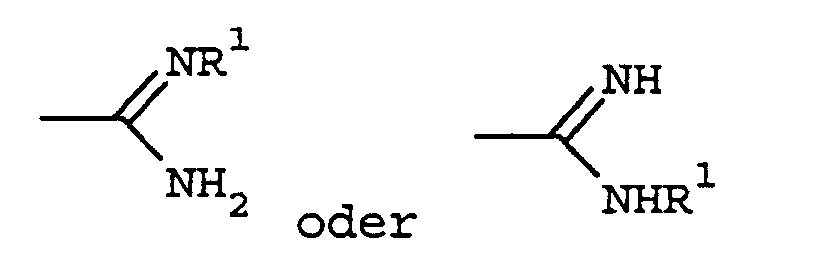
- R1
- für Wasserstoff, Hydroxy, Alkyl, Alkoxy, Alkylcarbonyl,
Alkycarbonyloxy, Aralkoxycarbonyl oder einen
Rest der Formel (a),
steht, wobei
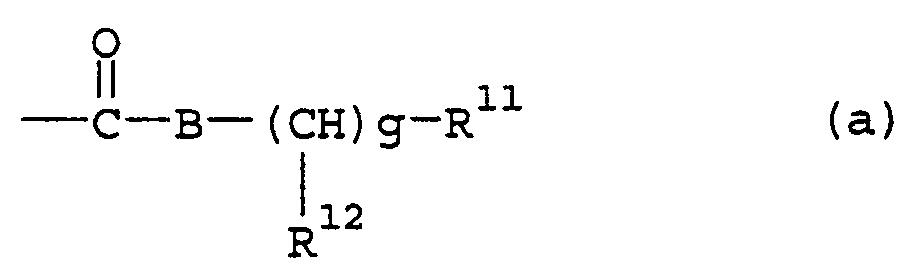
- B
- für Sauerstoff oder Schwefel steht;
- R11 und R12
- unabhängig voneinander für Wasserstoff,
Halogenalkyl, Alkylcarbonyloxy, Dialkylamino oder
einen substituierten oder nicht substituierten 3-
bis 7-gliedrigen gesättigten oder ungesättigten heterocyclischen
oder carbocyclischen Ring stehen;
und - g
- eine ganze Zahl von 0 bis 3 bezeichnet;
- R2
- für Wasserstoff, Hydroxy, Halogen, Carboxy, Aminocarbonyl, Alkyl, Alkoxy, Hydroxyalkyl, Aminoalkyl, Alkylcarbonyl, Alkylsulfonyl, Carboxyalkyl, Aminocarbonylalkyl, Alkoxycarbonylalkyl oder ein substituiertes oder nicht substituiertes Arylsulfonyl steht;
- R3
- für Wasserstoff, Halogen, Alkyl, Hydroxyalkyl, Carboxyalkyl,
Alkoxycarbonylalkyl, Alkoxycarbonyl,
Carboxy, Amino, Aminoalkyl, Aminocarbonyl, Aminocarbonylalkyl
oder einen Rest der Formel (b),
steht, wobei

- R13 und R14
- unabhängig voneinander für Wasserstoff, Alkyl, oder einen substituierten oder nicht substituierten 3- bis 7-gliedrigen gesättigten oder ungesättigten heterocyclischen oder carbocyclischen Ring stehen; und
- h
- eine ganze Zahl von 0 bis 3 bezeichnet;
die Gruppe der Formelfür einen Rest steht, der ausgewählt ist aus der Gruppe, bestehend aus Indolyl, Benzofuranyl, Benzothienyl, Benzoimidazolyl, Benzoxazolyl, Benzothiazolyl, Naphthyl, Tetrahydronaphthyl, Indanyl, Dihydrobenzofuranyl und Dihydrobenzothienyl;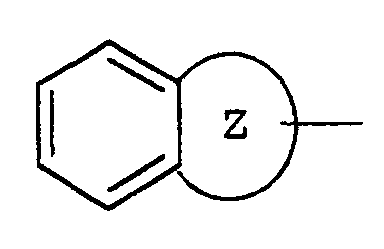
- A
- für eine gesättigte oder ungesättigte Alkylengruppe mit 2 bis 4 Kohlenstoffatomen steht, welche 1 oder 2 Substituenten besitzt, die aus der Gruppe ausgewählt sind, bestehend aus Carboxy, Alkyl, Hydroxyalkyl, Carboxyalkyl, Alkylcarbonyl, Alkoxycarbonyl und Alkoxycarbonylalkyl;
- W
- für eine Gruppe der Formel (c), (d) oder (e),
steht, wobei

- o, p und q
- unabhängig voneinander eine ganze Zahl von 0 bis 3 bezeichnen,
- R4, R5 und R6
- unabhängig voneinander für Wasserstoff,
Hydroxy, Carboxy, Alkoxycarbonyl, substituiertes
oder nicht substituiertes Arylsulfonyl, oder einen
substituierten oder nicht substituierten 3- bis 7-gliedrigen
gesättigten oder ungesättigten heterocyclischen
oder carbocyclischen Ring stehen, oder
für eine Gruppe der Formel (f), (g) oder (h),
stehen, wobei
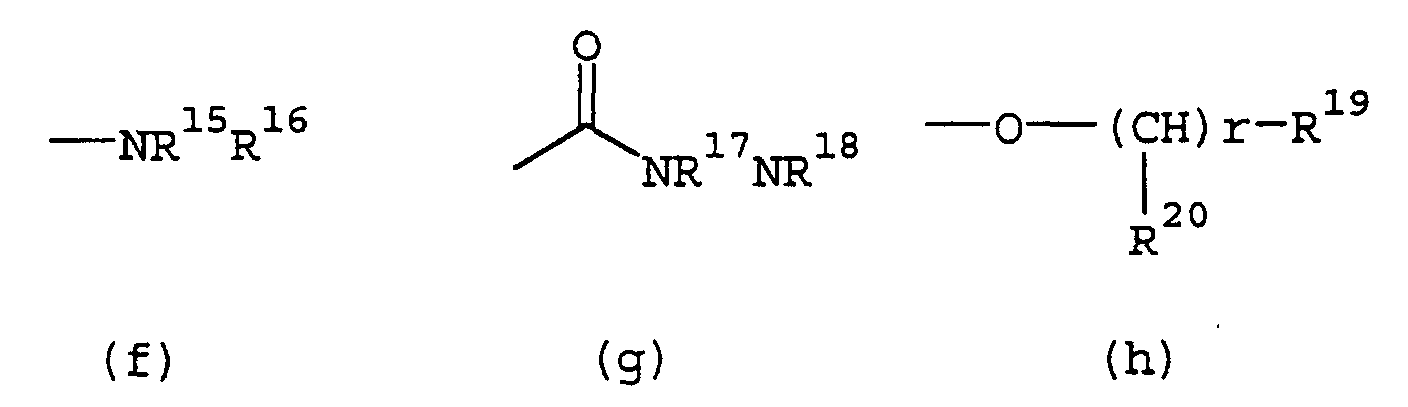
- R15, R16, R17 und R18
- unabhängig voneinander für Wasserstoff, Alkyl, Alkylsulfonyl, Carboxyalkyl, Alkylcarbonyl, Aminocarbonylalkyl, Alkoxycarbonylalkyl, substituiertes oder nicht substituiertes Arylsulfonyl, substituiertes oder nicht substituiertes Aralkyl, oder einen substituierten oder nicht substituierten 3- bis 7-gliedrigen gesättigten oder ungesättigten heterocyclischen oder carbocyclischen Ring stehen;
- R19 und R20
- unabhängig voneinander für Wasserstoff, Carboxy, Aminocarbonyl oder Alkoxycarbonyl stehen, oder für einen 3- bis 7-gliedrigen gesättigten oder ungesättigten heterocyclischen oder carbocyclischen Ring stehen, welcher mit einem oder mehreren 3- bis 7-gliedrigen gesättigten oder ungesättigten heterocyclischen oder carbocyclischen Ringen kondensiert sein kann; und
- r
- eine ganze Zahl von 0 bis 3 bezeichnet;
- Y
- für Wasserstoff oder einen 3- bis 7-gliedrigen gesättigten
oder ungesättigten heterocyclischen oder
carbocyclischen Ring steht, welcher mit einem oder
mehreren 3- bis 7-gliedrigen gesättigten oder ungesättigten
heterocyclischen oder carbocyclischen
Ringen kondensiert sein kann und welcher an einem
beliebigen Atom des Rings mit einem Substituenten
substituiert sein kann, der aus der Gruppe ausgewählt
ist, bestehend aus Sauerstoff, Halogen,
Nitro, Alkyl, Halogenalkyl, Hydroxyalkyl, Alkylsulfonyl,
substituiertem oder nicht substituiertem
Arylsulfonyl, substituiertem oder nicht substituiertem
3- bis 7-gliedrigen gesättigten oder ungesättigten
heterocyclischen oder carbocyclischen
Ring und einer Gruppe der Formel (i), (j) und (k),
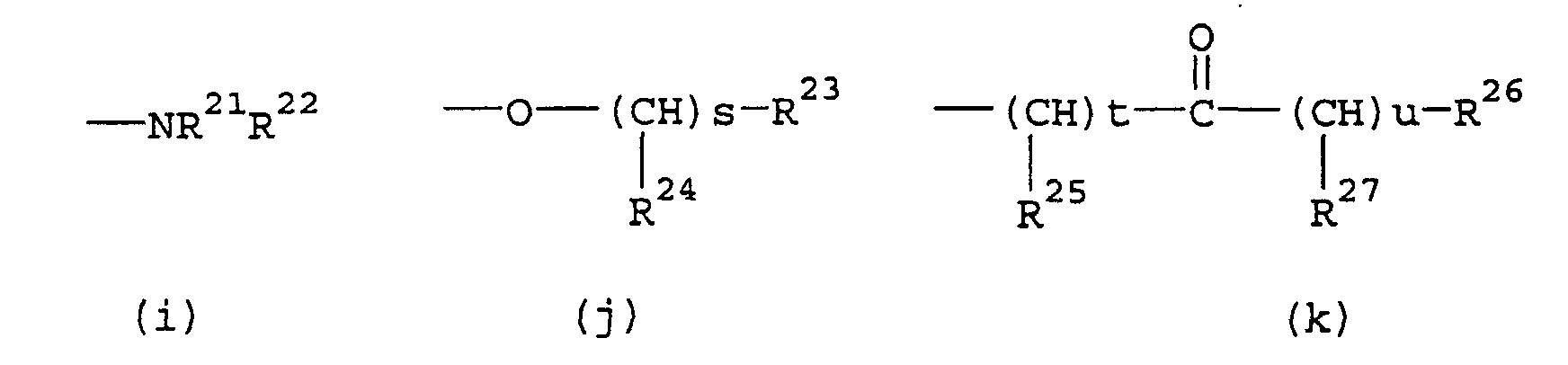
- R21 und R22
- unabhängig voneinander für Wasserstoff, Alkyl, Alkylsulfonyl, Carboxyalkyl, Alkylcarbonyl, Alkoxycarbonylalkyl oder substituiertes oder nicht substituiertes Arylsulfonyl stehen;
- R23 und R24
- unabhängig voneinander für Wasserstoff, Carboxy, Aminocarbonyl, Alkoxycarbonyl oder einen 3- bis 7-gliedrigen gesättigten oder ungesättigten heterocyclischen oder carbocyclischen Ring stehen, welcher mit einem oder mehreren 3- bis 7-gliedrigen gesättigten oder ungesättigten heterocyclischen oder carbocyclischen Ringen kondensiert sein kann;
- R25, R26 und R27
- unabhängig voneinander für Wasserstoff, Hydroxy, Thio, Amino, Carboxy, Aminocarbonyl, Alkoxy, Alkoxycarbonyl, Alkylamino, Alkylsulfonylamino, Alkenyl, Alkoxycarbonylamino, Cycloalkylamino, Alkoxycarbonylalkylamino, substituiertes oder nicht substituiertes Arylsulfonylamino oder einen substituierten oder nicht substituierten 3- bis 7-gliedrigen gesättigten oder ungesättigten heterocyclischen oder carbocyclischen Ring stehen;
- s
- eine ganze Zahl von 0 bis 3 bezeichnet;
- t
- eine ganze Zahl von 0 bis 6 bezeichnet; und
- u
- eine ganze Zahl von 0 bis 8 bezeichnet; und
- n
- eine ganze Zahl von 0 bis 2 bezeichnet,
- Verbindung nach Anspruch 1, wobei
- R
- für eine Gruppe der Formel
steht, wobei
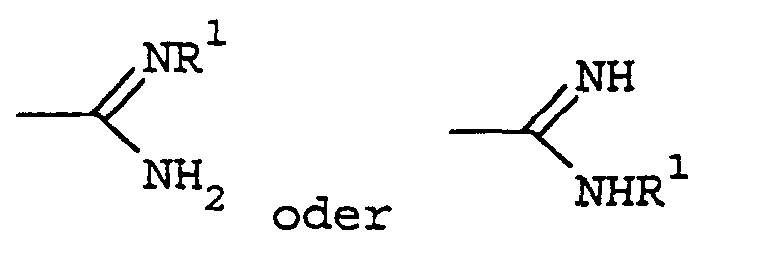
- R1
- für Wasserstoff, Hydroxy, C1-4-Alkyl, C1-4-Alkoxy,
C2-4-Alkylcarbonyl, C2-4-Alkycarbonyloxy oder einen
Rest der Formel (a),
steht, wobei

- B
- für Sauerstoff oder Schwefel steht;
- R11 und R12
- unabhängig voneinander für Wasserstoff, C1-C4-Halogenalkyl, C2-C4-Alkylcarbonyloxy, C2-C6-Dialkylamino oder einen substituierten oder nicht substituierten 6-gliedrigen carbocyclischen Ring stehen; und
- g
- eine ganze Zahl von 0 bis 3 bezeichnet;
- R2
- für Wasserstoff, Halogen, Carboxy, C1-C4-Alkyl, C1-C4-Alkoxy, C1-C4-Hydroxyalkyl, C1-C4-Aminoalkyl, C2-C4-Alkylcarbonyl, C1-C4-Alkylsulfonyl, C2-C4-Carboxyalkyl, C2-C4-Aminocarbonylalkyl oder C3-C7-Alkoxycarbonylalkyl steht;
- R3
- für Wasserstoff, Halogen, C1-C4-Alkyl, C1-C4-Hydroxyalkyl,
C2-C4-Carboxyalkyl, C3-C7-Alkoxycarbonylalkyl
oder einen Rest der Formel (b),
steht, wobei
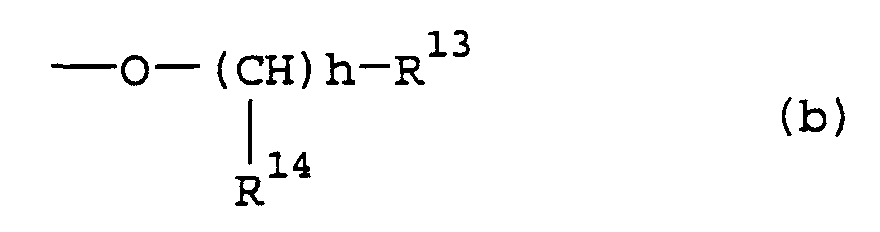
- R13 und R14
- unabhängig voneinander für Wasserstoff oder Phenyl stehen; und
- h
- eine ganze Zahl von 0 bis 1 bezeichnet;
die Gruppe der Formelfür einen Rest steht, der ausgewählt ist aus der Gruppe, bestehend aus Indolyl, Benzofuranyl, Benzothienyl, Benzoimidazolyl und Naphthyl;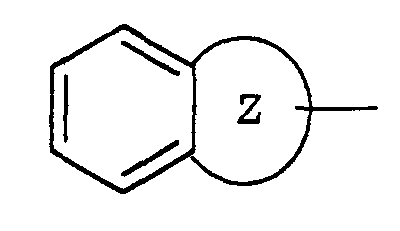
- A
- für eine gesättigte oder ungesättigte Alkylengruppe mit 2 bis 4 Kohlenstoffatomen steht, welche 1 oder 2 Substituenten besitzen kann, die aus der Gruppe ausgewählt sind, bestehend aus Carboxy, C1-C4-Hydroxyalkyl und C2-C4-Alkoxycarbonyl;
- W
- für eine Gruppe der Formel (c), (d) oder (e),
steht, wobei
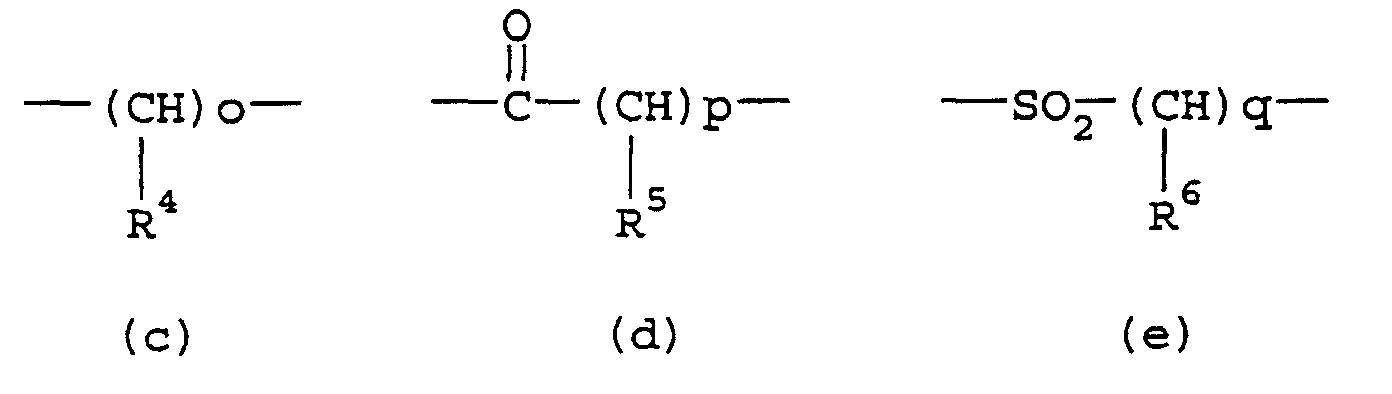
- o, p und q
- unabhängig voneinander eine ganze Zahl von 0 bis 3 bezeichnen,
- R4, R5 und R6
- unabhängig voneinander für Wasserstoff,
Hydroxy, Carboxy, C2-C4-Alkoxycarbonyl, Phenylsulfonyl
oder einen substituierten oder nicht substituierten
3- bis 5-gliedrigen gesättigten oder ungesättigten
heterocyclischen oder carbocyclischen
Ring stehen, oder für eine Gruppe der Formel (f),
(g) oder (h),
stehen, wobei
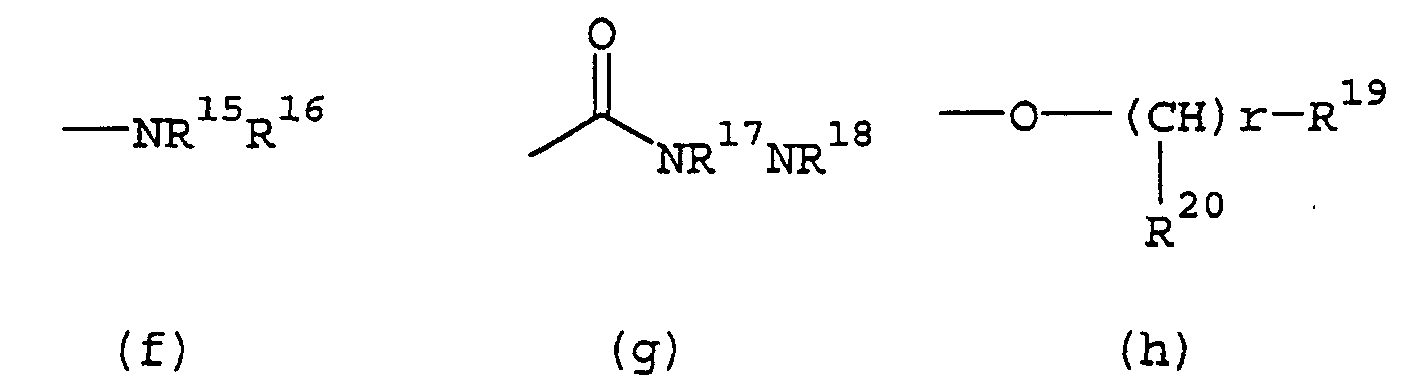
- R15, R16, R17 und R18
- unabhängig voneinander für Wasserstoff, C1-C4-Alkyl, C1-C4-Alkylsulfonyl, C2-C4-Carboxyalkyl, C2-C4-Alkylcarbonyl, C2-C4-Aminocarbonylalkyl, C3-C7-Alkoxycarbonylalkyl oder einen substituierten oder nicht substituierten 3- bis 5-gliedrigen gesättigten oder ungesättigten heterocyclischen oder carbocyclischen Ring stehen;
- R19 und R20
- unabhängig voneinander für Wasserstoff, Carboxy, Aminocarbonyl oder C2-C4-Alkoxycarbonyl stehen, oder für einen 5- bis 6-gliedrigen gesättigten oder ungesättigten heterocyclischen oder carbocyclischen Ring stehen, welcher mit einem oder mehreren 5- bis 6-gliedrigen gesättigten oder ungesättigten heterocyclischen oder carbocyclischen Ringen kondensiert sein kann; und
- r
- eine ganze Zahl von 0 bis 3 bezeichnet;
- Y
- für Wasserstoff steht oder für einen 5- bis 6-gliedrigen
gesättigten oder ungesättigten heterocyclischen
oder carbocyclischen Ring steht, welcher
mit einem oder mehreren 5- bis 6-gliedrigen
gesättigten oder ungesättigten heterocyclischen
oder carbocyclischen Ringen kondensiert sein kann
und welcher an einem beliebigen Atom des Rings mit
einem Substituenten substituiert sein kann, der
aus der Gruppe ausgewählt ist, bestehend aus Sauerstoff,
Halogen, Nitro, C1-C4-Alkyl,
C1-C4-Halogenalkyl, C1-C4-Hydroxyalkyl,
C1-C4-Alkylsulfonyl, Phenylsulfonyl, einem substituierten
oder nicht substituierten 3- bis 5-gliedrigen
gesättigten oder ungesättigten heterocyclischen
oder carbocyclischen Ring, und einer Gruppe
der Formel (i), (j) und (k),
wobei
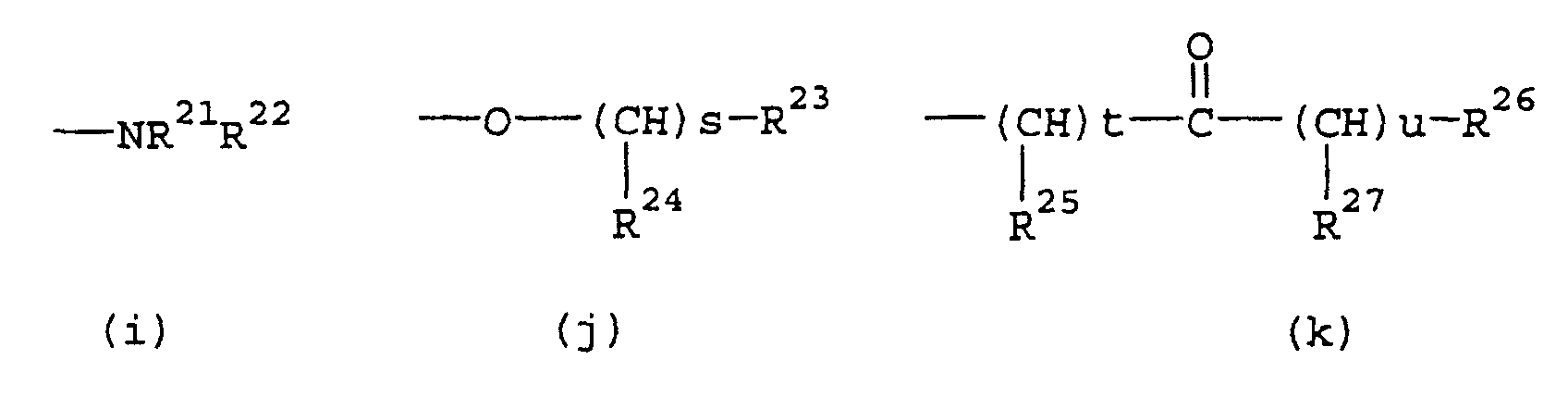
- R21 und R22
- unabhängig voneinander für Wasserstoff, C1-C4-Alkyl, C1-C4-Alkylsulfonyl, C2-C5-Carboxyalkyl, C2-C5-Alkylcarbonyl, C3-C7-Alkoxycarbonylalkyl oder Phenylsulfonyl stehen;
- R23 und R24
- unabhängig voneinander für Wasserstoff, Carboxy, Aminocarbonyl, C2-C4-Alkoxycarbonyl oder einen 3- bis 5-gliedrigen gesättigten oder ungesättigten heterocyclischen oder carbocyclischen Ring stehen, welcher mit einem oder mehreren 3- bis 5-gliedrigen gesättigten oder ungesättigten heterocyclischen oder carbocyclischen Ringen kondensiert sein kann;
- R25, R26 und R27
- unabhängig voneinander für Wasserstoff, Hydroxy, Thio, Amino, Carboxy, Aminocarbonyl, C1-C4-Alkoxy, C2-C4-Alkoxycarbonyl, C1-C4-Alkylamino, C1-C4-Alkylsulfonylamino, C2-C5-Alkenyl, C2-C4-Alkoxycarbonylamino, C3-C6-Alkoxycarbonylalkylamino, C3-C6-Cycloalkylamino, Phenylsulfonylamino oder einen substituierten oder nicht substituierten 3- bis 5-gliedrigen gesättigten oder ungesättigten heterocyclischen oder carbocyclischen Ring stehen;
- s
- eine ganze Zahl von 0 bis 3 bezeichnet;
- t
- eine ganze Zahl von 0 bis 6 bezeichnet; und
- u
- eine ganze Zahl von 0 bis 8 bezeichnet; und
- n
- eine ganze Zahl von 0 bis 2 bezeichnet,
- Verbindung nach Anspruch 1, welche aus der Gruppe ausgewählt ist, bestehend aus:3-[[(S)-2-[2-(6-Amidino-1-ethylindol-2-yl)ethyl]pyrrolidin-2-yl]methyl]benzo[b] thiophen-2-carboxamid,3-[[(S)-2-[2-(6-Amidino-1-methylindol-2-yl)ethyl]pyrrolidin-2-yl]methyl]benzo[b]thiophen-2-carboxamid,1-Ethyl-2-[2-[(S)-1-[2-(3-chlorphenyl)acetyl]pyrrolidin-2-yl]ethyl]indol-6-carboxyamidin,2-[2-[(S)-2-[2-(6-Amidino-1-ethylindol-2-yl)ethyl]pyrrolidinyl]-2-oxoethyl]benzoesäure,1-Ethyl-2-[2-[(S)-1-(2-cyclopenyl-2-phenylacetyl)pyrrolidin-2-yl]ethyl]-indol-6-carboxamidin,1-Ethyl-2-[2-[(S)-1-((R)-2-methylsulfonylamino-2-phenylacetyl)pyrrolidin-2-yl]ethyl]indol-6-carboxamidin,Ethyl-2-[[(R)-2-[2-[(S)-2-[2-(6-amidino-1-ethylindol-2-yl)ethyl]pyrrolidinyl]-2-oxo-1-phenyl]ethyl]amino] acetat,1-Ethyl-2-[2-[(S)-1-[(R)-2-carbamoylmethylamino)-2-phenylacetyl]pyrrolidin-2-yl]ethyl]indol-6-carboxamidin,2- [[(R)-2- [2- [(S)-2- [2- (6-Amidino-1-ethylindol-2-yl)ethyl]pyrrolidinyl]-2-oxo-1-phenylethyl]amino]essigsäure,1-Ethyl-2-[2-[(S)-1-(2-cyclopenylacetyl)pyrrolidin-2-yl]ethyl]indol-6-carboxamidin,Ethyl-3-[(S)-2-[2-(6-amidino-1-ethylindol-2-yl)ethyl]pyrrolidinyl]-2-cyclopentyl-3-oxopropanoat,1-Ethyl-2-[2-[(S)-1-(2-cyclohexylacetyl)pyrrolidin-2-yl]ethyl]indol-6-carboxamidin,1-Ethyl-2-[2-[(S)-1-(2-cyclopropylaminoacetyl)pyrrolidin-2-yl]ethyl]indol-6-carboxamidin,1-Ethyl-2-[2-[(S)-1-[2-[cyclopropyl (methylsulfonyl)amino] acetyl]pyrrolidin-2-yl] ethyl] indol-6-carboxamidin,Ethyl-2-[[2-[(S)-2-[2-(6-amidino-1-ethylindol-2-yl)ethyl]pyrrolidinyl]-2-oxoethyl]cyclopropylamino]acetat,Ethyl-2-[[2-[(S)-2-[2-(6-amidino-1-ethylindol-2-yl)ethyl]pyrrolidinyl]-1-methyl-2-oxoethyl]cyclopropylamino]acetat,2- [[2-[(S)-2- [2- (6-Amidino-1-ethylindol-2-yl)ethyl]pyrrolidinyl]-1-methyl-2-oxoethyl]cyclopropylamino] essigsäure,Ethyl-4-[(S)-2-[2-(6-amidino-1-ethylindol-2-yl)ethyl]pyrrolidinyl]-2-cyclopropylamino-4-oxo-butanoat,4-[(S)-2-[2-(6-Amidino-1-ethylindol-2-yl)ethyl]pyrrolidinyl]-3-cyclopropylamino-4-oxobutansäure,1-Ethyl-2-[2-[(S)-1-((R)-pyrrolidin-2-ylcarbonyl)pyrrolidin-2-yl]ethyl]-indol-6-carboxamidin,Ethyl-2-[(R)-2-[[(S)-2-[2-(6-amidino-1-methylindol-2-yl)ethyl]pyrrolidinyl]carbonyl]pyrrolidinyl]acetat,Ethyl-2-[(R)-2-[[(S)-2- [2- (6-amidino-1-ethylindol-2-yl) ethyl] pyrrolidinyl] carbonyl] pyrrolidinyl] acetat,2-[(R)-2-[[(S)-2-[2-(6-Amidino-1-ethylindol-2-yl)ethyl]pyrrolidinyl]carbonyl]pyrrolidinyl]essigsäure,2-[(R)-2-[[(S)-2-[2-(6-Amidino-1-ethylindol-2-yl)ethyl]-(S)-4-methylpyrrolidinyl]carbonyl]pyrrolidinyl]essigsäure,Ethyl-2-[(R)-2-[[(S)-2-[2-(6-amidino-1-ethylindol-2-yl)ethyl]pyrrolidinyl]carbonyl]pyrrolidinyl] propionat,Ethyl-2-[(R)-2-[[(S)-2-[2-(6-amidino-1-ethylindol-2-yl)ethyl]pyrrolidinyl]carbonyl]pyrrolidinyl]butanoat,Ethyl-2- [(R)-2-[[(S)-2-[2-(6-amidino-1-ethylindol-2-yl)ethyl]pyrrolidinyl]carbonyl]pyrrolidinyl]-2-phenylacetat,1-Ethyl-2-[2-[(S)-1-[[(R)-1-(carbamoylmethyl)pyrrolidin-2-yl]carbonyl]pyrrolidin-2-yl)ethyl]indol-6-carboxamidin,1-Ethyl-2-[2-[(S)-1-[[(R)-1-](N-cyclopropylcarbamoyl)methyl]pyrrolidin-2-yl]carbonyl]pyrrolidin-2-yl)ethyl]indol-6-carboxamidin,Ethyl-(S)-2-[2-[(R)-2-[[(S)-2-[2-(6-amidino-1-ethylindol-2-yl)ethyl]pyrrolidinyl]carbonyl]pyrrolidinyl]acetylamino]propanoat,1-Ethyl-2-[2-[(8)-1-[[(R)-1-(1-carbamoyl-3-hydroxypropyl)pyrrolidin-2-yl]carbonyl]pyrrolidin-2-yl]ethyl]indol-6-carboxamidin,2-[(R)-2-[[(S)-2-[2-(6-Amidino-1-ethylindol-2-yl)ethyl]pyrrolidinyl]carbonyl]pyrrolidinyl]-4-hydroxybutansäure,1-[(R)-2-[[(S)-2-[2-(6-Amidino-1-ethylindol-2-yl)ethyl]pyrrolidinyl]carbonyl]pyrrolidinyl]ethan-1,2-dicarbonsäure,1-Ethyl-2-[2-[(S)-1-[[1-(2-oxo-3-oxolanyl)pyrrolidin-2-yl]carbonyl]pyrrolidin-2-yl)ethyl]indol-6-carboxamidin,Ethyl-4-[(R)-2-[[(S)-2-[2-(6-amidino-1-ethylindol-2-yl)ethyl]pyrrolidinyl]carbonyl]pyrrolidinyl]butanoat,4-[(R)-2-[[(S)-2-[2-(6-Amidino-1-ethylindol-2-yl)ethyl]pyrrolidinyl]carbonyl]pyrrolidinyl]butansäure,Ethyl-5-[(R)-2-[[(S)-2-[2-(6-amidino-1-ethylindol-2-yl)ethyl]pyrrolidinyl]carbonyl]pyrrolidinyl]pentanoat,5-[(R)-2-[[(S)-2-[2-(6-Amidino-1-ethylindol-2-yl)ethyl]pyrrolidinyl]carbonyl]pyrrolidinyl]pentansäure,Ethyl-6-[(R)-2-[[(S)-2-[2-(6-amidino-1-ethylindol-2-yl)ethyl]pyrrolidinyl]carbonyl]pyrrolidinyl]hexanoat,6-[(R)-2-[[(S)-2-[2-(6-Amidino-1-ethylindol-2-yl)ethyl]pyrrolidinyl]carbonyl]pyrrolidinyl] hexansäure,1-Ethyl-2-[2-[(S)-1-[[(R)-1-[2-(methylamino)acetyl]pyrrolidin-2-yl]carbonyl]pyrrolidin-2-yl]ethyl]indol-6-carboxamidin,1-Ethyl-2-[2-[(S)-1-[[(R)-1-((S)-2-aminopropanoyl)pyrrolidin-2-yl]carbonyl]pyrrolidin-2-yl]ethyl]indol-6-carboxamidin,1-Ethyl-2-[2-[(S)-1-[[(R)-1-[2-aminobutanoyl)pyrrolidin-2-yl]carbonyl]pyrrolidin-2-yl]ethyl]indol-6-carboxamidin,1-Ethyl-2-[2-[(S)-1-[[(R)-1-((S)-2-amino-3-methylbutanoyl)pyrrolidin-2-yl]carbonyl]pyrrolidin-2-yl]ethyl]indol-6-carboxamidin,1-Ethyl-2-[2-[(S)-1-[[(R)-1-[(S)-2-(methansulfonylamino)propanoyl]pyrrolidin-2-yl]carbonyl]pyrrolidin-2-yl]ethyl]indol-6-carboxamidin,Ethyl-4-[(R)-2-[[(S)-2-[2-(6-amidino-1-ethylindol-2-yl)ethyl]pyrrolidinyl]carbonyl]pyrrolidinyl]-(S)-3-amino-4-oxobutanoat,1-Ethyl-2-[2-[(S)-1-[[(R)-1-(S)-2-amino-3-carbamoylpropanoyl)pyrrolidin-2-yl]carbonyl]pyrrolidin-2-yl]ethyl]indol-6-carboxamidin,4-[(R)-2-[[(S)-2-[2-(6-Amidino-1-ethylindol-2-yl)ethyl]pyrrolidinyl]carbonyl]pyrrolidinyl]-(S)-3-amino-4-oxobutansäure,1-Ethyl-2-[2-[((S)-1-[[(R)-1-(3-aminopropanoyl)pyrrolidin-2-yl]carbonyl]pyrrolidin-2-yl]ethyl]indol-6-carboxamidin,1-Ethyl-2-[2-[(S)-1-[[(R)-1-(3-amino-2-methylpropanoyl)pyrrolidin-2-yl]carbonyl]pyrrolidin-2-yl]ethyl]indol-6-carboxamidin,1-Ethyl-2-[2-[((S)-1-[[(R)-1-(3-aminobutanoyl)pyrrolidin-2-yl] carbonyl]pyrrolidin-2-yl]ethyl]indol-6-carboxamidin,1-Ethyl-2-[2-[(S)-1-[[(R)-1-[3-[(methansulfonyl)amino]propanoyl]pyrrolidin-2-yl]carbonyl]pyrrolidin-2-yl]ethyl]indol-6-carboxamidin,Ethyl-4-[(R)-2-[[(S)-2-[2-(6-amidino-1-ethylindol-2-yl) ethyl]pyrrolidinyl]carbonyl]pyrrolidinyl]-(S)-2-amino-4-oxobutanoat,1-Ethyl-2-[2-[(S)-1-[[(R)-1-((S)-3-amino-3-carbamoylpropanoyl)pyrrolidin-2-yl]carbonyl]pyrrolidin-2-yl]ethyl]indol-6-carboxamidin,4-[(R)-2-[[(S)-2-[2-(6-Amidino-1-ethylindol-2-yl)ethyl]pyrrolidinyl]carbonyl]pyrrolidinyl]-(S)-2-amino-4-oxobutansäure,1-Ethyl-2-[2-[(S)-1-[[1-[(R)-1-[3-carbamoyl-(S)-3-[(methansulfonyl)amino] propanoyl] pyrrolidin-2-yl]carbonyl]pyrrolidin-2-yl]ethyl]indol-6-carboxamidin,4- [(R)-2-[[(S)-2-[2-(6-Amidino-1-ethylindol-2-yl)ethyl]pyrrolidinyl]carbonyl]pyrrolidinyl]-(S)-2-[(methansulfonyl)amino]-4-oxobutansäure,1-Ethyl-2-[2-[(S)-1-[[(R)-1-(4-aminobutanoyl)pyrrolidin-2-yl] carbonyl]pyrrolidin-2-yl]ethyl]indol-6-carboxamidin,1-Ethyl-2-[2-[(S)-1-[[(R)-1-[(2-piperidinyl)carbonyl] pyrrolidin-2-yl]carbonyl]pyrrolidin-2-yl]ethyl]indol-6-carboxamidin,1-Ethyl-2-[2-[(S)-1-[[(R)-1-(3-piperidinylcarbonyl)pyrrolidin-2-yl]carbonyl]pyrrolidin-2-yl]ethyl]indol-6-carboxamidin,1-Ethyl-2-[2-[(S)-1-[[(R)-1-[(4-piperidinyl)carbonyl]pyrrolidin-2-yl]carbonyl]pyrrolidin-2-yl]ethyl]indol-6-carboxamidin,1-Methyl-2-[2-[(S)-1-[((R)-1-acetylpyrrolidin-2-yl)carbonyl]pyrrolidin-2-yl]ethyl]indol-6-carboxamidin,1-Ethyl-2-[2-[(S)-1-[((R)-1-acetylpyrrolidin-2-yl)carbonyl]pyrrolidin-2-yl]ethyl]indol]-6-carboxamidin,1-Ethyl-2-[2-[(S)-1-[[(R)-1-(2-propylpentanoyl)pyrrolidin-2-yl] carbonyl]pyrrolidin-2-yl]ethyl]indol-6-carboxamidin,Ethyl-3-[(R)-2-[[(S)-2-[2-(6-amidino-1-ethylindol-2-yl)ethyl]pyrrolidinyl]carbonyl]pyrrolidinyl-3-oxo-propanoat,1-Ethyl-2-[2-[(S)-1-[[(R)-1-(2-carbamoylacetyl)pyrrolidin-2-yl] carbonyl]pyrrolidin-2-yl]ethyl]indol-6-carboxamidin,Ethyl-4-[(R)-2-[[(S)-2-[2-(6-amidino-1-ethylindol-2-yl) ethyl]pyrrolidinyl] carbonyl] pyrrolidinyl] -4-oxobutanoat,4-[(R)-2-[[(S)-2-[2-(6-Amidino-1-ethylindol-2-yl)ethyl]pyrrolidinyl]carbonyl]pyrrolidinyl-4-oxo-butansäure,1-Ethyl-2-[2-[(S)-1-[[(R)-1-(3-hydroxybutanoyl)pyrrolidin-2-yl] carbonyl]pyrrolidin-2-yl]ethyl] indol-6-carboxamidin,1-Ethyl-2-[2-[(S)-1-[((R)-1-prop-2-enoylpyrrolidin-2-yl)carbonyl]pyrrolidin-2-yl]ethyl]indol-6-carboxamidin,1-Ethyl-2-[2-[(S)-1-[[(R)-1-(methansulfonyl)pyrrolidin-2-yl] carbonyl] pyrrolidin-2-yl]ethyl]indol-6-carboxamidin,1-Ethyl-2-[2-[(S)-1-[[(R)-1-(carbamoylmethyl)-5-oxo-pyrrolidin-2-yl]carbonyl]pyrrolidin-2-yl]ethyl]indol-6-carboxamidin,Methyl-2-[2-[[(S)-2-[2-(6-amidino-1-ethylindol-2-yl)ethyl]pyrrolidinyl]carbonyl]piperidinyl]acetat,1-Ethyl-2-[2-[(S)-1-[(3-piperidinyl)carbonyl]pyrrolidin-2-yl]ethyl]indol-6-carboxamidin,Ethyl-1-[2- [(S)-2-[2-(6-amidino-1-ethylindol-2-yl)ethyl]pyrrolidinyl]-2-oxoethyl]pyrrolidin-2-carboxylat,Ethyl-2-[2-[2-[(S)-1-[((R)-1-acetylpyrrolidin-2-yl-carbonyl]pyrrolidin-2-yl]ethyl]-6-amidinoindolyl]acetat,2-[2-[(S)-1-((R)-1-Acetylpyrrolidin-2-yl)carbonyl]pyrrolidin-2-yl]ethyl]-1-(carbamoylmethyl)indol-6-carboxamidin, und6-[2-[(S)-1-(2-Phenylacetyl)pyrrolidin-2-yl]ethyl]naphthalen-2-carboxamidin.
- Thrombininhibitorzusammensetzung, welche als einen aktiven Bestandteil die wie in Anspruch 1 definierte Verbindung der Formel (I) oder das pharmazeutisch akzeptable Salz davon zusammen mit einem pharmazeutisch akzeptablen Träger enthält.
- Thrombininhibitorzusammensetzung nach Anspruch 4, welche zur Vorbeugung und Behandlung von Thrombose verwendbar ist.
- Thrombininhibitorzusammensetzung nach Anspruch 4, welche als ein orales Präparat formuliert ist.
- Verfahren zur Herstellung der wie in Anspruch 1 definierten Verbindung der Formel (I) und deren Salze, dadurch gekennzeichnet, daß:(a) eine Aminoschutzgruppe einer Verbindung der Formel (V):wobei
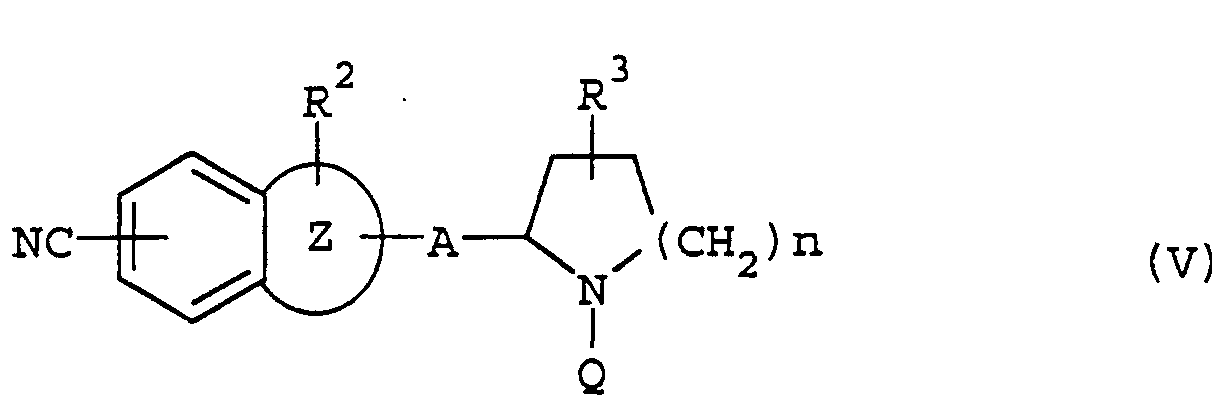 R2, R3, A und n wie in Anspruch 1 definiert sind und Q für eine Aminoschutzgruppe steht,

entfernt wird, um eine Verbindung der Formel (IV) :zu erhalten, wobei R2, R3, A und n wie in Anspruch 1 definiert sind;
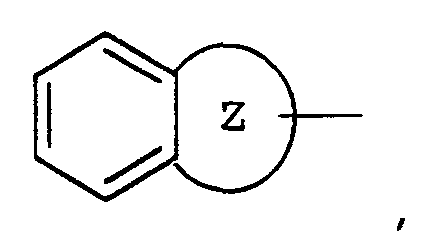 (b) die dadurch erhaltene Nitrilverbindung der Formel (IV) mit einer Verbindung der Formel (VI) :zu erhalten, wobei
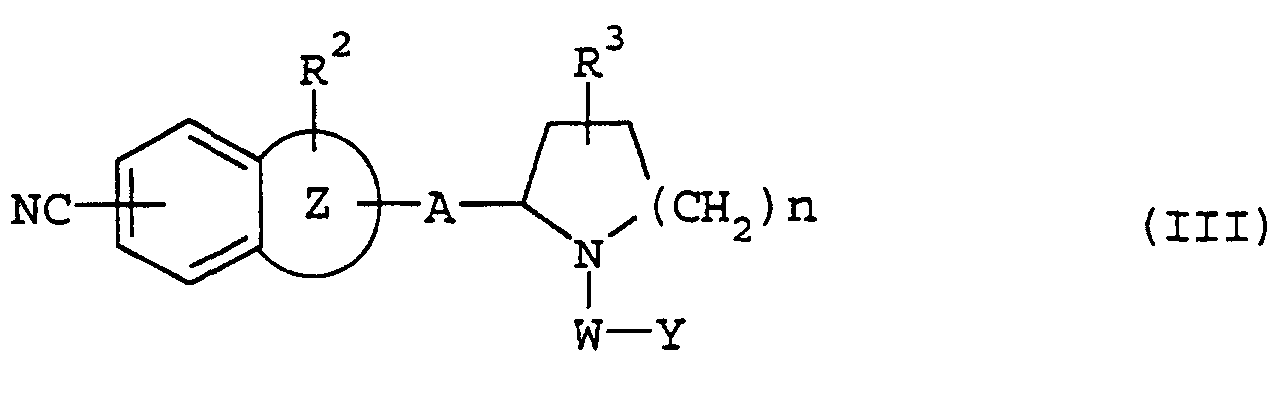 R2, R3, A, Y, W und n wie in Anspruch 1 definiert sind;
 (c) die Verbindung der Formel (III) mit einer Alkoholverbindung der Formel (VII) :zu erhalten, wobei
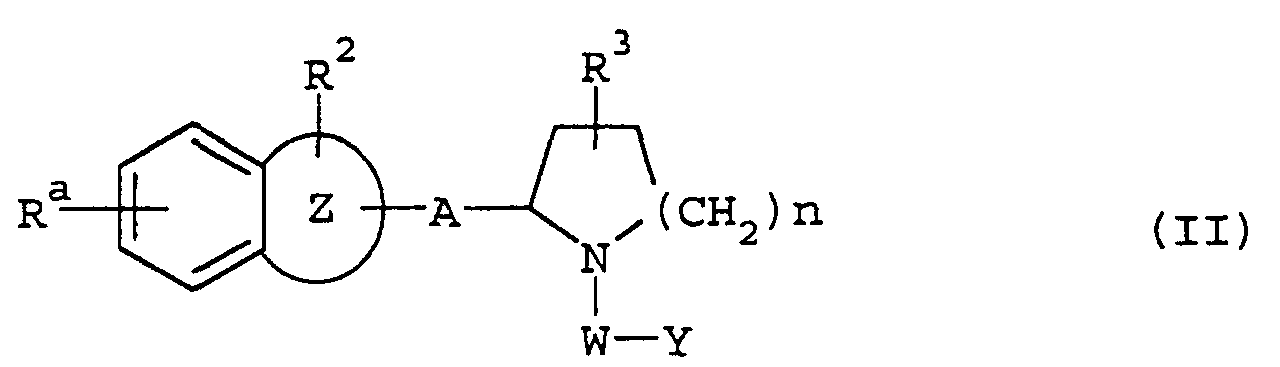 R2, R3, A, Y, W und n wie in Anspruch 1 definiert sind und Ra eine Gruppe der Formel
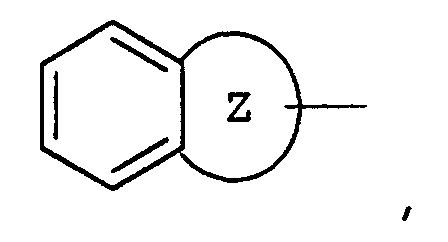 ist, wobei R1 wie in Anspruch 1 definiert ist; und;
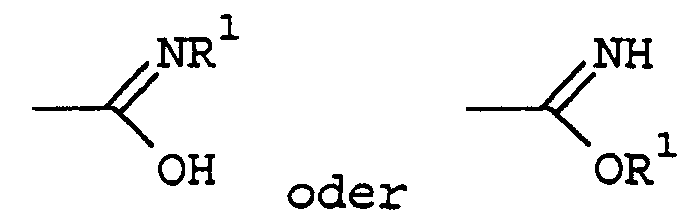 (d) die Verbindung der Formel (II) mit Ammoniak umgesetzt wird.
- Verbindung der Formel (II):und deren Salze, wobei
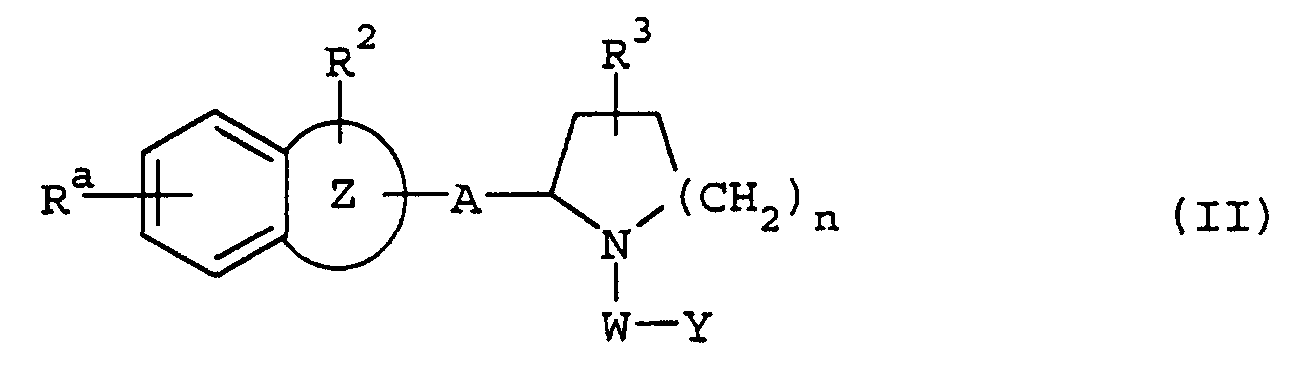 R2, R3, A, Y, W und n wie in Anspruch 1 definiert sind und Ra eine Gruppe der Formel
 ist, wobei R1 wie in Anspruch 1 definiert ist.
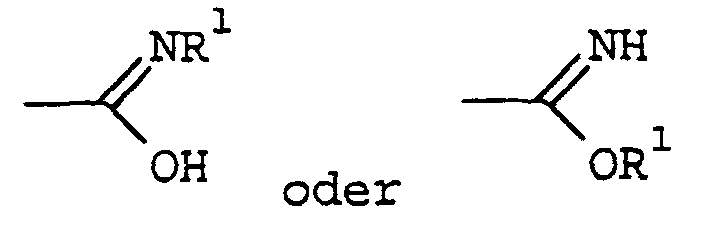
- Verbindung der Formel (III):und deren Salze, wobei
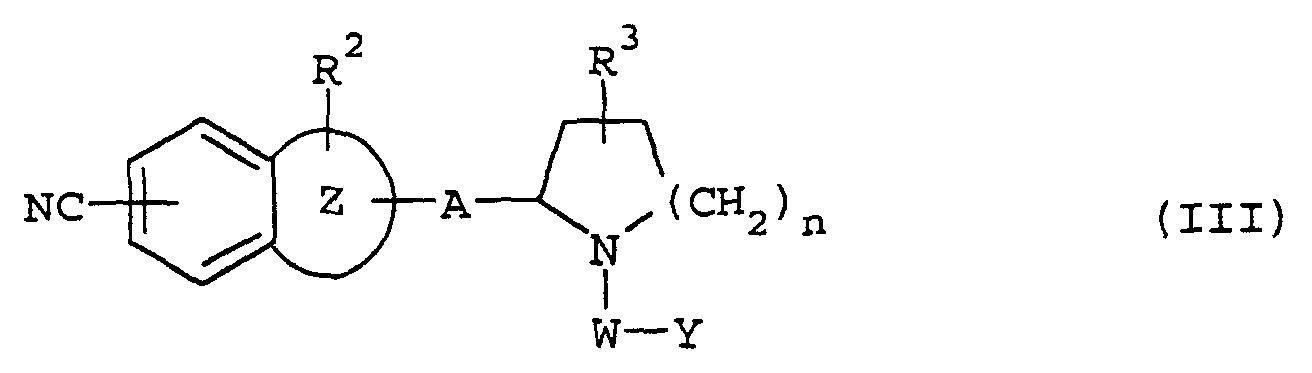 R2, R3, A, Y, W und n wie in Anspruch 1 definiert sind.
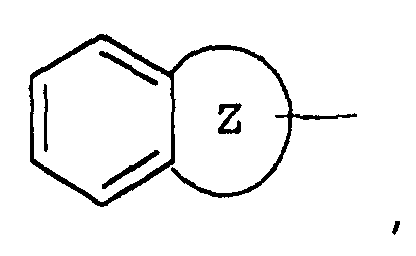
- Verbindung der Formel (IV):und deren Salze, wobei
 R2, R3, A und n wie in Anspruch 1 definiert sind.
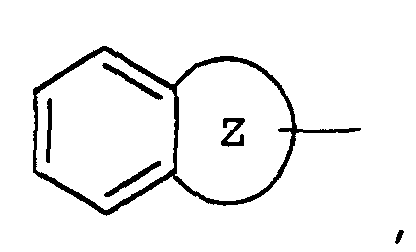
- Verbindung der Formel (V):und deren Salze, wobei
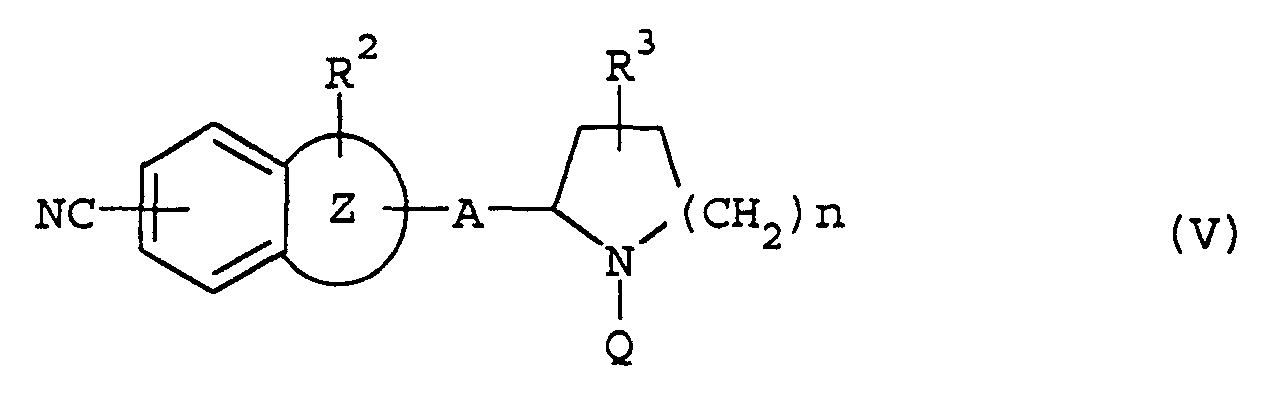 R2, R3, A und n wie in Anspruch 1 definiert sind und Q für eine Aminoschutzgruppe steht.
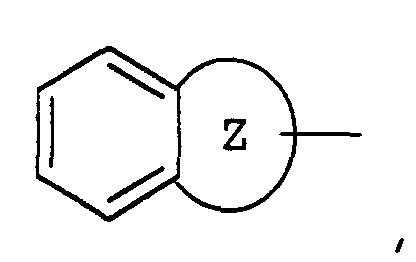
- Verfahren zur Herstellung der wie in Anspruch 11 definierten Verbindung der Formel (V) und deren Salz, umfassend ein Umsetzen einer Verbindung der Formel (4):wobei
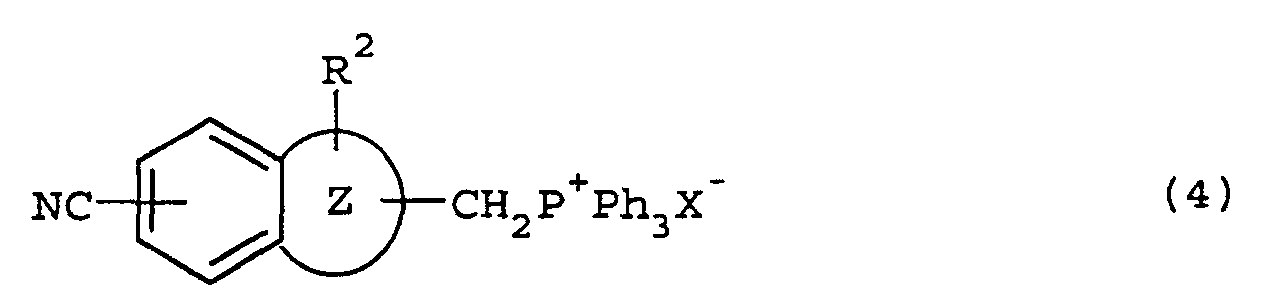 und R2 wie in Anspruch 1 definiert sind, mit einer Verbindung der Formel (5):
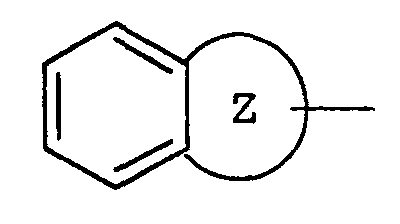 wobei R3 und n wie in Anspruch 1 definiert sind, zwei L-Gruppen gleich oder verschieden sein können und für Wasserstoff, Alkyl, Alkoxycarbonyl oder Alkoxycarbonylalkyl stehen, Q für eine Aminoschutzgruppe steht, X für ein Halogen steht und v eine ganze Zahl von 0 bis 2 bezeichnet.

- Verfahren zur Herstellung der wie in Anspruch 11 definierten Verbindung der Formel (V) und deren Salz, umfassend ein Umsetzen einer Verbindung der Formel (7):wobei
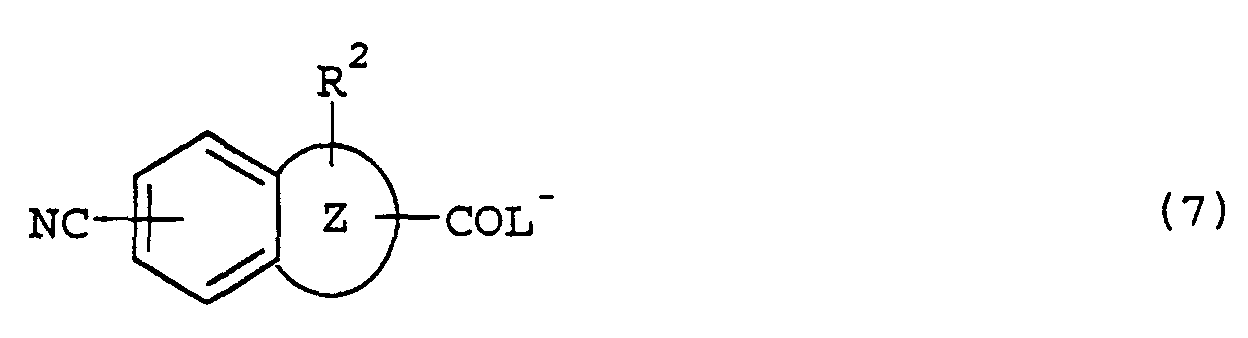 und R2 wie in Anspruch 1 definiert sind und L für Wasserstoff, Alkyl, Alkoxycarbonyl oder Alkoxycarbonylalkyl steht, mit einer Verbindung der Formel (8) :
 wobei R3 and n wie in Anspruch 1 definiert sind, Q für eine Aminoschutzgruppe steht, X für ein Halogen steht, L für Wasserstoff, Alkyl, Alkoxycarbonyl oder Alkoxycarbonylalkyl steht und v eine ganze Zahl von 0 bis 2 bezeichnet.
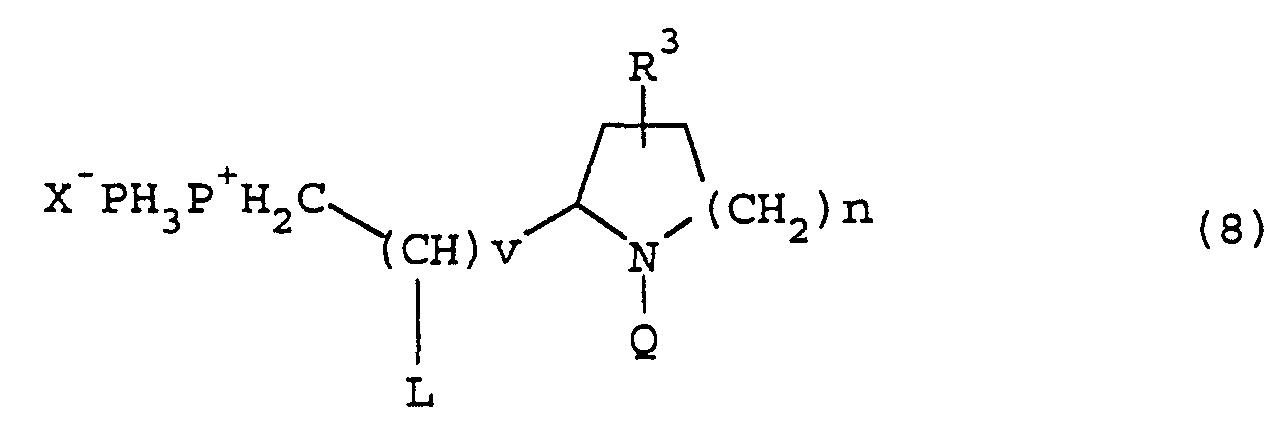
Applications Claiming Priority (3)
| Application Number | Priority Date | Filing Date | Title |
|---|---|---|---|
| KR9619282 | 1996-05-31 | ||
| KR19960019282 | 1996-05-31 | ||
| PCT/KR1997/000100 WO1997045424A1 (en) | 1996-05-31 | 1997-05-31 | Aromatic amidine derivatives useful as selective thrombin inhibitors |
Publications (2)
| Publication Number | Publication Date |
|---|---|
| EP0918768A1 EP0918768A1 (de) | 1999-06-02 |
| EP0918768B1 true EP0918768B1 (de) | 2002-01-09 |
Family
ID=19460481
Family Applications (1)
| Application Number | Title | Priority Date | Filing Date |
|---|---|---|---|
| EP97925316A Expired - Lifetime EP0918768B1 (de) | 1996-05-31 | 1997-05-31 | Aromatische amidinderivate als selektive thrombininhibitoren |
Country Status (11)
| Country | Link |
|---|---|
| US (1) | US6201006B1 (de) |
| EP (1) | EP0918768B1 (de) |
| JP (1) | JP3202994B2 (de) |
| KR (1) | KR100469028B1 (de) |
| CN (1) | CN1079396C (de) |
| AT (1) | ATE211741T1 (de) |
| AU (1) | AU3049497A (de) |
| CA (1) | CA2256438C (de) |
| DE (1) | DE69709933T2 (de) |
| ES (1) | ES2171945T3 (de) |
| WO (1) | WO1997045424A1 (de) |
Families Citing this family (17)
| Publication number | Priority date | Publication date | Assignee | Title |
|---|---|---|---|---|
| US6602864B1 (en) * | 1996-12-13 | 2003-08-05 | Aventis Pharma Deutschland Gmbh | Sulfonic acid or sulfonylamino N-(heteroaralkyl)-azaheterocyclylamide compounds |
| KR19990043605A (ko) * | 1997-11-29 | 1999-06-15 | 이경하 | 선택적 트롬빈 억제제로 유용한 방향족 아미딘유도체 |
| SK15072000A3 (sk) | 1998-04-10 | 2001-08-06 | Japan Tobacco Inc. | Amidové zlúčeniny |
| AU5319700A (en) | 1999-06-02 | 2000-12-18 | S. Mbua Ngale Efange | Nicotine receptor ligands |
| GB9924155D0 (en) * | 1999-10-12 | 1999-12-15 | Rhone Poulenc Rorer Pharma | Chemical compounds |
| ES2250196T3 (es) * | 1999-08-26 | 2006-04-16 | Aventis Pharmaceuticals Inc. | Aminoiminometil o aminometil dihidrobenzofuranos y benzopiranos sustituidos. |
| IL149544A0 (en) * | 1999-11-10 | 2002-11-10 | Aventis Pharma Gmbh | N-ACYLPYRROLIDIN-2-YLALKYLBENZAMIDINE DERIVATIVES AS INHIBITORS OF FACTOR Xa |
| US7361663B2 (en) * | 1999-11-10 | 2008-04-22 | Aventis Pharmaceuticals Inc. | N-acylpyrrolidin-2-ylalkylbenzamidine derivatives as inhibitors of factor Xa |
| JP2007511467A (ja) * | 2003-05-14 | 2007-05-10 | タケダ サン ディエゴ インコーポレイテッド | ジペプチジルペプチダーゼインヒビター |
| JP2005350417A (ja) * | 2004-06-11 | 2005-12-22 | Dai Ichi Seiyaku Co Ltd | 還元的エーテル化法を用いたピロリジン誘導体の製造法 |
| WO2006038119A1 (en) * | 2004-10-08 | 2006-04-13 | Warner-Lambert Company Llc | Stereoselective synthesis of n-protected alkoxy prolines |
| GB0507577D0 (en) | 2005-04-14 | 2005-05-18 | Novartis Ag | Organic compounds |
| EP2023874A4 (de) * | 2006-06-02 | 2009-07-08 | Bioseek Inc | Verfahren zur identifizierung von wirkstoffen und ihre verwendung zur prävention von restenose |
| EP2085397A1 (de) * | 2008-01-21 | 2009-08-05 | Esteve Quimica, S.A. | Kristalline Form von Abacavir |
| WO2012153135A1 (en) | 2011-05-09 | 2012-11-15 | University Of Glasgow | Methods of modulating micrornas in the treatment of pulmonary arterial hypertension |
| JP7692353B2 (ja) * | 2018-10-02 | 2025-06-13 | ディスク・メディスン,インコーポレイテッド | マトリプターゼ2阻害剤及びその使用 |
| CN113956192A (zh) * | 2021-11-16 | 2022-01-21 | 上海延安药业(湖北)有限公司 | 一种阿维巴坦中间体的合成方法 |
Family Cites Families (4)
| Publication number | Priority date | Publication date | Assignee | Title |
|---|---|---|---|---|
| US4258192A (en) * | 1977-12-16 | 1981-03-24 | Mitsubishi Chemical Industries Limited | N2 -Arylsulfonyl-L-argininamides and the pharmaceutically acceptable salts thereof |
| JPS5813549A (ja) * | 1981-07-15 | 1983-01-26 | Kowa Co | 新規フエニルエステル類 |
| ZA928276B (en) * | 1991-10-31 | 1993-05-06 | Daiichi Seiyaku Co | Aromatic amidine derivates and salts thereof. |
| JPH0820532A (ja) * | 1994-07-05 | 1996-01-23 | Dai Ichi Seiyaku Co Ltd | 抗膵炎剤 |
-
1997
- 1997-05-31 AU AU30494/97A patent/AU3049497A/en not_active Abandoned
- 1997-05-31 CN CN97195005A patent/CN1079396C/zh not_active Expired - Fee Related
- 1997-05-31 KR KR1019970022566A patent/KR100469028B1/ko not_active Expired - Fee Related
- 1997-05-31 DE DE69709933T patent/DE69709933T2/de not_active Expired - Fee Related
- 1997-05-31 JP JP54206597A patent/JP3202994B2/ja not_active Expired - Fee Related
- 1997-05-31 WO PCT/KR1997/000100 patent/WO1997045424A1/en not_active Ceased
- 1997-05-31 AT AT97925316T patent/ATE211741T1/de not_active IP Right Cessation
- 1997-05-31 CA CA002256438A patent/CA2256438C/en not_active Expired - Fee Related
- 1997-05-31 ES ES97925316T patent/ES2171945T3/es not_active Expired - Lifetime
- 1997-05-31 EP EP97925316A patent/EP0918768B1/de not_active Expired - Lifetime
- 1997-05-31 US US09/180,675 patent/US6201006B1/en not_active Expired - Fee Related
Also Published As
| Publication number | Publication date |
|---|---|
| JP3202994B2 (ja) | 2001-08-27 |
| JP2000504030A (ja) | 2000-04-04 |
| CA2256438C (en) | 2002-10-15 |
| CN1079396C (zh) | 2002-02-20 |
| US6201006B1 (en) | 2001-03-13 |
| CN1219932A (zh) | 1999-06-16 |
| ES2171945T3 (es) | 2002-09-16 |
| WO1997045424A1 (en) | 1997-12-04 |
| CA2256438A1 (en) | 1997-12-04 |
| KR970074779A (ko) | 1997-12-10 |
| DE69709933D1 (en) | 2002-02-28 |
| ATE211741T1 (de) | 2002-01-15 |
| DE69709933T2 (de) | 2002-08-29 |
| KR100469028B1 (ko) | 2005-07-07 |
| EP0918768A1 (de) | 1999-06-02 |
| AU3049497A (en) | 1998-01-05 |
Similar Documents
| Publication | Publication Date | Title |
|---|---|---|
| KR100469028B1 (ko) | 선택적트롬빈억제제로유용한방향족아미딘유도체 | |
| JP3461441B2 (ja) | 芳香族アミジン誘導体又はその塩及びその製造中間体 | |
| US4316905A (en) | Mercaptoacyl derivatives of various 4-substituted prolines | |
| CN1326858C (zh) | 三环螺哌啶化合物 | |
| CA2252163C (en) | D-proline derivatives | |
| EP1636224B1 (de) | Pyrrolopyridin-2-carbonsäuren als hemmer der glycogenphosphorylase | |
| CA2464358C (en) | Alkyl ether derivatives or their salts | |
| NO870981L (no) | Mellomprodukter. | |
| AU3552299A (en) | Substituted pyrrolidine hydroxamate metalloprotease inhibitors | |
| JP3810097B2 (ja) | ピロリジン−2−イルカルボニル複素環式化合物誘導体 | |
| WO2000017162A1 (en) | Novel thiol derivatives, process for producing the same and utilization thereof | |
| US5158970A (en) | Proline derivatives | |
| EP0238319A1 (de) | Pyrrolidinderivate | |
| US4291040A (en) | Mercaptoacyl derivatives of 4-disubstituted prolines and 4-substituted dehydroprolines | |
| EP1539178A2 (de) | Protease-inhibitoren | |
| EP1567489A1 (de) | Pyrrolidin-2-on-derivate als inhibitoren von thrombin und faktor xa | |
| JP2002534424A (ja) | Mmp阻害剤としてのチオピラン化合物 | |
| US4456761A (en) | 4-Substituted dehydroprolines | |
| JPH02262557A (ja) | 縮合ベンゼン誘導体、それを含有する医薬及び該化合物の製造中間体 | |
| US4499287A (en) | Certain-4-hydroxy-proline derivatives | |
| US4356182A (en) | Mercaptoacyl derivatives of 4-disubstituted prolines | |
| KR20010101950A (ko) | 치환된 방향족 아미딘 유도체 및 이를 함유하는 의약조성물 | |
| HK1166322A1 (en) | Proline derivatives as cathepsin inhibitors | |
| HK1166322B (en) | Proline derivatives as cathepsin inhibitors | |
| JPWO2000017162A1 (ja) | 新規チオール誘導体、その製造法および用途 |
Legal Events
| Date | Code | Title | Description |
|---|---|---|---|
| PUAI | Public reference made under article 153(3) epc to a published international application that has entered the european phase |
Free format text: ORIGINAL CODE: 0009012 |
|
| 17P | Request for examination filed |
Effective date: 19981124 |
|
| AK | Designated contracting states |
Kind code of ref document: A1 Designated state(s): AT BE CH DE DK ES FI FR GB GR IE IT LI LU MC NL PT SE |
|
| 17Q | First examination report despatched |
Effective date: 19991221 |
|
| GRAG | Despatch of communication of intention to grant |
Free format text: ORIGINAL CODE: EPIDOS AGRA |
|
| GRAG | Despatch of communication of intention to grant |
Free format text: ORIGINAL CODE: EPIDOS AGRA |
|
| GRAH | Despatch of communication of intention to grant a patent |
Free format text: ORIGINAL CODE: EPIDOS IGRA |
|
| GRAH | Despatch of communication of intention to grant a patent |
Free format text: ORIGINAL CODE: EPIDOS IGRA |
|
| GRAA | (expected) grant |
Free format text: ORIGINAL CODE: 0009210 |
|
| REG | Reference to a national code |
Ref country code: GB Ref legal event code: IF02 |
|
| AK | Designated contracting states |
Kind code of ref document: B1 Designated state(s): AT BE CH DE DK ES FI FR GB GR IE IT LI LU MC NL PT SE |
|
| PG25 | Lapsed in a contracting state [announced via postgrant information from national office to epo] |
Ref country code: NL Free format text: LAPSE BECAUSE OF FAILURE TO SUBMIT A TRANSLATION OF THE DESCRIPTION OR TO PAY THE FEE WITHIN THE PRESCRIBED TIME-LIMIT Effective date: 20020109 Ref country code: LI Free format text: LAPSE BECAUSE OF FAILURE TO SUBMIT A TRANSLATION OF THE DESCRIPTION OR TO PAY THE FEE WITHIN THE PRESCRIBED TIME-LIMIT Effective date: 20020109 Ref country code: GR Free format text: LAPSE BECAUSE OF FAILURE TO SUBMIT A TRANSLATION OF THE DESCRIPTION OR TO PAY THE FEE WITHIN THE PRESCRIBED TIME-LIMIT Effective date: 20020109 Ref country code: FI Free format text: LAPSE BECAUSE OF FAILURE TO SUBMIT A TRANSLATION OF THE DESCRIPTION OR TO PAY THE FEE WITHIN THE PRESCRIBED TIME-LIMIT Effective date: 20020109 Ref country code: CH Free format text: LAPSE BECAUSE OF FAILURE TO SUBMIT A TRANSLATION OF THE DESCRIPTION OR TO PAY THE FEE WITHIN THE PRESCRIBED TIME-LIMIT Effective date: 20020109 Ref country code: BE Free format text: LAPSE BECAUSE OF FAILURE TO SUBMIT A TRANSLATION OF THE DESCRIPTION OR TO PAY THE FEE WITHIN THE PRESCRIBED TIME-LIMIT Effective date: 20020109 Ref country code: AT Free format text: LAPSE BECAUSE OF FAILURE TO SUBMIT A TRANSLATION OF THE DESCRIPTION OR TO PAY THE FEE WITHIN THE PRESCRIBED TIME-LIMIT Effective date: 20020109 |
|
| REF | Corresponds to: |
Ref document number: 211741 Country of ref document: AT Date of ref document: 20020115 Kind code of ref document: T |
|
| REG | Reference to a national code |
Ref country code: CH Ref legal event code: EP |
|
| REG | Reference to a national code |
Ref country code: IE Ref legal event code: FG4D |
|
| REF | Corresponds to: |
Ref document number: 69709933 Country of ref document: DE Date of ref document: 20020228 |
|
| PG25 | Lapsed in a contracting state [announced via postgrant information from national office to epo] |
Ref country code: SE Free format text: LAPSE BECAUSE OF FAILURE TO SUBMIT A TRANSLATION OF THE DESCRIPTION OR TO PAY THE FEE WITHIN THE PRESCRIBED TIME-LIMIT Effective date: 20020409 Ref country code: PT Free format text: LAPSE BECAUSE OF FAILURE TO SUBMIT A TRANSLATION OF THE DESCRIPTION OR TO PAY THE FEE WITHIN THE PRESCRIBED TIME-LIMIT Effective date: 20020409 Ref country code: DK Free format text: LAPSE BECAUSE OF FAILURE TO SUBMIT A TRANSLATION OF THE DESCRIPTION OR TO PAY THE FEE WITHIN THE PRESCRIBED TIME-LIMIT Effective date: 20020409 |
|
| PG25 | Lapsed in a contracting state [announced via postgrant information from national office to epo] |
Ref country code: MC Free format text: LAPSE BECAUSE OF NON-PAYMENT OF DUE FEES Effective date: 20020531 Ref country code: LU Free format text: LAPSE BECAUSE OF NON-PAYMENT OF DUE FEES Effective date: 20020531 Ref country code: IE Free format text: LAPSE BECAUSE OF NON-PAYMENT OF DUE FEES Effective date: 20020531 |
|
| NLV1 | Nl: lapsed or annulled due to failure to fulfill the requirements of art. 29p and 29m of the patents act | ||
| ET | Fr: translation filed | ||
| REG | Reference to a national code |
Ref country code: CH Ref legal event code: PL |
|
| REG | Reference to a national code |
Ref country code: ES Ref legal event code: FG2A Ref document number: 2171945 Country of ref document: ES Kind code of ref document: T3 |
|
| PLBE | No opposition filed within time limit |
Free format text: ORIGINAL CODE: 0009261 |
|
| STAA | Information on the status of an ep patent application or granted ep patent |
Free format text: STATUS: NO OPPOSITION FILED WITHIN TIME LIMIT |
|
| 26N | No opposition filed | ||
| REG | Reference to a national code |
Ref country code: IE Ref legal event code: MM4A |
|
| PGFP | Annual fee paid to national office [announced via postgrant information from national office to epo] |
Ref country code: GB Payment date: 20030528 Year of fee payment: 7 Ref country code: FR Payment date: 20030528 Year of fee payment: 7 |
|
| NLV1 | Nl: lapsed or annulled due to failure to fulfill the requirements of art. 29p and 29m of the patents act | ||
| PGFP | Annual fee paid to national office [announced via postgrant information from national office to epo] |
Ref country code: ES Payment date: 20030619 Year of fee payment: 7 |
|
| PGFP | Annual fee paid to national office [announced via postgrant information from national office to epo] |
Ref country code: DE Payment date: 20030725 Year of fee payment: 7 |
|
| PG25 | Lapsed in a contracting state [announced via postgrant information from national office to epo] |
Ref country code: GB Free format text: LAPSE BECAUSE OF NON-PAYMENT OF DUE FEES Effective date: 20040531 |
|
| PG25 | Lapsed in a contracting state [announced via postgrant information from national office to epo] |
Ref country code: ES Free format text: LAPSE BECAUSE OF NON-PAYMENT OF DUE FEES Effective date: 20040601 |
|
| PG25 | Lapsed in a contracting state [announced via postgrant information from national office to epo] |
Ref country code: DE Free format text: LAPSE BECAUSE OF NON-PAYMENT OF DUE FEES Effective date: 20041201 |
|
| GBPC | Gb: european patent ceased through non-payment of renewal fee | ||
| PG25 | Lapsed in a contracting state [announced via postgrant information from national office to epo] |
Ref country code: FR Free format text: LAPSE BECAUSE OF NON-PAYMENT OF DUE FEES Effective date: 20050131 |
|
| REG | Reference to a national code |
Ref country code: FR Ref legal event code: ST |
|
| PG25 | Lapsed in a contracting state [announced via postgrant information from national office to epo] |
Ref country code: IT Free format text: LAPSE BECAUSE OF NON-PAYMENT OF DUE FEES;WARNING: LAPSES OF ITALIAN PATENTS WITH EFFECTIVE DATE BEFORE 2007 MAY HAVE OCCURRED AT ANY TIME BEFORE 2007. THE CORRECT EFFECTIVE DATE MAY BE DIFFERENT FROM THE ONE RECORDED. Effective date: 20050531 |
|
| REG | Reference to a national code |
Ref country code: ES Ref legal event code: FD2A Effective date: 20040601 |