EP0919344A2 - Pressform, insbesondere zur Verpressung von Dachziegeln - Google Patents
Pressform, insbesondere zur Verpressung von Dachziegeln Download PDFInfo
- Publication number
- EP0919344A2 EP0919344A2 EP98117268A EP98117268A EP0919344A2 EP 0919344 A2 EP0919344 A2 EP 0919344A2 EP 98117268 A EP98117268 A EP 98117268A EP 98117268 A EP98117268 A EP 98117268A EP 0919344 A2 EP0919344 A2 EP 0919344A2
- Authority
- EP
- European Patent Office
- Prior art keywords
- press mold
- mold according
- mold
- silicon
- silicon carbide
- Prior art date
- Legal status (The legal status is an assumption and is not a legal conclusion. Google has not performed a legal analysis and makes no representation as to the accuracy of the status listed.)
- Granted
Links
Images

Classifications
-
- B—PERFORMING OPERATIONS; TRANSPORTING
- B28—WORKING CEMENT, CLAY, OR STONE
- B28B—SHAPING CLAY OR OTHER CERAMIC COMPOSITIONS; SHAPING SLAG; SHAPING MIXTURES CONTAINING CEMENTITIOUS MATERIAL, e.g. PLASTER
- B28B7/00—Moulds; Cores; Mandrels
- B28B7/34—Moulds, cores, or mandrels of special material, e.g. destructible materials
- B28B7/344—Moulds, cores, or mandrels of special material, e.g. destructible materials from absorbent or liquid- or gas-permeable materials, e.g. plaster moulds in general
-
- B—PERFORMING OPERATIONS; TRANSPORTING
- B28—WORKING CEMENT, CLAY, OR STONE
- B28B—SHAPING CLAY OR OTHER CERAMIC COMPOSITIONS; SHAPING SLAG; SHAPING MIXTURES CONTAINING CEMENTITIOUS MATERIAL, e.g. PLASTER
- B28B13/00—Feeding the unshaped material to moulds or apparatus for producing shaped articles; Discharging shaped articles from such moulds or apparatus
- B28B13/04—Discharging the shaped articles
- B28B13/06—Removing the shaped articles from moulds
- B28B13/065—Removing the shaped articles from moulds by applying electric current or other means of discharging, e.g. pneumatic or hydraulic discharging means
Definitions
- the invention relates to a mold, in particular for pressing of roof tiles, with the characteristics of the generic term of claim 1.
- Molds for roof tiles are available in different designs known.
- the shaping surfaces of conventional molds are made either made of plaster or chrome-nickel steel.
- Gypsum molds have an excellent peeling behavior from gypsum after pressing. Leave plaster molds recover easily and inexpensively after wear.
- the main disadvantage of plaster molds is the heavy wear. The abrasive load on the forming Areas during the molding process lead to minimal downtimes of a maximum of 2000 pressings, after which a renewal of the Plaster mold is essential. Roof tile presses usually work with stroke rates of 5 to 30 pressings per minute. Consequently, when using plaster molds, the otherwise continuous process of roof tile pressing on average all be interrupted for two hours because of a change in shape, Efficiency of the overall system lowers. The need for constant production and supply of plaster molds and the necessary mechanical and human effort represent a significant cost factor in the manufacture of Roof tiles with plaster molds.
- roof tile shapes made of chrome-nickel steel allow long service lives in the order of 1 million Pressing until reprocessing or renewal of the Mold.
- the steel molds are much heavier and more expensive as plaster molds.
- the quality that can be achieved in the long term the pressed roof tile moldings significantly worse than in pressing with plaster molds. This is particularly true of one "Polishing effect" attributable to which after long use of the steel molds at crucial points in the shaping Surfaces occurs and leads to undesirable pressing errors.
- This Pressing errors have a greater impact, the smoother they are relevant shaping surface is made of steel. Based on these Quality losses are currently predominant in Germany Plaster molds used for the production of roof tiles.
- the release of the molded part from the mold is done with steel molds usually either by brushing with oil or by Electroshock supports to stick the sound to the prevent shaping surfaces and thus the risk of Tearing or damage to the moldings when opening the Avoid form.
- the silicon infiltrated silicon carbide used according to the invention (SiSiC) is initially made from the raw materials Silicon powder, silicon carbide powder and graphite or carbon powder mixed in the usual mixing ratio and in shaped a known ceramic manufacturing process.
- SiSiC silicon infiltrated silicon carbide used according to the invention
- Silicon infiltrated silicon carbide (SiSiC), has an excellent electrical conductivity, which is a particularly light and injury-free detachment of the moldings by electric shock enables. This is achieved in that the in itself known silicon infiltration with regard to an optimized electrical conductivity during the manufacturing process is controlled. The optimized electrical conductivity leads for an optimal detachment of the moldings from the mold Electric shock effect.
- the trained as blocks or joined sections Shaped bodies are preferably placed on their backing on support plates, which are advantageously made of steel, releasably attached. You can choose between the back of the block or the sections from the silicon-infiltrated SiC material an elastic / plastic Intermediate layer can be arranged in a Execution advantageously consists of Teflon and a thickness of 1 can have up to 2 mm, in particular 1.4 mm.
- FIG. 1 and 2 show a first embodiment of a press mold according to the invention in two variants.
- the upper mold 2 has one a steel plate 20 by means of strips 21 over inclined surfaces 23 on the moldings 22 held on the bottom of which 4 and thus the mold cavity facing the bottom shaping surfaces 25 corresponding to the interior or Outer contour of a roof tile are formed.
- the plans Back 26 of the molded body is interposed elastic Teflon layer 27 of a thickness of 1.4 mm on the plan bottom 28 of the steel plate 20.
- Shaped body 22 beveled corresponding to the inclined surfaces 23 Surfaces 29, so that a dovetail-shaped holder for the molded body 22 is formed on the steel plate 20.
- the lower mold 4 has a steel plate 40 attached to it Last 41 with inclined surfaces 43 which the molded body 42 over correspondingly beveled surfaces 49 against the flat top 48 of the steel plate 40 with the interposition of one Hold Teflon layer 47 corresponding to Teflon layer 27.
- On the molded body 42 has the side facing the upper mold 2 shaping surfaces 45.
- the shaped bodies 22, 42 solid, but have the following difference:
- the molded body is continuous made of a silicon infiltrated silicon carbide material (SiSiC), whose silicon infiltration is controlled so that optimal electrical conductivity is achieved.
- SiSiC silicon infiltrated silicon carbide material
- the solid molded bodies are made 22, 42 each of a hollow cast body with an outer layer 220, 420 made of the silicon-filtered silicon carbide material and a filling 221, 421 made of a filling material, such as a carrier mass for resistance heating (not shown).
- the filling material is, for example, one with water binding chamotte or SiC mortar or a permanently elastic, self-binding plastic casting.
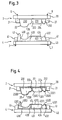
- the second embodiment according to FIGS. 3 and 4 differs by the fact that the molded body 22, 42 with the shape Surfaces 25, 45 are not designed as massive blocks, but of three sections 230, 231, 232 and 430, 431, 432 are formed. Each on the outside of the molded body 230, 232 and 430, 432 are again the inclined surfaces 28 or 48 for mounting by means of the inclined surfaces 23, 43 of the Last 21, 41 provided.
- each molded body 22, 42 are at their parting lines 233, 234; 433, 434 either glued using an adhesive that is so soft in the warmth is that a detachment of the sections of the molded body from each other is possible, or at the parting lines 233, 234; 433, 434 adjacent sides are perfectly smooth to each other trained, for example by grinding or lapping, so that the sections after joining them at their parting lines 233, 234 and 433, 434 by the natural cohesive forces stick together.
- the sections are 230, 231, 232 of the molded body 22 or the sections 430, 431, 432 of the molded body 42 as a hollow cast body with an outer skin 2300, 2310, 2320 or 4300, 4310, 4320 made of silicon infiltrated silicon carbide material and a filling 2301, 2311, 2321 or 4301, 4311, 4321 constructed from a filling material.
- the sections adhere to the Parting lines 233, 234 and 433, 434 to each other by gluing or due to the fact that the Surfaces generated cohesive forces.
- the strips can surround the moldings 22, 42 on all sides.
- the shaped bodies 22, 42 can have open pores with such a pore size and such a pore shape that A fluid such as air or water from the mold cavity through the pores can be sucked out. You can do this in the Steel plates 20, 40 corresponding extraction channels (not shown) are provided, which are connected to a vacuum source can be (not shown).
Landscapes
- Engineering & Computer Science (AREA)
- Ceramic Engineering (AREA)
- Manufacturing & Machinery (AREA)
- Chemical & Material Sciences (AREA)
- Mechanical Engineering (AREA)
- Press-Shaping Or Shaping Using Conveyers (AREA)
- Moulds, Cores, Or Mandrels (AREA)
- Injection Moulding Of Plastics Or The Like (AREA)
- Mounting, Exchange, And Manufacturing Of Dies (AREA)
Abstract
Description
- Fig. 1
- eine Preßform gemäß einer ersten Ausführung der Erfindung mit je einem massiven Formkörper aus siliziumimfiltrierten SiC-Material für eine Oberform und eine Unterform;
- Fig. 2
- eine Variante mit je einem mittels eines Füllmaterials ausgefüllten Hohlgußkörper als Formkörper aus siliziuminfiltrierten SiC-Material;
- Fig. 3
- eine zweite Ausführung einer Preßform gemäß der Erfindung, bei der die Formkörper von Oberform und Unterform aus Teilstücken aus dem siliziuminfiltrierten SiC-Material zusammengesetzt sind, und
- Fig. 4
- eine Variante der Fig. 3, bei der die Teilstücke jeweils aus mit einem Füllmaterial ausgefüllten Hohlgußkörpern bestehen.
Claims (14)
- Preßform, insbesondere zur Verpressung von Dachziegeln, mit einer Oberform und einer Unterform, dadurch gekennzeichnet, daß die formgebenden Flächen der Oberform und der Unterform aus siliziuminfiltriertem Siliziumkarbid (SiSiC) bestehen.
- Preßform nach Anspruch 1, dadurch gekennzeichnet, daß die Siliziuminfiltration in das Siliziumkarbid im Sinne einer Optimierung der elektrischen Leitfähigkeit des formgebenden Materials gesteuert ist.
- Preßform nach einem der Ansprüche 1 oder 2, dadurch gekennzeichnet, daß jeweils für die Oberform und/oder die Unterform die formgebenden Flächen an der dem Formhohlraum zugewandten Vorderseite eines einheitlichen Blockes aus dem siliziuminfiltrierten Siliziumkarbid ausgebildet sind.
- Preßform nach einem der Ansprüche 1 bis 3, dadurch gekennzeichnet, daß jeweils für die Oberform und/oder die Unterform die formgebenden Flächen an den dem Formhohlraum zugewandten Vorderseiten von in der betreffenden Form aneinanderfügbaren, einzeln austauschbaren Teilstücken aus dem siliziuminfiltrierten Siliziumkarbid ausgebildet sind.
- Preßform nach Anspruch 3, dadurch gekennzeichnet, daß zwischen der Rückseite des Blockes und der Trägerplatte eine plastisch oder elastisch verformbare Zwischenschicht angeordnet ist.
- Preßform nach Anspruch 5, dadurch gekennzeichnet, daß die Zwischenschicht eine Kunststoffolie, insbesondere eine Teflonfolie einer Dicke zwischen 1 und 2 mm, vorzugsweise 1,4 mm, ist.
- Preßform nach einem der Ansprüche 3 bis 6, dadurch gekennzeichnet, daß die Seiten des Blockes oder der äußeren Teilstücke schwalbenschwanzförmig divergieren, und daß mit entsprechend angeschrägten Seiten versehene Leisten beidseitig des Blockes bzw. der äußeren Teilstücke an der Trägerplatte befestigt sind.
- Preßform nach einem der Ansprüche 3 bis 7, dadurch gekennzeichnet, daß der Block oder die Teilstücke im Hohlguß als Hohlkörper ausgeführt sind.
- Preßform nach Anspruch 8, dadurch gekennzeichnet, daß die Hohlräume der Hohlkörper mittels eines formstabilen Materials aufgefüllt sind.
- Preßform nach Anspruch 9, dadurch gekennzeichnet, daß das formstabile Material als Trägermasse für eine Widerstandsheizung dient.
- Preßform nach einem der Ansprüche 1 bis 10, dadurch gekennzeichnet, daß wesentliche Bereiche der formgebenden Flächen angerauht sind.
- Preßform nach einem der Ansprüche 1 bis 11, dadurch gekennzeichnet, daß das siliziuminfiltrierte Siliziumkarbid-Material der formgebenden Flächen eine den jeweiligen Tonfeuchten angepaßte Porosität aufweist.
- Preßform nach Anspruch 12, dadurch gekennzeichnet, daß die Porosität zwischen 0 und 60 %, jedoch bei Verwendung von Ausfallkörnungen bis 80 % beträgt, wobei die Porosität im wesentlichen durch die verbleibende Festigkeit der Matrix beschränkt ist.
- Preßform nach Anspruch 13, dadurch gekennzeichnet, daß die Poren des siliziuminfiltrierten Siliziumkarbid-Materials des Blockes bzw. der Teilstücke der Oberform und/oder der Unterform offen sind, so daß sie von einem Fluid, wie Luft und/oder Wasser, durchströmbar sind.
Applications Claiming Priority (2)
| Application Number | Priority Date | Filing Date | Title |
|---|---|---|---|
| DE19744862A DE19744862C2 (de) | 1997-10-10 | 1997-10-10 | Preßform, insbesondere zur Verpressung von Dachziegeln |
| DE19744862 | 1997-10-10 |
Publications (3)
| Publication Number | Publication Date |
|---|---|
| EP0919344A2 true EP0919344A2 (de) | 1999-06-02 |
| EP0919344A3 EP0919344A3 (de) | 2000-06-21 |
| EP0919344B1 EP0919344B1 (de) | 2003-05-21 |
Family
ID=7845195
Family Applications (1)
| Application Number | Title | Priority Date | Filing Date |
|---|---|---|---|
| EP98117268A Expired - Lifetime EP0919344B1 (de) | 1997-10-10 | 1998-09-11 | Pressform, insbesondere zur Verpressung von Dachziegeln |
Country Status (3)
| Country | Link |
|---|---|
| EP (1) | EP0919344B1 (de) |
| AT (1) | ATE240823T1 (de) |
| DE (2) | DE19744862C2 (de) |
Cited By (1)
| Publication number | Priority date | Publication date | Assignee | Title |
|---|---|---|---|---|
| DE102005007909A1 (de) * | 2005-02-08 | 2006-08-10 | Rennebeck, Klaus, Dr. | Vorrichtung zur Herstellung von Formteilen aus Keramik |
Families Citing this family (2)
| Publication number | Priority date | Publication date | Assignee | Title |
|---|---|---|---|---|
| DE102011106218B3 (de) * | 2011-06-07 | 2012-10-04 | Etex Holding GmbH | Tondachziegel-Nasspressform und Verfahren zur Herstellung einer Form für das Herstellen von Tondachziegeln durch Nasspressung |
| EP3486056A1 (de) * | 2017-11-16 | 2019-05-22 | HÄNDLE GmbH Maschinen und Anlagenbau | Dachziegelpresse, oberform und zwischenplatte |
Family Cites Families (8)
| Publication number | Priority date | Publication date | Assignee | Title |
|---|---|---|---|---|
| FR1147425A (fr) * | 1955-09-12 | 1957-11-25 | Procédé pour faciliter le démoulage d'objets en argile, et installation pour sa mise en oeuvre | |
| DE1584662B1 (de) * | 1966-01-24 | 1970-01-15 | Rieter Werke Haendle | Presswerkzeug aus Metall zur Herstellung von Presslingen aus plastischen keramischen Massen |
| DE1925936A1 (de) * | 1969-05-21 | 1970-11-26 | Klaus Kirner | Pressform zum Herstellen grobkeramischer Erzeugnisse und Verfahren zu ihrer Herstellung |
| DE2426369C3 (de) * | 1974-05-31 | 1978-12-14 | Martin 8904 Friedberg Pehl | Preßform für Dachziegel mit auswechselbarer Ziegelbildeinlage aus Gips und Vorrichtung zum Vorfertigen von Ziegelbildeinlagen |
| DE2837900C3 (de) * | 1978-08-30 | 1981-07-30 | Norton Co., Worcester, Mass. | Verfahren zur Herstellung von Siliciumcarbidformkörpern |
| JPH064502B2 (ja) * | 1988-12-23 | 1994-01-19 | 日本碍子株式会社 | セラミックスの製造方法 |
| DE4131215C2 (de) * | 1991-08-02 | 1996-02-08 | Olaf Fischer | Verwendung von gießfähigem siliciuminfiltrierten Siliciumcarbid zur Herstellung einer Form zur Erzeugung von Glasartikeln |
| WO1998043793A1 (de) * | 1997-03-27 | 1998-10-08 | Rieter-Werke Händle GmbH & Co. KG | Form zum pressen von formkörpern aus plastischen massen |
-
1997
- 1997-10-10 DE DE19744862A patent/DE19744862C2/de not_active Expired - Fee Related
-
1998
- 1998-09-11 EP EP98117268A patent/EP0919344B1/de not_active Expired - Lifetime
- 1998-09-11 DE DE59808433T patent/DE59808433D1/de not_active Expired - Fee Related
- 1998-09-11 AT AT98117268T patent/ATE240823T1/de not_active IP Right Cessation
Cited By (1)
| Publication number | Priority date | Publication date | Assignee | Title |
|---|---|---|---|---|
| DE102005007909A1 (de) * | 2005-02-08 | 2006-08-10 | Rennebeck, Klaus, Dr. | Vorrichtung zur Herstellung von Formteilen aus Keramik |
Also Published As
| Publication number | Publication date |
|---|---|
| DE19744862C2 (de) | 2001-05-23 |
| DE59808433D1 (de) | 2003-06-26 |
| DE19744862A1 (de) | 1999-05-06 |
| EP0919344B1 (de) | 2003-05-21 |
| ATE240823T1 (de) | 2003-06-15 |
| EP0919344A3 (de) | 2000-06-21 |
Similar Documents
| Publication | Publication Date | Title |
|---|---|---|
| DE69509788T2 (de) | Schleifwerkzeug, zum schneiden od. dgl. und herstellungsverfahren dieses werkzeuges | |
| DE69516863T2 (de) | Verfahren zum herstellen von pulver-vorformlingen und davon hergestellte schleifartikel | |
| DE2930186C2 (de) | Förderbandtreibwalze | |
| DE3705658C2 (de) | ||
| DE10066044A1 (de) | Verfahren zum Herstellen eines Reibkörpers aus siliziumfiltriertem, Kohlenstofffaser verstärktem porösen Kohlenstoff, hieraus gewonnener Reibkörper und Verwendung eines solchen Reibkörpers | |
| DE19834571A1 (de) | Verfahren zur Herstellung von Körpern aus faserverstärkten Verbundwerkstoffen | |
| EP1640633B1 (de) | Verfahren zur Herstellung von Carbon-Keramik-Bremsscheiben | |
| DE2516731B2 (de) | Scheibenförmiges Läppwerkzeug | |
| WO2009036830A2 (de) | Bremsklotz für schienenfahrzeuge | |
| EP0919344B1 (de) | Pressform, insbesondere zur Verpressung von Dachziegeln | |
| EP1876158B1 (de) | Verfahren zur Herstellung von Carbidkeramik-Bauteilen | |
| EP1599682B1 (de) | Belagträgerplatte und verfahren zu deren herstellung | |
| EP0234360A1 (de) | Giessform zur Erstellung von Keramikkörpern | |
| EP1369403B1 (de) | Verfahren zur Herstellung eines tribologisch über eine Funktionsoberfläche beanspruchten Bauteils | |
| DE3615127C2 (de) | ||
| EP2147748B1 (de) | Wetzstab und Verfahren zu dessen Herstellung | |
| DE3843379C2 (de) | ||
| ATE139174T1 (de) | Verfahren zur herstellung eines metallischen werkstoffes und werkstoff, der nach dem verfahren hergestellt ist | |
| DE19847087C1 (de) | Verfahren zum Herstellen einer Preßform, insbesondere zum Erzeugen von Dachziegeln, und Preßform | |
| DE3931277A1 (de) | Schleifteller zur bearbeitung von gestein oder aehnlichen werkstoffen und verfahren zu seiner herstellung | |
| EP1355757B1 (de) | Honschleifwerkzeug mit schleifmittel und bindemittel | |
| DE3724106A1 (de) | Verfahren zum herstellen einer planschleifscheibe sowie nach diesem verfahren hergestellte planschleifscheibe zum bearbeiten von hartstoffen | |
| DE102007024430A1 (de) | Verfahren zur Herstellung eines Kernkörpers für einen Reibkörper einer innen belüfteten faserverstärkten Bremsscheibe und Reibkörper | |
| AT507931B1 (de) | Schleifwerkzeug | |
| DE146289C (de) |
Legal Events
| Date | Code | Title | Description |
|---|---|---|---|
| PUAI | Public reference made under article 153(3) epc to a published international application that has entered the european phase |
Free format text: ORIGINAL CODE: 0009012 |
|
| AK | Designated contracting states |
Kind code of ref document: A2 Designated state(s): AT BE CH DE DK ES FR GB GR IT LI NL PT |
|
| AX | Request for extension of the european patent |
Free format text: AL;LT;LV;MK;RO;SI |
|
| PUAL | Search report despatched |
Free format text: ORIGINAL CODE: 0009013 |
|
| AK | Designated contracting states |
Kind code of ref document: A3 Designated state(s): AT BE CH CY DE DK ES FI FR GB GR IE IT LI LU MC NL PT SE |
|
| AX | Request for extension of the european patent |
Free format text: AL;LT;LV;MK;RO;SI |
|
| 17P | Request for examination filed |
Effective date: 20001127 |
|
| AKX | Designation fees paid |
Free format text: AT BE CH DE DK ES FR GB GR IT LI NL PT |
|
| RAP1 | Party data changed (applicant data changed or rights of an application transferred) |
Owner name: RIETER-WERKE GMBH |
|
| GRAH | Despatch of communication of intention to grant a patent |
Free format text: ORIGINAL CODE: EPIDOS IGRA |
|
| GRAH | Despatch of communication of intention to grant a patent |
Free format text: ORIGINAL CODE: EPIDOS IGRA |
|
| GRAA | (expected) grant |
Free format text: ORIGINAL CODE: 0009210 |
|
| AK | Designated contracting states |
Designated state(s): AT BE CH DE DK ES FR GB GR IT LI NL PT |
|
| PG25 | Lapsed in a contracting state [announced via postgrant information from national office to epo] |
Ref country code: IT Free format text: LAPSE BECAUSE OF FAILURE TO SUBMIT A TRANSLATION OF THE DESCRIPTION OR TO PAY THE FEE WITHIN THE PRESCRIBED TIME-LIMIT;WARNING: LAPSES OF ITALIAN PATENTS WITH EFFECTIVE DATE BEFORE 2007 MAY HAVE OCCURRED AT ANY TIME BEFORE 2007. THE CORRECT EFFECTIVE DATE MAY BE DIFFERENT FROM THE ONE RECORDED. Effective date: 20030521 Ref country code: GB Free format text: LAPSE BECAUSE OF FAILURE TO SUBMIT A TRANSLATION OF THE DESCRIPTION OR TO PAY THE FEE WITHIN THE PRESCRIBED TIME-LIMIT Effective date: 20030521 |
|
| REG | Reference to a national code |
Ref country code: GB Ref legal event code: FG4D Free format text: NOT ENGLISH |
|
| REG | Reference to a national code |
Ref country code: CH Ref legal event code: EP |
|
| REF | Corresponds to: |
Ref document number: 59808433 Country of ref document: DE Date of ref document: 20030626 Kind code of ref document: P |
|
| PG25 | Lapsed in a contracting state [announced via postgrant information from national office to epo] |
Ref country code: PT Free format text: LAPSE BECAUSE OF FAILURE TO SUBMIT A TRANSLATION OF THE DESCRIPTION OR TO PAY THE FEE WITHIN THE PRESCRIBED TIME-LIMIT Effective date: 20030821 Ref country code: GR Free format text: LAPSE BECAUSE OF FAILURE TO SUBMIT A TRANSLATION OF THE DESCRIPTION OR TO PAY THE FEE WITHIN THE PRESCRIBED TIME-LIMIT Effective date: 20030821 Ref country code: DK Free format text: LAPSE BECAUSE OF FAILURE TO SUBMIT A TRANSLATION OF THE DESCRIPTION OR TO PAY THE FEE WITHIN THE PRESCRIBED TIME-LIMIT Effective date: 20030821 |
|
| PG25 | Lapsed in a contracting state [announced via postgrant information from national office to epo] |
Ref country code: ES Free format text: LAPSE BECAUSE OF FAILURE TO SUBMIT A TRANSLATION OF THE DESCRIPTION OR TO PAY THE FEE WITHIN THE PRESCRIBED TIME-LIMIT Effective date: 20030901 |
|
| PGFP | Annual fee paid to national office [announced via postgrant information from national office to epo] |
Ref country code: FR Payment date: 20030909 Year of fee payment: 6 |
|
| PG25 | Lapsed in a contracting state [announced via postgrant information from national office to epo] |
Ref country code: AT Free format text: LAPSE BECAUSE OF NON-PAYMENT OF DUE FEES Effective date: 20030911 |
|
| PGFP | Annual fee paid to national office [announced via postgrant information from national office to epo] |
Ref country code: NL Payment date: 20030922 Year of fee payment: 6 |
|
| PG25 | Lapsed in a contracting state [announced via postgrant information from national office to epo] |
Ref country code: LI Free format text: LAPSE BECAUSE OF NON-PAYMENT OF DUE FEES Effective date: 20030930 Ref country code: CH Free format text: LAPSE BECAUSE OF NON-PAYMENT OF DUE FEES Effective date: 20030930 Ref country code: BE Free format text: LAPSE BECAUSE OF NON-PAYMENT OF DUE FEES Effective date: 20030930 |
|
| PGFP | Annual fee paid to national office [announced via postgrant information from national office to epo] |
Ref country code: DE Payment date: 20030930 Year of fee payment: 6 |
|
| GBV | Gb: ep patent (uk) treated as always having been void in accordance with gb section 77(7)/1977 [no translation filed] |
Effective date: 20030521 |
|
| PLBE | No opposition filed within time limit |
Free format text: ORIGINAL CODE: 0009261 |
|
| STAA | Information on the status of an ep patent application or granted ep patent |
Free format text: STATUS: NO OPPOSITION FILED WITHIN TIME LIMIT |
|
| BERE | Be: lapsed |
Owner name: *RIETER-WERKE G.M.B.H. Effective date: 20030930 |
|
| ET | Fr: translation filed | ||
| 26N | No opposition filed |
Effective date: 20040224 |
|
| REG | Reference to a national code |
Ref country code: CH Ref legal event code: PL |
|
| PG25 | Lapsed in a contracting state [announced via postgrant information from national office to epo] |
Ref country code: NL Free format text: LAPSE BECAUSE OF NON-PAYMENT OF DUE FEES Effective date: 20050401 Ref country code: DE Free format text: LAPSE BECAUSE OF NON-PAYMENT OF DUE FEES Effective date: 20050401 |
|
| PG25 | Lapsed in a contracting state [announced via postgrant information from national office to epo] |
Ref country code: FR Free format text: LAPSE BECAUSE OF NON-PAYMENT OF DUE FEES Effective date: 20050531 |
|
| NLV4 | Nl: lapsed or anulled due to non-payment of the annual fee |
Effective date: 20050401 |
|
| REG | Reference to a national code |
Ref country code: FR Ref legal event code: ST |