EP0919533A1 - Electrosynthèse de quinones aromatiques - Google Patents
Electrosynthèse de quinones aromatiques Download PDFInfo
- Publication number
- EP0919533A1 EP0919533A1 EP98402852A EP98402852A EP0919533A1 EP 0919533 A1 EP0919533 A1 EP 0919533A1 EP 98402852 A EP98402852 A EP 98402852A EP 98402852 A EP98402852 A EP 98402852A EP 0919533 A1 EP0919533 A1 EP 0919533A1
- Authority
- EP
- European Patent Office
- Prior art keywords
- aromatic
- process according
- organic solvent
- solution
- alkanes
- Prior art date
- Legal status (The legal status is an assumption and is not a legal conclusion. Google has not performed a legal analysis and makes no representation as to the accuracy of the status listed.)
- Ceased
Links
Images

Classifications
-
- C—CHEMISTRY; METALLURGY
- C07—ORGANIC CHEMISTRY
- C07C—ACYCLIC OR CARBOCYCLIC COMPOUNDS
- C07C45/00—Preparation of compounds having >C = O groups bound only to carbon or hydrogen atoms; Preparation of chelates of such compounds
- C07C45/27—Preparation of compounds having >C = O groups bound only to carbon or hydrogen atoms; Preparation of chelates of such compounds by oxidation
- C07C45/28—Preparation of compounds having >C = O groups bound only to carbon or hydrogen atoms; Preparation of chelates of such compounds by oxidation of CHx-moieties
-
- C—CHEMISTRY; METALLURGY
- C07—ORGANIC CHEMISTRY
- C07C—ACYCLIC OR CARBOCYCLIC COMPOUNDS
- C07C201/00—Preparation of esters of nitric or nitrous acid or of compounds containing nitro or nitroso groups bound to a carbon skeleton
- C07C201/06—Preparation of nitro compounds
- C07C201/12—Preparation of nitro compounds by reactions not involving the formation of nitro groups
-
- C—CHEMISTRY; METALLURGY
- C07—ORGANIC CHEMISTRY
- C07C—ACYCLIC OR CARBOCYCLIC COMPOUNDS
- C07C201/00—Preparation of esters of nitric or nitrous acid or of compounds containing nitro or nitroso groups bound to a carbon skeleton
- C07C201/06—Preparation of nitro compounds
- C07C201/16—Separation; Purification; Stabilisation; Use of additives
-
- C—CHEMISTRY; METALLURGY
- C07—ORGANIC CHEMISTRY
- C07C—ACYCLIC OR CARBOCYCLIC COMPOUNDS
- C07C46/00—Preparation of quinones
- C07C46/02—Preparation of quinones by oxidation giving rise to quinoid structures
- C07C46/04—Preparation of quinones by oxidation giving rise to quinoid structures of unsubstituted ring carbon atoms in six-membered aromatic rings
Definitions
- the invention relates to a process for oxidizing alkyl and aromatic compounds using ceric ions. More specifically, the invention relates to the indirect electrosynthesis of carbonyl containing compounds using ceric ions for the oxidation of alkyl and aromatic compounds, the latter being in solution in a C 5 to C 15 alkanes and wherein the concentration of reagent in the solvent is critical so as to provide purer carbonyl compounds and less by-products, and substantially improved chemical yields.
- Prior art of interest also includes United States Patent No. 3,873,580, British patents GB 1 360 904, 1 203 434 and 1 192 037, all issued to R. A. C. Rennie, and a two-part article authored by D. Pletcher and E. Valdes entitled “Studies of the Ce(III)/Ce(IV) Couple in Multiphase Systems Containing a Phase Transfer Reagent” published in Electrochemica Acta, vol. 334, no. 4. pages 499-515 (1987).
- Each patent generally teaches the oxidation of aromatic hydrocarbons by an aqueous acidic solution of an oxidizing agent, where the aromatic hydrocarbon is dissolved in an organic solvent.
- Suitable organic solvents identified are chlorinated hydrocarbons, petroleum solvents and aliphatic, particularly C 5 -C 15 hydrocarbons, including hexane.
- Each patent also recognizes that the processes may be batchwise or continuous.
- U.S. 3,873,580 and GB 1 360 904 teach the use of hexane as the organic solvent for the dissolution of various aromatic hydrocarbons, including naphthalene (0.1 M ), diphenyl (0.1 M ), anthracene (0.1 M ) and toluene (0.2 M ).
- the oxidizing agent is persulfate anion, which is electrolytically regenerated from sulfate ion in a separate cell.
- Cerium when present at about 0.01 to 1 mole/mole organic substrate, appears to be a catalyst to the oxidation. Oxidation preferably occurs in the presence of a co-catalyst such as silver or iron.
- GB 1 203 434 teaches oxidation by ceric ion of 2,6-di-t-butylphenol dissolved in hexane to form a 0.05 M organic phase. Yield of 2,2',6,6'-tetrabutyldiphenoquinone was "substantially quantitative". This patent also teaches that after the desired time for the oxidation, carbonyl-containing products were in the liquid phase. Desired products were obtained from the liquid phase by evaporative or crystallization techniques.
- GB 1 192 037 teaches the dissolution of diphenyl in hexane to form a 0.19 M solution. Ceric ion was the oxidizing agent. A 70% yield of 2-phenylquinone was obtained. This patent teaches that quinones were obtained from the liquid phase by evaporative or crystallization techniques.
- Part 1 of the Pletcher et al. article teaches electrochemical regeneration of ceric ion in an undivided cell in which the electrolyte was an emulsion of an aqueous acidic phase and an organic solvent such as toluene, methylene chloride and hexane. Tributylphosphate or tetrabutylammonium ions were the interphase transfer agents.
- the second part of the article teaches indirect cerium-mediated oxidation of a 0.03 M solution of anthracene in n-heptane where the aqueous phase contains nitric acid.
- the solvent is cyclohexane while the concentration of nitronaphthalene in cyclohexane is from about 0.02 to about 1.0 molar, most preferably about 0.4.
- the reactant can be methyl-naphthane and the solvent is n-decane, with a methyl-naphthane concentration of about 0.05 to 3.0 molar.
- the solvent is preferably n-heptane, and the concentration of naphthalene is from about 0.02 to about 1.1 molar.
- the invention relates to a process for producing aromatic aldehydes, ketones and quinones, comprising the steps of:
- the invention relates to a process for producing aromatic quinones, aldehydes or ketones from aromatic or alkyl aromatic compounds, comprising the steps of:
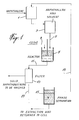
- naphthalene is supplied to a reservoir 1 which feeds into a container 3 containing an organic solvent to provide a mixture of naphthalene and solvent such as n-heptane.
- the mixture is fed via duct 5 into reactor 7 which separately receives via duct 9 ceric ions such as in the form of an acidic solution of ceric methanesulphonate.
- the reaction is allowed to take place and the reaction mixture is fed via duct 11 to a filter 13 which separates naphthoquinone from the solvent and unreacted naphthalene and the solvent are sent to a phase separationunit 15 via duct 17 and the remains are recycled to reservoir 1 via duct 19.
- the solvent and unreacted naphthalene is sent to a solvent stage 20 before returning to step 7 via line 21.
- Such processes could include distillation, crystallization, evaporation or other similar technique
- Naphthalene dissolved in n-heptane (concentrations range is 0.02 to 0.8 M) is reacted with an acidic solution (2.5 to 4.0. M) of ceric methanesulfonate (0.4 to 0.8 M) at 60 °C.
- the product, naphthoquinone is produced in sufficient concentration (the saturation point of naphthoquinone in such solvents is around 0.02M) that it can be separated as a solid by filtering or by centrifugation from the organic phase while the aqueous phase contains cerous methanesulfonate and methanesulfonic acid.
- the unreacted naphthalene remains in the n-heptane and can then be recycled back to the naphthalene preparation reservoir after phase separation.
- the reacting phases are allowed to settle and the cerous solution is returned to an electrochemical cell.
- the presence of solids in the reactor reduce the reaction time as a continuous process from over 50 minutes to less than 5 minutes. The conversion and yield are greater and the overall process economics measured by energy consumption are lower. The results of the continuous process are shown in Table 1.
- Cerous methanesulfonate in methanesulfonic acid is fed to the anode compartment of an electrochemical cell where it is oxidized back to ceric methanesulfonate and returned to stage 1.
- Molten 1-nitronaphthalene is mixed continuously with cyclohexane at the rate of 2.4 kg/h and 12 kg/h respectively and fed into an agitated vessel.
- a ceric solution (0.6 M) in methanesulfonic acid solution is fed at a rate of 300 litres per hour into the same reactor vessel.
- the mean residence time being 6 minutes.
- the product nitronaphthoquinone is separated from the two liquid phases by filtration.
- the liquid phases are fed into a decanter where the lighter cyclohexane phase containing any unreacted nitronaphthalene is siphoned off and returned to the solution make-up for further mixing with fresh nitronaphthalene.
- the heavier acid phase is returned to the cell after electrolyte purification.
- the conversion of nitronaphthalene is 90% and the chemical yield is 85%.
- the concentration is much greater than those used by Pletcher and Rennie.
- the fact that applicant uses higher concentrations result in a different method of product recovery.
Landscapes
- Chemical & Material Sciences (AREA)
- Organic Chemistry (AREA)
- Chemical Kinetics & Catalysis (AREA)
- Organic Low-Molecular-Weight Compounds And Preparation Thereof (AREA)
- Electrolytic Production Of Non-Metals, Compounds, Apparatuses Therefor (AREA)
Applications Claiming Priority (2)
| Application Number | Priority Date | Filing Date | Title |
|---|---|---|---|
| US97851897A | 1997-11-25 | 1997-11-25 | |
| US978518 | 1997-11-25 |
Publications (1)
| Publication Number | Publication Date |
|---|---|
| EP0919533A1 true EP0919533A1 (fr) | 1999-06-02 |
Family
ID=25526170
Family Applications (1)
| Application Number | Title | Priority Date | Filing Date |
|---|---|---|---|
| EP98402852A Ceased EP0919533A1 (fr) | 1997-11-25 | 1998-11-17 | Electrosynthèse de quinones aromatiques |
Country Status (3)
| Country | Link |
|---|---|
| EP (1) | EP0919533A1 (fr) |
| JP (1) | JPH11246463A (fr) |
| CA (1) | CA2254154A1 (fr) |
Cited By (2)
| Publication number | Priority date | Publication date | Assignee | Title |
|---|---|---|---|---|
| CN111892490A (zh) * | 2020-06-18 | 2020-11-06 | 兄弟科技股份有限公司 | Ce4+作氧化剂制备β-甲萘醌及其衍生物亚硫酸氢钠甲萘醌的方法 |
| CN117534555A (zh) * | 2024-01-05 | 2024-02-09 | 潍坊通润化工有限公司 | 一种烷基对苯醌的合成方法 |
Citations (5)
| Publication number | Priority date | Publication date | Assignee | Title |
|---|---|---|---|---|
| EP0075828A1 (fr) * | 1981-09-28 | 1983-04-06 | Diamond Shamrock Corporation | Oxydation de composés cycliques condensés à quinones par solutions aqueuses d'acides |
| US4632782A (en) * | 1983-05-26 | 1986-12-30 | Kawasaki Kasei Chemicals Limited | Oxidizing an organic compound |
| EP0244812A1 (fr) * | 1986-05-05 | 1987-11-11 | W.R. Grace & Co.-Conn. | Oxydation de composés organiques |
| JPS63190850A (ja) * | 1987-02-03 | 1988-08-08 | Nippon Shokubai Kagaku Kogyo Co Ltd | 1,4,4a,9a−テトラヒドロアントラキノンの製造法 |
| WO1993018208A1 (fr) * | 1992-03-04 | 1993-09-16 | Hydro-Quebec | Electrosynthese indirecte utilisant le cerium |
-
1998
- 1998-11-13 CA CA002254154A patent/CA2254154A1/fr not_active Abandoned
- 1998-11-17 EP EP98402852A patent/EP0919533A1/fr not_active Ceased
- 1998-11-25 JP JP10334715A patent/JPH11246463A/ja active Pending
Patent Citations (5)
| Publication number | Priority date | Publication date | Assignee | Title |
|---|---|---|---|---|
| EP0075828A1 (fr) * | 1981-09-28 | 1983-04-06 | Diamond Shamrock Corporation | Oxydation de composés cycliques condensés à quinones par solutions aqueuses d'acides |
| US4632782A (en) * | 1983-05-26 | 1986-12-30 | Kawasaki Kasei Chemicals Limited | Oxidizing an organic compound |
| EP0244812A1 (fr) * | 1986-05-05 | 1987-11-11 | W.R. Grace & Co.-Conn. | Oxydation de composés organiques |
| JPS63190850A (ja) * | 1987-02-03 | 1988-08-08 | Nippon Shokubai Kagaku Kogyo Co Ltd | 1,4,4a,9a−テトラヒドロアントラキノンの製造法 |
| WO1993018208A1 (fr) * | 1992-03-04 | 1993-09-16 | Hydro-Quebec | Electrosynthese indirecte utilisant le cerium |
Non-Patent Citations (1)
| Title |
|---|
| DATABASE WPI Section Ch Week 8837, Derwent World Patents Index; Class E14, AN 88-261574, XP002095613 * |
Cited By (3)
| Publication number | Priority date | Publication date | Assignee | Title |
|---|---|---|---|---|
| CN111892490A (zh) * | 2020-06-18 | 2020-11-06 | 兄弟科技股份有限公司 | Ce4+作氧化剂制备β-甲萘醌及其衍生物亚硫酸氢钠甲萘醌的方法 |
| CN117534555A (zh) * | 2024-01-05 | 2024-02-09 | 潍坊通润化工有限公司 | 一种烷基对苯醌的合成方法 |
| CN117534555B (zh) * | 2024-01-05 | 2024-04-02 | 潍坊通润化工有限公司 | 一种烷基对苯醌的合成方法 |
Also Published As
| Publication number | Publication date |
|---|---|
| CA2254154A1 (fr) | 1999-05-25 |
| JPH11246463A (ja) | 1999-09-14 |
Similar Documents
| Publication | Publication Date | Title |
|---|---|---|
| US3745180A (en) | Oxidation of organic materials | |
| US3873580A (en) | Oxidation Process | |
| AU665614B2 (en) | Indirect cerium mediated electrosynthesis | |
| FI80256B (fi) | Foerfarande foer oxidering av en organisk foerening. | |
| US4670108A (en) | Oxidation of organic compounds using ceric methanesulfonate in an aqueous organic solution | |
| EP0075828A1 (fr) | Oxydation de composés cycliques condensés à quinones par solutions aqueuses d'acides | |
| US4536337A (en) | Process for the preparation of quinones | |
| CA2254154A1 (fr) | Electrosynthese de quinones aromatisees | |
| US4794172A (en) | Ceric oxidant | |
| US3471254A (en) | Oxidation of soluble sulfides | |
| DE69103913T2 (de) | Verfahren zur Herstellung von Dodekandicarbonsäure. | |
| US5811598A (en) | Process for the recovery of phenol from an aqueous stream containing NA.sub. SO4 | |
| CN85100335A (zh) | 萘液相氧化制1,4-萘醌的方法 | |
| US3711539A (en) | Nonsolvent air oxidation of p-xylene | |
| EP0168778B1 (fr) | Procédé pour la production d'acides polyalkylaromatiques polysulfoniques et pour leur récupération par séparation de la phase lourde | |
| DE68921224T2 (de) | Verfahren zur wiedergewinnung von katalysatorwerten. | |
| EP0475687B1 (fr) | Procédé catalytique pour la production de sec-butylbenzène | |
| US5705049A (en) | Indirect cerium mediated electrosynthesis | |
| JPH0791211B2 (ja) | カルボン酸の製造方法 | |
| US4945183A (en) | Process for the preparation of 4-phenylquinol | |
| JPS63270635A (ja) | 1,4−ナフトキノンの製造法 | |
| US6180834B1 (en) | Process for the extraction of the salts contained in the neutralized separated product obtained in the preparation of phenol by the oxidation of cumene | |
| JPH11171825A (ja) | 塩化ベンゾイルの製造方法 | |
| JPS6176434A (ja) | 第3級カルボン酸の製造方法 | |
| JP3000874B2 (ja) | シクロオレフィンの製造方法 |
Legal Events
| Date | Code | Title | Description |
|---|---|---|---|
| PUAI | Public reference made under article 153(3) epc to a published international application that has entered the european phase |
Free format text: ORIGINAL CODE: 0009012 |
|
| AK | Designated contracting states |
Kind code of ref document: A1 Designated state(s): DE FR GB IT |
|
| AX | Request for extension of the european patent |
Free format text: AL;LT;LV;MK;RO;SI |
|
| 17P | Request for examination filed |
Effective date: 19991007 |
|
| AKX | Designation fees paid |
Free format text: DE FR GB IT |
|
| GRAG | Despatch of communication of intention to grant |
Free format text: ORIGINAL CODE: EPIDOS AGRA |
|
| 17Q | First examination report despatched |
Effective date: 20010104 |
|
| STAA | Information on the status of an ep patent application or granted ep patent |
Free format text: STATUS: THE APPLICATION HAS BEEN REFUSED |
|
| 18R | Application refused |
Effective date: 20010705 |